#point-set-topology
1 messages · Page 192 of 1


 dusk heron
Given a one-form $\xi$ on an oriented Riemannian $4$-manifold, what is the intuitive meaning of the one-form $\star(\dd{\xi}\wedge\xi)$, where $\dd{}$ is the exterior derivative and $\star$ is the Hodge star?
 gentle ospreyBOT
gustavn64
dusk heron
This is apparently something called the "twist form".
gentle ospreyBOT
slimvesus
 gritty widget
urysohn lemma?
 river granite
yeah sounds quite a bit like that or some separation axiom
gritty widget
ya i think u can urysohn this
river granite
was just looking at it lmao
gritty widget
compact hausdorff spaces satisfy the hypotheses of urysohn's lemma (normal space)
river granite
sounds like you want some kind of bump function in C?
gritty widget
just take {u} to be the closed set 
 tough imp
Are irreducible components disjoint?
I felt like they were, but then when I think about minimal primes I don’t think so anymore lol
 red garden
if X is a T_1 space with atleast two points , show that an open base which contains X as a member remains an open base if X is dropped
my attempt ( i know this is wrong and its bad but i wasnna know why ) :
suppose {B_1,B_2,....B_n,X,.......} is an open base
we wish to show that {B_1,B_2,....B_n,.....} is an open base
so for the sake of contradiction suppose it is not which means there exists x and y such that x and y are not inside B_1,B_2....B_n (it fails to cover it)
but {B_1,B_2,....B_n,X} is an open base
so for both x and y
we know since X is T_1 there exists neighbourhoods for x and y such that one does not contain the other , call them G_x G_y respectively
{B_1,B_2,....B_n,X} is an open base --> x is in B_i for some i which is a subset of G_x and also likewise for y
but x is not in B_i for any i and likewise for y
so B_i must equal X
hence G_x is a subset of G_y or G_y is a subset of G_x
as X is a subset of G_x
contradiction
this sounds like HELLA wrong
but i dont see why
i just feel why
no?
should i?
idk
no
i dont
any open set must be like a subset of X ig so it turns out the neighbourhoods are exactly X hence contradiction
i am sure this is wrong but i just want to know why
gritty widget
ah oops ignore what i said
red garden
@tough imp
 vocal wharf
how did you define base and what gives you two points that are not covered by the B_i @red garden
red garden
idk
i guess i only have one point
base is defined as like
for any x in an open set G there exists a base element B such that x is in B subset of G
@vocal wharf
fuck is this supposed to be hard
vocal wharf
well, you can characterize a base like: covers whole space and for every point in the intersection there is another base element that includes that point and is contained in the intersection
seemed like you were going for this
then the second thing about the intersection thing is easy
so you have to check that your new base covers X
assume it doesnt, get a point that is and one that isnt covered
apply T_1 to solve
red garden
ohhhhhhhhh
one that is covered and one not
yea clever
lmao
ty
got it @vocal wharf
if i assume it doesnt then im only allowd to assume
1 point that is not covered
right? that was the wrong thing
that i assumed existence of two pointst tht are not covered
right?
vocal wharf
i think so
at least i don't see how that follows
and what chmonkey said is correct as well
you should index your base not with natural numbers
 slow tree
Ok I asked in another channel but can someone help me with this problem:
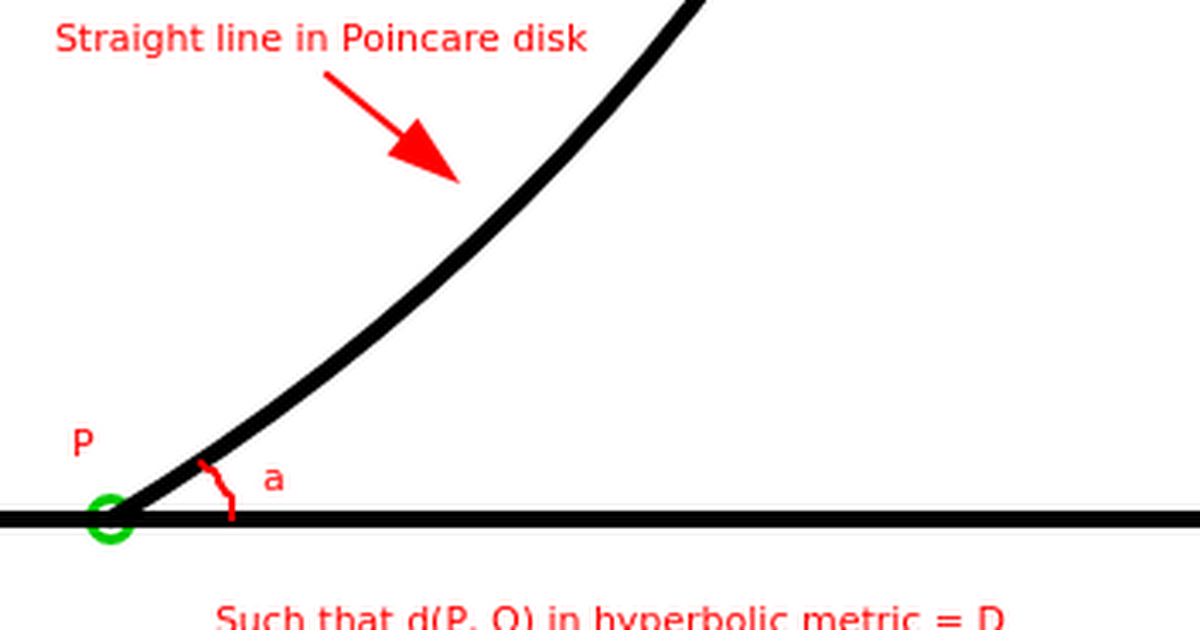
Here's the problem I'm facing: in the Poincare disk, given a point P, an angle a, and a hyperbolic distance D, I want to find the point Q such that the angle between the line from P to Q and the horizontal through P is a and the hyperbolic distance between P and Q is D. See https://drive.google.com/file/d/1uUGQbjNDh04GKZ5PnoCiD2jZR6PnjIcN/view?usp=sharing for an illustration of what I mean. I've been working on this problem for a couple of days but I can't seem to get it right.
One idea I had for doing it is calculating the line first, which will be a circle in euclidean geometry, then the circle of points of distance D around P, which will be another circle in euclidean geometry, and finally calculating the intersections between these two circles in cartesian coordinates. Unfortunately, I can't seem to figure out how to calculate either of these, and I can't find too many accessible resources for this. Can anybody help?
Google Docs
In short, given P, the angle, and the distance in the Poincare disk, I want to find Q
gritty widget
just to make sure I'm not crazy, it's always true that $Y \subseteq Z(T)$ if and only if $T \subseteq I(Y)$ right
gentle ospreyBOT
zd
 sleek thicket
Yeah so $Y \subseteq Z(T)$ iff $I(Z(T)) \subseteq I(T)$. Any element of $T$ vanishes on all of $Z(T)$, so $T \subseteq I(Z(T))$
gentle ospreyBOT
Schamrock
 tight agate
are Y1 and Y2 irreducible
oh wait nvm
this shouldnt be true
take p = 0
and uh
hmm
gritty widget
sorry p is a prime ideal
but I don't see how I can find all elements being products of elements from I(Y1) and I(Y2) in that intersection
tight agate
what are Y1 and Y2
gritty widget
Closed sets in affine space
tight agate
assume p is not equal to I(Y1)
take some element r in I(Y1) that is not in p
for any element s in I(Y2)
rs is in P (as it is in the intersection)
so s is in P (as r is not in P)
so I(Y2) \subset P
and we're done
oh fuck
nvm i screwed up
nah
it works
right @gritty widget ?
tight agate
gritty widget
but I don't see how I can find all elements being products of elements from I(Y1...
the product I(Y1)I(Y2) is contained in the intersection
gritty widget
That is clever but I am just a little confused why rs is in P
Oh is it? ok
hmm lemme think why
tight agate
rs is in I(Y1)
it is also in I(Y2)
I(Y1) is an ideal, so r in I(Y1) implies rs is in I(Y1) for all s
tight agate
I'm stuck on a part of Hartshorne problem 3.2.6
Let X be a noetherian topological space.
Let $U \subset X$ be open. Let $\mathscr{R} \subset i_{!}\mathbf{Z}_U$ be a subsheaf. Then the exercise asks us to prove that $\mathscr{R}$ is finitely generated.
gentle ospreyBOT
Brofibration
tight agate
where i: U ---> X is the inclusion map
I'm struggling to show that even $i_{!}Z_{U}$ is finitely generated
gentle ospreyBOT
Brofibration
tight agate
hmm I might have something
alright I think I'm being stupid
Z_U is just generated by 1 \in Z_U(U) right?
 meager python
What does it mean that a subsheaf is fg?
It is not true that Z_U is finitely generated as an abelian group
Or am I missing something?
 uncut surge
https://math.stackexchange.com/questions/587916/what-is-a-finitely-generated-sheaf this problem has apparently been had and the exercise is not formulated well

Mathematics Stack Exchange
I do exercise asking to show on Noetherian space $X$, any subsheaf $\mathscr{R} \subseteq \Bbb{Z}_U$ is finitely generated. $\Bbb{Z}U$ is sheaf $i{!}(\Bbb{Z}|_U)$ for $U \subseteq X$ open. What ...
 long hornet
If we have two disks and attach one to the other by sending a boundary point (x, y) to (-x, -y), how will the resulting manifold look like?
 sweet wing
long hornet
If we have two disks and attach one to the other by sending a boundary point (x,...
sweet wing
long hornet
If we have two disks and attach one to the other by sending a boundary point (x,...
a S^2?
long hornet
I thought so at first, but I can't visualize it..
Generally, if we have a manifolds-with-boundary, does it matter which homeomorphism of boundary we use?
uncut surge
This sounds like you're just attaching the two disks in the "obvious" way, but one of them is rotated by 180 degrees, since mapping a point x on the boundary to -x is the same as rotating it by 180 degrees around the origin, right?
long hornet
uncut surge
This sounds like you're just attaching the two disks in the "obvious" way, but o...
Oh yeah, I saw it by thinking about two intervals..
uncut surge
So in terms of what manifold you get, it doesn't matter whether you glue (x,y) to (x,y) or (x,y) to (-x,-y), it's just a rotation of one of the disks
long hornet
I get it now
uncut surge
naisu
long hornet
long hornet
Generally, if we have a manifolds-with-boundary, does it matter which homeomorph...
What about this?
uncut surge
@long hornet took me a while to get back to this, but yes, in general, the choice of homeomorphism does matter
The above picture shows you that if you glue two compact intervals to two compact intervals, you can either get two circles or one, depending on how you map the boundary points of the intervals
But a homeomorphism of the circle, I believe, can always be continuously "straightened out" to be either identity or -identity, so with two disks you should never run into problems
long hornet
uncut surge
But a homeomorphism of the circle, I believe, can always be continuously "straig...
Yeah. I think in general if a homeomorphism of the boundary can be extended to the whole manifold (always the case for balls), then it doesn't matter. I am not quite sure about my reasoning, however.
uncut surge
Hm, I'm also not sure about that. I believe in the above example with the compact intervals, you can extend the homeomorphisms on the boundaries to the full manifolds, right?
If the picture makes sense at all lol
long hornet
The arrows are confusing honestly
uncut surge
Hahaha, it's from the wikipedia article about surgery on manifolds which is somewhat related but not quite
But basically, take the manifold with boundary given by the disjoint union of two intervals [0,1] and [0,1]. We want to glue this manifold to another copy of itself. So one copy of this manifold is the two black lines, the other copy is the two red lines
long hornet
Got it
uncut surge
Now, the boundary of this manifold is equal to the four boundary points of the intervals, 0, 0, 1, 1, and depending on how we map the boundary to itself, we can end up with two circles or one circle
long hornet
The boundary in each case is a four-point set
uncut surge
Yup!
Oh, but it's true, you can't always extend the maps
From the boundaries to the manifolds, since that might require you to create a path between a zero of the first interval to the zero of the second interval, for example
long hornet
uncut surge
Oh, but it's true, you can't always extend the maps
Why? I thought you can use 1-x
long hornet
uncut surge
From the boundaries to the manifolds, since that might require you to create a p...
Ohhh..
uncut surge
Denoting the boundary points by $0_A, 1_A, 0_B, 1_B$ depending on wheter we're in interval A or B, your boundary homeomorphism maps $0_A \mapsto 0_A$ and $1_A \mapsto 0_B$, then there is no way to extend this to the whole manifold, since there is no path between $0_A$ and $0_B$
gentle ospreyBOT
Lartomato
uncut surge
So some homeomorphisms of the boundary can be extended, but not all
long hornet
Is it reasonable to expect to know all the cases when this is possible?
uncut surge
Hmm, no idea really. In this simple example, it seems like whenever you end up gluing in a way that gets you two disjoint circles, it's possible, but in general it all may be more tricky
This seems pretty close to this whole surgery theory business, so that may be the right area to look, but I'm an amateur when it comes to this gluing stuff
long hornet
Given a manifold-with-boundary M and boundary B, you can glue two copies of M to get a new manifold (without boundary), by identifying the boundaries of the two copies through a homeomorphism h : B ---> B. The question is whether the choice of h matters.
 marsh forge
but to address larto's remark, a big goal of surgery theory is to talk about how you can do surgery to the interior of a manifold with boundary without damaging the boundary and also preserving other structure
i think if Aut(B)/htpy is nontrivial there should be issues
long hornet
marsh forge
but to address larto's remark, a big goal of surgery theory is to talk about how...
Other structure like what?
marsh forge
It might even be an issue if Aut(B) is nontrivial
Smooth structure for example
Other times you're trying to specifically kill generators in H* or pi*
well, no, this is not necessarily the case actually
Aut(S^1)/htpy is Z/2
but the choice of homeo doesn't matter as long as topology is all you care about
long hornet
marsh forge
It might even be an issue if Aut(B) is nontrivial
Well, sometimes we can always extend an element of Aut B to one of Aut M. This is the case for balls.
marsh forge
otoh if we have some way of differentiating sides of the disk it does matter, like if we are talking about orientation, only one of these two choices should preserve it
like take a disk and give it a clockwise vector field
one choice of gluing will match up the two vector fields
and the other won't
If you take a filled in torus I think it matters because Aut(T^2) has a lot of funky stuff
long hornet
marsh forge
but the choice of homeo doesn't matter as long as topology is all you care about
Well, Lartomato gave an example where it does matter.
long hornet
marsh forge
otoh if we have some way of differentiating sides of the disk it *does* matter, ...
I don't care about it (yet) since I don't even know its definition 😂
marsh forge
I think my guess would be that if Aut(B) is trivial up to orientation it doesn't matter
long hornet
marsh forge
If you take a filled in torus I think it matters because Aut(T^2) has a lot of f...
Can you describe Aut(T^2)
marsh forge
GL(2,Z)
long hornet
marsh forge
I think my guess would be that if Aut(B) is trivial up to orientation it doesn't...
Hmmmm..
marsh forge
Sorry I was being uncautious
there are way more automorphisms of a torus
these are the automorphisms of the torus as a lie group
(they are the nice automorphisms of the torus that are linear on the universal cover)
long hornet
Actually I can't even see why GL(2, Z) is a subgroup of Aut(T^2). Is it related to Möbius transformations somehow?
marsh forge
Are you aware of the description of the torus as R^2/Z^2
GL(2,Z) is basically the automorphisms of R^2 preserving Z^2
so that if L is in GL(2,Z), so that L: R^2->R^2
then L descends to a map R^2/Z^2
long hornet
marsh forge
Are you aware of the description of the torus as R^2/Z^2
Yeah
Ohh, I see.
 delicate hollow
If asked: Determine all topologies on X = {a,b}
Is the answer?:
T_1 = {∅,{a,b}} , T_2 = {∅,{a,b},{a}} , T_3 = {∅,{a,b},{b}} , T_4 = {∅,{a,b},{a},{b}}
If asked: On the three-point set X = {a, b, c}, For each of n = 3
7, either find a topology on X consisting of n open sets or prove that no such topology exists.
Is the answer:
Proof:
For n=3
T = {∅,{a,b,c},{a}}
For n=4
T = {∅,{a,b,c},{a,b},{a}}
For n=5
T = {∅,{a,b,c},{a,b},{b,c},{b}}
For n =6
The only collections consisting of 6 sets are
T = {∅,{a,b,c},{a,b},{a,c},{a},{b}}
T = {∅,{a,b,c},{a,b},{a,c},{b},{c}}
T = {∅,{a,b,c},{a,b},{a,c},{a},{c}}
T = {∅,{a,b,c},{a,b},{b,c},{a},{b}}
T = {∅,{a,b,c},{a,b},{b,c},{b},{c}}
T = {∅,{a,b,c},{a,b},{b,c},{a},{c}}
T = {∅,{a,b,c},{a,c},{b,c},{a},{b}}
T = {∅,{a,b,c},{a,c},{b,c},{b},{c}}
T = {∅,{a,b,c},{a,c},{b,c},{a},{c}}
However none of these are valid topologies
For n=7
A collection with 7 sets is,
T = {∅,{a,b,c},{a,b},{b,c},{a},{b},{c}}
However {a} U {c} is not in T.
Or
T = {∅,{a,b,c},{a,b},{b,c},{a,c},{a},{b}}
However {b,c} ∩ {a,c} is not in T.
Without loss of generality it can be shown that there is no collection with 7 sets that satisfy all properties of a topology
QED
Should n=6 use a without loss of generality argument?
I could ask 9 more
but im pretty sure no one wants to check 9 exercises.
 frosty sundial
I don't agree with your statement "the only collections consisting of 6 sets are..."
unless you're using some kind of "no loss of generality"?
also your "no loss of generality" argument for n = 7 isn't really correct
in this case, "no loss of generality" means you can do things like switch a and b
not just "I'm only going to try one or two things and observe they fail, therefore all possibilities will fail"
delicate hollow
whats the best way to go about arguing 7 without writing a bunch that is hard to follow
frosty sundial
well first I think your argument for 6 is wrong because I found a topology on {a,b,c} with 6 elements
namely the very first one you wrote down
frosty sundial
for 7 there are a couple of approaches
first, notice that there are only 8 subsets of {a, b, c}
so any collection of 7 subsets we could think of as just "exclude one of the 8"
we can't exclude {} or {a,b,c} and that leaves 6 options
you could just write out all 6 of those and observe that none are topologies
or you could use a WLOG argument -- by changing the labeling as necessary we only have to consider the cases of "remove {a}" and "remove {a,b}"
because removing {b} is really just the same as removing {a} -- just swap the labels on a and b
delicate hollow
or {c}
frosty sundial
sure
the point is you can just consider "remove a 1-element subset" and "remove a 2-element subset" so you only ahve two cases
delicate hollow
oh ok
frosty sundial
and you can see directly that neither of those are topologies
delicate hollow
i was trying to go with something like that
frosty sundial
it looks like you were on the right track, but you need to be careful about your wording. You can't just say "WLOG" and move on, you should explain why you're not losing any generality
delicate hollow
not gonna lie but for the n=6 one I couldnt imagine something off the top of my head so I copy and pasted a bunch
oh ok
frosty sundial
haha
delicate hollow
i thought you could just state wlog as a magic word and people might follow what ur getting at
 cloud owl
lol
frosty sundial
well, eventually you can, but you have to learn how to use it before you can just wave it around
cloud owl
it's not quite a synonym for 'trivially'
frosty sundial
I mean it's not at all a synonym for "trivially"
cloud owl
it means you can do a swappity
frosty sundial
"trivially" means "this is easy". "WLOG" means "I'm only going to consider a specific case, but don't worry, the general case is equivalent to this"
cloud owl
yeah, that's my point
frosty sundial
in this problem, technically we would have to consider each of the cases "remove {a}", "remove {b}", and "remove {c}" separately since technically each of the resulting collections of 7 sets are not hte same
however, we realize that we don't really have to do that since removing {b} is the same as removing {a} -- we just swap the labels on {b} and {a} so they become the same
so, what we're telling the reader is
"I know that I'm only writing down a specific case, not the most general case, however, I'm not losing any generality because this specific case really does cover all the possible cases, which I know because I can just swap labels on elements as necessary"
delicate hollow
even though im only 1.5 years in to writing proofs and never had a class to talk about them, is it ok to just use words in a precise way instead of copying how i see proofs in textbooks?
An example being if I wanted to break down the two cases where I first remove an element of size 2 and then an element of size 1
frosty sundial
in my experience, proof writing is hard because there's not always a formula for how to write a proof. There's no "magic word" or magical order you can write words in to get a correct proof
delicate hollow
Could I state explicit, In this case we are removing any element of size 2 ... and then in this case we remove element of size 1
frosty sundial
yeah definitely
frosty sundial
"There are two cases to consider: Removing a subset of size 1 and removing a subset of size 2. Without loss of generality, we can just consider removing {a} and {a, b} because [reason].
Case 1: Removing {a}. This does not result in a topology because...
Case 2: Removing {a, b}. This also does not result in a topology because..."
yeah
the point of a proof is communication
you are trying to communicate what you are doing to a reader who isn't inside your head
you're writing your thought process down
so if you think of this problem in cases -- write that down!
as long as your thought process is correct, your proof will be correct
(well, as long as your thought process is correct and as long as you've written all of the steps down)
delicate hollow
so i can set proofs up in a way where it seems like im talking to the person
frosty sundial
yep
delicate hollow
so if i say "Lets think of the proof in cases"
ok
thats cool now that i know
always thought it had to have some type of 3rd person perspective
where we dont refer to the reader
frosty sundial
On the contrary, I think most proofs are written either in the first person plural or the second person imperative
so like "first we do this, then we do this"
or just "first do this, then do that"
delicate hollow
i never say we or you
frosty sundial
I would never say "you"
I would just use the imperative
like
Consider this case. Now, look at this.
(there's an implied "you", the reader, who I am asking to do the considering or the looking)
but I use "we" all the time in proofs
Mathematics Stack Exchange
Even when math papers are authored by one person, you will see stuff like "We now prove so and so" or "In the following section, we show that...".
How come papers with one author use "we" instead...
there are lots of other related questions about this as well
and I hope you'll get the idea that using "we" is very common, and even encouraged, over other options
It shouldn't be in every sentence, you don't want to write "we do this. now we do this. now we do that. now we're done"
river granite
frosty sundial
(there's an implied "you", the reader, who I am asking to do the considering or ...
it's not weird at all if we you consider this
sleek thicket
Sometimes I use "I" on my homework for metamathematical notes
 rotund thicket
I've gotten used to the we
I sort of like it
I mean it's done like that in science as well
gritty widget
I always use I cause I'm not a team 
 rugged swan
Btw you it can be a heritage from other language. French use "we" and it's not weird at all
uncut surge
french is very weird
 shut moat
Not sure if this is the right place for this, but I'm starting a chapter of Hubbard that introduces integration on manifolds. What it does is it defines the k-volume of a k-parallelogram in R^n spanned by v_1, v_2, ... v_k as sqrt(det(T^T T)) where T = [v_1, ...v_k]. To justify this, it basically just tests it out for a few cases in R, R^2, and R^3, and says we should probably define it this way for arbitrary k. Is there any more concrete justification/"proof" for why we choose this definition?
gritty widget
I think you want to expand on the question your are asking, you don’t ‘prove’ a defintion
tough imp
I think it's perfectly well-stated as is
They're just asking why you define it that way, the "proof" given that it's the right definition is a calculation for R^n for n = 1,2,3
you certainly can "prove" you've chosen the right definition for something
gritty widget
I don’t think it’s clear, I also think if they try ask the question again they will nearly answer the question for themselves
The question could either be: why are we allowed to define generalizations, or how can I see that this generalization agrees with some other definition of volume that I have. If they realise it’s the first question they want answered, they’ll get a better answer. If they realise it the second, they’ll realise they don’t have some other defintion they are trying to compare it to.
shut moat
Why's that last line implied by the first?
shut moat
gritty widget
The question could either be: why are we allowed to define generalizations, or h...
yeah i know there's no prior definition, but i feel that there should be at least a geometrically intuitive justification for why this is the right choice
even though there isn't a rigorous prior definition, intuitively if you have a 2-parallelogram in the plane and just shift it so it doesn't fit in the plane, it shouldn't change the 2-volume
and in R^n, the volume of an arbitrary n-parallelogram is already defined as |det[v_1, v_2, ...]|
so I guess one potential "justification" would be to move the k-parallelogram to a hyperplane and then use |det| but I'm not sure how to do that
shut moat
sry had to go for a sec. I think I figured it out 
I think I disagree that "it could practically be called a theorem", but what they did is exactly what I was spelling out above lol. Change of basis, then identify e_1, ... e_k (in R^n) with the standard basis of R^k by a map that kills off the "lower components", then take the volume of that
 wanton marsh
what's a GW invariant ?
tight agate
gromov-witten I assume
gritty widget
Yes. Someone who does enumerative geometry would be the best fit. I am willing to pay because I hear it could take some work
Would be very helpful to me
 golden gust
when people say that all metrics X^2 to R are continuous, that's only with respect to the standard topology on R, right?
 elder yew
Don't metrics induce a topology
and it would be with respect to that topology
But they all (if I remember correctly) end up more or less the same
golden gust
i thought the induced topology is on X, not R
marsh forge
"when people say that all metrics X^2 to R are continuous, that's only with respect to the standard topology on R, right?" I don't know how to parse this
My guess is that you mean given a metric the metric is continuous in the topology induced by the metric
which is true
but given some metric X^2->R it is not necessarily true that this metric is continuous with respect to arbitrary topologies on X
golden gust
we can use the continuity definition of "preimages of open sets are open". then it seems to me like it matters which toplogy R is equipped with
like say if R has the discrete topology so all sets are open
then the preimage of (an open set in the standard topology) is open, but this doesn't necessarily hold for the preimage of (an open set in the discrete toplogy)
golden gust
ah thanks. can you elaborate/send resources on "This is by construction"? I don't fully get this
 obtuse meteor
yeah this is basically it
like the topology induced by a metric is precisely like the coarsest topology on X which makes the distance function X x X -> [0, infty) continuous where [0, infty) is given the standard topology
I smell a universal property lol
gritty widget
Can anyone see why this is true? Let G be an abelian topological group, let H be the intersection of all open sets containing the identity. Show that if G is hausdorff then H consists of only the identity
uncut surge
This is not too tricky I think, is there a specific part that you're stuck on?
Since Hausdorffness is pretty directly linked to how different points can be separated by different open sets
gritty widget
I don't think it should be two tricky but I'm not seeing how to piece together the two things. The haussdorf lets us separate any x and y by open sets.
If we knew H was open then we could assume its not just the identity and get a contradiction
oh
damn we don't need to know H is open to seperate the points
uncut surge
Nope, we don't, we just need the openness of the sets that we intersect to get H 😄
gritty widget
But now it seems I haven't used any properties of being topological group
uncut surge
So this direction of the implication should follow once you've made that realization
You're going to use it in the other direction!
gritty widget
Is it true in general for a hausdorf space, the intersection of every open set contain x is x
uncut surge
Yup! And that is how you prove it
The special thing about topological groups is now that it's enough to check that this holds for a single point x to check that we have a Hausdorff space
(for example the identity point, which is what we're looking at in this exercise)
 woeful oasis
Pretty much anything local you have to say, you can say it at the identity
uncut surge
Ye that's the magic of having continuous multiplication and inversion
gritty widget
ty
i have the other direction
weird that I never noticed this is true for general hausdorff top spaces
woeful oasis
I have a question involving topological groups. The fundamental group of any topological group is abelian, which comes from the facts that multiplication is continuous and the unit square is simply connected.
Does any of this require group inverses or connectedness? It seems like only continuity of multiplication is required.
gritty widget
I know in the context of lie groups, smooth multiplication implies smooth inverse
Does this not also hold for continous?
woeful oasis
I mean, if it's not a group to begin with
uncut surge
wiki says dis
So sounds like you're right, only some continuous multiplication map is required
woeful oasis
that's some mighty big tiny words
uncut surge
sawry my screen 2 big
marsh forge
I’m not sure if this is related to your question
Not all spaces w cont multiplication have cont inverses though
gritty widget
Do you have a good example?
woeful oasis
So the "main homotopy" happening is still within the domain of parametrization, and continuity just passes this info to the product
gritty widget
I know we could take a monoid with the discrete topology
woeful oasis
addition in (R^+)^2
marsh forge
Mathematics Stack Exchange
A metrizable group is a metric space $(G,d)$ with a binary operation $\cdot$ such $(G,(\cdot))$ is a group and maps $(\cdot):G\times G\to G$ and $f:G\to G$ given by $(\cdot)(x,y)=xy$ and $f(x)=x^{-...
This should work
woeful oasis
My first thought was "but what about the Cayley graph of a group" but duh that's simply connected
marsh forge
woeful oasis
My first thought was "but what about the Cayley graph of a group" but duh that's...
I don’t think this is true
Lots of Cayley graphs have cycles, no?
woeful oasis
err of a lie group
If a discrete group is considered a subgroup of a lie group, then the cayley graph embeds in the universal cover of the lie group
gritty widget
hmm, what goes "right" in the case of lie groups
is it just being a smooth map on a smooth manifold is so much stronger?
marsh forge
I would guess that if you look at the proof
gritty widget
yeah
marsh forge
It would be clear
gritty widget
i forget how to show it
woeful oasis
inverse function theorem
gritty widget
I wonder then can you get k-times differentiable multiplication implies k'-times differentiable inverse
woeful oasis
yes, you can do inverse function theorem with respect to order of differentiability.
whatever order you're considering, usually with differentiable it's implicit that you're dealing with a manifold, so weird examples would still involve manifolds
gritty widget
by manifold here we mean smooth manifold
i suppose this is all a bit point less since for lie groups C^1 implies C^infinity
woeful oasis
there's weird stuff like infinite dimensional C^k manifolds... But once you have the inverse function theorem for k at least one, then you have an inverse of equal order differentiability
so as far as semigroup vs group, all you need is order 1
The weirdness of the MSE example I think was in the topology underlying the multiplication. Once you restrict to manifolds...
gritty widget
interestante
woeful oasis
muy
gritty widget
Every monoid object in the category of C^k manifolds is automatically a group object
woeful oasis
well, if it was already already a group, and multiplication is C^k, then inverse is C^k
gritty widget
Oh
So we can still have a C^k manifold with a C^k multiplication that does not have an inverse
woeful oasis
Or you might have an inverse, but the inverse might not be an element of the monoid you started with
marsh forge
I think lie monoids/semi groups can exist without being equal to their group competitions
Or without having inverses
That’s what mse suggests anyway
gritty widget
We have some top space X, and A subset B. We have quotient maps pi_a from X to X/A and similarly pi_b.
We we also have a map from X/B to X/A
Is it obvious that this is also a quotient map
woeful oasis
I think it would be X/A to X/B, squishing less to squishing more
marsh forge
for cont you need some extra point set stuff i think
maybe that all things in consideration are like good pairs or whatever
maybe less
gritty widget
sorry i got distracted and never asked the question
the question was why is this a quoitent map
and yes the A and B should be swapped
but it comes from the universal property of the quoitent map pi_b
marsh forge
i dont know if it is in general but yeah just think about equivalence classes here
as long as the identification is well defined everything works on the level of sets
and then you just need point set considerations for things to work out topologically
obtuse meteor
you can just use universal prop of quotient set right?
Like to show the map X / A -> X / B is a quotient map it suffices to show that if you have a thing X / A -> Y that's constant on B then that gives you a thing X / B -> Y that makes the diagram commute
X / A -> Y that's constant on B is the same as X -> Y constant on B by universal prop which gives you your X / B -> Y by universal prop
paste some diagrams together QED
gritty widget
yeah
marsh forge
I don’t think this needs that level of machinery
But first the first map has to exist in Top
And second the is obvious by construction without reference to category theory
obtuse meteor
I can only think in terms of pasting and universal props lol
It is obvious in terms of “if this isn’t true the theory is fucked” and by the construction tho
gritty widget
Its definitely good to be able to do it out explicitly from the definitions. But I do find that the abstract nonsense helps to better organise it in the mind
Having said that In hindsight its not too hard to check using the definitions. The map is clearly a surjection, and there isn't to much checking that the open sets work nicely
elder yew
Every time I try to learn algebraic topology I just find it unsatisfying or uninteresting
I don't know why
gritty widget
what do you find interesting
elder yew
I like Low dim'l topology
Knots, Links, 3 manifolds
I'm currently reading about mapping class groups, which relies a lot on Alg. Top. results
elder yew
It's a very niche area, very few people learn anything about it
elder yew
It's huge in research, but when you look at schools where you can go do research in it
Most schools are hard pressed to even have one low dim'l topologist
Of course there are the heavy hitters like Austin, Davis, Princeton, etc.
Santa Barbara, but like Berkeley has 2
UW Seattle doesn't even have one
marsh forge
I think having 2 is a lot
Half the schools in applying to have like one or two topologists
Studying my stuff
Almost every school has at least one low dim person
elder yew
What specifically are you applying for max?
gritty widget
are you also into low dim top?
elder yew
That's more popular/has more than ldt
marsh forge
I don’t think that’s true
marsh forge
I mean I’d be happy to
But only because it’s a good school
I don’t have any desire to leave/stay outside of that
gritty widget
How low counts as low dim top?
elder yew
2, 3, 4
elder yew
Right now I only think about 2 and 3. 4 scares me
marsh forge
Exotic spheres aren’t out lol
elder yew
have you taken a class from farb, max?
marsh forge
Two
elder yew
I'm reading one of his books, it's quite excellent
gritty widget
Do people expect dim 4 to have exotic spheres
marsh forge
i dont really know if people have strong opinions
gritty widget
what kind of stuff are you into
elder yew
he answered that, homotopies!
marsh forge
i like generalized cohomology and stuff like that
gritty widget
gg
elder yew
outside of topology, I like harmonic analysis and PDEs
marsh forge
obviously manifolds are often interesting examples for these things
I'm slightly interested in the intersection of dynamics and AT
although its gone out of fashion
gritty widget
kind of stuff do you look at their
just super general only obeying the eilneberg steenrod axioms
marsh forge
a good example is Schub's entropy conjecture (which was false as originally stated but people think something similar is true)
Well normally I care about specific generalized cohomology theories
like MU/KU etc
I also care about equivariant stuff
and am getting into CHT
marsh forge
marsh forge
a good example is Schub's entropy conjecture (which was false as originally stat...
this is dynamics not coho
gritty widget
I have no idea what MU/KU and CHT are
tough imp
wtf is an exotic sphere
gritty widget
topologically the same as a sphere but not the same in terms of manifold structure
marsh forge
Smooth manifold homeomorphic to but not diffeomorphic to the standard sphere
it is the same in terms of manifold structure
just not smooth manifold structure
most dimensions don't have them
gritty widget
They form a group
tough imp
under?
gritty widget
connected sum
gritty widget
sorry yeah you need to include the standard sphere
tough imp
ah gotcha
gritty widget
yeap
gritty widget
as far as I know, the history story is
gritty widget
he was doing some stuff working under the assumption that homeomorphic to standard sphere implies diffeomorphic
calculating some betti numbers or something
wasn't looking right
wham bam thank you maam
the thing must have not been diffeomorphic to a standard sphere
marsh forge
the Kervaire Milnor paper Groups of Homotopy Spheres is the first piece of the puzzle
Well the first piece of the general classification
Smale, Milnor, and someone else found some examples early on
iirc
the history is kinda hard to remember exactly
the fun part is that these days the problem is basically a problem in stable homotopy theory
outside of dim 4
gritty widget
If you know about characteristic classes the papers aren't inpreitable
what is the suss with stable homotopy
marsh forge
the kervaire invariant one problem was recently solved for all dimensions except 126(?) using methods from stable homotopy theory
elder yew
Smale's interviews are fun to watch
gritty widget
Whoever was saying they like low dim top
elder yew
yA das me
gritty widget
Is this continous family of exotic R^4's hard to read about
marsh forge
Yeah okay counting diffeo classes of spheres has been reduced to computing the cokernel of the image of the J homomorphism up to the kervaire invariant problem
the latter is almost solved
elder yew
I don't think about 4
marsh forge
and coker J is hard
marsh forge
i think the sweet spot is to study cobordisms of 3 manifolds
that way you get just a hint of dim 4
obtuse meteor
It’s astounding how hard low dimensional shit is
elder yew
Yeah, I think the knot table goes up to crossing number 18 now
After that it's currently computationally infeasible
(Well maybe if some hardcore CS people dedicated more time to computing knots they could get a lot more, but it's probably not worth it, they have ads to run)
gritty widget
Is it harder or can you ask harder questions?
marsh forge
harder
gritty widget
Is there something in particular about knots in 3 dimesion
marsh forge
lots of 'high dimensional' results get killed in one sweep
elder yew
There's lots of unreasonably hard questions in knot theory
marsh forge
so like, iirc Poincare conjecture was solved for n>4 in one paper
n=2 in one paper and n=3 in a separate
obtuse meteor
gritty widget
Is there something in particular about knots in 3 dimesion
Philosophically there’s enough to tangle but not enough to like move around things
gritty widget
yeah this is a good point
obtuse meteor
n = 4 was solved with a stronger conjecture right iirc?
That like every manifold can be cut up into pieces with some specified list of geometries
marsh forge
oh i have no idea
obtuse meteor
Something Thurston thought about
marsh forge
the details are not something i know much about
elder yew
The classification wasn't exactly trivial. n = 4 is still unsolved in certain cases
tight agate
thurston geometrization?
marsh forge
the classification for n=2 was not trivial but poincare follows trivially
tight agate
ye that's what perelman proved
obtuse meteor
Perelman’s proof of n = 4 point are either directly used or like is simple to modify to get geometrization
gritty widget
obtuse meteor
Philosophically there’s enough to tangle but not enough to like move around thin...
So I know any knot be untangled if you give your self 4-dimensions to play with
tight agate
geometrization implies poincare
gritty widget
but can you generalise knot to some co-dimesion 1 manifold in general and get interesting stuff
elder yew
Even knot connect sum how it behaves with crossing number
Even the definition of crossing number is a bit trouble some
Since it relies on a projection
There's no intrinsic definition of crossing number, it's always done in relation to a regular projection
marsh forge
All I want to do is compute $H^V(*)$
gentle ospreyBOT
Ultimate TA Emailer
elder yew
A topological understanding of the Alexander-Jones polynomial is still unknown
obtuse meteor
elder yew
A topological understanding of the Alexander-Jones polynomial is still unknown
Huge L
elder yew
Yeah yeah
marsh forge
Lmao
elder yew
I made a funny mistake
I thought it was one guy
Yeah yeah hilarious
Anyway, I just read the statement of baum-connes
I don't understand it
It's very easy to ask a very hard question in knot theory
My prof. once had to construct a knot that had more crossings than there are atoms in the observable universe to find a counter example
to
w(K#J) = w(K) + w(J) - 2?
marsh forge
is that still the best known counterexample
elder yew
No, it was reduced down to a few thousand crossings now
He said if he gets bored one afternoon he will draw it
Here's the paper if anyone is interested
tight agate
colorful pictures
elder yew
his recent papers have much better diagrams
 little hemlock
does anyone know what the f_* map refers to in rotman's AT?
gritty widget
In general
your X and Y are top spaces
H_0(X) and H_0(Y) are groups
f_* is the group homo induced by f
little hemlock
you mean the image of f under the H_n functor?
gritty widget
Yes
little hemlock
ahh thanks!
gritty widget
If you want to know what it is explicitly
Elements in H(X) are equivalence classes of paths
If p is a path in X, and you wan to make a path in Y the only thing you can really do is compose p and f
So f_* sends [p] to [p \circ f]
little hemlock
yup, makes sense!
gritty widget
Was it expected that the a proof of the geometreization conjecture would come before a proof of poincaire
elder yew
I'm not sure, but it seems like an area that was making a lot of progress for a while
My professor was a grad student in LDT when perelman's proof was being verified, basically everyone that was interested in it knew nothing about ricci flow
gritty widget
Where ldt?
delicate hollow
Question given:
Show that the set T containing ∅,ℝ, and all intervals (-∞,p) for p∈ℝ, is a topology on ℝ.
The first condition is satisfied because for X = ℝ, T contains ∅ and X=ℝ.
For the second condition, a finite intersection of members of T is also in T,
Let p∈ℝ and q = p+1 then intersecting (-∞,p) and (-∞,q) gives us (p,q)
but (p,q) isnt in T?
tight agate
that is not the intersection
tight agate
yes
delicate hollow
so if im trying to show 2nd condition
I need to show for q > p and q < p
and that should be sufficient?
tight agate
you need to show that for any finite collection (-infty, p_1), ..., (-infty, p_n), the intersection of those is of the form (-infty, x) for some real number x
or the empty set
or the whole thing
delicate hollow
oh ok
its trivial if the finite collection is empty or the whole thing
so the main part of the proof is showing that for a finite collection (-infty, p_1), ..., (-infty, p_n),
and showing that its intersection is an open set in the topology
am I right?
tight agate
yes
delicate hollow
thanks bro
Is it proof enough to say that Given a set {p_n|p_i are reals} $\bigcap\limits_1^n (-\infty,p_i) = (-\infty,sup({p_n}))$
lol
Is it proof enough to say that Given a set {p_n|p_i are reals} $\bigcap\limits_1^n (-\infty,p_i) = (-\infty,sup({p_n}))$
gentle ospreyBOT
Marlin Flier
Compile Error! Click the  reaction for more information.
(You may edit your message to recompile.)
delicate hollow
wait not again
sleek thicket
Nope
sleek thicket
You can't just work with sequences
wait hang on
Sorry I thought you were looking at the union
sleek thicket
I think it's simpler to just work with two sets in the topology
Instead of an arbitrary finite number of them
So $(-\infty, p) \cap (-\infty, q) $
delicate hollow
$(-\infty, p) \cap (-\infty, q) = (-\infty,min(p,q))$
gentle ospreyBOT
Marlin Flier
sleek thicket
Right
delicate hollow
then to argue that to arbitrary finite union what would I say>?
or I dont argue that at all and asume it to be somewhat trivial?
Would the flow of argument be to argue that:
$(-\infty, p) \cap (-\infty, q) = (-\infty,min(p,q))$ and $(-\infty, p) \cap \mathbb{R} = (-\infty,p)$ and $(-\infty, p) \cap \emptyset = (-\infty, p)$ so an arbitrary number of intersections of any of these elements will create some sort of repeating cycle that gets elements already in the set?
gentle ospreyBOT
Marlin Flier
delicate hollow
last one meant to be emptyset
not sure how to elegantly put the
so an arbitrary number of intersections of any of these elements will create some sort of repeating cycle that gets elements already in the set?
part. @sleek thicket
sleek thicket
umm basically if you have open sets $U_1,\ldots, U_n$ then you can write their intersections as $U_1 \cap (U_2 \cap (\ldots \cap (U_{n-1} \cap U_n)\ldots)$ and say that $U_{n-1} \cap U_n$ is in your topology because it's a binary intersection, $U_{n-2} \cap (U_{n-1} \cap U_n)$ is for the same reason, and so on. Formally you'd phrase this as an inductive proof
gentle ospreyBOT
Schamrock
delicate hollow
is this not sorta obvious?
do i need to give this argument
or is it enough to just show
meager python
Eh very basic question. Assume X is a projective hypersurface that’s reducible. Does it follow that X = V(f) = V(g) \cup V(h) for some g,h? (We can assume algebraically closed if it’s needed)
gritty widget
I don’t think you are even have X=V(f)?
Plenty of varieties can’t be written as the zero set of just one equation
meager python
An algebraic hypersurface can be
Depending on the definition. But assume that X is defined by a principal ideal
 high monolith
I’m pretty sure V(f) is reducible iff f is reducible, so it should be true given the assumption
 summer jolt
Could anyone explain why this identity is true?
I'm having trouble understanding the notation on the RHS as "composition of pullbacks"
Ok my confusion is about the fact that we regard psi_2* as a function.
Definition of pullback that was given to me was psi*f = f composed psi
but psi is a function but not psi* right?
@gritty widget yes, my confusion was indeed that I didn't think of the pullback as a mapping but as some kind of weird operator
 pastel linden
this is a stupid question
I'm trying to prove that the local matrix of the differential induced by a smooth map between manifolds is independent of coordinate charts
But I'm failing to see how to prove this fact
wait I missed an obvious fact never mind
gritty widget
is it? 
pastel linden
yeah it's not I had a brain fart
gritty widget
i know it's rank and, if the manifolds have the same dimension, it's determinant, is well defined
pastel linden
that is the true part
I misinterpreted independence of the differential as an object from coordinate charts as "local matrices are the same" which is just obviously false by the word "local"
pastel linden
gritty widget
i know it's rank ~~and, if the manifolds have the same dimension, it's determina...
is this because the differential becomes an isomorphism of the tangent spaces that the determinant is well defined?
gritty widget
wait i might be having a smooth brain moment
you need a linear map to go from a vector space to itself to have a determinant, sorry
i was thinking of invertibility (which is subsumed by the rank condition)
pastel linden
makes sense
gritty widget

river granite
C^\infty brain moment
 plain raven
My brain is literally a perfect sphere. Scientists don't understand how such a flawless geometric figure could have even arisen through biological processes
river granite
exotic sphere brain
 vast estuary
Hello, can someone help me with the following theorem reformulation please? It's been bothering me for a while now. It's related to convex geometry and I hope this is the right place to post:
Mathematics Stack Exchange
Preliminaries
The distance $d(K, L)$ between symmetric convex bodies $K$ and $L$ is the least positive $d$ for which there is a linear image $\tilde L$ of $L$ such that $\tilde L ⊂ K ⊂ d\tilde L$....
 willow spear
how would one prove that an open interval is homeomorphic to the real number line?
like what would be teh exact steps?
im sort of confused
willow spear
how does that work, all I know is teh defintion of a homeomorphism
this sio my first time applying it
*is
gritty widget
come up with a function from your open interval to R which is
-continuous,
-bijective,
-and has a continuous inverse
willow spear
is that it?
gritty widget
yes
willow spear
I dont need to prove anythign right?
gritty widget
 well you should prove that your function is actually a homeomorphism
willow spear
and how are you just supposed to come up with a function
gritty widget
well you can start by looking at some examples of functions that take open intervals to all of R
willow spear
gritty widget
<:sully:651816820122189834> well you should prove that your function is actually...
by this you just mean going through the checklist right? Not like a formal proof?
gritty widget
that's what a "formal proof" is
willow spear
lol ok
gritty widget
like it might be easier to start by finding one that works for something simpler like (0, 1), and then it should be pretty clear how to make one for any open interval of the form (a, b)
willow spear
The inteval must have values right liek (2,3) or (5, 7) right? It can't just be a and b
gritty widget
(of course tht's in the case of a bounded one)
rotund thicket
make sure to include "this follows trivially" and then it is a formal proof
gritty widget
willow spear
The inteval must have values right liek (2,3) or (5, 7) right? It can't just be ...
post the full question
as in
the source
rotund thicket
i'd just start with a simple open interval like (0,1) or (-1,1)
willow spear
ok so then would I just magically write down a formula lol?
rotund thicket
yeah pretty much
willow spear
bruh
rotund thicket
i mean you're doing like an existence proof
willow spear
i meant function, not formula my bad
rotund thicket
just go into a graphing calculator and think of some cool functions that work
idk if you're familiar with the sigmoid function from ML
that does what you want
but backwards
willow spear
so like would y = x^2 work?
rotund thicket
well what open interval would map to the entirety of R?
(a,b) -> (a^2, b^2)
probably some rational function would work
rotund thicket
yeah probably
willow spear
Woudl u mind guiding me through this problem, this is my first experience in Topology and it'd be nice for a walkthrough
rotund thicket
this might be just some random idea
see how the middle part of the function maps (-1, 1) to (-1, -infinity)
it isn't bijective but
willow spear
yee
rotund thicket
like if you could get something that looks like x^3
willow spear
so essentially any interval that is taken on the function that you find shoudl map to (-infinity, infinty)?
or is it only teh interval u are looking for?
rotund thicket
well a homeomorphism is a function
willow spear
yes
rotund thicket
so just for exploratory purposes just think of a simple open interval
and find the function which satisfies the properties of a homeomorphism
hint: maybe something trigonometric might be good
@willow spear
willow spear
alright gotcha
little hemlock
dumb question, but how does this definition ensure that $$\partial'n(S_n') \subset S{n-1}'?$$
gentle ospreyBOT
kxrider
tough imp
It’s defined as a map into S’_n-1
Like... the fact you draw an arrow from S’_n -> S’_n-1 means it’s a map between those two
And in addition you require that that map be obtained by restriction
little hemlock
right, but it just comes from restricting the original map to the domain of the new subgroup
tough imp
Right, but I think the fact that it’s a sub_complex_ implies it’s still a complex
Aka that the map actually maps into the right thing
You just require in addition
That the maps be obtained via restriction
Altho I guess it’s not clear via that
That that’s the case which is kinda pepega...
I think it’s implicit in that that a subcomplex is still a complex but it doesn’t really state it
little hemlock
i mean, lets say i have a part of a complex S_n -> S_{n-1} -> ......
and d_n : S_n to S_{n-1} is a nonzero map. There would be no way to make a subcomplex where S_{n-1}' = 0 and S_n' = S_n.
So you cant just choose any sequence of subgroups to make a subcomplex. Is that correct?
tough imp
Right it’s not a complex then
I think the description should be like
A subcomplex is a complex where each S’_n is a subgroup of S_n and the maps are obtained by restriction
Then by requiring it be a complex we know that the codomains work as needed
little hemlock
ah okay, that makes sense to me. thanks
obtuse meteor
little hemlock
does this reduce to it just having a monic from S' to S
it looks like it does
and that's a lot easier to explain / read imo
marsh forge
yeah coho
a subcomplex is just a complex w a monic map of complexes
where the commutativity data is encoded in the second half of that
willow spear
what does a polart rectabgle look like?
marsh forge
?
cloud owl
define rectangle
cloud owl
ah, so this will just be like the region where x =< theta =< y and a =< r =< b
willow spear
so does it pictorially look like a rectangle or something?
cloud owl
because here they mean a rectangle in the sense of two variables varying
it's like, a rectangle at the origin, x could be going from -1 to 1, y could be going from -3 to 3
cartesian, that is
but these 'rectangles', they're varying over r and theta
willow spear
excluding 0 right?
cloud owl
uhhh including 0, for cartesian
willow spear
oh
cloud owl
for the polar ones, r =/= 0, but they've covered that because the 'rectangles' are open
marsh forge
 ivory dragon
this is why my present boxes are nonorientable
obtuse meteor
willow spear
so does it pictorially look like a rectangle or something?
it pictorially looks like a slice of pie
a section of some circle
well
more like an annulus
 heady grove
i love you guys
obtuse meteor
like, first you chop a slice of pie out of the plane
then you cut it off with circular cutty bois
Like the gray part of this picture
sleek thicket
heady grove
i love you guys
i love me too
 tacit stratus
Why is this true? It feels like it should be pretty clear, but I just can’t see it.
Here, M is a riemann surface, K is its canonical line bundle, and P is a principle G-bundle over M
Shouldn’t it give a map ad P*^d —> /mathbb{C}?
 sonic hill
Looking at fibers, a homogenous polynomial of degree $d$ maps $\mathfrak g$ to $\bC$. The effect of tensoring by $K$ makes the right hand side tensor by $K^{\otimes d}$
gentle ospreyBOT
Icy001
tacit stratus
ahhh okay thank you
 bright acorn
I was thinking about this problem, what are some necessary conditions, the least the best, one should impose on your space in other for it to always have a basis?
meager python
Eh, how does one check practically that certain points are in "general position" in a projective space?
tight agate
in affine space you can do it by calculating the rank of some matrix
so restricting to some affine open and checking might work
meager python
Is it really the rank of a matrix? I barely remember what it means in linear algebra
tight agate
ig you need to translate them to turn it into a matrix calculation
sleek thicket
Tolaria, iirc general position is a statement about linear or affine independence
At least when you're talking about a set of points being in general position
so the fact that it comes down to computing the rank of a matrix shouldn't be too surprising
since that's exactly telling you that things are linearly independent
meager python
But it says something like any m points are linearly independent out of say n
meager python
Rank of a matrix = dimension of the image?
sleek thicket
Yes, and also the number of linearly independent columns (the equivalence of this with what you said should make sense)
Or the number of linearly independent rows
meager python
Ok so how does this definition translate into projective space?
Would I have to check on all affine cover elements?
sleek thicket
I'm not sure, but that's sort of my intuition. I think you could also translate it into a statement about whether these n lines lie on a common plane in A^(n+1)
meager python
By the affine cone or something?
sleek thicket
Right
Like, general position is a statement about how many of the points lie on a given line, right? And lines in P^n are planes through the origin one dimension up
unless I'm getting mixed up lol
meager python
Yeah
sleek thicket
I'm not really sure how to do this in projective space, sorry. I was just trying to say earlier why it makes sense that it would come down to computing the rank of a matrix
meager python
Yeah thanks, I never did classic linear algebra
tight agate
What exactly is your definition of general position?
meager python
I have 6 points in P^2 and want to check if they're in general position. So would it be like checking if any 3 of them are linearly independent?
That's the thing, I don't know. Lol
sleek thicket
so it's not exactly linear independence
Like three points in R^2 can be in general position
tight agate
because there isnt a single definition
sleek thicket
If we stick to A^n it's about affine independence
tight agate
subtract one of those points from the other two to turn it into a linear independence question
sleek thicket
So x0, x1,...,xn are affinely independent if {x1-x0,...,xn-x0} are linearly independent, equivalently no single line in A^k goes through more than 2 of them
note that we are not restricting to lines through the origin
meager python
I hate how classic algebraic geometry is just linear algebra, like literally linear algebra
Ah
tight agate
meager python
I have 6 points in P^2 and want to check if they're in general position. So woul...
sometimes in this context, general position can mean that those 6 points do not lie on a conic
it really depends on what they mean by general position
tight agate
meager python
in this case it probably means that they intersect at 5 distinct points
and the uniqueness follows from Bezout
oh wait tangent to all of them nvm
for any five points there is at most one conic
why is there only one choice of 5 points
meager python
"In a projective space of dimension d (projective dimension), a set of points is usually considered to be in general position if no d+1 are contained in a hyperplane."
I found this on mathstack. So what does it mean in terms of say rank of a matrix?
For say d = 2, number of points = 6
tight agate
so we want no 3 of them to lie on a line
meager python
I literally feel like a calculus student right now 
tight agate
there is a unique line going through two of them
so you just need to check if the third one is on the line in this case
but if we want a method that works in general
find a line that misses all 3
the complement is an affine space
subtract one of the points from the other two
now we have 2 vectors in C^2
check if the matrix has nonzero determinant
that should do it
meager python
So you have to do that for all combinations? Or will those determinants be some minors of a larger matrix
tight agate
umm yeah, probably just do it for all collections of 3 points among those 6
did you do the conic tangent to 5 lines problem?
meager python
Nah
tight agate
I wonder if there's an easy way to turn it into a problem about bundles
we're asking for a unique section of O(2) tangent to 5 lines
or perhaps some easy dimension computation
conics in P2 are parameterized by P5
as we have x^2, y^2, z^2, xy, yz. xz
for a conic to be tangent to the line at some point p, ig we want the conic to vanish to at least order 2
so maybe each thing corresponds to a hypersurface in P5
so roughly we're looking at the intersection of 5 hypersurfaces in P5
which is a point?
which corresponds to a conic
something like that I assume
so there's just one conic tangent to five lines
but 3264 conics tangent to 5 conics
weird
meager python
I like that book, 3264 and all that
meager python
I tried to read small parts to get motivation for the hilbert scheme
tight agate
did it work?
meager python
Didn't really have the time, but it was very "geometric" so I might try it again at some point
tight agate
the hilbert scheme shouldnt be hard to motivate anyway
it's just that the construction is super technical
meager python
Well motivation for the technical definition. I tried to work some easy cases explicitly
meager python
Only for projective spaces afair
tight agate
ye the general construction requires a whole bunch of vanishing theorems
I think Kollar does it in his book
meager python
Ah, which one?
tight agate
rational curves on algebraic varieties
or something like that
lectures on curves on an algebraic surface also does it
both hilbert and picard schemes
and proves that they're smooth at points corresponding to 1-regular curves
shut moat
Can I get a hint on how to approach this?
for context, definition 5.2.3 is:
now it's fairly easy to show that it's a smooth 1-manifold because it's a union of opens subsets of R, but I couldn't think of any way to make a [relaxed] parametrization
possibly related to my inability to visualize this manifold lol
(and the identity map doesn't work here because vol_1(∂U) != 0)
gritty widget
I don't see why the identity map doesn't work? The boundary of U is some discrete collection of points? So long as there is no continuous strip this has zero volume\
shut moat
sleek thicket
Let $G$ be a Lie group and $\rho : G \to \mathrm{GL}_n(\R)$ a continuous representation. Is $\rho$ necessarily smooth? If not, can someone provide a counterexample?
gentle ospreyBOT
shamrocK^n(X)
sleek thicket
Sorry ~S^1, I thought about your problem and nothing popped out at me
@gritty widget you've become Lie pilled right
over break
solve
now
🔫
tight agate
sleek thicket
Let $G$ be a Lie group and $\rho : G \to \mathrm{GL}_n(\R)$ a continuous represe...
The wikipedia page on Lie groups claims that any continuous homomorphism between lie groups is real analytic
sleek thicket
oooohhhhhh
Very interesting
I did not know that
This is also not helpful for my actual question I care about
huh, any topological group which is a topological manifold has a unique analytic lie group structure
obtuse meteor
that's weird and cool
sleek thicket
Yeah haha
obtuse meteor
feels like a generalization of what happens for complex geometry stuff
sleek thicket
Faye you might like the question that inspired this
marsh forge
wait sham
marsh forge
actually nvm
obtuse meteor
but I'll hear it out
marsh forge
my question was dumb
sleek thicket
wtf lie groups are based
marsh forge
lie groups are lame
sleek thicket
but also the only lie group I'm talking about is GL(n, R) and GL(n, C)
marsh forge
compact Hausdorff Groups are cool and good
obtuse meteor
H-groups only
sleek thicket
Let $\mathsf{Vect}$ denote the category of finite dimensional vector spaces over $\R$ or $\C$
gentle ospreyBOT
shamrocK^n(X)
obtuse meteor
I reject differentiability, continuity is my friend now
obtuse meteor
mhm
sleek thicket
So we have a notion of a continuous or smooth endofunctor
sleek thicket
Note that continuous does not mean preserves categorical limits
sleek thicket
yeah, or between R Vect and C Vect or whatever
obtuse meteor
you mean a diff-enriched endofunctor
sleek thicket
Yeah, or Top-enriched
obtuse meteor
if not I doubt the viability of modern mathematics