#point-set-topology
1 messages · Page 184 of 1
 gritty widget
 fading vale
yes and it defines a topology
which is a subset of the power set of X subject to certain conditions
i think you need to review your definitions here
gritty widget
ok
fading vale
and look at a couple more examples
gritty widget
ok
I guess I'm trying to make examples of simple sets that are topologies both with and without metrics in the natural numbers and my definititions are messed up.
fading vale
you need to understand that like
this is a weird way to think about it
you start with a set
you put a topology on the set
fading vale
the discrete metric given by d(x, y) = 1 if x =/= y, else d(x, y) = 0
gritty widget
how could one put a metric on {0, 1} then?
fading vale
would induce this topology
i mean as a two point space its not like it really matters because the only non-zero value the metric takes on is going to be d(0, 1) lol
gritty widget
ok, so as a set with ordered pairs for d, { 0, 1, (0, 1, 1), ( 0, 0, 0), ( 1, 1, 0) }?
fading vale
as long as its positive its fine
ok this doesnt make sense again
is (0, 1, 1) supposed to represent the metric and the output
gritty widget
yes
fading vale
this is not in the topology though
the topology is just a subset of the initial space {0, 1} that fulfills certain axioms
the metric induces a topology on {0, 1}
fading vale
yes
but (0, 1, 1)? is not in that set
also its not really a visualization lol its just what it is
what are you learning topology out of
gritty widget
ok, what would that set look like for {0, 1} and the metric d from before?
bert mendelsons into to topology
gritty widget
intro
gritty widget
ok, I'm trying to find more examples, hard to search the internet for specifics when I mess up the wording, lol
gritty widget
ok, munkres, great!
 woeful oasis

Okay, so we’ve defined a topology on a set $latex X$. But we also love categories, so we want to see this in terms of categories. And, indeed, every topology is a category! First, remember th…
 feral copper
Hello ! Just trying to understand the notation here, what does the square brackets refer to ?
Hom(-,-) would be my first idea, but there's no reason why we could interchange the roles of X and Y in this case...
Like Hom(Z/2,Z) and Hom(Z,Z/2) are not the same for instance
Ooooooh that totally makes more sense now
Thanks !
However as I see it, it is defined for X=Y, what am I getting wrong ?
Like is it assuming we are taking X≅X×{basepoint} and Y≅{basepoint}×Y in the product X×Y ?
Thank you 🙂
 summer jolt
Hi guys I'm trying to find a continuous surjection from the closed unit interval to the unit square. Is such a thing possible?
 cloud owl
peano curve?
 elder yew
I think it is possible
 rugged swan
lol
summer jolt
now find a homeomorphism 😉
@gritty widget Wait there is even a homeomorphism????
How's that possible
 elder yew
It's impossible for a 1 dimensional thing to be homeomorphic to a 2 dimensional thing
gritty widget
are we talking "unit square" as in the set {max(|x|, |y|) = 1} or the filled in square 
cloud owl
who tf uses unit square for a hollow square
gritty widget
i just did i guess

i was thinking "unit circle" and that's basically a hollow square yeah?
so my mind said "unit square"
cloud owl
begone
gritty widget

 ivory dragon
i was thinking "unit circle" and that's basically a hollow square yeah?
ah, the L^1 norm
summer jolt
I'm talking about [0,1]x[0,1]
gritty widget
haha my bad
summer jolt
peano curve?
@cloud owl hmm haven't heard of this before. I'll look it up
feral copper
https://www.youtube.com/watch?v=RBWwlfcftYM
Interesting, I had never actually seen it
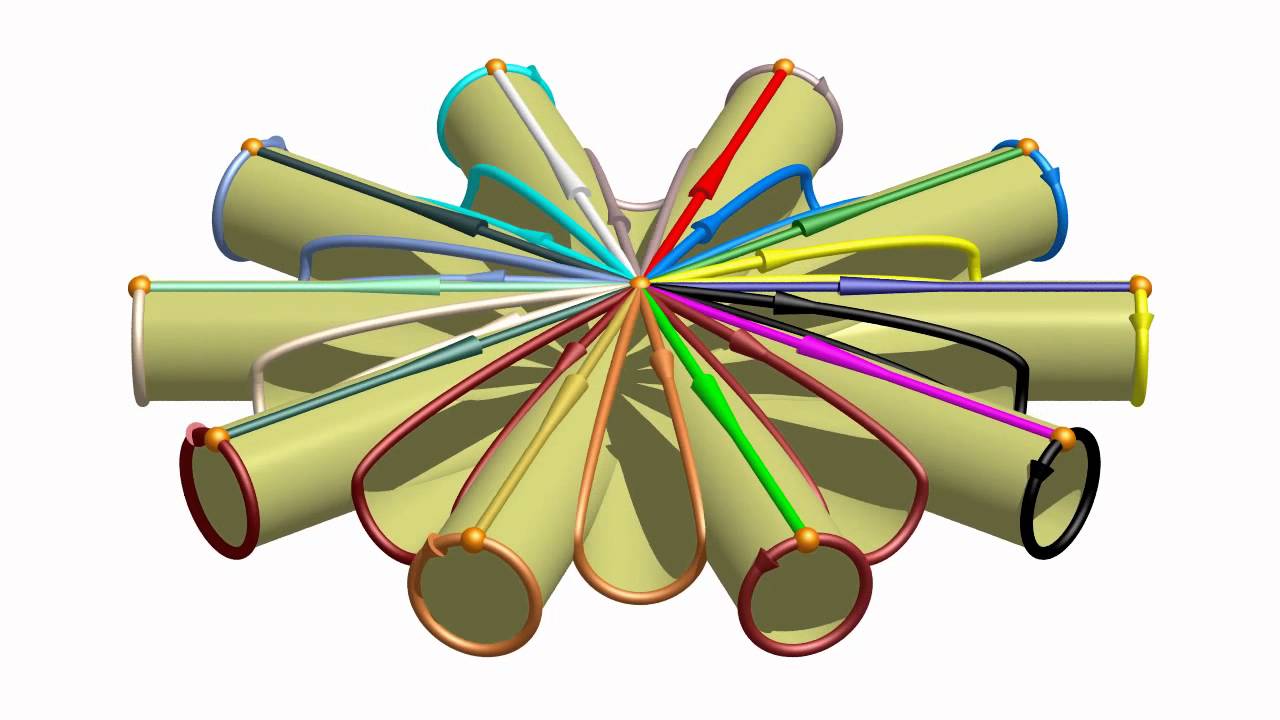
A polygon with 40 edges can be bent into a genus 10 surface (a surface with 10 holes).
gritty widget

feral copper
I have no clue how to compute this relative homology group... Would anyone have any advice please ? 🙂
$$H_4(S^2\times S^2,S^2\vee S^2)$$
 gentle ospreyBOT
Matplotlib:
fading vale
you can use the LES from relative homology to get ... -> H_4(S^2 V S^2) -> H_4(S^2 x S^2) -> H_4(S^2 x S^2, S^2 V S^2) -> H_3(S^2 V S^2) -> ...
the first and last of these are zero so we by exactness we get an isomorphism H_4(S^2 x S^2) -> H_4(S^2 x S^2, S^2 V S^2)
@feral copper do you know how to compute H_4(S^2 x S^2)
it requires the kunneth theorem but the computation itself is fairly simple
fading vale
np
: )
also dont feel dumb haha everyone messes up on stuff like this at some point
its normal
feral copper
Yeah ^^" ty ^^
In my case, none of the groups will have torsion, so I can use Kunneth's formula just like if I had a field, right ? (I need homology over Z to use Hurewicz's theorem)
fading vale
ah yeah oops
feral copper
Np ^^
gentle ospreyBOT
Moth:
feral copper
Tyvm !
fading vale
:D no problem
feral copper
Another question ! Can"t I just have H4≅Z by orientedness ?
fading vale
uhh possibly?
i dont know too much about orientability and stuff
but i think yes
assuming we know that S^2 x S^2 is orientable anyway
feral copper
A product of orientable is orientable I believe (I hope so ! XD)
 feral copper
Love that emoji
fading vale
it is very good yeah 
fading vale

 gritty widget
i want to make a really bad joke
about the exterior derivative satisfying d^2 = 0
 meager python
What are the quintessential examples for cohomology in algebraic geometry that one should do
 cedar pebble
If by cohomology you mean coherent cohomology then THE series of examples you should understand is the cohomology of line bundles/vector bundles on curves
Also cohomology of line bundles/vector bundles on P^n
But the curve case can keep you busy for a long long time and most more complicated examples reduce to a very good understanding of the curve situation
meager python
Exactly what I was looking for, thanks 🙂
cloud owl
hi. i'm really really bad at topology, ie. just starting out.
A function f : X → Y between two topological spaces is continuous if and only if f^-1(U) is open in X whenever U is open in Y.
- are you allowed to just say U is open in X? wouldn't you have to define the topology U is open in?
- why does the book suddenly take a hard left into category theory?
but can't there be multiple topologies on a space?
??
ohhh okay
right, yeah, i remember now
 sweet wing
consider the trivial topology and the discrete topology
any function to the trivial topology is continuous
- why does the book suddenly take a hard left into category theory?
also what book you should switch books
cloud owl
it's the one pinned in #book-recommendations
cloud owl
then why is it pinned lmao
sweet wing
what one person finds useful another may find absolutely garbage
i say this because idk why max seem to think(?) that it is a good intro
i think the category theory feels too forced, it seems more like "in theory we can teach like this"
same for me with like hatcher sure it is geometric but heck i cant learn from it
feel feel to just ask for book recommendation! mentioning your background and goals always helps
cloud owl
i saw no description lol
sweet wing
the book preface seems to imply so tho and chap 0 says the prelims are just a quick review of topology kinda implying you already know topology 🤔
i usually read preface to gauge if book is too hard for me lol
summer jolt
Can someone explain why the finite product of discrete spaces must be discrete. I have seen many explanations online but can't fully make sense of them. I know that if you a discrete spaces then their base must be singletons (and obviously they are open). But how do I show that all subsets of the product are open?
sweet wing
essentially you want to show some element (a_1,a_2,...,a_n) is open
summer jolt
@sweet wing Ok so an element like that would be open because the projection maps pn are continuous so their preimage is open?
sweet wing
yup
something along that lines
alternatively you know it's basis is products of open sets from the indiv topologies (cuz finite product)
and (a_1,a_2...,a_n) is a_1\times a_2\times...
cloud owl
it pains me to already have to ask for help for the first set of exercises but
i don't understand this
fading vale
its ok topology is hard
cloud owl
the first one definitely works
i think
but surely for the unions/intersections of any of the others they'd no longer look like
wait nvm i got it
i see the answer
i'm a fool
fading vale
haha
cloud owl
</rubberduck>
fading vale
yeah
cloud owl
pain
 uncut surge
is (x) the surprise topology
that's a funny one
ah no, probably (ix), but i'm not sure why (x) couldn't work
gritty widget
What is (x)?
uncut surge
in kaisheng's screenshot
uncut surge
oooh! i get it now, it's actually (i) that doesn't work
uncut surge
are unions of intervals always intervals?
cloud owl
ah crap
uncut surge
that was a fun problem tho, you go through the whooole list and you're like "no, no, no, no, no" and then at the end you're hit with these really weird topologies that actually work
 night parrot
im working my way through some beginner differential geometry stuff, and just got to the first / second fundamental forms. i wanted to check that my understanding here was correct
so in this equation, is ∇f(x0) a jacobian matrix? since the function that describes the surface, f(u, v), is a mapping from R2 to R3?
and a and b are just arbitrary 2D vectors?
gritty widget
yeah ∇f(x0) would be a 3x2 matrix, so the first fundamental form would be given by the 2x2 matrix ∇f(x0)^T ∇f(x0). as you say, a and b are vectors in R^2 (picture says this exactly)
night parrot
but i mean they can just be anything right?
and the product shown at the bottom is basically showing how the relative lengths of a and b change, with respect to the surface or something? just having some trouble building intuition here
or i guess, how the angle between them and lengths change, is how im interpretting it.. but not sure
gritty widget
and the product shown at the bottom is basically showing how the relative lengths of a and b change, with respect to the surface or something?
kinda, yeah. it's a little weird since this is only an approximation (one that gets better for a and b of smaller magnitude). it might help to draw a surface and a parametrization f, and then visualize ∇f(x0)a and ∇f(x0)b as tangent vectors to the surface at the point; then the inner product <∇f(x0)a, ∇f(x0)b> is how you compare them
if i had access to something to draw on i'd show you what i mean, but unfortunately i don't
maybe you can do a simple example, like with a parametrization of a sphere (or even simpler, a plane)
that might help you build some intuition
night parrot
thats a good idea, i have some ways i might be able to visualize a simple example
gritty widget
like everything in diffgeo should be tested against simple examples lol
I keep confusing covariance with contravariance, what's a way to distinguish them?
fading vale
dan
gritty widget
in the differential geometry context? it's either something to do with whether it takes in vector fields (contravariant) or covector fields (covariant), or with the position of indices (if you're a physicist)
fading vale
oh do you mean covariant vs contravariant functor
cloud owl
one has 'ntra' in it
fading vale
covariant functors preserve the direction of arrows
contravariant functors reverse them
fading vale
its probably related
gritty widget
diffgeo loves abusing terminology lul
ya maybe
mathacka: introduction to smooth manifolds
ok, thanks!
i actually use the appendix b of his riemannian manifolds book more, tbh, so i'll rec that too
fading vale
it seems like the same general concept of preserving vs inverting direction
gritty widget
oh sorry @gritty widget i got it wrong, covariant takes in vector fields, and contravariant takes in covector fields
fucking confusing
yeah
haha
well it's all in lee's books, i'd check those out
@fading vale there is actually some kind of connection, maybe. contravariant and covariant differ in how they transform with respect to changes of bases
i don't remember the specifics
but one goes one way and one goes the other way lol
the wiki page is clearly written for physicists but it's a good read
fading vale
im not sure if theres a genuine mathematical connection or if its just shared terminology (like "co" for flipped shit/contra for flipped maps)
gritty widget
i'd guess just shared terminology, but i'd love to see if there's a genuine connection
fading vale
someone categorify diff geo
fading vale
its kind of dumb that homology is covariant but uses chains while cohomology is contravariant but uses cochains
smh
gritty widget

that's gotta be confusing
contravariant eats covector fields, but covariant eats vector fields
physicists why?
 sleek thicket
ISM does have a good explanation
fading vale
hello shamrock
sleek thicket
Hello
I started writing an explanation and then someone pinged me in a different server
fading vale
lol
gritty widget
hi shamrock
i looked into it more, the terminology does make sense
contravariant things transform with the inverse of the change of basis matrix
which makes a lot of sense and im surprised i didn't learn about it sooner
elder yew
The way I think of it is contravariant goes against the change
covariant goes with the change
contra = against
co = with
sleek thicket
@gritty widget that's what I was saying in my deleted post basically
I think it's okay terminology, it's just not really how I think about these things
fading vale
LMAO
@sleek thicket holy shit i went on the like wikia webpage or whatever and i got an ad for ISM
lmfao
targeted advertisement is amazing
fading vale
amazing
sleek thicket
springer graduate texts in homophobia
fading vale
want




 tough imp
gritty widget
tough imp
gritty widget
736 followers, popular
gritty widget
no
sleek thicket
::(
gritty widget
my twitter account is cursed
sleek thicket
is it mostly furry porn or something?
gritty widget

sleek thicket
lol
gritty widget
Is geometry empirical or a priori?
gritty widget
That's why I'm asking 😭 idk if einstein refutes kant or not
fading vale
it has nothing to do with geometry
gritty widget
Alright my bad
fading vale
this question is basically just "does synthetic a priori justification exist" but thats a philosophical question lol
its not really about geometry
gritty widget
He thinks the opposite
That geometry is empirical
"Until some time ago, it could be regarded as possible that Kant’s system of a priori concepts and norms really could withstand the test of time. This was defensible as long as the content of later science held to be confirmed*) did not violate those norms. This case occurred indisputably only with the theory of relativity. However, if one does not want to assert that relativity theory goes against reason, one cannot retain the a priori concepts and norms of Kant’s system."
Well he says this
So apparently it has to do with relativity
fading vale
i dont think einstein is talking about geometry here
^
wow thank goodness i read deleuze

it was all for this moment
gentle ospreyBOT
Davide | Math student:
gritty widget

 cold vine
So I have top.space. X and point x in S^n. Now since X×S^n retracts to X×{x} we see that Hn(X × S^n) is isomorphic to Hn(X×{x}) + Hn(X×S^n, X×{x}) (by splitting of the LES of the pair. We have shown this previously)(+ is the direct sum). Now since X×{x} is trivially isomorphic to X we see further that Hn(X × S^n) isomorphic to Hn(X) + Hn(X×S^n, X×{x}) Q.E.D.
Does this make sense . Seems a bit too easy so I'm thinking if I missed something
fading vale
@cold vine im not sure you can assert that the LES splits here so easily
or rather idk what argument ur using
maybe i have to review some stuff here ik that we get an injection H_n(X x {x}) -> H_n(X x S^n) but i dont remember the construction of the LES so idk if the map in the LES is injective
cold vine
So I've proven earlier that if A is a retract of X then the sequence splits and thus H(X) = H(A)+H(X,A)
and here I choose A = X×{x}, X=X×S^n
 quiet pilot
Is there some general method on how to describe certain curves in projective space P^2?
For example, a line in P^2 is defined as the zero set aX+bY+cZ=0, except the origin. A conic is gotten by ax^2+bXY+...+fZ^2=0
elder yew
yeah there are theorems on this
quiet pilot
Do we always just add in a Z and make things symmetric?
fading vale
@cold vine sorry i misremembered bc this problem is in hatcher
but theres a part 2 which uses mayer vietoris
quiet pilot
But ax+by is already homogeneous
cold vine
@fading vale Alright no probs ^^
quiet pilot
Ah of course
Thank you
I guess it becomes slightly messier for conics?
Ah right, thanks again
cold vine
So I'm doing an excision of a manifold X and a point x in X so now I have the nbd of x homeomorphic to R^n which is A, and I get from the excision of X-{x} and A that H(X,X-{x}) = H(A,A-{x}) =H(R^n, R^n-{*}) but now I should get that the last group is Z which I don't believe holds since that last group seems to be homology group of a two point space?
fading vale
use the LES of the relative homology to get H_n(R^n) -> H_n(R^n, R^n - *) -> H_n-1(S^n-1)
the first is 0 so we get an isomorphism of the 2nd onto the 3rd and the 3rd is just Z
uncut surge
Why do you think it has to do with homology of a two-point space?
cold vine
Ah yeah I'm wrong on that one. I was thinking we quotient everything but the point away to another point and then take the homology but thats def wrong.
Alright I see!
Thats very nice
cold vine
Hmm another question... So I have a space X constructed from three disks D1, D2, D3 with their boundaries identified. Now we also have subsets X1 and X2 which are made by identifying D1,D2 and D2,D3 respectively (and they are homeomorphic to S^n). So clearly X1 and X2 are closed but are they also open? I'm not quite clear on the quotient topology here. Is it done from the disjoint union of D1, D2, D3? I would presume so and thus they are also open.
fading vale
Im kind of unclear what you mean
by "we have subsets X1 and X2 made by identifying..."
do you just mean like X1 = D1 U D2 in D1 U D2 U D3/~
intuitively it looks like X1^C = int(D3)
cold vine
so now im doing excision on the three identified disk with the subsets of two identified disks
and thus i need that X1 and X2 are open in this space
fading vale
ah
cold vine
So I think X is formed from the disjoint union of Di
fading vale
um i dont think you need X1 and X2 to be open necessarily
you just need their interiors to cover X
cold vine
that is true
but if they are closed i think their interiors go to zerp, no?
so then i would need some other subspaces
but i would think that they are indeed open since inverse image of X1 is D1 U D2
and they are open if it is in disjoint union, I think?
fading vale
i think ur right
cold vine
This is a bit hand wavy  but i think it makes sense
fading vale
ur right i think
fading vale

cold vine
Ahh it actually doesn't seem to work since if we take the inverse image of the projection of X1 we get not only D1 U D2 but also the boundary of D3 which definetely is not open 😅 Well thats rough
 slender plank
Hello I need help with .last question

French is only used to introduce things
I need help for question 6)c
we need to show that there exist a theta that veriifies this inequality
gritty widget
Neat problem, maybe one idea is, if the zj all lie on the circle, then maybe you can prove it for any theta by a pigeonhole argument (for any line through the origin, a majority of the points must lie on one side), although I didn't do any calculations
gritty widget
(nvm it can't work for any theta)
uncut surge
I'm not sure I get it but from the setup of the question, it sounds like you need to integrate both sides of the inequality from b)
and pray to jeebus that you can somehow show that the left-hand-side is an integrable function in theta
And then I suppose some mean value theorem about integrals or so
yeah that feels about right
@slender plank ton fromage est pret
and yeah the mean value theorem i mean is $\int_a^b f(x) dx = f(c) (b - a)$ for some $c$
gentle ospreyBOT
Lartomato:
uncut surge
ah in fact you need to show that the integrand is continuous for that to hold
might be a bit tricky
oh no, you can just take the supremum of the integrand instead
slender plank
Ok thx Lartomato
 red garden
yo
Let Y be a subspace of a metric space X, and let A be a subset of the metric space Y. Show that A is open as a subset of Y <--> it is the intersection of Y with a set which is open in X
suppose A is the intersection of Y with a set which is open in X
Y is open in Y
let x be in A --> we wish to show S_r(x) is contained in A for some r>0
x be in A --> x is in Y and x is in N for some open set N in X
we wish to show S_r(x) is contained in the intersection
i cant do shit
help
plz ping me if help
hint
no spoiler
plz
ty
gritty widget
It's not S_r(x) contained in the intersection that you want to show, it's S_r(x) cap Y
@mo2men
red garden
thats what i thought cuz i am af ucking geinus
okay i wrote it down in paper before i told u
gritty widget
Nice
red garden
can i tell u
the proof tho
im p sure its still wrong
suppose A is open
i claim A is the intersection of Y intersect S_r(x) for x in X and r>0
or wait
so for each x in A
i wish to show that A = Y S_r(the same x) ?
for some r>0?
@gritty widget
gritty widget
I guess no. But I'm not exactly able to follow what you're saying
red garden
omg i cant do it
idk what the fuck is the set open in X
idk
just am etric space where the subspace is a meetrics space on the same metric
just the set is subset
idk this is the ssubspace topology but i am not supposd to know that yet
 tight agate
Let X be an almost complex manifold. Then using the almost complex structure, we have a direct sum decomposition of the (complexified) sheaf of k-forms on X: $A^k(X) = \bigoplus_{p+q = k}A^{p,q}(X)$. If $d: A^k(X) \rightarrow A^{k+1}(X)$ is the exterior derivative, then we can define $\partial := p_{p+1, q} \circ d: A^{p,q} \rightarrow A^{p+1,q}$ (by projecting onto the summand after applying the exterior derivative), and simimlarly we can define $\bar{\partial} := p_{p, q+1} \circ d: A^{p,q} \rightarrow A^{p,q+1}$.
gentle ospreyBOT
Brofibration:
gentle ospreyBOT
Brofibration:
tight agate
by picking coordinates
The book I'm reading says that the almost complex structure is integrable if and only if $d = \partial + \bar{\partial}$
gentle ospreyBOT
Brofibration:
tight agate
But another definition for an integrable complex structure is one that comes from a complex structure
That equality needs to fail while passing from local to global
So the question I have is is there an example where I can see that equation fail to hold globally
I'm assuming the problem arises while trying to change coordinates using a transition function that is not holomorphic
Is there some weird way in which the eigenspaces of i and -i of the almost complex structure switch around to prevent the equality from holding globally
I think that might be it as the transition functions are holomorphic if and only if they commute with the action of the almost complex structure, and if they commute with it then they preserve eigenspaces
but that's pretty handwavy
meager python
In Spec k[x,y,u,v]/(xy+ux^2+vy^2), how does one see that D(x,y) is not principal?
 knotty pasture
Why if the structure group of a (k-1)-sphere bundle E can be reduced to O(k), we can form a RIemannian vector bundle E' of rank k whose unit sphere bundle S(E')=E?
 frozen phoenix
how I would prove that if U is an open subset of R^n then the tangent space of U to a point p in U, is equal to R^n ?
My thoughts : Show that the directional derivatives are in one-to-one correspondence with the vectors, a vector v \in R^n produces a map taking appropriate smooth maps to reals, then we need to show that given a derivation can be realized as such a directional derivative
is this along the correct lines?
ok ty
frozen phoenix
is this the best/efficient way?
quiet pilot
How would I rigorously show that V(XT-YZ) \ {0} in k^4 has the origin in its closure?
k is infinite
Intuitively it feels like a function which is 0 on the whole V(XT-YZ) except possibly at a single point needs to have XT-YZ as a component
Nvm I think I got it. If f isn't 0 on origin then V(f)(intersected with V:=V(XT-YZ) is closed in V. So {0} is open in V, which is absurd as V(XT-YZ) is irreducible
gritty widget
any tips how to show lower limit topology doesnt have countable basis
cloud owl
i know not enough about things but iirc you show things aren't countable by assuming countability and then using a diagonal argument to find contradiction?
gritty widget
you do not know enough about things
cloud owl
ok
gritty widget
although you probably can prove that statement by seeking cardinality contradiction (at least tahts what I was trying to do), but it has nothing to do with diagonal argument
cloud owl
fine, cardinality contradiction, yeah
i've been incorrectly calling that sorta thing where you list them and find one that isn't in them a diagonalisation argument then
gritty widget
although I find your comment kinda weird, its not like finding that missing element is trivial in every case. Basically you said just prove it lmao
uncut surge
Aaah, I get it now. There wouldn't be a way to get something like [\pi, 5). Unions of closed sets can form open ends, but not closed ones.
And that is the precise problem, if you had a countable base, there would be at least one set of the form [x,\infty) that is not contained in the base for some real number x, but no union of half-open-intervals can give you this interval, unless one of them was equal to [x,\infty) to begin with
@gritty widget tricky stuff
Or, uh, hmm, maybe I'm lying. You could have something like [\pi,x) union [x, 5). But I think this is the right direction
regardless, one of the sets in the union has to have \pi as its lower end
it happens so often that i spam a channel with maththonk and then nobody talks to me anymore
F
gritty widget
@uncut surge I dont understand what you mean
uncut surge
AWRIGHT here we go
If you take your proposed topological basis, how would you form the set [\pi,4) by unions?
gritty widget
uhh decimal expansion left side\
[3.14159265358979..., 4) but I guess it will be just (pi,4)
uncut surge
Recall that you can only take unions, so I'm not sure how the decimal expansion will help you
Yeah, exactly
uncut surge
the wikipedia one
uncut surge
In topology, a second-countable space, also called a completely separable space, is a topological space whose topology has a countable base. More explicitly, a topological space
    T


{\displaystyle T}
is second-countable if there exists ...
gritty widget
so we should be able to produce from basis elements any open set and vice versa?
uncut surge
Yeah
A basis of a topological space is defined as a collection of sets so that every open set is a union of elements from this collection
gritty widget
how would I make [\pi,4) from uncountable base tho
uncut surge
I guess just [x,y) for all real x and y
gritty widget
I guess the problem is that we cant do all [irrational, whatever) cuz of countablility?
gritty widget
yeah Ig thats right
uncut surge
So from understanding this example, we see that if we have an interval like [x,y), then we can only get this by unions of half-open intervals A_1,A_2, ... , if one of the intervals A_i already is of the shape [x, something)
So we can only get the closed end by unions if one of the intervals has the same closed end
gritty widget
yeah
uncut surge
this is a bit awkward to formulate but i hope you can sorta follow
uncut surge
naisu
gritty widget
also, is subspace of separable space separable?
with induced topology I guess
example (R\Q)^2 as subspace of R^2
probably not true
sleek thicket
It's true for R^2 or any metric space because separable is equivalent to second countable for metric spaces
I doubt it in general
uncut surge
Yeah apparently it's not true in general
gritty widget
uhhh the problem im supposed to do is find out whether (R\Q)^2 is separable, was just my idea if thats true in general lol
uncut surge
|| it's not a counterexample, take (p + pi, q + pi) where q and p go through all rationals||
sleek thicket
Can you take like an uncountable discrete space an attach one generic point?
gritty widget
oh yeah wtf obviously larto
sleek thicket
ty ultra, moonbears suggested it and said you'd like it
I think my idea works but I'm not sure
uncut surge
oh i spoiled your whole problem then
gritty widget
how didnt I think of that, I was trying to show its not separable lol
uncut surge
whoops
sleek thicket
So let S be an uncountably set and define X = S union {γ}. Define a topology on S by saying a set is closed iff it's a subset of S or is all of X. Then the closure of {γ} is X, so X is seperable, but the subspace topology on S is that of an uncountable discrete space, which isn't separable
Does that look good?
uncut surge
that's smert
sleek thicket
ty
gritty widget
ye nice one makes sense to me
also, is C[0,1] d_sup separable? should be right? Im thinking just take lines y = q q rational
or y =px
uncut surge
With that first set you'd only be able to approximate the subspace of constant functions I'm pretty sure
sleek thicket
My intuition is not separable but I'd need to think about it
gritty widget
oh wait yeah knowing you can approx with polyniomials you can take just all polynomials?
those are countable
with rational coef
uncut surge
Yeah I think that's fine
sleek thicket
that makes sense
gritty widget
big brain time
when I learned that theorem I was thinking its the most useless one in analysis
since we didnt use it anywhere in that specific analysis course
uncut surge
it takes some time to appreciate some theorems, yeah
"wtf this doesn't help me calculate integrals AT ALL"
fading vale
that just makes it better i think
sleek thicket
integrals are good actually
 quaint agate
Anyone here want to talk about knot theory?
gritty widget
@ moonbears
quaint agate
Who is moonbears 
Oh wait
Lmao
they’re one of my friends
I didn’t even recognize the name for a sec
gritty widget
 solar cape
do we know about nets here
gritty widget
i've encountered them once or twice
solar cape
I have the forwards direction (phi converges) done and it took like a page and a half and a lemma or two
but the backwards direction is tougher
i cant tell if im just being dumn and not seeing the easy way but yeah
thought I'd ask hhere
 nimble cipher
Hi. How do I get the inverse of $p$? Alternatively, do I need its inverse or is there another way of computing for the lifting? By the way, $p$ is given by $p(x,t)=(t\cos 2\pi x,t\sin 2\pi x)$.
gentle ospreyBOT
emphatic_wax:
nimble cipher
Yeah someone told me to do that. I will try that. Somehow, my multivariable calculus left me
rugged swan
Hello, I'm looking for an example which satisfies the homotopy extension property, thus an example of cofibration. Could someone show me one ? I don't find any on wiki or nlab.
rugged swan
hi again, I found my answer to my question.
I have another one question. I was reading the homotopical definition of the mapping cone on nlab : https://ncatlab.org/nlab/show/mapping+cone.
As I've understood the definition, for me, the mapping cone of a function f : X -> Y is the unique space Z with an embedding Y -> Z making the arrow f homotopically trivial.
The nlab page claims that the suspension is the mapping cone of f : X -> *. I don't agree with this because f is already homotopically trivial here, the mapping cone of f should be the point * too. What I didn't understand ?
nimble cipher
Can someone help me find 3 spaces X,Y,Z, covering maps q and r such that p is not? That is, when we omit the condition that r^-1(z) is not necessarily finite.
slender plank
Yo can someone help me for a fats exercise
So i send you a sum and you need to show that it implies that the polygone is regular
 nimble cipher
Yeah I'm trying to do something with the circle
slender plank
So w is the number above ei2π/n
And we need to show that if the sum is true then the polygone is regular
Do anyone as an idea how to do it ? Apparently you have to use the general case of triangular equality
nimble cipher
So I remove one property in that so it does not become a covering map
?
that's sad haha
Okay. I will read through this paper. Algebraic topology is fun
Ohhh will also look into that
and find that stackexchange so I can have my peace too
I have seen the answer from the paper you linked. I think that works
slender plank
<@&286206848099549185>
sweet wing
how do you do a reu on AT without reading hatcher or a equivalent
fading vale
so the basic concept here right is like
(for context this is cohomology and psi is an element of H^1(X, G) where X is a 2 dimensional delta complex)
in the case G = Z2 if we pick any triangle either two of its faces are mapped to 1 or none of its faces are mapped to 1 by psi if psi is trivial under delta
so then we can like i guess mark all of the edges which get mapped to 1
and those all have 2 adjacent edges (meaning edges sharing a triangle) that are also marked
and then we draw a curve transversing all the edges and not any of the unmarked ones?
summer jolt
Hi I have to show that the commutator of lie derivatives and the lie bracket of vector fields are the same when acting on a (1,1) tensor.
I managed to show this
where tao is a (1,1) tensor but not really sure how to proceed next.
gentle ospreyBOT
slimvesus:
sleek thicket
for a vector field this is the jacobi identity, right?
(assuming you know the lie derivative and lie bracket coincide for vector fields)
I think we can say $(\mathscr{L}_X \omega)(V) = X(\omega(V)) - \omega(\mathscr{L}_X(V))$, so $(\mathscr{L}_X \omega)(\mathscr{L}_Y \omega))(V) = X((\mathscr{L}_Y \omega)(V)) - (\mathscr{L}_Y \omega)(\mathscr{L}_X(V)) = X(Y(\omega(V))) - X(\omega(\mathscr{L}_Y(V))) - Y(\omega(\mathscr{L}_X(V))) + \omega(\mathscr{L}_Y(\mathscr{L}_X(V)))$
gentle ospreyBOT
shamrock:
sleek thicket
then $(\mathscr{L}_X \omega)(\mathscr{L}_Y \omega))(V) - (\mathscr{L}_Y \omega)(\mathscr{L}_X \omega))(V) = X, Y + \omega(\mathscr{L}_Y(\mathscr{L}_X(V)) - \mathscr{L}_X(\mathscr{L}_Y(V)))$
gentle ospreyBOT
shamrock:
sleek thicket
hmm i dont see it
oh wait lol
that last bit is $(\mathscr{L}{[X, Y]}\omega)(V)$ by the first computation I did and the fact that $\mathscr{L}{[X,Y]}(V) = \mathscr{L}{X}(\mathscr{L}{Y}(V)) - \mathscr{L}{Y}(\mathscr{L}{X}(V))$
gentle ospreyBOT
shamrock:
sleek thicket
so this shows it for 1 forms, just by how the lie derivative of a contraction works
then to check it on $(1,1)$-forms it suffices to check it on simple tensors $f V \otimes \omega = f \otimes V \otimes \omega$
gentle ospreyBOT
shamrock:
sleek thicket
also note that it holds for functions because the lie derivative of a function is just applying the vector field to that function
so now assume $\mathscr{L}_[X, Y] T = \mathscr{L}_X \mathscr{L}_Y T - \mathscr{L}_Y \mathscr{L}X T$ and $\mathscr{L}[X, Y] S = \mathscr{L}_X \mathscr{L}Y S - \mathscr{L}Y \mathscr{L}X S$ for tensors $T, S$. Then $\mathscr{L}{[X, Y]}(T \otimes S) = (\mathscr{L}{[X,Y]} T) \otimes S + T \otimes \mathscr{L}{[X, Y]}(S) = (\mathscr{L}_X \mathscr{L}_Y T) \otimes S - (\mathscr{L}_Y \mathscr{L}_X T) \otimes S + T \otimes (\mathscr{L}_X \mathscr{L}_Y S) - T \otimes (\mathscr{L}_Y \mathscr{L}_X S)$
gentle ospreyBOT
shamrock:
gritty widget
sleek thicket
on the other hand $\mathscr{L}_X (\mathscr{L}_Y (T \otimes S)) = \mathscr{L}_X(\mathscr{L}_Y T \otimes S + T \otimes \mathscr{L}_Y S) = (\mathscr{L}_X (\mathscr{L}_Y T)) \otimes S + (\mathscr{L}_Y T) \otimes (\mathscr{L}_X S) + (\mathscr{L}_X T) \otimes (\mathscr{L}_Y S) + T \otimes (\mathscr{L}_X (\mathscr{L}_Y S))$
gentle ospreyBOT
shamrock:
sleek thicket
from this we see $\mathscr{L}_X (\mathscr{L}_Y (T \otimes S)) - \mathscr{L}_Y (\mathscr{L}_X (T \otimes S)) = (\mathscr{L}_X (\mathscr{L}_Y T)) \otimes S + T \otimes (\mathscr{L}_X (\mathscr{L}_Y S)) - (\mathscr{L}_Y (\mathscr{L}_X T)) \otimes S - T \otimes (\mathscr{L}_Y (\mathscr{L}_X S))$
gentle ospreyBOT
shamrock:
sleek thicket
and that's what we had up above
so this bit was proving that your property is true for two tensors it's true for their tensor product, it only used the product rule for the lie derivative
it holds by definition on 0-tensors (functions)
it holds by the jacobi identity on vectors
and you can extend it to covectors via the identity $\mathscr{L}_X (\omega(V)) = (\mathscr{L}_X \omega)(V) + \omega(\mathscr{L}_X V)$
gentle ospreyBOT
shamrock:
sleek thicket
any tensor of arbitrary rank is a sum of tensor products of (0,0)-tensors, (0, 1)-tensors, and (1,0)-tensors, and the lie derivative is additive, so this establishes it for tensors of arbitrary rank
@summer jolt
anyone in this thread smoke weed
elder yew
no, but I love to fuck with people that are high
 chrome dew
sleek thicket
chrome dew
sleek thicket
i just felt awkward dumping tensor bullshit and then complete silence
gritty widget
lol
just never deal with mixed / contravariant tensors
join the covariant-only club
cartan only holds for lie derivatives of forms tho right?
sleek thicket
I didn't use cartan?
lol
i think i had this as an exercise in my smooth manifolds course
like
it's not really so bad
right
then you use the formula $\mathscr{L}_X (\omega(V)) = (\mathscr{L}_X \omega)(V) + \omega(\mathscr{L}_X(V))$
gentle ospreyBOT
shamrock:
sleek thicket
to get the case of a 1 form
then you argue that it's preserved under tensor products
both of those last two things are very very easy
just lots of symbols
you just do the product rule or w/e when you need
it's really not so bad, you just follow your nose
i mean cartan only does the 1 form case
which is not so bad
it is easy lol
people danning are wrong
this isn't DG
@gritty widget I don't really see how you do (1,1)-tensors without doing (p,q)-tensors
like
because there's no metric
this is diff top
 sleek thicket
this is all just about smooth structures on manifolds!
no jommetry
not quite slim
it's a sum of those
and you mean \otimes lol
yeah, $\sum_{i=1}^\infty f X \otimes \omega$
right
so... show that it's preserved under tensor products?
gentle ospreyBOT
shamrock:
sleek thicket
yeah exactly
that gives you the (p,q)-case lol
yes
well you have three terms here anyways
$f \otimes X \otimes \omega$
gentle ospreyBOT
shamrock:
sleek thicket
like you kind of need to induct, but I think if you're doing this level of stuff it's okay to say "it holds for tensor products of 2 things so it holds for tensor products of n things"
yeah?
yeah so like
if you look at my proof again
there's two sections
(1) establish it for 1 forms
(2) do it for tensor products
yup
it's an easy problem
just like
lots of symbols
exactly
there is no cleverness needed
I think cartan will actually be annoying
versus the formula I used
?
$\mathscr{L}_X(\omega(Y)) = (\mathscr{L}_X \omega)(Y) + \omega(\mathscr{L}_X Y)$
i mean which formula are you asking about
there's like 3 formulas that are relevant here
the one I posted is just a product rule but for applying a covector to a vector
gentle ospreyBOT
shamrock:
sleek thicket
then there's a product rule for the tensor product
the statement we were trying to prove overall is that $[\mathscr{L}_X, \mathscr{L}Y] = \mathscr{L}{[X, Y]}$
I don't really get your question
like
the lie derivative is a thing that we care about
this is saying it satisfies a good property
i.e. it's a derivation
Pretty much
gentle ospreyBOT
shamrock:
sleek thicket
that sending a vector field to its lie derivative is a lie algebra representation
a lie derivative takes (p,q)-tensors to (p,q)-tensors
you look at how the tensor changes as you flow it along a vector field
elder yew
^_^
elder yew
If I recall correctly, lie derivatives are the same thing as lie brackets
If things are nice enough
gritty widget
u might need C^\infty for that moonbears but also all manifolds are C^\infty
sleek thicket
it's like a directional derivative
but we need more structure
than just a single vector
we need an entire vector field so we get a flow
sleek thicket
yup
gritty widget
sleek thicket
I can define flow or I can try to give you a nice picture
and I think the picture is easier first
so like
gritty widget
define it and make sure to avoid all the domain issues too 
sleek thicket
say you have a vector field
that's an integral curve of X
the flow bundles up all the integral curves together
elder yew
Looks like someone wants to do research in RG
sleek thicket
lol me?
I changed my name to this because of a tweeet where I said I hate RG
I legit don't think I want to continue with it after this class, it has been very annoying lol
but geometrically flow is like, take a point and follow the path of the vector field
yup
elder yew
(Peterson > Lee)
elder yew
That's awesome though
sleek thicket
Yeah he's great!
elder yew
I liked RG mainly because I liked covariant derivatives so much
and thinking about manifolds
sleek thicket
also more cynically it'll be nice to have him to write me a letter of rec
manifolds are good
but I like manifolds without metric more 😛
elder yew
I don't think that's cynical to want good letters
From reputable mathematicians
I have relatively uknown mathematicians as my letter writers
so I'm a little concerned
sleek thicket
sheafs+manifolds are good
@elder yew I'm definitely aware of like, letters of rec being important and am trying to optimize for them
but otoh, it can feel a little grimy
elder yew
Do you have any research project?
Like do you think you can get something with jack in the spring?
sleek thicket
yeah I did that knot theory reu this summer
elder yew
Like a reading course
sleek thicket
am currently doing this weird bad physicsy project, it might turn into weird good deformation quantization stuff next quarter
jack is retiring this year 😦
elder yew
Oh what a shame
sleek thicket
I don't think he wants to do a reading course or research
but he will have had me for two years in small grad courses, and I made myself known
like after 1 quarter with him he was willing to write me my reu letter
sleek thicket
I've liked them a lot
elder yew
I'm going to a talk by Wilson on Monday
he's presenting at my research mentors seminar
sleek thicket
oh nice
He was willing to let me skip into the ug measure theory course freshman year, even though the honors analysis sequence I was taking didn't technically fit the prereqs
but I had a time conflict
elder yew
Yeah. He was going to let me into his topics PDE course but it cost too much
sleek thicket
oh that sucks :/
elder yew
It would've been 4k up front
whereas if I wait another year a course would be closer to 1.5k
sleek thicket
well if you end up taking a pde course next year I might see you! depending on whether I recover from my anti-RG sentiment
elder yew
It depends if I get into UW or not. I think I have a good chance
elder yew
My letters and research are strong, my gpa is a little poopy
sleek thicket
honestly like
i hated ODEs so much
thought they were boring and poopy
but flows are so good
very cool
elder yew
I hated PDEs so much at first, and fourier
sleek thicket
also geodesics and parallel transport and stuff
sleek thicket
I haven't really done anything with them yet, except for like figuring out some ad hoc stuff on manifolds hw when it was necessary
but they seem interesting
and useful
elder yew
If I get in shammy, can you share toro's exams w/ me?
sleek thicket
yeah sure
elder yew
I wanna prepare for the quals
sleek thicket
I can send you the one we took last friday rn
elder yew
Sometimes they take exam questions from the prof that taught it prior
oh sick
I'll tuck that away
Will they let you take quals?
sleek thicket
ehh
chmonkey wanted to this year and they didn't let him
I don't really want to, it seems unpleasant
elder yew
The first problem is exactly a problem in stein and shakarchi
sleek thicket
i found it in there during the test lol
elder yew
I did that problem and made sure I had it down for my class. Thought it would be a great test question
Didn't show up
sleek thicket
I wish I had done it before the test, it was an optional problem :/
there are like 1-3 of those after every lecture
i mean yes
it is literally just solving an ODE
huh
I guess the picture just helps me a lot more than the formula
like
I understand how they relate and all
and I'm gonna use the definition of integral curve if I want to prove anything
Yeah, ik what you mean
ugh this reminds me I gotta do riemannian geo homework
I'm supposed to compute the sectional curvatures of $SU(2)$ under a family of metrics
this convo made me realize the approach I had thought of doesn't work lol
oh word?
gentle ospreyBOT
shamrock:
sleek thicket
is there a nice way to do it im missing?
lol
the issue is that like
there's a nice formula in the bi invariant case
this was like a hw problem
for me
but the metrics I have are only left invariant
so like, covariant derivatives aren't nice
r i p
mood
I'm not sure I agree
like, what other topics?
maybe I don't understand what you mean by accessible. I'm finding RG less hard than AG and slightly more hard than AT
like i'm at the point where most of the stuff I'm doing is like, obtuse and hard lol
yeah that's a mood
idk I felt like that with algebra a lot
(and then I woulld eventually get used to it and develop intuition)
I mean dummit & foote and basic comm alg
I'm thinking of the algebra course I took last year
like when I first learned group theory I found it really unintuitive
and when I first learned rep theory I couldn't figure out how it all fit together
because im bad at physics and don't find it interesting
anyways slim diff geo is really annoying
i agree
i didn't mean to be like, combatitive
I am the Riemannian Geometry Lover, so
I am cursed to be with it
despite my wishes
Yes
okay goodbye I'm gonna play magic the gathering with some friends
Good luck managing the pain of curvature :)
 coarse kestrel
So every complete metric space is the continuous image of the cantor set
Does this mean the cardinality of metric spaces is always not greater than the cardinality of R?
yeah the cardinality of complete metric spaces
so that's why it doesn't quite make sense to me
by a continuous image of a cantor set, the continuous function should be surjective right?
so that means the cardinality of the cantor set is always greater than or equal to that of any complete metric space
 little hemlock
cantor set is compact tho
and R is complete but not compact
i.e. there is something fishy about that theorem.
the only theorem online i see about this is that every compact metric space is the continuous image of the cantor set. maybe u mixed up completeness and compactness?
tight agate
Anyone know a good reference on spectra?
topology spectra
I have been looking at some of Lurie's books
I was curious if there was a more 'classical' reference
in the orginal setting
sans quasicategories
unless the originial setting involved that
orginial*
ffs
original
nah I just wanted to see how they first came up
just as representing objects of cohomology theories I assume?
that sounds reasonable
that article says that spectra were first introduced in the context of spanier-whitehead duality
ahahahaha
summer jolt
sleek thicket
any tensor of arbitrary rank is a sum of tensor products of (0,0)-tensors, (0, 1...
Thanks a lot
gentle ospreyBOT
weilam06:
 nimble flower
if i have a cts map, t -> f_t, would the map t -> f_t^-1 be cts as well?
suppose the f_t are homeomorphisms
gritty widget
what's the topology on your function space
fading vale
maybe this is a silly question but im a little confused by this
i get that the snake lemma gives us Z_n-1 -> B_n-1 -> ker delta -> Z_n -> B_n
well
the duals of the B and Z but like
yea
so is a composition with the quotient from ker delta to H^n(C; G) just like
implicit here
and this is actually Z_n-1 -> B_n-1 -> ker delta -> H^n(C; G) -> Z_n -> B_n
or am i misunderstanding something
🤔 i guess technically this is just hom alg but its from hatcher so wutever
wait this doesnt make sense lol
its that the maps from ker delta_n into Z_n vanish on im delta n+1 probably right?
so we can pass to the quotient?


 exotic root
If X is an affine variety in A^n, is X open or closed in the projective closure? Is X open or closed in P^n?
Like if phi is the identification of A^n with D(x_0) in P^n then the Zariski closure of phi(X) in P^n should be the projective closure
But im not seeing where the stuff are open or closed
tight agate
Well if it is closed then it is it's own closure
So it is affine and projective
If you're working over a field
then global sections is a finite k algebra
which implies that the variety is a point/points
as it is affine
exotic root
But does that imply that X is open?
tight agate
If it is not a point/points
exotic root
X is X^pclos \cap D_+(x_0) in P^n
tight agate
yup
exotic root
Yeah
tight agate
not in D(x0)
and by the argument above, if X is closed in it's projective closure then it is a collection of points
Oh you're asking if it's open
yeah it is
in its projective closure
exotic root
In both its closure and in P^n?
tight agate
in it's projective closure
wether it's open or not in Pn depends on X
If you take X = An, and embed X as D(x0), then it is open in Pn
exotic root

Mathematics Stack Exchange
Let $Y=Z(I)$ be an affine variety of $A^n$ with vanishing ideal $I$. Then $Y$ can be identified with an open set of the projective space $P^n$ and its projective closure $\bar{Y}$ is the closure of...
They say Y can be identified with an open set in P^n
Thats whats confusing me I think
tight agate
It can be identified with an open subset of a projective variety
I don't think it can be identified with an open subset of projective space
Take a single point
(spec k)
exotic root
Hmm
tight agate
it isnt an open subset of Pn due to dimension reasons
exotic root
Opens in projective have high dimension no?
tight agate
same dimension as the whole space
exotic root
Being dense
tight agate
and dim Pn = n > 0
exotic root
Right
tight agate
but spec k is 0 dim
But yeah I assume they wanted to say it can be identified with an open subset of a projective variety
not projective space
gritty widget
yo so I'm not sure about one thing: given lexicogrpahic square I want to find the interior and closure of (0,1) x {0}. so interior is empty and the closure should be (0,1] x {0} sum [0,1) x {1}. Not sure how to argue why (1,1) is in the closure. Would saying that (1,1) isn't a successor of any element be enough, so when taking a nbhd of that point we can't go just from the top without crossing any points on (0,1)x{0}?
not sure how to show it formally
feral copper
Hi (again) ! I asked a question about a week ago on MSE, and it didn't find any answers, so I thought I may ask it here ! It's about computing a homotopy group of a wedge of CW spaces : https://math.stackexchange.com/q/3907570/259363
exotic root
What am I missing? Why does it follow from the orange that Z x_B A -> Z is closed?
 cunning coral
Just a quick sort of really informal concept check I need.
So in the hyperbolic plane, if you have a line m that contains the limiting parallel to a line l, m and l cannot share a common perpendicular. And I'm trying to understand a basis of why. My though process is that since m is asymptotic to l, then the distances between l and m is always increasing as you slide along a given direction of l. So you can't find two perpendiculars to l of equal length, so you cannot construct a perpendicular to both l and m.
Better way to say it, you can't drop equal length perpendiculars from m to l, so there is no common perpendicular to them l and m
woeful oasis
It is easy to picture in the poincare disc model
cunning coral
Poincare is the one with diameters and arcs of circles yeah?
I don't remember the models names
woeful oasis
The plane is good too, I just think sometimes the ball is easier to look at because it's compact
and you have just circles to worry about, instead of some circles, some lines
cunning coral
But yeah, I understand the visualization, I just wanted to make sure my word explanation made sense
woeful oasis
i don't understand "contains limiting parallel". You mean they're lines, but asymptotic?
cunning coral
Since they are asymptotic you can't construct the situation you need to get to to construct a common perpendicular
Yeah, in the hyperbolic plane you end up with some angles allowing the rays from a given point to be parallel, and other angles beyond that won't be parallel
woeful oasis
If two circles are tangent to one another and have common perpendicular, then they'd have the same center and hence be the same
cunning coral
And the limiting parallel is the one such that any angles beyond that will cross, so they have to be asymptotic
sleek thicket
shomework (sham homework) time
fading vale
👀
sleek thicket
Let $G$ be a lie group with a bi invariant metric $g$
gentle ospreyBOT
shamrock:
sleek thicket
I need to show $\mathrm{sec}(X, Y) = \frac{1}{4}|[X,Y]|^2$
gentle ospreyBOT
shamrock:
sleek thicket
When $X, Y$ are orthonormal left invariant vector fields
gentle ospreyBOT
shamrock:
sleek thicket
I know from a previous exercise that $R(X, Y)Z = \frac{1}{4} [Z, [X, Y]]$ for any left invariant vector fields X, Y, Z
gentle ospreyBOT
shamrock:
sleek thicket
Since $X, Y$ are orthonormal, $\mathrm{sec}(X, Y) = Rm(X, Y, Y, X) = \langle R(X, Y)Y, X\rangle = \frac{1}{4} \langle [Y, [X, Y]], X\rangle$
gentle ospreyBOT
shamrock:
sleek thicket
so for some reason we have $\langle [Y, [X, Y]], X\rangle = \langle [X, Y], [X, Y] \rangle$
gentle ospreyBOT
shamrock:
quaint agate
Hey Shamrock
sleek thicket
hello
sleek thicket
sorry, I'm not a huge fan of knot theory. I did a project on it this summer and came out not super interested