#point-set-topology
1 messages · Page 181 of 1
 stable lance
 tight agate
cool, I would also be interested in knowing if there's a covering space way of doing it
the way you get the result on genus is just by computing the canonical bundle of the curve
which is not hard if you know the canonical bundle of projective space
stable lance
I was trying to mimic the n=2 case, but no success yet
I'm thinking this time some non elementary result will enter
 burnt spruce
@tight agate Something seems off about the approach via genus. E.g. the quadric gives you a CP^1 after projectivization, but the fundamental group of the cone is actually Z/2Z. I think the C^* bundle over the sphere is what introduces the loop.
tight agate
Oh no I think I misunderstood the problem, I thought you're trying to show that the fundamental group of the projective plane curve was nontrivial
yeah the argument does not apply to the cone
that's why I asked if you're quotienting out
tight agate
pi_1 takes products to products
So the fundamental group of the product is the product of the fundamental groups
 marsh forge
If the fundamental group is G just take a product with a K(1/G, 1)
Then ur simply connected
 river plinth
<@&286206848099549185>
 wind hull
uh that works
river plinth
<@&268886789983436800>
wind hull
..
river plinth
@wind hull
 gritty widget
Yes?
river plinth
help @wind hull
wind hull
uh i dont think we are supposed to ping for that
river plinth
he needs help
gritty widget
it's kind of you to try by your means to help Joshua
but you're not supposed to ping moderators for helping
river plinth
i cant im stuid
 keen cliff
wrong channel. this isn't topology or geometry.
gritty widget
🤔
river plinth
oh my bad i thought moderators helped people
wind hull
im in geometry
keen cliff
or at least, not the level of geometry for this channel
 ivory dragon
wind hull
ivory dragon
wind hull
kk thanks
ivory dragon
as an aside @river plinth , please don't ping helpers for other people, and also don't ping it before 15 minutes have elapsed
as per the rules in #❓how-to-get-help
burnt spruce
@ripe thistle @tight agate Yes, but its not the trivial bundle. The fundamental group would be Z in that case, but its only Z/2Z.
 proud maple
Is this a place where I can ask algebraic geometry too? I have a question about closed point in a scheme. I always thought since a scheme is locally and affine scheme, the existence of closed point in the scheme is to be guaranteed. But my google search seems to indicate it isn’t a trivial question. May I know what is wrong with my naive answer here?
locally an affine*
I reckon it has something to do with likely erroneous understanding of mine that any affine local chart the point will always correspond to maximal ideal of each ring?
 honest narwhal
In an affine chart you'll get a closed point, and if you're quasicompact you're fine
But in general you take an open cover, you want it to be closed wrt each element of the cover containing it, and that can be a problem in general
proud maple
@honest narwhal thanks!
 fallen canopy
So there is this theorem that says “If $X$ is any space and $Y$ is a compact space, then the projection map $\pi_X : X \times Y \to X$ is closed”. This follows quickly from the tube lemma. However, the converse of this theorem is apparently true. I DO know that if we have the projection map $\pi_X$ is closed for any choice of X and Y compact, then the tube lemma holds. But this is as far as I have gotten; does the tube lemma being true imply $Y$ is compact? I don’t see any reason why it would, but I’m not sure what else to do.
 gentle ospreyBOT
Michael Harp:
 lean swan
$Y$ is compact if and only if $\pi_X$ is closed for all spaces $X$.
gentle ospreyBOT
leoli1:
 exotic badger
Hi! can anyone help me? For i.) my idea is to show that any open ball with middle z in A_k lies in A_k. For that I'd have to take a y from the ball and show that dist(y,C) < 1/k right?
 bleak helm
What is the exact definition of dist(x, C)? @exotic badger
exotic badger
$dist(x,C) = inf{d(x,f) : f \in C }$
gentle ospreyBOT
Cone:
bleak helm
Thanks. Ngl, you kind of saved my soul here. For some reason I had never seen it before but I recently read it in a paper, and could not find an explanation of it anywhere.
Okay, so you should take a point in A_k, and then find a ball around that point that is contained in A_k
exotic badger
the point is contained in A_k if dist(y,C) < 1/k right?
bleak helm
Yes
So let $x \in A_k$ then $dist(x, C) < 1/k$. Now consider $B(x, 1/k)$, can you show that $B(x, 1/k) \subseteq A_k$ ? (changed it to x because I prefer it, lol)
gentle ospreyBOT
Lunasong:
exotic badger
does that work?
$ dist(y,C) = inf{d(y,f) : f \in C}
\leq d(y,f)
\leq d(y,x) + d(x,f)
\leq \epsilon + 1/k $
gentle ospreyBOT
Cone:
bleak helm
Wait,I think my radius is wrong. And you can't let ε approach 0, it has to be a fixed radius for your ball
Eating quickly then I'll think about it and @ you
exotic badger
ok np, enjoy!
bleak helm
Np
exotic badger
$ dist(y,C) = inf{d(y,f) : f \in C}
\leq d(y,f)
\leq d(y,x) + d(x,f)
\leq 1/k - dist(x,C) + 1/k
< 2/k - 1/k = 1/k $
i got this now
bleak helm
You should use \ before curly braces in latex
gentle ospreyBOT
Cone:
exotic badger
oh no d(y,x) is < 1/k - dist(x,C)
bleak helm
Oh, nvm, I misread badly
exotic badger
d(xf) is < 1/k
bleak helm
Yes
exotic badger
alright, thanks!!
bleak helm
@exotic badger no that's wrong
Sorry, I'm not paying attention properly
-dist(x, C) > -1/k
And notice you have yet to use the fact that C is closed. There is more to this.
bleak helm
@exotic badger btw, I don't think you need to use that C is closed
But you still need to fix what you did
exotic badger
on it!
exotic badger
hmm im not really getting anywhere
im stuck at
$ dist(y,C) = inf{d(y,f) : f \in C}
\leq d(y,f)
\leq d(y,x) + d(x,f)
\leq 1/k - dist(x,C) + d(x,f)$
gentle ospreyBOT
Cone:
exotic badger
also i noticed d(x,f) < 1/k doesnt have to hold
lean swan
Notice that $d(x,C)=\inf{d(x,z)\mid z\in C}\leq d(x,y)+\inf{d(y,z)\mid z\in C}$, so we have $|d(x,C)-d(y,C)|\leq d(x,y)$, therefore $d(-, C)$ is continuous
gentle ospreyBOT
leoli1:
bleak helm
I have $1/k > dist(x, C) \geq d(x, y) + dist(x, C) = d(x, y) + \inf {d(x, f): f \in C } = \inf {d(x, y) + d(x, f): f \in C } \geq \inf { d(y, f): f \in C } = dist(y, C)$
gentle ospreyBOT
Lunasong:
bleak helm
Only the steps where I take d(x, y) into the inf, and where I apply triangle inequality inside the inf needs to be justified, but I think you can do that.
exotic badger
thanks both! ill get to work
how did u conlcude $dist(x,C) \geq d(x,y) + dist(x,C)$?
gentle ospreyBOT
Cone:
bleak helm
Lol, idk what I wrote there, I am just going to take a picture of what I wrote down earlier when I did it, if I can find it
Okay, just ignore the 1/k > d(x, y) part.
It should have started with d(x, y) < ε = 1/k - dist(x, C), so 1/k > d(x, y) + dist(x, C) and then continue from there
@exotic badger
exotic badger
ok thanks
 nimble cipher
Is the product topology on $\mathbb{R}^\omega$ path connected?
nimble cipher
Ohh nice. and infinite product of continuous functions is also continuous?
ivory dragon
not necessarily
nimble cipher
ohhh I get this now
the component functions are continuous and hence the function is continuous because it's in the product topology
gritty widget
Yah
nimble cipher
Thanks!
burnt spruce
Ohh nice. and infinite product of continuous functions is also continuous?
@nimble cipher As a simple counter example, take the infinite product of $f(x) = x$ with itself on the domain $[0,1]$.
gritty widget
Huh? But for a basis set in the codomain U1 x U2 x ... x Un then inverse image is U1 \cap U2 \cap ... \cap Un, open, am I missing something...?
@burnt spruce
 glacial portal
@nimble cipher As a simple counter example, take the infinite product of $f(x) = x$ with itself on the domain $[0,1]$.
@burnt spruce
How this function looks?
burnt spruce
Huh? But for a basis set in the codomain U1 x U2 x ... x Un then inverse image is U1 \cap U2 \cap ... \cap Un, open, am I missing something...?
@gritty widget No I think we are just talking past eachother -- the product in the sense of the map into the product is continuous. Maybe I was confused about what the poster meant, I thought they were asking something like, we know that if $f,g$ are continuous then $fg$ is continuous. So what about $f_1 f_2 \ldots = \pi_{i = 1}^{\infty} f_i$.
@burnt spruce
How this function looks?
@glacial portal The product of $x$ with itself infinitely many times (pointwise, not categorical) is $0$ on $[0,1)$ and $1$ at $1$.
glacial portal
@glacial portal The product of $x$ with itself infinitely many times (pointwise, not categorical) is $0$ on $[0,1)$ and $1$ at $1$.
@burnt spruce
Aaah, it's true, hahaha
I was thinking of R
 meager python
Stupid question, X = Spec k[x, y, z] what is O_X(U) for U = X \ V(x,y)?
meager python
That’s what I’m thinking based on ”geometrical picture” since U = D(x) \cup D(y) but I kinda don’t see it algebraically 😦
meager python
But can we use O_X(D(f)) = R_f twice or smth?
 cedar pebble
Essentially yes
meager python
Like if D(x) and D(y) would be disjoint then the sheaf of the union would be the product
cedar pebble
An easier way is to note how localization at distinguished opens behaves under union
Well so the point is that
$S^{-1}R=\varinjlim R[f^{-1}]$
gentle ospreyBOT
nGroupoid:
cedar pebble
Taken over elements f of your multiplicative subset S
meager python
I guess maybe looking at ker(prod O_X(U_i) —> O_X(U_ij))?
The intersection would be on the elements over z
cedar pebble
Yes! That’s essentially the limit appearing here
meager python
Hence why we don’t get two copies of z but only one
cedar pebble
I think that is right?
meager python
So we identify the product terms on the right which agree on the intersection, otherwise they get distinct copies
Outside their intersection
If that makes sense
cedar pebble
Yea I see what you are saying
meager python
Thanks
gritty widget
what is a holomorphic vector bundle
 crisp sparrow
In mathematics, a holomorphic vector bundle is a complex vector bundle over a complex manifold X such that the total space E is a complex manifold and the projection map π : E → X is holomorphic. Fundamental examples are the holomorphic tangent bundle of a complex manifold, an...
gritty widget
complex manifolds 
 fading vale
when ur defining a homology theory, why does going from reduced/absolute to relative homology mean you change the third axiom from wedge sums to disjoint unions
like i guess i get that its more general because you can just take all the basepoints, call the set of all of them A, and then $(\coprod X_\alpha, A) = \bigvee X_\alpha$
texit please
idk maybe im just being dumb and overthinking this
 small phoenix
is it clear that you can't keep the 3rd axiom as written in unreduced homology? it's just false since h_0 counts connected components.
marsh forge
Maybe a side note: you should think about reduced (co)homology as being the correct notion for based spaces which is justified by the isomorphism $\tilde{H}(X_+)=H(X)$
gentle ospreyBOT
MaxJ:
marsh forge
In this context wedge is the correct notion of coproduct
and we want to preseve them
@fading vale
 thick ferry
I'm trying to give an example of a measurable space $(\Omega,\Sigma)$ a function $f:\Omega \to \mathbb{R}$ such that $f$ is not $\Sigma$-measurable but both $|f|$ and $f^2$ are. I was thinking of letting $\Omega = [0,1]$ letting $\Sigma$ be the smallest algebra containing all open sets in $[0,1]$ and defining $f$ so that $f(x) = 1$ if $x\in A$ and $f(x) = -1$ if $x\notin A$ where $A$ is some non measurable subset of $\Omega$. The problem is I cant find such a set $A$, does it even exist?
gentle ospreyBOT
Kraft Macaroni:
 floral gust
For what a non-measurable subset could be, check out https://en.wikipedia.org/wiki/Non-measurable_set
In mathematics, a non-measurable set is a set which cannot be assigned a meaningful "volume". The mathematical existence of such sets is construed to provide information about the notions of length, area and volume in formal set theory. In ZF, choice entails that non-measurab...
thick ferry
Thanks mate, out of interest I'm struggling to visualize what a measurable set actually is. Is it a matter of just getting used to the definition and not bothering whether you can visualize it or not?
Also doesn't the Cantor set have measure zero, does that mean it's not measurable?
floral gust
Yes, I misremembered the definition of non-measurable
marsh forge
two questions
the first is
is Spec Z/p^n homeomorphic to Spec Z_p where the latter is the p-adics?
the second depends on that?
my rational here is that both should be the sierpinski space?
tight agate
Are you asking if lim Spec Z/p^n = spec Zp?
marsh forge
no maybe im just being dense bc im trying to help someone with a pset for a class im not in
but the prime ideals of Z/p^n should be 0,p and likewise for Z_p
right?
so they should be homeomorphic as spaces
tight agate
sounds alright I think
marsh forge
equally potentially dumb question
if i have two rings R and S with prime ideals
then i keep seeing that the prime ideals of RxS are of the form PxS and RxP
for P a prime ideal in the other
but the 0 ideal is also prime but not of that form right?
tight agate
yeah the proof of that fact that the prime ideals of RxS are of that form also uses the same idea
fading vale
is (b) even true
like if n = 2 and k = 1 wouldnt taking out a circle in S^2 just partition it into two disks
with trivial homology
@marsh forge it is your time to shine max
wait nvm
lol
in that case i would be 2 - 1 - 1 = 0 so checks out
ok i think i see the intuition now
small phoenix
oh yeah. schoenflies theorem.
actually, that's weaker. schonflies says that the components are homeomorphic to disks.
the funny thing is schoenflies doesn't generalize to higher dimensions because of funny, pathological embeddings like alexander's horned sphere.
and homology can't detect such pathologies.
gentle ospreyBOT
emphatic_wax:
 cold vine
Hi! I'm kind of stuck. I'm supposed to prove that if I have a topological group with normal subgroup such that the quotient group and the normal subgroups are connected that the whole group is connected.
I know that projection is open map and if I assume for contradiction that there is an open & closed set then I should maybe get some contradiction, but I can't see how.
cold vine
w.l.o.g H is in X and thus all the cosets should probably be in X?
at least each coset is connected as well
ah yeah i see, i was going about it backwards
thanks a lot that helps quite a bit!
do you have any clue if it would be harder with the characterization of connectedness that there is no subset that is both open and closed, which was what i first tried to do
ah yeah makes sense!
 zealous glen
if we have an atlas of M, and find additional charts which are compatible with all the other charts in the Atlas. It says any two such additional charts are also compatible with each other (in the same atlas).
am i thinking that this is trivial as axioms just still holds? as being in the same atlas
or is there another way to think of this?
like... the sets will still be open, hence intersection is open... and transition maps are still smooth
gritty widget
so you're asking if chart 1 and chart 2 are each compatible with some atlas A, then chart 1 and chart 2 are compatible with eachother? this is true and it's not difficult to prove, but there's more to it than what you wrote
gritty widget
i'm assuming the explicit setup is you have two charts $(U, \phi)$ and $(V ,\psi)$ each compatible with the atlas ${(U_\alpha, \phi_\alpha)$ on some locally euclidean space, and you're wanting to prove that $(U, \phi)$ and $(V, \psi)$ are compatible with eachother, meaning that the transition maps between $\phi$ and $\psi$ are $C^\infty$ (i.e. the maps $\phi \circ \psi^{-1}$ and $\psi \circ \phi^{-1}$ are $C^\infty$)
gentle ospreyBOT
TTerra:
gritty widget
in which case i have no idea how this proof shows that
unless we have some different meaning of compatible in mind
proof in spoilers in case you don't want to be spoiled
zealous glen
ah this is the book im studying from
gritty widget
nice
zealous glen
but i didnt want to cheat huehue
gritty widget
i guess for a hint i can say: you want to rewrite the transition map $\phi \circ \psi^{-1}$ as a composition of two maps you know are smooth (e.g. by being compatible with the atlas you're given, and the fact that it's an atlas is important)
gentle ospreyBOT
TTerra:
gritty widget
you know the fact it's an atlas is important because tu discusses that chart compatibility is not transitive
so try using that
 stuck kraken
is the tangent space of a manifold a vector space?
gritty widget
yes
stuck kraken
ty
burnt spruce
@stuck kraken Tangent space at a point
shakes fist pedantically
(You could also have the vector space of all smooth vector fields.)
stuck kraken
ok hold on
so the tangent space is just the vector space tangential to a point on a manifold
what do you call the set of all tangent spaces
stuck kraken
is the tangent bundle a vector space?
gritty widget
not quite
how could you possibly add two tangent vectors to a manifold living in different tangent spaces?
stuck kraken
i mean that was what i was asking i suppose, whether there is a sensible definition of addition in this sorta context
so if it's not a vector space, what kind of object is it (or is it just a thing in its own right)
gritty widget
i can say it's (it being the tangent bundle) something known as a vector bundle, but i don't actually know enough about those to say anything meaningful
stuck kraken
fair enough
stuck kraken
also, can someone give some sort of intuition for why this should be true?
 coarse kestrel
Can someone give me a hint for this
Here's the definition of a neighborhood system
I was thinking maybe we can use the collection of N(x) as a basis then generate a topology, but that doesn't quite work as if we take R^n and the set of closed balls with positive radius, then this collection satisfy the hypothesis and the corresponding topology is the usual topology, but the topology generated by these closed balls is not the usual topology
nimble cipher
Hi. How do I show that $[0,1]\cap\mathbb{Q}$ is not locally compact?
gentle ospreyBOT
emphatic_wax:
tight agate
Yo can anyone help me out with this: Let M be a 4-dim smooth manifold. Let $\sigma \in A^2_{\mathbb{C}}(M)$ be a closed form such that $\sigma \wedge \sigma = 0$, and $\sigma \wedge \bar{\sigma}$ is nowhere vanishing. Show that there is a unique complex structure I on M such that $\sigma$ is a holomorphic 2-form on M.
gentle ospreyBOT
Brofibration:
tight agate
I assume we can use the 2-form to define a map from TM to TM*
and the kernel would work out to be the eigenspace of -i oncee we define I
And is the intuition for an almost complex structure just defining the action of i on each of the tangent spaces (making them complex vector spaces) in a compatible way?
 tidal forge
How do you show that the complex projective space is compact?
What are some common ways to prove compactness in general? The definition doesn't seem like a very useful way to prove the compactness...
gritty widget
the quotient of any compact space is compact
write projective space as the quotient of a certain compact set and you're good
@tidal forge
"the quotient of any compact space is compact" basically falls right out of the definition of the quotient topology
one or two line proof lol
tidal forge
Is $\mathbb{C}^n \setminus {0}$ compact?
gentle ospreyBOT
shifubear:
gritty widget
no
but that's not the only set of which complex projective space is a quotient
can you think of any other ones?
the one i have in mind is ||the sphere||
zealous glen
why can a graph have the condition of continuous and still be a smooth manifold
even though the graph can have corners etc?
like |x|
gritty widget
because the graph of any function can be given a smooth structure
it might not be a "smooth" manifold in the sense you'd think
but after all, a smooth manifold is just a set with some maps you call smooth
however
it will not be what is called a smooth submanifold of R^2
i.e. its smooth structure is not "inherited" from R^2
the atlas is just the projection to the domain of the function whose graph you're considering
so while the graph has a smooth structure, it's not the one "coming from R^2"
zealous glen
ah so it may represented by (x,y) on some space its a smooth manifold in R^n but not in R^2
gritty widget
a particularly "offensive" example is the square. it's homeomorphic to the circle, so it can be given a smooth structure, but it's sure as hell not going to be a smooth submanifold of R^2
not sure what you mean by that
gritty widget
well if it's badly worded i'm not gonna know what you mean 
it's still a subset of R^2, and it's a smooth manifold, but it's just not a smooth submanifold of R^2
as for what a submanifold entails, the idea is that it's a subset, which is also a smooth manifold, whose smooth structure is "inherited" from the larger manifold
zealous glen
ahhhh ok
gritty widget
it's actually not that hard to prove that the graph of |x| isn't a smooth submanifold of R^2
or at least intuitively think about it
zealous glen
but why can we just define a continuous function being a smooth manifold?
gritty widget
the function itself isn't a manifold, its graph will be
zealous glen
why is it true to be smooth on R^n but not a smooth submanifold of R^2
yeah a graph of a continuous function
gritty widget
why is it true to be smooth on R^n but not R^2
no clue what this means
the graph of a function will be a smooth manifold because you can give it a smooth structure
zealous glen
how can you just give it a smooth structure?
gritty widget
you can pick a particularly awful function and get something that doesn't look like it'll be "smooth" in the normal sense of the word, but you're still getting a smooth manifold by definition
as follows
if $f : \bR \to \bR$ is continuous and $\Gamma_f = {(x,f(x)) : x \in \bR}$ is the graph of $f$, then, if $\pi : \Gamma_f \to \bR$ is the projection $\pi : (x, f(x)) \mapsto x$, the set ${(\Gamma_f, \pi)}$ is an atlas on $\Gamma_f$. by adjoining to this collection all of the charts compatible with $(\Gamma_f, \pi)$, you get a smooth structure on $\Gamma_f$ making it a $1$-dimensional smooth manifold
gentle ospreyBOT
TTerra:
zealous glen
so any topological manifold where a homeomorphism exists can be considered as a smooth manifold?
gritty widget
"where a homeomorphism exists" ?
zealous glen
which there exists
gritty widget
you're gonna have to be a bit more precise
but i think i know what you mean
any manifold exists homemoprhism manifold can be considered smooth maniofld exist?
any topological space that's homeomorphic to a smooth manifold is itself a smooth manifold. this is easy to prove (pull back the charts etc. etc.)
and is actually a more general case of the construction given here
is that what you mean?
(and that's the max reaction amount)
i remember doing a ton of exercises on this stuff way back when i was first learning manifolds
fun stuff
||👻||
zealous glen
Let M be a topological manifold of dimension $n$. Suppose that there exists a homeomorphism
$\phi \colon M \longrightarrow \mathbb{R}^n$
defined for all $x \in M$. That is, $\phi$ is a continuous bijection with a continuous inverse. Thus, it would be appropriate to call $\phi$ a chart on $M$ and, it seems to me, we could define an atlas $\mathcal{A}$ on $M$ consisting of the single chart $\phi$,
$\mathcal{A} := {(\phi, M)}$
Using this atlas, if my reasoning is correct, one can consider $M$ to be a smooth manifold. Therefore, any topological manifold $M$ for which there exists a homeomorphism $\phi \colon M \longrightarrow \mathbb{R}^n$ can actually be considered as a smooth manifold.
gentle ospreyBOT
!R. ¬:
zealous glen
is that line of reasoning correct?
gritty widget
protip: \varphi
this is correct, and a special case of what i mentioned earlier
however!
you may want to be careful and say that A induces a smooth structure on the manifold
(if you want to be pedantic)
since we're on the topic of smooth structures and atlases and what not
zealous glen
mhm ok, and how can one make this much more general?
gritty widget
let $M$ be a smooth manifold and let $N$ be a topological space for which there is a homeomorphism $h : M \to N$. if ${(U_\alpha,\varphi_\alpha)}$ is an atlas on $M$, consider ${ (h(U_\alpha), \varphi_\alpha \circ h^{-1}) }$
gentle ospreyBOT
TTerra:
gritty widget
this is more general because $\bR^n$ is covered by a single chart $(\bR^n, id)$
gentle ospreyBOT
TTerra:
zealous glen
ok, thank you.
gritty widget
prolly a good exercise to work out the details on that one
it's not terrible; you know what to check
tidal forge
Is the sphere homeomorphic to the projective space?
or do i need to take some quotient of the sphere
gritty widget
projective space is a quotient of the sphere
which answers your question of whether or not projective space is compact
if you're used to representing projective space as a quotient of C^n \ {0} (or whatever) and not comfortable with that statement, it shouldn't be terrible to come up with a homeomorphism between the two quotients
(projective space is obtained by identifying antipodal points on the sphere)
tidal forge
ohhhhh ok i vaguely recall seeing that definition before.
gritty widget
now that i've muted all of the other channels i can camp this one 
tidal forge
haha you're the best
gritty widget
this is also like the only advanced channel i can post in, since of all of the advanced channel topics the only one i've had a full course in is topology 
coarse kestrel
Is there any point in memorizing these, and how can you memorize these more easily
Ah makes sense ok
coarse kestrel
The thing is that it doesn't feel very intuitive to me
gritty widget
visualize subsets of R^3
nimble cipher
Assume that a point in the space has a neighborhood contained in a compact set. Choose a sequence of rationals in the neighborhood converging to an irrational...
@gritty widget Thank you!
 versed geode
Just try drawing some examples; it feels pretty instinctual after some practice
gritty widget
imagine two balls touching 
coarse kestrel
How is quasi-component not just the components
coarse kestrel
Is there an example of a space where the quasi components are not the components
Oh I think I see where my reasoning went wrong
So a space $X$ is connected iff every continuous map $d$ from $X$ to a space $D$ with discrete topology is constant. Then I thought if the quasi-components are the equivalent classes of the relation $x\sim y$ if $d(x)=d(y)$ for all $d$, then if $Y$ is a quasi-component then $d|_Y$ will be constant so $Y$ will be connected. But this is false since not all maps $d:Y\to D$ has a continuous extension to $X\to D$
gentle ospreyBOT
Whoever:
gritty widget
bredon
 sleek thicket
let M be a compact, oriented, connected riemannian manifold with boundary. Suppose X is a vector field on M and that $\int_M (X f) d V_g = 0$ for all $f \in C^\infty(M)$. Is $X$ necessarily zero?
gentle ospreyBOT
shamrock:
sleek thicket
I don't think it should matter that M is riemannian, feels like this should be true for any volume form (or false in this special case lol)
lol nvm I'm dumb the problem I'm trying to solve is much simpler than this
gritty widget
what is this from if you don't mind me asking?
sleek thicket
trying to show that if two harmonic functions agree on the boundary (and the boundary is nonempty) they agree everywhere
Wlog u = 0 on the boundary is harmonic. I was trying to use green's identity
$\int_M p \nabla q dV_g = \int_{\partial M} p N q dV_{\hat{g}} - \int_M \langle \grad p, \grad q\rangle dV_g$
gentle ospreyBOT
shamrock:
sleek thicket
If you just take p = q = u you get that $\int_M |\grad u|^2 dV_g = 0$, so necessarily $\grad u = 0$, but I was being dumb and taking q = u but letting p be arbitrary
gentle ospreyBOT
shamrock:
sleek thicket
that gives you $\int_M (\nabla u)p dV_g = 0$ for any smooth function p : M -> R
gentle ospreyBOT
shamrock:
gritty widget
i see
this is just a bit beyond me, but it looks like an interesting problem, so i'll keep it in mind (currently learning RG)
thanks
gritty widget
harmonic stuff
sleek thicket
I am also currently learning riemannian geo
in week 2.5 of a course
these are exercises from ch2 of lee's introduction to riemannian manifolds
we aren't gonna talk about them in class but I wanted to learn the material
meager python
I’m a bit confused. Classical algebraic varieties seen as ringed spaces are not locally ringed spaces because the pullbacks do not send maximal ideals to maximal ideals, right?
We lack the generic points?
I’m confused that one calls say fg reduced k-algebras seen as schemes also affine varieties
sleek thicket
you can build a scheme out of an affine variety
and this "build out of" is a (full and faithful iirc) functor

 uncut surge
@sleek thicket Let $M = S^1$ and $X = \partial_\phi$, $\phi$ being the usual coordinate on the circle. Choose the volume form $d \phi$. Then $\int_{S^1} Xf d \phi = \int_0^{2 \pi} f'(\phi) d\phi = f(2 \pi) - f(0) = 0$ for all functions $f \in C^\infty(S^1)$
gentle ospreyBOT
Lartomato:
uncut surge
Does that make sense? I think that makes sense
sleek thicket
@meager python see proposition 2.6 in hartshorne
gritty widget
why is there an algebraic geometry in this chat smh
 tough imp
I think in section 4 he shows the image is just blah blah reduced finite type separated k-schemes
Because this is where AG goes
unironically
meager python
Is there an alg geom chat?
sleek thicket
that sounds right lartomato, I need to take a second to think about it
no tolaria you're in the right place
nice username btw 🙂
gritty widget
well, either here, or abstract-algebra chat
tough imp
It's just here
uncut surge
naisu
tough imp
Yeah but
I am of the opinion AG goes here
commutative algebra that is secretly AG goes in algebra
sleek thicket
anyways @meager python does that answer make sense? we have a way of embedding the category of k-varities into the category of k-schemes and you don't get any new morphisms by doing this or anything
sleek thicket
the construction is essentially "add in all the generic points"
sleek thicket
I think it should be a locally ringed space but I'm not totally sure
you have a sheaf of regular functions and the stalk at any point should be(?) the same as the stalk of the structure sheaf of the corresponding scheme at the corresponding (closed) point
that might be wrong though...
meager python
But normal mspec doesnt send maximal ideals to maximal no?
Unless we add the generic points
tough imp
You’re never gonna get that even when adding in generic points I think
sleek thicket
so if I understand right you're worried that a morphism of varities might not be local on stalks?
(also the result from hartshorne proves the claim I made about the regular functions/structure sheaf)
wait i screwed up the word varieties again didn't I
I should go to bed and stop thinking about harmonic functions
meager python
Well yes dont we need locality on stalks?
meager python
Otherwise schemes are not op ring etc
sleek thicket
(1) are varieties local ringed spaces with the sheaf of regular functions
(2) are morphisms of varieties morphisms of locally ringed spaces or just ringed spaces
meager python
Well for 1 to make sense we need 2 also no?
sleek thicket
I thought you were asking about (2) but you really meant (1)
yup
so you're asking if $\mathcal{O}_{X, p}$ is local, where $X$ is a variety
gentle ospreyBOT
shamrock:
meager python
Well that it is, since its A(X)_p
sleek thicket
that's what I was going to say lol
just trying to find the reference in hartshorne to make sure since it's been a while since I did varieties
so what's the issue?
O_{X, p} is the stalk at p of the sheaf of regular functions
meager python
So are the morphisms local? Ie maximal ideals are sent to maximal?
sleek thicket
right, so that's (2)
so say you have a morphism $f : X \to Y$ of affine varieties and a point $P \in X$. You want to say $f_P : \mathcal{O}{Y, f(P)} \to \mathcal{O}{X, P}$ satisfies $f_P(m_{f(P)}) \subseteq m_P$
did I get all that right?
meager python
Yes
gentle ospreyBOT
shamrock:
sleek thicket
no but I fixed it lol
meager python
Something like that
Inverse of a maximal ideal should be mapped into a maximal ideal
sleek thicket
okay so $f$ is dual to $\varphi : A(Y) \to A(X)$, we want to check that $\varphi_P : A(Y)_{\varphi^{-1}(m)} \to A(X)_m$ is a map of local rings for any maximal ideal $m$ of $A(X)$
gentle ospreyBOT
shamrock:
sleek thicket
does that sound right?
meager python
Yeah
sleek thicket
well $\varphi(\varphi^{-1}(m)) \subseteq m$ in $A(Y)$, the same should be true in the local rings
gentle ospreyBOT
shamrock:
meager python
For every point m in X
sleek thicket
yup
so like, if q = f(p) we already have a relationship between the maximal ideal representing q and the maximal ideal representing p
right?
namely m_q = varphi^{-1}(m_p)
I think i got all the backwardness right
meager python
Image of maximal doesnt need to be maximal
sleek thicket
the preimage doesn't need to be either
meager python
Neither does the inverse
sleek thicket
yup
actually here's what makes this all work: if $A, B$ are finitely generated $k$-algebras and $\varphi : A \to B$ is a morphism of $k$-algebras, then $\varphi^{-1}(\mathfrak{m})$ is maximal whenever $\mathfrak{m}$ is maximal in $B$. The proof is that you have an injective $k$-algebra map $A/\varphi^{-1}(\mathfrak{m}) \to B/\mathfrak{m}$. Because $B/\mathfrak{m}$ is a field which is finitely generated over $k$, it's finite over $k$, and so finite over $A/\varphi^{-1}(\mathfrak{m})$. Thus you have an integral extension $A/\varphi^{-1}(\mathfrak{m}) \subseteq B/\mathfrak{m}$, and as $B/\mathfrak{m}$ is a field this forces $A/\varphi^{-1}(\mathfrak{m})$ to be a field, and thus $\varphi^{-1}(\mathfrak{m})$ to be maximal
@tough imp can you check this
gentle ospreyBOT
shamrock:
sleek thicket
so @meager python in general you don't get that the preimage of a maximal ideal is a maximal ideal, but varieties are nice enough that it happens
tough imp
This seems right to me
meager python
Ah ok
tough imp
You just leverage finite extension for ID means one is a field IFF the other is
meager python
I’ll have to read through that
sleek thicket
the stuff I was saying earlier seems sus now
it uses some commutative algebra
@tough imp also a sneaky application of zariski's lemma
meager python
I basically ignored a lot of ag on classical varieties
sleek thicket
same lol
then schemes wrecked me
so I figure I should learn it eventually
like before I try for schemes again
meager python
Now I audit a course on classical old school ag with varieties and I’m trying to translate some stuff into scheme world
But try to see what goes ”wrong” etc
tough imp
Schemes didn’t quite wreck you, the exorbitant amount of time schemes take to learn wrecked you
meager python
I learned schemes first time in first year from liu, i passed the course but didnt really understand
meager python
Well not really, I had lots of time on my hands lol
sleek thicket
haha fair enough
chmonkey and I took an AG course in our second year and it was brutal
meager python
But liu did sheafs really poorly
sleek thicket
I dropped out before cohomology because I didn't understand schemes well enough
meager python
So I was handwaving a lot
Like I didn’t really understand the basics well enough
Yeah seems like zariski’s lemma is key there
So the thing that confused me was that they dont mention they need to be morphisms of locally rs but as you write i guess that follows
sleek thicket
who?
meager python
Its actually quite instructive to go through the classical theory
sleek thicket
I've sworn of AG for the moment. I'm learning riemannian geo now and hopefully I'll hate that enough to push myself back to AG
meager python
Nice, are you second year?
sleek thicket
3rd year
meager python
Sounds like a very good idea to get some breadth
 feral dragon
Geometers, tell me the difference between differential geometry, algebraic geometry, topology, differential topology and algebraic topology.
sleek thicket
can you give some context
Like
Do you know what any of those fields are, and if so what's your understanding of them?
bleak helm
I've sworn of AG for the moment. I'm learning riemannian geo now and hopefully I'll hate that enough to push myself back to AG
😂 😂 😂
feral dragon
Not much tbh. I'm kinda confused. I do know about topology and differential geometry (as in its relation with physics). But I don't know anything about AG, AT or Diff. Topology. I actually have been trying to study topology and differential geometry but I kinda see some similarities between other things of AG or AT but I don't know if I need them. So mostly I'm asking this to know what does each field deal with and if one is developed over another. So that I know where I should start from. (Most of what I am saying is purely related in the context of theoretical physics).
 violet sonnet
im a bit stuck on how to begin these questions
im not even sure if i have correctly defined the sets in i)
i have that $f(D(x_0, r)) = {f(x) \in X | d(x, x_0) \leq r}$, and $D(f(x_0), r) = {x \in X | d(x, f(x_0)) \leq r}$
gentle ospreyBOT
jn3008:
violet sonnet
i tried to post in questions but got no reply
please tag me if you reply ! thanks in advance
 sweet wing
@feral dragon
differential geometry -> basically calculus on manifolds
algebraic geometry -> linear algebra, but not really linear
topology -> basically set theory change my mind
differential topology -> differential geometry, but global (i.e. not looking at sufficiently small neighbourhoods)
algebraic topology -> either homotopy or (co)homology tbh but basically instead of having compactness hausdorff-ness simplyconnectedness you assign an algebraic object to sufficiently nice topological spaces
where should i start from
do point set first
feral dragon
Ahh.. thanks for that Ariana that kinda clears my doubt about those things. And Topology is just set theory, huh ? I have been learning stuff like compactness, connectedness, and well everything started from Set Theory but I thought Topology is something related to Geometry 😬
sweet wing
the answers are half serious but like
point set topology feels a lot like set theory
the boundary between geometry and topology is super fuzzy but i would say local stuff is more geometric and global stuff is more topological
compactness connectness etc. is pretty analysis-like
@violet sonnet suppose $x\in D\left(x_0,r\right)$, then what is the distance from $f(x)$ to $f\left(x_0\right)$
gentle ospreyBOT
ariana:
versed geode
Yes, I think
coarse kestrel
DC?
axiom of dependent choice?
looks like countable choice for some reason
hmm
gentle ospreyBOT
CityHunter:
gritty widget
I don't think you need DC for the second part 
fading vale
is this from bredon
coarse kestrel
And not “a subnet of a net $\mu:D\to X$ is the composition $\mu\circ h$ where $h:D’\to D$ is a function with $x\geq y\implies h(x)\geq h(y)$”
Yeah
gentle ospreyBOT
Whoever:
fading vale
are you asking why nets generalize the concept of sequences?
coarse kestrel
No
fading vale
oh i see
coarse kestrel
Why is that the definition of subnet and not mine
fading vale
uh i think your condition is stronger right
but its not necessary for the subnet stuff to work out
oh wait no
@coarse kestrel uh i think what happens if you drop the condition and just use monotonicity is you lose some properties of sequences and subsequences that you want to generalize
like just keep going and i think you'll see an example
honest narwhal
Oh yeah this is Bredon's font 100%
gritty widget
How do you lose properties by requiring a stronger statement
mu won't be able to repeat its values
coarse kestrel
But the normal subsequences don’t repeat values either
gritty widget
thats y the generalization
coarse kestrel
That still doesn’t answer why it’s the generalization
But my question is already answered
Also I just realized Bredon said it too
It’s not that it will lose properties
It’s that even this weaker version will preserve all the properties of subsequences
So no need for the stronger one
violet sonnet
@sweet wing if x in D then d(f(x), f(x0))= d(x,x0) this is because f is distance preserving, then what do I do?
coarse kestrel

 hard wind
I believe for the product topology the closure is R^omega, and in the box topology the closure is R^inf
Is that correct?
honest narwhal
His first chapter is a very general "All the point-set you need to know" book, so in particular it's got stuff that people in e.g. analysis might care about
Also it's how he proves Tychonoff in general
marsh forge
do people in analysis care about spaces that arent second countable
honest narwhal
Once you put in the weak topology anything can happen
marsh forge
who knew
burnt spruce
An important example is discussed here: https://mathoverflow.net/questions/157218/is-the-space-of-tempered-distribution-second-countable

MathOverflow
Let $\mathcal S '(\mathbb R^d)$ be the space of Schwartz tempered distributions equipped with the weak-* topology. I need to know if this space is second countable, i.e. if this topology has a coun...
tidal forge
To prove an atlas defines a smooth structure on a manifold, do i just prove that two arbitrary charts in the atlas are compatible to each other?
 small obsidian
Yeah pretty much
tidal forge
ok thanks 🙂
also, what is the cartesian product of two charts?
is it a mapping from two inputs to two outputs?
small obsidian
That's an odd notion haha
tidal forge
yeah i'm trying to define a smooth structure on a product of two smooth manifolds
tidal forge
hmmm ok i guess that makes sense
small obsidian
Stupid source doesn't say, but it's probably smooth when each are smooth
tidal forge
lol
i think that's what im trying to prove
how do you show that an atlas is maximal?
gritty widget
it's sufficient to just have a smooth atlas to get a maximal one
you usually don't prove that a given atlas is maximal
since, given an atlas, you can just add to it of the charts on the manifold compatible with that atlas, which gives you a maximal atlas
tidal forge
ohhh interesting
gritty widget
it'd really suck if we had to check an atlas we come up with is maximal every time we want to construct a smooth manifold
 river granite
I think one uses Zorn to prove a maximal atlas exists in general?
gritty widget
https://math.stackexchange.com/questions/66554/is-zorns-lemma-required-to-prove-the-existence-of-a-maximal-atlas-on-a-manifold this says it isn't

Mathematics Stack Exchange
In the definition of smooth manifolds, complex manifolds, and similar constructions, one starts by defining a property on neighborhoods in the space, specifying how they relate on overlapping
but that also looks cumbersome, so...
gritty widget
all vector spaces have bases 😌
coarse kestrel
Oh you think all vector spaces have a basis? Write down a basis for the vector of space of real numbers over rationals then
burnt spruce
a basis for the vector of space of real numbers over rationals
 dim meadow
Which vitali set?
coarse kestrel

marsh forge
thou shalt not have false vitali sets before me
feral dragon
So I've been spending hours in lectures for Topological manifolds and stuff related and there's a point when the Lecturer claims : Your whole life until now(possibly in physics) has been spent in charts This was kinda an interesting remark for me, the lectures were amazing though, very clearly explained bundles, fibre-bundles, charts, Atlas etc
gritty widget
it's physics don't expect it to make sense
probably something along the lines of "we are always using coordinates implicitly" idk
feral dragon
it's physics don't expect it to make sense
@gritty widget Yeah! Thats what he wanted to say. That everything that we've been doing in physics has been in one way or other related to charts.
gritty widget
"you undergrads"
sleek thicket
Implicitly you've been working in different coordinate charts
But you didn't have the language for it
eg "this transforms according to the following change of coordinates"
Is really expressing something about a global object
But you only see the local incarnations and how they relate to one another
also sorry to interrupt but I have a question
I was doing the following exercise: let $(M, g)$ be a riemannian 3 manifold. We have an isomorphism $\beta : TM \to \Lambda^2 T^* M$ given by $β(X) = X \lrcorner dV_g$. Define $\mathrm{curl} : \mathfrak{X}(M) \to \mathfrak{X}(M)$ by $\mathrm{curl}(X) = \beta^{-1}(d(X^\flat))$. Then $\mathrm{curl}(X) = (\ast d(X^\flat))^\sharp$
gentle ospreyBOT
shamrock:
sleek thicket
I said that for any 2-form $\omega = d(X^\flat)$ we have the equality $\omega = \beta((\ast \omega)^\sharp)$, and proved this by saying it's local and then choose an orthonormal frame and just bashing everything out
gentle ospreyBOT
shamrock:
sleek thicket
but this seems like a really shitty proof lol
Can anyone see a way to do this at a higher level?
For the previous problem about expressing div in terms of the hodge star I was able to just use the nice high level characterization of *
tidal forge
So composition of smooth functions is smooth, but the converse is not true right?
sweet wing
take any ugly bijective function and compose with its inverse
 graceful sequoia
@heady grove For part a, you need to find $ \int_{0}^{4 \pi} || \gamma^{'} (t) || dt $
gentle ospreyBOT
Sup?:
coarse kestrel
I don't quite get this proof
here are the theorems
and a closed map is a map that maps closed set to closed set
So I think 8.3 holds if we can prove that {y} is closed in Y, which isn't always true
marsh forge
What's the preimage of {y}
coarse kestrel
Xx{y}
marsh forge
is this compact?
coarse kestrel
It should be but idk
marsh forge
Is the product of compact spaces compact?
coarse kestrel
It should be but that’s the next theorem
marsh forge
Oh theres a more direct way
coarse kestrel
I guess this is homeomorphic to X which is compact
coarse kestrel
xD
marsh forge
Okay
coarse kestrel
Ok
marsh forge
what do we get?
gritty widget
Even, you don't need general product of compact spaces is compact
coarse kestrel
And now we get the projection is proper
coarse kestrel
Alright
 heady grove
@graceful sequoia what about b
hard wind
I did the first part, proving convergence in the product topology.
But frankly I'm not seeing how to show it doesnt converge in the box topology
tight agate
any product of open balls is open in the box topology
can you find a sequece of radii (r_i)i such that for all natural numbers N, there exists m > N such that x_m = (1/m, 1/m+1, ...) is not in the product of balls (i.e. for all m we have r_i < 1/m+i for some i )?
So basically pick a sequence that decreases a lot faster than 1/m
fallen canopy
so i know that U-K is open (k is closed in a hausdorff space), and i know that this has a basis of pre-compact opens, but i cant make any progress - any advice? do i want to cover K with a cover of pre-compact opens?
coarse kestrel
I'm pretty sure they mean $\forall a\in A,f_\alpha(a)\to f(a)$ right?
gentle ospreyBOT
Whoever:
 summer jolt
Hi guys how can I construct a homeomorphism from D2 x S1 (solid torus) to this subspace
 nimble jolt
Map D2 to the circle in the y=0 plane, then rotate by the angular coord of S1 about z-axis.
sleek thicket
I s2g I am never going to remember all of these coordinate formulas and transformation rules for connections
there's just so many terrible formulas
What the fuck is a semicolon in a subscript, that should be illegal
gritty widget

gritty widget
it's some cursed tensor notation iirc
sleek thicket
It's somehow denoting the like, direction in which you take a derivative I think
That's my understanding
Or like
Those indices eat a vector field and you differentiate in the direction of that vector field
sleek thicket
That's exactly what I was looking at lmfao
Post I made in another server at the same time
Does do carmo do this better somehow?
gritty widget
nah do carmo doesn't go into this kinda stuff at all lol
do carmo only talks about connections in TM (no arbitrary vector bundle stuff)
how do i put it
the only connection to do carmo is the levi-civita one 
his chapter on connections is also like 5 pages long
sleek thicket
oh lol
Yeah that wouldn't work for me
Lee is also teaching a course on vector bundles next quarter and it'll use connections on more general bundles
summer jolt
Map D2 to the circle in the y=0 plane, then rotate by the angular coord of S1 about z-axis.
@nimble jolt thanks that was helpful. I tried to think about an explicit map but failed. Any idea?
coarse kestrel
@limpid vault I don't quite see how
 gusty yew
 fervent citrus
thought that was relatively compact
coarse kestrel
In mathematics, a relatively compact subspace (or relatively compact subset, or precompact subset) Y of a topological space X is a subset whose closure is compact.
Every subset of a compact topological space is relatively compact (since a closed subset of a compact space is co...
Ok apparently they're the same?
I didn't find the word precompact on google for some reason
versed geode
tomato tomato 🤷♂️
coarse kestrel
But it did redirect me to relatively compact
fervent citrus
looks like "precompact" is a thing for uniform spaces
coarse kestrel
topology truly hurts me
versed geode
then why do you do it
versed geode
whoever is a masochist confirmed
Although I do see what you mean, after getting past and fully understanding all the tedious definitions, topology is really cool; it can become very intuitive
fervent citrus
ah there, found it
a uniform space X is precompact when for all entourage V of X, you can cover X with finitely many subsets of X that are V-small
tbh you don't really need to memorize all the defs, you just need to know where to find them when you need them
versed geode
What is entourage?
fervent citrus
an element of the uniform structure
gentle ospreyBOT
notwhale:
 dire rapids
I think there is a way to do it
gentle ospreyBOT
notwhale:
dire rapids
Like maybe we should consider maps $z\to w$
dire rapids
sorry if my messages are messed and unreadable
gentle ospreyBOT
notwhale:
sleek thicket
ah, gotcha
dire rapids
I would love any comments or just names of appropriate literature, where they consider this question (or give some route of it)
sleek thicket
key words would be degree theory
you can associate a homotopy invariant integer to any continuous map between two compact connected smooth manifolds of the same dimension called its degree, and for maps S^n -> S^n these classify when two maps are homotopic. There are also purely topological ways to do this for spheres specifically
Algebraic Topology by Hatcher does degree theory for the spheres, also other books probably
summer jolt
On a cantor space how can one form a basis of clopen sets?
 haughty anvil
Would this be the right channel to ask about this?
ivory dragon
no, try #geometry-and-trigonometry or one of the questions-x rooms
haughty anvil
Okay.
 earnest epoch
in regards to what was mentioned earlier. Pre-compact and relatively compact are not the same, but they are equivalent in complete metric spaces.
gritty widget
Sounds kinda dumb to me
"pre compact" totally just sounds like the set you have before you take a closure and it becomes compact
And it is also the definition that I am familiar with
sleek thicket
probably a terminology conflict where some people use it to mean something more specific than others
Like compact vs compact hausdorff vs quasicompact
 little hemlock
why is $\ell^p$ not homeomorphic to $\ell^\infty$?
gentle ospreyBOT
kxrider:
gritty widget
one is separable and one is not
little hemlock
Ah okay
gritty widget
assuming 1 <= p < infinity at least
i'm unsure about what happens when p < 1 not even a norm lmao
i should know this 
gritty widget
Terra did u recently add color to ur pfp? Or have I just been hallucinating that ur pfp was black and white
 untold rune
yeah looks like the pride flag
gritty widget
i did add color
and it is indeed the pride flag
i want to change it so there's a bit more of the rainbow showing
 modern trail
What if X and Y are not Hausdorff spaces?
i mean then sequence f(x_n) can have two limits
or theorem still holds (i guess it holds, since hausdorff space does not change defn of limit)
river granite
yeah, it holds regardless of what the spaces X and Y actually are
just read the proof
 river granite
well, one direction doesn't use it at all and Hausdorff doesn't guarantee metrizable (not even first-countable, which is enough to prove the converse as Munkres notes), so yeah it's not very relevant here
river granite
I just found this site https://topology.jdabbs.com/
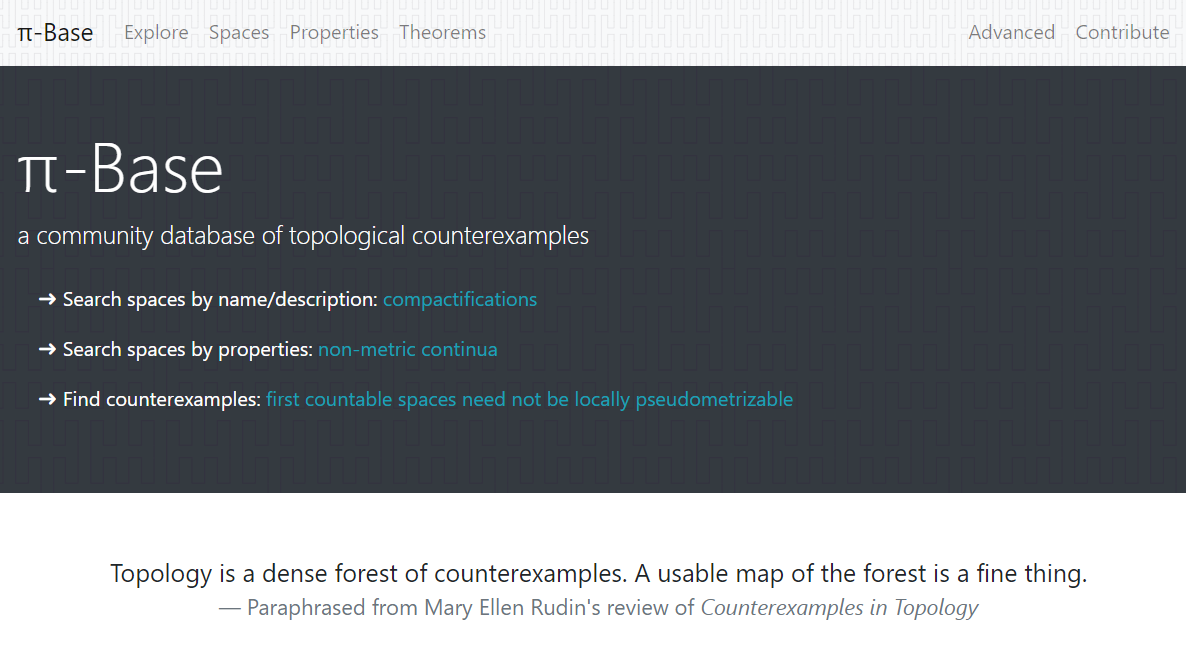
π-Base
A community database of topological theorems and spaces, with powerful search and automated proof deduction.
 cursive flume
I have a question regarding GR diffgeo. some authors define minkowski spacetime as a four dim manifold and some as an affine space, however I can't see why are they equivalent
I found this, but don't understand how the metric structure turns the mfd into an affine space 
cursive flume
it seems to boil down to the question of proving affine space=> manifold,but not the other way around
but idk how to prove that
sweet wing
it isnt rlly an affine space in the non-sr case isit?
gritty widget
If X is the projective space (seen as a prevariety) $P^1$ over an algebraically closed field k and we have the open cover by two copies of $A^1$, call them $X_1, X_2$ that glue together on $A^1 \ {0}$ by $x \mapsto 1/x$. I want to show directly that $\mathcal{O}_X(X) = k$. The definition in Gathmanns notes say that $\mathcal{O}X(U)$ is the set of functions $\varphi \colon U \rightarrow k$ which have the pullback by the maps $pi_i \colon X_i \rightarrow X$ in $\mathcal{O}{X_i}(X)$ on the patches. See 5.4 in https://www.mathematik.uni-kl.de/~gathmann/class/alggeom-2019/alggeom-2019-c5.pdf. I realize this is about showing that regular functions on each patch are polynomials $p(x)$ and that somehow we end up with $p(x) = p(1/x)$ implying that $p$ must be constant, this seems to hold over where you glue. But how do we show that this must hold globally $\mathcal{O}_X(X)$?
Somehow with this cumbersome notation I can't really show it, but I understand the proof in say Hartshorne
gentle ospreyBOT
Görtz:
gritty widget
Should I rephrase the question or add more explanations?
 snow gull
need some help. I would say that conectedness in T' implies conectedness in T but the other way around is not necessarily true. Am I correct? Am i missing something?
 quiet pilot
Seems correct
snow gull
But how do I prove my 2nd "claim"?. For the first one it makes sense that if every subset of X in T' is not open and closed at the same time (since X is connected by assumption) then none of the subsets of X in T will be closed and open at the sime time since every possible subset in T is also in T' because it is contained in it so it must be connected. The other way around i can't seem to justify it properly. Is my 1st justification even good though?
quiet pilot
I think you are correct, but you can even do it with definition
Simply show X not connected in T implies X not connected in T'
If X not connected in T we have X=A U B where A,B are in T, but then they are also in T' so X not connected in T'
For the other way around just find a counterexample
snow gull
Im sorry but I don't quite understand how showing X not connected in T => X not connected in T' is equivalent to my statement (X connected in T' => X connect in T).
gritty widget
contrapositive
snow gull
oh I see cuz the direction of the implication reverses
For the counterexample am I correct if I choose X=|R and T=usual topology and T'= left open topology.
In T |R is connected since u can't split it in 2 open subsets(A,B) such that AUB=|R since u would always be missing the point between the intervals, but in T' it can be disconnected if you chose A=]-infty,a] and B=]a,+infty] and |R=AUB. Am I correct or did I fail somewhere?
quiet pilot
Showing R is connected isn't that simple, A and B doesn't have to be intervals
But your example works if you just let T be the trivial topology instead
quiet pilot
Trivial topology is the topology where the only open sets are X and empty set
snow gull
oh I see, ty
quiet pilot
Are you using Munkres btw?
snow gull
yap
quiet pilot
Ah that's a nice book
You can usually find counterexample to these type of things by considering the coarsest topology i.e trivial, vs the finest i.e the discrete topology
snow gull
I see, should have thought about those, since they are simpler
quiet pilot
No need to get bogged down in technical proof of showing R is connected
snow gull
so just to make sure just need to change T to trivial? T'=left open works out and my example is not wrong?
quiet pilot
Yeah because every set is connected in the trivial topology
But R is not connected in left-open one as you noted
snow gull
Nice I was just worried about the intervals cuz in one we have infinity closed and in the other we have infinity open
is that not a problem?
quiet pilot
Oh wait
Infinity is not a point in R
Just let B =(a,infty)
It is open in left-open topology
All sets of form (a,b) are
snow gull
so the set [a,infinity] is open in left open? how?
quiet pilot
You get the left-open topology by letting the intervals of form (a,b) and (a,b] be basis elements.
snow gull
oh I see
quiet pilot
You can actually just let (a,b] be basis elements I believe
quiet pilot
Because you can write intervals (a,b) as a union of intervals (a,c]
so the set [a,infinity] is open in left open? how?
@snow gull Should be (a,infty)
snow gull
how tho? wouldn't u always be missing b?
quiet pilot
b is not in (a,b)
snow gull
guess im retarded
quiet pilot
Nah takes a while to get a good grip on topology
snow gull
I guess my problem is with the definition of the left open topology, is it true that (a,b] and (a,b) are both open in left open
if yes then it all makes sense
quiet pilot
Yes they are both open
snow gull
thx a lot
quiet pilot
Np
As I mentioned above you can let the intervals of form (a,b] be the basis for left-open. It follows that the left-open is finer than regular topology on R by the comparison test in one of the early chapters
Because in every basis elt (a,c) of R, you can fit a basis elt (a,a/2+c/2] of left-open topology
snow gull
I see, makes sense, thx
gritty widget
linearly independent in the space of vector fields along gamma, right? since it doesn't really make sense to say you have 2n vector fields which are linearly independent at each point of an n-dimensional manifold
(do carmo riemannian geometry, page 112)
i'm used to reading "linearly independent vector fields" as "vector fields whose values are linearly independent in each tangent space" so i just wanna be sure i'm not going crazy
nvm i see it, worked some details and it makes sense
modern trail
won't f(0) in the second part just be an empty set
being open
ah no
i am dumb
nvm
river granite
Is Do Carmo's RG good? I liked his book on curves and surfaces and read most of it, but didn't use it as a main text (I followed some course notes instead).
gritty widget
@river granite i've read up to chapter 4 (on 5 rn) and i think it's good. it doesn't require a ton of theory to jump into, but you should be comfortable with notions from smooth manifold stuff since the intro chapter he gives doesn't really cover everything you need for the text (even though he says it does lol). explanations are usually pretty clear, and he gets right to the point with things
exercises are good, but a lot of them come with hints that are basically "fill in the details to the solution" hints or just full on solutions
also notation abuse is rampant
river granite
so it's similar to the curves and surfaces one in those last two aspects lol
gritty widget
the exercises cover a ton of material
river granite
I know some smooth manifolds so I guess I'll check it out
gritty widget
i know the later chapters go into fundamental group and covering space stuff, so it might be good to know that too
the chapters are short but he really does just get right to the point. there isn't a lot of time spent covering extra semi-related stuff (cough lee cough) - probably my favorite part of the book
river granite
the chapters are short but he really does just get right to the point
that's my favorite kind of book lmao
gritty widget
although sometimes he leaves out steps in a computation and you'll be staring at it going "what the fuck??"
at least i did a few times
ricci curvature ptsd
i guess that's my short review of the book
while i haven't read them yet, i've heard that the later chapters are really good
 loud scarab
How do I get the x,y,z in terms of u's and v's so that I could calculate the Jacobian derivatives? When the equations are given to me this way I don't know how to get an expression for the partials of x and y with respect to u and v
is there a way to parametrize this?
gritty widget
If $X_1$ and $X_2$ are affine varieties then I have shown that the disjoint union $X_1 \sqcup X_2$ has coordinate ring/global sections isomorphic $A(X_1) \times A(X_2)$. How do I show that it is in fact an affine variety and not only a pre-variety?
gentle ospreyBOT
Görtz:
gritty widget
$A(X_1) = k[x_1, \ldots, x_n]/I, A(X_2) = k[y_1, \ldots, y_m]/J$ then $A(X_1 \sqcup X_2) = A(X_1) \times A(X_2)$ is also finitely generated but how do I conclude that $X_1 \sqcup X_2$ is isomorphic to an affine variety?
gentle ospreyBOT
Görtz:
gritty widget
I know that if $X, Y$ are affine varieties then they are isomorphic if and only if their coordinate rings are isomorphic. But if $X$ is a pre-variety (not necessarily affine) and $Y$ an affine variety then I can't conclude that if they have isomorphic coordinate rings then they are isomorphic, can I?
gentle ospreyBOT
Görtz:
sweet wing
@loud scarab you dont necessarily need x,y in terms of u,v to compute the jacobian
loud scarab
but how do i get the derivatives of x and y with respect to u and v as functions of u and v only? @sweet wing
sweet wing
If you have $\frac{\partial u}{\partial x}$, what does it tell you about $\frac{\partial x}{\partial u}$
gentle ospreyBOT
ariana:
loud scarab
I use the fact that the jacobian of the inverse function is the inverse matrix and try to go from there?
sweet wing
yesh
 pastel linden
In this paragraph, Spivak is establishing that invariance of domain forces the neighborhoods of points needed to be homeomorphic to R^n to be open, but I don't really understand the necessity of this theorem to prove that
if we have a neighborhood of p homeomorphic to R^n, can't we just take an open subset U of R^n, and by the continuity of the homeomorphism we know that f^-1(U) is open in the neighborhood of p and so it's an open neighborhood?
e.g. the neighborhood contains an open set containing p, and so the definition refers to open neighborhoods
I'm probably just confusing definitions, he just sort of jumps directly into things
pastel linden
also if we're going by this stuff then there are a lot of manifolds that he just doesn't consider manifolds (e.g. SU(n))
pastel linden
i realize now that I'm confusing what he wrote
this is his definition of a manifold M
he has a bit where he essentially just wrote the proof I wrote determining that it doesn't matter whether we use neighborhoods or open neighborhoods since every neighborhood contains an open neighborhood with the same property
but then he says that the neighborhood "must" be open, which is the confusing part
could you explain why invariance of domain prohibits this? if openness is a topological property then I don't see the issue, since f(U) would just be closed which is true
oh wait I'm dumb, it wouldn't be both closed and open and so there is no such homeomorphism
never mind still confused
the SU(n) example was more a reference that invariance of domain only applies to subsets of R^n, but I guess if you define a metric such that the set is isomorphic to some subset of R^n we can still consider it a manifold
oh, I see
and then invariance of domain just makes it so those neighborhoods happen to coincide exclusively with open neighborhhods
 nimble flower
Is the image of a disconnected set under a continuous function, disconnected?
gritty widget
zero function on [0,1] cup [2,3]
any constant function will always have a connected image
 pastel linden
you do have that if the function is not continuous then the image of a connected set is not connected
gritty widget
squishing disjoint blobs together gives you one blob
nimble flower
sadly i dont have a homeomorphism 😦
Just a continuous bijection
gritty widget
is it from a compact space to a hausdorff space 👀
pastel linden
continuous bijection is homeomorphism in hausdorff I thought
nimble flower
it's from a discrete, closed subset of R^n to R^n
i'm trying to show there cant be an uncountable subset. so i suppose it exists, then i get a bijection with R^n. since it has the discrete topology i get a continuous bijection
pastel linden
i have spent like 30 minutes staring at this and I have no fucking clue where this argument comes from
where does he get the existence of the one-to-one continuous map from
gritty widget
(x_1,...,x_m) -> (x_1, ..., x_m, 0, ..., 0)
gritty widget
prove it 😌
pastel linden
take an open ball around literally any point?
although I don't see how this negates the possibility of them being homeomorphic unless I'm missing some really obvious fact
gritty widget
invariance of domain
i think cant use that unless n = m lmao
:(
why am i not seeing this lol

pastel linden
I know, this seems very non-trivial despite spivak pretending it is
nimble flower
if A is a countable subset in R^n with the induced topology, that induced topology should be the discrete topology, correct?
nimble flower
ah true
fk topology
not as bad as analysis - but things that i want to be true arent true lol
pastel linden
but knowing that one specific map is not open doesn't imply that there can't exist any homeomorphism
I assume there's something with invariance of domain but I don't see how to apply it here
gentle ospreyBOT
slimvesus:
pastel linden
oh I see
so R^n is homeomorphic to the R^n subspace of R^m. Assume R^n is homeomorphic to R^m. Then if the R^n subspace is homeomorphic to R^n, it's also homeomorphic to R^m by composition. Then since the R^n subspace has the same ambient space as R^m, we can use invariance of domain to show that there is no way they can be homeomorphic which leads to a contradiction
gritty widget
just spivak being spivak
pastel linden
no you helped a lot, let me tex something proper up and then I'll post it if it's nonsense
pastel linden
thank you spivak
gritty widget
just... define a manifold with dimension in the definition?? you lose no generality
ok, maybe you could get some stupid shit like a line disjoint union sphere
but like
who cares lol
pastel linden
I think tu's intro just says "we hold back on proving that topological dimension is well defined until chapter 7" when manifolds is chapter 2
gritty widget
i think there's a definition out there that allows that lol
pastel linden
We recall Brouwer’s famous fixed point theorem: Theorem 1 (Brouwer fixed point theorem) Let $latex {f: B^n \rightarrow B^n}&fg=000000$ be a continuous function on the unit ball $latex {B^…
tao goes over why the proof is funky in this post a bit
gritty widget
tu allows stupid stuff like sphere disjoint union a line to be a topological manifold
pastel linden
well so does spivak with metric space nonsense
gritty widget
it literally never comes up in his book (intro to manifolds) though
pastel linden
for some reason he doesn't consider non-metrizable spaces and whatnot
gritty widget
pastel linden
which I guess makes sense from an intro pedagogy thing
gritty widget
all manifolds are metrizable so who cares 😌