#point-set-topology
1 messages · Page 174 of 1
 marsh forge
 dim meadow
You should feel ashamed
marsh forge
like the closed sets here should be the image of c right?
 sleek thicket
Yeah that's the idea
sleek thicket
I don't think you can write down an axiomatization of closed sets in one line
dim meadow
My favorite alternative definition is a limit of a sequence as an extension of a map from the natural numbers to a map from the naturals union infinity
sleek thicket
just define it as the one point compactification of N
dim meadow
It's just the one point compactification
dim meadow
Nah
sleek thicket
I think that should be the same right?
sleek thicket
Hmm any set of terms of a convergent sequence in R has the same topology right?
Like you always get N union {infty}
Sorry one with infinitely many distinct terms
marsh forge
yeah ahaha
sleek thicket
and yes because the sequence gives a continous bijection
between compact hausdorff spaces
If you throw out duplicate terms
sleek thicket
yeah haha
dim meadow
Except for constant sequences
marsh forge
eventually constant
dim meadow
Yeah
marsh forge
but the image should work
like if a sequence is N->X
then the image of that map will work for eventually constant sequences
i think
sleek thicket
yeah
sleek thicket
Pass to an injective subsequence
Bijective continous map between compact hausdorff spaces
marsh forge
any section of N->X will do
dim meadow
What do you mean?
sleek thicket
like what about X=N with the indiscrete topology
sleek thicket
I guess you have to figure out what convergent means
dim meadow
For what?
marsh forge
no wait
sleek thicket
The image of a sequence which isn't eventually constant is homeomorphic to N
It works if X is hausdorff I think
marsh forge
okay i think the issue might be that all but finitely many points must be distinct in terms of the open sets
dim meadow
No sham
marsh forge
so hausdorff will work
sleek thicket
no?
dim meadow
Homeomorphic to N union infinity
sleek thicket
Ah yeah sorry
dim meadow
Wait do you mean the image with the limit?
sleek thicket
Image together with limit is homeo to that
Yeah sorry I haven't really eaten today
dim meadow
Okay
sleek thicket
Was about to get dinner
marsh forge
yeah you don't fully need hausdorff
I think you just need that those points can be distinguished by open sets
dim meadow
Oh I see what you guys are talking about now
marsh forge
anyway im being rude
sleek thicket
yeah so suppose you have a space X and a sequence which isn't eventually constant
marsh forge
and typing during dinner
sleek thicket
wlog pass to a subsequence where the map N -> X is bijective
If you extend with the limit to a map from N union infinity, do you get a homeomorphism?
err I guess you also need to throw out the limit if it shows up in your sequence
But anyways that's the question I was talking about
dim meadow
Can the image not be hausdorff?
sleek thicket
Yeah it could not be
Take X = N union infinity with the indiscrete topology
and your sequence is xn = n
I guess the issue is with the meaning of convergent
If you only require that a limit exist then this is a counterexample
dim meadow
Oh I see
sleek thicket
Let φ : R -> S be a graded ring homomorphism. Let U = { p in Proj S : p doesn't contain φ(R_+) }. Hartshorne asks me to show U is open in Proj S and φ determines a scheme morphism U -> Proj R
I think I see why U is open
The complement is every homogeneous prime in Proj S which does contain φ(R_+). This is the same as containing the ideal J generated by φ(R_+). Since R_+ is generated by homogenous elements and φ is degree preserving, this ideal J is homogenous, and so Proj S \ U = V(J) is a closed set
The morphism f : U -> Proj R is presumably defined on points by pulling back along φ (which is well defined by the condition in the definition of U)
What about on sheaves? Probably, like, compose with the map φ induces on localizations somehow. Idk this is very similar to Spec and I don't want to do it
Maybe the easiest thing would be to cover by distinguished opens and glue, lol
The point is that on stalks φ is defined by the natural map R_(φ^(-1)(p)) -> S_(p), which should be enough to determine it everywhere
actually maybe I should prove that...
sleek thicket
oop I mean section of F
sleek thicket
Okay, next part of this problem: show that f can be an isomorphism even if φ isn't. Show this by showing that if φ_d : R_d -> S_d is an isomorphism for all d sufficiently large, then U = Proj S and f is an iso
 cunning coral
I suppose this is less of a math question and more of a physics question per say but figured I'd ask here as well since I haven't gotten a solid answer from other places and I know the people here always help me! So, if I were a being in either a positively or negatively curved space, would I perceive that curvature? Would it still be locally Euclidean? Is it even relevant to think about the perception of such spaces? Still sort of new to these areas just pondering somethings. Thanks a ton.
cunning coral
I suppose perceive in this sense is visual
 ivory dragon
from a "small enough" perspective it'll just resemble standard flat euclidean geometry
like how the earth "appears" flat from a human scale
but the effects of the nonzero curvature can be observed
like the famous example of boats disappearing over the horizon demonstrating curvature
marsh forge
You can also view it in geodesics iirc
cunning coral
Ok so maybe I've been thinking about it wrong then, existing in a curved space is analogous to being a person on the Earth?
marsh forge
Earth is curved
cunning coral
I suppose I was thinking there was some difference for whatever reason
ivory dragon
the earth is an example of a locally euclidean surface
cunning coral
Ok that makes a ton more sense then.
ivory dragon
the universe (probably) is as well
cunning coral
Yeah spheres are manifolds
ivory dragon
effects of curvature may be observable but it wont be easy
cunning coral
So it would then change if say the topology of the space were such that it wasnt a Euclidean manifold?
ivory dragon
we've currently estimated curvature to within 0.02 i believe
if the universe isnt locally euclidean our entire understanding of it is wrong
(at least our relativistic understanding)
cunning coral
Well I'm not talking about OUR universe here
marsh forge
i mean this is up to what you mean by locally euclidean
like its not clear that we exist in a continuum unless im mistaken
but the models work fine
cunning coral
Well I've been trying to wrap my head around manifolds and such, and I get that you can be locally Euclidean. But then when things like Hyperbolic manifolds enter the fray
Its hard to think about in terms of perception, which maybe isnt even a useful idea but
And I think the last statement cleared up a bit of my understanding, so you will always be able to find a part of the space that is "locally" Euclidean to some small degree of area?
 honest narwhal
The universe is the moduli space of elliptic curves
cunning coral
but that doesn't necessarily mean its the same size every time
ivory dragon
well if its a euclidean manifold
locally hyperbolic surfaces exist but theyre not really used physically for this specific sutff
if you want to disucss their mathematical structure, it really just becomes a mathematics question
not a question about "universes"
cunning coral
Yeah I'm not talking about use here, its more a thought experiment tbh
ivory dragon
i mean okay
its worth noting that "most" manifolds are homeomorphic to some hyperbolic manifold
(of small enough dimension)
that said i dont think this has any physical uses
it was pivotal in proving the poincare conjecture though
for whatever thats worth
honest narwhal
A million dollars apparently
cunning coral
Ok I think I'm understanding a bit more now.
Does the area that defines "locally" change with different curvatures?
ivory dragon
curvature (in the context of euclidean geometry of the universe) is a measure of how "different" local geometry is from global geometry
if local and global geometry coincide in a euclidean manner, the curvature is 1
roughly, a curvature > 1 represents "more spherical globally than locally" and a curvature < 1 represents "more hyperbolic globally than locally"
this isnt a very good definition
but it captures the rough idea and is what physicists use informally
cunning coral
I think that first statement clears up a lot for me
This cleared up a lot of misunderstandings I had, thanks a ton. I'll probably have more questions in the future.
sleek thicket
@honest narwhal the universe is an elliptic curve
I'm doing quantum topology/algebra now so I'm basically a physicist
marsh forge
tqft?
 elder yew
Sloth King hath speaken, all raise
honest narwhal
shamrock is going the Max route but from another angle
honest narwhal
Oh so funny thing along those lines
One person I know who at the time was a topology grad student (gauge theory stuff) was sorta telling me about some topologists at Notre Dame
And in particular was telling me to keep an eye on Stefan Stolz
But with the disclaimer that he doesn't know about Stolz's recent work (which he said might be an iffy sign)
Now thing is apparently Stolz recently has gotten into TQFT stuff
And uh
Benson does not believe in the stuff lol
I didn't know this and I brought it up and he was like yeahhhhhh idk fam the quantum business is sorta... like it's pretending to be physics but not really
And I was like oh he's quantum rip
marsh forge
benson hates everything fun
honest narwhal
I only know one thing about the area tbh, like apparently Frobenius algebras are the same thing as 2D TQFTs or whatever
Maybe replace Frobenius with another adjective idk
marsh forge
It also assigns invariants to closed manifolds
in particular if we are doing tqft over k then every closed manifold is an endo of emptyset which maps to an endo of k which is an element of k
honest narwhal
But yeah it's definitely not my thing but yeah he's very not fond, I remember in his rep theory class (I just talked to him last week and apparently he's teaching rep theory this fall again! Might even write a book) which I audited for 2 weeks he was all
See here we can actually go to the board and solve a problem, write down the irreps of S_3. Don't be like those people who when it's time to solve a problem are just like "uhhhh the quantum"
And in my mind I'm just thinking damn idk who he's calling out but he's calling someone the fuck out
Actually Max I wonder what you would think about this business, there's a book I'd like to read at some point for fun
Though this is somewhat lower on my list lmao
Wait actually you don't like manifolds buuuut
@sleek thicket
sleek thicket
not tqft max
Knot Theory + noncommutative algebra
because the operad stuff fell through
Now I get to think about hopf algebras a lot
I get to use words like "quantum enveloping algebra of sl(2)"
marsh forge
ew
sleek thicket
Yeah I'm feeling pretty meh about it so far
marsh forge
i find it hard to study purely algebraic (or categorical) stuff
sleek thicket
That's not really my problem with it, I'm a huge fan of algebra
like I would be happy just doing atiyah macdonald problems all day
there's a nonzero chance I'd be doing that this summer if not for this reu
It's just this flavor of algebra that I'm not so hot on
The more purely categorical stuff I do (and the more other stuff) the less interested in it I am
marsh forge
ah fair enough i guess
honest narwhal
@sleek thicket did you look at the book I sent?
sleek thicket
Oh no sorry I'll peep it
Hmm my phone doesn't like that link
Can you post a pdf directly?
honest narwhal
This is what he recommended at the time, looking it over now it seems like it basically presents a lot of difftop stuff but for singular spaces
sleek thicket
That sounds pretty neat
I haven't studied any of that but the idea is appealing to me
ooh I am also interested in learning about exotic spheres
Like why they exist and what's up with the monoid structure
Seems like it does a lot of (co)homology stuff I've seen before but also some characteristic classes stuff which I know nothing about but want to learn
 grim coyote
how do i build a 3-sphere topologically
is it like, a wedge of S^2s and you add in some 3-cells?
and is there an intuitive way to describe how to build spheres topologically
marsh forge
2 cells in each dimension
think about how you build a 2sphere like this
and then pretend that it makes sense for 3
sleek thicket
max how do I put a 2 cell in a dimension ≠ 2?
marsh forge
lmao
sleek thicket
Differential Topography and Geography
ivory dragon
is it just a subset of the diff geometry of a 2-manifold
or is it actually something that deserves a distinct name
oh rip
if it's not math then it's not "a thing"
 quiet pilot
In a metrizable space is it true that a sequence an --> a iff d(an,a) --> 0 where the latter convergence is in the standard topology on R?
 gritty widget
i believe so
how have you defined "a_n -> a" in your topological space?
if it's just "for all open U containing a, there is an N such that n >= N implies a_n in U" then yeah
quiet pilot
Yeah
gritty widget
the proof should be some definition pushing
i wrote something down and it was just applying definitions, nothing clever
(this is assuming that i haven't made any mistakes, which i am prone to doing at 3 am)
quiet pilot
Yes I did something similar, but I was surprised why the standard topology appeared
I guess it is because it is very conected to the definition of open sets in a metric space
gritty widget
topological stuff in a metric space is basically the same as the usual stuff in R but with |x - y| replaced with d(x,y); metric spaces are nice like that
quiet pilot
That's nice to know
gritty widget
in particular, things like convergence are particularly nice in metric spaces (limits are unique by hausdorffness, functions are continuous iff they preserve continuity, by first-countability, and so on)
quiet pilot
Yeah I needed this "lemma" to show convergence in the uniform/prod topology in R^\omega
For some specific sequences
quiet pilot
Haha what about it?
gritty widget
back when i took topology i found R^\omega and its metric space properties really hard to intuit for some reason
would be lying if i said i have a good feel for it now
quiet pilot
I just started with Munkres so I don't feel like I have any intuition at all right now
It was a nice result that R^ω was metrizable in the product topology though
gritty widget
is this section 20 problem 4? the one with all the sequences?
im staring at my copy right now lol
quiet pilot
Yeah
gritty widget
you can definitely push definitions here and get far, but i think it'd help if someone with a bit better intuition than me explained stuff on this
quiet pilot
Well I managed to solve it thinking of everything as converging in a metric space
The tedious part was showing everything in the box-topology
gritty widget
with the product topology yeah, just push metric space definitions
the box topology is something else...
quiet pilot
And I used that all three topologies were comparable
So I didn't need to do 12 small exercises in 1
gritty widget
yeah, that's a smart way to do it
quiet pilot
Box topology felt intuitive at first, but the more exervises I do, I realize it has way too many open sets
gritty widget
that's generally the way to look at it
the way i see the box topology vs the product topology is that you really want it to be true that a function's components are continuous iff the function is continuous
projections are by definition continuous, so a composition gives you one direction
but if all of the projections are continuous and you have too many open sets in the product, then the open set whose preimage you look at by f might be not open
that's really vague but i dont wanna type the LaTeX right now
quiet pilot
Yeah Munkres did that proof in an earlier section
Usually it really cuts down work when you can look at things componentwise I guess
gritty widget
consider a function $f : Y \to \Pi_{\alpha \in A} X_\alpha$ with component functions $f_\alpha$. no matter the topology on $\Pi_{\alpha \in A} X_\alpha$ the projections $\pi_\beta: \Pi_{\alpha \in A} X_\alpha \to X_\beta$ are continuous, so of course if $f$ is continuous then $f_\alpha = \pi_\alpha \circ f$ is continuous. \
on the other hand, suppose $\Pi_{\alpha \in A} X_\alpha$ has the box topology, and suppose that each $f_\alpha$ is continuous. we want to show that if $U$ is open in $\Pi_{\alpha \in A} X_\alpha$, then $f^{-1}(U)$ is open in $Y$. the thing is, the box topology has a ton of open sets, so your $U$ might not be nice enough to satisfy this (munkres has examples). therefore you want to "cut down" on the number of open sets of $\Pi_{\alpha \in A} X_\alpha$; this is done by giving the product the coarsest topology with respect to which all of the projections are continuous (the product topology!)
oh my god that is some awful formatting
ouch the prod does not look nice inline
marsh forge
use $\Pi$
 gentle ospreyBOT
MaxJ:
quiet pilot
Wait, about the last row
gentle ospreyBOT
TTerra:
quiet pilot
Wasn't projections always continuous?
gritty widget
in either of the two main topologies (box, product) yeah
quiet pilot
Ah ok
gritty widget
the keyword is coarsest
quiet pilot
Right, you need the cartesian product of all unvierses and an open set in $$X_\beta$$ to be open
gentle ospreyBOT
AoiKunie:
gritty widget
it might be an exercise in munkres to verify that the product topology is indeed the coarsest such topology
quiet pilot
And this is basically the product topology
quiet pilot
That was a nice way of looking at it
gritty widget
that's how my topology prof viewed it
quiet pilot
Yeah I'm self-studying so I'm missing out on lectures
gritty widget
munkres is unfortunately a bit dry
so you're probably going to have to look elsewhere for motivations
quiet pilot
I'm taking algebraic geometry in the fall so thought topology would be good to know for that
Well I managed to read Rudin so I'll survive
gritty widget
im not sure what algebraic geometry constitutes but i have a feeling topology would be useful for it
off of the word "geometry"
quiet pilot
You use something called the Zariski topology to study things so I guess so
I also study topology because it looked like a really fun subject
gritty widget
this is a bit past my algebra knowledge, so ill have to wait a bit, but it looks interesting!
quiet pilot
My algebraic geometry class has no prerequisites so it's a bit uncertain what it entails
Except an introductory algebra course
gritty widget
maybe it wont use too much topology then
then again
prerequisites are sometimes kinda... wrong
quiet pilot
I think they just really don't like prerequisites
Yeah my institution has way too few of them on most courses
But it's good because then if you self study some subject you can still take the courses
marsh forge
depends what you learn
gritty widget
example: the undergrad differential geometry course at my uni does not have topology as a prerequisite, despite being very topology heavy
big drop rate
i guess having the freedom to take more courses is nice
gritty widget
hm?
gritty widget
no riemannian geometry with notation soup
quiet pilot
Most of the math majors here even skip real analysis
marsh forge
by here
quiet pilot
Which isn't mandatory for some reason
quiet pilot
Yeah
marsh forge
more power to them
gritty widget
how is analysis not required
marsh forge
analysis is bad anyway
quiet pilot
That's for the people who want to do stats/applied though
marsh forge
i study topology
gritty widget
what kind of topology?
marsh forge
algebraic
gritty widget
ooh, sounds fun
i had a very slight introduction to algebraic topology in my topology course, always wanted to learn more
only AT course at my uni is a grad course though
marsh forge
its a good subject
sleek thicket
max is an algebraist, just a very topologically minded one
it's called the fundamental group, so studying it is group theory
marsh forge
This isnt entirely false at this point
 hexed holly
Ok so I'm looking at the spectral sequence of a fibration in Fomenko-Fuchs
He gives a requirement
I don't understand why it has to be homologically simple
If you look at the proof where this condition is used, you see
my question is why can't we fix one F_i use noncanonical isomorphisms to identify all H_q(F_i;G)
this is the statement of the theorem
@marsh forge
marsh forge
hmmm
normally one requires a that the space have simple pi_1 action but this is looser
but should be fine
There was some remark ive read about which of these depends on that condition
give me a second to fish out my more concise
hexed holly
interdasting
marsh forge
oh maybe not
Ah yes okay
So one can state the theorem in greater generality (and May does)
Using local coefficient systems
I.e.
$E_2^{p,q}=H^p(B,\mathcal{H}^q(F))$
gentle ospreyBOT
MaxJ:
marsh forge
And in order to get $\mathcal{H}(F)=H(F)$ we need homological simplicity
gentle ospreyBOT
MaxJ:
hexed holly
hmm
I guess I'm just interested in what part of the construction specifically breaks down
if we use noncanonical identifications
marsh forge
Nothing breaks down, these local coefficient systems work fine
you just need simplicity to be able to use H instead of mathcal{H}
hexed holly
thanks
marsh forge
https://pi.math.cornell.edu/~hatcher/AT/ATch5.pdf page 530 here also gives some explanation
 cursive nebula
hey guys, i have a question about Homotopy.
i just started studying about it today and i'm looking at the examples my teacher made. these are the class notes:
he proved that there's a Homotopy F between identity function from R^n \ {0} and that other function Phi
Phi(x) = a versor with the same direction as x
so i understand everything except the second and third line in purple
i think he wants to prove that F (the homotopy function) is continuous
and he's doing <F(x,t), F(x,t)> ?
so, the scalar product by itself?
and he gets a positive number and concludes that it's continuous?
i don't get it, can you help me?
cursive nebula
OH NVM I GOT IT !!
 sweet wing
If we have a sequence of discrete subgroup of PSL$(2,\mathbb C)$, ${G_n}$, they converge geometrically/polyhedrally to $G$ if their dirichlet fundamental polyhedra centered at some point $O$ converges to the dirichlet fundamental polyhedra of $G$
Is there some space such that the manifolds $\mathbb H^3/G_n$ also converge to $\mathbb H^3/G$? For the algebraic limit this space is like some teichmuller space of some surface
gentle ospreyBOT
ariana:
 cursive flume
can someone explain me the proof please?
gritty widget
$x^i \circ x^{-1}$ is the $i$th projection function on $\bR^d$, which you can see on the right. the $j$th partial derivative of this (still as a function $\bR^d \to \bR$) is the kronecker delta $\delta^i_j$, which you can see by, for example, picking out the $j$th coordinate of the gradient of $x^i \circ x^{-1}$. the first equality is just the definition of partial differentiation with respect to a coordinate system. the second equality is the thing i just said.
gentle ospreyBOT
TTerra:
gritty widget
anyways @cursive flume there's the explanation
 uncut surge
it's just not the standard font i guess
i suppose there's some individual settings? didn't know about that
cursive flume
ehm,sec let me understand what you wrote, im a bit confused
gritty widget
go to #bots and you can edit your preamble by typing
,preamble (write here the things you want to add)
(gotta say i find the standard font more readable but i think i'll stop interrupting your chart-business now)
cursive flume
@gritty widget wait, I think I am stuck here
why does this have to look like that?
cause you said this in words
if I accept that, then it's clear
for me it's not trivial that the x^i x^-1 just does that
what x^-1 does it takes me back to the chart right?
gritty widget
$x^i = \pi^i \circ x$
gentle ospreyBOT
TTerra:
cursive flume
can i evaluate formally x^i x^-1 (x(p)) as x^i(p)?
$(x^i \circ x^{-1})(x(p))=(x^i(x^{-1} x(p)))=x^i(p)$
can I do that?
gentle ospreyBOT
ProphetX:
gritty widget
that is true
$x^i \circ x^{-1} = \pi^i \circ x \circ x^{-1} = \pi^i$ is what i am thinking
gentle ospreyBOT
TTerra:
cursive flume
$\pi^i$ is the projection of the point p into the i-th component?
gentle ospreyBOT
ProphetX:
gritty widget
in $\bR^d$, yes
gentle ospreyBOT
TTerra:
cursive flume
makes sense,thanks!
cursive flume
another maybe trivial question,but I don't see it directly: can one introduce a chart independent basis on TpM?
gritty widget
what do you mean by chart independent?
cursive flume
well,what I do, is construct TpM as a vector space right
then push down the vectors into charts to give them components
but however,there should be vectors which can form basis on TpM
my question is:can one define such a basis that is chart independent?(i think no,but i want to be sure)
for ex if I push down the vectors into charts,then I can get a chart induced basis
gritty widget
i am interpreting this as "is every basis of T_pM induced by some coordinate chart?"
im not sure if that's what you mean
cursive flume
my question is: is choosing a basis of T_pM the same as choosing a chart?
gritty widget
yeah thats basically what i just said; every chart gives you a basis of T_pM, so you're asking the converse
i honestly am not sure
cursive flume
cause choosing a basis on T_pM means choosing some vectors from the vector space
but then you push them down into charts
you can push them into more charts
so you could 'associate' more charts to one basis
no?
if this was not true, this would make no sense:
i'm talking about the same vector/basis in different charts
but then comes the question: can one define a basis without choosing a chart?
gritty widget
without initially choosing a chart? sure, it's a vector space so you can give it some basis
my confusion is probably interpreting some hidden question which you may or may not mean to ask - that hidden question being "does that basis have to come from a chart?"
apologies if i confused you
cursive flume
i'm a bit confused,yes LUL
sorry for these basic questions,but I'm an undergrad physics student doing diffgeo
 small obsidian
You need a chart to represent a vector space in coordinates, that's where you're getting your coordinates from
cursive flume
so what i understand so far is: i have t_pm. i can choose a basis on it. then i can represent any vecotr in tp_M wrt to the chosen basis. note: these are abstract vectors. i can not talk about the coordinates of the vectors yet, until i introduce a chart.
is that right?
small obsidian
But one could say that such a vector space exists without needing to talk about a chart
cursive flume
for example if i give a basis to tpm and want to compute a vecotr with the help of these basis vectors, do I need to introduce a chart?
gritty widget
kaynex's first messsage answers this, i believe
cursive flume
so this is a yes,I guess, right?
gritty widget
if you mean "compute" as in "compute in coordinates" yeah
small obsidian
You don't need a chart to say
(1,2) + (2,4) = (3,6)
But you do need a chart to make that meaningful with respect to the manifold
Even worse, a change in chart usually means a completely different representation of these vectors
gritty widget
and that's the "hidden question" i was thinking of
cursive flume
i can take twice the length for example of the basis vectors
is this meant as 'choosing chart' in r^d?
cause i thought that's called choosing basis
r^3 for example: i,j,k
i can take 5i,3j,4k
is this choosing a chart or a basis? I thought it's basis
small obsidian
It looks like you're choosing a basis
cursive flume
yes
but then I can't see why does every basis have to be induced by a chart
cause I could for instance talk about a basis chart independent
and then when i want to express those basis vectors wrt to a chart,i induce the chart
small obsidian
Choice of basis and chart are independent
cursive flume
yes
but can one chooes a basis without choosing any chart at all?
or they go together
I get it,that I can choose a basis and represent it in many charts,then do the transition between these charts
but do I have to choose a chart, in order to choose a basis? or not necessarely
gentle ospreyBOT
ProphetX:
cursive flume
I have a feeling, that choosing a chart just helps me to rewrite the problem in r^d, but I could work in the TpM without a chart,no?
sleek thicket
I'm not sure agar you mean @cursive flume
T_p M is a finite dimensional vector space, so you can just choose an arbitrary basis
There's no reason for this vector space to be induced by a chart
I think
cursive flume
what I was thinking is: I can define a basis, no matter what
and then if I want to get physical meaning: I push them into charts
sleek thicket
If you have some vectors defined independent of any choice of chart, then they might form a basis, yes
I think I have a good example
Consider the sphere embedded in R^3
At any point, you can look at the tangent plane
And define a basis by thinking of the tangent vectors as vectors in R^3
You're not choosing a chart on S^2, you're using information about how it's embedded in ambient Euclidean space
Does that make any sense?
cursive flume
yes
so the answer is,yes, you can do it, but you can also introduce charts
thanks!
do you know anything about whitney's theorem, which states that every at least c(1) manifold can be made into a c infty manifold? I don't find much about it
sleek thicket
this provides a reference https://math.stackexchange.com/questions/1747752/every-mathcalc1-manifold-can-be-made-smooth

Mathematics Stack Exchange
I heard of a theorem saying that each $\mathcal{C}^k$-manifold with $k\geq 1$ can be made into a smooth manifold, i.e. $\mathcal{C}^{\infty}$ (by restriction of the atlas).
However, I cannot find ...
cursive flume
i'll look up Hirsch's book.thanks
 thorn mica
I have a question what is a softball and how it helps us describe continuity ?
 tepid nest
A softball is what's used in the actual sport "Softball".
@thorn mica What do you know so far about that? Like, what have you read? What are you specifically confused about?
You can formulate the definition of continuity for functions between metric spaces with open balls (i think that's what you mean by soft ball).
gentle ospreyBOT
Abhijeet Vats:
tepid nest
I'm not quite sure if there's anything else you want
gritty widget
ok but what does this have to do with softballs?
thorn mica
All i know is this formula
tepid nest
(i used that joke first shhh)
gritty widget
what book is this
tepid nest
That's Friedrich Schuller's lecture notes, yea?
The Geometric Anatomy of Theoretical Physics?
gritty widget
also, the "soft ball" in your picture is just the ball that abhi was talking about, in the standard euclidean metric space
thorn mica
That's Friedrich Schuller's lecture notes, yea?
@tepid nest yes
tepid nest
Okay yea his definition is very, very specific
He's using the Euclidean metric for describing the soft ball in R^d
But the open ball is something a bit more general in metric spaces
He starts off straight with topology and you won't really understand why he's using that definition of continuity without learning about metric spaces.
Go and learn about that stuff first and then come back to his lectures.
thorn mica
Ok, i am going to do that, thank you
tepid nest
You're welcome
tepid nest
They aren't his lecture notes, someone else basically compiled a script for his lectures.
Anyways, yea, he skips over lots of stuff because they're focused on physics
gritty widget
given the first and second fundamental forms, how does one find the surface specified by them? I can't seem to find a source which i can follow easily
gritty widget
<@&286206848099549185>
 fervent osprey
sleek thicket
fervent osprey
sleek thicket
that's really cute
 tough imp
What's a residue field of a scheme lol
Like isn't the residue field only defined for a point of a scheme
tough imp
no they said residue
the thing has two points so it wouldn't be crazy to me both residue fields are k
since they're schemes over k
Does this seem right to people who know AG? If we look at spec k[s,t]/(s - t^2) (x)_k[s] k[s]/(s - a), let a be non-zero for this and k algebraically closed. Tensoring with k[s]/(s - a) over k[s] means you mod out by the image of (s - a), but this says that s = a so we're looking at k[a,t]/(a - t^2) = k[t]/(a - t^2). From here using the CRT you break this up into k[t]/(t - root(a)) x k[t]/(t + root(a)) (just pick one of the square roots), which is k x k. From here, Spec k x k is two points, that correspond to 0 x k and k x 0 respectively, and the residue fields of both of these are simply k.
Technically I snuck in a detail, we're actually tensoring with kappa((s - a)) but since k[s]/(s - a) is already a field this is just k[s]/(s - a)
sleek thicket
I would rather look at it a different way but this looks right to me
tough imp
Yeet
sleek thicket
my first instinct is that k[s, t]/(s - t^2) is A[t]/(s - t^2), where A = k[s] is a base ring. Tensoring this with some A algebra B gives B[t]/(s - t^2), and taking B = k[s]/(s - a) we get k[s, t]/(s - a, s - t^2) = k[t]/(t^2 - a)
It's basically the same thing though
tough imp
I'm not dumb that the dual numbers residue field is just k again right?
k[t]/(t^2)
yeah I'm way overthinking that lol
Oh so Brendan I think your way is what you need for the generic point case actually
When you look at the residue field of (0) in k[s] you end up with k(s) right?
I think you have to approach it from your way if you want to get anywhere with that
sleek thicket
I'm not sure what you're asking tbh
The residue fields of the dual numbers is k
the residue fields of (s) in k[s] is also k right?
You localize to get k[s]_(s)
But then you just evaluate all those rational functions at s = 0
when you mod out by (s)
@tough imp
Sorry I'm an idiot
tough imp
wut
sleek thicket
Lol
cursive flume
can one derive the definition of continuity on R with epsilons learned in analysis with the help of the continuity defined with topology as:preimage of every open set in the target is open in the domain
for example if we equip r^n with O_std
tough imp
Yeah Prophet that those are the same is basically the content of the topology on R being the one induced by the metric
gritty widget
is a line on a sphere the shortest way to conect three points on can you make infanitely man lines out of two points?
two points
tough imp
wut
you have three points on a sphere
and you want a shortest path connecting them which travels on the sphere?
gritty widget
I meant two say two points
tough imp
well no matter
Yeah the line is
unless they're on opposite sides there's one unique geodesic which means a shortest curve and it's basically what you think it should be
But if they're on opposite sides you can like use any of the shortest lines if you can visualize that. Like you just rotate it
I'm at least 90% sure that's the answer
gritty widget
Ah okay cool
Does that mean there are infanitly man triangles you can make with three points on a sphere?
tough imp
I mean you have to define what a triangle is. If it's formed from geodesics I don't think so unless two of the points are antipodal
meaning they're on exact opposite sides
Also idk if this is the right channel for this
this might be more apt for #geometry-and-trigonometry
Since this channel is more for stuff about topology and manifolds and stuff
Or maybe like even just in #math-discussion c
There's probably people who do non-euclidean geometry stuff who can answer your questions with far more certainty than I
gritty widget
I thought topology was 2d non eucliden geomatry
tough imp
nooooo
Topology isn't really geometry
It's kind of hard to explain
but to give a vague idea you study property of objects which are preserved under like smooth transformations
So like how many holes a shape has
this lets you tell apart a sphere from a donut
Continuous if you wanna be exact
But like if you have a playdoh sphere
you can kind of make a cube out of it
without breaking it
gritty widget
ooh neat
tough imp
so those two are like "the same"
but that's like a vague way to explain it
it encompasses way more and starts to exit stuff you can actually visualize
 midnight jewel
I do actually wonder whether it’s problematic that we usually exemplify topology with homotopy rather than homeomorphisms
like all those classic examples like “donut turning into coffee mug” have a time component along which you do the transformation, but a homeomorphism doens’t need that (e.g. any object is homeomorphic to its mirror image but it may not be easily possible to do such a transformation “continuously”)
\footnote{pet peeve: english doesn’t distinguish between “continuous” in the sense of a continuous function (german: stetig) and “continuous” in the sense of “varying continously in time” (german: kontinuierlich)}
 nimble jolt
Well there are a few things being conflated in the above. Two ways in which spaces can be regarded as "equivalent" are as follows:
- Homeomorphism.
- Homotopy equivalence.
The latter is the statement that there are maps f: X->Y and g: Y->X such that both compositions fg and gf are homotopic to the identity maps on Y and X respectively.
Note that 1 is a stronger notion of equivalence than 2, as for two homeomorphic spaces you can find f,g such that both compositions are literally the identity.
Homeomorphism is perhaps the more natural thing to care about at first, but algebraic topology invariants like homology are in fact invariant under the weaker notion of homotopy equivalence.
Which simplifies calculations greatly, as it allows you to collapse things (see deformation retracts) to turn complicated spaces into simpler spaces in order to more easily compute their topological invariants.
As a simple example where both of these notions of equivalences are relevant, consider the problem of showing that R^m and R^n are not homeomorphic for m=/=n. Computing homology groups directly does nothing, as these spaces are both homotopy equivalent to a single point, which has trivial homology. However if they were homeomorphic, then puncturing each of these spaces in one point that is related by the homeomorphism would keep them homeomorphic. But now these two spaces are homotopy equivalent to two spheres of differing dimensions. These can be distinguished by homology.
tough imp
I used that example because I wasn’t really sure how to talk about topology in general to someone who I don’t think defining a topology would really help
It’s pretty hard to talk about “continuous transformations” so I feel like just giving some sort of rough estimate that can appeal to their geometric intuition is the most successful
Idk, I also felt really on the spot to talk about what topology is, and the only thing going through my head was “open sets, basis, closed sets” which wouldn’t help at all
nimble jolt
yeah mathemagician your explanation was fine, theres a reason thats the standard one given to people without the necessary background
midnight jewel
actually is there a term for a homotopy (between subspaces of some ambient space) which is also a homeomorphism at each time step?
I know isotopy but that implies smoothness right?
nimble jolt
Keep in mind that homotopies are relationships between two continuous functions, homotopy equivalences are a relationship between two topological spaces. But yes an isotopy between two homeomorphisms is a homotopy between these homeomorphisms that is a homeomorphism at each time step.
Or in the context it is usually used, the maps are specifically a family of embeddings from one manifold to another.
midnight jewel
yea I have a (probably bad) habit to mentally identify embeddings and their images
like if you wanted me to write down formulas explicitly I wouldn’t have an issue reframing it mentally but I tend to just think of the image unless I have to do otherwise
nimble jolt
its not bad if you only do it when it is unimportant
as long as you know it deep down haha
 stone pine
is there a name for the relation between a map and a path isometry which maps the input space to the same set of points as that map does? as in, one would say "The path isometry is a/the ____ of the other map"
stone pine
I think I'm missing a term which would help as well, that being a term for the relation between two different maps which map the same input space to the same set of points in the same output space (but don't necessarily map them the same way)
but whatever that relation is, I'm looking for a term for a path isometry that is related in that way to a given other map
(I may be asking nonsense questions here as I have very little idea what I'm talking about haha)
marsh forge
oh wait
i think i see what you mean
You want two maps $f,g:X\to Y$ and paths $\gamma_x$ from $f(x)$ to $g(x)$ for all $x$?
gentle ospreyBOT
MaxJ:
marsh forge
There isn't a real term for this because without any 'coherence' conditions it is kinda meaningless
 spark acorn
I was reading about CW complexes and came across this result . I know a not so easy proof for this result ,is there a easier way to prove this ? Here is the problem , Let $D\subset \mathbb{R}^n$ be a convex compact set such that $\text{Int}(D)$ is non-empty prove that $D$ is homeomorphic to $B_1(0)={x\in \mathbb{R}^n \ | |x|\leq 1 }$ .
gentle ospreyBOT
WhyamIsohot?:
nimble jolt
Take a point p in the interior. For each v in S^{n-1} consider g(v), the sup of t with p+tv in D. This is always nonzero and finite because p is interior and because D is compact respectively. It is also pretty easy to show that convexity of D implies g is continuous.
Then for x in B_1, define f(x)=p+g(x/|x|)x (f(0)=p). This map is obviously injective and continuous, and by definition of g and convexity of D it is bijective. Moreover as B_1 is compact, this is sufficient to prove it is a homeomorphism.
I left some details for you to check there, but none are all that hard.
midnight jewel
in one of my classes we made the following two definitions:
An isotopy is a smooth map $\alpha \colon X \times I \to M$ such that $\alpha_t := \alpha(\cdot, t)$ is an embedding for all $t$. A diffeotopy is an embedding $h\colon X \times I \to M \times I$ that is level-preserving, i.e. of the form $(x,t) \mapsto (f(x,t), t)$ for all $t$.
Then there was the remark that by forgetting about the second component, a diffeotopy always yields an isotopy, but that the other way round this does not hold in general (but that it does if $X$ is compact).
gentle ospreyBOT
Sascha Baer:
midnight jewel
My question is simply, is there a simple example where an isotopy $\alpha$ fails to define a diffeotopy via $(x,t) \mapsto (\alpha_t(x), t)$?
gentle ospreyBOT
Sascha Baer:
midnight jewel
(in all these cases, X and M are smooth manifolds, I is some interval)
 willow spear
If a torus is a topological strcuture, what is it's topological space?
marsh forge
a torus is a topological space
willow spear
so whats the structure?
marsh forge
A topology on a set is a structure on that set that tells you when two points are 'close'
willow spear
yes
marsh forge
it's basically a subset of the powerset satisfaying certain axioms
willow spear
ye
marsh forge
thats the structure
willow spear
so the individual connections between points on the torus is the topological structure?
marsh forge
induced as a subspace of R^3
willow spear
oh wait would it be anything that satifyies teh topological axioms
willow spear
so then whats the space?
how can teh trous be both a topology and a space
a topology is a subset of a space
marsh forge
no
a topology is a subset of its powerset
a topological space is a set with a topology
'torus' refers to a specific set with a specific topoloy
the torus isn't a topology. it has a topology
willow spear
oh ok so what that "topology then"
was it the induced as a subspace of R^3
If you take a look at 7:40 in the video, we he draws the cartesian ooridnate grid...whats the topologcal strcutre and what the topological space?
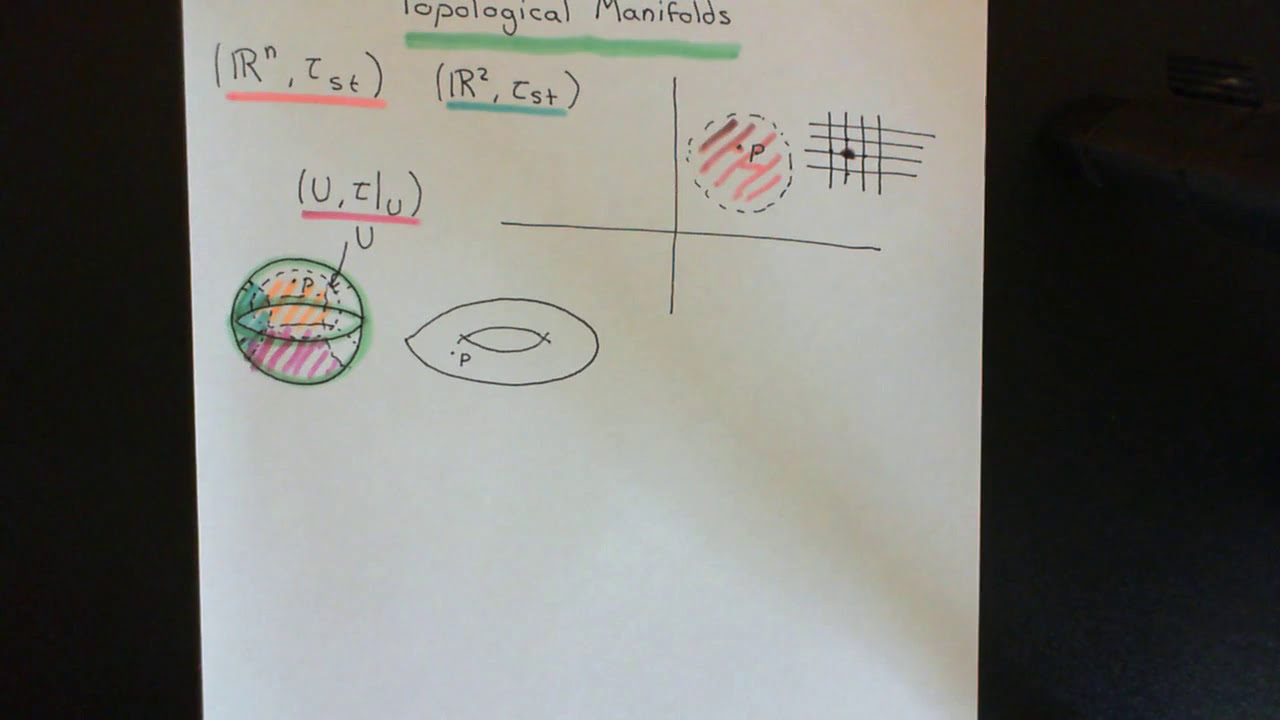
In this video we introduce the concept of a topological manifold.
marsh forge
topology is induced by the metric in R^3
and a subset of a topological space gets a free topology
marsh forge
The topological structure on the coordinate grid is induced by the metric
and the space is R^2
a space is literally just a set with a topology
willow spear
ok thanks makes sense now!
 stiff nymph
Hello
can someone help me out with a simple question
I just wanna check if I got it correct
 gritty widget

gritty widget
What do I need to know about elliptic curve geometry to read this page https://web.math.pmf.unizg.hr/~duje/coell.html
Diophantine m-tuples -
Connections with elliptic curves
I need to have a better understanding of this page, it's for a undergrad research topic with a prof
Like what are the domain and codomain of E? And what does it represent separately from it's implicit description?
No need to explain the stuff with m-tuples, abstract, and the simpler things, I can get that stuff without too much effort
gritty widget
Yes but I mean in this context
The image seems to contain points in R^2
If you look at the page I linked you will see more
Because they're explicitly defined as elements of R^2
sure, but this is talking about a point in the forward image of the rationals as a pair rather than a single rational number so I am a bit confused
because as you noted, it feels like E should be from R to R or a restriction thereof
But clearly the author is using it in a different way
Oh maybe E(Q) is just referring to the rational points on the curve
that would make more sense but it's not notation I'm used to lol
bruh it's a group ;-; I literally didn't read the wiki page smh
E(Q)
gritty widget
jeez it always sends so big lmao
Kinda? It confirms that E(Q) means the rational points on E but I've just never seen that as notation before, it looks very similar to an image
but it's not
thanks for linking the wiki tho I totally overlooked that xD
ohhh
found it
it's a group in the projective plane I think
that's why it has that special notation
it can be E(K) in general where K is a field over which the curve is defined
spark acorn
I'm trying to prove the following result , Let $X$ be a $CW-$ complex then $X$ is path-connected if $X$ is connected . Can anyone give any sort of small hints without spoiling much ? Thanks in advance
gentle ospreyBOT
WhyamIsohot?:
marsh forge
do you know what locally path connected means
spark acorn
yes
marsh forge
do you know that connected + locally path connected = path connected?
if so, you want to prove a CW complex is locally path connected
lmk if you want a bigger hint
spark acorn
do you know that connected + locally path connected = path connected?
@marsh forge Yes I know this result . Lemme see why a CW - complex is locally path-connected
spark acorn
I mean it's quite easy to see the $i-$ th skeleton $X_i$ is locally path connected by some inductive arguments and closure finiteness property and stuff , does it help ?
gentle ospreyBOT
WhyamIsohot?:
marsh forge
Well
Heres a hint
path connectedness is determined by the 1-skeleton
if you prove that claim
then it is pretty easy to see why this statement is true
spark acorn
Yay thanks finally managed to prove it
willow spear
What exactly is the standard topology
?
is iit the one with a ball that surrounds s point or something?
small obsidian
Standard topology on R?
A set X is open if every point has "wiggle room". That is, if every point x is contained in some (a,b) such that (a,b) is a subset of X
@willow spear
 jaunty ferry
Hello all, I'm here with beginner-level questions again, would anyone clarify this Wikipedia sentence
There is no metric that is an extension of the ordinary metric on R.
From https://en.wikipedia.org/wiki/Extended_real_number_line#Order_and_topological_properties
In mathematics, the affinely extended real number system is obtained from the real number system ℝ by adding two elements: + ∞ and − ∞ (read as positive infinity and negative infinity respectively), where the infinities are treated as actual numbers. It is useful in describing...
uncut surge
With the ordinary metric on R, we have d(0,n) = n for all natural numbers n, but if there was a metric d-tilde on the extended real numbers which extended this metric, then, by continuity of a metric:
$\tilde{d} (0, \infty) = \tilde{d}(0, \lim_{n \to \infty} n) = \lim_{n \to \infty} \tilde{d}(0,n) =
\lim_{n \to \infty} d(0,n) = \infty$
gentle ospreyBOT
Lartomato:
uncut surge
But a metric is supposed to assign finite values, not infinite ones, so this cannot be true
@jaunty ferry maybe that helps
jaunty ferry
Wait so the blackboard R is supposed to be R tilde?
Oh wait I get it
There is no metric to R tilde that is an extension to the ordinary metric on ordinary R.
Ok ok that makes sense
Thanks!
uncut surge
ooooh mathbb stands for blackboard
tough imp
Wtf is fraktur
Besides like
The thing you get from mathfrak
Is that like German or something?
ivory dragon
a style of german calligraphy
tough imp
The more you know
If you have an affine scheme X = Spec A, is any affine open subscheme U of X = Spec B for B some localization of A?
Like clearly, there are tons of open su schemes corresponding to localization of A, all D(f) are iso to Spec A_f, but does that extend everywhere?
Actually, I think you might be able to use Affine Communication Lemma to prove this 🤔
Or at least that’s one possible way to try and approach it
spark acorn
If you have an affine scheme X = Spec A, is any affine open subscheme U of X = Spec B for B some localization of A?
@tough imp Nope this is not true in general there are counterexample using elliptic curves ...
tough imp
ooooo, cool
I thought maybe that was too fantastic to be true, but I wasn't ready to try and construct some fucked up counterexample
Do you know of any resource that constructs a counterexample?
spark acorn
Do you know of any resource that constructs a counterexample?
@tough imp Yes! Check out the section 19.11 in Ravi vakil's book (roughly page 538) there is a section devoted to just pathological counterexamples using elliptic curves ...
tough imp
Awesome, thanks so much 🙂
Just checked, I'm gonna have to put that on some sort of note list for after I learn a bit more about elliptic curves haha
Many thanks though
tough imp
Okay, how tf do I show a closed immersion is stable under base change? After showing that the property is local on the target, I've reduced it to the following. Let $f\colon Y\to X$ be a closed immersion, with $X$ affine. Let $g\colon X'\to X$ be any map, with $X'$ affine, then show that the map $X'\times_X Y\to X'$ is a closed immersion
gentle ospreyBOT
Mathemagician:
tough imp
I'm pretty sure I can do this when $Y$ too is affine, but since this isn't a property that's local on the source that doesn't give me what I need. I really don't see very well how to really prove shit about fibered products when not every scheme involved is affine, I somehow managed to do the previous exercise about showing the set-theoretic fiber and scheme fiber are homeomorphic, but I'm really clueless on what to do here
gentle ospreyBOT
Mathemagician:
tough imp
Like very clearly, the closed subset it's homeomorphic to has to be $g^{-1}(f(Y))$ because literally what else could it be
gentle ospreyBOT
Mathemagician:
spark acorn
Yeah you are kinda right we can in the end reduce this property to the case $Y$ is affine
gentle ospreyBOT
WhyamIsohot?:
spark acorn
We just need a lemma which is used in the proof of existence of fibered products in the category of schemes
I mean let $h$ be the map from $X' \cross_X Y\rightarrow X' $ you just need a open cover of $X'$ by affines schemes say $\text{Spec}(A_i)$ such that $h^{-1}(\text{Spec}(A_i)=\text{Spec}(A_i/I)$ for some ideal $I$
gentle ospreyBOT
WhyamIsohot?:
spark acorn
We just need a lemma which is used in the proof of existence of fibered products in the category of schemes
I mean this lemma $ \text{Spec}(A_i)\cross_X Y=h^{-1}(\text{Spec}(A_i)$ . Now all you have to do is replace $X$ and $Y$ with "appropriate" affine opens ...
gentle ospreyBOT
WhyamIsohot?:
tough imp
So I did use that in order to reduce to this point
The issue is if X’ is affine, I know it suffices to show the induced map from the restriction to the inverse image of an open cover of X’ also is a closed immersion
I.e. I can check the map X’ x_X Y -> X’ is a closed immersion locally on X’
The issue I just have is I don’t see how you can ever get Y affine in this picture?
Like even if I go to an affine cover of Y, say some Spec A_i in Y, I can go to a cover of the fiber product by sets of the form X’ x_X Spec A_i, then everything is affine and things are great
But does this work? I thought about it for a while and came to the conclusion that for a map f: Y -> X that if you know for a cover of Y by opens, that the induced map on those opens are all closed immersions that that doesn’t tell you f is a closed immersion?
I even just thought about it being a homeomorphism onto a closed subset, if you cover Y with an infinite cover {U_i} and you know that f(U_i) is homeomorphic to U_i by the restriction of f, you’ll get that f(Y) = the union of the f(U_i) but how do you know that f(Y) is even closed? You’re taking a union of infinitely many closed sets which doesn’t have to be closed.
I mean maybe somehow the extra structure that it’s a map of schemes let’s you get that, but it seemed unlikely. Also I’m really tired and have been on this for a while so I might just be totally loony right now lol
The one thing I thought about was perhaps trying to show part b) first, namely that a closed subscheme of an affine is also affine
From there the fact that f: Y -> X is a closed immersion I think let’s you replace Y by an affine I think???
spark acorn
I mean let's consider a general situation where $X,Y,X'$ are arbitarary schemes and $U,V,W$ are open subschemes of $X',X , Y$ such that $g(U)\subset V $ and $f^{-1}(V)=W$ then $U\cross_X Y=U\cross_V W $
gentle ospreyBOT
WhyamIsohot?:
tough imp
I think that I’ve proven something similar? I think it came down to the fact that if you have maps Z -> U and Z -> Y which make that diagram commute (for the universal property of U x_X Y) that you know the image of Z -> Y is actually in W
I think actually yes, I did exactly this to show that the set theoretic fiber and the scheme fiber were homeomorphic
spark acorn
Yep now more or less we are actually done
tough imp
Hmm, so we can replace Y by the inverse image of something in X
As long as that thing contains the image of X’
spark acorn
Hmm, so we can replace Y by the inverse image of something in X
@tough imp Exactly !
tough imp
I see, I think that helps
I was actually trying to do this
But I was trying to replace X’ with the inverse image of f(Y)
This gave me something like g^-1(f(Y)) x_X Y -> X’
I thought maybe having explicit the set I thought it was homeomorphic to would make it easier
But it didn’t do anything, but I didn’t consider I can go the other way.
I’ll try that out and see if I can’t figure it out. Thanks so much for your help on this, and the thing earlier about the elliptic curve thing!
spark acorn
The one thing I thought about was perhaps trying to show part b) first, namely that a closed subscheme of an affine is also affine
@tough imp Btw this is true
tough imp
Yeah, this is the next part of the problem in hartshorne
Namely it’s like Spec A/I for a suitable I
But he says a “closed subscheme of an affine scheme” when earlier he says a closed subscheme is an equivalence class of closed immersions with the same image lol
So I was scared to try and do that without proving that closed immersions are stable under base change in case it didn’t actually solve my issue haha
spark acorn
Yeah I also had trouble with hartshorne in closed subscheme part so i resorted to vakil lol
tough imp
Yeah, I looked at Vakil but he just defines it completely differently right?
spark acorn
Yeah, I looked at Vakil but he just defines it completely differently right?
@tough imp Yep
tough imp
I think there’s an exercise to show it’s equivalent to what Hartshorne’s definition is, but it’s labeled as “hard”
So it really spooked me off tbh
Might I ask, have you done most of Hartshorne? At least chapters II and III?
spark acorn
Might I ask, have you done most of Hartshorne? At least chapters II and III?
@tough imp I actually didn't like hartshorne , So I did most of Vakil instead
tough imp
Oh okay, I think there’s increasingly more and more people who are doing that
I was just going to ask how long it took you lol, I found that I was making good progress with II.1 and II.2 but then my progress really grinded to a halt with II.3. The amount of commutative algebra involved sky rocketed, but I heard that II.3 is very very hard, so I wanted to hear someone else’s opinion lol
spark acorn
I would say around 6 months although I took some breaks here and there . Right now I'm learning Alg Top and Differential geo ...
I mean I didn't learn it seriously lol
tough imp
Gotcha, and that was to do a majority of Vakil?
spark acorn
I mean I had classes in my college to aid my doubts and stuff ....
Btw are you attending vakil's classes?
Gotcha, and that was to do a majority of Vakil?
@tough imp I mean there are lots of extra things in Vakil which I skipped ...
tough imp
Yeah I am, but the stuff rn is kinda eh, it’s a lot of stuff I already kinda knew
And I’d rather focus my time on new stuff
spark acorn
Yeah also this class is only for those who knew these topics well I mean he is tooo fast lol
If only I didn't knew these stuffs I would have dropped out in the very 1st lecture lmao
tough imp
Oh yeah haha, I mean I think with 1 lecture a week he has to move sort of fast
gentle ospreyBOT
WhyamIsohot?:
spark acorn
There's a simple counterexample without the finitely generated part
@gritty widget Yeah but that's the hardest part ...
Wait sure?
sleek thicket
can you find a counterexample with simply connected U, V
I feel like you can
hmm
Those won't be open
I'm having a hard time seeing that
once you fatten them up to open sets
Actually I think I just don't understand what the spaces you're considering are too start with
Sure
Won't those both be homeomorphic to S^1 v S^1 v S^2?
I don't understand your example but I think I have a simpler one
Take R^3 and a slightly fattened up sphere
Two simply connected open subsets of R^3 which aren't homeomorphic
 buoyant topaz
hello
I made a truncated icosahedron built from 5-pointed stars and twenty 6-pointed stars made of binder-clips
it's sturdy
and very heavy
it's a snub truncated icosahedron and it has 12 pentagons, 20 hexagons and 240 traignles
you can generally snub any polyhedron
just replace each face with a star
the regular soccer stars polyhedron cannot however be built from regular polygons
if all faces were regular, each vertex with 1 hexagon and 4 triangles would be perfectly flat!
this is the canonical form, meaning each edge is tangent to a sphere, each face is flat, and teh points where the edges touch the sphere have center of mass at the sphere's center
and there's a marvelous theorem that say that every polyhedron has a unique such representation
which is strengthening the Koebe-Andreev-Thurston circle packing theorem
for the canonical snub truncated icosahedron in the picture, the pengatons are regular, and teh hexagons are equilateral but not equiangular
and there are 4 different shapes of triangles, - two isosceles and 2 oblique
can you tell which is which?
tough imp
@signal venture I recall you asking if there's a Hartshorne reading group, i don't know if there are any going on but i'm working through the book currently myself. If we're working close together I would be happy to discuss the material, and work on problems together
gentle ospreyBOT
WhyamIsohot?:
 signal venture
@tough imp I'm game for that. It's a bit of a side project for me so I probably won't be able to put a huge amount of time into it. I've just started on sheaves in the last few days
marsh forge
Have u seen the picture proof @spark acorn
spark acorn
Have u seen the picture proof @spark acorn
@marsh forge NO I mean I know a proof using calculation
Using van kampen....
marsh forge
Yeah that one is basically a picture proof
We do van kampen with A,B
The border of A is our generator for pi1(A\cap B)
It is 0 in A
And its 2 times the generator of B
We are taking a pushout
So these have to be identified
I.e. we have a generator for B generating the group, but going twice around is trivial
spark acorn
Oh i see nice ...
marsh forge
Theres another geometric proof
If you know covering theory
Where we see Z/2 acting nicely on S^2 to create RP2
And the result is instant from that
 strange folio
it's super weird if you're used to thinking algebraically that the sphere covers something, because the sphere feels like it is P^1
 frosty sundial
zeta speaking of spheres and P^1 did I ever tell you about why I was confused about blowups for like 3 years
strange folio
haha no, why?
frosty sundial
so like, if you blow up a point on A^2 you basically replace that point with a P^1
strange folio
Blow-ups are incredibly gross.
frosty sundial
but in my mind, when I think A^2, I think A^2(R) which is a plane, and when I think P^1, I think P^1(C) which is a sphere
strange folio
though I'm glad you did not call them blowings up
strange folio
The picture on the front of Shavarevich is gorgeous
yeah, I think if you're doing algebraic geometry you just need to picture a line every time you think of C
frosty sundial
yeah
so that's why I was confused about the picture
because I was thinking of P^1(C) in A^2(R)
instead of P^1(R) in A^2(R)
strange folio
Yeah, I wish it was something I had more intuition for all the ways of looking at. I can understand the geometry side, and I can understand the change of variables stuff, but the connection between the two escapes me
this reminds me of the time that a fellow grad student and I had some "elliptic curve" that was, if we had thought about it, very clearly y^2=x^3 and we spent like two hours doing all these changes of variables to put it in Weierstrass form
and then when everything started canceling we got excited that the answer was goiung to be really nice
and then everything canceled and we were like "oh we are dumb"
(I also recall trying to internalize the commutative algebra interpretation of blow ups, which was also gross)
frosty sundial
oh no hahaha
cursive flume
might be a very stupid question, but: what's the difference between the field defined as in the picture and the field defined as a section of a bundle?
cursive flume
is there any use of going to the level of the module $\Gamma(TM)$ after constructing a vector field as a section of the bundle TM?
gentle ospreyBOT
ProphetX:
cursive flume
where are the modules used?
marsh forge
Are you asking whether that module is of use?
marsh forge
K Theory is one example
Actually maybe someone should confirm this, I am pretty sure its true that this is a motivation for alg K Theory but am not sure
@ivory dragon am i wrong
Yeah okay my memory was correct
cursive flume
thanks 😄
cursive flume
are the chart induced bases of the vector fields vector fields themselves?
I mean: we define the tangent bundle, then call vector fields the sections of the bundle, after that we can construct the module $\Gamma(TM)$, where the elements will be vector fields. it is proved by Morse theory that globally one can not choose a basis on the module, but one can choose locally a chart induced basis on it. my question is : would the basis 'vectors' be vector fields? -sorry if it is trivial, i'm an undergrad physicis student doing diffgeo
gritty widget
are the chart induced bases of the vector fields vector fields themselves?
to answer this question: the map U -> TU defined in your picture is a smooth vector field on U
to show that it's actually a section (i.e. it sends p to an element of T_pU, for each p in U) just follow definitions. there are a million ways to show it's smooth, but the most straightforward way imo is to write it in local coordinates (unless you've seen things like "vector field is smooth iff its component functions in a chart are smooth")
cursive flume
yes,maybe i've formulated it wrong,that is clear
my question is:is a basis on the module(TM) -locally- a vector field?
and if so,how can one 'imagine' it?
or just take it as an abstract thing
gritty widget
the definition of a basis of a module might help you https://en.wikipedia.org/wiki/Free_module
im honestly not sure what you're asking but i think that this is relevant
cursive flume
yes, this is what i'm asking, in my case the elements are vector fields,right?
a basis therefore has to be a vector field
gritty widget
well, yes, the elements of a basis of Gamma(TM) belong to Gamma(TM), so any basis of Gamma(TM) would have to consist of smooth vector fields
the basis would contain vector fields
curious: what is the result that says you can't globally choose a basis on the module Gamma(TM)? i'd like to see that (for reference, never heard of it)
cursive flume
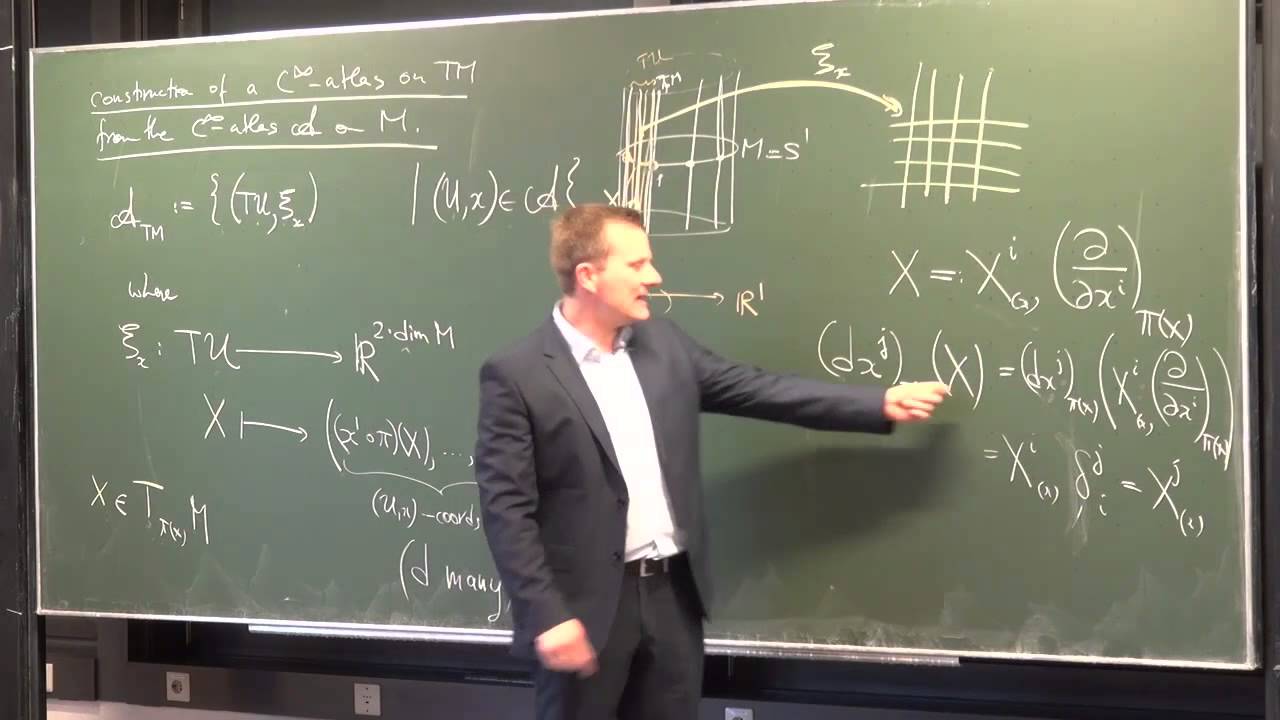
As part of the world-wide celebrations of the 100th anniversary of Einstein's theory of general relativity and the International Year of Light 2015:
Central lecture course by Frederic P Schuller (A thorough introduction to the theory of general relativity) introducing the mat...
gritty widget
and now im realizing the wording in your first picture is fucking whack: its calling the coordinate vector field itself a basis
thanks, ill check it out
cursive flume
do you have any 'illustrative' example of how I should imagine a basis on the module(TM)?
how to imagine every point at the space a vector field
to every point of the mfd i can imagine a vector
but thats a vector field
gritty widget
is module(TM) supposed to be Gamma(TM)
cursive flume
yes
gritty widget
i'd imagine it the same way i imagine a basis of a vector space: its a set of vector fields that spans Gamma(TM) and is linearly independent (in the module sense, but the definition carries over from vector spaces to modules with ease)
cursive flume
yes, I accept this abstractly, but can it be visualized?
I mean a gif/image which illustrates this
how to imagine a vector field to each point of the mfd
gritty widget
maybe you can think of the coordinate vectors fields on R^n
cursive flume
can you elaborate that? i'm not familiar with it
i can imagine a vector field
how would i associate a vector field to each point?
i don't see how i can put an entire field to a point visually
with definitions i can see it works same way with other object, but visually not
should I just ignore the visual understanding and work with the object?
gritty widget
im not sure what any of this has to do with "assigning a vector field to each point"
is this a new question or is it related to what we were talking about?
signal venture
i'm trying to grok the construction given in the proof here. couple questions. is there any picture/diagram that will help me understand requirement (2)?
and also, will there ever be any overlap between two stalks F_P and F_Q, or is the union there always disjoint? i can tell one requirement for overlap would be that P and Q are non-separable by open sets
spark acorn
and also, will there ever be any overlap between two stalks F_P and F_Q, or is the union there always disjoint? i can tell one requirement for overlap would be that P and Q are non-separable by open sets
@signal venture I think talking about intersection of F_P and F_Q doesn't make sense as both F_P and F_Q are not just sets but they have extra structure on them , I mean image of a section f in F_P means roughly "behaviour of f near P" and it's image in F_Q is it's "behaviour near Q" so talking about intersction of stalks at 2 distinct points doesn't make sense as noted they are not just sets and their equivalence relation varies at each points...
signal venture
hmm. i don't have any intuition for this at all, so i'm just going off the definition hartshorne gives
spark acorn
Are you familiar with smooth functions ?
in differential geo?
If so you can relate with them to get intution
signal venture
here's his definition. if U is a neighborhood of both P and Q, then <U,s> makes sense for both P and Q. but the thing is that you're looking at equivalence classes of <U,s> in each set, which is under different relations. so the class [<U,s>] in F_P may be different than the class [<U,s>] in F_Q
no i don't really know any differential geometry
spark acorn
i'm trying to grok the construction given in the proof here. couple questions. is there any picture/diagram that will help me understand requirement (2)?
@signal venture I don't have any picture to backup but what 2) means is that $s$ is a function on $U$ which " locally looks like a stalk of a section " to be more precise it says that you can cover $U$ with open sets ${U_i|i\in I}$ and there are $f_i\in \mathcal{F}(U_i)$ such that if $p\in U_i$ for some $i\in I$ then $s(P)=(U_i,f_i)\in \mathcal{F}_P$ ....
gentle ospreyBOT
WhyamIsohot?:
signal venture
i think i can see that is true
"the germ t_Q of t at Q" is just <V,t> in F_Q right?
spark acorn
"the germ t_Q of t at Q" is just <V,t> in F_Q right?
@signal venture Yes ....
signal venture
actually so (2) is also saying that for some neighborhood V of P, there is a single element t in F(V) that determines the value of s on all of V
which i think is what you were saying with the open cover and the f_i
spark acorn
Yes
signal venture
i think i need to look at some examples of these stalks
spark acorn
You can also look at Sheafification in Vakil's book where he defines them using "compatible germs" which is the same but maybe it could help...
signal venture
i'll take a look, thanks!
marsh forge
We have an equivalence of categories
Between vector bundles and C(X) modules
F,g proj^
Is there a nice description of the VB associated to such a module
(Other direction is ez)
spark acorn
Suppose we have a series of continous maps $X_1\stackrel{f_1}{\rightarrow} X_2\stackrel{f_1}{\rightarrow} X_3 \cdots $ where each $X_i$ is a topological space and each $f_i$ is continous , Is there a easier way to explicitly construct the colimit of this diagram (not just as sets but as topological spaces) ?