#point-set-topology
1 messages · Page 164 of 1
 marsh forge
It suffices to show that if I fix some point (x,y)
All other points have a path to (x,y)
You can choose a nice (x,y) if you want
That does seek
Seem
Like a nice choice
That is not a bad idea
Np
 eternal anvil
so did I miss this or can you define an n-dimensional manifold as any set that is locally isometric to a subset of Rn
 little hemlock
About the first hint: is f(y) = d(x,y) continuous? If it is, then f(A) is bounded and attains its bounds and the conclusion (for the first part) follows.
 fervent citrus
yes it is
little hemlock
I think I just wrote a proof of continuity. one sec
fervent citrus
it's even 1-lipschitz
little hemlock
Proof(?) Let $y \in X$, let $\epsilon > 0$ and take the open ball $V = (d(x,y) - \epsilon, d(x,y) + \epsilon) \subset \bR$. If $U = B(y, \epsilon/2)$, then we have that $f(U) \subset V$ by definition of $U$.
 gentle ospreyBOT
kxrider:
little hemlock
Seems kinda trivial 
I have no idea what 1-lipschitz means xd
fervent citrus
it means that for all $y$ and $z$ in $X$, you have $d(f(y), f(z))\leq d(y, z)$
gentle ospreyBOT
Tuong:
fervent citrus
which implies the (uniform) continuity of f
little hemlock
that would just follow from triangle inequality, right?
fervent citrus
Yes
for all y and z in X, you have
d(x, y)<=d(x, z)+d(y, z)
and
d(x, z)<=d(x, y)+d(y, z)
from which you can obtain |d(x, y)-d(x, z)|<=d(y, z)
little hemlock
i see. thank you!
fervent citrus
You're welcome
 fluid cloud
Heylu
What's the natural metric on functions in [a,b]?
A question requires me to find d_1, d_2 and d_infty of certain functions
marsh forge
Where are they valued
fluid cloud
erm
[0,1]
Consider the function $f(t):=t$ and $g(t):=t^2$ for $t \in [0,1]$. Compute
$$ d_1 (f,g) \ d_2 (f,g) \ d_{\infty} (f,g) $$
gentle ospreyBOT
SolitaryWolf:
fluid cloud
ueruoer idk how to typeset on texit, but you get me right
i dont want the entire solution, i just wanna know what the metric is
 gritty widget
d_2 is standard
fluid cloud
yeah idk the standard for functions
gritty widget
I gues d_1(x,y) is |x-y|
marsh forge
In linear algebra, functional analysis, and related areas of mathematics, a norm is a function that satisfies certain properties pertaining to scalability and additivity, and assigns a strictly positive real number to each vector in a vector space over the field of real or com...
My best guess
gritty widget
idk my guess would be calculating distances of f(t) and g(t) for all t and taking supremum idk
fervent citrus
when working with bounded functions, d_infty is pretty natural
marsh forge
Whats your point lol
fluid cloud
i think godel might be right
fluid cloud
idk how norm might help here tho
marsh forge
Norms induce metrics
fluid cloud
@fervent citrus idk what the natural is
marsh forge
The metric@induced for p=infty
gritty widget
yeah those 1 2 and infty are from p norm
fervent citrus
What's the natural metric on functions in [a,b]?
is pretty hard to answer when asked just like that
gritty widget
yeah the standard one is d_sup metric
marsh forge
He clarified later
fluid cloud
Honestly, I have no idea what I want, this is from my teacher's problem sheet; and-
let's just say-
he isnt that good...
marsh forge
Wolf pls trust me lol
fervent citrus
Big sad
marsh forge
I told you what you want
gritty widget
wolf pls trust me lol
gritty widget
yeah but those are functions, so you take p norm on all the points then take sup
fluid cloud
no book :(
he just blabbers stuff in lectures and thats it
yeah but those are functions, so you take p norm on all the points then take sup
@gritty widget that's exactly my concern, um, x isnt a vector right
Let p ≥ 1 be a real number. The p {\displaystyle p} p-norm (also called ℓ p {\displaystyle \ell {p}} {\displaystyle \ell {p}}-norm) of vector x = ( x 1 , … , x n ) {\displaystyle \mathbf {x} =(x{1},\ldots ,x{n})} {\displaystyle \mathbf {x} =(x_{1},\ldots ,x_{n})} is
‖ x ‖ p := ( ∑ i = 1 n | x i | p ) 1 / p . {\displaystyle \left\|\mathbf {x} \right\|_{p}:={\bigg (}\sum _{i=1}^{n}\left|x_{i}\right|^{p}{\bigg )}^{1/p}.} \left\|\mathbf {x} \right\|_{p}:={\bigg (}\sum _{i=1}^{n}\left|x_{i}\right|^{p}{\bigg )}^{1/p}.
um, @gentle osprey plis halp
fervent citrus
bad latex
fluid cloud
lmao
gritty widget
$ texit command $
fluid cloud
lemme just take a screenshot
gritty widget
texit doesnt work for free, you gotta give it the dollars you know what im sayin?
fluid cloud
oki hang on
:o
im dumb.
why dont i read the entire thing
lmfao
i think that's the one
$$ \int_{X} | f(x) -g(x) | ^p d \mu $$
gentle ospreyBOT
SolitaryWolf:
fluid cloud
okay, so X is [0,1], and whats mu?
fervent citrus
probably a measure but don't worry about it
fluid cloud
aite, thanks for your help!
 sleek thicket
Let X be a (hausdorff, second countable?) topological space. Define an n-dimensional smooth structure on X to be a sheaf of rings F on X with local stalks such that (X, F) is locally isomorphic to (R^n, C^infty).
Let M be a smooth manifold. Let (S, ι) be a pair of a topological space S and an injective continuous map ι : S -> Μ. Let F be the sheaf of smooth functions on M and G the sheaf of continuous functions on S. Pullback gives us a sheaf map ι^* : ι^(-1) F -> G. Let H be the image of ι^*.
I want to say something like there exists a smooth structure on S making ι a smooth immersion if and only if H is a smooth structure on S (and in this case, ι is a smooth immersion). Does anybody have thoughts about this? Have I missed an obvious counterexample?
If S has a smooth structure such that ι is a smooth immersion, it has at most one, see ISM 5.18 and 5.32 (i guess with the sheaf definition this is up to isomorphism)
Here's why I'm thinking this: Let S be an immersed submanifold of M and suppose U is an open subset of S. If a function f : U -> R is smooth, we can cover U by {Ui} where Ui is am embedded submanifold of M. Then the restrictions fi of f to Ui are smooth functions on an embedded submanifold, so there is some Vi open in M containing Ui and a smooth function gi : Vi -> R such that fi = gi|Ui. Thus a smooth function on an immersed submanfold is locally the restriction of a smooth function on the big manifold. Conversely, such a function is obviously smooth
 silver nexus
What are barycentric coordinates?
 dusty condor
Baricentric coordinates are coordinates in a simplex in such a way that the coeficients sum 1. I mean, you have a simplex given by the vertices and you can describe the points in the simplex with affine combinations with coefficients whose sum equals 1
silver nexus
😮 Do you know where I could read more about these?
dusty condor

In geometry, the barycentric coordinate system is a coordinate system in which the location of a point of a simplex (a triangle, tetrahedron, etc.) is specified as the center of mass, or barycenter, of usually unequal masses placed at its vertices. Coordinates also extend outs...
 pseudo crane
Is delta here understood to be a member of X?
 tough hamlet
no it's just a real number
tough hamlet
generally if it gets used in an inequality
it's a real number
the metric maps into R
pseudo crane
That’s what I would assume
tough hamlet
it still makes perfect sense
pseudo crane
Oh
Ok
Yeah for some reason in the next problem I forgot that delta represented a distance
thanks
tough hamlet
np
marsh forge
@honest narwhal this doesnt belong here but i have the other channels muted
Can you give me a sketch of the uniformization thing
that you were talking about
 honest narwhal
So I'm not terribly aware of the proofs of uniformization, and lol that super works here
honest narwhal
It might be on the tough end, mostly just feels like a cool theorem. I think a lot of proofs pretty much boil down to constructing these things called "Green's functions"
marsh forge
This actually isn't too bad
i found a like 10 page paper
oh lmao this was overseen by Bhargava
maybe its an reu paper
honest narwhal
Which are you looking at?
marsh forge
Uh it was one of the first results but im going to dinner now
honest narwhal
Alright, well there may be other things, I mostly suggested it since it's an S-tier theorem which involves complex analysis and links to topology
marsh forge
Yeah im into it
 hybrid echo
Hey nerds, so my prof was saying something, and I wanted to check to make sure I understand a few things properly
Is xsin(1/x) rectifiable using Cauchy-Crofton?
Because at least, my intuition is that the lines that intersect an infinite number of times would have measure 0, and therefore we can assign a length over any finite interval
 coarse kestrel
@dim meadow this channel's description 👀
 dim meadow

 celest flare
Suppose I have a topology on X. Then can I say that the boundary of a set A is X - int(A) - ext(A)?
 west spindle
sure
gritty widget
Hey, I need some help with this problem https://imgur.com/a/1PcxqBV
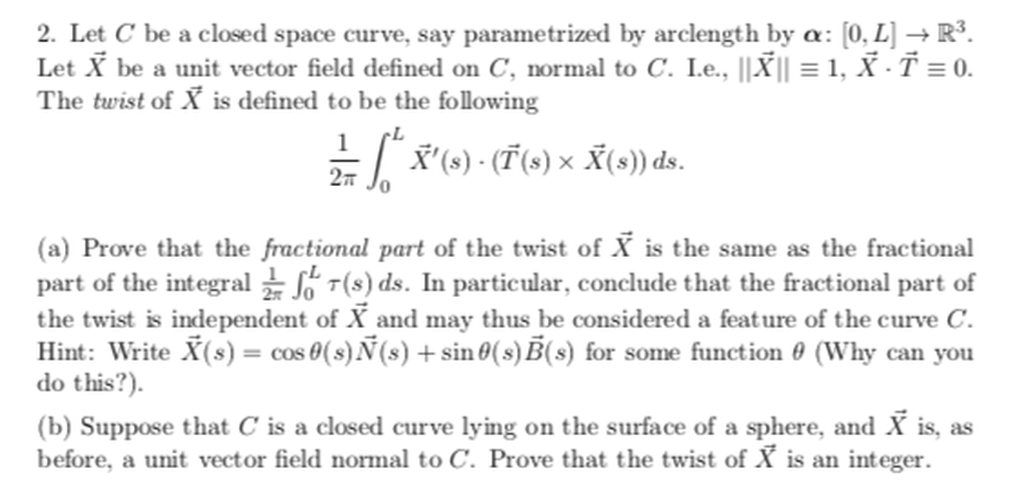
🥴
(Differential Geometry)
sleek thicket
I haven't been able to think about my manifolds hw for the last couple hours, so I'm going to do it in here
Let M be an embedded submanifold of R^n
I've shown that if y is some point in R^n and x a point in M minimizing |x-y|, then x - y is orthogonal to the tangent space T_x M
because the function f(p) = |p - y|^2 is smooth and minimized at x, and so its differential at x is the zero map, but it's differential is given by dotting with grad f(x) = 2(x - y)
Okay so define E : NM -> R^n by E(x, v) = x + v. This has a bijective differential at each point (x, 0), and so at each point there's a neighborhood of (x, 0) on which it's a diffeomorphism
We can assume that neighborhood is of the form V_δ(x) = { (x', v') in NM : |x - x'| < δ and |v'| < δ } by shrinking it
I want to shrink δ so that there's a unique closest point in M to anything in the union of the V_δ
The confusing this is that this isn't a local condition
I'm also confused about how to show existence of a closest point at all, let alone uniqueness
 glad badger
I have a problem, I hope this is the right chan, don't know what "degree" this is on but anyway
I have n number of 3D points (x,y,z) any 3 of these form a plane
Based on A plane I want to convert all the 3D points to 2D, mainting ratios etc (I want to do 2D calculations on the 3D points). I hope this makes sense.
 bitter yoke
This should just be projection onto your plane
 pliant radish
I found the first general solution

How can I find the next part?
for the next point?
please help : )
 gloomy plover
Not sure if you're even asking in the right channel
 ivory dragon
[definitely not]
 stable jackal
$sphere: (x-1)^2+(y-2)^2+(z+1)^2=9 \ curve: l(t)=(1+t,2+t^2,3+3t^2), \quad t\inℝ$
how do I find the shortest distance from the sphere surface to the curve numerically?
gentle ospreyBOT
Squik:
 sweet wing
you're basically minimising distance with constraints
 dire warren
How would I find this form that pulls back to dtheta if it wasn’t given in advance?
<@&681259184582688842>
 keen cliff
idk how to help for that 1 but also idk which channel dynamical systems goes in  so I'll put it in here for now
I'm doin exercise 2.1.6 in brin & stuck (excuse the weird formatting idk why that happened)
i can show it's dense, Q²/Z² are all periodic so they're dense
i have no idea how to find a non recurrent point tho
 wanton marsh
can you remind us of all the definitions
gentle ospreyBOT
woog:
wanton marsh
is A given by a matrix in M2(Z) ?
keen cliff
A is a 2×2 integer matrix with determinant 1, and has eigenvalues non-roots of unity
so like, eigenvalues have |λ|≠1
there's one |λ|>1, and the other is 1/λ
wanton marsh
yeah
keen cliff
NW is non-wandering but that part is easy
i am just completely bamboozled on R(A) ≠ T²
I've been trying to get an argument that just like
"finds" a point that does the trick
my friend suggested to me suppose R(A) = T²
and I was like

hwhat
wanton marsh
the exercise about the circle is easier lol
keen cliff
i haven't done that one 
or have i 
feels like there's some sort of cantor set- like thing
wanton marsh
it's not exactly the same problem since you don't have the det=1 requirement
though
keen cliff
i was having very loose ideas about this thing last night tho
some sort of 2d cantor set thingy but couldn't put anything concrete enough together
is (T²,A) conjugate to anything that might be helpful
wanton marsh
I would try to pick a point in one of the eigenlines but
keen cliff
yeah like
wanton marsh
then a small ball around it corresponds to lots of small intervals on that line
and you have to make sure you avoid them ?
keen cliff
wanton marsh
wait am i just dumb
why am i not thinking about the eigenline that has a small eigenvalue
wanton marsh
every nonzero point on that line should work
keen cliff
SHIEEEET
well I'm dumb too

I've been working on this problem for ages
thanks!!!
wanton marsh
lol I was thinking about the circle exercise
where Em is a dilatation
so it automatically made me pick the other line
first
xD
dire warren
@keen cliff oh hell you r doing Brin and stuck
We shud make a new adv channel for dynamcial systems
keen cliff
Yeah I am @dire warren
dire warren
I beleive chapter 2 has that beast of a theroem
Van de waarden
Have fun haha
This book is wild
keen cliff

dire warren
The difficulty level varies so much between parts
Is this for a course or self study?
keen cliff
course
keen cliff
theorem 2.8.1 van de waarden
exercise 2.8.1 prove theorem 2.8.1 using proposition 2.8.2
dire warren
Ppft
keen cliff
nah not the whole book but I'll probably end up continuing as self study cuz this stuff is hella cool
keen cliff
do u have any books that does things a little bit slower
i am KIND OF getting destroyed right now
dire warren
Katok hassellblatt’s first course in dynamics covers similar material at a slower pace
NOT the “intro to modern dynamical systems”
That one is kinda MonkaS
keen cliff
that one is very monkaS
i tried going thru the beginning of that during reading week
got stuck in the 0th section
dire warren
Hahaha
honest narwhal
Oh I have lecture notes on the Van der Waaerden section
keen cliff
@honest narwhal pass em
 wheat axle
Someone help me with my geometry hw
sleek thicket
Let G be a lie group. A smooth representation of G is a finite dimensional \R-vector space V and a smooth homomorphism G -> GL(V). To each of these, we can associate an \R[G]-module V. When does an \R[G]-module give rise to a smooth representation of G?
Like you can just say that it's finite dimensional over R and the action map G -> GL(V) is smooth, but we can we characterize in a more direct way?
 viscid shadow
are there 3d uniform tilings ?
 oak thistle
Can anyone help me with cone and cylinder?
gritty widget
what kind
marsh forge
gritty widget
they might be talking about the cone of a topological space or the mapping cylinder
I joke
oak thistle
I don't know topology
gritty widget
 frigid patrol
 floral gust
reddit
1,316 votes and 374 comments so far on Reddit
marsh forge
this is a good take
sweet wing
This is topology. Our space are nice. Our sequences are exact. Our groups are abelian.
 midnight jewel
This is a thread about math not set theory.
west spindle
can someone ELI5 what the fuck Spec(Z) is
honest narwhal
"This is a thread about math not set theory"
Hot damn someone got destroyed
 verbal prairie
What's the significance of this theorem? Why are these 0,0 0,1 1,1 vectors chosen?
marsh forge
Our spaces are simply connected
dim meadow
Maybe if you only study loop spaces and topological groups
verbal prairie

 small obsidian
I agree I've never understood Spec(R)
sleek thicket
Suppose I start with an \R-algebra A and build up a manifold M such that A = C^infty(M). I can then define TA = C^infty(TM) (where TM is the tangent bundle). Is there a more direct way to characterize/build TA in terms of A?
A book I'm reading says you can do it but it would be too far out of the way
 peak narwhal
Can half space (like half planes) work in three-dimensional (x,y,z) space? Do they just remain two-dimensional planes?
midnight jewel
yea, a half-space in general is just the set of all $x$ such that ${\lambda(x) \geq 0 \mid \lambda\colon \R^n \to \R \text{ linear}}$
gentle ospreyBOT
Sascha Baer:
midnight jewel
the boundary, where λ(x) = 0, will be an (n-1)-dimensional hyperplane
note that there’s the degenerate case λ(x) = 0 ∀x, which you may wanna exclude, or not
we didn’t exclude it in our definition because it allows you to say that a manifold with boundary has each point having a neighborhood homeomorphic to a half-space
 cursive nebula
hey guys, what is S^2?
 delicate spire
surface of a sphere
cursive nebula
AH!
i was suspecting that but wikipedia says "two-dimensional"
so i thought "two-dimensional" meant it was on a plane
bitter yoke
The surface of a sphere is two dimensional
delicate spire
topology people are weird
cursive nebula
now i'm not really sure i know what it means to be two-dimensional.
bitter yoke
I mean, the surface of the earth is locally flat
It looks flat to us, and so the surface is a two-dimensional object
cursive nebula
okay. ahh
i just started studying topology today, so these things are a little alien still
thank you for being patient
bitter yoke
You'll learn about manifolds soon where you can formalize this idea
cursive nebula
so i was thinking...
"two-dinensional" might mean "its points can all be described with two coordinates"
but i can't do that with the surface of a sphere
i could cut the sphere in half though and i could do it with the two halves
floral gust
Are you familiar with tangents?
 rugged swan
You can locally do it
floral gust
You can define the dimension as the number of independent tangent vectors
cursive nebula
uhh
so, it's the surface of a sphere.
that number can't be more than 3
how do i prove it's 2?
well, it's at least two, of course
because i can picture a tangent PLANE in each point in the surface of a sphere
floral gust
Yes. For which the number of independent tangent vectors can be atmost 2.
cursive nebula
why 2 and not 3?
midnight jewel
because linear algebra dictates that a plane cannot have three independent vectors
cursive nebula
yeah, intuitively i dont see how there could be more
floral gust
number of independent tangent vectors = number of vectors in the basis of the tangent plane = 2 since a plane is spanned by two vectors namely the one in x direction and the one in y
midnight jewel
if you see the tangent space at a point as a vector space
delicate spire
latitude and longitude
cursive nebula
OH YEAH i know that!!
ahh alright
so. the surface of a sphere is locally a two-dimensional object
midnight jewel
ye. and a thing which is everywhere locally of the same dimension is called a manifold of that dimension (this is a very rough definition)
floral gust
Yes you can say that. To formalize this notion of dimension, you will study more in manifold theory
midnight jewel
(like, very rough)
cursive nebula
do you consider the tangent space for... each point of the surface?
midnight jewel
what you do often is consider charts, that is maps from a region in the space onto ℝⁿ for the right n
cursive nebula
because if you consider two points that arent polar opposites you get two different planes
ahhh regions. okay
floral gust
It is the dimension of those planes which is our concern
midnight jewel
yes, each point has its own tangent space
there’s a notion of the tangent bundle, which is basically the “union” of all these
(but you also remember where you are on the surface)
cursive nebula
AH!! ok. ok.
midnight jewel
but yea here we just need the dimension
cursive nebula
so i was thinking of this tangent bundle and i wanted to say that it's R^3
but for a Single Point, it's a plane
midnight jewel
it’s not just the union, so it’s more complicated than jsut saying it’s ℝ³
floral gust
Dont... dive into these higher level topics like tangent bundle just now. They require a bit of prerequisite knowledge of manifold theory and this sort of abstraction so fast would leave you confused.
cursive nebula
mhmh..
guys, can i ask you how you learnt this stuff?
do you know books you found very useful?
midnight jewel
these things will be defined in due time, and possibly quite soon even
cursive nebula
i have to study on my own because we're quarantined (coronavirus)
so, no classes for now
midnight jewel
I’m just taking classes. didn’t use any textbooks for diffgeo, which is where we covered manifolds
floral gust
Why do you have to study manifold theory just now? Take your patience with it. Learn what you are studying right now with patience and detail.
But if you must, start with Differential Geometry of Curves and spaces, move onto introduction to topological manifolds and then onto smooth manifolds
the latter two are by John Lee
cursive nebula
ahh i can think of many answers
one is that i have to take the exam in a couple of months
haha!
yes, thank you, i will check that out!
i will also probably be hanging around in this channel ;v;💞💞
our teacher let us download some solved exercises
so i know what kind of stuff will be on the exams, but....
i need theory
thank you for helping me :>
my questions will get progressively less and less dumb, and then... chef kiss diffgeo mastery.
floral gust
Yeah it’s not like a prerequisite but more like preparatory material to get you familiar with the ideas you’ll see much formally in manifolds. Like differential forms etc. But maybe that’s just me
cursive nebula
i dont really know what a manifold is, yet
this is a two semester course called "geometria 2". the first semester is about topology and algebraic topology and the second semester is called "curves and surfaces"!
we also have a "geometria 3" course in year 3, i don't know in which course we're going to cover manifolds, but i'm sure we will!
(i think differential geometry is in this course though!)
 cursive flume
when defining the standard topology, we have to define the soft ball, in which we basically use the "distance" or "norm"
however it is said that it we don't need norm to define that
do we need vector space structure?or we don't need anything more than a set on r^n to define the soft ball?
 vocal wharf
what
cursive flume
we define soft ball as follows: they are d- duples, for which holds, that $ \sum_{i=1}^d (q_i-p_i)^2<r^2$
gentle ospreyBOT
Lina:
cursive flume
does this not imply the definition of norm?
vocal wharf
this just looks like the open ball with radius r around the point p in d-dimensional euclidean space?
i mean, generally you can give a topology to a metric space that way, but not every topology is generated by some metric
cursive flume
yes, I do understand this, but I'm watching Schuller's lectures on GR, but he says something fishy...
As part of the world-wide celebrations of the 100th anniversary of Einstein's theory of general relativity and the International Year of Light 2015, the Scientific Organizing Committee makes available the central 24 lectures by Frederic P Schuller.
Titled "A thorough introduc...
min 22
he says we don't need norm
vocal wharf
well, if you forget the vectorspace structure on R^d and regard elements simply as d-tuples, you can still write this down and define open balls that way
cursive flume
so you don't need the definition of norm? just metric?
vocal wharf
i'm not quite sure what he's getting it
in general you do not need a metric to define a topology
but the standard topology on R^d comes from a metric
sleek thicket
Can someone explain why we care about lie brackets of vector fields to me? I have no idea what they represent
cursive flume
@vocal wharf i've found something. we don't need a metric to define a topology, but to define the standard topology we do need a metric, however a metric does not need the structure of vector space, just a metric space. a vector space which is normed is more special, because to every norm we can associate a metric, but metric can be defined independently, without the need of vector space structure, I think this is what Schuller means, do you think this is an ok explanation?
dire warren
They don’t need a norm because all norms on fin dimensional vector spaces are equivalent in that they induce the same topology. So they just work with this given topology @cursive flume
gentle ospreyBOT
Celephinnor:
 versed pivot
@rich fiber
That condition implies $\frac{f(x)}{f(y)} + \frac{f(y)}{f(x)} \leq 2|x - y|$, is that right?
Since $(a-1)^2 \geq 0$ you have a simple inequailty $a + \frac{1}{a} \geq 2$ for $a > 0$
Taking $|x - y| < 1$ would contradict this
gentle ospreyBOT
Seoin:
versed pivot
I just swapped the roles of x and y and added the two inequalities
oh I see, I didn't read that part carefully enough
you can probably fix the argument if you replace x by a nearby rational but I would have to write it down to make sure
or maybe not, if f isn't continuous
yes maybe this is too simple, I missed the part that y is supposed to be rational
 chrome dew
not sure if this is helpful or not, but pick some z in ]0,infty[ and since Q and R\Q are both dense in R we can find a limit of terms of x -> z and y->z. Then you'll end up with 1 <= 0
dim meadow
Something I was thinking about is maybe you can let U_n be the set of points st f(x) is < 2^-n or > 2^n. I think you can show that those sets are open and dense
And then the intersection is clearly empty
chrome dew
I assumed continuity, ignore me
dim meadow
Lol bad assumption
We do though
Wait maybe this is bad
No I can show it
You can show that around a rational or irrational point there is a small open neighborhood not including that point
I'll write something up
dim meadow
Okay got it
Given an irrational point x_0, suppose y is a rational point with |x_0-y| < (2^-n)f(x_0). Then f(y) >= f(x_0)/|x_0-y| > 2^n
Now given a rational point y_0, suppose x is an irrational point with |x-y_0| < 2^-n/f(y_0). Then f(x) <= f(y_0)|x-y_0| < 2^-n
This is a little off rn but I think you can make this work
There's still a bit of work to be done though
Yeah me too
Sure
gentle ospreyBOT
Celephinnor:
gentle ospreyBOT
Celephinnor:
dim meadow
Welp
That's just empty
👀
Oh lol
Why is that open?
I wouldn't think it would be
But if it is that means the other one is closed
But I don't think it is
Oh wait
There's also the case of equality
But that doesn't seem so important
I don't agree with your close enough statement
Cause the problem is when you go closer, the radius of the ball shrinks
It's the juggling problem
I don't think that will do it
Okay here's something interesting
So you start off with the balls of radius 2^-n/f(y) about each irrational point
Then you intersect that with the balls of radius 2^-n f(x) about each rational point
This is an open dense set with the property that each point has f(x) < 2^-n or f(x) > 2^n
And then you're done I think
Yeah wtf
I think that does it
Fuck
Yeah this definitely does it
Wow that took me way too long
Cause it's an intersection of open sets
@chrome dew
We got it
What do you mean?
We are intersecting 2 open sets
👍
Baire is super applicable in weird ways
chrome dew
cool I'll check it out
dim meadow
What don't you get?
Say the two sets are U_n and U_n'
They do though
Okay look
U_n cap Q has the property
And U_n' cap R-Q has the property
So (U_n cap U_n') cap Q has the property
And (U_n cap U_n') cap R-Q has the property
(the property here meaning that all the elements either are < 2^-n or > 2^n)
Therefore A_n = U_n cap U_n' has the property
What's wrong with this?
@rich fiber
Lol
You're just inexperienced
Eventually you'll be able to deal with these kinds of arguments fairly easily
👍
dim meadow
👀
@gritty widget what do you mean?
Do the problem above
I'm writing some hw up right now
Please don't give me a problem
Yeah that was top tier
Yeah that shit is gross
The hint is baire category theorem
dire warren
@gritty widget try challenge problem 152
dim meadow
👀
@gritty widget R+ is R
Lol
Do you not know this?
(0, \infty) is homeomorphic to R
Locally compact hausdorff
dire warren
It’s a topological invariant
dim meadow
Locally compact, hausdorff
dire warren
The locally attaches to compact
It’s two properties
Hausdorff, and locally compact
Yeah
 wooden scarab
I'm looking for a classification of universal covering spaces of closed 2 manifolds. It should be in some intro topology textbook I assume?
dim meadow
For orientable we have S^2, R^2 and H^2
honest narwhal
Yup, this is called the uniformization theorem
wooden scarab
Where H^2 is a disk?
dim meadow
Hyperbolic plane (or disk)
honest narwhal
Actually is it true that any orientable surface is a Riemann surface?
wooden scarab
I think so *(for manifolds)
honest narwhal
Like if so then yeah what you said is an immediate corollary of uniformization
dim meadow
Classification of surfaces says yeah
dim meadow

dim meadow
Yeah
honest narwhal
Yeah lol uniformization ez
dim meadow
For non compact there is a classification
honest narwhal
Well it's not ez but yeah
wooden scarab
how about compact with boundary?
sleek thicket
Is the following variant of Whitney's approximation theorem true?
Let M, N be smooth manifolds and f : M -> N a homeomorphism. Then f is homotopic to a diffeomorphism
I'm guessing not
 edgy crescent
I wouldnt call this a variant of whitney but it's true
nevermind
it is not
this is troubling
because continuous maps are homotopic to smooth ones
and homotopies may be replaced by diffeotopies when they exist
but thats not enough
sleek thicket
What are diffeotopies?
edgy crescent
smooth homotopies
sleek thicket
Oh you're saying homotopies between smooth maps, not the homotopy you get from Whitney approximation
Can you find a counterexample?
edgy crescent
yes
no but google can https://math.stackexchange.com/questions/1068805/is-every-self-homeomorphism-homotopic-to-a-diffeomorphism

Mathematics Stack Exchange
Given a smooth manifold $M$, is every homeomorphism $M \to M$ homotopic to a diffeomorphism?
Hirsch's "Differential Topology" has a proof that every $C^1$ diffeomorphism of smooth manifolds is
sleek thicket
Oh lol I should've googled it first
gritty widget
lol serious tho
i wanna ask a q
and idk if it belong to multivariable or this channel
edgy crescent
ask
edgy crescent
just compute dw
gritty widget
yea, but just wondering if some operations could make it 0
edgy crescent
they're always linearly independent vectors in Alt^2 R^n
gritty widget
if not then ok ill try to find a counterexample
gritty widget
we didn't use basis to define differential forms though...
we just define k-forms as summation of index
edgy crescent
yes, but they form a vector space
and you want to show that this sum is not zero
it can't be if the vectors are linearly independent
gritty widget
in this case what are the vectors?
edgy crescent
dx1^dx2, dx2^dx3, etc
gritty widget
ok, ill try, thanks
edgy crescent
as an example so you can sanity check, a basis for Alt^3 R^4 is given by
dx1^dx2^dx3,
dx1^dx2^dx4,
dx1^dx3^dx4,
dx2^dx3^dx4
gritty widget
i heard calculus on manifolds is good
gritty widget
ok
oh wait...
d(x1 dx2) is not dx1 dx2
i gotta do product rule...
man
this sucks
gritty widget
according to book its supposed to be d(w^v) = dw ^ v + (-1)^k w ^ dv
where in my case x1 is a 0-form
gritty widget
yea that ik
edgy crescent
so when you have something of the form f dx_I
then you have an explicit formula
In the mathematical fields of differential geometry and tensor calculus, differential forms are an approach to multivariable calculus that is independent of coordinates. Differential forms provide a unified approach to define integrands over curves, surfaces, solids, and high...
given by the partials of f
gritty widget
but yea, i think then d( x1 ^ dx2) is not dx1 dx2 because of product rule for d operator
gritty widget
oh right
edgy crescent
so you can always just apply d to the scalar
edgy crescent
it's general for d(v^w)
edgy crescent
v and w are any forms
gritty widget
d(v^w) = (dv)^w when v is any form??
gritty widget
when v is 0 form that is true though right
edgy crescent
not really
w has to be a pure form
with constant scalar
something like dx1^dx3
not x^2 dx^1^dx^3
more generally w has to be closed
the precise useful statement is in the wiki page i linked
gritty widget
oh exterior product
man
we just call it different names
its just product of a k-form and an l-form
yea i got that bit
im thinking though, maybe d(f ^ dx1 ^ ... ^ dxk) = df (dx1 ^ dx2 ^ ... dx^n) is a special case if you keep on applying product rule, but i dont know
because at least we seen that d(f^dx) = df ^ dx
edgy crescent
yes it is
that's the case in the image above
im going to play videogames if you need me yell bloody mary 3 times to your mom
gritty widget
ok lol
go have fun
so i got an answer
and if u can approve thats good
so since w= dx1dx2+...+dxn-1dxn
i let y(t) = (t, t, ..., t): [0,1]->R^n
so that integral of w over y is n-1 which is not 0
for n>1
edgy crescent
your loop should be closed
closed forms integrate to 0 under (contractible) closed loops
edgy crescent
you can always integrate but that doesnt give you information
the result is that closed forms integrate to 0 over contractible closed loops
gritty widget
but here the definition of closed is dw = 0
edgy crescent
oh then why are you integrating?
oh you're integrating dw aren't you?
not w
I see that confused me
yeah a way to show dw is not zero is to integrate it
but that's a bit overkill
gritty widget
yea
edgy crescent
linear algebra shows it's nonzero immediately
gritty widget
sorry didnt clarify
i guess about lin alg ill ask prof tomorrow
and pt d), i just say since w not closed, then w not exact
edgy crescent
yea
gritty widget
ok thanks
 chrome schooner
 gritty widget
hey i think i got what you mean by vector space now
so for a k-form, let all the possible indices dx_{I} be the coordinates right
and then the dx1 ^ dx2 + ... + dx_{n-1} ^ dx_{n} is something like a bunch of 1's and 0's on the nxn matrix
wild guess actually
or are they like vectors (1,1,0,...,0), (0,1,1,0,...,0),...,(0,...,0,1,1) that are linearly independent?
i think thats what i meant
@edgy crescent if u can confirm true/not true
sleek thicket
I'm taking my first course on smooth manifolds and we've just gotten to flows of vector fields. My book has an appendix with proofs of existence/uniqueness of solutions to linear ODEs, and those made sense, but the theorem about the solution smoothly depending on initial conditions seems really hard. Is it important for me to understand it right now?
edgy crescent
@gritty widget not exactly true
your formula would imply that dx1^dx2, dx1^dx3 and dx2^dx3 are linearly dependent
the vector space of alternating k-forms in R^n has dimension n choose k
where a basis is given by the dxJ where J is an increasing subset of [n]
gritty widget
oh
so the dx objects are the basis of the vector space which is the V^k(A) all k-forms
?
V as in the upside down V
but are they known as the standard basis just like the standard basis for a linear transformation?@edgy crescent
edgy crescent
yes
gritty widget
Ok thanks
pseudo crane
Smells like differential geometry in here
midnight jewel
fields whose name ends in y are the best since you can use the descender of the y to underline the title
 prime prism
Can I just make sure: the intersection of two simplicial complexes need not be a simplex
In particular it can be a disjoint union of simplicies
(e.g. Two tori joined in two spots)
gritty widget
Are two circles with the same orientation concatenated at a point homotopic to a single circle?
I'm thinking no but I don't know how to prove it
like the loop concatenation $fg$ where $f(t)=(\cos(2\pi t), \sin(2 \pi t))$ and $g(t)=(2-\cos(2\pi t), -\sin(2 \pi t))$
gentle ospreyBOT
zd:
gritty widget
Assume a homotopy (by defn. continuous) exists from $fg$ to $f$, so if $C$ is an open (closed) set in $\mathbb{R}^2$, the inverse image $f^{-1}(C)$ in $[0,1] \times [0,1]$ is open (closed)... something something contradiction?
gentle ospreyBOT
zd:
midnight jewel
Are two circles with the same orientation concatenated at a point homotopic to a single circle?
are we talking in an ambient space? like, in ℝ² or sth?
gritty widget
Yeah
midnight jewel
if you have no requirement for the homotopy to be injective (for fixed t), then you can just contract everything to a point and then expand into a circle
seing as ℝ² is contractible
gritty widget
True, I was trying to understand/learn about fundamental groups of R^3-{some knot} so what about in that case
midnight jewel
or just contract one of the loops into the basepoint
so you can pull things apart if you don’t require the basepoint to remain fixed
ah wait no it even works generally
you can turn it into a big loop
gritty widget
I see what you're saying yeah
midnight jewel
by just moving the loop a bit away from the basepoint when it first returns to it
gritty widget
cause that loop you're shrinking can contract to a point
and u just have the big boi left
midnight jewel
in your case with the knot it would depend whether the loop goes around the knot or not
gritty widget
ye ye
I have a much clearer image of this now ty tho
Didn't understand that before
gritty widget
sorry I didn't connect the loops at an initial basepoint but in this case they're homotopic to that setup anyway
with the stuff on the bottom, pic 1 to 2 is concatenation of the loops, 2 to 3 is performing what I'm pretty sure is a valid homotopy right? (That's my question ;-; )
Space is supposed to be R^3\ {trefoil}
 fading vale
So I'm trying to understand a proof in bredon that, given a hausdorff space X the following conditions are equivalent:
-X is locally compact
-X is a locally closed subspace of a compact hausdorff space
-X is a locally closed subspace of a locally compact hausdorff space
for showing (1) implies (2) he says that since X is locally compact its an open subspace of its one point compactification which ofc is a compact hausdorff space which makes sense to me
but i dont get why this implies X is locally closed
does local compactness imply locally closed?
honest narwhal
@fading vale Open subsets are locally closed
Open subset of a closed subset
The whole space is closed
boom
honest narwhal
lmfoa
fading vale
ok tbf he defined locally closed literally the line above this and then went abt proving this
oh
@honest narwhal yea he didnt define it as being open in its closure
honest narwhal
What was his def again?
fading vale
every a in A, there exists a neighborhood U with a in U, A cup U is closed in U
this still works tho i was being dumb and not thinking
dire warren
I’m having trouble understanding the characteristic embedding described in Milnor’s lectures on the h cobordism theorem. Why are hyperbolic sine and cosine chosen?
<@&681259184582688842>
Screenshots for context
gritty widget
I honestly have no clue if this is relevant but maybe https://en.wikipedia.org/wiki/Integral_curve#Generalization_to_differentiable_manifolds has some insight as to the motivation of that last sentence in the section you're talking about? Again no clue lol
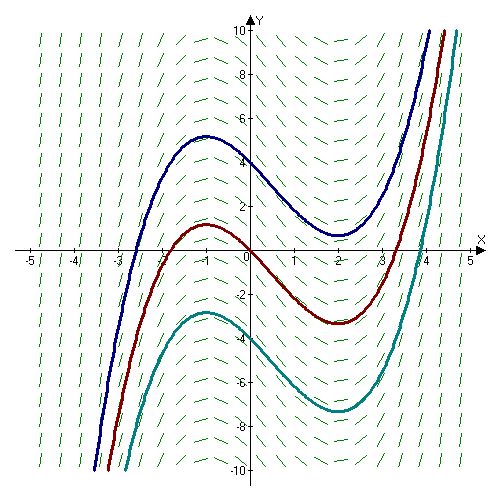
In mathematics, an integral curve is a parametric curve that represents a specific solution to an ordinary differential equation or system of equations. If the differential equation is represented as a vector field or slope field, then the corresponding integral curves are tan...
from hatcher: why is $ir \cong \mathbb{1}$? Is Hatcher using $a \cong b$ as meaning "$b$ is a restriction of $a$"?
also apparently I don't know how to write those symbols in latex oof off to google
It is clear to me that ri is the identity though, just include A, A=im(r) and r=r^2, done.
If an element of X\A goes through ir, it will end up in A, so clearly it's not equal to the identity, so I'm guessing that Hatcher means something about restrictions with that symbol right
and no it's not included in the "standard notations" section even 😂
 coral pivot
hatcher uses $\cong$ to mean homotopy
gentle ospreyBOT
JohnDoeSmith:
coral pivot
lol np
gritty widget
ree
gentle ospreyBOT
zd:
gritty widget


marsh forge
huh
gritty widget
I can't figure out how to get mathbb{1} to work here
gentle ospreyBOT
Merosity:
Compile Error! Click the  reaction for details. (You may edit your message)
gentle ospreyBOT
Merosity:
Compile Error! Click the reaction for details. (You may edit your message)
chrome dew
oh well I tried
gritty widget
oof
how 2 prove homotopy type equivalence is transitive?
Suppose spaces $X \cong Y$ and $Y \cong Z$. So homotopy equivalences $f_1$ and $g_1$ exist between $X$ and $Y$, and $f_2$ and $g_2$ between $Y$ and $Z$ likewise. Again by definition these equivalences have homotopies $F$, $G_1$, $G_2$, and $H$ such that $F$ is between $g_1f_1$ and $\text{id}_X$, $G_1$ is between $f_1g_1$ and $\text{id}_Y$, $G_2$ is between $g_2f_2$ and $\text{id}_Y$, and $H$ is between $f_2g_2$ and $\text{id}_Z$. Is this the right way to set it up? Cause it's a lot ;-;
My immediate thought is to try to find homotopies between $f_2f_1g_1g_2$ and $\text{id}_Z$, and $g_1g_2f_2f_1$ and $\text{id}_X$ but idk how
gritty widget
if anyone has a hint toss it up so I could keep trying
gritty widget
I was thinking I might need to find a homotopy between $g_1g_2f_2f_1$ and $g_1f_1$ since then transitivity of homotopy gives that the former is homotopic to $\text{id}_X$ as desired, but I have no clue how to construct one from the other ones
gentle ospreyBOT
zd:
gritty widget
If it's taking me this long to work through a trivial part of a paragraph in chapter 0 of Hatcher like this should I just give up on pursuing this at all
Will I just never be good enough to do things this quickly
gritty widget
Good to know I'm not alone lol
Do I need to show that compositions of homotopic functions are homotopic? as in going down the route of trying to show $g_2f_2f_1 \cong f_1$, and then composing both sides with $g_1$?
gentle ospreyBOT
zd:
gritty widget
In turn showing that composition in the other direction of homotopic functions yields two also homotopic functions would prove this completely right, cause we know $g_2f_2 \cong \text{id}_Y$, compose to get $g_2f_2f_1 \cong \text{id}_Yf_1=f_1$, again the other direction $g_1g_2f_2f_1 \cong g_1f_1 \cong \text{id}_X$, and done by those two lemmas?
gentle ospreyBOT
zd:
gritty widget
Proving this would also show that you can multiply equations defining homotopy equivalences together too
like $a \cong b$ and $c \cong d$ implies $ac \cong bd$, cause $ac \cong bc$ and $bc \cong bd$ by the lemma
gentle ospreyBOT
zd:
gritty widget
So it would be nice for it to be true, is there another way to do this proof of homotopy type equivalence being transitive without proving this too? cause Hatcher says proving homotopy type is an equivalence relation is "easy" soooo
 rugged raptor
Isn't a torus the same thing as a knitted sweater?
Since you can entwine it around itself to make it into an arbitrarily long string, and the just knit with that string.
cursive flume
Schuller in his lectures makes the definiton of "manifold philosophy", which basically means: we do physics on manifolds, represent it in charts, then associate the chart properties with the real world properties, continuity works- for example, but then he goes into "ill defined properties", which can be chart dependent, if we do the physics on the whole manifold. can someone give me such an example?- we want physics to be chart independent
I was thinking of differentiability,if we do it on the whole manifold, without making restrictions, but we can solve it with restrctions (work on a more rigorous structure, namely a differentiable manifold), does anyone know such a "property", which can "not be fixed" by "adding more structure"?
sweet wing
Assuming some conditions holds, this is true
is literally how most theorems are
floral gust
I was thinking of differentiability,if we do it on the whole manifold, without making restrictions, but we can solve it with restrctions (work on a more rigorous structure, namely a differentiable manifold), does anyone know such a "property", which can "not be fixed" by "adding more structure"?
@cursive flume I don’t know think so because you can literally introduce the property as a fix. As in “we now consider the manifolds that will satisfy the given the property.” And the 0 dim manifold would most likely satisfy this due to some sort of vacuity. Interesting is then is to ask what properties ca;you introduce and still not run out of the base cases.
cursive flume
@floral gust yes, this was my question, what property can be defined such
floral gust
Take any self-contradicting property
 wheat brook
@cursive flume Consider the sphere. We cannot map it to 1 chart. If we do physics on the whole sphere, we will always run into pole somewhere. The fix is to switch locally to a different chart.
cursive nebula
hey guus, can i ask a topology question?

ahh i did!!
NICE
thabk you!!
i need it for another longer proof
i will still check them
i dont know if it's the SMALLEST topology that you can generate with those sets
wait. it is
yeah,
/rotate
the exercise im trying to solve is on the base chapter
gentle ospreyBOT
cursive nebula
i need this result (tau3 is a topology) to prove that thing
oh thanj you!
see i tried using the axioms, intuitively i can see it's reasonable for tau 3 to be a topology
but idk how to write it formally
,rotate
gentle ospreyBOT
cursive nebula
this is the exercise i have to do
i have to prove that B is a base for a topology that is more fine than the topology is
so this is what i thought
,rotate
gentle ospreyBOT
cursive nebula
if tau3 is a topology, i can easily prove that B is a base for tau3
so thats why i asked if tau3 was a topology
gritty widget
Hello there, I would ask you for some recommendations about some nice Topological subject to talk about for a group of undergrad students, please?
midnight jewel
what level are we talking? like is the target audience people who have zero experience with topology yet or ones who have already done some (or maybe even a lot of) basic topology stuff?
“undergrad” could mean anything from no experience to having taken two years of topology classes
cursive nebula
hey guys,
i'm trying to solve problem 25, but i don't know how to go about points ii) and iii)
(what does relative topology mean?)
,rotate
gentle ospreyBOT
cursive nebula
this is the idea i had for points ii) and iii) but i don't know if i'm on the righr track (it would help if i had That Definition)
i can hit the second line in Each Point with open sets
(and they would generate the discrete topology)
but i cant do it with the first
is that it?
midnight jewel
relative topology is also called the subspace topology
if you have $X \subset Y$ and you have a topology $\mathcal{T}$ on $Y$ then you can define a topology on $X$ by simply saying the open sets in $X$ are all sets of the form $X \cap O$ for $O \in \mathcal{T}$
gentle ospreyBOT
Sascha Baer:
midnight jewel
ie you intersect the open sets of Y with X to get open sets in X
cursive nebula
ahh thank you so much!
okay, so
those lines are subspaces of R^2
i can easily prove ii) bc i know that topology includes every singleton so it's discrete
 topaz shuttle
Hi there does anyone know anything about the topology of complex numbers?
midnight jewel
I mean it’s just the standard topology on ℝ²
if you have specific questions you should 
 twin aurora
I'm trying to work out a proof of the following theorem from basic algebraic topology, that the deck transformation group of a covering space is isomorphic to the fundamental group of the base space mod the fundamental group of the covering space. does anyone have any hints to drop/resources that i could check out to be pointed in the right direction?
bitter yoke
<@&681259184582688842>
 dawn geyser
hi everyone! i'm working with double factorials (as in 9!! = 9 x 7 x 5 x 3 x 1, not (9!)!)) and trying to use them for a proof of n-spheres but i'm really struggling with a lot of the notation
delicate spire
hey whatchu need help with?
dawn geyser
im working with this right now
<@&681259184582688842>
im basically tryna get to here by combining the recurrences but idk know how to
delicate spire
Sn and Vn are surface area/volume of unit sphere?
dawn geyser
i think? i don't actually know what the S is meant to represent
delicate spire
ok yea like for a 3d sphere it has S2 surface area V3 volume
I found the proof I think you want on wikipedia O_o
looks like you need 1 more recurrence formula and it's easy to get the double factorial bits
dawn geyser
i got it from wikipedia yeah
im just trying to understand the steps and its not really explaining it that well to me
delicate spire
ok, I can't really follow the integration bits, but this part makes sense to me
what part is tripping you up?
dawn geyser
this is my first time doing anything involving n-spheres, so we haven't learnt a lot of the theory for it.
so basically all of it
ivory dragon
if $V_{n+1} = \frac{S_n}{n+1}$, then $V_{n+2} = \frac{S_{n+1}}{n+2} = \frac{2\pi V_n}{n+2}$
surely you follow at least this much?
gentle ospreyBOT
Namington:
ivory dragon
so one can use this to show inductively the two identities below
dawn geyser
yeah yeah i follow that
ivory dragon
i'll show the first one, the next case follows. let $k = 0$, then $V_{2k} = V_{0} = 1$ by definition, so clearly $V_{0} = \frac{\pi^0}{0!} = \frac{1}{1}$.
gentle ospreyBOT
Namington:
ivory dragon
now we can assume that this holds for some $k$ and wish to show it for $k+1$
gentle ospreyBOT
Namington:
ivory dragon
$V_{2(k+1)} = V_{2k+2} = 2\pi \frac{V_{2k}}{2k+2}$
gentle ospreyBOT
Namington:
ivory dragon
due to the identity shown earlier
and we know that $V_{2k} = \frac{\pi^k}{k!}$ by the inductive hypoth
gentle ospreyBOT
Namington:
ivory dragon
conclusion follows.
ivory dragon
ie
$V_{2k+2} = 2\pi \frac{V_{2k}}{2k+2} = 2\pi \frac{\pi^k / k!}{2(k+1)} = \pi \frac{\pi^k}{k!(k+1)} = \frac{\pi^{k+1}}{(k+1)!}$
gentle ospreyBOT
Namington:
ivory dragon
in case you couldnt finish the algebra yourself
this completes the induction
anyway a similar process holds for V_(2k+1)
this is very standard "first proofs class" induction, no real tricks
dawn geyser
i'm in 12th grade, doing like four unit maths. it's an extension question and we've barely covered any thing involving n-dimensions, so i'm not really able to do these sorts of proofs yet
thanks for helping so much though
ivory dragon
the gist behind induction is that
we prove something for a "base case"
in this case, our base case was when k = 0
and then we show that "k holds" implies "k+1 holds"
by a "domino effect", this shows it for all integers greater than the base case
since we've proven that k = 0 is true
and then k = 0 is true implies k = 1 is true
and then k = 1 is true implies k = 2 is true
and so on
this is called the "inductive step"
dawn geyser
okay yep, i get that
ivory dragon
and the fact that we're allowed to assume is the "inductive hypothesis"
if you show both the base case and inductive step, you have a complete proof by induction
thats the main "mechanics" of the above proof, everything else is just algebra
dawn geyser
so how could i use this an example of an application of double factorials? can i use it to find the n-dimension volume?
ivory dragon
well, if you want to get it into double factorial form, you have to show $\frac{\pi^k}{k!} = \frac{(2\pi)^k}{(2k)!!}$
gentle ospreyBOT
Namington:
ivory dragon
i omitted that from my proof
this isnt particularly hard to show, however
in any case, yes, this is how you calculate the n-volume of an n-sphere.
dawn geyser
where n=2k?
ivory dragon
yes
i.e. even n
for odd n you use the below formula
same gist either way
er well i should clarify
dawn geyser
yeah thats right, thank you for that. i think i've got it now.
ivory dragon
this is the volume of an n-sphere
of radius 1
for radius x you have to multiply by x^n
dawn geyser
so R is radius 1?
ivory dragon
(also technically "volume of the n-ball" is a more mathematically correct term but who cares)
the formulas you screenshotted assumed a unit n-sphere
i.e. radius 1 (R = 1)
if you change the radius, just multiply by R^n
dawn geyser
ok can you give me a practice question of volume of the n-ball with a value for k?
ivory dragon
i mean, you can make random numbers and just plug them in essentially
calculate the volume of the 5-dimensional ball of radius 7
or of the 12-dimensional ball of radius 2.1
use this to rederive the formulas for the area of a circle and the volume of a sphere
etc
dawn geyser
units^5 right?
ivory dragon
yes
(mathematicians generally don't bother to write units, so if you're looking into this and see units being disregarded, dont worry - it's just notation abuse)
dawn geyser
this kind of stuff is crazy, idk how you guys do this for a living honestly
ivory dragon
i mean, these methods are fairly routine
ignore the conceptual "woah n-dimensional sphere thats so craaazy" and just see where the definitions take you
alternatively, stop viewing "dimension" as something that's necessarily tied to spatial dimensions
we just use "dimension" to mean "an axis on which some data can vary"
if theres 3 dimensions or less, its usually convenient to represent that data as a location/position
that's the motivation for the cartesian plane, for example
but really, computers are regularly doing 1000-dimensional statistics whenever they do machine learning stuff
its nothing crazy, just maybe a bit hard to visualize
they're, of course, not asking "geometric" questions about this 1000-dimensional statistics (theyre not gonna ask what the "volume" is), but the idea of an n-sphere is just generalizing a geometric connection from 2/3 dimensions to higher dimensions
dawn geyser
yeah i think its the visualisation that i struggle with but your explanation cleared up with the axis yeah
just functions with another axis
its hard to think of but that makes it easier
oh by the way, what does it mean by this?
The dimension of n-sphere is n, and must not be confused with the dimension (n + 1) of the Euclidean space in which it is naturally embedded. An n-sphere is the surface or boundary of an (n + 1)-dimensional ball.
ivory dragon
ok so uh
this is a notational thing
and the reason we choose this notation is due to some fairly sophisticated topology
well, not particularly sophisticated but
basically a "2-sphere" is a 3d sphere
a "3-sphere" is a 4d sphere
etc
the reason for this is that a "sphere" is actually the boundary of a ball
specifically, the 2-sphere is the boundary of the 3-ball
and so on
dawn geyser
ok yeah thought so