#point-set-topology
1 messages · Page 157 of 1
 urban anvil
just add the complement to be safe
might be necessary
especially for general spaces aka not schemes
 random slate
So, I'm not tired because I'm thinking about mathy things.
My physics-PhD friend and I are trying to go through "The Geometry of Physics" by Theodore Frankel. We got to this page about submanifolds:
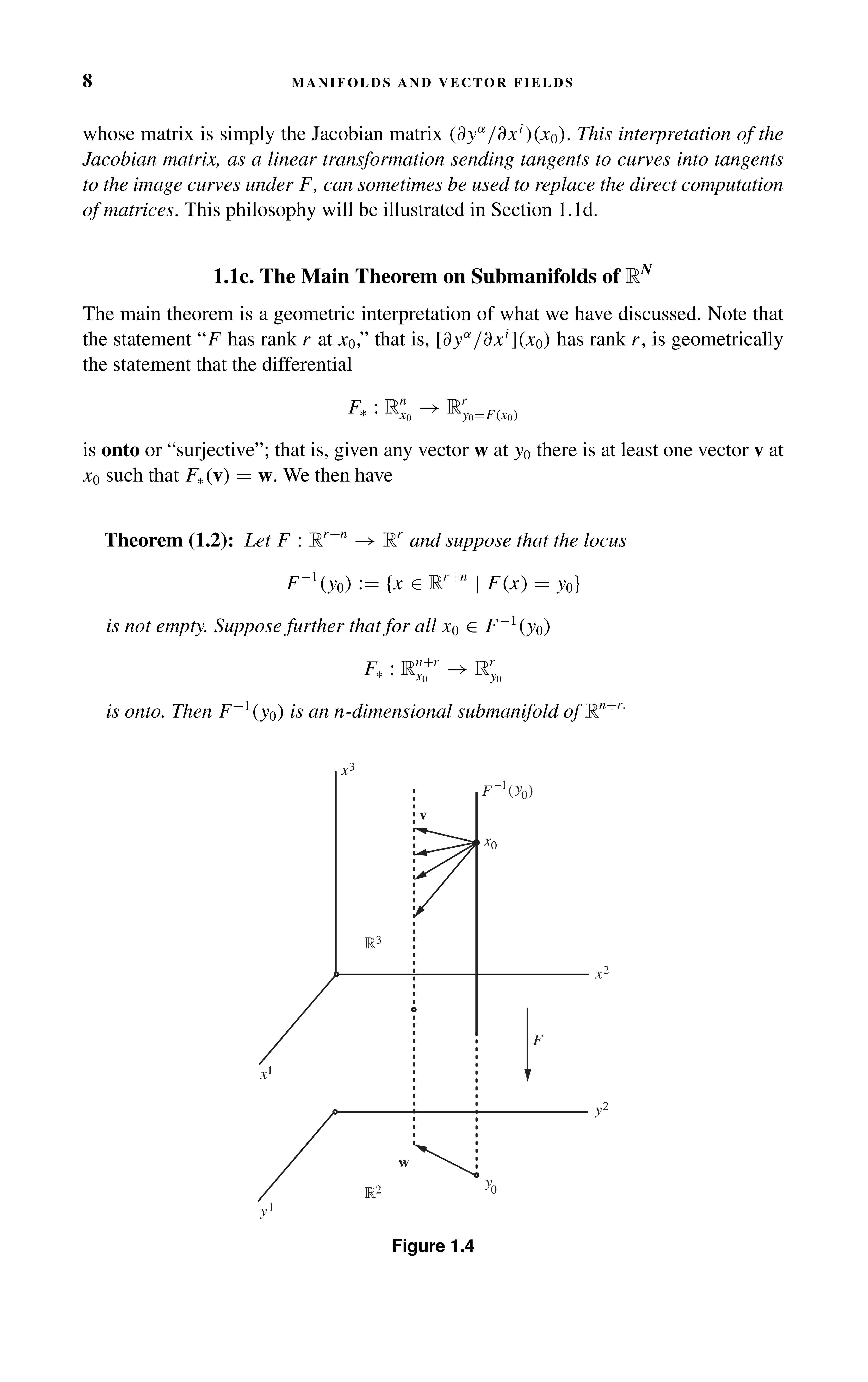
I'm wondering if anybody would be up for talking it out with me so that I can try to associate this with an actual example or two.
Because I'm having a hard time trying to see what should fit where with, say, a parabola in R^2 or a helix in R^3.
 honest narwhal
@random slate so think in terms of linear algebra
If you're trying to solve a system of linear equations Ax=b where A is a matrix, well let's say the A is n x m where n < m and A has rank n
Then solutions to Ax=b will be an affine subspace of R^m of dimension m-n
If the rank decreases, then the solution space becomes a higher dimension
Now if we switch to the smooth case, we're trying to solve F(x)=y
And the idea is that if the derivative has max rank, you sorta expect that locally you're playing the linear algebra game from earlier, and that you're getting a tangent plane of the right dimension
random slate
Okay -- I think I get that at least conceptually
honest narwhal
If your derivative matrix dies off you now have too many tangent vectors. So imagine the graph of |x| in the plane
random slate
But what I'm trying to do is tie all the variables to an actual example of a submanifold -- like, say, what goes where when I want to be able to show that the helix (cos t, sin t, t) is a submanifold of R^3?
honest narwhal
So in general you can't always play this game, some manifolds aren't given in this form globally
But lemme see about the helix
random slate
I know at least you'd have n = 1, r = 2, because n is supposed to be the size of the "input space", and n + r is supposed to be the size of the overall ambient space
I know that earlier, the function F was described in terms of implicit functions and eventually was used to define the differential
honest narwhal
So R^3 -> R^2, I guess you know x^2 + y^2 = 1
random slate
But then they switched from F: R^n -> R^r to F: R^(n+r) -> R^r
honest narwhal
And sin(z) = y
So let's say we have F:R^3->R^2 given by F(x,y,z) = (x^2+y^2-1,y-sin(z))
random slate
Ooooh. Hmm.
I'm not sure why those two equations in particular. I can see at least that the first is satisfied by any point on the helix, and the second is true as well, but there seem to be any multitude of other equations you could have chosen
honest narwhal
Actually hmm that might be a double helix actually, nothing is preventing x=-cos(z)
random slate
But it does seem that a curve in R^3 should be an intersection of two surfaces
(I would imagine you'd use a helicoid and a cylinder but I dunno if that helps)
honest narwhal
Can a helicoid be described in terms of a single equation?
honest narwhal
I don't know cylindrical coordinates lmao
random slate
If it would be easier to do a different example that's fine
I just want to do something that's not like ... a line
honest narwhal
But hmm I guess a way to rectify my earlier attempt would be to use tan
Well, circle in the plane is x^2 + y^2 = 1
random slate
Alright, I'd be fine with doing the circle in the plane instead
honest narwhal
So you have a map R^2 -> R given by F(x,y) = x^2 + y^2
Derivative is (2x,2y)
Which is surjective whenever (x,y)≠(0,0)
random slate
Okay, so F is going from R^2 to R, and you've said it's equal to F(x,y) = x^2 + y^2, since the points on the circle an be written as F(x,y) = c. What would a sample y_0 be in this case?
Would it be a point on the circle?
honest narwhal
A sample (x_0,y_0) would be
Oh their y_0 is my c
By their notation y_0 would be a point in the image, so a radius
random slate
Ohhhh.... so then y_0 might be, say, 4, and then F^-1(4) would be the set of all points such that F(x,y) = 4
honest narwhal
Yup
random slate
So y_0 is being used to define "level curves" of sorts
honest narwhal
Yeah this theorem is saying when the derivative is nice, then level curves are submanifolds
random slate
BTW lemme show you the previous page
I want to make sure I'm understanding how the differential works here as well
Thank you so far, this is coming together
 honest narwhal
But yeah so as a counterexample just to make things clear, F(x,y) = y^2 - x^3
The level curve at 0 isn't a submanifold, it has a sharp point
random slate
Oh interesting
honest narwhal
And the idea is that (0,0) is a point where the derivative of F is not surjective
random slate
I'm not entirely sure I'm understanding what the derivative is here
honest narwhal
Jacobian matrix, (2y,-3x^2)
random slate
In terms of F_* at least
Hmm I see
I'm not used to non-square Jacobians
But I guess that's because we're taking R^2 to R^1
honest narwhal
Just the matrix of partial derivatives. The point is that such a matrix defines a linear map the way all matrices do
This is the "linear approximation" of our smooth function
random slate
Alright. I do understand that idea that at each point you've got a tangent space, and vectors can live inside that tangent space
So say you were looking at y^2 - x^3 = 1, which should be a submanifold
So that's gotten by setting "y_0" = 1
random slate
Sure that's fine
Yeah it's using x's for all inputs and y's for all outputs sorta
Expressing things as y^1 = f_1(x^0,x^1,...,x^n), y^2 = ..., etc
honest narwhal
Also F_* lmao
Nobody called it a pushforward
I'm pretty sure it technically is but like
Nobody does that
Df
random slate
So F^-1(c=1) is basically that curve, and it's nonempty, so we're good
Let's call "x_0" b as well
So for all b in F^-1(c), we need to look at F_*: (R^2 at b) -> (R^1 at c)
So, that's taking 2D vectors attached to a point on the curve
And taking them to ... 1D vectors attached to c somehow?
random slate
It seems weird to have a copy of R^1 attached randomly to c=1
honest narwhal
Yeah they're doing something which is irrelevant now but will matter later
random slate
But okay ... so say I have the vector <-2,1> attached to the point (2,3) on the curve
Where will F_* take this
honest narwhal
0
Errrrr
Wait no
Okay so y^2 - x^3 = 1, your point is on this curve
So now the gradient is (-3x^2,2y)
In this case (-12,6)
random slate
Okay ... so ohhhh
I see why you're doing the inner product
That should be the projection sort of, or a scaling of it
honest narwhal
So if we're looking at the tangent vector (-2,1), the inner product gives 30
random slate
So <-12,6> is pointing in the direction of the tangent space
To our curve at that point
honest narwhal
Uh, I'm not totally sure about that geometric interpretation
Tbh I don't think about a lot of linear algebra this geometrically, in my mind it's like, a linear approximation
honest narwhal
Something something tangent vectors are orthogonal to level curves I guess?
random slate
Yeah
I feel like this part is what might be relevant
And sorry if I'm being frustrating, but the thing that helps me the most here is when I can take a concrete example with actual equations and actual numbers and see where everything fits
honest narwhal
Yeah I guess I just think about things differently
random slate
Maybe that means I won't make it as a mathematician 😂 but whatever hehe
honest narwhal
So numbers tend to just not do much work for me at all
To a degree I think about examples but more like, idk in the service of pictures rather than computations
And lol we'll all find out in due time whether we're good enough to make it in the subject, in that regard I say let the future stay in the future
random slate
The really annoying thing here still btw is that it starts off with F: R^n -> R^r and then for this big theorem it suddenly switches to F: R^(n+r) -> R^r 😠
So I've been building up this intuition the whole time and then it's gone
But I at least do understand the role that "y_0" or c is taking now
honest narwhal
Yeah this is making me think that physicists aren't to be trusted with notation
random slate
But okay. Let's run with the inner product thing for now. It seems that that inner product should be onto, logically
Pick the right vector and you can get any inner product you want
Whereas if you'd started with c=0, then at (0,0) you'd have a point where that Jacobian is <0,0>
honest narwhal
And that's not surjective yeah
random slate
And any inner product with that will be 0, so you no longer have an onto map
I wonder why they didn't say "not identically zero" instead of "onto"
Because it seems that being identically zero would be what would cause your problem
But perhaps there are also other ways bad things can happen.
honest narwhal
Nope surjectivity is actually what matters
It's just that the image of a linear map to R is either identically 0 or surjective
honest narwhal
Yup
random slate
Having something like, a fold between planes, would be equally bad
This really has helped
I'm gonna report back to my friend and have him help with some of the other computations, since he's the one who does the physics and is supposed to be used to this stuff XD
honest narwhal
👍
random slate
It seems also that r is the number of "parameters" that can be used to define your curve
honest narwhal
In a way, like what matters here is the difference in dimensions
Think rank-nullity
random slate
In this case we've had, r = 1 because once you know you've got a curve of the form y^2 - x^3 = c, you only need to know the value of c to be able to tell which curve you're looking at
Whereas with the helix, you'd need to know two parameters -- the radius, and the initial phase
 sleek thicket
codim (ker T) = dim (im T)
huh
Not relevant
I just thought of it because of "think rank nullity"
honest narwhal
Rank nullity is very relevant, if your derivative is surjective this is literally the statement of the dimension of the preimage of a regular value
Like at tangent spaces
sleek thicket
yeah sorry I just meant the fact that you could write it using codimension
I just thought it was cute
random slate
Yeah I think that makes sense
I see how the concepts of linear algebra are making sense here with dimension
honest narwhal
Yeah, pretty much it's that linear algebraic stuff gives you dim of tangent spaces
But that's gonna be precisely the dim of the manifold itself
random slate
Thank you a bunch @honest narwhal
honest narwhal
No problem! And yeah I should prob get going tomorrow's gonna be a long day grading calc 2 midterms 😭
We're gonna meet up at fucking 9AM
Such bullshit
Mornings don't exist smh
random slate
It's always 5 PM somewhere
honest narwhal
And I wanna be there
Actually no that's wrong
I'm pretty sure time zones are in increments of ≥ half hour, right?
So at this very second it's either n:20 or n:50 in any location
random slate
shhhh
honest narwhal

 midnight jewel
@honest narwhal not true, there's at least one time zone that's a quarter hour offset https://en.wikipedia.org/wiki/Nepal_Standard_Time
Nepal Standard Time (NPT) is the time zone for Nepal. With a time offset from Coordinated Universal Time (UTC) of UTC+05:45 all over Nepal, it is one of only three time zones with a 45-minute offset from UTC. (The others are Chatham Island Standard Time, with an offset of UTC...
sleek thicket

A web app that works out how many seconds ago something happened. How hard can coding that be? Tom Scott explains how time twists and turns like a twisty-tur...
midnight jewel
topology prof, after missing the edge case of n=0 for the severalth time in a row: "can't we just work in dimension 5 and up?"
 marsh forge
Tbh people who point out those edge cases deserve the electric chair
Like if you interrupt a lecture with “what about the empty set” I hate you as a person
Esp in topology
midnight jewel
ah but here it was actually kinda relevant I feel like
it was about the homology groups of Sⁿ and he made a huge mess about the proof, which, as much as I understood it, kinda relies on the base case because it’s “inductive” in a sense
cause if I recall correctly we showed that $H_n(S^n) = H_{n-1}(S^{n-1})$? don’t have my notes with me, except that there’s some messy things for n≤1
 gentle ospreyBOT
Sascha Baer:
urban anvil
you wanna use reduced homology to do n = 0 which is dumb
urban anvil
just forget 0 and start from 1
midnight jewel
well, for S¹ we only know the first homology group because of hurewicz’s theorem and because we happen to already know the fundamental group, we never looked at the higher ones; also we did it in a more general settings of deriving it via the axioms of homology, not making any assumptions about e.g. the underlying groups and what not
and in that case you kinda need 0 because for 0 we had an axiom telling us about the homology
marsh forge
Just remember that H0 is connected components and move on
midnight jewel
afaik the way we proved it you couldn’t get the H_n(S¹) directly from the H_n(S⁰) so you either would have to work them out differently or do the thing with the reduced homology
but it was such a mess, I think I’ll hve to read a clean proof of it elsewhere
the proof actually ended in “exercise: fix this”
so like
yea
marsh forge
Good tbh
It’s not that bad
Fix it
Esp if you’re working over fields
Or even Z tbh
midnight jewel
we’re not working over anything we just deduced it from the axioms of homology, which did not include an “over fields” or “over Z”
urban anvil
it includes an over Z
marsh forge
Yeah if you’re looking concretely at S^n you’re almost certainly doing liked, singular
Which requires a group G (normally taken as Z due to universal coefficient)
(Or singular in disguise like cellular or simplicial)
midnight jewel
Our definition was:
A homology is a functor from pairs $(X, A)$ where $X$ is a top. space and $A \subseteq X$ to graded groups together with natural transformations $\partial_* : H_p(X,A) \to H_{p-1}(A) := H_{p-1}(A,\emptyset)$ satisfying five axioms (named homotopy, exactness, excision, dimension and additivity, I don’t feel like typing them all out)
gentle ospreyBOT
Sascha Baer:
midnight jewel
and we defined $H_0({p}) =: G$ the coefficient group and then the theorem was that $H_p(S^n) = G$ for $p = 0,n$ and $0$ else
gentle ospreyBOT
Sascha Baer:
 dim meadow
Okay, once you have that you can do stuff
midnight jewel
if I understood correctly what we’re doing now is just assuming the homology we defined at first satisfies all of these axioms (we’ve shown about half of them I think and the rest’ll come later) and now we’re defining CW-complexes and looking at how we can determine their homology groups
dim meadow
You prove all the axioms
midnight jewel
we will but later
dim meadow
Oh, oof
midnight jewel
he decided he wanted to show some applications first
so as to not make it too dry up ahead
so for now we’re basically just looking at what one can do with a thing satisfying the axioms and occasionally assuming the “usual” homology satisfies them
I don’t think that’s all that out there tbh
like as long as it’s clear we’re making not-yet-proven assumptions but are actually proving them later I’m completely fine with that
dim meadow
Sure
midnight jewel
I think my main issue with the course is just a lack of good lecture notes. he doesn’t follow any book very closely (well, he mostly follows bredon but with some deviations anyway)
and the part we’re covering is like some chapters in the middle of bredon, too
idk why he’s not using hatcher, he said he was gonna use it last semester
but he changed his mind for some reason
midnight jewel
yea it’s mostly a time thing tbh
idk where to take the time from to revise after lectures
midnight jewel
so far I’ve not liked what I’ve seen of bredon
though there’s definitely merit to it being what the prof follows
what’s bad about hatcher tho
that said I looked at the proof in bredon and basically, he seems to do the thing where he leaves out non-obvious things without saying that they’re not necessarily obvious, but this is fine since the prof spent a bunch of time on those details but messing up pretty much everything that actually was in the book instead :P
urban anvil
sure I mean graded abelian groups aka graded Z-modules
the emphasis is on, this is over Z
or on abelian
honest narwhal
Okay so
There's a notion of a group acting smoothly on some manifold
Actually nvm my question is stupid
urban anvil
glad you arrived at the answer on your own
honest narwhal
I was basically confusing what one might call a "smooth action of a Lie group" with an action of a general group by diffeos
 tame jasper
 umbral surge
no one thinks youre funny
gentle ospreyBOT
matqew:
 chrome dew
soft square topology
midnight jewel
that much is obvious but google didn’t give me a definition cause I just tried to look it up
it’s probably defined earlier in the book
chrome dew
well looks like they define the open sets next line
basically like a soft ball topology but instead of disks that don't contain their boundary they're squares
midnight jewel
what’s the soft ball topology?
chrome dew
actually I didn't read the next line I just realized
soft ball, just another name for open ball, here I'll just define that now
midnight jewel
I know what an open ball is, but that’s just the standard topology
and if you define it via squares it’s still the standard topology
so I doubt it’s that
chrome dew
yeah I agree it will be the same topology
well, ok I guess I was just going to make up something that was going to be like the R^2 version with the squares on the distance chopped off, but yeah probably best to find where they define it earlier in the book
midnight jewel
does the course follow a book?
 gritty widget
not really
no
soft ball topology is standard topology
maybe soft squares is like std but with a different norm q_q
midnight jewel
okay yea in that case I think merosity is right
yea it would be induced by the manhattan metric I guess
wait no
the supremum metric
midnight jewel
but it’s the same topology
midnight jewel
eh same shit a norm gives a metric, and a metric gives a topology
$d_\infty(X,Y) = |X-Y|\infty = \max{i = 1,\dots,n}{|X^i - Y^i|}$
gritty widget
i mean the answer sheet goes on to draw this lol
gentle ospreyBOT
Sascha Baer:
gentle ospreyBOT
matqew:
midnight jewel
and uh yea the \R is a nonstandard macro I defined it for texit :P
you can specify your own preamble
gritty widget
oop
midnight jewel
I use it so often that I just define that everywhere
it gets very old to write \mathbb quickly ^^
gritty widget
so it'd be like $U \in \mathcal{O}_{\text{sst}}$ if $\forall p \in U:\exists r \in \mathbb{R}^+: B_r(p) \subseteq U$
wiat no
midnight jewel
for each p in U
gritty widget
^
midnight jewel
yea. and you can quite easily show that this is the same as the standard topology
gentle ospreyBOT
matqew:
gritty widget
ye it is
midnight jewel
because you can fit balls inside squares and vice versa
 lucid turret
Trivial question for big brains like you, but consider two subspaces of R^2, one is two circles, one inside the other, and the other is two circles, but this time next to each other
What is a good way of distinguishing these subspaces? They are clearly homeomorphic :(
Is it that no homeomorphism of R^2 can map one subspace to the other?
midnight jewel
what do you mean with the two circles inside another exactly?
like, a ring?
oh wait do you just mean like, the circles themselves, not filled?
like two copies of S¹?
lucid turret
yeah just S^1
midnight jewel
if so, the first one separates ℝ² into three regions, two of which are not simply connected and one of which is, but the second one has two simply-connected regions
midnight jewel
I think so. let f: ℝ²→ℝ² be a homeo which maps the concentric circles onto the separate circles, take U to be the ring between the two circles including the circles themselves. Then, because homeomorphism and boundary commute, we must have that δf(U) = f(δU) = {the two circles}. Now, because U is connected, f(U) is too, so f(U) is ℝ² \ the two balls, but this is no longer compact, contradiction
so yea, there does not exist a homeo from ℝ² → ℝ² which restricts to a homeo between the two circles
the argumentation is not perfectly rigorous but you can fill in the gaps it’s not particularly interesting :P
lucid turret
Nice & cute
 floral gust
Is the argument for inclusion correct?
marsh forge
Sorry I am having a little trouble following (you should really avoid using so many symbols in your proof) and never use \wedge
I’m not sure I follow the main point of your argument
Namely, the step
Well
You show that a set U in the basis is a subset of an open set
This doesn’t really show it’s open
floral gust
Oh sorry it should be equal instead of subset
I could not avoid the inclusion of f without going obstruse since it is set-theoretic definition chasing
sleek thicket
I'm having trouble with a really simple problem about irreducible spaces
I'm trying to show that if X has an open cover by irreducible subspaces, then it if connected iff it is irreducible
irreducible => connected is obvious
For connected => irreducible, I think I reduced it to showing that if X is connected and X = Z union W for proper closed subsets Z, W, the intersection of Z and W is disjoint from any irreducible open set
Which might be false idk
Or that Z/W is the union of all irreducible opens it contains
Which is the same as saying if an irreducible open is not contained in Z, it is disjoint from Z
sleek thicket
Figured it out
It's super easy if you use irreducible iff every nonempty open is dense
floral gust
Is this possible because empty set cannot be in the topology because the emptyset is not inside the second collection of sets
floral gust
Indeed But it is not in the second collection
And for emptyset to be in the topology, it must be in both collections
floral gust
Oh indeed sorry. I confused it with something else.
marsh forge
np
floral gust
One more thing. To show the space itself is in the topology, I have to show infty is in the second collection. But I cannot see why is that possible
Since X\A is open whereas for infty to be in the second collection, X\A must be compact
dim meadow
Ooh is this the one point compactification of a open subset?
gritty widget
No what you want is that (X\A)+{∞} ∈ ℱ_Y
So you need to either show that (X\A)+{∞} ⊂ X\A and moreover that it is open, which clearly is impossible because ∞ ∉ X\A so the inclusion is false.
Or, you need to show that you can write (X\A)+{∞} = [(X\A)+{∞}]\C for some compact C ⊂ X\A. I claim there is such a C.
floral gust
Because both of them can be in the first collection (atleast a priori)
gritty widget
I think you are confusing inclusion and membership
dim meadow
Yeah this is literally the one point compactification of an open subset
Just show one point compactifications work in general
And you're done
dim meadow
Yeah you're right, sorry
gritty widget
@floral gust what you think you want to prove is that (X\A)+{∞} ⊂ ℱ_Y, so you what you are right now thinking about is to prove that ∞ is in one of the two sets, but this is not the case, what you actually want to show is that (X\A)+{∞} ∈ ℱ_Y and this has nothing to do with proving that ∞ is in either set
At least that's what it looks like to me, maybe I just didn't understand you
floral gust
@gritty widget Is it because emptyset is closed and a closed subspace in a compact space is compact. Thus empty is compact. And since empty is in the second collection we have Y\ empty is in the second collection
dim meadow
Infinity is in Y\C
gritty widget
@floral gust yes
floral gust
Perfect. Thanks!
dim meadow
@floral gust have you seen one pt compactifications before?
floral gust
Yes. I have!
Btw is there not a much weaker version of the given claim where X just has to be locally compact Hausdorff?
marsh forge
i feel like there has to be a better way of writing down the one-point compactification properly
dim meadow
No, X doesn't have to be anything
It has to be locally compact hausdorff to become hausdorff
floral gust
For one point compactification?
dim meadow
You can one pt compactify any space
floral gust
0.0
dim meadow
It just looks shitty
marsh forge
but all decent spaces are locally compact anyway
floral gust
Ah okay okay!
marsh forge
and semilocally simply connected
dim meadow
Of course
marsh forge
and contractible
 honest narwhal
One point compactification is stereographic projection plus some other examples nobody cares about
honest narwhal
Why is that a space you contemplate?
dim meadow
It's not
It's just an example
It saved me on quals though
Cause if you one pt compactify a manifold minus n>1 pts you don't get a manifold
But I have yet to see it actually be really useful
Outside of the standard stuff
marsh forge
I use one point compactification often
Like D^n -> S^n
I guess that's not really a 1pt
dim meadow
No
marsh forge
yeah nevermind
dim meadow
You're thinking R^n to S^n
dim meadow
Or open ball
marsh forge
D^n - S^{n-1} -> S^n
marsh forge
I was
floral gust
One more question regarding the previous question. We know that P and R are compact iff P | - | R is also compact. But this is in contradiction since for us it is given that X\A | - | {infty} is compact but X\A being open in a Hausdorff space is not compact where |-| is a disjoint union
sleek thicket
I don't know the context but I would be surprised if X\A |_| {infty} has the disjoint topology
floral gust
Oh nvm. I think the topology on the disjoint union is different which let it becomes compact Hausdorff
dim meadow
It has the disjoint union Topology iff X\A is compact hausdorff I think
 digital nova
Why don't the closed intervals [a, b] for a < b form a basis for R?
dim meadow
Basis elements are open sets
digital nova
well yes but we could define the closed intervals to be the open sets in this topology right?
sleek thicket
Sure, but it won't be the standard topology
digital nova
That's not what I'm asking, I'm asking why they don't form a basis
sleek thicket
Oh I'm dumb
It's because [-1, 0] intersect [0,1] = {0}
Which doesn't contain an interval
sleek thicket
Np
gritty widget
The job was to found the right homotopy between the standard circumference (cost,sint) and this
This was my shot
I feel like it does not work because of small s and t where I'm starting "behind" (1,0)
Is it true? If yes how should I work for "stop" and "start" a curve in that way? Not asking for the right homotopy only for a "way" to formalize the start&stop motion, thanks
gritty widget
I mean, I wrote that I feel like it does not when t and s are small
It should not be continuos but I'm unable to prove it rigorously
It seems to me like after the "stop" at (1,0) my curve starts from behind if s and t are small enough
Because I cannot get past the -2tpi
Endpoints should be ok
Sigma0 and sigma1 are ok
 potent sky
Does that say spi?
gritty widget
Continuity is missing ( I think)
potent sky
@gritty widget if you're checking continuity shouldn't it suffice to take the limit at s*pi
gritty widget
Not really
potent sky
Because both of the functions in your piecewise are continuous
gritty widget
What I fell I'm missing is the right motion as I start the curve
I fell like it stays at (1,0) then "teleports" behind and start the regular motion which should be the right one
gritty widget
I think that too lol
potent sky
So your homotopy, call it h
You need h(0) = (cos t, sin t)
Or you could say h(0, t)
potent sky
It won't because
Let me check
Maybe I'm just having a hard time reading this
Is s the thing ranging from 0 to 1?
gritty widget
Problem are in the "pasting" process of the two interval when t,s are changing
Yes, it is
T is between [0,2π]
gritty widget
I think
potent sky
I don't think you even need to, they're homeomorphic
gritty widget
No, I think the formula is wrong, I'm looking for the confirm
potent sky
Ah
gritty widget
I think I have the right one, but I want to understand why this does not work
dim meadow
@digital nova they do actually form a basis
But not a very interesting one
They generate the discrete Topology
@sleek thicket
(sorry, this was from the question before)
potent sky
It's ok
sleek thicket
Only if you allow a = b
gritty widget
It happens that it is behind as I was saying right?
potent sky
Well there's just this odd jump from (1,0) to whatever happens at t = pi/2
All I know is it's not (1,0) or close to it
You break continuity of h(1/2, t)
gritty widget
While cos(s(2t-2π)+(1-s)t) works right?
potent sky
I don't know you have to show me the whole homotopy
sleek thicket
@dim meadow that's why I originally said it formed a basis
dim meadow
Oh I see
gritty widget
Someone please help explain? I have no clue :/
marsh forge
Does anyone in this server even do geometry
Can we just rename this to topology and redirect geometry to hopf lmao
potent sky
@marsh forge differential geometry
gritty widget
Sorry mb.
honest narwhal
Liquid likes geometry
@potent sky what he was saying was that no member of this server really does much geometry, everyone here is more into topology
So that we could just call this channel topology and avoid having people come with 9th grade shit
But yeah Liquid likes geometry for sure, I know SashaMomo is doing diffgeo right now so this could end up being a good place for her
Shamrock likes geometry as well
potent sky
@honest narwhal #topology-and-diffgeo ?
honest narwhal
I'll see if this becomes a thing. When this was named advanced geometry we were plagued by this
potent sky
@honest narwhal the thing about diffgeo is
everyone who knows what it is knows what it is
and high schoolers have no idea
honest narwhal
True, just that in principle this isn't restricted to diffgeo. Geometric group theory, for example, could happen here
And this is the first time I've seen someone come with high school geometry in a long time
potent sky
mm then maybe it is not a problem after all
gritty widget
Let $\omega, \sigma \in \Omega^1(M)$, then, for some $X,Y \in \Gamma(TM)$,
\begin{align*}
(\omega \wedge \sigma)(X,Y) &= (\omega \otimes \sigma)(X,Y) - (\omega \otimes \sigma)(Y,X) \
&= (\omega \otimes \sigma)(X,Y) - (\sigma \otimes \omega)(X,Y) \
&=(\omega \otimes \sigma - \sigma \otimes \omega)(X,Y)
\end{align*}
gentle ospreyBOT
oprah winfrey:
gritty widget
whoops overthinking it
midnight jewel
@honest narwhal I'm also doing diffgeo rn
or, well, suffering through it, is probably a better description
floral gust
Can somebody please review this? Especially the notation for dealing with quotient space
marsh forge
Please lord stop using symbols for and/or
Also the piecewise function doesn’t make sense
What does x=A mean
You define f on X not X/~
Ie you define a function f on X that descends to a function f’ on the quotient
You have to show this is well defined on eq. Classes
You keep switching between talking about f as a function between X and Y and also X/~ and Y
Ie f^-1(U) is not a set in X its in X/~, you have to show that this is homeomorphic to the obvious set in X
Actually, never mind, you just seem to be playing kinda fast and loose with thinking of elements of X/~ as eq classes and as elements of X
Ie you treat the trivial equivalence classes as being “just elements of X” instead of technically eq classes
But if your prof doesn’t care then I guess its fine as long as you understand it
I think the rest is fine but its gross to read so I probably won’t
floral gust
Yeah I am a bit confused about how I can represent the equivalence class which is equal to the set A
Actually, never mind, you just seem to be playing kinda fast and loose with thinking of elements of X/~ as eq classes and as elements of X
Yes I am doing exactly that. But my TA is notational pedant. So I want to make sure what would be the precise formulation
floral gust
And what about A?
marsh forge
So if you want a function from X/~ to Y
You say f([x]) = [x] if x \notin A and f([x]) = \infty if x in A
Then you have to show this is well defined
What that means is that if y,z are in class [x] then if x in A, y,z are also in A
Which is obvious
And if y,z are in [x] not in A, then y=z=x
Then this map makes sense
Alternatively you can define g: X -> Y in such a way that it induces a map on X/~
floral gust
How would I write A \not\in U where U is an open set in quotitent space?
As in what notation should I use such that it is apparent that A over here refers to an equivalence class
@marsh forge
floral gust
Yes I realize that. But for x \in A, [x] = A
marsh forge
If x \in A then pi^{-1}([x])=A
No
[x] does not equal A
Ever
A is a set
Well actually I guess on a purely set theoretic level you’re correct, sorry
I’ve never really thought about it like that
Yeah I guess [x]=A is fine but I don’t think its very common
floral gust
Yeah because [x] ={y | y ~x} ={ y | x=y or x,y \in A}
marsh forge
I think this is because A has a topology but we don’t think about [x] having a topology
floral gust
That makes sense tbh
marsh forge
But anyway yeah, on a set theoretic level this notation is fine
floral gust
So I should use pi^{-1}([x])=A and this subsumes the topological properties by preseriving it via the function?
marsh forge
On some level kinda
But its more that like, we think of [x] as a point
Even if its technically a set
So it’s just weird to put = here
(The category theorist would say that [x] is not regarded as a topological space itself so the sentence [x]=A is meaningless but whatever)
floral gust
Yep Yep thank you. I will rework the proof now
marsh forge
Anyway the main point is to distinguish eq classes from honest-to-goodness points notationally
Anyway the rest of the point set work looks ok at a glance
floral gust
Wait so can you clarify how the piecewise funcition look like?
marsh forge
It depends how you want to write it I would probably say
marsh forge
f:X/~ -> Y
f([x])=x if x \notin A
f([x])=\infty if x \in A
Noting that for x\notin A, the class [x]={x} and for x\in A the y\in [x] if and only if y\in A
floral gust
oh Yes that basically means pi^{-1}([x])=A
marsh forge
Hence this map is well defined
Yeah that’s equivalent
It’s just nice to use language that is easier to read
Minimize symbols where possible
floral gust
The thing is my TA is very "ThaT sEnTEncE iS noT clEar". So if I use language it becomes unneccesarily long real quick
floral gust
And I obviously reply it is clear from the context and then he says, well i know that because I know you and I know the solution. Someone else who doesn't know either would get confused.... So yeah... I have to go full notational pedant to prevent any ridicolous charges of unclarity
marsh forge
Trust me, your TA is wrong
Writing things out their way is far more confusing for the average person
That’s why no professional mathematicians write like that lmao
floral gust
Yeah but then again he is grading so 🤷
honest narwhal
May not be a bad idea to try and just get the class and/or prof to go to him and be like "You're a cretin"
gritty widget
A and C are open in d_sup, C only open in tau metric
Can someone help me find closure of A and C sets with those two metrics?
gritty widget
I mean, yeah, in A in d_sup it's just gonna be f(t)>=0, in C with tau metric integral <=1, same with d_sup? Although not sure how to formally state that besides 'it has to be this way' lol
sleek thicket
For A with d_sup, you can say uniform convergence implies pointwise convergence, so if f is a limit of functions which are > 0 at x_0, f(x_0) is the limit of a sequence of positive numbers, and thus is nonnegative. Then if f(t) >= 0 everywhere, f is the uniform limit of f_n = f + 1/n
For C with τ, iirc this is a general result about normed vector spaces, and it might be easier to prove it by forgetting about functions
gritty widget
I'm looking for the torsion of the following curve
Do I really have to explicit that? No one knows any smart method?
gritty widget
Hi, I need someone to verify my answer (if I'm thinking correctly about one thing): In 3-adic topology with 3-adic metric I have set: $$S\left(0,\frac{1}{27}\right) = { n \in \mathbb{Z} : d_3 \left(0,n\right) = \frac{1}{27} }$$ I believe this sets contains of only 27 and -27. Is this set S closed? It has to be, right?
gentle ospreyBOT
Godel:
gritty widget
It's probably also open but right now I'm just not sure how to state that its closed besides saying its made of just two points (so I guess its cuz its' complement is open?)
marsh forge
tbh i don't know much about p-adics
but you can consider what it means to be a limit point of your set
and show that they are all contained
this is sufficient
gritty widget
Haven't had limit points yet I believe.
marsh forge
is your only def of closed complement of open then?
gritty widget
Wait no, there were others.
Let me check.
Actually yeah I think thats the only one introduced yet
marsh forge
Yeah ok, then my first approach for this type of thing would be along these lines, let me know if this sounds doable to you
gritty widget
You might ask why do I have p-adics and also categories on my 3rd topology lecture, I'm wondering too lol
marsh forge
Take your set, take its complement. Look at a point in the complement. Show that theres some open ball (in the metric top) thats also in the complement. If this holds for an arbitrary point it holds for all of them
then the complement must be open
gritty widget
Ok yeah actually that's obvious theres always a ball in complement I think
marsh forge
Perfect!
Sorry that I couldn't be more specific but I've somehow never had to force myself to learn p-adics yet
gritty widget
It's pretty not fun so far so you haven't missed much.
marsh forge
Yeah I haven’t gotten fun vibes
gritty widget
But its cuz its too abstract for me at the time
midnight jewel
I'm confusing myself here, I may be too tired.
Let A be a discrete subspace of B, and B a subspace of C
Under what conditions is A discrete in C?
marsh forge
Depends on your definition
If you take discrete to mean its subspace topology is discrete
then A being discrete in B means that for all a there is an open set U of B such that U\cap A={a} so then U=B\cap V for V open in C so in particular V\cap B\cap A = U\cap A = {a}
If you require that you get a covering then you need a covering
midnight jewel
yea I meant the former
and glad that it is always I wrote a proof that didn’t seem to need any assumptions and figured I had to have messed up somewhere
btw if you just enclosed the formulas in dollar signs, the latex bot would’ve rendered the comment nicely
dim meadow
No
midnight jewel
no?
floral gust
ye
gritty widget
If in topological space X each subset is open or closed does it mean that this space is discrete?
gritty widget
take what of what
gritty widget
the other one has to be open though
urban anvil
yes, that's how topologies work
gritty widget
no, it can be none
urban anvil
???????????????????????????????????????????????????????????????????????????????????????????????????????????????????????????????????????????????????????????????????????????????????????????????????????????????????????????????????????????????????????????????????????????????????????????????????????????????????????????????????????????????????????????????????????????????????????????????????????????????????????????????????????????????????????????????????????????????????????????????????????????????????????????????????????????????????????????????????????????????
gritty widget
A set can be not open and not closed right
urban anvil
yes
gritty widget
can you explain what did you mean by those two points and what they prove
urban anvil
it's an example to the answer to your question
it's an example of a space where all subsets are open or closed
but is not discrete
dim meadow
That's called sierpinski space lol, and it's a famous counterexample in Topology
urban anvil
sectumsempra
midnight jewel
additional question marks aren’t actually achieving anything apart from annoyance
urban anvil
not math
midnight jewel
no, just presentation
urban anvil
still not math
midnight jewel
still relevant to discussions
anyway, to clear up the confusion
when they said “no, it can be none” they had misunderstood you thinking you claimed that in a topology, every not closed set is open
where you had meant that the complement of a closed set is open
midnight jewel
this does not look like “this is clear” to me
sleek thicket
Yo stop being an asshole
urban anvil
nah dude someone bumping into a done conversation just to preach and "clear confusion" where there is none gets that
honest narwhal
I'm gonna step in and say let's not
This conversation is over, and in the future do not be rude
honest narwhal
Alright at this point I'm just gonna comply then
 wooden scarab
Is there a g-handled 2-sphere with abelian fundamental group for g>1?
honest narwhal
Nope, you can compute the fundamental group of the surface of genus g by Van Kampen
gentle ospreyBOT
Dami:
floral gust
@gritty widget Consider the space X ={a,b} with the topology T ={∅, {a},X }. We can verify this is a topology since ∅,X ∈ T and it is closed under arbitrary unions and finite intersections. Now consider the subsets of X
X - Open and Closed
∅ - Open and Closed
{a}- Open
{b}- Closed
Every subset is either open or closed and since {b}∈P(X)\T thus T is not discrete. Thus there exists non-discrete spaces with every set either closed or open.
sleek thicket
This is the spectrum of a local ring, but it's probably a lot more understandable by the person who asked the question
midnight jewel
I’m frustrated because my algtopo prof keeps making a huge mess out of classes and no one can really follow what he’s saying; last years was really well-organized and has good lecture notes (which I’m reading now, he did things a bit differently - mostly involving much more abstract nonsense and humor)
marsh forge
topologists are just like that
sleek thicket
Lee is kind of disappointing tbh
He's a good lecturer but he just proves the stuff in the book
Which makes sense, since he wrote it for this course
honest narwhal
Lol for a sec I thought you meant the book lmao
I don't think anyone here is the author of a particularly famous textbook
sleek thicket
hmmm, you sure?
It would be pretty embarrassing if someone who knew math saw me shitposting tbh
 sleek thicket
Oh lol
It's nice being able to namedrop my instructor
He told us in class that he had Munkres for algebraic topology in grad school
 sleek thicket
?
I'm a student at the uw
University of Washington
Taking the manifolds course
Why do you ask? @civic kraken
sleek thicket
Oh no
I'm just lucky enough to be taking a class on manifolds from the dude who wrote the manifolds books everybody uses
sleek thicket
Yeah he's surprisingly energetic
 civic kraken
isnt he like 200
sleek thicket
And is fun to talk to
Yeah
Like seventy something
He's retiring after this year (but also told me he might be teaching the geometry special topics course next year so idk what retirement actually means)
civic kraken
emeritus?
sleek thicket
I think I proved something too strong. Can someone check this for me?
Let G be a topological group and H a subgroup of G containing some open set U which contains 1. Then H is open. To show this, it suffices to show that for each h in H, there is an open set containing h contained in H. But hU is open, and hU <= hH = H, and h = h1 in hU
 west spindle
midnight jewel
west spindle
midnight jewel
I’m reading the previous year’s prof’s AlgTopo notes and so far I think they’re very good
Will J. Merry's website
 royal badger
I have found the vectors (1,1,1,1) , (-1,1,-1,1) , (0,-1,0,1) , (-1,0,1,0) which should be perpendicular to each other (correct me if I'm wrong). But I'm wondering if there's an easy way to do this for any dimension.
 fervent citrus

royal badger
lol sorry am retard
marsh forge
Topological groups scare me
Like the fact that they induce the same structure on their pi_1
Wilke
Wild*
sleek thicket
What do you mean by same structure?
Is π_1(G) also a topological group?
With what, the compact open topology?
honest narwhal
I think the point is more like
You have the multiplication on pi_1(G) given by concatenation of loops
You also have pointwise
sleek thicket
Oh I might have known this
Someone once pointed out to me that π preserves products and the initial object, so it sends group objects to group objects, so π(G) is abelian for G a topological group
And that's just this but with more words
Maybe
Since π(multiplication in G) is pointwise multiplication, right?
Yeah I know
That's why I thought of it
If you take the multiplication map m : G×G -> G, then π(m) : π(G) × π(G) -> π(G) should be pointwise multiplication, up to the identification π(G×G) ≈ π(G) × π(G)
That's what the last part was
marsh forge
The best argument
Is that pi1 preserves products and therefore group objects
And a topological group is a group object
And an abelian group are the group objects of Groups
Oh wait I just noticed shamrock already posted that
I’ll walk away in shame now
 remote grotto
is there a name for a manifold whose ricci scalar vanishes but not necessarily its ricci curvature tensor?
midnight jewel
ugh I spent ages on a problem today only to learn they made a mistake in the question
they gave us the parametrization of the torus and we had to prove some things about geodesics, but they messed up
they gave it like this, that last sin(y) should’ve been sin(x)
I only noticed after I went to plot some things to convince myself that what I’m trying to prove makes sense
so much time wasted
marsh forge
Wait
That’s pretty gross
For an AT course lol
Oh wait is that your diffgeo course
civic kraken
is it that geodesics given in the plane by a line with rational slope are closed? and irrational slope means dense?
midnight jewel
nah, these were the exercises
I spent quite a while just writing down the geodesic equations, which was good practice I guess but like, tedious
after I noticed the mistake I didn’t have the energy to try again
the circle in exercise (a) is the one at the very top of the torus btw, and the region is the “outer half” of it
and yea it’s diffgeo
midnight jewel
ayy I just had a revelation tho (a) is actually pretty easy
the outer half of the torus is a surface of revolution, so I can just apply clairaut’s relation to it, which tells me that if the geodesic ever hits the upper or lower circle, then it must be tangent again; and use the geodesic equations to show that when it’s tangent, x will tend to 0 (i.e. into the outer half)
and (b) will probably have a similar solution but there it’s not a surface of revolution hm
midnight jewel
apparently this is the worst thing we’ll ever do in this class
I sure hope so
midnight jewel
we’re currently doing classic results of diffgeo, later on we’ll do index-free stuff which is supposedly much less painful
other profs don’t really do this stuff
but hey with the equations above, gauss’ Theorema Egregium has a 1-line proof!
marsh forge
My favorite construction of the torus
Is drawing a fat oval on a board and then adding a small hole
midnight jewel
like so?
(drawn with mouse, hence ugly)
(the inner lines should ofc not intersect)
marsh forge
Yes perfect
 raw sedge
I'm not sure if this belongs here or not, but does anyone have any recommendations for an algebraic geometry textbook for self-learning?
civic kraken
when i took diffgeo
my prof hated the book so much
we skipped christoffel symbols and the usul geometric proof of gauss bonnet
he ended up teaching us derham cohomology and proved gauss bonnet via triangulations
and then he didnt know what to put on the final so told us to write up a full proof to gauss bonnet (since he just hand waved it) instead
honest narwhal
Yeah I don't like the subject of differential geometry
One thing I will be very happy to just never see again
marsh forge
@raw sedge Vakil lecture notes
raw sedge
thanks
raw sedge
What should I know before learning algebraic geometry?
raw sedge
is commutative algebra basically algebra but thinking about what happens when structures are commutative?
 lavish laurel
some algebraic topology and differential geometry helps
what do you mean?
commutative algebra is the study of rings
lavish laurel
because rings are commutative
raw sedge
the study of Z is the most pretentious way to say number theory do you know where I can get a shallow but simple overview of algebraic topology and differential geometry?
lavish laurel
number theory isn't really the study of Z but the study of Gal(\bar{Q}/Q)
in particular you care about number rings
of which PIDs like Z are the easiest case
uhh
why do you wanna learn algebraic geometry?
raw sedge
because I want to know a lot of maths
and because I don't really understand what it's about and I'm curious
and because I need something to read
lavish laurel
commutative algebra is a good thing to read
I wouldn't rush to do more
I'd take my time with manifolds and algebraic topology
raw sedge
so should I do that first?
lavish laurel
if you like algebra, sure
raw sedge
I think I like algebra from what I know so far
lavish laurel
then yeah sure
raw sedge
I learned some basic group theory
lavish laurel
oh
you might wanna learn more algebra first
basic ring theory and galois theory
from something like dummit & foote
or lang
or uh
any algebra book
sleek thicket
AG is at least 40% ring theory
raw sedge
I started reading dummit and foote but some definitions in chapter 2 strikes me as very unmotivated and lacking any intuition
sleek thicket
That doesn't get better in AG
imo
You need a bunch of seemingly nonsense definitions
raw sedge
the thing is I'm sure there is some intuitive way to think about it
sleek thicket
Like what a sheaf is, what a locally ringed space is, what an affine scheme is, what a scheme is
raw sedge
for all of the seemingly arbitrary definitions until now I could find intuitions
which helps me organize it in my head, and also makes me find it much more beautiful, and makes me better at figuring out how to prove things
sleek thicket
That's great, but you should not try and learn algebraic geometry right now
There is intuition in ring theory
But the best way to get that intuition is to do more ring theory
raw sedge
what should I learn before ag except ring theory?
sleek thicket
What's your background with topology and geometry?
raw sedge
topology - I barely know what it is
geometry - just some very elementary stuff from schools, never learned it deeply
sleek thicket
Okay, you need to know topology
And it helps to have background in differential geometry. I didn't when I started learning AG and strongly regret that choice
raw sedge
what is differential geometry really about?
well, I think I'll keep reading dummit and foote for now for the ring theory
then I'll find someplace to learn topology
then differential geometry
then I'll read those lecture notes
@lavish laurel @sleek thicket thanks
lavish laurel
well dummit and foote is dry as hell
you can find other algebra books
@raw sedge
if it isn't working for you
any algebra book will do really
there's many good ones
pinter's particularly friendly
raw sedge
I'd rather stick to it cause I started with it, and because it's supposed to be very comprehensive.
lavish laurel
it is, but the material is very standard
there's no harm in using various books for a topic
the exercises in D&F are great though
raw sedge
you're right, I should read it together with something else
do you know if I can easily find a PDF of Pinter's?
 versed geode
cough libgen probably cough
midnight jewel
what is differential geometry really about?
so the topic list for my diffgeo 1 course is as follows:
Introduction to differential geometry and differential topology. Contents: Curves, (hyper-)surfaces in R^n, geodesics, curvature, Theorema Egregium, Theorem of Gauss-Bonnet. Hyperbolic space. Differentiable manifolds, immersions and embeddings, Sard's Theorem, mapping degree and intersection number, vector bundles, vector fields and flows, differential forms, Stokes' Theorem, de Rham cohomology.
the first few topics (up to gauss-bonnet) are various classic results about “shapes in ℝⁿ”, basically. the second part is differential topology, which I don’t really know a whole lot about yet ^^
but so some things we’ve done so far were various statements about smooth curves in space, submanifolds (“locally flat surfaces”) and curvature
the basics of the subject kinda boil down to “how can we work with shapes that aren’t just nice and flat, but are at least nice when you zoom in enough?”
 rugged swan
let . be the definition of a topological manifold
what can you say about this definition ?
-> defining differential manifold
what can you said about differential manifold ?
that's differential geometry x)
honest narwhal
Ehh
I'd say differential geometry needs more than just being a smooth manifold
Either a Riemannian metric or some other geometric structure
If you're just working with the smooth structure I think you're doing topology more than geometry
rugged swan
I was joking
just to shoz that with one definition you can say many many thigs about int
floral gust
Is this correct
 merry shale

 sleek thicket
my intuition is that for r < 0, we have det(rI) = r^n I and r^n > 0 (in the even case)
 kind surge
also the centers of the groups can't be in bijection for even n
gritty widget
Well because the only normal subgroup of On(R) of order 2 is <-I>, which is in SOn(IR) if n is even
(The argument for this is that a subgroup of $O_n(\mathbb R)$ of order 2 is generated by an element $r$ such that $r^2 = I, r \ne I$. Then, $\mathbb R^n = \underbrace{\ker(r+I)}_{\ne 0} \oplus \ker(r-I)$. The normality of $\langle r \rangle$ implies that $\ker(r+I)$ is invariant under every element of $O_n(\mathbb R)$. Since it is nonzero, it must be the entirety of $\mathbb R^n$, hence $r = -I$)
gentle ospreyBOT
trex:
marsh forge
Sanity Check
How do we realize RPn as a connected sum a la classification of surfaces
Oh wait
That’s why the sanity seems off
 fleet rapids
so I get that this metric is just indicating when m isn't n, but why does it induce the discrete topology on N ?
chrome dew
the open balls of radius 1/2 are the integers themselves
I was going to say singleton but if they're confused over the discrete metric already I figured it'd just be jargonizing it
k
fleet rapids
lol yes I know what a singleton is
and Ive read a good 100 pages of topology already
Thank you Merosity though
(there's always one person who answers the question in a non-jerk way then everyone else wants to insult to make themsleves feel better, I'm working on like 15 different courses back and forth because of prepping for the mgre and Im on 6 hours of sleep so holy crap Im so sorry if I make a silly mistake sometimes)
ah ok fair enough then
ok so am I correct that induces here means we have open sets of "being distance 0 from n"
then it makes perfect sense, I just didnt process why that would be the induced topology (I guess it wouldnt have been anything else but idk)
thank you (sorry for misjudging a minute ago) that makes sense now
I guess I should've phrased the question in my mind more as "what would the open sets contain" then it should've been clear that they should only contain the singletons
so with Z or N its discrete then right?
if you get what I mean
I guess N would be a subspace (but not a very interesting one)
but then the subspace would just have the same discrete topology, but ah Im rambling
chrome dew
@gritty widget lol
marsh forge
Can someone give me an example of a connected manifold
With nontrivial tangent bundle
marsh forge
Ok so like
I guess my confusion is
Everywhere the tangent bundle is R2
But it’s the fact that TM is not isomorphic to MxR2
That confuses me
Is that because the space Tm
Is much more complicated
Sort of like how a covering space works?
dim meadow
So maybe you're confused about vector bundles in general
marsh forge
I am
dim meadow
So here's a proof that the Mobius bundle over S^1 isn't trivial
You have the canonical 0 section
Take it out of the Mobius bundle
And you get a connected space that is actually just the cylinder
But if you remove the 0 section from the trivial bundle
You get 2 cylinders
dim meadow
It's hard because all vector bundles over a space are homotopy equivalent
And yeah, I guess
marsh forge
Sorry I think of mobius as [0,1]/~
Sorry square that
But anyway
Yes I see the proof
dim meadow
So there's no boundary here
dim meadow
One sec let me look at Lee's smooth manifolds
marsh forge
Ok I think I get it actually
dim meadow
And I'll give a more cogent explanation
marsh forge
Vector bundles being locally trivial is about like
How the surjection map
Only is locally like a surjection map
Out of the trivial bundle
marsh forge
I thought it was thought of as the pair usually but obviously that can be recovere
Triple*
dim meadow
Well yeah
marsh forge
Anyway yes I think you’ve helped a lot actually
I was thinking about “locally trivial” wrong
dim meadow
So yeah, the subtlety is how the whole thing is pasted together
So there's something called a frame
dim meadow
Which is basically n smooth vector fields which are linearly independent at each point in TM
marsh forge
Oh nvm lol
dim meadow
Oh sorry
marsh forge
Yeah ok but that makes sense