#point-set-topology
1 messages · Page 155 of 1
 umbral surge
 fleet rapids
Is it the case that:
 dim meadow
Do you have a map between S^2 and S^1?
fleet rapids
if f is a continuous invertible map from S^1 to S^2 then that map's inverse f^-1 is not continuous
 marsh forge
He’s asking if there’s a continuous map with non continuous inverse
dim meadow
That is continuous and bijective
fleet rapids
thats what im asking
marsh forge
Between those two
dim meadow
Such a map cannot exist
fleet rapids
This: if f is a continuous invertible map from S^1 to S^2 then that map's inverse f^-1 is not continuous
umbral surge
yeah, if it had a continuous inverse then, S1 and S2 would be homeo, and they arent, so we know such a map cant exist
fleet rapids
right if we had all 3 conditions then its homeo
but such an f exists, just that f^-1 is not continuous
marsh forge
If such an inverse exists
It is necessarily not cont
I’m not sure if such an inverse exists
fleet rapids
mhmm ok thaks
dim meadow
It's hausdorff to compact
marsh forge
So clearly if 2/3 of the def holds, the last part can’t
fleet rapids
Well I think the f exits since theres a bijection betwen them
unless none of such bijections are continuous
marsh forge
Well the bijection has to be cont
fleet rapids
yeah
marsh forge
^
dim meadow
Cause of point set chicanery
fleet rapids
sorry trying to focus on several things,, thanks
 small obsidian
Hold up, looking to see what properties that continuous maps preserve
umbral surge
fleet rapids
im having trouble finding what point set chicanery is on the google, pls help
dim meadow
In particular it's a closed map
Even if it's just surjective
There's a cute question
fleet rapids
yes im very new to topology
dim meadow
Show that the the interval has the least Topology so that it's hausdorff
Coarsest
And the finest Topology so that it's compact
fleet rapids
"the interval"?
fleet rapids
ah
dim meadow
[0, 1]
dim meadow
Hint:think imbeddings
umbral surge
sorry, im not clear on what youre asking
dim meadow
So you have a Topology on I which is a subset of the standard Topology
And makes I hausdorff
Show that Topology must be the standard Topology
@umbral surge does that make sense?
Similarly with the compact question
umbral surge
yeah, makes sense
dim meadow
@honest narwhal you up?
 primal burrow
Looking for current research on continuous geometry created by von nueman for thesis
marsh forge
Does anyone have an intuition for how we think about (co)fibrant objects
I’m not sure what a “generalized covering space” over the final object should look like
 honest narwhal
Okay so time to understand the cell structure on CP^n because Hatcher's description is not working
So you have CP^{n-1}\subset CP^n
 gentle ospreyBOT
Dami:
gentle ospreyBOT
Dami:
honest narwhal
And in particular it must equal $\sqrt{1-\sum_{j=0}^{n-1} |z_i|^2}$
gentle ospreyBOT
Dami:
honest narwhal
Ohhhh
honest narwhal
Beautiful
honest narwhal
Okay so, RP^2 is gluing a 2-cell to S^1 along z->z^2
honest narwhal
And given Hatcher's theorem about attaching 2-cells, this should mean that pi_1(RP^2) = Z/2
dim meadow
Yes
honest narwhal
Obv this is easy to see because it's a quotient of S^2 by Z/2
But yeah that should imply it
So now hmm, in general is it nice to compute the fundamental group of a connected sum?
Let's just say of surfaces
I can see a Van Kampen style argument for orientable ones
dim meadow
I think it's not too bad
There's an argument that Hatcher uses in a hw problem in the cohomology section
dim meadow
Which I think works here too
honest narwhal
This should work for non-orientable as well
dim meadow
Which makes a map from connected sum to wedge sum
honest narwhal
Chop a disk out of the funny square diagram for RP^2
dim meadow
Which is nice
It induces a surjection on pi_1 I think
And then you use first isomorphism
To get more info
honest narwhal
That guy defo retracts to the boundary identification which is gonna be (ab)^2
So I guess that would suggest the fundamental group of the Klein bottle is <a,b,c,d|ababcdcd>?
Oh wait a sec we also have the relations in RP^2
Wait okay now I'm confused with this square picture of RP^2
So pi_1(RP^2) = <a|a^2>
And pi_1(RP^2\D) = <x,y| (xy)^2>
I'll call that C_1
And C_2 for the other copy
So pi_1(C_1) = <x,y|(xy)^2>
And pi_1(C_2) = <a,b|(ab)^2>
C_1 and C_2 glue along a circle which includes as what?
Oh hold on I'm dumb I think about pi_1(RP^2\D)
 gritty widget
what topology is this?
honest narwhal
The only topology which makes sense
Anyway that's the square identification of the torus, let's say you kill a disk
What happens?
gritty widget
what part of algebraic topology does this belong to?
gritty widget
That's why it looks like something even I can understand 🤔
honest narwhal
Oh God I cannot visualize these things
honest narwhal
Hmm, so RP^2 is e_0 \cup e_1 \cup e_2
If you remove a point from e_2 does it just retract back to e_1?
dim meadow
Yeah
That's the case
Think of removing a point from a torus
And how that deformation retracts to a wedge of circles
Which is the 1-skeleton
honest narwhal
Okay that works better, since the torus picture also makes sense when it comes to the square but the RP^2 square picture suggests it's some wedge of circles as well
But okay I think I see it now
So then pi_1(C_1) = <a> and pi_1(C_2) = <b>, and then the boundary circle includes how exactly? Since the attaching map is z^2 in each case, it should be a^2 = b^2
So pi_1(Klein) = <a,b|a^2b^{-2}>
Or I guess we can let b=b^{-1} and just call it that
And induct the idea to get any non-orientable surface
So the idea of the action of pi_1 on the fiber seems to be this
We have a covering map p:E->B
Given a loop at x_0, it lifts to a path with endpoints in p^{-1}(x_0)
And I guess if you choose two representatives of the same element of pi_1, they're gonna be homotopic paths, so now there's the homotopy lifting property
Let H be the homotopy
And \tilde{H} be the lifted homotopy
Since p\tilde{H}=H, we see that p\tilde{H}(0,t) = p\tilde{H}(1,s) = x_0 for any t,s
Which means p\tilde{H}(1\times I) \subset p^{-1}(x_0), which is discrete, and by connectedness we see p\tilde{H}(1\times I) is a point
And same with p\tidle{H}(0\times I)
So the lifts \gamma_1 and \gamma_2 of the representatives of element of pi_1 have the property that \gamma_1(0) = p\tilde{H}(0,0) = p\tilde{H}(0,1) = \gamma_2(0), and same for 1
So there's a well-defined action of p_1 on the fiber as follows: given ([\gamma],y_0), \gamma lifts uniquely to \tilde{\gamma} such that \tilde{\gamma}(0) = y_0
And then we send that pair to \tilde{\gamma}(1)
This is now well-defined
Okay so now some more facts
If p:(E,y)->(B,x) is a covering space, the induced map p_*:\pi_1(E,y) -> \pi_1(B,x) is injective
This should be the homotopy lifting property as well
And in fact the image of p_* is gonna be homotopy classes of loops at x which lift to loops at y (instead of paths y to some other point in p^{-1}(x)
And that should imply further that the index of p_*(\pi_1(E,y)) is the number of sheets
Since we have our earlier action of \pi_1(B,x) has stabilizer precisely equal to p_*(\pi_1(E,y))
honest narwhal
Mom called and held me for a bit too much time...
So lifting criterion will take just a bit too long to read the proof of so nah
Uniqueness of lifts, on the other hand
Yeah it's pretty much a closed and open thing
Construction of the universal cover.... yeah nah
I'll just see what it is and not verify that it works
 midnight jewel
hey I understand like every second sentence!
I definitely need to read more into lifts at some point cause we only did them rather superficially (just to prove the fundamental group of S¹)
dim meadow
Lifting criterion is just lebesgue number lemma
Over and over again
Not too bad
But tedious
honest narwhal
So let's say X is path connected, locally path connected, and semilocally simply connected
Then we let \tilde{X} be the set of paths gamma starting at x_0
Up to homotopy
And the topology is that a neighborhood of [\gamma] is the set of [\gamma\cdot \eta] where the composition works and where \eta is contained in an open set U in X
dim meadow
I think there's a little distinction
From what you said
You say two paths which start at x_0, end at the same point, and are homotopic are the same
@honest narwhal otherwise there's some problems
With for example a contractible space
I think there may be some technicalities with the homotopy equivalence relation also
honest narwhal
Oh yeah it's equivalence classes of paths so homotopy rel stuff
dim meadow
Semilocally simply connected is locally contractible?
Or was it something else
I always forget
I think locally contractible implies semilocally simply connected maybe
honest narwhal
Locally contractible does imply semilocally simply connected
Semilocally simply connected is that for each x\in X, there's some open U containing it such that the map on pi_1 induced by the inclusion U->X is 0
honest narwhal
Yeah
honest narwhal
Yeah
And then there's the classification of covers, subgroups of pi_1 = covering spaces
Normal subgroups = normal covers (normal cover means Aut acts transitively)
Aut here meaning deck transformations
dim meadow
Oh so something that's cool
dim meadow
So there's a correspondence between congugacy classes of subgroups of the fundamental group of index n and n fold covering spaces
Say n is prime, then by some algebra theorems you have that subgroups of index p are normal
So you just need to count the normal subgroups of index p
You can do that by looking at maps from the fundamental group to Z/pZ
 stoic tulip
by which algebra theorems do you have that subgroups of index p are normal
dim meadow
I forgot the proof but here's a relevant stack exchange

Mathematics Stack Exchange
Generalizing the case $p=2$ we would like to know if the statement below is true.
Let $p$ the smallest prime dividing the order of $G$. If $H$ is a subgroup of $G$ with index $p$ then $H$ is normal.
stoic tulip
this is a well known result, yes
dim meadow
It's just sylow stuff
dim meadow
Oh right
I'm stupid
Lmao
I think you need the subgroup to be normal to do stuff with maps to Z/pZ
But I think there was a way to get around that
Oh anyway you can do easier stuff for normal covers
honest narwhal
:0
Anyway so if a cover is normal then Aut = pi_1/im(other pi_1)
And now there's the stuff about covering space actions
Okay I think I have the theory down good enough for the moment
Time for problems
So T^2-{pt} is S^1 wedge S^1, that's because you can sorta expand that hole
Non surjective maps to the sphere are nullhomotopic, you can stereographically project wrt a point not in the image, kill shit in R^n, and project back
To be detailed, let f:X->S^n miss the point y and let P_n:S^n{y}->R^n be stereo projection. Then define F:X\times I -> S^n by F(x,t) = P_n^{-1}(tP_n(f(x)))
Okay jumping from the warmup problems to the non warmup problems... I'm screwed
These super geometric examples are just not working for me
If I do fail this one which I prob will then maybe I'll do analysis or smth instead
honest narwhal
Excision seems nifty, basically what's going on deep inside A doesn't affect relative homology
This feels definitely obvious when (X,A) is a CW/good pair
Since you just murdered A and all its inhabitants
marsh forge
The point set condition just allows you to do the obvious thing
honest narwhal
Yeah I'm not too familiar with operator K-theory in particular, I'm vaguely aware of K-theory of spaces
marsh forge
Jan ELIU operators
honest narwhal
And yeah it satisfies all the Eilenberg-Steenrod axioms aside from dimension
marsh forge
Or I guess operator algebras
midnight jewel
excerpt from a mail we just got from our topology prof:
But I'd also like to take this chance to make a few comments about oral exams. I find that oral exams are not objective at all, very much luck-dependent, unfair, do not even give enough time for me to give feedback, and to sum up that it is disgraceful that second-year core courses have oral exams. I know that the grades that many of you got do not reflect your understanding of the subject, for many of you being much lower than you deserve; in fact it seems to me that a majority of you would have done better or at least as well on a written exam.
 west spindle
all exams here are oral 
honest narwhal
I'll say that you may have some folk who cave under the pressure of being watched and for those guys perhaps what this guy is saying is true
Though you could prob make the case that being able to present is just a skill that people have to have, especially in math, so it's fair to just require it
And yeah for people in general oral gives you more opportunities to be hinted though things that would otherwise be insurmountable roadblocks
 frigid patrol
 marsh forge
Yeah I love oral exams they are more fun
dim meadow
I've never had an oral exam, but I feel like there would be a lot of banter
marsh forge
Oral exams are good iff your students can handle the social pressure of having to present a result
Or the embarrassment of having to think in silence
Like there are added social factors that I could see making someone dislike them
But math is a social sport so 🤷
gritty widget
Math is for lonely nerds
 gloomy plover
Math is for everyone! :)
gritty widget
big oof

 digital peak
I spoiled it for myself
gentle ospreyBOT
matqew:
 bitter yoke
@gritty widget What have you thought about?
gritty widget
what do they mean by maximal open subsets?
in topology of F^1, F^1 is maximal open subset
bitter yoke
Yeah I think it's worded weirdly
As in, they want the maximal open subsets such that the map x is injective
gentle ospreyBOT
 Requested by Blitzkrieg#7821
gritty widget
Requested by Blitzkrieg#7821
gritty widget
that still doesn't fit with me (this interpretation) but let's just say we all agree
gritty widget
owo
maybe I could have one set restricted to positive m
then the other to negative m
bitter yoke
@gritty widget are you sure that restriction makes your function injective?
gentle ospreyBOT
matqew:
gritty widget
and
gentle ospreyBOT
matqew:
gritty widget
@bitter yoke
bitter yoke
Okay well you said positive and negative m earlier
But this is probably what they want yeah
gritty widget
yeet ty
 past brook
how do i compute the knot polynomial of that knot on the right?
the one i arrowed
isnt it just $d^{-1}$ ?
gentle ospreyBOT
xy:
bitter yoke
You take the polynomial of a whole knot, not just a part of a knot
past brook
ah yeah
which was what led me to thinking about this question
the states we use to compute the polynomial are all relative to the original, whole knot
so im not really understanding what the author is saying
this is taken from kauffman's book, knots and physics volume 1
bitter yoke
He means
That applying a reidemeister 1 move to a knot will not change the polynomial
He's just focusing on that one part of the knot
And saying that the polynomial will be unchanged if that part is changed as shown
past brook
did you mean reidemeister 2 ?
past brook
im not really seeing how 1 comes into play here
midnight jewel
(and my favourite prof teaches it)
bitter yoke
2 yes sorry
midnight jewel
(but it was taught last year, and it’s every two years, so I’ll have to fit it into my master’s)
past brook
@sascha im an undergrad 😦
midnight jewel
as am I
past brook
ive been learning it for the past week for a possible research project
midnight jewel
but it won’t be taught again here while I’m still in my bachelor’s
past brook
i kinda have difficulty figuring out all the A-type splits and B-type splits that kauffman introduces
and i have to slowly decipher the splicing/splittings at each crossing
midnight jewel
(I particularly love how she teaches it with a focus on education)
small obsidian
@midnight jewel
Don't take it. The knot book is online and is a very easy read
midnight jewel
@small obsidian It's not just a class on knot theory tho. it's a class that's also on math education, and with my favourite prof
small obsidian
Oh well then that's pretty lit
midnight jewel
@small obsidian this is the course description
it doesn’t look like it goes very deep, but I know Akveld has written some books on the topic so I assume she knows stuff
 wanton marsh
there is no channel for nonsense
 brittle widget
 dark wyvern
"studying"
gritty widget

The Alexander horned sphere is a pathological object in topology discovered by J. W. Alexander (1924).
 coarse kestrel
Ugh pathological stuff
gritty widget
idk why
i have no idea why i sent that
i guess i sent this to the wrong person
person/server
oh no
yeah
i dont have acess to voice channels
so i was talking to someone or "whoever" about rieman mapping theorem
and about why you need path connected open sets and not the more general connected open sets
gritty widget

 leaden mica
Am gonna learn topology just to understand this image
midnight jewel
Explanation:
||X stands for any generic space, i.e. any set. P(X) is the powerset of X, i.e. all subsets of X. A topology is a collection of “open sets”. (X, P(X)) means we define the open sets of X to be the elements of the powerset of X, so every subset of X is considered to be an open set.
If you have two topologies, then one is called “finer” than the other if it has more open sets (in a certain sense). Thus, P(X) is the finest topology that can exist on X, as every set is open. This topology is also called the discrete topology. ||
 compact oracle
@midnight jewel , I know you probably consider that a "standard" explanation but damn I think it's fine... pun. Seriously though, thanks. Been away from Math for awhile and that was an excellent refresher on the definition of discrete topology. Thanks.
I'll also use that concise example the next time I have to describe fine vs coarse.
 sweet wing
some use finer and some use coarser
past brook
the jones polynomial is defined in these notes like that, and i have several questions: firstly , the skein relation given seems a little different from the ones i found online, which essentially state that the first term on the right hand side of the very first equation should be q^-1 -q
secondly, i don't really understand the exercise. isnt the jones polynomial of the unknot defined to be equals to 1 (normalization) ?
$P_2$ denotes the jones polynomial here and i know its a little different from the more common notation used
gentle ospreyBOT
xy:
bitter yoke
I'm not sure where you're looking to see that it should be q^(-1) - q
But maybe the crosses on the left hand side of the equation are also switched?
past brook
 night pivot
and we let q=sqrt(t)?
bitter yoke
Also, I'm not sure where you see that the unknot is defined to be 1, I'm not sure that's standard either
night pivot
wait 1/sqrt(t)?
past brook
the polynomial of the unknot isnt 1 ?!
@night pivot if we let q = 1/sqrt(t) then
q - q^-1 = 1/sqrt(t) - sqrt(t)
but the second screenshot i sent indicates
sqrt(t) - 1/sqrt(t) instead
essentially differs by a multiple of -1
night pivot
Oh I see
because the polynomial of the unknot is equal to 1
doesn't mean that the polynomial of multiple unknots is equal to 1
bitter yoke
Yeah this polynomial definitely isn't the jones polynomial?
Are you sure it's not the definition of the bracket polynomial?
night pivot
well, about setting the polynomial of the unknot to be 1, we are normalising the polynomial by dividing all Jones polynomials by q - q^-1
past brook
it is the jones polynomial (sorry i didnt capture that part in my original screenshot)
screenshots were taken from this guy's lecture notes
@night pivot im sorry, could you elaborate? the solutions shown in the first screenshot gives P_2 (O) = q + q^-1. or did you mean dividing by q+q^-1?
bitter yoke
What he's talking about seems to be similar to https://en.wikipedia.org/wiki/Jones_polynomial#Colored_Jones_polynomial
In the mathematical field of knot theory, the Jones polynomial is a knot polynomial discovered by Vaughan Jones in 1984.,. Specifically, it is an invariant of an oriented knot or link which assigns to each oriented knot or link a Laurent polynomial in the variable
...
night pivot
hmm I'm also slightly lost here
past brook
sorry for the trouble, my professor went for this guy's lectures a couple of months ago and last week he handed me a copy of the notes
bitter yoke
Probably best to just ask him
past brook
hmm yeah okay, thanks!
 urban panther
hello, anyone able to help with a question about metrizable topologies on R^n
bitter yoke

urban panther
ooh my bad. i'd like to know how i could go about proving that if we've got a metric on two n-dim R-vectorspaces R^n and R^n', that their topologies generated by that metric are isomorphic to each other? or is this claim completely false?
i was thinking about it too and i think that this comes down to seeing that any basis-change map is distance-preserving?
ooh, i said something wrong.
i see.
does this simplify the question to seeing that any change-of-basis isomorphism is distance preserving?
im familiar with the non-topological way of that thing, i suppose
oh, id like to see that an n-dim R-vectorspace with a given basis has a canonical topology by seeing that said vectorspace is isomorphic to R^n
the exercise the prof gave in lectures was that this canonical topology is independent of the basis in the actual vectorspace
im having a little bit of trouble attacking this problem, i was trying to see that an isomorphism from an n-dim R-vectorspace to R^n preserves distance.. i dont know if thats the right way to go about this
yup
yep, it's injective and surjective
ahh, like, continuity?
sorry, im a little bit new to this
okay, i see your point now
thanks heaps, im going to try it out
urban panther
thank you very much!
 digital nova
does anyone have a proof that R^m is not homeomorphic to R^n (m not equal to n of course)
 burnt mirage
take a point out of both of them, deformation retract them to S^{m-1} and S^{n-1}, calculate the homology groups and observe that they differ (up to isomorphism) at certain points? Hatcher's book shows this in Theorem 2.26 to be true for any open sets U in R^m and V in R^n
digital nova
no idea what a homology group is
is there a proof for someone who knows the basics of point-set topology and manifolds?
and maybe a little differential geometry
honest narwhal
Do you know what it means for a map to be nullhomotopic?
And that the identity on a sphere is not nullhomotopic?
 urban anvil
if you care about diff geo, seeing that they aren't diffeomorphic is super easy
it follows immediately from chain rule
midnight jewel
yea but things can be homeomorphic yet not diffeomorphic
west spindle
exotic R^4
 placid thorn
I have a question concerning how to apply the topology of something
So, say I want to divide the entirety of a 3D space into 4 regular 3D subspaces
The way you would do that would be tetrahedral right?
What would those susbspaces look like when you approach the origin at which they all intersect?
 versed pivot
I guess the most obvious thing you could do would be to divide it into four pieces, where each piece consists of two octants
is that the kind of thing you mean?
placid thorn
Well I mean
Okay, so lemme talk to you about where I’m coming from
This is for some fantasy worldbuilding I’m doing in the elemental plane
and in the elemental plane there are 4 infinite sources for each of the four elements
But they’d be perfectly equidistant from eachother and “perpendicular-ish” if that makes sense
versed pivot
oh I see
placid thorn
Yeah
And I’m trying to figure out what the 3D space of the elemental plane would “look like”
versed pivot
you want to arrange 4 points in a nice way in 3d, such as at the vertices of a tetrahedron
and then you want to divide the space into 4 regions each containing 1 of those points
versed pivot
why don't you try it with a triangle in 2d first
versed pivot
as an analogy that you can visualize more easily
placid thorn
It would look like the crest of the East India company?
versed pivot
lol yes it seems so
placid thorn
So then
The 3D subspace would be a collection of 4 tetrahedral spaces with their faces all together
But they wouldn’t have bottoms
placid thorn
Yeah
versed pivot
the edges of the four regions will be the lines perpendicular to the original tetrahedron's faces
and there will be six (pieces of) planes that make up the faces of the regions, each plane bordering two of the four edges
night pivot
So basically, you have the 3D Voronoi diagram of the vertices of a tetrahedron?
placid thorn
yeah
okay, another question related to that
I want to make a "swirly cone"
that is, a cone with a diameter that is regularly twirling down to make a swirling vortex
of two "spinny" hemicones that combine with eachother to make a whole cone
like, imagine the intersection of a cone and an infinitely wide and tall cylindrical helix
the 2 subspaces created by intersection of the helix and the cones is what I'm looking for
midnight jewel
you may have a nice way with words but I have no clue what you’re describing nor what exactly the question is

 placid thorn
Yeah just like the one on the bottom
Well not quite
The helix doesn’t just have a radius
versed pivot
the top is the thing from before
placid thorn
It has a diameter
If you “dangle” the cone by the way it’s cut, it’s still a single cone
midnight jewel
ah I see what you mean now
 midnight jewel
so basically you take a line and then rotate it as you move it along a central axis
and then take the intersection with a cone that’s also through that central axis?
 lucid turret
I wish to show π_k(S^∞) = 0, where S^∞ is inductive limit of S^1 ⊂ S^2 ⊂ ...; Take map f : S^k → S^∞, its image must be compact, hence contained in a finite subcomplex, in particular in K-skeleton of S^∞ which is S^K for some K.
Then f is a map S^k → S^K → S^K+1 → S^∞, where last two arrows are inclusions, so f is not surjective, hence homotopic to constant map
Where am I wrong at this??
digital peak
if Y is a subspace of X and f : X -> Z is continuous at every x in Y, is f|Y continuous?
does Y need to be open in X for this to work?
digital peak
with Y open it seems to match up
marsh forge
Take $V$ open in $Z$. Then $U:=f^{-1}(V)$ is open in X, and therefore $U\cap Y$ is open in Y which should be exactly $f\mid_Y^{-1}(V)$ I think
gentle ospreyBOT
MaxJ:
digital peak
yeah, with Y open it's trivial
marsh forge
$U\cap Y$ is always open in subspace
gentle ospreyBOT
MaxJ:
marsh forge
f is continuous
digital peak
it's only continuous at each point of Y
marsh forge
Oh man I misread the original
Uh no, I don't think this will work otherwise
But maybe it will, let me think some more
Okay so for the definitions to make sense
we have that X and Z are metric spaces
marsh forge
You don't get cont at a point in that context
marsh forge
Oh wow, that's a glaring omission from nlab
digital peak
marsh forge
Ok anyway, so take $y\in Y$, and $U\ni f(y)$. Then we get a neighborhood $V$ of $y$ in $X$ such that $V\subset f^{-1}(U)$. But then $V\cap Y \subset f^{-1}(U)$
gentle ospreyBOT
MaxJ:
marsh forge
then ofc $y\in Y\cap V$ and that is an open neighborhood
gentle ospreyBOT
MaxJ:
marsh forge
So yes I think that works
(with the modification that V be chosen open originally)
I need to take a longer look at the nlab page for continuity later and see if there really is an omission that glaring
Actually, mniip, in that reference, do we get true continuity from pointwise in this context?
digital peak
yes
Theorem cts_locality {X Y} (TX : TopOn X) (TY : TopOn Y) f :
  cts TX TY f = forall x, cts_at TX TY f x.
in english is preferable
but yeah okay then my proof should work unless im being dense
digital peak
f is continuous iff forall x, f is continuous at x
oh it is me who was being dense
I was trying to prove the opposite implication
I don't think that has to be true
marsh forge
That if the restriction is cont we get pointwise cont?
Yeah that seems less likely to me
Yeah counter example sketch:
marsh forge
I've got one
digital peak

marsh forge
in me head
It's not hard to picture a not-open-set that restricts to an open set
when intersected
digital peak
with this lemma local definition of continuity turns out to be a piece of cake 🤔
digital peak
hmm, I wonder if there's some, like, extremely general concept that related open sets and basis sets
some sort of fucked up induction
if P is true for every basis set, and arbitrary unions preserve P, then P is true for every open set
but this is somewhat unsatisfying
burnt mirage
Dark Induction 
Conway does that a lot in his A Course on Point-Set Topology, extending it to subbases of topologies as well — for instance, if for some map of topological spaces f: X to Y and any base or subbase of the topology on Y, if all members S of the (sub)base have f^{-1}(S) open in X, then f is continuous (the converse is true as well)
same thing holds for the definition of compactness (Alexander's theorem) and local connectedness
digital peak
yea because f^-1 preserves both unions and intersections
 spark skiff
i need help
west spindle
what have you tried so far and where are you stuck
spark skiff
I want to prove that A is an open
night pivot
so far that's just restating the question (assuming that you have A a regular surface)
midnight jewel
any book suggestions to accompany my diffeo course?
topics:
Introduction to differential geometry and differential topology. Contents: Curves, (hyper-)surfaces in R^n, geodesics, curvature, Theorema Egregium, Theorem of Gauss-Bonnet. Hyperbolic space. Differentiable manifolds, immersions and embeddings, Sard's Theorem, mapping degree and intersection number, vector bundles, vector fields and flows, differential forms, Stokes' Theorem, de Rham cohomology.
prof refers to these books here, any opinions on them?
Differential geometry in R^n:
- Manfredo P. do Carmo: Differential Geometry of Curves and Surfaces
- Wolfgang Kühnel: Differentialgeometrie. Kurven-Flächen-Mannigfaltigkeiten
- Christian Bär: Elementare Differentialgeometrie
Differential topology: - Dennis Barden & Charles Thomas: An Introduction to Differential Manifolds
- Victor Guillemin & Alan Pollack: Differential Topology
- Morris W. Hirsch: Differential Topology
dim meadow
Lee's smooth manifolds and Milnor's Topology from a differentiable viewpoint
midnight jewel
could you please give more than just a title?
I wanna know why you recommend the books, not just that they exist
I like what I’m seeing in lee’s book tho
dim meadow
This is a weird list
gritty widget
how so
i get the top part being weird
its out of context, it was derived from replying to a comment on fematikas channel
sweet wing
imo it's still good to read multiple books for like a topic
gritty widget
midnight jewel
imo it's still good to read multiple books for like a topic
Imma try to make room for reading one
even that is not exactly going to be an easy endeavour
my timetable is full\™
 chrome dew
reading multiple books doesn't mean you are reading them all cover to cover. you can read the parts that explain the concepts in the way that makes most sense to you
midnight jewel
that’s fair
sweet wing
or could even just take the exercises from one book to supplement
midnight jewel
I assume I’ll have enough exercises already with the weekly assignments
might look for more during study break but not throughout lecture time
sweet wing
not suitable here should be in #geometry-and-trigonometry but no thats for a rectangle
digital peak
peculiar
you'd think in the box topology on the product of a family A of topologies, the empty set is going to be a basis set
but only if A is nonempty
dim meadow
The empty set is always a basis element
If you use the standard basis for the box Topology
bitter yoke
Well first you're going to have to translate
But this is definitely not the right channel for this as far as I can tell
 torn forum
its differentials thought it was here
bitter yoke
Differential geometry is much more advanced than derivatives in calculus
versed pivot
I don't understand what the question was
torn forum
oh damn i just saw im in the wrong chat
digital peak
@dim meadow no it isn't, if the product is over an empty family
there is only one basis element in that case and it's the entire space
that's a bit like saying that a product of n copies of a set is empty iff the set itself is empty
false for n=0
 dire warren
Question.. let T(V) denote the tensor algebra or a vector space V and I the ideal generated by elements of the form x tensor x.. then the exterior algebra Wedge(V) is defined as T(V)/I. There is a natural surjection pi: T(V) -> Wedge(V).
There is also a isomorphism between T(V’) and multilinear maps out of V, and an isomorphism between Wedge(V’) and alternating multilinear maps out of V. Here V’ denotes the dual of V.
We can define the Wedge product on the level of the exterior algebra as follows..
a Wedge b = pi(a0 tensor b0), where a0 and b0 are any two representatives of a and b in T(V’).
Now say we want to define the Wedge product on the level of multilinear maps as is usually done In textbooks. Say a corresponds to the alternating multilinear map A and b to the alternating multilinear map B by the isomorphism mentioned earlier.
We can define the Wedge product of these two maps as Alt(A tensor B) or (some term with factorials) Alt(A tensor B)
Which of these corresponds to a Wedge b as defined earlier? And which of these is the one used in differential geometry when taking Wedge products of forms? If they differ, why the difference?
 hazy eagle
hi guys. how is the cartasian product of 2 polytopes p1 and p2 calculated, where p1 is element of R^n and p2 is element of R^m. Can someone explain to me how it's exactly done here? https://en.wikipedia.org/wiki/Duoprism
is it just the concatenation of all pairs of vertices from p1 with all pairs of vertices from p2 ?

In geometry of 4 dimensions or higher, a duoprism is a polytope resulting from the Cartesian product of two polytopes, each of two dimensions or higher. The Cartesian product of an n-polytope and an m-polytope is an (n+m)-polytope, where n and m are 2 (polygon) or higher.
The...
bitter yoke
Yes
hazy eagle
@bitter yoke its just the concatenation of the pairs?
hazy eagle
concatenation like in theory of computation.
bitter yoke
They're not strings, you don't just concatenate them
What they describe in the article is creating an ordered pair
You can think of it as a 2-tuple
hazy eagle
say p1 = {(a,b),(c,d),(x,y)} and p2 = {(u,v), (w,z)}
then p1 x p2 = {(a,b,u,v),(a,b,w,z),(c,d,u,v),(c,d,w,z),(x,y,u,v),(x,y,w,z)}
@bitter yoke is the example correct?
bitter yoke
You have a couple typos here but yes
Well, technically
It's ((a,b),(u,v)) etc
Essentially a 2-tuple of 2-tuples
bitter yoke
Yeah they're basically the same
hazy eagle
ty man
hazy eagle
Hey I have another question. Just out of curiosity. How are non-convex polytopes defined? I can't seem to find any material regarding non-convex polytopes online.
 random slate
So uh. This was "fun".
From our projective geometry book (Coxeter). Since he seems to take such a "minimalist" approach to diagrams.
coarse kestrel
hm
dim meadow
alright, time to do a dami style rant about sheaves
so lets first define a presheaf on a topological space X
a presheaf is a contravariant functor $F:X\to C$ for some category C, where you view X as the category whose elements of the open sets of X and whose morphisms are the inclusion maps between open sets. Every pair of open sets either has one map between them or 0.
for example, the assignment of the set of continuous functions on U to every open set U, with the inclusion function of X being mapped to the restriction function.
gentle ospreyBOT
Liquid:
dim meadow
Lets talk about the stalk of a presheaf at a point. There are two ways of defining the stalk at p.
Consider the subcategory of open sets of $X$ which contain p. This is a inverse system. Take the image of the inverse system under the contravariant functor F. This is a direct system (I'm using direct system to mean dual of inverse system, not sure if this is the right term).
take the direct limit of that system, that is one definition of the stalk at p
the other definition is you look at germs of the presheaf F at p, IE pairs (f, U) where $f \in F(U)$ and $p\in U$. We identify pairs $(f, U)$ and $(g, V)$ if $f$ and $g$ restrict to $h$ on some $W$ which is contained in both $U$ and $V$
dim meadow
Now these definitions are exactly the same if you unpack the construction of direct limit as disjoint union modulo the direct system
(at least in reasonable categories, not even going to consider more abstract shit)
okay, now we can define what sheaves are
Sheaves are presheafs which satisfy 2 axioms, the identity axiom and the gluability axiom
you basically want presheafs that behave like the sheaves we know and love from differential geometry and other parts of math, eg the sheaf of C^k or C^\infty functions on open sets of a manifold
say you have an open cover $U_\alpha$ of X. Then the gluability axiom says that if you have "functions" $f_\alpha \in F(U_\alpha)$ whose restriction to intersections agree ($res_{U_i, U_i\cap U_j} f_i = res_{U_j, U_i\cap U_j} f_j$) then there exists a "globally defined function" $f$ so that $res_{X, U_i} f = f_i$
gentle ospreyBOT
Liquid:
dim meadow
the identity axiom says that if you have two "functions" $f_1, f_2 \in F(X)$ so that for all $V$ in an open cover we have $res_{X, V} f_1 = res_{X, V} f_2$, then $f_1 = f_2$
gentle ospreyBOT
Liquid:
dim meadow
So let's talk about some examples. Given a sheaf on X, and an open subset U of X, you define the restriction of the sheaf on $X$ by just restricting the contravariant functor $F$ to the subcategory generated by $U$
gentle ospreyBOT
Liquid:
dim meadow
given a set S and a topological space X, consider for each $p\in X$ the inclusion map $i:{p}\to X$. Consider the set of functions on open subsets $U$ of $X$ $i_{pS}(U)$ = S if $p\in U$ or ${e}$ if $p\notin U$ (where {e} is some arbitrary element). The restriction operator $res_{U, V} i_{pS}$ will just be the restriction to open subsets of V of this function. (U has all then open subsets of V and then some, so this is good)
gentle ospreyBOT
Liquid:
dim meadow
Constant sheaves and presheaves. You can just map all the open sets of X to the same set
let the restriction operator be the identity
 sleek thicket
why are we talking about sheaves?
dim meadow
this is not in general a sheaf, for categorical reasons
Oh sorry, I'm using this channel to write shit out for myself
dim meadow

honest narwhal
@sleek thicket literally read the channel description man
dim meadow
lmao
sleek thicket
I assume that it's v funny but also am too stupid to find it on mobile
dim meadow
okay, so heres an exercise from vakil
sleek thicket
@dim meadow what's the vakil exercise?
dim meadow
Let S be a space with the discrete topology, and let F(U) be the continuous maps U\to S. (these maps are called locally constant) Show that this is a sheaf
let me make sure I'm understanding the problem actually
I am not understanding it right
sleek thicket
Is that the correct statement?
sleek thicket
Continuous maps S -> U?
sleek thicket
Oh yeah
Mb
The uniqueness of gluing is immediate, since restrictions are the literal restrictions of the functions
Unless I'm being stupid
dim meadow
yeah, that is exactly what they are
verifying this stuff for spaces of maps is very natural
sleek thicket
It seems like existence of gluing should just be the gluing lemma from topology?
Yeah
Whenever I'm working with a more general sheaf I just pretend it's C(-, R)
Or analytic functions or w/e
dim meadow
okay, so this is called the constant sheaf of a set S
Next exercise
Suppose Y is a top space. Show continuous maps to Y form a Sheaf on X.
dim meadow
same stuff with restriction and gluing lemma
yeah
Next we do the same thing, but with sections instead
given a map Y \to X, show sections of this map give you a sheaf
sleek thicket
What's that? Fix a continuous function f : Y -> X and look at g : X -> Y such the f ° g is the identity?
I can never remember which way it goes
dim meadow
so heres a tip
theres a general thing for this
given a map d: A \to B, a section s is a map s: B \to A so that dsd = d
depending on the situation it could be either way
it could be ds = id or sd = id
depending on if d is injective or surjective
sleek thicket
ohhhh, by epi/mononess that will imply the thing you want
dim meadow
yeah
sleek thicket
Because you can cancel the d off the appropriate side
Also makes me feel like I understand splitting maps on homological algebra a bit better
dim meadow
that's how I think of things like splitting of exact sequences
sleek thicket
Lol
dim meadow
yeah
okay, so here I think the map is surjective
(that's usually how it is in topology)
dim meadow
don't mind at all
sleek thicket
So fix a map f : Y -> X, look at continuous functions g : U -> Y such that f ° g = id
That's the sheaf?
dim meadow
yeah
sleek thicket
It's clear to me that it's a presheaf
Bc restrictions will preserve that
And it's a subpresheaf of the sheaf of continuous functions into Y
So you just need to verify the gluing we found above is still a section
Which can be checked on a cover
dim meadow
yeah
so this is fine, because you define the glued function in the obvious way, and elementwise it's clearly a section (check the open set in the cover where the element lives) , and it's continuous by the gluing lemma
so sure
okay, this one is more interesting
Suppose Y is a topological group. Show this construction gives you a sheaf of groups.
sleek thicket
Ooh
So this is essentially saying that the sections of f on U form a group?
With stuff pointwise
dim meadow
yeah, exactly
sleek thicket
For clarity, (gh)(x) = g(x) h(x)
dim meadow
yeah
sleek thicket
Why is that still a section?
sleek thicket
Yeah this feels wrong
We're not assuming a group structure on X right or anything about f, right?
dim meadow
no, just that f is cont between top spaces
sleek thicket
Oof
dim meadow
and the grp operation is continuous
maybe conjugation or something
hmm
yeah, the naive thing definitely shouldn't work
and you probably do need X to be a topological group as well
okay, maybe there's just some facts about topological groups I don't know
Let's take some easy examples of topological groups
N with the discrete topology
take the quotient map which identifies 2n with 2n+1
then a section of this map will be the identity (trivially)
as well as the map n \mapsto n+1
and similar maps
obviously this doesn't do what I want it to with the standard multiplication
(or rather addition lol)
okay, so actually this is fine
so we actually view the sections in F(U) as acting on maps $Y \to X$
gentle ospreyBOT
Liquid:
dim meadow
so actually $F(U) \subset Hom(Hom(Y, X), Hom(U, U))$
this is the way to think about these sections
not pointwise
oof
gentle ospreyBOT
Liquid:
dim meadow
and this subset acts on maps Y\to X through composition with a particular map
hmm actually I'm not 100% sure this checks out
I guess let's try to finish this question and then I'll sleep
wait fuck I'm stupid
this question is wrong
I'm just looking at continuous maps to Y
so literally $Y^X$ as a group
gentle ospreyBOT
Liquid:
dim meadow
smh
dim meadow
well not literally
sleek thicket
And was not able to message about sheaves
dim meadow
but a subgroup
so the thing is
vakil put this as a part b of the section question
and stated it as a follow up
dim meadow
so I assumed that I had to think about sections
but nah
goddamn it
there's 25 minutes of my life I'll never get back
sleek thicket
Classes start at my uni tomorrow and I'm still undecided on whether I'll try and take the AG course
It seems hard
But
This stuff is neat
dim meadow
Are you in grad school?
sleek thicket
Nah, undergrad
sleek thicket
I did a reading group on it this summer though
dim meadow
i'll do one more
sleek thicket
oh no, I skipped this because it was long
dim meadow
or espace etale
suppose F is a presheaf on X. Construct a top space H and a cont map $H \to X$ by saying H is the disjoint union of the stalks of F, which automatically gives a quotient map to X.
gentle ospreyBOT
Liquid:
dim meadow
topologize it as follows
For each set F(U) take the set {(f, s_x) : f\in F(U) and x\in U}
Those are your basic open sets
Or maybe the subbasis
sleek thicket
I'm gonna duck out for tonight. Have fun with your espace etale
sleek thicket
First class of the term at 10:30
dim meadow
My laptop just died lmao
sleek thicket
very excited
dim meadow
Oh you're doing quarters
sleek thicket
Smooth Manifolds and commutative algebra stuff in the second quarter looks awesome
Yee
dim meadow
Are you at Chicago?
sleek thicket
Fucking everyone here it's so annoying
dim meadow
Haha
sleek thicket
It's so bad
I'm interested more in alg. Top stuff
And there's way fewer people here
dim meadow
I remember what it was like being interested in logic at Stony Brook
And all anyone did was Geometry
sleek thicket
It's like that being interested in logic at the uw too lol
We have one logic class and it's an undergrad Phil class
dim meadow
Oof
sleek thicket
Well, two if you count the basic formal logic class people who are scared of calculus take
It's disappointing
There's some folks in the programming languages group in the cs dept but it's very applied
dim meadow
what time is it in washington?
sleek thicket
It is 12:13 am
dim meadow
oh that's not too bad
sleek thicket
Yeah
sleek thicket
I'm TAing a class with lectures at 8:30 though
sleek thicket
tbh the word etale is just scary
dim meadow
okay, I'll do the echo chamber thing then
yeah it is
but that's fine
so the sets we described before are our basic open sets]
it's probably some work to show they form a basis
so I'll think about that tomorrow
now for each y in H, there is an open nbd V of y and an open nbd U of \pi(y) so that \pi restricted to V is a homeomorphism
so maybe some covering map shit...
ooh
I guess it makes sense that the space of stalks would be a covering space of X
no that's not right
well, let's first prove this fact and then we'll see what it implies
So the basic open sets are {(f, s_x)| f \in F(U) and x \in U} ranging over U open.
you should think of H as a bundle over X I guess
okay, I misinterpreted the topology
the basic open sets are actually determined by each f \in F(U)
each "function" f in F(U) determines a basic open set {(x, f_x)| x \in U}
where (x, f_x) is the equivalence class of f in stalk at x
so each basic open set determined by f and U bijects onto U by the quotient map \pi which sends the stalk at p to p
(why is the quotient map here continuous, because the preimage of an open set U will be the union of the basic open sets determined by F(U) )
👍
okay, so you have a continuous bijection from an open set to an open set, why is this a homeo?
so this is because the map is a quotient map. (why is it a quotient map)
oh this is just restating the question
smh
so let's prove the more general fact that this map is a quotient map
so we already showed that U open in X implies \pi^{-1}(U) is open in H
wait that's not right
maybe this is not the quotient topology
no it's not
smh
so we just want to show that pi is an open map
and that will do it
this is true since the basic open sets have one representative for each element of an open set, so the union of basic open sets will have at least one representative of the union of the open sets in X the basic open sets correspond tp
so this is an open map
so if you restrict it to an open set it is still an open map
oh okay, so it is in fact a quotient map
I just misremembered the definition of quotient map
smh
okay, so I believe this fact now
so this is called the space of sections of the sheaf F
I believe this is notated $\Gamma(F)$
gentle ospreyBOT
Liquid:
 fresh grove
honest narwhal
fresh grove
honest narwhal
@floral gust please do not post your question in more than one channel
 floral gust
Apologies.
dim meadow
Wow I hogged this channel for 3 and a half hours last night
bitter yoke
Implying that other people would have used it?
dim meadow
I guess I don't feel bad then
And I'll just do this when I feel like it
It's surprisingly effective lol
bitter yoke
Maybe I should start doing this too
I mean, it's basically the same as typing it up into a latex file for yourself
honest narwhal
@sleek thicket lol I almost went to your UW. Went to the other UW instead :P
sleek thicket
It's a pretty good uw
Currently sitting in the first lecture of grad algebra
Group theory review 💤
dim meadow
I only like groups that are group objects lol
bitter yoke
I'm vaguely trying to go there for grad school
Partially because I'm from the area but
sleek thicket
That would be sweet, it's a great school
sleek thicket
Oh yeah also the sheaf theory review will come in handy
My friends and the prof convinced me to take AG
We won't get to schemes until the second quarter though
honest narwhal
@bitter yoke wait which one?
bitter yoke
the washington one
honest narwhal
Ah
So when I was choosing, the thing I noticed was that they had such a long faculty list in the research interests page
Like you'd think they have the largest research group in every subfield of math
But then half of them are "Acting Assistant Professor Emeritus" or something
So the number of suitable advisers is way lower
Prob the main thing to be cautious about
dim meadow
I think I might opt out of vakil
And use it as a reference
And instead use eisenbud and Harris or something
bitter yoke
Did I hear Hartshorne?
dim meadow
I was thinking of doing hartshorne problems
And possibly also using it
We'll see how the extent of my commitment later today lol
I was looking at Vakil on the bus
And I realized I was super bored
I want to do some Geometry rn lol
bitter yoke
algebraic geometry has geometry in its name
urban panther
um, i need a bit of a sanity check; can anyone help me show that the map f : R^(n+1)\{0} -> S^n by f(x) = (1/|x|)*x is continuous?
(where |x| is the norm function)
versed pivot
what have you tried?
urban panther
i suppose just taking open sets in S^n and checking their preimage, but im running into a mental block.
urban panther
oh, use metric continuity == topological continuity?
versed pivot
so we only need to show that x -> x_j / |x| is continuous as maps from R^{n+1}{0} to R
urban panther
and that would let us know that it's continuous as a map to S^n ?
is that because f is a sort of composition of maps?..
sorry, im not doing that great at the moment i can see
versed pivot
yes if each component is continuous then the whole thing is continuous
I wouldn't say it's a composition, but a product sure
and yes if it's continuous as a map into R^{n+1} and its image lies in S^n then it's continuous as a map into S^n
urban panther
awesome. so i'd just need to see that x -> 1/|x| is continuous as a function to R
versed pivot
well x -> x_j / |x|
urban panther
right, sorry
versed pivot
but yes
and this should be easy to see with basic calculus rules for limits of sequences
urban panther
thank you
 rapid ridge
@urban panther
Yes, and since x_j is trivially continuous and finite product of continuous is continuous
sleek thicket
@dim meadow Hartshorne sucks imo
It's not better at geometry it's just worse at category theory
 finite turtle
I love geometry
This space-filling honeycomb, In Isometric Projection, produces the Rhombitrihexagonal Tiling Pattern.
The matrix is a truncated variant of the Cantic Cubic Honeycomb. It is a uniform matrix composed of tessellated Cuboctahedrons, Square Prisms & Semitruncated Rhombic Dodecahedrons.
~ Discovery by Abyssal Dionysus ~
Info - Learn more
Semitruncated Rhombic Dodecahedron
https://commons.wikimedia.org/wiki/File:Nonuniform_rhombicuboctahedron_as_rectified_rhombic_dodecahedron_max.png
Prism geometry
https://en.wikipedia.org/wiki/Prism_(geometry)
Cuboctahedron
https://en.wikipedia.org/wiki/Cuboctahedron
Cubic Honeycomb & Space-Filling Tesselations
https://en.wikipedia.org/wiki/Cubic_honeycomb
Rhombicuboctahedron
https://en.wikipedia.org/wiki/Rhombicuboctahedron


In geometry, a prism is a polyhedron comprising an n-sided polygonal base, a second base which is a translated copy (rigidly moved without rotation) of the first, and n other faces (necessarily all parallelograms) joining corresponding sides of the two bases. All cross-sectio...
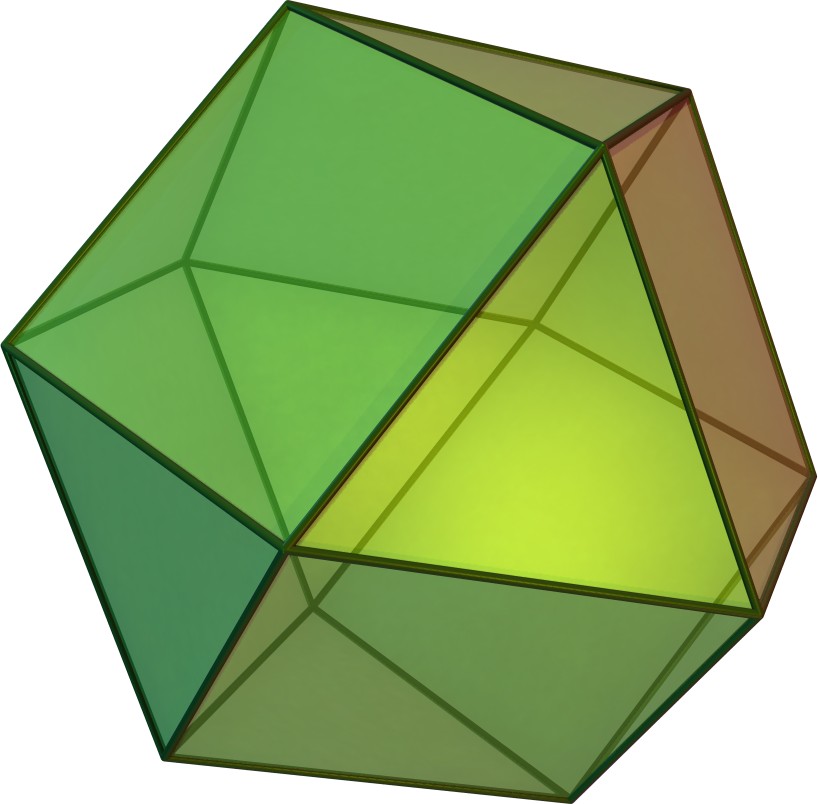
In geometry, a cuboctahedron is a polyhedron with 8 triangular faces and 6 square faces. A cuboctahedron has 12 identical vertices, with 2 triangles and 2 squares meeting at each, and 24 identical edges, each separating a triangle from a square. As such, it is a quasiregular ...
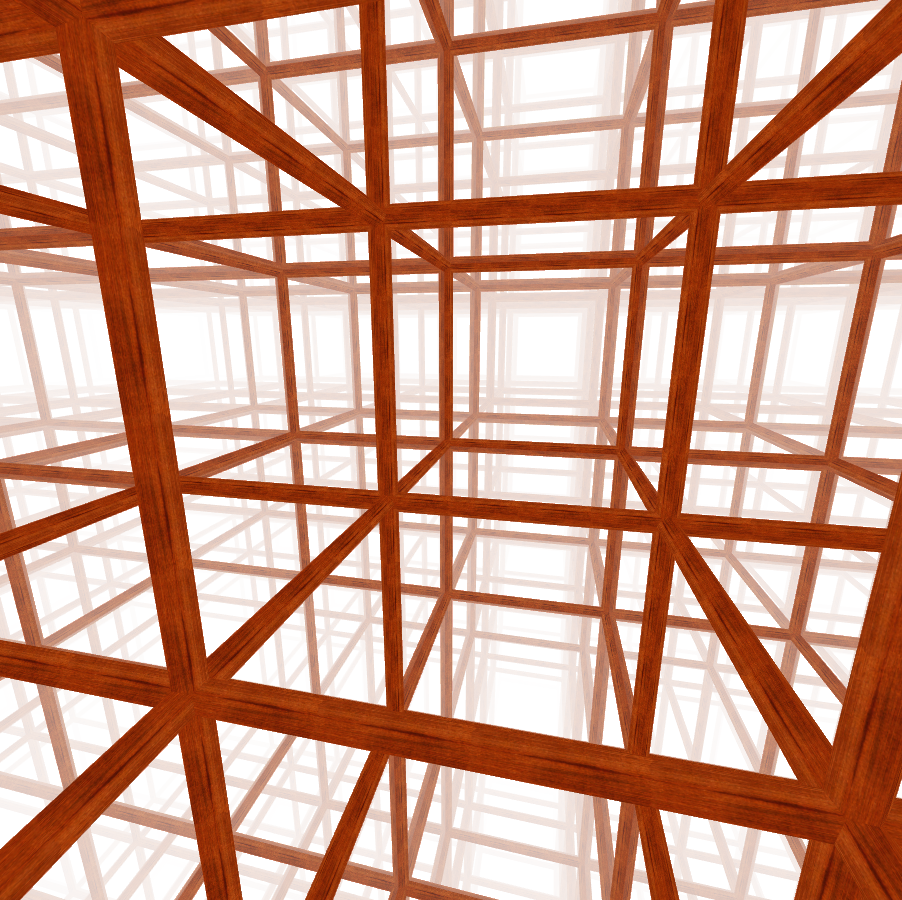
The cubic honeycomb or cubic cellulation is the only proper regular space-filling tessellation (or honeycomb) in Euclidean 3-space, made up of cubic cells. It has 4 cubes around every edge, and 8 cubes around each vertex. Its vertex figure is a regular octahedron. It is a sel...

In geometry, the rhombicuboctahedron, or small rhombicuboctahedron, is an Archimedean solid with eight triangular and eighteen square faces. There are 24 identical vertices, with one triangle and three squares meeting at each. (Note that six of the squares only share vertices...
 ivory dragon


 sweet wing
Sounds like just some high schooler who went on wikipedia and was like
Woah images look so pretty !1!1!1!
 vocal wharf
which isn't a bad thing, one of my professors studied math and became a complex analyst bcs he liked the first images of the mandelbrot set
 ember maple
I think interest is great and all but they need reality check otherwise they will turn crazy.
sleek thicket
yall want to hear how my prof defined an affine variety?
This was the second lecture, with the first mostly being introductions
Fix an algebraically closed field
A space with functions is a topological space X along with a set O(U) for each open set U of X, satisfying the following
- For each
U,O(U)is a subalgebra of the set of functionsU -> k. - Given an open set
Uand an open cover{U_α}ofU, for anyf : U -> kwas havef in O(U)ifff|U_α in O(U_α)for eachα. - If
f in O(U)thenD(f) = { x in U : f(x) ≠ 0 } is open. - If
f in O(U)is never zero,1/fis inO(U)
So it's a simpler subcategory of the category of locally ringed spaces
A morphism (X, O_X) -> (Y, O_Y) is a continuous function φ : X -> Y such that for any open set V of Y and f in O(V), if U = φ^{-1}(V) then f ° φ|U is in O(U) (so it's the same a morphism of locally ringed spaces, I'm pretty sure)
We define a space with functions (X, O_X) to be an affine variety if O_X(X) is a finitely generated k-algebra and for any other space with functions (Y, O_Y) the map Hom_{swf}((X, O_X), (Y, O_Y)) -> Hom_{k-alg}(O_Y(Y), O_X(X)) given by pullback is bijective
Imo this is very good and cool
Really glad I read Hartshorne this summer or I'd be 100% lost