#point-set-topology
1 messages · Page 110 of 1
 forest pasture
 woven trail
since it kinda guides you into what the solution should look like by knowing what it shouldn't look like
woven trail
forest pasture
But if I ask you to prove something, it would be better to reformalize it
oh yeah
forest pasture
So you'd see where you can apply the rules you know
I mean like
All of first year abstract algebra for me will be to reword the questions with sets
woven trail
forest pasture
All of first year abstract algebra for me will be to reword the questions with s...
oh that makes sense
I mean, a big part in understanding a subject is understanding how it teaches you to formalize problems
like, a lot of problems could just be stated with too much words but what the tools give you is a way of formalizing it in an approachable way
forest pasture
woven trail
I mean, a big part in understanding a subject is understanding how it teaches yo...
Hmmmm
I don't know if it's appropriate to ask in topology, but
Wouldn't computer generated proofs be all about reformalization?
forest pasture
woven trail
why
Idk
woven trail
forest pasture
I don't know if it's appropriate to ask in topology, but
I think it's ok
once in a while some channel just starts a random ass discussion and it just stays there
ig we should only care if someone appears actually wanting to talk about topology
happened in #real-complex-analysis one time
forest pasture
Ok so to formalize it, I think any proof takes a logical state and known lemmas and transforms it using logical rules into another logical state
woven trail
oh right
forest pasture
The question is, in a computer proof, would a logical state that is dual to another logical state and they lead to dual proofs (I don't know if I'm using dual right, I mean the category theory thing)
Would they be represented in the same way?
If not, we'd clearly need to reformalize
woven trail
ym like, computer generated proofs supposedly would or do work with us reformalizing a problem in a way that the computer can apply stuff it "knows" to come to a conclusion?
forest pasture
I'm very sorry if I sound dumb I didn't start uni yet so I didn't study most of this
woven trail
forest pasture
The question is, in a computer proof, would a logical state that is dual to anot...
I don't think so
woven trail
forest pasture
I'm very sorry if I sound dumb I didn't start uni yet so I didn't study most of ...
me neither B)
woven trail
I didn't even finish highschool lmao
I'm thinking this has a strong metaphor potential with (non-modern) algebra
forest pasture
woven trail
I didn't even finish highschool lmao
Gigachadette
I did watch some lectures on how Isabelle and similar programs work
woven trail
like, computers can only simplify algebra so easily because we have an amazing formalism for it to work with
(god thank viéte)
forest pasture
I have no clue what you're referring to
woven trail
ok I need to dinner rn I'll explain it later
forest pasture
I haven't added numbers by hand since 2023
woven trail
this isn't what I'm talking about
forest pasture
woven trail
ok I need to dinner rn I'll explain it later
Wanna dm about it? I don't think it's appropriate to converse on it in topology
Alternatively there's chill
Or discussion
 civic verge
Has anyone read Grothendieck's work on Topological vector spaces?
 next tinsel
Given $G$ a topological group with identity $e$. Let $a \neq e \in G$, I want to show there exists a neighbourhood $V$ of $e$ such that $(V \cdot a) \cap V = \emptyset$. What I tried is that I firstly suppose for the contrary that for all neighbourhood V of e, we have $(V \cdot a) \cap V \neq \emptyset$, then $\exists x,y \in V, a = x^{-1}y$, that means for all neighbourhood $V$ of $e$, we have $a \in V^{-1}V$. In short, $\forall V$ containing e, we have $a \in V^{-1}V$. I want to somehow say, $\bigcap_{e \in V} V^{-1} V$ = ${e}$ probably using the T1 axiom. But I don't know how.
 gentle ospreyBOT
lmwang4321

 red yoke
next tinsel
Given $G$ a topological group with identity $e$. Let $a \neq e \in G$, I want to...
red yoke
next tinsel
Given $G$ a topological group with identity $e$. Let $a \neq e \in G$, I want to...
When working with topological groups it's nice to keep the continuous map G×G → G in mind
Not just the translation maps
 tribal palm

from Viro, that second paragraph is an interesting way to start off the book

Do not hurry to fall in love with it, do not let an imprinting happen.
 sonic crane
Man like how do i show this map between quotient space and S1 x S1 is continuous
The open sets are just hard to write out
Its like R2 \ ~ -> S1 x S1
Equivalence relation is when p-q in Z x Z
 real star
i think you can use a covering like the exponential map from R^2 -> S1 x S1, (x,y) -> e^(2pi * i * x),e^(2pi* i * y) and then that this is also well defined on the quotient
then something something universal property of the quotient
 unreal stratus
sonic crane
Man like how do i show this map between quotient space and S1 x S1 is continuous
unreal stratus
sonic crane
Man like how do i show this map between quotient space and S1 x S1 is continuous
You basically always want to use the "universal property" of quotients
Oh lol said above
But yeah like you write down the map from R^2 -> S^1 x S^1 which should be easy to check is continuous, and then check it respects the relation so that it automaticlaly factors through
sonic crane
unreal stratus
But yeah like you write down the map from R^2 -> S^1 x S^1 which should be easy ...
Yes i think this one was covered
sonic crane
unreal stratus
But yeah like you write down the map from R^2 -> S^1 x S^1 which should be easy ...
How can I show inverse map is continuous? S1 x S1 -> R2 \ ~
I guess its the same thing similar
tribal palm
my prof talked would always mention these universal properties whenever introducing a new construction, and many of his arguments would be in vaguely categorical language, but he never bothered to define a category

kiand what book are you following btw
unreal stratus
sonic crane
How can I show inverse map is continuous? S1 x S1 -> R2 \ ~
So your original map from R^2/~ -> S^1 x S^1 is a continuous bijection and you can show it is open by showing it is a local homeomorphism
sonic crane
tribal palm
kiand what book are you following btw
my prof is using janich but i dont like it
i like munkres but actually rn we are doing a lot of top group stuff and munkres doesnt really cover that
 iron bolt
tribal palm
my prof talked would always mention these universal properties whenever introduc...
iron bolt
tribal palm
my prof talked would always mention these universal properties whenever introduc...
no point in defining categories just to talk about specific universal constructions like that tbf
I think it makes sense to talk about universal properties early to get familiar with them, but only introduce categories later when they're actually useful
sonic crane
unreal stratus
So your original map from R^2/~ -> S^1 x S^1 is a continuous bijection and you ...

is this what ur referring to??
bro i cannot read my profs notes
like what is this saying
tribal palm
iron bolt
no point in defining categories just to talk about specific universal constructi...
yeah i loved his lectures
 novel plank
I need help with something. For context, let $(R, <)$ be a dense linear order and consider the order topology on $R$. Let $n$ be a natural number and $i_1,...,i_n \in {0,1}$. A subset of $R^n$ is an $(i_1,...,i_n)$-box if it's of the form $A_1 \times ... \times A_n$ where $A_k$ is a singleton if $i_k = 0$ or $A_k$ is an open interval if $i_k = 1$.
Given $A\subseteq R^n$ an $(i_1,...,i_n)$-box, we define it's dimention to be $i_1 + ... + i_n$.
Also, a box in $R^n$ is simply a $(i_1,...,i_n)$-box for some $i_1,...,i_n \in {0,1}$
gentle ospreyBOT
Eduude
 novel plank
I'm trying to prove the following:
If $A\subseteq R^n$ is a box, and we can write $A = C_1 \cup ... \cup C_k$ as the disjoint union of boxes, then $$\dim(A) = \max {\dim(C_1), ..., \dim(C_k)}$$
gentle ospreyBOT
Eduude
 novel plank
This makes sense and it's not so difficult to see why it is true, but for some reason I'm having a lot of trouble formalizing this into a proof
how would you go about this?
idk why but this is giving me algebraic topology vibes. However there is probably some simple argument I'm not seeing
sonic crane
unreal stratus
So your original map from R^2/~ -> S^1 x S^1 is a continuous bijection and you ...
What does that mean
Show its a local homeomorphism?
iron bolt
it means that any point in the domain has a neighbourhood on which the map restricts to a homeomorphism between open subsets of the domain and codomain
you can prove that any such map is open
forest pasture
Hello
I have a proof that every compact subset of a metric space is closed idk if it's right
The proof is as follows
Take the K ⊂ X a metric space, K is open. Take a point in K call it p. Take a disk and circle around it (closed set) and say it has a radius of r and is entirely within K call it C
Denote by C_i a circle like C but with a radius of r/i
An infinite cover of K is the union of all K-C_i∪p (an open set)
It has no finite subcover
An immediate issue I noticed when I started writing this is that in topology closed and open aren't antonyms, but I think that generally proves at least every compact subspace isn't open
I would like it if someone would scrutinize my proof
forest pasture
Btw I used the words circle and disk fast and loose a little, but I mean the points q where d(p, q) ≤ r/i
iron bolt
forest pasture
Btw I used the words circle and disk fast and loose a little, but I mean the poi...
(closed disk and open disks are the words I'd use - but it's clear what you meant)
iron bolt
forest pasture
Union p
you mean adding the set {p} to the cover? or adding p to every set in the cover?
forest pasture
iron bolt
you mean adding the set {p} to the cover? or adding p to every set in the cover?
Doesn't matter
iron bolt
either way - it is indeed a cover then. but is it open?
forest pasture
I don't think it changes
forest pasture
iron bolt
either way - it is indeed a cover then. but is it open?
Oh yeah
P makes it not open
Ok so
Wait a sec
iron bolt
yup. {p} could be open depending on the space, but it's usually not
 opaque scroll
forest pasture
An immediate issue I noticed when I started writing this is that in topology clo...
opaque scroll
forest pasture
An immediate issue I noticed when I started writing this is that in topology clo...
Compact sets can be open though, so proving that is not a good thing
iron bolt
you are close to proving that compact sets in metric spaces are closed though
forest pasture
forest pasture
An immediate issue I noticed when I started writing this is that in topology clo...
It was born out of this dumbness
forest pasture
iron bolt
you are close to proving that compact sets in metric spaces are closed though
I know a proof they are closed
I wanted to construct my own proof
I will no cri
But like
Can you gimme an example of an open compact set?
I think the open disk is one
No wait it isn't
If it has radius r
iron bolt
it's not compact
forest pasture
Take the union of all open disks on the same centre or radius r*(n-1)/n
opaque scroll
forest pasture
Can you gimme an example of an open compact set?
Being open is relative to the ambient space, while being compact is not.
For example the whole space is always an open subset of itself
forest pasture
opaque scroll
Being open is relative to the ambient space, while being compact is not.
For ex...
Oh yeah
Lel
Thanks all you are all so nice
iron bolt
forest pasture
Take the union of all open disks on the same centre or radius r*(n-1)/n
that's the open disk of radius r again, lol
forest pasture
iron bolt
that's the open disk of radius r again, lol
Yes
But contains no finite subcover
Proving it isn't compact
forest pasture
Back in my age galiois started developing Galois theory
While I can't understand what compactness is...
forest pasture
iron bolt
I thought you mean that as another example of a compact open subspace
I did
I literally thought of this proof 5 minutes before as to why it isn't compact
It is why I asked the question
That was a generalization of that proof
Is every compact set only open wrt itself?
As far as I understand, which is near, the ambient space is the object itself?
forest pasture
forest pasture
Back in my age galiois started developing Galois theory
I have good news
Galois was one year older when he submitted his paper
I have one year to become galois
Galois speedrun
 clever dagger
We still have some time to develop an entirely new way of understanding polynomials
iron bolt
forest pasture
Is every compact set only open wrt itself?
nope. but since compact sets are closed (in metric spaces at least), every open compact set must be both open and closed, which means that it is disconnected from the rest of the space
so in connected spaces like R^n, every compact set is non-open or empty
forest pasture
iron bolt
nope. but since compact sets are closed (in metric spaces at least), every open ...
Question
Can we have like
Say
This
 sonic crane
iron bolt
it means that any point in the domain has a neighbourhood on which the map restr...
sonic crane
iron bolt
it means that any point in the domain has a neighbourhood on which the map restr...
That doesnt imply continuity, just open map?
forest pasture
The metric space is the open disk at the origin, and everything where x and y > 2r
And the open disk is a compact subspace
iron bolt
sonic crane
That doesnt imply continuity, just open map?
should also imply continuity I think. though usually continuity is take to be part of the definition
as in, "a continuous map f : X → Y is called a local homeomorphism if..."
iron bolt
forest pasture
And the open disk is a compact subspace
if you make that a closed disk yes. other wise it's still not compact
forest pasture
forest pasture
Is this a legal metric space in topology or will the topology police get me for it?
forest pasture
iron bolt
if you make that a closed disk yes. other wise it's still not compact
Yeah true
iron bolt
forest pasture
Is this a legal metric space in topology or will the topology police get me for ...
it is for a very simple reason 
every subset of a metric spaces is a metric space
iron bolt
welcome to topology, I guess 😆
later in #alg-top-geo-top you'll learn to count and classify them
forest pasture
 paper wedge
but many flavors
paper wedge
but many flavors
Is there bread flavour?
paper wedge
idk i only know the algebraic and geometric ones
forest pasture
I heard everything in maths is bread flavoured
paper wedge
ie may and hatcher
forest pasture
I see I see I quite understand...
 round oyster
how can a set be open and closed at the same time, excluding the set it self and the empty
like intiution for this set, how can u even draw it / feel it
forest pasture
round oyster
how can a set be open and closed at the same time, excluding the set it self and...
Ok so
Closed isn't related to open
Closed means contains all the limit points
A limit point is a point that's right next to a point in the set simply
More formally, a limit point is a point that if you drew a circle/sphere around that, no matter how small you make that shape (so long as its radius isn't 0) there will be points from the shape in it
This zooming in circle thing applies to 2 kinds of points, the border of the shape, in which some points in the shape are in the set we want and some are out
And what mathematicians call interior points, points where all the points in some small enough circle are in the set
Is that clear?
An open set is a set which only contains interior points
A point contained within a border, no matter how close it is to the border, if it doesn't touch it, there is a small enough circle that is all in the border, centred at the point and encircling it
Is that clear?
Please note, limit points are the border and interior points, not just the border
 alpine nest
forest pasture
And what mathematicians call interior points, points where all the points in som...
alpine nest
forest pasture
And what mathematicians call interior points, points where all the points in som...
Interior points
forest pasture
@round oyster , if you want, I can draw it for you
forest pasture
alpine nest
Interior points
Exactly, I always make that error
@alpine nest is my explanation clear? I hope I didn't fuck it up lol
alpine nest
You've explained the definition, but I'm not sure that's what MadAbdo was confused about, more about the intuition of what a clopen set is.
But I agree it's important to be clear on definitions, and in particular that "open vs closed" is not a dichotomy.
Generally clopen sets show up when your space is disconnected, for example if its the set {0,1}
{0} is a closed and open subset of it, because it has no limit points outside of it (it has no limit points at all), and also it's open, beacuse its complement is closed.
And more directly, it's open because 0 is its interior point, because all elements sufficiently close to 0 will be in {0}
(because the only such element would be 0 itself)
So the intuition about clopen sets is that they're "pieces" of your space that are "cut off" from the rest
 tiny obsidian
As a slightly more complicated example, consider the space X = (0,1) u [2,3]. Then both sets (0,1) and [2,3] are open and closed in X. In R, which is probably what you're thinking of as intuition, (0,1) isn't closed because it doesn't contain limit points 0 and 1; these aren't even in X, so (0,1) doesn't not contain them in order to be not closed. Similarly in R, [2,3] isn't open because 2 and 3 aren't interior points, as 1.9, 1.99, 1.999 or 3.1, 3.01, 3.001 etc. are arbitrarily close to them; in X, again these points don't exist to make [2,3] not open.
alpine nest
Yep, and again, note that the space in this example is in two separate "pieces"
And each of these pieces is a closed-and-open (clopen) set
 mighty hull
Yeah, it's not right to say closed and open are "unrelated."
They are related, just not in the naïve way their names suggest, that "closed" means "not open".
tiny obsidian
Yeah there being closed and open sets (other than empty and whole space) is in fact equivalent to being in multiple pieces; I hoped to give an example where it's clear why this break would lead to sets being closed and open, and one where its clear exactly how both conditions are satisfied and where the usual intuition (viewing sets as lying in connected R^n, specifically n=1 for the example) breaks down
 wanton heart

Is it necessary to take delta=min(delta1, delta2, ...) here?
I am a little confused on exactly what I'm supposed to do at that stage
I want to show that for any t0 in h^(-1)(U) that there exists an open set in the standard topology on R containing it which is a subset of h^(-1)(U)
tiny obsidian
wanton heart
Is it necessary to take delta=min(delta1, delta2, ...) here?
The issue with this is that you don't necessarily have delta>0
(and technically you mean inf in this case)
what's the codomain of h? you didn't say
wanton heart
oh right since there are infinitely many delta
wanton heart
tiny obsidian
what's the codomain of h? you didn't say
R -> R^(omega)
Do you have an idea for how it is meant to be done then?
tiny obsidian
the fact sup|...| < ε is a stronger condition than |...| < ε for all n
more specifically, there is ε' (e.g. the supremum itself) with |...| <= ε' < ε; in other words |...| doesn't get arbitrarily close to ε
I'm not yet sure how precisely to use this fact, but I suspect this allows you to either pick the δn a smarter way, or even δ directly
probably triangle inequality...
round oyster
forest pasture
<@453691393399848960> , if you want, I can draw it for you
yes please
i would really appreciate
forest pasture
round oyster
yes please
Hey
A sec
So, C is a circle without border, or an open disk
C' is a circle with a border
The dashed line is just to signify we have to border
In sending a drawing
I could do these in desmos but I'm an arteest

So
round oyster
the picture still loading for me sec :)
forest pasture
C, in IR ², is open
round oyster
ok i see now
forest pasture
It doesn't contain the border although the border touched some points of C
C' is closed
But C, with respect to C, is closed
It is still open, every point is surrounded by points
There isn't an edge, only points arbitrarily close to it
Cut since the edge doesn't exist in C, then C is "closed" because it contains all the limit points of C that are in C
It contains all the borders of C that are in it, that is, none of them
round oyster
so there is no edge, and it contains the border?
forest pasture
round oyster
so there is no edge, and it contains the border?
No
round oyster
like, i'm trying to imagine it not in like R^2, in general toplogy would it make any sense
forest pasture
Just a sec
round oyster
ok
forest pasture
round oyster
like, i'm trying to imagine it not in like R^2, in general toplogy would it make...
Slow down
Firstly, I'm using edge and border interchangeably
Secondly, begin with this example then I'll generalize it
round oyster
k
forest pasture
As I was saying, if you live in R², you'd be walking and suddenly you'd be like "holy shit I fell into a circle! Someone should put an edge around this!"
But if the circle was everything, you can't get outside the circle
You can't be like "oh look, an edge"
You can't touch it
forest pasture
You can get arbitrarily close
round oyster
yes
forest pasture
It is open because you are always in the circle
In both cases
But because you can't get outside, you can't touch the edge
round oyster
i imagine it you see a prism, whenever you get close to it, it feels a little bit more far, yet its still fixed in its place
forest pasture
The edge doesn't exist in that frame of reference
So it is closed with respect to itself
round oyster
got it
forest pasture
round oyster
i imagine it you see a prism, whenever you get close to it, it feels a little bi...
Kinda
Now, on the number line, the open interval (0, 1) is an open set
round oyster
ye
forest pasture
There are no points that touch a number between 0 and 1 and touch the outside world
They are all contained within
But
With respect to R², it is neither open nor closed
The points are all edges
Right?
The points all touch other points from the set, while also touching points from outside
So it isn't open
But also
It doesn't contain 1 and 0, which do touch a point from the set, but also the outside world
round oyster
so you saying points from outside the set are touching points from inside the set if its not closed nor open?
forest pasture
round oyster
so you saying points from outside the set are touching points from inside the se...
No
round oyster
wait, i'll tell you how i think about it, i want to restore my thinking
i had problem understanding your language
forest pasture
Closed means contains all points that touch points from it
round oyster
forest pasture
Closed means contains all points that touch points from it
yes agree with this
forest pasture
Now that means at most adding the border
Ok,
There isn't a point outside the set with the border that touches the border
It will always be some distance away
Even if that distance is super close
round oyster
can you formualte this in math operators, sorry but i'm struggling to understand your language
forest pasture
Oh gladly
So, for now, P ⊂ X
p is a point in P
X is a metric space
Neighborhood of p, denoted N_r(p) is the set of all q such that
d(p, q) < r
r is a real positive number
d is distance
P is an open set if for all p∊P, the exists some r >0, for all q∊N_r(p) => q∊P
that is, there is a small enough circle such that all points in that circle are in the set
Or p is surrounded by points in the set
Something obvious worth noting is that, if that works for r, then it works for all reals in (0, r)
Now
round oyster
yes sure this makes sense, so basically for any point that is inside the circle, there is a small enough circle within the set of neighborhood of any point, that is included in the circle
forest pasture
If for all q∊X, if for all r>0, N_r(q) contains some point in P, then q∊P, then P is closed
forest pasture
round oyster
yes sure this makes sense, so basically for any point that is inside the circle,...
Not necessarily a circle in the first sentence
A set can be dinosaur shaped
But the distance is a circle
forest pasture
Is the definition of closed clear?
forest pasture
That's kinda it
round oyster
for any neighborhood of the points, they share a point with the set
forest pasture
As you can see
The set of q we can pick from depends on X
If X = P, then any open set is closed
round oyster
first i asked you this question, because i was trynna to shape how the clopen sets are in connex spaces
forest pasture
round oyster
first i asked you this question, because i was trynna to shape how the clopen se...
I have 0 clue what this is
I didn't study this far
Lol
round oyster
i mean, for the set it self X, and phi are both clopens but i'm looking to draw it
forest pasture
If you know what it is, please tell me
I don't know what clopen is
When you know the answer, please dm me
round oyster
let X be some topological space, we say that it's connex if it can't be written as a unionn of two opens / two closed
forest pasture
Makes sense
round oyster
there are some weird propertys with clopens
connex = connected, i forgot to translate that to english
forest pasture
What's a clopen
round oyster
forest pasture
What's a clopen
closed and open set at the same time
oh wait, in connected spaces, only open / closed are X and the empty set
but in other toplogical spaces, i have no idea how they look like, if i find an answer i will tell you
right
round oyster
R is connected, since you can't do with with two disjoint
round oyster
your set will never be split up, thats why it's called connected
forest pasture
Please note I am dumb
forest pasture
round oyster
two opens / two closed
Makes sense
round oyster
(-oo, 0) U (0,oo)
round oyster
so there is always a link between any two opens i think
 round oyster
not necessarly, but generally there is path between some opens, if you think of opens as mountains there is canyon in between. i think
forest pasture
In this example
A dashed line means some areas are closed and some are open
B U C =A
So clearly
round oyster
i dont get what u mean, but i suppose your thinking of it as one is completing the other, but there is emptiness those gears cannot be filled
forest pasture
I think any set can be then a combination of 2 sets of different types
forest pasture
round oyster
i dont get what u mean, but i suppose your thinking of it as one is completing t...
What
I mean
For any set, an open and a closed can make it
round oyster
oh, of course that will always work
any toplogy
consider any toplogy thats not trivial, take any element as an open set, the complement is closed and their union is X it self
round oyster
forest pasture
For any set, an open and a closed can make it
hmm, wait lemme think about it
sonic crane
iron bolt
it means that any point in the domain has a neighbourhood on which the map restr...
I dont actually understand this
forest pasture
When you reach anything
round oyster
i'll tell yo
forest pasture
round oyster
i have to sleep too, bye
Byeee
sonic crane
unreal stratus
So your original map from R^2/~ -> S^1 x S^1 is a continuous bijection and you ...
Idk how 😢
 real gazelle
I'm thinking about a dumb generalization of metric spaces where instead of real numbers, the set of distances is a set D, equipped with an arbitrary relation ("less than or equal to"), a bottom element ("zero") that relates to every other element on the left, and a binary operation (for defining the triangle inequality). I can define convergence, show constant sequences converge, show a sequence converges iff. every subsequence converges, define the discrete metric when D={0,1}, and turn it into a topological space by taking the generating set to be the "open balls", but that's about it.
sonic crane
If you have a quotient map X -> Y, is it like X / ~ with ~ being x = y if phi(x)=phi(y), and give quotient topology to it makes X / ~ homeomorphic to Y?
real star
sonic crane
If you have a quotient map X -> Y, is it like X / ~ with ~ being x = y if phi(x)...
if it's surjective i think yes
sonic crane
Yeah quotient map defined to be surjective in munkres
 unreal stratus
sonic crane
If you have a quotient map X -> Y, is it like X / ~ with ~ being x = y if phi(x)...
unreal stratus
sonic crane
If you have a quotient map X -> Y, is it like X / ~ with ~ being x = y if phi(x)...
Yup
 rancid umbra
real gazelle
I'm thinking about a dumb generalization of metric spaces where instead of real ...
rancid umbra
real gazelle
I'm thinking about a dumb generalization of metric spaces where instead of real ...
less than or equal to has to be total order. otherwise triangle inequality may not hold in all cases
sonic crane

Im pretty stuck on showing the maps are continuous still
For R2 \ ~ -> s1xs1 I showed R2 -> s1 x s1 is continuous by showing that the map to the individual factors are continuous, and then use universal property to see the quotient map version is cts
But showing S1 x S1 to R2 / ~ is cts i dont know how
Or showing the original thing is an open map
 wise mist
incase of finite fields vector subspaces of an NLS are bounded subsets
or does that even make sense ?
 plush folio
sonic crane
plush folio
sonic crane
One idea could be to show that R^2/~ is compact, for example by showing that it is homeomorphic to [0, 1]^2/~
dunno how easy that is though
sonic crane
Yeah, ive seen arguments like this online but it seems suspect to throw that in
He did no such thing in lectures
plush folio
it's just the closed map lemma, so it shouldn't be too far-fetched
it's IMO the nicest lemma in basic topology
sonic crane
True but I wouldnt have come up with that myself yk
wait, what theorem are u even referring to? continuous bijection X compact Y Hausdorff implies map is homeomorphism?
is what i wrote even correct lol, been a while
maps into products can be checked to be continuous by checking each factor, what about maps from out of products?
no such simplification ?
is the map ((cos(2pi t), sin(2pi t)) -> (cos(pi t), sin(pi t)) From S1 to S1 easily seen to be continuous and open?
Like i just said it is in my homework cause like damn idk going through the nitty details of what open sets look like here just seems annoying
plush folio
sonic crane
wait, what theorem are u even referring to? continuous bijection X compact Y Hau...
yep, a continuous map f from X compact to Y hausdorff is closed, and in particular if f is bijective then it is a homeomorphism
sonic crane
oh, closed sets in compact spaces are compact, and compact sets in hausdorff spaces are closed
i would like to not use this though
plush folio
sonic crane
maps into products can be checked to be continuous by checking each factor, what...
I'm not the best person to ask, but I think in general there's no easy way to check. I don't think (cos(2pi t), sin(2pi t) -> (cos(pi t), sin(pi t) is open, as it maps S^1 to a half-open circle in the upper plane
sonic crane
plush folio
I'm not the best person to ask, but I think in general there's no easy way to ch...
for 0 <= t < 1 right
poo
plush folio
yeah, you would need the restriction 0 <= t < 1, otherwise the map is not well-defined
btw, maybe it is possible conclude R^2/Z^2 =~ S1 x S1 by using R/Z =~ S1 somehow? For example, is R^2/Z^2 isomorphic to R/Z x R/Z?
sonic crane
plush folio
I'm not the best person to ask, but I think in general there's no easy way to ch...
But it sends open proper subsets of S1 to opens in S1 right
 low flame

would maximality be something like this?
X = (-1,1) cup (5, 15)
subset of R
would (-1,1) and (5,15) be maximal sets
since theyre the largest contained sets in R
and each point in each of these sets will be connected through their unions?
mighty hull
low flame
would (-1,1) and (5,15) be maximal sets
Yes. When talking about sets, a maximal set M with property BLAH is a set such that if there's another set with property BLAH and M ⊆ S then S ⊆ M.
low flame
is the blah a fill in the blank for me?
mighty hull
Yeah, whatever you want.
The idea of "maximal" is something you can frame generically in any partial order.
Let (P, ≤) be a partial order. Let C ⊆ P some subset of elements in C (these are the ones with the property we're interested in).
An element m ∈ C is maximal if s ∈ C and m ≤ s implies s ≤ m.
Here the partial order is (P(X), ⊆), where P(X) is the power set of X, and C ⊆ P(X) is the collection of all connected subsets of X.
low flame
ah okay this makes sense, it hits my intution, but i just want to verify it 🙂
mighty hull
A maximal element might not exist.
For example, look at ℝ and let C be the set of all compact subsets of ℝ. ℝ itself isn't compact, but given any compact subset X ⊆ ℝ I can always find a strictly larger compact subset containing X.
Hence the need for 11.G, to show that every point is inside at least one maximal connected subset.
low flame
thats very interesting actually
low flame
mighty hull
A maximal element might not exist.
For example, look at `ℝ` and let `C` be the ...
Thank you very much cufflink 🙂
thats a beautifiul example btw
mighty hull
Also, don't think the connected components have to be open intervals.
Modifying your example, this space has two closed connected components:
X = [-1, 1] ∪ [5,15]
Last thing. One relevant theorem is that a space X is connected if and only if it has exactly two subsets that are both open and closed (aka clopen): the empty set ∅ and the whole space X, which are both clopen in any space.
If a subset S ⊆ X is both closed and open then X\S is also closed and open. They're always disjoint, simply as sets, which means
X = S ∪ (X\S)
is a decomposition of X into two disjoint open subsets.
So if you're looking for connected components it can help to look for non-trivial clopen subsets.
low flame
so if i have [-1,1] as X and I set S equal to {1} then i got a clopen set, which is then also connected?
mighty hull
No, {1} is not open in [-1,1].
[-1,1] is connected, so that theorem says the only clopen subsets are all of [-1,1] and the empty set.
But look at something like X = [-1,1] ∪ [10, 15].
[-1,1] is both closed and open in X.
Or if you want a single point to be open (in the subspace topology), look at a space like
X = {-2} ∪ [10, 15]
A space is always clopen in itself. Subsets of a space may be closed, open, neither, or both.
low flame
ah!! i understand i think now
X is open based on its topology. and its closed if its compliment is the empty set which is closed
mighty hull
A topology is defined in terms of open sets and one condition is that a topology on X includes both X and ∅ as open sets.
If ∅ is open then its complement in X is closed, but that's all of X.
If X is open then its complement in X is closed, but that's the empty set ∅.
So that part just follows from how we define topologies. Every topological space X has at least two clopen subsets: X and ∅.
It has exactly two if and only if its connected.
low flame
beautiful
 chilly topaz
Are all interior points limit points?
sonic crane
Well maybe If X = {1} U [2,3] and consider A = {1} then A is open so 1 is an interior point but its not a limit point of A?
Well a better example is probably X = {0,1} U [2,3] then A = {0,1} is open but we can see 0 and 1 are not limit points
chilly topaz
sonic crane
Well maybe If X = {1} U [2,3] and consider A = {1} then A is open so 1 is an int...
I think 1 is still a limit point of A, because in this example the only open set that contains 1 is {1} and clearly {1} intersects with A,
sonic crane
Limit point x in A is if every open set containing x intersects A-{x}
chilly topaz
sonic crane
Well a better example is probably X = {0,1} U [2,3] then A = {0,1} is open but w...
And here, 0 and 1 are interior points?
sonic crane
chilly topaz
I think 1 is still a limit point of A, because in this example the only open set...
Thats also not true. There are other open sets that contain 1 that are not {1}
sonic crane
chilly topaz
And here, 0 and 1 are interior points?
Yes because {0,1} is open, so everything in that set is interior points
chilly topaz
sonic crane
Limit point x in A is if every open set containing x intersects A-{x}
Ohhhhh
So then . . . can I say no interior point of A is a limit point because there is always an open set u that is a subset of A (aka it does not intersect X - A) ?
chilly topaz
sonic crane
Thats also not true. There are other open sets that contain 1 that are not {1}
Example?
Wait,
The whole set itself,
Is open and contains 1, yeah makes sense,
chilly topaz
Right yes yes,
sonic crane
chilly topaz
So then . . . can I say no interior point of A is a limit point because there is...
In that example before, 1 is not a limit point because open sets containing 1 does not intersect A - {1}
sonic crane
sonic crane
Well a better example is probably X = {0,1} U [2,3] then A = {0,1} is open but w...
But i think this example is better to look at
chilly topaz
sonic crane
In that example before, 1 is not a limit point because open sets containing 1 do...
Are we constricting ourselves to the subspace A or do we look at the whole X? . . . If we only look at A, the ofcourse and open sets of A does not intersect X-A, where would make no point a limit point? . . . But if we look at all X, then the open set (1/2, 3/2) contains 1 and intersects X - A, so how can 1 not be limit point?
sonic crane
For a subset A < X, x in A is a limit point of A if every open set containing x intersects A-{x}
In that example, there are open sets contaning 1 that do not intersect A-{1}, like that case is even worse because every open set containing 1 does not intersect A-{1}... because A-{1} is just empty
sonic crane
chilly topaz
Are we constricting ourselves to the subspace A or do we look at the whole X? . ...
You dont look if it intersects the complement of A
So why are u looking at X-A
U dont look at X-A
chilly topaz
And because litterally any other open set that is not {1} doesn’t contain 1, 1 is not a limit point,
?
sonic crane
A is just {1} so A-{1} is empty
so of course any open set containing 1 isnt gonna intersect A-{1}
so 1 is an interior point of A (bc {1} is an open set) but 1 is not a limit point of A
sonic crane
sonic crane
Well a better example is probably X = {0,1} U [2,3] then A = {0,1} is open but w...
i like this example better
chilly topaz
sonic crane
i like this example better
And here, 0 and 1 are not limit points because there is an open set that contains 1 but does not intersect A - {1} (same with 0) . . . Is that set {1}? Why is {1} open?
sonic crane
sure, that set could be {1} but also {1} U [2,2.5)
u should review subspace topology
{1} is open because {1} = (-0.5,0.5) intersect X
this is all subspace topology stuff
definition of subspace topology
mighty hull
chilly topaz
And here, 0 and 1 are not limit points because there is an open set that contain...
Share the definitions of "interior point" and "limit point" that you're working from.
chilly topaz
sonic crane
{1} is open because {1} = (-0.5,0.5) intersect X
Why is the intersection not (0, 0.5) ?
chilly topaz
sonic crane
u should review subspace topology
Yes yes I should,
sonic crane
it could be different things that was just an example showing {1} is open
oh
well that intersection is just {1} cause X = {0,1} U [2,3]
chilly topaz
Ahh wait, {0, 1} is just point 0 and 1,
chilly topaz
I read that as the interval of 0 to 1 my bad,
Yes yes,
Okay got it got it makes sense,
So intuitively it just point that are “alone” (do not belong to interval) that can be interior but not limit points?
chilly topaz
mighty hull
Share the definitions of "interior point" and "limit point" that you're working ...


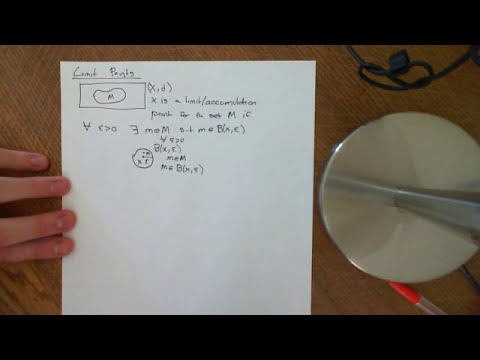
In this video the concept of limit/accumulation points is introduced.
^ from here ^
^ where I (wrongly) generalized that a limit point p of an arbitrary topology is when there is an open set that that contains p that intersects with A (when it should intersect with A - {p}, otherwise the weird lonely points like {1} would be limit points).
mighty hull
chilly topaz
That first definition is not the usual definition of limit point. It implies every element of M is a limit point.
It's what is sometimes called an "adherent point".
A limit point has the additional condition that every neighborhood of x doesn't just contain some element of M, but that it contains an element other than x.
Because if x is in M then every open ball around x contains an element of M, namely x itself.
So the definition is that x is a limit point of M if every open set containing x also contains an element m of M, with m != x
alpine nest
mighty hull
That first definition is not the usual definition of limit point. It implies eve...
As a side note, I think when working with closures/closed sets, thinking in terms of adherent points is often preferable to thinking in terms of bona fide limit points, since the specific distinction involved in being a limit point is often completely irrelevant to the proof.
chilly topaz
Okay okay, so my open ball must contain an element of M that is not x, otherwise every point in M would be a limit point, including the single points like {1},
But in practice I can just use adherent points (where x can be said element of M),
Got it got it, thank you all so much 🧡

 mighty hull
Annoying terminology. Its normally the other way around! Haha.
mighty hull
wise mist
But yes, it's trying to account for isolated points because every point in a set is a limit point under this definition.
wise mist
alr
alpine nest
wise mist
As Cufflink points out, most authors define limit point as one that satisfies definition 2.2.23, and points satisfying 2.2.1 are called adherent points. I wouldn't call the definition you posted wrong, because it does show up in literature, but it's worth keeping in mind that in other texts "limit point" is very likely to be one satisfying 2.2.23 (and also that the distinction between 2.2.1 and 2.2.23 only occasionally matters)
wise mist
noted
alpine nest
In particular the statement "a set is closed if and only if it contains all its limit points" works for both defintions of "limit point", as does "the closure of a set is the union of itself and all its limit points"
wise mist
what about the closeness of G ?

can we create something like a subgroup in the rationals, then take a sequence converging outside of it
(namely the important angles in unit circles are irrational)
but i would love to get an argument via preimage of cont maps, if thats desireable
low flame
Prove that if A is a proper nonempty subset of a connected space, then FrA!=∅.
so i was thinking something like this here. If As boundry is empty, then well A is open, but its also closed since it contains all of its boundry points right? This then would be a contradiction to the fact that X is connected since X and the empty set are the only ones allowed to be clopen?
low flame
Suppose the closure isnt connected.
then U cup V is the closure of A
then that means the the boundry of fr A = (Fr A cap U) cup (FrA cap V)
now since the boundry is connected, as per the question, this implies that one of these intersections is empty.
without loss of generality let (FrA cap U) be empty. Thus we have a set U that is open, since it contains no boundry points, and closed since it contains all its boundry points. This contradicts that its part of an larger connected space, and thus is the boundry is connected, then also is the closure.

 fierce lily
I suppose X is hausdorff here, then for every point x,y in X, they are separated by open sets U and V. Since X has cofinite topology, then X-U, X-V is finite as well, but it contradicts that X is infinite. Am I right?

 gritty widget
fierce lily
I suppose X is hausdorff here, then for every point x,y in X, they are separated...
gritty widget
fierce lily
I suppose X is hausdorff here, then for every point x,y in X, they are separated...
How does it contradict that X is infinite?
fierce lily
gritty widget
How does it contradict that X is infinite?
I mean if U is an open set that contains x, then X-U is finite. and since U is a finite set( in hausdorff, every pair of points can be seprated by open sets, so I just let U only contains x), but X-U is not finite because X is infinite, hence it contradicts.
gritty widget
fierce lily
I mean if U is an open set that contains x, then X-U is finite. and since U is a...
But how can you choose U open set such that U contains only x ?
fierce lily
gritty widget
But how can you choose U open set such that U contains only x ?
How you will argue this question?
The only thing I can come up with is to point out X hausdorff here will make X finite as my purpose
gritty widget
fierce lily
How you will argue this question?
Say there exists non-empty set U and V such that U cap V is empty, then I can write X = X - U cup X-V.
But X-U and X-V is finite implies X is finite.
mighty hull
fierce lily
I suppose X is hausdorff here, then for every point x,y in X, they are separated...
Yes, but you have to say why. Let's prove the contrapositive: every Hausdorff space with the cofinite topology is finite.
\\
Let $X$ have the cofinite topology and assume it is Hausdorff. Pick $u,v \in X$ and separate them by disjoint open sets $U$ and $V$. In general, if $U \cap V = \emptyset$ we can write $X$ as \begin{align*}X &= X \setminus \emptyset \ &= X \setminus \left(U \cap V\right) \&= (X \setminus U) \cup (X \setminus V)\end{align*}
But if $X$ has the cofinite topology then $X \setminus U$ and $X \setminus V$ are both finite, which means $X$ is also finite.
gentle ospreyBOT
Cufflink
Compile Error! Click the  reaction for more information.
(You may edit your message to recompile.)
 unreal stratus
Yes
 cedar pier
 gritty widget
cedar pier
gritty widget
cedar pier
Just take the closed unbounded sets in R
cedar pier
gritty widget
Just take the closed unbounded sets in R
for the proof?
how do i even start this
gritty widget
So are you working in metric space?
If yes then you can use sequential compactness
cedar pier
gritty widget
So are you working in metric space?
yeah
gritty widget
cedar pier
yeah
You know the sequential compactness?
gritty widget
cedar pier
maybe?
Every sequence has a convergent subsequence which has a limit in that subset.
If K is a compact subset in metric space X then every sequence in K has subsequence which is convergent in K.
cedar pier
gritty widget
Every sequence has a convergent subsequence which has a limit in that subset.
...
do we use this theorem?
gritty widget
Yes
Take x_n in K_n
x_n in A_n
Now use that
To show the intersection is non-empty
Can you guess which point must be in intersection?
cedar pier
null set?
gritty widget
No you have to show intersection is non-empty
Let x_n in A_n, so your sequence is {x_1, x_2,...,x_n,...} where x_1 is from A_1, x_2 is from A_2,....
Now (x_n) is a sequence in A_1, correct?
So it has convergent subsequence which is convergent in A_1, say limit is x
cedar pier
we need to show that x is in that set?
gritty widget
Which set? Intersection
cedar pier
yeah
gritty widget
I used A_1 is compact so x in A_1
gritty widget
cedar pier
yeah
Yes we need to show x is in the intersection
Now that subsequence, if x_1 occur in that subsequence remove it, remaining subsequence is convergent to x and sequence in A_2, so x in A_2
gritty widget
gritty widget
Now that subsequence, if x_1 occur in that subsequence remove it, remaining subs...
Here I used that compact space is closed
cedar pier
gritty widget
Now that subsequence, if x_1 occur in that subsequence remove it, remaining subs...
so can we keep doing this so that x is in all of them?
gritty widget
cedar pier
so can we keep doing this so that x is in all of them?
Yes
If you are not comfortable in this method, there are other methods too
cedar pier
i get it
gritty widget
Finite Intersection Property
This one is generalization and equivalent to compact definition
In general topology, a branch of mathematics, a non-empty family A of subsets of a set
    X


{\displaystyle X}
is said to have the finite intersection property (FIP) if the intersection over any finite subcollection of
    A


{\displaystyle A}
is non-empty. It has the...
cedar pier
ill check that out, thanks
gritty widget
cedar pier
So decreasing sequence follows FIP
cedar pier
gritty widget
So decreasing sequence follows FIP
how about c and d?

 heady skiff
if f and g are continuous and H(x) = G(f(x), g(x)) where G is continuous is it the case that H is continuous
paper wedge
yeah in product top
heady skiff
ok cool thanks
gritty widget
cedar pier
how about c and d?
c is closed, take the convergent sequence in that set and shows that it is convergent in that set
gritty widget
cedar pier
how about c and d?
d is open, think about interior points, for each point you can choose the radius around it such that the entire open ball contained in given set
wise mist
Z[sqrt2] dense in R
well should i treat this as a ring
still im only converging to zero
i dont like the epsilson arguemnt here
the next generalisation is density of Z[a] in R
$\mathbb Z$, $\sqrt 2 \mathbb Z$ are closed\
but $\mathbb Z[\sqrt2]$
is dense in $\mathbb R$
gentle ospreyBOT
yeshua
 iron bolt
if it was closed and dense it'd have to be the space itself, which it is clearly not
oh, my bad. I misread and thought you said Z[√2] was closed
 pallid comet
hi point-set-topology! today i just read something that blew my mind from wikipedia
apparently Z with the Furstenberg topology is homeomorphic to the rationals as a subset of the reals with the usual topology
the Furstenberg topology being the topology on Z generated by the basis of arithmetic progressions {an+b | n in Z} for integers a, b (a nonzero)
does anyone know how to construct the homeomorphism? (googlr isnt being helpful)
red yoke
The more I stare at this the more my head hurts
opaque scroll
pallid comet
does anyone know how to construct the homeomorphism? (googlr isnt being helpful)
The proofs I could find for them being homeomorphic is quite far from being constructive.
So I'm assuming any explicit construction must be absolutely horrible
fierce lily
Can someone help me with part(b)? and what does the set of all sequences that are eventually 0 mean here?
 paper wedge
what is the complement of the solid torus in S^3
mighty hull
paper wedge
what is the complement of the solid torus in S^3
Another solid torus
paper wedge
xd
red yoke
What if it's knotted 
 fringe thorn
what are some examples of interesting (whatever that means to the reader) adjunction spaces?
I'm just looking for some examples to keep in mind as I go forwards
paper wedge
mighty hull
Another solid torus
how do u picture this
 bronze wadi
I have a disk, 2 open sets U, V on its boundary, 2 points x, y on the disk. Can I always find 2 open sets in the disk, one containing x and having exactly boundary U, the other containing y and having exactly boundary V?
It sounds true but i have actually 0 idea how to show that rigorously
unreal stratus
Wdym by "on its boundary'
bronze wadi
well ig id have to consider the disk as a manifold
unreal stratus
This sounds impossible unless U = V = disk as V would be open and closed
unreal stratus
Well
Sure, manifold w boundary
But uh yeah
Do you mean U and V are open subsets of the boundary
bronze wadi
yes
unreal stratus
Okay that was unclear lol
bronze wadi
sry about that
unreal stratus
But yeah you'll have U and V closed and open
If they are boundaries of smth else then they are closed
unreal stratus
bronze wadi
they dont need to partition the boundary
And I didn't use that
bronze wadi
oh right
unreal stratus
It's just if V is the boundary of smth else then V is closed
bronze wadi
thats just the topology
woops

Isn’t this red set open
im not sure i understand why its not true
unreal stratus
bronze wadi
Isn’t this red set open
The like big thing or the bit on the boundary
Oh
You still mean boundary in the sense of manifolds for that open subset
OK then yes sure
bronze wadi
Again sry for the lack of clarity lol
unreal stratus
You can just like radially scale or whatever
Like e.g. consider the segment you get from that open arc
(And remove the centre)
bronze wadi
this type of property is not true for all manifolds right
bronze wadi
unreal stratus
Like e.g. consider the segment you get from that open arc
and right that does make sense
thx a lot
unreal stratus
bronze wadi
this type of property is not true for all manifolds right
Hm not sure
Though note that when you say manifold that means no boundary by default
bronze wadi
unreal stratus
Though note that when you say manifold that means no boundary by default
do we say like manifold with boundary?
unreal stratus
Ye
bronze wadi
ah fair enough
do we require compactness on manifolds
or can they extend infinitely
i think compactness is only assumed if we say its closed, but i forgot exact nomenclature
 cerulean oriole
fringe thorn
fringe thorn
what are some examples of interesting (whatever that means to the reader) adjunc...
cerulean oriole
fringe thorn
fringe thorn
what are some examples of interesting (whatever that means to the reader) adjunc...
bumping this
bronze wadi
I’m a bit lost at how to understand the nhood of the vertex here. I’m fairly confident this isn’t a surface but I have trouble showing the vertex cannot have a nhood in R^2 or R_+^2

I tried to glue and going from sides to sides, but I don’t really understand what’s going on honestly
red yoke
bronze wadi
I’m a bit lost at how to understand the nhood of the vertex here. I’m fairly con...
What if you pick a point on the edge instead?
(That's actually the same as picking a vertex)
red yoke
3 cones? 
bronze wadi
well idk like i dont get where it should get glued first
red yoke
I mean just a small nbhd of the point
 red yoke
Vertices are the same
bronze wadi
red yoke
Vertices are the same
So is this the picture then
 red yoke
bronze wadi
red yoke
bronze wadi
You can apply a homeomorphism to this diagram

 bronze wadi
right i get its a homeomorphism
red yoke

Gluing the blue arrows is the same as gluing the red arrows
So edge point and vertex are literally the same
bronze wadi
well they have similar nhood yeah
red yoke
red yoke
So it's 3 semidisks glued at an edge
So nbhd of vertex is this too
bronze wadi
well i feel like 3 semidisks at an edge cant be similar to a nhood of a plane or half plane if thats what youre getting at
red yoke
Yea
bronze wadi
hm yeah, its just hard to tell becauses surfaces can bend weirdly
but it sounds right
thx
red yoke
I guess one way to prove this would be to apply invariance of domain on two disks glued at an edge
wise mist
continous maps in from MnR to MnR
how do i think about the open ball?
do i have to rely upon a metric ?
also is there any expmple of discontinous map in this space
opaque scroll
wise mist
how do i think about the open ball?
As a space MnR is just R^n^2, so just think about it in the same way you would R^n
wise mist
oh right, sequence and open ball both
 knotty vine
fringe thorn
what are some examples of interesting (whatever that means to the reader) adjunc...
knotty vine
fringe thorn
what are some examples of interesting (whatever that means to the reader) adjunc...
Two lines attached along their endpoints are a circle, two disks attached along their boundaries are a sphere (this generalizes)
Not sure if that answers your question... Attaching doesnt really do anything pathological unless you put weird spaces in.
iron bolt
knotty vine
Not sure if that answers your question... Attaching doesnt really do anything pa...
if only
glues two real lines together by their rational points
I guess you could say that the rational numbers are weird tbf
not being locally compact and all that
still, I think having the spaces in the adjunction be nice still gives your gluing maps plenty of room to be pathological
knotty vine
Fair enough
low flame
The integral of 1/x is Ln|x| + c
The domain of 1/x is not connected, since it cannot take a value at 0. IE, (-inf, 0) union (0, inf).
Thus, by the def of a map being locally constant, this means that we can have 4 + ln(x) for x in (0, inf). Then we could have -14 + ln(x) for x in (-inf, 0) and the derivative of this still gets you 1/x.
Even more interesting is that this can be generalized further: Locally constant functions are a vector space of dimension c, where c is the number of connected componets. The basis of this vector space is the characteristic function which is 1 on given component and 0 on another.
so my question is does this mean that the + c in integration is realted to localy constant functions?
sorry i know its a calculus question more maybe?
but i came across the idea doing topology tbh
red yoke
low flame
The integral of 1/x is Ln|x| + c
The domain of 1/x is not connected, since it c...
Yea this is related to de Rham cohomology
The differential map (f → df) is a linear map from the R-vector space of 0-forms (smooth functions) on the smooth manifold (-∞,0) ∪ (0,∞) to the R-vector space of 1-forms (smooth function * dx)
The kernel of this map is the vector space of locally constant functions
It's called the 0th de Rham cohomology group
low flame
okay thats a lot for me to read, ive never seen this before 😛
red yoke
One can prove that de Rham cohomology groups agree with singular cohomology groups, so this is indeed related to a topological property of the domain
low flame
does this kinda explain why you add c? because you can get a lot of different splits of domains on R?
red yoke
If the domain is connected, that means locally constant functions are just constant functions C
But if the domain is split in 2, locally constant functions can be + C for < 0 and + D for > 0, for instance
red yoke
red yoke
It's called the 0th de Rham cohomology group
So you can see the dimension of this kernel reflects the number of topological components
low flame
okay, i think i understand. yeah i just made a simple example when i was reading this because 1/x has a simple split domain and this whole thing came up. so when they teach you that its just ln|x| + c, its in a way wrong since you could have two different constants
and then i went well if you have more connected sets, then youre gonna have more of this
its good to hear that my intuion was correct
and its related to something ive never seen before haha
red yoke
Algebraic topology is fun
low flame
lemme get through regular topology first
red yoke
We eagerly await the day of your enlightenment
low flame
red yoke
We eagerly await the day of your enlightenment
Thanks! have a good day 🙂
low flame
I am wondering. Could i just apply the intermediate value theorm and say that on [0,1] there is some f(x), then its connected. and then being a path is a continous map, then if the domain is continous, so is the image.


 novel acorn
cedar pier
how do i show it's open, closed, or neither?
novel acorn
cedar pier
how do i show it's open, closed, or neither?
Write it as a countable union of open sets
cedar pier
novel acorn
Write it as a countable union of open sets
take x to be a point in S where S is the set from that question, take the union of another point?
novel acorn
Idk what you mean
cedar pier
novel acorn
Idk what you mean
how do i write it as a countable union of open sets?
novel acorn
cedar pier
how do i write it as a countable union of open sets?
Hint: the set for R^1 is U_i (i,i+1)
cedar pier
😭
novel acorn
Basically you're taking the union of everything in between the integers
cedar pier
i dont think my prof covered that 😭
cedar pier
novel acorn
Do you know what the open sets in R look like?
all i know is that the defn of open sets is that there exists an open ball that is completely inside the open set
novel acorn
Ah okay
Okay so
The idea is that like
I'm trying to describe what this space looks like as best I can
cedar pier
i dont understand what the space with no integers looks like, is it just filled with gaps like swiss cheese?
novel acorn
You take R^n but you throw out all the hyperplanes parallel to the coordinate hyperplanes that pass through a point with at least one integer entry
cedar pier
if so, we just have to take an open ball placed at the edge of an integer, if there exists an episilon that is greater than 0, the ball wont be contained inside
novel acorn
Think of this space like a bunch of little n-dimensional boxes with edges of length 1
If you pick a point in this space it'll be in one of the little boxes
So you just have to see which edge it's closest to and pick a ball of size less than that distance
cedar pier
novel acorn
Think of this space like a bunch of little n-dimensional boxes with edges of len...
how do i show that mathematically?
novel acorn
cedar pier
how do i show that mathematically?
take a point in your set x = (x1, ..., xn)
Take the distance of each coordinate to the nearest integer
Take the minima of all these distances
This is the distance from your point to the nearest point containing an integer (show this)
Take a ball less than this distance
Show my minimality there are no points with an integer coordinate inside this ball
heady skiff
what is f^-1 here? it isn't the inverse mapping, since the inverse may not be defined; is it a function from Y to the quotient set Y / ker f (with fibers identified)?

We first note that $f^{-1}$ has domain $Y$ and codomain $Y / \text{ker}(f)$. Hence we actually have the composition
[Y \xrightarrow{f^{-1}} Y / \text{ker}(f) \xrightarrow{h} Z]
so is this true?
gentle ospreyBOT
okeyokay
 heady skiff
yeah i was able to figure it out
can somebody help me see this? here X / A is the quotient space obtained by identifying all the points of A (and everything else is a singleton)

this amounts to showing that h(x) = h(A) for every x not in A right
iron bolt
heady skiff
this amounts to showing that h(x) = h(A) for every x not in A right
nope
it's probably simpler than you think - what are the fibers of that map X → X/A? ||A itself and a bunch of singletons||, right?
it's easy to see that h is constant on each of those if it is constant on A
heady skiff
iron bolt
it's probably simpler than you think - what are the fibers of that map X → X/A? ...
yea my brain was fried at this point
thank you lol
wanton heart
What is the difference between R^inf and R^omega typically?
is it that R^inf has only finitely many non zero entries
iron bolt
I wouldn't call either of those well-defined without further context
wanton heart
Munkres
mighty hull
wanton heart
Munkres
He'll define them specifically somewhere.
heady skiff
can somebody explain to me how corollary 1.9 shows that varphi is continuous

is it because $\varphi = h\upsilon^{-1}$? then $\upsilon$ is an identification if we give $X / \text{ker}(h)$ the quotient topology, but this also requires that $h$ is constant on each fiber of $\upsilon$
gentle ospreyBOT
okeyokay
 heady skiff
and i know this looks like the previous remark, but ker h isn't a subset of X
heady skiff
iron bolt
it's easy to see that h is constant on each of those if it is constant on A
by constant on each fiber you mean h(v^{-1}({[x]})) = z' for all [x] in X / A right
in other words the image of each of the fibers is the same point in z
iron bolt
it's not the same point for each fiber - but each fiber gets mapped to a single point, yes
or in other words, whenever you restrict v to a fiber, that restriction is constant
heady skiff
iron bolt
it's not the same point for each fiber - but each fiber gets mapped to a single ...
oh okay, i was mixing up my definition then
heady skiff
heady skiff
can somebody explain to me how corollary 1.9 shows that varphi is continuous
also do you know why this holds?
nvm
i think i got it
iron bolt
I don't know what they mean by identification - presumably what others call a quotient map?
ah, good
heady skiff
To see that $\varphi$ is continuous, note that $\varphi = h\upsilon^{-1}$ where $\upsilon: X \to X / \text{ker}(h)$ is the natural projection. In other words, the following diagram commutes:
[\begin{tikzcd}
X && Z \
\
& {X / \text{ker}(h)}
\arrow["h"', from=1-1, to=1-3]
\arrow["\upsilon", from=1-1, to=3-2]
\arrow["\varphi", from=3-2, to=1-3]
\end{tikzcd}]
Now $\upsilon$ is an identification since $X / \text{ker}(h)$ (presumably) has the quotient topology. Also, for each $[x] \in X / \text{ker}(h)$,
[h\bigl(\upsilon^{-1}\bigl({[x]}\bigl)\bigl) = h\bigl(h^{-1}({x})\bigl) = x] by the definition of $\text{ker}(h)$ (and using the fact that $h$ is surjective). Thus Corollary 1.9 applies and $\varphi$ is continuous.
gentle ospreyBOT
okeyokay
 heady skiff
What a headache
heady skiff
iron bolt
I don't know what they mean by identification - presumably what others call a qu...
yes
had to break out the commutative diagrams for this one
 rain nova
Sorry guys but can an open set has a closure? I get confuse by the definition of closure of any subset$A$ of a topological space $X$ is the least closed set contained $A$. Thanks for the response!
gentle ospreyBOT
Tanxs
 plush folio
rain nova
Sorry guys but can an open set has a closure? I get confuse by the definition of...
plush folio
rain nova
Sorry guys but can an open set has a closure? I get confuse by the definition of...
Every set has a closure, including open sets. For example, the closure of (0, 1) is [0, 1]
iron bolt
yep. the closure is the smallest closed set containing A, and you can always construct it by taking the intersection of all closed sets that contain A
since arbitrary intersections of closed sets are closed
opaque scroll
Why couldn't O have boundary points in X besides itself?
Is there an assumption you haven't stated?
Like if X is the space of real numbers and O is (0, 1) then it's closure is [0, 1], i.e. O plus it's boundary {0, 1}
rain nova
opaque scroll
Why couldn't O have boundary points in X besides itself?
My fault I thought I delet already but it did not! The question solved once I realize this will be a issue when the space $X$ is connected.
gentle ospreyBOT
Tanxs
 rain nova
opaque scroll
Is there an assumption you haven't stated?
rain nova
opaque scroll
Is there an assumption you haven't stated?
Nope, I think I get confused by the definition of closure, it did not require set $O$ to has an boundary point as it element (which caused the question asked because open set contains none of it boundary point).
gentle ospreyBOT
Tanxs

 tidal lynx
If S is closed in X and int(T) is empty then why must int(S u T) = int(S)
**int is the interior and u is union
If U is an open subset of S u T, I need to show U is contained in S / does not intersect T
Now I’m stuck
opaque scroll
tidal lynx
If U is an open subset of S u T, I need to show U is contained in S / does not i...
Consider U \ S
 fluid herald
Does anyone here know anything about the Ellentuck topology? I just learned about it and it seems very interesting. The space is the set of countable infinite sets of natural numbers and the open sets are those that can be defined as follows. Take a finite set $s$ of natural numbers and an infinite set $x$ of whole numbers such that $max(s) < min(x)$. The open set corresponding to this would be the set of infinite sets of whole numbers $z$ such that $s \subseteq z \subseteq s \cup x$ It has the neat property that a set is nowhere dense iff it is completely Ramsey null, and has the Baire property iff it is completely Ramsey. I wonder what other interesting or cursed properties it has. Not sure where to put this.
gentle ospreyBOT
θωθ^-1
 low flame
would [0,1] -> S1 : t -> cos(2pit) + sin(2pit) make a path connected curve for the circle?
no its (cos(2pit), sin(2pit))
paper wedge
this is a parametrization of the circle
paper wedge
low flame
would [0,1] -> S1 : t -> cos(2pit) + sin(2pit) make a path connected curve for t...
the continuous image of anything path connected is path connected
low flame
paper wedge
this is a parametrization of the circle
well yes, i agree its the parameterization of the circle, but its important to define this i believe right if i wanted ot actually prove it.
low flame
paper wedge
the continuous image of anything path connected is path connected
and i can use this to say that S^n is path connected whenever n > 0 right
paper wedge
no ur using that [0,1] is path connected
low flame
yes, but you have to have a function that maps [0,1] to S^1
paper wedge
yeah which is what u have no?
low flame
yes i do? haha im sorry
because like if this was [0,1] to R^n i would have t: (1-t)x_i + ty_i
ah no shit i see what you mean, since [0,1] is path connected, then the image will be as well
low flame
paper wedge
yeah which is what u have no?
Thank you for that bit of knoweldge 😛 its like regular connected
paper wedge
yw
 inland thistle
I just want to check the quick fact: Let A in X be a subspace. Then if x in cl(A) (closure of A), then any neighborhood of x contains some point a in A? is this correct? what other facts do we also have
paper wedge
yeah with a not being = x
every nbd meets A in a point other than x
that's what it means for x to be a limit point
the clossure is the union of the set with its limit points
inland thistle
thx for ur clarification
paper wedge
yw lancer evo!
 cedar jungle
Let $f: X \rightarrow Y$ be a continunous function. Let X be separable. How can I show that f(X) is also separable?
gentle ospreyBOT
Gapi
 pallid comet
cedar jungle
Let $f: X \rightarrow Y$ be a continunous function. Let X be separable. How can ...
pallid comet
cedar jungle
Let $f: X \rightarrow Y$ be a continunous function. Let X be separable. How can ...
try considering f(A), where A is a countable dense subset of X. Let U be open in f(X). Then...?
cedar jungle
then $f^{-1}\left( U \right)$ is open in X.
gentle ospreyBOT
Gapi
 pallid comet
cedar jungle
then $f^{-1}\left( U \right)$ is open in X.
pallid comet
cedar jungle
then $f^{-1}\left( U \right)$ is open in X.
...then?
 tender halo
there is only O(1) things to try
pallid comet
also (sorry for interrupting Gapi - dm me if your question is swept away) i have a question of my own:
Are there any compact topological spaces with an uncountable collection of disjoint open sets? (i.e. does compactness imply the Souslin property?)
cedar jungle
pallid comet
...then?
Then $A \cap f^{-1}\left( U \right)$ is not empty and it is countable
gentle ospreyBOT
Gapi
 cedar jungle
Then $f \left( A \cap f^{-1}\left( U \right) \right)$ is countable
gentle ospreyBOT
Gapi
 cedar jungle
but what now?
tender halo
pallid comet
Are there any compact topological spaces with an uncountable collection of disjo...
sure
none of them are metrizable of course because souslin implies separable there
red yoke
pallid comet
Are there any compact topological spaces with an uncountable collection of disjo...
First uncountable ordinal + 1
tender halo
or take [0; 1] in some high degree, that should also work
cedar jungle
pallid comet
f(A) intersect U is ...
countable
tender halo
high meaning at least bigger than 2^omega
so 2^2^omega works I think
wait actually no, Hewitt Marcewski Pondiczery implies that it doesnt work
tender halo
does beta (discrete space of cardinality 2^omega) work i wonder
yeah it works unless im missing something
 vague hinge
Hey, in the standard topology on R how would you prove that the closure of [a,b) = [a,b]? Ive solved problems similar to this one in different ways but none of them are formal and precise enough for me and I can’t figure it out. Appreciate all the help
I mostly used the fact that closure of A is the smallest closed set containing A
pallid comet
cedar jungle
but is it dense too?
hm. you have shown that for any open set U of f(X), U intersect f(A) is nonempty.
vague hinge
But Id like to do it using the formal definition
pallid comet
red yoke
First uncountable ordinal + 1
thank you!
pallid comet
tender halo
does beta (discrete space of cardinality 2^omega) work i wonder
wait actually im not sure how this would work? can't you take the open cover consisting of all the singletons?
pallid comet
vague hinge
Hey, in the standard topology on R how would you prove that the closure of [a,b)...
is b a limit point of [a,b)?
let p<a. is p a limit point of [a,b)?
let q>b. is q a limit point of [a,b)?
tender halo
pallid comet
wait actually im not sure how this would work? can't you take the open cover con...
and do what with it
pallid comet
...oh
vague hinge
pallid comet
is b a limit point of [a,b)?
let p<a. is p a limit point of [a,b)?
let q>b. is ...
So basically I say that [a,b] is the closure then show that any closed set that contains [a,b) must contain b aswell?
pallid comet
vague hinge
So basically I say that [a,b] is the closure then show that any closed set that ...
if you want to be formal here i think "the closure of A is A union all of A's limit points" is better / easier to work with than "the closure of A is the smallest closed set containing A", so maybe try to think in that direction
vague hinge
I dont think we had limit points introduced or Im just not familiar with the name in english. Our definition of a closure was the union of all closed sets containing A
pallid comet
wait so how did you define closed sets
cedar jungle
pallid comet
hm. you have shown that for any open set U of f(X), U intersect f(A) is nonempty...
so f(A) is therefore dense in f(X). Thank you
 sly geyser
I've just realised that the triangle inequality is actually more important for metrics than I thought
it means that for a point P in an r-ball around O, the (r-d(O,P))-ball around P is a subset of it, because
d(X,P) < r-d(O,P) -> d(X, O) <= d(X,P) + d(P, O) < r - d(O,P) + d(O,P) = r
 queen prism
yea triangle inequality is indispensable
low flame

im unsure of how to even do this proof honestly? if its path connected, then for x1, x2 in A s(0) = x1 and s(1) =x2 thus obviuosly s(I) is a subset of A and are connected path
queen prism
so A being path-connected means for any two points x, y in A there’s a continuous map (in the subspace topology) s : [0, 1] -> A joining s(0) = x to s(1) = y
does the latter statement imply this?
and does this imply the latter as well?
low flame
yes, i mean obvioulsy so to me?
we pretty much wrote the same thing above. i can see though how this is in the subspace topology though
queen prism
yea it’s not supposed to be hard, just being careful about what is taken with respect to what
low flame
okay i skipped ahead and did the proof that showed that is X is path-connected then is Y, so thats prob why im overthinking this.
heady skiff
here, would the fibers of just be S^n x {1}, and every singleton in S^n x I \ S^n x {1}?
 mighty hull
heady skiff
here, would the fibers of just be S^n x {1}, and every singleton in S^n x I \ S^...
mighty hull
heady skiff
here, would the fibers of just be S^n x {1}, and every singleton in S^n x I \ S^...
What is CX? The cone over X?
heady skiff
yea, i was able to show that it's a homeomorphism
 worn fable
How is point set topology? I am considering taking a course for it, but I am uncertain about what it is like.
 quick crane
worn fable
How is point set topology? I am considering taking a course for it, but I am unc...
quick crane
worn fable
How is point set topology? I am considering taking a course for it, but I am unc...
I wouldn't take a course in it. I learn it as I need it for more interesting things.
worn fable
quick crane
I wouldn't take a course in it. I learn it as I need it for more interesting thi...
Interesting, why wouldn’t you take a course for it?
sonic crane
heady skiff
here, would the fibers of just be S^n x {1}, and every singleton in S^n x I \ S^...
bruh is that Janich
sonic crane
quick crane
I wouldn't take a course in it. I learn it as I need it for more interesting thi...
what are the more interesting things that use topology?
queen prism
I don't think janich's examples look like that unless I'm looking at a different book
 opaque scroll
sonic crane
what are the more interesting things that use topology?
opaque scroll
sonic crane
what are the more interesting things that use topology?
Functional analysis, algebraic topology, algebraic geometry, differential topology, more stuff probably
plush folio
worn fable
Interesting, why wouldn’t you take a course for it?
I would definitely take a course in it. Topology is so fundamental, so it's nice to get a thorough introduction to it
But I guess it depends on what you intend to study later, some subjects need it more than others
quick crane
sonic crane
what are the more interesting things that use topology?
analysis, including PDEs, differential geometry, probability theory, statistics.
sonic crane
quick crane
analysis, including PDEs, differential geometry, probability theory, statistics.
how does probability theory use topology? thats interesting
worn fable
plush folio
I would definitely take a course in it. Topology is so fundamental, so it's nice...
Thanks for your input. To be honest, I definitely don’t need it, but I am just weighing my options as to what is the most interesting to me.
quick crane
sonic crane
how does probability theory use topology? thats interesting
Metric spaces and functional analysis are generally sufficient, but you need to know some general topology for functional analysis. See https://link.springer.com/book/10.1007/978-3-031-29040-4 to see it in action.

SpringerLink
queen prism
functional 
heady skiff
sonic crane
bruh is that Janich
nah it's rotman
 rare creek
can I get a hint on part b. im not totally sure where to start

 steep kite
rare creek
can I get a hint on part b. im not *totally* sure where to start
steep kite
rare creek
can I get a hint on part b. im not *totally* sure where to start
Take a countable base for X, it will be of the form {Bn | n natural}, now for every n chose an element xn in Bn. Consider D={xn | n natural}, this will be your dense subset.
rare creek
holy shit
i had that written down on my pape r
and i crossed it out
💀
THANK U bruh
steep kite
rare creek
THANK U bruh
Good luck haha
rare creek
hopefully there wasnt apush hw
cuz i been doing math for like 2 hours
fuck it we ball
steep kite
steep kite
Take a countable base for X, it will be of the form {Bn | n natural}, now for ev...
And another thing, for this to work every Bn has to be non empty, so you have to exclude the Bn’s that are empty
 pliant elk
what's required for a real-valued continuous function to not have any "holes" in its range? (ie. if f:X to R is continuous for a topological space, are there any "nice" properties that prevent f from not attaining values in [a,b] but with values both >b and <a?)
like, if X=R, there aren't any holes. If X is the trivial topology, then any function is continuous, so you can easily make holes. If X is the discrete topology, then only constant functions are continuous, so there aren't any holes. Is there a middle ground that makes it true?
rare creek
i would assume connected and locally connected topologies
red yoke
Connected suffices
 prime elbow
I am not sure about what the closure of A looks like.
But I think closed sets are a form of R, an empty set, (-∞, a].
And closure of A is intersection of all closed sets containing A
 red yoke
prime elbow
I am not sure about what the closure of A looks like.
But I think closed sets ...
red yoke
prime elbow
I am not sure about what the closure of A looks like.
But I think closed sets ...
Yes
You can pick your favorite set A and work out an example
prime elbow
red yoke
You can pick your favorite set A and work out an example
Set of natural numbers are dense in this topology
prime elbow
Finite sets are not closed in this topology
red yoke
Yup
prime elbow
red yoke
How about negative integers
Say -N, so closure of -N is (-∞, -1]
red yoke
Yea
prime elbow
But how can I generalize this ?
red yoke
Do you know what a supremum is
prime elbow
Yes I thought about it
So if sup A exists then closure of A is (-∞, sup A), in this case sup A is not in A
If it is in A then (-∞, sup A]
And if sup A does not exist then A is dense
red yoke
prime elbow
So if sup A exists then closure of A is (-∞, sup A), in this case sup A is not i...
Is (-∞, supA) closed
prime elbow
No😕
Say A = (0,1) then sup A = 1
Closure of A is (-∞,1], because 1 in cl A
If I take any open set containing 1 the it is form of R or (1-e, ∞) so by sup A it is intersect with A
Thank you @red yoke 
wise mist
prime elbow
Closure of A is (-∞,1], because 1 in cl A
$\overline{A} = {x \in \mathbb{R} \mid \forall a < x, , A \cap (a, \infty) \neq \emptyset }$
gentle ospreyBOT
yeshua
 wise mist
does this get a pass ?

 wise mist
so convergence of a sequence here secures UC so there is nothing to say anymore right ?
now what if the norm is L_1
is the map still continous ?
 dawn tundra
are metric spaces compactly generated?
or do you have to assume locally compact or smth
wise mist
wise mist
now what if the norm is L_1
is the map still continous ?
to which my answer is
gentle ospreyBOT
yeshua
 wise mist
am i wrong in my arguments ?
tender halo
dawn tundra
are metric spaces compactly generated?
yes
you dont need metric, being first countable is enough
 jagged prairie
I've been trying to learn about Topology, but the difference between Open and Closed sets has me stumped. They say that an open set U of superset X does not include the boundary of U, but how does U not have a boundary? Isn't a boundary inherent to an interval/area/volume? Or is it that U does have a boundary, but that boundary is not part of the set U?
opaque scroll
jagged prairie
I've been trying to learn about Topology, but the difference between Open and Cl...
It's that U doesn't contain any part of its boundary.
For example, say X is the real line and U is the open interval (0, 1). Then the boundary of U consists of the two points 0 and 1, neither of which are in U.
Conversely the closed interval [0, 1] has the same boundary, but this time the set contains it's boundary
jagged prairie
Ah okay, so it's not that it doesn't have a boundary, just that the set does not contain it. Thank you
opaque scroll
jagged prairie
Ah okay, so it's not that it doesn't have a boundary, just that the set does not...
It can happen that a set doesn't have a boundary, in which case it's both open and closed (because it both contains all of and none of its boundary)
For example the empty set is such a set
jagged prairie
And then (1, 3] would be neither open nor closed, because it contains half of its boundary?