#point-set-topology
1 messages · Page 108 of 1
 mighty hull
Another way to think about connectedness is that a topological space is connected iff the only clopen sets are the empty set and the entire space.
If S is a topological space and K ⊆ S is clopen then S\K is open (because K is closed), but:
K∩(S\K) = ∅K∪(S\K) = S
So if K is anything other than S or ∅, K and S\K separate S.
 shrewd night
Is there a nonempty perfect set in R with no rational number?
My instinct is saying yes but I can't prove it
Like how do you even start to prove it in a relatively simple way
 rancid umbra
shrewd night
Like how do you even start to prove it in a relatively simple way
rancid umbra
shrewd night
Like how do you even start to prove it in a relatively simple way
create an uncountable closed set whose intersection with Q is empty. then apply cantor bendixon
shrewd night
rancid umbra
create an uncountable closed set whose intersection with Q is empty. then apply ...
I see
I'll just come back to this later
 rancid umbra
,rotate
 gentle ospreyBOT
 rancid umbra
shrewd night
Meanwhile exercise 23 looks alright but what's the best way for a breakthrough?
rancid umbra
shrewd night
Meanwhile exercise 23 looks alright but what's the best way for a breakthrough?
the hint
shrewd night
rancid umbra
the hint
I know that exists but I have no clue how to use it
When I ask for help I actually have a go first
 opaque scroll
shrewd night
I know that exists but I have no clue how to use it
opaque scroll
shrewd night
I know that exists but I have no clue how to use it
I mean the hint just is the solution. So you just have to verify it, which amounts to writing down the definitions and knowing that a set in a metric space is open if it contains an open ball around each of it's points.
shrewd night
opaque scroll
I mean the hint just is the solution. So you just have to verify it, which amoun...
Oh I see thx
 steep sand
if I have a topological group G acting continuously on a G-set X which has the discrete topology (X is an abelian group here, but the action is not compatible with the sum), are the sets of the form {g in G: g(a_1)+...+g(a_n)=g(b)} open? I was thinking you can vary g(b)=c and write it as a union of ({g in G: g(a_1)+...+g(a_n)=c} \cap {g in G: g(b)=c}, the second component is open because its a translation of a stabilizer, and for the first one you write it as union in c_1{g in G: g(a_1)=c_1} \cap {g in G: c_1+...+g(a_n)=c}, and again the first component is open, etc., and you iterate, obtaining an arbitrary union of finite intersections of open sets, and so it´s open?
like, in general, if i have a topological group G acting continuously on a G-set X (also with a group structure, but not compatible witht he G-action) with the discrete topology, is something like {g in G: equation 1 depending on specifying the action of G in some elements = equation 2 depending on specifying the action of G in some elements} always open? by saying its the union of all possible values making the equations true, and then using that every {g in G: g(a)=b} is open?
 low flame

im having a hard time understanding what i should do with 9.7
9.6 is straight forward
steep sand
low flame
im having a hard time understanding what i should do with 9.7
what is the interior of an open set? what happens to limits under continuous functions?
low flame
steep sand
what is the interior of an open set? what happens to limits under continuous fun...
the interior is all the points that have nbhds completlyh within the set.
 prime elbow
low flame
prime elbow
low flame
Hint: can you show that f^-1(Int A) \subset Int f^-1(A) ?
Provided f is continuous
low flame
so its the opposite of the closures inclusion
 low flame
what books that from? munkres?
prime elbow
No basic real analysis by Sohrab
low flame
yes it is 🙂
prime elbow
Chapter 9, good
low flame
yeah im falling behind my class, but im not doing this for a grade so it doesnt matter.
because im doing viro, and its a workbook haha
prime elbow
low flame
yeah im falling behind my class, but im not doing this for a grade so it doesnt ...
Good
low flame
prime elbow
Good
so the reason for the cls f^-1(A) subset f^1(clos(A))
is because that the closure of A is the largest closed set that contains A.
therefore the closure of the inverse of A may be a random set thats smaller than the actual closure of A right?
prime elbow
low flame
so the reason for the cls f^-1(A) subset f^1(clos(A))
is because that the closu...
Not necessarily true last statement
low flame
im confused then
prime elbow
Let x in cl f^-1(A) now you have to show that x in f^-1(Cl A)
So you have to show that f(x) in Cl A
Now how can you show that?
What are the equivalent definitions you know about cl A?
low flame
i just remember its the smallest closed set that contains A, IE the intersection of closed sets that contain A
prime elbow
Here is the one more x in cl A if and only if for any open set containing x intersect with A
So assume that now
You can prove that if you want
low flame
no it makes sense,
prime elbow
Okay
low flame
it has to 🙂
prime elbow
Now you have to take any open set containing f(x) it must be intersect with cl A
So when you take the open set f(x), U
So f^-1(U) is open right
prime elbow
And it is an open set containing x
low flame
yes
prime elbow
Now x is in cl f^-1(A)
What does it mean ?
Take any open set containing x it must intersect with f^-1(A)
prime elbow
So you have a point in f^-1(U) which intersect ^-1(A)
low flame
prime elbow
Here is the one more x in cl A if and only if for any open set containing x inte...
x is in the closure of A, it means that for every point x in the set there exists a nhbd N(x,r) r >0 such that N(x,r) cap A is not empty.
thenthe other way around is, take the intersection of nbhds, and you will get the closure of A
would this be right?
low flame
prime elbow
So you have a point in f^-1(U) which intersect ^-1(A)
an i see and thats the def of closure right
prime elbow
low flame
an i see and thats the def of closure right
Yes
So you get your result, right?
low flame
haha yes, i see it 🙂 thank you sir
prime elbow
low flame
x is in the closure of A, it means that for every point x in the set there exist...
Wait I am not sure about it
Can you explain more?
low flame
well its the converse direction you dont like right?
prime elbow
low flame
well its the converse direction you dont like right?
I don't get it
low flame
prime elbow
I don't get it
can i do something like if x is not in A, then there exists a nhbd that doesnt intersect A, which would contradict our assumption of N(x,r) cap A
prime elbow
low flame
can i do something like if x is not in A, then there exists a nhbd that doesnt i...
You mean x is not in cl(A) ?
low flame
yes, sorry
prime elbow
Let me do it again, you know cl A is the intersection of all closed sets which contain A
Now we have to show that x in cl(A) if and only if every open set containing x intersect with A
So let first prove that x in cl(A) then every open set containing x intersect with A
low flame
yes, that means that every point x has a N(x,r) where r > 0 such that N(x,r) cap A != \empty
prime elbow
Not particular neighborhood, every open set
And this is true in topology
So we cannot assume metric stuff
low flame
im sorry i dont understand what you mean by the last bit. but i ahve to go i have a meeting and then a job fair 🙂
prime elbow
No problem
 heady skiff
can I have a hint for c please, intuitively I know I want to express it as a preimage of T in some way


 iron bolt
can you show that the subset of Y where x_1 is a c if x_0 is a b is closed? if you can, how does that help you?
heady skiff
iron bolt
can you show that the subset of Y where x_1 is a c if x_0 is a b is closed? if y...
do you mean only for the coordinates 0 and 1?
i guess if that's the case, then W is equal to the union of all those subsets
which are closed
or wait no maybe W is the intersection of all thos epoints
iron bolt
yep
if it was the union it wouldn't work, since unions of closed sets are not always closed
but it's the intersection
heady skiff
cool! I'm having a bit of trouble proving this - for each $n \in \mathbb{Z}$ I'm letting $U_n = \prod_{k = -\infty}^{n - 1} X_k \times {b} \times {c} \times \prod_{k = n + 2}^{\infty} X_k$ and my claim is that $W = \bigcap_{n \in \mathbb{Z}} U_n$
gentle ospreyBOT
okeyokay
 iron bolt
oh, that's because it's not actually true
heady skiff
okay i was able to do it by showing that the complement is open
iron bolt
you don't want every consecutive pair of characters to be "bc" - you just want it to be "bc" if the first character is a b
heady skiff
would this work?
For each $n \in \mathbb{Z}$, let $U_n \coloneqq \prod_{k = -\infty}^{n - 1} X_k \times {b} \times {a, b} \times \prod_{k = n + 2}^{\infty} X_k$, which is open in the product topology on $Y$. We claim that
[
Y \setminus W = \bigcup_{n \in \mathbb{Z}} U_n
]
which is open as the arbitrary union of open sets in $Y$. Let $(y_n){n \in \mathbb{Z}} \in Y \setminus W$. Then there exists $n \in \mathbb{Z}$ such that $y_n = b$ and $y{n + 1} \neq c$; thus $y_{n + 1} \in {a, b}$, so $(y_n) \in U_n \subseteq \bigcup_{n \in \mathbb{Z}} U_n$. Conversely, if $(y_n){n \in \mathbb{Z}} \in \bigcup{n \in \mathbb{Z}} U_n$, then $(y_n){n \in \mathbb{Z}} \in U_m$ for some $m \in \mathbb{Z}$. Thus $y_m = b$ and $y{m + 1} \neq c$; it follows that $(y_n)_{n \in \mathbb{Z}} \in Y \setminus W$. Thus the claim is proved, and since $Y \setminus W$ is open, $W$ is closed.
gentle ospreyBOT
okeyokay
 iron bolt
that would work, yes
the argument as an intersection of closed sets works basically the same, except the set in the middle is not {b} ⨯ {a,b} but its complement in {a,b,c}^2
then it's closed and W is an intersection of those
as always, many paths to the same answer
prime elbow
For part c, X is isometrically embedded in X* *, I don't understand what it means?
I found a function f:X -> X* *such that x -> [x], where [x] denotes the equivalence class of x with respect to a given relation, p(x,y) = 0.
Now this function is well defined and p(x,y) = p* *(f(x), f(y) ).
 rancid umbra
that’s exactly what it means: there is a function f : X —> Y such that d_X(x,y) = d_Y(f(x), f(y))
prime elbow
rancid umbra
that’s exactly what it means: there is a function f : X —> Y such that d_X(x,y) ...
Does my function work here ?
rancid umbra
yes
prime elbow
Can you help me to understand d part ?
rancid umbra
17 part a?
prime elbow
I know that real numbers is a special part of d
prime elbow
rancid umbra
17 part a?
Done
prime elbow
First I don't understand the hint here what it means < < x_n,m> >
rancid umbra
the elements of X* are equivalence classes of cauchy sequences
prime elbow
Yes Cauchy sequence of X
prime elbow
rancid umbra
the elements of X* are equivalence classes of cauchy sequences
Yes
But how can I show that X* is complete metric space
rancid umbra
you need to show that any cauchy sequence of equivalence classes of cauchy sequences is convergent. try to unwind the definitions
prime elbow
rancid umbra
you need to show that any cauchy sequence of equivalence classes of cauchy seque...
But for showing it is convergent should I know where they converge ?
Is there any use of part a ?
prime elbow
A metric space X is compact if and only if every collection F of closed sets with the finite intersection property has a non-empty intersection.
I proved this one. Is it true in arbitrary topological space?
I think yes because in my proof I just used set theory not metric space property
 red yoke
prime elbow
A metric space X is compact if and only if every collection F of closed sets wit...
red yoke
prime elbow
A metric space X is compact if and only if every collection F of closed sets wit...
Yes
prime elbow
red yoke
Yes
Thank you
 rugged nimbus
yo can someone plis expalin to me the sequential definition of a limitpoint
 paper wedge
wdym
a point is a limt point if there exists a sequence in the set converging to it?
rugged nimbus
of a set
paper wedge
a limit point of a set is a point ( not neccesairyly in the set ) ssuch that every nbd of this point intersects the set in more than one point (iirc)
prime elbow
Any hint to construct a metric space which is totally bounded but not compact ?
opaque scroll
prime elbow
Any hint to construct a metric space which is totally bounded but not compact ?
A metric space is compact iff it is totally bounded and complete
prime elbow
opaque scroll
A metric space is compact iff it is totally bounded and complete
Yes so I thought about it and took a metric which is not complete, Q or open interval but they don't work, now I need different metric space which is not complete
opaque scroll
prime elbow
Yes so I thought about it and took a metric which is not complete, Q or open int...
Why do you say they don't work
prime elbow
opaque scroll
Why do you say they don't work
Q is not totally bounded, right?
opaque scroll
Well, not all of Q. But like (0, 1)
prime elbow
Oh wait this one totally bounded?
Oh wait
Intuitively yes if you give me the distance then I divide the interval in sub interval
Right?
opaque scroll
Yeah that works
prime elbow
Thank you ❤️
paper wedge

i know that in general the number of sheets is the same
for lpath-connected coverings
in the sense that you have a bijection sending one fiber to the other with a map
now with showing that it is finite
wouldn't any evenly covered nbd of p^-1(p(x)) cover X?
and hence has a finite subcover by compactness?
iron bolt
nope
for a very simple example, the identity map on an a compact space X is always a covering - the fibers only consist of single points then, and you can easily pick an evenly covered neighbourhood that is not the whole space
the fibers do have a special topological property though that together with compactness can get you the result
actually, the proof I was thinking of does require X to be Hausdorff as well. not sure about the more general case
paper wedge
iron bolt
actually, the proof I was thinking of does require X to be Hausdorff as well. no...
yeah
i thikn it has t odow ith closed sets being compact
singletons being clossed
something like that
ig thats what ur thinking of

here is something but i thought the U V_b,x cover the space already
iron bolt
what I was thinking of (I guess I can spoil it now since it doesn't actually solve the exercise) is: the fibers are always discrete, and if {x} is closed they're closed too, so as closed subspaces of a compact space they're compact
paper wedge

Mathematics Stack Exchange
For a compact covering space, the fibres of the covering map are finite.
I am working on the same question as the one posed in this link, but there was an unanswered question at the end, namely, w...
iron bolt
and compact discrete spaces are finite
so I guess the precise fact I was thinking of is that coverings where X is compact and Y is T1 have finite degree
paper wedge
paper wedge
https://math.stackexchange.com/questions/728279/why-is-the-fibre-of-each-point-c...
check out the answer by stefan hamcke
its the kinda the same key point " the sheets cover the space "
paper wedge
iron bolt
for a very simple example, the identity map on an a compact space X is always a ...
but theres this
iron bolt
yeah, I thought you only meant the preimage of a single evenly covered neighbourhood
iron bolt
paper wedge
this for example works with all such preimages instead though, which is something I didn't think of and indeed an open cover
paper wedge
iron bolt
yeah, I thought you only meant the preimage of a single evenly covered neighbour...
i meant like
take p(x)
take an admissible nbd
then the sheets of that admissible nbd cover Y
iron bolt
X?
paper wedge
i think i messed up
the naming
cover the covering space
yeah X
in my problem notatino
iron bolt
yeah, I don't think so
paper wedge
iron bolt
yeah, I don't think so
yeah take X-->X with f(x) = x ig
as u sad
said
but ig
iron bolt
paper wedge
finally understood this one - it actually works without any assumptions other than compactness, I think
so if you're looking for a working solution, that's one
low flame

im confused by this
i looked at the hint and i was even more confused
isnt there a jump discontunity in f(x)
but I guess the map itself is continious?
 river granite
low flame
isnt there a jump discontunity in f(x)
river granite
low flame
isnt there a jump discontunity in f(x)
the idea of "jump discontinuities" works for real functions, with the usual topology on R
the induced topo on Z_+ is a whole different thing
low flame
river granite
the induced topo on Z_+ is a whole different thing
ive kinda looked at the f mapping and said it maps everything cleanly
{0} -> {0}, {2} -> {1/2}
so its one to one and surjective, i think so its continous
also its the discrete topology
river granite
low flame
so its one to one and surjective, i think so its continous
this doesn't immediately imply it's continuous -- but yes the induced topo in~~ both Z_+ and f(Z_+) ~~ (e: correction, Z_+ only) should coincide with the discrete topo
low flame
and then i see with the g function how you get abunch of values approaching zero, which means there is multiple g^-1 which can map to zero?
low flame
the hint says that the singleton 0 is not open in the topology of f(Z+)
and i dont understand it.
river granite
yes I was also thinking of this just now 
think of the definition of subspace topology
how do you induce a topo into a subspace
opaque scroll
low flame
the hint says that the singleton 0 is not open in the topology of f(Z+)
What are the open sets in R that contains 0?
Are there some that only contains 0 and no other elements from f(Z+)?
low flame
river granite
how do you induce a topo into a subspace
to be honest im not enterily sure, does this imply the subspace topology?
river granite
yes. I'm asking if you recall this definition
since that's the key behind that hint as jagr says
low flame
its some set intersected with another
i can go look, but thats what i remember off the top of my head, you take a subset, and it has to intersect i think the parent set?
river granite
yeah, it's the set of intersections of the subspace with open sets in the "parent" topology
so in this case if $\tau_\bR$ is the topology in the real line, we might define [\tau_{\bZ_+}\coloneqq \bZ_+ \cap \tau_\bR = {\bZ_+\cap U:~ \text{$U\subseteq \bR$ is an open set}}]
gentle ospreyBOT
derivada.schwarziana
 river granite
same thing if we wanted a topology on f(Z_+)
low flame
okay im ingesting this
 wise mist
hint
 opaque scroll
wise mist
hint
opaque scroll
wise mist
hint
X is always a closed subset of X. So you might try to construct counterexamples to A and B with X=Y
And it should be enough to consider X as subspaces of R
wise mist
what about the clopen one
opaque scroll
wise mist
what about the clopen one
Is X open in X?
low flame
river granite
same thing if we wanted a topology on f(Z_+)
so is it that that in f(Z+) theres gonna be a lot of values approaching zero, so it wont have a nbhd of only zero?
river granite
low flame
so is it that that in f(Z+) theres gonna be a lot of values approaching zero, so...
that's kinda the point yes, try to actually write out what the set {open sets in f(Z_+)} is
low flame
okay, im gonna go for a walk now and think on it, i appreicate you help 🙂
river granite
no prob 
opaque scroll
wise mist
its so simple
If you want it to be harder you can add the assumption that X is complete.
wise mist
opaque scroll
X is always a closed subset of X. So you might try to construct counterexamples ...
do i put d = min(1, |x-y|)
opaque scroll
wise mist
do i put d = min(1, |x-y|)
Yeah, so still not that hard I guess
wise mist
i mean if X=Y then i have to put some bound on metric or the X right ?
for the distance in Y is atmost 1
is this the only sort of counter ?
via tweaking the metric ?
opaque scroll
wise mist
is this the only sort of counter ?
via tweaking the metric ?
Well, I guess that depends what metric you start with. For the original question something like (0, 1) with standard metric works.
If you also want it to be complete, something like bounded functions with supremum-norm would work.
I guess the main take away is that A, B, C all depend on the topology, and not really in the metric.
And restricting the metric to be less than 1 doesn't change the topology, as it only depends on "small" open balls
wise mist
opaque scroll
Well, I guess that depends what metric you start with. For the original question...
at most 1 doesn't mean in some case it has to be 1 right?
opaque scroll
Nope
wise mist
i mean imagine sup|f(x)| = 1
i can say it's at most 2 ?
would that be logical to say
wise mist
ok
wise mist
opaque scroll
Well, I guess that depends what metric you start with. For the original question...
for this interval the distance never reaching 1 but arbitrary close to 1, so we can say at most 1
that was my concern
i mean what else would it be, i am such a blind
low flame
river granite
that's kinda the point yes, try to actually write out what the set {open sets in...
something like (1/n - e, 1/n + e) \cap f(Z+)?
river granite
low flame
something like (1/n - e, 1/n + e) \cap f(Z+)?
yes all of these for each n are open sets, but that's not the whole induced topology on f(Z_+)
actually you aren't missing much -- just the neighborhoods of 0
so the induced topology looks like, {1/n} for each n and then the sets {0, ..., 1/(n+1), 1/n} for each n
and unions of those ofc
low flame
river granite
and unions of those ofc
AH okay it makes good sense now
heady skiff
in proving b => a, could we let any $y \in X \setminus V$, and since $y \in X \setminus V$ there is no sequence $(x_n) \subseteq V$ with $(x_n) \to y$, otherwise this would contradict b, so we have $\epsilon > 0$ such that $B(y, \epsilon) \cap V = \varnothing$, so $B(y, \epsilon) \subseteq V$
 gentle ospreyBOT
okeyokay
 heady skiff
I feel like this doesn't work, since just because (x_n) doesn't converge to y doesn't necessarily imply that we can find a neighborhood that doesn't contain points of x_n
because sequential criterion is just saying that eventually all the points have to be in it
opaque scroll
heady skiff
because sequential criterion is just saying that eventually all the points have ...
Think about the sequence of sets B(y, 1/n)\cap V
What would it mean if they are all non-empty
heady skiff
ye i was able to get it
heady skiff
For the $\leftarrow$ direction, could we say the following: Suppose for contradiction that $x \notin \overline{A}$, so that there exists some closed set $C$ with $A \subseteq C$ but $x \notin C$. Then $x \in X \setminus C$, which is open, and $X \setminus C \cap A = \varnothing$, which contradicts our assumption
 gentle ospreyBOT
okeyokay
 mighty hull
heady skiff
For the $\leftarrow$ direction, could we say the following: Suppose for contradi...
mighty hull
heady skiff
For the $\leftarrow$ direction, could we say the following: Suppose for contradi...
Yes, if x is in not in the closure of A then there's an open neighborhood of x that doesn't intersect A. The contrapositive of that statement: if every open neighborhood of x intersects A then x is in the closure of A.
Do the contrapositive in the other direction, too.
 sonic crane
Whats ur guys’s definition of closure of a set?
My prof had as definition, all points not exterior to A
So like for me, by definition x being in closure means every open set containing x intersects A
paper wedge
sonic crane
Whats ur guys’s definition of closure of a set?
A union the limit points of A
 hoary breach
smallest closed set containing A
heady skiff
hoary breach
smallest closed set containing A
this seems to be the first definition i've encountered in most of the courses i've taken, but you end up proving every open set containing x intersects A is equivalent to it anyways later on so it all doesn't rlly matter
heady skiff
mighty hull
Do the contrapositive in the other direction, too.
ye i did the other directoin
luckily this it not hw just proving all theorems in prep for midterm next week 😅
iron bolt
fun fact: much like how you can define topologies as some collection of sets satisfying certain properties and then just declare that sets in that collection are called "open", you can also define topological spaces as a set X with a map P(X) → P(X) satisfying certain properties and calling that the closure operator
because the closure operator allows you to recover open sets as the complements of its fixed points, so a topology is completely determined by its closure operator
and whenever a map P(X) → P(X) satisfies some simple axioms the complements of its fixed points form a topology whose closure operator agrees with that map
In topology and related branches of mathematics, the Kuratowski closure axioms are a set of axioms that can be used to define a topological structure on a set. They are equivalent to the more commonly used open set definition. They were first formalized by Kazimierz Kuratowski, and the idea was further studied by mathematicians such as Wacław Si...
what I'm getting at is: depending on the definitions you use, the definition of closure might be as trivial as that of an open set :p
 round oyster
heady skiff
For the $\leftarrow$ direction, could we say the following: Suppose for contradi...
round oyster
heady skiff
For the $\leftarrow$ direction, could we say the following: Suppose for contradi...
This is the definition we were given :
x is in the closure set of $A$ if for all neighborhods $U$ of $x$, $U \cap A \neq \phi$
gentle ospreyBOT
MadAbdo
 round oyster
Or, its the smallest closed containing A
 ocean canyon
If M^n is a connected manifold for n > 1, and B is a regular coordinate ball, we know that M^n \ B is still an n-manifold with boundary homeomorphic to S^{n-1} (see e.g. problem 4.17, Lee:s "Topological Manifolds"). Is it the case that M^n \ B is still connected?
 snow gull
Hey guys. I have to show that there exists only one topology such that the sets Bx are neighbourhood basis. The sets Bx have this behaviour.

How do I prove uniqueness of topologies?
 rigid perch
this is my proof of "show that any closed subset Y of a compact set C in X is also compact". let V be an open cover for Y. Then, V union ({C\Y}) would be an open cover for C, since all sets in this collection of sets are open (by Y being closed), and clearly, for all x in C, x is either in C/Y or in Y. if x is in Y, then it gets covered by V. if it's in C/Y, then it gets covered by ({C/Y}). By compactness of C, V union ({C\Y}) has a finite subcover. Thus, taking elements in V of this finite subcover, we have a finite subcover of Y. is this proof correct??
iron bolt
ocean canyon
If M^n is a connected manifold for n > 1, and B is a **regular** coordinate ball...
yes. I don't know a nice elementary proof though
it's a direct consequence of the last part of the Mayer-Vietoris sequence
trying to prove it without heavy machinery like that might be a fun exercise
ocean canyon
iron bolt
yes. I don't know a nice elementary proof though
oh, I see, thanks
I was trying to prove b) here, but then I suppose my idea is not the way to go

I'd be happy for a hint
though
^^
iron bolt
if your idea is to show that M_1 and M_2 are connected I think you're on the right track
ocean canyon
iron bolt
if your idea is to show that M_1 and M_2 are connected I think you're on the rig...
well, if you mean M'_1 and M'_2 then yes
that was my idea
iron bolt
I'd assume there is some elementary proof, I just didn't think about it for long
I'd say, assume that you have a clopen subset of M'_1 and see what you can say about it
ocean canyon
yeah I was trying to prove the thing I asked about, and since manifolds are locally path-connected we have connected iff path-connected, so me and a friend discussed whether we could show that M'_i = M_i \ B_i for B_i regular coordinate ball is still path-connected (since M_i is connected iff M_i is path-connected)
iron bolt
right, that approach works too
thinking about non-smooth paths directly is always a bit ugly since they can be so all over the place and thus hard to modify - that's one reason why all the algebraic topology stuff is so useful, to get arguments like that written down in a very clean way
but modifiying paths does actually get you what you want
ocean canyon
iron bolt
but modifiying paths does actually get you what you want
Oh, I see, thanks for the input; my energy levels are quite depleted, I might sleep on it (CET time zone, here). 🙂
iron bolt
I think it's clear visually if you think about what modification you need to do and draw a picture - it's just converting that intuition into a rigorous proof that might be a bit hard
ocean canyon
iron bolt
I think it's clear visually if you think about what modification you need to do ...
Like, roughly, the idea would go like this (and this might be totally wrong). Take any pair of points p,q in M'_i. If there exists a path not going through B (in the original manifold M_i), then this gives us a path in M'_i. If not (i.e. every path between p and q goes through B), then you'd want to "nudge" the path "around" the ball B?
iron bolt
yep 
iron bolt
you're not removing the boundary, right?
ocean canyon
youd want the path to go along the boundary perhaps, of B; i.e. youd perhaps want to connect p to q by going from p to the boundary of B, and then along the boundary to another boundary point, and then to q (very very roughly, or something like that)
ocean canyon
iron bolt
you're not removing the boundary, right?
right
iron bolt
ocean canyon
youd want the path to go along the boundary perhaps, of B; i.e. youd perhaps wan...
yeah, that works actually
I was thinking of only modifying the parts of the path that are in B, it could potentially still enter and exit the boundary of B an infinite number of times
but ofc you're right, in the middle of the path you can do what you want
ocean canyon
well, ok, I guess the issue is that a path from the boundary of B to say q might still go through B, so I don't think that solves it (atleast how I thought about it; perhaps you thought of something different)
ocean canyon
iron bolt
I was thinking of only modifying the parts of the path that are in B, it could p...
right
I am not sure what it would "technically" mean to modify the parts inside B such that one still gets a path, ig
iron bolt
ocean canyon
well, ok, I guess the issue is that a path from the boundary of B to say q might...
yeah, the path from p to q can cross ∂B an infinite number of times - if you pick any t with γ(t) ∈ ∂B, you could still have γ enter B both on [0,t] and [t,1]
so you can't just pick any point in the preimage of ∂B - ||you need to pick the leftmost and rightmost one||
can you see why that is possible?
iron bolt
ocean canyon
I am not sure what it would "technically" mean to modify the parts inside B such...
writing down a different path and showing that it's also continuous
ocean canyon
iron bolt
so you can't just pick any point in the preimage of ∂B - ||you need to pick the ...
hmm, right, this is what my friend said (he is a lot more topology-knowledgeable than mean). iirc his idea was that B is open, and a path f is cont. so f^{-1}(B) is open, so its complement is closed, and since in [0,1] it is bounded, so compact (heine-borel)
so one would want to pick the first point that a path f "enters" the boundary of B (and I suppose the last point, as you pointed out)
iron bolt
yep, that's exactly the right idea
you don't need Heine-Borel for compactness btw - closed subsets of compact spaces are compact
ocean canyon
iron bolt
you don't need Heine-Borel for compactness btw - closed subsets of compact space...
ops, yes
you are right (this is prop. 4.36.(a) in Lee, iirc)
iron bolt


 iron bolt
maybe
ocean canyon
I think I have 2^nd (E-book)
ocean canyon
iron bolt
I have a pdf of the second edition, but all the topology is in the appendix
wait, all the topology in appendix (!?), are you talking about the book "smooth manifolds"?
iron bolt
yes
iron bolt
oh lol. I thought "Lee's manifolds" was unique 
ocean canyon
haha, I made the same mistake when I took differential geometry, but the other way around
I ordered top. manifolds
ocean canyon
iron bolt
oh lol. I thought "Lee's manifolds" was unique <:kekw:826210128168091708>
easy to mix up
iron bolt
by the way, I don't know if Lee covers it, but in my experience things like why concatenations of paths are continuous are very often glossed over
there's a useful lemma you can show that allows you to easily prove those things rigorously: if your space is covered by finitely many closed subsets and a map restricts to a continuous map on each of those, then it is also continuous on the whole space
works more generally for locally finite closed covers too iirc
ocean canyon
iron bolt
by the way, I don't know if Lee covers it, but in my experience things like why ...
that sounds useful, I was about to ask about that earlier
oh wait, is this not the gluing lemma? Anyways, I think I need to relax. But thanks a lot for the input! 🙂
iron bolt
oh, neat. I didn't know it under that name
ocean canyon
ocean canyon
so one would want to pick the first point that a path f "enters" the boundary of...
I think also there is some elementary analysis fact I am forgetting for why we know that a minimal/maximal such element exists, and not just infimum/supremum; is it that a continuous map on a compact set attains its maximal and minimal element, applied to the special case of the points along the boundary of B? Well, yes, I suppose so, since the boundary is closed, so f^{-1}(partial B) is closed, so compact (prop. 4.36.(a)); so we can look at f restricted to f^{-1}(partial B), which is still continuous (the rest. of a continuous map is continuous)
iron bolt
the lemma you're referencing gives you a minimum/maximum with respect to an order on the codomain
ocean canyon
iron bolt
the lemma you're referencing gives you a minimum/maximum with respect to an orde...
ops, yes
iron bolt
here we just have an order on the domain and a compact subset of it
ocean canyon
you are right
iron bolt
you're right that it is related though: that analysis fact is basically just the combination of the fact that continuous images of compact sets are compact and compact subsets of R have a minimum and maximum
ocean canyon
As I understand it now, it is enough that f^{-1}(∂B) is cpct, together with (something I seem to have forgotten; cpct subsets of R contains their infimum and supremum). I don't see where continuous images of a cpct set is cpct factors into it (perhaps I misunderstood you)
iron bolt
what I meant is that "continuous functions from a compact set to R take on a minimum and maximum" follows directly from their range being compact and compact subsets of R having minima and maxima
it's not relevant to the exercise though
 dapper kestrel
I'm having problems solving this 3rd question, because if i'm not mistaken this topology would be the (lower) limit topology and every subset would be clopen? If that's the case then, (I think) every set would be it's own closure because is the smallest set that fully contains it? But then I don't know how to prove that every set it's clopen because closed sets "should" look like this $(-\infty, a) \cup [b, \infty)$, which the latter subset could be built from just the basis but the first one I don't know how, infinite union of a set whose lower limit goes to minus infinity I guess.
 gentle ospreyBOT
pablo
 dapper kestrel
Asked this in the wrong chat lol
mighty hull
dapper kestrel
I'm having problems solving this 3rd question, because if i'm not mistaken this ...
No, every subset of R isn't clopen in the lower limit topology.
In general, the closure in a finer topology is a subset of the closure in the coarser topology.
dapper kestrel
mighty hull
No, every subset of R isn't clopen in the lower limit topology.
How would a closed set look like in that topology then
If I take the complement of any basis element I get $(-\infty, a) \cup [b, \infty)$ the union of two sets I can build like this: $\bigcup_{n \in \mathbb{N}} [-n, a)$ and $\bigcup_{n \in \mathbb{N}} [b, n)$
gentle ospreyBOT
pablo
 dapper kestrel
And those are the arbitrary unions of open sets then open too
mighty hull
dapper kestrel
How would a closed set look like in that topology then
You're over complicating it. The closure of A is the intersection of all closed sets that contain A.
What's the smallest closed set that contains (a,b) in the lower limit topology?
dapper kestrel
I'm guessing [a, b] but I how can I prove that that is a closed set
mighty hull
dapper kestrel
I'm guessing [a, b] but I how can I prove that that is a closed set
You did (2), right?
Forget about the guess
Is the lower limit topology finer or coarser? What does that mean?
dapper kestrel
Yeah lower limit topology is finer
mighty hull
What does that mean?
dapper kestrel
It has more elements than the usual topology
mighty hull
It means it has more open sets, yes. Everything open in the usual topology is open in this topology, and some other things are open, too.
rancid umbra
precisely, T is a subset of T_l
mighty hull
So do you know that [a,b] is closed in the standard topology? How?
If its complement is open in the standard topology then its complement is open in any finer topology, by definition.
What is the complement of [a,b)? Is it open in the lower limit topology?
dapper kestrel
gentle osprey
**pablo**
Thats what I was saying, if this isn't wrong it is open
mighty hull
Yep. So [a,b) is closed.
And it contains (a,b)
Is there a smaller closed set that contains (a,b)?
dapper kestrel
I dont think so
dapper kestrel
That is closed?
mighty hull
There's only one possible smaller set containing (a,b)
Maybe it's closed. TBD.
What's the one set contained in [a,b) that contains (a,b)?
And is it closed?
dapper kestrel
I can't think of one?
mighty hull
(a,b) contains (a,b)
It differs from [a,b) by a single point, so it's the only one
Is it closed?
dapper kestrel
Oh
mighty hull
It could be closed, this is a different topology.
But you know right away it has to be [a,b] or [a,b) or (a,b] or (a,b) because the topology is finer, so it's a subset of [a,b] containing (a,b) and there are only four of those
dapper kestrel
The complement would be (-oo, a] U [b, oo), which I think it would be closed because it isn't a basis element?
The first subset
mighty hull
That's the complement, but for (a,b) to be closed you need the complement to be open
dapper kestrel
So (a, b) would be open
mighty hull
It can be both open and closed
mighty hull
Anyhow, I'll leave it to you, but (a,b) is open because the lower limit topology is finer and it's open in the standard topology. It's not closed, which you can prove if you need to.
Which means [a,b) is the closure of (a,b) in the lower limit topology.
Not [a,b]
dapper kestrel
gentle osprey
**pablo**
Ok but does this prove that (at least) every basis element is clopen?
mighty hull
Yes.
dapper kestrel
Awesome, thanks for the help :)
low flame

so i was thinking of doing something like this
$\phi_1 = \min {k \in \mathcal(N) | U_k \subset W_1}$ then I was thinking for everything after this I can do the following
$\phi(n)$ when n >= 2 can be defined as the following $\min {k \in N | k > \phi(n-1) \text{ and } U_k \subset (U{\phi(n-1)} \cap W_n)}$
is this a good way to define this function phi?
gentle ospreyBOT
RealTek

 woven trail
is this x cross x (x,x)?

I mean, it would make sense, but I generally see the cross representing being between sets and not elements
 plush folio
woven trail
is this x cross x (x,x)?
plush folio
woven trail
is this x cross x (x,x)?
Yeah, it's (x, x). I prefer this notation, x cross x looks kind of weird
woven trail
same
plush folio
Like (1, 2) is a point in R^2, writing 1 x 2 \in R^2 is cursed
sonic crane
Lol yeah definitely cursed
 inner cosmos
Can anyone recommend any good books I can cite for n-dimensional geometry? Dont want to cite like 5 books. Anything that deals with euclidean like properties of n spaces and their topology
 quaint relic
Is it true that in a compact T0 space there's a closed point?
mighty hull
quaint relic
Is it true that in a compact T0 space there's a closed point?
Yes. If X is your space, consider the set {Cl({x}) : x ∈ X} of all closures of singletons in X.
heady skiff
can I get a hint for b, in particular showing that T is contained in T_F? I know this is Urysohn's lemma, but having trouble applying it
 quaint relic
mighty hull
Yes. If `X` is your space, consider the set `{Cl({x}) : x ∈ X}` of all closures ...
quaint relic
mighty hull
Yes. If `X` is your space, consider the set `{Cl({x}) : x ∈ X}` of all closures ...
I'm sorry but how does that help?
mighty hull
quaint relic
I'm sorry but how does that help?
Call that set F. Order the elements of F by set inclusion. Does it have a minimal element? What would a minimal element look like?
Also, consider compactness in terms of the finite-intersection property: https://en.wikipedia.org/wiki/Finite_intersection_property
heady skiff
heady skiff
can I get a hint for b, in particular showing that T is contained in T_F? I know...
as a sanity check, is the half open interval (a, 1] for a > 0 open under the subspace topology on [0, 1]? Since (a, 1] complement = [0, a] which is closed under subspace topology on [0, 1]
quaint relic
mighty hull
Call that set `F`. Order the elements of `F` by set inclusion. Does it have a mi...
Ahhh you use Zorn to get that the set F has a minimal element using the finite intersection property?
mighty hull
quaint relic
Ahhh you use Zorn to get that the set F has a minimal element using the finite i...
Yes, the FIP tells us the intersection of everything in each chain is non-empty. That means each chain is bounded (below), so you can apply Zorn's lemma.
And then you have to prove that what you get from Zorn's lemma looks like {x}, for some x.
mighty hull
heady skiff
as a sanity check, is the half open interval (a, 1] for a > 0 open under the sub...
Correct. The open sets in the subspace topology look like the subspace intersected with open sets from the whole space.
In particular, (a,2) is open in ℝ, so (a, 2) ∩ [0,1] is open in the subspace topology on [0,1].
quaint relic
mighty hull
Yes, the FIP tells us the intersection of everything in each chain is non-empty....
Thanks I didn't think of Zorn sooner
heady skiff
are the basis elements in R^2 under the product topology of the form (a_1, b_1) x (a_2, b_2)
sonic crane
yea
heady skiff
hm i'm a bit unsure though because doesn't the product topology (at least for finite products) have basis elements of the form U_1 x U_2 for U_1 open in T_1 U_2 open in T_2 blah blah blah
so U_1 open in R wouldn't necessarily look like an interval right, but an arbitrary union of open intervals
sonic crane
(a_1, b_1) x (a_2, b_2) stuff can generate all of that tho
also a basis for product topology can be basis of factors
U x V with U and V open are a basis but also Bu x Bv with Bu and Bv basis elements is also a basis
u can make all the U x V's with the basis products
heady skiff
i see, i think that makes sense
how would you achieve that tho? bc say we have U x V with U = arbitrary union of open intervals (and same with V)
i don't think we can write U x V = (a_1, b_1) x (c_1, d_1) U (a_2, ,b_2) x (c_2, d_2) x ..... where U(a_i, b_i) = U and U(c_i, d_i) = V right
or am i getting this wrong
sonic crane
heady skiff
i don't think we can write U x V = (a_1, b_1) x (c_1, d_1) U (a_2, ,b_2) x (c_2,...
Hm i dont think i understood what u wrote
heady skiff
sonic crane
(a_1, b_1) x (a_2, b_2) stuff can generate all of that tho
i guess i'm confused about ths
sonic crane
((0,1) U (2,3)) x (0,1) = ((0,1) x (0,1)) U ((2,3) x (0,1)) for example
Products confuse me too. They suck
heady skiff
heady skiff
can I get a hint for b, in particular showing that T is contained in T_F? I know...
anyone?
iron bolt
I'm assuming the problem is that you don't know which two sets to apply the lemma to, right?
if you have an open set U, there is one closed set that immediately comes to mind
then to apply the lemma you just need to think of another closed sets that is disjoint from it. that's less easy - there's no canonical choice there
so what you can try instead is to apply the lemma to all possible sets, and see what you can construct from that. you will need to take a union at some point
 devout sorrel
when we're taking the product topology, can we have empty sets at finitely many coordinates in the product and the full spaces in the rest of the coordinates, and this set will be open?
i.e. on $\prod_\alpha X_\alpha$, $\prod_\alpha U_\alpha$ such that $U_\alpha=\varnothing$ for $\alpha=n_1, \dots, n_N$ and $U_\alpha=X_\alpha$ otherwise
gentle ospreyBOT
CoolShot
 devout sorrel
how do you even write down an element belonging to this set?
i think this set should not be well defined?
or wait
that set is just the empty set if even one U_a is empty
yeah idk what i was thinking i forgot how regular cartesian product works..
 vital river
is the set of limit points the same as the boundary?

because I have seen formulations of the closure as $\bar A = A\cup \partial A$
gentle ospreyBOT
Kakaka
 vital river
where $\partial A$ is the boundary of the set A
gentle ospreyBOT
Kakaka

 alpine nest
vital river
because I have seen formulations of the closure as $\bar A = A\cup \partial A$
alpine nest
vital river
because I have seen formulations of the closure as $\bar A = A\cup \partial A$
That's an equivalent definition/characterization of the closure, but the fact that $A\cup B$ and $A\cup C$ are equal doesn't imply that $B = C$.
gentle ospreyBOT
Outsider
 alpine nest
(also please don't ask the same thing in multiple channels)
prime elbow
Let K be a compact subset of metric space X and {U_i | i in I } are open cover for K. Prove that there exists eps >0 such that any ball B(x, eps) is contained in some U_i.
Yes I think eps is Lebesgue's number but I want to prove the existence of Lebesgue's number, maybe it is better if we prove for a subset E which has a diameter diam (E) < 2eps, then E contained in some U_j
I don't see how contradiction works here
 nocturne matrix
Mathematics Stack Exchange
The definition of $T_1$-Space is:
A topological space $X$ is said to be $T_1$ if for each pair of distinct points $a,b, $ $\exists$ open sets $U,V$ s.t $a\in U, b\notin U, a\notin V, b\in V$.
Wha...
Why does the author of the answer claim that U is the complement of {x}? Isn't U just a subset of said complement?
Oh no nvm I got it; it can't be a subset because no point other than x are left out of that union
iron bolt
prime elbow
Let K be a compact subset of metric space X and {U_i | i in I } are open cover f...
if you let r(x) be supremal radius such the B(x,r) is contained in a set from that cover, is there anything helpful you can say about that as a function of x?
heady skiff
iron bolt
if you have an open set U, there is one closed set that immediately comes to min...
ya, that being the complement, but kinda tricky finding out the other set
i guess i'll ponder some more for a bit and then giv eup
idk maybe singletons in U
disjoint from the complement of U
heady skiff
yeah so I know if i can express it as an arbitrary union of finite intersections of preimages of open sets in [0, 1] then I'm done
i think
iron bolt
yep
heady skiff
so maybe define a function for each singleton in U or something
which maps each singleton to 0
and then consider the intersection of their preimages of [0, 1]??
well my idea was to send all of them to 0
via a continuous function f_u
for each u in U
and then look at f_u^{-1}({0}) but that's not an open set in [0, 1]
wait nvm it is
(0, 1] is its complement
right?
iron bolt
heady skiff
and then look at f_u^{-1}({0}) but that's not an open set in [0, 1]
nope, that's closed
heady skiff
wait
oops i'm tripping lmao
bruh this is an exam problem and i've spent 3 hours on it
iron bolt
any open set in [0,1] where you know that the preimage is contained in U?
heady skiff
well the open sets are of the form (a, b), [0, b), (a, 1], [0, 1], and to map elements to those sets I want to use urysohn's lemma...
but urysohn's lemma only guarantees elements sent to 0 and 1, so I'm having trouble here
i was thinking about this earlier on
oh wait
[0, 1/2)
and we can send element sof X/U
to 1
so they can't live in [0, 1/2)
or the preimage of it
iron bolt
yep
heady skiff
LET'S GOOO
ok now the problem is trying to define it for each u
because that would give a possibly infinite intersection
iron bolt
even [0,1) works, it just can't contain 1
heady skiff
oh wait i don't even need to define it on all of U
or for each singleton
because the preimage must contain U
wait i don't know if it must equal U th
o
iron bolt
the preimage is contained in U, but could be a lot smaller
since parts of U can get mapped to 1 too
what can you do with open subsets of U like that to get closer to it?
heady skiff
iron bolt
what can you do with open subsets of U like that to get closer to it?
sorry wdym by this?
does this have to do with T being regular maybe
since normal + hausdorff => regular
iron bolt
you want to construct U from those subsets to show that it is open in T_F
for each u in U, you already have constructed an open subset of U that contains u
open in T_F I should say
heady skiff
damn I really want to repeat this construction for all $u \in U$ to get $\bigcap_{u \in U} f_u^{-1}\bigl([0, 1)\bigl)$ or something but I know this wouldn't work since it would be an infinite intersection
gentle ospreyBOT
okeyokay
 iron bolt
you're really close, only caught up in one simple detail xD
heady skiff
i don't know, take some finite subset of U??
then consider intersection over that finite subset of the functions f_u?
iron bolt
intersecting sets makes them smaller, not larger
heady skiff
uhhhh
iron bolt
the intersection might even be empty
you want to do something else with all the sets instead (and yes, for all u)
heady skiff
oh unions lmao
bruhhhh
every time i consider unions it happens to be intersections and vice versa 😭
okay lemme see this
oh wait yeah this works
FINALLY
thank you so much
mighty hull
You could also use the universal property of the initial topology, I think.
It's the unique topology with the property that, for any topological space $S$, a function $g: S \to X$ is continuous if and only if $f \circ g: S \to [0,1]$ is continuous for every continuous function $f: X \to [0,1]$. Then prove that the topology on $X$ has that property.
gentle ospreyBOT
Cufflink
 mighty hull
Something like, for $s \in S$, take a neighborhood $U$ of $g(s)$. Urysohn's lemma then gives you a continuous function such that $f(g(s)) = 0$ and $f(x) = 1$ for all $x \in X \setminus U$.
\
Then because $f \circ g$ is continuous, look at the preimage of $[0,1)$ under $f \circ g$.
gentle ospreyBOT
Cufflink
 heady skiff
mighty hull
It's the unique topology with the property that, for any topological space $S$, ...
heady skiff
mighty hull
It's the unique topology with the property that, for any topological space $S$, ...
oh that's neat, I didn't think of that
i guess it makes since that it has a universal property then
mighty hull
Any time you hear the word "initial" or "final", there's a universal property at hand. Same with "smallest blah blah" and "largest blah blah"
shrewd night

I used the hint they gave
But I can't seem to picture what this E set would look like
mighty hull
shrewd night
TBH the contrapositive is easier to prove, here.
But say you have a limit point x of E. What can you say about any neighborhood of x?
And remember that each F_i is closed.
shrewd night
mighty hull
TBH the contrapositive is easier to prove, here.
But say you have a limit point...
I have a feeling it has something to do with, well obviously every neighborhood of a limit point must contain a point in E but something would be wrong if that were to be the case
mighty hull
shrewd night
I have a feeling it has something to do with, well obviously every neighborhood ...
Keep in mind that F_{i+1} is a subset of F_i.
 fierce lily
Question: 1. Can I treat this long line as a real numbers line? 2. How can I prove this line is not metrizable?
 fierce lily
Then how will you describe it as a topological space
iron bolt
in the text you're using, how was the long line defined?
opaque scroll
fierce lily
Then how will you describe it as a topological space
omega_1 x [0, 1) with the order topology for example
fierce lily
iron bolt
in the text you're using, how was the long line defined?
it does not give me any def in my text.
fierce lily
opaque scroll
omega_1 x [0, 1) with the order topology for example
omega_1x [0,1) refers to?
iron bolt
rip. weird that it gives that as an exercise than
but I guess it might just be assumed knowledge
fierce lily
iron bolt
but I guess it might just be assumed knowledge
our instructor style is pretty free
opaque scroll
fierce lily
omega_1x [0,1) refers to?
[0, 1) is the half open interval, omega_1 is the first uncountable ordinal
x product with lexicographic ordering
iron bolt
I think it's a slightly tricky exercise if you haven't seen ordinals before, because I think you do need some amount of induction over ordinals to really get started
the most important thing to know is basically that for every point x > 0 in this long ray (let's call it L), the interval [0,x) is homeomorphic to [0,1)
but the space as a whole isn't, because it is too long
by 0 mean (0,0) ∈ L here btw. it's the first point in that ray
the long line is technically not this ray, but what you get by gluing two copies of it together at 0 - much like R can be viewed as two copies of [0,∞) glued together
but it doesn't really make a difference for most topological properties
opaque scroll
I guess you could also just remove 0
iron bolt
then you only get a half-long line
opaque scroll
Right, I see
mighty hull
fierce lily
Question: 1. Can I treat this long line as a real numbers line? 2. How can I pro...
Strongly recommend this book: https://en.wikipedia.org/wiki/Counterexamples_in_Topology
What theorems about metrizability do you know?
mighty hull
fierce lily
Question: 1. Can I treat this long line as a real numbers line? 2. How can I pro...
Any theorem of the form "Here are five different characterizations of Concept X and in a metric space they're all equivalent" is one possible avenue towards proving a space isn't metrizable.
For example, if the space satisfies one of those characterizations but not another.
fierce lily
mighty hull
Strongly recommend this book: https://en.wikipedia.org/wiki/Counterexamples_in_T...
for metrizable, I know that it must be a topology induced by the distance d on a set X, namely any basis for this topology is of the form B_d(x, epsilon) for each x in X. that's the thing I know only I guess
fierce lily
mighty hull
Any theorem of the form "Here are five different characterizations of Concept X ...
about this part, can you point out the page of this book?
mighty hull
fierce lily
about this part, can you point out the page of this book?
What book?
You mean Counterexamples in Topology? I was just sharing that as a catch-all reference when you're looking to understand what spaces have properties X and Y but not Z and why.
mighty hull
fierce lily
for metrizable, I know that it must be a topology induced by the distance d on a...
What book are you using?
fierce lily
mighty hull
What book are you using?
I am using james munkres.
mighty hull
fierce lily
I am using james munkres.
Is this an exercise from the book or something your professor gave you?
fierce lily
mighty hull
Is this an exercise from the book or something your professor gave you?
it is the practice our instructor gives
mighty hull
fierce lily
it is the practice our instructor gives
Without pulling a rabbit out of the hat, I have two suggestions:
- Find all instances of "long line" in the index of Munkres and look at what he says
- If there's any special notation Munkres uses to talk about the long line, look that up in the index, too
- Find a digital copy of Munkres and search through it for "metrizable space", "are equivalent", "long line", etc.
Countexamples in Topology is nice and would help here. For example, the index has this chart. The numbers along the left-hand-side refer to specific topological spaces.

Also, Munkres has several exercises about the long line that give more context. It might be helpful to do those, but you should at least look at them.
 long finch
how do i know wtf im doing
 gritty widget
b part, claim: G is not required to be open.
Let the open ball B(x, r) where r > 0. If B(x,r) has non-empty intersection with G then G cup Ext(G) has non-empty intersection with B(x,r).
If B(x,r) has an empty intersection with G imply x in Ext(G). Hence G cup Ext(G) has a non-empty intersection with B(x,r).
In both cases, G cup Ext(G) has a non-empty intersection with an open ball.
Since Ball is arbitrary thus it would intersect with every non-empty open set.
 gritty widget
To prove: The finite union of nowhere dense subset of metric space M is nowhere dense.
Proof: We will prove the case when n = 2. Assume A and B are nowhere dense. By definition of nowhere dense, M\cl(A) is non-empty open dense subset of M.
Result: intersection of two non-empty open dense subsets is dense subset.
Thus, X(clA cup cl B) = X(cl(A cup B) ) is a dense subset in M imply A cup B is nowhere dense.
heady skiff
closed subsets of regular spaces need not be compact, right?
iron bolt
if they were, that would in particular mean that all regular spaces are compact
I don't think they are
heady skiff
yeah makes sense
does anybody have an idea about what the resulting picture/object would be?

i'm used to identifying ends of the unit interval so this is a bit of a weird construction for me
iron bolt
I mean, what are the points of Y? what are the open sets? it's a finite topological space (hope that wasn't a spoiler), so it shouldn't be hard to describe
once you have that we can talk pictures :>
heady skiff
ye part of the question was describe the open sets lol
working on that now
oh wait we just identify the whole entire open interval (0, 1) so it should be a 3 point space no
mighty hull
heady skiff
oh wait we just identify the whole entire open interval (0, 1) so it should be a...
There's one point per equivalence class.
mighty hull
Mmmhmm
heady skiff
let me make sure i have definitions right - is the quotient topology on $Y$ the collection of all sets such that $U \subseteq Y$ is open if and only if $\pi^{-1}(U)$ is open in $X$?
 gentle ospreyBOT
okeyokay
 iron bolt
it's the set of all sets whose preimages are open, yes
heady skiff
okay, I guess i sometimes get it confused with quotienting out points of X
but i guess this is a more general formulation
iron bolt
which is equivalent to saying that under that topology, a set is open iff its preimage is
heady skiff
ah i think i got it now
oh wait so determining the open sets in X/~ under the provided equivalence relation is basically determining the open sets in a set of order 3
hmmm so I think the open sets should just be $X / {\sim}$, $(0, 1) \cup {0}$ and $(0, 1) \cup {1}$ no?
gentle ospreyBOT
okeyokay
 iron bolt
almost
heady skiff
and empty set lmao
because if i'm not missing something, $\pi^{-1}\bigl((0, 1) \cup {0}\bigl) = [0, 1)$ which is open in $[0, 1]$ right?
gentle ospreyBOT
okeyokay
 heady skiff
because 1 is just mapped to itself under the quotient map
iron bolt
that and some technicalities - the sets would be {(0,1),{0}} and {(0,1),{1}} since (0,1), {0} and {1} are elements of X/~, not subsets of it
iron bolt
oh, and there's one more set that's open
heady skiff
uhhhh i already said the whole space right
lemme think
it wouldn't be the singletons
not the collection of singletons either
iron bolt
heady skiff
it wouldn't be the singletons
why not?
heady skiff
well because the preimage of {0} is just {0} right
which is not open in [0, 1]
unless i'm missing something
iron bolt
{0} is an element of your space, {{0}} is a singleton in it :p
but yes
the other singletons are {(0,1)} and {{1}}
heady skiff
iron bolt
{0} is an element of your space, {{0}} is a singleton in it :p
right my bracket game is p bad
iron bolt
it's fair, working with sets of equivalence classes like that can arguably get a bit confusing
heady skiff
so it would just be: $\varnothing, X / {\sim}, {(0, 1), {0}}, {(0, 1), {1}}, {(0, 1)}$ i think
gentle ospreyBOT
okeyokay
 iron bolt
heady skiff
huh that wasn't as interesting as i though ti twould turn out
iron bolt
now to answer your original question about the picture: what you've done here is collapse the interior of the interval to a single point, right?
heady skiff
yes
iron bolt
so now you have three points, two still corresponding to the boundary of the interval and one representing the entire middle part
since the middle part of the interval gets in a sense infinitely close to the boundary - every neighbourhood of 0 intersects (0,1) - every neighbourhood of {0} in the quotient space contains the point (0,1)
similarly for the other end
heady skiff
okay wait i feel like this has to do with the next question they ask, which is is the quotient topology hausdorff
heady skiff
no, i don't think so
yeah that makes sense i guess, let me try to formalize
thanks for the help!
iron bolt
iron bolt
since the middle part of the interval gets in a sense infinitely close to the bo...
I think there is some nice non-rigorous visual intuition to be found here btw, so I will still elaborate a bit :p
I think the most visual explanation of what an open set is, aside from the formalism, is that it is a set where for every element in it, the complement of the set can't get arbitrarily close to it
so the neighbourhoods of a point are exactly those sets whose complements don't get arbitrarily close to it
if a point x is contained in every neighbourhood of a point y, this means that {x} gets infinitely close to y - so in this sense, it means that x is infinitely close to y
the slightly wild part is though, this is not a symmetric relation
in the case of the exercise you're doing, (0,1) is infinitely close to both {0} and {1}, but not the other way around
soo... that shows you that non-T1 topologies can be wild I guess. but I still like that there's at least some visual understanding to be found, even if it's not the most intuitive
iron bolt
iron bolt
the slightly wild part is though, this is not a symmetric relation
(if you want to how well it behaves exactly: you can show that this relation if reflexive and transitive, just not symmetric, and so it has more the vibes of a partial order than of an equivalence relation)
heady skiff
thank you! i'll read this in a bit once i finish this exercise
devout sorrel
say we have the set [a, b] subset X with order topology.
if A subset [a, b] is open (in [a, b]), then there exists an interval (c, d] subset A
can someone explain why this is true? i dont understand because (c, d] is not an open set in [a, b], right?
iron bolt
the empty set is certainly open and doesn't contain any non-empty interval, so there's probably some context missing from your question
devout sorrel
suppose non emptiness
devout sorrel
iron bolt
the empty set is certainly open and doesn't contain any non-empty interval, so t...
yes its a specific line from a proof in munkres im struggling with
suppose $B_0$ is a nonempty open set in $[a, b]$. we have a $c \in B_0$, then it follows from $B_0$ being open that there is a $d$ such that $(d, c] \subseteq B_0$
gentle ospreyBOT
CoolShot
 devout sorrel
(with order topology)
iron bolt
c is probably required to be > a, and d to be < c?
devout sorrel
iron bolt
c is probably required to be > a, and d to be < c?
yes, sorry, we do have that
it reads like it claims (d, c] is open in [a, b] which i dont get
iron bolt
yep, it indeed is not
or at least, doesn't have to be
but there is an open set containing it that is contained in B_0
iron bolt
I don't think that is even required
devout sorrel
iron bolt
but there is an open set containing it that is contained in B_0
yes but if c < b then say we have (d, e) subset B_0, if c > e it doesnt work correct?
iron bolt
do you know what specific neighbourhoods of points under the order topology look like? like, in R^n, if a point is contained in an open set then it's also contained in an open ball contained in that set - can you say something similar about the order topology?
devout sorrel
open intervals we can take as a base, so that?
iron bolt
open intervals and open rays like (a,∞), yes
but in this specific case (c < b) you can actually show that c is always contained in an open interval
and I mean, once you have that c is contained in an open interval in B_0 you're basically done, right?
iron bolt
yep
there is only one more subtlety here
you know that B_0 is open in [a,b] with the subspace topology, but what we just said is true for the order topology only
has the text you're working with already shown that on subsets intervals in ordered sets the order topology and subset topology agree, or do you need to be careful with that here?
devout sorrel
the topologies are equal when convex
and intervals are convex, so it should work
thank you for guiding me through this lol i really appreciate it
wise mist
Let $ f: \mathbb R→ \mathbb R $ be a continuous function and let $S$ be a non-empty proper subset of $\mathbb R$ . Which one of the following statements is always true?
\ \
A. $\operatorname{int}f(S) \subseteq f(\operatorname{int}S)$
B. $f(\overline S) \subseteq \overline {f(S)} $
C. $f(\overline S) \supseteq \overline {f(S)} $
D. $\operatorname{int}f(S) \supseteq f(\operatorname{int}S)$
gentle ospreyBOT
yeshua
 rancid umbra
have you tried with any examples?
wise mist
negated D
wise mist
yeah it was some counter example
$f=x^2, S=[-1,1], intS=(-1,1), f(S) = [0,1], f(intS)=[0,1), intf(S)=(0,1)$
gentle ospreyBOT
yeshua
 wise mist
this ain't faulty right?
wise mist
Let $f:X\to Y$ be a continuous map between metric spaces. Then $f(X)$ is a complete subset of $Y$ if \
A. the space $X$ is compact\
B. the space $Y$ is compact\
C. the space $X$ is complete\
D. the space $Y$ is complete
gentle ospreyBOT
yeshua
 sonic crane
devout sorrel
suppose $B_0$ is a nonempty open set in $[a, b]$. we have a $c \in B_0$, then it...
sonic crane
devout sorrel
suppose $B_0$ is a nonempty open set in $[a, b]$. we have a $c \in B_0$, then it...
Was so confused by this too, but yeah, its not claiming (d,c] is open in B0 which is what i thought it was saying at first
gritty widget
wise mist
Let $f:X\to Y$ be a continuous map between metric spaces. Then $f(X)$ is a compl...
a, f(X) is compact implies it is complete
sonic crane
That whole proof for connectedness of R was honestly confusing
gritty widget
sonic crane
That whole proof for connectedness of R was honestly confusing
if you can show for open interval (0,1) then you can easily get insight for R, refer Topology without tears
gritty widget
yes
sonic crane
I just find that proof confusing
gritty widget
but Topology without tears has better proof for it
sonic crane
Hmm ok. Ill chrck it
wise mist
i completely forgot the definition of complete set
gritty widget
sonic crane
Hmm ok. Ill chrck it
 gritty widget
wise mist
i completely forgot the definition of complete set
gritty widget
wise mist
i completely forgot the definition of complete set
every cauchy sequence is convergent sequence
alpine nest
In a metric space, a convergent sequence is always Cauchy.
A Cauchy sequence isn't guaranteed to be convergent, unless the space is complete.
I.e. "convergent -> Cauchy" holds always, "Cauchy -> convergent" holds if your space is complete
gritty widget
yes
 rapid lagoon
I don't know exactly where this goes, because my question is a bit more general
But, first a motivating example. We say that the subspace topology of A \subset X is the coarsest topology that makes the inclusion continuous
The product topology is the coarsest topology that makes the projections continuous
Yet, the disjoint union topology is the finest topology that makes the natural inclusion continuous
When is it the coarsest, when is the finest?
As in, suppose we have some topological space $X$, and another set $Y$, with a natural mapping $f: X \rightarrow Y$. Would the topology that is induced by X be dependant on whether f is a surjection or an injection?
gentle ospreyBOT
dulg_n

 dire dove
More or less yes
I mean not exactly
When you have a map (or a bunch of maps) out of a set you want the coarsest topology usually
Because the discrete topology trivially makes any map out of the set continuous
mighty hull
rapid lagoon
As in, suppose we have some topological space $X$, and another set $Y$, with a n...
Sure, consider if Y is a one-point space.
dire dove
And a finer topology makes it easier in general to have continuous maps out of it
gritty widget
rapid lagoon
When is it the coarsest, when is the finest?
let (X, T_1) and (X,T_2), T_1 is finer than T_2 if and only if f: X -> X , x -> x domain with T_1 and co - domain with T_2, f is continuous
dire dove
So you care about the other extreme
When you have a map into the set the interesting extreme is the finest topology (because again, a coarser topology makes it easier for maps into your set to be continuous, i.e. they are less interesting)
dire dove
dire dove
When you have a map into the set the interesting extreme is the finest topology ...
(and the indiscrete topology which is the coarsest makes everything continuous)
And indeed you can see that for both product and subspace you want a topology on a set from which you have a map coming out, i.e. you want the coarsest, while for the disjoint union you have the inclusions which are into it, and so you want the finest topology
rapid lagoon
dire dove
Because the discrete topology trivially makes any map out of the set continuous
Ah I see
Thqt actually makes a lot of sense
mighty hull
rapid lagoon
As in, suppose we have some topological space $X$, and another set $Y$, with a n...
What you're looking at is the difference between the "initial topology" and the "final topology".
If we have a space X we can generally look at functions that map into X (i.e., where X is the codomain) or functions that map out of X (i.e., where X is the domain).
If we're looking at function that map out of X then the finest topology where those functions continuous is always the discrete topology, because every function out of X is continuous if X has the discrete topology and it's the finest possible topology.
So it's only interesting to ask about the coarsest topology such that blah blah blah.
And the converse is the case when we're looking at maps into X, but with the trivial topology instead of the discrete topology.
rapid lagoon
I don't mind if you guys started talking in category theoretic language
Because I know that the discrete topology is the initial object, and indiscrete is the final
rapid lagoon
mighty hull
What you're looking at is the difference between the "initial topology" and the ...
Hold on, is that even true?
For example, suppose $X \subseteq Y$, with $X$ being a topological space. Wouldn't the superset/ancestor topology on Y be the finest topology that makes the inclusion continuous?
gentle ospreyBOT
dulg_n
 rapid lagoon
So here, we have a mapping going out of X, yet we require it to be the finest
Or is this example wrong?
rapid lagoon
Yes
dapper kestrel
Can I interrupt you guys to make a question or do I wait lol
rapid lagoon
dapper kestrel
Can I interrupt you guys to make a question or do I wait lol
dont ask to ask, just ask
mighty hull
It's not like anywhere you see X it will work, X is just a placeholder.
dapper kestrel
rapid lagoon
dont ask to ask, just ask
I mean it was more about being polite about your conversation lol
rapid lagoon
mighty hull
It's not like anywhere you see `X` it will work, `X` is just a placeholder.
omg
dire dove
X is "the thing you want to put a topology on"
mighty hull
rapid lagoon
omg
🙂
dapper kestrel
How can I prove that $f(\sigma) = 2 \sum_{j \in \mathbb{N}} \sigma_j 3^{-j}$ is continuous from $X = {{0, 1}}^\mathbb{N}$ to $[0, 1]$, $X$ with the product topology, $f(X)$ is the Cantor set (which I havent proven yet) and what I was thinking was given a (a, b) open interval in [0, 1] and say that I would get really close to a with finite indexes, finite zeros and ones and then the other indexes to be determined "could reach" to b and that would be an open set in the product topology, I dont know how to formalize that though.
rapid lagoon
mighty hull
It's not like anywhere you see `X` it will work, `X` is just a placeholder.
Actually, no, my point still stands
gentle ospreyBOT
pablo
 mighty hull
rapid lagoon
Actually, no, my point still stands
mighty hull
rapid lagoon
Actually, no, my point still stands
The discrete topology is finer than the topology you described.
Discrete topology = every subset is open
dire dove
gentle osprey
**dulg\_n**
In this case you want Y to be an initial object
dire dove
dire dove
In this case you want Y to be an initial object
I.e. among the ones with a map coming from X you want the initial one
mighty hull
Y is the space that doesn't have a topology, so we're looking at maps into Y.
dire dove
I guess the confusion is that among the objects with maps into them we want the initial one, that is one with maps from it
mighty hull
dapper kestrel
How can I prove that $f(\sigma) = 2 \sum_{j \in \mathbb{N}} \sigma_j 3^{-j}$ is ...
You know at some point you're going to have to ensure $\left|f(\alpha) - f(\beta)\right| < \varepsilon$, where $\alpha, \beta \in \left{0,1\right}^{\mathbb{N}$.
\\
To get some ideas, I might start by trying to estimate $\left|f(\alpha) - f(\beta)\right|$ for two arbitrary elements of $\left{0,1\right}^{\mathbb{N}$.
gentle ospreyBOT
Cufflink
Compile Error! Click the  reaction for more information.
(You may edit your message to recompile.)
 dapper kestrel
mighty hull
You know at some point you're going to have to ensure $\left|f(\alpha) - f(\beta...
dapper kestrel
mighty hull
You know at some point you're going to have to ensure $\left|f(\alpha) - f(\beta...
Sorry for the late reply but wouldnt I need to define a metric in the product topology in order to say that alpha and beta are near?
(I was in class :P)
dapper kestrel
dapper kestrel
Sorry for the late reply but wouldnt I need to define a metric in the product to...
Or just taking an open set in product topology would sufice
mighty hull
dapper kestrel
Sorry for the late reply but wouldnt I need to define a metric in the product to...
No, f(α) and f(β) are real numbers in [0,1]
dapper kestrel
I was thinking about the epsilon-delta definition
mighty hull
dapper kestrel
I was thinking about the epsilon-delta definition
Yes. You can't use the metric on both sides, but if the codomain is a metric space then the idea is:
Given ε > 0, find an open set U such that for all α,β in U, we have |f(α) - f(β)| < ε
Then think about what it means for α,β to be in the same open set.
I understand prompts like this can be annoying because you don't see exactly where it will lead, but when you're dealing with novel/unfamiliar problems you have to strike out in any direction where you can plausibly get traction.
I'm willing to tell you exactly what to look at, if you want. Just let me know. But the "hard part" of any novel problem is figuring out what to look at and what perspective to take while looking at it.
dapper kestrel
mighty hull
I understand prompts like this can be annoying because you don't see exactly whe...
Not at all, I understand. I appreciate a lot your help and I think I got this problem, when I get home Ill redact it properly :)
 rain nova
$(X_1, T_1)$ and $(X_2, T_2)$ be topological spaces and let $f:;X_1\xrightarrow{} X_2$ be a bijection. Then $f$ is homeomorphism \emph{if and only if} $f$ sends $O_1\in T_1$ to $f(O_1)\in T_2$.
\
\emph{$(\longrightarrow)$ has been proved by myself so I omit here}
\
For the $(\longleftarrow)$ direction, we only need to prove $f$ and $f^{-1}$ are continuous. Consider $f^{-1}$, let $U\in T_1$ be arbitrary open set. Since $f(U)\in T_2$ and $f=(f^{-1})^{-1}$ it will eliminate the effect of $f^{-1}$ and enable us to get the inverse image of $U$, which implies that $f^{-1}$ is continuous. Now consider $f$. Since $U\in T_1$ correspond to an \emph{unique} $f(U)\in T_2$ and by bijective,$f^{-1}$, $f=(f^{-1})^{-1}$ has the similar effect which let every $f(U)\in T_2$ correspond to an \emph{unique} $U\in T_1$, which implies $f$ is continuous.
I would like to ask is this argument valid? Thanks for the opinion!
gentle ospreyBOT
Tanxs
 round oyster
Let $(E,T)$ and $(F,T')$ be two toplogical spaces, and let $f : E \rightarrow F$ be a continious map, show that the image by $f$ of a dense subset $A$ of $E$ is a dense subset of $f(E)$.
gentle ospreyBOT
MadAbdo
 iron bolt
that's not a question, that's the statement of an exercise
what did you try? how was "dense" defined in the text you're working with, and what does the exercise look like if you expand out that definition? do you see where a proof could go from there?
 real star
once you know the trick it is really easy
real star
round oyster
Let $(E,T)$ and $(F,T')$ be two toplogical spaces, and let $f : E \rightarrow F$...
if you use this defintion, I suggest you try using statement 5.

 craggy cedar
round oyster
Let $(E,T)$ and $(F,T')$ be two toplogical spaces, and let $f : E \rightarrow F$...
craggy cedar
round oyster
Let $(E,T)$ and $(F,T')$ be two toplogical spaces, and let $f : E \rightarrow F$...
Not sure if you’ve solved it by now, but think about the literal definitions of continuity and density
 quick crane
round oyster
Let $(E,T)$ and $(F,T')$ be two toplogical spaces, and let $f : E \rightarrow F$...
quick crane
round oyster
Let $(E,T)$ and $(F,T')$ be two toplogical spaces, and let $f : E \rightarrow F$...
this is trivial with nets too
iron bolt
😂
gotta love it when somebody asks a question, and the entire chat just decides that no matter how you do it it is trivial
they'll surely love to hear that
round oyster
quick crane
this is trivial with nets too
nets ?
i wrote a proof, yet not sure of it
would you like to hear it?
real star
sure
real star
round oyster
i wrote a proof, yet not sure of it
go ahead
round oyster
$\bar{A} = E \implies f(E) \subset \bar{f(A)}$ \
take $x \in \bar{f(A)}^{c}$
\begin{align*}
&\implies \exists U_{x} \in V(x), \quad U_{x} \cap f(A) = \phi \
f^{-1}(U_{x} \cap f(A) ) \subset f^{-1}(U_{x}) \cap
f^{-1}(f(A)) \
\implies f^{-1}(U_{x}) \cap A = \phi \
\end{align*}
We have $f^{-1}(U_{x})$ is open of $E$ and it's neighborhood
of $f^{-1}(x)$.
[
f^{-1}(x) \notin (\bar{A} = E) \implies
x \notin f(E) \implies f(E) \subset \bar{f(A)}
]
gentle ospreyBOT
MadAbdo
 round oyster
does this work?
quick crane
round oyster
nets ?
yeah suppose $y = f(x) \in f(E)$. Take a net $x_{\alpha} \in A$ with $x_{\alpha} \to x$. Then $f(x_{\alpha}) \in f(A)$ and $f(x_{\alpha}) \to f(x)$.
gentle ospreyBOT
L
 real star
round oyster
does this work?
real star
round oyster
does this work?
I would've taken x in f(E), take any open neighborhood U of x and take the preimage which is open.
f^(-1)(U) intersects A (by density), so f(U) intersects f(A)
I just have trouble following along this lol because my proof is simpler
round oyster
real star
I would've taken x in f(E), take any open neighborhood U of x and take the preim...
oh this works nicely
thanks for your help, maybe some one will review my proof later
round oyster
quick crane
yeah suppose $y = f(x) \in f(E)$. Take a net $x_{\alpha} \in A$ with $x_{\alpha}...
net? is that a sequence ?
quick crane
round oyster
net? is that a sequence ?
a sequence is a net, but nets include things other than sequences. For metric spaces, sequences are enough to characterize the closed sets, but for general topological spaces, you need nets to characterize the closed sets in a similar way that sequences do for metric spaces.
round oyster
quick crane
a sequence is a net, but nets include things other than sequences. For metric sp...
oh, from my french lecture, i think they call these "nets" sequences, because they were defined along other toplogy definitions, as if a sequence converge to x_n in A, and x_n -> x, => x in closure of A, and things like that
quick crane
round oyster
oh, from my french lecture, i think they call these "nets" sequences, because th...
 real star
lol
https://en.wikipedia.org/wiki/Net_(mathematics) this has an example on R^R where sequences aren't enough to describe a closure
In mathematics, more specifically in general topology and related branches, a net or Moore–Smith sequence is a function whose domain is a directed set. The codomain of this function is usually some topological space. Nets directly generalize the concept of a sequence in a metric space. Nets are primarily used in the fields of analysis and topolo...
quick crane
from "Real Analysis" by G. Folland.
round oyster
real star
https://en.wikipedia.org/wiki/Net_(mathematics) this has an example on R^R where...
Oh wait, i thought the sequences definition works all the time?
ist not a necessary condition?
real star
round oyster
Oh wait, i thought the sequences definition works all the time?
sequences is enough for metric spaces as L said, in non-metric spaces you need to generalize to nets
plush folio
More generally in sequential spaces, which includes first countable spaces
iron bolt
sequential spaces are cool because they're the coreflective hull of the extended natural numbers
that gives them some neat categorical properties, and also makes them seem really fundamental in a way
alpine nest
The cultured person's uwu.
alpine nest
iron bolt
sequential spaces are cool because they're the coreflective hull of the extended...
Sadly the weak or weak* topology is rarely sequential
alpine nest
(but also you're often specifically interested in weak or weak* convergence of sequences, i.e. sequential closure matters more than topological closure)
rain nova
I would like to ask is $\emph{identify function}$ on X continous automatically or it depends on the topology assigned to the set X?
gentle ospreyBOT
Tanxs
 shrewd night

For exercise 27, what are your ideas on showing for all x in P, x is a limit point of P
I've proved everything else here
 faint gyro
rain nova
I would like to ask is $\emph{identify function}$ on X continous automatically o...
faint gyro
rain nova
I would like to ask is $\emph{identify function}$ on X continous automatically o...
https://math.stackexchange.com/questions/1961656/example-of-an-identity-function-thats-not-continuous depends on the topology
Mathematics Stack Exchange
I was looking at this big list mathoverflow question about common misconceptions: https://mathoverflow.net/questions/23478/examples-of-common-false-beliefs-in-mathematics specifically as a comment to
does this theorem have a specific name? or is this just another theorem in a long list of theorems in topology
 red yoke
faint gyro
does this theorem have a specific name? or is this just another theorem in a lon...
red yoke
faint gyro
does this theorem have a specific name? or is this just another theorem in a lon...
Complete metric spaces form a reflective subcategory of the category of isometries
faint gyro
lol i think i'll keep this theorem nameless then
alpine nest
faint gyro
does this theorem have a specific name? or is this just another theorem in a lon...
Well, the concise phrasing of the theorem is that "every metric space has a completion" (https://en.wikipedia.org/wiki/Complete_metric_space#Completion), but it doesn't have any better "name" than that.
shrewd night
shrewd night
Hello?
mighty hull
shrewd night
Hello?
hi
alpine nest
shrewd night
Hello?
There's some discussion of that problem here: https://math.stackexchange.com/questions/1386387/the-set-of-all-condensation-points-is-perfect
round oyster
Ist possible to prove that
$\mathring{A} \subset A$ without using the definition, there exist an open for which is in A and contain a point x
gentle ospreyBOT
MadAbdo
 mighty hull
gentle osprey
**MadAbdo**
mighty hull
gentle osprey
**MadAbdo**
Is that the interior of A?
alpine nest
To prove anything about the interior you need to have some definition of the interior, and invoke that definition somehow (directly or indirectly)
mighty hull
Yeah. The interior is the union of all the open subsets of A.
alpine nest
Another definition of the interior is that it's the union of all open subsets of A, and from this definition the inclusion follows trivially
mighty hull
The empty set is open, so every set has at least one open subset.
round oyster
mighty hull
Is that the interior of A?
yes
also i have another question, about $A \subset \bar{A}$, following from this result, it implies that every point $x$ of $A$, the set of neighborhoods of $x$ is not empty, which means that every point of our set X, has an open subset that contains it
gentle ospreyBOT
MadAbdo
 faint gyro
round oyster
also i have another question, about $A \subset \bar{A}$, following from this res...
faint gyro
round oyster
also i have another question, about $A \subset \bar{A}$, following from this res...
yea, X contains every point x in X and X is open
alpine nest
round oyster
also i have another question, about $A \subset \bar{A}$, following from this res...
You're skipping too many words so I'm not entirely clear on what you mean.
mighty hull
gentle osprey
**MadAbdo**
This is why we demand the empty set and the whole space be open.
So that every subset of a topological space has at least one an open subset and one open superset.
That also means every subset of a topological space has at least one closed subset and one closed superset, so we can talk about
- The interior, i.e., the union of open subsets of A
- The closure, i.e., the intersection of closed supersets of A
round oyster
alpine nest
You're skipping too many words so I'm not entirely clear on what you mean.
because if you consider any arbitrary point, $x$ of $A$ there exist an open neighborhood of $x$, because since $A \subset \bar{A}$ means all points of $A$ are already in the closure, so this means atleast one neighborhood of each point of $A$ must exist
gentle ospreyBOT
MadAbdo
 alpine nest
round oyster
because if you consider any arbitrary point, $x$ of $A$ there exist an open neig...
alpine nest
round oyster
because if you consider any arbitrary point, $x$ of $A$ there exist an open neig...
Every element of A has an open neighborhood, but that neighborhood might not be a subset of A
round oyster
mighty hull
That also means every subset of a topological space has at least one closed subs...
This makes it clear, i always not consider that the empty set, the set it self are open
mighty hull
round oyster
because if you consider any arbitrary point, $x$ of $A$ there exist an open neig...
Every point in A is contained in some open set in X, it's true, but that open set need not be a subset of A
round oyster
alpine nest
Every element of A has an open neighborhood, but that neighborhood might not be ...
yes sure, those points cannot be in the interior, but they can be in the closure, from the definition of closure we only consider the set of neighborhoods V(x), not the once that are contained in A , since X \in V(x), always X \cap A != phi
 gaunt drift
yes, in closure we check for all neighborhoods of x if they intersect A for x to be in the closure, while the interior is the union of all open subsets of A
shrewd night
alpine nest
There's some discussion of that problem here: https://math.stackexchange.com/que...
I read through it and I have a hard time understanding that
mighty hull
shrewd night
I read through it and I have a hard time understanding that
What ideas do you have for proving every point is a limit point?
shrewd night
mighty hull
What ideas do you have for proving every point is a limit point?
My first thoughts are this. I'm thinking if we have to show if there is a neighborhood with no points in P, you'd get a contradiction
mighty hull
shrewd night
My first thoughts are this. I'm thinking if we have to show if there is a neighb...
Yeah, always a good idea to assume the opposite is the case and see what breaks down.
If x ∈ P is not a limit point of P (i.e., it is an isolated point) what does that mean?
shrewd night
mighty hull
Yeah, always a good idea to assume the opposite is the case and see what breaks ...
||Then there would be a neighborhood D of x where D int P = x||
shrewd night
mighty hull
Yeah, always a good idea to assume the opposite is the case and see what breaks ...
||Is it right to say that as E is uncountable and P^c int E is at most countable, could we say that P^c would be at most countable and then P would be uncountable||
Not that it could get anywhere
mighty hull
I'd go a more direct route.
Like you said, if x is isolated then you have some open neighborhood V of x such that V∩P = {x}. V contains uncountably many points of E, directly from the definition.
Let U = V\{x}. What can you say about neighborhoods of points in U?
Keep in mind that U∩P is empty.
shrewd night
mighty hull
I'd go a more direct route.
Like you said, if `x` is isolated then you have so...
||That they also must have a neighborhood which when intersected with P must also be empty||
Surely that has to be the case
mighty hull
Maybe, but I'd still stick w/ the immediate definitions in hand.
Can a point in U have a neighborhood that contains uncountably many points in E?
(Write out what it means for U∩P to be empty. P is the set of points such that XYZ. Therefore no point in U has property XYZ.)
shrewd night
mighty hull
(Write out what it means for `U∩P` to be empty. `P` is the set of points such th...
Oh yes of course
shrewd night
mighty hull
(Write out what it means for `U∩P` to be empty. `P` is the set of points such th...
I'm just trying to work through Rudin's book
mighty hull
Yep.
shrewd night
This chapter has just been pain
mighty hull
Just saying, for a lot of these problems it's a matter of unwinding the definition and putting it in front of your face.
Thinking you have it in your mind's eye isn't enough.
shrewd night
mighty hull
Just saying, for a lot of these problems it's a matter of unwinding the definiti...
That's what happened when I did the other part of this question
Problem*
mighty hull
The idea here is you'll be able to cover V with a countable collection of countable sets, but V is uncountable.
(I'll leave you to fill in the rest.)
rain nova
faint gyro
https://math.stackexchange.com/questions/1961656/example-of-an-identity-function...
Thanks
mighty hull
shrewd night
That's what happened when I did the other part of this question
Or another way to think about it is that: each point y of V has an open neighborhood N_y that only contains countably many elements of E. By definition, there's a basic open neighborhood of y contained in N_y.
But there are only countably many basic open neighborhoods, so...
shrewd night
mighty hull
Or another way to think about it is that: each point `y` of `V` has an open neig...
How I did it was that I went back to $W$. Every point $y$ of $V$ is not in $P$ so it must then be in $W$, which also means $V$ is a subset of $W$. Keep in mind $W \cap E $ has at most countable points of $E$. This means also that $U \subset W \cup {x}$.
Then take both sides with an intersection of $E$, so $U \cap E \subset {x} \cup (W \cap E)$. Now $W \cap E$ has at most countable $E$, meaning $U \cap E$ has at most countable $E$. However, $x$ was in $U$ and was a condensation point, which provides a contradiction. @mighty hull
gentle ospreyBOT
s1yuan
 mighty hull
That's a little too big hah
gentle ospreyBOT
s1yuan
 dapper kestrel
How can I justify writing the open neighborhood of an element as a basis element
If I have an open neighborhood of x then I have a basis element that also contains x and is fully contained by the neighborhood?
Does that make sense?
mighty hull
dapper kestrel
If I have an open neighborhood of x then I have a basis element that also contai...
Yes, that is what I mean. This is just true in general: if U is an open set containing x then there exists a basic open set B with x ∈ B ⊆ U.
That's sometimes the definition of a base for a topology.
dapper kestrel
Yeah it makes sense, thanks. I didnt get to writing the proof yesterday but today I will 😅
dapper kestrel
dapper kestrel
Yeah it makes sense, thanks. I didnt get to writing the proof yesterday but toda...
Talking about the exercise I sent yesterday :P
shrewd night
mighty hull
Yes, that is what I mean. This is just true in general: if `U` is an open set co...
That's exactly the definition of the base in Rudin's book
mighty hull
shrewd night
That's exactly the definition of the base in Rudin's book
Yeah, the other (equivalent) definition is that a collection of open sets form a base if every open set can be written as the union of basic open sets.
If an open set V can be written as the union of basic open sets then any element of V is in at least one of those basic open sets. Conversely, if every x in V is contained in some basic open set B(x) ⊆ V then V is the union of all all such B(x).
shrewd night
mighty hull
Yeah, the other (equivalent) definition is that a collection of open sets form a...
Yeah that's a theorem Rudin used
I'm assuming you've read all of his books
mighty hull
shrewd night
I'm assuming you've read all of his books
Nah. Baby Rudin was my undergrad analysis textbook. I've skimmed parts of RCA but never worked through it start to finish.
heady skiff
For 2b, can we just say that if $f \circ \pi$ is continuous and $U \in \mathcal{T}_Z$ is arbitrary, $(f \circ \pi)^{-1}(U) = \pi^{-1}\bigl(f^{-1}(U)\bigl)$ is open in $X$, so by the definition of the quotient topology $f^{-1}(U)$ is open and thus $f$ is continuous
 gentle ospreyBOT
okeyokay
 shrewd night
mighty hull
Nah. Baby Rudin was my undergrad analysis textbook. I've skimmed parts of RCA bu...
shrewd night
mighty hull
Nah. Baby Rudin was my undergrad analysis textbook. I've skimmed parts of RCA bu...
Fair enough
shrewd night
mighty hull
Nah. Baby Rudin was my undergrad analysis textbook. I've skimmed parts of RCA bu...
I've also had a look at RCA and FA
Those textbooks are so demanding
mighty hull
Yes
gentle ospreyBOT
person2709505

 swift sluice
Wait nevermind I mixed up the x- and y-axes 🤦♂️ please disregard
 fringe thorn
heady skiff
For 2b, can we just say that if $f \circ \pi$ is continuous and $U \in \mathcal{...
fringe thorn
heady skiff
For 2b, can we just say that if $f \circ \pi$ is continuous and $U \in \mathcal{...
yes 
fierce lily
if n=3 with x=(-1,0,0), y=(1,0,0), then it seems that the length of f(t) would be 2, which is much larger than 1, can anyone explain why it happens here?
 mighty hull
fierce lily
if n=3 with x=(-1,0,0), y=(1,0,0), then it seems that the length of f(t) would ...
mighty hull
fierce lily
if n=3 with x=(-1,0,0), y=(1,0,0), then it seems that the length of f(t) would ...
Why do you say its norm is always 2? Show the calculation.
What happens when t=0 for example?
dapper kestrel
Finally got to writing the proof, is this correct? The writing could be improved as I'm not used to writing proofs in english but I think it's fine
 fierce lily
mighty hull
Why do you say its norm is always 2? Show the calculation.
fierce lily
mighty hull
Why do you say its norm is always 2? Show the calculation.
no, I mean there exists norm that is 2, which is greater than 1, so I am confused what is happenning
fierce lily
mighty hull
Why do you say its norm is always 2? Show the calculation.
ex:x=(-1,0,0), y=(1,0,0)
fierce lily
mighty hull
Why do you say its norm is always 2? Show the calculation.
I am sure that when we list f(t), its norm is always smaller than 1, but it seems that this two points can let length of line greater than 1 such that f(t)=(1-t)(-1,0,0)+t(1,0,0) as t belongs to [0,1]
as norm(f(t)<=1, but distance between x and y is 2
dapper kestrel
fierce lily
if n=3 with x=(-1,0,0), y=(1,0,0), then it seems that the length of f(t) would ...
f(t) gives you points that connect x to y, and what this is saying that the norm is bounded by 1 is that every point that the function gives you is in the unit ball, the lenght of the path that those points take could be 2 but that is not the norm of f
it would be something like the integral of the norm I think but i'm not sure
mighty hull
fierce lily
I am sure that when we list f(t), its norm is always smaller than 1, but it seem...
The norm of f(t) is the distance from the origin to f(t)
fierce lily
dapper kestrel
f(t) gives you points that connect x to y, and what this is saying that the norm...
The thing that makes me confused is, I can apply f(t) to connect points x=(-1,0,0) and y=(1,0,0), but |f(t)|<=(1-t)||f(x)||+t||f(y)||<=(1-t)*1+t=1
fierce lily
dapper kestrel
f(t) gives you points that connect x to y, and what this is saying that the norm...
so do you mean the norm of f(t) measures the distance from origin to each pair of points instead of measuring the line itself?
then it seems that ||f(t)||<=1 but the closed ball is of radius 2?
dapper kestrel
fierce lily
so do you mean the norm of f(t) measures the distance from origin to each pair o...
It's not to each pair of points, but by triangle inequality you have $||(1-t)x + ty|| \leq ||(1-t)x|| + ||ty||$ and that is bounded by 1 because $x, y \in B^n$
gentle ospreyBOT
pablo
 dapper kestrel
fierce lily
then it seems that ||f(t)||<=1 but the closed ball is of radius 2?
dapper kestrel
fierce lily
then it seems that ||f(t)||<=1 but the closed ball is of radius 2?
If $||x|| \leq 2$ and $||y|| \leq 2$ your bound would also be $(1-t)||x|| + t||y|| \leq 2(1-t) + 2t = 2$
gentle ospreyBOT
pablo
 fierce lily
dapper kestrel
It's not to each pair of points, but by triangle inequality you have $||(1-t)x +...
fierce lily
dapper kestrel
It's not to each pair of points, but by triangle inequality you have $||(1-t)x +...
ok, so f(t) connects (-1,0,0) and (1,0,0) right?
and I am confused about the distance between this two point can be 2, but |f(t)|<=1 by triangle inequality, that's the thing I feel confused
because f(t) expressed as a line as that connects two points, but its norm seems does not match the length of line connecting two points
dapper kestrel
f(t) is not a line but the points that live in that line
and every point in that line is inside the unit ball
fierce lily
dapper kestrel
and every point in that line is inside the unit ball
then what does norm of f(t) measure?
dapper kestrel
fierce lily
then what does norm of f(t) measure?
is the norm of those points
it's <= 1 because those points are in the unit ball
fierce lily
dapper kestrel
is the norm of those points
I realize that f(t) is the expression of a collection of points lying on this line, so it is the norm of these points on line
dapper kestrel
Yeah and since there is a path that connects two arbitrary points in the unit ball we can say that it is path connected
mighty hull
fierce lily
then what does norm of f(t) measure?
This is what's happening: https://www.desmos.com/calculator/qwuxkhje31

Desmos
The norm ||f(t)|| is the length of the purple line.
You can drag x and y around if you want
fierce lily
if X is first countable, then each a in X has neighborhood U contains at least one of element of U, is that correct

for def part, it writes there is a countable collection B of neighborhood of x such that each neighborhood of x contains at least one element of B, so does it mean each neighborhood of x contains points other than {x}?
fringe thorn
not necessarily
consider when X is discrete
then {x} itself is a countable basis at x, because every nbhd of x contains x, by def
and {x} is a neighbourhood of x, that obviously only contains x 
fierce lily
fringe thorn
and {x} is a neighbourhood of x, that obviously only contains x <:KEK:5862408773...
so when it says each nbhd of x contains at least one of the elements of B, it just means contains at least one of elements of this nbhd?
fierce lily
fringe thorn
not necessarily
I mean, each nbhd of x must contain at least one element of itself because nbhd is obviously non-empty, so do I misunderstand sth?
fringe thorn
fierce lily
so when it says each nbhd of x contains at least one of the elements of B, it ju...
no it should contain all of the elements in at least one of the nbhds in B
fringe thorn
fierce lily
I mean, each nbhd of x must contain at least one element of itself because nbhd...
I fear I don't understand 
fierce lily
fringe thorn
I fear I don't understand <:kongouderp:483988392099446794>
what does all of the elements refer to
fierce lily
fringe thorn
no it should contain all of the elements in at least one of the nbhds in B
so there is a single point x here, and I am confused about all of elements here?
fringe thorn
this is the kind of picture you can imagine

U is an arbitrary nbhd of x, and we can always find at least one element A in B such that A is contained in U
in the case of a discrete space, {x} is the only element in B needed to make B a countable basis at x
because any open nbhd U is obviously going to contain {x} in it; think of the picture!
fierce lily
fringe thorn
this is the kind of picture you can imagine
i think you mean each nbhd must contain at least one nbhd, namely an element from B.
fringe thorn
fierce lily
i think you mean each nbhd must contain at least one nbhd, namely an element fro...
that’s correct
it’s just that in a discrete space, we can take B = {{x}} to be our countable basis at x
also, just a heads up, I’m heading off to bed now!
so I’m not gonna be able to respond to anything from here 
sonic crane
Tbh im having a hard time visualizing quotient topologies
Why, for example, identifying the boundary of a circle as a single point suddenly makes it into the sphere
Or the rectangle identifications making the torus
red yoke
If it helps you can play with some paper or play-doh
fringe thorn
sonic crane
Why, for example, identifying the boundary of a circle as a single point suddenl...
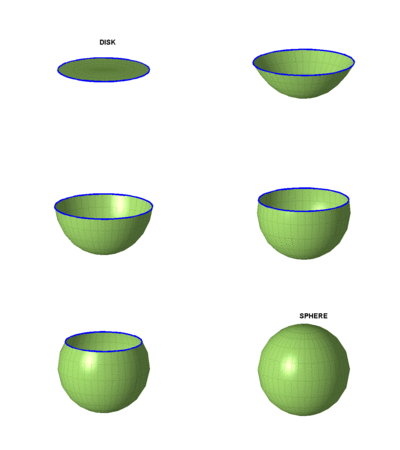
 fringe thorn
sonic crane
Or the rectangle identifications making the torus
fringe thorn
sonic crane
Or the rectangle identifications making the torus

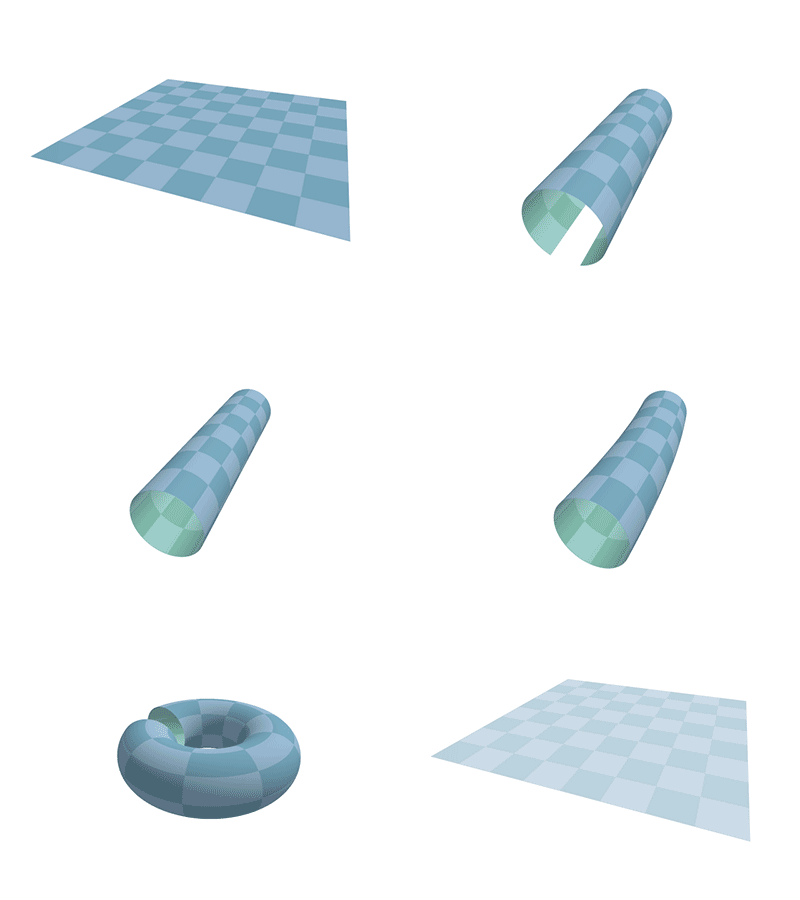
do these GIFs help? 
in the first case, we gotta somehow force the entire boundary of the disk into a single point
the only way we can do that is by pushing the interior of the disk downwards, and then moving the boundary up to a point
this forms a sphere, as you can see in the GIF
mighty hull
sonic crane
Or the rectangle identifications making the torus
This one you can do w/ a physical piece of paper.
fringe thorn
in the case of the square, we identify the left and right edges with each other, glue them together to get a cylinder, and then identify the top and bottom of the cylinder (which are just the top and bottom edges of the square), and glue those together to get a torus