#point-set-topology
1 messages · Page 85 of 1
 winged viper
 worthy olive
Why does homology exist if cohomology does everything homology does and more?
 grave solstice
I was trying to do this (R^R is given the product topology, with R the standard topology)

I'm thinking that a simple formula won't work, because Q^Q is first countable I think
also I know that f_n-->f means pointwise convergence
 red yoke
worthy olive
Why does homology exist if cohomology does everything homology does and more?
red yoke
worthy olive
Why does homology exist if cohomology does everything homology does and more?
Did someone ask this yesterday 
 safe torrent
red yoke
Did someone ask this yesterday <:pandathink:524885344995508235>
safe torrent
red yoke
Did someone ask this yesterday <:pandathink:524885344995508235>
I feel like I've seen this question before yeah
Before answering this maybe think about why we care about linear forms
grave solstice
what do they mean here? isn't (1/n)_{n natural number} an ultranet in the real numbers?

or do they mean for a given directed set Lambda, you can't construct ultranets in general (i.e., it depends on AC)?
 zinc siren
it's great compared to A Concise Course for first timers.
the first couple chapters of a Concise Course that I read were the only time something was harder than Baby Rudin for me.
 gritty widget
what did u just call me
 ebon galleon
😯
 hot locust
how do you prove here that the image of an open set, i.e f(V) is open?


 formal jasper
 visual rock
I hated reading hatcher, didn't finish it
 empty grove
I like concise, way more than Dieck 
 glacial crane
i have a few questions about the fundamental group. i was trying to learn some introductory topology/alg top and kind of needed some intuition.
so i know that the fundamental group is defined as the set of equivalence classes of loops under homotopy (w.r.t. some base point x_0), with concatenation.
- why can we usually omit noting the base point explicitly?
- when we define the concatenation operation on this set, we're defining it on 2 loops. if the elements of this set are equivalence classes, are we picking an arbitrary representative from each class to apply concatenation to? i'm guessing it does not matter, because concatenating any two representative loops would end up belonging to the same resulting equiv. class?
- do you have any good resources (books and/or lecture series) for learning topology?
 lime sable
glacial crane
i have a few questions about the fundamental group. i was trying to learn some i...
lime sable
glacial crane
i have a few questions about the fundamental group. i was trying to learn some i...
- you can do this if you deal with a path-connected space, which nice spaces generally are. (you can just look at one path component at a time if there are multiple)
- yeah, you have to prove the operation is well defined
- hatcher is the "standard" but lots of people don't like it, i'm sure other people in this channel have recommendations
munkres for basic topology, but i assume you're talking about algebraic topology
glacial crane
lime sable
1. you can do this if you deal with a path-connected space, which nice spaces ge...
okay, thank you! and i'll check out munkres—i probably should learn topology more in-depth before moving onto much algebraic topology
 cerulean oriole
grave solstice
what do they mean here? isn't (1/n)_{n natural number} an ultranet in the real n...
cerulean oriole
grave solstice
what do they mean here? isn't (1/n)_{n natural number} an ultranet in the real n...
Going by the definitions, I don't think that sequence is residually in U_n (1/(2n+1), 1/(2n-1)) or its complement.
cerulean oriole
grave solstice
or do they mean for a given directed set Lambda, you can't construct ultranets i...
In terms of filters, using the Axiom of Choice you can prove that there is a (non-principal/non-“trivial”) ultrafilter on any set X.
As for a non-trivial ultranet indexed by any directed set (without a maximum element, say) in any (say, infinite) space, I'm not sure if that's true or even not false even using Choice. You can show that any net has an “ultra subnet”, but I think only if you define subnet broadly enough that it can have a larger indexing set than the original net.
 solemn oar
You'll get used to it.
 west sigil
we just got spammed with so many definitions
Show that the intersection of two open dense sets is again open and dense
can we solve the dense part algebraically?
like i was able to solve that its open with algebraic notations
but finding it hard with density
 hidden crag
Hint: There’s a characterization of density using intersections of arbitrary open sets with your dense set
west sigil
hidden crag
Hint: There’s a characterization of density using intersections of arbitrary ope...
wdym in "characterisation"
like an identity?
hidden crag
What definition of density are you using
west sigil
a set S is dense in X if closure(S) =X
hidden crag
By characterization I mean something equivalent to your definition
A set is dense iff the intersection with every non empty open set is non empty
west sigil
ye ig thats implied from the definition of boundary thinking about it
hidden crag
Now try working with that characterization of density for your problem
west sigil
wait sorry another question
if A is in X
(let (X,T) be our topology)
and A is a subeset of X
then is A' boundary of A?
A' is A compliment
west sigil
hidden crag
A set is dense iff the intersection with every non empty open set is non empty
whats the difference between this and boundary as well?
hidden crag
Not sure what you mean by that
west sigil
hidden crag
A set is dense iff the intersection with every non empty open set is non empty
the definition of boundary we got given is:
x is a boundary point of a subset S ⊂ X if it is neither an exterior nor interior point; i.e., for all neighbourhoods U of x, U ∩ S ̸= ∅ and U ∩ S ̸= ∅. The boundary of a set S is the collection of all boundary points and denoted by δS.
west sigil
hidden crag
A set is dense iff the intersection with every non empty open set is non empty
how is that defintion of boundary different to this definition of density?
grave solstice
cerulean oriole
Going by the definitions, I don't think that sequence is residually in U_n (1/(2...
ah ok I see, thanks
worthy olive
red yoke
Did someone ask this yesterday <:pandathink:524885344995508235>
I asked it yesterday yeah
 violet summit
If f is a homeomorphism and f is a simplicial map, is f^{-1} a simplicial map as well?
 umbral panther
That’s not a simplicial map
 winter verge
Anyone know how Sober spaces got their name? Nothing coming up on google.
gritty widget
the guy who came up with them happened to stop drinking at the same time
ebon galleon
https://ncatlab.org/nlab/show/sober+topological+space
as per there (and i remember seeing this same justification on MSE or MO at some point), it's that you're seeing the "correct" number of points: You're not seeing double of any points (i.e. you have a sort of very weak separation axiom like T_0: you can always tell distinct points apart by at least one open set), but you also aren't not seeing any of the points (there are enough points as described on nlab)
ebon galleon
gritty widget
the guy who came up with them happened to stop drinking at the same time
this too
winter verge
ah, that actually makes more sense than I anticipated
hidden crag
gritty widget
the guy who came up with them happened to stop drinking at the same time
not true, topologists never stop drinking
empty grove
Stay drinking stay driving stay winning 💪
 swift fjord
west sigil
how is that defintion of boundary different to this definition of density?
swift fjord
west sigil
how is that defintion of boundary different to this definition of density?
Every open set vs every open nbhd of x
 jagged rampart
hi guys, i picked up the Gamelin book recently
this is the index
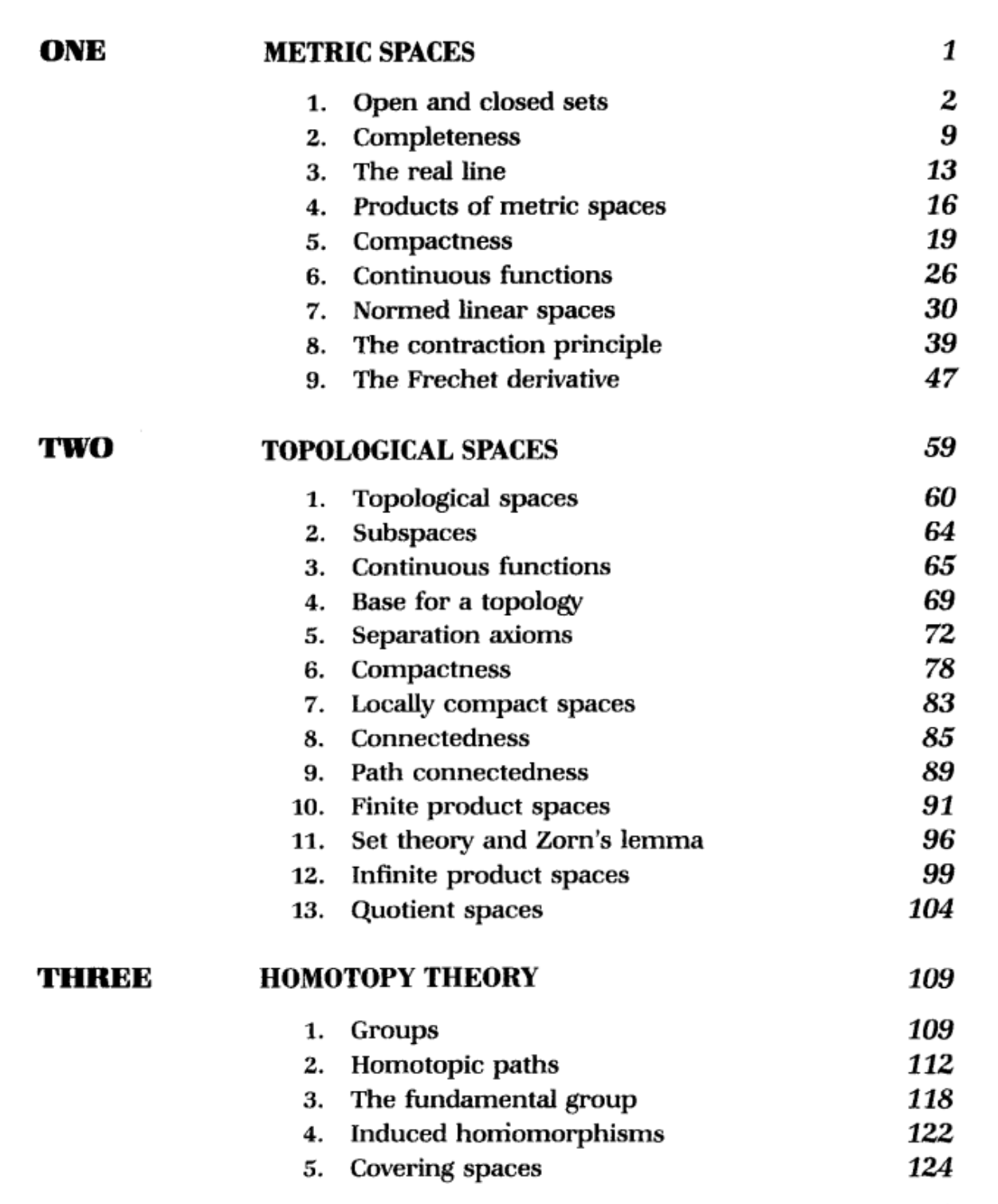
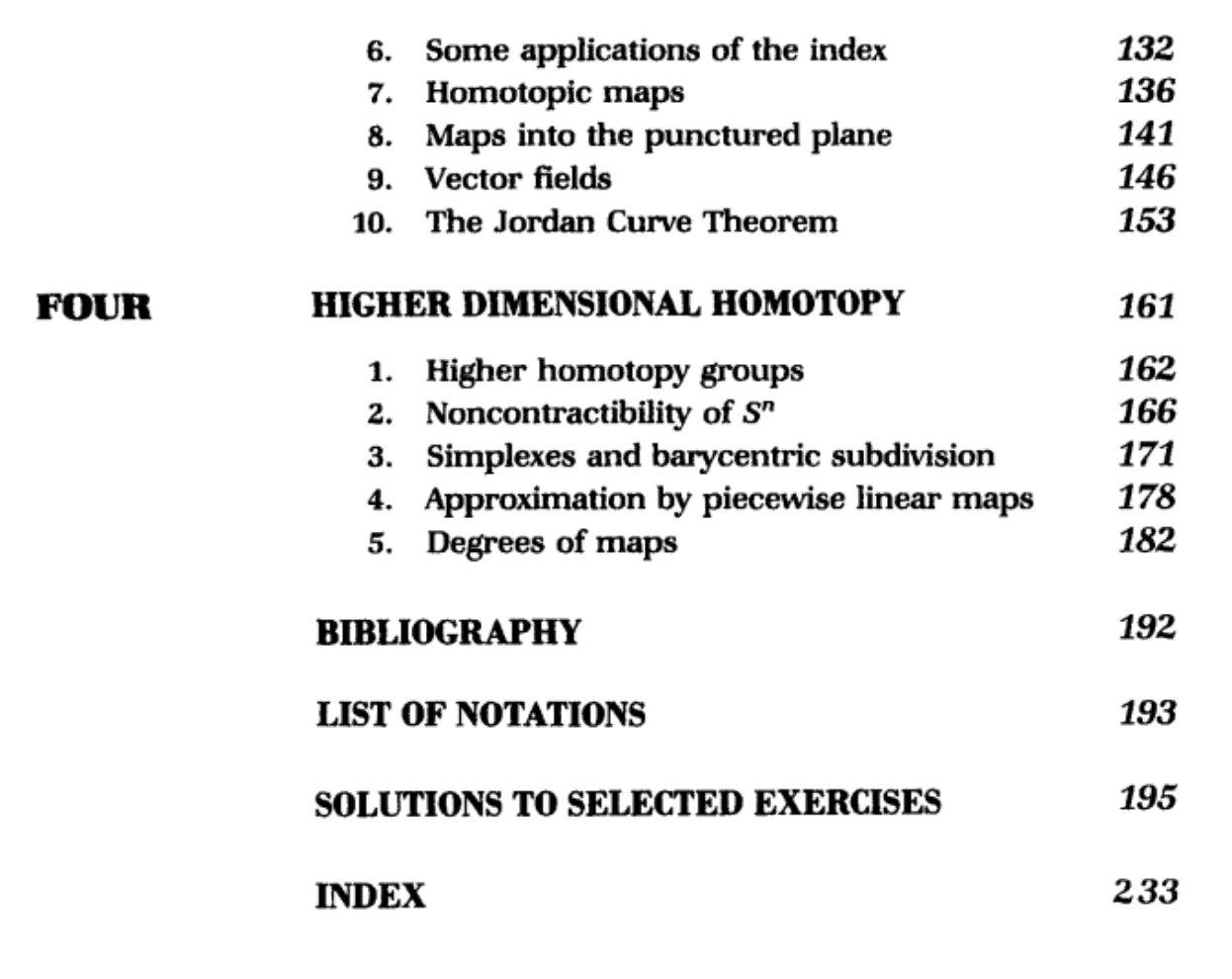
around when do i stop being able to distinguish between a coffee mug and a donut?
 tender halo
not actually sure if you can just from this book, i guess you will need the classification theorem for surfaces to rigorously convince youself of that
jagged rampart
oh wow that sort of thing is pretty much what everyone talks about when they try to introduce someone to the idea of topology, I thought its more central than that
solemn oar
You can reach this statement as soon as you learn about homotopy equivalences.
Or even sooner, as soon as you learn about homeomorphisms
red yoke
jagged rampart
around when do i stop being able to distinguish between a coffee mug and a donut...
You can already explicitly construct a metric space equivalence between a donut surface and coffee mug surface
Or their interiors
(Not that it would be a particularly fun or useful exercise)
Munkres has a chapter on classifying compact surfaces, involving fundamental groups
worthy olive
What are the differences between algebraic and differential topology?
 paper wedge
differential topology is the study of manifolds ig
algebraic topology is how you attach invariants that are algebraic into topological spaces
 cedar pebble
worthy olive
What are the differences between algebraic and differential topology?
cedar pebble
worthy olive
What are the differences between algebraic and differential topology?
usually in differential topology you are making essential use of the extra structure that exists on things like smooth/complex/Kahler/whatever manifolds and using this extra structure to say something about the topology of these spaces
there is a big overlap with algebraic topology, but usually in strictly algebraic topology you're not really making use of extra structure like this, you're usually working more combinatorially and using things like simplicial methods
for example you can study things like characteristic classes for vector bundles/principal bundles on a topological space algebraically in terms of cohomology rings of classifying spaces and prove things about these in an algebraic way. If you're working on a smooth manifold, then Chern-Weil theory tells you that you can compute a lot of information about characteristic classes in terms of connections and curvature in a way that generalizes things like the Gauss-Bonnet formula. The latter is really an analytic thing that makes use of additional structure that exists on smooth manifolds...
gritty widget
Where to find works on stone cech compactification of complex numbers
I have come across results like How we can embed C in l_\inft(C)
I would like to know more results on how the stone cech compactification of these spaces and what are its properties
 last topaz
jagged rampart
around when do i stop being able to distinguish between a coffee mug and a donut...
last topaz
jagged rampart
around when do i stop being able to distinguish between a coffee mug and a donut...
By page 69 would be my guess.
jagged rampart
last topaz
By page 69 would be my guess.
nice
gritty widget
Are there different open set?
 gritty widget
Are there different open set?
gritty widget
gritty widget
Are there different open set?
Your question is not clear can you rephrase it?
Rx{1} and Rx{0} are indeed different open sets of that topological space
one only contains elements of form (x,0) and other only of form (x,1) and they aren't empty so they are different
gritty widget
gritty widget
one only contains elements of form (x,0) and other only of form (x,1) and they a...
thank you brother
gritty widget
gritty widget
thank you brother
i'm not your brother, i'm your sister
worthy olive
What is a dual group?
 opaque scroll
worthy olive
What is a dual group?
opaque scroll
worthy olive
What is a dual group?
Could depend on context, but for a locally compact abelian group G
Hom(G, R/Z)
is called the Pontryagin dual of G. Or simply the dual group of G.
 prime elbow
If I = [0, 1] then subspace topology I × I on R × R is strictly finer than ordered topology on I × I.
For strictly finer it gives the argument that [ 0.5 × 0, 0.5 × 1 ] is open in the Subspace topology but it is not open in ordered topology in I × I.
Why?
 unreal stratus
i think the notation is a bit wrong there , do you mean [0.5,0.5] x [0,1]
though thtat isn't open in subspace top so it can't be what you meant
prime elbow
unreal stratus
i think the notation is a bit wrong there , do you mean [0.5,0.5] x [0,1]
No actually they use the coordinate of X × Y as x × y
unreal stratus
Oh is this munkres
Yeah do not use that notation as I've never seen anyone else use that aha
But okay sure
By ordered, do you mean dictionary order?
prime elbow
unreal stratus
By ordered, do you mean dictionary order?
Yes
unreal stratus
Hm then I'm confused because isn't that set just like {1/2} x [0,1]
Unless the dictionary order is different to what i imagine
prime elbow
unreal stratus
Hm then I'm confused because isn't that set just like {1/2} x [0,1]
Yes it is
unreal stratus
Hm that isn't open in the subspace topology
prime elbow
Why ? R × R has ordered topology
You can take an open set ( 0.5 × -2, 0.5 × 3) and take the intersection with I × I then it will be ( 0.5 × 0, 0.5 × 1 ), right?
umbral panther
prime elbow
If I = [0, 1] then subspace topology I × I on R × R is strictly finer than orde...
That’s backwards. The lex order topology is strictly finer than the product
 unreal stratus
prime elbow
Why ? R × R has ordered topology
unreal stratus
prime elbow
Why ? R × R has ordered topology
Okay but you didn't say that
unreal stratus
 vast estuary
The fibre over b is just F from that diagram
like π-1(b) = proj_1^-1(b) = {b} x F
 north hedge
if I have a manifold^2 I know that the open neighbourhoods of each point of M^2 would be homeomorphic to B^2(open ball in R^2), but in order to map for example S^2 on a subset of R^2, I would need to map all the charts and overlap them?
unreal stratus
vast estuary
upto the isomorphism yeah
ye
umbral panther
north hedge
if I have a manifold^2 I know that the open neighbourhoods of each point of M^2 ...
Yes
 solemn oar
safe torrent
Why R/Z is a circle?
solemn oar
safe torrent
Why R/Z is a circle?
If you think of it as real numbers modulo 1, does that ring a bell?
empty grove
Note that they mean it as a group quotient
The quotient notation for groups and topologies clashes. They're not just collapsing all integers (which is what the topological interpretation of the notation would be), but also collapsing all cosets of the integers.
solemn oar
Try to think of the circle as the unit circle in the complex plane. There's a group structure inherited from multiplication of complex numbers. What does that look like?
 obtuse meteor
safe torrent
Why R/Z is a circle?
obtuse meteor
safe torrent
Why R/Z is a circle?
R/Z is made up of Z many intervals [n,n+1]. All of these are identified. So we have an interval [0,1], and we identify the endpoints. So topologically it is a circle
safe torrent
obtuse meteor
R/Z is made up of Z many intervals [n,n+1]. All of these are identified. So we h...
Oh now I get that
obtuse meteor
Another way to view it
The map R -> S1 by theta Maps to e^(2*pi*theta)
This map is Z-invariant (translating theta by an integer doesn’t change it)
So quotienting by the integer as a group you get R/Z -> S1 as a map
It’s a good exercise to see this map is a homeomorphism
Do it
- directly, by constructing an inverse/showing continuity of the inverse
- using the theorem about maps of compact spaces and Hausdorff spaces
Quotients by group actions are incredibly important as topology soups up, so understanding both general quotient topology, how you prove things abt them, and specifics about quotients by a group action are worthwhile
Interesting note: isometrics of R are translations. So if G is a group acting on R by isometries nontrivially, and the action is discrete (say Hausdorff quotient), then R/G is always the circle
This is part of why the circle is so fundamental
It’s lurking in basically group action that leaves invariant a line
Groups of Isometries of hyperbolic space are very important as well in a lot of math. As are their quotient spaces
obtuse meteor
safe torrent
I'm trying to think of it in terms of first iso theorem
First iso will work in terms of the group isomorphism
But as a space there’s more to keep track of
First iso gives you the result immediately in those terms :)
safe torrent
obtuse meteor
First iso gives you the result immediately in those terms :)
how do you set that up?
I forgot
Oh wait nvm lol
Idk what's wrong with me today

Thanks @obtuse meteor
visual rock
obtuse meteor
Interesting note: isometrics of R are translations. So if G is a group acting on...
reflections are also isometries. Unless you require the action to be free, you can also get the interval from the infinite dihedral group acting on R.
and I guess [0,1) from G being generated by a single reflection
obtuse meteor
visual rock
reflections are also isometries. Unless you require the action to be free, you c...
Sorry I should have specified orientation preserving
I don’t believe in non-oriented things rn in my life 😌
safe torrent
The more I do algtop the more I think it's really a based field
obtuse meteor
Depends on what counts as algtop imo but ya I agree a lot of the ideas are really cool
prime elbow
unreal stratus
Okay but you didn't say that
Yeah that's my mistake
zinc siren
...this looks like something my prof would assign.
I like the physics notation of ; for covariant derivative indices.
And ∂_i f is nicer than ∂/∂x^i f
prime elbow
How closed intervals in R are connected space. And is this connected subspace of R ?
prime elbow
Is that like, let any closed interval A any closed set in A is closed interval and any proper closed set of A can not be open in A, right?
zinc siren
The answer is always clopen.
 real granite
Can someone explain the highlighted bit? I’m not getting how $[x,z] \in I$ and $y \in A$ lead to $[y, y+\epsilon) \in A$.
I think you could say that since we’re working with the standard topology (which is metrizable), we can say there is an open ball centred on $y \in A$: $(y-\epsilon, y+\epsilon) \subseteq A$, and therefore $y+\epsilon/2 \in A$, which contradicts $y$ being the supremum.
So I can see that there is a contradiction, but I’m not sure on the exact reasoning used in the proof.

 gentle ospreyBOT
Douglas

 grim knot
Does somebody know a good paper where I can find an algorithm for computing homologies with the boundary matrices?
 knotty vine
grim knot
Does somebody know a good paper where I can find an algorithm for computing homo...
knotty vine
grim knot
Does somebody know a good paper where I can find an algorithm for computing homo...
Homology over a field or something more general (usually a principal ideal domain)?
https://www.matem.unam.mx/~omar/mathX27/smith-form.html seems good (not a paper tho)
grim knot
Over a field k
knotty vine
Any textbook about topological data analysis will have a chapter on this
 viral atlas
gentle osprey
**Douglas**
viral atlas
gentle osprey
**Douglas**
The proof is saying the same thing
grim knot
knotty vine
Any textbook about topological data analysis will have a chapter on this
Oh okay that's nice thanks a lot, if you have a recommendation they are welcomed
north hedge
what is clopen?
 quiet thorn
closed and open
knotty vine
grim knot
Oh okay that's nice thanks a lot, if you have a recommendation they are welcomed
Tbh I was looking and most of what I found was either about general PID's or about persistence. These lecture notes treat computation of homology over a field tho: https://www.few.vu.nl/~botnan/lecture_notes.pdf see chapter 3
north hedge
how xd..
I mean a set can only be open to a space X right?
If I take a closed ball on a topological metric space
north hedge
north hedge
If I take a closed ball on a topological metric space
it would be closed, but not open
knotty vine
We need a bot command to post the "Hitler learns topology" video
knotty vine

Hitler gets confused about the topological definitions of open and closed sets. Then he totally freaks out.
There's a typo right in the beginning of the video. It should say "...and all zero of the points in the null set," so no "the" before zero. And if you're wondering what I meant by "close points," they are Wikipedia calls "limit points" of...
grim knot
knotty vine
Tbh I was looking and most of what I found was either about general PID's or abo...
My professor sent me a paper and I think it would be prop 2. 18 and 2.19,but I don't really see how to apply it https://www.cambridge.org/core/journals/acta-numerica/article/topological-pattern-recognition-for-point-cloud-data/BB0DA0F0EBD79809C563AF80B555A23C

Cambridge Core
Topological pattern recognition for point cloud data* - Volume 23
knotty vine
The idea for a field is not so difficult: all that we need to know about the boundary matrices is their rank and nullity
grim knot
You that is how I would do it, but whz do I need to do these matrix transformations?
I wanted to compute it by hand as you're suggesting, but my professor said that she wants us to learn the algorithm
knotty vine
The only reason for the transformation is to find the rank/nullity of the matrix
How else would you find the rank?
grim knot
I mean I just wanted to apply Gauss, but without having to deal with the matrix itself
knotty vine
Yeah Gaussian elimination is a matrix transformation. wdym without having to deal with the matrix?
grim knot
Gaussian transformation is equivalent to multiplying the matrix A by the matrix which gets created by those transformation
And I thought we needed to define that (?)
north hedge
(0,1) U (1,2) as a subtopology of R, but the complementary of (0,1) is open, so (0,1) is both closed and open, so it's clopen
knotty vine
grim knot
Gaussian transformation is equivalent to multiplying the matrix A by the matrix ...
Yeah, using (augmented) Gaussian elimination of a matrix M, we get two matrices R and V with R=MV (did I get this right?) where R is in row echelon form and V is of full rank/invertible.
Then Prop 2.18 in that paper you linked says that we can basically forget about V for the purposes of homology
And the reason why we want row echelon form is because it's easy to read the rank of the matrix from it
prime elbow
The continuous image of the path connected is the path connected.
First they define a path, a path in X from x to y is a continuous map f:[a, b] -> X of some closed interval in the real line such that f(a) = x and f(b)= y. A space is said to be a path connected if every pair of points of X can be joined by a path in X.
Now if I let there is a function h: X-> Y such that h is a continuous function and X is the path connected.
So now let any two points from h(X) say y_1 and y_2. Then there are points x_1 and x_2 in X such that h(x_1) = y_1 and h(x_2) = y_2. Now since X is path connected so there is function f: [a,b] -> X such that f(a)=x_1 and f(b)=x_2 then if I define g = h(f) then g maps from [a,b] to Y and g is continuous because f and h are both continuous and such that g(a)= y_1 and g(b) = y_2.
Hence, h(X) is path connected.
Is it correct?
 kindred cairn
yes
prime elbow
kindred cairn
yes
Okay thank you
 lament vortex
feeling silly about a detail in the TDA package for R, if anyone knows about this and could give some clarification that'd be much appreciated -
I'm theorizing about how much of the geometry of a space can be recovered from a persistence diagram, as opposed to just the topology. I'm starting with a very simple example, in which we have 3 points and are given that they lie on the circle of radius 1. Our PD looks like the attached image, and the matrix that generated it is this:
dimension Birth Death
[1,] 0 0 2.0000000
[2,] 0 0 1.6281593
[3,] 0 0 0.5594266
The birth/death times are the epsilon values at which those events occur, correct? ie, the two closest points in our sample meet when e = 0.5594266, meaning they are 1.1188532 units apart. But then the next event is what's making me scratch my head. It's saying the next two closest points meet at e = 1.6281593. but that would mean they are 3.2563186 units apart... yet they lie on a circle of diameter 2. What am I misinterpreting?

 limpid dragon
uh yeah if theres space around here id appreciate some ideas here because im blanking. as i said elsewhere, kind of get the sense the structure of the cover should be a "root" at one torus and the surrounding n h-1 torii can cover the h-torus. but this cover woud surely assign the "root" to different places simultaneously right?

oh sorry, didnt mean to interrupt
 formal tide
Is there anything interesting to say about the -1-th reduced homology of the empty set? It's Z, which is weird
it's tempting to just say it's an artefact of the machinery, but I'm not so sure of this, since one can express this machinery in terms of simplicial objects, which seems very "uniform" to me
 novel acorn
limpid dragon
uh yeah if theres space around here id appreciate some ideas here because im bla...
novel acorn
limpid dragon
uh yeah if theres space around here id appreciate some ideas here because im bla...
maybe think about what the euler characteristic of a g-holed torus is and how the characteristic acts under lifting to an n-fold covering
 feral copper
Hey! Does anyone know of an exhaustive list of all possible fixed-point sets of involutions on non-orientable surfaces?
I know I can obtain it from https://arxiv.org/abs/1612.08489 by hand, but I'm wondering if it's been written down already somewhere. Thanks!

arXiv.org
We use equivariant surgery to classify all involutions on closed surfaces, up to isomorphism. Work on this problem is classical, dating back to the nineteenth century, but some questions seem to have been left unanswered. We give a modern treatment that leads to a complete classification.
gentle ospreyBOT
Matplotlib
 worthy olive
What does a[x,y] mean graphically where [x,y] is an n-chain and a is in an abelian group G?
 shadow charm
I was wondering if anyone could help me walk through lemma 2 of section 8 here? I think I sort of get the general idea but I'm not quite comfortable enough with alg top to fix the details
in particular the part about using a path from x_i to x_r+1 to conclude linear independence
im guessing there's some poincare duality shenanigans but im not too good on it
(the rest of the proof im relatively okay with)
 signal fox
Please I really need your help, does anyone know the formula of the homeomorphism between the unit circle and [0,1]×[0,1] ??
gritty widget
there isn't one, unless you meant "unit disk"
zinc siren
r/max(|x|,|y|) [x,y]
and 0 at 0
note that this is 2-norm/\infty-norm
for continuity, we can use either norm.
thus we get easily continuity
using the \infty norm
by reversing the fraction, we get what we can see is the inverse.
basically: we are mapping the ball in the 2-norm to the ball in the uniform norm.
limpid dragon
novel acorn
maybe think about what the euler characteristic of a g-holed torus is and how th...
i used this to show the existence of a covering implies the relation, but how would it be useful to build a covering from that relation?
(i went to sleep, sorry)
 stoic eagle
The idea is that homologous elements have the same intersection numbers. If they are dependent (if one is homologous to a sum of the others, say, h_1=h_2+h_3) since h2,h3 intersect the curve to x1 trivially and h1 doesnt you get a contradiction. @shadow charm
 near sage
How can I prove that {U_f | f is a polynomial of two variables (x,y)}, where U_f = {(x,y)∈R^2 | f(x,y) != 0}, is a basis for a topology in R^2?
Like I think I proved the first condition for a basis, but Im having difficulties with the second
viral atlas
What do you mean by the second condition?
That if U_f and U_g are two such sets, you must have some set in your collection contained in their intersection?
If so, I would suggest thinking about the most obvious candidate the comes to your mind: given polynomials f and g, how do you construct a polynomial that is nonzero only when both f and g are?
 near sage
I mean wouldnt the points for which the new polynomial is non-0 be the exact same points for which both the first 2 polynomials are non-0
therefore the sets U_F = U_f intersect U_g
edit: changed the notations
near sage
so its fine if its that way? By the definition I used I have that U_F ⊂ U_f intersect U_g should be the condition
viral atlas
Do you need it to be a proper containment?
 viral atlas
This doesn't help as it is, there is no universally accepted convention on whether \subset symbol should mean a proper inclusion or not
Let me check what Munkres' convention is
near sage

Oh ok yeah so it would be good
again from his book
ok thats what got me confused tbh... so I think such polynomial that is non-0 when both f and g are non-0 would be fg (multiplication) no?
viral atlas
Yes, that works
near sage
ok I got it thanks
near sage
While finding the Zariski closure of I = {(x,0), x ∈ [0,1]} can I just say that there should exist a polynomial f(x,0) = 0 for all x ∈ [0,1] which is a polynomial with infinitely many zeros therefore f(x,0) ≡ 0 therefore the Zariski closure of I is R^2?
gritty widget
near sage
While finding the Zariski closure of I = {(x,0), x ∈ [0,1]} can I just say that ...
No. Let f(x,y)=y. Then the locus of f is {(x,0) : x in K}
gritty widget
Let f(x,y) be a polynomial s.t. f(x,0)=0 for all x in [0,1]. Let g(x)=f(x,0). Then g is 0 for infinitely many x, so g=0. Therefore f(x,y) is a polynomial in y with no constant terms.
near sage
so what would be the closure then? like a set of points (x,y) where f(x,y) ≡ 0 that contains I, right? what would f being a function of only y do towards the goal?
gritty widget
when is f(x,y) = a_n y^n + ... + a_1 y = 0?
near sage
Yeah
gritty widget
It wasn't a yes or no question
gritty widget
yeah
near sage
hmm, ok thanks
prime elbow
If X is indiscrete topology and there is continuous mapping from X to Y where Y is Hausdorff space so the mapping must be constant mapping, right ?
gritty widget
prime elbow
If X is indiscrete topology and there is continuous mapping from X to Y where Y ...
What would happen if there was a non-constant mapping?
prime elbow
gritty widget
What would happen if there was a non-constant mapping?
Let X has more than one element.
If there is non- constant mapping then there is x_1 ≠ x_2 such that f(x_1) ≠ f( x_2 ).
Then by Hausdorff property there is a disjoint open set U and V containing f(x_1) and f(x_2) respectively.
Then since f is continuous, so f^-1 ( U) and f^-1(V) are open set and since they are non empty therefore it will be X, so there is y which belongs to both f^-1(U) and f^-1(V) then f(y) belongs to U and V, it contradicts that U and V are disjoint open set of Y.
shadow charm
stoic eagle
The idea is that homologous elements have the same intersection numbers. If they...
is this because of poincare duality or smth else?
gritty widget
prime elbow
Let X has more than one element.
If there is non- constant mapping then there ...
Sounds good
shadow charm
also this uses some sort of assumption on the intersection path no? (I could imagine for example a bounded path in R^2: all 1-cycles are homologous but some have intersection nb 1 while others 0)
gritty widget
More generally a similar argument should work for T0 spaces
prime elbow
gritty widget
More generally a similar argument should work for T0 spaces
T_0 space means ?
gritty widget
prime elbow
T_0 space means ?
Given any two points x,y there is either a neighbourhood of x not containing y or a neighbourhood of y not containing x
prime elbow
gritty widget
Given any two points x,y there is either a neighbourhood of x not containing y o...
Okay
prime elbow
Is {0} connected subsets of R?
umbral panther
shadow charm
is this because of poincare duality or smth else?
This is a very simple thing that is a prerequisite for stating duality
But you could say it’s the local property of manifolds that globalizes into pd
umbral panther
shadow charm
also this uses some sort of assumption on the intersection path no? (I could ima...
Huh?
Are you assuming both are cycles?
shadow charm
Okay maybe I’m misunderstanding smth: how are we defining intersection number here
I’m sure it’s quite simple but i did Poincaré duality way too fast and not really understanding it a while back so just assume I don’t know what it says
Like I think I see the idea? The path from x_i to x_r+1 determines a function on 1 chains given by intersection numbers, and i guess intuitively this vanishes on boundaries so it should define a well defined map on homology but the “intuitively” part isn’t formally clear to me
 fading vale
i think its pretty common to prove this using PD
i guess morally its not really that different
umbral panther
shadow charm
Like I think I see the idea? The path from x_i to x_r+1 determines a function on...
The (transverse) intersection of a cycle z with a chain x is a chain and d(z.x) = z.dx. Thus if w and y are homologous, you can find x so that dx = w-y, then z.dx gives a homology between z.w and z.y
In particular, if z is the path between the cusps and b is a boundary = dx, then z.x is a bunch of intervals, so z.b is a bunch of paired cancelling points
stoic eagle
shadow charm
is this because of poincare duality or smth else?
I don’t think you need that. These facts are in “A Primer on Mapping Class Groups” I believe
Also Margulis is a goat
shadow charm
umbral panther
The (transverse) intersection of a cycle z with a chain x is a chain and d(z.x) ...
Sorry again for the questions but where is your operator . coming from?
shadow charm
stoic eagle
I don’t think you need that. These facts are in “A Primer on Mapping Class Group...
Oki ill look into that
shadow charm
stoic eagle
Also Margulis is a goat
So true
umbral panther
shadow charm
Sorry again for the questions but where is your operator . coming from?
It’s simply intersection. But it is only the right thing if the chains are transverse to each other. Most of the work is reducing to the transverse case
A generic pair of chains are transverse. Given x and y not transverse, x is homologous to a chain x’ transverse to y. If x’ and x’’ are transverse to y and homologous, then x’-x’’’ Is the boundary of a chain transverse to y
shadow charm
So when you say d(z.x) = z.dx how are you taking intersections of a 1 chain with a 0 chain on the Rhs to get a 0 chain on the lhs
umbral panther
1 and 2
We want to understand the intersection of two 1-chains. But one of them is a boundary y=dx. So we intersect with the 2-chain x to understand the intersection y that we really care about
shadow charm
okay so let me just do a drawing to understand here
So this is a shit drawing but is it what you’re saying?

now in what sense is z.x a one-chain with boundary p-p tilde?
(don't mind that i havent specified orientations here you get my point)
umbral panther
If z is a cycle, w is not a boundary
If you want to compare z to z’, your 2-chain should have boundary z-z’
shadow charm
wait why is z supposed to be a cycle im confused
doesnt z correspond to the path between our cusps here?
umbral panther
You could think of z as a cycle in relative homology. Its boundary is the cusps, which doesn’t count
shadow charm
hmm is there some kind of les argument under the hood for working with relative homology?
like we're trying to show linear independence in H_1(X/Gamma), and you want to work in H_1(S,S-X/Gamma) so we need to relate these two somehow?
or i guess this is almost excision?
umbral panther
We’re working in H_1(S, cusps)
shadow charm
right and how do we obtain a statement on H_1(S-cusps) from there?
cedar pebble
use the long exact sequence
umbral panther
We have an intersection pairing. H_1(S-cusps) tensor H_1(S, cusps) -> Z
shadow charm
shadow charm
right and how do we obtain a statement on H_1(S-cusps) from there?
cause H_1(S,cusps) = H_1(X/Gamma, punctured neighb of cusps) no?
umbral panther
PD says it’s a perfect pairing, but here we just want to know it’s well defined
shadow charm
umbral panther
We have an intersection pairing. H\_1(S-cusps) tensor H\_1(S, cusps) -> Z
ahh okay
so my path between cusps lives in H_1(S,cusps)
umbral panther
shadow charm
cause H_1(S,cusps) = H_1(X/Gamma, punctured neighb of cusps) no?
True by homotopy invariance, er + excision
shadow charm
and the loops about cusps live in H_1(S-cusps)
and i guess if i did want an argument by PD i could just use perfectness no?
umbral panther
I don’t think PD gives you anything. Perfection says cycles exist with prescribed intersections. But we already have the cycles
shadow charm
oh yeah sorry i see
okay at the end of the day I guess I just need to get familiar with the exact definition of the intersection pairing for this to make sense to me, thanks
in terms of the homology of X/Gamma
in the end will we just get H_1(X/Gamma) = Z^(nb cusps)
and to get torsion we'd need elliptic points?
 merry geode
,ask cusp
gentle ospreyBOT

Wolfram Alpha doesn't understand your query!
Perhaps try rephrasing your question?
Click here to refine your query online
 Requested by abstia
merry geode
Requested by abstia
merry geode
Node vs. Cusp is always confusing to me
umbral panther
shadow charm
in the end will we just get H_1(X/Gamma) = Z^(nb cusps)
2 problems (1) The complete surface S has homology and that doesn’t go away. (2) The homology of the cusps isn’t the free abelian group on the cusps, but reduced by 1
If you had torsion in Gamma, the quotient stack would have torsion homology, but the quotient space wouldn’t
paper wedge
To compute the fundamental group of RP^2
can i say that , as RP^2 = S^2/x~-x , S^2 is a covering of RP^2 with the projection map
but then if you for example have a point in RP^2 say [x1:x2] (the line) then the inverse image would be just {x1} U {x2}
gritty widget
what does it mean to compute RP^2
paper wedge
paper wedge
but then if you for example have a point in RP^2 say [x1:x2] (the line) then the...
therefore this is a 2-sheeted covering
we know S^2 is simply connected tho so by like the index shit whatever we get that RP^2's fundamental group must have order 2?
is this correct
empty grove
paper wedge
is this correct
Yes, I'm just not sure what you mean by the inverse image of [x1:x2] being {x1} ∪ {x2}
paper wedge
i meant like
okay so for example (S^2,x_0) and (RP^2,x_1)
so the preimage of x_1 whatever its homogenous coordinates are would be x_0 and -x_0
correct?
empty grove
Ah ok yeah
paper wedge
yeah
empty grove
Homogeneous coordinates of ℝP² are usually triples though
empty grove
stupodi 
prime elbow
If X is connected then is there a subspace of X which is not connected ?
ebon galleon
Not necessarily: consider any indiscrete space, or more simply, the space with one element.
(Excluding the emptyset, which some people consider to be disconnected by definition)
prime elbow
ebon galleon
Not necessarily: consider any indiscrete space, or more simply, the space with o...
Yes, in R if I take a subspace open interval then maybe it is not connected, right?
prime elbow
ebon galleon
like (0,1) is connected
Yes
I am not sure about the when the statement says U is connected in X , so does it mean U is connected subspace of X ?
prime elbow
If X is a topological space and U is an open set of X and C is a component of U. Does it mean that we are taking U as subspace and then find Components of U?
gritty widget
"component of U" does indeed mean "component of U"
prime elbow
gritty widget
"component of U" does indeed mean "component of U"
So are we taking U as subspace of X?
 vital pilot
prime elbow
I am not sure about the when the statement says U is connected in X , so does it...
vital pilot
prime elbow
I am not sure about the when the statement says U is connected in X , so does it...
A subset U of X is connected if U is connected with the relative topology
And every subset U of X is itself a topological space in the relative topology
empty grove
prime elbow
If X is a topological space and U is an open set of X and C is a component of U....
Yes you view U as a space by giving it the subspace topology
prime elbow
vital pilot
And every subset U of X is itself a topological space in the relative topology
Relative topology?
prime elbow
empty grove
Yes you view U as a space by giving it the subspace topology
Okay thank you
empty grove
prime elbow
Relative topology?
Another name for the subspace topology
 vestal herald
i'm confused about what (b) is asking. the distance from x to A equals the infimum of all d(x,a) so there is some a0 where d(x,A)=d(x,a0) right? i feel like i'm misunderstanding the question or some definition since it's saying to assume that A is compact

i think i get it now nevermind
gritty widget
vestal herald
i'm confused about what (b) is asking. the distance from x to A equals the infim...
0 is the infimum of (0,1] but 0 is not an element of (0,1]
worthy olive
What a cochain complex vs a standard chain complex?
umbral panther
In a chain complex the differential lowers degree
C_n -> C_n-1
In a cochain complex it raises degree
C^n -> C^n+1
It is very superficial, but it is a useful convention
worthy olive
But are the chains themselves the same (like C_n)
worthy olive
umbral panther
In a chain complex the differential lowers degree
C\_n -> C\_n-1
In a cochain co...
Thanks
umbral panther
You can turn a chain complex into a cochain complex by just changing the numbering
C^n = C_-n
gritty widget
a topology cofinite topology and also cocountable topology is it possible?
 naive trench
Wdym by countable topology?
gritty widget
naive trench
Wdym by countable topology?
yes it is another name
naive trench
I meant, I dont understand your question
 pastel linden
is it true that generally that fiber bundles over X with coycles ${g_{\alpha \beta}}$ and {\tilde{g}{\alpha \beta}}$ are isomorphic (as fiber bundles) iff $g{\alpha \beta} = \lambda_\alpha \tilde{g}{\alpha \beta} \lambda\beta^{-1}$ for functions $\lambda_\alpha : U_\alpha \to \mathrm{Homeo}(F)$ and $\lambda_\beta : U_\beta \to \mathrm{Homeo}(F)$?
gentle ospreyBOT
bacono
Compile Error! Click the  reaction for more information.
(You may edit your message to recompile.)
 ebon galleon
gritty widget
a topology cofinite topology and also cocountable topology is it possible?
ebon galleon
gritty widget
a topology cofinite topology and also cocountable topology is it possible?
Are you asking whether the cofinite topology and the cocountable topology can agree for some set? If so, that happens if and only if the set is finite
pastel linden
I know this is true for vector bundles, and I think the proof follows through if you just forget the linear structure on fibers
gritty widget
ebon galleon
Are you asking whether the cofinite topology and the cocountable topology can ag...
oh, thanks
shadow charm
umbral panther
2 problems (1) The complete surface S has homology and that doesn’t go away. (2)...
just to get back to this actually: since X/Gamma is a non compact surface its fundamental group must be free so H_1 is free as well right? So we do get Z^(nb cusps -1)
umbral panther
shadow charm
just to get back to this actually: since X/Gamma is a non compact surface its fu...
Yes, it’s not compact. Yes, the homology is a free abelian group. But it could have genus, so not all the homology comes from the cusps
shadow charm
ahhh okay i see
thanks a bunch
(yeah ofc freeness of homology doesnt even need freeness of the fundamental group since it's torsion free anyways)
 outer harness
I recently learned that (for example) that the knotted torus is homeomorphic to a regular torus. I understand that this “knottedness” property is a property of how the torus is embedded in R^3, but it still feels…wrong. Does the homeomorphism from the knotted torus to the regular torus look different if they were embedded in R^4 (or some other R^n), and is there any other intuition to make this “feel right”?
umbral panther
Yes, if you take an embedding T -> R^3 and compose to get an embedding R^4, all the embeddings become isotopic
 oak python
What does a induced metric topology mean? I don't even understand the information given in this question. Is there any video or pdf I can read understand?
And any hints on the a)?
 unreal stratus
Every metric space (X,d) canonically gives rise to a topological space
by saying that a set is open in X iff it is open in the metric spaces sense
oak python
how is a set open in metric space?
unreal stratus
I suggest you look at metric spaces somewhere like Munkres
This question seems to assume such knowledge
oak python
ok thanks
prime elbow
empty grove
Another name for the subspace topology
Okay thank you
 frigid patrol
Whats the universal property of a universal cover?
gentle ospreyBOT
kevinhardy2

 steel glen
frigid patrol
Whats the universal property of a universal cover?
steel glen
frigid patrol
Whats the universal property of a universal cover?
are you asking or were you responding to someone
frigid patrol
Asking
novel acorn
frigid patrol
Whats the universal property of a universal cover?
I think it's something like if M is the universal cover and E is another simply connected covering space then M and E are homeomorphic and the diagram commutes
steel glen
i thought i knew but im no longer sure. i figured it would be the initial object in Cov(X), provided it exists
im sure there's some obvious counterexample to that that i can't think of
red yoke
It should be initial among based covers 
umbral panther
steel glen
i thought i knew but im no longer sure. i figured it would be the initial object...
The initial cover is empty
The universal cover has automorphisms (deck transformations), so it is not initial. Consider R as the cover of R/Z. Translation by Z commutes with the covering map, so it is not initial
But if you choose a lifting from the the base point of the circle to the line and don’t allow that point to move, it becomes rigid and universal
worthy olive
How would you solve
 paper wedge
one of the reasons i started studying math was to understand what type of black magic this shit is
it's been years
im still missing a few words lmfao
zinc siren
worthy olive
How would you solve
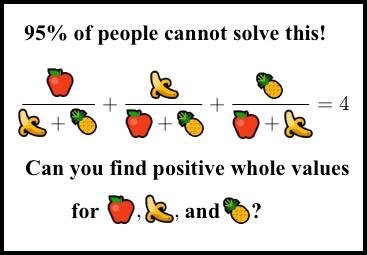
My favorite one of those was the one that still had nothing more than numbers and basic algebra, but whose solution requires some serious number theory
gritty widget
zinc siren
My favorite one of those was the one that still had nothing more than numbers an...
FLT?
zinc siren
no no
the question was simply to find the integer solutions to some diophantine equation, i think
someone wrote a solution and put it on quora

This is actually a neat problem for getting some overview of numbers
Quora
Answer by Alon Amit (אלון עמית), PhD in Mathematics; Mathcircler.
prime elbow
In any metric space , the collection of €- balls with € <1 forms a basis element for the metric topology, if this statement is true then can is this true if I replace inequality with € < a , where a is real positive number?
merry geode
zinc siren
https://www.quora.com/How-do-you-find-the-positive-integer-solutions-to-frac-x-y...
Yeah, this one could serve a nice intro to num theory
zinc siren
prime elbow
In any metric space , the collection of €- balls with € <1 forms a basis element...
€
😂
€>0?
€->0!
(brexit amirite)
merry geode
€, ah that's a good trick
zinc siren
using € implicitly makes some claims about the European economy
 sullen bear
prime elbow
In any metric space , the collection of €- balls with € <1 forms a basis element...
sullen bear
prime elbow
In any metric space , the collection of €- balls with € <1 forms a basis element...
well if a >= 1, then the result is obviously true because the original basis is contained in the new one. however if a < 1, its a matter of showing that any open ball B of radius < 1 can be covered by open balls of radius < a (this isnt too tricky, just put every point in a ball that is contained in B)
sullen bear
im having a nightmare doing hatcher exercise 2.2.30 right now. Im up to part c. If we say f: (a, b) -> (a, -b), how do we determine the induced map in H_2? i know its -1, but how do we show this?
 prime elbow
zinc siren
€
prime elbow
zinc siren
€
I don't know how to use LaTeX so
gentle ospreyBOT
Xela
 zinc siren
latex is really easy
prime elbow
Okay
zinc siren
or go and copy paste the symbol, or type "epsilon", but, € is laugh worthy.
prime elbow
zinc siren
or go and copy paste the symbol, or type "epsilon", but, € is laugh worthy.
😂
zinc siren
are you laughing at my laughter?
prime elbow
sullen bear
well if a >= 1, then the result is obviously true because the original basis is ...
Oh
prime elbow
 steel glen
prime elbow
steel glen
prime elbow
what is your definition for metrizable
assuming it means there's a metric that induces the topology, then i think it's fine. i think a direct proof may be more neat
also note that if you know that all metric spaces are hausdorff, then you can just say that since X is a metric space it is immediately hausdorff
prime elbow
steel glen
assuming it means there's a metric that induces the topology, then i think it's ...
Yes, but all metric spaces are Hausdorff and all metrizable spaces are Hausdorff use exact proof, right?
steel glen
what do you mean by exact proof
prime elbow
Means they imply each other?
steel glen
the idea is that whatever proof you use to show that metrizable spaces are hausdorff will surely work to show any metric space is hausdorff
so if you've proved that metric spaces are hausdorff before, you either:
- cite that theorem
- copy that proof
but the proof you have above is fine
prime elbow
I know when I take B(x, d(x ,y)/2 ) and B( y, d(x,y)/2 ) are two disjoint open balls which contain x and y respectively then it will work
prime elbow
steel glen
but the proof you have above is fine
Okay thank you
steel glen
prime elbow
I know when I take B(x, d(x ,y)/2 ) and B( y, d(x,y)/2 ) are two disjoint open b...
yeah this is the direct proof i was talking about above
i think its nicer than a contradiction
prime elbow
steel glen
i think its nicer than a contradiction
Yes
prime elbow
steel glen
the idea is that whatever proof you use to show that metrizable spaces are hausd...
So are they both equivalent?
steel glen
are what equivalent
prime elbow
Means they imply each other
steel glen
but which two things
prime elbow
prime elbow
I know when I take B(x, d(x ,y)/2 ) and B( y, d(x,y)/2 ) are two disjoint open b...
Does it work for both metrizable space and metric space?
steel glen
what is your definition of metrizable
prime elbow
steel glen
but which two things
Metric space and metrizable spaces
steel glen
they should be equivalent, as in there is a natural pairing between them
prime elbow
steel glen
what is your definition of metrizable
If X is a topological space, X is said to be metrizable space if there exists a metric d on the set X that induces the topology of X.
steel glen
then they are "equivalent"
a metrizable space is not a metric space since they are different objects, but a metrizable topological space can certainly be seen as a metric space if you just take the metric that induces it
and similarly, a metric space can be seen as a metrizable space if you take the topology it induces
prime elbow
steel glen
then they are "equivalent"
a metrizable space is not a metric space since they a...
Metrizable space and metrizable Topological space are different?
steel glen
no im using "metrizable space" instead of "metrizable topological space"
prime elbow
steel glen
then they are "equivalent"
a metrizable space is not a metric space since they a...
Got it
Thank you
 coral pawn
Sanity check: forgetting "ho" and using intuition from normal direct limits, one can think of an object of Sp(C) as a sequence C_0, C_1,... of spaces such that C_i is homotopy equivalent to omega C_i+1. Thinking in terms of the concrete definition of prespectra, there are objects in that category called omega prespectra that satisfy the property that the structure maps X_i --> omega X_i+1 are weak homotopy equivalences. When forming the category of spectra, we take the omega prespectra replacement of each spectra, which is why the infinity category notion coincides with this one

Can someone verify if my intuition is correct?
gritty widget
what is a Gδ set?
tender halo
gritty widget
what is a Gδ set?
a countable intersection of open sets
most often, \delta is countable intersection, \sigma is countable union, G is open set, F is closed set
gritty widget
tender halo
a countable intersection of open sets
alright, what is a Fσ set?
tender halo
a set whose complement is a G_\delta set 😛
alternatively, a countable union of closed sets
gritty widget
oh so easy thank you
gritty widget
tender halo
a countable intersection of open sets
hmm X any open set and X countable mean X=Gδ set.
True?
gritty widget
thank you
obtuse meteor
steel glen
then they are "equivalent"
a metrizable space is not a metric space since they a...
these are not equivalent. "The" metric inducing a topology is not well-defined. Many metrics induce the same topology
gritty widget
True?

 brave geode
obtuse meteor
these are not equivalent. "The" metric inducing a topology is not well-defined. ...
brave geode
obtuse meteor
these are not equivalent. "The" metric inducing a topology is not well-defined. ...
i think they mean that the full subcategory of metrisable spaces is equivalent to metric spaces with continuous maps between them
prime elbow
gritty widget
True?
U subset of X, right
gritty widget
prime elbow
U subset of X, right
thank you
prime elbow
gritty widget
True?
In this T contains empty set X and all subsets which contain a not just empty and itself
 drowsy quest
Got a midterm today on Hatcher chap 1. Wish me luck guys 🫡🫡
steel glen
obtuse meteor
these are not equivalent. "The" metric inducing a topology is not well-defined. ...
i should not have said "the" you're right, but that's why i put equivalent in quotation marks
gritty widget
prime elbow
In this T contains empty set X and all subsets which contain a not just empty an...
but not discrete space, true?
prime elbow
Yes
Just take an example X= {1,2} and let a=2 then T contains an empty set, X, and {2} not {1}
gritty widget
ı understand, really so thank you
steel glen
brave geode
i think they mean that the full subcategory of metrisable spaces is equivalent t...
this is what i was getting at, assuming this is indeed correct
brave geode
the embedding of metric space with continuous maps between them into Top is faithful, and full because we chose continuous maps
and by definition every metrisable space is isomorphic to something in the image
so they are equivalent
steel glen
naturally?
steel glen
as in, pick one of those metrics that induces the topology
brave geode
yeah it's the same way you show the fundamental group is equivalent to the fundamental groupoid
pick isomorphisms and induce commutative squares
you should work it out yourself before you read "equivalence of categories" in riehl
steel glen
why before
brave geode
because it's easy and more enlightening
 brave geode
,rotate
gentle ospreyBOT
 steel glen
what is S^u_*
obtuse meteor
brave geode
yeah it's the same way you show the fundamental group is equivalent to the funda...
which is why equivalence of categories is often the wrong thing. And why cts maps isn't the right thing for metric spaces
(Lipschitz maps or Holder maps are much more reasonable)
worthy olive
U is a covering space for X, The other s stuff means a subset of X and all cycles on X. It’s a subset of the general S_n(X)
brave geode
obtuse meteor
which is why equivalence of categories is often the wrong thing. And why cts map...
equivalence of categories is the wrong thing? then what is the right thing
 umbral panther
 fathom steeple
An example that is not a CW pair is two copies of the Hawaiian earrings glued by an interval between the basepoints. This has fundamental group the free product of two copies of the Hawaiian earrings group. If you collapse this interval to a point, you get a much bigger fundamental group, in which you can go back and forth between the two groups infinitely many times. (Isomorphic to the Hawaiian earrings group)
unreal stratus
I'm not sure what you mean - it's part of the proof
You have to use the "homotopy extension" property
Indeed there's no obvious way to create a (non-trivial) map X/A -> X in the first place in general
 fathom steeple
ahh i see
 abstract saffron
intuitive a 1-cell is a line segment, and you glue it so that the endpoints are glued with the endpoints of A
fathom steeple
yeah
unreal stratus
Is the total space of the ("unit") circle bundle associated to the mth tensor product $\gamma_1^{\otimes m}$ of the tautological line bundle over $\mathbf{CP}^{\infty}$ a model for $B\mathbf Z/m$?
gentle ospreyBOT
Süßkartoffel
 unreal stratus
I imagine so, essentially because like
γ_1^(x)m is the pullback of γ_1 along "multiplication by m" CP^oo -> CP^oo
umbral panther
unreal stratus
Is the total space of the ("unit") circle bundle associated to the mth tensor pr...
Yes. Usually people say the total space modulo Z/m, and call it a lens space, your description works, too
unreal stratus
unreal stratus
Is the total space of the ("unit") circle bundle associated to the mth tensor pr...
How would you properly show this is the case?
I guess actually shouldn't be too hard to do it by hand
I guess I'm just not used to thinking of the total space gamma_1^(x)m as a space in its own right
I guess it may be easier just to show that gamma_1 mod Z/m is gamma_1^(x)m
Which i guess holds because you can view S^1 -m-> S^1 as S^1 -> S^1/(Z/m)
Or is there any slick way to see this
 heady skiff
why exactly would each isngleton set be an open set of A? i'm assuming that we're imposing the subspace topology on A, if we consider a broader topological space X and consider A to be a subset of that space

 sterile fossil
heady skiff
why exactly would each isngleton set be an open set of A? i'm assuming that we'r...
sterile fossil
heady skiff
why exactly would each isngleton set be an open set of A? i'm assuming that we'r...
Once they are isolated, for every x there is an open set S with $A \cap S = {x}$
gentle ospreyBOT
Leu
 heady skiff
i literally forgot the definition of an isolatd point lmfao
heady skiff
why do we need to take the limit of both sides for part b? because I know that we have $c_{-1} = \frac{1}{(n - 1)!} \frac{d^{n - 1}}{dz^{n - 1}} \bigl((z - z_0)^n f(z)\bigl)$ but isn't this formula valid as it is?

 gentle ospreyBOT
okeyokay
 heady skiff
because by definition c_{-1} is the residue
paper wedge
ask in #real-complex-analysis
heady skiff
oh yeah oops wrong channle
unreal stratus
that doesn't look dodgy at all
 zinc siren
heady skiff
why exactly would each isngleton set be an open set of A? i'm assuming that we'r...
zinc siren
heady skiff
why exactly would each isngleton set be an open set of A? i'm assuming that we'r...
there's an open neighborhood of a that contains no other points of A. thus under the subspace topology {a} is open.
ah, I am too late.
 rugged canyon
guys, are basic questions abt topology ok here?
rugged canyon
rugged canyon
guys, are basic questions abt topology ok here?
like, what is the motivation behind some of the basic general topology definitions?
for example, if we consider metric spaces, it makes intuitive sense to define a set to be closed if it contains its limit points.
but when we define a closed set iff complement is open my brain goes brr – like, yeah, this is true in metric spaces, but why did we choose this particular generalization, for example?
same for closures – why did we choose definition «the smallest closed set that contains A»?
sure, we cant use limit points since we dont have distance – but I just have trouble visualizing it in more abstract context (without a metric)
or mb i just need to see more examples of topological spaces that aren't metric spaces 
zinc siren
rugged canyon
same for closures – why did we choose definition «the smallest closed set that c...
closure seems intuitive tome
the general construction of "smallest [blank] containing S"
it's everywhere in mathematics
rugged canyon
zinc siren
it's everywhere in mathematics
yeah. like in «construction» of naturals for example as «the smallest inductive set»
I just don't like this «construction» since it ain't constructive 
zinc siren
what?
wdym
I'm thinking of, say, the linear span.
Or a subgroup generated by S
Or the normal closure (smallest normal subgroup containing S)
or the subring/subfield/subalgebra generated by S
or the sigma algebra generated by S
or the topology generated by a subbasis.
rugged canyon
zinc siren
wdym
defining smth as «the smallest» is far less constructive to me that specifying the object by saying its a union with its limit points
zinc siren
It's not constructive. But it's everywhere.
It's very useful, too.
Also, union with limit points begs the question of "what about limit points of those limit points?"
To me, the closure is first and foremost the smallest closed set containing S, it's the closed set generated by S, a special case of this general construction, insert abstract nonsense about universal properties.
rugged canyon
zinc siren
Also, union with limit points begs the question of "what about limit points of t...
yeah, that's a technicallity we have to prove, sure. but it at least gives some mental pic
sterile fossil
rugged canyon
same for closures – why did we choose definition «the smallest closed set that c...
One thing to keep in mind is that when things get more general they tend to become weird as well. I guess the idea of using those definitions is more related to being able to use the same arguments in different contexts
rugged canyon
(or a better mental pic)
rugged canyon
sterile fossil
One thing to keep in mind is that when things get more general they tend to beco...
hmmm, interesting 
zinc siren
The intuition behind smallest closed set containing blank is that you use the same reasoning you did everywhere else in mathematics
Honestly for me, the harder justification is the axioms defining a topology in the first place!
To this day they feel strange. I am unable to succinctly explain what topology is to someone without starting at the definition and working out some of the results
rugged canyon
zinc siren
Honestly for me, the harder justification is the axioms defining a topology in t...
hm, but they are just heine borel classifications of open sets in metric spaces, no?
zinc siren
wat
rugged canyon
that union of arb open sets is open and int of fin many open sets is open
zinc siren
I don't know this classification, though I probably know the result.
zinc siren
rugged canyon
that union of arb open sets is open and int of fin many open sets is open
Oh, yes.
Didn't realize that was Heinr Borel. I hear "Heine Borel" and think "in R^n, compact iff closed and bounded"
rugged canyon
zinc siren
Didn't realize that was Heinr Borel. I hear "Heine Borel" and think "in R^n, com...
my bad
the wrong name lol
zinc siren
Topological spaces are significantly worse than metric spaces.
 patent pulsar
Hello there, I'm looking for a "math buddy" because my phd is a bit lonely and I miss vocalizing my questions and ideas.
We could talk about literally any topic. Though I'm currently trying to learn (at a low level for a good bunch of them) about the following :
algebraic topology in general, (co)homology, category theory, Lie groups and algebras, representation theory, differential geometry, bundles, projective geometry, quantum mechanics.
We could also choose a paper to read each week and try to go through it together. Also I don't mind starting a whole book if you're motivated.
About me : I'm super chill, I like elegant math, I value pedagogy and taking my time on the basics. Also any level is cool. Let me know if you're interested ! 🙂
tender halo
rugged canyon
same for closures – why did we choose definition «the smallest closed set that c...
nothing preventing us from using limit points
you can define closure as the set with all of its limit points
pastel linden
patent pulsar
Hello there, I'm looking for a "math buddy" because my phd is a bit lonely and I...
Hit me up! We have a lot of overlapping interests
zinc siren
patent pulsar
Hello there, I'm looking for a "math buddy" because my phd is a bit lonely and I...
Sure? I worry I may not be at the required level.
I'm currently reading Fulton and Harris.
Honestly, I'd even be happy just sending random math stuff to you and receiving random math stuff.
visual rock
rugged canyon
like, what is the motivation behind some of the basic general topology definitio...
Here are some good things to think about:
-
open sets (in metric spaces) contain a lot of the information of the metric space. For instance, you can characterize continuity as the inverse image of every open set is open, and convergence of sequences as x_n -> x if for every open set containing x, eventually x_n is inside that open set.
-
Given the above definition of convergence for a sequence, you can show that every closed set in a topological space contains all limit points of sequences in it (however the converse is false).
-
this applies for more than just closures, generally when we define something to be 'the smallest X satisfying P', then if an arbitrary collection X_i satisfy P, we can intersect them to obtain something new satisfying P. Therefore the smallest thing satisfying P is just the intersection of all things that satisfy P.
-
In a metric space, you can define the closure by just adding all limit points of sequences. You can also do this in a general topological space, but you need to replace sequences with the more general nets.
zinc siren
I do like the idea that a topology only has a notion of closeness, and not one of how close.
But that's too close to a uniformity
But, with uniformities I believe you have some notion of closer?
Because you can half the closenesses.
tender halo
zinc siren
I do like the idea that a topology only has a notion of closeness, and not one o...
my favorite fact about that is that the closure of an open r-ball is not the closed r-ball
cuz closeness is a local property that cant be "accurately seen" from far away
rugged canyon
visual rock
Here are some good things to think about:
1. open sets (in metric spaces) conta...
- [...] For instance, you can characterize continuity as the inverse image of every open set is open
we can do that even without a metric, right?
- [...] that every closed set in a topological space contains all limit points of sequences in it
but here u mean metric spaces, no?
- [...]
yeah, I just rephrased the intersection with «smallest» bc I was too lazy to type it all up
- [...] You can also do this in a general topological space, but you need to replace sequences with the more general nets.
oh, that's cool! Thanks!


 visual rock
rugged canyon
> 1. [...] For instance, you can characterize continuity as the inverse image of...
visual rock
rugged canyon
> 1. [...] For instance, you can characterize continuity as the inverse image of...
for 1, that is typically taken to be the definition of continuity outside of metric spaces. For 2, this applies to all topological spaces, with a suitable definition of limit points (such as the one in part 1). There are several intricacies here that don't apply to metric spaces, such as potential non-uniqueness of limits, and that the converse doesn't generally hold.
 tribal palm
anyone have some nice resource explaining the big deal with covering maps? (why are they of interest)
my prof sort of just defined them out of the blue without much explanation, except giving exp(iθ) as an example
umbral panther
The quotient by a proper free action of a discrete group is a covering map
The universal cover is a covering map. Nice spaces have universal covers
Two application:
Picard’s theorem on essential singularities
a subgroup of a free group is free
 plain raven
tribal palm
anyone have some nice resource explaining the big deal with covering maps? (why ...
plain raven
tribal palm
anyone have some nice resource explaining the big deal with covering maps? (why ...
they show up everywhere in complex analysis, a simple way of thinking about them is a formalism for defining multi-valued functions. For example there's no continuous square root function on the complex numbers, but given the map z^2 : C -> C (which is a covering map except at z=0) we can understand the "square root" function to refer to any/all valid continuous sections of this bundle defined on an open subset of C. There are no global sections of this bundle, but there are global sections on any simply connected open subset of C not containing zero.
Similarly, exp(i\theta) doesn't have any global sections, but we can still talk about the "natural logarithm" on the unit circle S^1 as long as we understand that it refers to a choice of section on some simply connected subset of the unit circle.
tribal palm
plain raven
they show up everywhere in complex analysis, a simple way of thinking about them...
ooooh this sounds very promising, i admit i was rather frustrated by the treatment i’ve seen so far of multivalued functions
maybe these covering maps are just what i need 
thank you
plain raven
A good book on complex analysis that treats covering spaces early on is "Lectures on Riemann Surfaces" by Otto Forster.
Sheaves are a different formalism than covering spaces for talking about multivalued functions, but they're equivalent in a sense. Certain kinds of sheaves correspond to covering spaces and vice versa.
 tribal palm
plain raven
A good book on complex analysis that treats covering spaces early on is "Lecture...
tribal palm
plain raven
A good book on complex analysis that treats covering spaces early on is "Lecture...
wonderful, will have a look
patent pulsar
tribal palm
ooooh this sounds very promising, i admit i was rather frustrated by the treatme...
Just to add for a good heuristic I heard for covering spaces : imagine that you're looking at a loop inside a circle. This is already... Kind of messy to visualize, at least for me. So we would like to "untangle" that loop, that is, instead of considering the loop in the circle, instead consider a path in a "multi-level car park". It's way easier to talk about that because you know at which level you're at

Each level corresponds to a copy of the circle
Well, not sure this is 100% correct, but I'm sure they had the "let's untangle this crap" in mind when they started working on this
Once you have your path in that space, which we call "covering space", you just have to project it to get back to the circle. In others word, to tangle it again
Of course this untanglement is not unique because why choose one level instead of the one right above ? However, you can prove that it's unique up to an integer
tribal palm

zinc siren
a covering space locally looks like a stack of pancakes
 civic verge
plain raven
Sheaves are a different formalism than covering spaces for talking about multiva...
civic verge
plain raven
Sheaves are a different formalism than covering spaces for talking about multiva...
I hope one day to reach that level!
paper wedge
pretty stupid question incoming no lonely assholes please:
yeah nvm
or wait
if i have a space that it is a quotient of some other space
and if the quotient space is contractib le
is the big space contractible
cuz u lift the homotopy ?
ebon galleon
why would you be able to lift the homotopy
the singleton is a quotient of any nonempty space
paper wedge
if you are asking this then i definitely do not understand the homotopy lifting property
ebon galleon
this would imply every space is contractible
paper wedge
ebon galleon
why would you be able to lift the homotopy
i thought you could always do that ?
ebon galleon
idk what kind of quotient you are considering so maybe it has the HLP
but the actual problem i guess is that even if you can lift the homotopy, you need a particular type of homotopy to conclude the total space is contractible, right? You'd need a homotopy from the identity to constant at a point, which you can't guarantee you'll get with just this data
Like the endpoints of the lifted homotopy might not be constant or identity
paper wedge
yeah
i only know where it starts yeah
the lifted homotopy would have F(_,0) = p^-1(x_0)
but thats it
is that what you mean
ebon galleon
it would have to lie in the subspace p^{-1}(x_0), yeah. which may be very large for a general quotient
unreal stratus
ebon galleon
this would imply every space is contractible
Isn't this the case tho
ebon galleon

quiet thorn
Just squeeze hard enough
rugged canyon
sterile fossil
One thing to keep in mind is that when things get more general they tend to beco...
I guess the idea of using those definitions is more related to being able to use the same arguments in different contexts
Now, I see what u meant

those looks almost exactly like the ones for metric spaces(!)
is there a notation for a nbhd of a point in a topological space? \
don't like writing $\exists , U\in\tau \text{ s.t } x \in U$
gentle ospreyBOT
Sweet Tea 🧋
 rugged canyon
how do I show the reverse? \
like, that if
\begin{align*}
\forall B_\varepsilon (x) , \exists N \text{s.t.} \
x_n \in B_\varepsilon(x), \text{ if } n \ge N
\end{align*}
then
\begin{align*}
\forall \text{open subsets } U \text{ of } M , \exists N \text{s.t.} \
x_n \in U, \text{ if } n \ge N
\end{align*}
(the other direction is trivial)
 gentle ospreyBOT
Sweet Tea 🧋
 rugged canyon
gentle osprey
**Sweet Tea 🧋**
rugged canyon
gentle osprey
**Sweet Tea 🧋**
Assume we are given a metric space $(M, d)$ and for any $\mathbb{R} \ni r > 0$ and $x_0 \in M$ we define
$$
B_r (x_0) := {x \in M , | , d(x, x_0) < r}
$$
as usual
gentle ospreyBOT
Sweet Tea 🧋
 sterile fossil
gentle osprey
**Sweet Tea 🧋**
sterile fossil
gentle osprey
**Sweet Tea 🧋**
What It means for U to be open in M?
rugged canyon
sterile fossil
What It means for U to be open in M?
I only now noticed I had to include $x \in U$ (i.e. $U$ is a nbhd of $x$)
gentle ospreyBOT
Sweet Tea 🧋
 rugged canyon
sterile fossil
What It means for U to be open in M?
rugged canyon
sterile fossil
What It means for U to be open in M?
ahhhhhhhhhhhh. it was that simple
thank you soooo much 
btw, I'm struggling to see what's the point of defining convergence (i.e. being eventually arbitrary close to a point) somewhere where we can't measure closeness?
just doesn't make any sense
this assumes injectivity and surjectivity, no? (asking bc there is no specific mention of it)
 gritty widget
this does not assume that f is bijective
f^{-1}(U) means the preimage of U (as it says in the text)
unreal stratus
ye
gritty widget
the set of all things in X which f maps into U
rugged canyon
gritty widget
the set of all things in X which f maps into U
oh wow. so not only we don't assume injectivity, we also don't need surjectivity(!)\
like, we are fine with $f^{-1} (U) = \varnothing$, ye?
gentle ospreyBOT
Sweet Tea 🧋
 unreal stratus
yes
empty set is always open anyway
also like
- this characterisation works for metric spaces already
- you will later prove that f: X -> Y is continuous iff the restriction X -> f(X) is continuous anyway
but that requires giving f(X) a natural topology (though for metric spaces it isobvious what to do)
rugged canyon
am I even on the right track?
 unreal stratus
ye
Chad move is to just say "by basic set theory" and then write down the answer you need
without checking
rugged canyon
how do we define $f^{-1}[U]$? Like, with
$$
f^{-1}[U] = {x \in X , | , \exists y \in U \text{ s.t. } f(x)=y}
$$?
Then what if for some $y_0 \in U$ there is no $x$ s.t. $f(x)=y_0$? Do we add the emptyset into the output of $f^{-1}[U]$? \
For example, if $U={y_1, y_2}$ and $f^{-1}(y_1)=x_1$ and $f^{-1}(y_2)$ does not exist \
Do we write $f^{-1}[U]={\varnothing, x_1}$ or just ${x_1}$?
gentle ospreyBOT
Sweet Tea 🧋
 gritty widget
f^{-1}(U) = {x in X : f(x) in U}
sterile fossil
gentle osprey
**Sweet Tea 🧋**
You can look from your definition, you used existencial quantifier, so you just ignore that y_0
jagged rampart
any lectures to follow along for Munkres general topology?
cedar pebble
worthy olive
What exactly is S_n(X)?
I'm assuming this is the group of singular n-simplices in X?
this is like, pretty insanely large, I don't know how satisfying of a description you can really hope for
viral atlas
jagged rampart
any lectures to follow along for Munkres general topology?
Look up for MAT327 lecture notes from University of Toronto
worthy olive
cedar pebble
I'm assuming this is the group of singular n-simplices in X?
Yeah, but what does it actually mean for a simplex to be in X?
cedar pebble
worthy olive
Yeah, but what does it actually mean for a simplex to be in X?
You just consider continuous maps from a simplex
 prisma garnet
rugged canyon
> I guess the idea of using those definitions is more related to being able to u...
prisma garnet
rugged canyon
> I guess the idea of using those definitions is more related to being able to u...
this looks like lee
rugged canyon
prisma garnet
this looks like lee
ya
prisma garnet
rugged canyon
ya
basedddd
reject munkres' tyranny, accept lee's gospel, join the anarchy!!
gritty widget
i like Willard for point set
gritty widget
viral atlas
Look up for MAT327 lecture notes from University of Toronto
LET'S FUCKING GOOOOOO!!!! IVAN!!!!!!
 stuck geyser
I have done very little topology but my dumbass had an idea to try to prove the smooth, euclidean case of Urysohn's lemma, that is for any two closed sets A, B in R^n, that there is a function from R^n to [0,1] where the fiber of 0 is A, and the fiber of 1 is B.
Namely using the fact that in a euclidean space, every open cover admits a countable subcover, and applying this to a covering of open balls of a fixed radius
I know if any open covering of E / (A \cup B) must have a countable subcover. The problem is that the union over the subcover might overflow and intersect into A or B
unreal stratus
I think this is easier by other methods
stuck geyser
I was going to construct, for each sequence of balls that cover E / (A \cup B), a geometric-like series function
unreal stratus
i may be wrong lol
stuck geyser
unreal stratus
I think this is easier by other methods
I'm avoiding convolution by mollifiers
stuck geyser
I was wondering if there was a way that doesn't appeal to measure theory
I might try to prove that for each set X in R^N there is a locally-finite covering of balls for it, probably through Lindelof Property
worthy olive
cedar pebble
You just consider continuous maps from a simplex
Maps from a simplex to ?
Sorry if I’m just stupid
gritty widget
to X
 honest shore
Guys, is borsuk ulam's theorem excluding the point (0,0) ? Like the theorem is useless if its not cause f(0)=f(0)
And if it's then that's kinda weird to get
 clear jackal
honest shore
Guys, is borsuk ulam's theorem excluding the point (0,0) ? Like the theorem is u...
clear jackal
honest shore
Guys, is borsuk ulam's theorem excluding the point (0,0) ? Like the theorem is u...
The origin is not a point of a sphere
It does not have norm 1
honest shore
Oh right
honest shore
U got an eg of pi(X) being isomorphic to pi(Y) without X and Y being homeomorphic ?
umbral panther
X=R^0, Y=R^1
honest shore
Tf is R^0
umbral panther
Or X=R^2
honest shore
Ty
unreal stratus
honest shore
Tf is R^0
A point
worthy olive
Is there such things as non positive integer simplexes?
knotty vine
Sometimes it makes sense to call the empty space a (-1)-simplex
unreal stratus
and a 0-simplex is a point
plain raven
Beyond that the (-n) simplex is
{ 0 > -1 > -2 > ... > -n }
|| This is a shitpost. ||
gritty widget
Wasnt there something about some kind of negative dimentional objects using spectra or something
solemn oar
The notion of "dimension" is not really appropriate in the category of spectra. You can have homotopy groups indexed by any integer, but it is better to think of these as analogous to the homology groups of an unbounded chain complex.
grim knot
can sombody help me find the homology group of del 1 and del 2 using this method:

I'm trying to solve this exercise and I got del 2 = (1, 1, 0, 0, 1) and
del 1 = [(1 0 0 1 1), (1 1 0 0 0), (0 1 1 0 1), (0 0 1 1 0)]
 opaque scroll
grim knot
I'm trying to solve this exercise and I got del 2 = (1, 1, 0, 0, 1) and
del 1 =...
opaque scroll
grim knot
I'm trying to solve this exercise and I got del 2 = (1, 1, 0, 0, 1) and
del 1 =...
The only relevant information is the dimension of the image and kernel, which you can find by row reducing the matrices.
Also, are you working in characteristic 2? Otherwise I think you're missing some signs
 willow viper
hello, can I prove this with a chain of equations? $\bar A^c=A^{c\circ}$
gentle ospreyBOT
based
 paper wedge
chain of definition unfolding yeah
unreal stratus
Yes, stare at the definition of interior and closure
 rotund halo
Are nets typically assumed to be nonempty (or the directed set used for their domain)? I'm trying to prove that $x\in X$ is an accumulation point of a net ${x_a }{a\in J}$ iff some subnet of ${x_a}{a\in J}$ converges to $x$, I can build up a subnet that I think works but I keep getting stuck proving convergence because I don't know why $J$ can't just be empty?
gentle ospreyBOT
DootDooter
 paper wedge
arent like
subnets defined on like
cofinal subsets
of directed sets
which are nonempty?
rotund halo
Yeah the definitions involve cofinal and directed sets, I just don't see why those have to be nonempty.
paper wedge
i might be wrong but irrc a subnet isjnt defined as just a map from a subset of the directed set
rotund halo
I could be missing it
rotund halo
Because convergence reqs showing a particular index exists
If the set I need to produce an index from is empty, then I can't do that.
paper wedge
okay well
new definitoin just drofpped
a directed set is a nonemtpy set such that...
😄
rotund halo
Lol yah, my suspicion here is that somewhere in my chain of definitions I'm missing a "blah blah such and such is nonempty"

rotund halo
Imma double check. That's a relief then.
opaque scroll
I guess one definition of a directed set would be a poset in which every finite subset has an upper bound.
Then it would follow that the set is nonempty, since the empty set needs an upper bound.
rotund halo
Mine is along the lines of a partially ordered set where for any pair of elements you can find an upper bound for the pair.
This is from munkres. I'm paraphrasing it a bit but the nonemptyness is dropped afaict. I looked back at the definition of a partial order and don't see nonemptyness there either.
Gonna assume they just forgot it or something lol.
Thanks for the help!
willow viper
unreal stratus
Yes, stare at the definition of interior and closure
is it okay to write it like this $\bar A^c= (X \setminus \bigcap \set{C:A \subseteq C,C~closed})=(\bigcup\set{X\setminus C: A \subseteq C, C~closed})=\bigcap\set{(X\setminus C)^\complement: A \subseteq C, C~closed} = A^{c\circ}$
unreal stratus
Yes nice
willow viper
Would it also be okay to write it as C1 ∪ ... ∪ Cn?
unreal stratus
No because there many be infinitely many things
willow viper
but isn't the union of set countable?
willow viper
Isn't that the word? A must consist of a finite amount of sets no?
willow viper
willow viper
Would it also be okay to write it as C1 ∪ ... ∪ Cn?
this seems easier to use when using set theory operations that's why
ebon galleon
willow viper
Would it also be okay to write it as C1 ∪ ... ∪ Cn?
Oh I see, the bigcups. Yeah, writing it like this would imply that there are finitely many sets your taking a union over, but really this will be infinite in general
So you shouldn't write unions or intersections this way unless there are only finitely many
willow viper
But why infinite I don't quite understand that ^^
ebon galleon
In general, there might be infinitely many closed sets containing A
For example: A = (0,1) and X = R. Then any [-n,n] contains A, for n a positive integer; there are infinity many positive integers
unreal stratus
I think the question is also more - why should it be finite or countable
There is nothing in the definitions to that effect
willow viper
ebon galleon
For example: A = (0,1) and X = R. Then any [-n,n] contains A, for n a positive i...
Ok yes that makes sense thx
willow viper
unreal stratus
There is nothing in the definitions to that effect
I think I mixed some terms up sry ^^
worthy olive
 merry geode
,rotate
gentle ospreyBOT
 zinc siren
... isn't a long exact sequence defined as exact?
merry geode
Maybe it is asking why the long exact sequence exists
zinc siren
that's seriously left as an exercise?
point is you have a short exact sequence of chain complexes
using my own letters,
0->A->B->C->0
0->H1(A)->H1(B)->H1(C)->0
0->H2(A)->H2(B)->H2(C)->0
err with chain complexes pretend I put C_i instead of H_i
point is, snake lemma
err, zigzag lemma

if above image
then below image

there's this annoying diagram chase thing you can do to construct \delta
now anyways the snake lemma is a generalization
and this is an application of it


coker is A'/im a
so note that the map between kernels is great and the map to the coker is fine since after passing to homology im a becomes trivial.
at least, I think that's the explanation
 old plover
zinc siren
old plover
zinc siren
Tf is this😭🙏💀
zinc siren
arrow theory
willow viper
hello, how can I start proving that every subset of a separable metric space is a separable metric space again? How can I find a countable subset which is dense?
zinc siren
just take the original one
willow viper
zinc siren
just take the original one
in what sense?
zinc siren
you have a separable space
take a countable dense subset
restrict to the subspace
QED
willow viper
what the heck
zinc siren
what?
willow viper
I don't quite understand ^^
zinc siren
Let X be a separable space.
Let A be a subset, give A the subspace topologym
X has a countable dense subset S
Now S \cap A is a countable subset of A dense in A.
umbral panther
Not if A is the complement of S
zinc siren
...shit
willow viper
I read about creating a base but I don't quite get it
ebon galleon
Is this statement even true? I thought it was only open subsets
No, it's not. Consider R U {infty} where R is given the discrete topology, and then infty is a generic point. Then R with the subspace topology is not separable, but R U {infty} is, with {infty} being dense only for topological spaces
zinc siren
that is, one point compactification of an uncountable discrete space
willow viper
But it's only about metric spaces, not general spaces
umbral panther
If S is the countable dense subspace, I suggest attempting to find a countable dense subspace of an arbitrary subset A by starting with the countable set SxN and for each s,n, finding a point of A within 1/n of s, if any such point exists in A
 spiral lagoon
<@&286206848099549185> I'm asked to define a homotopy, with a homotopy square/diagram/rectangle, to show that f(t) = x0 is the identity on the fundamental group π1(X,x0) for f a path in X. How can a single homotopy show this?
gritty widget
you're probably not going to get much mileage out of pinging helpers for questions in the "advanced mathematics" channels
spiral lagoon
gritty widget
you're probably not going to get much mileage out of pinging helpers for questio...
Sorry, who should I ping?
steel glen
spiral lagoon
<@&286206848099549185> I'm asked to define a homotopy, with a homotopy square/di...
do you have the exact question in hand?
it sounds like they are asking you to show the path product with x_0 induces the identity
spiral lagoon
steel glen
it sounds like they are asking you to show the path product with x_0 induces the...
"Write out the formula for a homotopy (and draw the rectangle) to show that f(t) = x0 is the identity for the fundamental group"
steel glen
yeah im still not sure what they're looking for. where is the question coming from
spiral lagoon
Just a Canvas assignment
swift fjord
steel glen
yeah im still not sure what they're looking for. where is the question coming fr...
They want you to show that for any other loop concatenating with the identity on either side is homotopic to the loop
And write out the homotopy explicitly
spiral lagoon
Ohhh
 sonic hill
Does anyone happen to know if the generator (of order 12) of $\pi_6(S^3)$ is possibly the quaternionic multiplication $S^3\times S^3\to S^3$ (after a suitable modification as in the J-homomorphism)?
gentle ospreyBOT
Icy0

 rough arch
I have a question in Topology iam currently reading Topology by James Munkres and he claims that the one point set is a Basis for the discrete Topology of any set X.
 alpine nest
The collection of all one-point sets, you probably mean?
Because just one such set isn't going to be a basis
rough arch
But i do not understand why that should be the case for example the set X=(1,2,3) the first condition is satisfied but the second is not definable because every element of the OPS is disjoint from one another so every construcable intersection is empty
tender halo
the intresections are empty so the condition is vacuously true
i assume the condition you mean is something like for ever point inside the intersection there is a basis set contained inside it
alpine nest
rough arch
But i do not understand why that should be the case for example the set X=(1,2,3...
The intersection of any two distinct basis sets in this case is empty. So vacuously, every element of the intersection belongs to some basis set that's a subset of the intersection.
It works for tricksy logical reasons, but it does work
rough arch
The condition says that if x is element of the intersection of two basis elements then there must be another base element B3 that contains x and B3 ⊂ B1intersectB2 which is for my given example X(1,2,3) not the case
alpine nest
Right, so if the interesection is empty, it has no element.
rough arch
Exactly
alpine nest
So in the "if x is element..." implication, the first part is false
And thus the implication is true
alpine nest
It is
For every x, x is not an element of the intersection
"x is an element of the emptyset" has a well-defined logical value
 brittle rapids
you can take two singletons that are the same, and their intersection will be nonempty
alpine nest
Which is always false
brittle rapids
it's exactly like say open intervals on R
rough arch
But why does he then say for every set when it’s clearly not the case for every set given my example
alpine nest
brittle rapids
you can take two singletons that are the same, and their intersection will be no...
Yes, and then the one element of that intersection will belong to that intersection, which is a basis set and a subset of the itnersection
Still works
brittle rapids
the point was that you can avoid the tricksy logic because really this is what we're used to
given a point contained in the intersection of two basis sets we can find a smaller one
alpine nest
rough arch
But why does he then say for every set when it’s clearly not the case for every ...
It is the case for every set, it's just that it's often vacuous and not very practical/interesting
But it is true
brittle rapids
brittle rapids
it's exactly like say open intervals on R
consider two disconnected open intervals in R
rough arch
So the justification that its true even for my case is that our premise is wrong because the empty set is not an element but an subset and 0->1 so we base true on logic but not really mathematical truth
brittle rapids
this is mathematical truth
you dispose of the cases where the assumption is false
alpine nest
If the intersection is empty, it's true there's no condition you could/would actually want to check, and that's why the logic is defined so that an implication with false predecessor is always true.
Precisely so that the only cases that are interesting/merit investigation are ones where there's something to actually check
It is sometimes unintuitive, a frequent stumble, and a lot of seminar talks have been ruined by the innocuous equestion of "but what about the empty set?", but it's still overall the aproach we've come to prefer.
brittle rapids
(again this isn't even a case of vacuous truth. the axiom the basis needs to satisfy is supplied by pairs of identical basis sets)
alpine nest
Yeah, but the vacuous truth comes in when you consider a pair of disjoint basis sets.
brittle rapids
that's the argument for why vacuous truth is natural
alpine nest
Yes
rough arch
Ok can u say that then if all base elements are disjoint from one another it is enough to just show the first condition to show that it is a base
rough arch
Ok thank you guys so much i highly appreciate your help this dispute was keeping me up all night
brittle rapids
one of the motivations for vacuous truth is that true implications should stay true when you restrict your universe of discourse
so by thinking, "wlog i need only consider pairwise distinct base sets" you immediately imply vacuous truth
gritty widget
In the proof of Whitney-Graustein it is stated that if there's a regular homotopy as t goes from 0 to 1, then the turning number depends on t continuously. Can someone explain why is it obvious that the dependence of turning number is continuous?
umbral panther
What is your definition of the turning number?
gritty widget
if $\gamma(s)$ is a closed smooth curve, then the turning number is defined to be the number of rotations of the $\frac{d\gamma(s)}{ds}$ vector, where clockwise rotations are counted with a minus sign
gentle ospreyBOT
topology student
 umbral panther
Express it as an integral. Integrals are continuous
gritty widget
thanks, will have to think about it but I get the idea
tender halo
can there be an uncountable closed set \subseteq R \ Q?
naive trench
Mmmm Cantor set(?
tender halo
cantor set has rational points right?
can you wiggle the set so that it no longer has them?
naive trench
Yeah I did not read it well
ebon galleon
I want to say no nevermind
umbral panther
Isn’t there a positive measure closed subset of [0,1] containing no rationals?
tender halo
oh yeah true
umbral panther
Eg, enumerate the rationals and delete a neighborhood of each one. Let the n-th neighborhood have size 3^-n, so the total area removed is less than 1
alpine nest
yeah, the complement of a small open set containing all the rationals will be closed, uncountable and contain no rationals
that said, I wonder if you can prove this without invoking measure
is there a purely topological argument, probably involving Baire somehow
alpine nest
yeah, as bw wrote above me
union of open intervals around each rational, with lengths summable to an arbitrarily small total
umbral panther
The standard cantor set is the set of numbers that when expressed in a base 3 have only 0 and 2, no 1
Consider the cantor set of numbers such the n-th digit is either the n-th digit of sqrt(2) or the n-th digit of sqrt(3), independent choice for each n. Easily closed and uncountable. Probably possible to prove no rationals
Easy to prove example:
Numbers of the form sum of a_n / n! Where a_n is 1 or 2
alpine nest
neat
tender halo
neat
unreal stratus
tender halo
can there be an uncountable closed set \subseteq R \ Q?
R\Q
tender halo
not very closed
unreal stratus
I joke though as I assume you mean closed in R
But the way you've written it makes it seem like it should be closed in R \ Q
 limpid sandal
I’m a bit confused on the claim B(a,delta) is a subset of f^-1(V). Based on the definition of continuity it seems the x they are using must also be in f^-1(V) so their assumption that x is in B(a, delta) should really be x is in the intersection of B(a, delta) and f^-1(V) which would not lead to B being a subset of f^-1(V). Every proof I’ve looked at seems to ignore this so I’m not sure

 wispy veldt
alpine nest
is there a purely topological argument, probably involving Baire somehow
wispy veldt
alpine nest
is there a purely topological argument, probably involving Baire somehow
You have a homeomorphism between the irrationals and N^N, and you can take the inverse image by any homeomorphism, of {0,1}^N which is compact by tychonoff and clearly uncountable
alpine nest
Thanks, I hate it
 uneven bronze
I'm new to this. I was wondering how to show $$\phi(x)=\begin{cases} 1 &\text{if } x=\infty \ \frac{x}{\sqrt{1+x^2}}&\text{if } -\infty<x<\infty \ -1 &\text{if } x=-\infty\end{cases}$$ is a homeomorphism between $\overline{\mathbb R}$ and $[-1,1]$. Does it suffices to simply show that $\phi(x)$ has an inverse and the function+inverse is continuous? Or do I need to do something more?
gentle ospreyBOT
Philip
 wispy veldt
uneven bronze
I'm new to this. I was wondering how to show $$\phi(x)=\begin{cases} 1 &\text{if...
wispy veldt
uneven bronze
I'm new to this. I was wondering how to show $$\phi(x)=\begin{cases} 1 &\text{if...
yes you can do this directly
worthy olive
What sets do you use for this? I tried to do homotopy for two joined toruses, but the Mayervictories sequence is still not known
 uneven bronze
wispy veldt
yes you can do this directly
uneven bronze
wispy veldt
yes you can do this directly
ok, when should I be cautious about this? I've heard a continuous bijection need not always be a homeomorphism...
worthy olive
Exercise 6 plz btw
wispy veldt
uneven bronze
ok, when should I be cautious about this? I've heard a continuous bijection need...
if the domain is compact and range is hausdorff then any continuous bijection is a homeomorphism, so be careful when these conditions are not available
There is certain situations where this is true too, for example see the bounded inverse theorem.
uneven bronze
wispy veldt
if the domain is compact and range is hausdorff then any continuous bijection *i...
Do we know though that the extended real line is compact a priori? Isn't that what the homeomorphism establishes? Feels like we are using things we need to show...
wispy veldt
you dont need to use this result, you have a explicit map and you can check the continuity of the inverse directly.
but if you want to, you can just show f^-1 is a continous bijection
extended reals are hausdorff
uneven bronze
alright, thanks
sterile fossil
limpid sandal
I’m a bit confused on the claim B(a,delta) is a subset of f^-1(V). Based on the ...
Do you agree that the set which satisfez $|x-a| < \delta$ is precisely $B(a, \delta)$
gentle ospreyBOT
Leu
 limpid sandal
Yeah
sterile fossil
The proof says that if x satisfies the inequation then f(x) satisfies the second inequation
And the f(x) satisfying the second inequation means that $f(x) \in B(f(a), \epsilon)$
gentle ospreyBOT
Leu
 sterile fossil
Thus $x \in f^{-1}(B(f(a),\epsilon) \subset f^{-1}(V)$, but x was arbitrarily chosen in $B(a, \delta)$, so in fact $B(a, \delta) \subset f^{-1}(V)$
gentle ospreyBOT
Leu
 limpid sandal
It just seems we have to require that x is in f^-1(V) as well to conclude f(x) is in B(f(a),epsilon)
sterile fossil
limpid sandal
It just seems we have to require that x is in f^-1(V) as well to conclude f(x) i...
Look
You agree that the first inequation implies the second one?
limpid sandal
Like I’m thinking of a case that a is on the boundary of the set f^-1(V) so B(a,delta) has points not in f^-1(V)
Yeah but only if x is also in f^-1(V) as well
sterile fossil
x is in U
limpid sandal
So that f(x) is defined
sterile fossil
limpid sandal
I’m a bit confused on the claim B(a,delta) is a subset of f^-1(V). Based on the ...
And U is open
So ultimately you could say there is an open ball of radius r_1 contained in U where x is inside
And you have that open ball with that \delta, you can then construct an open ball inside those two
Do you agree with that?
sterile fossil
sterile fossil
And you have that open ball with that \delta, you can then construct an open bal...
The intersection is open, x is element of the intersection then there is an open ball inside the intersection with center at a
limpid sandal
sterile fossil
And you have that open ball with that \delta, you can then construct an open bal...
I’m not sure what you mean. But I didn’t mean f(x) isn’t defined outside of f^-1(V). I meant to say it won’t map to f(V) so f(x) will not be in V and hence not in B(f(a),epsilon) if x is not in both B(a) and f^-1(V)
sterile fossil
You think that the first inequality doesn't imply the second inequality?
limpid sandal
Yeah I think it only implies the second if x is also in f^-1(V) which they never state
This is the case I’m trying to disprove idk if this helps

Like it seems like we have to show no such y could exist
sterile fossil
1 - f is continuous in U
2 - U is open
3 - V is open
4 - $a \in f^{-1}(V)$
5 - By (4) $f(a) \in V$
6 - By (3) there exists $\epsilon > 0$, such that $B(f(a), \epsilon) \subset V$
7 - By (1) there is $\delta > 0$, such that $x \in B(a, \delta) \subset f^{-1}(V) \implies |f(x) - a| < \epsilon$ this follow from the definition of continuous function
sterile fossil
limpid sandal
This is the case I’m trying to disprove idk if this helps
$f(y) \in B(f(a), \epsilon)$