#point-set-topology
1 messages · Page 58 of 1
 tidal cedar
 trail charm
mhm
tidal cedar
the image here can be thought of as points w/ paths between them
so once we quotient out by the 1-simplices or paths
we get only the isolated ones
trail charm
isolated points?
tidal cedar
like, the connected components here
it can help to see this by actually drawing some simple examples
like just a small finite discrete set
tidal cedar
do like
trail charm
the goal was the top one represents H1 and bottom represents H0
tidal cedar
X = {a,b,c} discrete
your 0-chains are Z[a,b,c]
so Ker \partial0 is also that
The image is trivial
Because you have no higher simplices
trail charm
mhm
tidal cedar
Now what happens if we add a 1-simplex connecting a and b
trail charm
im partial 1 is b - a?
trail charm
{a, c}?
tidal cedar
kinda yeah
remember it's free abelian so we are just getting representatives
but you now only have Z^2
trail charm
oh yea
tidal cedar
instead of Z^3
tidal cedar
so now you just have Z^2
and it's generated by the connected components there
similarly if we add a 1-simplex
between b and c
we "kill off" another generator
and just get Z
trail charm
gotcha
tidal cedar
does that help answer your question?
trail charm
yea ok yea that makes sense
tidal cedar
cool!
trail charm
so in S1 there’s the 0-simplex v and the 1-simplex e
\partial 0 is zero so ker \partial 0 is Z[v] itself?
oh wait partial 1 is zero
wait but partial 0 is 0 by defn
so u just have Z/0?
≈Z
tidal cedar
yeah
trail charm
sick 😎😎 tysm
 high hill

what does "colaxly closed" mean here
(do i need to understand what a filter is, to understand that)
 feral copper
At first I thought this was a typo, but then no, googling it proved me wrong x') what a weird name...
high hill
eh? i couldnt find anything when googling colaxly
feral copper
feral copper
But I mean, you're reading the nLab, so of course it's gonna be ugly and not digestable
high hill
feral copper
https://www.google.com/search?q=colaxly+closed&rlz=1C1ONGR_enFR1014FR1014&oq=col...
was there supposed to be something here
feral copper
 high hill
thats not what i get at all
even in an incog tab
anyways... it appears I can skim over this term?
high hill
morbid curiosity getting to me tho
feral copper
You can skim over the entirety of nLab
high hill
Well Im looking to intuit 1st countable and have not liked anything at all found.
so Im trying nlab's
high hill
Nope.
This is like the 5th time I'm trying to do this btw
Like sure, I can understand the given definition, but not why we define it this way
feral copper
It's really nothing fancy!
high hill
How it relates to 2nd countable
and why a local basis is a "basis"
So I'm trying again from scratch
feral copper
high hill
How it relates to 2nd countable
The nuance is:
(1) 1st countable, you have a countably many things at each point, but you may have a shitload globally
(2) 2nd countable has globally countably many things
Have you tried proving that R² is 2nd countable for instance?
high hill
(2) is easy to understand for me, but I just do not get at all how (1) like... works?
Like why does the definition need to be exactly like this.
feral copper
(1) is ugly, the typical spaces you live with are 2nd countable
high hill
For reference - I've black boxed 1st countable every time til now, and think its about time I come to terms with it 
feral copper
Where exactly do you need to handle the details of the definition?
high hill
I like - definitely could not reconstruct the definition of 1st countable from 1st principles
it doesn't "make sense" to me
I could do that with basis, and 2nd countable, for example
feral copper
1st countable you have a basis for the topology
It's just that this basis is extra fancy because at each point you only need countably many of the basis elements to envelop all neighborhoods
high hill
but why is it envelop
feral copper
feral copper
1st countable you have a basis for the topology
Take the union of all the countably many thingies at x for all x in X
high hill
as opposed to having a union
feral copper
Wdym?
high hill
I would 'expect' for "local basis" to mean "we have a basis, but locally"
but that does not appear to the case
as far as I can see
feral copper
Isn't this what this is?
high hill
high hill
I would 'expect' for "local basis" to mean "we have a basis, but locally"
like if I were to define this it would be:
"take a neighbourhood of x. A local basis is a basis for this subspace topology"
But a problem with this is we apparently want this to apply to all neighbourhoods of x
feral copper
Taking an open neighborhood of x, it's the same
A basis for the induced topology on an open neighborhood is a local basis at x
high hill

yeah well, if i can prove this given the usual defns of 1st countable, im convinced id be happy with the defn
(what im trying now)
my intuition for point set isnt strong enough to see these are the same
feral copper
Do this in two steps:
(1) Assume I have a local basis (B_n) at x. I need a basis for the induced topology on N. Take the basis N intersect B_n
(2) Assume you have a basis for the induced topology on N. This gives directly a local basis
N is an open neighborhood of x in 
Again, don't bother too much with this stuff, most spaces you'll work with are metrizable anyways. (Smooth) manifolds are metrizable, bundles are, CW spaces are working almost as if they were metrizable
(I think compact CW spaces might be metrizable too? I'm unsure, I don't want to make a bold statement)
high hill
Consider this topology on the natural numbers:
t = {{}, N, {0}, {0, 1}, {0, 1, 2}, ...}
Then {{0}} is a neighbourhood basis for every point, right?
This "basis" with 1 basis element, {0}, doesn't coincide with what I understand a basis to be.
feral copper
high hill
Consider this topology on the natural numbers:
t = {{}, N, {0}, {0, 1}, {0, 1, 2...
You mean N with the discrete topology? Then for any n, {n} is a neighborhood of n yes
This "basis" with 1 basis element, {0}, doesn't coincide with what I understand a basis to be.
The discrete topology is not a good example to visualize what a basis should be, it's not even a great example to see what a topology is... It's like learning what topology is through the Zariski topology: it's not even separable, so it's just messy. You wouldn't want to think that singletons are open in a typical space
feral copper
{0} is closed and open, so {1} is {0,1} intersection the complement of {0}
feral copper
I'm unsure what I said is correct, but I'm pretty sure the topology you described is the discrete one
feral copper
feral copper
> This "basis" with 1 basis element, {0}, doesn't coincide with what I understan...
And in any case, this comment still stands: if you pick a random ugly topology, intuition is going to fail you
high hill
I quite frankly don't like that - if an intuition fails for edge cases, Id consider there to be a problem with it
feral copper
Welcome to topology 
And I'm pretty serious, topology is usually intuitive, until it comes to writing it all down. If you want to make sure edge cases are fine, you'll end up writing 400 pages long proofs. This is why we do pictures
 opaque cloud
feral copper
And I'm pretty serious, topology is usually intuitive, until it comes to writing...
opaque cloud
feral copper
And I'm pretty serious, topology is usually intuitive, until it comes to writing...
pictures as in category theory? 
feral copper
There are pictures in cat theory?
trail charm
this is kind of confusing me. is the motivation for choosing the "maximal collection of cancelation pairs" just so that the new space doesn't have 'unnecessary' terms?

im also stuck on intuitively understanding the construction of the triangle complex via disjoint unions
i.e., i dont know what "identifying the pairs... corresponding to chosen canceling pairs" looks like
i also dont even know what to look up to read about this :(
tidal cedar
high hill
so Im trying nlab's
this is literally the opposite of what you want to do for intuition
high hill
well idc, i just want some source somewhere
And what I can see rn is the confusion stems from me assuming the word "base" in local/neighbourhood basis has anything to do with a topological "base"
feral copper
nLab isn't going to help your confusion more than Wikipedia... The definition is what it is, it's not very complicated, just sit down and write it down
high hill
I just do not understand why a "neighbourhood basis" or a "local basis" is termed such
These aren't topological bases - they are some other sort of basis
feral copper
In topology, you always have things like 'up to taking a smaller neighborhood, we can assume [...] wlog'
A basis makes sure you can still do that
high hill
Unless I also have this wrong. But the confusion should be that
tidal cedar
this has discussion of the verbiage used
but this is not what you should be looking at for intuition
especially if you're working through 1st countability
high hill
Ok forget nlab
But even wikipedia mentions local and neighborhood bases
and I just have no idea at this point what to make of these
To me, a topological basis is really a generating set under unions for a topology
But those are not this
feral copper
In case you're confused because of this: nothing to do with vector space bases
high hill
yes i am totally aware topological bases are not those
they are more like generating sets of groups say
tidal cedar
so there's a poset of all the neighborhoods of a point x right
tidal cedar
yeah
this is also a structure known as a filter, though that's not super important for this
a basis of this is some subset of that poset
so that for every neighborhood U of x
there's some neighborhood in the basis
contained in U
and first countable is asking that this must be countable
tidal cedar
yeah
so for something like R
we can take neighborhood basis to be open balls of radius 1/n, for example
this is countable
and any neighborhood of a point fully contains one of these
high hill
Yh, I follow that (and have seen examples for non-1st)
tidal cedar
I don't remember the usual non first countable ones
high hill
cocountable works
high hill
yh or any uncountable
tidal cedar
ok yeah that makes sense
high hill
i now see 2nd countable easily implies 1st. Just consider all the open sets containing that point
Still cant see why 1st is an important characterisation say, but getting there...
From what I read up its about sequential arguments
a lot like analysis-1 arguments you can do by using that countable sequence
tidal cedar
the closure properties of first countability are prolly the biggest things
tidal cedar
in a 1st countable space nets / filters can be replaced with sequences
the closure of a set U is the set of all limits of sequences in U
in spaces that aren't first countable that isn't true
high hill
a limit is a point where every neighbourhood contains a tail of the sequence?
right that immediately falls out - a sequence is a neighborhood basis for any of its limits. I think. will think on it to double check
 fickle elm
trail charm
this is kind of confusing me. is the motivation for choosing the "maximal collec...
fickle elm
trail charm
this is kind of confusing me. is the motivation for choosing the "maximal collec...
Forcing the coefficients to be 1 or -1 in a singular chain means you will very likely end up with a simplex appearing several times in the chain. After applying the boundary map to the singular chain, you have a collection of degree-1 simplices and if you find 2 degree-1 simplices with opposite signs, you glue them up (identify them). The singular chain being a cycle means it becomes zero after applying the boundary map, i.e. every degree-1 simplices can be identified with another one.
Think of triangles viewed as 2-simplices. The sign before them can be thought as an orientation. After applying the boundary map, you have a collection of lines (1-simplex) with directions (orientations). Now glue up 2 lines (boundary of the triangles) if they have the opposite direction. If the singular chain is a cycle, every boundary can be glued with another, so you get a manifold.
I am not very sure about the (n-3)-skeletons because it is really hard for me to imagine things beyond 3 dimension. If they are only points, I think everything is fine. But if they are of higher dimension, something weird may happen as the book said, i guess.
tidal cedar
high hill
a limit is a point where every neighbourhood contains a tail of the sequence?
yeah I believe so
might be some specific verbiage around filters vs. pre filters when it comes to this
fickle elm
trail charm
this is kind of confusing me. is the motivation for choosing the "maximal collec...
I suppose not many people like to write explicitly their intuition like Hatcher, so it is hard to read about this. I recall that Hatcher is a geometric topologist, he loves these kind of "visualization".
His book becomes extremely long because of this particular reason, and consequently, many people hate Hatcher's book. But still some may find his book enlightening, especially those who like to "imagine" spaces.
Btw, personally I dont like it.
Seriously, people's intuition about dimension 4 or larger is a very big mystery to me.
feral copper
In dimension 4, it's only an intuition, because nothing works like you'd expect. Example: exotic R^4's
trail charm
fickle elm
Forcing the coefficients to be 1 or -1 in a singular chain means you will very l...
ok yeah this makes sense thanks
 abstract saffron
feral copper
In dimension 4, it's only an intuition, because nothing works like you'd expect....
abstract saffron
feral copper
In dimension 4, it's only an intuition, because nothing works like you'd expect....
this is why everyone should study knot theory 😄
feral copper
abstract saffron
this is why everyone should study knot theory 😄
You mean knotted surfaces, right? 
 heady skiff
yo i'm trying to construct a homeomorphism from the unit cube to the unit ball, and i'm thinking about $x_i \mapsto \frac{x_i}{n}$ where we are working in $n$ dimensions and $x_i$ is the ith component in $(x_1, x_2, \dots, x_n)$. am i on the right track? or am i missin something here

 gentle ospreyBOT
okeyokay
 heady skiff
i'm trying to figure out surjectivity right now which is a bit tricky
it's equivalent to showing that for $s_i$ in $(s_1, s_2, \dots, s_n)$ in the unit sphere that $ns_i$ a coordinate of some point in the unit cube ig
gentle ospreyBOT
okeyokay

 gritty widget
draw a picture of what the map you proposed does
gritty widget
draw a picture
gritty widget
draw the unit ball and draw the unit cube
heady skiff
yea i did
my first thought
was identity for points of the unit cube inside the unit circle and dsquishing everything outside the unit circle into the unit cube but that obviously wouldn't be injective
gritty widget
so you're fixing the stuff in the ball and scaling the stuff outside the ball down to it?
 unreal stratus
like you seem to be defining a map from the cube to the cube unless i am confusion
gritty widget
i like the idea actually. what if you also scaled down the stuff inside the ball?
could you make it injective?
heady skiff
gritty widget
so you're fixing the stuff in the ball and scaling the stuff outside the ball do...
ye exactly
heady skiff
unreal stratus
like you seem to be defining a map from the cube to the cube unless i am confusi...
oh nah
sorry maybe a picture will clarify
heady skiff
gritty widget
i like the idea actually. what if you also scaled down the stuff inside the ball...
yea lemme try that
 gritty widget
it is fixable
heady skiff
just looking at 2 dimensions for simplicity lol
unreal stratus
But uh
heady skiff
uh oh
unreal stratus
From experience it is easiest if you just do 2D and imitate the same formula
heady skiff
wym
heady skiff
wait i'm confused how could you even define a bijection from the unit sphere to the unit cube if the unit sphere is contained in the unit cube
gritty widget
...
gritty widget
you are
unreal stratus
How can you define a bijection from [0,1] to [-1,2]
unreal stratus
They are both uncountable subsets anyway
heady skiff
actual factuals
unreal stratus
assuming by order you meant like cardinality ig
heady skiff
unreal stratus
for 2D you can write out a pretty explicit formula
form for what
unreal stratus
for a homeomorphism
heady skiff
oh that's crazy
unreal stratus
by thinking about the difference between the two metrics giving rise to the ball vs cube basically
heady skiff
so something something involving maximum functions
max functions
🤯
ok i give up
time to consider enlarging the circle to a square
gritty widget
 hidden crag
gritty widget
hidden crag
gritty widget
just doing that isn't going to work, for the same reason your first idea didn't work
heady skiff
damn
unreal stratus
i mean think geometrically
dividing by a constant is just gonna give smth of the same shape
heady skiff
oh lmfao my bad
ur right
damn bro
i don't know how to map those damn regions outside the circle but contained in the circle injectivelyu
bc if i let it be the identity inside the circle then those points are already taken
so maybe i shouldn't let it be the identity inside the circle...
does this require some high school geometry
not sure if i wanna do allat
unreal stratus
basically it's enough to do the boundary
because then you can scale stuff to get the whole thing
so try that
 heady skiff
unreal stratus
basically it's enough to do the boundary
heady skiff
unreal stratus
basically it's enough to do the boundary
huh ok
gritty widget
when you have an element of R^n what is an easy way to get a new element with norm 1
using the properties of norms
gritty widget
it might help
heady skiff
well in this case we're looking for elements that fit the criteria x^2 + y^2 = 1.... so we want x = sqrt(1/2) and y = sqrt(1/2)
the problem is is that this won't be defined for negative coordinate sof the unit cube lol
RIP
anyways i'll come back this problem's a bitch
well prolly trivial for y'all
 tawdry widget
heady skiff
well in this case we're looking for elements that fit the criteria x^2 + y^2 = 1...
tawdry widget
heady skiff
well in this case we're looking for elements that fit the criteria x^2 + y^2 = 1...
They both have “layers”. Like layer r for the former is {(x1,…,xn): max{|x1|,…,|xn|}=r}
Layer r for the latter is {(x1,…,xn): Σxi^2=r^2}. Their layer r are homeomorphic. (Cubic surface homeomorphic to sphere, construct the homeomorphism)
I think not just cubes, it works for some other bounded contractable set too,like simplex. Barycenter as center easily we can see what “layers” of it are.
heady skiff
tawdry widget
They both have “layers”. Like layer r for the former is {(x1,…,xn): max{|x1|,…,|...
Ooh ok imma ignore this until I get stuck on it tmrw for an hour, thank you tho!!
hidden crag
@tawdry widget this is what we mean
Several people gave hints and they made progress on the problem
And you decide to paste the entire solution
tawdry widget
hidden crag
<@826318983413366824> this is what we mean
Sorry…
I just wanted to tell him cube is layers of cubic surfaces, ball is layers of spheres. Cubic surface homeomorphic to sphere. Is it better… I will edit
 tawdry widget
 rustic haven
can anyone help with this plz??
rustic haven
can anyone help with this plz??
Consider these two facts:
1, any locally-path connected space, its connected components are its path-connected components.
2, any open and closed subset, is union of connected components.
You can exam whether your space here is locally path-connected.
If it does, what would its path-connected components be
rustic haven
Thanks I’ll have a think about that, I tried showing that the max point in the closed set of points in U intersect Ln is also in the cloven set Z\U which is a contradiction. Just to prove the hint. My professor said correct track but I’m not sure where to go from here
tawdry widget
So you proved the hint?
tawdry widget
rustic haven
Thanks I’ll have a think about that, I tried showing that the max point in the c...
What I said is also to prove the hint. But since you proved the hint already, the rest is clear: it contains one of them, say (0,0), so there is a ball B of radius r center at (0,0), such that intersection of B and Z is in U. This ball will intersect any L_n for n large enough. Consider what happens for the other end of each L_n for n great enough, since U is also closed
(Closed subset contains limit point of points in it)
rustic haven
(0,1/n) for increasing n and this point is inside our ball. Since (1/n)^2 < r^2. So for other side: we need ((1/n), 1). For the same n?
Then I show U is closed so it must have both points?
tawdry widget
What I wanted to say was (1/n,1) is in U for n large enough, and (0,1) is their limit
tawdry widget
This disk B, it contains (1/n,0) for n large enough, and you already showed that by the hint, L_n is in U, so (1/n,1) is in U
 abstract quail
Let $a$ and $b$ be two points of a metric space $X$ with the metric $d$, let $q$ be continuous parameterised path from $a$ to $b$, $q \colon [0,1] \rightarrow X$ by $t \mapsto q(t) \in X$, such that $q(0) = a$ and $q(1) = b$. A metric is defined on the space of these paths $q$ by $$d_1(q,q') = \sup_{0\leq t \leq 1} d(q(t), q'(t)).$$
The geometric paths, equivalence classes of parameterised paths under changes of parametrisation ($[0,1] \rightarrow [0,1]$, monotone and continuous) also form a metric space under the metric $$D(q,q') = \inf_{P} \sup_{0\leq t \leq 1} d(q(t), q'(t)),$$ where $P$ is the set of all possible parametrisations.
I want to ask if my understanding of these two metrics is correct.
In the first case, i.e. the metric $d_1$, if I imagine two particles travelling along two paths, given their paths and velocities, $d_1(q,q')$ is simply the farthest distance the particles will ever be from each other.
I don't understand the meaning of the metric $D$. I have been thinking about it for quite some time, but can't figure it out.
gentle ospreyBOT
Apoorv Potnis
 abstract quail
Given two geometric paths, if I choose my parametrisations (velocities) such that one particle travels very slowly initially and speeds up at last, and the other particles speeds up initially and slows down at the end, I can get the distance between $a$ and $b$.
gentle ospreyBOT
Apoorv Potnis
 abstract quail
I can also choose the parametrisations such that the particles come closest together such that the distance between them is the shortest distance between the two geometric curves.
abstract saffron
abstract quail
Given two geometric paths, if I choose my parametrisations (velocities) such tha...
this is true, but it doesn't matter, D is the infimum over all the possible parametrisations. In some sense, it means something more intrinsically geometric.
abstract quail
abstract quail
I can also choose the parametrisations such that the particles come closest toge...
the curves intersect at end points, so the distance is zero🤔
abstract saffron
I.e. given the paths traced out, you shoule be able to determine D, without needing the parametrisation
Of course you can always find some weird parametrisation to screw d(. , . ) up, but the point of inf is to now allow that not to make any difference
abstract quail
abstract saffron
Of course you can always find some weird parametrisation to screw d(. , . ) up, ...
then what is the geometric meaning of $D$?
gentle ospreyBOT
Apoorv Potnis
 abstract saffron
it's very hard to define, I am also struggling to make an intuition about it
you can go from simple cases, e.g. q and q' are two line segment AB and CD, then D is the min(max(AC, BD), max(AD, BC)).
likewise you can think about q and q' more discretely: choose some n points on q, and see what n points on q' will minimise the maximum distance between pairs of points
rustic haven
tawdry widget
Consider these two facts:
1, any locally-path connected space, its connected com...
How can I use this to prove the hint? I’m not confident with my proof 😢
abstract saffron
but the fucked up thing is the continuity of the paths creates an order for points. Otherwise it'd have been easy
without continuity, something like maximal distance between any two points of two paths would have sufficed
tawdry widget
rustic haven
How can I use this to prove the hint? I’m not confident with my proof 😢
Oh because path-connected components of Z is L_n or {(0,0)} or {(0,1)}. So U is union of some of them. Naturally either L_n doesn’t intersect U, or is contained in U
rustic haven
Oh this very quickly shows Ln is subset of U
abstract quail
abstract saffron
you can go from simple cases, e.g. q and q' are two line segment AB and CD, then...
do you mean a quadrilateral with points A, B, C and D?
abstract saffron
yes
abstract quail
lemme think for a bit
tawdry widget
abstract saffron
you can go from simple cases, e.g. q and q' are two line segment AB and CD, then...
Nvm I thought something wrong…
abstract quail
I can think of two cases:
- Let q and q' be paths corresponing to semi-circles of a circle. So that a and b lie on the endpoints of a diameter. Then the line joining particles must cross the center of the circle at some time, in all parametrisations. Thus, the infinum would be equal to the diameter, as the superemum shall be the diameter for all paths.
abstract saffron
😄
usually, for problems like this, what I do is: line segments -> polygonal chain -> rectifiable paths -> continuous paths
tawdry widget
Oh, isn’t D(q,q’) simply maximal distance d(x,y) for x in im(q) and y in im(q’)
abstract saffron
no
you see, it would be, have it not been because of the continuity of the path
abstract quail
- I can think of this way in the case of a rectangle, perhaps this is too vague. The value of D is equal to the length of the line segment joining the two particles, for any given velocities.
abstract quail
abstract quail
2. I can think of this way in the case of a rectangle, perhaps this is too vague...
sorry, i am confused again...
abstract saffron
tawdry widget
Oh, isn’t D(q,q’) simply maximal distance d(x,y) for x in im(q) and y in im(q’)
wait, actually...
it's not that far off
suppose the maximal is attained for some x = q(t) and y = q'(t') for some 0 < t, t' < 1, then this is correct
it's just when the maximum is attained at the boundary that's fucked up.
ofc D(q, q') <= sup (q(t), q'(t')). The trouble is to show the equality sign, which is troublesome exactly in the case above
rustic haven
tawdry widget
Oh because path-connected components of Z is L_n or {(0,0)} or {(0,1)}. So U is ...
assume there exists at least one point in common between U + Ln
Consider the path-connected components of U in the subspace topology of Z. Partition U into its path-connected components:
U1, U2,…,Uk
Assume, for contradiction, that Ln is not entirely contained in any of the path-connected components.
If Ln is not entirely contained in any Ui, then there must exist some points on Ln that belong to different path-connected components, Ui and Uj where i does not = j.
This implies two points, one in each of these path-connected components connected by a continuous path within U, as they are in the same path-connected component.
this is a contradiction.
Is this satisfactory proof for the hint?
sorry for interrupting with your other questions guys
abstract saffron
abstract saffron
ofc D(q, q') <= sup (q(t), q'(t')). The trouble is to show the equality sign, wh...
but suppose the case above, then we are back to the case where q and q' are two line segments, that we solved above. Again, it's only my intuition. To be proven here.
tawdry widget
rustic haven
assume there exists at least one point in common between U + Ln
Consider the pa...
I think so. Except one small part: you shouldn’t have assumed that there are finitely many path-connected components. Other than that I think it’s fine
abstract saffron
oh wait, lmao, it doesn't matter, it's just me being foolish
abstract saffron
tawdry widget
Oh, isn’t D(q,q’) simply maximal distance d(x,y) for x in im(q) and y in im(q’)
this is true actually. Fun exercise indeed
hint: ||you may not get to the boundary, but you can get arbitrarily close. Then the argument above works.||
rustic haven
abstract saffron
oh wait, lmao, it doesn't matter, it's just me being foolish
will this still be fine if i make this statement? i mean the properties and proof still holds
abstract saffron
ohhhh, wait, hold on, I'm mistaken again, it's the infimum over all parametrisations, not supremum
tawdry widget
Yeah I wasn’t thinking clearly. inf
abstract saffron
But I'm surprised actually. Inf makes a metric?
pretty sure the triangle inequality will fail. We almost always define metrics with sup for this reason
abstract quail
abstract saffron
But I'm surprised actually. Inf makes a metric?
the book says that it does define a metric, on equivalence classes of paths
tawdry widget
abstract quail
the book says that it does define a metric, on equivalence classes of paths
Well I proved it’s a metric indeed. But can’t answer your original question though… finding a geometric explanation for D…
Choose p,q,r: I=[0,1] to the space respectively
Then A=D(p,q)=inf{max{d(p(f(t)), q(t)): t from I}: f monotonic homeomorphism from I to I}
B=D(q,r)=inf{max{(q(t), r(g(t))): t from I}: g monotonic homeomorphism from I to I}
So any ε we can find A<=d(p(f(x)), q(x))=max d(p(f(t)), q(t))<Α+ε
B<=d(q(y), r(g(y)))=max d(q(t), r(g(t)))<B+ε
Then d(p(f(t)),r(g(t))<=d(p(f(t)),q(t))+d(q(t),r(g(t))<= d(p(f(x)),q(x))+d(q(y),r(g(y))<Α+B+2ε
So indeed we have D(p,r)<=D(p,q)+D(q,r)
But I can’t find geometric explanation. You have the two line case by Tadokoro anyway, I tried polygonal chains but went nowhere
Polygonal chains case p, q , im(p), im(q) has m+2 or n+2 vertices respectively
max appears at d(x,y) where at least one of x and y are vertex of im(p) or im(q). But I need to take inf for choices of n points on im(p) and choices of m points on im(q). It becomes too complicated…
 ebon galleon
tawdry widget
Choose p,q,r: I=[0,1] to the space respectively
Then A=D(p,q)=inf{max{d(p(f(t))...
ebon galleon
tawdry widget
Choose p,q,r: I=[0,1] to the space respectively
Then A=D(p,q)=inf{max{d(p(f(t))...

abstract quail
@tawdry widget thanks. will try to think about it
In mathematics, the Fréchet distance is a measure of similarity between curves that takes into account the location and ordering of the points along the curves. It is named after Maurice Fréchet.
 median sand
If G is a topological group and G/N is a quotient by a subgroup, then the quotient map is open, right? Since if U is any set, then p'(p(U))=\bigcup_{x\in U}xN=UN=\bigcup_{y\in N}Uy, so if U is open, this set is open, and p(U) is open in the quotient topology.
 ebon galleon
wut
 quiet thorn
 tiny ridge
What did I watch
feral copper
💩 music, 💩 meme format and 💩 relation to maths
tawdry widget
median sand
If G is a topological group and G/N is a quotient by a subgroup, then the quotie...
Yeah, p: G->G/N. Open U, p^-1p(U)=union of hU for h in N. And multiply by h is homeomorphism
 umbral panther
I think this argument is circular. What is your definition of the quotient topology? I think you’re assuming that it’s an open map
Indeed, the statement is false if N is not closed, eg, if N is dense
median sand
umbral panther
I think this argument is circular. What is your definition of the quotient topol...
I don't see how it's circular. My definition is that given the set G/N imbue it with the finest topology such that p:G->G/N is continuous (the standard definition of a QT afaik). In this case a subset of G/N is open if and only if its preimage is open in G.
median sand
gritty widget
What's the joke here, is it just the incongruity of the superimposition? Why does his mood change on a dime, you'd expect the background to change too for it to make sense.
umbral panther
median sand
I don't see how it's circular. My definition is that given the set G/N imbue it ...
I gave you a counter example, so your proof is wrong. I haven’t identified the error, so maybe it isn’t circular
 opaque scroll
umbral panther
I gave you a counter example, so your proof is wrong. I haven’t identified the e...
opaque scroll
umbral panther
I gave you a counter example, so your proof is wrong. I haven’t identified the e...
What is the counter example, i.e. which open set will not be mapped to an open one?
median sand
umbral panther
I gave you a counter example, so your proof is wrong. I haven’t identified the e...
IDK what you're on about, mon ami, here is the exact same statement and proof from Stroppel's "Locally Compact Groups".
 opaque scroll
Seems to work fine for R/Q at least
umbral panther
opaque scroll
Seems to work fine for R/Q at least
Ok, I don’t have a counter example
 limber wren
I think a counter example would just be taking [0, 1] and identifying the endpoints, giving S^1. Then [0, a) is open in [0, 1] for any a < 1 but it's image in S^1 isn't open
opaque scroll
limber wren
I think a counter example would just be taking [0, 1] and identifying the endpoi...
You'd be hard pressed turning [0, 1] into a topological group I think
Especially if {0, 1} has to be a normal subgroup
tawdry widget
At least I didn’t find mistake in my context… multiply by h is a homeomorphism , hU open, so union of them is still open…
median sand
opaque scroll
You'd be hard pressed turning [0, 1] into a topological group I think
For conversation's sake, can't you just use some bijection with S^1 to transfer the topology and group law? Not particularly useful, but it would work, no? Have the bijection identify 1 with 1 and 0 with -1 and you get a normal subgroup (since it's abelian).
opaque scroll
median sand
For conversation's sake, can't you just use some bijection with S^1 to transfer ...
If you put a different topology on [0, 1] you can do whatever you want I guess
median sand
opaque scroll
If you put a different topology on [0, 1] you can do whatever you want I guess
No, sure, I didn't mean it for the sake of disproving the "quotient map of subgroup is open" statement, since it's patently true.
opaque scroll
And I guess every topological group is homogenous, so [0, 1] has no hope of becoming a topological group
 narrow cairn
ive realised im really bad at actually showing that 2 spaces are homeomorphic
like im stuck on this problem:
4.5

i have an idea for what the homeomorphism is but its such a drag to actually show continuity both ways
tawdry widget
narrow cairn
i have an idea for what the homeomorphism is but its such a drag to actually sho...
But the homeomorphism I can think of is very well expressed by elementary functions… so naturally continuous
polynomials actually…
narrow cairn
huh
fickle elm
narrow cairn
4.5
Use the following model for the infinity cylinder (cosx,sinx,y) where 0<x<=2pi, y is any real number. Consider the map (cosx,sinx,y)-->(ycosx,ysinx,y). It is continous and its image is C. And at y=0, it collapse into a point, so it must factor through M/A. At other points it is a homeomorphism.
tawdry widget
Yeah I constructed this one too
(x, y, z) to (zx, zy, z), polynomials
Inverse being rational except one point…
narrow cairn
fickle elm
Use the following model for the infinity cylinder (cosx,sinx,y) where 0<x<=2pi, ...
wait i dont follow, where did (cosx, sinx, y) come from?
oh wait nvm
sorry i thought you were talking abt the cone
okay i think i get it
 wind moat
narrow cairn
i have an idea for what the homeomorphism is but its such a drag to actually sho...
wind moat
narrow cairn
i have an idea for what the homeomorphism is but its such a drag to actually sho...
There is actually a neat way to prove this without exhibiting an explicit homeomorphism. Can you define an quotient/identification map from S^1 x R to C? Well okay you’re kinda doing the hard lift here by defining the quotient map, but you’ll get the homeomorphism part for free.
feral copper
That's the kind of problems you answer with a picture 😛
The space S¹×R is a cylinder, and quotienting it by S¹×0 is like tightening a belt and squishing its stomach.
The space z²=x²+y² is a cone (an actual cone, not just a half-cone).
Those are the same spaces!
It is not locally Euclidean near the apex of the two half-cones that make it
It's topologically a wedge of two disks
You could explicitly describe the homeomorphism by working out a parametrizarion of the z² thing: write it as a union of circles of radii increasing linearly.
From this, there is an obvious map from the cylinder to the z² thing, and it factors through taking the quotient by S¹×0
 somber phoenix
He's lying bro..

V can't be contained in a neighborhood which is at most radius 1 in all dimensions, because V is infinite in almost all dimensions
He's chosen N, so 1/N > 0
gritty widget

narrow cairn
feral copper
That's the kind of problems you answer with a picture 😛
The space S¹×R is a cyl...
oh no i totally get why they are the same thats not the issue most of the time
hidden crag
stable homotopy theory
somber phoenix
somber phoenix
He's lying bro..
Yeah this is just plain wrong. If y is in V, it can in some factor be anywhere on the real line, and that certainly can be outside of the at most 1x1x1x... Of the Ball of D.
Not to mention how specific this set U already has to be.
Omg he's right, that bastard
He did it
But this U has to span to infinity in almost all direction, I think
somber phoenix
Hm, I guess it's a metric topology on D
heady skiff
why couldn't we just say that since X has a finite subcover and since C is a subset of X, this finite subcover must cover all of C as well?

 queen prism
you need to show that any cover of C has a finite subcover
a cover of C need not cover X as well
that’s basically what the “add the X - C” part is about
heady skiff
oh nah i meant a cover of X covers C, since X is compact we can find a finite subcover for X, and thus a finite subcover for C, since C lives in X
or am i smokin
ebon galleon
That's... what it does???
Except a cover of C needs not cover X
So you need it to be closed so that you can add the complement X-C to your open cover
queen prism
just start from the hypothesis
“let O be an open cover of C”
heady skiff
queen prism
just start from the hypothesis
“let O be an open cover of C”
ok sure
ig that makes more sense then
thanks
i'll just ask in OH
tfw $\phi$ not $\emptyset$
 gentle ospreyBOT
okeyokay
 queen prism
(\varnothing)
gentle ospreyBOT
Bladewood
 heady skiff
$\varnothing$
gentle ospreyBOT
okeyokay
 heady skiff
no wy
ebon galleon
heady skiff
tfw $\phi$ not $\emptyset$
tfw sequentially compact
heady skiff
why is it we can consider C being contained in the union of these specific balls centered at the origin with integer radius, and not a union of arbitrary open sets?

nvm
 tidal lynx
yeah the open cover in question are the balls
heady skiff
ye
heady skiff
here, what do they mean by "natural topology"? in my head i'm visualizing 2 dimensions, and if we're considering the x and y axis with the open sets being the union of open intervals then wouldn't the product topologies just be open squares? idk i'm trying to think about balls as well
 ebon galleon
heady skiff
here, what do they mean by "natural topology"? in my head i'm visualizing 2 dime...
ebon galleon
heady skiff
here, what do they mean by "natural topology"? in my head i'm visualizing 2 dime...
Metric topology under the usual (Euclidean) metric
Sum the squares of the coordinate (distances), and then sqrt
this give you balls which gives open sets
heady skiff
hmm okay thanks
gritty widget
median sand
What's the joke here, is it just the incongruity of the superimposition? Why doe...
Check whose paper this is 😉
 tawdry widget
rustic haven
could anyone lend a hand with this ive tried for a week and cannot get anywhere
tawdry widget
rustic haven
could anyone lend a hand with this ive tried for a week and cannot get anywhere
Say t_0 =0, and WLOG, for t<0, ψ_1 (t)=0, for t>0, ψ_2 (t)=0. So ψ_1 ‘(0)=0=ψ_2 ‘(0) since it’s smooth, you need only one side. for example you calculate ψ_1 ‘(0) it equals limit of ( ψ_1 (t)- ψ_1 (0))/t for t->0-,
rustic haven
just wondering why t<0, ψ_1 (t)=0, for t>0, ψ_2 (t)=0 implies that the first order derivatives = 0 at t=0, kind of understand it geometrically but how do you explain that formally
gritty widget
What does it mean they say "embed klein bottle in R^4" (I am taking intro to discrete mathematics class and have only taken linear algebra | ) so take it easy explaining if anyone wants to. Can this image be described using linear algebra?

 novel acorn
gritty widget
What does it mean they say "embed klein bottle in R^4" (I am taking intro to dis...
novel acorn
gritty widget
What does it mean they say "embed klein bottle in R^4" (I am taking intro to dis...
It means there exists an injective continuous map taking the Klein bottle to R^4
unreal stratus
I guess cause the klein bottle is compact that is correct lol
gritty widget
novel acorn
It means there exists an injective continuous map taking the Klein bottle to R^4
Is this linear algebra or some other shit that would take me years to learn? WHere is the map from?
If you have a simple of example of this I would like to see it
tawdry widget
rustic haven
just wondering why t<0, ψ_1 (t)=0, for t>0, ψ_2 (t)=0 implies that the first ord...
Because ψ_1 (t)-ψ_1 (0)=0-0=0 for t<0
limit of ( ψ_1 (t)- ψ_1 (0))/t (for t->0-) is therefore 0, similarly ( ψ_2 (t)- ψ_2 (0))/t is also constant 0 for t>0, so ψ_2 ’(0)=0
gritty widget
unreal stratus
This is topology
Why can't it be done in terms of linear algebra and vector spaces?
queen prism
kleine bottles don't look very linear to me but idk
gritty widget
queen prism
kleine bottles don't look very linear to me but idk
A sphere doesn't look very linear to me
hidden crag
What's your point?
gritty widget
hidden crag
What's your point?
We can represent all points of the sphere in 3d vector space, so why can't we do the same from the klein bottle
Except 4d
hidden crag
embedding something in R^3 doesn't mean we can do linear algebra on it or that we can do so by means of lin alg
sure it's a subset but there's no linear structure on either of the objects you're embedding
gritty widget
So what R^4 are you talking about
unreal stratus
Lol
gritty widget
I don't understand, your embedding something into a space with 4 points, what does this even mean?
hidden crag
it means you have an injective continous map from the klein bottle to 4 dimensional real space that is a homeomorphism onto its image
queen prism
klein bottles don't have much (anything?) to do with linear algebra
they're just a subset of R^4, which is the set of ordered quadruples with real coordinates {(x, y, z, w) | x, y, z, w in R}
in much the same way a cube or a sphere is a subset of R^3
R^4 is often described as a vector space because you can put that kind of structure on R^4, but it doesn't have to be
gritty widget
hidden crag
it means you have an injective continous map from the klein bottle to 4 dimensio...
4 dimensional real space? What dimension are you talking about? Not spacial
gritty widget
queen prism
klein bottles don't have much (anything?) to do with linear algebra
they're just...
Right
gentle ospreyBOT
Timo
 gritty widget
So the klein bottle is not an object at all its just a mathematical thing
hidden crag
what's an "object" for you
gritty widget
Yeh thats a question which has layers... 😬
I honestly cant even answer it, I can answer it in terms of reality, but none of math is reality
queen prism
if you really care about "what" R^4 is, maybe watch https://www.youtube.com/watch?v=zwAD6dRSVyI

Visualizing high-dimensional spheres to understand a surprising puzzle.
Help fund future projects: https://www.patreon.com/3blue1brown
This video was sponsored by Brilliant: https://brilliant.org/3b1b
An equally valuable form of support is to simply share some of the videos.
Special thanks to these supporters: http://3b1b.co/high-d-thanks
Home p...
he has some good visualization tips
gritty widget
What is a number
tidal lynx
#proofs-and-logic is good for this
gritty widget
queen prism
if you really care about "what" R^4 is, maybe watch https://www.youtube.com/watc...
That videos stupid, he's talking about a "hypersphere" like its a real object that has distances and what not, 4 dimensional space simply doesn't exist, there are no objects in the space. I get what they mean about the shifting lines and increasing to higher dimensions, but actually talking about a "hypersphere"? Come on man. Will definetly not be majoring in math 😢
queen prism

even if you don't believe in higher-dimensional geometry, higher dimensions are extremely useful in applied math
I believe machine learning plays with thousands of coordinates
tawdry widget
Not funny. This is a serious channel. Are you trolling? Like you asked this in a topology channel so you clearly know you are discussing something related to topology, but you acted like “is this linear algebra?” But you didn’t ask in linear algebra channel. And say things like this is not real that is not real…
gritty widget
queen prism
I believe machine learning plays with thousands of coordinates
This is different, I agree with him about increasing the singluar lines and allowing them to represent increasing dimensions, say 3 dimensional space and then time as the fourth one , but there are physically no "shapes" "hyperspheres" or whatever rubbish hes talking about in that video, there"s no "cutting sections" of a larger object thats just stupid
unreal stratus
Lol
queen prism
potato is topologically equivalent to a ball
ebon galleon
"Nothing I don't understand is real"
 void tapir
gritty widget
That videos stupid, he's talking about a "hypersphere" like its a real object th...
void tapir
gritty widget
That videos stupid, he's talking about a "hypersphere" like its a real object th...
wait until you find our about infinite dimensional space
tidal lynx
Is it just me or is showing that (open set continuity) <=> (nbhd continuity) <=> (epsilon-delta continuity) much more natural than what is commonly done (jumping from the former to the latter)?
limber wren
tidal lynx
Is it just me or is showing that (open set continuity) <=> (nbhd continuity) <=>...
Whats nbhd continuity?
tidal lynx
if N_2 is a neighborhood of f(c) then there exists a neighborhood N_1 of c such that f(N_1) is a subset of f(N_2)
limber wren
oooh yeah that makes sense
that seems pretty directly equivalent to the inverse open defn'
unless I'm missing some subtlety
tidal lynx
No yeah it is
So going from A to B and then B to C is much smoother in my head than just A to C
fickle elm
tidal lynx
if N_2 is a neighborhood of f(c) then there exists a neighborhood N_1 of c such ...
You mean f(N_1) is a subset of N_2, right?
Or do I miss something
tidal lynx
yeah sorry
 obtuse meteor
gritty widget
This is different, I agree with him about increasing the singluar lines and allo...
obtuse meteor
gritty widget
This is different, I agree with him about increasing the singluar lines and allo...
This is either a top tier level troll or plain ignorance and I don’t know what’s funnier
unreal stratus
Lol
gritty widget
obtuse meteor
This is either a top tier level troll or plain ignorance and I don’t know what’s...
If I was walking in a 3d space, my location could be represented in r3 , now if wind starts hitting me, that could also be measured in r4. So when he says “hypersphere” what does he mean
queen prism
if you want to talk about wind ask the physicists
obtuse meteor
gritty widget
If I was walking in a 3d space, my location could be represented in r3 , now if ...
You just gave an example. When the square sum of all those variables is 1 :)
limber wren
gritty widget
If I was walking in a 3d space, my location could be represented in r3 , now if ...

In mathematics, an n-sphere or a hypersphere is a topological space that is homeomorphic to a standard n-sphere, which is the set of points in (n + 1)-dimensional Euclidean space that are situated at a constant distance r from a fixed point, called the center. It is the generalization of an ordinary sphere in the ordinary three-dimensional space...
gritty widget
obtuse meteor
You just gave an example. When the square sum of all those variables is 1 :)
Ok, so its not a spacial object, that is what I'm saying
unreal stratus
What do you mean by spatial object
I mean a sphere in R^3 isn't a physical object either
limber wren
Ok lets all agree hyperspheres are not spacial objects and move tf on
obtuse meteor
gritty widget
Ok, so its not a spacial object, that is what I'm saying
Notably this does not mean notions of distance are not meaningful or interesting to study
(Which was what you originally complained abt)
gritty widget
obtuse meteor
Notably this does not mean notions of distance are not meaningful or interesting...
Yes I think I have a better understanding now, I hadn't eaten for 12 hours yesterday and was just annoyed that the teacher was talking about a klein bottle in a discrete math class
obtuse meteor
Hangry and predisposed to being annoyed. Truly a person after my own heart 😌
hidden crag
I do wonder how this topic came up in discrete math
obtuse meteor
Klein bottles are good and based that’s how 😌
gritty widget
They are also talking about the projective plane and euler characterstics, I think its to give the students who are interested in persuing pure maths a taste of it
topology is discrete math (combinatorics) anyways
obtuse meteor
Euler characteristics are extremely useful everywhere
unreal stratus
gritty widget
topology is discrete math (combinatorics) anyways
Utterly based
 tribal palm
gritty widget
topology is discrete math (combinatorics) anyways
tribal palm
gritty widget
topology is discrete math (combinatorics) anyways
from a phil maths perspective, all modern maths is, in it’s symbolic-mechanistic nature

ebon galleon
wdym a topology is just a frame (infinitary distributive lattice), so it should be order theory
obtuse meteor
What an area of math is is purely about vibes not abt symbols
tribal palm
elementary geometry, honestly
limber wren
I find math gets more feels based the higher you go, like at some point symbolic manipulation is a tool but it's not what it's about, you need to develop deep vibes to do harder stuff lol
queen prism
ya
and that takes time
gritty widget
One thing I didn't fully vibe with in the video was the distance formula for higher dimension. Like, I get the three dimensional example, where the the distance in two dimensions become the base of a right triangle in 3 dimensions. But how do I extend this to 4d using the literal thinking they were showing in the rest of the video.
queen prism
you take it as a definition in 4D
then if you take a 3D subspace like R x R x R x {0}, the 4D distance of two points in this subspace agrees with their 3D distance
limber wren
gritty widget
One thing I didn't fully vibe with in the video was the distance formula for hig...
If you look at length formulas in 2 and 3 dimensions, you get sqrt(x^2 + y^2) and sqrt(x^2 + y^2 + z^2), so in 4 dimensions it would make sense to define it as sqrt(x^2 + y^2 + z^2 + w^2), and you can go to 6,7, or any number of dimensions in the same way
it may be unsatisfactory from a physical perspective if you want to restrict yourself to spaces you can easily visualize but the generalization is straight forward
gritty widget
limber wren
it may be unsatisfactory from a physical perspective if you want to restrict you...
Yeh, I spoke to the course coardinator (discrete mathemetician), and they were baisically telling me they don't get how this stuff works either. Basically all of math is some kind of abstraction that we made up (with reason) and she was telling me the higher you go the more abstract things are and its basically not visual in the slightest at that point. I see how it works but I don't think I'll ever be persuing pure math 🙂
limber wren
lol well that's fine, you shouldn't pursue something you're not interested in. There's still a lot of visual aspects to different areas of higher math, but you need to be interested in the math itself for it to be worth thinking about
unreal stratus
Tbf e.g. general relativity uses a notion of 4D "distance" and stuff and quantum mechanics uses infinite dimensional analogues
they are useful abstractions even outside math
queen prism
with things like the klein bottle and other funky manifolds, visualization is basically like a blind guy feeling the different parts of an elephant and trying to figure out what the bloody animal looks like
or so I've heard
 fading vale
Lots of math is extremely visual
limber wren
also for an interesting example, someone mentioned a while back that every compact manifold in R^n can be represented as the state-space of some planar mechanism, kindof like a double pendulum but it can be a lot more complicated
gritty widget
unreal stratus
they are useful abstractions even outside math
There are many useful abstractions for sure, some that we probably won't use until next century, some we won't use at all. I do not think I have the logic base and making these generalisations is not natural for me. I find it interesting but it would be selfish of me to persue the subject since I don't see myself making any useful contributitions to the field
limber wren
so even arbitrarily high dimensional manifolds can be understood in terms of something visual in 2D
queen prism
sounds horrifying
queen prism
gritty widget
There are many useful abstractions for sure, some that we probably won't use unt...
me neither, doesn't mean you can't do it for fun
gritty widget
fading vale
Lots of math is extremely visual
I have people telling me a sphere is just a figment of R^3 and telling me math is extremely visual, i feel a bit lost. If anyone has any books on how to think of mathematics and about it it would be greatly appreciated 🙂
Like I want to think how you think, I don’t want to be in a twisted mess of trying to associate physics reality and math into one thing
queen prism
it's just experience
by reading books, talking with other people, and thinking for an ungodly amount of hours, you collect thousands upon thousands of examples of a mathematical phenomenon, over time shaping and refining your understanding of what that thing is
you first learn to think of the world as just 3D space, but after familiarizing yourself with the number line, the cartesian plane, and space, you start to notice that a lot of their properties can be abstracted into rules and structures (vector spaces, topologies, algebras, manifolds) that apply very generally
you notice that object A shares a lot of properties with object B despite looking nothing like it
and once you make this connection, your perception of what A really is changes drastically
obtuse meteor
limber wren
it may be unsatisfactory from a physical perspective if you want to restrict you...
There’s a good physical reason: it’s the curvature 0 metric on real n-dimensional space
(“The” sorta in quotes here. There are a few easy transforms to do that preserve this property)
 hot locust
okay dumb question after a month of topology, how exactly do you define an open set in a non-metrizable topological space? Our prof discussed it in the context of a metric space then just ran off somewhere. Even the book has done some hand-waving or I am just not able to convince myself. I am not able to deal with the fingers poking at the back of my head whenever I write 'Say U be an open set in X'. HELP.

some book I was using simply defines it as sets in the topology, I mean, what?
ebon galleon
A topology on a set X is a collection of subsets of X. The elements of the topology are then called "open sets"
They need not (and often don't, for nonmetric topologies) really have a great notion for why they're "open" is some sense, but that's just what they're called
queen prism
they’re your primitive elements
hot locust
queen prism
they’re your primitive elements
primitive elements?
like, just, axiomatically defined?
queen prism
they’re the basic objects of study
the rules of a topology define how they interact with each other—unions and finite intersections of different primitives will keep you inside the topology
but beyond that there is not much you can say about what open sets “are”—they are defined by their relations to one another
they are nonetheless very flexible, because the rules of a topology are so simple that a lot of things act like open sets in a topology
as long as your collection of subsets behaves well under set operations, for all intents and purposes it’s a topology
hot locust
queen prism
they are nonetheless very flexible, because the rules of a topology are so simpl...
makes sense, thanks
narrow cairn
any small hints on showing that the long line is path connected?
since you can have two points that are infinitely far apart
gritty widget
then just make an infinitely long path
narrow cairn
alright then
ebon galleon
gritty widget
then just make an infinitely long path
:o
narrow cairn
but i thought if you could have an infinitely long path then the topologists sine curve would be path connected
wait but:
[0, ω] isnt compact since (a, a+2) for -1 < a ≤ ω has no finite subcover (and similarly, cant be contained in any compact set)
[0, 1] is compact
the continuous image of any compact set is compact
 red yoke
narrow cairn
since you can have two points that are infinitely far apart
red yoke
narrow cairn
since you can have two points that are infinitely far apart
Cuz what does "infinitely far apart" mean
You can embed any countable ordinal in R, then the distance becomes "finite"
narrow cairn
narrow cairn
wait but:
[0, ω] isnt compact since (a, a+2) for -1 < a ≤ ω has no finite subcov...
where does this fail?
red yoke
narrow cairn
wait but:
[0, ω] isnt compact since (a, a+2) for -1 < a ≤ ω has no finite subcov...
Does not cover ω
narrow cairn
oh fuck right
the intervals behave weirdly when they have to include limit ordinals
this shit is hard to get your head around
i didnt think topology would be this hard
red yoke
Ordinals are fun stuff
narrow cairn
does constructing ω_1 require choice?
 sinful cloak
uncountable well order requires choice
red yoke
Oh
ebon galleon
sinful cloak
~~uncountable well order requires choice~~
no
knowing that there is a well-order of any cardinality requires choice
but there are uncountable well-orders without choice
idk if you need choice to know that the least uncountable ordinal has cardinality aleph_1 or not tbh. Wikipedia seems to indicate that you maybe don't?
red yoke
Pog
sinful cloak
ebon galleon
<https://math.stackexchange.com/questions/1833322/a-well-order-on-a-uncountable-...
I see, basically w_1 = { w | w is a countable ordinal }.
ebon galleon
Yeah I think that's what they said works. But also, it would be morally wrong if all ordinals were countable lmao. Since there's a proper class of them they should take (idk the exact formulation/proof off the top of my head) arbitrarily large cardinalities
sinful cloak
ebon galleon
Yeah I think that's what they said works. But also, it would be morally wrong if...
Well you can do the same thing I think. Assume W was the set of all ordinal numbers. W itself can be well ordered by ordinal comparison and is hence an ordinal. If W is itself an ordinal, it would need to be an element of W.
ebon galleon
Right, I think that's pretty much the proof that it forms a proper class
red yoke
Wait how is aleph_1 defined
sinful cloak
red yoke
Wait how is aleph_1 defined
Cardinality of w_1.
red yoke
ebon galleon
idk if you need choice to know that the least uncountable ordinal has cardinalit...
Sus
sinful cloak
oh yeah I think that is then by definition.
ebon galleon
Ooooh I never actually read up on how aleph numbers are defined
I thought every (infinite) set had an aleph cardinal without choice, but I guess that statement is equivalent to every set being well-orderable huh
Welp. Today I learned
tidal lynx
 queen prism
beware the pipeline
narrow cairn
we need to start using δ and then a picture of a subset for the boundary
i love that
narrow cairn
gritty widget
then just make an infinitely long path
okay, for a path between 1 and ω, does f(x) = 1/x when x > 0 and ω when x = 0 work?
wait, is that even continous? seems terrible to check
its also weird because like, what are the neighborhoods of ω
like how does the order topology on ω1 even work, let me think abt this
okay so every neighborhood containing ω must contain some finite number? weird shit
but that number can be arbitrarily large
okay so if U is open and doesnt contain ω (or any infinite ordinal) then trivially this map is continuous since analysis
if open U does contain ω then just consider U = (a, ω + 1) in which case the preimage is [0, 1/a) which is open in [0, 1] so this is a path
wait holy fuck do you use transfinite induction here
thatd be cool
i know its probably easier than this but i have to try it
heady skiff
are there any general guidelines/ideas to follow when constructing homeomorphisms? for me it's very different from the notion of showing isomorphisms or even cardinalities, for ex i'm strugglint to show show that the unit cube is homeomorphic to the unit sphere
unreal stratus
Disk I suppose you mean, or boundary of the cube
 gaunt linden
No, cube goes with sphere.
unreal stratus
I guess usually in situations like this geometric intuition
To me cube has always meant [0,1]^n or similar
gaunt linden
Ah, I get it. He should have said "... to the unit ball".
heady skiff
oh yea
sorry
maybe i'll just think about it as two sets and try to construct something from that
instead of trying to see something visually
which i have no idea how to describe functionally
gaunt linden
If you're coming from abstract algebra, suppose the main novelty is that there's a lot more freedom when picking a homeomorphism than for algebraic isomorphisms. So you'll need to get comfortable with "just choose something that feels vaguely right in each part of the function, and it probably will be" whereas in algebra it's often been "once you choose this tiny little detail to begin with, it forces everything else to be exactly so-and-so".
heady skiff
gaunt linden
If you're coming from abstract algebra, suppose the main novelty is that there's...
right, bc like
lmfao just choose where generators go
and usually there's a very obvious candidate
here it's a lot different it seems yea
heady skiff
heady skiff
lmfao just choose where generators go
(if u are finitely generated for a small amount of generators that is lol)
gaunt linden
So, e.g. you could say something like "put the center of the cube at the center of the ball, and then scale each ray out from that center linearly such that the end of it ends up at the surface of the new shape you want it to have.
Or, since the shapes are convex, you can pick any interior points of each to be "center" and do similarly.
The main challenge here is not to find something that will work -- topological spaces are very squishy so almost anything will -- but to find something where proving it works doesn't drown you in uninteresting symbol bashing (or at least something that needs as little of it as you can get away with).
heady skiff
i see yea that makes sense thanks
i think my main trouble is actually putting these squishing/transformations into the form of a function
ok fine scaling down the cube to fit inside the ball is fair enough
but then expanding it to fit the ball? no clue how to come up with that
anyways for this one i'll probably look up the answer anyways, spent way too long trying to figure it out lol
gaunt linden
Another idea that may be easier to implement might be to do it in several steps, along different coordinate axes, using lemmas such as:
if f(x) is a continuous always positive function, then (x,y,z) -> (x,f(x)y,z) is a homeomorphsm of R^3 to itself (and therefore from any subset to its image).
Suppose we start by knowing a square is homeomorphic to a disk -- then we can apply this to the xy-plane of our cube to make it into a cylinder.
Then scale each horizontal layer of the cylinder differently, such that the middle latitudes get the correct shape, but the poles still end up flat (because we can't afford collapsing the whole end disk of the cylinder to a point).
Finally scale each cylindrical shell vertically by an appropriate amount to get the shape of the polar areas right.
The result of all this might not be as nice as scaling rays correctly in one step is, but proving that each step is continuous everywhere could be simpler.
heady skiff
I see, thanks Tropo
yeah that definitely makes more sense, breaking it up into chunks instead of tackling it all at once
i suppose it's a matter of practice as well too, so i'll try to show other stuff is homeomorphic
heady skiff
i don't understand how they got to this point, shouldn't it be t|y_i|??
 obtuse meteor
heady skiff
i don't understand how they got to this point, shouldn't it be t|y_i|??
obtuse meteor
heady skiff
i don't understand how they got to this point, shouldn't it be t|y_i|??
Note this fails at 0 a bit and one should thonk
heady skiff
obtuse meteor
Yes just make it y = tx
ye ok thanks
i don't understand how that implies that t = 1 tho
heady skiff
heady skiff
i don't understand how they got to this point, shouldn't it be t|y_i|??
also is the method of reasoning that they used for surjectivity normal in topology? seems kind of hand-wavy/non-precise, but then again it is a very visual subject
does anybody know of showing this is homeomorphic to this problems
obtuse meteor
heady skiff
also is the method of reasoning that they used for surjectivity normal in topolo...
This is definitively precise lol
It’s an intermediate value theorem argument
obtuse meteor
Hm? Wdym
obtuse meteor
heady skiff
i don't understand how that implies that t = 1 tho
You can just pull multiplying by t out of the max and then it’s like Blah = |t| * Blah so |t| = 1. -1 can be ruled out easily
(The map preserves more than collinearity. It preserves direction)
obtuse meteor
heady skiff
that's crazy
I mean how do you know x^3 is surjective [0,1] -> [0,1] . It’s the same type of thought process
heady skiff
obtuse meteor
I mean how do you know x^3 is surjective [0,1] -> [0,1] . It’s the same type of ...
i suppose but that's not really my thought process lol, i would just take any x in [0, 1] and take the preimage to be the cube root of x
anyways thanks for the help tho
obtuse meteor
But my good sir
Why do cube roots fucking exist
(The only way to prove this easily is with continuity)
tidal lynx
what’s the easy way
I know that the usual way is to declare it as z = sup({y | y^3 < x}) (checking that z^n = x is the annoying part)
queen prism
if we're talking about continuity then maybe it's via the inverse function theorem since d/dx x^3 > 0 (except at x = 0 but that's a trivial case)
although proving the inverse function theorem is already a fair amount of work... (I'm sure IVT must be overkill here)
queen prism
tidal lynx
I know that the usual way is to declare it as z = sup({y | y^3 < x}) (checking t...
yeah this is how I would prove it
not fun
tidal lynx
queen prism
if we're talking about continuity then maybe it's via the inverse function theor...
what does the inverse function theorem tell you here?
injectivity yea, but that’s also just true because x^3 is increasing
oh shit
queen prism
uhhhhh
tidal lynx
you can just spam IVT no?
queen prism
idk
tidal lynx
to show that the image of x^3 is all of R
so then x^3 is both injective and surjevtive, so it has an inverse function
I guess this doesn’t tell you what the inverse is… idk if that’s important
queen prism
e wait
what about the other IVT

lol
i kinda dismissed it because i forgot the exact statement
tidal lynx
Yeah maybe my “spamming IVT” is the proof of (usual statement of IVT) implies (image of interval is interval)
queen prism
does this count as an easy proof 
tidal lynx
What I had in mind was: given an arbitrary real y, to show that it is in the image, apply (usual) IVT to (cbrt(a), a) and (cbrt(b), b), where a is some perfect cube less than y and b is some perfect cube greater than y
Maybe this is what Faye had in mind
tidal lynx
tidal lynx
I guess this doesn’t tell you *what* the inverse is… idk if that’s important
Idt it’s that important now that I think about it
once you know that x^3 has an inverse function, you can still prove the usual exponent laws using this inverse function
tidal lynx
tidal lynx
Yeah maybe my “spamming IVT” is the proof of (usual statement of IVT) implies (i...
Let f: R -> R be continuous, and a and b reals. Suppose image of the interval (a, b) is not an interval. Then there exists reals x, y, c such that f(x) < c < f(y) but c isn’t in the image of f. This contradicts usual IVT.
tidal lynx
tidal lynx
Let f: R -> R be continuous, and a and b reals. Suppose image of the interval (a...
This is funny, cuz the usual topological proof of showing the usual IVT statement uses the fact that the image of connected sets is connected, but in R the only connected sets are intervals…
tidal lynx
tidal lynx
Let f: R -> R be continuous, and a and b reals. Suppose image of the interval (a...
But then in a real analysis class you probably prove usual IVT first and then do this proof
ebon galleon
Does anyone have an example of a quotient map p: X --> Y with X and Y locally compact Hausdorff which known to not be preserved by - x A for some (necessarily not locally compact) Hausdorff space A?
A bit specific, I know, but it would give a nice counterexample for something I need.
heady skiff
heady skiff
i don't understand how they got to this point, shouldn't it be t|y_i|??
can somebody tell me where the max in the function came from? what's the point of it being there?
topology hard
actually all of math hard lol
queen prism
you remember |x|_p norms from functional right
when you take p = 2, your unit ball looks like the ball we all know and love
as you increase p, the shape of your ball approaches a cube
and in the limit as p -> infty your norm happens to be "take the longest component of your point"
heady skiff
queen prism
you remember |x|_p norms from functional right
no i don't rip, i only studied functional for like 1 week and then school started
but that's just the norm you sent right
in the wikipedia article
or wait
queen prism
uuuuh not really, that one's for functions
heady skiff
i remember what this
i think
it was the one i was strugglinw tih about why the limit goes to it
or smt
queen prism
basically this is what you want

yeah it's that one
https://www.desmos.com/calculator/ufbffm8zj4 take this and try playing with the parameter p
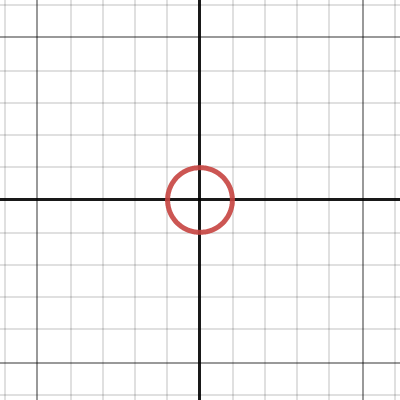
Desmos
as p -> infinity the graph approaches a square
and your norm approaches |(x, y)| = max{|x|, |y|}
here's the cube/sphere example as phrased by lee


try thinking about what it would mean to be in the set C
you can convince yourself that C is a proper cube
heady skiff
queen prism
here's the cube/sphere example as phrased by lee
oh thank you, what page is this on?
heady skiff
queen prism
you can convince yourself that C is a proper cube
yea, i'm seeing C to be the surface of a cube
idk what the terminology is
but with the inside empty
because we required that one of the coordinates has absolute value 1
what does he mean by cubical surface of side 2 centered at the origin tho lol
queen prism
coob has side length 2 and is centered at O
= coob of radius 1
heady skiff
yea makes sense
the cube is empty though right?
or the surface is the only thing filled in
heady skiff
ok
queen prism
but you can probably see how to adapt it to fill in the cube
heady skiff
mmm yea i'll have to think about it
how can i see this, specifically the part that this formula gives the unit vector projected inward in the direction of p
is this something related to basic physics/multivar that i forgot
that dividing by the distance metric or whatever gives a vector or smt
queen prism
take a point x in space
divide it by its length |x|
what do you get
heady skiff
a scaled down version of it closer to the origin right
queen prism
right
and its length is actually 1
which means it's on the unit sphere
the phrasing is a little confusing but what it means is take a point in C
the cube is bigger than the sphere so all this transformation can do is shrink the length of the vector (or leave it unchanged), never stretch
nor does it turn the vector
so that's what it means when we say it projects the point inward to the sphere
heady skiff
oh ok... so the presence of the norm of x in the denominator here is to make sure that it's of distance less than 1 so that it's in the unit ball, right?
 heady skiff
queen prism
the phrasing is a little confusing but what it means is take a point in C
the cu...
heady skiff
queen prism
the phrasing is a little confusing but what it means is take a point in C
the cu...
ahhh okay that makes sense then
!
obtuse meteor
heady skiff
oh ok... so the presence of the norm of x in the denominator here is to make sur...
You need a scalar which ranges from 0 to 1
From the defn of a cube a possible scalar is that maximum
This is really the only thing you need you could fiddle with it a lot
obtuse meteor
obtuse meteor
You need a scalar which ranges from 0 to 1
The reason you need such a scalar is you want to cover all a ray of length 1 in any direction to cover a sphere
heady skiff
i see.... i think i 'm starting to get the idea
i guess i have to digest that it actually works
because rn all i'm seeing is just shrinking to the unit vector then possibly scaling by a real number between 0 and 1, and i'm struggling to see how that actually suffices to cover the unit ball
because rn i'm just thinking about dilating and shrinking.... it's fine tho i can go to OH
like
i can’t see how it can curve to fit the unit ball yknow
narrow cairn
okay so what i've been thinking: say theres a path $1 \rightarrow \alpha$. then there is certainly a path $\alpha \rightarrow \alpha + 1$, and you can just squish and glue together the paths. next suppose that $\kappa$ is a limit ordinal. since it is a countable limit ordinal, it is the limit of a sequence $({\alpha}_n)$. there is a path by the induction hypothesis between each of these, so take $(p_n)$ where each $p_n$ is a path between ${\alpha}n$ and ${\alpha}{n+1}$. take $q_n(x) = p_n(\frac{x}{2^n} + (1 - 2^{k-1}))$, and set each $q_n(1) = \kappa$. then by the gluing lemma there is a path $q$ from $1$ to $\kappa$. therefore by transfinite induction, there is a path from $1$ to all countable ordinals (trivially there is a path to 0) so $\mathscr{L}$ is path-connected.
does this work?
if this does work then this is super cool
ebon galleon
glueing lemma is used how? Also I feel like there is a nice closed form of what the sum^{n-1} 1/2^k looks like
gentle ospreyBOT
most likely to honorable
 ebon galleon
So q_n should be giving a path alpha --> alpha+1 or something? Also, what's the domain of q_n?
narrow cairn
domain of q_n is uh i dont know how to describe it
ebon galleon
Some part of the interval, such that the union is [0,1]?
narrow cairn
yes
ebon galleon
So like maybe you mean for the domain to be like [1-(1/2)^n, 1-(1/2)^{n+1}]?
If so, you can't apply the gluing lemma to this
ebon galleon
Glueing lemma required the cover to be locally finite, so each point has a neighborhood that intersects finitely many of the sets. No neighborhood of 1 satisfies that
ebon galleon
It's okay, I've made that mistake before too lmao
narrow cairn
well im not too worried about the mistake just that 'proof' took all of my brain power
and now i am very lost
i dont think i can modify it to resolve this
ebon galleon
yeah idk how you prove it tbh
narrow cairn
god dammit that was so cool too
i hate topology
ruining my transfinite induction
my book says it doesnt have to be locally finite just either open or finite closed
either way cant apply it here
wait, can you?
maybe
because you might be able to do like (1 - 2^k - eps, 1] which is open and you could maybe do some clever math to find a good eps
man now im totally lost, i felt smart writing that one
is there really not a way to construct a path from countably many component paths?
obtuse meteor
heady skiff
i can’t see how it can curve to fit the unit ball yknow
this is the point of the exercise right like. Corners aren't topological
It might help to make the map animated (i.e. turn it into a deformation retract to be technical).
If you add a time parameter t which specifies how far along the line from 0 to the point on your cube you go to get into the sphere
you essentially "slide" farther in if you're on the outer parts of the cube (outside the sphere).
So that's how you get rid of the corners
ebon galleon
narrow cairn
ruining my transfinite induction
It looks like you might wanna do some order topology shenanigans or something. A similar idea might work? But glueing lemma won't give you the result
narrow cairn
man im really gonna be stuck on this problem for another week arent i
maybe the gluing lemma holds for things like this when the domain is a compact subset of R?
R is nice so maybe it works
ebon galleon
You need the locally finite condition.
Define f : [0,1] --> R by mapping [1 - (1/2)^n, 1 - (1/2)^{n+1}] to the line segment between n and n+1, and then picking any real number to map 1 to. This is a cover of [0,1] for which the restriction to any of the closed sets is continuous, but clearly f is not continuous itself.
*the cover is { [1 - (1/2)^n, 1 - (1/2)^{n+1}]] } U { {1} }
So it's something special to something something ||order iso between omega x [0,1) with the dictionary order and [0,1) itself for countable ordinals omega|| or something? At least that's what it looked like from my skimming
tidal cedar
obtuse meteor
It might help to make the map animated (i.e. turn it into a deformation retract ...
yeah for these sorts of problems I find myself thinking about it as a homotopy
this might not actually be a good way but idk
tawdry widget
heady skiff
i don't understand how they got to this point, shouldn't it be t|y_i|??
This is exactly what I told you. Cube to ball, r-layer of cube (cubic surface whose distance from origin is r, under norm max(|x1|,…,|xn|}) to r-layer of ball (sphere whose distance from origin is r, under norm sqrt(Σxi^2)) , (x1,…,xn) to r(x1,…,xn)/sqrt(Σxi^2)
Therefore together (x1,…,xn) to max(|x1|,…,|xn|)(x1,…,xn)/sqrt(Σxi^2)
 onyx raft
Are people talking about cube homeo sphere?
Just realize both are simply connected surfaces
tawdry widget
Solid cube to solid ball
I told him once each “layer” are homeomorphic so together he will have a homeomorphism. Strange that last time he didn’t go through
hot locust
If X is compact hausdorf sp., then a closed sp. F and a point x not in F can be separated using open sets.
Like, I get that if you can show that there exists, say V, open in X such that F is a proper subset of V, such that V intersection H is empty, where H is a subset of F complement then we are done. But I am stuck.
F is compact, okay, fine. so there's an open set that contains F. But how do I show that the intersection between this open set and H is empty?
narrow cairn
here's a fairly strong hint: ||for every point p in F, take a neighborhood U_p of p and V_p of x that are disjoint (you can do this since X hausdorff). then take the cover of F by all of these sets, and since F compact, take a finite subcover. then you have a collection of neighborhoods U_1, U_2... U_n that cover F and V_1, V_2... V_n with U_n and V_n disjoint. how can you use these to construct the desired neighborhoods?||
hot locust
narrow cairn
here's a fairly strong hint: ||for every point p in F, take a neighborhood U_p o...
oh got it, I think
thanks
hot locust
Example of a T1 space that's not hausdorf?
 quick delta
hot locust
Example of a T1 space that's not hausdorf?
quick delta
hot locust
Example of a T1 space that's not hausdorf?
Cofinite topology on any infinite set
 grave solstice

Can someone help me understand this?
So what I understand: The discrete topology is the topology where the open sets are the subsets of F (the field). Then, given x in F a neighborhood of x is a subset of F containing x. Finally, F will be locally compact with this topology iff for every x in F there exists a neighborhood of x that is (contained in a) compact (subset), meaning that any cover (of the subset) admits a finite subcover.
wouldn't {x} satisfy the requirement already? or just any finite subset containing x? 
opaque scroll
grave solstice
wouldn't {x} satisfy the requirement already? or just any finite subset containi...
Yes, that's right. Any space with the discrete topology is locally compact.
grave solstice
opaque scroll
Yes, that's right. Any space with the discrete topology is locally compact.
how is this useful
like the discrete topology, unless it resembles the p-adic topology or something
opaque scroll
grave solstice
how is this useful
It's not, that's sort of the point
grave solstice
grave solstice
ah ok so when they say "... one adds the condition that the field should not be discrete" they mean that the topology should not be the discrete one
opaque scroll
Like you can equip any field with the discrete topology, and that doesn't give you anything interesting. Therefore they want to study fields that are not discrete
Yeah, they want a more interesting topology
grave solstice
grave solstice
ah ok so when they say "... one adds the condition that the field should not be ...
idk why I interpreted that at first as the field not being finite lol
i c i c
grave solstice

I tried to prove this. This is my idea: For every rational x in [0,1] let H(x) be its denominator written in reduced form, call it the height of x. Define H(0)=1. There are exactly phi(n) numbers of height n in the interval and these can be linearly ordered, say these are H_n^1<H_n^2<...<H_n^phi(n). Now, for even n let S(2n) be the sequence (for 2n) linearly ordered and for odd n let S(2n+1) be this sequence for 2n+1 but with reversed order. Then we have two sequences S(1)S(2)S(3).... and S'(1)S'(2)S'(3)... (note that S'(1) is empty and from that point the sequences are the same) the first enumerating the rational interval [0,1] and the second enumerating the rational interval (0,1), To define the homeomorphism [0,1]_Q-->(0,1)_Q simply pair the two sequences.
This should work right?
mmh not sure, like what you are doing is moving every element in the height sequence defined above two places to the right
I'll think more about it
 queen prism
continuity is a fucking myth
red yoke
There's no way that's continuous
red yoke
grave solstice
What if you do
||(-1, -x)(-x, -x/2)(-x/2, -x/4)…{0}…(x/4, x/2)(x/2, x)(x, 1)
≈
{0}…(x/4, x/2)(x/2, x)(x, 1)||
And repeat
 sturdy notch
I'm slightly confused about a definition/notation involving spectra
If E is a spectrum, then does $E^*(E)$ denote the direct sum $\bigoplus_n E^n(E)$ or does it denote $\bigoplus_n \lim_k E^{n+k}$?
Because the mod p Steenrod algebra is defined as the algebra of stable mod p operations so it can be written as $\mathbb{H}\mathbb{F}_p^*(\mathbb{H}\mathbb{F}_p)$

 sturdy notch
this is using the second notation
heady skiff
tawdry widget
I told him once each “layer” are homeomorphic so together he will have a homeomo...
sorry boss i'm kinda new to this, will work on it tho
in a metric space, the closed sets are the closed balls right?
 amber raven
heady skiff
in a metric space, the closed sets are the closed balls right?
amber raven
heady skiff
in a metric space, the closed sets are the closed balls right?
No they're the sets F so that when a point x of the metric space verifies that all balls of center x cross F, x belongs to F
sturdy notch
gentle osprey
**dadaurs**
I should say that I'm taking an inverse limit over the maps E^n(E) -> E^n(SE) -> E^n-1(E)
limber wren
heady skiff
in a metric space, the closed sets are the closed balls right?
close balls are closed yeah, but that's not all of them. In general an open set is the union of open balls, and a closed set is the complement an open set
heady skiff
limber wren
close balls are closed yeah, but that's not all of them. In general an open set ...
ah ok yea that makes more sense, for some reason i thought that the open sets were exactly the open balls and same with closed sets being closed balls
got it tho
thanks!
here, I set inf${d(a, b) \mid a \in \bar{A}, b \in \bar{B}} = \delta$, and I let $U = \bigcup_{a \in \bar{A}} B(a, \frac{\delta}{2})$, $V = \bigcup_{b \in \bar{B}} B(b, \frac{\delta}{2})$. So $U$ and $V$ here are clearly open and clearly $A \subseteq U$ and $B \subseteq V$. I assumed their intersection was nonempty, so I let $z \in U \cap V$ and obtained $d(a_i, z) < \frac{\delta}{2}$, $d(b_j, z) < \frac{\delta}{2}$, to get $d(a_i, b_j) \leq d(a_i, z) + d(z, b_j) = \delta$ which contradicts our choice of $\delta$. would this argument work?
 gentle ospreyBOT
okeyokay
 heady skiff
obtuse meteor
You can just pull multiplying by t out of the max and then it’s like Blah = |t| ...
heady skiff
obtuse meteor
You can just pull multiplying by t out of the max and then it’s like Blah = |t| ...
i'm not really sure how this rules out |t| = 1, -1, can you expand on this pls?
nvm
i'm an idiot
lol
heady skiff
obtuse meteor
You can just pull multiplying by t out of the max and then it’s like Blah = |t| ...
how tho? how do we know that the maxes are equal?
obtuse meteor
You’re proving it’s injective so you’re assuming f(x) = f(y)
This implies y = tx for some t
heady skiff
mhm
obtuse meteor
Then max(stuff for y) * tx / |tx| = max(stuff for x) * x/|x|
heady skiff
oh
obtuse meteor
And it’s just like manipulations from here
umbral panther
sturdy notch
I'm slightly confused about a definition/notation involving spectra
If E is a sp...
Something with a star always represents the sequence where the star takes on integer values. You can turn a sequence into a single object by taking the direct sum
In particular, E^*E represents the sequence E^nE, which are the homotopy groups of the spectrum of maps from E to E, or, equivalently, the sequence of groups of homotopy classes of maps from S^nE to E
I don’t understand your second possibility I don’t think it makes sense. There is no map from E^nE to E^n+1E. But it may be tricky to define maps of spectra, especially if they aren’t spectra, but just prespectra, and you may need to take a (different) limit. But that’s just to define a single E^nE. You still need all of them
sturdy notch
Yeah Im just a bit confused by wikipedia’s definition of the steenrod algebra
Because it only contains the stable cohomology operations which obviously isnt all of HF_p^*(HF_p)
Im also pretty unfamiliar woth spectra so Im extra confused
umbral panther
An unstable operation is a map of spaces between K(pi,n). Maps between then that are maps of spectra are stable
sturdy notch
Ooh and then it all makes sense ofc
Yeah ofc the maps of spectra are stable and those are precisely represented by the limit
Alright that cleared up a lot, thanks 🙂
umbral panther
Also, H is a spectrum, not a prespectrum, but defining a map of spectra still is an inverse limit. It is a compatible map on all spaces. That is an inverse limit
unreal stratus
heady skiff
here, I set inf$\{d(a, b) \mid a \in \bar{A}, b \in \bar{B}\} = \delta$, and I l...
Nice
There's a fun way to do it like consider f(x) = d(x,A)/(d(x, A) + d(x,B)l
Continuous, preimage of 1 is B, preimage of 0 is A
heady skiff
unreal stratus
Nice
Holy shit I did something right
heady skiff
unreal stratus
There's a fun way to do it like consider f(x) = d(x,A)/(d(x, A) + d(x,B)l
Huh interesting
ebon galleon
unreal stratus
Continuous, preimage of 1 is B, preimage of 0 is A
metric spaces are T_6 frfr
ebon galleon
ebon galleon
Does anyone have an example of a quotient map p: X --> Y with X and Y locally co...
hmm the standard examples for quotient maps not preserved by products is to take X = R, y = something like R/Z, and A = Q, so the map RxQ --> (R/Z)xQ is not a quotient map. But I don't think R/Z is locally compact ( since [Z] has no compact neighborhood ) (where R/Z is with Z contracted to a point)
But I can't cook up any examples
heady skiff
to show that any two open balls in R^n are homeomorphic, it would suffice to first use the taxicab metric to move the center of one ball onto the other center, then scale up the ball right
gritty widget
what does the taxicab metric have to do with just translating a ball?
just translate it
heady skiff
wait i think i'm confused
gritty widget
if you have two points a and b, then the mapping f given by f(x) = x + b - a takes a to b
heady skiff
so i would have to first align them one-dimensionally, then two-dimensionally, etc.?
wait
i think i might be high
oh it would just be $f(x_1, \dots, x_n) = (x + x_1, \dots, x + x_n)$ where $x$ is the center of the ball in question, at least for translation
gentle ospreyBOT
okeyokay
 gritty widget
if you have two points a and b, then the mapping f given by f(x) = x + b - a tak...
gritty widget
gritty widget
if you have two points a and b, then the mapping f given by f(x) = x + b - a tak...
.
heady skiff
wait i'm confused that's only defined in terms of a right
heady skiff
yea but if you plug in something like c you're not gonna get b
gritty widget
okay, but who cares? all you need to do is take a to b
if anything other than a also mapped to b, we wouldn't have a homeomorphism
heady skiff
and here a and b are the centers of the balls right
gritty widget
sure
heady skiff
gritty widget
if you have two points a and b, then the mapping f given by f(x) = x + b - a tak...
so you would have to define this function individually for each point in the ball
sorry i'm confused
bc then how would you define say f(x_1, ..., x_n) if you don't know the point you're mapping it to
for any arbitrary point in the ball
gritty widget
all you asked about in the first place was moving one centre to the other
i urge you to think about what this translation is going to do to the whole ball
let a be the centre of one ball and b the centre of the other. define the map f by f(x) = x + b - a. what does the image of the first ball look like?
draw a picture
the ball with centre a is being translated so that it has the same centre as the other ball. now you can scale
 uneven bronze
Basic question. Given an open ball $B(x,r_1)$ of radius $r_1$ and choose $r_1>r_2>0$. Is the $\textit{closed}$ ball $\bar{B}(x,r_2)$ of radius $r_2$ necessarily contained in $B(x,r_1)$?
gentle ospreyBOT
sunside
 uneven bronze
The question arose from the following; if X is an open set, then for every point in X there exists an open ball B(x,r) of radius r>0 contained in X. I was wondering if by this we also get a closed ball around x with radius s if we choose s small enough.
queen prism
define a closed ball
uneven bronze
queen prism
define a closed ball
Open ball: $B(r,x)={y\in X: d(x,y)<r}$ \
Closed ball: $\bar{B}(r,x)={y\in X: d(x,y)\le r}$.
gentle ospreyBOT
sunside
 queen prism
alright
so let (B(x, r_1)) and (\overline{B}(x, r_2)) be two concentric balls with (r_1 > r_2)
how do you show that the second set is contained in the first set?
gentle ospreyBOT
Bladewood
 queen prism
generally speaking, how do you show that one set is contained in another?
uneven bronze
you show that for every y in \bar{B}(x, r_2), y must also belong to B (x, r_1), right?
i.e. $y\in \bar{B}(x, r_2)\implies y\in B(x, r_1)$
gentle ospreyBOT
sunside
 uneven bronze
yeah, should be no biggie 🙂
if $y\in \bar{B}(x, r_2)$, this means $d(x,y)\leq r_2$, but $r_2<r_1$, so $d(x,y)<r_1$, which implies $y\in B(x,r_1)$
gentle ospreyBOT
sunside
 uneven bronze
So we can say that if a set is open, there is also a closed ball around each point
queen prism
yes
 pliant elk
kind of basic, but I'm having a bit of trouble getting intuition for the proof that homotopy respects composition. If $F_0,F_1:X\to Y$, and $G_0,G_1:Y\to Z$ are homotopic, then taking $H_F,H_G$ as the respective homotopies, you can define $H':X\times [0,1]\to Z$ by $H'(x,t)=H_G(H_F(x,t),t)$. This clearly has $H'(x,0)=H_G(H_F(x,0),0)=H_G(F_0(x),0)=G_0(F_0(x))$, and identically $H'(x,1)=G_1(F_1(x))$, but I'm having issues trying to show it's continuous. Like, how do you take the preimage into $X\times [0,1]$ where $[0,1]$ "appears" twice (you're mapping $X\times [0,1]$ to $Y$, then reattaching $[0,1]$ to map it into $Z$).
gentle ospreyBOT
frog
 ebon galleon
Both $H_F : X \times I \to Y$ and $\pi_I : X \times I \to I$ are continuous, where $I = [0,1]$ and $\pi_I$ is the projection map. Thus, by the universal property of products, $(H_F, \pi_I) : X \times I \to Y \times I$ given by $(H_F, \pi_I)(x, t) = (H_F(x, t), t)$ is continuous. Now compose that with $H_G$.
gentle ospreyBOT
Ryx (Home for flowers)
 heady skiff
why is it that if O is any open set in Y, then f^{-1}(O) = {x} x O is an open set in {x} x Y? is it because {x} is the whole space if we're talking about {x} x Y and O is an open set in Y?
 heady skiff
ok i think that makes sense then
obtuse meteor
X x O is Open in X x Y so (X x O) intersect ({x} x Y) is open in {x} x Y
This is exactly {x} x O
obtuse meteor
heady skiff
yea but if you plug in something like c you're not gonna get b
You’re not trying to map everything to b this would be a bad map.
Pls leverage geometric intuition otherwise topology is pointless
gritty widget
for the love of god okeyokay draw pictures
obtuse meteor
gritty widget
for the love of god okeyokay draw pictures
Begging pleading and on my knees for ugs to draw (good) pictures
ebon galleon
gritty widget
for the love of god okeyokay draw pictures
this might help I wonder why people keep emphasizing to draw pictures
heady skiff
i do draw pictures but i'm not an artist or anything
didn't realize i was taking an art class
damn
gritty widget
moving a circle in a straight line does not require artistic proficiency
heady skiff
idk dude you're kinda overestimating my artistic capabilities
 dusk heron
It is a classic fact that a bijective continuous function $f:X\to Y$ need not have continuous inverse (for, say, $X$ and $Y$ subsets of Euclidean space in general), and also, that if $X=Y=\mathbb{R}$, then $f^{-1}$ \textbf{is} actually necessarily continuous. Are there any simple examples of a continuous bijection $f:X\to Y$, where $X$ and $Y$ are \textbf{open} subsets of some Euclidean spaces, and where $f^{-1}$ is not continuous?
gentle ospreyBOT
gustavn64
 pliant elk
ebon galleon
Both $H_F : X \times I \to Y$ and $\pi_I : X \times I \to I$ are continuous, whe...
pliant elk
ebon galleon
Both $H_F : X \times I \to Y$ and $\pi_I : X \times I \to I$ are continuous, whe...
right, thanks
obtuse meteor
dusk heron
It is a classic fact that a bijective continuous function $f:X\to Y$ need not ha...
Space filling curve
opaque scroll
obtuse meteor
Space filling curve
Space filling curves are usually not bijective though
obtuse meteor
Oh oof I thought you could make them that if you were non compact
obtuse meteor
dusk heron
It is a classic fact that a bijective continuous function $f:X\to Y$ need not ha...
Open annulus and half-open square
With the wrapping function
Eek
I will think more my coffee hasn’t kicked in