#point-set-topology
1 messages · Page 40 of 1
 unreal stratus
unreal stratus
unreal stratus
Oh nice
 hidden crag
slightly different but same idea
unreal stratus
Yes iirc doesn't he like scale the polynomials themselves
Rather than like restrict to a big circle like here
hidden crag
yeah
 tiny ridge
I have a cheeky proof
hidden crag
This is my sign to pick up my copy of may again for a bit after i'm done grading
i got a used version for like 7 euros i think, love it
 undone ridge
that's the one I'm most familiar with
 undone ridge
that's the one I'm most familiar with
undone ridge
undone ridge
that's the one I'm most familiar with
I'm taking a course in galois theory this semester tho and we'll probably prove it again in a different manner
unreal stratus
Oh this is funny because like
undone ridge
undone ridge
that's the one I'm most familiar with
btw theorem 1.7 is that \pi_1(S^1) is isomorphic to \Z
unreal stratus
I did a past paper exam recently for my uni where the notation and even wording was near identical to this
Lol
tiny ridge
Gah, I think my proof requires some extra effort
I was trying to prove it by Atiyah Singer index theorem
 abstract saffron
Bruh
tiny ridge
Let H be the space of all complex valued L^2 functions on the unit circle such that the Fourier coefficients a_n = 0 for all n < 0. For any polynomial p, consider the map T_p : H -> H, f(t) -> p(t) f(t). Then T_p is a Fredholm operator, and if the leading term is z^n, T_{p_t} is a homotopy of Fredholm operators where p_t = z^n + t(lower order terms in p). Index of a Fredholm operator is a homotopy invariant, Index of T_p = Index of T_{z^n} which can be checked by hand to be -n.
unreal stratus
Nice lmao
tiny ridge
But what next?…
Its not finished something has to be said. If p is nonzero, T_p should have zero index
Oh coz its invertible, as 1/p is holomorphic
T_{1/p}

 gritty widget
abstract saffron
gritty widget
abstract saffron
wtf is wrong with your pdf
undone ridge
abstract saffron
why is the formatting like that, is this an old paper/book? Looks like something from the 60s~70s or smth
abstract saffron
I gave up joining everything into one photo
 coral pivot
this is extremely based ibsen.
abstract saffron
This is stupid
abstract saffron
undone ridge
why is the formatting like that, is this an old paper/book? Looks like somethin...
It is from the 60s
coral pivot
abstract saffron
which milnor book is this
abstract saffron
coral pivot
bc if its either char classes or morse theory, its latexed
undone ridge
abstract saffron
It is from the 60s
well that explains it I guess
tiny ridge
coral pivot
this is extremely based ibsen.
thanks 🙇♂️
abstract saffron
coral pivot
which milnor book is this
Topology from the Differentiable Viewpoint
coral pivot
Oh I dont think that ones latexed :(
abstract saffron
It's not really well-known for some reasons, altho it's a hidden gem
abstract saffron
His proof is like, Homotopy theory but in disguise
tiny ridge
homotopos theory
abstract saffron
lmfao
I think this is cleanest proof using topology
Of course, if you point a gun at me, I'll pull the complex analysis way without a doubt, it's shorter and simpler
 thorny agate
I'm having trouble coming up with a map that connects p and q

Say the map is f. My issue is that I know f(0) = p and so we should have f^-1(p) = [0, b) for some b < 1 which isn't an open set.
gritty widget
it's open in [0, 1]
 cosmic socket
Given two line bundles on $\xi, \eta$ on a space $X$. These line bundles are can be thought of pull backs of of the universal bundle $\gamma^1$ via maps $f, g \in [X, \mathbb{C}P^\infty]$. I can consider the composition $X \rightarrow \mathbb{C}P^\infty \times \mathbb{C}P^\infty \rightarrow \mathbb{C}P^\infty$ (where the first map is $(f, g)$ and the second map is given by the multiplication on the H-space structure of $ \mathbb{C}P^\infty$). Now pulling back the universal bundle by this composition I should (I think) get the tensor product $\xi \otimes \eta$. Does anyone know where I can find a proof of this last part? Or a sketch of one if possible.
 gentle ospreyBOT
bigradedSphere
 cosmic socket
I think it is enough to prove it for $X = \mathbb{C}P^\infty$ and the first map to just be the diagonal.
gentle ospreyBOT
bigradedSphere
 cosmic socket
Also unrelated question but does the phrase weakly-complex manifold
mean a finite CW complex that has weak homotopy type of a manifold
or a manifold with weak homotopy type of a complex manifold
oh wait maybe it just mean an almost complex manifold
that would make much more sense
 echo elk
A question. From Wikipedia, boundary operators of a chain complex are also called differentials; this seems to imply that coboundary operators are called codifferentials. This doesn't make sense to me because exterior derivatives (i.e. “differentials”) are the operators of a cochain complex, so that'd make them the codifferentials (the naming is already a red flag). Then there is already the notion of a “codifferential” for a chain complex, so then that “codifferential” is really a differential. I must be misunderstanding something, does anyone have any clarifying insights?


 cosmic socket
I think it’s just nomenclature
I’ve only seen it called differential whether it is cochain complex or not
That is to say coboundary operators are also called differentials
echo elk
Alrighty, I figured. Better to verify than to continue with the possibility of what seemed to be a fundamental misunderstanding. Thanks.
 fresh thunder
Hi
tiny ridge
@cosmic socket This is nearly definitional depending on how you look at it. Given a line bundle L -> X, embed it fiberwise in the trivial vector bundle X x C^n+1 for some large n, then the “fiberwise Gauss map” is the map X -> CP^n. Tensor product of two such line bundles L1 o L2 embeds fiberwise inside C^n+1 o C^m+1 = C^(n+1)(m+1), and the fiberwise Gauss map lands inside CP^(n+1)(m+1)-1. This means that the tensor product L1 o L2 is induced from the Segre embedding CP^n x CP^m -> CP^(n+1)(m+1)-1, which is precisely just “tensor product of two lines”.
Taking a limit as n, m -> infty gives the H-space structure on CP^infty
 coarse night
You can give a product on homology groups similar to cohomolgy for H spaces, is it any useful? I haven't seen much that's why asking
@tiny ridge
tiny ridge
@coarse night For an H-space, the homology becomes a Hopf algebra, in that it admits both a product and a coproduct (which is always the case, induced from the diagonal map X -> X x X and Kunneth). This is extremely useful, see Hatcher Section 3.C
coarse night
hmm okay
tiny ridge
Essentially, the high level of compatibility between the two allows one to compute the algebra from the coalgebra, or vice versa. I think a nice computation along these lines is H_*(\Omega S^n)
Which can incidentally be computed using Morse theory.
coarse night
i see
 urban zinc
wowwww every group is the fundamental group of some 2-dim cw complex that's so COOL
tiny ridge
this is a good one
unreal stratus
Yeah and sorta intuitive construction which is noice
hidden crag
and generalizes
unreal stratus
ofc
Every group, whether abelian or not, is the pi2 of some 2-dim cw complex
/j
tiny ridge
@urban zinc What’s the fundamental group of S^1 x S^3?
unreal stratus
lol
 lean knot
(X, t) is a second countable space, B is a basis for t. Is there always a countable subset C of B, such that C is also a basis for t?
unreal stratus
This is a different question
lean knot
we don't know if B is countable
unreal stratus
But anyway, so like
thorny agate
After some thinking I think the answer is yes but lemme try to type it out on my phone lol
 trail charm
if X is second countable, then every open cover of X has a countable subcover; bases are open covers, but would a countable subcover of a basis be considered a basis?
(not an exercise-like question, genuine question)
coarse night
that would not necessarily be a basis
trail charm
kk that's what i was thinking
coarse night
check if you take the subcover (n, n+2) for n ∈ ℕ then it forms a subcover of the std basis but is not itself a basis
check why
coarse night
urban zinc
wowwww every group is the fundamental group of some 2-dim cw complex that's so C...
There's a another one that says any finite group can be realised as a fund group of a manifold
tiny ridge
shh
tiny ridge
my question is the first step to a proof of this
tiny ridge
the question that everyone eat reacted to 
coarse night

gentle ospreyBOT
Spamakin🎷
 coarse night
help me on this one, section 2.2 problem 9d of hatcher
 quiet thorn
latexing on phone 
thorny agate
It was so bad but I was on couch and didn't want to get laptop
tiny ridge
king shit
thorny agate
Hey, no compilation errors 
Ignore the fact that I used i for many things, uhhh read from context
tiny ridge
coarse night
help me on this one, section 2.2 problem 9d of hatcher
let me crack it open
quiet thorn
 coarse night
feels like those covering space action but not sure about the solution
lean knot
thorny agate
I think this works?
Maybe, I'll check it out latter
tiny ridge
and yes those identifications are done by the covering space action
coarse night
yeah thought about cellular, what I'm getting is Z →Z² → Z with all differentials 0 but not sure if that's correct
tiny ridge
correct
coarse night
did that with cellular
tiny ridge
oh, neat
tiny ridge
its a messed up quotient of the inverse limit of free groups theres a site online that describes awful topological spaces which has the answer
coarse night
 nah I'm good
tiny ridge
probably a sub not a quotient
there can be infinite length words but as long as a letter does not infinitely repeat youre good
coarse night
hmm makes sense actually otherwise image of [0,1] won't be compact
tiny ridge
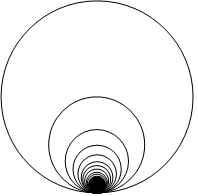
Here is one of my favorite spaces: The earring space, i.e. the “shrinking wedge of circles.” This space is the first step into the world of “wild” topological spaces. This p…
tiny ridge
coarse night
hmm makes sense actually otherwise image of [0,1] won't be compact
exactly
quiet thorn
coarse night
yeah thought about cellular, what I'm getting is Z →Z² → Z with all differential...
how does one get this?
i really cannot picture this quotient space in my head
coarse night
try giving it a CW structure
rather try to see what happens to the CW structure it already has
tiny ridge
heres a hint, if you take S^1 x [0, 1] and quotient the S^1 x {1} end by Z/nZ, thats the mapping cylinder of S^1 -> S^1, z-> z^n
@coarse night how was commalg
urban zinc
tiny ridge
<@531535537362829315> What’s the fundamental group of S^1 x S^3?
 uhh Z?
ayyy
coarse night
tiny ridge
<@468830761261203476> how was commalg
not great
tiny ridge
urban zinc
<:devastation:898725325335298088> uhh Z?
yeah. what about (S^1 x S^3) # (S^1 x S^3)? (# = connect sum)
tiny ridge
coarse night
not great
neither is commalg so its ok
tiny ridge
oh right
right right right this is the modular group of order 16
dummit foote moment
unreal stratus
coarse night
she asked us to compute all galois subext of x⁸-2
lol
Yeah x^n - 2 just seems annoying for large enough n lol
coarse night
it is
tiny ridge
i think i did it for reasons unknown a long time ago but i dont remember why
coarse night
I will never compute those
tiny ridge
probably in my algebraic number theory course
coarse night
you don't just have to compute the group but the normal subgroups as well as their fixed fields

hidden crag
tiny ridge
pfeh
cosmic socket
tiny ridge
<@749044385349632062> This is nearly definitional depending on how you look at i...
I don’t understand how you know the gauss map will agree with the segre embedding.
tiny ridge
just definitions, the line fiber of L1 o L2 sitting over a point in X is tensor product of the line fibers of L1 and L2
the Segre embedding just sends a pair of lines to the tensor product of the lines
tiny ridge
in the spirit of italian and russian mathematicians
no classifying space, no mixed motives, no deligne mumford stacks
only projective geometry
cosmic socket
Yea I guess now how do you know the segre embedding agrees with the H space structure induced by the functoriality of classifying space
tiny ridge

cosmic socket
So are you a hater of higher algebra
cosmic socket
cosmic socket
Yea I guess now how do you know the segre embedding agrees with the H space stru...
Actually this shouldn’t be too hard I think you can show the h space structure on CP^infty is unique
tiny ridge
cosmic socket
So are you a hater of higher algebra
not necessarily, i think of an A_oo algebra in the spirit of Sullivan, just the loopspace
and also Peter May
cosmic socket
I don’t know much higher algebra but Vezzosi (in the sense of Toën and Vezzosi) is Italian. So you must like derived algebraic geometry right
tiny ridge
by italians i mean the old italian algebraic geometers
Segre, Veronese, Enriques, Cremona, Castelnuovo, …
cosmic socket
I’m curious what area of math you work on?
lean knot
X is complete metric space, O is an open subset of X, x is in O, a complete metric group G acts continuously on X. Are there an open neighborhood of 1_G, U, and an open neighborhood of x, P, s.t. U⋅P ⊆ O and for any y ∉ O, U⋅y ∩ P = ∅?
tiny ridge
cosmic socket
I’m curious what area of math you work on?
broadly, geometric topology. so far my work has been more algebraic than geometric, but i am planning to change this :p
but topology, all in all
urban zinc
tiny ridge
yeah. what about (S^1 x S^3) # (S^1 x S^3)? (# = connect sum)
Z*Z? no idea
tiny ridge
urban zinc
Z*Z? no idea
That is correct!
So the connect sum of n copies of S^1 x S^3 has fundamental group the free group on n generators, yes?
 rough cedar
urban zinc
rough cedar
urban zinc
ayyyy
urban zinc
tiny ridge
So the connect sum of n copies of S^1 x S^3 has fundamental group the free group...
That makes sense
The S^3 here is redundant right?
Like the connected sum of n copies of S^1 also has fundamental group the free group on n generators?
tiny ridge
Connect sum of two circles is a circle. Oops.
tiny ridge
Wedge is absolutely right. The S^3 allows you to treat the connect sum as a thickened wedge, Thickened by a sphere of sufficiently high dimension (eg S^2 will also work) so that it doesn’t affect the fundamental group.
urban zinc
ahhh I get it
tiny ridge
Now, I want to think like you’re thinking. #^n (S^1 x S^3) is like a thickened wedge of n circles, fundamental group is F_n. Suppose I have a group with n generators, and some finitely many relations.
I want to do the Cayley complex stuff but with the thick version
urban zinc
👀
tiny ridge
Suppose you have some relation, r = 1, where r is a word on the generators. This is homotopy class of some loop in #^n(S^1 x S^3)
Pick a loop from this homotopy class. This can be an absolutely terrible, space filling loop. But homotopy it so that its a nice, smooth or even piecewiselinear loop.
It may self intersect at a bunch of points, but I claim you can remove all the self intersections and make it an embedded loop (Jordan loop) by a homotopy also. Why?
thorny agate

Not sure how to do this
I was trying contradiction since I know that X \ U is closed and so compact but that got me nowhere
Can I maybe do cases?
case 1: one of the C_alpha is empty, so then this is immediate
otherwise case 2: they are all non-empty so in particular finite intersections are non empty and we have the finite intersection property, so C is non empty
idk what that could get me though
 nimble portal
What is an inclusion map?
Can someone also remind me what an embedding/embedding map is?
 novel acorn
nimble portal
Can someone also remind me what an embedding/embedding map is?
novel acorn
nimble portal
Can someone also remind me what an embedding/embedding map is?
injective continuous map
if you're working in diff geo continuity is probably replaced by smoothness
novel acorn
nimble portal
What is an inclusion map?
it's a map that includes a subspace of some larger space into that larger spaces
so like
take the unit ball and R^2
nimble portal
Nah Lee says assume continuity at most
novel acorn
then there's an inclusion map of S^1 -> R^2
nimble portal
Hes
Yes
I understand
But like
How does the function act on the subspace?
Is it just the identity map
From the subspace to the larger space
LOL
novel acorn
nimble portal
Is it just the identity map
yes
nimble portal
Icic
And an embedding?
Inclusion map sounds like what I’d think of as “embedding” intuitively
but I think it could be more general than that
unreal stratus
An embedding is a homeomorphism onto its image yeah
So like you can factor an embedding as a homeomorphism followed by an inclusion anyway so yeah
nimble portal
Ayaya
urban zinc
tiny ridge
It may self intersect at a bunch of points, but I claim you can remove all the s...
Okay I'm stuck here, I have no idea
tiny ridge
urban zinc
Okay I'm stuck here, I have no idea
Suppose you have a very nice smooth loop in R^3, which is like a figure 8 contained in the xy plane
How do you homotope this 8 to be not self intersecting?
(Hint: This would not be possible within R^2)
urban zinc
could you move the one strand up in the z direction and the other strand down
urban zinc
ahhh
how do you prove you can always do that
like what if there are a bunch of self intersections really close together
tiny ridge
If there are finitely many such intersections, and each of them look like an X, you can always zoom into one of them, and move one of the strands of X up in the extra dimension
And since you can do it in R^3, certainly you can do it in R^4 as well!
The loop we started off with was piecewise linear (we ensured this after a homotopy, but I didn’t tell you why. The reason is the simplicial approximation theorem, but let us blackbox this), so convince yourself that all the intersections necessarily look like such.
coarse night
that makes wonder which groups cannot be realised as fund groups of a 3manifold. Is there an obstruction measuring this?
(assuming finitely presented)
tiny ridge
These things are all understood after geometrization
Finite 3-manifold groups are discrete subgroups of O(4)
coarse night
I can kinda see how go from discrete subgroup to 3-mani
maybe not
just quotient right?
tiny ridge
That may have fixed points, not all such groups work I think.
But, say, its a discrete subgroup of SU(2). Then quotient works.
coarse night
finite discrete?
tiny ridge
Discrete subgroup of a compact group is necessarily finite
I’m saying if you pick a finite subgroup of O(4), that may not act freely on S^3.
tiny ridge
Uh, no. Central would mean abelian. In fact center of O(4) is Z/2
O(4) has tons of nonabelian discrete subgroups
coarse night
okay I misremembered something
coarse night
T²×R? although that's not compact
tiny ridge
Compact 3-manifolds, certainly
coarse night
how hard is it to prove it for Z²?
gritty widget
1 and 3...
tiny ridge
Uhm
Suppose M is a 3-manifold with fundamental group Z^2. Pass to the universal cover, thats simply connected. So \pi_2 = H_2 by Hurewicz. I claim that this has to be zero
If its not then there’s a non-nullhomotopic sphere. Push this sphere down to M, its still non-nullhomotopic (else youd be able to lift the nullhomotopy upstairs)
Now by some standard rigamarole this means that the sphere is separating ie if you cut along it the manifold splits into two, ie M is a connect sum of two manifolds M1 # M2 where neither M1 nor M2 is a sphere (theres some casework but lets ignore it)
That would means the fundamental group is a nontrivial free product by van Kampen which Z^2 is not
So \pi_2 = H_2 = 0
The universal cover is noncompact, so \pi_3 = H_3 = 0 by noncompact Poincare duality
All the higher homologies vanish by cellular homology because youre in dimension 3 hence so do the higher homotopies
This means that the universal cover has all homotopy groups zero so its contractible by Whitehead
So M is a K(Z^2, 1) space, so its homotopy equivalent to a torus T^2
But M is a compact 3-manifold! H_3(M; Z/2) = Z/2!
Contradiction
coarse night
oh wow that's a really nice argument 
tiny ridge
tiny ridge
Now by some standard rigamarole this means that the sphere is separating ie if y...
This is where the hard stuff is hidden
coarse night
yeah I realised
tiny ridge
You need the Papakyriakapoulos sphere theorem
gritty widget
did you spell that from memory
coarse night
thought about asking but I guess I need more machinary
tiny ridge
gritty widget
did you spell that from memory
yes lol
novel acorn
gritty widget
did you spell that from memory
Ibsen is a crazy russian don't forget
Who knows the vastness of knowledge that is in his head
tiny ridge
morally, morally
novel acorn
He always calls himself a russian style mathematician so that's what I know him by lmao
gritty widget
someone was touched by that arnold rant
gritty widget
novel acorn
(I didn't know someone ranted abt arnold lmao)
novel acorn
arnold was russian what
I didn't know that I thought he was french for some reason???
tiny ridge
wtf lmao
novel acorn
His name is spelled like Arnol'd and I thought damn that looks french
gritty widget
the ' is supposed to be the soft sign in russian
the tiny little b thing i don't have it on my keyboard
coarse night
you have any reference for papyakfjwokpolos sphere?
coarse night
lol okay
novel acorn
Ibsen are you by any chance a hatcher fan
tiny ridge
chapter 3
tiny ridge
novel acorn
Ibsen are you by any chance a hatcher fan
Sherlock Holmes here has my number
tiny ridge
i think its good for geometric topologists
not everyone is a geometric topologist, which is fine
novel acorn
tiny ridge
https://pi.math.cornell.edu/~hatcher/3M/3M.pdf
Also I have to say that this is a long proof wow
coarse night
60 is manageable lol
novel acorn
coarse night
60 is manageable lol
the proof is the last 7-8 pages if I read it clearly
coarse night
I think he's setting up the basis
tiny ridge
novel acorn
Also I have to say that this is a long proof wow
Papa’s theorem is an old one but a hard one. There were no correct proofs of the theorem until 50 years of its announcement by Dehn (along with a wrong proof)
coarse night
I'll have a look after 6th
novel acorn
Thankfully it's not as long as the proof of the main theorem of Iwasawa theory that's like a solid 20 pages lol
Gonna learn Iwasawa theory over the summer can't wait
tiny ridge
coarse night
I'll have a look after 6th
dont read too much about 3-manifolds though
dead field kek
im just repeating what my advisor told me when i wanted to learn this stuff
3-manifold topology has become geometric group theory now
and i couldnt be bothered to learn more about gRoNps
 fading vale
tiny ridge
3-manifold topology has become geometric group theory now
fading vale
tiny ridge
3-manifold topology has become geometric group theory now
thanks to HF its also become combinatorics! 
fading vale
So true
i would like to one day be able to feel on a moral level the n - m dimensional topology slogan
tiny ridge
theres 2+1 which is Thurston style hyperbolic geometry (and ggt grrrrr), and theres 4-1 which is using 4d invariants on nullcobordisms to spit out info about 3
tiny ridge
nuclear take
coral pivot
biggest open problem in GGT? there are many answer
all of them are wrong
the correct answer is
novel acorn
gritty widget
https://www.math.fsu.edu/~wxm/Arnold.htm
Mentally challenged zealots of "abstract mathematics"
coral pivot
is vN(Fn) iso to vN(Fm)
novel acorn
this rant is nuts
tiny ridge
what is vN(G)
coral pivot
the von nuemann algebra of G, for a discrete G it is simple enough to explain
tiny ridge
thats sufficient
coral pivot
take the representation G-> B(L^2(G)) the left regular representation
novel acorn
It seems to me that a reasonable explanation was given by I.G. Petrovskii, who taught me in 1966: genuine mathematicians do not gang up, but the weak need gangs in order to survive. They can unite on various grounds (it could be super-abstractness, anti-Semitism or "applied and industrial" problems)
coral pivot
this extends to a *-homomorphism L^1(G) -> B(L^2(G)) (L^1 with convolution product), look at the image and take the strong operator closure
(strong operator topology is the topology of pointwise convergence, i.e A_lambda ->A in SOT iff A_lambda x -> Ax for all x\in L^2(G))
tiny ridge
the image is vN?
coral pivot
the strong operator closure of it
coral pivot
yeah its surprising how much ggt and von nuemann interacts
basically von nuemann algebras are a good way to study certain groups and the groups ggt care about happen to fall into that
so one way to study these groups is the fourier algebra, which is the predual of vN(G), which is known to be rigid. But we want to know when is vN rigid, and the problem i stated is p much one of the biggest open problems in von nuemann algebras
we know for every amenable group for example, the have the same von nuemann algebra
tiny ridge
this feels reminiscent of one of many ways to construct boundaries of groups in ggt but everything is too operatorized so im having trouble orienting myself
coral pivot
ends? yeah idk how they connect I need to learn more ggt oof
tiny ridge
something like ends yeah
tiny ridge
coral pivot
we know for every amenable group for example, the have the same von nuemann alge...
curious
they’re also all one ended
coral pivot
oh interesting
coral pivot
all abelian groups are amenable btw
tiny ridge
yeah
end is a flippy notion, theres this thing called a poisson boundary
a countable group is amenable iff there is a symmetric random walk law with trivial poisson boundary
coral pivot
(oh btw not all amenable i mispoke, its all amenable that have each non trivial conjugacy class infinite, these are called ICC groups and von nuemann algebraist care bc this means vN(G) has trivial center, i.e is a type ii_1 factor!)
oh interesting
tiny ridge
maybe i can define one of the boundaries to illustrate my point regarding this similarity
let me recall from past life
@coral pivot ok
Say G is a countable group, pick a set S of generators and P be a probability measure on S. Run a random walk on G using P, by picking generators at random using P and concatenating one after the other, which generates a walk on the Cayley graph of G
coral pivot
right
tiny ridge
For any two points x, y in G compute K(x, y), the expected number of time the random walk starting at x returns to y
coral pivot
hmm is there a reason this would not just be infinite
unless you meant how many steps to y
rather than how many times x returns to y oof
tiny ridge
it would be if your graph is recurrent for example
but in Z^3 already it is finite
the random walk is transient
coral pivot
oh interesting
tiny ridge
it just escapes to infinity
coral pivot
i see
tiny ridge
Choose some basepoint o, then look at the map G -> C^0(G), y -> K(-, y)/K(o, y)
put the pointwise convergence topology on C^0(G) and take the closure of the image
cl(G) \ G is called the Martin boundary
coral pivot
interesting, yeah i see some similarities
tiny ridge
tiny ridge
a countable group is amenable iff there is a symmetric random walk law with triv...
this is true for the Martin boundary as well (Poisson boundary is just Martin boundary with a natural measure I think)
for hyperbolic groups the Martin boundary becomes the Gromov boundary, which is closer to the notion of ends (eg for F_n it is exactly the space of ends, the Cantor set)
do you know what a hyperbolic group is
tiny ridge
oh lol
coral pivot
lol
tiny ridge
ill tell you what a gromov boundary is tho
coral pivot
yeah sure
tiny ridge
let G be a gromov hyperbolic group, o be a basepoint. look at all geodesic rays in the Cayley graph of G starting at o
call two geodesics equivalent if uh
if theyre at bounded distance from each other
tiny ridge
definitely interestingly distinct geodesics do that
thats why were identifying the unimportant ones
coral pivot
i see
tiny ridge
heres a dumb example
take F_2
look at the ray aaaaaaaaaaaaaaaa
um
ok yeah then look at the ray which is the same thing but lags behind in time 1
coral pivot
oh yeah i see
tiny ridge
yeah so the gromov boundary is all rays modulo equivalent rays
coral pivot
i see
tiny ridge
the topology is a bit more convoluted but basically imagine two points p, q in the gromov boundary and two geodesics joining o to these points at infinity
if these stay close together for a long time, you say p and q are close
coral pivot
I see, so something like how long they were close is the metric ig?
tiny ridge
thatd make nearby points have a very large distance so you have to do e^{-how long they were close}
tiny ridge
no yeah thats the most natural thing, i get it flipped also
its like the p-adic metric
coral pivot
right
tiny ridge
delta slimness basically guarantees this is a meaningful notion because the triangle joining o, p, q will be delta slim (two vertices of this triangle are at infinity but you get my drift)
which means the geodesics do tend to stay kind of close, just the measure of closeness is the metric
coral pivot
right that makes sense visually
tiny ridge
and yeah bobs your uncle
the Gromov boundary of F_2 is a Cantor set, of a surface fundamental group is a circle, …
its invariant under quasi isometries etc etc
tiny ridge
Cantor set
coral pivot
i see, so this is probably not something that can distinguish the von nuemann algs oof
tiny ridge
probably not
lol its open if a hyperbolic group with Gromov boundary S^2 is a 3-manifold group or not
false for all other dimensions
nuts
i mean no what it means is its probably false and no one has come up with a nutcase enough example
coral pivot
interesting
tiny ridge
gronps
coral pivot
maybe the solution is to look at a correct von Nuemann algebra 👁️
probably not von nuemann doesnt capture stuff like smooth structure well oof
tiny ridge
maybe! the only thing worse than a gronp is a C* algebra
so you expect the latter to solve a problem about the former
coral pivot
lol i see
(btw @bitter smelt you might find the above convo interesting, still trying to turn you over to the dark side lol!)
coral pivot
ggt
tiny ridge
 bitter smelt
Yeah, I used to do a lot of ggt! But sadly not to many people here are into it so I've gradually shifted over to alg/diff top. I might try to hit up Chifan though, I should read more about von Neumann algebra
fading vale
i thought mig also did symplectic and contact stuff
bitter smelt
Sniped :)
Yeah very recently I've been into contact stuff, knot theory and whatknot
tiny ridge
oh fantastic
bitter smelt
Floer homologies etc. I plan to hammer down on something specific this semester though. My net is too wide 😅
tiny ridge
ive been thinking about symplectic/contact a lot since last year
fading vale
what sort of stuff r u into ibsen
tiny ridge
everyone here does ggt
bitter smelt
It's a trendy topic with lots of low hanging fruit I feel
Contact/symplectic that is
Well maybe less on the symplectic side. Geometry is frightening.
tiny ridge
fading vale
what sort of stuff r u into ibsen
my research dances around h principles, which is a way to attack geometric problems using softer tools from topology
tiny ridge
bitter smelt
Well maybe less on the symplectic side. Geometry is frightening.
yeah lol looking for more problems on the contact side
id like to say that yeah
fading vale
tiny ridge
my research dances around h principles, which is a way to attack geometric probl...
oh this is cool stuff
bitter smelt
Oh wow you really were the person to ask about the h principle resources then huh!!
bitter smelt
It's not a bad idea, could also just start with a thread here to gauge interest
fading vale
i think just threads or posting here is better cause the offshoot discords tend to get very inactive
tiny ridge
yeah agreed
bitter smelt
Anyway I am going to go be social at this conference, thanks for the rec @coral pivot, I'll take a look later
fading vale
god i gotta learn more complex AG
tiny ridge
bye migilonomy
fading vale
bye bye mig  have fun at your conference
fading vale
hi john!
fading vale
coral pivot
what are you upto these days
symplectic geo and related things
coral pivot
i see
fading vale
recovering emotionally from finishing hartshorne II 
coral pivot
lol
tiny ridge
that sounds painful
fading vale
my joker moment was when one of the exercises in II.7 was unsolvable because he did the entire theory of weil divisors with like one extra assumption that didnt hold in the problem statement and i spent ages agonizing over it only to discover i wasted my time and it was fine
shoulda just read EGA man
coral pivot
I got talked into doing a project on langlands connection to QFT for a QM class, so thats how my days are going these days lol
coral pivot
yes except when you realize this is way above your paygrade 😭

arXiv.org
These lecture notes give an overview of recent results in geometric Langlands
correspondence which may yield applications to quantum field theory. We start
with a motivated introduction to the Langlands Program, including its geometric
reformulation, addressed primarily to physicists. I tried to make it as
self-contained as possible, requiring v...
what we are reading 
coral pivot
yep
fading vale
very nice
tiny ridge
doesnt witten have a 200 page paper where he “proved” langlands lol
fading vale
damn i remember when u were in hs
coral pivot
haha right, and I remember when u were a first yr in hs i think!
coral pivot
wouldnt put it past him ibsen lol
yeah indeed
remember how i used to hate analysis in hs
now I am analyst lol
fading vale
character growth
surely if i take 3 analysis classes in a row starting next fall i will like it by the end 🙂
coral pivot
yes
I can operator pill you too then!
although I dont know anyone at your school who does operator algs i dont think
tiny ridge
i think i finally understand how to grow mushrooms
 cedar pebble
coral pivot
https://arxiv.org/abs/hep-th/0512172
cedar pebble
coral pivot
https://arxiv.org/abs/hep-th/0512172
the ramping up in difficulty between parts I, II, and III is insane

 tiny ridge
Phase portraits are great
unreal stratus
Yeah good fun too lol
Like nice doing lil things about each point and then it being clear how stuff glues together
Yummy
tiny ridge
Now I just need to do the above but with three rows of mushrooms

💀
(Each row of mushrooms blocks one third of the flow, I want to block everything)
urban zinc
how do you "extract from this a countable subcover"? I get the rest of the problem, but this one step is tripping me up
 nimble portal
Something tells me you’ll want to cover M similar to the cover used in the proof for the fundamental group being countable
 sweet wing
coral pivot
remember how i used to hate analysis in hs
sweet wing
coral pivot
remember how i used to hate analysis in hs
same
sweet wing
tiny ridge
doesnt witten have a 200 page paper where he “proved” langlands lol
iirc there was some conjectured extension of langlands duality from some funny string duality??? idk man
tiny ridge
sounds believable lol
sweet wing
some equiv of categories of branes or some black magic im not qualified to understand
sweet wing
what ever the fuck this is
 sweet wing
oh ya it is jus S duality memeing the middle one is supposedly stronger than langlands

im partially unconvinced by the physical arguments but ok physics goes brrr
tiny ridge
yeah idk where they get this stuff
the version of mirror symmetry i care about seems shockingly legit
sweet wing
tiny ridge
the version of mirror symmetry i care about seems shockingly legit
tbh yea string theory actually producing good results wtf
iirc there are quite a few areas where its conjectures have been proven correct
would be nice to someday formalize the lolimaginephysics arguments tho 
it's like back when physicists with their electromagnetism and newton laws and predicting motions while cauchy figuring how to define convergence
tiny ridge
its so much worse though because at least some guy would fiddle around with the magnets and prove it works
nowadays the explanation is typically that particles in CERN just vanish in one of the 11 complex dimensions
also its damn funny that originally mirror symmetry was conjectured for calabi yau manifolds but nobody on gods green earth knows if there are infinitely many of these
good thing Kontsevich came along and extended the conjecture for a much larger class
russians, once again
sweet wing
tiny ridge
its so much worse though because at least some guy would fiddle around with the ...
tbf i feel like there are 2 groups of string theorists these days
those who still firmly believe they have an accurate model of reality and publish copium and
those that just use it as a cute toy model for a hypothetical universe and study it to get these mathematical results
tiny ridge
lol yeah accurate.
sweet wing
i dont think it's bad to study what if we try to quantize n-dimensional particles, it is definitely a cute toy
tiny ridge
i dont mind 2
tiny ridge
yes lol
sweet wing
then theres also those people in the second group who can publish insane "results"(conjectures) with minimal equations (see literally any of wittens papers it's purely physical arguments) and those that bash out all the math in hopes of something lulz
tiny ridge
i feel like without actual experiments they eventually run out of their stupid path integral bag of tricks
cuz none of it makes any sense
sweet wing
at some point i think witten is just trolling us
his intuit is so good he doesnt need to bash the math to know it is true and us noobs need to wack through all the math fucking polchinski
sweet wing
tiny ridge
i feel like without actual experiments they eventually run out of their stupid p...
it's insane how many conjectures comes from jus considering path integrals tho
tiny ridge
his papers have barely any justification, he spams a shitload of words and quotes atiyah
sweet wing
you know thinking about it
the expression \int e^{t<thing>}
does appear a lot in math
and changing the <thing> gives you a lot
could say use <thing> = sqrt(eigenvalues of laplacian) and you get a lot of information out of nowhere
maybe physicists were onto something
tiny ridge
this is pretty much supersymmetry yeah?
sweet wing
it appears in normal stat mech too
tiny ridge
index of the dirac operator is integral that thing with t -> 0 (infrared limit), and the right hand side of APS for t -> oo (UV limit)
sweet wing
if your energy levels sre Ei, your partition function is sum_i e^Ei/T where T is temperature(normalized)
tiny ridge
yeah hannah pointed out this thing a while back
sweet wing
then for some fuck reason it gives you everything you want
path integrals are kinda continuous variants of it
tiny ridge
i mostly think of gaussians when i think of this, the statmech connection didnt click
sweet wing
maybe if all the stat mech people didnt suicide we would have a better understanding /j
tiny ridge
rofl
fading vale
tiny ridge
the version of mirror symmetry i care about seems shockingly legit
HMS is so cool
tiny ridge
some people are working on lattice gauge theory in the hopes of making some sense of e^-iSt
i dont know if theyre successful
the results look hideous
fading vale
like it feels like an area i can very easily see myself ending up just in terms of how much all the stuff i think is neat interplays there
sweet wing
some (more legit) application of these path integrals appears when S is a finite sum
tiny ridge
fading vale
HMS is so cool
i think if you get into it you should be careful about which version you want to get into
sweet wing
i heard witten did some black magic there i need to dig up my notes when i tried to study a bit of string theory LOL
tiny ridge
you know Lefschetz tried to make sense of path integrals
fading vale
wdym by version
tiny ridge
i was reading an old book of his where he formulates a mathematical version
sweet wing
oo
tiny ridge
fading vale
wdym by version
what do you think of when you typically think of hms?
fading vale
an equivalence between the derived category of coherent sheaves and the derived fukaya category on some pair of calabi yau manifolds
tiny ridge
yeah this is awful
fading vale
tiny ridge
nobody knows if there are finitely many calabi yau manifolds
pointless fucking conjecture
sweet wing
you know whats the most ridiculous thing ive seen so far
tiny ridge
slightly better is the landau ginzberg version, with a superpotential.
that is a correspondence between the fukaya seidel category and coherent sheaves
sweet wing
"we have 3 generations of fermions and bosons, hence the euler characteristic of the compactified calabi yau is 6 or -6"
how the fuck
but ok im not gonna ask
tiny ridge
works for toric, toric degenerations eg fano, certain del pezzo surfaces, …
and more
i like the one with weinstein manifolds, formulated by Kontsevich
fading vale
i see
for context i know nothing about the details of any of this stuff i just think it seems conceptually very neat lmao
tiny ridge
sweet wing
"we have 3 generations of fermions and bosons, hence the euler characteristic of...
lmao
fading vale
also hi ari been a while
sweet wing
you know whats the greatest thing
theres no reason to use calabi yau nothing i see suggests a complex structure even but physicist just see it and wow it fits the condition of ricci flat plop
sweet wing
fading vale
also hi ari been a while <:nozoomi:651816986837254148>
henroooooo
tiny ridge
yeah exactly i think they should not bother with much of this highly symmetric junk
sweet wing
reading polchinski vol 2 is like a fever dream
tiny ridge
someone should just formulate string theory for almost Kahler guys. worldsheets are just pseudoholomorphic curves
sweet wing
polchinski vol 1 is passable
tiny ridge
lets go
sweet wing
tiny ridge
someone should just formulate string theory for almost Kahler guys. worldsheets ...
honestly id bet it would work out considering how flexible it is
tiny ridge
lol my roommate struggled with this for a long time and eventually gave up
fading vale
i dont really care about the physical motivation ngl
sweet wing
tiny ridge
sweet wing
honestly id bet it would work out considering how flexible it is
exactly my thoughts
@fading vale I’ll just tell you about the Weinstein version of HMS, its super natural. Take the cotangent bundle of any manifold T*Q, this has a symplectic form sum_i dq_i wedge dp_i where q is position (coordinates on Q) and p is momentum (coordinates on cotangent fibers).
fading vale
mhm
tiny ridge
Screw the Fukaya category, lets just think about its object. These are Lagrangians in T*Q. What are some natural examples? Graph of exact 1-forms df, treated as a section of T^starQ, yes?
tiny ridge
In general a Lagrangian will just be a multigraph over Q, locally still of the form df
fading vale
Multigraph?
tiny ridge
Think of multi-valued functions, no reason a Lagrangian will map homeomorphically back to the zero section under the bundle projection
fading vale
Ah
tiny ridge
But locally it is nevertheless df
fading vale
Yes
tiny ridge
Extend the class a little bit and allow conical Lagrangians. What are these now? Well think T*R which is R^2 and consider union of the y-axis and the x-axis
The axes are Lagrangian subspaces
The union is a singular gadget but it deserves to be called a singular Lagrangian
fading vale
sure
tiny ridge
Conical means invariant under the scaling (q, p) -> (q, cp), c > 0
Intuitively, if you know some contact geometry, this means the Lagrangian is cone of some Legendrian object in the unit cotangent bundle (which is a contact manifold with contact form pdq)
Anyway so these are my objects. Make your Fukaya category using these by running the machine, lets call it Fuk(T^*M)
fading vale
tiny ridge
Conical means invariant under the scaling (q, p) -> (q, cp), c > 0
are you saying take subsets of this form?
tiny ridge
On the other hand, consider the manifold M that it is a cotangent bundle of and consider constructible sheaves over M. This just means that you have a sheaf s.t. there is some stratification of M for which the sheaf restricts to constant sheaves on each stratum
Given such a sheaf, you can look at the support, closure of the set of points where the stalk is nonzero.
fading vale
right
tiny ridge
There is a steroids version of support, called microsupport. It is given by the set (x, p) of codirections such that you cannot “parallel transport” the the stalk F_x in the codirection given by p, ie sections do not propagate in the direction given by p
Intuitively this just means that if you draw a little ball B around x, the map F(B) -> F(B \cap {p < 0}) is not an isomorphism
But not quite, you should take derived functors and ask the same thing for cohomology ie H^i(B; F) -> H^i(B \cap {p < 0}; F) is not an isomorphism. its ok
Theorem (Kashiwara): the microsupport of a constructible sheaf is a singular Lagrangian
fading vale

tiny ridge
Beefed up version by Nadler-Zaslow: microsupport gives a dg equivalence DSh(M) -> DFuk(T*M)
This is mirror symmetry for the cotangent bundle
fading vale
tiny ridge
This has a bunch of “real life” impact. Not the theorem per se, but philosophically it says whatever symplectic geometry you can do in T*M with all your pseudoholomorphic crank can be done just by sheaf theory
This has been used to great effect by Kashiwara-Schapira-Guillermou. For example, the Gromov nonsqueezing theorem can be proved just by sheaf theory
Shende-Zaslow-Truemann-Ng-Rutherford has interpreted invariants like Legendrian contact homology from sheaf theory
These are pretty concrete phenomena. The Nadler-Zaslow theorem is not as important as these IMO
Its just the banner of the story
fading vale
wait this is extremely neat
tiny ridge
The conjectural extension to Weinstein manifolds (I am not sure if you know what these are so I will avoid details) is based on the fact that these are symplectic manifolds which conjecturally walks and quacks like the cotangent bundle. They can be thought of as cotangent bundles to some singular Lagrangians inside them
Conjecturally, at least
fading vale
do you think you could use this to recast some of the pseudoholomorphic stuff in T^*M in terms of microlocal analysis on M
disclaimer i know 0 microlocal analysis
but it would be neat
tiny ridge
a great deal can be and has been done but I am not sure the extent of this.
fading vale
tiny ridge
its a bit bizarre that the two sides are related at all and imo one should unpack the nadler zaslow proof to see whats exactly going on
a lot of mirror symmetry proofs are just bashing out the two categories on either side and show they’re equivalent
it doesnt explain much
fading vale
tiny ridge
This has been used to great effect by Kashiwara-Schapira-Guillermou. For example...
this is very pretty to me in particular
tiny ridge
its shocking yeah
fading vale
tiny ridge
a lot of mirror symmetry proofs are just bashing out the two categories on eithe...
yeah this does sound maybe less ideal
like being able to actually translate the problems from one language to the other is sort of more of what i was vaguely hoping on a conceptual level for the relationship between the theories
tiny ridge
but the sheaf theorists write awfully. after grappling with this stuff for a couple of months im convinced you can do away with a lot of generality Kashiwara et al works in
tiny ridge
fading vale
like being able to actually translate the problems from one language to the othe...
the conceptual is mostly lost in most proofs of mirror symmetry in test cases unfortunately
the idea of microsupport was conceptual breakthrough
and i feel like most people do not appreciate it enough because they read pages of six functor formalism
fading vale
i see
thank u for telling me about this this is neat stuff
on the list of things to read for sure

 tiny ridge
i suppose but maybe homotopy theorists disagree
nimble portal
I asked because of fundamental group stuff
 languid patrol
Fundamental groups are definitely algebraic topology
nimble portal
Yes
But is homotopy theory in general alg top
Ig that’s a silly question
Lmao
Can be used in a lot more places than just for algebra
languid patrol
What are you thinking of when you say “homotopy theory?” I guess the answer is either obviously yes or yes depending on what you’re thinking of
languid patrol
Anyway homotopy theory has wide reaching impacts which have stretched to algebra, category theory, algebraic geometry, etc.
nimble portal
abt any cool use of paths at least
What else is in alg top? All I know is fundamental groups and homology
Is stuff about chains algebraic topology?
tiny ridge
yes
nimble portal
Would you call the study of Lee groups algebraic topology?
Idek what “the study of Lie groups” means
tiny ridge
not particularly
nimble portal
mfw I wrote Lee instead of Lie
languid patrol
Lee groups are when you study Lie groups but only from Lee
tiny ridge
algebraic topology could be useful studying Lie groups
nimble portal
My cat just bit my lip
She loves biting my nose and sometimes she catches my lip bc I try to kiss her but stay out of nose-getting-bitten range
tiny ridge
maybe your cat is a homotopy theorist who wouldn’t like to be called a topologist of any kind
clark barwick
nimble portal
Could be
nimble portal
nimble portal
What else is in alg top? All I know is fundamental groups and homology <:opencry...
What else?
languid patrol
bit weird if Clark barwick bit your lip
tiny ridge
@fading vale ok so hits blunt its not totally bizarre that the two sides are related from a physics POV
think of a constructible sheaf as some fucked up bundle with a flat connection on M
T*M is where classical mechanics happens, and what this is saying is we can formulate it in terms of sections of this strange bundle
so this is some kind of quantization
Dmitry Tamarkin has some good stuff on how all of this ties in with physics, but I have never really read any of it
the russians i tell you
always read the russians
abstract saffron
nimble portal
What else is in alg top? All I know is fundamental groups and homology <:opencry...
cohomology ring, bigraded, trigraded even
At least in low dimensional topo, there's this huge thing about quantum invariants
abstract saffron
abstract saffron
cohomology ring, bigraded, trigraded even
And with them comes the real "algebraic" part of AT
Also, surprise surprise, we still have covering spaces
sweet wing
tiny ridge
<@223340518619217920> https://link.springer.com/book/10.1007/978-1-4684-9367-2
ohhhh
ill have a look!
abstract saffron
Also even "homology" itself is so huge there are a ton of them
I guess you can add persistent homology, which is not a homology theory, but a field in its own right.
novel acorn
nimble portal
What else is in alg top? All I know is fundamental groups and homology <:opencry...
spectral sequences, homotopy theory, cohomology etc.
coral pivot
sweet wing
same
lol character growth for us both then!
coral pivot
lol
 white oxide
Can someone give me an example of the former? A quotient map which has contractible fiber but no section?
 unreal stratus
How about I -> S^1, viewing latter as identifying 0 and 1
tiny ridge
Two points isnt contractible I believe
white oxide
That was disconnected fiber
tiny ridge
Try quotienting an interval by a closed subinterval
unreal stratus
Yes that's better lol
white oxide
Yeah that works
tiny ridge
Take a nonmetallic hollow, flexible tube. Knot it, glue the ends together. Thread a wire around it so that it becomes a knotted solenoid. Once you pass some current through this, this gives a magnetic field which is confined to the interior of the tube. But the potential is a U(1) connection on the exterior of the tube ie on the knot complement; particles doing a loop de loop around the knot (so as to have positive linking number with the knot) experiences a change in phase by the Aharonov-Bohm effect.
Is there an interpretation of the Alexander polynomial using this?
The connection is just the flat connection corresponding to 1 in H^1(knot complement; Z) = Z
The Alexander module is the twisted first homology of the knot complement, twisted by this flat bundle, as a Z[t, t^-1] module where t acts by this monodromy. But I don’t know what this physically means.
nimble portal
What the fuck did I just read
 floral bear
do homology sequences go forever?
like are there infinite homology groups to describe any space
bc that kinda seems weird, like how do you have a 4d chain on a 3d space
im using intuition from simplical homology
forgive me if this seems weird
tiny ridge
If the space is nice and n dimensional, then the homology groups vanish above the nth grade
The keyword is “CW complex”
But there are pathological examples beyond the realm of CW complexes that might challenge your notion of dimension, see https://www.jstor.org/stable/2034486
urban zinc
galois correspondence for covering spaces is so coolllll
coarse night
yes
nimble portal
Well issue is you could call an element of R^1 a point  on the real line
R^0 being a point doesn't make sense to me
Empty set feels more proper
coarse night
take it as a definition
R⁰ is generated by the empty set
so is a point
as a vector space
urban zinc
coarse night
Can you show RP² cannot be a cover of something other than itself
No I prob need to read more first haha
white oxide
coarse night
Can you show RP² cannot be a cover of something other than itself
For CW-complexes?
coarse night
it becomes a cw complex
white oxide
Wasn't there something with the euler characteristic for that then?
coarse night
yes
tiny ridge
too fancy
coarse night
(subgroup)
tiny ridge
too fancy
coarse night
lol
hidden crag
lift to universal cover S^2
coarse night
(too fancy )
white oxide
coarse night
(subgroup)
Uh... why?
hidden crag
hidden crag
lift to universal cover S^2
I’ll leave this here as a hint without elaborating
cosmic socket
No I don’t think that’s what it’s saying
It’s saying if you start with a ball of radius r (in d). Then there is a smaller ball of radius r’ (in d’) that is contained in your original ball
No what you wrote is wrong.
You wrote that there exists a ball contained in every ball. This is not true
white oxide
Well, you want to show that both metrics generate the same topology. If it does then the interior (relative to d') of any open set U in the topology induced by d must be U.
Right, so if you were given just a set you can ask the question what it's interior looks like, the answer of which depends on the topology.
Did you have something along the lines of:
A set U is open iff every point has a neighbourhood contained in U?
Right, that's actually what's needed. The interior would just be the union of all the open sets from the second half, that are contained in U.
gentle ospreyBOT
marc
 white oxide
Or yeah sure, use the books formulation.
Well, take an open set U from the topology induced by d. Now look at it as a set, what does it mean for this set to be open in the topology induced by d' ?
Why?
gentle ospreyBOT
marc
 white oxide
gentle osprey
**marc**
white oxide
gentle osprey
**marc**
Utilize this and your initial problem statement to show that the set U, which is open in (M,d) is also open in (M,d')
white oxide
"The metric space" always means the pair (M,d), M is just a set. It could be amodule, topological space, or an projective variety but just knowing the set M won't tell you that.
Very often it is clear that one "thinks of" M as a metric space, in that case d is just implicit.
Yeah
As a prototypical question, can you reason why the topology induced by the taxicab metric and the euclidean metric on R^2 is the same?
One has open sets that are just of overlapping squares without borders and the other made out of balls without borders.
white oxide
gentle osprey
**marc**
It has to do with this
Well, is there an open ball (given by d') of some positive radius around x which is contained in U?
I mean, you can take a break and re-look at the problem. But that is indeed the argument
Abstract nonsense stuff just takes time to digest
 viral halo
Doing an exercise on de Rham cohomology

 viral halo
But i'm stuck for some of higher cohomology groups
gentle ospreyBOT
Syst3ms
 viral halo
By removing two points from S² separately, we get open sets homeomorphic to ℝ²×S⁴, i.e homotopy equivalent to S⁴, with intersection homotopy equivalent to S¹×S⁴. Using the Mayer-Vietoris sequence, this gives :
gentle ospreyBOT
Syst3ms
 viral halo
but we don't know the dimension of the first and last ones, so we're stuck
Any ideas ?
unreal stratus
Is Kuenneth banned
viral halo
yes, but i'm curious anyway, what does it state ?
thorny agate
I'm having trouble proving the following statement:

Let $\{Y_{\alpha}\}$ be a collection of spaces and $Y = \times_{\alpha} Y_{\alpha}$.
Prove that the function $f\colon X \to Y$ is continuous if and only if each composition $\pi_{\alpha} \circ f$ is continuous.

My issue is that I'm not sure how to do this for arbitrary products. For finite products basically I'm using the fact that
\begin{align*}
  f^{-1}(U_1 \times U_2) &= f^{-1}((Y_1 \times U_2) \cap (U_1 \times Y_2)) \\
                         &= f^{-1}(\pi_1(U_1)) \cap f^{-1}(\pi_2(U_2))
\end{align*}
And I rely on the fact that it's a finite intersection.
Spamakin🎷

 toxic coral
thorny agate
```tex
I'm having trouble proving the following statement:
Let $\{Y_{\alpha}\}$...
toxic coral
thorny agate
```tex
I'm having trouble proving the following statement:
Let $\{Y_{\alpha}\}$...
Assume that each composition $\pi_{\alpha} \circ f$ is continuous.
To show that $f$ is continuous, you observe that for any open set $U \subseteq Y$, we have $f^{-1}(U) = \bigcap_{\alpha} (\pi_{\alpha} \circ f)^{-1}(\pi_{\alpha}(U))$.
Since each $\pi_{\alpha} \circ f$ is continuous, the sets $(\pi_{\alpha} \circ f)^{-1}(\pi_{\alpha}(U))$ are open in $X$ for all $\alpha$.
Therefore, their intersection $f^{-1}(U)$ is open in $X$, proving the continuity of $f$.
Now, assuming $f$ is continuous, we want to show that each composition $\pi_{\alpha} \circ f$ is continuous.
Let $V_{\alpha} \subseteq Y_{\alpha}$ be open. Then $(\pi_{\alpha} \circ f)^{-1}(V_{\alpha}) = f^{-1}(\pi_{\alpha}^{-1}(V_{\alpha}))$.
Since $\pi_{\alpha}^{-1}(V_{\alpha})$ is open in $Y$, its preimage under $f$, which is $(\pi_{\alpha} \circ f)^{-1}(V_{\alpha})$, is open in $X$. Thus, $\pi_{\alpha} \circ f$ is continuous.
So, we conclude that $f$ is continuous if and only if each composition $\pi_{\alpha} \circ f$ is continuous.
gentle ospreyBOT
∯ | caltech
 toxic coral
it might be wrong, but i tried
white oxide
thorny agate
```tex
I'm having trouble proving the following statement:
Let $\{Y_{\alpha}\}$...
This is pretty much the reason why the topology on arbitrary product spaces is not the box topology if I didn't mix something up.
The pre-image of an open set under the projection map is precisely an element of base of the topology of your space, so by saying the composition is cts it follows that the pre-image of any basis element is open in X.
But since any open set is the union of basis elements, the pre-image is a union of such pre-images, which is then again open
thorny agate
toxic coral
it might be wrong, but i tried
The issue is that arbitrary intersection of open sets isn't necessarily open
thorny agate
white oxide
But since any open set is the union of basis elements, the pre-image is a union ...
Ah ok
It's a basis argument, got it
white oxide
It's part of the definition of the product topology
Apparently even it's universal property, funny thing

 violet summit
I'm not sure how the dot products described in (a) could be turned into a function, and also how to use that to show O(n) is closed

 untold lily
they can be turned into a function like how the map f(a,b) = ab is a function from R^2 to R
as to how this helps to show O(n) is closed, use the hint that the columns form an orthonormal basis, try to deduce something about the dot product
i.e. something these maps must fulfill
violet summit
untold lily
they can be turned into a function like how the map f(a,b) = ab is a function fr...
wouldn't those be maps from R^{2n} to R though instead of n^2?
untold lily
your input is an n by n matrix
the function f(a,b,c) = ab is a map from R^3 to R even though I only use two of the coordinates
untold lily
yeah
urban zinc
Suppose M is locally Euclidean, Hausdorff, connected, and has a locally finite cover by precompact coordinate domains. How do we know that the cover has a countable subcover?

I'm really stuck on this step
urban zinc
@nimble portalhave you done this problem yet 🥺
nimble portal
No but let me think about it a bit 🤔
I have a feeling that “extracting a countable subcover” is related to the fact that by local finiteness, any nbhd of a point intscts finitely many sets in your cover
I forgor what a connected component is, let me look
oh never mind I know
urban zinc
I see why all the other steps of the problem work, but this step specifically of turning from a locally finite cover to a countable cover is idk
😔
nimble portal
Could you do like
urban zinc
The fact they're precompact is probably important too
nimble portal
nimble portal
I have a feeling that “extracting a countable subcover” is related to the fact t...
Yeah I got no clue beyond this
Could you just sample points in your component so that nbhds about them cover the component
Then take the intersections of those nbhds with your cover
Wouldn’t that cover the component, then since it’s locally finite you’re guaranteed a countable # of intersections, and since they’re precompact they’ll be open?
urban zinc
Why do you only need to sample countably many points
nimble portal
uh
good question
maybe that comes from paracompactness too
since any nbhd intersects finitely many sets in our cover
then only finitely many sets contain our point??
yeah I’m not sure…
urban zinc
yeah I'm really stuck
violet summit
untold lily
as to how this helps to show O(n) is closed, use the hint that the columns form ...
How does this sound? (sry for tag)
Let \({f_{i,j}}\colon{\RR^{n^2}}\to{\RR}\) be the dot product
    of \(\vec{v}_i\cdot\vec{v}_j\) in the matrix \(A\). Define
    \[
        f(A) := \begin{bmatrix}
            f_{1,1}(A) \\
            f_{1,2}(A) \\
            \vdots \\
            f_{n,n}(A)
        \end{bmatrix}.
    \]
    \(f_{i,j}(A)\) equals \(0\) when \(i\neq j\) and
    \(1\) when \(i=j\) for all \(1\leq i,j\leq \)if and only if \(A\) is in \(O(n)\).

    I claim \(f\) is continuous. This reduces to showing \(f_{i,j}\) is
    continuous for all \(i,j\). Let \(A\in \RR^{n^2}\).
    Given \(\eps>0\), we can change the values in \(A\) by less than
    \(\delta=\frac{\eps}{\text{max entry in A}\cdot 2n}\), and still
    get a vector that was changed by less than \(\eps\).

    Since \(f\) is continuous, the preimage of the closed set of
    the vector that is \(0\) when \(i\neq j\) and \(1\) when \(i=j\) is
    closed, which is precisely \(O(n)\).
pramana
 untold lily
perfect
sweet wing
urban zinc
The fact they're precompact is probably important too
iirc yea you also jus use the fact the closure is compact and stuff to eventually get down to a countable cover
~~mildly related: https://arxiv.org/abs/0910.0885 ~~
arXiv.org
Manifolds have uses throughout and beyond Mathematics and it is not
surprising that topologists have expended a huge effort in trying to understand
them. In this article we are particularly interested in the question: `when is
a manifold metrisable?' We describe many conditions equivalent to
metrisability.
oh yes i recall the proof now
the idea is similar to the fundamental group being countable (it was proved earlier iirc)
your goal now is to construct $M=\bigcup K_n$ where $K_n$ is compact
and since you are given a locally finite cover whose sets are precompact, youd probably want to construct $K_n$ as some form of closure of unions of those sets
gentle ospreyBOT
ari 亲
 sweet wing
can try to go on from here
a construction of K0 and K1 (afterwards it may be obvious i hope?):
K0=||closure of any set inside it||
K1=||closure of the [union of all open sets in the cover intersecting K0]||
 quiet summit
do you guys know any journal that is easy to read, regarding application on topology??
 solemn oar
quiet summit
do you guys know any journal that is easy to read, regarding application on topo...
solemn oar
quiet summit
do you guys know any journal that is easy to read, regarding application on topo...
Journals tend to be quite hard to read by themselves, and when it comes to applications of math, you'd want some background in the area of application to get much out of it.
The first thing that pops into my head is persistent homology and topological data analysis. Rather than journals, I'd recommend you pick up a textbook on those.
quiet summit
solemn oar
Journals tend to be quite hard to read by themselves, and when it comes to appli...
alright tnx
urban zinc
sweet wing
your goal now is to construct $M=\bigcup K_n$ where $K_n$ is compact
and since ...
ty :))) I will look at this shortly
urban zinc
sweet wing
a construction of K0 and K1 (afterwards it may be obvious i hope?):
K0=||closu...
hmmm okay I still don't get why you only need countably many of these Kn to cover M
sweet wing
so the idea is to show that for every y in M, y is in some Kn right
urban zinc
yeah
sweet wing
the idea is ||the exists a path from x to y, i.e. a map [0,1], 0->x, 1->y||
urban zinc
ohhh wait and that's because connected components are open and therefore path-connected?
unreal stratus
Are you path connected, locally path connected, semi-locally simply connected and in want of insurance? We've got you covered!
urban zinc
wait no I don't see why it's path-connected
oh wait it's because M is locally Euclidean so locally path connected as well
I understand nowwww
thank you!
urban zinc
every group with two generators is the symmetry group of some covering space of the figure eight
wtf
solemn oar
Fancy way of saying that pi1( S^1 v S^1 ) is free on two generators.
urban zinc
this galois correspondence is so cool
hidden crag
urban zinc
> every group with two generators is the symmetry group of some covering space o...
Did you think about Ryus exercise
urban zinc
hidden crag
Did you think about Ryus exercise
I thought about it and haven't gotten anywhere lol I think I need to finish reading this section first
coarse night
hidden crag
Did you think about Ryus exercise
I am not sure what way you were suggesting
The solution I came up with using universal cover is not elementary
What was your intended solution
white oxide
urban zinc
> every group with two generators is the symmetry group of some covering space o...
Well, the figure eight has two generators and there is a way to add any relations you like by just gluing in two-cells in the right way
hidden crag
coarse night
What was your intended solution
||decktrafos on S^2 are iso to pi_1(X) (where p:RP^2->X is a covering) or alternatively you look at free group actions on S^2||
I can elaborate tmrw if you want, I’m out rn
hidden crag
coarse night
Ig but euler char is the easiest imo
Yeah I agree
 grizzled ibex
what do we get by glueing the boundary of a moebius strip into a single point?
kinda lazy to take the pen
and it doesn't seem a obvious answer to me
tiny ridge
rp2
grizzled ibex
tiny ridge
rp2
makes sense
bitter smelt
tiny ridge
sorry lol
grizzled ibex
its horrible to visualize it
bitter smelt
It's not.
tiny ridge
nah