#point-set-topology
1 messages · Page 18 of 1
 unreal stratus
Like okay you have a small ball about γ(0), use that to correct the path on like [0,ε] to a straight line, then keep going
 pseudo coral
oh i see
so I AM picking an epislon so that the difference of any two points in the subdivision are less than that radius
unreal stratus
ye ig lol
 icy zenith
Maybe a stupid question but can we write $$[0,1] = \bigcup_{i \in I} [a_i,b_i] $$ where I can be infinite ?
 gentle ospreyBOT
Julien J

 gritty widget
take all a_i to be 0 and all b_i to be 1
icy zenith
sorry forget to mention that a_i and b_i cannot be 0 and 1 respectively
gritty widget
well no then the union won't contain 0 or 1. at best you'll get the open interval (0, 1) (by taking, for example, a_n = 1/(2n) and b_n = 1-a_n)
 untold lily
don't think you can, unless I'm missing another pathological counterexample
if the point 1 belongs to the union on the right, it has to belong to one of the sets being unioned over
no way around that
icy zenith
gritty widget
well no then the union won't contain 0 or 1. at best you'll get the open interva...
yeah seems very logical
I am trying answer this by an argument using simpley-connectedness of [0,1] but I am not really getting anywhere... Can someone give some help ?
 gritty widget
is the torus simply connected?
this is overkill btw
you can give a much more elementary argument. my favorite trick is to think about what you have to remove from one space to disconnect it but not the other
icy zenith
gritty widget
is the torus simply connected?
I am trying to show that it is not but I am not succeeding
gritty widget
so do the easier argument
icy zenith
Mmmh I can remove {1} from [0,1] but not from S^1 ?
gritty widget
those aren't the spaces you're working with, though
you're working with [0, 1]^2 and (S^1)^2
icy zenith
can we get the same argument with the product or something similar ?
gritty widget
i suggest you argue with pictures
 hidden crag
maybe drawing a picture helps
gritty widget
lol
hidden crag
oh come on
gritty widget
great minds think alike
hidden crag
i already deleted two of my messages and reacted with  instead because you said it while i was still typing
and now another snipe
 stark fog
icy zenith
Mmmh I can remove {1} from [0,1] but not from S^1 ?
stark fog
icy zenith
Mmmh I can remove {1} from [0,1] but not from S^1 ?
think of an open set of [0, 1]² as a subspace of the product topology of R² and see if it can be mapped by a continuous function to S1 x S1 (if the resulting set will be open as well)
hidden crag

stark fog
dunno if it helps
 gritty widget
stark fog
think of an open set of [0, 1]² as a subspace of the product topology of R² and ...
gritty widget
stark fog
think of an open set of [0, 1]² as a subspace of the product topology of R² and ...
there obviously exists a continuous map from [0, 1]^2 onto (S^1)^2, so i don't see where you're going with this
[0, 1] has one onto S^1 so take squares
the question is asking whether the spaces are homeomorphic; whether any such map can have a continuous inverse
icy zenith
stark fog
think of an open set of [0, 1]² as a subspace of the product topology of R² and ...
A possible open subset of [0,1]^2 can be [0,1) x [0,1) right ?
stark fog
gritty widget
there obviously exists a continuous map from [0, 1]^2 onto (S^1)^2, so i don't s...
sorry, but I was thinking that maybe we need f(U) open whenever U is open in X for continuous f to be a homeo
hidden crag
I suggest you think more about what tterra said
that's definitely the easiest way to do it
gritty widget
gritty widget
you can give a much more elementary argument. my favorite trick is to think abou...
i'll elaborate. [0, 1]^2 is a square and (S^1)^2 is a torus. what can you remove from the square to disconnect it? what if you remove that from a torus?
gritty widget

icy zenith
I can remove the point (1,1) for example for the square and a circle for the torus
 hearty jacinth
Ig it's sufficient to show [0,1] is not homeomorphic to S^1?
hidden crag
that's basically the same thing
gritty widget
icy zenith
I can remove the point (1,1) for example for the square and a circle for the tor...
that's not going to disconnect either of them
so it says nothing about the spaces
icy zenith
gritty widget
that's not going to disconnect either of them
ah yes you are right
I can remove 2 points then
gritty widget
nope
[0, 1]^2 is a filled in square, it's not just the boundary
what do you need to remove to disconnect this thing?

(pretend it's completely filled in)
icy zenith
gritty widget
[0, 1]^2 is a filled in square, it's not just the boundary
oh I am tired I forgot this is filled 😅
I remove the diagonal for example nah ?
gritty widget
that works
so you can disconnect [0, 1]^2 by removing a line. can you disconnect the torus by removing something homeomorphic to a line?
icy zenith
no because we will need 2 circles to disconnect a torus ?
one circle does not disconnect our torus
gritty widget
you could disconnect the torus with just one circle
just have it cut off a little part of the surface
icy zenith
how ?
stark fog
yeah, that's what he meant with cut 
gritty widget
gritty widget
just have it cut off a little part of the surface
rather than winding around the whole thing
but the solution i have in mind is indeed that removing a line (something homeomorphic to a line in R^2) will not disconnect the torus
gritty widget
hearty jacinth
Ig it's sufficient to show [0,1] is not homeomorphic to S^1?
you can think of it as the same solution to this, but everything has the dimensions up by 1
sorta
maybe.
icy zenith
yeah I understand thank you
gritty widget
if you want to use simple-connectedness, just note that the torus has some loops that can't be deformed to a point on the torus
in symbols: pi_1(square) = 0 and pi_1(torus) = Z^2
icy zenith
gritty widget
in symbols: pi_1(square) = 0 and pi_1(torus) = Z^2
yeah okay I get it
To be sure (0,1) x (0,1) is open in [0,1]^2
gritty widget
true but i don't see how it's relevant
icy zenith
gritty widget
true but i don't see how it's relevant
no sorry just an independant question nothing with the previous discussion
 halcyon dock
i remember that $\sup A+\sup B=\sup(A+B)$, but it won't necessarily be true that
$$\sup_{x\in\bR}|f(x)-g(x)|+\sup_{x\in\bR}|g(x)-h(x)|=\sup_{x\in\bR}(|f(x)-g(x)|+|g(x)-h(x)|)$$
right? can we at least say that it's $\geq$?
gentle ospreyBOT
nilpotent nix
 stark fog
I think that's the triangle inequality on a space of bounded functions with uniform norm
halcyon dock
yeah i'm trying to prove d is a metric on bounded real functions but i'm not sure about my proof
 stark fog
Yeah, the other two properties are trivial to check
untold lily
yes you can say it is greater than, the sup of the stuff you are taking over is a subset of the original one
stark fog
maybe this do the trick, but yeah it is good to make sure whether the equalities or inequalities hold for all functions
untold lily
halcyon dock
yeah i'm trying to prove d is a metric on bounded real functions but i'm not sur...
I mean greater than in here is correct
halcyon dock
okay great thank you both! @untold lily @stark fog

 plain raven
It depends on context.
 warm hedge
I will try to figure it out from the rest then 
 keen cliff
probably D2 centered at origin whereas B can be centered anywhere
stark fog
keen cliff
probably D2 centered at origin whereas B can be centered anywhere
or maybe D² for the unitary disk centered at the origin, then B any disk of any radius at any point
 bitter estuary
Is the union of D_1(0) with D_1.1(2) open? It's from complex analysis but is certainly a topology question, which I'm not super versed in. D_1(0) is a disk of radius 1 centered at 0, if notation is not clear.
 nocturne basalt
in Hatcher's description of RP^n as a cell complex, he first identifies it with S^n/(v ~ -v) and then says that this is equivalent to the quotient space of a hemisphere D^n with antipodal points of its boundary identified. how does he get from the first to the second? isnt a hemisphere of D^n equal to saying the last coordinate is greater than or equal to 0 (when embedded in the obvious way) so then antipodal points of its boundary would only lie on the "flat part" that is D^{n-1}? and if so how does this equivalent to the quotient space from earlier?
 coarse night
nocturne basalt
in Hatcher's description of RP^n as a cell complex, he first identifies it with ...
coarse night
nocturne basalt
in Hatcher's description of RP^n as a cell complex, he first identifies it with ...
you are discarding the lower open hemisphere
since it's being quotiented out anyway
and identifying the remaining part of the upper hemisphere, which is the boundary D^n-1
Another way to think about it is you are quotienting in 2 steps, first when the last coordinate is <0, this step will leave you with a closed hemisphere. Then you quotient when the last coordinate =0. That's exactly the boundary
unreal stratus
Another description is that the map D^n -> S^n/(x ~- x) is a surjective closed map (clearly surjective and closed as domain compact, codomain hausdorff, say) and it identifies points iff they are antipodal on the boundary of D^n
Also more generally we are taking a closed saturated subset ig so it should work
gritty widget
How can you write the lein bottle as an S^1-bundle over S^1
 empty grove
gritty widget
How can you write the lein bottle as an S^1-bundle over S^1
empty grove
gritty widget
How can you write the lein bottle as an S^1-bundle over S^1
Take the mobius strip as a line bundle over S¹ and 1 point compactify all the fibers
gritty widget
that gives RP^2
empty grove
oh
Right
Well you know the polygon you use to glue the Klein bottle
Hold up I forgot which way the gluings go
Like one pair is the same way and other the wrong way right?
gritty widget
yes
empty grove
empty grove
Take the mobius strip as a line bundle over S¹ and 1 point compactify all the fi...
Hmm then I don't see why this don't work
But you take that polygon
And you treat one of its edges as the S^1
gritty widget
the 1-point compactification is the same as the Thom space (for compact base spaces)
and the Thom space of the mobius band is definitely RP^2
empty grove
And projection onto that edge as the bundle map
empty grove
gritty widget
the 1-point compactification is the same as the Thom space (for compact base spa...
Thom space also identifies all the points at infinity
gritty widget
yes
but for compact base spaces
you don't need to first do it fiberwise
you can just 1-point compactify the total space
but yes in general you should compactify fiberwise first and then identify the points at infty
empty grove
Yeah but I'm 1 point compactifying fibrwise
Does that give the same thing?
Really doesn't seem like RP² to me lol
gritty widget
are you 1-point compactifying fiberwise
gritty widget
but then not identifying the points at infinity
no RP^2 is not
RP^2 is the Thom space
empty grove
gritty widget
but then not identifying the points at infinity
Ye
gritty widget
this will still give RP^2
halcyon dock
so a function is continuous iff the preimages of an open set in the codomain is open, right? then how does one negate that definition? like would that mean there is an open set in the codomain that has a preimage that is not open?
 ornate berry
Yes
stark fog
halcyon dock
so a function is continuous iff the preimages of an open set in the codomain is ...
yes, for example a function from the real numbers with standard topology to the real numbers with the lower limit topology
pseudo coral
so im still trying to show R^n \ {0} for n > 2 is simply connected. For the path connected, if I pick two points that are not multiples of each other then i can use the straight line homotopy right? And for two points that are scalar multiples of eachother, can I pick a third point which lies say above the origin, then straight line homotop from the starting point to this third point then to the terminal point? so in R^3 say (x1,y1,z1) and (x2,y2,z2) are two points that are not scalars of eachother then the path t(x2,y2,z2)+(1-t)(x1,y1,z1) works , if however theyre scalar multiples then 0 is between them then can i straight line homotop (x1,y1,z1) to say (x1+\epsilon,y1+\epsilon, z1+\epsilon) then from this point to (x2,y2,z2)?
running 2t from point 1 to the epsilon point and 2t-1 from the epsilon point to the 2 point?
or should I map (x1,y1,z1) to (\eps,\eps,\eps) then to (x2,y2,z2) as (\eps,\eps,\eps) is just hovering above the origin
 pearl holly
just do the linear homotopy thingy
pseudo coral
but what if the two points are scalar multiples of one another, then 0 lies on that line segment between them..
so do i straight line it from (x1,y1,z1) to (x1+\eps,y1+\eps,z1+\eps) then to (x2,y2,z2)?
pearl holly
idk man tbh I'm too tired to read the notation, idk why I responded in the first place I'm sorry
pseudo coral
lol its cool
pearl holly
tbh I don't see what the problem is. For path connected, just do a line. For trivial fundamental group, just do a linear homotopy
pseudo coral
sorry i meant R^n \ {0} where n >2
pearl holly
oh bruh
pearl holly
I mean I guess that works for path connected? Like you pick a third point, like you said
for the simply connected part I would look at what R^n\0 is homotopy equivalent to
unreal stratus
For the path connected it suffices to do n =2 and then it is an easy proof by pictures
😎
pseudo coral
pearl holly
for the simply connected part I would look at what R^n\0 is homotopy equivalent ...
i wanted to show simply connected just by brut force if possible by having the loop trace along the boundary of some epsilon ball about the origin as the path nears the origin, i know that R^n \ {0} is homotopy equiv to S^n-1 x (0,\infty) and the fund group of prods is the prod of fund groups
pearl holly
oh okay yeah I'm sorry
pseudo coral
so my idea for path-conn works ? have the first point get mapped to some point plus epsilon of original point?
and then to the terminal point
unreal stratus
I don't think doing simply connected by hand will be too tractable
pseudo coral
lol
unreal stratus
Mostly because it is hard enough for spheres and those r htpy equivalent to these
pseudo coral
unreal stratus
Mostly because it is hard enough for spheres and those r htpy equivalent to thes...
does my idea work for path-connectedness using a third point and labeling it (x1+\eps,y1+\eps,z1+\eps)
 hollow geyser
Question, can two closed (nonempty) sets form a partition of a connected topological space? This isn't hw, just curiosity related to something else.
gritty widget
what's the definition of a connected topological space?
gritty widget
it happens to everyone
gritty widget
If there exists a homotopy of paths between f1 and f2, how does one show there exists a homotopy of paths between their inverses?
 versed geode
Can you express the inverses in terms of reparameterizing the original function?
gritty widget
versed geode
Can you express the inverses in terms of reparameterizing the original function?
I see, precomposing the homotopy with the parametrization yields the required homotopy.
versed geode
Uhh what do you mean by that
gritty widget
versed geode
Uhh what do you mean by that
So if H is the homotopy between f_1 and f_2 and since f_i^(-1)(t)=f(1-t), then H composed with p gives a homotopy between the inverses, where p is the reparametrization p(t)=1-t
versed geode
Yeah
 odd flame
can i get some pointers on this, im not sure how to see this

tbh im not even sure i can really see a projective plane
versed geode
Do you know the fundamental polygons?
Try the m,n=1
Also, have you learned the classification of surfaces?
odd flame
this is chapter 1 of massey's book
which covers that
so im still grappling with it
if i can bother you, can we talk through what a projective plane is first
the text has this but i dont see how this corresponds to the standard form abab
 odd flame
 hollow wigeon
<@395300498552651776>
hollow wigeon
<@395300498552651776>
i mean that would be nice sure
odd flame
versed geode
Do you know the fundamental polygons?
im assuming this is different than the platonic solids?
hollow wigeon
So you didn't understand the above text?
odd flame
are you referring to the projective plane one?
hollow wigeon
No
odd flame
then wdym
hollow wigeon
Do you have the class and classification concept?
odd flame
all i have is classification of surfaces
S^2, T # ... # T, and P # ... # P
and the notions of triangulation and the euler characteristic
hollow wigeon
okay.
I will explain.
if two points are on the same line through the origin, we will say that they are in the same class
so

in mathematical expression.
got it?
odd flame

hollow wigeon
so when we think about the RP1, we can think the circumference with the radius 1.
Do you know what the RP1 mean?
@odd flame Are you there?
odd flame
yeah im here
trying to read the book at the same time is all
i havent seen that notation but i probably know what it is
odd flame
i can guess what that is yeah
hollow wigeon
when we consider RP1, we give the 'homogenous relation" in R2 (2-dim real linear sphere)
If two points are on the same line through the origin, we say that they are in the "homogenous relation"
got it?
odd flame
hollow wigeon
Good.
And we consider all the points in the "homogenous relation" as one point.
got it?
odd flame
so it suffices to consider one hemisphere right
hollow wigeon
yeah, but not exactly.
First let's consider about the Rp1
so the semi-circumference
okay?
with the radius 1.
odd flame
okay
 odd flame
yeah i see that
hollow wigeon
Do you understand my image?
we have to identify the (1,0) and (-1,0).
Because they are in the same class.
hollow wigeon
yeah.
so in the case of Rp2, as you know we think the semi-hemisphere.
but we have to consider about the circumference on the xoy plane.
odd flame
 odd flame
i follow so far
hollow wigeon
So Do you understand the whole meaning?
hollow wigeon
Sorry but what do you mean?
odd flame
i'll be right back i wanna write some stuff down
odd flame
what do you think about this description

also @hollow wigeon im feeling better about the projective plane
could we go back to the question from before
odd flame

this was the original question
i know that a torus summed to a projective plane is P # P # P (let P be a projective plane)
but im not sure about n,m many if that makes sense
odd flame
hollow wigeon
Do you know what the result of sum of 2 tori is?
isn't it just a double torus
or one w two holes
i dont know the formal name for it but i know what it looks like
 odd flame
what does it have to do with what uni i attend
hollow wigeon
Then pls say first.
what is the result of sum of tow toris?
what is the result of sum of two projective planes?
odd flame
i know the two tori give a "double tori"
i have the planar model for it in my notes
and i know the sum of n projective planes is represented by a 2n-gon
hollow wigeon
Good.
In topology, Imaginary is very important because it is the abstract math branch.
I will right back.
odd flame
@hollow wigeon could it be enough to use that T # P = P # P # P
if you have m tori and n projective planes
odd flame
god i wish
but ok if m = n
you get 3n projective planes summed to each other i think
connected sums should be commutative
if we have more tori than projective planes, m > n
you still just get some connected sum of projective planes
hollow wigeon
I think you misunderstand the problem.
odd flame
possibly
hollow wigeon
we have mtori T#T#T#T#T.....
and P#P#P#....
And we are going to glue two objects now.
right?
odd flame
it's asking what the connected sum of those two surfaces is, no?
isn't that just the connected sum
oh i guess not necessarily
oh i think my picture is wrong too actually
T#P should be a 6-gon
odd flame
hollow wigeon
And we are going to glue two objects now.
is the act of "gluing" not necessarily the same as a connected sum
hollow wigeon
Maybe, but I think we have to think about the order.
Do you think T#T#P#P is equal to T#P#T#P?
hollow wigeon
I don't thinks so now. I think you have to check about that.
odd flame

MathOverflow
I'm looking for a detailed reference about connected sums. I'd like it to contain a proof that a connected sum of connected surfaces is independent - up to homeomorphism - of the various choices in...
hollow wigeon
As a mathematician, we have to consider all the possible conditions, even the 1% possiblility.
odd flame
it's commutative
hollow wigeon
Okay. thanks.
My major is the Algebra and geometry.
not the topology.
But I am interested in the topology.
coarse night

coarse night
odd flame
odd flame
this is the problem if you wanna take a look
i think it's just different numbers of copies of P summed to each other tho

ryuuuuuuuuuuuuuu
empty grove
gritty widget
this will still give RP^2
Why though
odd flame
holy shit moldi
empty grove
sub seppp
odd flame
wanna look at my shitass question pls
empty grove
Nah looks shitass
odd flame
i think it's just P # ... # P a certain number of times depending on if you have more tori or more projective planes
but that feels too easy
empty grove
idk
odd flame

embed failure moment
and now it embeded?
ok discord
alg topology is proving hard moldi
empty grove
empty grove
Why though
I feel like it is the Klein bottle because if you start with the mobious band and glue the "opposite edges" together you get the Klein bottle, right? And that's what fibrewise 1-point compactification is doing
empty grove
odd flame
alg topology is proving hard moldi
It is so easy
odd flame
are you saying that because youre cracked
empty grove
odd flame
$\amogus$
gentle ospreyBOT
sebbb
 empty grove
@gritty widget https://en.wikipedia.org/wiki/Klein_bottle#3D_pinched_torus_/_4D_Möbius_tube this is what I am seeing lol
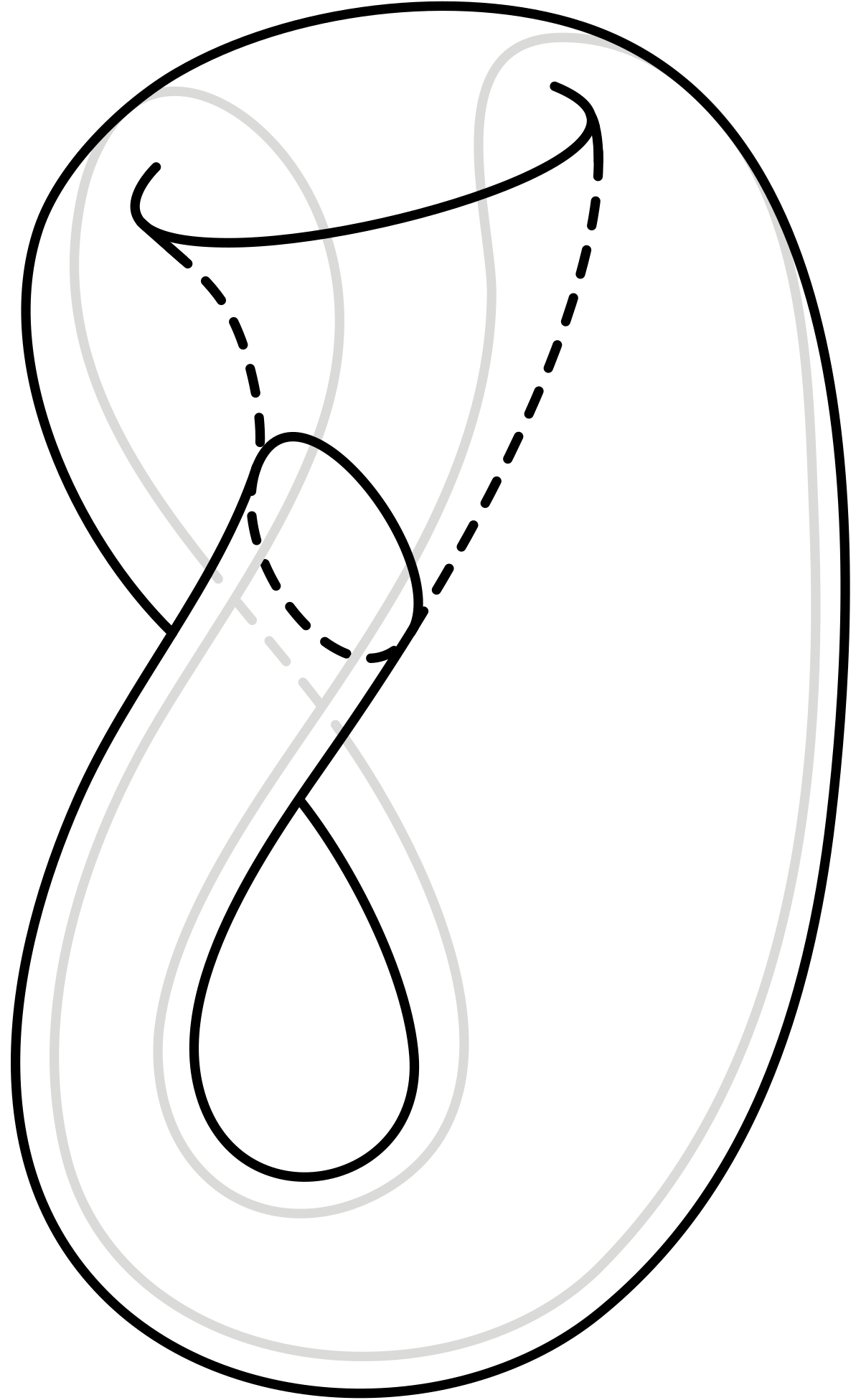
In topology, a branch of mathematics, the Klein bottle () is an example of a non-orientable surface; it is a two-dimensional manifold against which a system for determining a normal vector cannot be consistently defined. Informally, it is a one-sided surface which, if traveled upon, could be followed back to the point of origin while flipping t...
coarse night
odd flame
$\amogus$
Why not working for me
odd flame
lol
coarse night
Is that a custom command?
coarse night
Sure lol
odd flame
odd flame
i think it's just P # ... # P a certain number of times depending on if you have...
i just wanna check this

for this problem
coarse night
odd flame
i know T # P = P # P # P
so i should just be able to use that as much as i want right?
no worries if you dont know
coarse night
I forgot is RP² orientable?
odd flame
it is not
coarse night
I had done a similar ex, so the only orientable surfaces are surface with n-genus, and non orientables are RP²#RP²#... so if you attach one RP², you'll get a non orientable one so it's otta be one of the form RP²#...#RP²
something similar to that
I cannot prove the classification theorem but what you can try is draw the n-gon and try to cut paste some sides, see if you get RPⁿ s
odd flame
my general idea was to start from T # P = P # P # P
odd flame
coarse night
I cannot prove the classification theorem but what you can try is draw the n-gon...
we did it in class so i dont have to do that
coarse night
that's how I did that so you'll eventually get it as well
odd flame
odd flame
my general idea was to start from T # P = P # P # P
but then here
if you sum another P it's obviously just more projective planes
i use P it's easier lol
but adding another T you can just rearrange bc it's commutative
imma just go with that
,ti
gentle ospreyBOT
The current time for stμ₂dying is 03:27 AM (EST) on Tue, 31/01/2023.


 odd flame
isnt 8.9 the torus for even and odd n????
 fiery token
could someone verify if my proof is correct?

other two definitions used:


note that we have not yet defined open and closed sets
icy zenith
Is $\mathbb{Z}$ with the p-adic metric compact ?
gentle ospreyBOT
Julien J
 fiery token
haven't defined compactness yet either
(which also means I don't know what that is)
having had a quick look at the wikipedia article and assuming 'p-adic metric' means this:

I'd say no, $\mathbb{Z}$ is not compact with respect to the p-adic metric
gentle ospreyBOT
thou_art_an_egg

 weary herald
in a metric space, convergent sequences are sufficient to describe continuity: if every sequence x_n converging to x is such that f(x_n) converges to f(x), then f is continuous at x.
Is there a (relatively simple) counterexample for this in a non-metric space ?
gritty widget
this holds true in, more generally, any first countable space, so you want to look for counterexamples in spaces which aren't that
weary herald
do you know of an example?
gritty widget
In X = [0, w_1] any sequence convergent to w_1 must be eventually constant. So if you take f from X to itself with f = id on [0, w_1) and f(w_1) = 0 then for any sequence x_n in X convergent to x, f(x_n) converges to f(x). But f is not continuous
weary herald
what is the topology on X?
gritty widget
Order topology
gritty widget
w_1 is the first uncountable ordinal
weary herald
my bad
does a simpler example exist?
something not involving ordinals
I'm guessing not, in which case our professor will not ask us this type of question on our exam
gritty widget
weary herald
do you know of an example?
nope, but i knew where to look so i hoped that would help
untold lily
not sure you can hope for much simpler examples since you are looking for topologies that aren't first countable
 next crystal
in the last paragraph, why does U x V \subset (X x X) \ diagonal imply that U and V are disjoint?
 gritty widget
Is a lifted closed loop still a closed loop?
plain raven
gritty widget
Is a lifted closed loop still a closed loop?
are you talking about like, in the fundamental group
and covering spaces
if so, the answer is no
gritty widget
plain raven
and covering spaces
yes
plain raven
yeah so consider the covering space map R -> S^1
plain raven
gritty widget
plain raven
<:catthumbsup:614540188747563008>
thank you
 paper wedge
next crystal
in the last paragraph, why does U x V \subset (X x X) \ diagonal imply that U an...
paper wedge
next crystal
in the last paragraph, why does U x V \subset (X x X) \ diagonal imply that U an...
suppose its not
what happens
as in suppose U and V are not disjoint
so there exists an element both in U and V
what would happen inside U x V
next crystal
paper wedge
so there exists an element both in U and V
ah that makes sense now
if they shared a common element x, then (x,x) would be in U x V, but then U x V isnt a subset of (X x X) \ diagonal
paper wedge
cool\
weary herald
why would every sequence in A converge to a point in A?
unreal stratus
Wait no mistake ignore
stark fog
next crystal
in the last paragraph, why does U x V \subset (X x X) \ diagonal imply that U an...
literally a question in my topology exam today
next crystal
I need to prove that if for each pair of points of X, each has a neighborhood not containing the other, then X is $T_1$.\
Suppose the hypothesis and that $x \in X$. Then by hypothesis, for all $y \in X \setminus {x}$, there is an open set $U_y$ such that $y \in U_y \subseteq X \setminus {x}$. So $\bigcup_{y \in X \setminus {x}} U_y \subseteq X \setminus {x}$. I want to also show that $X \setminus {x}$ is a subset of the union, so then we have that $X \setminus {x}$ equals the union of open sets, completing the proof, but i'm not sure how to do this
gentle ospreyBOT
michαel
 stark fog
I think this goes by construction. Notice that you're taking a union of open sets containing a point of $X\setminus{x}$ for each point in this set. So this set is contained in the union.
gentle ospreyBOT
SubGui

 next crystal
that makes sense
stark fog
(more interestingly but I might be wrong here is that if this open cover had a finite subcover, then X\ {x} would be compact, but {x} is closed because it is its own cover in any topology, so either X is finite or the topology on X is the discrete topology)

stark fog
stark fog
(more interestingly but I might be wrong here is that if this open cover had a f...
like I am saying this but I didn't even had lectures on compactness
next crystal
we're covering compactness in a few weeks
if i remember i'll come back to this then lol
pseudo coral
Does anyone know a short proof for this:
gritty widget
yes
pseudo coral
If C \subset complex is compact and contracible then it’s complement is connected
coarse night
One point compactify C then from Alexandar duality
$\tilde{H}_0(S^2 \setminus K) \cong \tilde{H}^{2-0-1}(K)=\tilde{H}^1(K)=0$ since K is contractible
gentle ospreyBOT


 tidal lynx
I'm trying to prove that in the set (0, 1), the sequence p_i = 1/i for i > 0 is Cauchy
and to do this, I need to show that for any eps > 0, there exists an N > 0 such that for all i, j > N, d(p_i, p_j) < eps
I chose N = ceil(2/eps), but I'm having struggle with proving that this works without referring to 0, which isn't in the set
If I was able to refer to it, I could just say:
for all i, j > ceil(2/eps), we have that d(p_i, p_j) < d(p_i, 0) + d(0, p_j) < eps/2 + eps/2 = eps
but we can't, so this seems to be an issue
so if we were working in R and not (0, 1), the above would be a valid proof. thus, can't I say that because it is cauchy in R, it must be cauchy in (0, 1) as well?
untold lily
you can refer to 0 lol
specifically, you are using the induced standard metric from R
so whatever you can deduce from R about distances will hold in the induced metric for (0,1)
tidal lynx
but doesn't the induced metric "forget" everything not in (0, 1) ? specifically, the metric is just a partial function of the original metric
tidal lynx
tidal lynx
---
so if we were working in `R` and not `(0, 1)`, the above would be a valid pr...
or are you saying something like this
- working in R, we know that
p_i = 1/iis Cauchy - thus it must also be Cauchy in
(0, 1)(removingp_1of course)
untold lily
the induced metric forgets, you don't
call p the metric on (0,1) induced by the standard metric d on R
you know that d(p_i,p_j) < epsilon
by definition, d(p_i,p_j) = p(p_i,p_j)
there is really nothing mystical here, you are working with 2 different functions
unless someone banned you from using d
tidal lynx
untold lily
by definition, d(p_i,p_j) = p(p_i,p_j)
wait lol
u probably didn't wanna choose p as the other metric
wdym by d_i and d_j
untold lily
tidal lynx
or are you saying something like this
1. working in R, we know that `p_i = 1/i` ...
oh mb
fixed
didn't mean to quote that either
tidal lynx
makes sense, thanks
untold lily
tidal lynx
or are you saying something like this
1. working in R, we know that `p_i = 1/i` ...
you can say this but it all comes down to the reasoning above, a sequence being cauchy in a subset depends on the distances between points on that subset
and if you are using the induced metric, these by definition agree
tidal lynx
I see
are there any nontrivial complete metric spaces where it's easy to prove completeness without using high powered theorems
ok not even "high powered theorems", I just mean something not as hard as the proof for R
 silk tapir
What does the identity element of C_n(X) (the free abelian group with basis the singular n-simplices on X) look like?
Will it just be the zero map?
coarse night
no
the identity of C_n(X) does not come from a map from Δⁿ → X, it's a "formal" element
tidal lynx

am I crazy or does this not just work?
all the proofs I saw on MSE were like three times as long
unreal stratus
To me this seems fine lol
hearty jacinth
Yeah seems fine
stark fog
tidal lynx
yeah, like the inclusion map takes an element of the open set and send it to the same element in the top. space. So if you take the pre-images of these open sets, you will always find an open set containing the point in the subspace top. means the intersection with the open set on X with Y 
I think so
coarse night
Am I missing something here. So every CW complex is paracompact, and there's an obvious CW structure of $\vee_n S^1_n$. But finding an open refinement of the open cover ${ S^1_n \setminus , N() }$ doesn't seem plausible.
gentle ospreyBOT
 unreal stratus
(what does N mean here - a small nhd of the wedge point or smth?)
But yes I think you could refine it just by taking some smaller bit of each S^1
So like uhhh I can draw a picture lol to show what I mean

idk if this is clear enough lol
But like you just take out a bigger section of the S^1 \ *
This is clearly an open refinement and there's a neighbourhood of the wedge point which only intersects one open set, i.e. N(*) in ur notation
This should go through without any problems to the general (i.e. n > 2) case
@coarse night
coarse night
What’s the nbd of *
also isn't any nbd of * is of the form U1 v U2 v ... where Ui is a nbd of * in S¹_i
so O don't see why that intersects only finitely many of those
@unreal stratus
coarse night
yes
unreal stratus
coarse night
also isn't any nbd of * is of the form U1 v U2 v ... where Ui is a nbd of * in S...
Yeah sure
So that's why I made the other sets smaller
coarse night
but that's wedge of countable nbds of * in S¹
unreal stratus
I haven't changed the neighbourhood of *
I just changed the other sets
I can write it more formally if you'd like
coarse night
that still intersects nbd of * no?
if you make them too small then it'll stop becoming a cover
unreal stratus
Yes, the point is that there is some fuzziness as I showed in my picture ^
sorry if that was unclear lol
coarse night
so won't be a refinement
unreal stratus
I'll make it better lol
Okay so I mean really all we need to do is do the n=1 case in a sense like
coarse night
ok just draw for one circle maybe
unreal stratus
If we look at the intersection with each circle, then uh
let's say for ease that N(*) is some open arc of angle φ, say
Then we can replace S1 \ * with S1 \ {closed arc of angle φ/2 about the point}
coarse night
oh lmao I've been working with a wrong definition of locally finiteness
unreal stratus
Oh lol
Yeah the point is that the point ahs some neighbourhood
not some neighbourhood in the cover
coarse night
Been thinking thay N(*) has to intersect finitely many
unreal stratus
No worries, literally just means you were a bit unsure w a def that's calm
And gave me good practice cause I have never rly considered examples lol

 old violet
When Munkres say we only need to show it for the interval $[0, 1]$, why is that true? How does the general case follow?
 gentle ospreyBOT
Cookieman
 old violet
Is it because the proof presented works for the interval [a, b] instead of [0, 1]?
 marble socket
because you have nice homeomorphism between [a, b] and [0,1]
old violet
huh
marble socket
find f for [0, 1] and then compose this with the map g : [0, 1] --> [a, b] given by g(t) = a+(b-a)t
so in the end you get X --> [0, 1] --> [a, b]
you can then check that this composite sends A and B respectively to {a} and {b}

not uwu? 
old violet
marble socket
find f for [0, 1] and then compose this with the map g : [0, 1] --> [a, b] given...
right sorry, I'm just thinking about how to adapt this into my proof.. This makes sense. Thank you!
old violet
marble socket
find f for [0, 1] and then compose this with the map g : [0, 1] --> [a, b] given...
Also just a sanity check, the proof presented for the interval [0, 1] does work for all $a, b \in \mathbb{R}$, right?
gentle ospreyBOT
Cookieman
 old violet
I don't see how the proof utilized anything special about 0 and 1, except from they make the proof looks cleaner
versed geode
Yeah
versed geode
old violet
I don't see how the proof utilized anything special about 0 and 1, except from t...
This is all
marble socket
ig there is a subtlety
endpoints of [0,1] are rational, but for [a, b] this need not be the case
i don't remember exactly how the proof went, but ofc this could be fixed
old violet
Ah interesting..
marble socket
but yea afair you only needed a countable dense subset which included the end points, so doesn't matter that much, ig having the endpoints isn't really a requirement, but the "same" proof won't work
 split orchid
Im starting a topology class and we are currently talking about the fixed point property.
We proved that the fixed point property was a topological property and that seemed pretty straightforward, the book then follows this up by asking if a torus has this property, and Im struggling to intuitively understand what this means.
A continuous function f: from the surface of the torus -> the surface of the torus must have a point where x = f(x) right? Im not sure where to even begin for proving this. Are we supposed to unglue the object into a 2d plane and try to answer the question there?
versed geode
What examples of surfaces with/without the fixed point property have you covered?
split orchid
In class we talked about [0,1] vs (0,1)
Where [0,1] had the property but (0,1) did not because of f(x) = x^2
versed geode
Hmm, okay, do you recall the definition of a torus
split orchid
I dont think the book covers it, but we did it in class it was something like a 2d plane with X/a gluing it into a cylinder, and then X/b gluing the cylinder into a torus. But idk if thats the actual definition or just a thing we did on the board for intuition or somethsing
versed geode
Is there anything you know homeomorphic to the torus?
gritty widget
split orchid
Im starting a topology class and we are currently talking about the fixed point ...
they're asking if every continuous function has a fixed point
but rotate a torus 180 degrees and you see this map has no fixed points
split orchid
versed geode
Is there anything you know homeomorphic to the torus?
coffee mug? 😅
split orchid
gritty widget
but rotate a torus 180 degrees and you see this map has no fixed points
Im not sure what you mean by this
versed geode
what blitz said is a good hint
Fixed property needs to hold for any continuous function
But if I imagine the donut from a birds eye view and imagine the continuous map that rotates this 180 degrees clockwise
paper wedge
split orchid
coffee mug? 😅
S^1 x S^1
split orchid
So i thought that the maps in question had to be movements across the surface. like a path or something. So im not sure how to translate that to rotating the object
versed geode
 split orchid
Oh I see
I think i actually get what ur saying
The map is basically reflecting the x to its adjacent point on the other side of the torus right?
versed geode
That's exactly in the 180 degree case
But note even "rotating" by 1 degree is enough
split orchid
right
that makes sense
Okay is that valid as a proof? Like can topologist just say "imagine the rotating torus. QED" lol
versed geode
Idk depends on your prof tbh
For a more rigorous version
I was trying to hint that the torus is homeomorphic to S^1 x S^1
Now since fixed point property is preserved under homeomorphisms the questiosn becomes
Does S^1 x S^1 have the fixed point property?
hearty jacinth
You can write a formula for the function
split orchid
for S1 x S1 im imagining infinite circles place around in a circle and eventually forming a solid torus, and inline with the rotating torus, you could assign f(x) to be the same point x in the next circle. but idk how to rigorously work with this stuff
split orchid
versed geode
Does S^1 x S^1 have the fixed point property?
I find it just as hard to answer this question, as the torus question lol
split orchid
okay wait
I over complicated this
S1 does not have the fix point property because you can define a function f to the points on the opposite side of the circle and finding one mapping is enough (thats the part i was forgetting)
versed geode
Yeah
Having fixed point property is quite "strong" in the sense it must hold for every continuous function
split orchid
Right I have no idea what I was trying to solve for in my head, but finding one mapping is not that hard i dont think in this case. It just requires encoding the rotation into a function.
I think for the circle f(x,y) = (-x,-y) should be reflection along the center.
and similiarly for the torus i think f(x,y,z) = (-x,-y,-z) should work.
I think ™️
 onyx raft

I am trying to show that the equivalence will collapse the disjoint union down to \Delta^n
plain raven
what do you have so far
the basic idea is that for any degenerate simplex in the disjoint union, there's a map from that simplex to some lower dimensional simplex and you're going to glue along that map
so the degenerate simplex is going to disappear in the sense that it just gets identified with its image in the lower dimensional simplex
and so at the end of the day, only the nondegenerate simplices really appear in the complex
 zinc siren
versed geode
I was trying to hint that the torus is homeomorphic to S^1 x S^1
zinc siren
versed geode
I was trying to hint that the torus is homeomorphic to S^1 x S^1
...is there another definition of the torus besides as S^1 X S^1 endowed with product topology?
zinc siren
split orchid
Right I have no idea what I was trying to solve for in my head, but finding one ...
why even use Cartesian coordinates? more natural to use the two circle angle cords.
\forall a != 0,
f(\theta, \phi) = (\theta+a, \phi) where we take angles mod 2\pi can't have a fixed point because that would imply \theta = \theta + a but a != 0.
gritty widget
zinc siren
...is there another definition of the torus besides as S^1 X S^1 endowed with pr...
identifying points of the square [0, 1]^2
zinc siren
ahhh
zinc siren
eww
gritty widget
I'm sure algebraic geometry can't be this bad
 fathom flare
group actions?
gritty widget
gritty widget
you can also define it using polynomial equation... or something
(x^2+y^2+z^2+1/2)^2-4(x^2+y^2)=0 for example
tidal lynx
this is a proof for why cl(A) x cl(B) ⊂ cl(A x B), where A, B are subsets of a topological space X and the product topology is considered.

why is it that because A is closed, U and A are not disjoint?
gritty widget
"by the definition of closure points, U intersects A at some a'."
i don't know where you're reading what you wrote about A being closed
gritty widget
what is the definition of the closure of A
tidal lynx
these are the defns of a closed set I know:
- contains all its limit points
- complement is open
and the defn of closure I am using is a set along with its limit points
gritty widget
what is a limit point
tidal lynx
a point p is a limit point of a set A if all neighborhoods of p intersect A infinitely number of times
or just once I think
gritty widget
gritty widget
"by the definition of closure points, U intersects A at some a'."
so a is in the closure of A and U is a neighborhood of a
so a is either in A or is a limit point of A
do you see how the definition of a limit point gives you a point in the intersection of U and A?
tidal lynx
I see that now, but what if a is not a limit point
gritty widget
think about what you are trying to prove
if a is not a limit point, then it's in A, and it's in U, so...
(so we can take a' to just be a)
tidal lynx
lemme try to reproduce the proof from the beginning
given a point (a, b) \in cl(A) x cl(B), in order to prove that (a, b) \in cl(A x B), I need to show that every neighborhood of (a, b) intersects A x B at least time (other than (a, b)). so I need to find a point (a', b') in this intersection
let W be a neighborhood of (a, b). then there exists open U, V such that (a, b) \in U x V ⊂ W (standard basis).
assuming a and b are limit points:
because cl(A) is closed, we know that the neighborhood U of a must intersect cl(A) at some other point a'. similarly we can define b'. then (a', b') \in ((U \cap cl(A)) x (V \cap cl(B))) ⊂ U x V, so this point indeed works
if either are not limit points, then
wait I understand the defn of a closed set, but how can I check that a point p is a member of a closed set?
because
given a point (a, b) \in cl(A) x cl(B), in order to prove that (a, b) \in cl(A x B), I need to show that every neighborhood of (a, b) intersects A x B at least time (other than (a, b)). so I need to find a point (a', b') in this intersection
isn't really true right? I basically just said that in order for a point to be in a closed set, it has to be a limit point of that set, which is wrong
tidal lynx
I realized the problem is I don't understand the concept of a closure well
Let X be a set, and let X' be the set of limit points of X
I want to show that cl(X) = X \cup X' is a closed set, i.e., it contains all of its limit points. To do this, I can show that all limit points of cl(X) are also limit points of X, so by the defn of cl(X) this will suffice.
Suppose p is a limit point of cl(X). This means that every neighborhood U of p contains a point x \in cl(X) other than itself. I will show that p is also a limit point of X, and to do this, I will show that in every neighborhood of p, there is a point other than itself contained in X.
Let U be a neighborhood of p. If the other point x \in cl(X) contained in U is in X, then we found our point.
Otherwise, if x \in X', then by the definition of X', x is a limit point of X. Moreover, x \in U means there is another neighborhood V of x such that V ⊂ U. But since x is a limit point of X, this neighborhood must contain a point in X. Thus we have found our point.
Lol the explanation of this everywhere is 2 lines but I only understand it if I write out everything
ok now I can tackle the original problem
given a point (a, b) \in cl(A) x cl(B), in order to prove that (a, b) \in cl(A x B), I need to show that either (a, b) \in A x B or every neighborhood of (a, b) intersects A x B at least once (other than (a, b)). so I need to find a point (a', b') in this intersection
now on with the proof. let (a, b) \in cl(A) x cl(B). if (a, b) \in A x B we are done. otherwise, for every neighborhood of (a, b), we need to find a point (a', b') also in this neighborhood that is in A x B
let W be a neighborhood of (a, b). then there exists open U, V such that (a, b) \in U x V ⊂ W (standard basis).
assuming a and b are limit points (because (a, b) is not in A x B, but still have to check when one is a limit point and the other isn't*****):
because cl(A) is closed, we know that the neighborhood U of a must intersect cl(A) at some other point a'. similarly we can define b'. then (a', b') \in ((U \cap cl(A)) x (V \cap cl(B))) ⊂ U x V, so this point indeed works
*****if one is a limit point and the other isn't, WLOG a is a limit point and b isn't. then (a', b) is our other point.
finally!
tidal lynx
gritty widget
(so we can take a' to just be a)
now I finally understand why this works 👍
tidal lynx
does every infinite sequence (of distinct points) in the zarski topology converge to every point
yeah seems so
coarse night
@odd flame were you able to resolve your problem?
odd flame
i'll find out tomorrow when i get my hw back 
coarse night
lol anyway I can refer you to some material where the algorithm is given
I was actually reading it so thought might refer you as well
odd flame

coarse night
John M Lee Introduction to topological manifolds, look at chapters on classification of compact surfaces
odd flame
do you have pdf or link?
 odd flame
thank <3
next crystal
Suppose X and Y are topological spaces and f: X -> Y. "for every closed subset V of Y, the preimage f^{-1}(V) is closed in X" implies that f is continuous
Pf:
Suppose U \subset Y is open. Then Y\U is closed in Y. So f^{-1}(Y\U) is closed in X by hypothesis. Therefore X\f^{-1}(U) = f^{-1}(Y\U) is closed in X. Therefore f^{-1}(U) is open in X
How do we get that X\f^{-1}(U) = f^{-1}(Y\U)?
coarse night
it's a set theoretical fact that $f^{-1}(A^c)=(f^{-1}(A))^c$
gentle ospreyBOT
 coarse night
try picking an element and show they are same, basic exercise
gritty widget
hi, is this proof right?

 haughty cedar
Im trying to get a grasp of a compact set. I have a definition that if for every x_n in S there is a convergent subsequence in S, then S is compact.
Now, would the set such as [2, 3] \union [4, 5] be compact?
I can't find a proof that it is not.
haughty cedar
since i know from borel theorem, that compact is bounded and closed, I can think of all the sets that are bounded and closed.
marble socket
so is the above set closed and bounded in R?
haughty cedar
Yes
But, the reverse implication is incorrect AFAIK
bounded and closed => compact
marble socket
ahh, wait i read it wrong
heine borel theorem says that this is true for subspaces of R^n
but you'll see that soon ig
marble socket

haughty cedar
thanks!
marble socket
you could prove that the above set is (sequentially) compact directly by definition
haughty cedar
That's a good idea as well.
gritty widget
gritty widget
hi, is this proof right?
Too much text
alright bet
f^-1(empty) = empty, f^-1(Y) = X so f is continuous. Is what I'd write. Add some flavour to make it look like a proof. Then qed
yeah i suppose thats all you need to write, i think for me though i wrote out like everything i was thinking sense when i first looked at it i didnt realise f^-1(Y) is X
haughty cedar
Suppose we have a function, f which is differentiable on (a, b). How do we know that inverse of this function is differentiable?
gritty widget
haughty cedar
Suppose we have a function, f which is differentiable on (a, b). How do we know ...
this seems like a #calculus yes?
gritty widget
haughty cedar
Suppose we have a function, f which is differentiable on (a, b). How do we know ...
In mathematics, specifically differential calculus, the inverse function theorem gives a sufficient condition for a function to be invertible in a neighborhood of a point in its domain: namely, that its derivative is continuous and non-zero at the point. The theorem also gives a formula for the derivative of the inverse function.
In multivariabl...
next time put it in a different channel, if it's related to differentiability then this is probably not the place to post it
coarse night
gritty widget
https://en.wikipedia.org/wiki/Inverse_function_theorem
believe that's not the question they asked.
coarse night
haughty cedar
Suppose we have a function, f which is differentiable on (a, b). How do we know ...
it's not always true, take (-1, 1) → (-1, 1) by x ↦x³
gritty widget
i read it as what blitz interpreted it. it seems like theyre wondering what conditions need to be met for the inverse of a function to be differentiable over an interval.
old violet
Can we actually expect the Locally Compact Hausdorff Version of Urysohn's Lemma to do this?

In particular, I am wondering if the statement after "Moreover" is possible
It seems like the original proof for the Urysohn's Lemma for LCH spaces wouldn't go through. In particular, if we require continuity, then we won't have compact support and if we require compact support, then continuity fails.
This is the proof I am following: https://www.math.ksu.edu/~nagy/real-an/1-05-top-loc-comp.pdf
old violet
Also I hope this is not duplicated question from yesterday. I believe composing by the original homeomorphism suggested by @marble socket, unfortunately, won't help in this case. In particular, everything outside of the support $f$ after composition would be raised by $a$, making $f$ not compactly supported.
gentle ospreyBOT
Cookieman
 gritty widget
old violet
In particular, I am wondering if the statement after "Moreover" is possible
gritty widget
old violet
In particular, I am wondering if the statement after "Moreover" is possible
it's a typo (or someone didn't think this through for all I know)
they really want f-a to have bounded support
old violet
I see what you mean, but then can they get f to be still a on F?
gritty widget
all they are doing is sending [0, 1] to [a, b]
so whenever f would output 0 in the first part of the theorem, they send it to a
old violet
Oh I see
old violet
Lol okay, so are we asking too much if we also ask for compact support?
gritty widget
so you basically do a+f(x)(b-a) where f is the compactly supported function
old violet
Is there a counter example?
gritty widget
old violet
Lol okay, so are we asking too much if we also ask for compact support?
yep, it really should be "constant outside of a compact set"
just take anything like a = 1
and X not compact
gritty widget
gritty widget
yep, it really should be "constant outside of a compact set"
this is what the author really meant
gritty widget
marble socket
i think it's resolved now uwu
maybe idk. I didn't get an answer
old violet
gritty widget
just take anything like a = 1
Mmm yeah I agree. Sorry I had to head to a class earlier and wasn’t able to reply. Thank you!
gritty widget
It's fine! I was just saying you might still be confused 
pearl holly
anyone knows what this notation means (I am referring to the smash with a subscript)? It's never defined and I can't find sources that define what this is

at first I thought it was some orbit space but idk now
 lunar yoke
pearl holly
at first I thought it was some orbit space but idk now
lunar yoke
pearl holly
at first I thought it was some orbit space but idk now
Yes schwede uses them for the orbit space of the diagonal action
So here you can think of it as inducing up the action from the subgroup 1xS_n to S_m+n
 median sand
Quick sanity check: D\subset X discrete => D\cap A\subset A discrete for all A\subset X:
If B\subset D\cap A, then B\subset D and it's open in D, so B=D\cap O for open set of X. Then B=B\cap A=(D\cap A)\cap (A\cap O) is an open subset of D\cap A => D\cap A is discrete in A.
gritty widget
median sand
Quick sanity check: D\subset X discrete => D\cap A\subset A discrete for all A\s...
D cap A is discrete as a topological space
being discrete means just that
(though sometimes they impose that it needs to be closed, but that's uncommon)
gritty widget
D cap A is a subspace of D
median sand
Oh like that you mean.
gritty widget
subspace of discrete space is discrete
median sand
OK sure
If you have two subspaces A,B of X and a subspace C of A\cap B, then the topology of C doesn't depend on whether you consider it as a subspace of A or B, right?
gritty widget
median sand
If you have two subspaces A,B of X and a subspace C of A\cap B, then the topolog...
since subspace topology is transitive
in the sense that if $X\subseteq Y\subseteq Z$, $X$ has subspace topology from $Y$, $Y$ has subspace topology from $Z$, then $X$ has subspace topology from $Z$
gentle ospreyBOT
Blitz
 median sand
Yeah, I know.
gritty widget
we have that C has, in both cases, subspace topology from X
median sand
Thanks.
gritty widget
median sand
Yeah, I know.
this transitivity property doesn't always hold for some properties of a topological spaces so I thought I'd write it as a fact
median sand
If I want to show V=R^n x C^m (as an R-vector space) is Euclidean (in terms of its topology), is it enough to say
"|(x,z)|=max(|x_i|,|z_j|) defines a norm on V [it does, right?] and since all norms on a findim space are equivalent, V is Euclidean"?
gritty widget
C is homeomorphic to R^2
from properties of product of topological spaces, V is homeomorphic to R^(n+2m)
gritty widget
median sand
If I want to show V=R^n x C^m (as an R-vector space) is Euclidean (in terms of i...
well if you're going to introduce the concept of finite-dimensional space as a topological space
then you ought to show it's well-defined beforehand
median sand
gritty widget
from properties of product of topological spaces, V is homeomorphic to R^(n+2m)
I know, but I want to show it differently.
Does what I say work?
median sand
gritty widget
then you ought to show it's well-defined beforehand
The Euclidean topology is the only topology on R^n that makes it a topological vector space and all findim R-VS have the same topology induced by a basis (change of basis is a homeomorphism).
gritty widget
like, you're trying to prove something but I don't even know what you're proving
median sand
Yeah, maybe it's a little ill-posed.
gritty widget
if V is n-dimensional R-vector space, with any topology giving it topological vector space structure, then V is homoemorphic to R^n
median sand
NVM, I'll just treat V as R^{n+2m} (which it essentially is).
gritty widget
this follows from V being linearly isomorphic to R^n so that it induces a topological vector space structure on R^n
median sand
Yeah.
gritty widget
which then is homeomorphic with standard topology on R^n
gritty widget
gritty widget
this follows from V being linearly isomorphic to R^n so that it induces a topolo...
such that the linear isomorphism becomes a homeomorphism
so
topology of finite-dimensional space is uniquely defined by the dimension
in the sense that, any two n-dimensional topological vector spaces are homeomorphic
median sand
Thanks.
 pastel coral
Hello, I just want some reality check. I conjecture that it's true that the circle group $\mathbb{T}$ is isomorphic to quotient space $\mathbb{R}^2/\sim$ where $(a,b)\sim (c,d)$ if and only if $ab-cd\in \mathbb{Z}$. I think this is true by considering the quotient mapping $\rho: \mathbb{R}^2 \to \mathbb{T}$ via $\rho(a,b)=exp(2\pi i ab).$ Are there any obvious reasons why this may fail to be true?
gentle ospreyBOT
blackiris
 unreal stratus
Well i guess you've just gotta check whether this is indeed a quotient map, but assuming that is true this holds fine
But yeah I imagine this is an open map anyway
gritty widget
if I have X is the set of two disjoint nonempty closed subspaces, X is connected? because something is not connected if it's the union of two nonempty open disjoint subspaces. like rn I'm visually like two closed balls in R2 and it seems like by the definition it's connected? but it feels weird to call them connected

this is definitely disconnected
it's the union of two non-empty disjoint open subspaces!
do note that in the definition of connectedness it doesn't matter if you use open or closed subspaces
if X is a disconnected topological space, X = U \cup V with U, V open and disjoint, then U is X - V so it's closed as well
same for V
or maybe i should phrase it like: if X is a disjoint union of U and V, then U and V are both open if and only if they're both closed
ohhhh
yeah I was thinking about the topology on R2
stark fog
gritty widget
or maybe i should phrase it like: if X is a disjoint union of U and V, then U an...
there is also that result that X is connected iff its only clopen subsets are the empty set and itself
 forest barn
Is If A is in a topological space then we call A open (in that space)?
stark fog
forest barn
Is If A is in a topological space then we call A open (in that space)?
you mean as a subspace?
or as an element of the topology?
forest barn
element
stark fog
the elements of the topology are called the open sets of the space
you can also define a topology where the elements are closed
but for the subspace case, it may not be true, for example [0, 1] as a subspace of the real line, it is open in the subspace topology but closed in the topological space
lunar yoke
forest barn
Is If A is in a topological space then we call A open (in that space)?
yes, as part of the axioms of a topology, A must be an open subset of the space A
stark fog
note: as a subset of the space A
because in the subspace topology, $A = A\cap X$, where $A\subset X$ is a subspace of the top. space $X$.
gentle ospreyBOT
SubGui
 gritty widget
stark fog
you can also define a topology where the elements are closed
gritty widget
stark fog
you can also define a topology where the elements are closed
that's not called a topology
I don't think it has any name
stark fog
gritty widget
that's not called a topology
maybe I messed it up, I was thinking of a example where you have a discrete topology on a finite set satisfying T1 axiom
very specific btw
gritty widget

stark fog
 gaunt linden
There are some contexts where it's most convenient to define a topology by describing what the closed sets are, rather than what the open sets are. (One example is the Zariski topology in AG). It sounded like that was what you were talking about.
gritty widget
lunar yoke
yes, as part of the axioms of a topology, A must be an open subset of the space ...
I wouldn't say it's part of axioms of topology. We define topology to satisfy certain axioms and simply call set open if it belongs to the topology
stark fog
gaunt linden
There are some contexts where it's most convenient to define a topology by descr...
most likely, but I possibly messed it up
thanks nevertheless
lunar yoke
gritty widget
I wouldn't say it's part of axioms of topology. We define topology to satisfy ce...
its is literally an axiom

also all these nitty gritty special case examples are super useless for someone that is just learning the definition of a topological space
gritty widget
what is
lunar yoke
like you cannot seriously imagine that this is in any way helpful
gritty widget
the original question was asking about subsets of topological space
gaunt linden
Do you have a definition in mind that does not make it an axiom that the entire space must be an open set?
stark fog
gritty widget
gaunt linden
Do you have a definition in mind that does _not_ make it an axiom that the entir...
the question is open up to interpretation
what stronq was asking that is
I don't think they were asking about whole space being open at all
gaunt linden
There's nothing up to interpretation here. If you want to claim there is such a defintion in anything resembling common use that doesn't make this an axiom, the onus is on you to provide it.
gritty widget
Is If A is in a topological space then we call A open (in that space)?
is that not open up to interpretation?
 shadow charm
I agree with blitz here question wasn’t clear
gaunt linden
No, the answer is unablguously yes beacuse the axiom requires that.
shadow charm
Nowhere was it specified that A is the topological space in that question
Or what A even is relative to that space
stark fog
shadow charm
Or what A even is relative to that space
yeah, that's why I asked if it was as the subspace of the space, but it didn't mention if A was a subset to begin with
shadow charm
If A is a subset of X, A is open in the subspace top on A
But not necessarily open in X
If that was the question
gritty widget
I think the one answering the question should have just confirmed what the question really is
because we're all guessing at this point what it could mean
gritty widget
gaunt linden
I somehow didn't see the word "in". Sorry.
It's okay, at least you weren't rude about it
 void gazelle
Hi, guys, why this is a homotopy? How to see that immediately $F: I\times I\to Y, F(t,s) = h_t\cdot\varphi_tf\cdot \overline{h_t}(s)$ is continuous?
 gentle ospreyBOT
cc0101

 steel glen
are you asking how you’d prove it or more intuitively?
void gazelle
i can see why intuitively this is true
steel glen
path products (when endpoints are shared) are continuous by the pasting lemma, and these paths all share endpoints for arbitrary values of t
void gazelle
Yes, this is true. My main concern comes from that if F: X\times Y\to Z is map, and F: X\times {y}\to Z is continuous, F: {x}\times Y\to Z is continuous, for all x,y, then we cannot conclude that F: X\times Y\to Z is continuous
so for every t, F(t,s) is continuous does not make F into a homotopy
steel glen
well you can use the product topology to show this is continuous. i believe, in particular, this amounts to using/proving the tube lemma, but that could be wrong
steel glen
void gazelle
so for every t, F(t,s) is continuous does not make F into a homotopy
oh are you saying F(t,s) continuous is not enough?
the rest of the conditions should follow really easily
void gazelle
yeah, i worried about that, F: {t}\times I \to Y is continuous is not enough
steel glen
h_t is continuous as it is a composition of continuous maps. same reasoning for phi_t of f
i don’t know if there’s anything else left to show? you have continuous maps from continuous compositions, and you’re taking their product which is also continuous (as they share endpoints)
void gazelle
Sorry, i am a little confused, do you mean if we have a map F on X times Y. We want to show it is continuous, we just need to show F is continuous on X by fixing a point in Y, and F is continuous on Y by fixing a point in X?
steel glen
no
i’m saying that F is a product of paths, where each path is continuous as it is a composition of continuous functions
so F is continuous itself
steel glen
no no problem
void gazelle
steel glen
i’m saying that F is a product of paths, where each path is continuous as it is ...
Hi, sorry to bother, but I looked up the definition of homotopy from wiki. I am not sure about the last sentence contradicts to what you said
 steel glen
we’re not claiming h_t is continuous for each individual t, we’re saying h_t is continuous over the whole space X x I since it is a composition of continuous maps.
they’re saying it is not sufficient for h_t to be continuous at each X x { t }
 echo oyster
Can someone help please to understand the question 7(b)
 gritty widget
what's not clear about it?
echo oyster
Do i need to assume some functions continuous from R to Rl , then show it is continuous from R to R ?
gritty widget
echo oyster
Do i need to assume some functions continuous from R to Rl , then show it is con...
The question doesn't ask you to show anything
It just asks you to ponder on what those functions could be
echo oyster
Oh
Constant functions are continuous from R to Rl
Does it help to conclude something about f : R→R
stark fog
recall that the open sets in $\bR_{\ell}$ are of the form $[a,,b)$
gentle ospreyBOT
SubGui

 swift fjord
slight nuance: those are the basic open sets
open sets in R_\ell are going to be unions of these
stark fog
mb, yeah the union of these
 elder loom
stark fog
recall that the open sets in $\bR_{\ell}$ are of the form $[a,\,b)$
elder loom
stark fog
recall that the open sets in $\bR_{\ell}$ are of the form $[a,\,b)$
I never use this topology ever
like
where does it come up?
stark fog
elder loom
where does it come up?
notice you're taking a limit as x approaches a from the right, so x is in a set [a, b) for some b > a
now you apply the definition of continuity
untold lily
elder loom
I never use this topology ever
topology is all about counterexamples, the sorgenfrey line is home to many of those
so it is important to a topologist
unreal stratus
eh intro pointset top is about counterexamples
 prisma arrow
untold lily
topology is all about counterexamples, the sorgenfrey line is home to many of th...
prisma arrow
untold lily
topology is all about counterexamples, the sorgenfrey line is home to many of th...
counterexamples are important but there is more to the field than this
the types of questions i see are usually about classification if anything
untold lily
okay I apologize for exaggerating, topology is not literally all about counterexamples
 river granite
intro pointset is sort of about classifying spaces and finding out precisely which hypotheses you need for interesting theorems (e.g. Tietze) to hold, so counterexamples are needed to draw the line so to say
gritty widget
river granite
intro pointset is sort of about classifying spaces and finding out precisely whi...
just like in any field of math, huh (comment was edited so what I said might not make sense)
counter-examples gives us crucial insight no matter where we are headed
part of general topology is about classifying spaces
so its important to know what classes of spaces overlap... and which is contained in which etc.
that's the only reason why there's more counter-examples in intro to general topology than other introductions to a math field
that's my take anyway
untold lily
stark fog
maybe there is a God of topology and it doesn't want us to find it
 ruby crown
A refinement D of a cover A does not necessarily have to be a cover right? If you think about it empty set can always be an refinement, as the definition only requires that for all elements in the refinement there exists an element of A such that the element in the refinement is a subset of that element of A. Since, for all statement of an empty set is always true the empty set is always a refinement, which is of course not a cover for any set except for the empty set
gritty widget
ruby crown
A refinement D of a cover A does not necessarily have to be a cover right? If yo...
it does have to be a cover
ruby crown
Is that part of the definition?
gritty widget
if it doesn't follow from your definition, then take it as an additional assumption
it should be in the definition of refinement you're using, though
stark fog
Yeah, I think the definition of refinement of a cover also says "still covers"
ruby crown
I see. I am also looking for a way to interpret paracompactness, namely an intuition for what it means for there to exist a locally finite open refinement for every open cover. The notion of open refinement is pretty easy to understand as it is just about having the possibility of a cover with less/smaller sets than the one you started with. Locally finite may be interpreted as you do not want a neighbourhood of a point in the space to collide with infinite many elements in your cover. However, I still do not have a clear idea of why we would need this notion of paracompactness based on its definition. Does anyone have an intuitive way thinking about this concept?
prisma arrow
ruby crown
I see. I am also looking for a way to interpret paracompactness, namely an intui...
you know how hausdorff is a way to talk about seperating two points?
gritty widget
maybe it'll be insightful to think in what way is paracompactness used
we usually have a local property, and using paracompactness we can "glue it" obtaining a property which is global
ruby crown
prisma arrow
you know how hausdorff is a way to talk about seperating two points?
Yeah, that you have two disjoint neighbourhoods for any two points
unreal stratus
(also if it didn't need to be a cover, it'd be a bit of a pointless definition)
Was about to say smth but Blitz beat me too it :)
Well, perhaps to add to it, importantly a space X is paracompact hasudorff iff all open covers admit subordinate partitions of unity, which allows one to often do what Blitz says in the last message ^
prisma arrow
you can interpret it as a bound on the open sets of the cover that makes things more localized
i can try and think of an example to illustrate this
gritty widget
as for definition of paracompactness itself, I don't see much intuition for it, really, a locally finite open cover obtained from using paracompactness, will probably be pretty wild in general
unreal stratus
Yeah to me it just feels like "here are some arguments we want to make - what is the weakest hypothesis possible that allows us to do them"
Which is fair but yeah feels inch resting
gritty widget
yeah, you want it rephrased asap
if to gain an intuition for it, is what it feels like
unreal stratus
Yeah
ruby crown
prisma arrow
i can try and think of an example to illustrate this
A concrete example would be helpful for me to grasp it.
gritty widget
I mean, compactness even, to see why its defined that way you really want to go and look into the history
ruby crown
I'm trying to see what it meant with local property, what would be an example of that?
gritty widget
I suspect to gain intuition for the concept of paracompactness, other than it just being similar to compactness, you need to look at how it was obtained in the first place
gritty widget
ruby crown
I'm trying to see what it meant with local property, what would be an example of...
manifolds are a good example
well, by locally we really mean using partitions of unity in a clever way to derive global properties from local ones
for example, using property such as local metrizability
local properties usually come in two flavours
things like local compactness, and things like how usually the term is used
here we mean that there is a neighbourhood which is metrizable
ruby crown
gritty widget
for example, using property such as local metrizability
I see, I'll try to understand why that turns that into metrizability with paracompactness
gritty widget
Hausdorff paracompact locally metrizable spaces are metrizable
because Hausdorff paracompact makes the local metrizability into a global property
i.e. metrizability
stark fog
coincidentally I asked a friend if they studied paracompactness in his courses and he couldn't tell me what was it useful for
thanks about these
gritty widget
its okay
shadow charm
gritty widget
because Hausdorff paracompact makes the local metrizability into a global proper...
How do you extend local properties for just general hausdorff paracompact spaces? I know for manifolds you can use partitions of unity but how does it go in general?
gritty widget
unreal stratus
Well, perhaps to add to it, importantly a space X is paracompact hasudorff iff a...
.
tidal lynx

graders said that this wasn't enough?
but isn't showing "U x V must be open for open U \in X, V \in Y, when the two projection maps are continuous" equivalent to the the product topology being the coarsest?
plain raven
I think your logic is sound here but you did not make that explicit.
"Let U \subset X be open. Since alpha is continuous, alpha^{-1}(U) = U x Y is also open" In what topology?
In the product topology or in another topology?
You probably would have gotten full credit if you added a sentence at the beginning where you said "Let tau be an arbitrary topology on X x Y such that the projection maps alpha, beta are continuous. Let U be open in tau" Otherwise it seems like you might just be talking about the product topology, which is the only topology mentioned explicitly in the question
tidal lynx
plain raven
"Let U \subset X be open. Since alpha is continuous, alpha^{-1}(U) = U x Y is al...
In X's topology. X is given as a topological space so isn't it fairly implicit?
how could a subset of X be open in the product topology anyways
that's a categorical error
(I posted this like a week ago) this was the previous part to that question, and I got full credit for it
 tidal lynx
plain raven
You probably would have gotten full credit if you added a sentence at the beginn...
tidal lynx
plain raven
You probably would have gotten full credit if you added a sentence at the beginn...
I guess it's because I included the "That is..." part similar to what you said, but I thought I could just leave it out of the next part rip
plain raven
tidal lynx
In X's topology. X is given as a topological space so isn't it fairly implicit?
Sorry i meant U x Y
and X x V
not U and V
the topology of X and Y is unambiguous.
What's ambiguous is the topology of X x Y.
I edited my original post to clarify.
 eager herald
are these the T_0 T_1 kind of things?

i searched it up and the separation axioms seem kind of different from these
it later proves the equivalence of (i) and (ii)
and defines any top space satisfying these to be separable
is there any relationship between separable spaces and the separation axioms?
i'd imagine there is, but not sure how
coarse night
These are odd terminologies. A space is called separable if it has countable dense subset and called 2nd countable if it has a countable open basis. In general 2nd countability implies separability and converse is true for metric spaces.
unreal stratus
eager herald
are these the T_0 T_1 kind of things?
Bruh