#point-set-topology
1 messages · Page 3 of 1
 swift fjord
 unreal stratus
More generally the set of path components is (pi0(X))
swift fjord
it's not
but yea you can show that pi_0 is homotopy invariant
that's much easier
like
taking that approach is easier
unreal stratus
Set of path components
swift fjord
set of path components
as potato said
you can show that a homotopy equivalence induces a bijection between the sets of path components
this shows path connectedness is a homotopy invariant
unreal stratus
I think all the examples kinda show a deformation retract is basically when a space is a "fluffed up" version of a subspace
Like those examples with the letters or things like the circle being a deformation retract of R^2 minus a point
swift fjord
unreal stratus
Like those examples with the letters or things like the circle being a deformati...
This doesn't count as a retract idt
Wait nvm
I'm stupid
I was thinking of compactification
unreal stratus
Ah
swift fjord
In whicb you add a point instead ot taking it away
unreal stratus
Idk tbh of how much interest retracts are
 shadow charm
Deformation retracts are the useful retracts
unreal stratus
Usually it's just that often you can show two spaces are homotopy equivalent as one is a def retract of the other or smth
 gritty widget
unreal stratus
Idk tbh of how much interest retracts are
gritty widget
unreal stratus
Idk tbh of how much interest retracts are
They are of interest
They connect with extension properties
unreal stratus
Actually yeah brouwer and stuff
shadow charm
Retracts do give you surjections of the fundamental group if im not mistaken
Nice example of a retract that is not a deformation retract is the torus mapping to a circle on it
You can clearly get a continuous map to this circle (retract) but for it to be a deformation retract you’d need to cut up the torus
unreal stratus
Ig you always get that for any product of spaces
shadow charm
unreal stratus
Ig you always get that for any product of spaces
True
gritty widget
I feel like it boils down to circle to point example
shadow charm
gritty widget
I feel like it boils down to circle to point example
Yeah fair enough
 pallid lion
^ me every time I ask a prof or supervisor a question
 hushed marlin
staring an intro to topology course in a few days. Any tips on success in that class?
gritty widget
be comfortable with some basic set theory
general point-set topology is easy if your basic proof skills and set theory is solid
the first chapter of munkres' book provides a comprehensive review
hushed marlin
awesome I'll check it out, thank you!
gritty widget
gritty widget
general point-set topology is easy *if* your basic proof skills and set theory i...
Depends on how in depth you want to go
But for a course it should be easy. They chop off a lot of material and force feed you it in my experience
Proof of something like, product of continuum separable spaces is separable for example
I wouldn't say it's easy
Or proofs of metrization theorems
fine, "mostly easy with some hard parts"
Proof of Urysohn lemma
It'll be easy if your grasp on topology is good
the context was someone starting a course in the subject
please interpret my messages with this context
Yeah. So they probably won't have intuition for what they're learning (at first at least)
It might make things seem harder
unreal stratus
Also btw the most general thing is that pi0 is actually a functor (from Top to Set) sending each space to its set of path components and each map between spaces to the induced map between path components (since continuous maps send path components to path components) If you can prove that then everything else follows
It may seem overkill but ofc the same is true for pi_1 and indeed any pi_n
 polar whale
In which book can I get a clear idea regarding the concept of a manifold ?
Also, can someone explain it briefly here ?
shadow charm
Probably better suited to #diff-geo-diff-top @polar whale . You can get the intuition for a manifold without going through a textbook, but if you want to work with them then the standard introductory texts are lee and tu if I’m not mistaken
With tu being more expository but worst exercises, and lee being somewhat dry but good exercises from what I hear
gritty widget
shadow charm
Probably better suited to <#908108569688301649> <@763356334976139276> . You can ...
shadow charm
The essence of a manifold is a space that looks like Euclidian space at small scales, ie it is locally homeomorphic to R^n (locally flat if you will) This isn’t everything you need for a manifold, you have other assumptions like for the space to be hausdorff etc but that’s the property that captures why they’re interesting the most.
Most nice surfaces you can think of are manifolds for example
polar whale
shadow charm
With tu being more expository but worst exercises, and lee being somewhat dry bu...
Okay I'll look into both thnx
polar whale
shadow charm
The essence of a manifold is a space that looks like Euclidian space at small sc...
Nicee...I think I should delve deeper...thnx for the exposure
polar whale
gritty widget
or <#716264872018706443>
Right!
 chrome ridge
https://math.stackexchange.com/questions/788097/showing-that-every-finitely-presented-group-has-a-4-manifold-with-it-as-its-fu In the answer here, why is $\pi_1(X \setminus int(N_j)) = \pi_1(X)$ ?

Mathematics Stack Exchange
Wikipedia: For any finitely presented group it is easy to construct a (smooth) compact 4-manifold with it as its fundamental group.
Question: How do we do this?
EDIT: Below is a proof sketch fo...
 gentle ospreyBOT
ru0xffian

 brisk cairn
Is there a name for a topological transformation that creates or closes holes in a surface? (Think sphere to donut or vice versa) Or a sort of transformation that causes two disconnected surfaces to blend into one, or likewise separate into two? (For context I know nothing about topology, I'm writing a paper on implicit surface rendering and these sort of deformations are relevant, but I'm not sure what to call them, for now just "arbitrary topological transformations") Thanks!
 hidden crag
To stick spaces together you have the wedge sum for example
gritty widget
brisk cairn
Is there a name for a topological transformation that creates or closes holes in...
there's gluing
In mathematics, an adjunction space (or attaching space) is a common construction in topology where one topological space is attached or "glued" onto another. Specifically, let X and Y be topological spaces, and let A be a subspace of Y. Let f : A → X be a continuous map (called the attaching map). One forms the adjunction space X ∪f Y (sometime...
as for "separate into two", hard to say what you mean. Maybe disjoint sum?
brisk cairn
I don't mean anything too spooky, for example here's some basic metaball blending

But it could get as trippy as something like this https://youtu.be/-1x-dFD695g?t=667
You're just seeing the zero isosurface of some scalar field that's changing in time
shadow charm
Any hint on 5? The second part follows easily from the first since we’ll get that X tilde is homotopic to an infinite wedge of circles, but I’ve absolutely no clue how to produce the required neighborhood. I’ve tried looking at some kind of maximal element of the poset of open sets containing the left edge inversely ordered by inclusion with zorn but I’m not sure how to rule out closed sets that aren’t the left edge itself
 chrome ridge
Let $X = (S^3 \times S^1) # \cdots # (S^3 \times S^1) $ $n$ times. Then we know that $\pi_1(X) = <a_1, a_2, \cdots, a_n, |>$ i.e. the free group on generators $a_1, \cdots, a_n$. Let $b_j$ be a loop in $X$. Let $N_j$ be a tubular nbhd of $b_j$. Is there a way to figure out $\pi_1(X \setminus int(N_j)) ? $
gentle ospreyBOT
ru0xffian

 magic geyser
shadow charm
Any hint on 5? The second part follows easily from the first since we’ll get tha...
magic geyser
shadow charm
Any hint on 5? The second part follows easily from the first since we’ll get tha...
I think what you wanna do is lift it without the top edge (you can bc it's simply connected without the top edge), then use something like the lebesgue number lemma and induction on the number of delta neighborhoods covering the left edge to show that horizontally adjacent points in a delta nbhd of the left edge have been lifted close to each other. then you can extend to (a piece of) the top edge. does that make any sense? if it doesnt maybe im wrong
shadow charm
I’m not sure I understand what you mean by being able to lift without the top edge @magic geyser
magic geyser
shadow charm
I’m not sure I understand what you mean by being able to lift without the top ed...
If you subtract the top of the square you get a “comb” which you can lift into X tilde
shadow charm
Sure but what does simple connectedness have to do with that?
magic geyser
shadow charm
Sure but what does simple connectedness have to do with that?
That’s why that lift exists
shadow charm
I’m slightly confused
When does a lift « not exist »
You mean it’s evenly covered?
shadow charm
By lift we do just mean the inverse image under the covering map right?
I don’t get what you mean by a lift not existing
magic geyser
oh so if $p: \tilde{X}\to X$ is the covering map, we say $f: Y\to X$ lifts under $p$ if there exists $\tilde{f}:Y\to \tilde{X}$ st $p\tilde{f} = f$
gentle ospreyBOT
motivik
 shadow charm
Right but what’s f?
magic geyser
here f is the inclusion of a subset in X
shadow charm
Ah i see
Okay I see what you mean
And why it exists by simple connectedness
But won’t that just end up showing that the neighborhood lifts homeomorphically to a subset of X tilde
Not to all of X tilde?
magic geyser
yea the comb is simply connected so you can lift it. in general you can lift f if the image of $\pi_1(f)$ is contained in the image of $\pi_1(p)$
gentle ospreyBOT
motivik
 shadow charm
magic geyser
yea the comb is simply connected so you can lift it. in general you can lift f ...
shadow charm
magic geyser
yea the comb is simply connected so you can lift it. in general you can lift f ...
Yeah lifting criterion
I just didn’t realize you were originally talking about maps (or that that’s what the exercise meant)
magic geyser
not sure i understand ur question
shadow charm
magic geyser
not sure i understand ur question
The way I understand the exercise it’s asking to show that the preimage of one of the neighborhoods of the left edge is all of X tilde and homeomorphically so
That’s how I interpreted « lifts homeomorphically »
But perhaps I misunderstood the exercise
magic geyser
oh no
shadow charm
It makes more sense now
magic geyser
it means homeomorphically onto the image of the lift
shadow charm
magic geyser
it means homeomorphically onto the image of the lift
Here’s what I’m confused about, isn’t an evenly covered neighborhood always going to satisfy this?
magic geyser
yes
shadow charm
Then what’s the big deal?
Just take an evenly covered neighborhood of the left edge no?
magic geyser
why should there be a nbhd of the left edge thats evenly covered?
magic geyser
yea that doesnt work
shadow charm
Okay I’ll give that another think now that I know what the exercise is asking for
And that way there’s actual work to be done for the second part too
Thanks a bunch
magic geyser
np
shadow charm
@magic geyser doesn’t the argument only work for covering spaces that are path connected and locally path connected?
Since that’s when the lifting criterion applies?
magic geyser
oh uhhh maybe
shadow charm
I mean it should still work if I only care about the second part I guess since simply connected requires path connected and locally path connected if I’m not mistaken
 bitter smelt
shadow charm
I mean it should still work if I only care about the second part I guess since s...
bitter smelt
shadow charm
I mean it should still work if I only care about the second part I guess since s...
this is not true iirc hold on
yeah comb space is counter example
magic geyser
well the comb is not gonna be locally path connected, but it is simply connected. but if ur saying local path conn is required for all this covering space lifting stuff to go through then i guess im lost
shadow charm
Ah yeah local path connectedness isn’t required in the definition of simply connected
shadow charm
magic geyser
well the comb is not gonna be locally path connected, but it is simply connected...
It’s required of the covering space yeah for lifting criterion to apply
bitter smelt
also topologists sine curve
shadow charm
Though maybe for this specific case you could show the lift exists without the criterion
shadow charm
bitter smelt
also topologists sine curve
Yeah one exercise shows a counterexample with quasi-circle
magic geyser
maybe im tired but it seems like you should just be able to do this by mimicking the proof that you can lift a path. you know where you just lift one piece at a time under evenly covered neighborhoods.
just start at the bottom of the left edge and work your way up
each time possibly shrinking the width of your neighborhood as needed
shadow charm
I’ll give that a shot tomorrow, thanks again for the help
chrome ridge
In the footnote, could someone explain how performing the surgery kills off w_j ? I think it is some application of Van Kampen's thm but I couldn't figure out the details
 shadow charm
Anyone know which graphs with 2 vertices and 3 edges Hatcher refers to here? The only ones that appear to me to have the given covering space Z are the graph with one loop at each vertex and a straight edge between the vertices, and the graph with three straight edges between the two vertices. However the first is a covering space of the second so we don’t get the required solution
Mathematics Stack Exchange
Suppose $Z\to X,\ Z\to Y$ are covering spaces.
Does there exist a space $W$ s.t. $X\to W$ and $Y\to W$ are covering spaces?
Reference:
Exercise 1.3.11 in page 80 from Allen Hatcher's book Algebraic
 lament needle
The premeasure her refers to here is $\mathcal{P} = {[a,b):a,b \in \mathbb{R}}$ with $\mu_\alpha([a,b)) = \alpha(b) - \alpha(a)$. I think i was able to figure out which sets are non-measurable and that seems to be any of the sets contaning an interval $(a,0]$ or $[a,0)$. But I wasn't really sure how to show that this is the only class of non-measurable sets. I know for the lebauge measure constructing non measurable sets is not necessairly simple
 gentle ospreyBOT
matthew
 gritty widget
lament needle
The premeasure her refers to here is $\mathcal{P} = \{[a,b):a,b \in \mathbb{R}\}...
gritty widget
lament needle
The premeasure her refers to here is $\mathcal{P} = \{[a,b):a,b \in \mathbb{R}\}...
That's just the dirac delta measure at 0
any subset of R should be measurable
also #advanced-analysis
bitter smelt
shadow charm
https://math.stackexchange.com/questions/1129047/does-there-exist-a-space-w-s-t-...
How is the first a covering space of the second? They each have 2 vertices that are valence 3, so the covering map would have to have sized 1 fibers no?
shadow charm
It can be made into a covering space by considering it not as a graph on two vertices but on 4 by introducing a vertex in each of the loops
Which doesn’t change the space in itself
bitter smelt
I see
bitter smelt
So what maps to the two vertices in the second graoh
shadow charm
Yeah okay I’m just an idiot
bitter smelt
And if you have a 1-sheeted cover your spaces are just isomorphoc
So it's a trivial covering
shadow charm
I was imagining taking the second graph and “unwrapping it” along one edge to the first graph
But yeah that doesn’t work
Alright thanks I’m a fool
bitter smelt

 empty grove
A sufficient condition is for X to be the colimit of a diagram in which the only space that appears is I
Or rather, if the above condition holds for all maps out of X, then that is equivalent to saying that X is the colimit of all the paths in X. Not sure if that's helpful
 ornate berry
Not really no. Paths aren't really the right way to think about topological spaces
If you take e.g. Q with the usual topology, this isn't even path-connected
In fact its path components are its points
So clearly paths aren't the right way to view an arbitrary topological space.
swift fjord
If you look at paths up to homotopy you get the fundamental groupoid
ornate berry
Manifolds may behave nicely with regards to this.
bitter smelt
is there a classification of all fundamental polygons with four edges somewhere
like what they are, what they look like, are they orientable, etc
 obtuse meteor
Anything that holds for any convenient category of spaces but not for general topological spaces is true and anyone telling you otherwise is a proponent of BIG TOPOLOGY
 steel glen
what's the usual topology on C
or what is the usual metric on C
oh google says d(z,w)=|z-w|
 ocean narwhal
steel glen
or what is the usual metric on C
ocean narwhal
steel glen
or what is the usual metric on C
whats nice about spaces like C or R^n is that all norms are equivilent. this means that every norm generates the same toplogy.
hence convergence wrt one norm implies convergence in the other
steel glen
right, i just didn’t consider norms and instead sqrt(z^2 - w^2) which is obv not a metric on C
 raw bolt
Hello. I'm studying paracompactness in topology. What intuition about this property can you give me? Is it some kind of "local compactness" if that makes sense?
 plain raven
raw bolt
Hello. I'm studying paracompactness in topology. What intuition about this prope...
plain raven
raw bolt
Hello. I'm studying paracompactness in topology. What intuition about this prope...
the most important thing about paracompactness is that paracompact Hausdorff spaces admit partitions of unity subordinate to every open cover.
partitions of unity, in turn, can be used to glue a bunch of locally defined things together into a global thing
Two important examples
- Any (locally trivial) fiber bundle over a paracompact Hausdorff space has the homotopy lifting property. The proof goes by first noting that it's obvious that a trivial bundle has the homotopy lifting property, and then showing that the local homotopy lifts can be glued together into a global homotopy lift using partitions of unity
This theorem is in Spanier's algebraic topology book, section 2.7
second example:
(From Bott, Tu)

The theorem says "compact" but the theorem holds if Y is paracompact and Hausdorff, which all manifolds are (if you require manifolds to be second countable)
the proof again uses partitions of unity
raw bolt
uhh, I am trying not to get to manifolds yet
plain raven
Great article by Dold
plain raven
raw bolt
uhh, I am trying not to get to manifolds yet
yep no problem.
raw bolt
mmm, I wanted a more pure topological understanding of the property
I think there was an equivalence for compactness, it was something like every sequence has a subsequence that converges
are there something similar for paracompactness?
I am trying to "feel" what paracompactness is, but maybe it is just not posible xD
plain raven
The wikipedia article says -
A topological space is metrizable if and only if it is a paracompact and locally metrizable Hausdorff space
so like, if every point has an open neighborhood homeomorphic to a metric space
then you can glue these together into a global metric somehow
using paracompactness
Conversely, every metric space is paracompact
gritty widget
yeah but is every metric space locally metrizable???
plain raven
so like, it would not surprise me if it's somewhat difficult to explain what paracompactness is using the metric, because it might reduce to something trivial
plain raven
gritty widget
yeah but is every metric space locally metrizable???
Hm, damn, I hadn't thought of that
I will see if i can come up with a proof in my ample spare time
raw bolt
plain raven
then you can glue these together into a global metric somehow
that's interesting, so paracompactness allows you to kind of extend the property of local metrizability to the totality of the space
plain raven
raw bolt
that's interesting, so paracompactness allows you to kind of extend the property...
yeah and this is something that holds more generally for other things besides metrizability. paracompactness is a feature that lets you take things that are true locally - every x has a neighborhood such that this is true - and prove that the statement is true everywhere on the space.
raw bolt
sounds cool
but what does it has to do with compactness other than compact -> paracompact?
so, my intuition for compactness is "topological finitude"
plain raven
well compactness lets you take an arbitrary cover and replace it with a finite one. paracompactness lets you take an arbitrary cover and replace it with a locally finite one.
So like
For a compact space, you get your finite cover and then you can often proceed to argue by induction on the number of open sets in the cover
For a paracompact space you can do the same thing but like, locally within a neighborhood of each point
raw bolt
omg
ok, I kind of see how they are related
so in the end it is indeed like local compactness
in some way
plain raven
np
gritty widget
plain raven
I will see if i can come up with a proof in my ample spare time
Uh what? No matter what neighbourhood you take it's metrizable as a subspace of a metric space.
blitz i think you need to seriously consider the people you're talking to
give some genuine thought as to whether or not diligentclerk or i would actually be tripped up by a near triviality like this
i understand the joking tone may not have been conveyed well through text, but you've surely been around long enough to understand that we might possibly be joking
🙂
 opaque cloud
you know how in algebra and anywhere you deal with "spaces" you have this notion of a subspace
like subgroup, submanifold, subring whatever
is there a subtopological space?
gritty widget
subspace
opaque cloud
is that what it's called in topology?
gritty widget
yes
opaque cloud
the subset of the topological space that has the same topology?
gritty widget
see "subspace topology"
gritty widget
you mentioned "submanifold", so probably
gritty widget
opaque cloud
the subset of the topological space that has the same topology?
it's not the "same topology", but the topology on the subset comes from the larger space in a way
gritty widget
i think it's best to give you the definition at this point
opaque cloud
okay
gritty widget
if $(X, \tau)$ is a topological space and $S \subseteq X$, then let $\tau_S$ be the collection of subsets of $S$ of the form $U \cap S$ for $U \in \tau$. prove by yourself as an easy exercise that $(S, \tau_S)$ is a topological space
gentle ospreyBOT
TTerra
 gritty widget
the topology on S is called the subspace topology (maybe with extra words to describe the situation, like "subspace topology inherited from X")
and, of course, S with this topology is called a subspace of X
whenever you have a topological space and a subset of it is referred to as a topological space, this is the topology which is being discussed
opaque cloud
I see okay, is it like a "canonical" topology or are there infinite choices for a subspace topology?
I was mainly wondering "how big can a neighborhood around a point be? can it be a subspace with a subspace topology?"
gritty widget
the subspace topology on S is the smallest topology making the inclusion map S -> X continuous
gritty widget
i guess you could say a topology on S is a subspace topology if it makes the inclusion continuous
but we'd rather not have redundant open sets, so we give it the topology which ensures this property with the least amount of sets
opaque cloud
ahh okay so there are choices but most of the time we choose the smallest one
gritty widget
all of the time
opaque cloud
gritty widget
but we'd rather not have redundant open sets, so we give it ***the*** topology w...
hm yeah makes sense
opaque cloud
opaque cloud
I was mainly wondering "how big can a neighborhood around a point be? can it be ...
can it?
gritty widget
gritty widget
i guess you could say a topology on S is ***a*** subspace topology if it makes t...
i should note that "a subspace topology" isn't established terminology. if you say subspace topology everyone will interpret it as the one i defined above (coarsest making inclusion continuous)
opaque cloud
okay got it
gritty widget
how big can a neighborhood around a point be?
the whole space counts
 gritty widget
the definition of a topology asks that the whole set be open
typically people ask questions about how large neighborhoods of points or sets are with some restrictions on the set
like
if i have a function on a topological space that satisfies a property locally, i might want to ask just how large i can make the neighborhood before the property fails
 gritty widget

Another thing is that some people assume neighbourhoods are open sets but others do not. I think it's too much of a restriction to assume that they are open, especially in fields like functional analysis.
what is a neighborhood if not an open set?
Neighbourhood of x is a set of which x is in interior of
Upward closed
opaque cloud
closed neighborhood, open neighborhood? people could make that distinction
clopen neighborhood 
gritty widget
I think all 3 are used
opaque cloud
gritty widget
Clopen sets arise when you're talking about components, especially of compact spaces

Very interesting to think about how they behave
shadow charm
I tend to say open neighborhood or just neighborhood when it’s clear from context
chrome ridge
In the footnote, could someone explain how performing the surgery kills off w_j ? I think it is some application of Van Kampen's thm but I couldn't figure out the details
 magic geyser
chrome ridge
In the footnote, could someone explain how performing the surgery kills off w_j ...
magic geyser
chrome ridge
In the footnote, could someone explain how performing the surgery kills off w_j ...
Do you know what the surgery is?
aren't you are gluing in something simply connected?
namely $D^2 \times S^{n-2}$
gentle ospreyBOT
motivik
 chrome ridge
magic geyser
Do you know what the surgery is?
chrome ridge
magic geyser
Do you know what the surgery is?
So we cut out a tubular nbhd $N_j$ around the loop that represents $w_j$, then we glue $D^2 \times S^{n-2}$ along the boundary, my question is why the fundamental group after the gluing is the free group with relation $w_j$ ? I know it should be some application of Van Kampen's but i couldn't figure out the details
gentle ospreyBOT
ru0xffian
 chrome ridge
Oh yeah I mean that srry
magic geyser
yea rigorously it's probably van kampen
but intuitively just think about the fact that after the surgery the loop w_j now lies in something simply connected so it's now null homotopic
chrome ridge
Yeah I get that, I am just trying to figure out the details
magic geyser
so in van kampen the intersection is something like $S^1\times S^{n-2}$
gentle ospreyBOT
motivik
 magic geyser
the generator of $\pi_1$ of which hits $w_j$ when you look at $\pi_1$ of the inclusion
gentle ospreyBOT
motivik
 magic geyser
so it kills $w_j$ in the free product
gentle ospreyBOT
motivik
 chrome ridge
but what are the open sets we are applying Van-Kampen's on ?
magic geyser
how about one is the manifold minus $S^1$
gentle ospreyBOT
motivik
 magic geyser
the other is the interior of $D^2\times S^{n-2}$
gentle ospreyBOT
motivik
 magic geyser
youre right you annoyingly need open sets in van kampen. which makes this more annoying
id say first figure it out assuming van kampen doesnt need open sets, so you can make the intersection exactly $S^1\times S^{n-2}$. after that it should be clear how to "thicken" the sets to get open sets
gentle ospreyBOT
motivik
 chrome ridge
in your first suggestion , isn't the intersection homotopically equiv to the boundary $S^1 \times S^{n-2}$ ?
gentle ospreyBOT
ru0xffian
 magic geyser
yes
magic geyser
sure
chrome ridge
magic geyser
how about one is the manifold minus $S^1$
Sorry one more question prob trivial, could you clarify why removing $S^1$ from the manifold didn't change the fundamental group ?
gentle ospreyBOT
ru0xffian
 magic geyser
chrome ridge
Sorry one more question prob trivial, could you clarify why removing $S^1$ from ...
magic geyser
chrome ridge
Sorry one more question prob trivial, could you clarify why removing $S^1$ from ...
good question. definitely we need to use $n\geq 4$. the inclusion $M-S^1\subset M$ is definitely surjective in $\pi_1$. To show it's injective we just have to show that anything that is null homotopic in $M$ stays null homotopic in $M-S^1$. a null homotopy is just a map from $D^2 \to M$. Since $dim(M)\geq 4$, you can use transversality argument to show that you can adjust $D^2 \to M$ to miss $S^1$
gentle ospreyBOT
motivik
 magic geyser
is that at all satisfying?
Maybe there is a more elementary argument. im not very good at this stuff maybe someone else knows a simpler argument
chrome ridge
Yeah I think this argument might be a bit complicated, I will try to see if i could figure out the details. I would appreciate it if someone else could provide an elementary argument
magic geyser
welcome to the hand waving of geometric topology 😄
magic geyser
chrome ridge
Yeah I think this argument might be a bit complicated, I will try to see if i co...
oooh heres a paper that might help by Milnor, the last topologist to ever give a rigorous proof of anything https://www.maths.ed.ac.uk/~v1ranick/papers/milnorsurg.pdf
 high hill
Hatcher pg 50
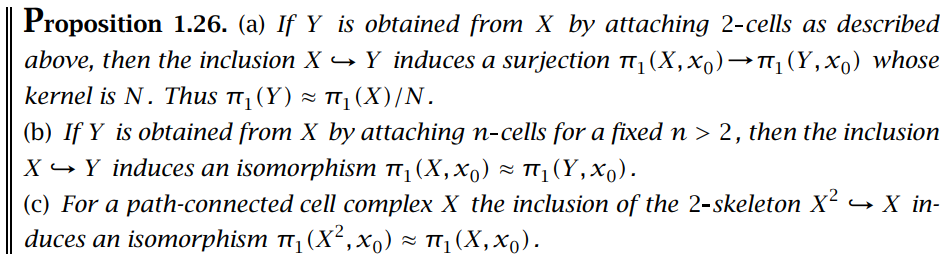
I don't quite understand (c)
X is an arbritrary path-connected cell complex, and "the 2-skeleton X^2" is...?
chrome ridge
high hill
X is an arbritrary path-connected cell complex, and "the 2-skeleton X^2" is...?
I think it's defined in the inductive definition of a CW-complex
 chrome ridge
yeah
high hill
I won't say I fully understand, but that is to say the n-skeleton is unique up to the starting set!?
I was under the impression it depended on the maps, surely
chrome ridge
you start with 0-cells and you get the 0-skeleton. Then you attach 1-cells to the 0-skeleton and you get a 1-skeleton. then you attach 2-cells to the 1-skeleton and you get 2-skeleton and you go on like that
high hill
I agree you get a 2-skeleton, surely you can choose how many 2-cells to attach and how to attach them?
chrome ridge
high hill
I agree you get *a* 2-skeleton, surely you can choose how many 2-cells to attach...
I guess so ?
high hill
high hill
https://i.imgur.com/UHbjsCh.png
Then which 2-skeleton does this proposition refer to?
Any?
I don't get the reusage of the letter X, either. We start as X^0 = X, build X^1, then build X^2?
In which case I wouldn't understand the inclusion map... surely X is contained in X^2 if so
Ohh ok, I think step (3) is key. X = X^n for some n >= 2 presumably
chrome ridge
magic geyser
good question. definitely we need to use $n\geq 4$. the inclusion $M-S^1\subse...
The paper you sent probably uses a different approach than Van-Kampen's; I didn't quite understand what they're doing. Do you have any other suggestions? could elaborate more on the transversality argument ?
 fading vale
high hill
Any?
fading vale
high hill
Any?
Any yes
fading vale
high hill
Ohh ok, I think step (3) is key. X = X^n for some n >= 2 presumably
the inductive process doesnt have to terminate
X can have n-cells for any n
The point of this claim is basically that pi_1 is depending only on the 2-skeleton (meaning the n-cells for n <= 2)
and that adding a 2-cell is equivalent to adding a relation to the group pi_1
gentle ospreyBOT
c squared

 rancid umbra
nvm
gritty widget
S^1 x R and C are not homeomorphic
if you remove the origin from C you disconnect it, but removing a single point from S^1 x R won't disconnect it
gritty widget
even basic algebraic topology tests kill it
one's simply connected (contractible, even) and the other isn't
rancid umbra
i was trying to show that M/A is homeomorphic to C where A = S^1 x {0}
and we collapse A to a point
and i wanted to argue by using quotient maps
gritty widget
the map q descends to a map S^1 x R / A -> C which might be what you're looking for
(by the universal property of quotient maps)
you should be able to write down a continuous inverse C -> S^1 x R / A to that without too much trouble
rancid umbra
i guess my thought was that the quotient map $p:M\to M/A$ and the map $q$ above make the same identifications. if i could show that $q$ was indeed a quotient map then i would be done
gentle ospreyBOT
c squared
 rancid umbra
where M = S^1 x R
bitter smelt
anyone have a visualization of $S^2 \times S^1$
gentle ospreyBOT
Migillope
 high hill
bitter smelt
anyone have a visualization of $S^2 \times S^1$
high hill
bitter smelt
anyone have a visualization of $S^2 \times S^1$
S1 x S1 you can imagine a circle orbiting around a point to make a torus.
The same for S2, the (surface of the) sphere orbits, but this needs to take place in R^4. You can still 'visualize' the orbit in R^3 if you allow things to go through each other
Another option is to think of S2 as 2 copies of D2 'glued' at the D2 boundaries.
Visualizing the orbit separately for each D2 copy, you get the interiors of 2 tori and the 2 are identified at the boundary of the tori
 sharp frost
This does Not™️ make any sense because $\partial_{q+1}s_q=\operatorname{id}{Z_q}$ so how are they ending up with $\operatorname{id}{C_q}}$ at the end
 gentle ospreyBOT
Compile Error! Click the  reaction for more information.
(You may edit your message to recompile.)
 high hill
Can I have a hint on how one formally proves a loop that goes around S1 once is not nullhomotopic. Say f : I -> S1, f(x) = x mod 1
high hill
high hill
Can I have a hint on how one formally proves a loop that goes around S1 once is ...
Looking around, I seem to need covering spaces to show this? In which case it seems to me when the concept of homotopy classes is initially defined, it isn't clear (apart from some geometric intuition) there necessarily exists more than 1 class in any space?
 hollow harbor
high hill
Looking around, I seem to need covering spaces to show this? In which case it se...
hollow harbor
high hill
Looking around, I seem to need covering spaces to show this? In which case it se...
Certainly, determining simply connectedness is not easy
I mean
There are proofs that don't use covering spaces
Actually I can't think of one
If you know any diff top, you know that you can define the mod 2 degree of smooth maps and see that it's smooth homotopy invariant, and any homotopy can be smoothened without too much error. This is a way around using covering spaces
pallid lion
If you know some complex analysis you can also show it by proving that the path integral of 1/z around 0 is not 0. I don't think the homotopy invariance of holomorphic path integrals relies on any covering space things iirc
unreal stratus
hollow harbor
There are proofs that don't use covering spaces
Another proof is simplicial approximation, say, which one could prove in this special case specifically if rly needed
But ye idk how long that'd be to do from scratch lol
swift fjord
you can also use lifting to define the degree and show that it's homotopy invariant
I think that's the lowest-tech method but it's not very enlightening
or intuitive
like you can do it without 'needing' covering space thoery
hollow harbor
pallid lion
If you know some complex analysis you can also show it by proving that the path ...
Oh that's a good one
hollow harbor
swift fjord
you can also use lifting to define the degree and show that it's homotopy invari...
I figured that this is what shuri meant by covering spaces. But personally I feel like it's the best way to do it. Not like the lifting lemma here is super hard to prove.
hollow harbor
ye
idk what else they would have meant by "needing covering spaces" since the lifting method is the standard proof 
(and, imo, by far the most intuitive - i guess the diff top one is fine, the complex analysis one is not intuitive at all though from my perspective)
high hill
Thanks 👌
 coarse night
gritty widget
if you remove the origin from C you disconnect it, but removing a single point f...
coarse night
gritty widget
if you remove the origin from C you disconnect it, but removing a single point f...
how does removing origin disconnects C?
nvm wrong plot

btw how to show smash product of $S^n$ and $S^m$ is $S^{n+m}$?
gentle ospreyBOT
 gritty widget
coarse night
how does removing origin disconnects C?
gritty widget
coarse night
how does removing origin disconnects C?
To avoid further confusion of people, it's not $\mathbb{C}$ but $C$.
gentle ospreyBOT
Blitz
 gritty widget
coarse night
btw how to show smash product of $S^n$ and $S^m$ is $S^{n+m}$?
gritty widget
coarse night
btw how to show smash product of $S^n$ and $S^m$ is $S^{n+m}$?
Mathematics Stack Exchange
How to prove rigorously that $\mathbb S^n \wedge \mathbb S^m =\mathbb S^{n+m}$ and $\mathbb S^n \ast \mathbb S^m = \mathbb S^{n+m+1}$?
And what intuition should i have for compute $\wedge,\ast$ for
 pearl holly
I'm very sorry if this is a dumb question but I'm very tired and I can't stop thinking about this. Anyway, why is F_nH_n(E) = H_n(E)?

F_nH_n(E) is the image of H_n(p^(-1)(B^n)) --> H_n(E) where p: E --> B is the fibration and B^n is the n-skeleton of B
pearl holly
ok me go to sleeps so I won't be able to respond
gentle ospreyBOT
bchaotic

 cursive spade
would the argument here be that since f induces a full functor from the cat of paths in X to the cat of paths.
obtuse meteor
that's major overkill
gritty widget
oh my goodness
gritty widget
going to revoke your category theory language pass for that one
cursive spade
cursive spade
the image of a connected space is connected under a cont. function
I don't think this is true for path connected
gritty widget
have you tried to prove it?
gritty widget
cursive spade
would the argument here be that since f induces a full functor from the cat of p...
Why is it a full functor?
obtuse meteor
pearl holly
F_nH_n(E) is the image of H_n(p^(-1)(B^n)) --> H_n(E) where p: E --> B is the fi...
I believe p^(-1)(B^n) should be the n-skeleton of E
gritty widget
pick two points in Y. need a path connecting them? you can find one connecting their preimages, so...
ocean narwhal
cursive spade
would the argument here be that since f induces a full functor from the cat of p...
"cube root of 2 is irrational because cube root 2 = p/q => 2q^3=p^3 contradicting Fermat's last theorem"
obtuse meteor
or well. actually it's a higher skeleton of E depending on the dimension of F
but either way it's like. Definitely has the same H_n
bc it'll have the same n-skeleton
er well
off by one errors here
but this doesn't matter :)
obtuse meteor
obtuse meteor
bc it'll have the same n-skeleton
it's surjective at least bc of this
gritty widget
gritty widget
pick two points in Y. need a path connecting them? you can find one connecting t...
Wouldn't it being full mean that every path in Y is of the form, f o p where p is a path in X
blitz i don't even know what full means, im trying to tell them the normal way to prove this
(and i do not want to learn what it means either)
Oh. Sorry, I thought you were responding to me
pallid lion
I've known what the projective space is for a good 2 years now
nevertheless my intuition for it is still garbage
the "lines through the origin" analogy is just semi-comforting, will this ever go away
magic geyser
wait until the proj construction
plain raven
pallid lion
I've known what the projective space is for a good 2 years now
Do you know about the duality principle?
pallid lion
plain raven
Do you know about the duality principle?
most likely not
it doesn't sound like sth that ever came up in one of my courses. at least not those 2 words exactly combined like that
plain raven
A lot of the basic theorems of geometry are almost dual in the sense that if you swap "point" and "line" you get something else that's true. Like -
- Any two points determine a unique line (the line which passes through them)
- Any two lines in the plane determine a unique point (their point of intersection)
The problem here is that (2.) is not exactly true. Really it's, any two lines determine a unique point *unless they're parallel, in which case they never meet.
That's kind of an annoying counterexample
hidden crag
can you kinda trick that counterexample by compactification
pallid lion
hidden crag
can you kinda trick that counterexample by compactification
I mean that's kind of what the proj space does
plain raven
Well that's where i'm going.
Projective geometry can be seen as an attempt to rigorously reformulate the basic notions of geometry so that (2.) is true. In the projective plane, for every line in the plane there is an additional point added at "infinity" at the end of the line (which can be approached from both directions
hidden crag
pallid lion
I mean that's kind of what the proj space does
brainlag
plain raven
Then it's just straight up true that any two distinct lines intersect at a unique point. If they're parallel, they intersect at infinity.
pallid lion
I feel like this still doesn't quite tell me what happens in higher projective dimensions... well I'm sure there is a good analogon though as bezouts theorem basically tries to tell us about it
plain raven
Well, learning about duality in low dimensions will at least give you a better foothold if you want to try and understand n-dimensional projective space!
I think another reason for talking about projective geometry is that even if you start with objects which don't really require projective geometry to formalize, it can be useful to use projective geometry to formulate the general idea of a morphism between objects in your category
and thus to give a notion of when two objects are isomorphic
and "the same" from the pov of your theory
Even if you're really not cat-brained, in order to understand a branch of math you need to know when objects are essentially "the same" from the pov your theory
In projective geometry two things are the same if they differ by a projective transformation
i.e. a change in the pov of the 'observer'
pallid lion
ok here things are starting to sound buzzy for me
pallid lion
plain raven
I think another reason for talking about projective geometry is that even if you...
this flies over my head
plain raven


You can research projective transformations to learn about more. But basically, think of the affine plane as being embedded into projective space by the map that sends (x, y) to [1 : x : y]
Projective geometry, like any other branch of geometry, has some notion of when two spaces are "the same" - two manifolds are the same if they're diffeomorphic, etc.
Two subsets of the plane are "the same" from the pov of projective geometry if they are the same up to a projective transformation in both directions
If A , B are two sets of the affine plane (regarded as subsets of the projective plane by the inclusion) then A and B are projectively equivalent if there is an invertible linear transformation R^3 -> R^3 sending A bijectively onto B
pallid lion
ok this makes more sense. this seems very grassmannianish if I'm not wrong
plain raven
Projective n-space is Gr(1, R^n+1), the Grassmannian of lines in R^n+1
pallid lion
I meant more with the "being equal" if there is an invertible linear transformation from one to the other. do you mean by "equal" here just isomorphic or actually some equivalence relation
nvm "projectively equivalent"
plain raven
"A and B are isomorphic" is an equivalence relation on objects of a category
Two groups are generally considered by group theorists to be the same if they are isomorphic.
All interesting group-theoretic properties are preserved under isomorphism of groups
Projective geomety studies only those properties of objects which are preserved under isomorphic projective transformations
obtuse meteor
plain raven
All interesting group-theoretic properties are preserved under isomorphism of gr...
Strong disagree
pallid lion
yeah but no I meant more in a topological sense. if this was an equivalence relation on some top space. which looking at it now isn't what was meant
obtuse meteor
Or rather I would be more careful than that lol
plain raven
There is a difference between Z and an infinite cyclic group in that one is equipped with a choice of generator and the other isn't, I guess
obtuse meteor
Some grp theorists are very interested in particular actions as well which are richer ofc
Or like subgrps contain more structure than just as a grp (more appropriate to view as slice category)
pallid lion
I don't quite see how that invalidates what clerk said
anyways, thanks for the help, I gotta go to bed
sweet non-canonical nightmares
unreal stratus
The dark side is a path to many abilities some consider non-functorial
 dry jolt
today I learned a little bit about H-spaces!
but I'm seeing conflicting definitions :( Lecture notes say it's a space equipped with "multiplication" map and "inversion" map while sources online just say "multiplication" map
Or rather, lecture notes call H-space a group object in homotopy category of spaces
plain raven
In my experience i've seen the weaker definition (monoid object in the homotopy category) more often
Did you see the eckmann hilton argument yet
that one's so cool
dry jolt
I've seen it in a group theory text in the past, think we'll cover it in class tomorrow
that's used to show higher homotopy groups are abelian, right?
plain raven
Yeah but the same argument shows that all homotopy groups of an H-space are Abelian.
dry jolt
primary example right now are loop spaces (which I'm still trying to internalize) so I'll have to think about that
well I guess suspensions too for cogroups
methinks loop spaces are confusing because my topology notes never covered compact open topology lol
plain raven
dry jolt
primary example right now are loop spaces (which I'm still trying to internalize...
Actually, this observation lets you see that the theorem "all homotopy groups of an H-space are abelian" implies that all higher homotopy groups of an arbitrary space are abelian.
The argument is as follows: Elements of $\pi_{n+2}(X,x_0)$ are the same as homotopy classes of maps in $[ \Sigma\Sigma (S^n, p) ; (X,x_0)]$. By the exponential correspondence (adjunction) between suspension and loop space (which you can check respects the homotopy equivalence relation) this is the same as $[ \Sigma (S^n,p), \Omega(X,x_0)]$. So $\pi_{n+2}(X,x_0)\cong \pi_{n+1}(\Omega (X,x_0))$. So the former is Abelian iff the latter is.
gentle ospreyBOT
diligentClerk
 plain raven
I mean maybe it's not obvious a priori that the bijections are group isomorphisms but this turns out to be true when you check it
dry jolt
oh that's a neat way to think about it
plain raven
The Eckmann-Hilton argument also shows that if $H$ is an H-space with multiplication $\mu: H\times H\to H$ , the induced multiplication of maps in $[S^n, H]$ given by sending $(f, g)\mapsto \mu \circ (f,g)$ agrees with the multiplication in $\pi_n(H)$, giving two equivalent ways to present the multiplication of the homotopy group
gentle ospreyBOT
diligentClerk
 swift fjord
plain raven
Yeah but the same argument shows that all homotopy groups of an H-space are Abel...
swift fjord
plain raven
Yeah but the same argument shows that all homotopy groups of an H-space are Abel...
It also shows that homsets in the stable homotopy category are abelian
It's so broken
Like in particular it gives you a group structure
dry jolt
I hope we touch on stable stuff sometime
obtuse meteor
dry jolt
methinks loop spaces are confusing because my topology notes never covered compa...
The compact open topology is just the thing that makes hom adjunction true. Knowing anything else is kinda useless imo
plain raven
Walter if the compact open topology seems arbitrary it helps to go back to analysis. the compact open topology on maps R->R is just the same as the topology of uniform convergence on compact subsets
that comes up in like, Arzela-Ascoli or shit like this
dry jolt
obtuse meteor
The compact open topology is just the thing that makes hom adjunction true. Know...
sorry, could you elaborate a bit on the adjunction here? Is this in relation to the smash product?
But yes, calling back to analysis makes it feel more natural
plain raven

This theorem should be equivalent to saying that if you take any subset A \subset C(X) which is equicontinuous and pointwise bounded, then the closure of A is compact in C(X) (with the compact open topology)
I could be fucking up the translation
gritty widget
plain raven
This theorem should be equivalent to saying that if you take any subset A \subse...
I think it's too weak because we talk only about sequences
plain raven
I get your intuition. But I think C(X) should be metrizeable under the given hypotheses. Does that change anything?
gritty widget
Yeah it should be.
plain raven
For a compact Hausdorff space, C(X;R) should be metrizable under the sup norm. And if X is sigma compact then I think that we should be able to put a metric on C(X) by hacking together the metrics of the compact subspaces.
obtuse meteor
dry jolt
sorry, could you elaborate a bit on the adjunction here? Is this in relation to ...
Hom(X x Y, Z) = Hom(X, Map(Y,Z))
gritty widget
plain raven
For a compact Hausdorff space, C(X;R) should be metrizable under the sup norm. A...
Not necessarily. But if it's LCH then it should admit exhaustion by compact sets
And using it we get topology of uniform convergence on compact sets which is metrizable
Anyway I think Arzela-Ascoli is more general but I'll double check
They use compact-open topology here

Y is Hausdorff
plain raven
dry jolt
sorry, could you elaborate a bit on the adjunction here? Is this in relation to ...
In what Faye said you need to assume the space Y is locally compact and hausdorff. We can anticipate her response scoffing about pathologies in the category of Top and not working in a convenient category of spaces.
gritty widget
I think this is topology of uniform convergence on compact sets when Y is LCH but I might be wrong here.
plain raven
Nice.
hollow harbor
Yes, that's correct.
gritty widget
hollow harbor
Yes, that's correct.
Thanks. I knew it is for compact Hausdorff Y, but wasn't sure here
hollow harbor
Yea
gentle ospreyBOT
poTato
 swift fjord
Oh btw @dry jolt I did a talk on the stable homotopy category if you wanna take a look
It was part of MaxJ's seminar
Following afa.s
Adams
 kindred drum
here's the proof that metric spaces are normal, for the set S let $S_{\varepsilon}^{}={x | d(S,x)<\varepsilon }$, obviously, $S_{\varepsilon}^{}$ is open. Take any closed sets A and B, we will show that for some $\varepsilon$ it holds that $A_{\varepsilon}^{} \cap B_{\varepsilon}^{}$ is nonempty, assume that $x \in A_{\varepsilon}^{} \cap B_{\varepsilon}^{}$, then $d(A,B)\leq d(A,x) + d(B,x) \leq 2 \varepsilon$, for epsilon small enough we get contradiction since distance between closed sets are positive. Is this correct?
gentle ospreyBOT
poTato
 unreal stratus
gentle osprey
**poTato**
unreal stratus
gentle osprey
**poTato**
Wdym by common distance here?
ocean narwhal
hausdorff distance probably
kindred drum
 ocean narwhal
kindred drum
ocean narwhal
kindred drum
thats not a metric (edit: nvm)
kindred drum
A and B are subsets of metric space with distance function d, these definitions are just "extension"
ocean narwhal
kindred drum
A and B are subsets of metric space with distance function d, these definitions ...
ohh okay
kindred drum
kindred drum
you can assume that these are some new functions
triangle inequality holds for such extension, it is easy to prove so assume that it is also true
oh, there's mistake
distance between closed sets could be zero even if they are disjoint
but i think i know how to modify this argument
dry jolt
swift fjord
Oh btw <@288018899805667331> I did a talk on the stable homotopy category if you...
I would in fact be interested in looking at this
pearl holly
obtuse meteor
I believe p^(-1)(B^n) should be the n-skeleton of E
okay so just to make sure, we're using a CW approximation and I can do this without issue?
fading vale
pearl holly
okay so just to make sure, we're using a CW approximation and I can do this with...
im not convinced this is true...
pearl holly
what's not true?
fading vale
That the preimage of the n skeleton of B should be the n skeleton of E after homotopying
meaning after doing CW approximation and homotopying your map to a cellular one
i cant think of a counterexample but in general CW complexes are not closed under pullbacks (literal pullbacks i mean)
pearl holly
yeah I wasn't entirely convinced either but idk
pearl holly
pearl holly
I'm very sorry if this is a dumb question but I'm very tired and I can't stop th...
tbh this looks like a typo to me or something
pearl holly
like not the theorem itself
fading vale
I think pullbacks are homotopy equivalent to homotopy pullbacks when you do it along a fibration right?
fading vale
Im pretty sure this is true
so p^-1(B_n) is the pullback of the inclusion B_n -> B along the fibration p
hence its homotopy equivalent to the homotopy pullback
which does have the homotopy type of a CW complex
so you can reduce the problem to saying that the homotopy fiber of the n skeleton along a cellular map is the n skeleton, up to homotopy
pearl holly
ye right I see
fading vale
i dont see an easy proof of this : /
fading vale
pearl holly
ye right I see
cant you just take the inclusions E_n -> p^-1(B_n) -> E commuting with the inclusion E_n -> E and use that since the latter induces an isomorphism on H_n, p^-1(B_n) -> E induces a surjection on H_n?
its like 6 am so maybe im like
being extremely fucking stupid
or no not E_n wtf E_n+1
obtuse meteor
fading vale
cant you just take the inclusions E_n -> p^-1(B_n) -> E commuting with the inclu...
This is better but I think what I said is true precisely bc it’s a fibration yeah
pearl holly
thanks to both you btw!
obtuse meteor
What moth does to formally justify what I did is a bit overkill though. You can place a CW structure on the total space of a fibration a priori w/o appealing to CW approximation
From this pov what I said that it’s a higher skeleton is apparent
obtuse meteor
obtuse meteor
What moth does to formally justify what I did is a bit overkill though. You can ...
Ok as long as the base space is connected which is probably a safe assumption here
fading vale
obtuse meteor
What moth does to formally justify what I did is a bit overkill though. You can ...
u need to CW approximate for the fiber i think though
bc it doesnt say its a CW space in the problem
but also yeah im dumb if you just CW approximate the fiber then the CW structure on the total space is literally just cells times cells of the fiber
or something
wait is it...
obtuse meteor
fading vale
bc it doesnt say its a CW space in the problem
Ah I didn’t see this
Everything is CW ☺️
fading vale
Oh yes right
i see
this is kind of a yass actually
the preimage of any cell under the fibration is cell x F
because the cell is contractible
obtuse meteor
fading vale
this is kind of a yass actually
Agreed
I thought it must be true and looked it up
fading vale
society if moth understood AT
obtuse meteor
I was just like “true for coverings…no way it’s not true”
fading vale
I think its true for coverings because the fiber is discrete
so its automatically a CW complex
obtuse meteor
Ah I mean yeah I assumed fiber + base are cw to get total cw
coarse night
Let $X, Y$ be Housdroff topological spaces, then we know that $A \subseteq X$ is a compact subspace and $f : A \to Y$ be continuous, then $X\sqcup_f Y$ is housdroff. My question is, is it true when $A$ is \textbf{not} compact, but only closed? Any CE in case answer is no.
gentle ospreyBOT
 hidden crag
what's a closed topological space for you
swift fjord
My eyes skipped over the first line
coarse night
hidden crag
what's a closed topological space for you
I meant to write housdroff
Let $X, Y$ be Housdroff topological spaces, then we know that $A \subseteq X$ is a compact subspace and $f : A \to Y$ be continuous, then $X\sqcup_f Y$ is housdroff. My question is, is it true when $A$ is \textbf{not} compact, but only closed? Any CE in case answer is no.
gentle ospreyBOT
 gritty widget
coarse night
I meant to write housdroff
gritty widget
coarse night
I meant to write housdroff
Hausdorff
coarse night

dry jolt
Is the adjunction $[\Sigma X, Y] \cong [X, \Omega Y]$ also an isomorphism of groups?
gentle ospreyBOT
walter
 bitter smelt
If I have a direct sum decomposition of the manifold into $n$ pieces, how can I find the orientation of one of the pieces given the other $n-1$? I can give more context if necessary
gentle ospreyBOT
Migillope
 bitter smelt
I'd prefer the most generic answer though
bitter smelt
Maybe more #diff-geo-diff-top
gritty widget
coarse night
Let $X, Y$ be Housdroff topological spaces, then we know that $A \subseteq X$ is...
Let Y be a point. Then this is X/A. If X isn't regular, there exists closed set A and point x of X which can't be separated by open neighbourhoods. Then the same is true in X/A so it's not Hausdorff
So let X be a Hausdorff but not regular space
Alexandroff plank is probably the most common
If it's not normal then take Y to be a two-point space and f to map the two closed sets A, B for which it falls onto distinct points of Y
And here you can have stuff like deleted Tychonoff plank
gritty widget
So it's not true even if we assume they are regular
Btw. If X, Y are separable metric spaces and A is compact, f:A to Y continuous, then the resulting space is separable metric
But if A is just closed then this can fail to be metrizable as R/Z shows
dry jolt
plain raven
Actually, this observation lets you see that the theorem "all homotopy groups of...
Another fun application brought up in class today is that homotopy groups of Lie groups are abelian 🐱
 spice jungle
hell ya
cursive spade
if I treat the determinant as a function GLn to C. how do I show the the fiber at each point in C\0 is connected.
in am trying to show GLn(C) is both connected and path connected
magic geyser
cursive spade
if I treat the determinant as a function GLn to C. how do I show the the fiber ...
do you know any decompositions for GL or SL?
magic geyser
cursive spade
<@882841089021722644>
the accepted answer here looks good https://math.stackexchange.com/questions/139549/how-to-show-path-connectedness-of-gln-mathbbc
Mathematics Stack Exchange
Well, I am not getting any hint how to show $GL_n(\mathbb{C})$ is path connected. So far I have thought that let $A$ be any invertible complex matrix and $I$ be the idenity matrix, I was trying to ...
cursive spade
ok I believe the problem boils down to showing the set of metrix with det 1 is connected
cursive spade
thanks @magic geyser
 elder edge
How do you visualize topological properties like compactness and completeness?
gritty widget
elder edge
How do you visualize topological properties like compactness and completeness?
For compactness I pretend I have infinitely many open sets in general that cover my set of interest and then ask myself if theres finitely many of them that will cover it. For completeness you can roughly think of it as saying if I remove bits of these two overlapping open sets or arbitrarily close open sets whose sequence of open subsets get arbitrarily close together as the process continues then they should converge to an element that is still in the space you considered a collection of open sets on. In that sense, whenever you narrow in on something shared by open sets or arbitrarily close open sets it’s not like it’s missing from the original space. All the holes we could try to think of by zooming in on shared parts of overlapping pieces or arbitrarily close bits of arbitrarily close pieces are patched
elder edge
Thanks for making it clear
gritty widget
Honestly dato i never forced myself to think about completeness until you asked
So thanks for giving me some enlightenment
coarse night
gritty widget
And here you can have stuff like deleted Tychonoff plank
I didn't quite get what you are saying. What is not true?
swift fjord
dry jolt
Another fun application brought up in class today is that homotopy groups of Lie...
Of topological groups in general! No need for smoothness
gritty widget
coarse night
I didn't quite get what you are saying. What is not true?
It's not true that it's Hausdorff if we only assume that A is closed
coarse night
ok but X,Y normal and A closed does mean that X U_f Y is normal right
gritty widget
That's sadistic
gritty widget
dry jolt
Another fun application brought up in class today is that homotopy groups of Lie...
https://en.wikipedia.org/wiki/Eckmann–Hilton_argument
doesn't even have to be a group either
gritty widget
coarse night
ok but X,Y normal and A closed does mean that X U_f Y is normal right
it actually is normal
The proof is 3.4 in Dugundji
My bad, it's not something I remembered
coarse night
can you write the full name of the book
gritty widget
is something like this true for alexander spanier cohomology
we have a space X
we cover it with closed sets
do this in a sufficently nice way that it makes sense about a set corresponding to a point x
fix some element in the cohomology of X
define a subspace of X as follows
x in X such that f is not in the kernel of the map H(X) to H(Vx)
the map H(X) to H(Vx) is the map induced by the inclusion of the closed set which corresponds to x
plain raven
dry jolt
Another fun application brought up in class today is that homotopy groups of Lie...
Very cool.
unreal stratus
is there any nice or particularly major motivation for configuration spaces? I know about the related physics notion but curious about the motivation to study config spaces in their own right
 shadow rampart
is a set open iff every element has a nbd contained in the set ?
unreal stratus
yes, now try proving it
spice jungle
unreal stratus
is there any nice or particularly major motivation for configuration spaces? I k...
Well, config spaces parametrizes points in manifolds right, for example if you wanna study braid group action
Then you might want to think about n points onR^2
Also they give E_n operads
And there is like this Ran space in geometric Langlands, which is like a complex geometric version of points on Riemann surfaces
 cedar pebble
unreal stratus
is there any nice or particularly major motivation for configuration spaces? I k...
cedar pebble
unreal stratus
is there any nice or particularly major motivation for configuration spaces? I k...
the KZ equation and its monodromy is a nice motivation/application of configuration spaces
there's a lot of fun things you can do with the KZ equation depending on how you set it up
spice jungle
cedar pebble
the KZ equation and its monodromy is a nice motivation/application of configurat...
What is the KZ equation???
Heard it so many time now I’m too afraid to ask
cedar pebble
yeah so the definition is kinda complicated and depends on a choice of affine Lie algebra
there's a universal version that is related to this that is somehow a little easier to understand I think
the basic example is the universal KZ equation on Conf_4(CP^1)/PGL_2(C)=CP^1-{0,1,\infty}
it's a Fuchsian differential equation with values in (a completion of) the free Lie algebra on two generators X_0 and X_1, so elements are like formal power series in brackets like [X_0,X_1] and so on
spice jungle
Sure you are saying something about the 4 point function right
cedar pebble
right
cedar pebble
I don't think so, since this isn't quite using an affine Lie algebra so you're not getting e.g. an embedding of the Virasoro Lie algebra into your chosen affine Lie algebra by Siegel-Sugawara
but nevertheless the following is illustrative: take the Fuchsian differential equation $\mathrm{d}F=\Big(\frac{\mathrm{d}z}{z}X_0+\frac{\mathrm{d}z}{1-z}X_1\Big)F$
gentle ospreyBOT
nGroupoid
 cedar pebble
so it's taking values in the completed universal enveloping algebra of this free Lie algebra, so non-commutative formal power series in two variables X_0 and X_1
spice jungle
Interesting
cedar pebble
the parallel transport of this equation along paths in P^1-{0,1,\infty} is basically expressed in terms of the monodromy of multiple polylogarithms
spice jungle
Do I know you from another server LOL
cedar pebble
in particular, if you take the parallel transport of this equation along a straight path from 0 to 1 and suitably regularize it you get multizeta values
yeah maybe lol
cedar pebble
yeah we've probably talked before hi 
but yeah these 4 point functions from this universal KZ satisfy braid relations
so like Yang Baxter or whatever
you can define the same universal KZ equation for n points in general (and you kinda need to play around with the 5 point functions to prove a pentagon identity for this associator) but as is usually the case in CFT things reduce to the 4 point situation
the usual KZ equation that physicists care about is similar to this, just with affine Lie algebras instead of these free Lie algebras, but it's a similar game
 rich bison
How much Algebraic Topology does one need to know for Homotopy Theory? Or can I directly jump into homotopy theory?
Also what would be a good introduction to it, videos are more welcome
 lunar yoke
rich bison
How much Algebraic Topology does one need to know for Homotopy Theory? Or can I ...
lunar yoke
rich bison
How much Algebraic Topology does one need to know for Homotopy Theory? Or can I ...
I dont know of any introductory homotopy theory lectures on youtube, but this is a nice playlist as a first course in algebraic topology https://www.youtube.com/playlist?list=PL2Rb_pWJf9JqgIR6RR3VFF2FwKCyaUUZn

YouTube
rich bison
lunar yoke
I dont know of any introductory homotopy theory lectures on youtube, but this is...
Hmm... We assume basic knowledge about the fundamental group, categories and CW-complexes throughout the course, these things weren't taught to me in topology (except fundamental group). Should I read about them somewhere or should I check other series which doesn't assume them like - https://www.youtube.com/playlist?list=PLpRLWqLFLVTCL15U6N3o35g4uhMSBVA2b (by Pierre Albin) or go through some topology playlist covering them?
 shadow charm
Are there situations when computing homotopy/homology groups where the group you get is a topological group in a way that makes sense (ie the topology on the group has something to do with the topology of the original space) and where you can compute the homotopy/homology groups of that to get information on the starting space?
 gaunt linden
Hmm. I think there are cases where you can get a nontrivial topology on a homotopy group in a natural way -- e.g. the fundamental group of (R\{0})×R union {0}×Q. But the topology would be pretty ugly because "homotopy group" implies collapsing each path-connected component to a single point before you define the group operation. So its homotopy group(oid)s would be trivial.
unreal stratus
cedar pebble
the KZ equation and its monodromy is a nice motivation/application of configurat...
Oh interesting hadn't heard of this thanks
 mortal iris
@rich bison I'd say read up on them, they do only say basic knowledge. There's a good intro to categories for AT in Rotman and for CW complexes I'd suggest Chapter 5 of Lee's Topological Manifolds.
rich bison
mortal iris
<@362794394887127042> I'd say read up on them, they do only say basic knowledge....
Is that his - An Introduction to the Theory of Groups or Advanced Modern Algebra?
mortal iris
It's his Introduction to Algebraic Topology
@rich bison Chapter 0 should have about all you'll need, if it's not enough, there's also Topology: A Categorical Perspective by Bradley, Bryson, & Terilla. But I don't have too much experience with that book
gritty widget
Say A is a retract of X and r:X to A is a retraction.
Say H:X x I to X is a homotopy between H_0 = Id_X and H_1 = const.
Consider G = r o H o i where i:A x I to X x I is the inclusion, i(a, t) = (a, t).
Then G_0(a) = r o H(a, 0) = r(a) = a so that G_0 = Id_A and G_1(a) = r o H(a, 1) = r(const.) = const.
@uneven hawk
This proves that G is a contraction from Id_A to a constant function, so A is contractible
 stark creek
Okay.
spice jungle
Okay
opaque cloud
how do we define dimension in a topological space?
like are we able to define it in such a way that it naturally generalizes the notions of dimension that we're most familiar with?
for example let's say you think of a finite dim normed vector space as a topological space and ignore the basis
if you looked just at the topology and found out what dimension it would be, would it be the same dimension as looking at the basis set and seeing what dimension it would be?
 tawdry valve
I don't know anything about it, but I've heard that https://en.wikipedia.org/wiki/Lebesgue_covering_dimension is the thing that you're looking for
In mathematics, the Lebesgue covering dimension or topological dimension of a topological space is one of several different ways of defining the dimension of the space in a
topologically invariant way.
so this does meet your criteria---euclidean n dimensional space has lebesgue covering dimension n (same will follow for any finite dim normed space, since all norms are equivalent for finite dimensions). it looks like kinda a weird definition, I don't have any intuition for it yet
opaque cloud
thanks
tawdry valve
yup
opaque cloud
it does seem kinda weird  I'm gonna wait until I learn more top
tawdry valve
yeah that seems fine lol, I've never seen this in a course, I've only ran into it online a few times
it seems a lil tricky to prove something has lebesgue covering dimension greater than n for some n
gritty widget
in algebraic geometry i learned the definition of dimension for topological spaces that is dual to the krull dimension of a ring
the dimension of a topological space is the supremum of the lengths of chains of closed irreducible subsets
so you might call it the krull dimension of a topological space
different requirements necessitate different definitions
worth noting that this dimension is a little goofy if you're not doing algebraic geometry
there's also fractal dimension and hausdorff dimension, but i haven't the faintest fucking clue what those do
pallid lion
I thought it was sort of meant to be a thing to see in what dimesion does it "make sense" to give your object a measure is really vaguely what the hausdorff measure does. If you try to measure the "line volume" (dimension 1) of a bended area in 3d space it's obviously infinity, but if you measure it with spheres (dimension 3) it is zero. so you'd have to choose the right method of measure "little pieces of area" (dimension 2) for your paper to have finite volume that is not 0 (sometimes there is none, so you just take the infimum of all dimensions where it is 0). The Hausdorff dimension actually allows for fractal dimensions and it turns out that due to some self similarity arguments (3b1b has a really good video on this), some objects do deserve a fractal dimension (like the sierpinski triangle).
ornate berry
gritty widget
there's also fractal dimension and hausdorff dimension, but i haven't the fainte...
Fractal/Hausdorff dimension is specific to metric spaces rather than topological spaces. It requires a notion of distance (specifically, diameter of a subspace).
gritty widget
Yeah that's not really... topological
There's small/large inductive dimensions too
This all goes under a field of topology called dimension theory
I don't know much about it, but all the standard ways of measuring dimensions should agree for separable metric spaces.
Together with the theory of continua, dimension theory is the oldest branch of general topology. The first concepts and facts predate Hausdorff’s definition in 1914 of general Hausdorff topological spaces and, so, involved only subsets of Euclidean spaces.

SpringerLink
- Brief Historical Sketch. Together with the theory of continua, dimension theory is the oldest branch of general topology. The first concepts and facts predate Hausdorff’s definition in 1914 of general Hausdorff topological spaces and, so,...
Also see Engelking's "Dimension theory"
gritty widget
gritty widget
I don't know much about it, but all the standard ways of measuring dimensions sh...
There's examples of metric spaces where the small end large inductive dimensions don't agree
 stable wing
cedar pebble
the parallel transport of this equation along paths in P^1-{0,1,\infty} is basic...
stable wing
cedar pebble
the parallel transport of this equation along paths in P^1-{0,1,\infty} is basic...
do you have a reference for this? i couldn't quite follow from the discussion
cedar pebble
stable wing
do you have a reference for this? i couldn't quite follow from the discussion
this is given in a lot of places, for instance like section 1.5 of this book http://javier.fresan.perso.math.cnrs.fr/mzv.pdf
basically the point is that if the universal KZ equation looks like
$\mathrm{d}F=\Big(\frac{\mathrm{d}z}{z}X_0+\frac{\mathrm{d}z}{1-z}X_1\Big)F$
gentle ospreyBOT
nGroupoid
 cedar pebble
then this defines a connection on the trivial vector bundle (with infinite dimensional fibers C<<X_0,X_1>>) with connection 1-form as above:
$\omega=\frac{\mathrm{d}z}{z}X_0+\frac{\mathrm{d}z}{1-z}X_1$
gentle ospreyBOT
nGroupoid
 cedar pebble
the parallel transport of this connection is expressed in terms of iterated integrals of this 1-form along a given path
so a typical term will look like uhhhh
$\int_{0\leq t_1\leq\hdots\leq t_n\leq 1}\omega_1(t_1)\hdots\omega_n(t_n)\mathrm{d}t_1\hdots\mathrm{d}t_n$
gentle ospreyBOT
nGroupoid
 cedar pebble
where the \omega_i's are either dz/z or dz/(1-z)
but now you have integral expressions like
$\mathrm{Li}n(z)=\sum^\infty{k=1}\frac{z^k}{k^n}=\int^1_0\int^{t_1}0\hdots\int^{t{n-1}}0\frac{\mathrm{d}t_n}{1-t_n}\frac{\mathrm{d}t{n-1}}{t_{n-1}}\hdots\frac{\mathrm{d}t_1}{t_1}$
gentle ospreyBOT
nGroupoid
 stable wing
@cedar pebble amazing! thank you so much for explaining. that is really cool! (my background is in physics, so I am used to thinking about KZ but only in the context of Kac-Moody stuff)
cedar pebble
haha I am in the opposite camp, I learned this first and at some point tried learning the Kac-Moody stuff
cedar pebble
stable wing
<@375570548316438528> amazing! thank you so much for explaining. that is really ...
something you'll find kind of amusing... When you study these iterated integrals in this situation, you often want to specialize to the case z=1 so you're integrating along a straight path from 0 to 1. But this requires some regularization, since these differential forms have poles at z=0 and z=1 respectively.
there's a canonical way to regularize this: only integrate from \epsilon to 1-\epsilon, then expand as a power series in log(\epsilon), and take the constant term.
The book refers to this as "the physicists regularization scheme"


 gaunt linden
The constant term would be log(epsilon)=0, thus the integral backwards from 1 to 1-1?
stable wing
gaunt linden
The constant term would be log(epsilon)=0, thus the integral backwards from 1 to...
no the meaning is something like: one has an asymptotic series in \epsilon -> 0 of the form a0 log(\epsilon) + a1 + o(\epsilon). the first term is diverging but in the end we're just interested in a1. with some work you can show this is well-defined, if we were to choose a different regulator say
gaunt linden
Ah, okay. A "power series in log(epsilon)" sounded like a0 + a1 log(epsilon) + a2 log²(epsilon) + ... to me.
gritty widget
Question if my proof is correct: I have to show that given $d_1(f,g) = \int |f-g| dt, d_2(f,g) = sup |f-g|$ on C([0,1]) we have $\tau_1 \subsetneq \tau_2$:
Take $U \in \tau_1, f \in U$. There is $\varepsilon >0 : f \in A_{1, \varepsilon} \subset U$, where $A$ is epsilon nbhood wrt to metric 1. But since $$\int |f-g| \leq sup |f-g|$$ we have that $A_{2, \varepsilon} \subset A_{1, \varepsilon}$, so $U$ is open in $\tau_2$.
gentle ospreyBOT
Catematician
 gritty widget
I know that this doesnt show the nonequality of t1 and t2, havent tried that yet.
 abstract saffron
Wait, what's the question again?
gritty widget
gritty widget
Question if my proof is correct: I have to show that given $d_1(f,g) = \int |f-g...
well the phrasing of it is arguable but the inequality is the main ingredient here and I think you are thinking of the right thing
just the phrasing is bad
abstract saffron
gritty widget
<@383995074893185025> can you troll somewhere else
I just didn't see the question, if that's what you meant
Sketchy argument I'd say, but it seems good
gritty widget
mainly because A_(2, eps) doesn't contain the information about the center nor it was mentioned anywhere
and the center seems to be f
Oh yeah of course
Didn't really want to write out the definition of it in here.
For me you don't even have to mention open sets, just open balls and that'd be clear too
as for showing they are different, probably the easiest would be to take some sequence which is convergent in one metric but not the other
For the t_2 not a subset of t_1 some argument using unbounded functions that are integrating to 1 should work right>
hidden crag
Not sure what you mean by unbounded here
They’re continuous functions on a compact set
gritty widget
Okay so yeah that would work to show what you mentioned, but how exactly does that show their topologies are different? I mean, it makes sense because convergence depends on topology, but whats the rigorous arguemnt for that?
gritty widget
hidden crag
Not sure what you mean by unbounded here
unbounded set of functions of course (thats still a bad phrasing hah)
Spike getting bigger in say x=1/2 yet integrating to 1 or something like that.
if they are equal then convergent sequences in both are the same, obviously from definitions
I'm not sure what you're asking
convergence is defined using topology
a sequence f_n is convergent to f iff for every neighbourhood U of f, there is N such that f_n is in U for all n >= N
abstract saffron
gritty widget
For the t_2 not a subset of t_1 some argument using unbounded functions that are...
Yes, it should. You can make up a sequence of functions whose integrals are always 1, but nonetheless converging to zero function.
So that a sequence converges in a topology but not another.
gritty widget
abstract saffron
Yes, it should. You can make up a sequence of functions whose integrals are alwa...
no that won't work. If it converges pointwise then it converges uniformly
You want to take a sequence of functions which converges to 0 in L^1 but not in the sup-norm
An example should be f(x) = x^n
abstract saffron
I'm not sure if I get you right, but convergence in sup-norm (aka L-infinity) is far stronger than in L^1.
Wait, I'm messing myself 😄
abstract saffron
gritty widget
no that won't work. If it converges pointwise then it converges uniformly
It goes the other way, if it's converging uniformly, then it converges pointwise.
gritty widget
abstract saffron
It goes the other way, if it's converging uniformly, then it converges pointwise...
It does. But here it's equivalent
abstract saffron
Take the function defined as f_n(x) = n on [0, 1/n], and 0 everywhere else. The sequence converges pointwise to zero function, but the integeral remains 1.
gritty widget
not continuous but yea
abstract saffron
gritty widget
It does. But here it's equivalent
With some extra assumption, it will be equivalent, but unless I miss something, I didn't see it mentioned
gritty widget
It doesn't converge pointwise to the zero function
In fact a sequence of continuous functions on [0, 1] can't converge pointwise to the zero function
and it's not an example
abstract saffron
gritty widget
not continuous but yea
then you can cook up with affine function, say a line from (0, n) to (1/n, 0). A bit messier to write down, but it goes similarly
gritty widget
Yeah but cant converge to 0 pointwise because of f(0)
those won't produce examples of functions convergent in one norm but not the other
Yeah your example x^n works well.
abstract saffron
gritty widget
Yeah but cant converge to 0 pointwise because of f(0)
Oh, you need on [0, 1]? I thought (0, 1), my bad
gritty widget
(answering now deleted question) that looked like something homeomorphic to R
 odd flame
i can see how left is a subset of the right but why is the opposite not true?
 gritty widget
because it's more like cartesian product is multiplication and union is addition
you should have 4 terms on the left, not 2
odd flame
i can see that in my head but do u have any counterexampless
gritty widget
try writing some yourself
ornate berry
The empty set does in fact mess things up
Also, this isn't a topology question. This really should be in #discrete-math or #proofs-and-logic.
odd flame
fair, it's ch1 of munkres that's all
odd flame
ornate berry
The empty set does in fact mess things up
i see this now, oops lol
gritty widget
every book usually has some prerequisites but they are still not the main topic of the book
odd flame
swift fjord
odd flame
fair, it's ch1 of munkres that's all
Yea, which is a set theory review
gritty widget
Hi, another problem I'm not sure if I got correct. I'm asked to find cts bijection from (0,1] to S^1 and show there is none from S^1 to (0,1]. So for the first part f(x) = (cos2pix, sin2pix) should do the job, since functions on both coordinates are continuous, bijectivity is clear I think. For the second part, if it existed then those two would be homeo, but cannot be since (0,1] isn't compact.
Does that seem reasonable?
lunar yoke
gritty widget
Does that seem reasonable?
It already suffices to say that if we had a cts bijection S^1 -> (0,1] then the latter would be compact, yes
gritty widget
lunar yoke
It already suffices to say that if we had a cts bijection S^1 -> (0,1] then the ...
Oh true that.
lunar yoke
Do you have a homeomorphism if there exist cts bijectiosn X -> Y and Y -> X ?
they dont have to be inverses per se
maybe i just have brainlag
gritty widget
For some reason I remember it implying existence of homeo, maybe I'm just misremembering though, cause I can't come up with a proper argument.
lunar yoke
maybe one can do some kind of continuous cantor-schröder-bernstein argument
it wouldnt surprise me if there is a counterexample though
arbitrary spaces are wild
gritty widget
Hah yeah I just googled something of this sort and yeah uses weird set theory stuff I didnt bother reading.
lunar yoke
lunar yoke
maybe one can do some kind of continuous cantor-schröder-bernstein argument
oh wait i dont think you actually construct an inverse there, you also just get a bijection
gritty widget
I'll just stick to compact sets map to compact sets under cts functions lol
 golden gust
is a continuous bijection from a set to itself necessarily a homeo? feels untrue but for some reason I can't come up with a counterexample
gritty widget
with different topologies?
gritty widget
No iirc
There should be some example with a subset of R
I think you take a copy of N, a countable amount of (0, 1) and [0, 1) together
rich bison
Any topologists here. I have the munkres book and I am thinking of following this UG topology course at University at Buffalo. Are these any good -
https://www.youtube.com/playlist?list=PLoWHl5YajIf6MNTh7Ok024T1JkhZEcYXm

YouTube
Videos for the course MTH 427/527 Introduction to General Topology at the University at Buffalo.
gritty widget
like, {-n} for naturals n > 0, [0, 1) and (n, n+1) for n > 1
rich bison
They also have a nice website at https://www.mth527.site/ (with notes and homework)
gritty widget
you should try mapping -n to -n+1 here, [0, 1) to a part of (1, 2) and so on
the other part of (1, 2) to (0, 1)
I guess you don't need (n, n+1) for n > 1 but just (1, 2)
but yeah, this should be continuous bijection but not homeomorphism
@golden gust visualization of what the map does

oh yeah now I see why we need the intervals (n, n+1) for n > 1
that left part of the interval (1, 2) won't fill itself
so we need something similar to what we're doing with points {-n} on the left side here

like this
gritty widget
Back again with another problem: needed to show A in R^n is compact iff every cts function f: A -> R is bounded. => is clear because compact sets map to compact and in R its closed and bounded. Other way: Assume A is not compact, therefore unbounded or not closed. If unbounded then simply f(x)=|x| does the job for contradiction. If it's not closed, then there exists a sequence in A x_n converging to y not in A. Then we can define f(x)=1/|x -y| which is unbounded and cts. Does that work?
If A is not compact then it contains a closed subspace homeomorphic to N
just take f(n) = n and use Tietze extension theorem
Thank you for your idea but I was wondering if my proof is correct.
it's how you prove it in general
yes, your proof works
this property is called pseudocompactness btw
you essentialy shown that pseudocompactness is equivalent to compactness for subsets of R^n
as you already have seen, compactness always implies pseudocompactness
the converse is generally not true
You mean the property of any cts function being bounded?
yes
Never seen that term before
gritty widget
gritty widget
the converse is generally not true
Any example of such space off the top of your head?
I'd have to think about it more/research
No worries, thought maybe there is some easy classic example I couldve seen before.
gritty widget
gritty widget
No worries, thought maybe there is some easy classic example I couldve seen befo...
[0, omega_1] should work
wdym, like, extended reals?
no wait. It doesn't work
that's a compact space

not closed?
yes. I was going to say this next
there's this book about pseudocompact groups but it's a reference book

SpringerLink
should be this one
doesn't feel appropriate for reading but still, good for browsing results I suppose
 white oak
Hello!
Given continuous maps f, g: A → B, a homotopy is _h: A × 1 → B, h (_, 0) = f, h (_, 1) = g _. In some categories I can transport a function of two arguments h: A × 1 → B into a function into the space of functions curry h: 1 → (A → B). Then a homotopy I should like to be a set of functions indexed by 1 such that an open set in 1 is sent to an open interval in A → B. How should I define a suitable topology on A → B? What do I need to prove to make this work?
Makes sense, A → B being an exponential object.
https://en.wikipedia.org/wiki/Compactly_generated_space ← These k-spaces?
Cool, this is very curious. Is there a book I should check to find out more?
Thanks!
plain raven
Charles Rezk has an expository paper on compactly generated spaces here. https://faculty.math.illinois.edu/~rezk/cg-spaces-better.pdf
lament needle
What does it mean by on $S^2$
 gentle ospreyBOT
matthew
 lament needle
does it mean attach 0 cells 1 cells and 2 cells or does it mean construct s^2 via these cells
i feel like the assumption is to construct S^2 since that is the euler characterstic of the sphere
pallid lion
lament needle
does it mean attach 0 cells 1 cells and 2 cells or does it mean construct s^2 vi...
it wants you to construct S^2
lament needle
Bet. ok i got it. thanks
 spiral silo
I'm struggling with Hatcher 1.1 problem 5, (a) -> (b). I think I'm making it harder than it has to be. The extension from S1 -> X to D2 -> X is clearly going to take some homotopy in D2 from S1 to a point (say, transport each point of S1 in D2 linearly along a straight line to a base point at the edge of D2), and correspond it to the homotopy in X from a loop to a point. But I'm having trouble proving that this is continuous.
bitter smelt
well post the problem lol
bitter smelt
uh... ok I guess
cool? I mean I don't understand what any of that is saying without the question but... go you!
get em
spiral silo
Okay here

thanks lol
I think it's gonna be something like
Let S1(s) : [0, 1] -> S1 in D2 be defined as:
S1(s) = (cos (2 pi s), sin (2 pi s))
Pick s0 on the boundary of D2.
Let d(t, s) = t * s0 + (1-t) * S1(s)
so that d(t, s) linearly interpolates from S1 to the point s0.
Let f(t, s) : [0, 1] X [0, 1] -> X be the given homotopy in X from the loop to the point, where f(0, s) parameterizes the loop, and f(1, s) is the constant map with image a point.
Let m : D2 -> X be defined
m(p) = let (d(t, s) = p) in f(t, s)
The part I'm stuck on is actually proving m is continuous
I guess if you guys want to help, that would be great
spiral silo
Sorry about all that
rancid umbra
try using the fact that (S^1 x [0,1])/(S^1 x {1}) is homeomorphic to D^2 @spiral silo
spiral silo
rancid umbra
try using the fact that (S^1 x [0,1])/(S^1 x {1}) is homeomorphic to D^2 <@98993...
Thanks! I'll look at it tomorrow, got to go to sleep.
rancid umbra
spiral silo
Thanks! I'll look at it tomorrow, got to go to sleep.
as an outline for a proof, $p:S^1\times[0,1]\to D^n$ given by $((x,y),t)\mapsto (1-t)(x,y)$ is a quotient map which makes the same identifications as the quotient map $q:(S^1\times[0,1])\to(S^1\times[0,1])/(S^1\times{1})$ and $p:S^1\times[0,1)\to D^n\setminus{(0,0)}$ is a homeomorphism
gentle ospreyBOT
c squared
 rancid umbra
then you know that the homotopy factors through $(S^1\times[0,1])/(S^1\times{1})$ which should let you finish the proof
gentle ospreyBOT
c squared
 rancid umbra
gentle osprey
**c squared**
rancid umbra
gentle osprey
**c squared**
p restricted to S^1 x [0,1) into D^n\{(0,0)}
unreal stratus
(homotopy?)
gritty widget

Suppose that the verticle maps are cofibrations

and in cohomology the top map is an injection, and the right verticle map is an isomorphism
can i say anything about if H*(Y) to H*(B) is an isomorphism
 echo dove
I think no -- should be many counterexamples. Eg. take $X = Y = D^n$ with $B = S^{n-1}$ and $A$ a point.
gentle ospreyBOT
daveamayombo
 gritty widget
How do I show there is no cts bijection from (0,1) to S^1? I was thinking that if such function existed, we would have for x_n -> 0 and y_n -> 1 lim f(x_n) = lim f(y_n) = a, but there won't be a point x such that f(x)=a. That's pretty much just intuition, not sure if that approach is correct though.
Couldn't come up with any topological argument, would gladly hear one, although maybe this fits more in analysis channel.
hidden crag
gritty widget
How do I show there is no cts bijection from (0,1) to S^1? I was thinking that i...
S^1 is compact while (0,1) is not
gritty widget
Can't noncompact map to compact?
hidden crag
so there can't be a continous function from (0,1) with all of S^1 as image
wait
uuh
i didn't read properly
the pre image of a closed set under a continous function is closed
and since you want a bijection the pre image of S^1 would have to be all of (0,1)
gritty widget
But like, aren't we talking about the subspace topology for (0,1), in which (0,1) is closed?
So I don't think this argument is valid.
 gaunt salmon
Can anyone think of an example of a continuous map that is not surjective, but hits all the open sets in the target (except the empty set) that is not also an epimorphism?
in the category TOP
nvm
hidden crag
@gritty widget would a connectedness argument work here maybe
gritty widget
gritty widget
How do I show there is no cts bijection from (0,1) to S^1? I was thinking that i...
Because if f:(0, 1) to S^1 were a continuous bijection, then so would be f:(0, 1/2) sum (1/2, 1) to S^1\{f(1/2)}
unreal stratus
Don't you still have a bit of a gap there?
e.g. we can have a continuous bijection [0,1] cup [2,3] to [0,2]
ornate berry
We argue via path connectivity from that point
hidden crag
i was thinking something along the lines of removing a point from (0,1) and then restricting our alledged cont. bijection to (0,1) without that point
gritty widget
unreal stratus
Don't you still have a bit of a gap there?
You can argue via "continuous bijection is monotone"
hidden crag
but uuh
gritty widget
wlog we can assume f is a monotone bijection
now while you approach 1/2, the missing point will provide a contradiction
I did this in this channel before
gritty widget
Contradiction with connectedness right?
contradiction with bijectivity
You take A = sup f on (0, 1/2) for example. A is in (0, 1) but there's no x such that f(x) = A
Oh I see
But also, wouldnt connectedness argument also work? (0,1/2) cup (1/2,1) is disconnected, circle without a point is connected.
Disconnected space can map to a connected space
Not under continuous though?
that doesn't matter
Oh my bad
Wrong direction
So yeah it's more like, open intervals must map to open intervals (under continuous bijections)
And that would contradict that (0, 1) is connected
 candid hedge
How to prove that any polynome is continuous
ornate berry
Certainly the identity function x is continuous, and so are all constant functions. We also know that the product and sum of continuous functions are also continuous. Hence polynomials are continuous, as they are obtained from repeated products and sums of the identity function and constants.
candid hedge
what does this proof mean then
 ornate berry
It's saying that the product and sum of continuous functions are also continuous.
candid hedge
ornate berry
It's saying that the product and sum of continuous functions are also continuous...
okay
gritty widget
candid hedge
what does this proof mean then
If you're talking about polynomials of multiple variables then you use projections on each of the coordinate. In the 1-dimensional case it's "the function x"
But other than that the reasoning is the same
candid hedge
gritty widget
If you're talking about polynomials of multiple variables then you use projectio...
i still dont get what projection has to do with this. Projecting what on where