#groups-rings-fields
406252 messages · Page 558 of 407
 unique juniper
 nova plank
Don't tell me lax wrote a book on rings
unique juniper
which part are you trying to prove


 mint seal
I like Herstein Topics in Algebra, it's a little old school but I just get it
unique juniper
im doing the excersises in that book
theres a few differences
in notation
to me
 terse orchid
@thorn delta could you explain what you meant - the ruler and compass constructions
why you cant double a cube
or square a circle
 thorn delta
squaring a circle has to do with transcentality of pi, which might be slightly different than trisecting an angle or doubling a cube. But the basic idea is that in order to construct a cube with volume 2, you have to be able to solve x^3 - 2 = 0. This polynomial is irreducible over Q[x], so it gives you a field extension of Q of degree 3. But all constructible numbers (numbers you can reach with ruler and compass) belong to field extensions of degree a power of 2.
terse orchid
so the article that i just linked, saying it is possible to do it in euclidean space time
thorn delta
(irreducible basically just means you can't factor it over the rationals here)
terse orchid
does that mean that the field extensions do reach a degree of 3 in euclidean space time
i think these extension fields are beyond my reach
it looks really interesting but i dont think ill be able to understand it enough to write a whole paper
maybe my research is too superficial
thorn delta
honestly, idk enough physics to have a clue what's going on in a cursory scan
i mean, i think the nitty gritty part about field extensions would have to be handwaved a bit without some algebra knowledge. A big part of the proof though, is identifying the constructible numbers. This part is purely geometric (and elementary algebra i guess)

the reason why i think its mostly doable is this: consider the proof that you can't trisect a 60 degree angle:

its mostly stuff a high schooler can understand, UNTIL the very last part
but irreducibility isn't that difficult of a concept: it means you can't factor it (in coefficients of that field). Also, without knowing exactly what the degree of a field extension means, the degree of the field extension it defines is simply the degree of the irreducible polynomial you started with.
 past temple
oh so this is how ruler compass stuff connects to field theory
thorn delta
@terse orchid but idk, you should choose whatever you feel comfortable doing. don't let me sway your judgement lol
 chilly ocean
i think non-constructibility arguemnt with field theory is refreshingly accessible for a high schooler
past temple
is sqrt(2) constructable
because u can just draw a right triangle with two legs of length one
giving u a hypotenuse of sqrt(2)
thorn delta
yeah, that's right
past temple
which agrees with sqrt 2
or
the rationals generated over root 2
is an extension of degree 2
thorn delta
yea, as long as your extension of Q is degree a power of 2, its np
past temple
shit
algebra is pretty cool ig
this is the first time I've seen it applied in a concrete wat
way
 south temple
how can a group have more than 1 Sylow p-subgroup?
if a Sylow p-subgroup is the maximal p-subgroup
if I had two Sylow p-subgroups, then they must contain each other (right?), so they are equal
chilly ocean
"a Sylow p-subgroup is the maximal p-subgroup" this is not right, a sylow p-subgroup is a maximal p-subgroup, not "the". or maybe a p-subgroup of maximal order
south temple
sure, but if it's maximal, it should contain all other p-subgroups right
chilly ocean
no, that's not what maximal means
eg in the context of sets, a set A is called maximal with property P if there does not exist another set B such that B has property P and A is a strict subset of B and
there is another term, for the definition that i think you are thinking of, for any set B satisfying P to be a subset of A
south temple
hmm
so let's say P is a Sylow p-subgroup
then if H is a p-subgroup that also contains P, it must be exactly P?
chilly ocean
yes
and this is clear from order considerations, since if |G|=p^a*m, then P is order p^a, so there are no p-subgroups with order strictly larger than that of P
south temple
but I can have a different p-subgroup K (which doesn't contain all of P) and this K may also be a Sylow p-subgroup, correct?
chilly ocean
yes
south temple
towards the end of the proof, why does Lagrange's Thrm imply that H \cap K = {1}?

 smoky cypress
H \cap K is a subgroup of H and K, so its order divides the order of H and K, p and q by lagrange theorem, so it must be 1 since p and q are distinct primes
@south temple
(Also fun fact all groups of order n is cyclic iff n is square free and for any two prime divisors p and q or n we have the conditions p does not divide q-1)
south temple
smoky cypress
H \cap K is a subgroup of H and K, so its order divides the order of H and K, p ...
ah right! I was trying to apply Lagrange's with the original group G..
and the order of xy is pq because order of xy is lcm(ord(x), ord(y)) right?
smoky cypress
south temple
and the order of xy is pq because order of xy is lcm(ord(x), ord(y)) right?
I'm not sure what you mean here, but the thing is we really can't say anything about the order of a product of two elements in a non abelian group
It can be literally anything
south temple
I'm referring to the last sentence of the proof I sent
there, they have determined that H and K commute
smoky cypress
oh yeah then yes
x and y commute so the order works out nicely
(btw by literally anything, I meant for any positive integers m, n, r, there exists a group G and elements x,y in G such that the orders of x, y, xy are m, n, r, respectively)
 vestal snow
Does anyone know what "F.K. derivatives" are here and where I could read more about them?
 vestal snow
Does anyone know what "F.K. derivatives" are here and where I could read more ab...
vestal snow
vestal snow
Does anyone know what "F.K. derivatives" are here and where I could read more ab...
@prisma ibex Do you know anything about this?
 magic owl
have you checked the references
for something by schmidt
last reference here is in german lol
but i think this is the concept?
vestal snow
magic owl
have you checked the references
I did
And I got some other paper in german lol
 final dove
What am I being asked to prove here? isn't ii the definition of i, being flat?

I don't understand what the theorem is trying to say...
 next obsidian
I think like
A priori flat means it turns a LES into a LES
But ii) says it suffices to look at SES
Which isn’t a fact about tensor, so much as a fact about exact functors
final dove
ahh
dang, I see
so when someone says "exact sequence", I should think "LES"
and I should use the fact that I can always break an LES into SESes to show that it suffices to be flat on SES?
Nice, thank you! I now understand what the question is asking 😄
next obsidian
Well that’s how I interpreted it since it said “all exact sequences”
Some sources define an exact functor as sending SESs to SESs
Or even just something of the form
A -> B -> C which is exact to an exact sequence
But they’re all equivalent
 vocal depot
I have a question I'm hoping someone can answer
chilly ocean

vocal depot
One second I was writing something down to illustrate my point

So I've got these stars here
Which describe the algebraic structures of various integers mod n under addition
I was playing around a little and noticed that if you draw a line through 0
Then the additive inverses for each number rest on either side of the that line of symmetry.
It worked for Z mod 8 and Z mod 5
But I'm curious if this is true in general
Like can I do that for every n pointed star?
vestal snow
I'm not quite sure what you're saying
So take Z_5
And draw a line through 0
Oh wait I think I understand
Yeah I think this is always true
vocal depot
I couldn't find anything about this specific property in the Google search I did
That's why I asked here
vestal snow
This is somehow representing the property that $-m\equiv n-m$ mod $n$
 cloud walrusBOT
Have a Banana, Bitch
 vocal depot
Hmm
vestal snow
There isn't anything very deep going on here
vocal depot
I didn't figure as much
I just wanted to know what was going on there.
It was just a neat thing I noticed while playing around on Brilliant's number theory course.
They didn't explicitly say that this is what the star was describing but I picked up on it and started playing
There's also apparently nice little ways to describe cosets with this as well
 opal osprey
 latent anvil
🍰
smoky cypress
Is F*/(F*)^2, the multiplicative group of a field over all the squares, always {-1,1}?
 oblique river
That’s not true for most fields
smoky cypress
Oh ok that’s much more wild
Ok what are some typical examples of F*/(F*)^2
For finite fields I realized that if the characteristic is not 2 then the quotient should still be 2 elements
oblique river
acually i guess for all finite fields except in char 2 it is also Z/2Z
Though need not be generated by -1
Eg in F_5, -1 is a square
smoky cypress
Yeah
oblique river
For Q, the quotient is a countable direct sum of Z/2Z
smoky cypress
Oh
oblique river
For any field F the quotient will be a vector space over F_2 so the only question is what the dimension is
For C it’s 0, for R and for finite fields of odd characteristic, it’s 1, for Q it’s countable dimension
For the p-adics it’s 2 if p is odd and 3 if p = 2
oblique river
Yes
It’s an abelian group on which “multiplication by 2” which is just squaring in this instance is trivial
the operation is multiplication, so instead of x + y you have xy
And instead of x + x you have x^2
A vector space over F_p is just an abelian group where “multiplication by p” is 0
smoky cypress
oblique river
A vector space over F_p is just an abelian group where “multiplication by p” is ...
This part
And sham congrats!
latent anvil
🥳
You can use this to prove some neat stuff in group theory whoever
Like classifying groups of order p^2
smoky cypress
Ah ok
And this doesn’t just work with squares
You can also say quotient by all cubes is a Z/3Z vector space
latent anvil
Right
oblique river
Yee
smoky cypress
ig for non primes it’s only a module
oblique river
In fact these are pretty important groups in number theory
They tell you a lot about the field
latent anvil
Whoever it's also interesting to think about what happens with fields that have an indeterminate
Like F2(t)
smoky cypress
I mean
It’s countable so the quotient is a countable sum of Z/2Z right
Although that tells you nothing about how the elements are like
latent anvil
well, yes
oblique river
Not necessarily, no. The algebraic closure of Q is countable but the quotient is trivial
But it is true in this instance
smoky cypress
Yeah that’s true
I was just thinking it doesn’t tell you what elements are squares and what are not
latent anvil
I guess really I'm just thinking that F2(sqrt(t))/F2(t) is a neat/fucked up extension
oblique river
Yeah
latent anvil
Well it doesn't if you only remember the dimension
But it does if you eg know a basis
smoky cypress
Isn’t that the typical example of an inseparable extension?
latent anvil
yup
smoky cypress
Nice
smoky cypress
oblique river
They tell you a lot about the field
Can you elaborate more on this
oblique river
Oh i guess just like in general they tell you about quadratic extensions of a field
oblique river
Oh haha its fine i was going to mumble something about local class field theory
latent anvil
I would still like to hear it 👀
oblique river
do you know any galois cohomology 
chilly ocean
I hope you are not driving and discording
latent anvil
my friend is going to give a talk on algebraic number theory/maybe group cohomology stuff for our friend group
I'm very hyped
oblique river
oh nice! i am sort of a "galois cohomologist" by trade so I find it super interesting
one thing I can say about why F*/F*^2 is interesting for some fields
take F = Q_p
local class field theory (huge blackbox if you've never seen it) says that Gal(Qp-bar / Qp) is isomorphic to the profinite completion of (Q_p)*
latent anvil
lmao gotcha
oblique river
okay so what does that mean in practice
oblique river
uhh none of those are profinite I don't think
oblique river
(Q_p)^\times
latent anvil
I thought it was a dual
oblique river
yeah sorry the notation is bad haha and I was too lazy to write \times
latent anvil
Alright I'm on board
oblique river
so let's consider abelian extensions of Qp. for simplicity let's start with cyclic extensions Z/pZ
these are (surjective) homs from Gal(Qp-bar / Qp) to Z/pZ
latent anvil
yup, makes sense
oblique river
by the isomorphism from local class field theory, since Z/pZ is a finite group, these are the same as (surjective) homs from Qp* to Z/pZ
latent anvil
Also makes sense! Neat
oblique river
all of which factor through Qp*/Qp*^p
latent anvil
Right
latent anvil
So we're really looking at the dual of Qp/Qp^p
Lmao I almost asked
but was like
"he knows what he's doing"
oblique river
hahahaha sorry yeah every prime is p
no but really the p in Q_p need not be the same as Z/pZ extension
oblique river
so we could look at Z/17Z extensions of Q_5
latent anvil
Right
oblique river
but yeah -- Hom(Qp*/Qp*^q, F_q), which is the F_q-dual of that quotient, tells you what Z/qZ extensions of Q_p there are
oblique river
moreover, this isomorphism from local class field theory is functorial in extensions. All of this is true for any finite extension K of Q_p
with the absolute galois group of K being iso to the profinite completion of K^\times
latent anvil
And what's making this tick is the profinite completion thing
it wouldn't generalize to just some field
oblique river
right, this is very specific to local fields
latent anvil
That's very cool
oblique river
yeah!
you can also make this kind of explicit -- suppose we have some extension L/K of local fields
latent anvil
(I'm reading local field as finite extension of the p adics)
oblique river
then G_L is a subgroup of G_K (with quotient group Gal(L/K) if the extension is galois)
EDIT nvm everything in this picture is abelian so everything is galois
oblique river
latent anvil
(I'm reading local field as finite extension of the p adics)
yep
the corresponding map L^\times to K^\times is just the norm map
(or maybe some multiple of it becuase some choices are noncanonical)
latent anvil
Sorry what's this corresponding to? The case of a cyclic extension?
oblique river
also im just realizing that ive lied to you -- everywhere I write Gal(Kbar / K) ir eally mean the abelianization of that
oblique river
this thing with L and K is an arbitrary abelian extension
latent anvil
oblique river
the corresponding map L^\times to K^\times is just the norm map
Right, but you said "the corresponding map"
oblique river
I'm just describing like, we have these isomorphism between K^\times and G_K^ab
oh sorry, the map on the K^\times side which corresponds to G_L^ab --> G_K^ab
let me try to say this a bit better -- Under this correspondence, if we have some abelian extension L/K
then Gal(L/K) is a finite quotient of G_K^ab
which is canonically isomorphic to the quotient K^\times / N(L^\times)
where N is the norm map
latent anvil
Cool!
oblique river
so -- K^\times corresponds to G_K^ab (with a profinite completion), and here is an explicit way you can also tie their quotients to each other
if we know L is cyclic of order p, then this in fact tells us that K^\times / N(L^\times) is a quotient of K^\times / K^\times^p
so this is a more precise correspondence than the one above -- the correspondence between Z/pZ extensions of K and Hom(K*/K*^p, Z/pZ) is "the kernel of such an extension is a subgroup, which is exactly the subgroup of norms from L"
sorry I know i'm kind of all over the place
latent anvil
Lol it's okay
oblique river
it's been a while since I tried to explain this from scratch and I'm running into a lot of "oh i should say this, oh no wait but first I need to say something else"
this is actually really cool computationally though, like let's say I have some Z/pZ extension L/K and I know very little about it, but maybe I know some specific element x in L
and if I can calculate N(x) which lies in K^\times
in some cases that can completely determine the norm subgroup
which actually tells me everything about L
latent anvil
Woah
oblique river
for example, let K = Q_p (again... not the same p... sorry... i'll switch to q for the other one) and let q be a prime which divides p-1 (or actually this is also true for q = p as long as they are odd). Then, Qp* / Qp*^q will be 2-dimensional over F_q.
so if we're looking at Z/qZ extensions
they should each correspond to some subgroup of this which has a quotient of Z/qZ
but because 2 = 1 + 1, this means that the norm subgroup of these extensions are all 1-dimensional
and therefore once you know a single nontrivial element, you know the whole subgroup
and therefore the whole extension
basically because Qp* / Qp*^q is 2-dimensional and every extension is some hom from this to F_q, we know that the kernels are all 1-dimensional
which means to know the whole kernel, we only need to know a single nontrivial element
latent anvil
Sorry I left to go get dinner
oblique river
and now under the correspondence from earlier with the norm subgroup business, that means that in order to determine the kernel, which will determine the extension, I only need to find a single nontrivial element of Qp* / Qp*^q which is a norm from the extension
so if we happen to know even a single element of our extension which we can show has nontrivial norm
latent anvil
That makes sense
oblique river
that tells us the whole extension
latent anvil
It's just like, functionals are determined by a nontrivial element + their kernel
oblique river
yeah
and you're just lucky enough in how the dimensions work out
like, if Qp* / Qp*^q were 3-dimensional, then the kernels would be 2-dimensional, and so much harder to pin down (and impossible to pin down with only a single element)
latent anvil
Right
oblique river
btw this exact argument is like, the proof of one of the theorems in one of the chapters of my dissertation haha
latent anvil
Oh no, I've made a grave mistake
oblique river
or like, the theorem is "this extension is unramified if and only if some random quantity vanishes" and the proof is "by some magic this random element can be shown to be in the norm subgroup of this extension, and now by these kinds of games, this quantity completely determines our extension"
latent anvil
That sounds wild
latent anvil
I like it when math involves like, lots of weird ad hoc tricks that just about work
oh no
smoky cypress
oblique river
or like, the theorem is "this extension is unramified if and only if some random...
Tbh this sounds like the entirety of algebra and I’m terrified 
smoky cypress
chilly ocean
I hope you are not driving and discording
No I wasn’t driving if I was driving then I would’ve been able to charge my phone
oblique river
sry having trouble finding it buried in this document
N and p are primes with N = 1 mod p
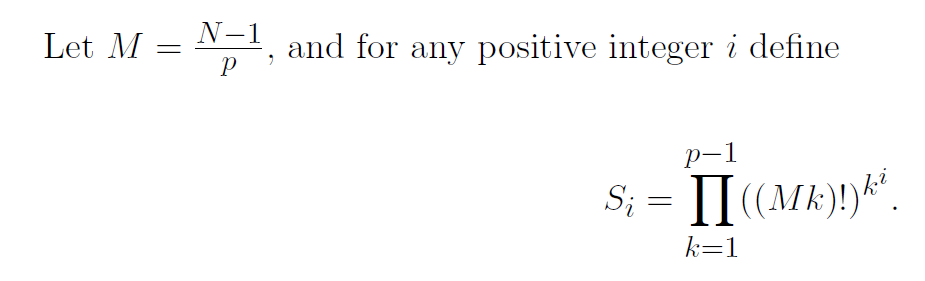
what kind of number is this lmao
a product of powers of factorials
whether or not these are pth powers modulo N tells you if some class group is trivial or not
oblique river
smoky cypress
Tbh this sounds like the entirety of algebra and I’m terrified <:nervousSweat:78...
just like, hardcore algebraic number theory probably haha
latent anvil
Wtf
oblique river
yeah basically lol
god im looking through my dissertation now, in particular two sections which i had to like rush to write in the last 48 hours of the deadline and i have absolutely no memory of them hahahaha
oblique river
it was a classic case of "ive written down the proof of this theorem in a special case and i'm rpetty sure the details work out in the general case as well, i'll figure it out later"
oh hahaha i do remember writing this line though

the restricted restriction map
latent anvil

oblique river
ok sorry got off topic there :^)
i hope i was able to satisfy your curiosity a bit shamrock
regarding the F*/F*^p stuff
latent anvil
it was cool!
oblique river
if youre curious about more or are still unsure of something feel free to ask or DM me :)
latent anvil
will do!
 uncut girder
Aggressive algebraic number theory
As opposed to light algebraic number theory
Ok I have a question
Which I was discussing with nGroupoid#5061
So you have a perfect field k
And a split torus T defined over k, that is, T is a finite product of copies of G_m = k*, the multiplicative group in k.
Say you have a representation of T on some finite dimensional vector space V
Why is it that this action can be diagonalized?
That is, why is there a basis of eigenvactors of the action of T
latent anvil
sorry so just to strip out the AG for my benefit, you have a perfect field k and a linear action of $k^\times\times \cdots \times k^\times$ on a finite dimensional $k$-vector space $V$?
and you want to simultaneously diagonalize everything
is that right?
cloud walrusBOT
Sham aced their analysis final
 uncut girder
Yes, so that the matrix representation of each group element with respect to this fixed basis is diagonal
Here it is done for k=C, I have not read it carefully.
https://math.stackexchange.com/questions/828359/proof-of-basic-fact-that-torus-actions-are-diagonalizable/828906

Mathematics Stack Exchange
Suppose a torus $T=(\mathbb{C}^\ast)^n$ acts on a finite dimensional vector space $W$, and define for $m \in M$ ($M$ is the character lattice of $T$) the eigenspace $W_m$ by
$$W_m = {w \in W \mid t\
But I want to see if this is true for all perfect fields k, or if this author is lying
uncut girder
Ok, the proof above relies on the multiplicative Jordan decomposition, which according to wikipedia,
Over a perfect field,such a decomposition exists


Maybe that's the only place where the perfect hypothesis is used 🤷♀️
@latent anvil what is the coordinate ring of (k*)^n where k is a perfect field?
Does coordinate ring only make sense for algebraically closed fields?
 wild sapphire
I have a factor group (Z4 x Z12)/(<2> x <2>), and I think the order is 4. Is this true?
 solemn rain
wild sapphire
solemn rain
wild sapphire
I think I'm struggling to understand what context the cyclic groups <2> are in, are they both subgroups of their respective Z4 and Z12 ?
because then I would have (4 * 12)/(2 * 6) which is how I got my answer
wild sapphire
no I was just asking if I was on the right track
I'm kinda struggling to understand factor groups and cosets, that whole kind of relationship 🤔
wild sapphire
I have a factor group (Z4 x Z12)/(<2> x <2>), and I think the order is 4. Is this true?
that was my initial question
wild sapphire
an external direct product, they're not generators. <2> can't be a generator of either
 north widget
wdym by external?
llike not related
not a generator
but like make their own subgroups
so like <2> in Z4 would be 0,2
and in Z12 would be 0,2,4,6,8,10
right?
chilly ocean
2 is the generator of the subgroup <2> Marlin I think you just swapped some terminology
all good
north widget
you said order is 4?
wild sapphire
yes
wild sapphire
see, this is where I'm not understanding
north widget
more than 4?
wild sapphire
do I use laganges theorem or cosets, like what even am I doing when I find a coset
what do cosets even represent lmao, I've only learned the formal definition.
north widget
im pretty sure its a normal subgroup, dont remember how much that matters
so like
G/H = {g+H | g in G}
wild sapphire
it has to be a normal subgroup to form a factor group (Z4 x Z12)/(<2> x <2>)
chilly ocean
what mo2men said, you're just using Lagrange's theorem and the fact about the order of a product of groups
north widget
oh
chilly ocean
I think you did it right
wild sapphire
and a subgroup being normal implies the left and right cosets are equal ?
just side question
chilly ocean
Z4 x Z12 is abelian and every subgroup of an abelian group is normal
wild sapphire
ah that makes sense
north widget
thats why its a normal group, but i think both statements are equivalent
 maiden ocean
wild sapphire
and a subgroup being normal implies the left and right cosets are equal ?
maiden ocean
wild sapphire
and a subgroup being normal implies the left and right cosets are equal ?
among like 12 other equivalent conditions yes 
wild sapphire
so, what am I doing when I form a factor group. I feel like the overlap of set notation and regular division/multiplication notations is messing with me.
is it almost like a set minus?
north widget
what is a set minus?
maiden ocean
uh
wild sapphire
like a reletive difference operations on two sets
north widget
nah
maiden ocean
not really
north widget
not at all
maiden ocean
its more like quotienting
wild sapphire
ah
maiden ocean
its like. there are 3 groups of 4 in 12
north widget
and using cosets of subgroup
maiden ocean
and 12 / 4 is the number of those groups
in the same sense G/H takes the "groups" of elements of G wrt H (cosets) and then scales them to a single element
wild sapphire
so, the cosets of a normal subgroup partition the main group (at least that's what I think I've learned) I'm struggling to take it one step farther into factor groups 🤔
maiden ocean
cosets form a partition regardless of normality
wild sapphire
maiden ocean
cosets form a partition regardless of normality
ah, good to know
maiden ocean
normality allows you to put a well defined group operation on the cosets
gHkH = gkH
wild sapphire
ah, that is familiar yeah
north widget
tbh kinda confusing with direct products
atleast to me
as compared with not direct products
i think quotient topologies had same confusion on me with direct products
chilly ocean
I think a nice way of getting used to quotient groups is just writing out examples of elements and actually doing some computation, like an element of (Z4 x Z12)/(<2> x <2>) is (3,9)+(<2>x<2>)=(1,1)+(<2>x<2>). We can add it for example to (0,1)+(<2>x<2>) to get (1,0)+(<2>x<2>).
the / notation can be a little confusing at first but just remembering what the elements actually look like really helps
maiden ocean
this is the intution i have for it
 maiden ocean
if u imagine it visually ur taking the elements of the coset and squishing it to a single element
topology brained
i assume Z2 x Z2
wild sapphire
yeah, so like an easy one is partitioning the integers modulo into cosets
north widget
oh its zmod2?
chilly ocean
those are the cyclic subgroups generated by 2 in Z4 and Z12 respectively as a product
north widget
i was thinking its Z4/Z2 x Z12/Z2
chilly ocean
the context was from the problem
maiden ocean
wild sapphire
yeah, so like an easy one is partitioning the integers modulo into cosets
yes
if you imagine taking a number line and like grouping points together if theyre equal mod 3
you kind of get hte idea visually
chilly ocean
quotient space moment 
maiden ocean
tbh i didnt get quotient groups until i saw quotient spaces
north widget
lol
maiden ocean
i also didnt get group actions until i did covering theory
north widget
other way around for me
i still dont understand group actions enitrely
i only had one of my friends explain stab to me
wild sapphire
I literally just keep watching this video from 3:50 to 4:00 and I'm not understanding what she means 🤔
i feel like there's a bit of a jump there
idk
north widget
nah fam
maiden ocean
just read a book that deals with the construction explicitly tbh
north widget
she just expects you to understand definitions
maiden ocean
ur not going to understand it without going into the weeds and working it out
north widget
oh
speaking of going into the weeds
i have a quick off tangent question
if I were to prove that the galois group of a certain splitting field is non-trivial, I would have to show that the identity isnt the only homomorphism. To do this I need to make sure that some of the roots of the polynomial are able to be "permuted"
or something along those lines?
so like
if I have Gal(Q(a)/Q)
and need to show it is non-trivial
I just need to show that there exists an f in Gal(Q(a)/Q) such that f(a) = b for some homomorphism f?
 small bison
you can always permute the roots of the minimal polynomial of a
it's a question of how many roots the minimal polynomial has
north widget
ya
chilly ocean
hype to learn about Galois theory at the end of this semester in Abstract II, looks cool
north widget
the question i got had f(x) = x4+x3-x2-x+1 given that a is a root show -1/a is a root
i showed -1/a is a root
i was just gonna show that a potential homomorphism could take a -> -1/a
and that wouldnt be the identity
small bison
you def do have a homomorphism but what if the root is like i
small bison
then a = -1/a and you wouldn't have a nontrivial homomorphism
north widget
im confident atleast
small bison
yeah then automatically your poly doesn't have repeated roots
small bison
like you don't know if a != -1/a
it could be that you just plug in the same number twice
small bison
assuming your polynomial isn't reducible then it'll have at least 2 different roots
maiden ocean
chilly ocean
hype to learn about Galois theory at the end of this semester in Abstract II, lo...

north widget
yea polynomial isnt reducible
it is irreducible
cuz its monic
and all coefficents are 1
and we in Q[x]
chilly ocean
maiden ocean
<a:0_KEKLaugh:702655648697024602>
is it painmode
north widget
not painmode
maiden ocean
its boring
north widget
it is boring
maiden ocean
lmao
small bison
well you have some -1's in there lmao
north widget
src:me
small bison
but you can prob check some other way like the rational roots test
north widget
idk that
there are def no rational roots tho
i can confirm
is i a root of x4+x3-x2-x+1?
north widget
well i just need to give the homomorphism?
and i only have confirmed that a and -1/a are roots
so i need to show a != -1/a
but idk how m8
chilly ocean
I'm doing research in diophantine equations and I have seen that there are a bunch of theorems relating Galois extensions to elliptic curves and the latter is what I am interested in getting more use out of to parametrize some classes of solutions
chilly ocean
so still hype
north widget
ye i isnt a root
small bison
you should also check -i i think
small bison
-1
north widget
damn
small bison
uh it should be -i^3
north widget
1+i+(-i)^2 - i + 1
small bison
idk i would just plug into wolfram alpha tbh
north widget
bruh imaginary is too hard
small bison
,w i^4 + i^3 - i^2 - i + 1
north widget
-i = i^3 => (-i)^3 = (-i)^9
cloud walrusBOT


 Requested by young_smasher#5746
north widget
Requested by young_smasher#5746
north widget
bruh moment
small bison
nice
north widget
what if a is 2i?
small bison
they'll be diff
north widget
what
small bison
cause a = -1/a iff a^2 = -1
north widget
2i = -1/2i?
ohhhh
im low iq xd
hmu if u want a favor
ty main man @small bison
small bison
np bro
latent anvil
uncut girder
<@228562950703546368> what is the coordinate ring of (k*)^n where k is a perfec...
Sorry I didn't get this ping
It should be k[x1,...,xn, 1/x1,...,1/xn]
wait... is this right?
uncut girder
Can you explain?
latent anvil
Hmm I'm not sure it is
okay let's do it a way I know to be correct
So first off, what's the coordinate ring of Gm = k\{0}?
uncut girder
🤷
latent anvil
Ah okay, my bad
So there's sort of a trick
You can see it two ways
the first way is to note that Gm is isomorphic to the vanishing locus of xy - 1 in k^2
just project down onto the first coordinate
That gives a bijection Z(xy-1) -> Gm
And the inverse is t |-> (t, 1/t)
Everything is a rational function, so these are (inverse) morphisms of varieties
does that make any sense?
uncut girder
latent anvil
the first way is to note that Gm is isomorphic to the vanishing locus of xy - 1 ...
Does this work for any field
latent anvil
yeah so you sort of need to clarify what context you're thinking of these things in
Are you considering Gm as a scheme?
if so it's not going to be set theoretically equal to k*
Like if k = Q you have a bunch of ghost points floating around from the algebraic closure
if you're working with them as varieties over a potentially non algebraically closed field then what I said is correct
The same maps work
(x, y) |-> x
t |-> (t, 1/t)
uncut girder
latent anvil
Are you considering Gm as a scheme?
No, I'm thinking of it as a variety, so yeah I guess that's kind of the definition
uncut girder
latent anvil
does that make any sense?
That makes sense yeah
latent anvil
Cool
So with this in mind we see Gm is affine
Since Z(xy-1) is
And has coordinate ring k[x, y]/(xy-1)
This is really the localization of k[x] where we invert x
(we're just formally adding in an inverse y)
uncut girder
Right that makes sense, thanks
uncut girder
I'm always worried when I'm using algebraically closed or not
latent anvil
If you have a variety X in A^n and a function f on X, the set D(f) = { x in X : f(x) ≠ 0 } is affine with coordinate ring A(X)_f
where A(X) is the coordinate ring of X and we're thinking of f as an element of A(X)
The same kind of isomorphism of D(f) with Z(yf(x1,...,xn) - 1) works
anyways Gm^n is trickier. Do you know what the coordinate ring of a product of varieties is?
Actually, I might not know this....
(in the non algebraically closed case)
latent anvil
latent anvil
It should be k[x1,...,xn, 1/x1,...,1/xn]
After thinking a bunch I agree with my original guess lol
uncut girder
latent anvil
anyways Gm^n is trickier. Do you know what the coordinate ring of a product of v...
What would it be?
latent anvil
Well I'm realizing it's tricky in the non algebraically closed case...
In the algebraically closed case you take the tensor product of the coordinate rings
But in the general case you might not get an integral domain back
Eg C tensor C over R
I think if you do get an integral domain it'll be the coordinate ring, and in this case you do get an integral domain
But it's not obvious to me
uncut girder
In all definitions of coordinate ring I found online, they take the field to be algebraically closed, so idk if what I'm asking even makes sense
latent anvil
I think it does. I know at least one way to treat varieties which aren't algebraically closed
I'm basically thinking in terms of kempf's AG book
Schemes are definitely a nicer setting here though
sorry ptyamin this might not be satisfying. I don't usually think about non algebraically closed fields and varieties at the same time
you should probably ask someone who knows AG (which I do not)
But I think k[x1,...,xn,1/x1,...,1/xn] is probably right
uncut girder
Yeah its fine
I probably should be thinking about schemes but I do not have that background
latent anvil
don't worry I don't either
This is good practice since chmonkey has roped me into a reading course on algebraic groups
I'm ready to be lost 
next obsidian

It’s my job to make sure you get a nutritious diet of all math
Meanwhile you watch as I get 400% my DV of algebra and no analysis
maiden ocean
complex analysis is a daily vitamin for AG people
uncut girder
latent anvil
This is good practice since chmonkey has roped me into a reading course on algeb...
What are you reading?
Maybe I should read Humphreys Linear Algebraic Groups
latent anvil
I think that was one of the books the prof proposed
uncut girder
It's a big book
From Humphreys book

So X is defined over k means the radical of the ideal of X is generated by k-polynomials
When k is perfect, being defined over k is the same as being k-closed.

If X is defined over k that doesn't mean that X is a subset of "affine k-space" (products of k)...
Affine space is still over the algebraic closure of k. And X is a subset of that affine space over the algebraic closure of k.
The only thing X being defined over k means is that its radial ideal is generated by k-polynomials. If we wanted to talk about the subset of "affine k space" (or k^n) that X cuts out, that would be the k-rational points of X denoted X(k).
Omg. This makes so much more sense
@latent anvil look at the screenshots, it's relevant to what we were discussing 
 sour plume
i have a question about DGLAs

do you need (pro-)nilpotency of the DGLA anywhere here? i guess it has to do with exp(\ad_\xi), but that should always be defined if L^0 is a finite-dimensional Lie algebra, right? it's just the exponential of a bounded operator
oh maybe this is just a cheap cop-out for when you want infinite-dimensional L^0
 severe tide
Is a Borel field a ${\sigma}$-algebra?
cloud walrusBOT
Alpha7
 cloud walrusBOT
Alpha7
 cloud walrusBOT

 Requested by Alpha7#3950
severe tide
Requested by Alpha7#3950
severe tide
There, the definition. ^
But, I would say yes... maybe the only note that there is not needed complement, but in the a sigma-algebra only need a stable complement rather than just to be needed. :/
Stable = closed (for this matter), analysis has infected me. 😄
What is confusing?
Well, a sigma-algebra of sets in a set $X$ is a collection of subsets of $X$ containing $X$ as a member, and closed (i.e. stable in the context of real analysis) with respect to the operations of complementation and forming countably infinite unions and it contains the empty set and the stability can be proved via De Morgan with respect to forming countable intersections and it is also an algebra.
cloud walrusBOT
Alpha7
 severe tide
Given this definition, is it a Borel field?
Well, I'm asking because I don't know much about that Borel field, I encountered that in an archaic textbook that is talking about French development in measure and set-theoretic probability theories.
OKay, after a bit of looking up, from the looks of it; it is a Borel set that belongs to the field, which are, afaic, algebras, so... 🤷♂️
maiden ocean
discrete topology is the only one that matters
severe tide
Yeah, they're defined in a topological space considering open or closed sets, but match the exact properties of a $\sigma$-algebra on their own.
cloud walrusBOT
Alpha7
 maiden ocean

severe tide
maiden ocean
discrete topology is the only one that matters
Love me some knots, and fuck the rest of topology, especially homotopy and fuck type theorists for using it.
 severe tide
OKay, would it be better if I said, I like knots (only)?
(Especially invariants defined under HOMFLY, they're ingenues and cute.)
severe tide
severe tide
Yeah, they're defined in a topological space considering open or closed sets, bu...
I don't think it matter though if it is an open or closed set, it still has the exact properties of said algebra.
I hate when I find some definition that is terribly outside my field or is old as shit.
Reminds me of the old Godel models of ZFC; okay, now I'm remembering some nightmares.
 high lava
does pairwise commute mean each element g commutes with every other element? If so, I can't see how this matrix multiplication does this check

lambda is defined as follows


 rustic crown
yep
unique juniper
hmmmmm
how does that show that G1 x G2 is isomorphic to G, specifically how does showing that A x B is isomorphic to G show that G1 x G2 is iso to G?
 carmine fossil
If A is iso to G_1 and B is iso to G_2, A x B is iso to G_1 x G_2
Let phi_1 be iso from A to G_1 and phi_2 be iso from B to G_2.
Consider the map phi:AxB to G_1 xG_2
phi(a,b)=(phi_1(a),phi_2(b))
This will be an isomorphism
 sly crescent
Has anyone enumerated the families of infinite simple groups of Lie type based on affine Dynkin diagrams?
 languid meteor
Super quick question, dont want to intrude on the question above ^. When this says "view U and V as k[x]-modules via alpha and beta respectively", what exactly does it mean. alpha maps from U to U, so im not sure how to use it to define the multiplication operation between K[x] and U
 languid meteor
oh can I assume x is in U?
 rich ravine
Sorry my notation is confusing. For u in U, $x\cdot u := \alpha(u)$
cloud walrusBOT
Othenor
 languid meteor
ahh ive seen this before actually, that makes sense. Thank you!
rich ravine
Another way to say this : a K[x]-module structure is the same as a ring morphism K[x] -> End(U), where End is the endomorphisms as abelian groups
You already have a map K-> End(U), by the fact that U is a K-vector space
So you just need to specify what X maps to
and it maps to $\alpha$
cloud walrusBOT
Othenor
 languid meteor
ah ha, thanks a million for the help!
 bleak crystal
oh is that so
alright I've got one for you
prove there are (p^2 +p)/2 monic degree 2 composite polynomials in Zp[x] of form (x+a)(x+b)
thorn delta
Pretty sure it’s just a combinatorics thing. Choosing values for a and b that give distinct polynomials
You can start with p choose 2 and add on the polynomials that are missed by that calculation
Am I making sense to you @bleak crystal ?
bleak crystal
tbh
no
what i have so far is a=b and a/=b
(x+a)^2 and (x+a)(x+b), expanded
i'm not too sure how to proceed but i know that (x+a)(x+b) counts twice because of commutativity
i think
thorn delta
alright, so note that the value of a and b completely determines what (x+a)(x+b) is, so we shouldn't have to expand things out. Yea, so we have to make sure that we don't count twice for (x+a)(x+b)=(x+b)(x+a).
My suggestion is to first count the polynomials for a != b. You can use combinatorics for this. We are picking two values, a and b, out of {0, 1, ..., p-1}, and order does not matter (by commutativity).
bleak crystal
what does combinatorics mean
thorn delta
From wikipedia: "Combinatorics is an area of mathematics primarily concerned with counting, both as a means and an end in obtaining results, and certain properties of finite structures."
bleak crystal
ah
counting
got it
so uh
how do we count a? is a<=p?
wait it has to be...
so then how do we know how many combinations there are? p^2?
thorn delta
Nope. Do you know what $\binom{n}{k}$ means?
cloud walrusBOT
kxrider
 thorn delta
like, if you have a bag of n things, n choose k is the number of way to choose k things out of the bag
bleak crystal
oh i was backwards
n ways of choosing k things
i had a (BAD bad) probability teacher
thorn delta
so with a and b (for a != b), its like we want to choose 2 things out of a bag of p things
thorn delta
because you can't choose the same thing twice with n choose k.
thorn delta
The assumption with combinations is that there are p distinct things, and once you choose something out of the bag, its no longer in the bag.
bleak crystal
right
i see why the number of things has to be p
okay i see why pC2 is relevant too
thorn delta
so if choose the number 3 for a for example, then I can't choose the number 3 again for b, just because of the way combinations work
thorn delta
ok, so there are p choose 2 ways to make polynomials for a != b. All that's left is to add in the cases when a = b.
bleak crystal
i still don't get the a! thing
thorn delta
ohh, != just means not equal to lol. its more of a programming convention i guess
thorn delta
oof my bad
bleak crystal
i always write not equal as /=
fuck that was the main reason i wasn't following ahhh
okay i need to reset
completely off atm
okay so when a/=b, we have p C 2 combinations, yes?
thorn delta
yep
thorn delta
rather, p C 2 enumerates all of the polynomials where a /= b
thorn delta
yea, that should be right
bleak crystal
wait, why are all of those composite again?
oh
nevermind
ignore
i see i am a fool
thorn delta
nah its all good
bleak crystal
is...is that it?
thorn delta
yep
bleak crystal
p C 2 + p composite monic polynomials of deg 2
wait would it be (p C 2) /2?
since we were counting a and b AND b and a?
or did we account for that with the choose
thorn delta
yea the "choose" makes sure we don't count extra permutations
bleak crystal
got it
uh
i don't remember the choose form, would you remind me?
its like something squared?
thorn delta
$\binom{n}{k} = \frac{n!}{(n-k)!k!}$
cloud walrusBOT
kxrider
 thorn delta
np
 old hollow
Ok don’t roast me

I cannot intuit M_P/M_P^2
Can anyone help me understand this, cause I get everything up to it
bleak crystal
@thorn delta wait that doesn't equal (p^2 + p) /2 though
thorn delta
(p choose 2) + p = p!/(2!(p-2)!) + p = p(p-1)/2 + p = (p^2 - p)/2 + p = (p^2 + p)/2
bleak crystal
welp i did something wrong
chilly ocean
old hollow
I cannot intuit M_P/M_P^2
it's just the cotangent space
bleak crystal
thorn delta
(p choose 2) + p = p!/(2!(p-2)!) + p = p(p-1)/2 + p = (p^2 - p)/2 + p = (p^2 + p...
forgot to take (p-2) factorial
that clears it up
oops
math is hard
bleak crystal
i just need a confirmation that i'm doing this right
(3x+1) is a unit in Z mod 9 [x] with its inverse given by (6x+4)
is this good and also justified?
FUCK it's not
i hate life
WAIT IT IS I LOVE LIFE
3x+1 is a unit with its inverse given by 6x+1. is THIS good?
thorn delta
yea, it would appear that (3x+1)(6x+1) = 1
bleak crystal
fantastic
thanks
"Show that every polynomial (except the constant polynomials 3 and 6) in Z9[x] can be written as the product of two polynomials of positive degree."
this one is stumping me
i have no idea where to even begin, shit
it's part of the last question about the unit in Z9[x] so i assume that was relevant
chilly ocean
Maybe p(x)=(p(x)u(x))*u(x)^-1, where u is a unit
But perhaps we need to check that p(x)u(x) has positive degree
And I guess also u(x)^-1
chilly ocean
So maybe for "most" polynomials you can do p(x)(3x+1) and 6x+1
bleak crystal
im trying that rn
okay i am currently stuck
i supposed p(x) * 3x+1 was a constant (alpha)
since we need it to be deg>0
and obviously 6x + 1 has deg 1
so i have p(x) as 6ax + a
and the polynomials are given by that form, 6ax + a
by a = {0 thru 8 excluding 0, 3, 6}
now i'm finding myself asking "so what?"
chilly ocean
What do you mean p(x) is 6ax+a? a is constant term of p(x)?
bleak crystal
uhhh
p(x)u(x)u^-1(x)=a•u^-1(x) (a constant)
where u^-1 is 6x+1
because we want it to NOT be constant, right? it needs to be deg >0
bleak crystal
"so what" lol
chilly ocean
Well, you can say under certain conditions this decomposition works
Maybe you can find another pair of units that works when this condition fails
Or maybe not, maybe you can solve it a different way
chilly ocean
Just throwing out ideas
bleak crystal
i want to see this through but I don't get how..
because if a=1 then p(x)u(x)=1, a constant
we don't want that
you see what i mean?
chilly ocean
Yes
This decomposition works (ie that thing is not a constant), in "8/9 cases" based on possible values of the coefficients of p
(8/9 in quotes, because really there are infinitely many polynomials p)
bleak crystal
right
chilly ocean
Er, actually maybe I undercounted. Anyhow it's something around 8/9
bleak crystal
I catch your drift
chilly ocean
Question:
if gcd(a,b)=1, a|c, b|c
Then: ab|c
gcd means greatest common divisor
a|c means a divides c
bleak crystal
what's the question?
chilly ocean
proof ab|c
bleak crystal
well, do you know that ab/(a,b)|c?
i wish i could walk you through this but this was presented to me as fact
basically, if you multiply the two then "take out" what they have in common, you get the result you want
chilly ocean
bleak crystal
basically, if you multiply the two then "take out" what they have in common, you...
you mean a|c and b|c ?
bleak crystal
also if you have ab|c, that means c=qab for some integer q, right?
chilly ocean
yup
bleak crystal
what if you divided ab by the gcd of a and b? what would happen?
bleak crystal
what if they weren't
bleak crystal
that is to say that cd=qab
does qab/d =c and thus divide it?
so ab|c
you could also say something like
 ebon osprey
chilly ocean
it would become a/(am+bn)
ebon osprey
chilly ocean
it would become a/(am+bn)
Why not just lcm(a,b) ?
ebon osprey
Oh sorry it's a long convo sorry
bleak crystal
no worries
chilly ocean
ebon osprey
Why not just lcm(a,b) ?
because I'm not familiar with that terminology xD
bleak crystal
hop in if you want
ebon osprey
bleak crystal
hop in if you want
Thanks :)
bleak crystal
cd=cax+cby since d=(a,b) means d=ax+by
since b|c, thus ab|cax
and since a|c, ab|cby
so finally, ab|cax+cby
but cax+cby IS cd
so ab|cd
and ab/(a,b)|c so long as a|c and b|c
ebon osprey
a|c means c = ak, but b|c means c = bl so ak = bl so a | bl but gcd(a,b)= 1 means (not a|b)(suppose a is not 1 pls) therefore a|l and l = aj so c = abj
What do you think of this one @bleak crystal @chilly ocean
bleak crystal
what if a is 1
ebon osprey
Nate gone :'(
chilly ocean
no, i'm thinking the last part of @ebon osprey proof
ebon osprey
Abstract hurty ?
chilly ocean
i didn't get this part
gcd(a,b)= 1 means (not a|b)(suppose a is not 1 pls) therefore a|l
chilly ocean
yes
ebon osprey
So gcd(a,b) >= a
chilly ocean
but both are prime numbers we can't say that
ebon osprey
ebon osprey
Yes I said IF a|b THEN gcd(a,b) >= a
Therefore if gcd(a,b) < a then a does not divide b
Because a|bl and (not a|b)
chilly ocean
now i get it
ebon osprey
So a must divide l
chilly ocean
thanks @ebon osprey
ebon osprey
You're welcome !
bleak crystal
good point
 scarlet estuary
assuming this is meant to hold for all r
bleak crystal
it is
old hollow
chilly ocean
it's just the cotangent space <:smugsmug:812884290282848266>
Wait really
chilly ocean
that was slightly tongue in cheek
chilly ocean
i'm not familiar with this specific context, but i know that in some treatments of smooth manifold theory, the cotangent space is defined that way (but with smooth functions vanishing at the point or something like that)
so i wouldn't be surprised if the idea/motivation here was the same as the cotangent space
old hollow
Ah
Even still
Trying to think about a quotient ring of an ideal with itself squared (?)
is wack
 old hollow
Jesus
bleak crystal
yes.
abstract.
due tomorrow
I'm cutting so many corners
I'm just too tired and i have an educational psych test tomorrow too
alright I'm stuck on 10b), a+b is nilpotent
the hint he gives is "what can you say about (a+b)^n+m"
old hollow
Expand and prove that it’s zero
bleak crystal
are we supposing n=1=m
old hollow
When you expand u get a^n and b^m which r zero
bleak crystal
how do you get that
wait are we just supposed to say a^n = 0 when n = 1 thus a=0
this is so confusing i have absolutely no idea what to do
bleak crystal
his hint for a is "you might want to choose the smallest positive integer for n such that a^n = 0"
well the smallest + integer is 1
so n=1?????
how would we know that
this literally makes zero sense
nothing I'm writing makes any sense either
so n=1 right? he literally said "choose the smallest positive integer n"
ebon osprey
Wow wow
old hollow
Ok let’s see
bleak crystal
i got a