#groups-rings-fields
406252 messages · Page 472 of 407
 solemn rain
 steep hull
...
solemn rain
by chinese remainder
 oblique river
yes this is the whole point of the method I gave you
solemn rain
boys ur amazing tysm
oblique river
you take the largest divisor corresponding to each prime
solemn rain
yea
oblique river
and the gcd of those must be 1
solemn rain
i gotchu
oblique river
since they are relatively prime
solemn rain
yea i just had brain lag
and obv to go from
invariant factors
i juist keeep factorizing
the factors
to primes
right?
oblique river
to prime powers, yes
if you had an invariant factor of 50
that would give you 2 and 25
not 2, 5, 5
exercise: find the invariant factors if the elementary divisors are 2, 4, 8, 3, 9, 5, 5, 5
oblique river
no
solemn rain
2,3,5
oblique river
no
oblique river
take the largest of each of the prime pieces
multiply those together. that's your largest invariant factor
now repeat the process with what's left
the idea of going from elementary divisors to invariant factors is that you're trying to consolodate
oblique river
basically insetad of writing your group as a product of 8 cyclic groups (as in the exercise I gave you)
we want to combine them
in the same way that we can combine Z_2 x Z_3 = Z_6
steep hull
Invariant factors form geometric progression by the way you wrote them out hehe
oblique river
also no that's still wrong
take the largest of each of the prime pieces
what is the largest power of 2 that shows up?
oblique river
yes
solemn rain
okay
oblique river
largest power of 3?
solemn rain
so its 8 * 5 * 9
oblique river
yes!
oblique river
we're trying to consolodate
we know by CRT that we can combine cyclic groups as long as their orders are relatively prime
which means we can pick one cyclic piece from each of the prime "groups"
so one piece from the 2s, one piece from the 3s, one piece from the 5s
steep hull
He/she should try to understand why invariant factor decomposition is unique
solemn rain
well ^ its given for me
oblique river
but additionally, remember that we have this condition that n_1 is divisible by n_2
solemn rain
in the statement of the theorem
steep hull
Well understand why
oblique river
(you should try to understand htat part of the proof then)
solemn rain
no its not prove for me
oblique river
so basically we want n_1 to be the biggest it can be
oblique river
so we are going to take the largest of each of the prime power parts
oblique river
yep
solemn rain
and i pick the coprime numbers
steep hull
The uniqueness is an elementary number theory fact but whatever
solemn rain
so i can combine their groups
oblique river
and then we use what's left
solemn rain
am i right bros?
oblique river
to find n_2
and repeat the process
so the elementary divisors were 2,4,8,3,9,5,5,5
the first invariant factor is 360
what is the second?
oblique river
(It was 2, 4, 8, 3, 9, 5, 5, 5. Not 2, 4, 8, 3, 3, 9, 5, 5, 5)
oblique river
so what is the 3rd invariant factor then
solemn rain
okay so basically
if i decompse an abelian group
using elementary divisors
i combine them using chinese
oblique river
(can we call it CRT please, saying "using chinese" sounds weird)
oblique river
yes -- but you can't just combine willy-nilly
oblique river
because we want the invariant factors to satisfy this divisibility relation
solemn rain
n_i+1 | n_i
oblique river
in the example I gave, it's "360 is divisible by 60 which is divisible by 10"
but notice that if you tried to combine them in another way
that would have failed
solemn rain
so basicalyl writing a group as invariant factors sucks
oblique river
yes
solemn rain
okay boys
i relaly like this course
group theory for a fucking stupid
guy
i think i can do most exercises now
is there a quick way to find the numebr abliean groups?
i multiply the parition of the prime numbers right?
yea i do
oblique river
"the partition of the prime numbers"?
solemn rain
i find the number of partitions for each prime factor
and multiply them together
that would 'span' all As i hope
oblique river
yes -- you are finding the partitions of the exponent on each prime factor
steep hull
You could make a table with nonascending prime powers for a given prime (where 1 is appended so that the rows have the same number of entries) and then just multiply down the columns as well
oblique river
no
steep hull
Partitions are very hard to predict exactly
oblique river
basically the way I do it in my head is just try to be systematic about it
like if I wanted to find aprtitions of 5
steep hull
Though asymptotics are known
oblique river
I would write down like
"how many are there where the biggest number is 5? (only one -- 5). how many where the biggest number is 4? (only one -- 4+1). how many are there where the biggest number is 3? (two -- 3+2 and 3+1+1)"
solemn rain
damn i hoped therre woudl be like
a calculator or a function
p(2) = 2
boom
im done
cuz i think it gets harder at higher n
anyways boys
oblique river
I mean
oblique river
p(n) is a function
solemn rain
your*
oblique river
it just doesn't have a nice formula
solemn rain
oh so ur not being nice
cool
jk
also the number of conjugacy classes of S_n is numebr of patitions of n
steep hull
p(n)~e^(pi(sqrt(2n/3))/(4nsqrt(3))
solemn rain
which i proved b4
oblique river
so I can feel like I'm being productive
solemn rain
and dont remembeer how now
solemn rain
yea man cool
no bro
i dont think im going to do shit
with this brain dmg
but i mean
im having fun
oblique river
lol I was being a little sarcastic because I'm not that much older than you
oblique river
I'm 2 months away from a phd
solemn rain
cool af
steep hull
In what
oblique river
number theory
solemn rain
damn
steep hull
More specifically?
oblique river
algebraic number theory, I think about very arithmetic things
like class groups
and other invariants of number fields
oblique river
and I use a lot of galois cohomology
solemn rain
jk
oblique river
basically what I do to prove theorems is
solemn rain
yo did you ssee that proof of abc conjecture
oblique river
"translate arithmetic questions into the language of cohomology and then muck around there and then translate back"
the proof is wrong
steep hull
So I’m assuming some CFT?
solemn rain
yea i meant the new one
oblique river
at least, the vast majority of mathematicians think it's wrong
no, it's still wrong haha
oblique river
yeah CFT is huge for me
solemn rain
is there a famous problem your working on
so i could cheer for you
and tell my friends
?
goldbach collatz
thats all ik
oblique river
haha uhhh not really? there are well known problems in number theory
but people outside of NT wouldn't be as familiar with them
I'm interested in something called the sharifi conjectures
and I'm interested in the langlands program although I don't really work in that area at all
oblique river
yeah
it would be pretty big if it were completely proven
but we are very far from that
steep hull
I sadly still don’t understand things like the connection between second cohomology and Brauer groups
oblique river
what do you mean "the connection between"?
solemn rain
gl tysm again
oblique river
np, gl to you
for some people, the second cohomology of a field is the brauer group
steep hull
oblique river
is your definition of the brauer group in terms of central simple algebras?
steep hull
Yes
oblique river
ah okay
idk if I have a better explanation than the one on wikipedia
if you're not super comfortable with galois cohomology, the sentence "since all central simple algebras over K become..." might seem like it doesn't make sense
I'm happy to chat about that more later but I need to head out for a bit
oblique river
sorry, but please feel free to ping me in a bit or in the future when you wanna talk about cohomology!
steep hull
Will do, thanks
 brisk granite
Let K by the splitting field of some polynomial f in F[X]. Is K/F normal?
 latent anvil
Yes. Let g(x) be an irreducible polynomial in F[x] with a root α in K. Choose a splitting field E of g over K. We'll show that any root β of g in E is actually in K. We have an isomorphism φ : F(α) -> F(β) fixing F. Now let K' = K(β). This is a splitting field f over F(β), and K is a splitting field for f over F(α), so φ extends to an isomorphism K -> K' fixing F. Note that K and K' are both finite over K, and the above implies [K : F] = [K' : F]. But since K is a subfield of K', this implies K = K', so β in K
@brisk granite
brisk granite
I think I get it, but I need a minute to mull over it
latent anvil
Yeah np
I had this as a hw problem last quarter and it took me more than a minute to come up with
brisk granite
how did you come up with it tho?
brisk granite
I don't really get how we extend isomorphisms
latent anvil
Like in this proof or in general?
brisk granite
in general
latent anvil
Because I'm using a general result
brisk granite
wasn't covered in my book
latent anvil
Okay so there's one fundamental lemma we use for the other extension things
Let F and F' be fields and suppose we start with an isomorphism φ : F -> F'
let f(x) and f'(x) be irreducible polynomials with coefficients in F, F' such that φ(f(x)) = f'(x)
Where I'm using φ(f(x)) to mean apply φ to the coefficients of f
I claim that for any root α of f (in some extension of F) and β of f' (in some extension of F') there is an isomorphism ψ : F(α) -> F'(β) extending φ
brisk granite
wdym by "extending phi"
latent anvil
ψ(t) = φ(t) whenever t is in F
brisk granite
ah ok
latent anvil
there's a nice square
You should be picturing
so the real usage is when F = F' and φ = id
Then this says the fields you get by adding in two roots of an irreducible polynomial are isomorphic over the base field
And it's not that hard to prove
What we're using is that F(α) ≈ F[x]/(f(x)) over F and F'(β) ≈ F'[x]/(f'(x)) over F'
Have you seen this lemma?
brisk granite
no
brisk granite
dude, I gtg rn. could I dm you in an hour?
brisk granite
ok, then could I dm you later
brisk granite
ok
 elder valley
this should be easy but i'm not seeing it
suppose i have a cyclic group G of order 2^v with generator h, and i have an algorithm for computing the discrete log in G with base h. if g = h^x is any element, then i should be able to also compute discrete logs with base g using the algorithm. i can see the usual change of base formula works if g is also a generator, but what if g has order less than 2^v?
elder valley
i think i figured it out. using the algorithm we can find an integer x such that $g=h^x$. then compute an integer s such that $s \cdot x=gcd(x, \vert h \vert ) \mod \vert h \vert$ through extended euclidean algorithm. then this equality holds for any a in $\langle g \rangle$:
$\gcd(x,|h|) \cdot \log_g(a) = s \cdot \log_h(a)$
 cloud walrusBOT
Auvera:
 azure grail
just need some quick clarification on notation
cloud walrusBOT
dk:
 autumn plover
I'm used to the latter being used for isomorphisms, and the former for saying that two quantities f,g are 'asymptotically equal'
azure grail
hmmm that's what I thought too
I'm pretty sure that's what they mean here though, right?
autumn plover
Yeah, in that case it definitely looks like an isomorphism
azure grail
okie thanks 
 smoky cypress
You expand out the right side
solemn rain
2x mod 2 is 0 no?
smoky cypress
yes
solemn rain
okaay so aphrodite you done?
okay so
if i have G isomorphic to Z_2 x Z_9 x Z_3 x Z_5
 leaden finch
Z_2 is : { 0,1}
leaden finch
oh wait ( x+1) (x+1) = x^2 +2x+1 since its in mod 2 it gives us x^2 +1 ?
@chilly ocean
oblique river
@solemn rain yes you are correct
the invariant factors must have this divisibility relationship
solemn rain
yea
oblique river
remember what we did last time
solemn rain
yea i do
oblique river
take the largest of each prime that appears
solemn rain
and i got it
yea yea i did that
and it worked
but i wanted to see if i can find it using elementary divisors
then find the invariant factors
using just chiense
oblique river
you have the elementary divisors already -- 2, 9, 3, 5
solemn rain
yea
i wanted to write them as groups
and just use chinese
but then i got Z_18 x Z_15 instead of Z_90 x Z_3
oblique river
yes, that is a valid way to write the group
the group is isomorphic to Z_18 x Z_15
oblique river
but that is NOT the invariant factor decomposition
the group is also isomorphic to Z/6 x Z/45
solemn rain
yes
oblique river
And Z/9 x Z/30
solemn rain
i actually got 2 ivnariant factors right usiong this method
and the third i just fucked it up
was that just luck?
oblique river
yes
solemn rain
i got Z_270 and Z_3 x Z_3 x Z_30
solemn rain
okay so
can i group them untill i get
that every order divides the next order?
so here 3|3 and 3|30
so it works
mine is shit cuz it doesnt satisify n_i+1 | n_i
right?
the Z_18 x Z_15
thats just usiong groups
if im stuck im just going to do whwat you said
oblique river
there are lots of ways to write the same group
solemn rain
its way easier but i jut wanna buid up 'intuition'
oblique river
but the invariant factor decomposition is unique
that's why it's nice
because there is exactly one way to do it
oblique river
for example, this makes it easy to tell if two (finite abelian) groups are isomorphic
we just write them both using invariant factors
oblique river
and see if the invariatn factors are teh same
solemn rain
yea yea
oblique river
cuz otherwise it's like -- how do we tell if Z_18 x Z_15 and Z_9 x Z_30 are really isomorphic?
solemn rain
u find out their invariant factors
Z_18 x Z_15 is not written with invariant factors
9 and 30 is
and im sayign this with respect to just the divsibility condiition right?
solemn rain
3]
oblique river
neither of them are written in their invariant factor decomposition
oblique river
yes, that is invariant factor
solemn rain
yea sorry typo
oblique river
but Z_9 x Z_30 is not
solemn rain
okay bad question wtf i wrong with the ordering here
like
is Z_90 x Z_3 the same as Z_3 x Z_90 ?
just reflect along y=x right?
(x,y) --> (y,x)?
oblique river
what
solemn rain
the isomoprhism
solemn rain
yea
solemn rain
okay so it doesnt matter
oblique river
no
technically I guess the larger ones should be first
but at the end of the day that's not as important
solemn rain
yea
fuck thats a long ass section
i am going to do the classification exercises
then go to the fun ones
like i see one already that i cant do but i will try it alone
oblique river
gl
solemn rain
Let A = Z_60 x Z_45 x Z_12 x Z_36
find the numebr of elements of order 2
i think i look at syloow 2 subgroups here?
all elements of order 2 must be in sylow 2 subgroups?
right approach ?
or bad? i always struggle with counting number of elements of certain ordr
oblique river
in a direct product of groups
oblique river
(a,b) has order 2 exactly when a and b [blank]
oblique river
uhhhhhh
what does it mean for two elements in different groups to be coprime
if a is in A and b is in B
so (a,b) is in A x B
what does it mean to say "a and b are coprime"
oblique river
if a has order 2 and b has order 3
solemn rain
when the orders are coprime
oblique river
what will the order of (a,b) be?
solemn rain
the lowest common multiple of both cuz like
oblique river
yes
oblique river
so we want (a,b) to have order 2
solemn rain
well i think i want lcm(a,b,c,d) = 2
oblique river
great
solemn rain
thats hard tho XD
oblique river
so what does that tell you about the orders of a,b,c,d individually
what possible orders could a have
solemn rain
2 or 1 ?
solemn rain
lmao why
oblique river
uhhh
solemn rain
wait
oblique river
if lcm(a,b,c,d) = 2
then 2 is the least common multiple of a,b,c,d
in particular, 2 is a multiple of a, b, c, and d
oblique river
also you can just do this directly
solemn rain
a has to be at highest 2
oblique river
if 2(a,b,c,d) = (0,0,0,0)
well
2(a,b,c,d) = (2a, 2b, 2c, 2d)
which means 2a = 0
(and 2b = 0 and...)
solemn rain
yea
oblique river
so a must have order dividing 2
great
so now
are there any other restrictions on the orders of a,b,c,d?
we know that individually they all have to be 1 or 2
solemn rain
idk
solemn rain
if one of them is 1 then the lcm must be 1 righht?
oblique river
really?
solemn rain
i didnt thinnk it would be such a great deal XD
oblique river
but not with basic arithmetic lmao
solemn rain
they cant be equal to 1
oblique river
they can't all be equal to 1
solemn rain
yea
oblique river
so this gievs us a strategy
for each of the 4 groups
find all the elements of order 1 or 2
oblique river
then take the product of htose numbers
solemn rain
so that would be easy
oblique river
and subtract 1
because we need to subtract off (0,0,0,0)
which has order 1, not 2
ok I have to go
do work
and be sad
ebcause work is sad
gl
solemn rain
be sad cuz im trash u pmeant
okay 1 sec tho
in Z_12
i solve the equation gcd(12,k) = 6
the number of soultiosn of k
is the numebr of elements of order 2
right?
oblique river
no I'm saying I'm goign to go do work and be sad, not that you have to go do work and be sad lol
oblique river
yeah I mean
a cyclic group either has 1 element of order 2 or no elements of order 2
(if you count elements of order 1 or 2, then a cyclic group either has 1 or 2 of them)
solemn rain
yea k = 6 is the only sol here anyways
oblique river
yes
in Z/nZ
if n is odd there's nothing of order 2
if n is even tehre's 1 thing of order 2
namely n/2
oblique river
glhf
solemn rain
ty
oblique river
just for you to check later, the answer to the question you posted is that there are ||7|| elements of order 2 in that group
you better not click that spoiler
oblique river
👍
solemn rain
hwo iu would appraoch this
how* i *
'in Z/nZ
if n is odd there's nothing of order 2
if n is even tehre's 1 thing of order 2
namely n/2'
conisder Z_n with n being even
---> 2 is the divisor of the order
there exists a unique subgroup of order 2 in the group by fundamental theorem of cyclic groups
hence there cannot exist more than one element of order 2
oblique river
correct
oblique river
correct
oblique river
correct
oblique river
John Q. Cyclic
solemn rain
fuck really
 scarlet estuary
Cyclic Groups were named after
solemn rain
yo bys im stupid but not this much
scarlet estuary
Mr. Groups
solemn rain
oh okaay
now its obnv
obv*
i just realised this stuf im learning is p new compared to like calculus
like that guy sylow
is 1800s
and di just learnt about his theorems 5 days ago ro something
thats cool right?
oblique river
yep, relatively pretty new
solemn rain
yea
idk if iam going to have the ability to get to the higher and (newer) stuff
but like
this shti is new as fuck lmao
oblique river
there is some pretty new stuff even in group theory
oblique river
yep
 topaz mulch
hey guys.. i dont mean to interrupt....new member with the need for a simple formula based on some constants.. any one wanna help me tackle it? its for a script similar to c# BUT i can do all of the scripting part, i just need help coming up with the formula.. we know that
*Some constants to know is this is in a circle, based on XYZ being 0 0 0 and yaw=0*
If yaw=0 then x= -1.5 & z= -1.5
If yaw=90 then x= -1.5 & z= 1.5
If yaw=180 then x= 1.5 & z= 1.5
If yaw=270 then x= 1.5 & z= -1.5
so we need to find the formula for a floating scale for the following
while yaw floats between 0 and 360 then:
X floats between -1.5 & 1.5
&
Z floats between -1.5 & 1.5```that was going to be my exampl ehaha
scarlet estuary
this is not abstract algebra
oblique river
wrong channel
topaz mulch
sorry...
solemn rain
okay im going to do one more classification problem
scarlet estuary
unless youre modelling this as the quarternion ring
topaz mulch
point me to the right one?
solemn rain
and then im done with the classifcaiton stuff now onto the high iq problems
scarlet estuary
naively this looks like a trig problem
but when in doubt, just use a generic questions channel
solemn rain
is there a big problem in group theory
that i can understand?
;like udnerstand its statement
that is open for now?
scarlet estuary
do you know what a galois group is?
solemn rain
no
the biggest thing ik now i think
is feit thompson
thats like the newest thing i think i eencountered
all odd groups are simple or something like this
all odd prime simple groups are isomprhic to Z_p something like this
scarlet estuary
huh ok here's a cute one
if a group is finite, and its order equals the sum of the orders of its normal proper subgroups
scarlet estuary
we call it a "leinster group"
scarlet estuary
the conjecture is that there exist infinitely many leinster groups
scarlet estuary
well, if these problems are open, they're pretty hard lmao
scarlet estuary
people care about this one though
solemn rain
yea
scarlet estuary
and in fact we've come up with some cool constructions
oblique river
do you know about conjugacy classes?
solemn rain
yes
oblique river
here's a qusetion:
scarlet estuary
like a nonabelian leinster group can have odd order
we've specifically constructed one in fact
solemn rain
what is the group!
oblique river
does there exist a constant c such that the number of conjugacy classes in a finite group G is always at least c*log_2(G)
scarlet estuary
this bullshit
solemn rain
umm
oblique river
ok I actually need to leave glhf
scarlet estuary

MathOverflow
For a finite group G, let |G| denote the order of G and write $D(G) = \sum_{N \triangleleft G} |N|$, the sum of the orders of the normal subgroups. I would like to call G "perfect" if D(G) = 2|G|,...
solemn rain
@oblique river is this an open problem too
solemn rain
lmao was just about to try it
XD
i was thiknnif of S_n cuz thats the only gropuu i k how to find the number of conjugacy classes easily
scarlet estuary
anyway the reason i asked about galois groups
probably the most famous open problem in group theory is the inverse galois problem
which asks, "is every finite group the galois group of some galois extension of Q?"
if you dont know what that means, dont worry about it too much but
solemn rain
i really wana learn about galois theory but its rreally likke
scarlet estuary
its a pretty cool statement
solemn rain
later in the text
and i dont htink im even smart enough so thats al ong way ahead
can ia sk a stupid question
how do you prove that
there exists infinitely many of something?
do you assume the negation?
scarlet estuary
theres a variety of ways
the classic proof of the infinitude of primes supposes for contradiction that there is a maximal prime
oblique river
arXiv.org
This is a collection of open problems in group theory proposed by hundreds of
mathematicians from all over the world. It has been published every 2-4 years
in Novosibirsk since 1965. This is the...
(I got it from here)
scarlet estuary
[ok people are gonna nitpick me here]
[since this proof isnt actually necessarily contradictive]
but the point stands; assume there is some product of all primes up to some k, and then we can always construct another number n such that either:
- n is prime
- n has a prime factor not in k
hence we've constructed a new prime
in some way
scarlet estuary
this is generally the most obvious approach
just show a way to construct infinitely many of them
solemn rain
yea
are there ppl working hard on this problem?
cuz for osmereason i just want it solved now
( prob cuz its only prob ik )
the leinster group prob
like are there promising mathematicians working now or did they just leave this in the fridge
scarlet estuary
i'm not the most familiar with the field
solemn rain
okay cool
scarlet estuary
but i know there's been progres smade as recently as the past few years
so people are, at least, thinking about it
solemn rain
yea i did just somee googling
the guy who invented the gruop you mentioend
is someone still alive today
francois brunault
so good luck to him ig
solemn rain
final problem im doing for this classification stuff
so as it says the in the problems
if G is an abelien group tghen G ~= Z_p_1 x Z_p_2 x ....
so these are invaraint factors
( hsouldnt he say t hat G must be abelian here cuz the invariatn factors theorem should look lilkke G ~= Z^r x Z_p_1 x Z_p_2 ... )
so i just did number d right away
so to find the elementary divisors
i prime factorize everything
those are precisly the divisors
so after i prime factorize everything i get the only lists equal are the last two
so these are isomorphic ( since htey have same elementary divisors )
am i right?
 toxic zephyr
Can someone explain the process of finding the inverse of this matrix if the entries are in $\mathbb{F}_{13}$?
$$\begin{bmatrix}8&3\2&6 \end{bmatrix}^{-1}=\begin{bmatrix}2&-1\8&7\end{bmatrix}$$
cloud walrusBOT
nix:
toxic zephyr
Or at least get me started with one entry so I can verify the others myself
So far I have that the determinant is 3 (42 mod 13). Multiplicative inverse of 3 in F13 is 9 so dividing the entries of the adjoint by the determinant is actually just multiplying the entries by 9.
I know in the adjoint of a 2x2 we swap the diagonal elements so it makes sense that 9*6=2 is the top left entry.
And 9*8=7 so the diagonal is good.
But I'm not sure how to proceed with 9 times -3 and 9 times -2.
oblique river
so just to be clear -- your question really isn't about inverting matrices
your question is about how to multiply 9*(-3) in F_13
it sounds like you have the matrix part down, in fact!
toxic zephyr
Haha I guess so
oblique river
so you can do two things
- 9*(-3) = -27 and -27 = -1 mod 13
or 2) -3 = 10 mod 13 and 9*10 = 90 = 12 = -1 mod 13
also notice that we could write 12 instead of -1 if we want
it's just up to you which one you prefer
some people like to keep all their entries in {0,...,p-1} if they're working in F_p
but I kind of prefer to keep the entries "smaller" if possible, so I would personally write -1 instead of 12
toxic zephyr
Aha I was struggling to find how to get -1 out of 12. But I could have it be 12 and it would still be the inverse?
oblique river
of course
-1 is literally equal to 12 in F_13
they are the same element
so if one works, so does the other
you could also use 25
or -14
or 129
If you're working in F_p, you don't have to use {0,...,p-1}
like I mentioned above, it can often be convenient to always "reduce" down to one of those
toxic zephyr
Okay, I see. It's strange to me that they take the negative value for the top right entry, and the positive for the bottom left. Because -5 would also work there and it would be smaller. Same with 7 instead of -6 I suppose.
oblique river
yeah, not sure what the author had in mind
 simple agate
seems as though someone really hates double digits
oblique river
I mean honestly I might do the same
like for example I would do the computation in {0,...,12}
and then get 12
and be like, hmph, that's kinda big and I know that 12 = -1
so I'm just gonna write -1
but 8 is just like... yeah it's 8 whatever
toxic zephyr
Ahaha. That sounds exactly like my thought process when I'm helping students with Linear Algebra.
Thanks for the help!
oblique river
np and gl
oblique river
how did you choose p=2
leaden finch
oh wait, that doesnt work. its suppose to be p =5 right ?
leaden finch
i did a mistake since i thought it would divide
oblique river
what do you mean?
I don't want to be rude, but did you actually look at the polynomial you got?
like I'm not sure how you thought 2 would divide 5
leaden finch
yeah, i didnt test every coefficient lol i thought it would be 2 since 10/2
but i see it now ha
azure grail
So I'm trying to prove this:
and I'm using the normal subgroup test to prove it, but it's coming out incredibly, incredibly messy
E.g. we know H is a subgroup of G, so
cloud walrusBOT
dk:
azure grail
I also thought to use the definition of a normal subgroup, but G isn't abelian, so it wouldn't work 😦
whoops, typo btw: $MLM^{-1} \in H$, not G
cloud walrusBOT
dk:
 woven delta
Preimage of a normal subgroup under a homomorphism is normal
Cause that's the same thing as the kernel of the natural map to the quotient group
@azure grail
R^* is abelian, so every subgroup is normal
azure grail
not gonna lie I need to review what a kernel is  , and I don't know what a natural map is either
woven delta
Okay so have you proved that the kernel (zero set) of a homomorphism is normal?
azure grail
nope
woven delta
So prove that quickly
But okay, let's assume you don't know what a kernel or a quotient group is
azure grail
I briefly skimmed my textbook and it's in the next chapter under group homomorphisms
so yeah assume I don't know that kernel
woven delta
Suppose det(L) \in K. Why is det(MLM^{-1}) also in K?
azure grail
quotient group is the current topic I'm on
woven delta
More precisely what is det(MLM^{-1})?
azure grail
D: I'm not sure without multiplying it out I actually failed linear algebra so I've got some gaps in my knowledge
woven delta
Are you taking an abstract algebra course?
woven delta
🐶
woven delta
Yeah
azure grail
okay then I guess it's pretty straightforward then
woven delta
This is the reason why det is a group homomorphism btw
Otherwise the question wouldn't make sense
azure grail
Oaaaaa operation is preserved
woven delta
But also you might want to prove that fact
azure grail
once I get to the next chapter, to improve my understanding, I will

thanks Liquid 🙂
ah wait I actually don't need the next chapter
but yeah thanks 
 harsh steeple
So not 100% sure if this question belongs here, but due to involving vector spaces and im guessing a homomorphism ill post it. If a normal matrix A is f: V->U, then A transpose is from f: U* -> V* . The combination of AA(transpose) results in a matrix which is supposedly to go from f: U* -> U and the opposite if it was A(transpose)(A) aka f: V->V*. When writing out this matrix in terms of transformations I get stuck. For example if I look at A(transpose)A (composing the transformation) it should obtain f: V->V * but instead I obtain that f: V->U (some conversion into U* which I am unaware of) then f: U * -> V* . After the first transformation, how do you equate the vectors of U into the vectors of U* which can be transformed into V*?
oblique river
yep this belongs here
this is a good question
if you just have a random vector space V, there's no way to really compare it to its dual
but if you choose a basis for V, that defines an isomorphism V --> V*
(as long as V is finite dimensional)
let V be finite dimensional and let {e1, ..., en} be a basis. Then {e1*, ..., en*} is a basis for V*
where ei* is the map V --> k (where k is the field -- or just pretend I wrote R instead of k if you don't know what that means) that sends ei to 1 adn all the rest of the ej to 0
this lets us define an isomorphism V --> V* via ei --> ei*
how does this tie into matrices? Well, you are correct that matrices and linear transformations are the same.....
but in order to write a linear transformation as a matrix you need to choose a basis
what I mean is that the same linear transformation can give rise to two different matrices if you choose two different bases
so let me summarize: as soon as you start with matrices, that means you've implicitly chosen a basis
and as soon as you've chosen a basis, you get an isomorphism V --> V* and U --> U*
and that's what's secretly going on in the background
(sorry I know I said alot)
harsh steeple
No, thank you very much I appreciate it! I would much rather have an indepth response!
I am curious tho, should I treat the V and U of the original matrix A, as the same space that A(transpose) acts upon? So for example if I had A(transpose)(U*)=V* via the isomorphism you said should I treat the vectors as if they existed in the original V and U space (aka A(transpose)U=V ), and if so does that mean that A(transpose) is acting almost as an inverse of sorts, because if A goes from V->U and A transpose from U->V?
oblique river
it's not going to be a literal inverse for most matrices A
but yeah, A goes from V-->U and you can think of A^t as going from U-->V
so A*A^t is like a map from U to itself
have you done things like dot products or inner products?
harsh steeple
Yes!
oblique river
cool -- so this kind of stuff shows up when you're dealing with dot products sometimes
I'm going to use the notation <v,w> for dot product
i.e. <v,w> = v dot w
often times it's important to keep track of exactly where your vectors are living
if you have multiple vector spaces V and U for example
so let's say we have V and U, and A is a transformation from V to U (think of A as a matrix so that we've chosen a basis for both sides) and <,> is the dot product on U
if v and w are vectors in V, we can talk about the dot product of Av and Aw: <Av, Aw>
because Av and Aw live in U
it's a general fact (and this is sort of "why" transposes are nice from a linear algebra perspective) that <Av, Aw> = <A^t Av, w>
where now the second dot product is happening in V
but notice that A^t Av also lies in V
so the second dot product makes sense
I think I made this much more complicated than I needed to
latent anvil
I don't want to make this more complicated, but it's worth noting that vector spaces don't come with a dot product, the same way they don't come with a basis. Once you choose a basis you get a dot product (at least in the finite dimensional case)
oblique river
basically what I'm sayhing is that it's useful to think of A^t as mapping U to V
latent anvil
Sorry to interrupt your explanation
oblique river
so that you can talk about A^t A as mapping from V to V
so that you can make sense of <A^t Av, w>
yes shamrock is right -- but in fact choosing a basis also gives you a dot product
harsh steeple
The example you gave about the inner product
Where does the matrix A go for the second entry?
oblique river
it's "moved" onto the first entry
with a transpose
<Av, Aw> = <A^t Av, w>
this is a general fact about how dot products and transposes work
latent anvil
so this is actually pretty easy to prove. If you think of your vectors as column vectors (which makes sense once you choose a basis), <v, w> = v^T w
harsh steeple
so <Av,Aw> = (Av)^t dot Aw = v^t A^t A w which just gets refactored back into the product?
oblique river
yep
oblique river
if you group (v^t A^t A) w = (v^t (A^tA)^t)w = (A^t A v)^t w = <A^t A v, w>
(notice that A^t*A is always symmetric!)
harsh steeple
So how would the matrix A^tA and AA^t relate to the original?
oblique river
sorry -- the original what?
harsh steeple
Sorry!
The original matrix A
I know they would both me sym in different dimensions
So if A was an nxm, one matrix would be nxn and the other mxm
But how do they both relate back to the Original A?
oblique river
oh I see
I'm not sure if there's a "relation" other than just it's equal to AA^t
like, AA^t doesn't tell you tooooo much about the original A
if you've heard of "orthogonal matrices" before, those are (square) matrices A such that AA^t = I
so if you know AA^t = I that tells you that A is orthogonal
harsh steeple
Like what ive seen is that any rectangular matrix can be rewritten via the SVD, which is characterized via the eigenvectors and values of AA^T and A^tA
oblique river
ah yeah, there is that
SVD is basically trying to accomplish "diagonalizing" a nonsquare matrix
harsh steeple
Huh, that makes sense then.
So one last question
For example when looking at least squares A^t(e) comes up where e is the error of the given output compared to the wanted output. When A^t(e) is evaluated it goes from U*->V* which was said was isomorphic and can be treated like U->V. To make sense of it, should I then overlay the answer of A^t(e) which we said was in V space, over the ORIGINAL V space, or should they be viewed as two separate versions of the same space?
oblique river
hmm sorry I'm not familiar with the context of the error thing here, but usually in these kinds of situations the way you get leverage on the situation is by overlaying the spaces
like when you look at A^tA you want to think of that as a map from V to itself
as opposed to V to some separate copy of V
oblique river
no these are great questions
like I think it takes a pretty deep understanding of linear algebra to even think to ask "should we think of them as two separate copies of V or the same copy of V"
and even noticing that AA^t didn't seem to match up the way it was supposed to (your initial question) is something that most people wouldn't even think about
in general dealing with these kinds of things can be a little tricky because often times theorems about vector spaces are just stated for naked vector spaces
but often times vector spaces come to us with some extra structure
like a choice of basis or a choice of inner product
and so it can be tricky to keep track of like "which piece of data depends on the choice of basis"
harsh steeple
Thank you! So to learn more about this would you say that my next step is learning Abstract Algebra, or maybe a higher level linear algebra?
oblique river
so linear algebra goes pretty deep, and I think it depends on what your motivations and future plans are
if you want to keep on with pure math, I think abstract algebra is the way to go. if you are particularly fond of analysis and have some background, the field of functional analysis is basiacally "infinite dimensional linear algebra but with some topology thrown in"
and is very important mathematically
I do algebra, and personally it wasn't until after I took abstract algebra that I really felt like I started to understand a lot of why linear algebra was so important
harsh steeple
Yea atm this is all hobbyist with the end goal of understanding higher level theoretical physics, but as of rn I really just want to learn the complexities of the math so I dont fall a victim to the whole (physics throws away the rigor of math) stigma. So I really dont care as abstract things go as long as it adds to my understanding. (Although I havent read any analysis)
oblique river
theoretical physics is actually pretty mathematical
abstract algebra would be useful
if you're familiar with "group theory" it actually gets used quite a lot
in particular combining groups and linear algebra
harsh steeple
I watched a few lectures but really dont have a good understanding of that, would that normally be rolled into a book on Abstract Alg? (Group theory that is)
harsh steeple
Besides the book listed in the above section, do you know of any video lectures youd reccomend?
oblique river
hmm, I learned abstract algebra out of Artin's Algebra
Dummit & Foote is a common one
I don't know any video lectures, sorry
I know they exist
but I just don't know which are good
harsh steeple
Aww ok thanks ill look into em!
oblique river
np and gl!
brisk granite
Yes. Let g(x) be an irreducible polynomial in F[x] with a root α in K. Choose a splitting field E of g over K. We'll show that any root β of g in E is actually in K. We have an isomorphism φ : F(α) -> F(β) fixing F. Now let K' = K(β). This is a splitting field f over F(β), and K is a splitting field for f over F(α), so φ extends to an isomorphism K -> K' fixing F. Note that K and K' are both finite over K, and the above implies [K : F] = [K' : F]. But since K is a subfield of K', this implies K = K', so β in K
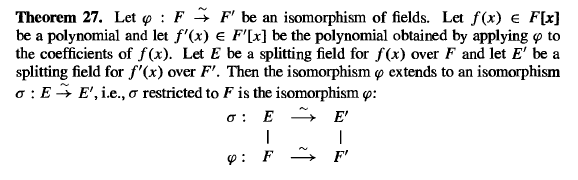
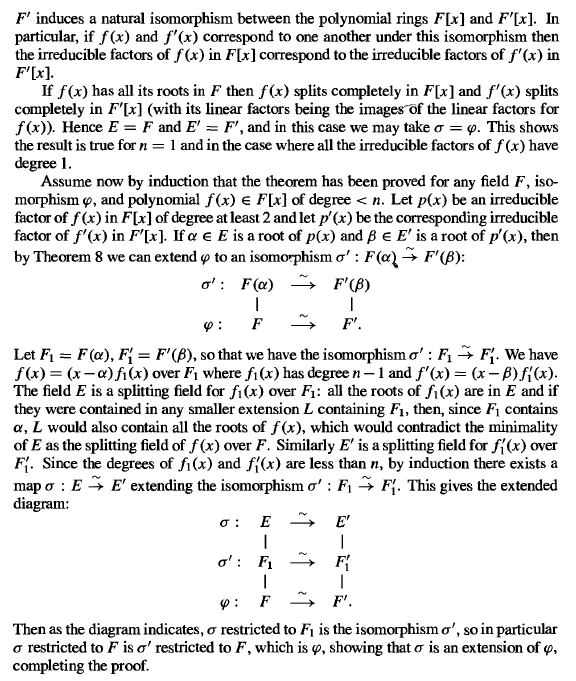
Could I have a bit of help understanding the proof Shamrock gave me? I'm not really sure how we extend φ and when I am allowed to do so. Is there a theorem about extending field isomorphisms?
oblique river
there is but I don't remember the exact hypotheses
I know it's in the start of the galois theory chapter of dummit and foote
brisk granite
I don't have dummit and foote lol
oblique river
lemme see if I can find it one sec
scarlet estuary
just use libgen
is this what you mean
since that doesnt seem right
but the only other theorem at "the start of the galois theory chapter" is this lmao
 scarlet estuary
ah alright
oblique river
and yeah it's not at "the start"
oblique river
well
it's in the section
that also contains galois theory
and why would you be doing this otherwise
scarlet estuary
im offended
oblique river
(you're technically right but that was just my thought process haha)
scarlet estuary
so let me get this straight
rather than being at the start of the galois theory chapter
it's at the end of a subsection of field theory
you managed to get literally all 3 parts of the statement wrong
brisk granite
lmao
oblique river
well
it's before galois theory
and that whole section might as well be about galois theory
:P
scarlet estuary
scarlet estuary
oblique river

 oblique river
:P
leaden finch
toxic zephyr
Suppose we have a system $AX=B$ in $\mathbb{F}_p$ where $\det(A)$ is not zero and not divisible by $p$. If $X=A^{-1}B$ is the solution when we're just talking about real rational entries, then will evaluating the entries of $X$ in $\mathbb{F}_p$ give a solution over that field?
cloud walrusBOT
nix:
toxic zephyr
That is to say, is $\det(A)^{-1}adj(A)B$ always a solution
cloud walrusBOT
nix:
latent anvil
So it's saying A and B are matrices with integer entries?
toxic zephyr
Yes
latent anvil
I think the answer is yes
So A*adj(A) = det(A) I, right?
Over the integers, for any A
Let A be the matrix containing a distinct variable in entry
Then this holds as an identity in Z[all those variables]
Does that make sense?
Like, we get n^2 polynomial equations
toxic zephyr
You kind of lost me with "distinct variable in entry". And I'm also not sure what Z[*] is describing
latent anvil
Do you know what a polynomial ring is?
toxic zephyr
No I don't 😬
latent anvil
oh
Do you know what a ring is?
Actually I don't need full rings
Suppose you have a polynomial equation which holds over the integers
In some number of variables
Then it holds over Fp, just reduce all the coefficients
Does that make sense?
toxic zephyr
Yes the concept does makes sense. I think I'm just not experienced enough with modular arithmetic to be able to see that no contradictions would arise.