#groups-rings-fields
1 messages · Page 351 of 1
 karmic moat
hmm i see
 thorn jay
(in particular for any signature there's only a set's worth of varieties, even though varieties themselves are classes)
karmic moat
do y'all call them galois correspondences
thorn jay
ye
karmic moat
W
thorn jay
I mean adjoint functors doesn't seem fitting when you're really not thinking about stuff categorically
karmic moat
fair
thorn jay
karmic moat
W
ikr
it's funny how they pop up everywhere when you do anything related to order stuff
karmic moat
oh galois connections lol
i was confused i was thinking about the field theoretic galois correspondence
thorn jay
lma
karmic moat
wikipedia says ppl use "galois correspondence" for bijective galois connections sometimes
okay makes sense
yeah that's neat tho
 tough raven
Oh, THAT'S why they're called varieties?
tough raven
Yes, but that sounds way too old-fashioned.
thorn jay
karmic moat
wikipedia says ppl use "galois correspondence" for bijective galois connections ...
Oh yeah but there is a Galois correspondence between these things
thorn jay
thorn jay
Oh yeah but there is a Galois correspondence between these things
e.g. a Galois connection is between subsets of k^n and ideals of k[X1, ... Xn], with a Galois correspondence between algebraic sets and radical ideals
thorn jay
tough raven
Yes, but that sounds way too old-fashioned.
exactly
algebro-geometric terms are modern and hip
karmic moat
ah yeah
tough raven
thorn jay
algebro-geometric terms are modern and hip
By which we mean 100 years old, I suppose.
tough raven
I know tame, congruence and theory. 😎
In three different contexts. (But at least two of them are both in number theory.)
thorn jay
haha @karmic moat I was looking for solvable groups in AG online and came across this paper https://www.sciencedirect.com/science/article/pii/S0021869310003169/pdf?md5=8ac0062943ab29510005b7c485ebb73c&pid=1-s2.0-S0021869310003169-main.pdf which is about the algebraic geometry of groups
 quiet pelican
thorn jay
Raghuram have you ever heard about tame congruence theory?
quiet pelican
thorn jay
Raghuram have you ever heard about tame congruence theory?
None of those words are in the bible
thorn jay
thorn jay
haha <@261190376268890123> I was looking for solvable groups in AG online and ca...
that's funny, I didn't know that was still done
 thorn jay
this, along with the AG of Lie algebras is the motivation for universal algebraic geometry~~, in which I've done some cool stuff~~
karmic moat
im no damn robot i played that capatcha game
thorn jay
quiet pelican
None of those words are in the bible
neither is "hot say gex" but it's good nonetheless
thorn jay
karmic moat
im no damn robot i played that capatcha game
I can send you the pdf in dms if you're interested even though it doesn't really answer your question
lol
karmic moat
i'll prob open it when i get home onto my pc
must be a browser thing
too lazy to download chrome
thorn jay
lmao that is fair
 karmic moat
the main one is Flag Varieties by Lakshmibai and Gonciulea
but i'm supplementing with Humphrey's Linear Algebraic Groups bc the former skips a lot of proofs for this intro setup stuff
i have to present wednesday
i think semisimple/reductive groups, then prob like abstract root systems and stuff
thorn jay
karmic moat
i have to present wednesday
oof good luck with that
karmic moat
cheers
tough raven
karmic moat
i think semisimple/reductive groups, then prob like abstract root systems and st...
Oooh fun
karmic moat
not too worried about it it's just me, another student, and a prof
presentation is whatever i just want to get a good understanding of it on my own too
thorn jay
thorn jay
haha <@261190376268890123> I was looking for solvable groups in AG online and ca...
ugh I'm not sure if this says anything interesting or new
hate those kinds of papers >.>
well, it is interesting if you don't know the AG for groups yet I suppose
thorn jay
tough raven
In three different contexts. (But at least two of them are both in number theory...
basically it's a weird ass theory that allows you to study "locally" finite algebras in a black magic ass way
you assign to each algebra a set of types, and based on what types don't occur you can magically make Malçev-type terms appear
(terms with certain properties)
tough raven
Hmmm.
thorn jay
tough raven
Hmmm.
in trying to write down the proofs myself I accidentally discovered an alternative way to approach this lmao
relying more on monoid theory
tough raven
thorn jay
basically it's a weird ass theory that allows you to study "locally" finite alge...
fg subalgebras are finite sets?
tough raven
thorn jay
you assign to each algebra a set of types, and based on what types _don't_ occur...
type = the model theory type?
thorn jay
tough raven
fg subalgebras are finite sets?
no I meant that you study finite algbras "locally" by considering so-called "localisations" to "nice" subsets of your algebra
it honestly took me a while to get my head around all the concepts
The original idea is looking at the ranges of nonconstant unary polynomials f : A -> A, where A is finite and simple. Then, if there is a minimal such set U, then you can prove that U must be the range of an idempotent polynomial (one where f^2 = f), and in fact any minimal such set must be the range of an idempotent and they are all isomorphic in some sense.
This concept then gets generalized to arbitrary algebras in some wacky ass way
I've accidentally stumbled upon a way to view this as the study of certain right-ideals of the monoid of unary polynomials lmao

 late python

How do I get started to prove this? I thought the hint implied induction but that doesn't work
 kind temple
following the hint, if there is no such n, show that \sum_j=1^n 1 = \sum_k=1^m 1 implies n = m for all natural numbers n, m
i would proceed by ruling out cases n < m and n > m. and then using the hypothesis again somehow
what is actually going on is that you are showing that the unique homomorphism Z —> (the additive group of F) determined by taking 1 to 1 is not injective
 idle girder
What is N*? Is that positive integers or primes?
If positive integers, that hint seems overly complicated. Not sure how to explain that in a way that is not itself a hint.
kind temple
 earnest delta
<1>=01,2,3,4,5
<2>=0,2,4
<3>=0,3,6
<6>=0,6
earnest delta
<1>=01,2,3,4,5
<2>=0,2,4
<3>=0,3,6
<6>=0,6
6 is the same as 0 in Z/6Z, so some of your ideals listed have 1 too many elements.
this problem is just definition checking. where are u stuck?
 rapid cave
earnest delta
What should I do next
rapid cave
earnest delta
What should I do next
See that <2> is maximal because no other ideal other then <1> contains it
kind temple
idle girder
If positive integers, that hint seems overly complicated. Not sure how to explai...
its not terribly complicated, no? maybe not the simplest proof, tho.
late python
idle girder
What is N*? Is that positive integers or primes?
yes it is the set {1,2,...} all positive integers
late python
kind temple
i would proceed by ruling out cases n < m and n > m. and then using the hypothes...
so I need to show a contradiction in all these cases?
idle girder
kind temple
its not terribly complicated, no? maybe not the simplest proof, tho.
Yeah, it suggests a proof by contradiction, while you can just get the result directly by using that ZZ -> FF is not injective.
kind temple
late python
so I need to show a contradiction in all these cases?
yes
kind temple
idle girder
Yeah, it suggests a proof by contradiction, while you can just get the result di...
yea, this is the other thing i suggested
idle girder
kind temple
yea, this is the other thing i suggested
Ah, I read that as relating to the existing hint, instead of infinite -> finite, so non-injective.
idle girder
Right. I guess it's just a way to get you to consider sum(1 for j = 1, ..., m) = sum(1 for j = 1, ..., m') for m != m'. Okay, I'll shut up now to not give the game away entirely.
 sour rain
I used to think that vector spaces could be thought of as fields acting on abelian groups
But is this definition even complete? How would we get distributivity in this definition
 cedar vault
I think any ring action on an abelian group G will include distributivity
Since End G will have an additive structure given by pointwise addition and a multiplicative one given by composition
So more generally you can think of R-modules as abelian groups with an action of R, and the vector spaces will just be F-modules
 swift tundra
cedar vault
Since End G will have an additive structure given by pointwise addition and a mu...
swift tundra
cedar vault
Since End G will have an additive structure given by pointwise addition and a mu...
I really like this characterization of a vector space (as a function from the field into the endomorphism ring) because it give a bit more reason imo why we have the 4 other vector space axioms.
sour rain
cedar vault
Since End G will have an additive structure given by pointwise addition and a mu...
ok wait it took me a while to understand what u meant by this
do u mean like an R-module can be thought of as a unital ring homomorphisms from ring R to End G?
cause then the axioms are pretty clear and thats really neat
 delicate orchid
sour rain
do u mean like an R-module can be thought of as a unital ring homomorphisms from...
delicate orchid
sour rain
do u mean like an R-module can be thought of as a unital ring homomorphisms from...
yeah that's right
sour rain
o thats pretty sweet
 glad osprey
That's pretty much the definition of "field acting on an abelian group" isn't it? If R is a field and G abelian
cedar vault
Well it looks like they defined it by listing the axioms instead
Ofcourse they are equivalent
 earnest delta
you meant=n is 1 then it is z right?
n=2 then 2z
ohh it fails for 2z
no identity
please be quick
idle girder
The claim is that (nℤ, +, ×) is a ring without unity. Why are you looking for a unit element, when none is needed for a non-unital ring?
 astral ivy
What's the motivation for introducing stabilizer and orbits? Isn't stabilizer basically equivalent to identity element and orbits are just all other elements?
earnest delta
astral ivy
What's the motivation for introducing stabilizer and orbits? Isn't stabilizer ba...
i feel like stablizer is set of all orbits?
all possible path which is made by orbits?
delicate orchid
The set of all orbits is the original set
rapid cave
astral ivy
What's the motivation for introducing stabilizer and orbits? Isn't stabilizer ba...
I don't know the exact motivation, but look at the case of where a group acts on itself by conjugation. Here orbits are conjugacy classes and stabilizers are centrelizers
earnest delta
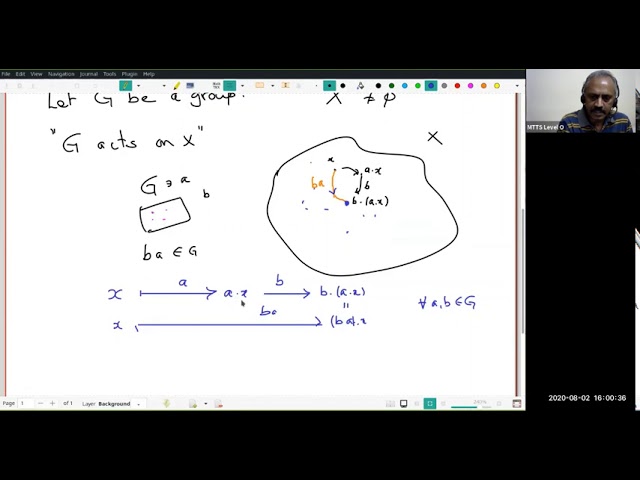
This is the first of the series video lectures on Group Actions. We give a lot of geometric as well as abstract examples. We introduce the notion of orbits and identify the orbits in the examples studied. We shall continue with more examples in the next lecture also.
Group actions play an important role in the structure theory of groups, in di...
this video is helpful in it
delicate orchid
astral ivy
What's the motivation for introducing stabilizer and orbits? Isn't stabilizer ba...
I don’t really know what you mean by this. It’s true that every orbit of x is isomorphic to G/Stab(x) as G-sets
So in that sense the stabiliser can be thought of as an identity element
 dull ginkgo
shategory theory
delicate orchid
Orbit is where it goes. Stabiliser is what doesn’t move it
delicate orchid
dull ginkgo
shategory theory
This ain’t theory no more this a cold hard fact
dull ginkgo
delicate orchid
I don’t really know what you mean by this. It’s true that every orbit of x is is...
Is G-set just the category of sets a group acts on
earnest delta
delicate orchid
Orbit is where it goes. Stabiliser is what doesn’t move it
doesn't move it?
delicate orchid
dull ginkgo
Is G-set just the category of sets a group acts on
No it’s the category of sets with a G-action
earnest delta
it is identity element no?
dull ginkgo
delicate orchid
This ain’t theory no more this a cold hard fact
Every shit gets cold and hard on the concrete floor bucko
delicate orchid
earnest delta
it is identity element no?
Yes… the identity is in every stabiliser because they’re subgroups
earnest delta
how is this true?
 delicate orchid
Im gonna be honest you’re not really making any sense
rapid cave
earnest delta
how is this true?
CRO?
earnest delta
ohhhhhhh
got it
unity exists yes
thanks

because matrices are not commutative right?
rapid cave
yes
astral ivy
rapid cave
I don't know the exact motivation, but look at the case of where a group acts on...
I see thank you
astral ivy
delicate orchid
I don’t really know what you mean by this. It’s true that every orbit of x is is...
I'm just learning about them right now so I asked out of curiosity
delicate orchid
astral ivy
I'm just learning about them right now so I asked out of curiosity
If you think about a group acting on itself by multiplication, then you’re right in that every stabiliser is just the identity element and the unique orbit is the entire group
earnest delta

can anyone simplify this statement
i am looking for unit elements in ring theory
if I take z_6
=,01,2,3,4,5
rapid cave
simplify?
earnest delta
make it simple to understand
delicate orchid
U(6) is the set of elements coprime to 6. There isn’t really much to simplify
earnest delta
by the definition i gotr 1,5
delicate orchid
That’s correct
earnest delta
how it is unit elements
delicate orchid
Because 1 is obviously a unit and 5^2 =1
earnest delta
does it not have any connectiion with other elements
astral ivy
delicate orchid
If you think about a group acting on itself by multiplication, then you’re right...
Can you give me an example where there's more than one stabilizer?
earnest delta
5.2mod6 =4
delicate orchid
astral ivy
Can you give me an example where there's more than one stabilizer?
Let G act on itself by conjugation. Then the stabiliser of an element x is the centraliser C_G(x)
earnest delta
astral ivy
Can you give me an example where there's more than one stabilizer?
i gave u a link
which is very useful
delicate orchid
delicate orchid
Let G act on itself by conjugation. Then the stabiliser of an element x is the c...
And the orbits are the conjugacy classes
delicate orchid
earnest delta
5.2mod6 =4
Ok… what’s your point?
If you multiply a unit by a non unit you get a non-unit
 delicate orchid
Yes if there exists. Not for all
delicate orchid
No worries
thorn jay
delicate orchid
Let G act on itself by conjugation. Then the stabiliser of an element x is the c...
this is an important example in itself

 knotty badger
I’ll leave this to you enpeace
thorn jay
yeah
the real kicker (I am not 100% sure if this holds for general rings) is that the converse holds; if any submodule has a complement, then M must be a direct sum of simple modules
..?
no that's the conclusion
well it's easily seen that a module is a sum of simple modules iff it is a direct sum of simple module
s
because, if A and B are simple submodules of M, then either A = B or their intersection is (0)
so if M is a sum of simple submodules, then if you remove all the copies in the sum you get a direct sum
 twin phoenix
is the group of 90 degree rotations isomorphic to addition modulo 4?
 proud vigil
yes, you can map the generator 1 to the generator 90 degrees
rapid cave
twin phoenix
is the group of 90 degree rotations isomorphic to addition modulo 4?
Both are cyclic of order 4 so yes
delicate orchid
cyclic group? call that the tour de france
 twilit wraith
i have to prove that if H is normal in G and it has prime index p, then for any subgroup K in G, either K \leq H or HK = G and |K: K \cap H| = p
the |K:K \cap H| = p part follows immediately from the second isomorphism theorem
but idk how to show that HK = G
twilit wraith
twilit wraith
i have to prove that if H is normal in G and it has prime index p, then for any ...
i know intuitively that H having prime index means its "right under G" in the subgroup lattice and so since K is not a subgroup of H, HK will be bigger than H but also a group and so it must be G
thorn jay
the usual definition for R[X] that follows the same universal property as for when R is commutative, has X not commuting with the elements of R
twilit wraith
but i dont know how to prove that H is right under G in the subgroup lattice
Yes
Because H is normal
proud vigil
twilit wraith
i have to prove that if H is normal in G and it has prime index p, then for any ...
G/H is cyclic, and since the size is prime, any coset of H that isn't H will be a generator
since K is not a subgroup of H, we can find k in K not in H, so kH != H, meaning kH generates G
i think this works
twilit wraith
proud vigil
G/H is cyclic, and since the size is prime, any coset of H that isn't H will be ...
Ah I had that first part
For the second I just take the union of all such k in K right
And thats equal to KH but also G
proud vigil
mhm yeah
or i guess i thought of it differently but i think it's the same idea
(kH)^r = k^r H
twilit wraith
proud vigil
mhm yeah
Why is it that kH generates G and not some other subgroup tho
proud vigil
and every element of G belongs to some (kH)^r
proud vigil
ya just standard coset partitioning
twilit wraith
proud vigil
ya just standard coset partitioning
The part that was tripping me up is knowing that theres some k in K that allows kH to generate G/H
But since its prime any representative not in H will generate G/H
proud vigil
mhm
twilit wraith
Given a group G of order p^a m where p doesnt divide m, a subgroup P of G with order p^a, and a normal subgroup N of G with order p^b n where p does not divide n, i have to show that |P \cap N| = p^b
ive managed to show that the order is a power of p but idk how to show that it must be a p^b exactly
 unique flint
Does it help that P is a Sylow p-subgroup?
twilit wraith
unique flint
Does it help that P is a Sylow p-subgroup?
cant use any sylow theory
best i have are the four isomorphism theorems, coset theorems including lagrange
unique flint
Maybe you can show that the subgroup of N generated by elements with orders that are powers of p is a subgroup of P
Well, maybe not, actually.
twilit wraith
unique flint
Well, maybe not, actually.
so far i just have that the if |P \cap N| = p^k then k is \leq both a and b
i guess just at this point i have to prove it cant be less than but the reason why that is isnt coming to me
unique flint
Maybe you can use the second isomorphism theorem
twilit wraith
unique flint
Maybe you can use the second isomorphism theorem
it is relevant to the chapter
that might be the move
but im not sure how exactly i should go about it
the problem is that the next part is finding |PN/N|
which is trivial given the second iso thm
but that also requires that i know |P \cap N| so itd be circular
proud vigil
i think i found a solution
it feels a little too easy
by second iso
|PN| / |N| = |P| / |P intersect N|
since |P| = p^a, |N| = p^b n, showing that |P cap N| = p^b is equivalent to showing that |PN| = p^a n
P and N are both subgroups of PN, so p^a divides |PN| and p^b n divides |PN|, meaning p^a n divides |PN|
nvm this doesn't show that they're equal :/
unique flint
So you would need to show |PN| = p^a n... Yeah I see
twilit wraith
we know that p^a dividing |PN| means its the largest power of p that divides |PN|
proud vigil
yeah... just need to show |PN| <= p^a n to finish this but i havent figured that bit out yet
twilit wraith
since PN \leq G
twilit wraith
proud vigil
by second iso
|PN| / |N| = |P| / |P intersect N|
since |P| = p^a, |N| = p^b n,...
the other problem with this is that it would basically cause you to find |PN/N| before |P cap N|
but the problem in D&F is worded in such a way that expects you to find it in the other order
proud vigil
oh
twilit wraith
maybe theres some particular theorem i need to use that im forgetting
unique flint
Probably something about N being normal
twilit wraith
yeah
im wondering if i could do something with G/(P cap N) and the third iso thm
ooh
wait no G/P isnt a group
wait neither is G/(P cap N)
lol now im just making shots in the dark this isnt good
ok i got it but i did look up help which feels bad
we do start with PN, so |PN| = p^k t
we know that k = a tho
so |PN| = p^a t
importantly n divides t since N is a subgroup of PN
then |PN/N| = p^{a-b} s
where s is the quotient of t and n
then by second iso we have |P/P cap N| = |PN/N| = p^{a-b}s
unique flint
Ah okay, I see, you can show s = 1 because P cap N is a p-group
twilit wraith
but as |P| has to divide |P/P cap N| we must have |P/P cap N| = p^{a-b}
wait
isnt that not right
theres no situation in which p^a divides p^{a-b} s
proud vigil
yeah it's the other way around? |P / P cap N| divides |P|
unique flint
P cap N only contains elements of order a power of p, so it must have order p^k
twilit wraith
proud vigil
yeah it's the other way around? |P / P cap N| divides |P|
wait why is this true
proud vigil
er just because we're dividing a number by one of its factors
twilit wraith
oh duh
unique flint
|P| = |P / P can N| |P cap N|
twilit wraith
yeah idk why i had that train of thought thats obviously true
good thing this is the last problem on the hw bc i think im nearing needing a math break
proud vigil
unique flint
P cap N only contains elements of order a power of p, so it must have order p^k
this also just follows from lagrange on P cap N wrt P, im confused why this adds new information we havent already deduced though
unique flint
proud vigil
this also just follows from lagrange on P cap N wrt P, im confused why this adds...
It's just a way to show s = 1 above
proud vigil
hm i dont think i get it
s is such that
|PN/N| = p^{a-b} s
right
proud vigil
right
how do u get to s = 1 from |P cap N| being a power of p
oh i see
we just use the theorem again
unique flint
|PN/N| = |P/(P cap N)| by second iso thm
unique flint
lol I feel so out of practice
twilit wraith
ugh i hate looking up solutions but i was so lost
feels bad
fortunately most of the problems on this homework i was able to do independently so at least theres that
proud vigil
i think you're still gaining value out of it, you have a perspective to apply to other problems in the future
twilit wraith
proud vigil
i think you're still gaining value out of it, you have a perspective to apply to...
very true
ive already done algebra once before so this time around its serving as a way to open up my perspective
and it definitely wont be the last time i do intro algebra
though i should only need to do it once more
@proud vigil thank you for your help
actually wait i need help phrasing something
i had to prove that if |G| = pq for primes p,q then either G is abelian or Z(G) is trivial
since Z(G) is a subgroup it has order 1,p,q,pq
how would i work the case where Z(G) = p or q?
you end up getting that G is abelian but it implies that Z(G) = pq
so it wasnt p or q to begin with
do i approach this as a contradiction despite having arrived at one of the sought-out conditions before arriving at the contradiction?
proud vigil
yeah that's fine, we do a similar thing when proving groups of size p^2 are abelian
twilit wraith
proud vigil
yeah that's fine, we do a similar thing when proving groups of size p^2 are abel...
should i just in parentheses state that it technically implies that Z(G) could not be p or q
well that just seems flimsy then
proud vigil
like you showed that
Z(G) = p -> Z(G) = pq
and that is a contradiction, so Z(G) != p
that's totally valid
twilit wraith
cool
 novel spruce
I am currently proofreading a book, and at some point the authors claim that S_4 is isomorphic to a subgroup of GL_2(R), without any further explanation. I somehow find this hard to believe. Is there anyone who happens to know either an embedding of S_4 into GL_2(R) or a proof that this does not exist?
quiet pelican
novel spruce
I am currently proofreading a book, and at some point the authors claim that S_4...
It can’t happen
Consider where the transpositions map to
By considering the eigenvalues, they must map to reflections in some lines
Call the lines corresponding to (12), (23), (34) respectively l_1, l_2, l_3
The fact that (12)(23) has order 3 implies the angle between l_1 and l_2 is some multiple of pi/3
Similarly the angle between l_3 and l_2 is some multiple of pi/3
As (12) and (34) commute and are distinct, the angle between l_1 and l_3 is pi/2 or 3pi/2
But this is a contradiction, as we get that some integer multiple of pi/3 is pi/2 or 3pi/2
knotty badger
Another way to see this is that (1234) has to map to a matrix A with A^4 = 1
This has simple roots over C, so is diagonalisable over C, with possible eigenvalues 1, -1, i, -i
In order to have order 4, the eigenvalues have to be i and -i, meaning that in some basis (1234) maps to a 90 degree rotation
But then (1234)^2 = (13)(24) maps to a 180 degree rotation, i.e. -id, which commutes with every matrix
This would imply (13)(24) commutes with every element of S_4, which it does not
novel spruce
Thank you for your answers!
thorn jay
knotty badger
This would imply (13)(24) commutes with every element of S_4, which it does not
this is a really good argument
knotty badger
thorn jay
this is a really good argument
:D
It’s rare that i can make a good argument in algebra
tough raven
Another argument using more machinery: GL_2(ℝ) ⊆ GL_2(ℂ), so S_4 maps into the latter as well. By the representation theory of symmetric groups (specifically, because S_4 has no 2-dimensional irreducible representations), up to conjugation, the only possibilities are the trivial representation s ↦ id, the "sign" representation s ↦ sign(s) id, and the direct sum of both s ↦ diag(1, sign(s)). None of these are injective - they have kernel S_4 or A_4. The same is then true for any group homomorphism from S_4 to GL_2(ℝ) as well.
knotty badger
yep
equivalently, a basis for a module is a chosen isomorphism with a free module
oh uh
for me every ring has unity
knotty badger
yep, this is also how a free module on an infinite set works
it's a specific way to turn a set into a module
 south patrol
knotty badger
it's a specific way to turn a set into a module
south patrol
knotty badger
it's a specific way to turn a set into a module
Eh I mean free module does mean this lol
A free module is indeed a module with a basis
knotty badger
interesting
for me i prefer free module referring to the specific construction via functions with finite support etc
knotty badger
knotty badger
equivalently, a basis for a module is a chosen isomorphism with a free module
since then this makes more sense
south patrol
This is standard
Multiple equivalent ways to define it
Probably easiest is that the only submodule of M containing that set is M
Yes, every element can be written as a linear combination of elements of the set
This is equivalent
That's what linear combination means
Yes, same as in lin alg
Oh I guess you are worried cause of non-unitality lol
I cannot speak about them
Lol
I have been assuming unital
Shouldn't matter cause you can just absorb into the linear comb
rapid cave
an A-algebra is a ring B with an A-action
 kind kindle
an action is just like generalized multiplication right
rapid cave
you can think of this as a way to multiply by an element of A
kind temple
kind kindle
question. What is an algebra exactly?
alternatively, an R-algebra is a ring with an R-module structure
kind kindle
alright sounds reasonable
also i've asked similar questions before, but I know elitpic curve operations basically use a rational function as a group action over a finite field in 2d
is there a way to construct rational functions like this that represent some sort of group over a finite field?
sorry if this is trivial/annoying
i know finite groups of lie type are a thing
i'd be interested in some sort of low dimensional way to represent one of those lie type groups using rational functions over a finite field on some tupple of finite field values i guess
eliptic curves feel like a trivial case of this where the group being represented is a direct product of finite cyclic groups
if we find a sufficiently good non abelian group/way to represent elements of that group in a way where conjugacy is hard, we should get post quntum crypto for free
Matrix representations have 2 issues:
- Linear algebra attacks on conjugacy
- really big
But if we have this group, the public key cryptography scheme i came up with is as follows:(Could be generalized if we have an otherwise desirable group where conjugation is easy to some other hard non abelian group problem)
Alice wants to send a message to bob. They agree on the following public parameters:
A public finitely presented non abelian group.(With efficiently solvable word/inverse problem and where taking powers is also efficient and some normal form)(finite group prefered)
a public element of a such that ord(a) >= 2^b where b is the bit security
bob has his private key k. Which is a private element of G. His public key p is p=k*a*k^-1.
If alice wants to send a private message M to bob using his public key, she does the following.
Chose a random number between 1 and ord(a)
-
Compute a^r and hash it using some hash function H. compute c = H(a^r)
-
Alice uses a symmetric algorithm to encrypt her message m using c(we denote this E(c, m))
-
Alice then computes p^r and sends (p^r, E(c, m)) to bob.
-
Using his private element k, p^r = k*a^r*k^-1 , so bob computes k^-1pk = a^r. From a^r bob computes H(a^r)=c and decrypts E(c, m) and recovers m
If eve is interloping on this conversation, and gets (p^r, E(c, m)). Eve would have to both break the conjugacy problem over G in order to recover the key. if She can compute discrete logs over G efficiently, she can also break the encryption however. She could compute r from p^r than recompute a^r to recover the key.
 noble nexus
It should include anything you can get to from the set by applying ring operations
if ur ring isn't unital then saying linear combinations is maybe a bit sloppy
karmic moat
Not sure about your confusion
What do you think it should be a subset of?
Well K is a submodule of F which is isomorphic to R^n
Pi is a map from K to R as defined
If pi =0 then it sends everything in K to 0
Ie the kernel is K
As desired
By definition of pi
It’s not all possible n-1 tuples to be precise
It’s all n tuples with 0 in the first coordinate
No the domain of pi is K
There’s no M in your screenshot lol
Ah i see what youre saying then
It probably means ker pi as a subset of K
Not all n tuples w 0 in first coordinate
Maybe. I’ll reread
Yeah should just mean ker pi as a subset of K, which ends up being all of K by definition
the result follows because K = ker pi is a submodule of R^{n-1}
which we know is free by induction on n
earnest delta
9z is maximal ideal of 3z but it is not for z why?
rapid cave
9Z is a subset of 3Z which both are ideals in Z. So 9Z is not maximal in Z by definition of being maximal
unique flint
kind kindle
Alice wants to send a message to bob. They agree on the following public paramet...
This is very interesting. Have you looked into Anshel-Anshel-Goldfeld key exchange? It's not exactly the same, but it's similar in also using conjugation in a non-abelian group.
I'm also working on some group-based cryptography, though what I'm working on isn't anywhere near as secure, yet I'm still having trouble coming up with an algorithm that can crack it.
kind kindle
unique flint
This is very interesting. Have you looked into Anshel-Anshel-Goldfeld key exchan...
Yeah I have. My goal though wasn't just a one time key exchange but a non interactive public key cryptosystem(all alice needs to send bob a message is a public key. no other communication is required). That was also relatively compact and able to work over arbitrary groups. Someone has probably come up with this before, but i'm suprised it's not on wikipedia making me think that maybe it has some trivial flaw i'm overlooking?
But if we found a suitable group, this could be far far faster than lattice based cryptography an on par with ecc in terms of speed assuming a suitable group and (possibly nonlinear) representation can be found(by nonlinear representation i mean for example the way ecc points are reprsented despite technically being a cylcic group)
i.e, the group operation does not resemble a bilinear map over a vector space in this presentation
general linear groups over a finite field would probably work for this. But that feels suboptimal in terms of keysize
My thought is some weird nonlinear automorphism from some finite simple group of lie type to F^n under which element inversion/exponentiation re computable efficiently
sporadic grpups may or may not work but even the monster group(which is too structured and computationall intensive) only has security of liek 153 bits assuming no better conjugacy aglorithm than brute force
but for the monster group, there probably is a way better algorithm
my hunches are weird representations of symmetric/alternating groups and lie type groups
that are relatively low dimensional
like technically via polynomial interpolation you ccould make a nonlinear representation of any group over any field but like it'd be so absurdly big as to not be worth it
we want to find these representations that are simple enough for practical use.
eliptic curves are special because they give an automorphism for a cyclic group over which discrete log is hard for that automorphism
So essentially, it's a one way automoprhism that's hard to convert back into a simple form
unique flint
I feel like maybe the reason it's not commonly used is that most groups that are complex enough to be useful for cryptographic security are hard to do computations in
delicate orchid
big matrix. the classic. el classico.
quiet pelican
A map M -> M is composed of
(A) a map M_1 -> M_1
(B) a map M_1 -> M_2
(C) a map M_2 -> M_1
(D) a map M_2 -> M_2
If you figure out how so, your problem is essentially done
Yeah
delicate orchid
it's a direct sum because the matrix is diagonal
that's why the matrix is diagonal
yeah that's cause the matrix is diagonal
actual answer is this argument doesn't work. You can only add morphisms in the same Hom-set
you'd have to embed them inside End(M_1 (+) M_2) implicity and that defeats the point
 tardy hedge
Wow u know Hom and stuff now
Just the other day u were confused by the definition
My bad G
earnest delta
Prime ideal and maximal ideal are the same thing?
If I have to find these ideals for z_12
What will be they?
2z,3z
Both are maximal and prime?via definition maximal says that it shouldn't be equal to z_6 and less than it
 mint seal
maximal and prime ideals are not the same in general
earnest delta
In this example they are same?
knotty badger
earnest delta
In this example they are same?
They’re the same for finite rings
mint seal
also apparently for commutative Artinian rings (with 1)
earnest delta
Is there any difference between equivalence class and equivalence relation?
knotty badger
earnest delta
Is there any difference between equivalence class and equivalence relation?
Yeah, equivalence classes are element-specific
earnest delta
[2]
Which means 2,4,6...like that?
And the relation is bound with reflexive,transitivity and symmetry
knotty badger
Depending on the equivalence relation, yeah
You may be thinking of interconverting between equivalence relations and partitions?
earnest delta
Class of element should satisfy equivalence relation properties?
knotty badger
Given an equivalence relation, the equivalence classes partition the set
And given a partition of a set, you can define an equivalence relation by saying a ~ b if they’re in the same subset of the partition
knotty badger
earnest delta
Class of element should satisfy equivalence relation properties?
The equivalence class of an element is just a subset of the parent set, so things like “reflexivity” and “transitivity” don’t really apply
knotty badger
knotty badger
They’re the same for finite rings
(This is cause finite integral domains are fields)
earnest delta

I didn't understand the equivalence class mean here?
@knotty badger
What are they trying to ask me?
knotty badger
earnest delta
I didn't understand the equivalence class mean here?
It means which of the following subsets of A is of the form [a] for some a in A
knotty badger
Ok wait R isn’t even an equivalence relation
earnest delta
But in this question totally lost
knotty badger
earnest delta
For specific [2] ={0,2,4,6...}
I don’t see where you got this from
earnest delta
knotty badger
Ok wait R isn’t even an equivalence relation
I didn't check
earnest delta
knotty badger
I don’t see where you got this from
I am just explaining
How I see [] class
But struggling how do I make here?
knotty badger
The definition is $[a] = {x \in A \mid a \sim x}$
 cloud walrusBOT
Pseudo (Cat theory #1 Fan)
 earnest delta
(2,1) is not there
(2,5)(5,1) is there
So equivalence not there
So the question is wrong?
knotty badger
Yeah
knotty badger
thorn jay
yeah
I mean I guess you could consider the equivalence relation generated by R
But at this level I think that would just be more confusing
thorn jay
knotty badger
I mean I guess you could consider the equivalence relation generated by R
"Let 1 be a negative number" ahh
 placid ginkgo
Would it be right to think of this as a "recursive" proof where if G/N doesn't contain an element yN of order p and therefore p does not divide |y|, then we consider (G/N)/⟨y⟩ which has a smaller order than G/N, and then repeat this until we reach the condition that p divides a quotient group? Sorry if this is a really basic question, I've never come across this type of inductive proof before.
 rapid cave
Its just induction:
p divides ord(x) or it doesn't divide ord(x)
in the first case there is an element of order p.
Otherwise you reduce to a quotient group and by the induction hypothesis there we have an element of order p.
Then we lift to an element of order p in G.
placid ginkgo
Oh makes sense
tardy hedge
thorn jay
"Let 1 be a negative number" ahh
lol
tardy hedge
Kind of basic questions, but the proof that every vector space has a basis relies on Zorn's lemma? Where does the property of k being a field come into play?
I just wanted to get clear in my head where exactly the ring being a field matters
knotty badger
tardy hedge
Kind of basic questions, but the proof that every vector space has a basis relie...
i believe it's the steinitz exchange lemma
afaik this doesn't work for arbitrary rings
tardy hedge
yea the "replacement" lemma thing? honestly its kinda my bad cause anytime i see that proof it looks annoying so i just dont think about it much
thorn jay
tardy hedge
I just wanted to get clear in my head where exactly the ring being a field matte...
well the simple modules are precisely the quotients by a maximal, and if F is a field then F is the only simple module, which all modules are built out of. But because it is also projective every (fg) module is a direct sum of copies of F, i.e. free. I'm sure you can extend that argument in some way using Zorn
ah yeah F is semisimple so every algebra is a direct sum of simple algebras
kind temple
tardy hedge
Kind of basic questions, but the proof that every vector space has a basis relie...
you end up dividing out by a certain scalar in the proof of the steinitz exchange lemma
you aren't guaranteed to be able to do this in a ring
tardy hedge
thorn jay
well the simple modules are precisely the quotients by a maximal, and if F is a ...
i mean i would like to understand why you said all this but i think initially im not sure why you mentioned simple modules
If M is a simple R-module then M is isomorphic to R/m as an R-module?
thorn jay
yes
tardy hedge
i think i remember doing that exercise
thorn jay
the other answers are better and more direct
thorn jay
thorn jay
well the simple modules are precisely the quotients by a maximal, and if F is a ...
this is in my opinion the more underlying reason ig
and if every module has a basis, then every simple module must be isomorphic to R, but this means that R can have no nontrivial (left) ideals, as those are submodules. In the commutative case this already implies a field, and in the noncommutative case (for left-modules) we have a divison ring.
 rocky cloak
tardy hedge
Kind of basic questions, but the proof that every vector space has a basis relie...
rocky cloak
tardy hedge
Kind of basic questions, but the proof that every vector space has a basis relie...
Something you can prove in general using Zorn is that every R-module has a maximal linearly independent set.
Then when R is a field you can show that this is a basis.
Exactly where k being a field comes up in your proof would depend on which proof you have in mind I guess
noble nexus
tardy hedge
Kind of basic questions, but the proof that every vector space has a basis relie...
If you have a maximal linearly independent set S that does not span, there is a vector v not in the span of S. We claim that S together with v is linearly independent. Suppose we have a linear relation that involves v $av + b_1s_1+\dots+ b_ns_n=0$. If a is nonzero, we can invert it and solve for v and find that v is in the span of S, which is a contradiction. Thus a=0, then each b is zero by linear independence of S
cloud walrusBOT
Blake
 noble nexus
the place where you use the field axiom is inverting the coefficient a if it is nonzero
 fiery dirge
can anyone please clarify if this is what elementary and normal forms are?
Let's say we have Z10 x Z20 x Z30.
Then elementary form would be Z2 x Z5 x Z4 x Z5 x Z2 x Z3 x Z5 or rewritten from smallest to largest: Z2 x Z2 x Z4 x Z3 x Z5 x Z5 x Z5.
Now, normal form is we take the largest (powers) first and combine them. So Z4 x Z3 x Z5 = Z60, Z2 x Z5 = Z10, Z2 x Z5 = Z10. So the normal form will look like Z60 x Z10 x Z10?
Is this what I wrote correct?
(it is unclear to me if we are allowed to merge the same ones so instead of Z10 x Z10 we'd have Z100. I assume this is not allowed)
rapid cave
your forms are correct
The general rule is that
$\bZ_n \times \bZ_m \cong \bZ_{nm}$ if $n,m$ are co-prime
cloud walrusBOT
ExpertEsquieESQUIE
 fiery dirge
rapid cave
your forms are correct
fiery dirge
rapid cave
your forms are correct
Okay thank you!
Can you tell me how do I examine if 2 groups are isomorphic? Unrelated to the previous example
rapid cave
this really depends on what 2 groups
fiery dirge
Okay, let's say Z12 and D3 x Z2
their orders are the same check
Z12 is abelian but D3 in the product isn't so that's where they dont match right?
they're all cyclic except D3
rapid cave
D3 is of order 6
fiery dirge
rapid cave
D3 is of order 6
my bad
fixed it
but what else is there to check? Highest order of the element, group order, abelian, cyclic?
rapid cave
there are a ton of things
fiery dirge
rapid cave
there are a ton of things
thats why I dont know lol
but this is introductory course
so at least 5-6 most important things
rapid cave
the subgroup structure, normal subgroups, number of p-sylow subgroups
fiery dirge
i didnt learn sylow so we stop there
rapid cave
you will learn it sometime probably
fiery dirge
what do you mean by subgroup structure and normal ones? How do I examine that in the groups?
 subtle crypt
Yes, if one group is abelian and the other isn't, they're not isomorphic.
fiery dirge
like how to see if D3 has a subgroup to begin with
rapid cave
D3 has 2 non-trivial subgroups, one is of order 3, and one is of order 2
fiery dirge
subtle crypt
Yes, if one group is abelian and the other isn't, they're not isomorphic.
but if only 1 is non-abelian or non-cyclic then the product with that group is automatically not either, correct?
rapid cave
yes
fiery dirge
rapid cave
D3 has 2 non-trivial subgroups, one is of order 3, and one is of order 2
of order 2 being D2 right? I don't know which one is of order 3 since dihedral groups have 2n orders usually
fiery dirge
ohhh I didn't actually get introduced to C denoted groups/subgroups, what are they?
 velvet hull
fiery dirge
like how to see if D3 has a subgroup to begin with
velvet hull
fiery dirge
like how to see if D3 has a subgroup to begin with
as long as a group is not prime cyclic it has to have at least one nontrivial proper subgroup, try and see why
fiery dirge
rapid cave
C2 would mean "cyclic of order 2"
oh that makes sense I see the correlation to Z2
fiery dirge
velvet hull
as long as a group is not prime cyclic it has to have at least one nontrivial pr...
figuring out stuff on my own is not my strength 😭 I would give up before even starting
 tribal moss
fiery dirge
of order 2 being D2 right? I don't know which one is of order 3 since dihedral g...
tribal moss
fiery dirge
of order 2 being D2 right? I don't know which one is of order 3 since dihedral g...
Unfortunately there are two different naming conventions for dihedral groups. In one of them the subscript is the number of elements in the group; in the other it's the order of a primitive rotation.
velvet hull
fiery dirge
figuring out stuff on my own is not my strength 😭 I would give up before even ...
I would still ask you to give it an honest attempt, at least
it's okay if you can't figure anything out just try
rapid cave
tribal moss
Unfortunately there are two different naming conventions for dihedral groups. In...
D3 will not make sense in the first naming conventioon
tribal moss
Right, so if the subscript is odd, you know it has to be the second convention (which it sounded like HMD was not aware of).
subtle crypt
fiery dirge
but if only 1 is non-abelian or non-cyclic then the product with that group is a...
Right. I think you can write them as tuples. For example, with D2 x Z3, you can write (element of D2, element of Z3). You can then look at (x, 0) + (y, 0), and if x and y aren't commutative, (x, 0) and (y, 0) won't be commutative, so the combined group won't be commutative.
tribal moss
Unfortunately even subscripts can be either one or the other convention...
fiery dirge
tribal moss
Right, so if the subscript is odd, you know it has to be the second convention (...
at D2 I mistakenly confused it with S2 and calculated the order as 2! instead of 2n (in which case the order is 4)
rapid cave
I always assume the second convention
tribal moss
rapid cave
D3 has 2 non-trivial subgroups, one is of order 3, and one is of order 2
Actually there are three different (but conjugate) subgroups of order 2: each of the three reflections together with the identity.
rapid cave
true
fiery dirge
what are possible orders of all subgroups? Do all of them have to divide the order of a group?
or is it contrary
they have to be coprime with order of a group
rapid cave
fiery dirge
what are possible orders of all subgroups? Do all of them have to divide the ord...
yes. This is lagrange's theorem
H <= G --> |H| | |G|
fiery dirge
so Z8 for example will have Z1 (e), Z3, Z5, Z7 and Z8 (Z1 and Z8 being trivial)
fiery dirge
rapid cave
yes. This is lagrange's theorem
yee
proud vigil
they cant be coprime, they have to be factors
additionally, not all factors correspond to subgroups
proud vigil
in cyclic groups they do (like Z8), but not in all groups
rapid cave
hello
rapid cave
I have an answer 🤑
astral ivy
When checking if 2 groups are isomorphic, one of the conditions is to make sure they have elements of the same order (or orders?). My question is how to find the order of various elements?
*how to find all orders of elements
rapid cave
what two groups are you thinking of?
astral ivy
Well let's start with something basic like Zn
To be more concrete let's go with Z8 and Z15 for example
velvet hull
in general that's a pretty hard / impossible thing
tribal moss
It depends critically on which kind of information you have about the two groups you start with.
velvet hull
but for groups with simple structure like abelian groups, dihedreal or symmetric groups it is doable
rapid cave
astral ivy
To be more concrete let's go with Z8 and Z15 for example
of course they won't be isomorphic because they have different orders
astral ivy
rapid cave
of course they won't be isomorphic because they have different orders
No no they're examples for finding orders of their elements but okay let's take Z8 and Z4 x Z2 then
rapid cave
every non-trivial element of Z8 has order 8
but every element of Z4xZ2 has order 1,2 or 4
tribal moss
"Finding the orders of elements" is not a general procedure that you can just apply to a random example. It's one of several possible strategies for proving that two groups are not isomorphic, but it doesn't always work.
astral ivy
velvet hull
but for groups with simple structure like abelian groups, dihedreal or symmetric...
Those are the ones I'm interested about as well as the Euler group Fn (x in F if gcd(x, n) = 1) might be the most complicated one for me
rapid cave
astral ivy
Those are the ones I'm interested about as well as the Euler group Fn (x in F if...
they are more interesting yes
astral ivy
rapid cave
every non-trivial element of Z8 has order 8
Yep I got that (because we can take n = 8 and apply it to 1 aka 1+1+...+1 = 8
tribal moss
rapid cave
every non-trivial element of Z8 has order 8
That's for a rather unusual sense of "non-trivial element", I think. There are also elements of Z8 that have order 2 and 4, and those are not really "trivial".
astral ivy
rapid cave
but every element of Z4xZ2 has order 1,2 or 4
But because of that they're not isomorphic
Is this some term I'm not familar with? Why is this suggested 😭🙏
 rapid cave
you typed that sometime
astral ivy
rapid cave
they are more interesting yes
Okay so regarding them how would it work?
rapid cave
what would you like to know about them?
twilit wraith
astral ivy
Those are the ones I'm interested about as well as the Euler group Fn (x in F if...
interesting, i didnt know that was called an euler group
astral ivy
Let's take F8 for an example.
F8 = {1, 3, 5, 7} right? gcd(n, 8) = 1 for every n from F8.
How would we check order of each element here? I don't understand the group operation well enough
astral ivy
twilit wraith
interesting, i didnt know that was called an euler group
We call it like that here, I don't think it's used internationally though
twilit wraith
i see
tribal moss
The group operation would just be multiplication modulo 8.
twilit wraith
maybe not in the whole US, but at my uni in the US we just call it (Z/nZ)^\times
rapid cave
twilit wraith
maybe not in the whole US, but at my uni in the US we just call it (Z/nZ)^\times
or (Z/nZ)*
tribal moss
(And it turns out the orders in this particular case are very easy to find just by brute force computation of powers of each element until you see the identity come up).
twilit wraith
say youre trying to figure out which elements of (Z/nZ)* are generating elements
astral ivy
tribal moss
The group operation would just be multiplication modulo 8.
Yeah but take Z8+, to get to element 4 we do 1+1+1+1 ie apply group operation to 1 four times hence the order of element 4 is 4. But here it doesn't make sense
rapid cave
twilit wraith
say youre trying to figure out which elements of (Z/nZ)* are generating elements
in general this group won't be cyclic
rapid cave
astral ivy
Yeah but take Z8+, to get to element 4 we do 1+1+1+1 ie apply group operation to...
you do 1 * 1 * 1 * 1
twilit wraith
rapid cave
in general this group won't be cyclic
yes, but you can optimize the brute force computations when checking if it is
astral ivy
rapid cave
you do 1 * 1 * 1 * 1
True but I already wrote what group operation was
 slow bison
hi
twilit wraith
you only need to multiply as much as half the order of the group to see if you have a generator
tribal moss
astral ivy
Yeah but take Z8+, to get to element 4 we do 1+1+1+1 ie apply group operation to...
No, the order of 4 in (Z/8Z, +) is 2, because when you add two copies of 4 together, you get 0 -- that is, the identity of the group.
twilit wraith
if you get -1 mod n earlier than half the group order's worth of multiplying some element by itself, it cant be a generator
if you do get it at the halfway point then it is
but only if thats the first time of it showing up
astral ivy
tribal moss
No, the order of 4 in (Z/8Z, +) is 2, because when you add _two_ copies of 4 tog...
Ahhh yeahh I see
astral ivy
tribal moss
No, the order of 4 in (Z/8Z, +) is 2, because when you add _two_ copies of 4 tog...
So can you show me how it'd work in Z/8Z *
twilit wraith
checking will demonstrate that (Z/8Z)* isnt cyclic
rapid cave
one more thing is that
$(\bZ/n\bZ)^\times \times (\bZ/m\bZ)^\times \cong (\bZ/nm\bZ)^\times$ by the CRT
cloud walrusBOT
ExpertEsquieESQUIE
 twilit wraith
which tells you what more standard group its isomorphic to
tribal moss
(Z/nZ)^× is only cyclic if n is a prime or twice a prime.
slow bison
rapid cave
one more thing is that
$(\bZ/n\bZ)^\times \times (\bZ/m\bZ)^\times \cong (\bZ/...
don't n and m have to be coprime?
tribal moss
astral ivy
So can you show me how it'd work in Z/8Z *
For example, 5 has order 2 because 5×5 = 25 == 1 (mod 8) and 1 is the identity in the multiplicative group. So the order is at most 2; on the other hand the order is not 1 because 5 itself (that is, the "product" of a single copy of our element) is not the identity.
rapid cave
isn't it a prime power
velvet hull
Odd Prime power, twice an odd prime power and 2 and 4 iirc
tribal moss
(Z/4Z)^× is cyclic of order 2, right?
twilit wraith
it has to be
tribal moss
Hmm, yeah, I think odd prime powers (and twice an odd prime power) will work too.
(But anything with two distinct odd prime factors, or multiples of 4 with any odd prime factor, will have too many elements of order 2 to be cyclic).
 coral spindle
(Z/p^nZ)^x is always cyclic for odd primes p (which you can prove, if you like, by some funny p-adic arguments, but is not easy to see)
And indeed if a, b are coprime then (Z/ab)^x is (Z/a)^x x (Z/b)^x
so if you get two distinct odd primes you get a copy of C_2 x C_2 so can't be cyclic
It's kinda easier to see if you take this perspective of applying the CRT first and remembering the group-of-units functor respects products... so oft forgotten...
(of course it's an adjoint, so)
rapid cave
coral spindle
(Z/p^nZ)^x is always cyclic for odd primes p (which you can prove, if you like, ...
isn't it the galois group of a finite field extension or something?
I rememeber something like this
coral spindle
Yes it's the galois group of a cyclotomic field
but this doesn't really help to see it's cyclic lol
At least, I don't see why it would help
coral spindle
Right yeah that would make it simpler
I was hoping this would be what the p-adic proof looked like when I first heard of it
alas it isn't. but nonetheless it is a very nice proof. Let me find it
rapid cave
rapid cave
oh it was that the multiplictive group of a finite field is cyclic
this actually uses this result
coral spindle
indeed!
astral ivy
tribal moss
For example, 5 has order 2 because 5×5 = 25 == 1 (mod 8) and 1 is the identity i...
So in a sense a set for Euler's group F_8 is technically a subset (probably also a subgroup) of Z_8 (because Euler's group has gcd (a, n) = 1 condition it has to satisfy as well)
rapid cave
astral ivy
So in a sense a set for Euler's group F_8 is technically a subset (probably also...
not a subgroup because its not the same operation
tribal moss
Definitly not a subgroup, because the group operations are completely different.
astral ivy
tribal moss
Definitly not a subgroup, because the group operations are completely different.
But the operation is still multiplication under mod 8?
tribal moss
When you view Z_8 as a group, the group operation is not multiplication modulo 8. (But instead addition modulo 8).
astral ivy
But what you did with 5x5 = 25 == 1 (mod 8) was multiplication
Even though Z_8 under multiplication is not a group indeed
tribal moss
When I said 5×5 = 25 etc, I was speaking about order in the multiplicative group Z8^× rather than in Z8.
coral spindle
To be crystal clear, Z8^× as a set does not contain the same elements as Z8
astral ivy
coral spindle
To be crystal clear, Z8^× as a set does not contain the same elements as Z8
Z8 = {1, 2, 3, 4, 5, 6, 7, 8} whereas Z8* = {1, 3, 5, 7}?
rapid cave
Z8 = {0, 1, 2, 3, 4, 5, 6, 7} more conventionally
 dire turret
idk which channel i should be asking this so ill ask here:
i am looking for some sort of algorithm which determines whether a solution to a system of linear equations modulo m where m is not necessarily prime exists (in particular im concerned with m=12 but the chinese remainder theorem says 4 is sufficient since 3 is prime). im not having a huge amount of luck (best I've found is to compute a hermite normal form or something which looks expensive) so i just thought id ask here to see if anyone knew a good algorithm for this?
tough raven
dire turret
idk which channel i should be asking this so ill ask here:
i am looking for som...
So the question is an algorithm to determine for m ∈ ℤ_+ and A, b k⨯n and k⨯1 matrices whether Ax = b has a solution for the n⨯1 matrix x (all with entries in ℤ/mℤ)?
By some change of variables (i.e. column operations on A) and linear combinations of equations (i.e. row operations on A) which are invertible over ℤ (and therefore over ℤ/mℤ as well), A can be brought to Smith normal form, i.e. a matrix with its only non-zero entries on the diagonal and the diagonal entries dividing each other in sequence. In other words, for some a_1 ∣ ... ∣ a_{min(k,n)}, A (x_1, ..., x_n) = (a_1 x_1, ..., a_{min(k,n)} x_{min(k, n)}, 0, ..., 0). Thus there is a solution for x iff a_i ∣ b_i for 1 ≤ i ≤ min(k, n) and b_i = 0 (mod m) for n < i ≤ k if n < k.
There is a formula for the a_i's without the full Smith normal form algorithm (namely, if x_i is the gcd of all i⨯i minors of A, then x_i = a_1 ... a_i, so a_i = x_i/x_{i-1}), so there are probably somewhat efficient algorithms for it, but I'm not sure how you would calculate the b_i (which are supposed to be the modified ones after doing the same row operations to b that were done to bring A into Smith normal form) without doing the row operations.
dire turret
tough raven
By some change of variables (i.e. column operations on A) and linear combination...
woah that's very cool! but (maybe i am not understanding this correctly) wouldn't it be that a solution exists if a_i x_i + 12l = b_i for i ≤ k? ie gcd(a_i, m) | b_i? thank you by the way this is very helpful
earnest delta
Q/Z is not quotient ring why?
a.b=1
z+2 so we don't have multiplicative inverse like
1/2
Am I right?
z has no rationals...and 0 element is also not having multiplication inverse
twilit wraith
Not really able to follow what ur saying here
 violet spade
earnest delta
z has no rationals...and 0 element is also not having multiplication inverse
violet spade
earnest delta
z has no rationals...and 0 element is also not having multiplication inverse
Multiplicitive identity is the element such that 1a=a1=a
earnest delta
violet spade
Multiplicitive identity is the element such that 1a=a1=a
I'm asking for rings
velvet hull
earnest delta
I'm asking for rings
yes, and rings need to have multiplicative identities
Q/Z does not
therefore it is not a ring
earnest delta
Yes. So how do I check Q/Z is not having multiplicative inverse
velvet hull
having a multiplicative inverse is not the same as having a multiplicative identity
earnest delta
Z is abelian in +
Z is semi group in ×@velvet hull
velvet hull
okay sure, what's your point
twilit wraith
earnest delta
Z is abelian in +
Z is semi group in ×<@530674466028650516>
What is the multiplicative identity of Q
Is that identity in Z?
earnest delta
Obviously 1
twilit wraith
And 1 is in Z right
earnest delta
Of course yes
twilit wraith
So then Q/Z is not gonna have a mult identity
twilit wraith
1 goes away
earnest delta
1 is persent in both
twilit wraith
No it isnt
Q/Z is the rationals in [0,1) looping over and over kind of like modulo
earnest delta
I still don't see the problem
Which restricts q/z to be ring
I meant quotient ring
velvet hull
1 is equal to 0 in Q/Z
you cannot divide by 0
so 1 is no longer a multiplicative identity
twilit wraith
There is no 1
earnest delta
Z should not have 0
twilit wraith
Ok instead think about Q and Z as additive groups
If you take the quotient group Q/Z what kinds of elements do u get
earnest delta
Z should be left and right ideal
okay so a-b where ab belongs to z satisfied
now let me check second property
a.r where a is from z and r is from q
Clearly a.r will not be in z
So it fails here to be ideal
twilit wraith
Thats a good way to see why the quotient ring fails
earnest delta
Why do we need ideals im quotient?
twilit wraith
Q/Z works totally fine as a group but multiplicatively theres problems
twilit wraith
earnest delta
Why do we need ideals im quotient?
Its kinda like why normal subgroups are needed for G/N to be a group
We need both left and right multiplication gives you closure for operations on ring cosets to be well defined
earnest delta
Thanks a lot. Actually I am learning concepts so I ask such low level questions thanks for helping
thorn jay
earnest delta
Q/Z is not quotient ring why?
Z does not absorb multiplication by Q, so does not act as a proper zero element
in a ring you expect 0a = 0, so for any element a of Q, we'd need to have aZ \subset Z
rapid cave
thorn jay
in a ring you expect 0a = 0, so for any element a of Q, we'd need to have aZ \su...
||universal algebra||
 somber sleet
Hey guys, can someone tell me which properties must hold for G, such that the subgroups of G are in one to one correspondence with the divisors of ord(G)?
quiet pelican
somber sleet
Hey guys, can someone tell me which properties must hold for G, such that the su...
It’s exactly if G is cyclic
somber sleet
quiet pelican
It’s exactly if G is cyclic
does this never happen otherwise? Like for abelian groups?
astral ivy
Let $n \in \mathbb{N}$ and $G$ a group of finite order such that $\left(g_1 g_2\right)^n = g_1^n g_2^n$ for all $g_1, g_2 \in G$. If $H = \left{g\in G: g^n = e \right}$ and $K = \left{g^n : g\in G \right}$, show that $H$ and $K$ are normal subgroups of $G$ and that $|K| = [G:H]$.
Firstly, I am slightly confused by the definition of $H$ and $K$ (element property and belonging to a set orders are different for some reason?).
Anyways, to show they're normal subgroups of $G$, I would first show they're subgroups. To do that, I demonstrate the rules:
- $A$ must be closed and non-empty. By definition of $H$, it has element $g^n = e$ already in it. $K$ also has an element $g^n$.
- If $g_1, g_2 \in A$, then $g_1 g_2 \in A$. For $H$ we take some $g_1^n$ and $g_2n$ such that $g_1^n g_2^n \in H$ but I am not sure how to show $\left(g_1 g_2\right)^n \in H$ as well. Maybe since all $g^n \in H$ are equal to $e$, then $g_1^n g_2^n = e = \left(g_1 g_2\right)^n$? $K$ looks like a direct application and should be more straight forward, for any $g_1^n, g_2^n\in K$, $g_1^n g_2^n \in K$ also and so is $\left(g_1 g_2\right)^n \in K$ by definition of the operation in group $G$.
- If $g\in A$, then there exists $g^{-1}\in A$. For $H$, the identity either has no inverse or is it's own inverse, in both cases $g_1^n, g_1^{-n \in H}$ and group operation $g_1^n g_1^{-n} = e = (g_1 g_1)^n$.
For them to be normal we will need to additionally show conjugates $gHg^{-1} = H, g\in G$ or alternatively left cosets = right cosets $gH = Hg, g\in H$. Is what I've done so far good or I have some issues? This seems so simple but that's also what makes it hard to not make a logical mistake. I feel like I made mistakes but I also don't know how else I would rewrite them.
cloud walrusBOT
danilojonic
 rocky cloak
somber sleet
does this never happen otherwise? Like for abelian groups?
rocky cloak
somber sleet
does this never happen otherwise? Like for abelian groups?
A finite group G is cyclic if and only if it has exactly one subgroup of order n for each n that divides it's order
quiet pelican
somber sleet
does this never happen otherwise? Like for abelian groups?
We prove it for “at most one subgroup of every order”
It holds for primes trivially
By induction on the order of G, every proper subgroup must be cyclic (as they have at most one subgroup of every possible order)
Then count the number of elements by their order - you find there’s at least one left over
rocky cloak
I'm pretty sure it's also true that any noncyclic group will have more subgroups than divisors of the order, but that's a little more tricky
tribal moss
earnest delta
Q/Z is not quotient ring why?
It doesn't have a well-defined multiplication at all. (Never mind whether the operation that isn't there would have an identity).
Since 1/2 = 3/2 in Q/Z, there would need to be a common result of (1/2)·(1/2) and (3/2)·(1/2). But 1/4 and 3/4 are not the same element of Q/Z.
rocky cloak
tribal moss
It doesn't have a well-defined multiplication at all. (Never mind whether the op...
I guess the fun thing here is that even ignoring that the multiplication would need to be related to Q somehow, there is no possible ring structure on Q/Z at all.
tribal moss
Right. If it had a ring structure with p/q counting as multiplicative unit, then (p/q)+(p/q)+...+(p/q) with q terms would be 0, but distributing ((p/q)+(p/q)+...+(p/q))×(1/2q) gives 1/2, a contradiction.
rapid cave
astral ivy
Let $n \in \mathbb{N}$ and $G$ a group of finite order such that $\left(g_1 g_2\...
Addressing your concerns:
First, $H$ are all of the elements of $G$ of order dividing $n$. While $K$ is something else entirely.
By the property of the group $G$, you know $$\varphi: g \mapsto g^n$$ is a homomorphism.
Using $\varphi$ we can describe $H,K$ as $$H=\ker(\varphi),K=\mathrm{Im}(\varphi)$$
Second, regarding your proof.
You show the 3 group axioms for both $H,K$. I would advise you to not use $"A"$ as its not clear to the reader what $"A"$ even is.
Now, when you show $G$ and $H$ are non-empty you say that $H$ is not empty because it has an element $g^n=e$.
This is what you are supposed to show! So what you should really explain is why $H$ contains the identity. Likewise with $K$.
Then you say "let $g_{i}^{n} \in H$" and this is just wrong as the elements of $H$ are not of this form, this instead would apply to $K$.
cloud walrusBOT
ExpertEsquieESQUIE
 earnest delta
{0} is prime ideal of z but not maximal ideal why?
rapid cave
earnest delta
{0} is prime ideal of z but not maximal ideal why?
its the furthest it can be from maximal in fact
any ideal contains (0)
so as long as Z is not a field (and it isn't) it will have a non-trivial ideal and (0) won't be maximal
astral ivy
rapid cave
Addressing your concerns:
First, $H$ are all of the elements of $G$ of order di...
I wouldn't use A, it was just a shortcut to write it as "universal" definition since we already use H.
astral ivy
rapid cave
Addressing your concerns:
First, $H$ are all of the elements of $G$ of order di...
Now, when you show $G$ and $H$ are non-empty you say that $H$ is not empty because it has an element $g^n=e$. This is what you are supposed to show! So what you should really explain is why $H$ contains the identity. Likewise with $K$. Then you say "let $g_{i}^{n} \in H$" and this is just wrong as the elements of $H$ are not of this form, this instead would apply to $K$.
How can I explain why H contains the identity?
cloud walrusBOT
danilojonic
 astral ivy
And how would I do it for K?
astral ivy
rapid cave
this shows it for both K and H
What about showing they're normal? Okay, kerG = H so it's automatically true but what should I do for K?
rapid cave
what is gKg^-1?
thorn jay
rapid cave
||universal algebra||
sleeper agent activated
thorn jay
so true
astral ivy
rapid cave
what is gKg^-1?
Conjugates of K
gKg^-1 needs to be equal to K
And K only has elements that are in g^n form
So I guess g k^n g^-1 = (g^-1 k g)^n?
rapid cave
astral ivy
So I guess g k^n g^-1 = (g^-1 k g)^n?
yep
thorn jay
well, it's used there
but you can use the diagonal map R -> R^n
this makes R^n into an R-algebra (given that R is commutative)
genuinely cannot tell if youre being sarcastic lol
proud vigil
Q/Z isn't a quotient ring because Z isn't an ideal of Q, right? is that the same idea as saying there's no identity element etc in Q/Z
thorn jay
yeah
earnest delta
Any famous examples of hamiltonian group rather than quarternion group
rocky cloak
proud vigil
Q/Z isn't a quotient ring because Z isn't an ideal of Q, right? is that the same...
I wouldn't really say those two are the same idea.
Like you need Z to be an ideal for there to even be a well defined multiplication on Q/Z. I guess it doesn't even make sense to ask what the identity of Q/Z is without any defined multiplication
proud vigil
thats what i figured, but originally people were saying that Q/Z wasnt a ring bc there wasnt an identity so i was just curious if those were equivalent
karmic moat
earnest delta
Any famous examples of hamiltonian group rather than quarternion group
SU(2) is isomorphic iirc
rocky cloak
earnest delta
Any famous examples of hamiltonian group rather than quarternion group
They are classified, but I wouldn't say any are famous.
They are all of the form Q8 times elementary 2-groups times odd abelian group.
In group theory, a Dedekind group is a group G such that every subgroup of G is normal.
All abelian groups are Dedekind groups.
A non-abelian Dedekind group is called a Hamiltonian group.
The most familiar (and smallest) example of a Hamiltonian group is the quaternion group of order 8, denoted by Q8.
Dedekind and Baer have shown (in the finite ...
karmic moat
How do you write SU(2) as such a product?
earnest delta
Are they all order 8?
rocky cloak
karmic moat
How do you write SU(2) as such a product?
SU(2) certainly have subgroups that are not normal, so perhaps you have a different definition of hamiltonian in mind than me
rocky cloak
earnest delta
Are they all order 8?
No. They're Q8 times something, so they will have order a multiple of 8
karmic moat
Tbh I didnt have a definition of Hamiltonian in mind (so prob shouldnt have said anything) but it is weird that a hamiltonian group can be iso to a non-hamiltonian group
rocky cloak
karmic moat
Tbh I didnt have a definition of Hamiltonian in mind (so prob shouldnt have said...
It cannot
karmic moat
Oh wait SU(2) is unit quarternions
rocky cloak
SU(2) is isomorphic to the group of unit quaternions under multiplication, but the quaternion group usually refers to
{±1, ±i, ±j, ±k}
quiet pelican
karmic moat
Is there a linear group isomorphic to the quaternion group
By the Quaternion group you mean Q_8?
If so, yes, by cayley’s theorem, it embeds in S_8, and S_8 embeds in GL(k, 8) by permuting the basis vectors
karmic moat
Nice
rocky cloak
karmic moat
Is there a linear group isomorphic to the quaternion group
It is a subgroup of SU(2), that would be the minimal faithful representation.
(if your field is the complex numbers anyway)
rocky cloak
The minimal faithful representation should be 2d if and only if -1 is the sum of two squares. Otherwise it's 4d
(This is for fields not characteristic 2. If you have characteristic 2 I think 8d is the smallest)
karmic moat
Oh that's interesting, didn't know that
fiery dirge
Can anybody explain Burnside's lemma to me? I can't understand it well... (and group actions in general)
An example: Find the number of ways you can paint points of an 18-gon with 4 different colors if two colorings are the same when the 18-gon is rotated.
rapid cave
About group actions, the most intuitive examples are the geometric descripition of common groups
for example S4 can act on {1,2,3,4} by permuting the elements
proud vigil
i imagine expert will explain this better so ill just send what i wrote up
the set we're acting on is the set of colored polygons, not checking rotations. there's 4^18 different colorings this way, and they all belong to this set S.
take the action of G = C18 on this set, where an element g^n in G rotates a given polygon by 10n degrees. Then the orbit of a polygon (the set of polygons it can reach via actions from the group) corresponds to 1 unique coloring, and we just want the number of orbits
according to Burnside, the number of orbits is the average number of set elements fixed by each element of our group. For instance, g^1 only fixes a polygon if all of the vertices are colored the same, g^2 only fixes a polygon if every other vertex is colored the same, etc, and if we count each of these and average them, we will get the total number of orbits
rapid cave
and Dn acts on a regular n-gon by rotation/reflection
tribal moss
fiery dirge
Can anybody explain Burnside's lemma to me? I can't understand it well... (and g...
Do you have a statement of the lemma? Is your trouble to grasp what it is the lemma claims, or how to apply it in your example situation, or how to convince yourself that the claim is true?
fiery dirge
tribal moss
Do you have a statement of the lemma? Is your trouble to grasp what it is the le...
Is your trouble to grasp what it is the lemma claims, or how to apply it in your example situation, or how to convince yourself that the claim is true?
All of that
i need an analogy for group action
is it like a regular group with operation but expanded onto some set?
Or is it more similar to a function from group to a set
rapid cave
rapid cave
for example S4 can act on {1,2,3,4} by permuting the elements
think about this example
rapid cave
rapid cave
and Dn acts on a regular n-gon by rotation/reflection
and this one is more geometric
tribal moss
Hmm, do you know vector spaces? Scalar multiplication might be the most commonly encountered example of an operation that goes as A × B -> B.
(It's even a group operation if you ignore the zero scalar and consider the multiplicative group of the scalar field).
fiery dirge
rapid cave
think about this example
but {1, 2, 3, 4} is kinda the part of the group no? It's the set
rapid cave
fiery dirge
but {1, 2, 3, 4} is kinda the part of the group no? It's the set
S4 is more of an abstract structure
you could replace {1,2,3,4} with {a,b,c,d}
fiery dirge
okay
fiery dirge
tribal moss
Hmm, do you know vector spaces? Scalar multiplication might be the most commonly...
I had linear algebra last year so kinda yeah but only the trivial stuff about them and how they're graphically represented
tribal moss
This is very basic stuff about abstract vector spaces.
fiery dirge
proud vigil
i imagine expert will explain this better so ill just send what i wrote up
the ...
I like your approach but don't know what C18 is and I don't quite understand the last part.
rapid cave
C18 - cyclic of order 18
tribal moss
For a vector space you need to have some set V of things you call vectors, and an addition operation which I'm going to ignore, and a scalar multiplication R × V -> V which satisfies some axioms such as a·(b·v) = (ab)·v.
That axiom gives that scalar multiplication is an action on V of the group of nonzero reals under multiplication.
fiery dirge
rapid cave
C18 - cyclic of order 18
like integers or dihedral with rotation only?
proud vigil
think of Cn like Z/nZ
if you take 1 and keep adding it to itself, you reach all numbers before getting to 0
so its cyclic
fiery dirge
proud vigil
if you take 1 and keep adding it to itself, you reach all numbers before getting...
yeah I got that
proud vigil
rotating a polygon vertex-by-vertex is a very similar idea
after 18 ticks, you return to the start, and you'll have cycled through all rotations, so this is a natural group to use here
fiery dirge
So, orbits are sets of elements we can get by applying group action onto a single element at a time? And stabilizers are elements that, when action is applied, go back to themselves i.e. they don't change (acting kinda like identity in a group).
fiery dirge
proud vigil
after 18 ticks, you return to the start, and you'll have cycled through all rota...
got it
tribal moss
Group actions can be thought of in one of two ways:
- either as a function G × X -> X, satisfying a few axioms,
- or by considering the group of all bijections X -> X and then saying "a group action by G is a group homomorphism into that group of bijections".
Both views are important; you get the best understanding by being able to switch back and forth between them as necessary.
tribal moss
fiery dirge
So, orbits are sets of elements we can get by applying group action onto a singl...
You're right about orbits here, but a stabilizer doesn't consist of elements of X -- its a subgroup of G, consiting of all the group elements that do nothing to whatever it is they stabilize.
fiery dirge
tribal moss
Group actions can be thought of in one of two ways:
- **either** as a function G...
yeeee that's why I asked if it's like a function from group (or group product) into a set
proud vigil
you're basically describing the set of points that are invariant under a specific group element's action (these are the sets we're interested in in burnside)
the set of group elements that don't move a specific point in our set are the stabilizer of that point
so they're very similar ideas but sort of opposite
fiery dirge
tribal moss
You're right about **orbits** here, but a **stabilizer** doesn't consist of elem...
ahh I see
tribal moss
fiery dirge
yeeee that's why I asked if it's like a function from group (or group product) i...
That's what I was trying to answer yes. I'm trying to say that sometimes we think of a group action as a special function from G into the group of bijections of X, but that is not always how they're thought of.
fiery dirge
so orbit(element from domain) = {set of all elements in codomain} and stabilizer = elements from group that act like a kernel kinda
fiery dirge
proud vigil
you're basically describing the set of points that are invariant under a specifi...
got it
tribal moss
It's not super useful (nor really clear) to speak of "domain" and "codomain" here.
fiery dirge
Okay, can you explain the Burnside's lemma now when we got the ground set?

X/G looks similar to that set of cosets in Lagrange's
tribal moss
I think X/G might not be a super enlightening notation here.
(Though it turns out that in the special case where X is group and G is a normal subgroup of X, and G acts on X by e.g. left multiplication, then the orbits are just the cosets of G).
How I think intuitively of orbits is: Start with some element of X and keep picking random elements of G to operate on the element of X in your hand with. The "orbit" is all the elements of X you can possibly end up with.
It turns out that the orbit is also the set of all things that can be reached in a single step, but my default mental image allows a whole chain of G-elements that I let act one at a time.
proud vigil
i think the notation is a little useful from a coset interpretation
e.g. Gx is like letting the group elements of G act on x, where the orbit is sort of like a coset, and Gx = Gy if and only if x and y belong to the same orbit
tribal moss
The risk here is that one may end up thinking that two different orbits have to "look alike" like cosets do -- which is not the case; different orbits of the same operations can have different cardinalities, for example.
proud vigil
that's fair, i do think the partitioning intuition is valuable though but yeah its generally good to be careful
fiery dirge
tribal moss
How I think _intuitively_ of orbits is: Start with some element of X and keep pi...
in this case elements of G are 4 colors and elements of X are 18 points on an 18-gon?
tribal moss
Partitioning intuition: Yes, definitely, we need that.
tribal moss
fiery dirge
in this case elements of G are 4 colors and elements of X are 18 points on an 18...
No, G is the group of all 18 possible ways to rotate the polygon.
X is the set of all 4^18 possible ways to color the polygon without starting to rotate it.
Unless all points get the same color, turning the polygon generally makes one coloring into another coloring -- that's an action of the rotation group on the set of coloring.
So here each orbit consists of colorings that can all be turned into each other by rotating the polygon appropriately.
And when the problem says:
if two colorings are the same when the 18-gon is rotated
what it means is exactly that it wants to count those orbits instead of the colorings themselves.
 thorny cobalt
two colorings would be distinct under reflection right?
Because G is not equal to D_18
tribal moss
Correct, that's how I read the problem.
(We could also use Burnside's lemma to count colorings where we do consider reflected colorings equal, of course -- it would be a pretty similar computation, but of course slightly different details).
rocky cloak
If you make the 18-gons out of paper you can't really reflect them without coloring the other side as well. So it's reasonable to not allow reflections.
Of course you could make them out of wiremesh...
But then I would need to go to the craft store
rapid cave
my 18-gons defy physics
tribal moss
If we want four different physical colors I think I might need a trip to the craft store anyway.
rapid cave
tribal moss
If we want four different physical colors I think I might need a trip to the cra...
yep I only have black pens
and pencil which is gray
fiery dirge
tribal moss
No, G is the group of all 18 possible ways to rotate the polygon.
X is the set o...
okay so how do I utilize it in the burnside's formula?
tribal moss
With this identification, the left hand side of the formula is (by definition) the number we're after.
tribal moss
And the right-hand side tells us to sum up just 18 subcounts (one for each group element) and divide by 18.
fiery dirge
it goes through every element of G
and X is 4 right?
4^18 is a bit too much
because we have g powers in the sum
tribal moss
X is a set with 4^18 elements.
X^g is not really a power, it's notation for "the subset of X that contains all elements that are unchanged when the single element g acts of them".
That's explained in the lines before the formula in Wikipedia:
 thorny cobalt
is that the stabilizer?
tribal moss
No, it's not a stabilizer. I don't think it has a nice name.
(Or if it does, I don't remember what it is).
thorny cobalt
oops nvm i mixed them up
fiery dirge
tribal moss
That's explained in the lines before the formula in Wikipedia:
Ahh I see, so how do I find the fixed elements?
they shouldn't exist because of different colorings and rotations tho?
tribal moss
We'll need to go through the 18 group elements one by one -- but many of them turn out to so similar that we can handle them pretty quickly.
First, and easiest: the identity element in G is "rotate by 0°". Which of the 4^18 colorings stay the same when we rotate the polygon by zero degrees?
fiery dirge
tribal moss
First, and easiest: the identity element in G is "rotate by 0°". Which of the 4^...
all of them
tribal moss
Yes, so the first term of the sum is 4^18.
thorny cobalt
tribal moss
We'll need to go through the 18 group elements one by one -- but many of them tu...
yeah you can js do casework on gcd(r, 360) i think where r is the rotaion angle
tribal moss
Next, "rotate by 20° clockwise". The condition for staying the same under such a rotation is that every corner has the same color as the next one. How many such colorings are there?
fiery dirge
thorny cobalt
yeah you can js do casework on gcd(r, 360) i think where r is the rotaion angle
the rotation angle is 20 degrees right? (360/18)
tribal moss
Yes.
thorny cobalt
fiery dirge
the rotation angle is 20 degrees right? (360/18)
yeah
fiery dirge
tribal moss
Next, "rotate by 20° clockwise". The condition for staying the same under such a...
none?
because of the rotation we don't count them as unique
thorny cobalt
what if all vertices are colored the asme color
then the figure would be preserved under a 20 degree rotaiton
fiery dirge
thorny cobalt
what if all vertices are colored the asme color
there's only 4 of them then
(1 for each color)
tribal moss
The elements of X is a sense of coloring where we do count them as separate no matter what happens under rotations. Perhaps we should speak of them as "raw colorings" or "precolorings" to avoid confusion.
tribal moss
fiery dirge
there's only 4 of them then
Right, so the second term of the sum is 4.
What comes next?
fiery dirge
various permutations Im not sure
proud vigil
what's the next group element?
fiery dirge
rotation by 40
proud vigil
you can do any of them really, we just need to get through all 18
yeah that works
rotating by 40 means what in terms of the vertices
fiery dirge
proud vigil
rotating by 40 means what in terms of the vertices
they all would rotate for 40 degrees meaning we wouldn't get any new permutations
because they could've been gotten from the previous 2
tribal moss
We're not trying to make "new" colorings here.
proud vigil
can you define for us what X and G represent right now
i think youre a little confused
slow bison
tribal moss
No, it's not a stabilizer. I don't think it has a nice name.
i think its just called the fixed points
tribal moss
The formula just asks to count how many elements there are in the set called X^g, no matter whether they already appeared for a different g or not.
This doesn't look like it has much to do with counting orbits, sure. The claim of "Burnside's lemma" is that we'll end up with the right result anyway.
fiery dirge
proud vigil
can you define for us what X and G represent right now
G is a dihedral group consisting of 18 rotations without translations. X is a set of all permutations for the colors so 4^18
tribal moss
Minor trouble here:
- That's not what "dihedral group" means but you're thinking of the right group (even though it's not dihedral).
fiery dirge
tribal moss
The formula just asks to count how many elements there are in the set called X^g...
there's 18*4 of them (all painted with 4 different colors so they're stabilizers in that case)
tribal moss
- The set X does not consist of "permutations", but just the set of functions from {1,2,3....,18} to {red,green,blue,yellow}.
tribal moss
fiery dirge
there's 18*4 of them (all painted with 4 different colors so they're stabilizers...
We're here talking about the precolorings that are fixed by a 40° rotation (that is, two steps of the polygon), right?
18×4 is not the correct count here. How did you arrive at that?
fiery dirge
tribal moss
We're here talking about the precolorings that are fixed by a 40° rotation (that...
no I was talking about all possible stabilizers
tribal moss
Why? There's not even any stabilizer in the statement of the lemma?
fiery dirge
tribal moss
Why? There's not even any stabilizer in the statement of the lemma?
I think I confused it with X^g
thorny cobalt
fiery dirge
G is a dihedral group consisting of 18 rotations without translations. X is a se...
dihedral group would also contain the 18 reflections i think
fiery dirge
thorny cobalt
dihedral group would also contain the 18 reflections i think
I said 'without translations' yeah
thorny cobalt
translations?
fiery dirge
but I meant reflections
thorny cobalt
oh alr
thorny cobalt
tribal moss
We're here talking about the precolorings that are fixed by a 40° rotation (that...
||for a 20n degree rotation it would just be 4^(gcd(n,18)) right?||
tribal moss
Yeah.
fiery dirge
tribal moss
We're here talking about the precolorings that are fixed by a 40° rotation (that...
is the number of elements for rotation 40 maybe gcd(2, 18) = 2 so |X^g| = 4^2 = 16?
thorny cobalt
yeah
fiery dirge
mf
tribal moss
Yes.
fiery dirge
he could've gave me the formula instead of spinning me around bruhhh
fiery dirge
I dont have time for intuitive understanding...
fiery dirge
thorny cobalt
formula?
technically yeah
thorny cobalt
intuitivie understanding
tribal moss
You don't have time to skip intuitive understanding.
thorny cobalt
fr
fiery dirge
its way too abstract 😭
thorny cobalt
thats why intuition is insaely important
otherwise you'll js get lost in the sauce with notation and whatnot
tribal moss
Bulldozing through one problem at a time without having intuitive understanding is way, way, way, too slow.
However if you got to the gcd formula without looking at Vivdax's hint, you should now be able to fill out a table with all the 18 terms quickly.
fiery dirge
but I dont have it, why is it the gcd(rotation count, number of vertexes)
fiery dirge
tribal moss
However if you got to the gcd formula without looking at Vivdax's hint, you shou...
I found it looking at a different source
thorny cobalt
ok lemme try to explain it
basically, consider rotation count = 5 (100 degree rotation)
the whole concept of the gcd formula relies on the residues of nk (mod 18), where 20n is hte rotation amount
so for n=5, take the modular inverse of 5 modulo 18, which is 11.
Basically, since the coloring must be identical to itself after a rotation by 5 (100 degrees), we see that the co.oring msut be identical to itself after a rotation by 55
however, 55 = 1 (mod 18), so rotating it by 55 (55*20 degrees) is equivalent to rotating it 20 degrees, and thus we get that the coloring must be identical to itself after a 20 degree rotation
which is 4^1 = 4^gcd(5,18) as shown sbove
the same idea generalizes for other gcd values
like if you take n=4 (80 degree rotation)
you see that the residues of 4k (mod 18) are just 0,2,4,8,.., 16
so the coloring must be identical to itself after a rotatin by 2 (40 degrees), which gives 4^2 = 4^gcd(4,18) preserved colorings
the key idea is that the smallest non-zero residues of nk (mod 18) is gcd(n,18) which you can try proving if you want
and then that gives way to the answer
fiery dirge
thorny cobalt
like if you take n=4 (80 degree rotation)
what would happen if the task had reflexion also included as well as rotations being unique colorings?
thorny cobalt
that would js be applying burnsides lemma on D_18
so all the rotation stuff stays the same, you js have to check for what colorings are presrved under certain rotations
i think all rotations would have an identical number of colorings that they preserve right?
its js 4^10 for each
proud vigil
fiery dirge
is the number of elements for rotation 40 maybe gcd(2, 18) = 2 so |X^g| = 4^2 = ...
you can do this from a really intuitive counting approach
if i want the shape to be the same after rotating each vertex forward by 2 vertices, then vertex 1 = vertex 3 = vertex 5.... = vertex 17 = vertex 1, and vertex 2 = vertex 4 = .... = vertex 18 = vertex 2
this gives us 2 subsets of vertices, and each subset needs 1 color for all its vertices, so we have 4^2 colorings
just try solving the problem directly, don't rely on fancier constructions, they'll be a crutch if you don't get why they work
tribal moss
thorny cobalt
its js 4^10 for each
4^10 for half of the reflections, 4^9 for the rest -- depending on whether the reflection axis connects two vertices or two side midpoints.
thorny cobalt
tribal moss
4^10 for half of the reflections, 4^9 for the rest -- depending on whether the r...
oh true i forgot about those
 white oxide
Why don't we have f finite type => finite? For if f is of finite type, then every element of B can be written as a finite sum \sum f(a_i) x_i. If we consider B as an A-module via a x b := f(a) x b, then doesn't this show that B is finitely generated as an A-module, in other words f is finite?

Oh wait never mind the x_i would appear in increasing powers
Still couldn't we take {x_0, x_1, x_2^2, x_3^3, ... x_n^n} as a finite generating set then?
rocky cloak
white oxide
Why don't we have f finite type => finite? For if f is of finite type, then ever...
Finite type just means finitely generated as an algebra, so for example k[x] is finite type over k.
white oxide
What does finite mean then? According to AM it's if B is f.g. as an A-module (assuming a ring homomorphism f: A -> B)
Isn't that the same thing as being f.g. as an (A)-algebra?
Or is it that B = A[x_1, \dots, x_n] (where A is really f(A) here, but if we view B as an A-algebra, then we can just say f(A) = A), and by Corollary 5.2 (here we use the integral assumption), A[x_1, \dots, x_n] = B is f.g. as an A-module, which is the definition of being finite
rapid cave
when you move from being generated as a A-algebra to being generated as a A-module you remove the ability of the generated elements to be multiplied with each other
white oxide
Ah so {x_0, x_1, x_2^2, x_3^3, ... x_n^n} as a generating set wouldn't make sense
In any case I think I got it
fiery dirge
Determine which of these are isomorphic. Can anybody help?
Фn = Z/nZ* where gcd(x, n) = 1
 rapid cave
check orders
fiery dirge
rapid cave
check orders
What is the order of the first product? Is it 180 or is it much smaller (because Z/10Z* doesn't have 10 elements)
rapid cave
it has 4
rapid cave
the size of (Z/nZ)* is phi(n) the euler phi function
fiery dirge
rapid cave
the size of (Z/nZ)* is phi(n) the euler phi function
Which is phi(10) = phi(2) phi(5) = 4
fiery dirge
rapid cave
the subgroup of Sn containing all even permutations
How do I find its order?
rapid cave
it has size n!/2
fiery dirge
rapid cave
it has size n!/2
Ahh I see
rapid cave
so as I said they all have the same order
rapid cave
so we can't disprove that any two are isomorphic with this
abelian is good
its easy to check
is the first abelian?
fiery dirge
rapid cave
is the first abelian?
Yes
Z/nZ* is always abelian
2nd one isn't tho, Symmetric isn't abelian
(and I assume A isn't as well since it's a subgroup)