#groups-rings-fields
1 messages · Page 349 of 1
 dull ginkgo
And that group toys with the underlying set
It acts on it to say
be careful with distinguishing the group elements from what they do to the set elements
don’t mix up the hammer with the nail
 astral ivy
yep I see this now
astral ivy
dull ginkgo
don’t mix up the hammer with the nail
crazy analogy
dull ginkgo
One of the main reasons groups pop up everywhere is because they can act on other things as automorphisms
 south patrol
Real.
astral ivy
so can anyone explain how to do the part with inverses?
dull ginkgo
Are you trying to show that the subgroup contains inverses
astral ivy
dull ginkgo
Are you trying to show that the subgroup contains inverses
yes
that's the other property I need
dull ginkgo
So
You can kind of split up what each permutation on your subgroup does
We have the fact that it doesn’t touch 7, it either fixes 2 and 3 or swaps them, and the rest can go however, but can only go to eachother
Show how you can invert each of those
:3
 glad osprey
astral ivy
crazy analogy
glad osprey
astral ivy
crazy analogy
One of the main reasons we care about groups is because hammers act on nails through their Carpenter groups
astral ivy
dull ginkgo
We have the fact that it doesn’t touch 7, it either fixes 2 and 3 or swaps them,...
so what you're saying basically is that 7 doesn't change at all and is thrown in as some sort of decoy to confuse me?
dull ginkgo
No,
 thorn jay
well, it's nice to know that 7 is fixed
dull ginkgo
It’s actually very important
In fact we have a subgroup of permutations that leave 7 unchanged (the stabilizer subgroup, they stabilize 7 and leave it unchanged)
But the great thing about permutations is that we can break them up to what they do on subsets
 quiet pelican
You could do this exercise on S_{1, …, 6, 8} (ie ignore 7) and it would work fine
But also stabiliser subgroups are important so like, it’s useful to see an echo of it now
isotropy groups are also why we can’t have nice things in geometry though
dull ginkgo
astral ivy
so what you're saying basically is that 7 doesn't change at all and is thrown in...
I believe this is an important thing to digest. So imagine we have a permutation p on a set S right
We can look at what p does in subsets of S, because if p permutes elements in a subset, then we can just invert it in that subset
In this case
Let’s say we have the set {1…8}
We have the subsets {1, 4, 5, 6, 8}, {2, 3} and {7}
Label these subsets A_1, A_2, A_3
If we have a permutation in that subgroup, why does that permutation send elements in each of those subsets to that same subset (i.e the permutation doesn’t make elements go between those subsets)?
quiet pelican
dull ginkgo
We have the subsets {1, 4, 5, 6, 8}, {2, 3} and {7}
{1, 4, 5, 6, 8}, not {1, 4, 5, 6}
quiet pelican
dull ginkgo
Oh is the original group S_8
Yes
dull ginkgo
dull ginkgo
If we have a permutation in that subgroup, why does that permutation send elemen...
@astral ivy then show that if we can “reverse” the permutation in each of these subsets, then putting it together just reverses the whole permutation :3 (effectively you’ve described the whole permutation)
I can provide an example if you like
astral ivy
dull ginkgo
If we have a permutation in that subgroup, why does that permutation send elemen...
either because of closure or because that's the property of permutation operation
dull ginkgo
No why does our subgroup do that
astral ivy
dull ginkgo
No why does our subgroup do that
idk
dull ginkgo
astral ivy
idk
So it sends 7 to 7, so {7} doesn’t change
pi(2) gets sent to 2 or 3, pi(3) gets sent to 2,3, so elements in {2,3} never leave {2,3} under pi
What about the other ones?
Why can’t they be sent into {7} or {2,3}?
astral ivy
dull ginkgo
Why can’t they be sent into {7} or {2,3}?
why? I can't think of any other explanation other than it being closure of subgroup or permutation property
astral ivy
dull ginkgo
Inversion :3
what about inversion tho? isn't the function bijective and invertible so everything sent can be sent back
dull ginkgo
Basically yeah
Because some element of {2,3} would have to leave the set, contradicting pi
astral ivy
dull ginkgo
Because some element of {2,3} would have to leave the set, contradicting pi
huh so the order (or cardinality) is fixed
dull ginkgo
Yes
astral ivy
I see
dull ginkgo
It’s a bijection
so the idea to prove invertibility is to just, take pi, notice how it permutes “inside” of disjoint {7}, {2,3} and {1, 4, 5, 6, 8}
Then just, reverse it inside of those subsets, and together that describes the inverse of pi
and it is in the subgroup, because it fixes 7, sends {2,3} to itself
Do you see what I mean
In fact, when you “fully” break down a permutation into the smallest subsets that are sent to themselves, it actually decomposes the permutations into cycles. You’ll see this soon
It’s important to also look at what permutations do to subsets, not just elements :3
glad osprey
Yep 👍 usually substructures map to substructures - subgroups, subrings, submodules etc.
But the image of an ideal under a ring hom is not necessarily an ideal (it is if the map is surjective)
I bet enpeace is gonna come and say something smart and incomprehensible about universal algebra now 
Yep, that's just the first isomorphism theorem AFAICT
Yep
thorn jay
glad osprey
I bet enpeace is gonna come and say something smart and incomprehensible about u...
ah well I guess its a general theorem
dull ginkgo
They just have the added map of R, R^op, or R (x)_Z R^op into End(M)
thorn jay
H \cap ker\phi is just the kernel of the composition of the inclusion with \phi
glad osprey
thorn jay
ah well I guess its a general theorem
phew, that was much more comprehensible than I feared 
thorn jay
and from there on it is indeed the first isorphism theorem 
glad osprey
glad osprey
But the image of an ideal under a ring hom is not necessarily an ideal (it is if...
I guess ideals aren't strictly substructures, so it's still true that substructures map to substructures
thorn jay
glad osprey
I guess ideals aren't strictly substructures, so it's still true that substructu...
ideals are indeed not substructures
 prime quail
https://drive.google.com/drive/folders/1Y3Y01g0Tfe3XTLGHGSF_TYA5JNRbytIv?usp=drive_link
here are every cycle structure of the rubik's cube
thorn jay
depends
you've got the category-theoretical or model-theoretical definition
in category theory it's an equivalence class of monomorphisms into some object
in model theory, a substructure of a model M for some theory T is a subset N < M such that it is closed under the operations of M, and it satisfies T, when all the relations are restricted to N
in universal algebra, where T consists of only equations, and there is no relational structure, this is equivalent to N being closed under the operations of M
in both contexts, when viewing R as a ring, ideals are not substructures
thorn jay
basically what im saying is it depends on context, but if you view R as a ring then in no context are ideals substructures of R
youve gotta view R as a module over itself R for that
dull ginkgo
Unless you consider rings without unity of which you are stinky and the important properties of ideals are "lost"
thorn jay
those arent "rings"
glad osprey
they are stinky, just like you would be if you considered them
 tardy hedge
You asked .. you shall receive …
glad osprey
in stinky poopoo-land analysis
thorn jay
i do consider them but not as rings
theyre a cool congruence representable class of algebras but not much more to me
in that regard lie algebras are cooler because they dont have a non-linear analogue (rings have monoids and rngs have semigroups)
glad osprey
I don't know much about analysis, but apparently in operator algebras and stuff. There was incidentally a thread asking this question on reddit yesterday: https://www.reddit.com/r/math/comments/1nfy9uf/nonunital_rings_where_do_they_come_up/
 karmic moat
Hodge theory
 topaz solar
Representations, Lie groups, harmonic analysis, operator algebras, continuous model theory
topaz solar
thorn jay
in model theory, a substructure of a model M for some theory T is a subset N < M...
Well, you don’t usually demand N |= T, that’s a submodel, but substructures need not model T
Unless T is universal
topaz solar
There’s like purely algebraic parts, but there’s some stuff of like, matrix spectrum stuff, and fancier groups like SL(2, R) get into analysis land
thorn jay
at least there's no difference for me 😎
topaz solar
Also ideals are rngs, but what’s more important is they’re submodules of R as a module over itself
It’s an area of research on its own
But later algebra, operator algebra analysis stuff, some harmonic analysis, fancy number theory
For what
Idk learn it and find out
thorn jay
representation theory is important in physics
so the boring type 
that's honestly a skill issue
I'm able to do what's asked of me pretty easily
 elfin wraith
Do we?
thorn jay
truthfully, I don't think you can apply it directly
the most abstract algebra I know relating to machine learning and data analysis is homological algebra for persistent homology
but I think dismissing a branch of math just because it isn't directly gonna make you money is kinda stupid tbh
what you get out of studying anything is wayy more than just the raw knowledge
topaz solar
There’s group rep stuff in quantum computing
elfin wraith
I mean we follow the same books so I don’t see how that could possibly be true lol, I did Tao 1 and 2 for my analysis courses
 maiden drift
I have a non-abelian group G of order pq for some primes p and q such that p < q. I’m pretty sure I’m able to show that there are p elements in Z(G) and then (q-1) noncentral conjugacy classes of size p. I’m trying to show that G has a nonnormal subgroup of index q. im pretty sure I can do that using the fact G has an element of order p. But how can I find a g in G such that <g> is not the center of G?
 earnest delta
Which part of group theory has topic related to commutator, nilpotent subgroup, derived subgroup?
thorn jay
group theory above elementary group theory
 tidal schooner
maiden drift
I have a non-abelian group G of order pq for some primes p and q such that p < q...
tidal schooner
maiden drift
I have a non-abelian group G of order pq for some primes p and q such that p < q...
Have you seen the classification theorem for groups of order pq? If so, then the existence of a nonnormal subgroup of index q follows pretty immediately from that
 cedar vault
maiden drift
I have a non-abelian group G of order pq for some primes p and q such that p < q...
cedar vault
maiden drift
I have a non-abelian group G of order pq for some primes p and q such that p < q...
If there were p elements in Z(G), the quotient G/Z(G) would be cyclic meaning G is abelian so I don't think it's possible that |Z(G)|=p
Can you explain how you got |Z(G)|=p?
Infact this tells you Z(G) is trivial
south patrol
cedar vault
If there were p elements in Z(G), the quotient G/Z(G) would be cyclic meaning G ...
(Can also use the funny trick: if the centre has order p then the centraliser of any element x not in the centre contains x and the centre, and is therefore the whole thing)
maiden drift
cedar vault
If there were p elements in Z(G), the quotient G/Z(G) would be cyclic meaning G ...
My thinking is that by the class equation pq = |G| = |Z(G)| + the sum of r indexes of the centralizers of the representatives of the non central conjugacy classes. My thought is that if |Z(G) = 1 then the sum of indexes must be pq-1. And since the summands are indexes, they must each divide pq. Which means they can only be 1 each and pq-1 of them. But that’s only true if G is abelian right?
cedar vault
maiden drift
My thinking is that by the class equation pq = |G| = |Z(G)| + the sum of r index...
Why must they be 1 each? For example take p=2,q=3 then 2*3 - 1 = 2 + 3
If some things divide pq, their sum need not divide pq
If some things are divisible by pq, then sure, their sum is divisible by pq
 coral spindle
Why not look at an example? Dih(2p) where p is a prime, the Dihedral group. What's its centre?
maiden drift
Ok but if you have a group of order pq with p=2 and q=3 and a trivial center then 6=1+?
cedar vault
6=1+2+3
cedar vault
coral spindle
Why not look at an example? Dih(2p) where p is a prime, the Dihedral group. What...
So here you want to look at dih(6)
maiden drift
Thanks. I’m tripping over myself
elfin wraith
Dih
 merry summit
for this question, i applied the sylow theorems and the possibility for A = {1, 3} and B = {1, 4} but i don't know how to proceed further. It's not given that it is a normal subgroup or not else eliminating 1 would be easy.

they want me to find what A and B are btw
 wraith cargo
merry summit
for this question, i applied the sylow theorems and the possibility for A = {1, ...
wraith cargo
merry summit
for this question, i applied the sylow theorems and the possibility for A = {1, ...
what's the size of these sylow subgroups?
Are they normal?
that's the question you should be asking
tardy hedge
if I = rad(I), then I = intersection of minimal prime ideals that contain I?
wraith cargo
tardy hedge
if I = rad(I), then I = intersection of minimal prime ideals that contain I?
yes
tardy hedge
ty
south patrol
rad(I) = intersection of minimal primes containing I, so yes
wraith cargo
prove this hehe
merry summit
wraith cargo
what's the size of these sylow subgroups?
Are they normal?
for sylow 2 subgroup the order is 8, idk if its normal.
for sylow 3 subgroup the order is 3, again idk if its normal
quiet pelican
merry summit
for sylow 2 subgroup the order is 8, idk if its normal.
for sylow 3 subgroup th...
To tell if they’re normal, how many element of order 3, 9, 27, … (resp. elements of order 2, 4, 8, …) are there in S_4?
merry summit
quiet pelican
To tell if they’re normal, how many element of order 3, 9, 27, … (resp. elements...
im unaware of smth like that
is there a theorem?
quiet pelican
merry summit
im unaware of smth like that
We’re essentially gonna do a counting argument to show that if you only had one sylow subgroup, then it wouldn’t be able to contain all the elements of order a power of 3 (resp 2), so contradiction by sylow 2
quiet pelican
merry summit
is there a theorem?
It’s just some combinatorics, after you figure out which cycle types have the relevant orders
 rapid cave
this is a classic trick
merry summit
quiet pelican
It’s just some combinatorics, after you figure out which cycle types have the re...
do you have a resource? I'll give it a read. i never came across this trick
quiet pelican
merry summit
do you have a resource? I'll give it a read. i never came across this trick
It’s not really something I can figure out a resource idrt
The cycle types you want to consider are errr
1, 1, 1, 1 has order 1
2, 1, 1 has order 2
2, 2 has order 2
4 has order 4
3, 1 has order 3
And nothing else has order a power of 2 or 3
In fact, there are no other elements of any other order in S_4
thorn jay
wraith cargo
prove this hehe
very simple lattice theory (as long as you define rad(I) to be the intersection of all primes containing I)
 cyan skiff
hello everyone, can someone give some reviews on this article that i wrote https://medium.com/@taahatariq2005/from-groups-to-homomorphisms-making-algebraic-structures-click-ebc93bb14de5
Medium
Exploring Cayley tables, kernels, and the First Isomorphism Theorem through concrete examples.
 tulip otter
what should i do to prove that the map a|->σ_a is surjective? I mean isnt it like surjective by definition

i mean take g=σ_a, a in (Z/NZ)* then g(w)=w^a for all w in G and here is the a appearing right there 
quiet pelican
tulip otter
i mean take g=σ_a, a in (Z/NZ)* then g(w)=w^a for all w in G and here is the a a...
Prove that g as defined there is an automorphism too
If you’re assuming you’ve already done that part then yeah that’s enough
tulip otter
quiet pelican
If you’re assuming you’ve already done that part then yeah that’s enough
ohhh so that is sufficient for surjectivity
alright i will write a full proof of the whole problem to make sure that i am not missing anything, if you can check it then i will be grateful.
glad osprey
tulip otter
i mean take g=σ_a, a in (Z/NZ)* then g(w)=w^a for all w in G and here is the a a...
It's somewhat non-trivial that this map is surjective - how do you know every automorphism of G is of the form g |-> g^a for some a?
btw, this is not the same as saying the map g |-> g^a is surjective
tulip otter
tulip otter
what should i do to prove that the map a|->σ_a is surjective? I mean isnt it lik...
let $f:(\mathbb{Z}/N\mathbb{Z})^\to Aut(G)$ be the map defined by $f(a)=\sigma_a$ and let $a,b\in (\mathbb{Z}/N\mathbb{Z})^$, then given $w\in G, f(ab)(w)=\sigma_{ab}(w)=w^{ab}=(w^b)^a=\sigma_a(w^b)=\sigma_a\sigma_b(w)$ so that $f$ is a homomorphism.\ \Next, $\ker f={a\in (\mathbb{Z}/N\mathbb{Z})^\mid f(a)=id}={a\in (\mathbb{Z}/N\mathbb{Z})^\mid\sigma_a(w)=w\ \forall w\in G}={a\in (\mathbb{Z}/N\mathbb{Z})^\mid a\cong 1\pmod N}={1}$ where $id:G\to G$ is the identity map of $G$ so that $f$ is injective.\ \Finally, let $G=\langle w\rangle$. Then given $g\in Aut(G), g(w)=y$ for some $y\in G$ but $y=w^a$ for some $a\in (\mathbb{Z}/N\mathbb{Z})^$ since $G=\langle w\rangle$ is a cyclic group of order $N$ and generator $w$. Hence $g(w)=w^a$ and $g(x)=x^a\ \forall x\in G$ so that $g=\sigma_a$ and $f$ is surjective.
 cloud walrusBOT
yassine
 tulip otter
glad osprey
It's somewhat non-trivial that this map is surjective - how do you know every au...
tulip otter
glad osprey
It's somewhat non-trivial that this map is surjective - how do you know every au...
ah yes i have to show that every automorphism of G is of this form, i was doing something else. After i read your message i tried to show that but idk if i succeeded or no
 velvet hull
tulip otter
let $f:(\mathbb{Z}/N\mathbb{Z})^*\to Aut(G)$ be the map defined by $f(a)=\sigma_...
velvet hull
tulip otter
let $f:(\mathbb{Z}/N\mathbb{Z})^*\to Aut(G)$ be the map defined by $f(a)=\sigma_...
for the last part, can you tell me why a has to be in (Z/nZ)*?
tulip otter
velvet hull
for the last part, can you tell me why a has to be in (Z/nZ)*?
ok so |G|=N and G=<w> so G={0,w,...,w^{N-1}}. So for any element of G of the form w^b with b in Z, you can reduce b mod N to get the element of G that it represents
velvet hull
okay, sure, what next?
because (Z/nZ)* is not the same as (Z/nZ)
hint - ||sending w to w^a does not always induce a group automorphism for all 1 <= a <= n, you need something more about a||
tulip otter
velvet hull
because (Z/nZ)* is not the same as (Z/nZ)
ah wait, for some reason i was thinking about Z/NZ and not (Z/NZ)* when i was coming up with the proof
ok let me think about it for a bit
if i dont get anything for a while i will check the hint
ohhh wait
if (a,N) neq 1 then |w|<N
but G=<w> and |G|=N so |w|=N?
is that correct or am i saying non-sense
i see, tysm for pointing this out so that i dont skip it unknowingly
tulip otter
cloud walrus
**yassine**
are there any other notes/mistakes/... about this other than your previous note and the weird congruent sign
i intended to write $\equiv$ but thought that $\cong$ gives the usual sign
cloud walrusBOT
yassine
 glad osprey
tulip otter
is that correct or am i saying non-sense
glad osprey
tulip otter
is that correct or am i saying non-sense
You're on the right path, but I think you can be a bit more precise. What is the relation between a and |w|?
tulip otter
glad osprey
You're on the right path, but I think you can be a bit more precise. What is the...
in terms of why a\in (Z/NZ)*?
glad osprey
yeah, specifically how do you go from (a, N) != 1 to |w| < N?
Remember that a isn't the order of w, it's just the exponent in the map g(w) = w^a. I think the conclusion |w| < N is on the wrong path actually, you need to think about another assumption you haven't used
tulip otter
hmmm maybe i see what you are trying to tell me. Actually i didnt use the fact that g is an automorphism. Since g is an automorphism then ker g={e}. Now if (a,N) != 1, then g(w^(a,N))=(w^(a,N))^a=w^N=e but w^(a,N) neq e since |w|=N and (a,N)<N which would contradict the injectivity of g
is that it?
glad osprey
yep, you got it 👍 but can you explain why (w^(a,N))^a = w^N?
-# sorry for nitpicking, I'm not trying to be pedantic, I'm just stupid and need help seeing all the steps
tulip otter
glad osprey
-# sorry for nitpicking, I'm not trying to be pedantic, I'm just stupid and need...
dw, that doesnt bother me at all. In fact your notes always point out mistakes/things that i didnt give much thought because i thought they were kinda obvious but that always turns to not be the case lol
tulip otter
glad osprey
yep, you got it 👍 but can you explain why (w^(a,N))^a = w^N?
maybe thats false 
i reached this result because i had (a,N)a=N in mind
but take a=5 and N=15 for example, then (5,15)5 neq 15
glad osprey
Yeah, (w^(a, N))^a = w^N is not true. I showed that (a, N) = 1 by using the fact that g is surjective, but I'm sure there's a way to use the fact g is injective too
tulip otter
ohhh nice
then i will try to use surjectivity first
so consider an integer b in [0,N-1] such that (a,b)=1. Then there doesnt exist y in G such that g(y)=w^b since if there exists such a y then g(y)=g(w^k)=w^{ka}=w^b. I think it is sufficient to consider k where ka in [0,N-1], by doing this you should have ka=b for w^{ka}=w^b to hold. But (a,b)=1 so ka neq b which contradicts the surjectivity of g (?)
i think that i did use injectivity here too no? (assuming that what i wrote is correct to begin with)
glad osprey
Yeah, I think that works, you're saying that if (a, N) != 1 and (a, b) = 1 then w^{ka} = w^b is impossible. You can simplify a bit by considering b = 1:
Since g is surjective, we must have g(w^k) = w^(ka) = w for some k. Then w^(ka - 1) = e, so ka = 1 (mod N), since w has order N
tulip otter
ohhh i see, thats a nice solution. Doesnt this in fact also use injctivity of g
glad osprey
hmm, I don't think so?
we're just assuming that there exists a k such that g(w^k) = w
tulip otter
glad osprey
hmm, I don't think so?
doesnt w^(ka-1)=e\implies ka=1 (mod N) in fact use it?
glad osprey
no, that's just because the order of w must divide (ka - 1)
 toxic sapphire

I'm not really sure where to go with this. we're given the hint to think about centralizers of an element and the center of the group
I've found some basic facts, like that becuase alpha is a homomorphism it preserves centralizers
could Lagrange's theorem be helpful?
toxic sapphire
hm. if I can show that I is a subset of C(G) then it's done by Lagrange, but I'm really struggling to show that
velvet hull
toxic sapphire
hm. if I can show that `I` is a subset of `C(G)` then it's done by Lagrange, but...
in any group, does sending x to x-1 always define a group homomorphism?
toxic sapphire
what is x-1 in general?
I'm not sure what that would be for the reflection in D_n for instance
oh wait do you mean x^{-1}?
nvm sorry I'll think about that for a second
no, right? this is a homomorphism precisely when the group is Abelian?
velvet hull
can you tell me why?
toxic sapphire
that map sends ab to b^-1a^-1, which is a^-1b^-1 only when a and b commute
toxic sapphire
if an isomorphism sends all group elements to their inverse, clearly G is abelian. but I'm not sure what to do in the case that ab is not sent to (ab)^-1, which is possible if |I| < |G|
since the map is homomorphic, ab goes to a^-1 alpha(b)
I don't think there's anything else we can say about where ab is sent without assuming b or ab is in I
 toxic sapphire
earnest delta
C option
toxic sapphire
earnest delta
C option
I think that's correct. the cosets are nZ, 1 + nZ, 2 + nZ, ..., (n-1) + nZ, where k + nZ is all integers equivalent to k modulo n
velvet hull
toxic sapphire
since the map is homomorphic, ab goes to a^-1 alpha(b)
hmmm, maybe think about it like this, is there anything you can say about the subset of all elements that gets sent to their inverse?
 merry harness
notational q. is there a difference between
[ (\bZ/30\bZ)^* \text{ and } (\bZ/30\bZ)^\times ]
man wat
...
toxic sapphire
lol try ^{*} and ^{\times}
cloud walrusBOT
qiu
 merry harness
toxic sapphire
lol try ^{*} and ^{\times}
merry harness
toxic sapphire
lol try ^{*} and ^{\times}
it wasn't math mode though 😔
toxic sapphire
oh right. in that context, no, those are both the multiplicative group of units mod 30
merry harness
my prof uses the former but dummit and foote the latter
merry harness
toxic sapphire
oh right. in that context, no, those are both the multiplicative group of units ...
Any contexts where they are different?
toxic sapphire
as in the two symbols? I'm not sure, maybe, but that is just two common ways to notate the same group
merry harness
Yeah the symbols \times vs * in superscript
toxic sapphire
not that I'm aware of
it would probably be kind of confusing, so I assume most authors would avoid using them both in similar ways to mean different things
toxic sapphire
velvet hull
hmmm, maybe think about it like this, is there anything you can say about the su...
this is the set I, and all elements in I commute with each other
velvet hull
anything more?
toxic sapphire
hm I'll think for a moment
merry harness
toxic sapphire
it would probably be kind of confusing, so I assume most authors would avoid usi...
math peeps otw to find yet another application for the symbol [ \mathcal{L} ]
cloud walrusBOT
qiu
 toxic sapphire
velvet hull
anything more?
toxic sapphire
velvet hull
anything more?
of course, we assume I constitutes more than 3/4 of G? I'm not thinking of anything else
velvet hull
is it a subgroup?
toxic sapphire
oh yeah that's an obvious question to ask. I'll check
actually it's not obvious to me that it's closed. that depends on it being commutative, which I've claimed, but I don't think I've proven
earnest delta
 toxic sapphire
I don't think I defined this way is always commutative, and thus I don't think it's always a subgroup, but it may be under the assumption that it constitutes the majority of G
so I guess, I think I is a subgroup because I think I is a subset of the center of G, which is exactly where we started, I'm still not sure how to show that I is in the center of G though
 crystal vale
earnest delta
crystal vale
earnest delta
S3 and D3 are isomorphic
crystal vale
earnest delta
What have you tried?
earnest delta
D6 has 12 elements
e,a,b...b^5...ab,ab^5
and center elements would be identity and?
I am stuck here
12/?
rapid cave
ab^3
remember what realtion defines Dn
bab=a
so b^3ab^3=a --> ab^3 = b^-3a
but b^-3=b^3 so a and b^3 commute
 twilit wraith
yo, i have to prove that given an abelian subgroup H of G, the group generated by $H \cup Z(G)$ is abelian
cloud walrusBOT
hiidostuff
 twilit wraith
its pretty obvious were the group to just be H \cup Z(G) itself
but im having trouble proving that, if the two sets arent equal, then the element not in H or Z(G) commutes with the elements of H
obviously it commutes with the stuff in Z(G)
 kind temple
if an element x is generated by H U Z(G), you can always write x as hz for some element h in H and z in Z(G) by collecting all terms in Z(G) to the right to form z
twilit wraith
kind temple
if an element x is generated by H U Z(G), you can always write x as hz for some ...
why is that
kind temple
an element x generated by a subset S of G is just a product of elements of S and their inverses, right?
twilit wraith
i was not aware of that
augh but now that i am looking at the textbook im seeing it now
i guess i just didnt register that section for some reason
then of course its clear now why the subgroup generated by H and the centralizer of H is not necessarily abelian
because the elements of the centralizer may not commute among each other
 limber sequoia
There are almost always two-three definitions of "generated thing"
- (top down definition) "smallest thing that contains the generators"
- (top down definition, concrete variant) "intersection of all things that contain generators"
- (bottom up definition) A concrete description of the set, usually as the set of all possible operations on the generators.
kind temple
imo 1 subsumes 2
and usually it’s called bottom up lol
limber sequoia
yeah I was translating in my head 😆
kind temple
from what language
limber sequoia
hebrew, we say "from up to down" literally
kind temple
oh cool
limber sequoia
One way in which groups are nice is that the bottom-up definition is very simple.
twilit wraith
limber sequoia
There are almost always two-three definitions of "generated thing"
1. (top down ...
i forgot about the third definition completely
i was thinking about it in the intersection sense and thus didnt have much info to go off of
unless i thought about it further i guess
kind temple
free constructions and presentations are cool
cedar vault
Well even if you think about it in the intersection sense you will get that the elements will have form hz with h in H and z in Z(G)
twilit wraith
cedar vault
Well even if you think about it in the intersection sense you will get that the ...
true because theyre equivalent
i guess its just not obvious from that definition
kind temple
cedar vault
Well even if you think about it in the intersection sense you will get that the ...
any nice way to see this?
twilit wraith
at least in my mind i cant come up with a reason why a stray element couldnt come about
limber sequoia
Here's a different proof:
H is abelian, Z is abelian. The set HxZ therefore must be abelian, and there is a surjective group homomorphism from it to HZ inside G, so HZ must be abelian.
I think im missing a step here and shoving something under the carpet.
twilit wraith
of course showing that the two definitions are equivalent does the trick but that somewhat presupposes their equivalence
cedar vault
kind temple
any nice way to see this?
It must be closed since you are taking an intersection of subgroups, so you will end up with a product of the form ...h1(product of stuff in Z)h2(product of stuff in Z)... And Z(G) commutes with everything, so..
twilit wraith
limber sequoia
Here's a different proof:
H is abelian, Z is abelian. The set HxZ therefore must...
the only thing shoved under the carpet is showing that the group generated by H and Z is HZ but i guess thats a clear step
twilit wraith
cedar vault
It must be closed since you are taking an intersection of subgroups, so you will...
i dont see why the first part immediately implies the second
limber sequoia
no, the function from HxZ to HZ is a group homomorphism if the image is abelian. So this suppouses the outcome.
twilit wraith
limber sequoia
no, the function from HxZ to HZ is a group homomorphism if the image is abelian....
ah, i missed that
cedar vault
twilit wraith
i dont see why the first part immediately implies the second
Because I should be able to take any some elements of H and any some elements of Z(G) and multiply them together in any order I want and it should end up still in the subgroup generated by H U Z(G)
I.e it's closed
twilit wraith
cedar vault
Because I should be able to take any some elements of H and any some elements of...
yes i understand that all words of elements from H or Z(G) is a subset
kind temple
but that’s just the first definition lol
twilit wraith
but the issue is why are they equal
limber sequoia
On the one hand, the generated set must contain HZ.
On the other hand, HZ is a group (because H or Z are abelian), so it must contain the generated set (as the generated set (as the generated set is the intersection of all containing groups)
The same argument applies, but replace HZ with the third definition.
twilit wraith
wait lol i just realized
i have to give an explicit example of a abelian subgroup H where the group generated by H and its centralizer is not abelian
couldnt i just let H be trivial in a nonabelian group lol
cedar vault
twilit wraith
yes i understand that all words of elements from H or Z(G) is a subset
Well if something is not of that form then it can't be in the intersection, because I can take the subgroup of words made by H and Z(G) and it won't be in the subgroup, so it can't be in the intersection of all subgroups
twilit wraith
cedar vault
Well if something is not of that form then it can't be in the intersection, beca...
oh thats actually a very good point
since the word group would be one of the groups we consider in the intersection
cedar vault
That's basically also the proof of the equivalence
twilit wraith
cedar vault
That's basically also the proof of the equivalence
that makes it abundantly more clear, thank you
kind temple
limber sequoia
Here's a different proof:
H is abelian, Z is abelian. The set HxZ therefore must...
maybe this is what you are bumping into: H and Z(G) are in Ab, but G is in Grp. H \coprod Z(G) gives you a homomorphism into G respecting the natural inclusions, and by construction, the image of this homomorphism is exactly words in H U Z(G) interpreted in G, which is precisely the group generated by H U Z(G). you may alternatively be able to analyze the kernel of the homomorphism H \coprod Z(G) —> G, but that feels a bit more difficult
limber sequoia
There's an "almost counterexample" to this construction I like to think about.
Sometimes the thing you generate is closed to multiple operations, and you need to close it by steps, that is, close it under, say, +, then close it under *, then again under +, then again... each time gaining new objects. Then sometimes this process stops or sometimes you need to take the limit of it. But here in groups you do one step and you're done which is very nice.
limber sequoia
kind temple
maybe this is what you are bumping into: H and Z(G) are in Ab, but G is in Grp. ...
one moment not sure I understood.
kind temple
this is a general process to obtain free objects
they are fixed points to these closure operations
limber sequoia
kind temple
maybe this is what you are bumping into: H and Z(G) are in Ab, but G is in Grp. ...
I agree with everything, but I didn't understand the "alternatively" part
kind temple
the image should be H \coprod Z(G) modulo the kernel by the first iso theorem
but i’m finding that describing the kernel is tricky
limber sequoia
yes, but why do I want to analyze that is what im missing
limber sequoia
kind temple
but i’m finding that describing the kernel is tricky
it's the normal subgroup generated by all sentences of the form g_1...g_n=e which are true in G.
Very helpful I know.
kind temple
lol
limber sequoia
Do you mean, in order to show that the image is abelian?
kind temple
yea, like maybe knowing the kernel gives you some nice relations to tell you that the image is abelian
but with the original way, it’s clear to argue element-wise why the image is abelian
limber sequoia
You can show that the coproduct is abelian, which is repeating the argument element-wise but on the coproduct.
and then any image is abelian and you're in the clear, but... extra work in order to think in a categorical way.
kind temple
the coproduct in Grp shouldn’t be abelian unless one of the groups is trivial
limber sequoia
oh right.
what I was thinking about is doing what you were saying
tardy hedge
for a squarefree monomial ideal, it's not actually obvious that its associated primes are monomial prime ideals right? (just ideals generated by single variables like (x1, x2) )
i guess my question is why are the associated primes for squarefree monomial ideals necessarily also monomial ideals
monomial prime ideals being of the form (x1, x2, ... xn) makes sense
tardy hedge
tardy hedge
i guess my question is why are the associated primes for squarefree monomial ide...
I dont think this is obvious, Herzog and Hibi have a whole algorithm for computing the primary decomposition here
tulip otter
glad osprey
no, that's just because the order of w must divide (ka - 1)
ohhh i see. tysm for your help yesterday and sorry for not replying until now but yesterday i had to do something so i left the laptop and didnt use discord until i slept.
tysm HChan for your help too
have a great day/night both of you
 minor gazelle
Guys in the context of monoid, and we define a property on monoid homomorphism called special and f is special if whenever fg = fh implies g=h and how can we derive that every map with special property in the context of monoid is injective
fg means f \circ g
limber sequoia
I think you can argue in contradiction here effectively.
Say we have an arbitrary monoid homomorphism A -f> B which is not injective.
The main challenge is finding two functions B -> (something) which are equal under composition but not equal in themselves.
minor gazelle
I shall work on that! 🥰
limber sequoia
gl
minor gazelle
I actually think I over complicated things after your hint, contradiction is gonna work 🥰 hopefully
 rustic patrol
Hey, can someone please give me some hints or direction on how I should be thinking?
 limber sequoia
Can you describe where you are stuck?
rustic patrol
limber sequoia
Can you describe where you are stuck?
I'm clueless. How should I use the associative binary composition to meet the required proof?
limber sequoia
ok so let's unpack the goal
We want to show that T is closed under composition.
That means, that taking arbitary objects a,b in T, we want to show that a \circ b is in T
by \circ I mean your operation. let's use * instead.
That is, we want to show that for all x,
( a * b )* x = x * (a * b)
rustic patrol
limber sequoia
by \circ I mean your operation. let's use * instead.
That is, we want to show th...
I saw a solution in a YouTube video. It showed some horrible things.
 limber sequoia
What do you mean by horrible?
Anyway, can you spot the error in the picture?
thorn jay
minor gazelle
Guys in the context of monoid, and we define a property on monoid homomorphism c...
do you know about free monoids?
rustic patrol
limber sequoia
What do you mean by horrible?
Anyway, can you spot the error in the picture?
Yeah, he simply took closed under S means closed under T too.
Am I right?
limber sequoia
Yes that's right
Also, her/his proof is a bit confused in other ways
he says that ax = xa, by T's definition, therefore "ax, xa in S"
But ax,xa being in S is entirely unrelated to ax = xa, so this is very strange.
thorn jay
limber sequoia
Say we have an arbitrary monoid homomorphism A -f> B which is not injective.
Th...
youve got it the wrong way around lol
the question asks to show monomorphism => injective
limber sequoia
thorn jay
youve got it the wrong way around lol
I always confuse which way around is which 😆
thorn jay
limber sequoia
I always confuse which way around is which 😆
haha can happen
just think of it like this: if you know the composition of a surjection with a mystery function, then, as the surjection gives you all values of the codonain, you can deduce the mystery function from the composition
thorn jay
minor gazelle
Guys in the context of monoid, and we define a property on monoid homomorphism c...
you actually dont need contradiction here! Do you know what maps from the additive monoid of natural numbers N to some arbitrary monoid M look like?
limber sequoia
If you're stuck I suggest the use of two methods:
- rolling down hill
- whack the mole
rolling down-hill: If you don't know how to progress in a proof like this, you can write down the start of how a proof should look. In this case, we want to show closed under T, so the proof should look something like, "let a,b in T, we want to show that ...."
Many times ideas form in this way.
whack the mole: after rolling down the hill a bit, you may reach an algebraic expression you need to prove and you're not sure how. Then you can look at all the things that were given to you in the prepositions and try to use them one after the other till you get the result or an easier form of the problem. In this question you only have 4, maybe 5 things to try, so sooner or later it will work out.
limber sequoia
rustic patrol
I'm clueless. How should I use the associative binary composition to meet the re...
in reply to this
minor gazelle
thorn jay
do you know about free monoids?
But with that the proof will be too technical
minor gazelle
thorn jay
you actually dont need contradiction here! Do you know what maps from the additi...
I will follow this route
I am just trying and I am very patient these days 🫣
Or maybe I should just do some research on free monoid 🫣 if that’s more efficient
Though admittedly even I am patient, trying 100 times isn’t a nice experience but fortunately I have some leads now in my head
rustic patrol
limber sequoia
If you're stuck I suggest the use of two methods:
1. rolling down hill
2. whack ...
Thank you,
I will re-try the problem.
kind temple
minor gazelle
But with that the proof will be too technical
it isn’t extremely technical or difficult. i think this is the “categorical/algebraic” way of thinking of it.
given an element x of a monoid M, there is a monoid homomorphism g : N -> M from the natural numbers N (with addition as the monoid operation) such that g(1) = x; you define g(0) = e, g(n) = x * x * … * x (n times).
given two elements x and y of M, you get two monoid homomorphisms g,h : N -> M with g(1) = x and h(1) = y.
now, if f(x) = f(y), then fg = fh since x and y completely determine g and h.
the proof is almost complete from here, so ill let you fill in the details.
thorn jay
kind temple
it isn’t extremely technical or difficult. i think this is the “categorical/alge...
this, indeed
the beauty of this proof is that it works with any representable functor
i.e. if F is representable then any monomorphism f gets sent to an injection
in some cases (like for forgetful functors of algebraic structures) F reflects monomorphisms too so if F(f) is injective then f is a monomorphisms
i think this happens when F is faithful? (edit: nlab agrees)
too much category theory for this channel
topaz solar
How do I extend a monoid to a group? (And what conditions other than cancellative do I need?)
 delicate orchid
topaz solar
How do I extend a monoid to a group? (And what conditions other than cancellativ...
delicate orchid
topaz solar
How do I extend a monoid to a group? (And what conditions other than cancellativ...
non-commutative I presume
rapid cave
delicate orchid
non-commutative I presume
why would commutativity prevent this?
delicate orchid
commutativity makes it trivial
topaz solar
delicate orchid
non-commutative I presume
Indeed
kind temple
topaz solar
How do I extend a monoid to a group? (And what conditions other than cancellativ...
pretty sure its the same construction as the free group construction, except that you already have a multiplication and identity, so you just need to throw in the inverses.
topaz solar
You definitely need it to be cancellative
thorn jay
hmm, there's something called a calculus of right/left fractions
topaz solar
But is that enough?
thorn jay
that's tangentially related I think
delicate orchid

MathOverflow
By general nonsense the forgetful functor from groups to monoids has a left adjoint. It maps a monoid $(X,\cdot,1)$ to the free group on ${\underline{x} : x \in X}$ modulo the relations $\underli...
rapid cave
just to understanding what you are trying to do, you are trying to add elements to a monoid to make it a group?
kind temple
topaz solar
You definitely need it to be cancellative
i don't understand this comment, sorry
thorn jay
kind temple
i don't understand this comment, sorry
if your monoid is embeddable into a group then we must have that xy = zy => x = z and xy = xz => y = z for all x, y, z
topaz solar
kind temple
i don't understand this comment, sorry
If xy = y for all x, we have an issue
Like, we can do that free group thing and get some kind of map M -> (the group)
But it sure ain’t injective, so what exactly do we need for that
Is cancellative enough?
thorn jay
no
if only
this one might be helpful

Cambridge Core
On embedding categories in groupoids - Volume 145 Issue 2
topaz solar
The test case I wanted was something like Z x N, where (0, 1)(1,0) = (n,1)
topaz solar
thorn jay
https://www.cambridge.org/core/journals/mathematical-proceedings-of-the-cambridg...
Oh boy, Johnstone
thorn jay
😭 is that bad
topaz solar
No but not who I expected fr
thorn jay
this is a preceding one which is more down to earth

Cambridge Core
The Immersibility of a Semigroup into a Group - Volume 3
i.e. no pure category theory
topaz solar
Gotta love when there’s no super easy thing to check
thorn jay
that's monoid theory for ya
topaz solar
topaz solar
So like a semidirect thing Z \rtimes N
This is probably not impossible to check wrt the conditions but it’s still like vruh
tardy hedge
Hey, Algebros! Keep up the Algebra’ing, and ill see y’all later! 👋
topaz solar
Some general thing like G \rtimes N in a similar fashion for (injective) endomorphisms sounds quite troublesome to do
When that endomorphism isn’t an automorphism
thorn jay
that's a trouble when your quotients aren't decided by a single fiber haha
topaz solar
Yeah real
You’d think there’s some that aren’t automorphisms where this works though?
delicate orchid
topaz solar
So like a semidirect thing Z \rtimes N
can you not just throw in (0,-1)(1,0) = (-n, -1)? Am I stupid?
topaz solar
Well, if it sends 1 to n, you’d probably want a 1/n in there?
So you can probably extend it to like, Z[1/n] or smth since multiply/divide by n is an automorphism?
But nastier endomorphisms of like Z^2 or something are probably cooked
thorn jay
the only endomorphisms I like are projections
 twin phoenix
this may sound stupid but what is the point of this property of a function
 rapid cave
homomorphism means a function preserving the structure
in the case of groups its preserving the group structure
twin phoenix
so it keeps being a group with the same operation after the homomorphism is applied?
twin phoenix
then what properties are preserved?
rapid cave
maybe preserved is not the best word for this, but most group properties of one group will translate through a homomophism to a similar property of the othe group
for example the image of any subgroup is a subgroup
the inverse image of any normal subgroup is a normal subgroup etc
twin phoenix
the bit i don't understand is why the product of the outputs for all members of G having the same value as the output of the product of the members making it a homomorphism
rapid cave
that is the definition
twin phoenix
but what bit about it makes it preserve properties
twin phoenix
rapid cave
for example the image of any subgroup is a subgroup
ah i see this makes sense
rapid cave
but this is what we are looking for to talk about maps between groups
twin phoenix
that's why i was a bit confused how you can have a bijection from one group to another
but i guess they're just sets in a sense so of course you can
rapid cave
yes
if there is an isomorphism we can think of both groups as being the "same"
a better phrasing of what I said earlier is probably that the function is compatible with the operations
thorn jay
twin phoenix
the bit i don't understand is why the product of the outputs for all members of ...
a homomorphism can be seen as some form of interpretation of the group G in the group H
for example, the group of integers has interpretations into any group by choosing an element g and taking the homomorphism f(n) = g^n
that is what this "preservation of operation" actually is; it tells you that your function gives an interpretation of G in H
of course, like any transfer of information, group homomorphisms may not faithfully interpret the group structure, this corresponds to the fact that group homomorphisms might not be injective
why care about group homomorphisms you may ask? well, you take groups that you understand well (like groups of matrices), and by seeing how some arbitrary group can be interpreted in those, say, matrix groups, you can study your group this way
this is what representation theory is
kind temple
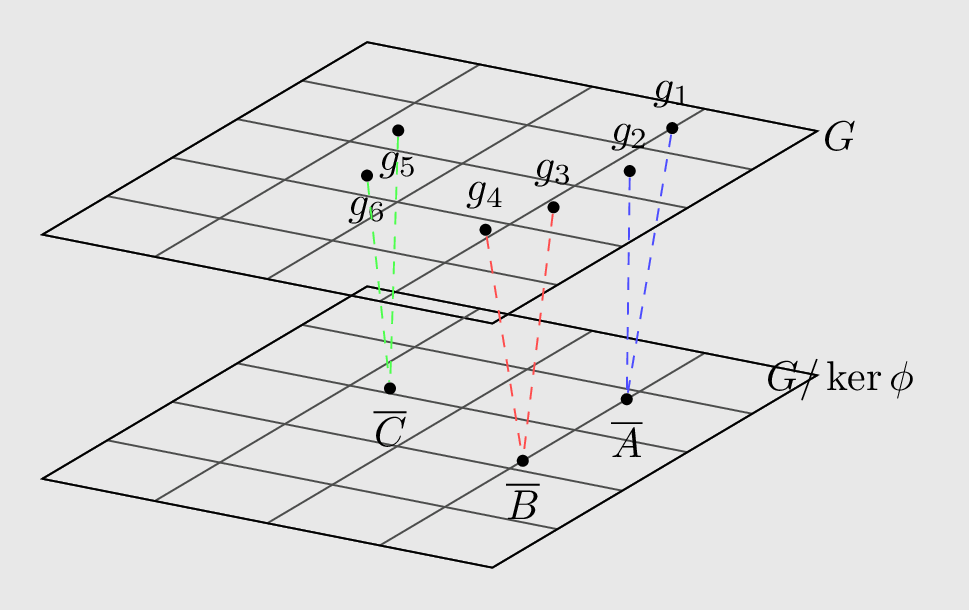
uhhh, how are you going to show that G/ker phi is a group?
thorn jay
show that ker ϕ is normal, and construct an isomorphism between G/ker ϕ and im ϕ
twin phoenix
thorn jay
why care about group homomorphisms you may ask? well, you take groups that you u...
ah i see this is pretty cool since homomorphisms will work for all groups
twin phoenix
thorn jay
a homomorphism can be seen as some form of interpretation of the group G in the ...
ye but to me it feels like "it's a homomorphism so this property is true" instead of "this is property is true so it's a homomorphism" (which makes more sense usually)
karmic moat
thorn jay
why care about group homomorphisms you may ask? well, you take groups that you u...
you should care about group homomorphisms because rings are group homomorphisms and a little more duh
kind temple
yea, but you are going to use normality to show that the collection of cosets is a group;
G/H is a group (with the usual product) if and only if H is normal.
twin phoenix
like the property seems to have no relation to why it gives an interpretation of g in h
kind temple
okeh
thorn jay
twin phoenix
ye but to me it feels like "it's a homomorphism so this property is true" instea...
i mean it is the definition of a homomorphism
so i dont quite get what you mean by this
ah okay i see
hm
okay, a function is an interpretation of some set X into another set Y, can you see this?
twin phoenix
yeah
kind temple
non-invective set functions interpret many elements of X as the same in Y
thorn jay
then we add a group structure to these sets. if we want this function to be an interpretation of the group structures, we expect it to be a change of perspective, that is, the function should take the group structure of G and put it in H, right?
twin phoenix
ye that bit makes sense
thorn jay
so, the change of perspective is seeing the element g as the element f(g). In terms of representation theory, this means representing a group element as some matrix.
in order for the structure to be carried over, we expect that, if a * b = c in the first group, then changing our viewpoint should not make this equation become untrue, else we wouldnt have the same group structure. this must mean that f(a) * f(b) = f(c). does this make sense still?
minor gazelle
kind temple
it isn’t extremely technical or difficult. i think this is the “categorical/alge...
Thanks so much 🥰🥰🥰
twin phoenix
thorn jay
so, the change of perspective is seeing the element g as the element f(g). In te...
ahhh i see
ok that does make sense a lot
thank you
the definition is the bit that represents the properties
thorn jay
and then setting c to a * b we get the usual definition f(a)f(b) = f(ab) (leaving out the multiplications)
thorn jay
twin phoenix
the definition *is* the bit that represents the properties
exactly
you see this for general (universal) algebraic structures too
hell, even at the high level of category theory
kind temple
nah, nah, im with him lmao
karmic moat
i only jest
thorn jay
karmic moat
like an addict
be afraid
 karmic moat
just shit myself
 crisp siren
hello
 knotty badger
twin phoenix
the definition *is* the bit that represents the properties
knotty badger
twin phoenix
the definition *is* the bit that represents the properties
I’m curious, what do you mean by this?
thorn jay
kind temple
nah, nah, im with him lmao
🙏 🙏
twin phoenix
knotty badger
I’m curious, what do you mean by this?
like the definition is equivalent to saying "any two elements of the group, how the operation on them behaves in the group has an analogue in the group after the homomorphism has been applied"
knotty badger
twin phoenix
like the definition is equivalent to saying "any two elements of the group, how ...
Mhm that’s true - but, wasn’t that what the original definition was saying too?
f(ab) = f(a)f(b)
thorn jay
in an abstracted way
that abstraction can be hard to parse at first; i know it was for me
knotty badger
thorn jay
in an abstracted way
In the sense that it uses letters instead of words?
twin phoenix
knotty badger
Mhm that’s true - but, wasn’t that what the original definition was saying too?
i don't think i appreciated what the function actually did when i first saw the definition and didn't see why it mattered why f(ab)=f(a)(f(b)
knotty badger
I’m not trying to be facetious to be clear
kind temple
i just think it gives some perspective to the symbolic definition of homomorphism, a way to interpret it, if you will
knotty badger
twin phoenix
i don't think i appreciated what the function actually did when i first saw the ...
Hm I see - so the equation on its own was unenlightening, but actually unpackaging what the equation meant helped?
thorn jay
knotty badger
In the sense that it uses letters instead of words?
yeah i guess, its like learning the definition of a number again
or addition
twin phoenix
knotty badger
Hm I see - so the equation on its own was unenlightening, but actually unpackagi...
well it's more why it works i guess
knotty badger
Why it works?
twin phoenix
why group homomorphisms have that effect on groups
knotty badger
I see - in your own words, why do they have that effect?
twin phoenix
with the effect and the definition on its own, it didn't initially make sense how they were linked
but now it makes sense, if the function preserves how the elements of the group interact with each other before the function just in terms of how it is after the function, it preserves the group in a sense
knotty badger
twin phoenix
but now it makes sense, if the function preserves how the elements of the group ...
Interesting - if I understand you correctly, what you’re saying is the following
What you want group homomorphisms to do is preserve equations, right?
Stuff like - if a^2 b = c d c^2, then f(a)^2 f(b) = f(c) f(d) f(c)^2
twin phoenix
no that's not what i meant
knotty badger
Hm, then continue
twin phoenix
i mean like if u have the reals
u can express them in terms of how they work before you apply the function
and after you apply the function
knotty badger
I suppose that’s the equation f(x + y) = f(x) f(y)
twin phoenix
the operation of the 2nd group (post function applied) is just a way of expressing the operation of the 1st group
thorn jay
knotty badger
What you want group homomorphisms to do is _preserve equations_, right?
thats a consequence of it
knotty badger
twin phoenix
the operation of the 2nd group (post function applied) is just a way of expressi...
Hm, right…
I guess I still don’t quite understand what you mean, but maybe that’s my fault
twin phoenix
nah it's most likely my fault
i'm learning this for the first time so i'm not sure the best way to express it formally
knotty badger
To be clear I’m not saying your understanding is bad
I’m just really interested in how you went from not understanding to understanding
thorn jay
thorn jay
thats a consequence of it
but the initial idea is to want the equality a * b = c to be preserved
knotty badger
For context I’m gonna be a tutor for a group theory course next term
twin phoenix
knotty badger
I’m just really interested in how you went from not understanding to understandi...
like when i understood it, it didn't make sense why i didn't understand it before
knotty badger
So I want to have a good understanding of the difficulties people have with the material
knotty badger
twin phoenix
the bit i don't understand is why the product of the outputs for all members of ...
We have your message here, right?
twin phoenix
i think because i saw f(g1) as just being an "output"
not as like after a mapping
even though those are similar concepts
but i didn't realise that the function changes the way the elements of G behave (although i guess it wouldn't if it was an isomorphism)
twin phoenix
thorn jay
so, the change of perspective is seeing the element g as the element f(g). In te...
like this was the perfect way to explain it
knotty badger
knotty badger
I’m just really interested in how you went from not understanding to understandi...
I don’t quite understand this, but maybe I don’t have to for now
Maybe it’s viewing homomorphisms as a change of perspective…?
thorn jay
yeah
knotty badger
I suppose this makes sense to me because homomorphisms are like functors
Sometimes I do like to think of them as putting on a pair of tinted glasses
Where if you view a group element g through the glasses, it looks like f(g)
And then if applying g then h looks like another element x without the glasses, then putting on the glasses you’d have f(g) then f(h) being f(x)
thorn jay
yeah
thats why functors are so important too because there are a lot of times where youd like to interpret some area of math into another to simplify certain problems (e.g. tbe multitude of functors from topological/geometric categories to algebraic ones)
knotty badger
knotty badger
Maybe it’s viewing homomorphisms as a change of perspective…?
I’ll keep this in mind, then
Because I would definitely say that functors generally are a change in perspective
thorn jay
a particular fun one being the functor from the groupoid of tame knot diagrams and homotopies to the category of quandles
:>
knotty badger
Actually enpeace do you mind if I ask a Q
thorn jay
sure
knotty badger
I’m gonna be tutoring for a groups and reps course next term
What sorts of confusions do students tend to have
thorn jay
hmm, im honestly not sure
ive never TAd myself, of course, and my method of learning groups was.. unique
knotty badger
Do you remember what confused you when you started off?
thorn jay
it was rather painful to have to come up with visualisations of the quotient stuff myself
ill give you a couple images though
knotty badger
thorn jay
it was rather painful to have to come up with visualisations of the quotient stu...
Mhm, I see - I’ll keep that in mind
twin phoenix
knotty badger
I don’t quite understand this, but maybe I don’t have to for now
it's like the operation has an equivalent in the 2nd group

 knotty badger
twin phoenix
it's like the operation has an equivalent in the 2nd group
knotty badger
twin phoenix
it's like the operation has an equivalent in the 2nd group
One way I like to view this is wanting the group operation to be “polymorphic” or “uniform”
knotty badger
It’s like how we use the same symbol, “+”, to denote addition of naturals and of integers and of rationals and of real numbers and of complex numbers
knotty badger
If you add 5 to 3, the result is 8 no matter if you consider these as naturals, or integers, or rationals, or reals, or complex numbers
 karmic moat
did you draw these
twin phoenix
ye sometimes u unconsciously read the group operation signs as being actual multiplication/addition
karmic moat
these are quite nice
thorn jay
delicate orchid
this is really good
the universal algebraists actually gave you something useful 
twin phoenix
i think if u're looking for a reason why i was confused, it might actually have been just that
it isn't a product, it's the operation
thorn jay
karmic moat
did you draw these
no, theyre from A Course in Universal Algebra
knotty badger
twin phoenix
ye sometimes u unconsciously read the group operation signs as being actual mult...
It’s like how there’s a sense in which + for naturals is a different function than + for integers
thorn jay
i think these pictures should be standard in any algebra textbook
knotty badger
But if a + b = c as natural numbers, then a + b = c as integers too
karmic moat
tbh i never really thought about visualizing quotient groups
knotty badger
twin phoenix
it isn't a product, it's the operation
Right yeah
Often the group operation is some kind of “composition”
In that the group elements can be interpreted as functions, and the operation as function composition
twin phoenix
knotty badger
But if a + b = c as natural numbers, then a + b = c as integers too
well aren't the natural numbers with addition a subgroup of the integers with addition?
thorn jay
karmic moat
tbh i never really thought about visualizing quotient groups
theres a madman in universal algebra who studied congruences (the stuff you quotient by) in a geometric manner
knotty badger
twin phoenix
well aren't the natural numbers with addition a subgroup of the integers with ad...
A submonoid actually
Since you don’t have inverses
karmic moat
geometry prevails once again
twin phoenix
ah ye ofc u can't do subtraction since group wouldn't be closed
karmic moat
ohhh that's interesting
knotty badger
What you can do is like
If $\iota : \mathbb{N} \to \mathbb{Z}$ is the inclusion map
cloud walrusBOT
Pseudo (Cat theory #1 Fan)
 knotty badger
Then $\iota(a) + \iota(b) = \iota(a + b)$
cloud walrusBOT
Pseudo (Cat theory #1 Fan)
 knotty badger
On the LHS you’re adding integers, on the RHS you’re adding naturals
glad osprey
@knotty badger do you think it helps pedagogically to formulate the homomorphism condition as a commutative diagram? I guess the issue then is you need to answer why do we want this diagram to commute
 delicate orchid
we're like 2 steps from Lawvere theories here so I approve
knotty badger
glad osprey
<@547515245258735616> do you think it helps pedagogically to formulate the homom...
Well I’m not sure - I didn’t want to interrupt enpeace when they were explaining
thorn jay
delicate orchid
we're like 2 steps from Lawvere theories here so I approve
approving Lawvere's stuff but hating on UA i see how it is..
everyone here is a hypocrite i am starting my villain arc
glad osprey
when I learned about homomorphism, I didn't really understand why we want f(ab) = f(a)f(b), but I didn't really question it either. I guess I just accepted it as something that might be useful later
delicate orchid
thorn jay
approving Lawvere's stuff but hating on UA i see how it is..
I like Lawvere's stuff because it's UA through a categorical lens
thorn jay
eh, thats fair
knotty badger
twin phoenix
ah ye ofc u can't do subtraction since group wouldn't be closed
Hm maybe one way to say what you were saying earlier is
If you want to compute f(a) f(b) in the new group, you can instead do ab in the old group, and apply f to that?
So the new operation is “determined” in terms of the old operation
thorn jay
delicate orchid
I like Lawvere's stuff because it's UA through a categorical lens
i wonder, do congruences exist for models of lawvere theories?
delicate orchid
wdym by congruences? the shit you can quotient out by?
thorn jay
i dont know what the meta is for them
thorn jay
its basically the central object of study of UA
delicate orchid
I know about them for posets (other than the obvious derivatives of groups and rings) but that's about it
thorn jay
knotty badger
There’s a categorical notion of congruence
i know i guess i meant more like are they as important for the study of lawvere theories
knotty badger
This I’m not sure
thorn jay
because basically anything you might care about for UA boils down to studying some congruences
hey if i get into lawvere theories i might even get a position in academia sometime
delicate orchid
thorn jay
hey if i get into lawvere theories i might even get a position in academia somet...
why would you want that
karmic moat
lawvere theories or a position in academia?
delicate orchid
the latter
karmic moat
real shit
karmic moat
>position in academia
>money
thorn jay
its better than not having a job at all
delicate orchid
thorn jay
money
there are better ways to make money. Like fraud
thorn jay
im gonna steal the moon
karmic moat
osrs flipping makes me a lot of money on osrs
 topaz solar
thorn jay
the only endomorphisms I like are projections
topaz solar
thorn jay
the only endomorphisms I like are projections
Also btw necessary and sufficient for G \rtimes N extending is being an injective endomorphism I think
For nastier structures idk tho
south patrol
karmic moat
\>position in academia
\>money
Hey I mean it often works
...If you get that far
karmic moat
1% of the time it works 100% of the time or however the saying goes
south patrol
Lol I guess I mean like
permanent position in academia can often be good like in US ig
non-permanent at least here is a bit different
knotty badger
thorn jay
step 1: assume everything is nice
this sounds like the joke of mathematicians always rigging their problems to be solvable
karmic moat
tough job market in the US too
thorn jay
it does feel that way sometimes
karmic moat
pay's not very good either
thorn jay
knotty badger
this sounds like the joke of mathematicians always rigging their problems to be ...
in response to this
karmic moat
talked to a prof and he was like "yeah you shouldnt do math for the money, there's not much of it here"
thorn jay
doing it for the love of the game >>>
karmic moat
to be precise, academia
forgot to include that
not for math
well depends heavily on what field you teach and where you are
if you do the right field and at the right school you can make a lot
it still counts as academia
topaz solar
thorn jay
step 1: assume everything is nice
Real, I’m trying to assume things are not and somehow derive that it’s nice anyway
karmic moat
i mean even teaching at smaller schools, if you teach the right thing then the pay is big
thorn jay
topaz solar
Real, I’m trying to assume things are not and somehow derive that it’s nice anyw...
foolish
topaz solar
Clearly
karmic moat
math is particularly bad because a lot of research in it seems useless to the real world
topaz solar
But yeah if we took like, an n-tuple \bar e of injective endomorphisms of G, I dunno but maybe there’s always a way to extend G \rtimes_{\bar e} F_n^+ or some similar thing like G \rtimes <\bar e> where the F_n^+ is free monoid or <> to denote sub-monoid in End(G)
karmic moat
sure there's still a lot of it which is relevant but there's a lot of it which doesn't seem relevant
topaz solar
If it does extend you’d probably get like G \rtimes F_n or similar based on extendibility of that monoid <\bar e> to a group
karmic moat
im not saying applied math is easier or harder lol
thorn jay
topaz solar
But yeah if we took like, an n-tuple \bar e of injective endomorphisms of G, I d...
hmm
karmic moat
i'm not in a position to comment on whether it is or isn't
thorn jay
I'll give it a thunk maybe
karmic moat
difficulty is subjective
thorn jay
if the monoids carry extra structure then this question might become easier
karmic moat
because it's more immediately relevant to the real world than algebra or something like that
thorn jay
thorn jay
if the monoids carry extra structure then this question might become easier
for example, what if we think about rings
topaz solar
thorn jay
I'll give it a thunk maybe
I think you’ll be able to do it if <\bar e> extends to a group, and in which case it’s gonna be a semidirect, the issue is you can’t do it as G \rtimes F_n
You need to like, include pre images
So you need to like, expand G some
topaz solar
Yeah
By like, taking a direct limit based on e_i G < G
And similarly for each e_i in order, which should work out fine if it extends to a group?
thorn jay
wdym by this?
topaz solar
Like we have an embedding of G into G from the G -> e_i G \leq G
Since injective endo
Lay this into itself infinitely many times, then e_i is an automorphism on this limit
The issue is handling the other endomorphisms
Since if you have two of them, you get a terrible tree thing instead of a straight line when trying to have both extend to an automorphism of G at once
topaz solar
Truly
The issue should maybe probably be fine if these extend to a group, which is a necessary condition at least
thorn jay
you mean the <e_i>?
topaz solar
Yeah
 lime magnet
hot take: using algebra to prove number theory facts is a lot more fun than having to use number theory facts to prove things in algebra
(e.g. Euler's theorem, Wilson's theorem)
earnest delta
If H is the subgroup of a group G then
Ha=Hb if and only if ba^-1 belongs to H
Is this true?
 lusty marlin
earnest delta
Is this true?
lusty marlin
earnest delta
Is this true?
Yes
earnest delta
ab^-1?
 proud vigil
ab^-1 in H and ba^-1 in H are equivalent
you also can just write it as
Hb = Ha
and then it's immediately true from symmetry
cedar vault
earnest delta
ab^-1?
Subgroups are closed under inversion.
twilit wraith
earnest delta
If H is the subgroup of a group G then
Ha=Hb if and only if ba^-1 belongs to H
Not gonna lie I personally find the whole ab^-1 one-step proof thing to just be kinda stupid
But yes
limber sequoia
You can think of it in terms of the G-set G/H if it helps.
lime magnet
i'm sure some - or many - would disagree: people have been studying the integers for centuries before groups, rings, and fields were conceptualized, so in a sense, it's more natural to study the integers first.
i guess what i'm thinking (and i'm not sure if this is right), is that math pedagogy where we learn more general/abstract ideas later is somewhat questionable. is it a waste of time to study the riemann integral for so long when it could be added as a special case of lebesgue integral? to an extreme: why not learn category theory or (at least naive) set theory first and then study specific areas later?
perhaps it's because the more abstract ideas aren't immediately applicable, and at most schools, sequences of courses need to be prepared to suit those who want to go into more depth as well as those who only want to learn, e.g., calculus.
lime magnet
earnest delta
If H is the subgroup of a group G then
Ha=Hb if and only if ba^-1 belongs to H
in my class, $ba^{-1}\in H$ is defined first as an equivalence relation on $G$, then cosets are defined as equivalence classes, and then we prove the equivalence that you've mentioned.
cloud walrusBOT
ransom
Compile Error! Click the  reaction for more information.
(You may edit your message to recompile.)
 lime magnet
hmm, 🫤 latex bot
 rocky cloak
lime magnet
rocky cloak
lime magnet
the equivalence is clearer with the intermediate $\exists h\in H$ such that $1_Ha=a=hb$
cloud walrusBOT
ransom
 lime magnet
i did a thing!
elfin wraith
lime magnet
i'm sure some - or many - would disagree: people have been studying the integer...
I think the specific difference here is that the number theoretic proofs you see in elementary number theory are like a half step away from the more general proofs you can write with some very simple group theory, and it’s pretty natural to do these things together
In general it’s certainly worth studying the less general less abstract objects first, and tbh in this case you still have, you spend all of your school days learning about the integers. You need to understand the context and the need for the generality, and it’s quite frankly usually easier to visualise. It’s far easier to draw some rectangles under a graph and explain integration to someone than have to start talking about measure spaces, and it would still feel pretty unnoticed even if you could convince them. Having the context that not all functions are Reimann integrable, even ones which we kinda expect to integrate, motives the lesbeque integral
Yes you can be kinda vague about measures and introduce the lesbeque integral as a bit of a special case, but I’ve always found this to be harder than it’s worth
knotty badger
elfin wraith
I think the specific difference here is that the number theoretic proofs you see...
Does it actually motivate the lebesgue integral
elfin wraith
knotty badger
Does it actually motivate the lebesgue integral
To me it does, or at the very least it motivates the need for a more carefully thought out definition
knotty badger
The Riemann integral seems pretty well thought-out though
quiet pelican
knotty badger
Does it actually motivate the lebesgue integral
It’s kinda your first indication that the Riemann integral doesn’t play nice with limits
And the fact that a lot of basic interchange-limits-and-integrals theorems are much nicer from the lebesgue PoV is to me the big motivation for it
knotty badger
quiet pelican
It’s kinda your first indication that the Riemann integral doesn’t play nice wit...
Yeah this is more convincing to me
south patrol
You need to be able to multiply by R
quiet pelican
We want the module generated by m to be an R-module
elfin wraith
knotty badger
Yeah this is more convincing to me
I think it’s both of these things, but in any case I’m making a more general point
karmic moat
The only motivation I had for lebesgue measure and stuff was probability class where every proof the prof presented was either “true/false bc it has/doesnt have lebesgue measure 0” or some weird convergence in measure thing
tardy hedge
last year i thought i was gonna take measure theory so i was studying it a bit over the summer
My God. I hated it
elfin wraith
Yeah I was thinking about taking some probability classes next semester for employment reasons until I looked at the course notes and remembered how much I do not enjoy analysis
cloud walrusBOT
mq
 karmic moat
when context is known, authors tend to drop the subscript
So there is likely no difference but you should check, the authors usually remark this kinda thing
Well I’d need full context then
Can you send the whole page(s)?
karmic moat
Yeah
quiet pelican
The latter doesn’t have to respect the R-module structure
All R-module endos, yeah
It’s my usual way to say yes in emoji form
 white oxide
Does this work for iv? iv. Suppose that $M_{\mathfrak{p}} = \bigl(\bigoplus M_i\bigl){\mathfrak{p}} \neq 0$. Let $\overline{x} \in M{\mathfrak{p}}$. If $(M_i){\mathfrak{p}} = 0$ for all $i$, then $x = m{\alpha_1} + \dots + m_{\alpha_n}$, so that $\overline{x} \in (M_{\alpha_1} + \dots + M_{\alpha_n}){\mathfrak{p}} = (M{\alpha_1}){\mathfrak{p}} + \dots + (M{\alpha_n}){\mathfrak{p}} = 0$. Therefore, $M{\mathfrak{p}} = 0$, a contradiction. If $(M_j){\mathfrak{p}} \neq 0$ for some $j$, then $M{\mathfrak{p}}\neq 0$, for it contains the nonzero image of $(M_j)_{\mathfrak{p}}$.
 cloud walrusBOT
okeyokay
 south patrol
It seems what you are saying is equivalent to saying localisation commutes with direct sums - indeed you use this implicitly
thorn jay
because R might not be the integers
south patrol
Or 0
south patrol
Sad!
thorn jay
in ring theory the only purpose it serves is as an annoying special case
 vapid vale
thorn jay
I rarely consider 0 to be a ring
vapid vale
thorn jay
I rarely consider 0 to be a ring
sure looks like one
thorn jay
I should rephrase: I rarely consider 0 when thinking about rings
vapid vale
it was a shape joke
thorn jay
aguh
too algebra brained atm
spent the past 3 or so hours butting my head with a fuckass badly written book which is basically the only resource about the topic out there
tidal schooner
vapid vale
it was a shape joke
Spiritual successor to #algebraic-geometry message
 wide spade
thorn jay
spent the past 3 or so hours butting my head with a fuckass badly written book w...
wide spade
thorn jay
spent the past 3 or so hours butting my head with a fuckass badly written book w...
what book/topic ?
thorn jay
wide spade
what book/topic ?
On The Structure of Finite Algebras by Ralph McKenzie and David Hobby
it's a book on some universal algebra and all the math in there is amazing, it's just so stinking hard that the book goes wayy too fast
and barely gives motivation for anything
wide spade
i see
rapid cave
You can help me in #algebraic-geometry instead xD
 lime badge
I have a silly question.
Consider the polynomial ring R = k[x,y]/I where k is a field. Let c = f(x) and d = g(y) be univariate polynomials in R
What conditions on I would I need to ensure that (c) \cap (d) is contained in (cd)?
My intuition is that the ideal I should not "mix" x and y, i.e. it should be of the form I = (p(x)) + (q(y)). Is that correct? If so, how can I formalize that?
I know there's the vanishing of Tor_1(R/I, R/J), but that's just restating the fact that I want
thorn jay
lime badge
I have a silly question.
Consider the polynomial ring R = k[x,y]/I where k is ...
a general sufficient condition for I ∩ J = IJ is I + J = R
iirc
lime badge
thorn jay
a general sufficient condition for I ∩ J = IJ is I + J = R
But it isn't necessary right?
south patrol
More generally like (I \cap J)(I + J) = IJ i think
thorn jay
south patrol
More generally like (I \cap J)(I + J) = IJ i think
what
south patrol
Uh maybe after taking radicals
thorn jay
oh i see
karmic moat
south patrol
More generally like (I \cap J)(I + J) = IJ i think
this is only an inclusion i think
thorn jay
lol im slow
south patrol
Ah no yeah it is an inclusion lel
or smth
but true for Z, famously lol
I think more generally true for Dedekind domains (by imitating the proof for Z but using unique factorisation of ideals)
karmic moat
for a general ring you should have $\text{rad}((I \cap J)(I+J)) = \text{rad}(I \cap J) \cap \text{rad}(I + J) = \text{rad}(IJ) \cap \text{rad}(\text{rad}(I) + \text{rad}(J))$
i hate you texit
south patrol
thorn jay
a general sufficient condition for I ∩ J = IJ is I + J = R
(nice proof is that if I+J=R then write 1 = a + b for a in I, b in J. Clearly IJ is contained in I \cap J, and conversely if c is in I \cap J then c = ca + cb and each of ca, cb is in IJ lol)
cloud walrusBOT
anamono
 thorn jay
south patrol
(nice proof is that if I+J=R then write 1 = a + b for a in I, b in J. Clearly IJ...
thorn jay
south patrol
(nice proof is that if I+J=R then write 1 = a + b for a in I, b in J. Clearly IJ...
that is very cool
i dont think i appreciate coprime ideals enough
quiet pelican
Yup that works
 spark veldt

Hi I think I'm just really confused with the wording more than anything.
Does this mean that given x,y,z in G, then choosing any two ensures they commute?
quiet pelican
spark veldt
Does this mean that given x,y,z in G, then choosing any two ensures they commute...
Given x, y, z, there is some pair that commute
rapid cave
Its means there is no x,y,z where any pair do not commute
quiet pelican
That's a nice question
rapid cave
quiet pelican
That's a nice question
Indeed. Short & Sweet
spark veldt
ahh i see okay thanks!
south patrol
spark veldt
Hi I think I'm just really confused with the wording more than anything.
i don't think this is on you lol
elfin wraith
It took me a couple of read throughs lol
glad osprey
quiet pelican
Given x, y, z, there is some pair that commute
yeah, why did they use a double negative instead of just saying this 😭
south patrol
I think solving the problem takes less time than reading and understanding the question
glad osprey
Fixed it:
Let G be a group with the property that there do not exist three elements x, y, z in G, no two of which commute. Prove that there does not exist x, y in G such that x and y does not commute
karmic moat
not enough negatives, i'd hardly call that a fix
 merry falcon
It’s like I unlock a new channel every time I learn new math (just started group theory)
quiet pelican
Group theory is the best maths
elfin wraith
quiet pelican
Group theory is the best maths
“Group theory is the best maths” - woman who has not yet discovered ring theory
quiet pelican
elfin wraith
“Group theory is the best maths” - woman who has not yet discovered ring theory
I discovered ring theory then realised groups are better
 elfin wraith
See that just doesn’t sound fun, but I’m glad you’re happy
rapid cave
Fields are amazing
merry falcon
quiet pelican
Group theory is the best maths
So far so good
quiet pelican
Groups > Rings = Fields
thorn jay
quiet pelican
Group theory is the best maths
"group theory is the best maths" - woman who has not yet discovered universal algebra
quiet pelican
thorn jay
"group theory is the best maths" - woman who has not yet discovered universal al...
Universal algebra boring logicy
thorn jay
only if you let it be
commutator theory and tame congruence theory are decidedly not logic
the latter is very lattice theory though
quiet pelican
Lattice theory scare mico
thorn jay
its not that scary
until it is
i have noticed a lot of theorems have a nice categorical interpretation though
tardy hedge
in commutator theory? ong wtf is ts sht
Tame congruence theory
like bruh
(that was your cue to tell me about commutator theory cuz im in the mood)
but ngl id prob be interested for like one sentence tho
tardy hedge
Bruh
i should try learning it then cmon
Easy
What the hell is tame congruence theory man
I am preparing myself
thorn jay
tardy hedge
(that was your cue to tell me about commutator theory cuz im in the mood)
commutator theory is a little easier to explain; basically you have the intuition that a "nice" algebra should be one where you can essentially cancel terms. that is, if t(x, a1, ..., an) = t(y, a1, ..., an), then x = y for any term t. For example, this holds in modules/vector spaces, and it so happens that we use these as nice algebraic objects to encode information (i.e. homology).
It just so happens that under surprisingly loose conditions, any algebra that satisfies this "niceness condition" must be a module, in some universal algebraic way. This is a pretty old and fairly classical result, and commutator aims to generalize this using the definition of a commutator of congruences, which essentially extends this "cancellation" idea and generalizes it to congruences in some way.
and it turns out that it is an extremely powerful tool
tardy hedge
what is a term?
thorn jay
tardy hedge
What the hell is tame congruence theory man
something something looking "locally" using idempotent polynomial operations
thorn jay
tardy hedge
what is a term?
youve got your basic operations, right
and a term is basically any composition of these operations
so a term for rings would be a polynomial with integer coefficients, and a term for groups would be a word, a term for vector spaces a formal linear combination etc
tardy hedge
oh ok i was thinking like in the polynomial x^2+2 the terms are x^2 and 2 or something lol
but ok that makes sense
thorn jay
ye
tardy hedge
thorn jay
commutator theory is a little easier to explain; basically you have the intuitio...
Tbh that is actually kind of interesting
But i would still be hesitant to learn that stuff because of how few other ppl learn about it
thorn jay
thats fair, but really any modern universal algebraist knows it, its just that there arent many of these online
tardy hedge
what schools have a uni algebraist group.. if any?
thorn jay
our library seems to have plenty of books on it though 👍
tardy hedge
Or is it just more like individual professors do their thing
thorn jay
tardy hedge
what schools have a uni algebraist group.. if any?
hawaii
thorn jay
it's where McKenzie (the guy who wrote the commutator and tame congruence books) does research i think
tardy hedge
I wonder if my supervisor is aware of universal algebra
thorn jay
ask him :0
thorn jay
tardy hedge
her. but sure I will actually haha
oh im so sorry lmao
elfin wraith
thorn jay
ask him :0
 tardy hedge
Hahaha np
tardy hedge
😂 😭
elfin wraith
thorn jay
BRO SENT IT TWICE <:opencry:586078614865444865>
Discord moment
tardy hedge
thorn jay
BRO SENT IT TWICE <:opencry:586078614865444865>
thats what made it funny to me 😂
the spam
thorn jay
its like alarms blaring
tardy hedge
i thought bro sent it 3 times
tardy hedge
thorn jay
its like alarms blaring
Fr
thorn jay
guys i promise im not sexist i love women!
tardy hedge
its ok me too
thorn jay
i even have a woman friend
tardy hedge
lucky you
thorn jay
whom i am very respectful towards
tardy hedge
im out there shooting my shots
thorn jay
tardy hedge
lucky you
love will find its way to you
on a logical redstone discord server apparently
tardy hedge
dam
I did meet a friend i met from club penguin last year
online friends becoming irl friends is funny
tardy hedge
tardy hedge
I did meet a friend i met from club penguin last year
like. I knew her since 2013 basically
met on club penguin
club penguin is becoming unc status now
tardy hedge
it got shut down once in 2017, after that has been private servers that fans have made
they usually shut down and open again
disney takes them down sometimes
thorn jay
theyve got a patent on the game mechanic summoning creatures that fight for you
tardy hedge
oh yea i think i saw video on that
thorn jay
thats fucking insane
tardy hedge
nintendo is just silly they always do stuff like that
thorn jay
this will start a patent war on game mechanicd
tardy hedge
theyve gone way more corporate in recent years than they were before tho
thorn jay
and of course indie games will suffer the most
thorn jay
tardy hedge
theyve gone way more corporate in recent years than they were before tho
gotta love capitalism
spark veldt
Hi I’m not really sure how to show that something is a permutation group. Can i get some help on this?

 noble nexus
given any set, the permutations of that set (bijections from the set to itself) form a group under composition. A permutation group is just any subgroup of the group of permutations of some set
thorn jay
basically, all you need to show is that R and L are closed under composition and inverses
composition being composition of functions
spark veldt
ahh i see, thanks blake and enpeace
elfin wraith
Yes
south patrol
But yeah I mean I suppose what you want to say is like
You can often give the abelian group R the structure of an R-module in many ways
But when people say like "view R as an R-module" or whatever, they mean the standard structure
Not sure what you mean
Only if you work with nonunital conventions
But there are still similar things in the unital case, like
view k[x] as a k[x]-module by like x acting as zero
(and k as usual)
thorn jay
not if you dont require that
a nonunital one
even if R and S both have unit, there may exist rng homomorphisms not sending 1 to 1
nope
thats only guaranteed if S is an integral domain
south patrol
Pain
thorn jay
no
let R = Z and S be any ring with an idempotent e bot equal to 1 or 0, i.e. e^2 = e. Then there is a unique map Z → S sending 1 to e
thorn jay
ye
south patrol
I meant your example was nice aha
thorn jay
no
oh, yeah
misread
im tired
yes
this is true
not going to classes today all of them are boring
but thats not a very useful fact if your range doesnt have special conditions like no idempotents or whatever
i have never seen someone use O for homomorphism
crazy convention
south patrol
thorn jay
i have never seen someone use O for homomorphism <:opencry:586078614865444865> <...
Real
cloud walrusBOT
mq
 rapid cave
O is for
Omomorphism
thorn jay
o is for omOri
thorn jay
havent played it yet but i will some dau
rapid cave
Highly recommended
thorn jay
i mean if I like deltarune theres a high change ill like omori
rapid cave
Yes they have a lot in similar
rapid cave
thorn jay
have a lot in similar is one ive never heard before <:opencry:586078614865444865...
... whats funny?
I don't understand
thorn jay
you merged the phrases "are very similar" and "have a lot in common"