#groups-rings-fields
1 messages · Page 280 of 1
 serene dune
 coral steeple
I meant to reply sorry. Maybe when I know more topology I can revisit your proof
 grizzled spindle
I’m getting something weird when I try to use this, is this not an action?
 grizzled spindle
That any H is a normal subgroup somehow
 kind temple
how do you get that?
grizzled spindle
Doing this I get that the kernel of phi is exactly H but I know I just messed up, idk what
 kind temple
S_G/H is the set of all bijections G/H --> G/H?
grizzled spindle
Yes
 sacred mulch
Saw this problem in Contemporary Abstract Algebra. I'm don't want help with proving it but I don't see how it's correct. I came up with this counterexample. The cayley table is:

$\begin{matrix}
_ & a & b & c\
a & a & b & c\
b & b & a & c \
c & c & c & a
\end{matrix}$
 cloud walrusBOT
Lukecell
Compile Error! Click the  reaction for more information.
(You may edit your message to recompile.)
 sacred mulch
Where a is the identity element, and it's possible to create a subgroup {a, b}
kind temple
sacred mulch
Where a is the identity element, and it's possible to create a subgroup {a, b}
cb = c means that b is also the identity
sacred mulch
Does that mean it's impossible for a group to have an order < 3?
wait nvm im an idiot
kind temple
no. if you intend for a and b to be distinct, then this just isnt a group. otherwise, a and b are equal. there may be some relations which show that c is also the identity here. otherwise, this is just a group with two elements
also, sanity check, the order of any subgroup must divide the order of the whole group
2 does not divide 3, so {a,b} can't be a subgroup of this group (if it were a group)
sacred mulch
I think I get it, in this instance a=b since bc=ac (where c is the only other element) so it's basically a group of 2 elements
kind temple
i believe thats correct, the presentation you have here is Z/2Z
kind temple
grizzled spindle
Doing this I get that the kernel of phi is exactly H but I know I just messed up...
Take G = S_3 and H = {(), (12)}. H is not normal in G. put g = (13). m_g is not a bijection since m_g((12)(13)) = H, and (12)(13) = (132) is non-trivial
kind temple
grizzled spindle
Doing this I get that the kernel of phi is exactly H but I know I just messed up...
somewhere in here you are assuming H is normal, implicitly.
i can't quite figure out where
 void cosmos
this isn't a particular problem
but is there a way to generlize like
like i learnt about de rham cohom and theres both homotopy invairance and meyer viteoris
turns out there is too with simplicial homology
and like probably the proofs go the same ( iahvent gotten there yet )
is there like
a generlization for this
or is it jusut that cohomology and homology are "dual" ( in a way i still don't know ) and that's it
 quiet pelican
grizzled spindle
I’m getting something weird when I try to use this, is this not an action?
quiet pelican
grizzled spindle
I’m getting something weird when I try to use this, is this not an action?
It’s not well defined if H is not normal
Different choices of a within the same coset would give different results
 inner steppe
I was watching Michel Penn's video on Quotient Ring with title: Abstract Algebra | Constructing a field of order 4.

I don't really understand the last step and he doesn't explain it either. He says that (x^2+x+1) is the ideal so it is like 0. Anyways how is that equality true. I am confused.
 rose ridge
in the quotient domain youre essentially doing computations mod (x^2+x+1), which means that you treat x^2+x+1 to be equal to zero
in the same sense that 3 mod 3 is congruent to zero
so in Z_2[x]/(x^2+x+1), x^2 and x^2+x^2+x+1 represent the same element
as another example, we have x^3 = (x^2+x+1)(x-1) + 1 = 1 mod x^2+x+1
inner steppe
rose ridge
as another example, we have x^3 = (x^2+x+1)(x-1) + 1 = 1 mod x^2+x+1
I am following but how come 1 and not x?
Anyways so I have like two mods? Excuse me if that sounds stupid but I have to check mod 2 and as well as the polynomial p(x) where Z_2/p(x) ?
rose ridge
thats right
rose ridge
inner steppe
I am following but how come 1 and not x?
kinda confused on why you think it should be x
inner steppe
rose ridge
kinda confused on why you think it should be x
The reason why I think that doesn't even sound logical to me. I'd rather you explain the right way.
rose ridge
rose ridge
as another example, we have x^3 = (x^2+x+1)(x-1) + 1 = 1 mod x^2+x+1
err alright then, ill be more specific with the steps
x^3 = (x^3-1) + 1 = (x^2+x+1)(x-1) + 1 %= 0(x-1) + 1 = 1
where we used the congruence mod (x^2+x+1) at %
tried to use * instead of % but got italized lol
note that since this is all over Z_2, we may also replace all the - by +, but i didnt to make it more clear
inner steppe
rose ridge
err alright then, ill be more specific with the steps
x^3 = (x^3-1) + 1 = (x^2+x...
Okay thanks, this was so beautifully explained! Hopefully I get it as I solve more questions!
rose ridge
glad i managed to get it across 👍
 opaque finch
I have a small doubt
Is $\mathbb{Q}(2^{1/3},\omega)$ same as $\mathbb{Q}(2^{1/3},i3^{1/2})$ ??? $\omega$ here is cube root of unity.
cloud walrusBOT
mycroftholmes1703
 opaque finch
can someone verify if it is true
 south patrol
Just look at the formula for omega
cloud walrusBOT
mycroftholmes1703
 opaque finch
And that's why I feel it's true
south patrol
Yes it is true
sqrt{3}i and w can be obtained from one another by adding and multiplying by rationals
inner steppe
What is a primitive polynomial and what is a irreducible primitive polynomial? I really cannot understand the formal definition.
- An element f in F is called a primitive element in F if it generates the entire multiplicative group, i.e., (F \ {0}, ·) = <f>.
- A polynomial k(x) in F[x] is called a primitive irreducible polynomial if [x] is a primitive element in F[x] / (k(x)).
 coral spindle
Can you elaborate on what in the definition is confusing you
inner steppe
coral spindle
Can you elaborate on what in the definition is confusing you
Honestly now that I think about it, it is not confusing and I feel like I understand them but when I am solving a question I just get stuck for example this problem.
Let the polynomial $ k(x) = x^3 + 2x + 1 \in \mathbb{Z}_3[x] $ and
$ R = \mathbb{Z}_3[x] / (k(x)) $, the ring of equivalence classes in $ \mathbb{Z}_3[x] $ modulo
$ k(x) $. Determine whether $ [x] $ is a primitive element in $ R $?
Answer: Since $ k(x) $ is irreducible, $ R $ is a field with $ 3^3 = 27 $
elements. The multiplicative group has 26 elements. The possible orders for elements
in $ (R \setminus {0}, \cdot) $ are therefore 1, 2, 13, and 26. Let’s take powers of $ x $ and compute:
$$
[x^3] = [x + 2],
$$
$$
[x^6] = [(x^3)^2] = [(x + 2)^2] = [x^2 + x + 1],
$$
$$
[x^{12}] = [(x^2 + x + 1)^2] = [x^4 + 2x^3 + 3x^2 + 2x + 1] =
[x(x + 2) + 2(x + 2) + 2x + 1] = [x^2 + 2],
$$
$$
[x^{13}] = [x^{12} \cdot x] = [(x^2 + 2)x] = [x^3 + 2x] = [x + 2 + 2x] = [2].
$$
Thus,
$$
[x^{26}] = [(x^{13})^2] = [2^2] = [1].
$$
We see that $x$ does not have order 1, 2, or 13, but has order 26. Therefore, it generates
the entire multiplicative group and is primitive.
My question
What do they mean by: The possible orders for elements are therefore 1, 2, 13, and 26."
coral spindle
OK so you should ask the question at hand instead
cloud walrusBOT
DatON1
 coral spindle
Do you know the theorem of Lagrange
inner steppe
coral spindle
Do you know the theorem of Lagrange
if G is a finite group and H is a subgroup of G then |H| | |G|?
coral spindle
Yes.
Set H to be a subgroup generated by x.
Let G, of course be R\{0}, which is a group under multiplication.
What do you get?
inner steppe
I am not sure
coral spindle
I really don't like it when people say they're not sure. When you say that, it seems to imply that you do have something in mind. So tell me.
If you just don't know, I would prefer you tell me that you just don't know
 knotty badger
I think they’re asking you to describe H
coral spindle
I am setting G to be the group R\{0}
I am setting H to be the subgroup of G generated by x
Now what does the theorem of Lagrange tell you?
inner steppe
That the number of elements generated by x will divide then number of elements in G. Other than that I don't know.
coral spindle
OK
What is the number of elements in G?
Recalling, of course, that I am setting G to be R\{0}
inner steppe
coral spindle
Recalling, of course, that I am setting G to be R\\{0}
26 elements
coral spindle
That's right!
Now you referred to this quantity given by the number of elements generated by x
Do you know another name for this quantity
inner steppe
order
coral spindle
(you do, but perhaps you are unaware of this connection)
Yes indeed
So the theorem of Lagrange now says that the order of x divides 26, agreed?
inner steppe
yes
coral spindle
So what can the order of x be? There are only so many divisors of 26
We cannot determine the order with certainty because we have not specified x, but we can look at options
inner steppe
1, 2, 13 and 26. Okay now I am following!
 elfin wraith
Did not scroll up far enough to see the original question and thought you were just losing it trying to apply lagranges theorem to \mathbb{R}^x 
coral spindle
not calling it \mathbb R^\times is fucked up
elfin wraith
I’m on my phone, I’m not putting in anymore backslashes than I have to
inner steppe
coral spindle
Yeah, so we're done.
so the question states: Determine whether [x] is a primitive element in R ? I guess I have show that all elements in R can be generated using x but then I wonder what is the point of doing everything we did so far. How is finding out the order of possible subgroups being 1,2, 13,26 doing? Sorry but I still cannot see the connection.
coral spindle
OK you haven't understood something
The order of the subgroup <x> is also the order of the element x.
We have shown that the order of the element x is one of those options
To be a primitive element, we require <x> = R\{0}. This is exactly to say that the order of x is 26.
We showed that the order of x is not any of the other options; it must be 26.
 somber sleet
Guys I have a really dumb question. If I want to show that the identity is unique in a field. Is it wrong to show that if 1 and 1' are both the identiy if$x\neq 0$, then $1 x= 1' x$ implies that $1 = 1'$
cloud walrusBOT
damn_guuurl
 somber sleet
I feel like this is wrong and it's not enough to show uniqueness, but I odn't see why
cloud walrusBOT
Boytjie xoxoxoxoxo
 elfin wraith
Technically you could do what you did because cancellation holds in fields, but the other proof is shorter and more general
I.e. works in any ring
coral spindle
You don't even need the rest of the ring structure tbh
elfin wraith
Fair
somber sleet
coral spindle
Hint: consider $1 \cdot 1'$
yes of course I know that proof, but my student all did the other thing
inner steppe
coral spindle
We showed that the order of x is not any of the other options; it must be 26.
Yes okay I understand so all of that was to show tha tonly 26 was a possible. But then I don't understand what they were doing with the x's in the solution there. Sorry if I am bothering you but I really have spent a lot time going back and forth with this.
somber sleet
and I feel like that's not necessary at all
coral spindle
inner steppe
Yes okay I understand so all of that was to show tha tonly 26 was a possible. Bu...
Elaborate on what is confusing you
coral spindle
somber sleet
yes of course I know that proof, but my student all did the other thing
OK so can you write out their logic in full
knotty badger
somber sleet
yes of course I know that proof, but my student all did the other thing
There’s sometimes a phenomenon where people are suspicious of a proof that feels too short
I feel like that may be what’s happening here
coral spindle
I'm inclined to agree
knotty badger
Like in maths you can totally have proofs which are one-liners
But irl you never really have a logical argument that’s just a single line, and that also works
inner steppe
coral spindle
Elaborate on what is confusing you
For starters: "Let’s take powers of x and compute:
[x^3] = [x + 2]"
What they trying to show here?
knotty badger
There’s always some room for nuance
coral spindle
[x]^3 is not the identity, so the order of [x] is not 3.
somber sleet
they take an arbitrary $x$, then assume that there are the identites $1$ and $1'$ such that $1x = x$ and $1'x=x$. They then set it equal, devide by $x$ by assuming that $x\neq0$ and get that $1 = 1'$. But I feel like it is rally strange
cloud walrusBOT
damn_guuurl
 coral spindle
take an arbitrary x
This is faulty logic
They need to take a specific x, otherwise what they write is true for the empty set
knotty badger
Yeah so strictly they’ve shown that, for any x not equal to 0, you can deduce that 1 = 1’
coral spindle
Ofc, they can prove that their set is nonempty by appealing to the identity, but this is precisely to say that x = 1 and it's the same proof.
somber sleet
coral spindle
>take an arbitrary x
This is faulty logic
obviously in the field, which is not empty by assumption
coral spindle
coral spindle
Ofc, they can prove that their set is nonempty by appealing to the identity, but...
See above
elfin wraith
Bit of a random question, just proved in the notes for my non comm class that:
if R is left noetherian and I is a proper ideal then there exist primes P_1,…,P_n containing I such that the product is in I and that min(I) is finite and non empty
Quite happy with this theorem and the proof, but afterwords we note that the noetherian property is really stronger than we need because we just need 2 sided ideals to satisfy the ACC, but that leads me to a somewhat interesting question, what would a ring which satisfys the ACC for all its 2 sided ideals but isn’t its self noetherian look like?
knotty badger
inner steppe
For starters: "Let’s take powers of x and compute:
[x^3] = [x + 2]"
What they tr...
They are trying to show that the order of x is not 3
elfin wraith
Not sure if there’s a nice example or if someone could just cook one up, but I’m struggling to picture what that ring could be or a nice way to create one
inner steppe
knotty badger
They are trying to show that the order of x is not 3
but what is the result saying, I mean what [x^3] = [x+2]
knotty badger
inner steppe
but what is the result saying, I mean what [x^3] = [x+2]
It means the equivalence class of x^3 is the same as that of x + 2
In other words, x^3 ~ x + 2 for ~ the equivalence relation under consideration
coral spindle
inner steppe
but what is the result saying, I mean what [x^3] = [x+2]
Do you know what is meant by a quotient field? If I write R[x]/(x^2+1) do you know what this object is?
Just say if you don't know.
inner steppe
coral spindle
Do you know what is meant by a quotient field? If I write R[x]/(x^2+1) do you kn...
Not formally but if I understand correctly given the field R[x], we can get a quitient field R[x]/(x^2+1) if and only if x^2+1 is irreducible in R[x]?
coral spindle
So you don't know what it means, OK
You need to recap the formal definition of a quotient ring.
This [] notation is part of the formal definition of a quotient ring.
Idk what textbook/notes you're working from, but this should be in any introduction to abstract algebra and rings.
inner steppe
I cannot find it in my book and prof never mentioned it formally. He just showed examples and told us what it was.
coral spindle
OK so I assume "he" is your professor
The professor is assuming that you know this already.
inner steppe
I'm using Normal Biggs (Discrete math) edition 2 if you guys know the book and the chapter.
coral spindle
You will need to review this content
elfin wraith
This is a fantastic website and very happy to learn about it, doesn’t seem like I can easily search for that specific combination of traits though
Might ask the professor on Monday, just seems like a curious combination of traits to have, so I’m wondering if there’s any actually interesting rings like that or if they’d be sort of “synthetic” cooked up examples
 rocky cloak
elfin wraith
Bit of a random question, just proved in the notes for my non comm class that:
i...
rocky cloak
elfin wraith
Bit of a random question, just proved in the notes for my non comm class that:
i...
I guess simple rings would be the obvious example
inner steppe
coral spindle
You will need to review this content
any good resource, please don't say wikipedia, I don't understand at all what they are doing on wikipedia. But anyways what is wrong with my definition?
rocky cloak
rocky cloak
I guess simple rings would be the obvious example
So for example if you take V and countably infinite dimensional vector space take R = End(V) and I the ideal of endomorphisms with finite dimensional image, then R/I is non-noetherian, but the only two sided ideal is 0 and R/I.
And if I'm not wrong End(V) don't have any other ideals besides 0, I and itself
knotty badger
inner steppe
Not formally but if I understand correctly given the field R[x], we can get a qu...
So R[x] is a ring here and not a field, but what you say is true in that R[x]/(x^2 + 1) is a field iff x^2 + 1 is irreducible
Remember that a ring is informally a structure where you can always add, subtract and multiply, and a field also allows division (by nonzero things)
coral spindle
inner steppe
any good resource, please don't say wikipedia, I don't understand at all what th...
Any introductory book on abstract algebra that includes rings will cover this. Maybe Fraleigh would suit you.
elfin wraith
rocky cloak
So for example if you take V and countably infinite dimensional vector space tak...
Oh yeah that makes sense actually, that’s a nice one!
inner steppe
coral spindle
Any introductory book on abstract algebra that includes rings will cover this. M...
I was thinking of online resources so I can do that right away.
coral spindle
Pdfs are easily available online
Piracy is so terrible but who knows what happens when you google book titles and “pdf”
rocky cloak
elfin wraith
Oh yeah that makes sense actually, that’s a nice one!
And I guess you can cough up bigger examples by giving V dimension Aleph_n
 waxen moth
What is the reason for the Zassenhaus lemma being also called the butterfly lemma?
 delicate bloom

In mathematics, the butterfly lemma or Zassenhaus lemma, named after Hans Zassenhaus, is a technical result on the lattice of subgroups of a group or the lattice of submodules of a module, or more generally for any modular lattice.
Lemma. Suppose
    G


{\displaystyle G}
is a group with subgroups
...
 prisma ibex
delicate bloom
https://en.wikipedia.org/wiki/Zassenhaus_lemma
prisma ibex
delicate bloom
https://en.wikipedia.org/wiki/Zassenhaus_lemma
oh mein gott zie zassenhausenlemmatta
waxen moth
schmetterlingslemma
 slim kayak
A great lemma. My brain almost instantly deletes all details any time I see and my only memory left is "haha funny butterfly diagam"
waxen moth
slim kayak
A great lemma. My brain almost instantly deletes all details any time I see and ...
Learning this makes me feel everything except joy; it's pure agony.
cant even remember what a centralizer and a normalizer is. ive probably written down the definition at least 5 times today already
slim kayak
The algebra gods demand sacrifice, it is what it is. gl
south patrol
||Just blackbox it||
 keen badge
Hallo,
Someone wants to talk about a cover of a finite group via cosets?
 tardy hedge
keen badge
Hallo,
Someone wants to talk about a cover of a finite group via cosets?
tardy hedge
keen badge
Hallo,
Someone wants to talk about a cover of a finite group via cosets?
wdym
For ideals a and b in Z, why is it true that (a+b)(a cap b) = ab?
rocky cloak
tardy hedge
For ideals a and b in Z, why is it true that (a+b)(a cap b) = ab?
You can try to just prove inclusions in both directions
keen badge
tardy hedge
For ideals a and b in Z, why is it true that (a+b)(a cap b) = ab?
$(a+b)(a\cap b)=a(a\cap b)+b(a\cap b)\subseteq ab$
cloud walrusBOT
gingerGM
 keen badge
tardy hedge
wdym
keen badge
tardy hedge
wdym
Wdym wdim?
south patrol
tardy hedge
For ideals a and b in Z, why is it true that (a+b)(a cap b) = ab?
This is also like an "ideal" version of gcd * lcm = product
keen badge
tardy hedge
wdym
For example, take $\mathbb C_8={0,1,\cdots,7}$.
We can say that $\mathbb C_8={1,3,5,7}\cup{2,6}\cup{0,4}=\left(1+2\cdot\mathbb C_8\right)\cup\left(2+4\cdot\mathbb C_8\right)\cup\left(4\cdot\mathbb C_6\right)$.
$$a\cdot C_n = {a\cdot c \pmod n: c \in C_n}$$
cloud walrusBOT
gingerGM
 keen badge
This is a cover via cosets of a finite group
I want to prove that no matter what is your cover, and no matter what is your finite group, you always have at least 2 cosets with the same cardinality
tardy hedge
south patrol
This is also like an "ideal" version of gcd * lcm = product
Thanks
I also understood more properly rn why that formula is true too
rocky cloak
keen badge
I want to prove that no matter what is your cover, and no matter what is your fi...
So when you say cover, you mean that it needs to be disjoint?
keen badge
keen badge
I want to prove that no matter what is your cover, and no matter what is your fi...
Someone wants to prove it
tardy hedge
They say a cap b = ab provided a+b = (1)
(a+b)(a cap b) subset ab, ab subset a cap b
I see how if a+b=(1) then it works ou
is this iff?
i guess the question is when does a cap b is a subset of ab
 hidden wind
dunno how common this is but Stillwell literally uses the notation gcd(I,J) for the sum I + J of ideals
delicate bloom
I see (I,J) to mean the sum of ideals pretty often, which also lines up with using just plain (m,n) to mean gcd that's fairly common as well. I've never actually seen gcd written for ideals though.
keen badge
You all need to remember that if I and J are ideals of Z then there exist unqiue positive n.m such that I=nZ and J=mZ.
Thus ...
delicate bloom
dare I say it - unique up to multiplication by a unit
hidden wind
pff
hidden wind
delicate bloom
dare I say it - unique up to multiplication by a unit
invalidated
keen badge
No one here wants to talk with me about cover of a finite group?
I really want to do smth
slim kayak
keen badge
I want to prove that no matter what is your cover, and no matter what is your fi...
Cover by what? arbitrary subsets?
keen badge
keen badge
For example, take $\mathbb C_8=\{0,1,\cdots,7\}$.
We can say that $\mathbb C_8=\...
@slim kayak
slim kayak
By disjoint shifted subgroups?..
keen badge
yes
slim kayak
Can you show that one always exists
keen badge
The correct term for "shifted subgroups" is "coset"
keen badge
slim kayak
Can you show that one always exists
One always exists
The trivial one
G is a "shifted subgroup"
and it covers itself
It is shifted by 0
slim kayak
And what are the two cosets there with the same cardinality?
keen badge
slim kayak
And what are the two cosets there with the same cardinality?
{0,4} and {2,6}
Their cordinality is 2
slim kayak
Thats from a different cover
slim kayak
So you want to figure out if you can always refine a cover to one that has two cosets of equal size
keen badge
sorry
yes my bad
you are 100% correct
hmm
The statement says as follows:
For a non-trivial coset partition, there exist two subgroups with the same cordinality
You can also adjust the conjecture for infinite group - but I would like to stay on the finite part
Here is the adjustment:
Let ${\alpha_i G_i}_{i=1}^r$ be a non-trivial coset partition of a group $G$, where $G_1,\cdots,G_r$ are subgroups of finite indices. Then the indices $n_1=[G:G_1], \cdots , n_r=[G:G_r]$ cannot be distinct.
cloud walrusBOT
gingerGM
 slim kayak
What have you tried so far?
For the cardinalities to work out and the hypothesis to be false you need to able to find a strictly increasing sequence of divisors of n adding up to n. But such sequences are possible.
inner steppe
Let R = {c2α² + c1α + c0 | c2, c1, c0 ∈ Z₅}, where α ∉ Z₅ that satisfies (α + 3)(2α² + 1) = 2α + 4. We want to determine if (R, +, ×) is a field.
Solution: 0 = (α + 3)(2α² + 1) - (2α + 4) is congruent to 2α³ + α² + 4α + 4 modulo 5, so R is equal to Z₅[x] divided by the ideal generated by k(x), where k(x) = 2x³ + x² + 4x + 4.
This is not the full soution but I am confused, shouldn't the form of k(x) be something like: c2α² + c1α + c0 ??
keen badge
slim kayak
For the cardinalities to work out and the hypothesis to be false you need to abl...
Correct, that means that if n is a number such that the sum of its divisors is less then n, then the conjecture is true for a group of order n.
We say that G is a HS group.
slim kayak
Oh, is this is an actual open conjecture?
rocky cloak
inner steppe
This is not the full soution but I am confused, shouldn't the form of k(x) be so...
Why do you say that?
inner steppe
rocky cloak
Why do you say that?
because of the definition of R being: "R = {c2α² + c1α + c0 | c2, c1, c0 ∈ Z₅}"
rocky cloak
inner steppe
because of the definition of R being: "R = {c2α² + c1α + c0 | c2, c1, c0 ∈ Z₅}"
Well if alpha satisfied
alpha^2 = -c1/c2 alpha - c0/c2
Then the alpha^2 term would be redundant
inner steppe
rocky cloak
Well if alpha satisfied
alpha^2 = -c1/c2 alpha - c0/c2
Then the alpha^2 term wou...
yes but then what is the definition R = {c2α² + c1α + c0 | c2, c1, c0 ∈ Z₅} telling us and more importantly how did they conclude k(x) = 2x³ + x² + 4x + 4.
rocky cloak
Like if alpha satisfies a cubic, that means alpha^3 can be expressed as
c2alpha^2 + c1alpha + c0
rocky cloak
inner steppe
yes but then what is the definition R = {c2α² + c1α + c0 | c2, c1, c0 ∈ Z₅} tell...
How they concluded it was just by multiplying out (x+3)(2x^2 + 1) = 2x + 4
The definition is telling you which elements are in the ring
inner steppe
rocky cloak
How they concluded it was just by multiplying out (x+3)(2x^2 + 1) = 2x + 4
yes but what is special with it?
rocky cloak
Well it was given that alpha satisfies that equation
inner steppe
rocky cloak
Well it was given that alpha satisfies that equation
but what about R = {c2α² + c1α + c0 | c2, c1, c0 ∈ Z₅}? What is the point of this?
rocky cloak
Well, usually to make a ring, you might start with Z5, then adjoin an element alpha.
Then for this to still be a ring you would also need alpha^2, alpha^3, alpha^4, and so on.
But if alpha satisfies some cubic equation you can already write alpha^3 as a combination of 1, alpha and alpha^2. So you don't need to add that in explicitly
So then R does become a ring
keen badge
slim kayak
Oh, is this is an actual open conjecture?
Yas
slim kayak
(i hate that emoji quickbar, ew)
So what was your plan on posting it here then? You dont seem terribly talkative about it
inner steppe
If a polynomial f(x) in F[x] has no roots in a field F, is it irreducible?
A: yes, always B: only sometimes C: no, never D: don't know
The correct answer should be A no?
 night tartan
wait am i being dumb
surely it's false
wouldn't it be B tho?
cus something like ||x^2 + 1 is irreducible in R[x] and has no roots||
ahaha nw we all sometimes fail to read
night tartan
inner steppe
If a polynomial f(x) in F[x] has no roots in a field F, is it irreducible?
A: y...
yeah ok so obviously considering something like F = C would not be fruitful cus every polynomial has a root in C
so let's try F = R and seeing what we can discover
can u think of a function in R[x] that has no roots? is it irreducible or not
inner steppe
night tartan
yeah ok so obviously considering something like F = C would not be fruitful cus ...
is C a constant?
night tartan
sorry i meant $\mathbb{C}$
cloud walrusBOT
LY
 night tartan
i was just too lazy to write it out in latex lol
inner steppe
night tartan
i was just too lazy to write it out in latex lol
I personally can't come up on any right now but if I understand you correctly since you mentioned complex numbers. I am just gonna assume a function with a form of something like f(x) = x^2 + b ?
night tartan
inner steppe
I personally can't come up on any right now but if I understand you correctly si...
well yeah if f(x) = x^2 + 1
does that have any real roots?
inner steppe
no
night tartan
is it irreducible?
inner steppe
yes
night tartan
what about i.e. f(x) = (x^2+1)^2?
is that irreducible? and does it have any real roots?
inner steppe
I don't think it has any real roots, but I don't know if is irreducible or not.
Ig not?
delicate bloom
inner steppe
I don't think it has any real roots, but I don't know if is irreducible or not.
what does reducible mean
inner steppe
delicate bloom
what does reducible mean
that it can be factored
delicate bloom
cool, can you factor (x^2+1)^2
maybe it's confusing to see written that way, can you factor x^4 + 2x^2 + 1
inner steppe
delicate bloom
maybe it's confusing to see written that way, can you factor x^4 + 2x^2 + 1
lol I am dumb hahah
thx guys for the help
delicate bloom
you're welcome!
hidden wind

i wonder if there's a somewhat sensible linear order to put on A4
i would be quite surprised but

 topaz solar
There’s some conditions for “right ordered groups”
I don’t remember what they are
But that’s some keywords of relevance
hidden wind
oooh thank you i'll def read up on that
Any left- or right-orderable group is torsion-free.
oh
hidden wind
topaz solar
I don’t remember what they are
G is right ordered if there is a total order ≤ on G which is right-invariant, that is, if a ≤ b, then also ac ≤ bc
if i may cite wikipedia

 golden turtle

I'm confused because it says let R be the ring EndK^(inf) and then it wants me to show R iso to R + R as an R-module
so is R an R-module or a ring
 glad osprey
golden turtle
I'm confused because it says let R be the ring EndK^(inf) and then it wants me t...
glad osprey
golden turtle
I'm confused because it says let R be the ring EndK^(inf) and then it wants me t...
R is a ring, but any ring can be considered a module over itself, where scalar multiplication is just ring multiplication. So I think that's what they want you to use
slim kayak
What the grothendieck looking fellow said
Ring multiplication defines a module operation
golden turtle
glad osprey
R is a ring, but any ring can be considered a module over itself, where scalar m...
I am using d&f, I don't think it is defined what it means to be ismorphic as an R-module
 charred iris
that and the notion of isomorphism they want is not ring isomorphism, but module isomorphism
ah
charred iris
basically
slim kayak
Yeah
charred iris
golden turtle
I am using d&f, I don't think it is defined what it means to be ismorphic as an ...
R-linear map that's a bijection?
slim kayak
Or, R-modules are "R-vector spaces"
charred iris
how bizarre that there's no definition otherwise
golden turtle
f:R->R+R such that f(x+y)=f(x)+f(y) and f(rx)=rx
bijective
Is the mapping obvious
I think maybe
f(phi)=(phi, phi)
slim kayak
golden turtle
f:R->R+R such that f(x+y)=f(x)+f(y) and f(rx)=rx
You can pull out elements from your ring
So f(rx)=rf(x)
golden turtle
slim kayak
You can pull out elements from your ring
so
for f(x+y)
x and y are endomorphisms right
but for
f(rx)
is r an element of K^(inf) or an endomorphism
If we define f:R->R+R by f(phi)=(phi,phi) then it follows easily that f(x+y)=f(x)+f(y)
slim kayak
I meant like in general, rf(x) is the module operation of r on f(x).
r(a,b)=(ra,rb) for direct sums
And here the module operation is just multiplication
golden turtle
so f(rphi)=(rphi, rphi)=r(phi,phi) since phi is an endomorphism we can pull out the r
slim kayak
r is also an endorphism here
golden turtle
golden turtle
If we define f:R->R+R by f(phi)=(phi,phi) then it follows easily that f(x+y)=f(x...
so this f is an R-module homomorphism and then I just need to show its bijective
golden turtle
slim kayak
r is also an endorphism here
oh
but the operation is multiplication still, not composition?
slim kayak
Sure
golden turtle
but r is an endomorphism of K^(inf) so how can it take an input from R+R
slim kayak
Note that for R as a R-module over itself the map is determined by f(1) or f(id)
charred iris
golden turtle
but r is an endomorphism of K^(inf) so how can it take an input from R+R
We have a ring R with composition as the multiplication. We can also make it an R-module, where the scalar multiplication is the same as the ring multiplication so again composition. The module R+R has scalar multiplication defined coordinatewise (same as with vector spaces), so it's coordinatewise composition in this case
golden turtle
slim kayak
Note that for R as a R-module over itself the map is determined by f(1) or f(id)
I understand this if we already know that f is a homomorphism
golden turtle
charred iris
We have a ring R with composition as the multiplication. We can also make it an ...
This makes sense
slim kayak
golden turtle
I understand this if we already know that f is a homomorphism
It is for addition
But like, just pull out phi as well
golden turtle
so f(rphi) = (rphi, rphi) by definition of f
and then we can do the scalar multiplication in R+R
r(phi, phi) which is like you said coordinatewise composition, is why this equals (rphi, rphi)
so I think I understand now why f is a homomorphism
I guess the last part I'm not getting is why r is an endomorphism
like we want f(rphi)=rf(phi) for it to be a module homomorphism
slim kayak
Ask yourself where r is from
golden turtle
in the definition is says it must come from R
so I see
R=endK^(inf)
so
r in R is an endomorphism
slim kayak
Yeah
golden turtle
I see thank you
slim kayak
The diagonal map won't work btw
golden turtle
What is the diagonal map, the one that I'm using?
slim kayak
Sending x to (x,x) is called the diagonal map
slim kayak
Take phi non-zero. What element maps to (0,phi) under f?
golden turtle
none
slim kayak
Yeah
slim kayak
My the R-module homorphism rules you are allowed to pull the "scalar" out of the function
(note the R-module axioms are just that of a vector space but without talking about fields)
But when thinking about R as it's own R-module, any r in R is just the scalar r acting on the "vector"/module element 1.
So f is completely determined by what f(1) is, since here f(r)= r f(1) holds
For f to be surjective there are two somewhat special elements in R^2 here you want to map to and then all others follow
golden turtle
right I was just typing like
so if we need f to be surjective something has to map onto both
(0, phi) and (phi, 0) for phi some nonzero endomorphism
and so we need
rf(1)=(0,phi)
r'f(1)=(phi,0)
for some r, r'
is that what you mean
slim kayak
Kind of, I mean two very particular ( - , -) here
slim kayak
Again, keep in mind that phi are also in R
golden turtle
slim kayak
For f to be surjective there are two somewhat special elements in R^2 here you w...
is one of them the identity?
oh
maybe we want to map to
(1,0) and (0,1)?
slim kayak
Ding ding ding
Yes
And f(1)=(g,h) for some endomorphisms g and h, this and some light work then gives you a very concrete problem.
golden turtle
slim kayak
And f(1)=(g,h) for some endomorphisms g and h, this and some light work then giv...
doesn't this define our map though, as you said? So I just say f(1)=(g,h) and then I determine what maps to (1,0) and (0,1)?
slim kayak
ag=1
ah=0
bg=0
bg=1 is what I was going for
golden turtle
I see
af(1)=(1,0)
bf(1)=(0,1)
=>
(ag,ah)=(1,0)
(bg, bh)=(0,1)
=>
ag=1
ah=0
bg=0
bh=1
slim kayak
Have fun working out the four endomorphisms involved here. You reduced the problem to just one about vector spaces
golden turtle
thank you sir
 amber burrow
This is probably a really dumb question, and I’ll realize it in like 2 minutes, but a simple group can’t have a quotient right?
Like if G is the simple group, and H is a subgroup, G/H is never a group right?
Since simple groups do not have proper subsets
void cosmos
amber burrow
Since simple groups do not have proper subsets
idk wdym by that
void cosmos
amber burrow
Like if G is the simple group, and H is a subgroup, G/H is never a group right?
yeah
assuming H is a non-trivial subgroup
cuz H can be G and it's fine
or the trivial subgroup which is also fine
but if G/H were to be a group then H would be normal
amber burrow
void cosmos
idk wdym by that
Meant to say proper normal subgroups
amber burrow
void cosmos
or the trivial subgroup which is also fine
Yeah now I see
I was thinking about SL(2,R)
 alpine island
Can you do this constructively?

I have found an easy proof by contradiction with Burnside's lemma, but this doesn't give you a way to find an element with no fixed points.
golden turtle
slim kayak
Have fun working out the four endomorphisms involved here. You reduced the probl...

that was not fun at all until I actually discovered the a,b,g,h and then it was very fun
 long obsidian
Can anybody say why the subring k[xx,xy,yy] is not isomorphic to k[x,y]?
delicate bloom
probably how the x and y interact
long obsidian
delicate bloom
probably how the x and y interact
Oh I guess since (xx)(yy)=(xy)(xy) its not a UFD while k[x,y] is a UFD
delicate bloom
yeah that looks good to me
 elfin prairie
$\varepsilon : D_n \to {\pm 1}, \hspace{3mm} \varepsilon(\sigma) = \begin{cases} 1 & \text{if x is a rotation,} \ -1 & \text{if x is a flip} \end{cases}$
cloud walrusBOT
James
 elfin prairie
I want to prove that this is a homomorphism
how should I approach this?
From the definition of a homomorphism, it seems that I need to know how rotations and flips combine with each other.
And maybe provide some justification for say what a rotation combined with a flip gives out a (flip? not sure)
elfin prairie
elfin prairie
And maybe provide some justification for say what a rotation combined with a fli...
my guess is that doing this and using the definition of a homomorphism would suffice
So my question is, how do I go about it? Should I just reference the Cayley table? (that feels like cheating lol)
knotty badger
elfin prairie
how should I approach this?
I think it would be useful to use a presentation for D_n
Which I assume is the dihedral group of size 2n?
Presentations for a group (generators and relations) are particularly useful for defining homomorphisms out of groups
night tartan
elfin prairie
$\varepsilon : D_n \to {\pm 1}, \hspace{3mm} \varepsilon(\sigma) = \begin{cases}...
one way to do this quite easily is to notice that D_n effectively represent linear transformations
so we could represent D_n as a group of matrices
now thinking of elements of D_n as a matrix, what is \varepsilon
inner steppe
can someone explain this to me?
f(x) = g(x)h(x) implies that exactly one of g(x) and h(x) belongs to the set of units (invertible elements) of F[x].```

When I tried to google I saw sites saying deg(h) or deg(g) is 0. What is the correlation between these two ways of expressing?I get the deg(h)=0 or deg(g)=0 because we are saying that only time f is reducible is when f(x) = g(x)*c where c is a constant. Kinda like a prime but the other definition is the formal definition I'm supposed to understand but as of now it is not telling me anything.
night tartan
inner steppe
can someone explain this to me?
```If F is a field and f(x) belongs to F[x], we...
the definition u've given here is just the definition of irreducible in an integral domain
now for a field F, it turns out that g(x) is a unit iff g has degree 0
inner steppe
night tartan
now for a field F, it turns out that g(x) is a unit iff g has degree 0
you mean g(x) is invertible if an only if it has a degree of 0?
night tartan
yeah
i mean if g(x) = constant c, then it's clearly a unit right?
just take h(x) = 1/c
if g(x) = say 1+x
then it has degree 1
and then degree analysis => h doesn't exist
inner steppe
night tartan
and then degree analysis => h doesn't exist
there is no case at where that is true tho right? I am just asking additionally questions?
in any polynomial field F a polynomial is invertible iff it has deg = 0 always.
night tartan
inner steppe
in any polynomial field F a polynomial is invertible iff it has deg = 0 always.
yh
hence the alternative definition u saw
this makes sense cus intuitively, you can only do 1/polynomial (and still have it be a polynomial) if it's a constant
inner steppe
night tartan
this makes sense cus intuitively, you can only do 1/polynomial (and still have i...
wait what? Are you saying that if we do 1/polynomial then it is no longer a polynomial so it is never possible
night tartan
sorry i don't understand ur query?
inner steppe
night tartan
sorry i don't understand ur query?
I didn't think what you said at first was clear so I was just asking if that is what you mean but upon rereading, it is clear exactly what you said. But I means that the only way a polynomial is invertible is if 1/p(x) is a polynomial but this is not a polynomial if unless p(x) is a constant which Ig is exactly what you said.
serene dune
elfin prairie
how should I approach this?
$1 \to \mathbb{Z}n \hookrightarrow D{2n} \twoheadrightarrow \langle \pm 1 \rangle \to 1$
\ \
\langle \pm 1 \rangle \text{acts on} Aut(\mathbb{Z}_n) \text{such that} a \mapsto a^{-1}
cloud walrusBOT
yeshua
Compile Error! Click the reaction for more information.
(You may edit your message to recompile.)
 serene dune
does that work ?
 terse crystal
Can you guys give me some examples of groups satisfying descending chain condition on normal subgroups? Strangely I only found Prufer group on google
(Groups satisfying that any descending (in terms of inclusion) chain of normal subgroups of it stabilize, or in other words having no infinitely long descending chain of normal subgroups)
rocky cloak
terse crystal
Can you guys give me some examples of groups satisfying descending chain conditi...
Group of bijections on N should be one
terse crystal
Oh yes only four normal subgroups
rocky cloak
And any finite group of course
terse crystal
rocky cloak
Group of bijections on N should be one
Thank you. I actually want to disprove that “a mono automorphism of a group satisfying DCC on normal subgroups is always a isomorphism”, I tried prufer group but it turns out to be true on it
rocky cloak
terse crystal
Can you guys give me some examples of groups satisfying descending chain conditi...
It appears that for abelian groups the Prufer groups are essentially the only ones

Mathematics Stack Exchange
How can I classify Artinian $\mathbb{Z}$-modules as Noetherian $\mathbb{Z}$-module? (A $\mathbb{Z}$-module is Noetherian iff it is finitely generated). Any hint will be helpful.
I have seen the
rocky cloak
terse crystal
Thank you. I actually want to disprove that “a mono automorphism of a group sati...
Sym(N) seems like it should be able to give you such examples
terse crystal
rocky cloak
It appears that for abelian groups the Prufer groups are essentially the only on...
Oh , thank you
No idea how to construct a injective but not surjective homomorphism…
rocky cloak
terse crystal
No idea how to construct a injective but not surjective homomorphism…
Like consider the subgroup that fixes some finite set
terse crystal
rocky cloak
Like consider the subgroup that fixes some finite set
I don’t get it, what homomorphism is derived from a subgroup…
rocky cloak
terse crystal
I don’t get it, what homomorphism is derived from a subgroup…
Well, what group is that subgroup isomorphic to....
terse crystal
Oh shit
terse crystal
rocky cloak
Well, what group is that subgroup isomorphic to....
Thanks a lot
And btw since it’s true for prufer group, so I can say that the statement is true given that the group is abelian right
rocky cloak
terse crystal
And btw since it’s true for prufer group, so I can say that the statement is tru...
Yeah, the key thing is that Prufer group satisfies dcc on all subgroups.
As you might notice the subgroups are the things relevant when talking about surjectivity, as opposed to normal subgroups which is more relevant for injectivity
terse crystal
rocky cloak
Yeah, the key thing is that Prufer group satisfies dcc on all subgroups.
As yo...
Thank you, I am going to think more about this
rocky cloak
terse crystal
Thank you, I am going to think more about this
It's a theorem that comes up a few times that a surjective endomorphism on a Noetherian module is an automorphism. And this is just the dual result to that.
inner steppe

I have solved this using Möbuis function with the 3 if-statements but I was wondering if it was possible to use this theorem?

Can't I like split first summation like Sum[mu(d)] * Sum[1/d] but then the left side will always be 0. Anyways what is the point of this theorem anyways?
 signal knot
https://github.com/priyanshupant/group-theory-python hey what do u guys think about this

GitHub
exploring finite groups and their properties with python - priyanshupant/group-theory-python
i was just messing around in python but idk if this has any potential or sm
 warm ember
inner steppe
warm ember
inner steppe
this is mobius inversion
say you have F=f*1
then Fmu=f1mu=fe=f
e is the identity (you used sigma)
warm ember
inner steppe
if you multiply this by 18 you have
mu*id
but id=1*e
so this is e*e=e
inner steppe
warm ember
say you have F=f*1
What is F=f*1?
warm ember
e(18)=0
warm ember
inner steppe
What is F=f*1?
do you know convolutions
inner steppe
warm ember
do you know convolutions
Sorry my course is in another language so I have search for definition, I googled the definition of it and it says mathematical operation that allows the merging of two sets of functions.
is composite function classified as one?
then sure otherwise not really
warm ember
$(f*g)(n)=\sum_{d\mid n}f(d)g\left(\frac{n}{d}\right)$
cloud walrusBOT
Kevin Yang
 warm ember
inner steppe
is composite function classified as one?
warm ember
inner steppe
is composite function classified as one?
im talking about dirichlet convolutions
for arithmetic functions
inner steppe
warm ember
im talking about dirichlet convolutions

Ig the one to right? I don't really understand it tho.
warm ember
yes thats right
that follows from the fact that mu*1=e and associativity of convolutions
f * mu = g * 1 * mu= g * e=g
In mathematics, the Dirichlet convolution (or divisor convolution) is a binary operation defined for arithmetic functions; it is important in number theory. It was developed by Peter Gustav Lejeune Dirichlet.
inner steppe
Can I ask a stupid question? What is Möbuis inversion formula is saying? I mean when do we use it?
Almost every where I go including my book they are just proving the functions and not explaineing anything else besides that.
warm ember
inner steppe
Can I ask a stupid question? What is Möbuis inversion formula is saying? I mean ...
a lot of arithmetic functions can be written as f * 1
using mobius inversion can find f
for example
Sigma=1 * id
(divisor sum)
d=1 * 1
(divisor counting)
also you have things like phi * 1=id
phi is euler totient
warm ember
warm ember
but id=1*e
sorry this is incorrect
opaque finch
Need assistance in a problem
Let $p(x)$ be an irreducible polynomial over a subfield $K$ of $\mathbb{C}$ and let $L$ be the splitting field of $p(x)$. Show that if the Galois group of $L$ is Abelian, then it's order equals the degree of $p(x)$
cloud walrusBOT
mycroftholmes1703
 opaque finch
I have tried to observe something from examples but failed
quiet pelican
Suppose some root θ of p(x) in L has non-trivial stabiliser under the action of the Galois group, and let σ(θ) = θ with σ non-identity. Let φ be a root of p(x) in L is such that σ(φ) =/= φ
Now the Galois group is transitive, so can you find an element that doesn’t commute with σ?
(Then after that, use orbit stabiliser to conclude)
opaque finch
hmmnn ok so
The last part if a bit unclear
if you could make it a more clearer please 😅
quiet pelican
opaque finch
if you could make it a more clearer please 😅
The Galois group is transitive so you can find an ele that doesn’t commute with σ?
Hint: the element you’re looking for is some element such that τ(θ) = φ
terse crystal
rocky cloak
It appears that for abelian groups the Prufer groups are essentially the only on...
I have two questions about this answer, “now let D be a divisible torsion artinian p-group, then its socle is a finite dimensional vector space over Z/pZ”, how to derive this? And why “therefore D=Z(p^infty)^n”?
opaque finch
quiet pelican
Hint: the element you’re looking for is some element such that τ(θ) = φ
yes so you mean that $\sigma$ is indeed a permutation of roots which fixes a specific root say $\theta$. Now an element that doesn't commute with $\sigma$ is any permutation that does not fix $\theta$
cloud walrusBOT
mycroftholmes1703
 quiet pelican
opaque finch
yes so you mean that $\sigma$ is indeed a permutation of roots which fixes a spe...
quiet pelican
opaque finch
yes so you mean that $\sigma$ is indeed a permutation of roots which fixes a spe...
Not quite
It needs to move θ to an element that isn’t fixed by σ
opaque finch
hmmnn
opaque finch
quiet pelican
Not quite
It needs to move θ to an element that isn’t fixed by σ
Ok. So let's do it a bit clearly. Suppose $\alpha_1,\alpha_2,\dots,\alpha_n$ be roots of $p(x)$. Every element in the Galois group corresponds to a permutation.
Let $\sigma_1$ be a permutation such that it fixes a root $\alpha_i$ but is not identity. Therefore there exists a root $\alpha_j$ such that $\sigma_1$ does not fix $\alpha_j$. Then we take the permutation $\sigma_2$ such that $\sigma_2(\alpha_i) = \alpha_j$. This element does not commute with $\sigma_1$ since
$\sigma_2(\sigma_1(\alpha_i)) = \sigma_2(\alpha_i) = \alpha_j$ but $\sigma_1(\sigma_2(\alpha_i)) = \sigma_1(\alpha_j) \neq \alpha_j$. Is this what you mean @quiet pelican ?
cloud walrusBOT
mycroftholmes1703
 quiet pelican
Yes
opaque finch
cool
quiet pelican
You should say a permutation such that sigma2(ai) = aj though
opaque finch
yes
I should mention that
Now to conclude from here, since the Galois group is abelian and it acts transitively on the set of roots, and each element corresponds to a permutation then it must permute without fixing any roots. Which means that order of Galois group is the number of distinct automorphisms of the roots.
am I right ?
 chilly ocean
ㅡㅡㅡ
Is there any example of a extension field that splitting but not separable
cloud walrusBOT
mh_le

 dim widget
by the way this is false
the powers of the norm are the unique maps N: F \to k such that N(a) = a^n if a \in k and N is multiplicative
so this is some power of the norm
 rotund aurora
dim widget
the powers of the norm are the unique maps N: F \to k such that N(a) = a^n if a ...
rotund aurora
dim widget
the powers of the norm are the unique maps N: F \to k such that N(a) = a^n if a ...
But why should it be multiplicative?
rocky cloak
chilly ocean
ㅡㅡㅡ
Is there any example of a extension field that splitting but not separable
Anything that is the splitting field of an irreducible non-seperable polynomial.
Like Fp(x)/Fp(x^p) for example
rocky cloak
terse crystal
I have two questions about this answer, “now let D be a divisible torsion artini...
So in general if a module is artinian, then the socle is a finite (nonzero) sum of simple modules.
From there it's just using lifting properties to show that a divisible group with socle (Z/p)^n is the sum of p-Prufer groups
terse crystal
rocky cloak
So in general if a module is artinian, then the socle is a finite (nonzero) sum ...
Yes I forgot to reply that the first part was figured out, yeah the remaining part, why sum of p-Prüfer groups
Lifting properties?
rocky cloak
Like choose M = Z/p in the socle, then consider x such that x in M or 0 =/= px in M or 0 =/= p^2x in M ...etc
And show that this is a direct summand of your group
(this is slightly inaccurate as written)
But pick a generator for Z/p, then lift that.
and construct the prufer group as a summand
terse crystal
rocky cloak
And show that this is a direct summand of your group
I am stuck at this step…
(Z(p^infty)^n is now a subgroup of D, I don’t know how to show that it’s a summand…
rocky cloak
terse crystal
I am stuck at this step…
Well, the socle is ( Z/p)^n. Pick a basis, then consider the submodule killed by p^2. Inductively lift to a sum of Prufer groups
opaque finch
Thanks for your hinta @quiet pelican I got the solution to it.
terse crystal
rocky cloak
Well, the socle is ( Z/p)^n. Pick a basis, then consider the submodule killed by...
Submodule of D killed by p^2?
terse crystal
rocky cloak
And killed by p^3 etc
Not sure whether I got it, does this make sense? : D’=(Z(p^infty))^n, we want to show that D’=D, namely any element a killed by p^r in D, is an element killed by p^r in D’. p^2 a=0 for some a in D, pa is in (Z/pZ)^n, so pa=Σx_i e_i, where {e_i} is a basis of (Z/pZ)^n, then p(a-Σx_i e_i/p)=0 gives us a=Σx_i e_i/p +Σy_i e_i=Σ(x_i +py_i) (e_i)/p, so a is in elements of D’ killed by p^2?
Elements of D’ killed by p^2 is generated by {e_i/p}
Wait elements of D killed by p is in (Z/pZ)^n?
Oh nvm yes , so I guess this is fine?
rotund aurora
@dim widget The other day I could find this formula, I'm pretty sure it's correct. If you consider f(x)=x^3-x^2-2x+1 you get N(x, y, z)=-x^3-y^3-z^3+4(x^2y+y^2z+z^2x)-3(x^2z+y^2x+z^2y)+xyz. Your claim is that N(x, y, z) is symmetric, which as you see needn't be true (this will only happen when alpha_1 alpha_ 2^2+...=alpha_1alpha_3^2+..., maybe you can always choose a defining polynomial with this property, idk.)

Btw this is slightly imprecise, as idk which coefficient should be T_+ and which coefficient should be T_- lol
 unique holly
I could use help with this problem: let G be a group of order p^n, where p is prime. Let H \neq G be a sugroup of G. Show there exists an x, x \not \in H such that x^{-1}Hx = H.
My understanding is that I need to let H be a proper subgroup of G and show that H is a proper subgroup of the normalizer of H in G. But I'm not sure how to go about this
 mighty totem
I think this is in D&F 6.1
warm ember
G has a nontrivial center Z
if Z is not a subgroup of H then we are done
otherwise take G/Z and consider H/Z
solution: ||by induction, there exists xZ that is in normalizer of H/Z and x is not in H. then x is in normalizer of H||
dim widget
rotund aurora
But why should it be multiplicative?
because if \sigma is a permutation of a set I and \alpha = \sum_i a_i \alpha_i, \beta = \sum_i b_i \alpha_i, then \sigma(\alpha\cdot \beta) = \sigma(\alpha) \cdot \sigma(\beta)
so \Prod_{\sigma} \sigma(\alpha) \cdot \Prod_{\sigma}( \sigma(\beta) = \Prod_{\sigma} \sigma(\alpha \cdot \beta)
dim widget
rotund aurora
<@724730020555390987> The other day I could find this formula, I'm pretty sure i...
yeah it's correct
rocky cloak
 cloud lynx
advanced algebra?
cloud lynx
advanced algebra?
Yes
cloud lynx
Are u also active in advanced algebra?😍
delicate bloom
they would be if there were questions there... 🥹
hidden wind
sad
cloud lynx
inner steppe
x in Z77 is described by ([x]7, [x]11). Which of the following is invertible?
A: (2, 10), B: (0, 7), C: (1, 0)
I know that according to CRT if sgd(7,11) then there wil be an inverse. But how am I supposed to think here?
quiet pelican
It’ll be invertible iff both components are
Because the congruence xy = 1 mod 77 is equivalent to xy = 1 mod 7 and xy = 1 mod 11
 earnest hare
Given some field F, F[x] is the ring of polynomials over an indeterminate x. F(x) is the field of fractions obtained from the integral domain F[x]

 wild jasper
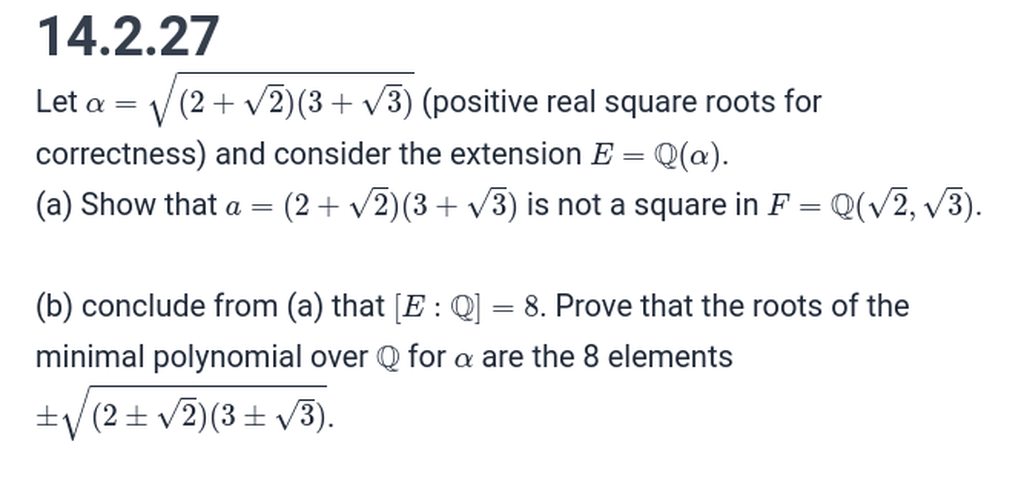
Say I have a field extension Q(alpha) of degree 8 and I would like to find the minimal polynomial of alpha = sqrt((2+sqrt(2))(3+sqrt(3)) in an effective way, what would be a way to do it?
tardy hedge
If for some x in ring, b1,b2 and a are ideals, why x(b1+b2) subset a implies xb1 subset a and xb2 subset a?
Nevermind got it. Use 0
inner steppe
If F is a finite field, then the characteristic of F is p = o+(1)
I know what characteristics mean, it when we take the mulitplicative identity 1 and add it until we get 0. The number of 1's we have to add then is our characteristics and it can only be 0 or a prime number.
But I don't understand the definition on my lecture slide, what do they mean by p = o+(1)?
void cosmos
wild jasper
Say I have a field extension Q(alpha) of degree 8 and I would like to find the ...
look at the galois group action on alpha
void cosmos
inner steppe
If F is a finite field, then the characteristic of F is p = o+(1)
I know what c...
what is o
wtf is this
void cosmos
wild jasper
Say I have a field extension Q(alpha) of degree 8 and I would like to find the ...
btw u can do this manually easily
wild jasper
void cosmos
btw u can do this manually easily
I've been trying for days 😦
inner steppe
Wait I think I get it, I just missed a little part of the slide where they mentioned that o+(1) is the order under addition. So I guess they are using g^n = 1 but with addition which I get is g^n = g*n = 0 so n in this case should be a prime?
inner steppe
void cosmos
what is o
does this sound right
void cosmos
i am not following but yes the characteristic of a field must be prime
void cosmos
wild jasper
I've been trying for days 😦
well either i missed something or u did but it's fine
inner steppe
void cosmos
i am not following but yes the characteristic of a field must be prime
or 0?
void cosmos
yes or 0
wild jasper
void cosmos
well either i missed something or u did but it's fine
can you show me any shortcuts to make the calculations easier?
void cosmos
i would probably just find out what the galois group is
this has order 8 and there are only 2 nonabelian groups of order 8 ig
wild jasper
this question is before the galois group is determined
void cosmos
yeah im telling u what iw ould do
wild jasper
ok
void cosmos
but yeah i think manually doing it sucks
inner steppe
Btw guys aren't these saying exactly the same thing:{x ∈ G ; x^d = 1}| and |{x ∈ G ; o(x) = d}|
The number of x in G whose order is d?
 thorn jay
First one is all the elements where the order divides d
inner steppe
thorn jay
First one is all the elements where the order divides d
how?
inner steppe
coral spindle
1^500 = 1, so is it true that o(1) = 500?
isn't the order g^n = 1?
inner steppe
coral spindle
so 1^500 = 1
no but prolly mixing it up, let me double check
coral spindle
What do you mean no
It is absolutely true that if 1 is the identity of any group, then 1^500 = 1
inner steppe
coral spindle
It is absolutely true that if 1 is the identity of any group, then 1^500 = 1
no but the smalled n in g^n = 1 is the order of g
coral spindle
Yes there you go.
So you have the answer to your question
They're not the same thing.
inner steppe
how come "First one is all the elements where the order divides d"
coral spindle
Because it is a standard fact that x^d = 1 if and only if o(x) divides d.
You should try proving this.
thorn jay
inner steppe
how?
Okay suppose o(g) = k
Suppose some d such that k divides d
Then d = n * k for some n
=> g^d = g^nk = (g^k)^n = 1^n = 1
Now suppose for some d, g^d = 1 and let r = d mod k
=> r = d + m * k < k for some integer m
=> g^r = g^{d + mk} = g^d * g^mk = 1 * 1^m = 1
But as r < k, r must be 0 by the definiton of order, hence k must divide d
Thus we've prove then g^d = 1 if and only if the order of g divides d
inner steppe
thorn jay
Okay suppose o(g) = k
Suppose some d such that k divides d
Then d = n * k for so...
the funniest thing is that I remember proving this as an exercise 2 weeks ago. Why do I keep erasing things completely from memory.
inner steppe
Thanks for this tho btw. I really appreciate the help.
inner steppe
thorn jay
I hope it kinda made sense x3
it definitely did!!
thorn jay
Okii idk im used to trying to teach this to people with barely any understanding of the subject matter hehe
inner steppe
thorn jay
Okii idk im used to trying to teach this to people with barely any understanding...
my problem is that I am gonna forget I ever did this in like a couple of days
thorn jay
Well it's basically number theory this
Modular arithmetic
Because working in the subgroup generated by g (which is always when u work with powers of it) is working in Z_o(g)
Would this belong here? Animation i made with motion canvas of S_nxS_n acting on a latin square
 gusty thistle
Suppose I have a ring A and a maximal ideal m of A. How do you show that the dimension of (A/m) (x) A^n as a A/m-vector space is n? I know that (A/m) (x) A^n is isomorphic to (A/m)^n as an A-module but this is not enough to conclude that the dimension is n right?
Clearly the dimension can not be greater then n but im not so sure how to show that it can't be less either
south patrol
gusty thistle
Suppose I have a ring A and a maximal ideal m of A. How do you show that the dim...
The isomorphism you mention is also an isomorphism of A/m-modules
So you're done
This is just because the A/m and A module structures are compatible "in the obvious way"
gusty thistle
thanks
inner steppe
Let (F,+,×) be a field with 2^6 (= 64) elements, ∣ 𝐹 ∣ = 64 ∣F∣=64. How many elements x∈F satisfy x^21 =1
If G is a field then it is also a group and for a group G where |G| = n, G is a cyclic group where if n|d n = |{x belongs to G ; x^1 = d}| = d
Am I correct this far that every field is also a group, then what remains to use this theorem is to find the order of G, now how do I do that?
thorn jay
inner steppe
Let (F,+,×) be a field with 2^6 (= 64) elements, ∣ 𝐹 ∣ = 64 ∣F∣=64. How many el...
26 (=64)
What
inner steppe
Totally understandable lol
thorn jay
inner steppe
Let (F,+,×) be a field with 2^6 (= 64) elements, ∣ 𝐹 ∣ = 64 ∣F∣=64. How many el...
x^21 = 1 means that the order of x divides 21 in the multiplicative group F*
21 | 63 so the number is just the number of elements with order 21, order 7, order 3 and order 1
The multiplicative group of a finite field is cyclic so in this case isomorphic to Z_9 x Z_7
From here it follows that there are 6 elements if order 7, as it has to be of the form (0, n) and 7 is prime so all elements except 0 generate it.
Elements of order 3 are of the form (m, 0) as 3 and 7 are coprime.
3k = 0 mod 9 => 3k = 9n => k = 3n
So there are two elements which have order 3; (3, 0) and (6, 0)
Then there are 2 * 6 = 12 elements of order 21; (3, 1), (3, 2), ... , (6, 1), (6, 2), ...
Finally, 1 element of order 1
Adding these up yields:
6 + 2 + 12 + 1 = 21
I think
thorn jay
inner steppe
Totally understandable lol
Does this seem good to you?
Oh ofc im stupid
21k = 63n
k = 3n
Which has 21 unique solutions
Lol
I thought it was suspicious already that it came out to be 21...
wild jasper
how can one tell if two elements in a finite field extension has the same minimal polynomial?
thorn jay
In an algebraic field extension?
thorn jay
Oh sorry i didnt see the finite part x3
Seems like a pretty computational problem though
wild jasper
indeed
https://imgur.com/a/vPKZsq9 I'm trying to solve the second part of (b) without having to compute the minimal polynomial and check 7 other roots
 rocky cloak
wild jasper
how can one tell if two elements in a finite field extension has the same minima...
rocky cloak
wild jasper
how can one tell if two elements in a finite field extension has the same minima...
The existence of an automorphism taking one to the other would do it
inner steppe
thorn jay
Does this seem good to you?
sorry I was gone for a little, not entirely sure so far
wild jasper
rocky cloak
The existence of an automorphism taking one to the other would do it
indeed
inner steppe
0^20 = 0 != 1, and (F \ {0}, ·) is a cyclic group with 80 elements. Since 20 divides 80, x^20 = 1 holds according to the known theorem for exactly 20 elements in F.
This is the answe they provided in the solution but I've no idea what they are trying to say ehre
thorn jay
inner steppe
sorry I was gone for a little, not entirely sure so far
well the multiplicative group of F is isomorphic to Z_63
so x^21 = 1 translates to 21k = 0 mod 63
21k = 0 mod 63 <=> 21k = 63n <=> k = 3n
for n = 21, 3n = 63 = 0 mod 63
hence for all values n in { 0, 1, ..., 20 } you get a unique solution, thus there are 21 solutions
rocky cloak
wild jasper
indeed
Which you can apply to your example by using that the Galois group of E is an extension of
Gal(F/Q) and Gal(E/F)
inner steppe
thorn jay
well the multiplicative group of F is isomorphic to Z_63
so x^21 = 1 translates ...
I get the math part in this, but what is unique solution telling us?
What is " for all values n in { 0, 1, ..., 20 } you get a unique solution," saying?
wait actually
how come
21k = 0 mod 63 <=> 21k = 61n ?
thorn jay
inner steppe
What is " for all values n in { 0, 1, ..., 20 } you get a unique solution," sayi...
it means that for all n=/=m in that set, 3n =/= 3m
thorn jay
inner steppe
21k = 0 mod 63 <=> 21k = 61n ?
definition of modulo
oh
63*
in my defence I am very tired
inner steppe
thorn jay
in my defence I am very tired
that makes 2 of us, no worries!!
thorn jay
loll
wild jasper
rocky cloak
Which you can apply to your example by using that the Galois group of E is an ex...
Well the part where I show that E/Q is Galois is after this
but E/F is...
inner steppe
thorn jay
it means that for all n=/=m in that set, 3n =/= 3m
I am sorry but I still don't get where we are going with this
rocky cloak
wild jasper
Well the part where I show that E/Q is Galois is after this
Then I guess just compute the minimal polynomial
wild jasper
rocky cloak
Then I guess just compute the minimal polynomial
yeah... and check 7 other roots! 😄
rocky cloak
Or the listed roots are clearly the roots of a degree 8 polynomial, so all you need to do is show that the minimal polynomial of alpha has degree 8
Which is the same as showing the degree of E is 8
So you just need to show that F = Q(alpha^2) if you've already done (a)
thorn jay
so we just go through all the n until we hit a number we've seen before
wild jasper
@rocky cloak ahha
inner steppe
sorry on a second thought k = 3n, not really sure where this comes from
thorn jay
so n=0 yields k=0
n=1 yields k=3
n=2 yields k=6
...
n=20 yields k=60
n=21 yields k=63 = 0 mod 63
n=22 yields k=66 = 3 mod 63
etc.
so there are only 21 unique values for k, hence 21 unique solutions to the equation
thorn jay
inner steppe
sorry on a second thought k = 3n, not really sure where this comes from
21k = 63n <=> k = 3n
division by 21 on both sides :3
inner steppe
thorn jay
so we just go through all the n until we hit a number we've seen before
then
wild jasper
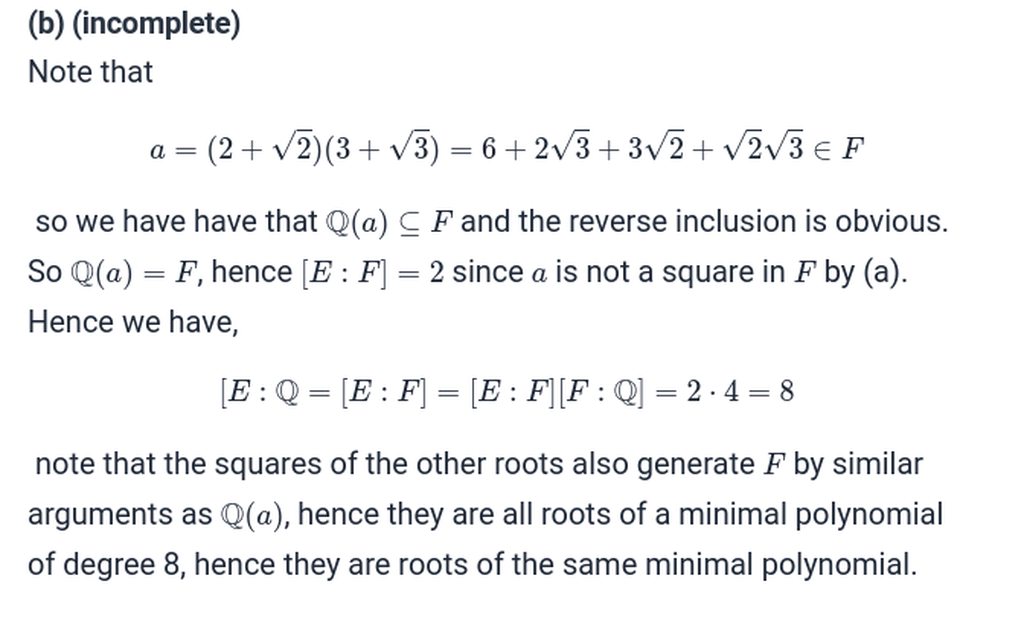
@rocky cloak does this work? https://imgur.com/a/vE5wwTe
 rocky cloak
wild jasper
<@581774454091415553> does this work? https://imgur.com/a/vE5wwTe
rocky cloak
wild jasper
<@581774454091415553> does this work? https://imgur.com/a/vE5wwTe
Well, I'm not sure "is obvious" is the best argument. But otherwise yeah
wild jasper
thanks 🙂
wild jasper
rocky cloak
Well, I'm not sure "is obvious" is the best argument. But otherwise yeah
actually it's not obvious that sqrt(2) and sqrt(3) are in Q(a) 😦
rocky cloak
Indeed, that's the main thing that needs a proof
inner steppe
thorn jay
Hm?
I am so lost because I am not even sure what we are trying to do sorry
Are you trying to show me hwo come we get this
0^20 = 0 != 1, and (F \ {0}, ·) is a cyclic group with 80 elements. Since 20 divides 80, x^20 = 1 holds according to the known theorem for exactly 20 elements in F.
Than I still have no clue where we are going with everything we did so far.
tardy hedge
Bit confused on how to show v)
 thorn jay
What is r here?
tardy hedge
tardy hedge
Bit confused on how to show v)
Also kinda stuck on vi) for n > 1
rocky cloak
tardy hedge
Bit confused on how to show v)
One inclusion is clear. For the other one, just start with x suck that x^k is in r(a)+r(b) then construct n such that x^n is in a+b
tardy hedge
x^k in r(a)+r(b) means x^k = y+z for y and z in ra rb but i wasnt sure on how to relate them
rocky cloak
tardy hedge
x^k in r(a)+r(b) means x^k = y+z for y and z in ra rb but i wasnt sure on how to...
So then you know there is an m such that y^m is in a and z^m is in b
See if you can use that
inner steppe
thorn jay
But you're trying to do x^21 = 1 right
yes but that was the solution so that is hwy I was confused the whole time and still am
inner steppe
yes
inner steppe
thorn jay
Well x^n = 1 has n solutions
but anyways is there any explanation to why they are solving it that way
thorn jay
Idk it's a very handwavey explanation of my proof
inner steppe
thorn jay
The multiplicative group of a finite field is cyclic so in this case isomorphic ...
are you talking about this proof?
thorn jay
thorn jay
so n=0 yields k=0
n=1 yields k=3
n=2 yields k=6
...
n=20 yields k=60
n=21 yields...
This proof
inner steppe
thorn jay
This proof
I finally see what you were tryna do there lol. Earlier I thought you were like doing similar things like them. Since I spent time understanding their solution I was not ready to receieve other ways until now. Thanks for the help!!
thorn jay
inner steppe
I finally see what you were tryna do there lol. Earlier I thought you were like ...
Hehe, i try, sorry for the confusion
 grave sedge
tardy hedge
x^k in r(a)+r(b) means x^k = y+z for y and z in ra rb but i wasnt sure on how to...
grave sedge
tardy hedge
x^k in r(a)+r(b) means x^k = y+z for y and z in ra rb but i wasnt sure on how to...
(fun fact/rant) This is somewhat of an inefficient thing, although it is the one people usually do: you're basically repeating the steps you use to prove the radical is an ideal, instead of using the properties you already have.
A "better" proof would be to notice that r(a)+r(b) ⊂ r(a+b) (because r(a) ⊂ r(a+b) and r(b) ⊂ r(a+b)) and then take the radical of both sides
tardy hedge
Hmm ill think about that thanks
$(i,j) = (i,i+1)(i+1, i+2)...(j-2, j-1)(j-1, j)(j-2,j-1)...(i+1, i+2)(i, i+1)$
cloud walrusBOT
kiand123

 next obsidian
grave sedge
A "better" proof would be to notice that r(a)+r(b) ⊂ r(a+b) (because r(a) ⊂ r(a+...
next obsidian
grave sedge
A "better" proof would be to notice that r(a)+r(b) ⊂ r(a+b) (because r(a) ⊂ r(a+...
This doesn’t finish it though you still just get an inclusion.
You need to do some argument to show you get everything, but for that you can just say that r(a + b) < r(r(a) + r(b))
grave sedge
next obsidian
This doesn’t finish it though you still just get an inclusion.
The other one is more or less obvious (since a+b ⊂ r(a+b))
(anyways my point was that this specific result needs no element-wise manipulations assuming you have already done the stuff that is usually done before it, like r(r(a))=r(a), but for some reason it's very common to see proofs by picking elements)
 fading summit
help! please
Let G be a finite group of order n, and let g ∈ G be such that G =<g> (a generator for the group). Let d ≥ 1 be a divisor of n.
- Let x be an element of G. Prove that x has order d if and only if there exists an integer k such that gcd(d, k) = 1 and x = g^(nk/d).
- Let x1, x2 ∈ G be two elements of order d. Prove that <x1>=<x2>. (Do not use the fact that there is a unique subgroup of G of order d – the statement in this problem was used in the proof of that theorem).
 brisk oak
tardy hedge
Also kinda stuck on vi) for n > 1
brisk oak
tardy hedge
Also kinda stuck on vi) for n > 1
Hmmm maybe use iii) ? 🤔🤔
thorn jay
fading summit
help! please
> Let G be a finite group of order n, and let g ∈ G be such that G ...
2 isnt true though? In the group Z_3xZ_3 one has elements (1, 0) and (0, 1) both of order 3
The respective subgroups generated only share (0, 0)
Oh im tired i didnt see G = <g>
Suppose x = g^m and o(x) = d
=> d * m = 0 mod n = k * n
m = k * n/d
Let gcd(d, k) = l and notice:
m * d/l = k * n/d * d / l = k/l * n
But l | k => k/l is an integer => m * d/l = 0 mod n
Hence by the definition of order gcd(d, k) = 1
The other direction is obvious
fading summit
the other direction would be this? x^d = (g^(nk/d))^d = g^(nk) = (g^n)^k = e^k = e
thorn jay
Mhm!
fading summit
thanks
thorn jay
fading summit
help! please
> Let G be a finite group of order n, and let g ∈ G be such that G ...
x1 = g^{n/d}^k1
x2 = g^{n/d}^k2
consider then S = <g^{n/d}>
clearly |S| = d and x1, x2 in S
=> <x1>, <x2> < S
But |<x1>| = |<x2>| = |S| = d
=> <x1> = S = <x2>
Omfg that took me way too long
fading summit
but the problem says we're not allowed to use the fact that there is a unique subgroup of G of order d
thorn jay
Yeah
I know
Im using the fact that the cardinalities must be equal
And since everything is finite that must mean the sets are equal
thorn jay
fading summit
but the problem says we're not allowed to use the fact that there is a unique su...
Where in my proof do i use that?
fading summit
since <x1> and <x2> are both subgroups of S with order d, it must be true that <x1> = <x2>
thorn jay
fading summit
since <x1> and <x2> are both subgroups of S with order d, it must be true that <...
S is also of order d
Hence you get
|S| = |<x1>|
Which means that <x1> = S as <x1> is a subgroup, and thus a subset, of S
fading summit
okay thanks!
thorn jay
Ofc!
fading summit
List all the possible orders of the elements of G := Z_30 × Z_24. For each number you list as a possible order, give an example of an element of G that has that order. Without listing all the 720 elements of the group, explain why the numbers on your list are the only possible orders.
i found out what the possible orders are: 1, 2, 3, 4, 5, 6, 8, 10, 12, 15, 20, 24, 30, 40, 60, 120
but how do i find examples for each of them? is there a pattern that im not seeing?
thorn jay
well the orders are lcm(o(a), o(b)) where a in Z_30, b in Z_24, as o((a, b)) = lcm(o(a), o(b))
fading summit
oh wait i figured it out
i can just let one of the components of (a, b) be 0 and then use the multiple for the other one
like the order of (6, 0) is 5
or the order of (0, 4) is 6
thorn jay
that is one way yes
golden turtle

I am confused how the earlier part of this problem is related to the final sentence. Say I show that T is surjective if and only if det M is a unit in R. How does this connect to the case of mxn matrices when the determinant wont even be defined?
thorn jay
well if there was a surjection to R^m to R^n, then R^n would be isomorphic to some quotient of R^m.
But a quotient of R^m would induce a surjective endomorphism, which would need to be an automorphism, hence R^m would be isomorphic to R^n, which is impossible as any commutative ring has IBN and m=/=n
golden turtle
we have not covered IBN yet, is that required here?
golden turtle
Okay I will try that, thank you
thorn jay
good luck ^w^
fading summit
Let G be a group of order 8, and let a, b ∈ G. Assume that o(a) = 4 and b is not in <a>. If H is a subgroup of G that contains a and b, prove that G = H (in other words, G is generated by the two elements a and b, i.e. G = <a, b>).
im thinking:
|<a,b>| = |<a>| + |<b>| − |<a ∩ b>| = 4 + 4 - 0 = 8
thorn jay
by langrange's theorem: [G:<a>] = 8/4 = 2, and b not in <a>, thus
G = <a> U b<a>
G = <a> U b<a> < <a, b> < G
=> <a, b> = G
fading summit
huh? is it really that simple
fading summit
could you elaborate it? im not following
also i havent learned what a coset is yet
thorn jay
well the index of <a> in G is 2, so it has two left cosets
b is not in <a>, so the other coset must be b<a> => G = <a> U b<a>
H = <a, b>, and notice that <a> U b<a> must be a subset of H
hence we get G < H < G => H = G
thorn jay
fading summit
also i havent learned what a coset is yet
ah okay
so no langrange's theorem then
😔
fading summit
no i've learned lagrange's theorem, but not cosets
fading summit
we didnt prove it in class yet. but we're still allowed to use it.
thorn jay
ah right..
of course
smg
smh*
hmm
well
I can quickly teach you cosets
they aren't that hard
if you want
fading summit
i was thinking we can let <a> = {e, a, a^2, a^3}, and let <b> = {b, ba, ba^2, ba^3}
so <a, b> = {e, a, a^2, a^3, b, ba, ba^2, ba^3}
so |<a, b>| = 8 and |G| = 8, so G = <a, b>
thorn jay
The <b> you defined is exactly the coset b<a>
fading summit
so the proof works?
thorn jay
Kind of akward notation
As <b> denotes the subgroup generated by b and <a, b> the subgroup generated by a and b
golden turtle
thorn jay
well if there was a surjection to R^m to R^n, then R^n would be isomorphic to so...
So I tried reasoning this out, and I'm not sure I understand completely. Are you saying, if there's a surjective module homomorphism f:R^m->R^n then by 1st iso R^m/ker(f) iso to R^n. But then I'm not quite getting what the "induced surjective endomorphism" is here. I think maybe you're saying something will show R^m iso to R^m/ker(f) iso to R^n, which is our contradiction. But Idk what the "something" is that shows that. Hopefully my question makes sense
thorn jay
golden turtle
So I tried reasoning this out, and I'm not sure I understand completely. Are you...
Oh you're right i was kinda being dumb lol
golden turtle
thorn jay
Oh you're right i was kinda being dumb lol
So its nothing I was missing?
thorn jay
For n>m
golden turtle
is it to just kill the extra stuff?
thorn jay
Yup
thorn jay
h : (r_1, ..., r_m, ..., r_n) -> (r_1, ..., r_m)
golden turtle
yes
thorn jay
Then f : R^m -> R^n surjective
=> h * f, f * h surjective
But both are endomorphisms so both are bijective
golden turtle
and is that because h*f and f*h are R^m to R^m and R^n to R^n respectively, so the first part gives us that
thorn jay
Mhm
thorn jay
From R^m to itself
golden turtle
ah yea
golden turtle
yes
so we want to get a contradiction from this right, we assumed that f exists as a surjection
thorn jay
The compositions of two surjections can only be an injection if both are injections
golden turtle
can't we let like, x=(0,0,..,0, r_(m+1), .. r_n) then f*h(x)=0 but this would contradict f*h being a bijection
golden turtle
would what I said also work as a contradiction?
thorn jay
Ofc!
And thanks for giving me a fun exercise too
Im gonna busy myself with the first part now
golden turtle
likewise
golden turtle
thorn jay
Im gonna busy myself with the first part now
I think we have that ||Madj(M)=detMI|| and ||adj(M)M=detMI|| so if T is surjective <=> det M is a unit we have ||M^(-1)=adj(M)/detM|| exists which implies ||M invertible => T bijective => T isomorphism||
I put the spoilers incase you were still working on it
but if you're not, maybe let me know if that's fine approach 🫡
thorn jay
Hmm as it is almost 4 AM i will look at it tomorrow x3
golden turtle
okay no worries, ty
 vagrant zinc
Hi guys, could someone tell me, if the demo outline is on the right track?

 gilded saffron
vagrant zinc
Hi guys, could someone tell me, if the demo outline is on the right track?
gilded saffron
vagrant zinc
Hi guys, could someone tell me, if the demo outline is on the right track?
I don't know Spanish but you have the right idea as far as $ker(p_1) = U_2$
cloud walrusBOT
rays
 serene dune
If $a^3 =a$ for all $a$ in a ring $R$, then $R$ is commutative.
cloud walrusBOT
yeshua
 serene dune
how often the converse is true btw ?
i was wandering if this is anyhow useful in commutative algebra or not
delicate bloom
serene dune
how often the converse is true btw ?
pretty much never, I'd say this isn't useful, it's more just an exercise for some really restricted conditions forces commutativity.
serene dune
i was very exiceted nonetheless 😿
delicate bloom
it's a fun result, the fact that it doesn't hold for the integers basically means you can't have the integers as a subring which isn't a good sign
serene dune
in anyways, can u suggest me good problem set(s) for rings
serene dune
delicate bloom
it's a fun result, the fact that it doesn't hold for the integers basically mean...
hmm thats a good note
warm ember
serene dune
in anyways, can u suggest me good problem set(s) for rings
try romania national mo grade 12
there are some good ring problems in there
void cosmos
serene dune
in anyways, can u suggest me good problem set(s) for rings
i would go through qualifying exams
from diff universities
algebra ones
surely u will find good (and should be deep ig?) problems
serene dune
https://blngcc.wordpress.com/wp-content/uploads/2008/11/rmc1997.pdf
this right?, i hope posting the link is approved by TOS
serene dune
alr
serene dune
void cosmos
i would go through qualifying exams
any sheets or specific problems would be appreciated 🙏
void cosmos
serene dune
any sheets or specific problems would be appreciated 🙏
idk if i can remember lilke
a specific problem
give an example of a ufd that is not a pid
serene dune
well i was solving artin as well
void cosmos
like
serene dune
umm i think i have done those
XD
void cosmos
here is one that i got in an exam i got examined
show that the ideals of M_n(R) are of the form M_n(I) where I is an ideal of R
i did only like one and a half direction couldn't finish it
void cosmos
okay i remembered one
void cosmos
cloud walrus
**yeshua**
similar to this
suppose we have a ring such that x^2=x for all x
serene dune
boolean ?
warm ember
boolean ring is commutative
void cosmos
yeah ig the problems ik are like
the ones that involvle standard arguments or tricks that one sees in qualifying exams
ig for more exotic problems u can see what kevin yang sent
serene dune
alr
warm ember
Prove that a nontrivial finite ring is not a skew field if and only if the equation $ x^n+y^n=z^n $ has nontrivial solutions in this ring for any natural number $ n. $
ring here means noncommutative ring with unity, and nontrivial means x,y,z are nonzero
serene dune
yeah im looking forward to qualify some exams
ok i will return to this, hopefully soon, topology untill then
rocky cloak
warm ember
Prove that a nontrivial finite ring is not a skew field if and only if the equat...
||So if R is a skew field, then for n = |R|-1, x^n = 1.||
||So if x, y and z are all nonzero then 1+1=1 contradiction. ||
||If there exists x and y such that xy=yx=0, then x^n + y^n = (x+y)^n||
||You can argue that such x and y exists by looking at the radical or in the case the radical is 0, using the classification of semi-simple rings.||
thorn jay
golden turtle
determinant is defined in the usual recursive way?
south patrol
Is that the normal way lol
rocky cloak
golden turtle
I am confused how the earlier part of this problem is related to the final sente...
Consider the surjective map
R^n ->> R^m -> R^n
is it an isomorphism?
(Where the first map is the usual projection)
thorn jay
We've already done the thing they asked about, now we're doing the main part of the question
thorn jay
south patrol
Is that the normal way lol
Idfk i like the basis invariant way but you'd have to show they're equal lol
rocky cloak
thorn jay
We've already done the thing they asked about, now we're doing the main part of ...
Ah sorry, I missed some stuff
south patrol
Oh I mean the other main definition i know is just axiomatic
thorn jay
Its oki :3
south patrol
or you can use the Leibniz formula
I guess you have one in terms of like Laplace expansion
thorn jay
Yeah
Thats the one i learned
But they're all so annoying to work with istf, but i suppose we should be happy to have something computable saying so much about the transformation
golden turtle
thorn jay
determinant is defined in the usual recursive way?
Yes, I’ve realized this only works for 1 direction though
Not for T surjective => det M unit
thorn jay
You've proven det M unit => T surjective?
golden turtle
That only works for 1 direction
golden turtle
thorn jay
You've proven det M unit => T surjective?
Yes
thorn jay
Clearly by the multiplicative property of determinants T iso => det M unit
thorn jay
Yeah yeah
But if we prove T surj => T iso we have
T surj => T iso => det M unit => T surj
golden turtle
Yes
thorn jay
Which implies
T surj <=> T iso <=> det M unit
golden turtle
Yes
thorn jay
thorn jay
Clearly by the multiplicative property of determinants T iso => det M unit
So this isnt totally useless if we can prove T surj => T iso
Lol
golden turtle
Yes
I have done the other direction in a different way but I suppose it doesn’t matter how we get it
Using that
It’s free
thorn jay
Yup
golden turtle
Do you have an idea for surj => iso?
thorn jay
Not really
golden turtle
That’s fine, me either