#groups-rings-fields
1 messages · Page 247 of 1
 slim kayak
 long geyser

 rocky cloak
Nice long diagram marathon
slim kayak
rocky cloak
Or just apply ||the snake lemma||
Would be kinda funny to make the ||snake lemma|| moved in front of results like that one
rocky cloak
No need to prove it, it was in that movie that one time 😉
slim kayak
Lmao
 dull ginkgo
SN A K E
https://ncatlab.org/nlab/show/salamander+lemma whoever wrote this fuckin nlab article deserves a fucking award for making the first comprehensible nlab article for idiot boys like myself
i spent a long ass time doing some weird homological shit thinking it was whackass and had no ground and apparently it's some weird shit called spectral sequences and looking into it further jumpscared me
rocky cloak
dull ginkgo
i spent a long ass time doing some weird homological shit thinking it was whacka...
Spectral sequences, the mother of all diagram lemmas
slim kayak
dull ginkgo
https://ncatlab.org/nlab/show/salamander+lemma whoever wrote this fuckin nlab ar...
Are you sure you understood it?
I can write Urs Schreiber an email to add more infinity cats in there to fix it
dull ginkgo
slim kayak
Are you sure you understood it?
I can write Urs Schreiber an email to add more i...
NOOOOO
long geyser
long geyser
just finished showing that if the top two rows are exact, then the bottom row is
that was definitely a slog
gave me much needed practice on exact sequences
obviously, I'm not gonna try proving the other half lol
 cobalt heath
I feel R is a free (abelian) group with a differential d/dt. Is there a way to make this precise?
 south patrol
is R here the reals?
I don't really know what you mean as you can define the derivation d/dt on any ring
cobalt heath
south patrol
is R here the reals?
Yeah
cobalt heath
south patrol
I don't really know what you mean as you can define the derivation d/dt on any r...
Is this as Kahler differentials?
But it can only act on polynomials, right
cobalt heath
Basically, I do not understand how analysis differs from algebra precisely in this kind of aspect.
rocky cloak
cobalt heath
But it can only act on polynomials, right
Kahler differentials makes sense on any algebra. It is the universal derivation.
For a ring R and a bimodule M (or if R is commutative you can just use a module) a derivation d is a linear map R -> M, such that
d(rs) = rd(s) + d(r)s
The kahler differential Omega_R/k is then a module equiped with a differential such that every differential factors through it uniquely.
Note that the assumption of linearity depends on the base ring. So for example derivations on the real numbers would be different if you required them to be R-linear than if you just required them to be Z-linear
rocky cloak
cobalt heath
Basically, I do not understand how analysis differs from algebra precisely in th...
The difference between analysis and algebra here would be that algebra doesn't see any of the continuity/smoothness.
Like in analysis land you would look at differential forms on a manifold, and in algebra land you would look at kahler differentials on varieties.
If you looked at for example kahler differentials on the ring of smooth functions you would get something much 'bigger' than just the differential forms.
cobalt heath
rocky cloak
Kahler differentials makes sense on any algebra. It is the universal derivation....
Yeah, I interpret them as "acting on polynomials" which could be imprecise. But still, it's not applying to general smooth.
 rotund aurora
cobalt heath
Basically, I do not understand how analysis differs from algebra precisely in th...
rotund aurora
cobalt heath
Basically, I do not understand how analysis differs from algebra precisely in th...
I don't really know about this but if you have some algebraic variety you can calculate its de Rham cohomology (you have to consider the analytification or whatever) by looking at the algebraic de Rham complex, which is defined by taking derivations of the coordinate ring modulo requiring that differentials of constants be zero. I guess this is saying that to calculate the cohomology you can just look at the algebraic differential forms (although not all differential forms need be algebraic).
Again, I don't actually know about this, I just watched this the other day https://youtu.be/FFH5HSbfcdg?si=xk1jK916cgojCyAh
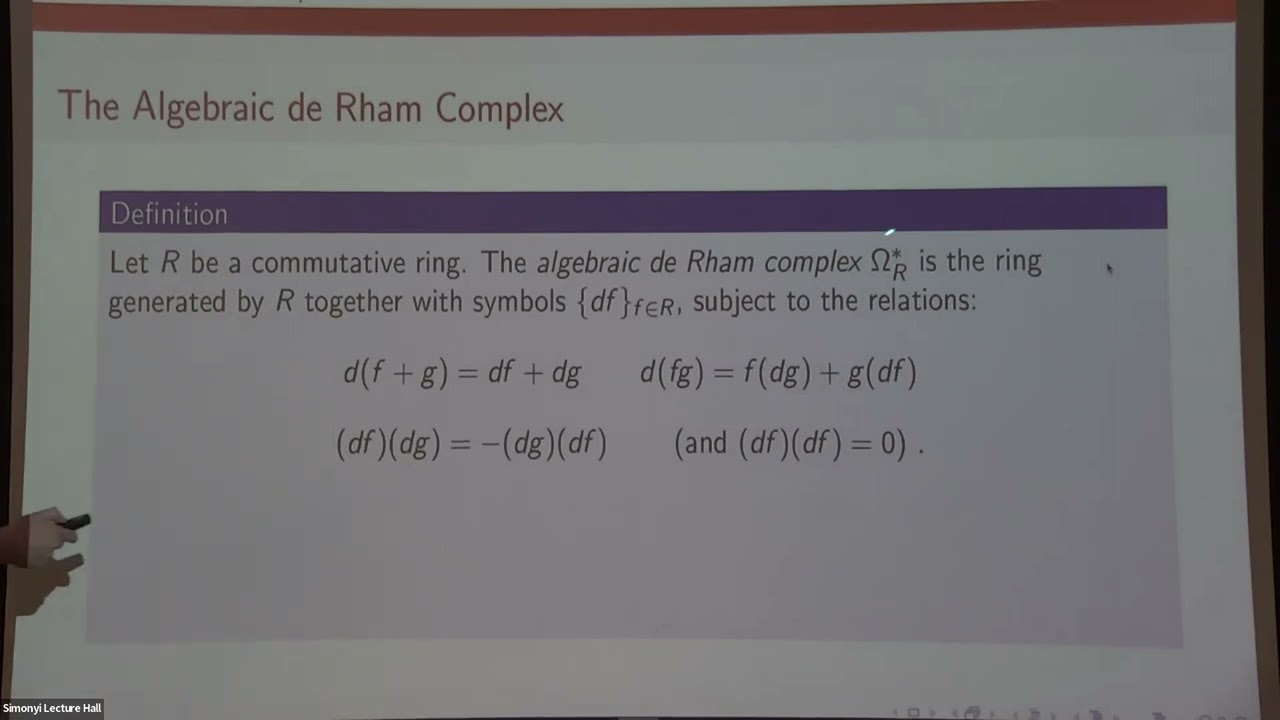
Members’ Colloquium
Topic: A Gentle Approach to Crystalline Cohomology
Speaker: Jacob Lurie
Affiliation: Professor, School of Mathematics
Date: February 28, 2022
Let X be a smooth affine algebraic variety over the field C of complex numbers (that is, a smooth submanifold of C^n which can be described as the solutions to a system of polynomial ...
cobalt heath
rocky cloak
The difference between analysis and algebra here would be that algebra doesn't s...
Yeah the thing is how they have analogue while only analysis got the smoothness.
Where does this come from?
Is it just diff geo envy 
rotund aurora
rotund aurora
I don't really know about this but if you have some algebraic variety you can ca...
 cobalt heath
rotund aurora
I don't really know about this but if you have some algebraic variety you can ca...
cobalt heath
rotund aurora
I don't really know about this but if you have some algebraic variety you can ca...
Yeah this explains the common properties, but not differences
But yep the fact that algebraic de rahm cohom coincides with singular cohom is indeed surprising
rotund aurora
rocky cloak
The difference between analysis and algebra here would be that algebra doesn't s...
if S=C^infty(M) for some manifold M and you require the differential S-->S to be zero at constant functions, don't you always get that these differentials are of the form f(x) · d/dx, where f(x) in S ?
idk much about differentials on manifolds, hopefully what I said makes sense lol
rocky cloak
rotund aurora
if S=C^infty(M) for some manifold M and you require the differential S-->S to be...
Like for differential forms df = f'(x)dx and for kahler differentials the same is true for polynomials f.
But if for example M is the real numbers, then the kahler differential d(sin(x)) should be different from cos(x)dx
Like the ring C^infty(R) can't "tell" that cos is the derivative of sin
 chilly ocean
random sanity check question: any two free modules, over the same ring R and with basis of same cardinalities, are isomorphic right? (same proof as in vector spaces)
cobalt heath
rocky cloak
Like for differential forms df = f'(x)dx and for kahler differentials the same i...
Why does d(sin(x)) make sense in the Kahler differentials?
Is it just for being defined over C(M)
rocky cloak
cobalt heath
Why does d(sin(x)) make sense in the Kahler differentials?
The kahler differential is a module together with a map d from the the ring to the module. sin(x) is a smooth function (so in the ring of smooth functions)
cobalt heath
Ah. So you cannot say d sin(x) = cos(x) dx because Taylor series does not make sense in algebraic settings
cobalt heath
cobalt heath
Ah. So you cannot say d sin(x) = cos(x) dx because Taylor series does not make s...
Which stems from the lack of (conventional) limit
rotund aurora
rocky cloak
Like for differential forms df = f'(x)dx and for kahler differentials the same i...
it is true in C^infty(R) that all derivations are of the form f(x) · d/dx, I think
rocky cloak
cobalt heath
Which stems from the lack of (conventional) limit
Yes a being a derivation is quite a weak condition, just d(fg) = fdg + (df)g
I find it pretty cool that this implies df = f' dx even if it just works for polynomials
cobalt heath
Formal derivation >.>
rocky cloak
rotund aurora
it is true in C^infty(R) that all derivations are of the form f(x) · d/dx, I thi...
Perhaps if you just mean derivations from C^infty to itself, or require some sort of continuity
But not in general for sure
south patrol
rotund aurora
I don't really know about this but if you have some algebraic variety you can ca...
Good talk
 ornate tiger

why every element here form order 2
do they mean like (0,0,0) (1,0,1) etc ?
or like x,y,z are differtant
 uneven jackal
there is an element of order one
which is zero
but all others are of order 2 yes
ornate tiger
ok thx
 whole moss
If F is a subfield of K and K/F is a galois extension with K=F(gamma), how would you prove the Fix(Gal(F)) is a subset of F direction for showing that Fix(Gal(F)) = F
i have the idea that it has something to do with automorphisms in Gal(F) uniquely permuting the roots of the minimal polynomial of gamma over F but im not sure how to make things precise
 serene ether
ı dont want answer ı just know a thing, what is r(a)?

 cloud walrusBOT
PD potato
 south patrol
It is the set of elements x of A such that x^n is in I for some n
 chilly radish
whole moss
i have the idea that it has something to do with automorphisms in Gal(F) uniquel...
chilly radish
whole moss
i have the idea that it has something to do with automorphisms in Gal(F) uniquel...
Hint: show that all the galois conjugates of gamma form a basis
Or rather
Show there is some element a such that sigma(a) for sigma \in Gal(F) is a basis
serene ether
south patrol
It is the set of elements x of A such that x^n is in I for some n
thank youu
chilly radish
This might be hard to prove without more assumptions on the field
This is the normal basis theorem
You might already know it
whole moss
ahh thanks ill give it a shot
nah havent heard of that theorem but ill look it up
its a bit weird becuase the lecturer started off with fields and introduced the galois correspondence theorem in the second lecture, and brushed over separability
 bitter locust
whats the difference between localization of a ring and using group completion on the monoid of the multiplicative structure already on a ring?
south patrol
Well one thing is that group completion inverts everything whilst localisation doesn't
Like you don't want to invert 0 in the monoid for obvious reasons
Moreover the localisation is compatible with the addition etc
bitter locust
would it be fair to call localization as "multiplicative group completion that plays nicely"? (by nicely i mean not imverting the 0 and obiding with the addition)
or rather
"partial multiplicative group completion that plays nicely"
tho why we pick just a subset S is kind of a mystery to me
dull ginkgo
I internalize the localization as almost a “unitification”
You are essentially taking a multiplicative subset S
And mapping it to a space where that S becomes a set of units
Versus like an ideal being sent to 0 for a quotient
Which is funny because it’s like the opposite, as the units are elements that don’t lie in any proper ideal
Which allows you to take a glance at what happens to the ideal structure under localization
 tribal moss
One reason not to localize to only some of the non-zerodivisors is if you want to take a quotient of the resulting ring. If you make too many elements into units, the set you want to quotient out afterwards might not be an ideal anymore.
bitter locust
dull ginkgo
And mapping it to a space where that S becomes a set of units
so like if i have Z and take S to be the evens 2Z, all elements of 2Z now are units?
tribal moss
That actually gives you Q, since every rational can be written as 2m/2n.
bitter locust
oh huh
tribal moss
But if you take S to be all the powers of 2 (that is, the smallest multiplicative set that contains 2), you get an interesting intermediate ring.
(Correction: you'd get Q if you take S to be 2Z\{0}. If you try to adjoin an inverse of 0, everything always collapses to the zero ring).
bitter locust
yeah right 0 isnt really allowed anyway
tribal moss
Another interesting case is to localize with respect to all the non-even elements of Z. That gives you the ring of all rationals with odd denominator -- so it won't contain 1/2.
bitter locust
oh but odd *odd = even
doesnt S have to be closed under multiplication
oh wait
lol
slim kayak
bitter locust
oh but odd *odd = even
groethendieck, is that you?
bitter locust
reincarnation
bitter locust
tribal moss
But if you take S to be all the _powers of 2_ (that is, the smallest multiplicat...
so for this ring we get all fractions with a denominator thats a power of 2?
tribal moss
Yes.
bitter locust
so 2 is a unit and so is 4 etc
tribal moss
(This is usually known as the "dyadic rationals").
slim kayak
Thats a cool ring, is it used for anything?
bitter locust
bitter locust
i remember using those before
not really using but i saw those (or their flavor) before in different contexts, like hackenbush, surreal numbers, or some proofs of theorems that divide an interval in half and half
 mighty kiln
bitter locust
would it be fair to call localization as "multiplicative group completion that p...
mighty kiln
bitter locust
would it be fair to call localization as "multiplicative group completion that p...
Localization freely generates a group structure indeed
Consider the category C of (R, S) where S is a multiplicative submonoid of a cring R, and the subcategory D of (R, S) where S is a group, I think there's a free-forgetful adjunction here?
bitter locust
mighty kiln
Consider the category C of (R, S) where S is a multiplicative submonoid of a cri...
i dont get adjunctions yet but does that basically mean that localization generates a free group (and forgetful is there because we forget about the additive structure)
mighty kiln
You forget the invertibility of S
And freely generate group structure (inverses) for S
bitter locust
oh so instead of "enhancing" the original ring R we take a different perspective and instead "enhance" S by using elements from R?
mighty kiln
We're modifying R and the S tells us which part to modify
 limpid ferry
I am about to learn Ring and Fields, but just want to ask in advance if this term "Fields", and the "Field" in linear algebra, over which a vector space is defined, refer to the exact same thing?
 dull marsh
Yes, they do
dull ginkgo
mighty kiln
Consider the category C of (R, S) where S is a multiplicative submonoid of a cri...
Ore localization is horrible
mighty kiln
dull ginkgo
Ore localization is horrible
How does Ore work 
dull ginkgo
Trust me you don’t wanna know
mighty kiln
Okie
 lethal cipher
Okay, so I am having a little trouble. Let $I$ be an ideal of a ring $R$ and $\pi: R \to R/I$ be the natural quotient map.
I want to show there is a one-to-one correspondence between ideals of $R$ containing $I$ and ideals of $R/I$, but I am having a lot of trouble.
I do know that since $\pi$ is a surjective homomorphism, that ideals map to ideals, and pre-images of ideals are always ideals.
However, i am having a hard time showing that there is exactly one ideal that corresponds to the ideal in the other ring.
cloud walrusBOT
dackid
 chilly radish
mighty kiln
How does Ore work <:eeveekawaii:556858499930259471>
chilly radish
mighty kiln
How does Ore work <:eeveekawaii:556858499930259471>
Do you know about the derived category?
Because it's kind of like getting the derived category from the homotopy category
Well it's exactly like that lmao
mighty kiln
I read about it a while ago
mighty kiln
lethal cipher
Okay, so I am having a little trouble. Let $I$ be an ideal of a ring $R$ and $\p...
Show that the two directions form a pair of inverse functions
mighty kiln
chilly radish
Well it's exactly like that lmao
So do you like
Take an additive cat with one element and "localize"
rocky cloak
mighty kiln
How does Ore work <:eeveekawaii:556858499930259471>
The basic idea is that when you localize a commutative ring you can write anything as r * s^-1, but in a noncommutative setting this doesn't work because s^-1 * r isn't on that form.
The ore condition just ensures that for r and s there are r' and s' such that s^-1 r = r' s'^-1 and the localization works out nicely
rocky cloak
mighty kiln
And the rest is equation chasing?
I'm not sure what you mean by that. But it's just a condition that makes it easier to explicitly construct the localization
mighty kiln
Is it equivalent to the existence of a localization?
mighty kiln
mighty kiln
Consider the category C of (R, S) where S is a multiplicative submonoid of a cri...
In the sense of universal property
rocky cloak
No, I think a localization should always exist
The category of rings is complete after all, and it doesn't seem like you should run into any size issues
Like just take the noncommutative polynomial ring R<S^-1> with formal inverses of S and add the appropriate relations. That works, but it's hard to do anything with that construction other than just using the universal property.
mighty kiln
Okie, thanks for the help
chilly radish
rocky cloak
No, I think a localization should always exist
Yea, it's just really badly behaved
ornate tiger
hi if i had a question asks to find all right and left cosets where should i start to be able to solve this stuff

if we had this for example
 noble lynx
I am trying to understand the reason for requiring algebraic indpendence in this. If the xi's are not algebraically independent, is what goes wrong the fact that homomorphisms preserve relations and so you cannot choose the \alpha's arbitrarily?

 true ingot
Getting back to this now a few days later. The fact that these two are affinely related seems very unintuitive to me geometrically. I guess this is where the fact that we are working with F_3 field comes into play?
tribal moss
Yes, and it's also important that those sets are not ordered.
Hint: think of it as ||{(0,0),(0,1),(1,0),(1,1)} and {(0,0),(0,1),(1,2),(1,0)}|| being affinely related, recalling that ||2 is -1||.
true ingot
tribal moss
Yes, and it's also important that those sets are not _ordered_.
Hint: think of i...
Ahhh when you say it like that... It's just a shear isn't it?
tribal moss
Yes.
true ingot
Thank you! Thats a cool way of seeing it 🙂
 winged void
hello i have a question regarding the following because i do not really understand how the following is true

 barren sierra
winged void
hello i have a question regarding the following because i do not really understa...
barren sierra
winged void
hello i have a question regarding the following because i do not really understa...
which part do you not understand?
winged void
well i do not understand the whole thing literaly how is it possible that if tau = sigam tau sigma ^-1 then this equivalent to that on the right side
barren sierra
This formula: $\sigma (a_1\ a_2\ a_3\ \cdots\ a_k) \sigma^{-1} = (\sigma(a_1)\ \sigma(a_2)\ \sigma(a_3)\ \cdots\ \sigma(a_k))$?
winged void
yes how is that true
cloud walrusBOT
Spamakin🎷
 winged void
it doe not make sense to me
barren sierra
ok so I'm going to just assume that tau is a cycle (since disjoint cycles commute + every permutation can be written as a product of disjoint cycles)
winged void
and why did you replace tau with (a_1 a_2 a_3 a_4 a_5 ... a_k)
winged void
barren sierra
ok so I'm going to just assume that tau is a cycle (since disjoint cycles commut...
sure i agree on that
but how do you know that tau is a disjoint cycle
and if tau is a disjoint cycle how is that going to help
barren sierra
Well if we can prove the formula for a single cycle
we can prove it for arbitrary permutations
for example $\sigma (a_1\ a_2\ a_3\ \cdots\ a_k) (b_1\ b_2\ b_3\ \cdots\ b_k) \sigma^{-1} = \sigma (a_1\ a_2\ a_3\ \cdots\ a_k) \sigma^{-1} \sigma (b_1\ b_2\ b_3\ \cdots\ b_k) \sigma^{-1}$
cloud walrusBOT
Spamakin🎷
 barren sierra
so without loss of generality we are going to assume that tau is a single cycle
ok well can you compute where a_1 gets mapped to?
Here's a start
Lets say all of these are permutations in $S_n$. For ease of notation let $\tau = (a_1\ a_2\ a_3\ \cdots\ a_k)$. Let $j$ be some integer $1 \leq j \leq n$. So since $\sigma$ is permutation there exists $a_i$ such that $\sigma(i) = j$. There are two cases: either $i = a_l$ for some $l$ or not. Tackle both of these cases separately.
cloud walrusBOT
Spamakin🎷
 barren sierra
I mean the two permutations are equal if and only if they are the exact same functions right, so we can just show that
winged void
I see I find though bit difficult
barren sierra
cloud walrus
**Spamakin🎷**
well try this
and see how far you get
and when you get stuck tell me your progress (ping me)
winged void
sure thanks alot!
long geyser
is this true if G is not abelian?

I don't think I used commutativity once when setting up zorn's lemma, so I say yes but then I'm wondering why the question specified abelian
 coral spindle
I agree with you. The union of a chain of subgroups is itself a subgroup, even if we're non-Abelian. I don't think I'm missing anything. I'm now wondering if this was some kind of gotchya
long geyser
maybe the author is instilling in the readers to always check which of the hypotheses they are actually using
coral spindle
Just a bit funny to do that while asking questions at that kind of level
long geyser
ye lol
coral spindle
Perhaps there is an 'easier' argument that requires Abelianity that we haven't noticed
long geyser
nah
coral spindle
I doubt it too
bitter locust
wanted to ask a question here but i just answered it by writing it down
long geyser
I have no idea how to do this

plus, the hint is incomprehensible
(these are modules)
long geyser
long geyser
plus, the hint is incomprehensible
now I understand the hint

(this definition is given 20 pages after the question is asked)
this book is way too comfortable with giving questions that require content further down
so if the exact sequence splits, we know that B is iso to A direct sum C, so what q should do is obvious
and the converse is simply from this, pretend I didn't ask anything
 barren sierra
tbf I think retraction / section are terms that are introduced in most intro to proof classes (at least they were introduced in mine and ones my friends took as well as the one I TAed for)
however
gun to my head I could not tell you which is which 😵💫
long geyser
I've seen the term before, that is not the deal
but if you have qi = identity, then it is by definition a retraction
so, what is the hint?
long geyser
long geyser
I don't think this is the same as a set theoretic retraction?
barren sierra
since S is a submodule of M it's for all intents and purposes the identity map
barren sierra
it sort of is
long geyser
which I now get
long geyser
yes
barren sierra
this idea of "same thing" in quotes comes up a ton in talking about SES
long geyser
idea is you can write b = (b - iqb) + iqb
and it is like B = kerq + im i
and im i = ker p, so p restricted to ker q must be an isomorphism
cool
slim kayak
Have you already shown that it splitting is equivalent to B being a direct sum?
long geyser
shown that splitting implies direct sum, but the book showed the converse is false
long geyser
 slim kayak
Right, but take some time understanding what exactly fails here
long geyser
why?
isn't it because M is like infinitely many A + infinitely many C
idk why that matters, it still fails
slim kayak
Because the splitting lemma exists
It being isomorphic + a little bit extra is equivalent
long geyser
idk what's going on
brother, idk what the splitting lemma is, and I already solved the problem I asked about
I'm so confused rn
slim kayak
Ight
 idle sapphire
Hi, does anyone have any resources on finite groups of lie type (and the conditions under which they are simple)? I've found some, but I really don't understand what a group of lie type is (and the resources I've found for that aren't helping). Note: I'm not sure if this is the best place to ask this question, seeing as though this is something probably covered in an undergrad math degree
chilly ocean
slim kayak
Mod some technicalities the splitting lemma should apply
The splitting lemma says that the sequence is isomorphic to the split sequence. It's not enough to require that B is the direct sum. The maps need to be the canonical ones. (i.e. the inclusion and the projection)

Like this. (If you have such a diagram then phi is automatically an isomorphism by the five lemma)
slim kayak
chilly ocean
The splitting lemma says that the sequence is isomorphic to the split sequence. ...
Which are said technicalities
chilly ocean
I have to prove that a group G with at most three elements is always Abelian
For case 2, is it necessary for me to prove that ea=ae or is it not needed?

Also, is doing this by exhaustion the correct way?
 delicate bloom
yeah
eg=ge is always true for the identity in a group, I suppose you could prove that as a separate thing altogether
delicate bloom
yeah I wouldn't worry about it personally for this
chilly ocean
Alr thanks
delicate bloom
also I'd probably do it by writing out a multiplication table, might help to see
kind of makes it into like a game of sudoku, but not repeating in a row or column means it's injective (a necessary aspect of being able to invert every element ofc)
true ingot
Reposting from #linear-algebra : If we denote $Z=Z(GL(n,F))$ we define $PGL(n,F) = GL(n,F)/Z$. At the lectures we said that $PSL(n,F)$ is the image of $SL(n,F)$ under this quotient map and from this it follows $PSL(n,F) = <SL(n,F), Z> /Z$.
How does this last thing follow exactly?
cloud walrusBOT
Faputa
Compile Error! Click the  reaction for more information.
(You may edit your message to recompile.)
 slim kayak
chilly ocean
Also, is doing this by exhaustion the correct way?
slim kayak
chilly ocean
Also, is doing this by exhaustion the correct way?
If you can't nuke it with a certain theorem, then exhaustion is the way to go
 spice whale
delicate bloom
eg=ge is always true for the identity in a group, I suppose you could prove that...
spice whale
delicate bloom
eg=ge is always true for the identity in a group, I suppose you could prove that...
1g = g and g1 = g are usually both axioms i thought
of course you only need one if you know all your inverses are double sided
dull ginkgo
spice whale
1g = g and g1 = g are usually both axioms i thought
Idk how this causes problems for groups lol
For rings it does A LOT
I’m pretty sure if there are two nonequal left inverses there are necessarily countably many
Annoying exercise in Jacobson
spice whale
dull ginkgo
Idk how this causes problems for groups lol
it doesn't
but it's usually included
makes it obvious that a group is a specific type of monoid
 tranquil musk
Hello, I'm not sure if this is allowed here, but I have a test on basic algebra (groups, rings, fields) and the test is completely open book. So I have the all clear to take in as much material as I want from any textbook. I was wondering if anyone had suggestions on what to take in like books with solutions so I can match it to the questions I get or aything like that
coral spindle
We don't know what specific content you are going to be asked about, nor do we know the specific questions you are expected to be able to answer. The best way to prepare for this is going to be deciding for yourself what material to bring in based on the content in your course.
You want to know a secret? That's why your professor is allowing you to take in materials. They are tricking you into revising.
 elfin prairie

I tried to do induction on n
I can't go from the induction hypothesis to the conclusion
I assumed an arbitrary U(k) has the property
how do I deduce that U(k+1) also has the property
rocky cloak
elfin prairie
I can't go from the induction hypothesis to the conclusion
I don't think induction is very helpful here. Try instead to just come up with two examples
(look at U(n) for small n to see if there's a pattern)
elfin prairie
but how do I prove it?
rocky cloak
elfin prairie
but how do I prove it?
By coming up with two examples and showing that they satisfy x^2 = 1
elfin prairie
but that doesn't exhaust all the possibilities
coral spindle
You don't need to exhaust possibilities
rocky cloak
For example x=1 is always in U(n) and certainly has x^2 = 1
If you can find another you have at 2
elfin prairie
hmm okay
 rapid junco
elfin prairie
hmm okay
rapid junco
elfin prairie
hmm okay
U(n) corresponds to the circle group
What complex number besides 1 has the property such that its square is 1.
 lusty marlin
rapid junco
U(n) corresponds to the circle group
lusty marlin
rapid junco
U(n) corresponds to the circle group
What's the circle group?
elfin prairie
$U(n) := {x \in \mathbb{Z^+} : x < n \text{ and } gcd(x, n) =1 }$
rapid junco
Oh I thought unitary.
dull marsh
And x >= 0
cloud walrusBOT
James
 rocky cloak
rapid junco
What complex number besides 1 has the property such that its square is 1.
rocky cloak
rapid junco
What complex number besides 1 has the property such that its square is 1.
Hint is still somewhat relevant 
rapid junco
James maybe you can use a counting argument
What is the order of the group? 1 is its own inverse and what happens if you assume that every element has an inverse which is not itself?
elfin prairie
hmmm
rocky cloak
rapid junco
What is the order of the group? 1 is its own inverse and what happens if you ass...
I mean you can use an argument like that, but it feels like it's overcomplicating it quite a bit
rapid junco
elfin prairie
hmmm
Ok heres an idea on how to work out the order
Note that 1 and n-1 form a subgroup.
What can you conclude by Lagranges thm?
elfin prairie
that isn't introduced yet in the text
lemme skim the wiki
I think I vaguely know about this result
elfin prairie
order is even?
rapid junco
Yes
Because 2 divides the group size.
Now 1 is its own inverse, so the set of all elements besides 1 is of odd order. Pair up all elements together and deduce that 1 element must be left over
This works in generality for any group of even order.
So good to know.
elfin prairie
so what does this entail?
long geyser
rapid junco
Note that 1 and n-1 form a subgroup.
if you've noticed this you've already solved the question...
you literally gave away the answer
rapid junco
long geyser
if you've noticed this you've already solved the question...
Oh yeah lmfao
I guess so
long geyser
so, here's how I would approach this
what are the solutions to x^2 = 1 in the integers
elfin prairie
+1 and -1
long geyser
yeah, so I'm guessing you have seen that operations modulo n give the same result regardless of the representative
so like, if a = b mod n and c = d mod n then ac = bd mod n
elfin prairie
yeah
long geyser
now, see that if -1 is equivalent to some guy c modulo n, then (-1)^2 = c^2 mod n
and that is essentially the answer
though I guess, you must convince yourself that a guy equivalent to -1 belongs to U(n) in the first place, but I leave this to you
elfin prairie
I was thinking about that haha
long geyser
well, first think about what can be equivalent to -1 mod n that is a non-negative integer less than n
then check and see if this candidate is relatively prime to n
elfin prairie
(n - 1)?
long geyser
yes
long geyser

 tardy hedge
d is a common divisor of a,b if (a,b) subset of (d) right?
tardy hedge
Gcd is the smallest ideal that contains (a,b)?
 next obsidian
No the smallest ideal that contains (a,b) is (a,b)
But actually if that ideal is PRINCIPAL then the generator is a GCD
tardy hedge
Oh ok yeah im on the section about euclidean domains so all ideals are principle
next obsidian

tardy hedge
Im not really sure what im confused about / the question im trying to clear up lol
tardy hedge
next obsidian
But actually if that ideal is PRINCIPAL then the generator is a GCD
Oh ok and taking a multiple of the generator and considering the ideal generated by that, it would be a common divisor but not gcd
So d is gcd if and only if (a,b) EQUALS (d)?
next obsidian
tardy hedge
So d is gcd if and only if (a,b) EQUALS (d)?
Yeh
tardy hedge
Ty chmonkey
 fresh gate
how do you prove that the order induced by the positive cone is total?

or in cone terms, a ∈ P ∨ (-a) ∈ P
rocky cloak
fresh gate
or in cone terms, a ∈ P ∨ (-a) ∈ P
This is just the definition of positive cone
Like if a-b is not in P, then b-a is, so either a>b or b>a
fresh gate
wait now that I think about it
the definition is for a prepositive cone🤦♂️ 🤦♂️
I really am stupid huh

 tropic obsidian
not sure how to prove that the kernel is contained in (X_1 - alpha_1, ..., X_n - alpha_n)
 bitter locust
not sure about containment but i think you could also reason about R[X1, ..., Xn]/Ker f and use the 1st iso theorem
tropic obsidian
yeah I guess I am looking for a way to prove it directly
rocky cloak
tropic obsidian
not sure how to prove that the kernel is contained in (X_1 - alpha_1, ..., X_n -...
Just by collecting like terms you can see that any polynomial p can be written as
p = q(x1 - alpha1) + r
where r is a polynomial in x2, ..., xn
Repeating for each indeterminate you get that each polynomial is a constant plus something in (x1-alpha1, ...)
tropic obsidian
rocky cloak
Just by collecting like terms you can see that any polynomial p can be written a...
sorry but how can you factor out x1 - alpha1 in the portion of terms not containing x1?
rocky cloak
tropic obsidian
sorry but how can you factor out x1 - alpha1 in the portion of terms not contain...
I'm not sure what you mean
tropic obsidian
I guess I am just confused why you can write p in that form
rocky cloak
tropic obsidian
I guess I am just confused why you can write p in that form
For example if you have
p = x1x2 + x3
then
p = x2(x1 - alpha1) + (x2alpha1 + x3)
In general you would right it out like
x1^n pn + x1^n-1 pn-1 + ...
and do normal polynomial division
tropic obsidian
ohh thats smart, thanks a ton
dull ginkgo
rocky cloak
In general you would right it out like
x1^n pn + x1^n-1 pn-1 + ...
and do norma...
Can we do normal polynomial division in non-integral rings
I guess we need to keep track of the leading coefficient
rocky cloak
dull ginkgo
Can we do normal polynomial division in non-integral rings
Yes, you can always divide by monic polynomials
The usual division algorithm only every uses that the leading coefficient is a unit
dull ginkgo
rocky cloak
Yes, you can always divide by *monic* polynomials
I forgot that remainder theorem holds for even noncommutative polynomial rings lol
limpid ferry
How comes ℤ_4/⟨(0)⟩ × ℤ_6/⟨(2)⟩ isomorphic to ℤ_4 × ℤ_2 ?
I already understood ℤ_4/⟨(0)⟩ = ℤ_4 and ℤ_6/⟨(2)⟩ is isomorphic to ℤ_2
coral spindle
If A is isomorphic to A’ and B is isomorphic to B’ then A x B is isomorphic to A’ x B’. Maybe you should try proving this intuitive fact.
limpid ferry
Yeah I should have asked a simpler question like that
long geyser
for part 2, I'm thinking of doing 0 -> ker g -> F -> G -> 0 where g and F are borrowed from part (i) and ker g -> F is inclusion
then, since this splits, there is an injective homomorphism G -> F and so G is a submodule of F

and finish with this

I'm still uncomfortable with the free stuff, so just need a check to see if my thought process is good
 vague granite
long geyser
for part 2, I'm thinking of doing 0 -> ker g -> F -> G -> 0 where g and F are bo...
vague granite
long geyser
for part 2, I'm thinking of doing 0 -> ker g -> F -> G -> 0 where g and F are bo...
To do the second part can’t you just pluck out a group presentation <X|R> and let A be the normal subgroup of the free group on X generated by R and let B be the free group on F(X)?
The fact that it splits tells you the free group is a direct sum of the two either side
But the subgroup of a free group is free and G is a subgroup so in particular G must be free
long geyser
I haven't done any group presentations or free groups (only abelian)
at least not in this book
vague granite
That’s a real shame because it it’s partly the reason why free groups are a big deal
Every group is the quotient of a free group so the free group is a kind of ‘cover’ that sometimes lets you do nice stuff
vague granite
Oh whoops
In the case of Z-modules that just amounts to being several copies of Z
At least if it’s finitely generated
You can still always construct a group presentation in a fairly elementary fashion (although I don’t remember how you get the relations) perhaps you can study such a construction and try to recreate it in a way compatible with the notation in your textbook
long geyser
I don't think I will
I was just asking if my solution had any errors
thanks though
vague granite
Actually what I’ve just described was doing part i)
To do part ii) that is exactly what you would want to do
The sub module of a free module is free so since it splits you get that the central one is a direct sum
Boom profit
dull ginkgo
vague granite
That’s a real shame because it it’s partly the reason why free groups are a big ...
Free Abelian groups are so much easier to work with lol
Basically it’s “Abelian group with a basis as a Z module”
Instead of like
Horrors beyond your comprehension
dull ginkgo
long geyser
for part 2, I'm thinking of doing 0 -> ker g -> F -> G -> 0 where g and F are bo...
I have a quick question fam, how does this book describe free Abelian groups
Like is it just the canonical example of Z^S or like any abelian group with a basis as a Z-module
long geyser
dull ginkgo
I have a quick question fam, how does this book describe free Abelian groups

 dull ginkgo
long geyser
for part 2, I'm thinking of doing 0 -> ker g -> F -> G -> 0 where g and F are bo...
dull ginkgo
long geyser
for part 2, I'm thinking of doing 0 -> ker g -> F -> G -> 0 where g and F are bo...
So uhm… here’s an idea right
For a SHORT exact sequence, the idea is A injects into B, B surjects into C
G is at the end right, and we are free to chose our A and B right
… what if your A or B are free themselves?
limpid ferry
Hey I see this strange notation and want to ask about it: "the quotient group (Z/2Z)/(Z/2Z) is isomorphic to 1"
I wonder if they mean exact the integer 1 or {1} the trivial subgroup.
 ivory trail
limpid ferry
Hey I see this strange notation and want to ask about it: "the quotient group (Z...
ivory trail
limpid ferry
Hey I see this strange notation and want to ask about it: "the quotient group (Z...
1 means the trivial group in group theory
sometimes people write 0 for it, too
chilly radish
dull ginkgo
JUST SAY Z
Specifying generators is important
coral spindle
limpid ferry
Hey I see this strange notation and want to ask about it: "the quotient group (Z...
The quotient group [...] is isomorphic to 1
So it's a group.
 grizzled crane
I’m trying to understand the definition of a field extension. A fied E is an extension of F if F is a subset of E and the operations of F are those of E restricted to F.
what does it mean by restricited to F?
coral spindle
It means restriction as in function restriction
if f : A x A x ... x A → A is a function
and B is a subset of A
we may restrict f to B x ... x B, which is to say we only consider its behaviour on elements of B
Note that its image may not be contained in B in general once restricted, but this definition is saying that we assume this is the case.
If you have seen the definition of a subgroup, subring, or subspace, this is exactly the same. If you haven't seen any of those things, you may be being a bit ambitious
grizzled crane
I was intitally thinking it’s similar to subfield
coral spindle
Yes, indeed, a field E extends F iff F is a subfield of E.
The definitions are precisely the same.
grizzled crane
the word restricted to F caught me
My guess was operations is restricted as in to the subfield elements.
for example, Q is a subfield of R under usual addition. The operation + is restricited to some elements in Q.
coral spindle
Yes this is exactly the same thing.
coral spindle
I don't quite understand the confusion but I hope in any case it's cleared up now
 coral spindle
For the second and third questions, choose a big non-Abelian group and start searching.
You already know infinitely many non-Abelian groups, so choose a big convenient one.
As for the name thing, socks and shoes is when there are two things you have to wear, and this new property needs three things.
elfin prairie
I only know the General and Special Linear Groups
coral spindle
I sincerely doubt you only know those groups. Have you heard, for example, of the symmetric group?
coral spindle
This is a great opportunity to make it non-vague.
chilly ocean
elfin prairie
is this Gallian
elfin prairie
yes
chilly ocean
nice
limpid ferry
coral spindle
> The quotient **group** [...] is isomorphic to 1
So it's a group.
can this trivial group "1" be the trivial subgroup of any group?
coral spindle
The trivial group embeds in every group.
limpid ferry
Given a group G, to prove that the direct product G x {1} is isomorphic to G ({1} being the trivial subgroup of any random group). Can I just define a homomorphism from G to G x {1}, that is bijective?
coral spindle
That is what an isomorphism is, yes
chilly radish
Mike it seems you lack familiarity with the basics of isomorphism and groups
I suggest you review the first few chapters of any group theory text
limpid ferry
I know what that is, I asked that question to know in advance if G x {1} is isomorphic to G, thanks for the advice tho 'cause I am still new anyway
tardy hedge
In many definitions of the norm for a euclidean domain, they state that N(ab) > N(b) is an axiom, and that the division algorithm holds. But in dummit and foote, they do not include the N(ab) > N(b) condition. Why is that?
Is that condition somehow implied just by there being a division algorithm?
rocky cloak
tardy hedge
Is that condition somehow implied just by there being a division algorithm?
I don't think it's implied, just not really necessary to work with a euclidean domain.
According to Wikipedia, any euclidean domain can be equipped with a norm satisfying N(ab) > N(b). So I guess it might just be more convenient to assume all norms satisfy this
More specifically if you define N'(a) = inf N(xa) you'll get a new norm with the desired property.
tardy hedge
I see, but I wonder what results discussed in these books rely on that fact
probably some results only follow from that condition right?
rocky cloak
tardy hedge
probably some results only follow from that condition right?
Well, no results about euclidean domains at least, but there could be results about different norms / when there is a unique norm etc
tardy hedge
It seems like the result that units in a euclidean domain satisfy N(u)=N(1) follows from this condition though
tropic obsidian
is the geometric intuition for newton's method valid intuition for hensel's lemma? Or since the topology of the p adics is just entirely different so one should not think of the two as the same? Having a hard time understanding why one should expect newton's root finding algorithm to "just work" over the p adics.
south patrol
Well the motivatino is the same for both. You want to find a root of a function $f$ and have some initial guess $a_0$. You can write $f(a_0+t) = f(a_0) + f'(a_0)t + \text{higher order terms}$ and if you set this to zero and ignore higher order things you get the formula for Newton-Raphson
cloud walrusBOT
PD potato
 south patrol
Like either way you hope/assume that t is "small" (wrt the relevant norm) and the norms are multiplicative so higher powers are less relevant, so you take the best linear approximation
rocky cloak
I feel like this is actually less intuitive for real numbers. At least in the p-addics we know exactly how p^k gets smaller.
So the question isn't "why does this work for p-addics?", but "why does it work for real numbers?"
And there I guess the answer is that it sometimes doesn't even work, so meh.
 limber sequoia
I know there's only one finite field of size p^n, but does that field split all irreducible polynomials of degree n?
limber sequoia
how come there isn't a polynomial that over the extension is reduced to two smaller polynomials?
coral spindle
Because they're irreducible...?
limber sequoia
i mean in the extension
i.e. why isnt there $f\in F_p[x]$ that is irreducible, and that $F_p[x]/<f>$ doesn't have all the roots of f?
cloud walrusBOT
tomer_k
 coral spindle
There should be an argument here via the fact that the roots of f will be roots of unity of the same degree, but I can't quite seem to think of it
limber sequoia
f should divide $x^{p^{degf}}-x$, and that splits
because you can show the finite fields are the sets of all the roots of that polynomial of the relevant size in the algebraic extension of $F_p$
does that make sense?

 rocky cloak
limber sequoia
i.e. why isnt there $f\in F_p[x]$ that is irreducible, and that $F_p[x]/<f>$ doe...
rocky cloak
limber sequoia
i.e. why isnt there $f\in F_p[x]$ that is irreducible, and that $F_p[x]/<f>$ doe...
I guess you can think of it like if x is a root of f, then
x, x^p, x^p^2, ...
gives you all the roots of f
coral spindle
Working on that!!!
rocky cloak
limber sequoia
does that make sense?
Yeah, this argument also works
coral spindle
Here is a simple argument. If a is a root of f in F_p[x] then so is a^p, a^p^2, etc. So there are at least n distinct roots of f in F_p[a], where n is the smallest natural with a^{p^n} = a.
So what is the order of a? Note p^n -1 | p^d - 1 if and only if n | d. So in fact d=n is the smallest integer such that there is a primitive (p^n-1)st root of unity in \F_{p^d}.
Sometimes I really regret writing in ascii...
limber sequoia
wait, i thought $a^p=a$ in $F_p$
cloud walrusBOT
tomer_k
 rocky cloak
limber sequoia
wait, i thought $a^p=a$ in $F_p$
rocky cloak
limber sequoia
wait, i thought $a^p=a$ in $F_p$
Yes, but a is in F_(p^n), not in F_p
limber sequoia
right
coral spindle
limber sequoia
wait, i thought $a^p=a$ in $F_p$
The polynomial x^2 + 1 is irreducible in F_p iff 4 does not divide p-1, so let's say p = 7 and consider the finite field F_49 := F_7/(x^2+1). What's x^7 in this field? x^7 = x.(x^2)^3 = -x.
limber sequoia
that makes a lot of sense
coral spindle
In fact, let's say x in F_{p^n} and x^p = x, where x is nonzero. Then x^{p-1} = 1. So in fact, it must be that x is in the subfield F_p, since the roots of X^{p-1}-1 are precisely 1, 2, ..., p-1.
Similarly, the fixed points of x |-> x^{p^2} are those in F_{p^2}, and so on.
limber sequoia
thank you
 vivid birch
Is $S_2 \wr S_2$ isomorphic to $D_4$?
cloud walrusBOT
Eduude
 rocky cloak
vivid birch
Is $S_2 \wr S_2$ isomorphic to $D_4$?
rocky cloak
vivid birch
Is $S_2 \wr S_2$ isomorphic to $D_4$?
Yes, there aren't that many groups of order 8
dull marsh
What's that symbol though?
rocky cloak
Wreath product
vivid birch
dull marsh
What's that symbol though?
No one truly knows
rocky cloak
rocky cloak
Yes, there aren't that many groups of order 8
More explicitly if D4 = (s, r) with s reflection and r rotation, then (s, sr^2) = (S2)^2 is normal and the action of conjugation by sr is two swap them
bitter locust
when taking multiple quotients is it ok to just write (C[x,y]/(y-x^2))/(y-1, x-1) or does it not make much sense? by not making sense i mean, the 1st quotient is iso with C[x], so taking the quotient with (y-1, x-1) in this context is a bit more mysterious, like what even is y here when we have just polynomials in terms of x
rotund aurora
bitter locust
when taking multiple quotients is it ok to just write (C[x,y]/(y-x^2))/(y-1, x-1...
yes, it does make sense
it doesn't matter the order in which you quotient ideals out. When you quotient by an ideal after having quotiened by some other ideal, it is understood that you are taking the reductions
bitter locust
oh huh i wasnt aware of the order not mattering
C[x,y]/(y-x^2)/(y-1, x-1) - we first pick a function and then evaluate it at a point
C[x,y]/(y-1, x-1)/(y-x^2) - we first pick a point and then evaluate a function there
is this a good way of thinking about it? (at least for this case with these ideals)
tho what would C/(y-x^2) even mean, would that just be C/(0) = C
rocky cloak
bitter locust
tho what would C/(y-x^2) even mean, would that just be C/(0) = C
Yeah, you would just use y and x to refer to their images in the quotient ring. So if you identify the quotient ring with C, then x=y=1
bitter locust
i see yeah that makes sense
rocky cloak
Also, instead of writing
C[x,y]/(y-x^2)/(y-1,x-1)
you could just write
C[x,y]/(y-x^2, y-1, x-1)
bitter locust
thats prob what makes the most sense
also that made me realize one could also write C[x,y]/(y-x^2)/(y-1)/(x-1)
smells like curry
 long obsidian
Considering that the integers Z are a subring of the complex numbers C
Does it make sense to call the polynomials in 1 complex variable C[x] a Z algebra?
rocky cloak
long obsidian
Considering that the integers Z are a subring of the complex numbers C
Does it ...
Yes, in fact you can make any ring into a Z-algebra in a unique way
long obsidian
rocky cloak
Yes, in fact you can make any ring into a Z-algebra in a unique way
So in addition C[x] is an R-algebra where R is the real numbers?
rocky cloak
long obsidian
So in addition C[x] is an R-algebra where R is the real numbers?
That's right
tardy hedge
tardy hedge
It seems like the result that units in a euclidean domain satisfy N(u)=N(1) foll...
Anyone know?
rocky cloak
tardy hedge
Anyone know?
Yeah
N(1) = N(u^-1 u) >= N(u) = N(u * 1) >= N(1)
tardy hedge
rocky cloak
Yeah
N(1) = N(u^-1 u) >= N(u) = N(u \* 1) >= N(1)
So this property does rely on N(xy) > N(x)?
rocky cloak
Yeah, I think so
tardy hedge
Yeah i noticed dummit and foote didnt mention this
And that was also the textbook that did not include that condition for a euclidean domain
winged void
@barren sierra
barren sierra
?
winged void
to be fair i do not really understand it

this is what i did until now
but did not get that far
in proving the thing
 winged void
not really
barren sierra
Lets try it
winged void
the thing is i do not really have intuition im missing that
barren sierra
it's not super intuitive
like what is this saying?
it's saying "if I conjugative tau by another permutation, I get a new permutation of the same cycle type"
winged void
yes i mean like what makes a cyclic permutation diffrent from a non cyclic permutation
barren sierra
if I were seeing this for the first time and someone asked me "would conjugating maintain cycle type" my instinct would be no
winged void
and here when i say the same cycle type then this mean that they have the same lenght
barren sierra
oh are you asking why did I reduce tau to a single cycle?
winged void
yes
barren sierra
rather than consider general tau?
ok suppose we know the result is true for 1 cycle, we immediately get the answer for two cycles
winged void
but i mean i thought that this result only true for a cyclic permutation
so for example lets say that we have such a permutation (12)(34)
then this is not going to be true
barren sierra
Because $\sigma (a_1\ a_2\ a_3\ \cdots\ a_k) (b_1\ b_2\ b_3\ \cdots\ b_l) \sigma^{-1} = \sigma (a_1\ a_2\ a_3\ \cdots\ a_k) \sigma \sigma^{-1} (b_1\ b_2\ b_3\ \cdots\ b_l) \sigma^{-1}$ so we can now apply the result to each cycle
cloud walrusBOT
Spamakin🎷
 barren sierra
winged void
then this is not going to be true
barren sierra
winged void
then this is not going to be true
wdym?
barren sierra
show me yea
winged void

i send you also a friend request because im afraid that the discussion is going to be long to be here
barren sierra
we can do it here, no one else is talking here
I don't see how what you sent there makes what we are proving false
all that says is that some permutations are cyclic
winged void
i mean then we have two or more cycles right
but a cyclic permutation is a single cycle
barren sierra
Lemme restate what I said
I claim that for any two permutations $\tau, \sigma$ that $\sigma \tau sigma^{-1}$ has the same cycle type as $\tau$. To prove this, it \textbf{suffices to prove this} for when $\tau$ is a single cycle.
cloud walrusBOT
Spamakin🎷
 barren sierra
Because $\sigma (a_1\ a_2\ a_3\ \cdots\ a_k) (b_1\ b_2\ b_3\ \cdots\ b_l) \sigm...
barren sierra
barren sierra
Because $\sigma (a_1\ a_2\ a_3\ \cdots\ a_k) (b_1\ b_2\ b_3\ \cdots\ b_l) \sigm...
If we can prove it for a single cycle, then by this argument we can prove it for any cycle type
barren sierra
Right so this is what I suggested

so lets try it
Let j be some integer between 1 and n
then there is some i with sigma(i) = j
the claim is that $\sigma (a_1\ a_2\ a_3\ \cdots\ a_k) \sigma^{-1} = (\sigma(a_1)\ \sigma(a_2)\ \sigma(a_3)\ \cdots\ \sigma(a_k))$, that's what we want to show
I am going to show this by evaluating both sides of the equal sign on j. If they agree on all j, then they must be the same permutation
cloud walrusBOT
Spamakin🎷
 barren sierra
so $j = \sigma(i)$ for some $i$. Now we have two cases. Either $i = a_l$ for some $l$ or not. Lets tackle the first case. Without loss of generality lets say $i = a_1$. Then what is $\sigma (a_1\ a_2\ a_3\ \cdots\ a_k) \sigma^{-1}(j)$? Can you compute that for me?
cloud walrusBOT
Spamakin🎷
 barren sierra
yea take your time
winged void
well we know that sigma(i) = j thus this means the following => sigma (a_1 a_2 ... a_k) sigma^- sigma(i) = sigma (a_1 a_2 ... a_k) j
barren sierra
you mean i at the end, not j?
sigma^-1(sigma(i)) = i
And then what is (a_1 a_2 ... a_k) i?
winged void
yes that is what i mean
winged void
barren sierra
And then what is (a_1 a_2 ... a_k) i?
well that is what i do not know
barren sierra
well there are two cases
either $i = a_l$ for some $l$ (without loss of generality say $i = a_1$) or $i$ is not any of the $a_l$. Lets tackle these cases separately. Lets tackle the first case now.
cloud walrusBOT
Spamakin🎷
 barren sierra
In the first case, what do we get?
dull ginkgo
This is why I hate symmetry groups
barren sierra
cool man let us work through this problem
barren sierra
cloud walrus
**Spamakin🎷**
@winged void you trying this? how is it going?
or are you stuck
winged void
Let me think cuz I’m getting error
dull ginkgo
ooooooohhhhh
barren sierra
don't give away anything Chmiz
dull ginkgo
Okay I don’t speak that language but is it about an n-cycle in S_n having cyclic centralizer
barren sierra
No
dull ginkgo
Not answering it I just was trying to remember if I did this before
barren sierra
it's about how if you conjugate a permutation tau by any other permutation, the resulting permutation has the same cycle type as tau
dull ginkgo
Oh okie
barren sierra
cute (and semi-surprising) fact
dull ginkgo
barren sierra
cute (and semi-surprising) fact
Yeah when I first came across that I had to ponder for like 20 minutes to explain it
barren sierra
so you can index the conjugacy classes of S_n by their cycle types, this is useful in representation theory
barren sierra
winged void
Let me think cuz I’m getting error
What error are you getting, since this should be almost immediate given that i = a_1?
winged void
i will take my time to think about it
now its too late
like almose 12 am
00:00
so i will reread it tommorow
bitter locust
bitter locust
when taking multiple quotients is it ok to just write (C[x,y]/(y-x^2))/(y-1, x-1...
thinking about this further, i noticed that if i start at C[x,y] i can pick a function on it like f(x,y) = x + y, i can restrict it to C[x,y]/(y-x^2) to the parabola, and restrict it further to C[x,y]/(y-x^2)/(y-1, x-1) to the point (1, 1)
at first i thought that this was something motivational for introducing sheaves later on, but the restrictions here happen on coordinate rings, rather than on spaces, and that restriction process is done on closed sets (plane -> parabola -> point) rather than open ones
is this related to sheaves in some way or is it just a coincidence
tardy hedge
Proofs in dummit and foote showing that certain rings are not euclidean domains do so in reference to a specific norm. For example, they showed Z(sqrt(-5)) is not a ED by showing that its not a PID, but the way it showed this was using a specific norm …
Then it concludes by saying its not a ED for any norm
Im just confused by it using a specific norm, and then that shows its actually not a ED no matter what norm you pick
What if a different norm makes it an ED, with a division algorithm that works etc …
I guess im just not sure how the specific norm function you pick relates to a division algorithm working or not. Because i guess this is implying so far that the division algorithm existing or not doesnt depend on the norm itself, but i guess something more already inherent to the structure of the ring
rocky cloak
tardy hedge
I guess im just not sure how the specific norm function you pick relates to a di...
The crucial part is just that it's not a PID, hence not a ED. The norm they defined is used in showing that it's not a PID, but is not really related to a potential division algorithm beyond that
tardy hedge
The proof was assuming the ideal is principal and then showing a contradiction, but the contradiction relied on the norm they picked
south patrol
But that's fine
Whether an ideal is principal isn't dependent on the norm or anything
rocky cloak
tardy hedge
The proof was assuming the ideal is principal and then showing a contradiction, ...
Exactly, they use the norm to show that there are non-principal ideals
south patrol
Norms are just a helpful piece of structure in general - and sometimes they also happen to give euclidean functions
I assume the proof they did showed that 2, 3, 1+- sqrt(-5) are prime by using the norm and showed it isn't a UFD?
Or smth
rocky cloak
I'm guessing, showing that (2, 1+sq-5) is non-principal because they have no gcd maybe
tardy hedge
I mean like, reason why im confused is that if u define some additional structure to the ring (the norm) and ur using THAT to show the ideal isnt principle , like what if the additional info from the norm is whats making the ideal not principle
Cuz the proof used the norm itself to show it cant be principle thats why i dont get it
rocky cloak
But wether an ideal is principal or not only depends on the ring structure. Imposing extra structure can't change that
Like Z doesn't stop being a cyclic group just because it also is a ring for example
coral spindle
tardy hedge
I mean like, reason why im confused is that if u define some additional structur...
It's not cheating to use whatever info you have about a structure to learn things about it. You wouldn't be surprised if, for example, I used the natural ordering on the integers to show that it's an infinite group, right? The norm isn't some extra thing we're tacking on, it's actually a natural thing.
I mean look at the typical norms for EDs that you know. The big one that comes to mind is degrees of a polynomial. That's very natural. We're just noting that a lot of things have this kind of natural notion of size.
tardy hedge
Thx for the help so far ill be back with more questions
tardy hedge
coral spindle
It's not cheating to use whatever info you have about a structure to learn thing...
Ok, yea, cause i was thinking the norm was just some tacked on thing. But idk how the definition of what a norm function is related to the ring. Isnt it just a function that takes ring elements and outputs positive integer or 0?
Please forgive my ignorance. Chatting here and saying dumb questions helps me a lot
coral spindle
No, as you know well there are other requirements for a Euclidean norm
If we had any old function it would likely be bullshit
For other kinds of norm we have different requirements
tardy hedge
I dont actually know. What are the other requirements? Im pretty sure dummit foote just says its a function that outputs 0 or pos integer
Let me see

It says any function
But then i guess for it to be a ED it says there is SOME norm so that the division algorithm is a thing …
Oh so thats the “euclidean” norm. Ok
Then, im still confused by this example

It shows that ideal cant be principle by contradiction from that random norm it defined
What if that norm was just some bs function that wasnt actually related to ring structure ? How do we even know
coral spindle
If it was a random bs function then most of the argument—which depends on the specific definition of N—would simply be false.
tardy hedge
I will look more closely at it thanks for help
Omg silly me i think i know where i got wrong
.. k not yet
 kind temple
is there an example of a non-commutative ring with 1 and a multiplicative subset such that the localization of the ring at that subset doesn’t exist?
i ask because when showing that localizations exist for commutative rings with 1, the only place we use commutativity is when establishing transitivity of the equivalence relation on R x S
i was trying to find a counter example in Mat(n,R), but im having trouble producing a poorly behaved multiplicative set S
kind temple
the universal sense?
mighty kiln
Like, you can adjoin inverses of S
kind temple
i thought this only works if the ring is commutative though
mighty kiln
You generate all elements the same way you generate a free group
kind temple
then why not do it that way to begin with
why do all the sources i find assume that the ring is commutative first
mighty kiln
In the commutative case you have all elements being rs^-1
So you don't need to look at all "words"
kind temple
mighty kiln
Like, you can adjoin inverses of S
is this similar to how you can adjoin elements to a polynomial ring
kind temple
kind temple
is there an example of a non-commutative ring with 1 and a multiplicative subset...
okay, but before adjoining inverses, there should be a c.e. to this, correct?
mighty kiln
What's a c.e.
kind temple
counter example
mighty kiln
You mean localization in the sense of {rs^-1}?
kind temple
yea, something where the construction of S^-1R fails
due to the non-commutativity of R
i.e., the equivalence relation (m1, s1) ~ (m2, s2) <==> there is some t in S such that t(s2m1 - s1m2) = 0 fails to be transitive
mighty kiln
Let M be the free monoid on x, y
Localize R[M] by y
Then xy^-1 is an element that isn't in S^-1R
kind temple
sorry, what’s R[M]?
mighty kiln
The ring you get from adjoining M to R
kind temple
i uh. am unfamiliar with these objects and terms tbh
but i believe you, thanks for verifying my suspicion
mighty kiln
kind temple
i uh. am unfamiliar with these objects and terms tbh
but i believe you, thanks ...
In a sense one literally adds elements of M to R (so that M commutes with R)
 crystal vale
I think this one is tricky

 ashen heron
if it were commutative then for any x in X, x not equal to r, x=x.r=r.x. then (x.r).(r.x)=r but this means x=r (contradiction)
chilly radish
kind temple
yea, something where the construction of S^-1R fails
Localisation still "works" in the noncomm setting, in that it gives you a ring, but it's cery unwieldy
You don't get a nice presentation like in the commutative case really
That's why we need the ore condition
That guarantees a well-behaved localisation, where you can present elements as s^-1r
So generally you will get elements of the form
r_1s_1^-1r_2s_2^-1...r_ns_n^-1
And sums of them
Not very nice
Ore guarantees you a presentation of the form s^-1r or rs^-1 or both, depending on if your ring satisfies the right or left ore condition
The localisation in the sense of the usual universal property exists though, mainly due to abstract nonsense
crystal vale
ashen heron
if it were commutative then for any x in X, x not equal to r, x=x.r=r.x. then (x...
Got it, thank you ❤️
Can I get to know what your thought process is behind this question?
dull ginkgo
mighty kiln
Localize R[M] by y
For the love of all things holy this R better be commutative or I’m raising hell
Actually wait I think you can just do (R[M])[X]/(1 - yX)
because you need two sided units as otherwise it’s very, very scary
bitter locust
bitter locust
thinking about this further, i noticed that if i start at C[x,y] i can pick a fu...
can i get some opinions on this
dull ginkgo
bitter locust
can i get some opinions on this
I am trying to jump to the original post but Discord mobile sucks
dull ginkgo
I don’t know very much about sheaves or varieties besides fucking around with it without knowing they were an actual thing but
Quotienting out by ideals which are the polynomials vanishing on algebraic sets of like R^n is a major idea in that
For example the parabola (x^2 + 1) as you mentioned
Points on the parabola cause polynomials that are in the principal ideal generated by x^2 + 1 under valuation
and you can use ring isomorphism theorems to kind of go further with that concept and to expand the structure
bitter locust
go further in what way?
dull ginkgo
bitter locust
go further in what way?
Have you ever tried localizing by a prime ideal complement?
Special collections of points are called Varieties, and their ideal is prime.
bitter locust
dull ginkgo
Have you ever tried localizing by a prime ideal complement?
i havent yet, so far i only experimented with different kinds of spaces and ideals
chilly radish
dull ginkgo
For example the parabola (x^2 + 1) as you mentioned
the vanishing set of x^2+1 is empty
Over R
bitter locust
i didnt even notice that it was x^2 + 1 my brain made it look like y - x^2 lmao
dull ginkgo
chilly radish
the vanishing set of x^2+1 is empty
Just pulled a random one out of my ass
Meant to say C
chilly radish
That's still not a parabola
dull ginkgo
Fair
ashen heron
crystal vale
Got it, thank you ❤️
Can I get to know what your thought process is behind this...
i mean it says X has more than one element, so there is an r and some x not the same as r. then i just tried contradiction, if it were commutative then x is x.r but x.r is also r.x. now look at the axioms again, x.y = r iff x = y so set x and y to be x.r and r.x...
dull ginkgo
@bitter locust here’s a nice exercise chain, skip parts at will
Let R be a commutative ring
- Show an element of R is a unit if and only if that element lies in no proper ideals
Let R be an integral domain, and let S be a multiplicative subset
2. Characterize ideals in RS^-1 based off ideals in R (similarly to fourth isomorphism theorem)
Hint: ||R injects into RS^-1, and all of the elements in S become units. Use the prior exercise||
Let P be a prime ideal in R.
3. Show that the complement of P in R is a multiplicative subset
4. Describe the maximal ideals in the localization by P’s complement
bitter locust
dull ginkgo
<@1146164759000010824> here’s a nice exercise chain, skip parts at will
Let R b...
thanks ill give it a shot, i already have an intuitive understanding of that like for example units cannot be in ideals because if they were theyd end up generating the whole ring etc
so it shouldnt be too hard to prove it
crystal vale
ashen heron
i mean it says X has more than one element, so there is an r and some x not the ...
Yes, thank you
dull ginkgo
bitter locust
thanks ill give it a shot, i already have an intuitive understanding of that lik...
I have another set after relating to the polynomials lol
elfin prairie
I have a little doubt related to cyclic subgroups
If G is a group, then $\langle a \rangle := {a^n : n \in \mathbb{Z} }$
dull ginkgo
The generated subgroup of a is the smallest subgroup containing a
cloud walrusBOT
James
 dull ginkgo
all powers of a are in every subgroup containing a because that subgroup is closed under the operation
coral spindle
Let's hear the question first
elfin prairie
is the group operation multiplication?
dull ginkgo
Yes
dull ginkgo
coral spindle
No that's misleading
Well the operation I assume he’s calling multiplication
coral spindle
We can write it however we like, but usually we write it as if it were multiplication.
elfin prairie
is it the same as the group operation,then?
coral spindle
But when you write <a> for a generated subgroup, you have to have a group already in mind that a is an element of
Yes, that's right. It's the operation of the group that a is an element of.
coral spindle
dull ginkgo
Yes
And I think I've demonstrated why it's misleading to say this :)
coral spindle
elfin prairie
is it the same as the group operation,then?
For example, if we're working in the group Z, then <2> = {n2 | n in Z} is the usual notation for that.
<2> is the subgroup of even integers
elfin prairie
can -1 generate Z?
elfin prairie
but -1 added multiple times with each other only spans the negative integers
coral spindle
Ah, but we're not just adding.
We need inverses too, otherwise typically we wouldn't get a group
elfin prairie
oh right
coral spindle
In general, a better definition of <a, b, ...> is the smallest subgroup containing each element a, b, etc.
So this should explain now why we get inverses in a more straightforward way
elfin prairie
I see
dull ginkgo
coral spindle
And I think I've demonstrated why it's misleading to say this :)
Fair enough!
 hidden wind
the definition <a> = {a^k : k in Z} doesn’t generalize nicely to generating sets of more than one element
mighty kiln
dull ginkgo
Actually wait I think you can just do (R[M])[X]/(1 - yX)
Not quite
X shouldn't commute with all of R[M]
It should be R[M'/(yX=1)], where M' is the free monoid over {x, y, X}
dull ginkgo
mighty kiln
X shouldn't commute with all of R[M]
Oh it shouldn’t good point
tardy hedge
coral spindle
If it was a random bs function then most of the argument—which depends on the sp...
oh is it because the field norm in that example is given from (a+bsqrt(-5))(a-bsqrt(-5))?
So its not a bs function, the value of the norm is actually from the ring itself
rocky cloak
tardy hedge
So its not a bs function, the value of the norm is actually from the ring itself
Yes, and I think even more important here is that it's multiplicative. So it tells you a lot about whether elements are multiples of each other or not
tardy hedge
Right, thanks a lot. My question now is that, if a ring is a euclidean domain, would any norm work for the division algorithm?
tardy hedge
rocky cloak
Yes, and I think even more important here is that it's multiplicative. So it tel...
I understand now that for that example, showing that its not a PID proves that it cant be a euclidean domain for any norm
rocky cloak
tardy hedge
Right, thanks a lot. My question now is that, if a ring is a euclidean domain, w...
I guess it depends on your definition of norm
kind temple
chilly radish
Localisation still "works" in the noncomm setting, in that it gives you a ring, ...
oh, is it similar to how darnymuckhi described it?
or is it different
limpid ferry
"If m divides |G|, G being a finite abelian group, then G has a subgroup of order m". Is this statement a result of Elementary Divisor Decomposition at all?
chilly radish
kind temple
oh, is it similar to how darnymuckhi described it?
or is it different
No, because y only has a one sided inverse in his construction
But it's similar
You take the free associative algebra over your ring in however many variables you need and then introduce inverses via quotients
kind temple
mighty kiln
Like, you can adjoin inverses of S
sorry, i was referring to this
kind temple
okay cool
chilly radish
This can also be just the 0 ring
Also
Do you happen to know about derived categories
kind temple
chilly radish
This can also be just the 0 ring
even if S doesn’t contain 0?!
kind temple
chilly radish
Do you happen to know about derived categories
no
chilly radish
kind temple
even if S doesn’t contain 0?!
If S contains 0 divisors...
chilly radish
kind temple
no
Nvm then. If/when you learn about them, compare the way that you obtain the derived category from the homotopy category to Ore localisation. Yakutieli does this explicitly (his book on dg categories)
kind temple
will keep this in mind
dull ginkgo
chilly radish
That's why we need the ore condition
horror
mighty kiln
Oop I forgot about one-sided inverses
dull ginkgo
mighty kiln
Oop I forgot about one-sided inverses
BIG HORROR
dull ginkgo
mighty kiln
Oop I forgot about one-sided inverses
If there are two nonequal one sided inverses of an element then there is necessarily infinitely many 
tropic obsidian
is the ideal generated by a single element denoted aR still used for non commutative rings?
delicate bloom
tropic obsidian
is the ideal generated by a single element denoted aR still used for non commuta...
yeah but you have to be a little more careful, that'd be a right ideal, which would be generically distinct from the left ideal Ra
crystal vale
tropic obsidian
for non commutative do people just use RaR then?
If the ring has no unity then two sided ideal generated by a look like Ra + aR + na + RaR, where n in Z
dull ginkgo
horror
vivid birch
Is it true that if I is an ideal in a semisimple ring, and if I^2 = 0 then I=0?
rocky cloak
tropic obsidian
for non commutative do people just use RaR then?
RaR is used, or (a) sometimes
vivid birch
 vapid vale
use the fact that a semisimplicity implies jacobson radical = 0 and artinian
vapid vale
use the fact that a semisimplicity implies jacobson radical = 0 and artinian
can you elaborate?
rocky cloak
vivid birch
can you elaborate?
The sum of all nilpotent ideals aka the nilradical is contained in the Jacobson radical.
And being semisimple is equivalent to being artinian with 0 Jacobson radical
bitter locust
dull ginkgo
<@1146164759000010824> here’s a nice exercise chain, skip parts at will
Let R b...
for the last one, is an argument like this fine or is it not general enough?
take any a from R\p
consider a/1 from RS^-1, it has an inverse of the form 1/a, which means that it's a unit, so no element a/1 can be in an ideal, so no element a/1 * 1/s can be in an ideal either
and then one can just check that p and (0) are prime ideals and p is maximal
bitter locust
yeah given just 3 ideals i can check that its indeed the maximal one
bitter locust
:3
dull ginkgo
But yeah that’s kinda one of the origins of localization
bitter locust
i saw a cool vid about it with an example in Spec C[x,y], it showed how the local ring at a point p contains just that point, but also the generic points associated with the space and the curves passing through p, which was quite enlightening
bitter locust
dull ginkgo
I have another set after relating to the polynomials lol
also can i ask for this 
dull ginkgo
bitter locust
also can i ask for this <:meowdy:1211089139550920895>
In a bit when I get home from work
bitter locust
alrighty
 errant wedge
what would be a more intuitive way to think abt why these r isomorphic? I can see it with certain structures but groups elude me a bit 

 prisma ibex
errant wedge
what would be a more intuitive way to think abt why these r isomorphic? I can se...
prisma ibex
errant wedge
what would be a more intuitive way to think abt why these r isomorphic? I can se...
one way to think about this is if you look at a cyclic group Z/nZ where n=p^{k_1}_1...p^{k_n}_n is a factorization into prime powers, then you have an isomorphism
$\mathbb{Z}/n\mathbb{Z}\simeq\mathbb{Z}/p^{k_1}_1\mathbb{Z}\times\hdots\times\mathbb{Z}/p^{k_n}_n\mathbb{Z}$
cloud walrusBOT
nGroupoid
 prisma ibex
so then if you look at the group of units you have an isomorphism
$(\mathbb{Z}/n\mathbb{Z})^\times\simeq(\mathbb{Z}/p^{k_1}_1\mathbb{Z})^\times\times\hdots\times(\mathbb{Z}/p^{k_n}_n\mathbb{Z})^\times$
cloud walrusBOT
nGroupoid
 prisma ibex
in your example you're looking at the group of units of Z/12Z, in which case you have an isomorphism
errant wedge
ohhhh
prisma ibex
$(\mathbb{Z}/12\mathbb{Z})^\times\simeq(\mathbb{Z}/2^2\mathbb{Z})^\times\times(\mathbb{Z}/3\mathbb{Z})^\times$
cloud walrusBOT
nGroupoid
 prisma ibex
which makes it clear why this is (Z/2Z)^2
errant wedge
Mhm tysm
prisma ibex
cloud walrus
**nGroupoid**
I should say this first isomorphism comes from the Chinese remainder theorem
errant wedge
Mhm, I forgot abt it but ik the theorem, thanks so much :)
tropic obsidian
why are pre images of ideals called contractions, instead of extensions? If anything, arent pre images more "complicated"
next obsidian
Imagine u have a subring A < B
And took a preimage
It’s like u made it smaller
And contracted ideal into A
tropic obsidian
hmm, if you consider a projection instead from R to R/I then wouldnt pre images be bigger?
I guess my intuition is backwards
rocky cloak
tropic obsidian
hmm, if you consider a projection instead from R to R/I then wouldnt pre images ...
It would be, but the relationship between ideals in R and R/I is quite simple. Ideals in R/I corresponds exactly to ideals in R containing I.
The relationship between ideals in a ring and a subring is much more complicated and interesting
tropic obsidian
I dont know how to show x1^2 + x2^2 + x3^2 is prime

I think I can do case work into different degrees, but is there a general way to do things like this?
delicate bloom
I guess x^2+y^2 is more easily seen to be irreducible, and so x^2+y^2+z^2 is irreducible by eisenstein now.
tropic obsidian
thanks, I got it using R[x, y, z] is a UFD and just algebra mashing to get a contradiction, since the degrees are small
south patrol
delicate bloom
I guess x^2+y^2 is more easily seen to be irreducible, and so x^2+y^2+z^2 is irr...
I guess this is very nice as it generalises to n not just 3
 vagrant zinc
errant wedge
what would be a more intuitive way to think abt why these r isomorphic? I can se...
vagrant zinc
errant wedge
what would be a more intuitive way to think abt why these r isomorphic? I can se...
name of book ?
lethal cipher
Okay, so question.
I know if you have some field R, then R[X] is a PID.
I've more or less accepted this as fact.
But, how would we actually go about showing that? I'm having a bit of trouble piecing this together.
rotund aurora
lethal cipher
Okay, so question.
I know if you have some field R, then R[X] is a PID.
I've m...
by showing it's a euclidean domain
i.e., by showing that you can do the division algorithm
I guess this is not totally trivial, the key idea here is the ||degree||
crystal vale
lethal cipher
Okay, so question.
I know if you have some field R, then R[X] is a PID.
I've m...
R is field if and only if R[x] is PID
errant wedge
vagrant zinc
name of book ?
Professor’s notes sorry
 long swan
direct sum and cartesian product are the same thing for abelian groups right?
$V \oplus W$ versus $V \times W$
cloud walrusBOT
chipotle
 dull ginkgo
long swan
direct sum and cartesian product are the same thing for abelian groups right?
dull ginkgo
long swan
direct sum and cartesian product are the same thing for abelian groups right?
For finitely many, yes
dull ginkgo
For infinitely many, the Cartesian product is as expected
But the direct sum consists of just finite sums :3
long swan
yeah that makes sense
 inner harbor
Guys What's K[X,Y]/K[X]
lusty marlin
inner harbor
Guys What's K[X,Y]/K[X]
Are K[X,Y] and K[X] polynomial rings here? If yes, then this quotient doesn't make sense, since K[X] isn't an ideal of K[X,Y].
inner harbor
Thats why it doesnt make sense, i thought it was
 warped shadow
is the exponential surjective from gl(R,n) to GL^+(R,n), i.e. to the space of invertible real matrices with positive determinant?
or do I need gl(n,C)
rocky cloak
warped shadow
is the exponential surjective from gl(R,n) to GL^+(R,n), i.e. to the space of in...
It is not surjective.
For example the diagonal matrix diag(-1, -2) is not in the image
warped shadow
rocky cloak
It is not surjective.
For example the diagonal matrix diag(-1, -2) is not in t...
so do I get a map to only positive definite matrices?
well not quite
that's too little I guess
rocky cloak
Well -I is certainly there
warped shadow
there was as far as I can remember a characterization based on the polar decomposition
rocky cloak
So for diagonalizable matrices youd want negative eigenvalues to come in pairs
warped shadow
e.g. A = US = U exp(X)
warped shadow
rocky cloak
So for diagonalizable matrices youd want negative eigenvalues to come in pairs
in pairs?
rocky cloak
Like if you have -1 as an eigenvalue you'd want it to have even multiplicity
So diag(-1, -2) is no good because each negative eigenvalue has odd multiplicity
rocky cloak
It's the exponential of a rotation matrix
Or of the 90 degree rotation matrix times pi rather
warped shadow
I think you mean of a skew-symmetric matrix with theta = pi
exp(-theta J) = rotation by theta
ok, that makes sense
rocky cloak
Point being, that every rotation matrix is in the image of the exponential
warped shadow
I am asking because I was doing interpolation in SO(n) and SE(n) with the exponential
$A(t) = \exp(t \log(A_1A_0^{-1}))A_0$
cloud walrusBOT
criver
 warped shadow
which gives me the geodesic between A_0 and A_1
if A_0,A_1 are both from O^+(n) or O^-(n), or from E^+(n) or E^-(n)
I was wondering whether the same can be applied for geodesics on GL(n,R)
but I guess not because the exponential is not surjective
of course I could go to GL(n,C) and gl(n,C) (since there the exponential is surjective)
but then I have no guarantee that the curve would not pass through a complex matrix inbetween
basically I wonder why I cannot interpolate within each of the two connected components of GL(n,R)
rocky cloak
warped shadow
basically I wonder why I cannot interpolate within each of the two connected com...
Well, I don't want to claim that this is the correct answer in this case. But it's not so hard to cook up examples where geodesics don't exist.
Like if you take the plane minus the origin with us usual metric, then there's no geodesic from (0, 1) to (0, -1) for example.
I guess we can imagine something like that is happening for GL(n, R)
warped shadow
rocky cloak
Well, I don't want to claim that this is the correct answer in this case. But it...
so you're saying there are "holes" in GL^+(n,R)?
I was kind of imagining GL^- and GL^+ like O^- and O^+, but I guess that mental model was wrong
rocky cloak
warped shadow
so you're saying there are "holes" in GL^+(n,R)?
Not necessarily holes per say. But GL^+ is not compact, so it could be that for example the shortest path between two points is to swing past the zero matrix. But no matter how close you get to the zero matrix you could always swing just a little bit closer, making the path just a little bit shorter
Hence no path is the shortest
In O^+ you don't have this problem. If you keep improving your path you'll eventually converge on the shortest path, because O^+ is compact
warped shadow
rocky cloak
Not necessarily holes per say. But GL^+ is not compact, so it could be that for ...
so I guess something like diag(-1,-2) and diag(1,2) would want to swing through 0?
e.g. you would generally have taken a linear interpolation I guess
but it goes through zero
rocky cloak
Yeah, or some other noninvertible matrix, idk
warped shadow
how does C solve this, e.g. in the case diag(-1,-2) and diag(1,2)
i guess it would just take the logarithm and get a complex matrix
and then take some funky path
rocky cloak
I guess you can take a shortcut through some complex matrices
warped shadow
rocky cloak
Not necessarily holes per say. But GL^+ is not compact, so it could be that for ...
that clarifies it a bit, thank you
I was looking at O(p,q,R) previously also, and there for p,q>=2 the exponential is not surjective, I guess also due to a similar reason
(even if I restrict myself to the connected component O^++(p,q,R) containing the identity)
 young hollow
Hello,
I’ve posted a precursor question to this in the #linear-algebra section and received response and confirmation for my attempt, which in turn brought me to my next question.
The original question was 2c below:

Redefining addition/multiplication as mod_n allows the integers and positive integers to form a field.
My natural follow-up inquiry is, how can I prove that these are the only ways to redefine addition and multiplication to form a field with the integers or positive integers?
coral spindle
So your answer to this is incorrect. That's not a redefinition of addition and multiplication on the integers: you have changed your set from the integers to only (as you might define it) the set {0, ..., n-1}, and not merely the definitions of addition and multiplication. Furthermore typically this will not be a field unless you have a certain restriction on n.
But frankly, 2(c) is a poor question to ask at this stage in time. Yes, there are in fact infinitely many non-isomorphic fields that we can define with underlying set Z, but these will all have very unnatural definitions of + and * that do not respect how we think of the set Z. (This is because there are many fields with countably many elements, so we may pass addition and multiplication through this bijection in such a way that defines a field with underlying set Z.)
Now on the other hand, your confusion did observe that somehow the integers mod n are related to the integers in a special way. You may see this later in your studies, long after linear algebra, but the integers mod n are what are called a 'quotient' of the integers. Indeed these are the only quotients of the integers and they form fields iff n is prime. A quotient of a ring (a ring is like a field but not necessarily having inverses) is a bit like redefining the set without redefining the addition and multiplication, but this is a very simplified explanation.
rocky cloak
I guess maybe you can think of it as a multipart question.
Like what happens if you change addition, what happens when you change multiplication what if you change both? Still not an amazing question though
 untold basalt
Let G be a group of order 357. Prove that the centre of G contains the Sylow 17-subgroup.
I've definetely seen something similar before but I can't remember how it was done
young hollow
coral spindle
So your answer to this is incorrect. That's not a redefinition of addition and m...
Thanks so much for your detailed reply! I am somewhat familiar with some ‘higher’ algebra, but I’m trying to learn it more systematically this time. Would it change anything if I redefined the operations as such:
The first attempt that comes to mind is something like:
Define addition as usual, except for any integer i, i+i=0, and likewise for multiplication (i,e., i*i=1, for i ~= 0)
young hollow
Understood, thank you
Is there any way to prove such a redefinition cannot satisfy the field axioms?
I’ve also attempted that proof to no avail
coral spindle
Really? Have you gone through each of the field axioms and checked them in order?
Or are you talking about some other redefinition
young hollow
I just mean a proof of the theorem “no redefinition of addition or multiplication exists such that the integers form a field”
coral spindle
One cannot prove a theorem that is false
young hollow
But by reductio?
coral spindle
coral spindle
But frankly, 2(c) is a poor question to ask at this stage in time. Yes, there ar...
As I mentioned up here, there are in fact infinitely many ways to do this.
young hollow
Perhaps I should wait to learn some of the more advanced machinery
coral spindle
I agree
young hollow
Thank you for your help!
Perhaps one last meta question, please
Halmos is fairly well regarded
The question does seem out of place. What do you think his intention with it was?
coral spindle
I don't know.
rocky cloak
untold basalt
Let G be a group of order 357. Prove that the centre of G contains the Sylow 17-...
So step 1 would be to show that the 17-sylow subgroup is normal, hint ||use sylow theorems||
Next consider how G acts on the sylow subgroup by conjugation, then the group is in the center if the action is trivial, hint ||The action can be described as a map G -> Aut(C17), what is Aut(C17), which maps are possible?||
slim kayak
If I have a finitely generated k-algebra A, and B its integral closure in the fraction field of A, can I conclude that B is a finite A-module?
rocky cloak
slim kayak
If I have a finitely generated k-algebra A, and B its integral closure in the fr...
It's true, but I think it takes some work to prove
Some sources here
https://math.stackexchange.com/a/391220/306319

Mathematics Stack Exchange
Let $k$ be a field and $A$ a finitely generated algebra over $k$ that doesn't have zero divisors. Why is the integral closure of $A$ a finitely generated module over $A$ ?
(edited)
slim kayak
Hm, okay
I am asking this in regards to harstshore II.3.8, showing that if X is of finite type over k, then the normalization of X is finite over X. Maybe there is a more straightforward reason that I am missing
slim kayak
oh
 barren sierra
slim kayak
oh
barren sierra
slim kayak
oh
yea this is why Hartshorne is annoying
slim kayak
I am happy that it is at least provided as a theorem for use lol
next obsidian
Lmao
 dim widget
slim kayak
I am asking this in regards to harstshore II.3.8, showing that if X is of finite...
dim widget
slim kayak
I am asking this in regards to harstshore II.3.8, showing that if X is of finite...
It’s because it’s Japanese
errant wedge
Why's it 4C4 and not 6C4 for c_1, ..., c_4?
 vivid birch
If $K \subseteq F$ are fields and $M$ is an $K$-module, is it true that all the sub-modules of $F\otimes_K M$ as a $F$-module are of the form $1 \otimes N$, for some sub-module $N$ of $M$?
cloud walrusBOT
Eduude

 slate fulcrum
errant wedge
Why's it 4C4 and not 6C4 for c_1, ..., c_4?
slate fulcrum
errant wedge
Why's it 4C4 and not 6C4 for c_1, ..., c_4?
probably a mistake from snew
lethal cipher
I'm not too familiar with the terminology in the 2nd paragraph. What does it mean by "I-residue"?
 lusty marlin
lethal cipher
I'm not too familiar with the terminology in the 2nd paragraph. What does it mea...
lusty marlin
lethal cipher
I'm not too familiar with the terminology in the 2nd paragraph. What does it mea...
As written in the paragraph itself, the I-residue of X_i being a_i means that X_i - a_i ∈ I
lethal cipher
Okay, then followup: why can we say such an a_i exists?
I do understand that there is some polynomial F such that X_i-F is in I, but why can we say that the constant polynomial a_i is such a polynomial?
I understand k=L here, but I'm having a hard time seeing why that tells us this.
next obsidian
dim widget
It’s because it’s Japanese
Just like me
next obsidian
lethal cipher
Okay, then followup: why can we say such an a_i exists?
It’s literally just the residue class of Xi
Or okay, this is maybe not as instructive
The way k embeds inside of L is by considering the composition k < k[X1,…,Xn] -> k[X1,…,Xn]/I = L
To say that k = L means that this map is surjective, so anything in L lifts to something in k
ornate tiger
is there a formula to find the permutations for S_4 or any S_n
mighty kiln
The number of permutations is n!
ornate tiger
yeah the number of them but what are the elemetns how to know all of them
mighty kiln
They are all the permutations on n objects
mighty kiln
For the symmetric group over {x, y, z, w}, the notation (xyz) means (xyz)(w)
x → y, y → z, z → x, w → w
ornate tiger
is there permutations of the form (xy)(zw) ?
mighty kiln
Yes
ornate tiger
how did u know that