#groups-rings-fields
1 messages · Page 222 of 1
 tacit hemlock
wait so, i can simply find ANY generator of Cn and proceed?
not necessarily 1?
but 1 is always the most obvious one for Z_n, so people pick it out of ease?
but, say, for Z_7
I could also use 3?
since gcd(3,7)=1
 rocky cloak
Yeah, you could if you wanted to. But usually picking 1 is the easiest
 toxic zephyr
oh yeah duh. 2am brain. strictly nonnegative doesn't even really mean anything lol
 vapid stone
Hi! I want to show that if given a ring $\mathcal{Z}$ has the property that for any ring $R$, there is a unique homomorphism $\mathcal{Z} \to R$, then $\mathcal{Z} \cong \mathbb{Z}$. I have already shown that the property holds for $\mathbb{Z}$, and that the unique morphism $\mathbb{Z} \to \mathcal{Z}$ is injective, but I'm stuck afterwards. I think this question is a primer for category theory ($\mathbb{Z}$ would be the unique initial object in the category of unital rings), but once again I'm unsure of how to proceed. Any ideas would be appreciated, thank you!
 cloud walrusBOT
LF

 next obsidian
vapid stone
Hi! I want to show that if given a ring $\mathcal{Z}$ has the property that for ...
next obsidian
vapid stone
Hi! I want to show that if given a ring $\mathcal{Z}$ has the property that for ...
What happens when you compose the map from both Z’s
And can you think of another map with the same domain and codomain
vapid stone
Ohh right, the composition would be the identity map?
next obsidian
Swag
You now proved that objects satisfying universal properties are isomorphic via unique isomorphism
Now you’re ready to glue things over affine open covers of schemes
🫡
vapid stone
thats so cool, thank you!
 chilly ocean
next obsidian
Now you’re ready to glue things over affine open covers of schemes
chilly ocean
next obsidian
Now you’re ready to glue things over affine open covers of schemes
How is that related to universal properties?
next obsidian
chilly ocean
How is that related to universal properties?
You need to prove a cocycle condition which basically says when you compose two maps it gives a third one. All of these maps are coming from a universal property and thus you get the equality for free
The way it goes is “you want a thing that solves some universal property over X”
You show it exists over an affine scheme
And that when you restrict to open subschemes, that solves the universal property
So you cover X with affines, take the object over each affine. On the intersection you have two things solving the same property so isomorphic
On triple intersections, you have the compatibility of the isomorphisms from the uniqueness part
Thus you can glue the things
 summer path
next obsidian
Thus you can glue the things
summer path
next obsidian
Thus you can glue the things
what does chmuwu imagine topological glue to taste like
next obsidian
summer path
what does chmuwu imagine topological glue to taste like
Yum yum
Like mmmmm
Maybe like
Sugary syrup
summer path
tubu imagines topological glue to be like gingerbread frosting
 rustic crown
det thought glue tasted somewhat salty
summer path
det tasted glue?
 fading field
summer path
what does chmuwu imagine topological glue to taste like
fading field
summer path
what does chmuwu imagine topological glue to taste like
bruh
 dull ginkgo
hi smay
 prime sundial
is the subspace lattice of an arbitrary vector space (can be uncountable) complete?
i can see that there are arbitrary meets since arbitrary intersections will be subspaces, but does the idea of the join of W and V being W + V extend to an uncountable collection of subspaces?
prime sundial
alright i see. thank you
prime sundial
with regards to that, it is evident that T(V + W) = T(V) + T(W). i assume the same argument about the uncountable sum being made up of finite sums from the V_i can be used here to show
T(∑ V_i) = ∑ T(V_i)
T being a linear trasnformation, should have clarified
my goal is to show that an injective linear map induces a homomorphism of the subspace lattices for the domain/codomain
prime sundial
great, thank you det
 vivid tiger
really you should ask what it's like to huff topological glue
 vestal marten
For problems such as this, is it reasonable to use a calculator to obtain the prime factorization / modulo?

Maybe I'm missing something, but 6545 was not factoring nicely in my head
 barren sierra
sure but like idk divide by 5 and move on with your life
the factorization is "obvious" if you go in a step by step manner
chilly ocean
6500 + 45
 vagrant zinc
vestal marten
For problems such as this, is it reasonable to use a calculator to obtain the pr...
vagrant zinc
vestal marten
For problems such as this, is it reasonable to use a calculator to obtain the pr...

 dusk whale
Im learning about composition series and I'm a bit confused why the condition that the composite factors are simple is necessary
 tawdry plover
,rotate
cloud walrusBOT
 tawdry plover
For the 8th bit a linear functional of such kind is completely determined by what it maps the countable basis of V to
So basically this question asks for a basis of sequence space of Q right?
Which shouldn't be countable because it has uncountable cardinality and if it had a countable basis then we can union the vectors as countable unions?
rocky cloak
dusk whale
Im learning about composition series and I'm a bit confused why the condition th...
Well the condition isn't "necessary", that's just part of the definition.
If you don't require the factors to be simple, it's usually called a filtration instead.
The main reason to care about composition series as opposed to arbitrary filtrations, would be the Jordan--Hölder theorem. Saying that the composition factors are unique.
 fleet citrus
tawdry plover
Which shouldn't be countable because it has uncountable cardinality and if it ha...
fleet citrus
tawdry plover
Which shouldn't be countable because it has uncountable cardinality and if it ha...
why you can union the vectors as countable unions?
tawdry plover
fleet citrus
why you can union the vectors as countable unions?
Every vector is a finite sum linear combination of basis elements
Oh wait youre right
I can't guarentee that by fixing an N for size of the sum
tawdry plover
How are set of all rational polynomials countable
I can just mimic the proof right @fleet citrus
 hidden wind

why is the kernel (\Gamma_7) interesting here? Wouldn't that just be all (I +7\mathbb Z I) ?
cloud walrusBOT
rødbet

 agile burrow
Not quite. For instance, you'd have matrices like [1 7 \ 14 1] in the kernel
Part of why the kernel is interesting is because SL(2, Z) doesn't act freely on the upper half plane, but Gamma_7 does.
 crystal vale
Hint, let G be a group, how can I show that S= {xyx^(-1)y^(-1) | x and y belong to G } this set is closed under operation?
Let a= x_1y_1x_1^(-1)y_1^(-1) be an element of S and b= x_2y_2x_2^(-1)y_2^(-1) then for ab what is my new x and y such that ab=xyx^(-1)y^(-1) ?
 untold garnet
crystal vale
Hint, let G be a group, how can I show that S= {xyx^(-1)y^(-1) | x and y belong ...
untold garnet
crystal vale
Hint, let G be a group, how can I show that S= {xyx^(-1)y^(-1) | x and y belong ...
It is not closed, though…
crystal vale
untold garnet
It is not closed, though…
But it makes a subgroup of G , so it must be closed
untold garnet
S is not a subgroup of G (in general).
crystal vale
Counter example?
crystal vale
untold garnet
It is not closed, though…
Isn't the commutator subgroup of G?
untold garnet
Look up the definition of the commutator subgroup.
untold garnet
crystal vale
Counter example?
I don’t know one. I think it’s a bit messy.
crystal vale
untold garnet
Look up the definition of the commutator subgroup.
41

I think S will be the commutator subgroup of G
hidden wind
agile burrow
Not quite. For instance, you'd have matrices like [1 7 \\ 14 1] in the kernel
woops right, and thank you i was not aware of the free action thing 🙏
crystal vale
untold garnet
Pay close attention to the notation.
x^(-1)y^(-1)xy and xyx^(-1)y^(-1) are not identical ? Means they generate the same set, right?
untold garnet
crystal vale
x^(-1)y^(-1)xy and xyx^(-1)y^(-1) are not identical ? Means they generate the sa...
No, this is unimportant. The point is that N is not the set containing the x^{-1}y^{-1}xy.
crystal vale
Oh means S is not a subgroup, N generated by set S
tawdry plover
Generated by and set is not the same thing
rustic crown
hi tubu 
 delicate orchid
summer path
the smallest group with commutator set not a subgroup has order 96
delicate orchid
summer path
the smallest group with commutator set not a subgroup has order 96
this is an insane fact to know, do you know the SmallGroup number?
summer path
i only know it because there was a week where people wouldnt stop talking about it 
 summer path
(irl)
delicate orchid
summer path
(irl)
I still missed it!
rocky cloak
delicate orchid
this is an insane fact to know, do you know the SmallGroup number?
Apearantly there's two
They have GAP ids (96,3) and (96,203) respectively.
delicate orchid
:thecosmoshumswithatunemostsweet: thank you jagr...
summer path
what's a SmallGroup number
delicate orchid
there's a database of all groups of order less than uhhh
2000...??? without 1024?
I forget
and basically all computer algebra systems have it inbuilt so u can access small groups really easily
 proud spindle
delicate orchid
2000...??? without 1024?
proud spindle
delicate orchid
2000...??? without 1024?
2000 iirc
 summer path
except 1024 
delicate orchid
1024 is most of them tbf
chilly ocean
2-groups are crazy
summer path
two many of them 
delicate orchid
there's similar exponential growth for all p-groups it's just that 2^10 is WAY smaller than 3^10
proud spindle
idk why powers of 2 have so many group structures (up to isomorphism)
rocky cloak
1024 had to be skipped, as there are additional 49 487 367 289 nonisomorphic 2-groups of order 1024
proud spindle
rocky cloak
> 1024 had to be skipped, as there are additional 49 487 367 289 nonisomorphic 2...
WHAT
delicate orchid
delicate orchid
there's similar exponential growth for all p-groups it's just that 2^10 is WAY s...
like, if we ever classify the p-groups of order p^8 it'll be approaching the sheer computational effort of the classification for finite simple groups
delicate orchid
proud spindle
WHAT
yeah I wasn't kidding, 1024 is almost all of them
chilly ocean
Have the p^7 ones been classified?
delicate orchid
they have, remarkably
proud spindle
delicate orchid
like, if we ever classify the p-groups of order p^8 it'll be approaching the she...
i remember trying to check how many groups there were (up to isomorphism ofc) of order 2^8 and i didn't know about p-groups being the way p-groups are so i was astonished by there being around 56k of them
delicate orchid
impressive computation
proud spindle
delicate orchid
impressive computation
i didn't compute a thing i just found it on a wiki lel
same number shows up on OEIS
delicate orchid
chilly ocean
What about p^n q ones?
not sure, but their behaviour is well known
so I imagine it's not hard (thought wise, it'll be a fuck ton of computation) to do it for p^7 using the existing classification
proud spindle
proud spindle
i didn't compute a thing i just found it on a wiki lel
iirc the highest power of 2 that's been calculated was 2^10 (for group structures)
crystal vale

 coral spindle
Yes
crystal vale
Then for the question, Let G be a group. Let H be the subgroup of G generated by {x^2 | x be element of G}. Let K be the commutator subgroup of G then K is subset of H.
So if I can write any xyx^(-1)y^(-1) as a sequence of a^2b^2c^2 so any element of K can be written as a sequence of g_k^(2), so K is a subset of H.
Is it correct?
delicate orchid
wait hold on I don't buy it
$xyx^{-1}xyx^{-1}xy^{-1}xy^{-1} = xyx^{-1}x^2y^{-1}$
cloud walrusBOT
Wew Lads Tbh
 coral spindle
crystal vale
Then for the question, Let G be a group. Let H be the subgroup of G generated by...
coral spindle
crystal vale
Then for the question, Let G be a group. Let H be the subgroup of G generated by...
Yes. Where is the confusion?
crystal vale
coral spindle
Yes. Where is the confusion?
I want confirmation
coral spindle
OK.
crystal vale
Thank you
delicate orchid
u should have more confidence in yourself
summer path
i have no confidence in myself either 
delicate orchid
u should have more confidence in yourself
chilly ocean
how can i have confidence in myself when i often make stupid mistakes
next obsidian
By going 
chilly ocean
but when i was a kid in school people said my smile was ugly so i stopped laughing forever
dull ginkgo

next obsidian
chilly ocean
but when i was a kid in school people said my smile was ugly so i stopped laughi...
Damn
 night lantern
Hey ! Do you know any free access book/website online which could be a good starting point to learn about symmetry groups ?
coral spindle
Do you mean the symmetric group?
I’m not sure what exactly you mean by a symmetry group, but if you just want to learn about groups, Artin is one standard choice amongst many textbooks.
vivid tiger
coral spindle
Do you mean the symmetric group?
I’m not sure what exactly you mean by a symmet...
a
(so, a significant part of mathematics - get enough textbooks about subjects and you'll see a "symmetry group" somewhere)
coral spindle
I don't like the implication that I don't know what the group of symmetries of an object is...
But it seemed to me that this was simply to generic a thing to study, and perhaps the asker simply wanted to learn group theory :) I'm sure you agree this is a reasonable thing to infer.
Remember of course that arguably, every group is a group of symmetries of some object :)
vivid tiger
sorry, wasn't trying to imply that
coral spindle
Understood, I'm glad
 rain grove
Hello I need some help with this problem:
Let φ : R → R endomorphism of an additive group of real numbers. Let's say φ is continuous. Prove that there exists such a ∈ R, so that φ(x) = ax for all x ∈ R.
I dont even know where to start
coral spindle
rain grove
Hello I need some help with this problem:
Let φ : R → R endomorphism of an addi...
Here's a start: try proving it for a map phi : Q → R, and then try to extend the result to R → R by thinking about continuity. Note, I wrote Q → R, not Q → Q!
vivid tiger
rain grove
Hello I need some help with this problem:
Let φ : R → R endomorphism of an addi...
an additive group of real numbers (as in, a subgroup of R,+) or the additive group of real numbers?
e.g.,
f: R->R arbitrary such that f(0)=0 is technically an endomorphism of the subgroup {0} after restriction.
you probably meant an endomorphism of the additive group of real numbers
but yes, as Boytjie says, a good trick is to identify \N with 0,1,1+1,1+1+1..., do things with \N, extend your result to \Z, extend it to \Q, and then use continuity to extend it to \R.
rain grove
I still don't know how to start
coral spindle
Have you given my hint any thought?
rain grove
i think i understand your idea,
something like this:
φ(n) = a * n
and then φ(n/m) = n/m * a ... ?
but dont i have to know that φ(1) = a?
rocky cloak
rain grove
but dont i have to know that φ(1) = a?
I mean. Surely phi(1) is something. Might as well call that number a
coral spindle
What's phi(1/n) + phi(1/n) + ... + phi(1/n), n times?
 sly rain
I read a chapter on free groups, which went over the characterisation via universal property and the explicit construction.
Can someone put the essence of the characterization via universal property into words?
The way i understand it, it gives us that up to isomorphism there is only one free group on sets of the same cardinality.
And gives us easy group homs out of the free group.
What else?
 mint root
group homs out of the free group is kind of the whole point: If you take a free group on 2 generators, maps out of it are precisely determined by where you send those 2 generators
coral spindle
sly rain
I read a chapter on free groups, which went over the characterisation via univer...
Take a map out of some group. The image of that map is a quotient of the group, which you can think of as making more things equal in the group: you add more relations between the elements.
The free group on n elements is therefore the group that has exactly the relations common to every group, which is to say only those relations guaranteed by the axioms of group theory and no more.
I guess I haven't addressed a different part of the universal property but it's close enough.
sly rain
coral spindle
Take a map out of some group. The image of that map is a quotient of the group, ...
Thanks, this is a nice way of thinking about it and i didnt make this connection.
Also thanks 23zeta
 sonic coral
delicate orchid
this is an insane fact to know, do you know the SmallGroup number?
sonic coral
delicate orchid
this is an insane fact to know, do you know the SmallGroup number?
it’s example 8 on page 180 of dummit and foote
vivid tiger
summer path
the smallest group with commutator set not a subgroup has order 96
...wait what?
huh?
oh, "commutator set"
 cobalt heath
Hmm, what is a commutator set?
vivid tiger
cobalt heath
Hmm, what is a commutator set?
set of commutators
commutator subgroup is subgroup generated by set of commutators
cobalt heath
Ah, I thought set of commutators always form a group
vivid tiger
cobalt heath
Ah, I thought set of commutators always form a group
me too, actually, but, apparently not!
cobalt heath
Yeah, quite surprising
dull ginkgo
cobalt heath
Ah, I thought set of commutators always form a group
Product of commutators need not be a commutator lol
$[a,b][c,d] = aba^{-1}b^{-1}cdc^{-1}d^{-1}$ noticeably doesn’t necessarily have to be a commutator
cloud walrusBOT
Mizalign #1 simp
 vivid tiger
(XY-YX)(WZ-ZW)=XYWZ+YXZW-YXWZ-XYZW is also not a commutator necessarily!
dusk whale
Could use a hint for this problem

 chilly radish
dusk whale
Could use a hint for this problem
chilly radish
dusk whale
Could use a hint for this problem
Choose a composition series containing H (How do you always find one).
and remember the composition factors are abelian
i'm not sure about the 'normal in G' part, that seems wrong
I think maybe it's supposed to be normal in H
rocky cloak
dusk whale
Could use a hint for this problem
Some hints:
- ||H is also solvable, and there's a very natural choice of subgroups, H > H1 > H2 > ... Hn > 1, such that Hi/Hi+1 is abelian||
- ||This choice is the derived series, and Hn is an abelian subgroup of H||
- ||The derived series consist of characteristic subgroups, fixed by any automorphism||
- ||Conjugation by elements in G is an automorphism on H||
rocky cloak
chilly radish
i'm not sure about the 'normal in G' part, that seems wrong
I think it should be normal in G. Doesn't really seem much harder to find one normal in G, than to find one normal in H anyway.
chilly radish
oh fair enough you're right
I forgot about that
I haven't done finite group theory in a very long time
 true ingot
Can anyone give any hint for the following? I've been trying for a while but can't seem to solve it..
Let H be a normal subgroup of G and let $f:G \to G/H$ be the quotient projection. Suppose that, for some $g \in G$ the order $m$ of $f(g)$ is coprime to $|H|$. Show that then $f^{-1}(f(g))$ contains an element of order $m$.
cloud walrusBOT
Faputa
 rocky cloak
true ingot
Can anyone give any hint for the following? I've been trying for a while but can...
rocky cloak
true ingot
Can anyone give any hint for the following? I've been trying for a while but can...
A hint could be that if m and |H| are coprime. Then there exists an n such that n|H| is congruent to 1 modulo m
true ingot
This follows from Bezout identity right? Thank you this looks like something direction I didnt try yet... I will try it
true ingot
Hm Im not sure how exactly I should use this information. So I know this implies that g^(n|H|) is also in f^(-1)f(g), however I am not sure how to get an element with an order m using that information 🙁
Perhaps I am too much blinded by my previous attempt, where Ive noticed that g^(m+1) is inside f^(-1)f(g) and have attempted to construct an element of order m using this information..
rocky cloak
true ingot
Hm Im not sure how exactly I should use this information. So I know this implies...
Well, what's the order of g^n|H|?
true ingot
Some multiple of m, right?
rocky cloak
Yes, but which multiple?
true ingot
I didnt know we can get more information than what I said. Let me see
 fringe heath
could i get some help with this please? i'm unsure how to proceed
 chilly radish
First isomorphism theorem
true ingot
rocky cloak
Yes, but which multiple?
I guess the answer is probably one but how do we see that?
rocky cloak
true ingot
I guess the answer is probably one but how do we see that?
Well, try to compute (g^n|H|)^m
Remember how you can manipulate exponents, and Lagrange's theorem
fringe heath
chilly radish
First isomorphism theorem
oh
is it just |A_5| * |ker \phi|
since it's surjective so image is A_5
true ingot
rocky cloak
Well, try to compute (g^n|H|)^m
Remember how you can manipulate exponents, and ...
Ahh ok. I forgot that a consequence of Lagrange's theorem is that an element of a group raised to the group order is the identity 😳.
So g^(n|H|)^m = (g^m)^(n|H|) = e (since g^m is from H).
crystal vale
Here, they define vector space, so a unique element statement means, scalar multiplication is well defined operation, right?
 coral spindle
In particular it will mean that, yes.
But you are not looking at the whole statement.
"... such that the following conditions hold." means that there is more you need to read!
The uniqueness is referring to the fact that ax will be uniquely defined by the properties listed below.
delicate orchid
coral spindle
"... such that the following conditions hold." means that *there is more you nee...
I ain't readin no thing....
coral spindle
Read books du horensohn
delicate orchid
coral spindle
Read books du horensohn
ich werde nie ein Buch lesen....
crystal vale
coral spindle
The uniqueness is referring to the fact that ax will be uniquely defined by the ...
Okay, thank you
Let F be a field and p be a polynomial over F with degree n.
Then if p(x)=0 for all x belongs to F, then how can I show that all p=0.
If F is an infinite field then maybe I use that if p is non-zero polynomial then p has at most n roots but it contradicts it. Hence p=0.
But if |F| = n ? I think there is another easier way
delicate orchid
if |F| = p then the polynomial x^p-x is a counter example to this
there must be some other condition
your approach for infinite fields works
crystal vale
Then maybe they are not considered a finite field
coral spindle
Consideration doesn't play a part
crystal vale
Or I misunderstood the statement
In a field F if I take V consists of all sequences { a_n} in F makes a group under + (same additive operation of F) ? I think yes because of the field property it follows groups property
crystal vale
crystal vale
In a field F if I take V consists of all sequences { a_n} in F makes a group und...
I think it works even when I take rings, right?
delicate orchid
sequences are just elements of the countable product of the ring with itself, and products of rings are rings. But prove it explicitly yourself as an exercise
crystal vale
coral spindle
Just try proving it
I just wanted confirmation because many times I made silly mistakes, thank you
crystal vale
delicate orchid
sequences are just elements of the countable product of the ring with itself, an...
Yes
 devout kernel
Hey all, can someone please help me get a better understanding of the proof here? In my case I need to show that $F[a] = F[a^2]$ which I think is the same?
https://math.stackexchange.com/questions/1393510/prove-that-e-f-alpha2
So I think $a^2\in F[a]$ since F is a field, therefore we have $F[a^2] \subseteq F[a]$\
Now the next part is ok but then $x^2-a^2 \in F[a^2][x]$ because this set contains all the polynomials which $a^2$ is root of? therefore we get that the extension is indeed smaller equal 2 (degree of that polynomial) and thus it must be odd so 1.
is it right? wrong?

Mathematics Stack Exchange
Let $E=F[\alpha]$, $\alpha$ is algebraic over $F$ and $[E:F]$ is odd. Prove that $E=F[\alpha^2]$.
Now clearly $[F[\alpha^2]:F]\mid[E:F]$, so $[F[\alpha^2]:F]$ is also odd. But how can we show that...
cloud walrusBOT
mtr123

 uneven bobcat
devout kernel
Hey all, can someone please help me get a better understanding of the proof here...
uneven bobcat
devout kernel
Hey all, can someone please help me get a better understanding of the proof here...
You're correct that $a^2$ is in $F[a]$ since $F[a]$ is a field, and thus $F[a^2]\subseteq F[a]$.
$F[a^2][x]$ is the set of all polynomials whose coefficients are in the field $F[a^2]$. Thus it contains all polynomials of which $a^2$ is a root, but also many other polynomials. But yes you're correct that $x^2-a^2\in F[a^2][x]$.
cloud walrusBOT
kr1staps
 devout kernel
uneven bobcat
You're correct that $a^2$ is in $F[a]$ since $F[a]$ is a field, and thus $F[a^2]...
devout kernel
uneven bobcat
You're correct that $a^2$ is in $F[a]$ since $F[a]$ is a field, and thus $F[a^2]...
Thank you very much, it’s more of a complex question but if you could help me understand the second part here too I’ll appreciate
uneven bobcat
devout kernel
Thank you very much, it’s more of a complex question but if you could help me un...
This result depends on two very important theorems in basic field theory. If you're unfamiliar with these and/or their proofs, I recommend first finding them in whatever text you're using, and understanding them.
-
Given any tower of field $K/E/F$, we have that $[K:F] = [K: E] [E : F]$, and
-
Suppose that $E/F$ is an extension, and that $a\in E$ is a root of $f(x)\in F[x]$. Then $[F(a) : F] \leq \deg f(x)$.
Returning to your particular problem, since we have a tower $F[a]/F[a^2]/F$, we know that $[F[a] : F] = [F[a] : F[a^2]] [F[a^2] : F]$. Observe that
$F[a^2][a] = F[a]$. Since $(x^2-a^2)\in F[a^2][x]$, and has $a$ as a root, by applying 2) we see that
$[F[a] : F[a^2]] = [(F[a^2])[a] : F[a^2]] \leq \deg (x^2 -a^2) = 2$.
Suppose for the sake of contradiction that $[F[a] : F[a^2]] =2$, then the formula we obtained from 1) becomes $[F[a] : F] = 2 [F[a^2] : F]$, but this would make $[F[a] : F]$ even, contrary to our assumption. Therefore $[F[a] : F[a^2]] = 1$ which is only possible if $F[a] = F[a^2]$.
cloud walrusBOT
kr1staps
 devout kernel
Damn I forgot to send the new link 😅
Mathematics Stack Exchange
Here is the work I've done so far:
$\sqrt[p]{2}$ is a real root of $f(x)$
Any $(\zeta \sqrt[p]{2})$ where $\zeta$ is a $p^{th}$ root of unity is also a root of $f(x)$
Since $p$ is prime, all its r...
Sorry
rocky cloak
devout kernel
Damn I forgot to send the new link 😅
https://math.stackexchange.com/questions/...
Are you asking for help understanding the solution here? If so what parts do you understand and which parts don't you understand?
delicate orchid
I don't see how u can get more detail than what kr1staps has already said
consider the minimal polynomial of a over F(a^2), then contradict using the tower law or whatever
rocky cloak
Well, the other link they sent is a completely different problem
devout kernel
The p-1 part, all of how you get it is what confuses me
devout kernel
rocky cloak
Are you asking for help understanding the solution here? If so what parts do you...
With that special polynomial
x^p-1/x-1
delicate orchid
yeah that's the minimal polynomial for any pth root of unity for p a prime
special case of cyclotomic polynomials and whatnot
so what part are you confused about, is it the application of Eisensteins?
 delicate orchid
ok since you're refusing to be more specific than "the entire solution" I'll explain the Eisensteins to you.
devout kernel
delicate orchid
ok since you're refusing to be more specific than "the entire solution" I'll exp...
I honestly don’t understand this part, why they chose to even use this polynomial, and how it help us get the rest of the answer
delicate orchid
If you expand out that ((x+1)^p-1)/x you get x^{p-1}+...+px, eisenstein gives us that this polynomial is irreducible immediately
now we have that f(x) is irreducible iff f(x+a) is irreducible for any a cause we're working over a field
gimme a minute to remember how this proof goes
ah yeah u show that the shifting is an automorphism
let f_a be the map sending a polynomial p(x) to p(x+a), then it's clear that f_a(1) = 1, and f_a(p(x)+q(x)) = f_a(p(x))+f_a(q(x)) and likewise for multiplication. So this is a ring automorphism with inverse given by just shifting back (the map f_-a). Hence p(x) is irreducible if and only if p(x+a) is irreducible.
which is why they're able to use the fact that phi_p(x+1) is irreducible to conclude that phi_p(x) is
 south patrol
Cyclotomics hot
delicate orchid
delicate orchid
let f_a be the map sending a polynomial p(x) to p(x+a), then it's clear that f_a...
this explaination is lame so I'll give you an intuitive one
 dire siren
or it's just straightforward to prove instead f reducible <=> f(x+a) reducible
delicate orchid
f(x+a) is shifting "the graph" of f(x) horizontally. So if f(x) doesn't intersect the x-axis it certainly ain't gonna do it after you move it side ways
delicate orchid
dire siren
or it's just straightforward to prove instead f reducible <=> f(x+a) reducible
I felt like this was pretty straight forward
south patrol
I should also say that like
These cyclotomics and this trick are very well known
It's not like this person pulled it out of nowhere
So yeah like the trick is pretty cool
devout kernel
delicate orchid
If you expand out that ((x+1)^p-1)/x you get x^{p-1}+...+px, eisenstein gives us...
This way you prove x^(p-1)+x^(p-2)+…+1 is indeed irreducible right? Also why did we get this polynomial in the first place?
Thanks for helping all of you 🙏🙏
delicate orchid
devout kernel
This way you prove x^(p-1)+x^(p-2)+…+1 is indeed irreducible right? Also why did...
indeed you do. And we get it by noticing that a pth root of unity "x" clearly satisfies x^p-1, that's what a root of unity is, but x^p-1 isn't reducible
so you factor it as (x-1)(x^(p-1)+....+1) and then show that the thing on the right is irreducible
dire siren
south patrol
Well you mean irreducible occ
I meant reducible; so proving non p <=> non q
and in fact we only need the =>
which is a one-liner
f(x)=g(x)h(x) implies f(x+a)=g(x+a)h(x+a), q.e.d.
south patrol
Ye
delicate orchid
raagghh etc. etc.
 hollow mica
why is schurs lemma for modules sooooo much easier to understand than the one for groups
delicate orchid
modules form an abelian category so every suboject is "Normal"
I haven't thought about schur's lemma for groups since I learnt about it but the fact that simple groups still have subgroups is very annoying
hollow mica
I see
chilly ocean
yeah, groups form only a semiabelian category so its only semi as easy to understand
delicate orchid
chilly ocean
yeah, groups form only a semiabelian category so its only semi as easy to unders...

no cokernels 
chilly ocean
delicate orchid
no cokernels <:sadcat:547124024585486359>
wut? groups homomorphisms do have cokernels
delicate orchid
u tellin me
wait
no you're right
wait no I don't buy it again
img(f) need not be normal
chilly ocean
the cokernel is the normal closure of the image iirc
devout kernel
delicate orchid
indeed you do. And we get it by noticing that a pth root of unity "x" clearly sa...
I understand, but I’m still not fully understanding why we want that (x^p-1)/(x-1) in the first place?
delicate orchid
chilly ocean
the cokernel is the normal closure of the image iirc
any excuse!!!
chilly ocean
delicate orchid
any excuse!!!
it satisfies the universal property so its a cokernel
delicate orchid
devout kernel
I understand, but I’m still not fully understanding why we want that (x^p-1)/(x-...
x^p-1 = (x-1)(x^p-1+...+1)
so (x^p-1+...+1) = (x^p-1)/(x-1)
delicate orchid
chilly ocean
it satisfies the universal property so its a cokernel
yeah I'm just annoyed I didn't think of that
and thus will be making fun of you to make myself feel better
chilly ocean
delicate orchid
and thus will be making fun of you to make myself feel better
it is pointless for i am a stoic
delicate orchid
even better, it's a win-draw rather than a win-lose situation!
devout kernel
delicate orchid
x^p-1 = (x-1)(x^p-1+...+1)
so (x^p-1+...+1) = (x^p-1)/(x-1)
Yeah but he didn’t say why we got that polynomial in the first place or have I missed it? I understand the computation there but not why we got there in the first place
devout kernel
delicate orchid
what is a pth root of unity
cis(2pi/p)?
delicate orchid
we're not in the complex numbers
it's something that satisfies x^p = 1
or x^p-1 = 0
hence if we wish to adjoin a pth root of unity to a field K, we should try K[x]/(x^p-1) as our first guess. But this doesn't work cause x^p-1 isn't irreducible
delicate orchid
delicate orchid
x^p-1 = (x-1)(x^p-1+...+1)
so (x^p-1+...+1) = (x^p-1)/(x-1)
ergo we factor it and find the largest irreducible factor
devout kernel
delicate orchid
what is a pth root of unity
Feeling really silly now but why we wanted the pth root of unity? 😅
devout kernel
But how did we get from Q[2^1/p, root]:Q[2^1/p] to this?
delicate orchid
we want the degrees of [Q(2^1/p) : Q] and [Q(root) : Q]
although at this point just go re-read the stack exchange post
sonic coral
is this the correct idea or should I be using the frobenius map?
 south patrol
Yes that is exactly right
I would add "over K" at the end of the first sentence for emphasis
But yes
sonic coral
cool thank you
south patrol
And also that t^1/p generates K over F
But yes
Method and idea are completely correct
sonic coral
i was also thinking you could argue that there was one root by the injectivity of the inverse of the frobenius map, would that also work
sonic coral
maybe i am explaining myself wrong, but i was thinking like x^p = t = y^p and then saying that x=y so we only have one root
south patrol
Yeah though then you have to show F_p(t) has no primitive pth roots of unity
Which is sort of clearly the case but additional work when you can just do your current argument
Like you can just say uh
sonic coral
south patrol
And also that t^1/p generates K over F
where should this be stated?
south patrol
oh sorry
You mean
x^p - y^p = (x-y)^p
But then that is more or less the same argument
south patrol
sonic coral
where should this be stated?
Idk I'd just say at the start
sonic coral
yeah i see that, okay
 languid trellis
I don't see how we get from gA \cap A = \emptyset to G acts imprimitively on S

I can see why gA = A implies G is imprimitive, because if we take A = g-orbit of a certain x in S, gA = A and the g-orbits partition S
pls ping
delicate orchid
a group action on X is primitive iff it's isomorphic as a G-set to G/H for some maximal subgroup H. Cosets are disjoint
I'm not pinging you hahaha
mainly because this is a non-answer
languid trellis
delicate orchid
a group action on X is primitive iff it's isomorphic as a G-set to G/H for some ...
i menat to ask why gA \cap A = \emptyset implies G is not primitive. I feel the theorem is what you just said, because the book already proved that the actions of G on S and G on G/H are isomorphic as g-sets
delicate orchid
we'll have to somehow construct a block of the action using that fact
if gA = A for all g it's obvious
both statements together
we get uhh
disjoint union $\bigsqcup_{g \in G} gA \subseteq S$
but how do we know it isn't S itself?
"block of S" doesn't make sense, ignore that
cloud walrusBOT
Wew Lads Tbh
 languid trellis
fyi defn of primitive here is that the only two partitions of S stable under the group action are {S} and each element {x_i} of S
delicate orchid
cloud walrus
**Wew Lads Tbh**
this is a partition of S because the action is transitive
hence the action preserves this partition by our assumptions on A
languid trellis
does gA \cap A = \emptyset imply that any two gA are different?
delicate orchid
yur
languid trellis
cus we can left multiply
delicate orchid
yus
delicate orchid
SNORE
delicate orchid
I shall continue to not ping you
languid trellis
delicate orchid
I shall continue to not ping you
fuck you
 white wraith
Every time I get confused on something like this it ends up being a simple answer

But how do you know that group has p elements?
Apologies if it's obvious, I've been doing maths for 14 hours straight, not thinking properly
delicate orchid
take a break?
white wraith
delicate orchid
take a break?
I might, don't think it will improve my understanding when I get back
delicate orchid
what does p_e mean
delicate orchid
ah ok
it's only p-elements because p^e = 0 lol
so once you've reached x = p you're back at x = 0, so the elements look like {1, 1+p^{e-1}, 1+2p^{e-1}, ...}
white wraith
Oh
white wraith
white wraith
Every time I get confused on something like this it ends up being a simple answe...
I return to my original statement above the image
delicate orchid
well tbf when they're trying to teach elementary group theory by doing this nonsense they tend to end up butchering it
like what's your definition of Z_n
white wraith
delicate orchid
well tbf when they're trying to teach elementary group theory by doing this nons...
(They're not, this is for Number Theory)
delicate orchid
yeah, I should've guessed
white wraith
But it was a question about groups so I put it here
white wraith
delicate orchid
yeah, I should've guessed
It's also not teaching, it's something I found when trying to figure out a proof for a research paper lmao
Although it is teaching for some university, I feel bad for whoever is taught by it
 lilac mango
Any hints to prove that given any field F, then F[x] has infinitely many ireducibles?
Ofc the case where F is infinite is easy since x-a is ireducible for any a in F
rocky cloak
lilac mango
Any hints to prove that given any field F, then F[x] has infinitely many ireduci...
Do you know Euclids proof that there are infinitely many prime numbers?
Because the proof is the same
 void cosmos
 south patrol
Proof by explicitly counting for finite fields
Actually I guess that kinda would work lol. Like if there are only finitely many irreducibles over some F_{p^k} then there'd not be arbitrarily large finite fields of char p
But knowing that all finite fields are of that form is more work
In any case I'm joking as your argument generalises much better
rocky cloak
I guess proving something like
x^q^n - a is irreducible in a field with q elements might be doable.
lilac mango
rocky cloak
Do you know Euclids proof that there are infinitely many prime numbers?
Oh lmao
south patrol
rocky cloak
I guess proving something like
x^q^n - a is irreducible in a field with q elemen...
Yeah
Though like ig the point is it doesn't split right
rocky cloak
Euclids proof is much easier anyway
south patrol
Yeah lol
I forget lol, what conditions do we need to apply that argument
Like for a general ring R
Infinite UFD or smth
Maybe a condition on units to avoid trivialities like an infinite field
rocky cloak
I guess you need some condition to make sure 1 + the product isn't a unit
south patrol
Yeah so finitely many units suffices
Cause you can take like
1 + (p_1 ... p_k)^N for different N
Until you don't get a unit
rocky cloak
But finitely many units seems very strong
south patrol
Using the ufd property I mean
That is true
Though it does hold for F[x] and F finite at least lol
But hm
lilac mango
south patrol
1 + (p_1 ... p_k)^N for different N
You could also change the 1 instead of changing the powers of N
south patrol
True yeah lol
lilac mango
Which I think generalizes more?
south patrol
u + ... for all units u
nice
Well
What if u + units is another unit
Idk I don't see how it works fully
I guess you'd need to show you don't just cycle around all units
But I don't see why that should be the case
rocky cloak
Hmm, so let x be the product of all the primes. Then for every y
1 - yx
is not a multiple of any primes, hence is a unit. So x is in the radical. But the radical is 0, contradiction.
So a UFD is either a field or has infinitely many primes
south patrol
Nice
Though is the jacobson radical necessarily 0
I haven't thought about it for ufds
Uhhh
Like can't you have local ufds or am I smoking
Yeah I'm p sure lots of examples exist from AG
rocky cloak
Yeah, you're right. I'm being silly thinking of the nilradical
south patrol
Dw.
rocky cloak
And as you say k[[x]] is a UFD with only one prime
south patrol
Though this would work for jacobson ufds then lol
Now I'm confused
Found someone saying a ufd which is not a field has infinitely many primes on stack exchange
rocky cloak
Link?
south patrol
Mathematics Stack Exchange
As we know, there are infinitely-many Integer primes per, e.g
, Euclid's proof.
Is it also true that there are infinitely-many primes in every UFD defined over an infinite set? I tried to see if E...
rocky cloak
They seem to be counting primes not up to associates
So 2 and -2 are two different primes
south patrol
Oh yeah okay lol well that is boring
 little shadow
If G (possibly infinite) is p-divisible is G/pG trivial?
It should be but im not sure how to prove it for myself, you can have A/B be non-trivial even if B is isomorphic to A
south patrol
To me this is basically the definition of p-divisible
p: G -> G is surjective so pG = G right
little shadow
south patrol
p: G -> G is surjective so pG = G right
Yes that was my thinking. Its a subtle difference between = and "is isomorphic"
south patrol
But this is an actual equality
Though qhen you say p-divisible, do you mean p:G -> G surjective
 white oxide
little shadow
If G (possibly infinite) is p-divisible is G/pG trivial?
white oxide
little shadow
If G (possibly infinite) is p-divisible is G/pG trivial?
big wagner fan?
little shadow
white oxide
big wagner fan?
of course iam
white oxide
little shadow
of course iam
🤯
little shadow
south patrol
But this is an actual equality
i thought, for all intended purposes, = and is isomorphic are the same, its just a matter of labeling the elements
south patrol
Not when it comes to things like quotients here
for example Z/nZ is nonzero even though Z and nZ are isomorphic groups
south patrol
Sure though that wasn't the point here
The important thing is like
Two inclusions give the same quotient if they are isomorphic in a manner compatible with the inclusion maps
little shadow
😵💫
 celest furnace
little shadow
i thought, for all intended purposes, = and is isomorphic are the same, its just...
celest furnace
little shadow
i thought, for all intended purposes, = and is isomorphic are the same, its just...
There’s notions of stronger isomorphisms—like induced ones
little shadow
I've never really heard of that
south patrol
Hm I guess more like natural ones
little shadow
Is the p map an automorphism for p-divisible groups?
surjective endomorphism sounds like it should be injective aswell, atleast for "nice" groups
celest furnace
Surjective endomorphism is redundant, right?
 icy totem
No
rocky cloak
little shadow
surjective endomorphism sounds like it should be injective aswell, atleast for "...
Not necessarily. Consider for example Q/Z. Multiplication by p (or any integer) is surjective, but not injective.
Don't know what qualifies as "nice" to you though. It holds for finitely generated abelian groups.
little shadow
rocky cloak
Not necessarily. Consider for example Q/Z. Multiplication by p (or any integer) ...
I see, thank you
rocky cloak
celest furnace
What is an endomorphism?
A map from something to itself
vivid tiger
little shadow
i thought, for all intended purposes, = and is isomorphic are the same, its just...
the Sylow subgroups are isomorphic.
(because they are conjugate - thus these are even inner isomorphic)
yet it's obviously useful to think of them as being different, so that you can ask questions like "how many?" and "if i take an element in one and multiply by an element in the other, what happens?"
 teal wind
Could someone check my work on these problems:
 vagrant zinc
teal wind
Could someone check my work on these problems:
vagrant zinc
teal wind
Could someone check my work on these problems:
Name of book?
crystal vale
I don't know if this is the correct channel for this question or not,
Let W_1 and W_2 be subspaces of a finite dimensional vector space V. I need to find the necessary and sufficient conditions on W_1 and W_2 so that the dimension of the intersection of W_1 and W_2 are the same as the dimension of W_1.
I think sufficient conditions will be W_1 must be a subset of W_2 but I am not sure for the necessary condition
chilly ocean
crystal vale
I don't know if this is the correct channel for this question or not,
Let W_1 ...
#linear-algebra would be the best channel for it
chilly ocean
crystal vale
I don't know if this is the correct channel for this question or not,
Let W_1 ...
What happens if W_1 is not a subset of W_2?
crystal vale
chilly ocean
What happens if W_1 is not a subset of W_2?
I thought as if W_1 is a subset of W_2 then intersection will be W_1 so it will be true so maybe I consider it as sufficient condition
crystal vale
chilly ocean
But what if it isnt a subset?
Intersection will be the proper subset of W_1, right?
chilly ocean
crystal vale
Intersection will be the proper subset of W_1, right?
It will be a proper subset, yes
crystal vale
chilly ocean
It will be a proper subset, yes
So I think the dimension of the proper subset cannot be equal to the dimension of that set
chilly ocean
crystal vale
So I think the dimension of the proper subset cannot be equal to the dimension o...
Why do you think that?
Also dimension is defined for subspaces not subsets
In this case it is a subspace tho
crystal vale
chilly ocean
Also dimension is defined for subspaces not subsets
Here the intersection is subspace, right?
chilly ocean
crystal vale
Here the intersection is subspace, right?
Yes, intersections of subspaces are subspaces
crystal vale
chilly ocean
Why do you think that?
If they have the same dimension, then the basis of a proper subset can generate the set W_1 , it contradicts that intersection set is proper set of W_1
chilly ocean
crystal vale
If they have the same dimension, then the basis of a proper subset can generate ...
Why cant the basis of a proper subspace generate W_1?
crystal vale
Let S be a proper subspace of W_1 then if basis of S generate W_1 that means every element of W_1 belongs to S, so S will not be proper subset of W_1
chilly ocean
Good, also why does S having the same dimension as W_1 imply the basis of S generates W_1?
crystal vale
chilly ocean
Good, also why does S having the same dimension as W_1 imply the basis of S gene...
Because, say dimension of W_1 will be n, then S has n linear independent vectors, so I know that if the cardinality of set of linear independent is the same as dimension then that set span vector space
chilly ocean
Yes, any linearly independent set of cardinality n will generate W_1
If you know that, what you want to prove follows
crystal vale
chilly ocean
If you know that, what you want to prove follows
So the necessary conditions and sufficient conditions are the same
chilly ocean
if you mean that
chilly ocean
crystal vale
I don't know if this is the correct channel for this question or not,
Let W_1 ...
This is a necessary and sufficient condition
It is
crystal vale
chilly ocean
This is a necessary and sufficient condition
Okay, thank you
 kind wave
Are there any books or papers related to constructions with a marked ruler and a compass which define this notion properly ? I've studied Wantzel's theorem and I'm now trying to show that if you add marks to the ruler, constructible numbers by this means are still algebraic over Q, but I'm lacking a rigorous definition
vagrant zinc
crystal vale
I don't know if this is the correct channel for this question or not,
Let W_1 ...
W_1=V
If I am not wrong, you should ask in linear algebra, they should have mastered that exercise.
 rotund aurora
kind wave
Are there any books or papers related to constructions with a _marked_ ruler and...
rotund aurora
kind wave
Are there any books or papers related to constructions with a _marked_ ruler and...
mark pi on the ruler?
 kind temple
kind wave
Are there any books or papers related to constructions with a _marked_ ruler and...
kind temple
kind wave
Are there any books or papers related to constructions with a _marked_ ruler and...
rigorous definition of what?
crystal vale
vagrant zinc
W_1=V
But I think the necessary condition is that W_1 must be the subset of W_2. If it is not then dimensions can not be equal.
vagrant zinc
I'm sorry I couldn't help you much, but you make me think that your thought makes sense, it's more likely that it's not a subspace of its own but the same, maybe, I don't know.
hidden wind
ok that took way too long
(admittedly i kept putting it down instead of just taking the time i needed, which turned out to be roughly an hour split over a week)
 rare monolith
Hi, I would like to show that $Z\oplus Z/Z\cong Z$ (Z being the group of all integers under addition) using the equivalence relations of the quotient group. So far I wrote down what's enclosed in the picture. However, I don't see how something of the form ( , ) could be in Z?
I genuinely hope this is the right channel to ask this in, I apolegise in advance if this is a mistake.
 cloud walrusBOT
schadowpop
 south patrol
Dw correct channel
rocky cloak
rare monolith
Hi, I would like to show that $Z\oplus Z/Z\cong Z$ (Z being the group of all int...
In order for Z(+)Z / Z to make sense you have to realize Z as a submodule of Z(+)Z somehow.
A natural way might be to consider the elements (n, n)
vagrant zinc
rare monolith
Hi, I would like to show that $Z\oplus Z/Z\cong Z$ (Z being the group of all int...
Que agradeble sujeto
rare monolith
rocky cloak
In order for Z(+)Z / Z to make sense you have to realize Z as a submodule of Z(+...
The only things I'm acquainted with is equivalence classes or the fundamentel theorem of homomorphisms. I think I can show it via the second but I'd rather show it via the first which has become more intuitive to me.
For context i'm a physics master that does a mathematical physics course. We're kinda thrown in the dark
rocky cloak
rare monolith
The only things I'm acquainted with is equivalence classes or the fundamentel th...
Yes, that's fine. But in order to define G/H, you need H to be a subgroup of G.
So you have to be a little precise what you mean by Z(+)Z / Z.
There are many subgroups of Z(+)Z isomorphic to Z, and it isn't clear which one you mean
rare monolith
I see you're correct
rocky cloak
Like the statement "(a, b) is in Z" doesn't make sense, since (a, b) isn't an integer.
rare monolith
Yes that's why I was confused
delicate orchid
rocky cloak
Yes, that's fine. But in order to define G/H, you need H to be a subgroup of G.
...
now you've got me thinking how many there are
ah there's one for each rational number between 0 and pi
rocky cloak
Very fancy way of saying 'countably many' you got there
delicate orchid
that corrispondence gets you a generator though
so there is actually extra information there
rare monolith
The reason I'm asking this question is because I'm trying to follow this example of Nakahara where he computes the 0-th Homology group of the simplicial complex in the picture

Now the 0-cycle group is just ${n p_0+m p_1|n,m\in Z}$
cloud walrusBOT
schadowpop
 rocky cloak
rare monolith
Now the 0-cycle group is just $\{n p_0+m p_1|n,m\in Z\}$
rocky cloak
rare monolith
Now the 0-cycle group is just $\{n p_0+m p_1|n,m\in Z\}$
Then the 0-boundaries are given by the image of the boundary map, which maps (p0p1) to p1 - p0
So then you're looking at the subgroup of elements of the form (n, -n)
cloud walrusBOT
schadowpop
Compile Error! Click the  reaction for more information.
(You may edit your message to recompile.)
 rare monolith
rocky cloak
So then you're looking at the subgroup of elements of the form (n, -n)
rare monolith
rocky cloak
So then you're looking at the subgroup of elements of the form (n, -n)
Yes I suppose so
I thought this would be Z because it's just one number
that's the way it was explained in class I think
rare monolith
but then I'd have to formally define an isomorphism of (n,-n) to Z
f:(n,-n)-> n perhaps
rocky cloak
Not really, because the thing you're interested in is the subgroup (n, -n). So it's not really that important if it's isomorphic to Z or not
rocky cloak
rare monolith
f:(n,-n)-> n perhaps
But this is correct yes
rare monolith
I see, the reason I'm doing that is because in class we usually wrote things in terms of Z
So wehn we had expressioins like $Z\oplus Z\oplus Z/(Z\oplus Z)$ we'd just call it Z
cloud walrusBOT
schadowpop
 south patrol
honestly i think this is bad notation, lol
rare monolith
rip
south patrol
I would personally never write it like that
rocky cloak
Yeah, so often one can infer from context what is meant. But the notation is leaving out a lot of relevant information
rare monolith
I hate how non-rigorous math physics lectures can be sorry for my negativity haha. Please, let's look at it properly then
south patrol
In context it seems this should be {(a,b,0)} or {(a,0,b)} or (etc) and those do all give the same quotient
but i don't think it is good notation
rare monolith
I need to compute the 0-th homology group by expressing the quotient (n,m)/(n,-n) group for n,m integer
rocky cloak
So the way I usually find the easiest is to use the first isomorphism theorem.
But you can also construct the cosets explicitly like you were trying to before
rare monolith
this one?
 rocky cloak
Yeah, that one
south patrol
though it should be emphasised that the important bit is not that there is just an iso, but how it is constructed
rare monolith
hmmm
then I need to find some homeomorphism f s.t. ker f = H with H subgroup G consisting of elements (n,-n)
I can have f:(m,n) -> m+n then
south patrol
(homomorphism)
rare monolith
we have f:(n,-n)->0 s.t. ker f = H
im f = all integers
done?
(for physicist rigor I'm quite content but I probably skipped a lot of required math rigor making you frown currently haha)
rocky cloak
rare monolith
done?
Guess you should probably also check that no other elements except (n, -n) is mapped to 0. But yeah, good job!
rare monolith
hmm well n+m=0 iff n=-m. This implies elements like (n,-n) and (-m,m) are in the kernel of f
But these two elements are the same right, can both be written as (n,-n)? So I think there are no other elements except (n,-n) in the kernel of f
If this line of reasoning is fine, I want to thank you for your help. It was very helpful (& guiding me in the right direction made me come up with the answer myself!)
Wait this is no good (edit: nvm got confused by reading homeomorphism as homomorphism life is good)
rocky cloak
They did choose annoyingly similar words for those two
hidden wind
i love both homomorphisms and homeomorphisms but especially homeomorphisms
sorry homomorphisms
 celest heath
I love diffeomorphisms
south patrol
How about homeomorphisms which are homomorphisms
coral spindle
As a person who eats food, I love spoons
celest heath
Forks>
delicate orchid
As a person who drinks, I love spoons
rare monolith
Okay but now I have a somewhat similar question on the simplicial complex $K={p_0,p_1}$. I have that $Z_0(K) = {np_0+mp_0|n,m\in Z}$ and $B_0(K)= {}$ (empty set). Now I'd like to show that the quotient group $Z/B$ is $Z\oplus Z$ but I'm having a hard time here finding the $0$-th homology group using a homomorphism
cloud walrusBOT
schadowpop
 rare monolith
I have also considered all the equivalence classes but I'm not sure, because for two elements c and g in Z0 we need c-g in B0. But given B0 the empty set, there is no such g (c being the representative)
Should B0 actually be a set containing zero?
my textbook tells me I should define $B_0$ to be 0 but I'm not quite sure what that means, would that be the set containing on element (being $0$)?
 cloud walrusBOT
schadowpop
 rare monolith
In that case the proof is trivial I think
coral spindle
rare monolith
my textbook tells me I should define $B_0$ to be 0 but I'm not quite sure what t...
0 is the zero group; the unique (up to isomorphism) group with only one element.
We call it 0 because we are working with Abelian groups.
hidden wind
south patrol
How about homeomorphisms which are homomorphisms
gives me full bodily reactions
i haven’t actually looked properly into topological groups yet
kind wave
rotund aurora
mark pi on the ruler?
just the unit length is marked
kind wave
kind temple
rigorous definition of what?
constructible using marked ruler and compass
one could probably say a point A is so iff there exists B such that AB = 1 and (AB) is constructible
but I'm not sure if this works
rotund aurora
... ok are you given any points?
Usually the classical set up is 2 distinct points + ruler + compass, you dont need to mark the unit length because its given by the two points
kind wave
yes, I'm given at least two
yes but if you allow the unit length to be "moved" you can trisect the angle and duplicate the cube
rare monolith
coral spindle
0 is the zero group; the unique (up to isomorphism) group with only one element.
Ah this is helpful; I see in my textbook they define 0 as the unit element of Abelian groups. This is indeed a group under the addition operation, trivially.
kind wave
i'm trying to show you still cannot square the circle
rotund aurora
I told you already, let pi be marked then you can square the circle
dull ginkgo
kind wave
i'm trying to show you still cannot square the circle
You’re asserting a priori that \pi is transcendent over \mathbb{Q} right
kind wave
rotund aurora
I told you already, let pi be marked then you can square the circle
what is marked is the length between the two 2 initial points
kind wave
dull ginkgo
You’re asserting a priori that \pi is transcendent over \mathbb{Q} right
yes
dull ginkgo
And you’re trying to construct a square of area \pi right
kind wave
i'm trying to show it's impossible even by adding two marks on the ruler
rotund aurora
kind wave
what is marked is the length between the two 2 initial points
No dude, you are contradicting yourself
🤦♂️
dull ginkgo
kind wave
i'm trying to show it's impossible even by adding two marks on the ruler
Marking two points on a ruler allows you to “store” a length
kind wave
the only stored length allowed is 1
dull ginkgo
Marking points on a compass is like defining a variable in the field
The only polynomials you can solve using a compass and a ruler are quadratics
kind wave
well I guess I am not being clear enough and this is just really poorly documented
dull ginkgo
Mainly by vertue of most of these constructions being the intersection of a quadratic (the circle) and a line
You can’t really solve cubics or beyond, especially transcendentials, with your tools
kind wave
dull ginkgo
Mainly by vertue of most of these constructions being the intersection of a quad...
I know, I've studied Wantzel's proof
dull ginkgo
kind wave
I know, I've studied Wantzel's proof
I’m pulling this out of my ass via intuition
kind wave
dull ginkgo
You can’t really solve cubics or beyond, especially transcendentials, with your ...
you can solve cubics if you allow segments of length 1 to be placed anywhere
rotund aurora
kind wave
well I guess I am not being clear enough and this is just really poorly document...
It's really well documented. You are just not making any sense
kind wave
rotund aurora
It's really well documented. You are just not making any sense
what is documented is constructions using a ruler with no marks and compass
dull ginkgo
kind wave
you can solve cubics if you allow segments of length 1 to be placed anywhere
OH you can place them anywhere
rotund aurora
kind wave
what is documented is constructions using a ruler _with no marks_ and compass
Sure dude... you know more than us
dull ginkgo
This is extremely up to interpretation here homie
rotund aurora
kind wave
what is documented is constructions using a ruler _with no marks_ and compass
Why would you even ask if it's not documented? Lol
dull ginkgo
what do you mean that you can place “lines of length 1” anywhere
Like you’d have to “know where” to place em first
kind wave
well I'm trying to figure out a rigorous definition for this
rotund aurora
You can solve everything if you can place segments of length 1 anywhere
dull ginkgo
rotund aurora
You can solve everything if you can place segments of length 1 anywhere
Wait
@kind wave let me try to parse. Given a point (constructed), you can place a line segment of length 1 there at any rational multiple of 2pi?
kind wave
rotund aurora
rotund aurora
You can solve everything if you can place segments of length 1 anywhere
Actually, you obtain all real numbers
rotund aurora
I told you the definition of constructible number already. And pretty sure there is a wikipedia article
kind wave
I know it
dull ginkgo
dull ginkgo
<@334416666010058754> let me try to parse. Given a point (constructed), you can ...
wait this is interesting
kind wave
I'm trying to extend it
dull ginkgo
You can construct all of the closure positive rational closure of Q with this technique I assume
rotund aurora
dull ginkgo
wait this is interesting
It's not, you can construct the point (cos x, sin x) then project onto the x axis to obtain cos x
For all x
kind wave
dull ginkgo
You can construct all of the closure positive rational closure of Q with this te...
what I'd like to show is just the inclusion
rare monolith
coral spindle
0 is the zero group; the unique (up to isomorphism) group with only one element.
I think I spoke to soon about the proof being trivial. Consider a simplicial complex $K={p_0,p_1}$. This has $0$-chain group $Z_0={np_0+mp_1|n,m\in Z}$ and $0$-boundary group $B_0=0$. Then trouble occur when I try to compute the 0-th homology grouop.
How is the unit element even a subgroup of $Z_0$?
cloud walrusBOT
schadowpop
 dull ginkgo
kind wave
what I'd like to show is just the inclusion
dull ginkgo
kind wave
what I'd like to show is just the inclusion
I came up with a weird alternate idea of a way to construct shit and now I’m parsing what it’s closure is
Kinda got distracted
I have an idea of how to interpret that
kind wave
French Wikipedia reads "Combined with the compass, the graduated ruler is more powerful than the conic intersection methods used by the ancient Greeks to solve so-called solid problems. The two instruments can be used to construct all the points in the complex plane obtained from the rationals by iterating the resolution of equations of the of the second or third degree, and to solve certain problems involving equations of the fifth or sixth degree."
kind wave
rotund aurora
No dude, you are contradicting yourself
^^
dull ginkgo
If you have two points, one the center and one the vertex, you can construct a circumscribed regular polygon of any side count with the vertex around the center
kind wave
hmm
dull ginkgo
That space generated should be closed under taking “rational powers”
Now that I’ve overcomplicated the problem, have fun!
kind wave
well technically you could construct any angle
dull ginkgo
As a limit
rotund aurora
dull ginkgo
If you have two points, one the center and one the vertex, you can construct a c...
This is like adding all the roots of unity
dull ginkgo
rotund aurora
This is like adding all the roots of unity
Yeah
 tawny magnet
https://fr.wikipedia.org/wiki/Neusis is this what you are looking for
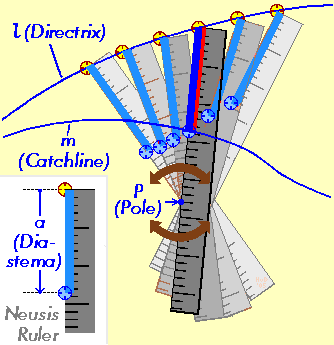
La neusis (du grec ancien νεῦσις venant de νεύειν neuein « pencher vers »; pluriel : νεύσεις neuseis) est une méthode de construction géométrique utilisée dans l'Antiquité par les mathématiciens grecs dans des cas où les constructions à la règle et au compas étaient impossibles.
rotund aurora
Or cos(2pi/n), sin(2pi/n) if you wanna keep it real
dull ginkgo
you can also get the Chebyschev poly roots by projecting onto a line
rotund aurora
Then if you close that with ruler and compass its just the splitting field of all polynomials of degree <=2 with coefficients nth roots of unity or rational numbers
kind wave
tawny magnet
https://fr.wikipedia.org/wiki/Neusis is this what you are looking for
not sure if this precisely is the same thing
dull ginkgo
rotund aurora
Then if you close that with ruler and compass its just the splitting field of al...
Yeah
Which really only works up to 4
Because of Abel-Ruffini
You can’t construct the whole “real” closure of Q
tawny magnet
in the english version it says this tho
 kind wave
oh alright
anyway
gonna try to sort this out
sorry if my poor math vocabulary was confusing
thanks for the help
 glad osprey
I often feel like the textbook solutions to exercises are needlessly complex. Here is the solution to an exercise asking to prove that a division ring has exactly two idempotent elements:

If $a \neq 0$, why not just multiply both sides of $a^2 = a$ by $a^{-1}$, leading to $a=1$ ?
cloud walrusBOT
sheddow
 delicate orchid
yeah you have a good point lol
glad osprey
It's annoying, because sometimes there's a good reason why they do it in a cumbersome way, but I can't always tell when
fleet citrus
glad osprey
It's annoying, because sometimes there's a good reason why they do it in a cumbe...
That's so relatable 🥲
rocky cloak
glad osprey
It's annoying, because sometimes there's a good reason why they do it in a cumbe...
I guess a reason here is that they're solution extends better to integral domains.
Still a little bit convoluted, but the fact that a(a-1) = 0 is somewhat useful to mention.
glad osprey
rocky cloak
I guess a reason here is that they're solution extends better to integral domain...
Yeah, I suppose thats true. Still, if I have a(a-1) = 0 in an integral domain, I would just immediately conclude a = 0 or a-1 = 0, instead of the weird a-1 = (a^(-1)a)(a-1) thing they did
 cloud solar
Let p prime and n>=p. Find the number of degree n polynomials in Z/pZ[X] with an injective polynomial function. What i did: let f be a polynomial with the above property. Since the polynomial function of f is injective and because Z/pZ is finite we know the function is a bijection. We have an unique element r in Z/pZ with f(r)=0. So the polynomial f has only one root in Z/pZ. I somehow want ți attack the coefficients using this bijection. I tried looking at the product of f(x) when x is not r = product when x≠0 of x = -1. If p is not 2 we have the same thing but for sums and they equal 0. If the degree of f was p-2 i could get a property about of the coefficients looking at the rank of the cyclic matrix only with the coefficients. Some hints?
Another thing we can consider the polynomial f be monic and from Bezout we would have f=(x-r) g where g is a polynomial with degree n-1 and g doesnt have any roots in Z/pZ
rocky cloak
cloud solar
Let p prime and n>=p. Find the number of degree n polynomials in Z/pZ[X] with an...
Note that any function can be realized as a polynomial. So you can reduce the question to how many polynomials define the same function.
chilly ocean
rocky cloak
Note that any function can be realized as a polynomial. So you can reduce the qu...
Is this question harder for Z/nZ where n is composite?
rocky cloak
I think it's probably a little harder yeah
dire siren
cloud solar
Let p prime and n>=p. Find the number of degree n polynomials in Z/pZ[X] with an...
you got that f is a bijection; that's right
so for each permutation (a_0,a_1,...,a_(p-1)) of (0,1,...,p-1), you want to count the number of polynomials f such that f(0)=a_0, f(1)=a_1, ..., f(p-1)=a_(p-1) ......... (1)
||use Euclidean division: f=(X^p-X)q+r, for some polynomials q and r with deg(r)<p
[btw, I didn't assume f to be monic]||
||now prove that (1) is equivalent to r(0)=a_0, r(1)=a_1, ..., r(p-1)=a_(p-1) and deg(q)=n-p||
||the first condition uniquely determines r, and the number of polynomials q with deg(q)=n-p is easy to compute||
rocky cloak
rocky cloak
Note that any function can be realized as a polynomial. So you can reduce the qu...
||there are p! Injective functions on Z/p||
||Each is given by a polynomial of degree at most p-1||
||To get a polynomial of degree n add f(x)(x^p - x) where f has degree n-p||
||There are (p-1)p^(n-p) many such polynomials, so in total p!(p-1)p^(n-p)||
cloud solar
Thanks, guys!
chilly ocean
Youre welcomr
 coarse shore
Quick question from someone kinda new to group theory: is a similarity transformation just a more general way of saying symmetry transformation?
coarse shore
nevermind i was completely wrong
vivid tiger
similarity with matrices is conjugation
coarse shore
thank you
languid trellis
How would i even begin to show that there are two groups of order p^2 up to iso? I already showed that every such group is abelian, and I'm pretty sure that these groups should be C_p^2 and C_p × C_p. I would appreciate any ideas, thanks all!
Please ping 🙂
 still dew
Not allowed fundamental theorem of abelian groups?
In anycase wouldn't say if your group has no p^2 order element then pick a non identity element which by Lagrange has order p
Then it's normal
As the group is abelian
Then G ~= <a> x G/<a> ?
languid trellis
still dew
In anycase wouldn't say if your group has no p^2 order element then pick a non i...
How do we know the non identity has order p? Is it not possible for it to have order p^2 if G = C_p^2 ?
Oh wait
still dew
Yes then it's cyclic
languid trellis
I can't read
still dew
I assumed it not to be
languid trellis
Yeah lol
still dew
still dew
Then G ~= <a> x G/<a> ?
Other than this just pick another <b> b not in a which should also have order p
Then uhhh
they don't have any non identity element in common
And abelian group so they commute and form a subgroup
G is just <a> x <b>
still dew
still dew
they don't have any non identity element in common
By counting argument this subgroup is G itself
languid trellis
still dew
Then G ~= <a> x G/<a> ?
How did we get here?
still dew
languid trellis
How did we get here?
Okay that's taken more from the proof of fundamental theorem (don't need to do that)
still dew
still dew
Other than this just pick another <b> b not in a which should also have order p
Instead this should be fine @languid trellis
still dew
still dew
G is just <a> x <b>
Easily identified as <a><b>
languid trellis
Right we have an iso <a>x <b> to a^kb^j which has order p^2 because p Is coprime to itself
still dew
p is coprime to itself ??
languid trellis
languid trellis
Right we have an iso <a>x <b> to a^kb^j which has order p^2 because p Is coprime...
And this is not an iso
the element ab has order p not p^2
still dew
No element is supposed to have order p^2
Our group is not cyclic remember
And that is an iso
languid trellis
Lemme try recap where we've gotten so far
If our group has an element of order p^2, then we pick this element. Then our group is clearly iso to C_p^2
If our group has no element of order p^2, then by lagrange, it has an element of order p, call this a.
<a> is an abelian group, so it is normal in G.
still dew
languid trellis
<a> is an abelian group, so it is normal in G.
No need for this part
languid trellis
Now, choose another element with order p, disjoint from <a>, call it b.
languid trellis
Claim: <a> × <b> is iso to G
still dew
Identify <a>x<b> as <a><b>
languid trellis
Wdym by <a><b>?
still dew
Just product of two subgroups
languid trellis
Which one
still dew
It's also a subgroup
languid trellis
Just group op?
still dew
op?
languid trellis
As in the product by the group operation
still dew
Yes
still dew
languid trellis
Right we have an iso <a>x <b> to a^kb^j which has order p^2 because p Is coprime...
In anycase this map works as it's surjective
And as G is finite
It automatically becomes Injective
languid trellis
I see
still dew
languid trellis
It's not entirely clear that this should define another subgroup
HK is subgroup iff HK=KH
Check this
languid trellis
I thought there'd be another condition
still dew
H and K are subgroups obviously
languid trellis
Then we have hkh'k'= hh'kk'
So stuff works
And (hk)^-1 = k^-1h^-1 = h^-1 k^-1
OK I'm convinced now
Wait
We have to replace elements
We don't have direct commutativity
still dew
yes
languid trellis
We have H, K normal then HK normal
still dew
But k^-1h^-1 is some h'k'
still dew
languid trellis
Right we have an iso <a>x <b> to a^kb^j which has order p^2 because p Is coprime...
Do u see why this is a surjection
languid trellis
So <a><b> Is a normal subgroup of G, with order larger than p, so it has order p^2 and is thus iso to G
still dew
Yes it having order p^2 gives the surjection
still dew
languid trellis
So <a><b> Is a normal subgroup of G, with order larger than p, so it has order p...
We haven't checked that this is Homomorphism yet
But that is also easy to check
languid trellis
Mhm
still dew
At the end we have a bijective map
languid trellis
Right I see
still dew
Which is homo
languid trellis
Recap: G has element p^2, then we have an iso C_p^2 to G. If not, then we pick 2 elements of order p and consider the direct product, which is iso to the product group, which has order larger than p so is equal to G. Moreover, there is a clear iso <a> x <b> to C_p x C_p
And G only has elements of order 1, p or p^2
So we are done
Just details left to fill out
still dew
👍
Now you could do this with abelian groups of order higher powers of primes
Or any number in general
languid trellis
Thanks so much for the help
still dew
Np 🙂
still dew
still dew
Not allowed fundamental theorem of abelian groups?
You'll encounter this along with fundamental theorem of finitely generated abelian groups
languid trellis
still dew
You'll encounter this along with fundamental theorem of finitely generated abeli...
That's in the modules chapter. Only like 120pages away lol
languid trellis
Jacobson: Basic Algebra I
dull ginkgo
still dew
Now you could do this with abelian groups of order higher powers of primes
No Sylow theorem is the next section lol
 signal dome
what is a functor
chilly ocean
signal dome
what is a functor
What are the applications of numerical analysis to algebra in particular group theory?
 crystal turtle
chilly ocean
What are the applications of numerical analysis to algebra in particular group t...
crystal turtle
chilly ocean
What are the applications of numerical analysis to algebra in particular group t...
What's with the 3x cross post asking about applications of numberical analysis to several different fields lol
Like what's the context
summer path
This looks very spammy, you might as well have just asked in adv lounge about applications to other areas
Also I'm pretty sure they cross posted in almost every channel lol
chilly ocean
crystal turtle
What's with the 3x cross post asking about applications of numberical analysis t...
i'm trying to get motivation for numerical analysis
chilly ocean
summer path
This looks very spammy, you might as well have just asked in adv lounge about ap...
hmm you're right i guess i could. thanks for feedback
south patrol
crystal turtle
What's with the 3x cross post asking about applications of numberical analysis t...
3x is understatement
crystal turtle
Oh I have most of them muted lmao, make that 7 times 
delicate orchid
chilly ocean
i'm trying to get motivation for numerical analysis
Google “all of engineering”
crystal turtle
delicate orchid
Google “all of engineering”
What the fuck is that
delicate orchid
It’s when people build things for actual people in reality. Like rocket ships and false hair implants
chilly ocean
delicate orchid
Google “all of engineering”
idc about nonmath applications
languid trellis
delicate orchid
It’s when people build things for actual people in reality. Like rocket ships an...
So it's a 40 year old man playing kerbal space program
dull ginkgo
or a wew
rocky cloak
chilly ocean
What are the applications of numerical analysis to algebra in particular group t...
Well, computational algebra / numerical algebra is very useful to get your hands on explicit examples, so that's an indirect application. But I'm not sure that would fall under numerical analysis...
 mighty kiln
chilly ocean
idc about nonmath applications
mighty kiln
chilly ocean
idc about nonmath applications
Are you be @postgraduate 
chilly ocean
mighty kiln
Are you be @postgraduate <:hmmcat:831508801646755850>
what do you mean?
mighty kiln
Oh you be @postgraduate
chilly ocean
mighty kiln
Oh you be @postgraduate
What?
 pliant forge
your role
chilly ocean
pliant forge
your role
What about it Eso?
pliant forge
chilly ocean
What about it Eso?
arki asked if you were a postgraduate, and then realized you had the role indicating you probably were, i believe
chilly ocean
pliant forge
arki asked if you were a postgraduate, and then realized you had the role indica...
why did he ask that?
pliant forge
I suppose because of your interest in mathematical applications of numerical analysis, rather than engineering
dull ginkgo
Does a lot of group theory come as a consequence of the independence of characters lemma?
delicate orchid
some of it does
dull ginkgo
Actually I mainly mean the bijective-ness of the main correspondance for finite field extensions
delicate orchid
idk wtf ur talkin bout!
vivid tiger
delicate orchid
Google “all of engineering”
hey, some of engineering isn't numerical stuff! e.g. coding theory, cryptography, apparently some telecom stuff but I'm not sure I believe them.
delicate orchid
vivid tiger
hey, some of engineering isn't numerical stuff! e.g. coding theory, cryptography...
telecom is fourier which is like................. like ok u get a pass but only by a technicality of FFT existing
vivid tiger
And the whole orthogonal basis for class functions
vivid tiger
delicate orchid
telecom is fourier which is like................. like ok u get a pass but only ...
no not that stuff
that's definitely numerical
other telecom stuff
delicate orchid
vivid tiger
explain?
idk it's just one of those things that comes up occasionally
I recall someone using it to prove some analysisy thing
oh yeah
the functions {e^\lambda t, \lambda real} are linearly independent over R
you can prove this using linear independence of characters
vivid tiger
delicate orchid
you can prove this using linear independence of characters
...please elaborate
also methinks one needs the compact group integral thing to do this
 wooden fulcrum
Hello
Why do I need a ring to contain the identity to prove that each proper ideal is contained in a maximal one?
If I have a chain C in the set of all ideals containing I, then since they're all proper and totally ordered by set inclusion, there is bound to be an element that is missing from them all hence U C would be proper also no?
No!
I see it lol
delicate orchid
when you union of the chain there is no gua- yeah you get it now
south patrol
Had never realised that was the case lol so thanks for mentioning
delicate orchid
wooden fulcrum
Wait or do I...
concluding the union is not the entire ring really needs the fact that we can't have any units in any of the ideals in C
wooden fulcrum
Coule I not use Zorn's lemma to prove that there exists and element not contained in any of the members of C?
If C' is the set of x in R, x not in c for c in C then that is a chain right
Reverse order
delicate orchid
it's a set
but I presume you want to put the obvious filtration on it
C'_m = {x \in R : x not in C_n, n \leq m}
delicate orchid
ok and why is this always non-empty?
wooden fulcrum
C is a set of proper ideals so theres always something missing from each C_n
And C is ordered by set inclusion so if something is in a C_n then it's also in all C_m for m≥n right
delicate orchid
true
south patrol
Why would that mean there's an element not in any of the things
for example R is the union of the sets [-n,n]
wooden fulcrum
Ah is an infinite union the set inclusion supremum?
delicate orchid
in a sense, yes
south patrol
Union is the supremum of the sets you union over
wooden fulcrum
Ah then that makes sense
Is there no way to do it otherwise, it feels weird that you can union sets none of which contain x but the union does? Nvm i see this isnt the caee now
Wait or
Ah yeha
Infinite moment
south patrol
In fact lol
You can turn subsets of a given set into a ring
and i imagine if you play around you can make it non-unital and stuff to make it have this issue
but idk
rocky cloak
wooden fulcrum
Why do I need a ring to contain the identity to prove that each proper ideal is ...
It might be nice to look at an example. If the product of any two elements in the ring is 0, then any subgroup is an ideal. So you just need to find an abelian group with no maximal subgroup.
Consider the 2-Prüfer group
Z/2^infty = {a/2^n}/Z < Q/Z
The proper subgroups are exactly the ones generated by 1/2^n and you have
(1/2) < (1/4) < (1/8) < ...
so there is no maximal one.
You might also notice that the union of all the proper subgroups is not proper anymore
 spice whale
rocky cloak
You might also notice that the union of all the proper subgroups is not proper a...
spice whale
rocky cloak
You might also notice that the union of all the proper subgroups is not proper a...
i think these two things are equivalent for groups
since Grp is cocomplete
rocky cloak
spice whale
i think these two things are equivalent for groups
Which two things?
spice whale
no maximal proper subgroup and the union of all proper subgroups being the whole group
rocky cloak
Well, you need some chain condition. Like the union of proper subgroups of Z/2 x Z/2 is everything
celest furnace
Won't union of all proper subgroups always be the whole group unless the group is cyclic?
rocky cloak
Yeah, if an element isn't contained in any proper subgroup then it's a generator
spice whale
I'm actually completely wrong actually
the union of two subgroups is not the colimit of the inclusions
delicate orchid
no maximal proper subgroup and the union of all proper subgroups being the whole group
The C_p^2 in question
spice whale
wait
delicate orchid
and yes, unions are not coproducts
rocky cloak
spice whale
the union of two subgroups is not the colimit of the inclusions
If you include all intersections it is
spice whale
yeah you should just ignore everything i said
spice whale
rocky cloak
If you include all intersections it is
consider <a> and <b> in F_{a,b}
delicate orchid
rocky cloak
Right, groups can be nonabelian as well
do you have a single r/math post to back that claim up
rocky cloak
delicate orchid
do you have a single r/math post to back that claim up
Wait, let me quickly post to Reddit
spice whale
rocky cloak
Right, groups can be nonabelian as well
this is not the reason
consider <a> and <b> in F^Ab_{a,b}
delicate orchid
rocky cloak
Wait, let me quickly post to Reddit
this is what I do but with the journal of algebra instead of reddit
spice whale
ignore my terrible notation
rocky cloak
spice whale
this is not the reason
consider <a> and <b> in F^Ab_{a,b}
Ah right, union doesn't mean sum either
spice whale
the colimit of the inclusions of these subgroups into the whole group is not their union
delicate orchid
unions of groups aren't groups so why should I be surprised by this
spice whale
exactly
delicate orchid
????????
spice whale
this is one of the reasons why i was so wrong
delicate orchid
u said urself that group was cocomplete what's going on
CHAT I'M SCARED
anyway I'm over it now
spice whale
Grp is cocomplete yes
delicate orchid
the actual coproduct is way cooler
spice whale
free product
delicate orchid
really nice example of when biproducts don't exist
rocky cloak
Now I'm wondering. Is there any simple characterisation of (abelian) groups with a maximal subgroup. Or perhaps better, where every proper subgroup is contained in a maximal one?
Finitely generated is sufficient, but probably not necessary
delicate orchid
once more I need to remember that infinite groups exist
so like a "local" group kind of thing
a single maximal subgroup?
or just A maximal one?
because I really. REALLY. Don't want to think about Zorn's right now
delicate orchid
delicate orchid
a single maximal subgroup?
this is just cyclic of prime power order right?
coral spindle
I think so, yes
delicate orchid
yeah, otherwise if M is your maximal proper subgroup, there will be some element x not in M that generates a proper subgroup - unless you're cyclic of prime power order lol
coral spindle
Doesn’t Noetherianity give us what we want? As in, Noetherian Z-modules. The maximal subgroup isn’t unique but it guarantees existence, and the converse is obviously false
wooden fulcrum
rocky cloak
It might be nice to look at an example. If the product of any two elements in th...
Thank you that's a great example
a*b=0 forall a,b just from defining it to be as such right
delicate orchid
coral spindle
Doesn’t Noetherianity give us what we want? As in, Noetherian Z-modules. The max...
ahh that's smart
coral spindle
An Abelian group has a maximal subgroup iff it has an Noetherian quotient 
Whoops
Meant Noetherian
delicate orchid
drop the abelian
coral spindle
Saying so little
delicate orchid
a group has a maximal subgroup iff it has a quotient
one of the stupidest things I've said in the server
 sly crescent
 rocky cloak
coral spindle
Doesn’t Noetherianity give us what we want? As in, Noetherian Z-modules. The max...
rocky cloak
coral spindle
Doesn’t Noetherianity give us what we want? As in, Noetherian Z-modules. The max...
Yeah Noetherian equals finitely generated for groups I guess.
But finitely generated is all you need, even for modules over non-Noetherian rings
coral spindle
Nice
rocky cloak
So the question is whether there's a characterization that catches infinitely generated ones
coral spindle
Iff it has a finitely generated quotient
rocky cloak
Might as well reach for simple quotient at that point
coral spindle
Idk this seems relatively impossible