#groups-rings-fields
1 messages · Page 105 of 1
 novel parrot
 summer path
Yes
 delicate orchid
More to the point, every element of that ring has a norm of at least 1, so you cannot make the norm smaller via multiplication - so it is impossible for anything other that -1, 1 to be a unit
Saves you having to think about a YUCKY ellipse
summer path
I mean you just observe that if b is not 0, then you have something bigger than 1 that you can't get rid off
There's not really much to thinking about the ellipse
delicate orchid
geometry=EW
I'm not actually saying there's anything wrong with their solution, it's perfect
I'm just providing an alternate way of thinking about it
 south patrol
hm i mean wew what you're doing seems to just assume that there are no elements of norm 1 besides -1 and 1
Like okay you can't make it smaller via multiplication, but how do we know we can't just keep it as 1
delicate orchid
you can, that's why -1 is a unit 
delicate orchid
it's very easy to show that there aren't... if only there was some sort of... quadratic expression in two variables I could use...
what a world that would be
south patrol
Lol
 slim kayak
If I have an abelian quotient group G/N and an epimorphism from it into the abelianization of G, then that map is an isomorphism. I can see why this holds for a finite group but what's the argument for infinite ones?
 chilly radish
delicate orchid
I'm not actually saying there's anything wrong with their solution, it's perfect
chilly radish
delicate orchid
I'm not actually saying there's anything wrong with their solution, it's perfect
You're perfect
 lethal dune
slim kayak
If I have an abelian quotient group G/N and an epimorphism from it into the abel...
lethal dune
slim kayak
If I have an abelian quotient group G/N and an epimorphism from it into the abel...
Not true for infinite ones
slim kayak
Oh? Counterexample tiem?
lethal dune
Countable direct sum of Z
delicate orchid
it's always the countable direct sum of Z...
 alpine remnant
Ok so, if I pick two real numbers, a and b, with b being positive, and build the matrix
J=[a, -b;
b, a],
its minimal and characteristic polynomials are an irreducible polynomial of degree two (figured out by doing (a-bi)(a+bi)). When you do this for a bigger matrix:
A=
[J,0,
I_2, J]=
[a, -b, 0 ,0;
b, a, 0, 0;
1, 0, a, -b;
0, 1, b, a],
The minimal and characteristic polynomials are now f^2.
I could prove all of this by hand.
How would I generalize for a matrix of 2nx2n entries for f^n?
Since the matrix A is triangular by blocks, I know that its characteristic polynomial will be f^n
My issue lies in proving that f^n is also the minimal polynomial
As in, proving f^(n-1) is not null
which would mean all f, f^2, f^3, ..., f^n-1 are not null, so f^n is the only possibilityh
 dim widget
alpine remnant
My issue lies in proving that f^n is also the minimal polynomial
dim widget
alpine remnant
My issue lies in proving that f^n is also the minimal polynomial
I would just write out f(A) explicitly
Then if that matrix is nilpotent (it will be) you know exactly what power of f that you need.
alpine remnant
dim widget
I would just write out f(A) explicitly
wait
f^n(A)=f(A)...f(A)
right=
ok i'm dumb
añsflkghañog
alpine remnant
dim widget
Then if that matrix is nilpotent (it will be) you know exactly what power of f t...
how would I go figuring that out?
dim widget
alpine remnant
how would I go figuring that out?
you can figure out the minimal polynomial of a nilpotent matrix over a field by looking at "which diagonal" the nonzero entries lie on.
A matrix is nilpotent iff it's conjugate to a strictly upper triangular matrix over an algebraically closed field, in your case I think you get something actually upper triangular.
Or lower triangular rather
dim widget
specifically if N is an nxn nilpotent matrix with only the top right entry nonzero then it squares to zero, if the nonzero entries are on the next diagonal down from that then it cubes to zero, etc.
dim widget
alpine remnant
but not triangular
f(A) will be strictly lower triangular.
alpine remnant
Ok so
let f=x^2+a_1x+a_0
f(A)=
f([J, 0, 0, ...;
I J, 0, 0, ...;
0, I J, 0, ...;
...])
= A^2+a_1A+a_0I
=[J^2+a_1J+a_0I, 0, 0 ...;
J+a_1I, J^2+a_1J+a_0I, 0, 0, ...
....]
Ok that notation looks like poop
alpine remnant
dim widget
f(A) will be strictly lower triangular.
But A is not triangular
It's triangular by blocks
If you use the block I=[1,0;0,1] and J=[a,-b;b,a], then A is triangular
but if you don't you have chunks poking out
 pliant forge
hello can someone point where im making a mistake because this feels very weird
Let $0 \to A \to_f B \to_g C \to 0$ be an exact sequence. Then $C = Im(g) \cong B/Ker(g) \cong B/Im(f)$. But since $Im(f) \cong A/Ker(f) \cong A$ since $Ker(f) = (0)$ we have $C \cong B/A$.
 cloud walrusBOT
Eso
 dim widget
alpine remnant
If you use the block I=[1,0;0,1] and J=[a,-b;b,a], then A is triangular
dim widget
alpine remnant
If you use the block I=[1,0;0,1] and J=[a,-b;b,a], then A is triangular
Then f(A) = D^2 + 2DN + N^2 + a_1(D) + a_1(N) + a_0 = f(D) + f(N) + 2DN
f(D) = 0
f(N) is lower triangular
2DN is lower triangular
so f(A) is lower triangular
pliant forge
i believe my iso for modulo makes stuff odd
dim widget
that's it
alpine remnant
dim widget
A = D + N where D is block diagonal and N is upper triangular
What are D and N again?
i'm confused by english notation sorry
well
terminology
dim widget
pliant forge
Let $0 \to A \to_f B \to_g C \to 0$ be an exact sequence. Then $C = Im(g) \cong ...
C is isomorphic to B/A that is correct, nothing weird about it, it's just the first iso theorem
pliant forge
dim widget
C is isomorphic to B/A that is correct, nothing weird about it, it's just the fi...
the thing that gets me is the exact sequence where A = B = Z and C = Z/nZ
wouldnt that imply Z/nZ iso 0
 wraith cargo
pliant forge
wouldnt that imply Z/nZ iso 0
wraith cargo
pliant forge
wouldnt that imply Z/nZ iso 0
no
So the first map is multiplication by n
The image of A is nZ
so taking the quotient still gives you Z/nZ
pliant forge
i know but Im(f) \cong Z/Ker(f) = Z/(0)
dim widget
pliant forge
i know but Im(f) \cong Z/Ker(f) = Z/(0)
you are not thinking about this clearly.
The ideal of integers divisible by n (say n = 2 for simplicity) is isomorphic to Z abstractly
wraith cargo
you need to look at Im(A) as an ideal of B for that quotient to be valid
dim widget
but Z/(2) is not zero
dim widget
alpine remnant
What are D and N again?
N is the lower triangular part of A and D is the block diagonal part of A
considered as 4x4 matrices
dim widget
alpine remnant
i'm confused by english notation sorry
Why not just try actually calculating what f(A) is yourself?
alpine remnant
dim widget
Why not just try actually calculating what f(A) is yourself?
I did I did
I have it on paper
The diagonal comes to blocks of 0
it is indeed lower triangular
dim widget
okay great!
alpine remnant
I was dumb and messing up a step
now I know this matrix must be nilpotent since f^n(A) is 0
I must demonstrate that indeed n is the index of nilpotence
dim widget
Also any lower triangular matrix with 0's on the diagonal is nilpotent
Is an entry of the form a_{i, i-1} nonzero?
dim widget
Then you should try to show that a matrix with those entries nonzero is nilpotent of maximal possible nilpotence degree
alpine remnant
dim widget
Then you should try to show that a matrix with those entries nonzero is nilpoten...
can I do that by induction on the degree of the matrix?
dim widget
alpine remnant
can I do that by induction on the degree of the matrix?
sounds good!
alpine remnant
okies
alpine remnant
dim widget
sounds good!
you've helped me a lot every time i've come to ask questions, Thank you very much for all the help you've given me
you really have been a life saver
dim widget
alpine remnant
you've helped me a lot every time i've come to ask questions, Thank you very muc...
no worries, glad to help 🙂
 chilly ocean
Man rep theory is fun
 formal ermine
indeed
lethal dune

lethal dune
No
Give me example of an irreducible 2 dimensional representation of an abelian group
dim widget
lethal dune
Give me example of an irreducible 2 dimensional representation of an abelian gro...
Z/2 acts on F_2^2 by permuting the two basis vectors
lethal dune
Oh char 0, forgot to mention
 dim widget
lethal dune
Char 0 you mean?
dim widget
lethal dune
Char 0 you mean?
No it's reducible (contains a nontrivial subrepresentation) in any characteristic
but it isn't a direct sum
 dim widget
lethal dune
Give me example of an irreducible 2 dimensional representation of an abelian gro...
dim widget
lethal dune
Give me example of an irreducible 2 dimensional representation of an abelian gro...
SO(2) acting on R^2
dim widget
lethal dune
Mind helping me in the diff geo problem
sure
dim widget
lethal dune
I had Z on R2
That is another example which is reducible but indecomposable, unless you have some weird action of Z in mind?
You could have Z act by an irrational multiple of pi radian rotation I suppose
lethal dune
Rotation by irrational angle or any 2 jordan block
dim widget
(x 1 | 0 x) doesn't work since it has a subrepresentation
lethal dune
Yeah just realised
south patrol
Oh ye I forgot about indecomposable stuff
Hm I guess it's equivalent to irreducible provided stuff is over a semisimple ring right
lethal dune
Hm
south patrol
Like p sure any semisimple module admits direct complements for stuff
dim widget
south patrol
Like p sure any semisimple module admits direct complements for stuff
yes by definition but it's generally harder to prove that a ring is semisimple than a module over it is semisimple without some kind of strategy
like in lie theory you have the casimir element and in finite groups you have the averaging operator.
These examples are basically showing that Q[Z] is not semisimple.
Which is not surprising since that's Q[X]_{x}
which is not zero dimensional
south patrol
dim widget
yes by definition but it's generally harder to prove that a ring is semisimple t...
Yee fair lol
 pastel cliff
old q but does this look right
 dim widget
pastel cliff
old q but does this look right
dim widget
pastel cliff
old q but does this look right
It's a little unclear what you're doing, maybe it's good to say that the elements which are "algebraic over L" are closed under multiplication and addition
since it seems you're trying to use that
pastel cliff

cloud walrusBOT
MyMathYourMath

 solar glacier
I just took an algebra II final and wanna know if I did it correctly
 rustic crown
yee that right
solar glacier
And is splitting field of $x^4-4x^2-5$ over the rationals just $\Bbb{Q}(\sqrt{5},i)$
cloud walrusBOT
MyMathYourMath
 solar glacier
rustic crown
yee that right
solar glacier
rustic crown
yee that right
Nice thanks
solar glacier
cloud walrus
**MyMathYourMath**
With degree 4
solar glacier
cloud walrus
**MyMathYourMath**
For this is subbed $y=x^2$
cloud walrusBOT
MyMathYourMath
 rustic crown
(x^2-5)(x^2+1) so yee
rustic crown

solar glacier
And to show the graph of a function in affine n space is an affine alg set can I argue it’s complement is infinite
Thus under Zariski top it’s closed
And thus and affine alg set
And the Zariski topology on any arbitrary fields affine 1 space is clearly compact right ? U take one of the open set… look at its complement which is finite pick an open set containing each of the finitely many elements and you have a finite union as your sub cover
He had us prove whether or not under Zariski top if affine 1 space is compact for arbitrary field k LOL on an algebra II final
rustic crown
solar glacier
And to show the graph of a function in affine n space is an affine alg set can I...
so this not true right
rustic crown
i mean not every infinite set is open
cloud walrusBOT
MyMathYourMath
 solar glacier
rustic crown
i mean not every infinite set is open
solar glacier
rustic crown
i mean not every infinite set is open
Sets with finite complement are open in Zariski top
rustic crown
yea but you're saying the converse
solar glacier
Oh no sorry
Disregard that part
So to show the graph is an affine alg set
I only need to show it’s finite
rustic crown
the field is finite?
solar glacier
Someone told me the trick they used after the exam of showing it directly but I forgot what they said
solar glacier
rustic crown
the field is finite?
No not necessarily
rustic crown
cause there are certainly infinite algebraic sets
like consider y = x^2 in A^2
or like literally anythign
solar glacier
Yes
rustic crown
A^1 itself
solar glacier
True
rustic crown
so yea, they need not be finite
infact the cardinality of the graph is just same as cardinality of the source
solar glacier
But under Zariski top we define the alg sets to be finite subsets
Or the whole space
Or empty set
rustic crown
that's true for the affine line, but the reason is because a polynomial only has finitely many roots
(assumign it's non-zero)
solar glacier
But not true for affine n space ??
rustic crown
solar glacier
But under Zariski top we define the alg sets to be finite subsets
(that's not called the zariski top, that's the "cofinite" top)
solar glacier
Zariski top and cofinite I thought were the same
rustic crown
for line, yee
rustic crown
yea 😦
solar glacier
Then I fucked that proof up lol
rustic crown
parabola for instance is closed but not finite/whole space
solar glacier
Ahhhhhh good example
Here’s a question none of use could get right : if u wanna@give it a shot
rustic crown
you define closed as stuff which are solutions to a bunch of polynomials
solar glacier
Let $V$ be an affine algebraic set in $\Bbb{A}_{\Bbb{R}}^n$ show there exists a polynomial $f \in \Bbb{R}[x_1,…,x_n]$ such that $V=Z(f)$ and show this is fals if we replace the reals w complex it seemed so counterintuitive since C is alg closed but R isn’t
cloud walrusBOT
MyMathYourMath
Let $V$ be an affine algebraic set in $\Bbb{A}_{\Bbb{R}}^n$ show there exists a polynomial $f \in \Bbb{R}[x_1,…,x_n]$ such that $V=Z(f)$ and show this is fals if we replace the reals w complex it seemed so counterintuitive since C is alg closed but R isn’t
 solar glacier
I chose my polynomial to be
cloud walrusBOT
MyMathYourMath

 coral spindle
Hint: if x, y are real numbers then x^2 + y^2 is usually positive
rustic crown
boytjie 
coral spindle
heyo det
rustic crown
haiii
rustic crown
hewwo
solar glacier
coral spindle
sorry I feel like I've made a terrible faux pas
I think I get it so that doesn’t hold@over C
solar glacier
Because of i
coral spindle
We'll see...
coral spindle
solar glacier
I think I get it so that doesn’t hold@over C
That's right
This could be summarised as saying that R is an ordered field
pastel cliff
det moment
solar glacier
Wow
pastel cliff
coral spindle
 you win some, you lose some
solar glacier
I got 6/9 problems completely correct
solar glacier
coral spindle
<:hecticShrug:1104622251959124068> you win some, you lose some
Even tery Tao says that in an interview its so true
He usually gives an A if u score over 50/55
rustic crown
coral spindle
This could be summarised as saying that R is an ordered field
(or being more fancy, as saying R is a formally real field)

solar glacier
Hey
It R is all rationals with odd denominator
To show the ideal (2) is maximal
It’s enough to show R/(2) is a field
Which it clearly is , right ?
coral spindle
rustic crown
(or being more fancy, as saying R is a formally real field)
OK fancy boy smh
pastel cliff
can i get a hint on this pls
 solar glacier
If u mod out by (2) you still have all. Non zero elements have mult inverses
rustic crown
pastel cliff
can i get a hint on this pls
can you say something about Q(x)/K? is it alg?
pastel cliff
x is transcendental no?
pastel cliff
no
solar glacier
Nope
rustic crown
so can K/Q be alg?
solar glacier
It’s alg over K
pastel cliff
it can be
south patrol
Tower law moment
solar glacier
That rule is so useful
pastel cliff
what does tower do here
rustic crown
Q(x)/K alg and K/Q alg => Q(x)/Q alg
pastel cliff
oh so x being transcendental over Q has no impact on extending by it?
rustic crown
yee
(in fact every such thing is purely transcendental)
(there is this cool theorem by Lüroth saying that any intermediate field of k(x)/k is simple)
pastel cliff
rustic crown
(in fact every such thing is purely transcendental)
wdym
rustic crown
so if you pick any intermediate thing in k(x)/k, say E
then as long as E is NOT k you have that k(x)/E is algebraic
so E/k would be transcendental
the theorem says it's also simple
pastel cliff
simple = adjoin one elt right
rustic crown
so E = k(alpha) for some rational function alpha
rustic crown
infty
pastel cliff
ohhhh
coral spindle
guess what the basis is
rustic crown
rustic crown
then as long as E is NOT k you have that k(x)/E is algebraic
(also i had a typo, i meant \neq)
pastel cliff
and Q(x/x^3+1)/Q is also finite
rustic crown
nup
pastel cliff
oop
rustic crown
that would make Q(x)/Q finite
pastel cliff
hmm then im not sure i see the tower
oh wait you can be infinite but still alg
right?
rustic crown
yea
but does that matter in this situation?
only alg extension in sight is finite
which is Q(x)/Q(alpha)
pastel cliff
ok so to see that $x$ is in fact algebraic over $\Q\big(\frac{x}{x^3 + 1}\big)$, we first observe that $\Q\big(\frac{x}{x^3 + 1}\big)/\Q(x)$ is a finite extension
cloud walrusBOT
not sebbb not stμ₂dying
 cloud walrusBOT
not sebbb not stμ₂dying
 rustic crown
umm
just show it directly, no?
show x satisfies a polynomial over Q(alpha)
that's what you'll do anyway to show it's finite
pastel cliff
polynomials over an extension adjoined x are just the fraction field right
rustic crown
went above me 
pastel cliff
wdym
rustic crown
didn't understand whut you wrote >.<
pastel cliff
ok then what do polynomial over Q(x/x^3 + 1) look like
since we're adjoining a polynomial in the first place
rustic crown
T^2 +alpha T + (alpha^3 -2)
pastel cliff

rustic crown
rustic crown
show x satisfies a polynomial over Q(alpha)
(hint: write alpha = (...)/(...) and recall that Boytjie's kids hate denominators)
coral spindle
They truly do
||in the end, this isn't that different from finding a min. poly. for a rational number over the integers||
pastel cliff
how the fuck do i find this min poly
delicate orchid
god knows
 pastel cliff
x...?
delicate orchid
pastel cliff
wew please i am at my limit
no I legitimately don't know I've never learnt galois theory
rustic crown
pastel cliff
x...?
that's the min poly of 0, and certainly alpha doesn't look like 0 :p
for instance if you remove the intersection point in alpha it disconnects into 3 components, while 0 stays connected
(sowwy :p)
rustic crown
(also write the min poly in terms of T, to not confuse it with x)
so you're allowed to use T and alpha and numbers such that when you plug T = x, the equation is true
pastel cliff
rustic crown
what' the min poly of alpha = 1/x
did you mean what's the min poly over Q(1/x)?
rustic crown
yea
pastel cliff
oh that makes more sense
rustic crown
rustic crown
so you're allowed to use T and alpha and numbers such that when you plug T = x, ...
(and no denominators)
pastel cliff
so what polynomial with coefficients in Q(1/x) has x as a root
pastel cliff
yeah just restating it clearly for myself
rustic crown
hehe :p
pastel cliff
,ti det
cloud walrusBOT
72 members found matching det!
Page 1/4
========
1.   sabladetan#9074
2.   JudetheDude#7115
3.   DetectiveClock#0449
4.   dethfromabove#6149
5.   Pakawat (Messi) Poldetch#1685
6.   xX_FanDeTosel_Xx#7223
7.   odette#6704
8.   DoctorVendetta#8928
9.   spacekadet#8395
10.  DeTrollWithBadTeeth#8793
11.  detiszero#6621
12.  NoDeThEoNe#7725
13.  SpaceCadet#2908
14.  lividEternity#2276
15.  DETERMINATION#1411
16.  ZdudeTHEMAN26#6795
17.  sparklecadet#5318
18.  detcader#3020
19.  detonator#8116
20.  ∆DETROIT•_•OP∆#9860 ```
Please type the number corresponding to your selection, or type `c` now to cancel.,ti
cloud walrusBOT
The current time for det is 01:22 AM (CEST) on Fri, 12/05/2023.
rustic crown
you can
rustic crown
just assume that i'm asleep if i stop replying
cloud walrusBOT
Member selection timed out.
 glossy crag
Dumb question maybe, but is there any notion of uniqueness of vector space structures?
What I mean is, if V is a K-vector space, do we know that it's uniquely so?
pastel cliff
no bot just timed out
chilly ocean
cloud walrus
`72` members found matching `det`!
```markdown
Page 1/4
========
1. sabladetan...
O i thought maybe because i pressed the reaction buttons here
glossy crag
glossy crag
What I mean is, if V is a K-vector space, do we know that it's uniquely so?
I was thinking about how uniqueness of prime power decomposition for finitely generated modules over PIDs is proved.
The proofs I know use R/(p)-dimension of p^kM/p^{k+1}M to characterise the prime powers appearing in the decomposition of M intrinsically
pastel cliff
rustic crown
great question <:catThink:526983414226747393>
t^2-1?
rustic crown
1/x^2 -1 = 0 then?
glossy crag
glossy crag
The proofs I know use R/(p)-dimension of p^kM/p^{k+1}M to characterise the prime...
And I was kind of wondering whether any ambiguity whatsoever in this situation is possible, i.e. if you might get different R/(p) dimensions based on how you define the R/(p)-VS structure on p^kM/p^{k+1}M
pastel cliff
uhhhh
rustic crown
(reminder: you're allowed to use alpha)
rustic crown
we're doing min poly of x over Q(alpha) where alpha = 1/x
 sage lodge
trying to understand the proof of (c). why is the last statement true?
 rustic crown
glossy crag
And I was kind of wondering whether any ambiguity whatsoever in this situation i...
rustic crown
glossy crag
And I was kind of wondering whether any ambiguity whatsoever in this situation i...
there is an ambiguity in general, but doesn't matter here.
rustic crown
pastel cliff
this shouldnt be this hard
yee overthinking makes life hard
pastel cliff
is f(t) = t - x valid
rustic crown
you're not allowed to use x
pastel cliff
only 1/x
pastel cliff
f(t) = t(1/x) - 1
rustic crown
rustic crown
there is an ambiguity in general, but doesn't matter here.
for an example, consider the k = Fp(t), then you can define k as a vector space over itself using the map k --> k being identity or the frobenius. one had dimension 1 other has dimension p
rustic crown
pastel cliff
f(t) = t(1/x) - 1
right, alpha * t -1
so you start with alpha = 1/x
you cross hate denominators so you do alpha * x = 1
and make this a polynomial
alpha * t - 1
pastel cliff
cross hate?
rustic crown
oops
wanted to use the old story again
was writing cross multiply
but then thought i'll write hate denominators
anyway, let's do alpha = x/x^3+1 now
rustic crown
rustic crown
there is an ambiguity in general, but doesn't matter here.
okie it does matter, but whenever you say consider the R/I module structure on M/IM, you mean the obvious one.
rustic crown
rustic crown
for an example, consider the k = Fp(t), then you can define k as a vector space ...
another example is k = Q(t1, t2, .....) and k --> k being the map identity or shift these ti. one will have dim 1, other has ifninite dim
pastel cliff
hmmm but 1/x^3+1 isn't in the field right
rustic crown
rustic crown
so you start with alpha = 1/x
try copying what i did here
pastel cliff
oh
rustic crown
(you're really overthinking lmao)
rustic crown
yep!!
cloud walrusBOT
not sebbb not stμ₂dying
 rustic crown
hopefully you see now that it didn't depend at all on what alpha was
rustic crown
sort of?
but we don't care about that
all you wanted to show was Q(x)/Q(alpha) is algebraic
pastel cliff
(and find min poly of x over K)
pastel cliff
but it is minimal right
rustic crown
yep
directly showing that might be hard, so just eisenstein it up
with the UFD D = Q[alpha]
as alpha is transcendental, this is isomorphic to Q[X] to a pid
and alpha is prime in D
alpha divides the constant term, but its square doesnt :3
 dull cobalt
Basically I'm trying to understand a series of papers titled "Algebraic Approach to Signal Processing" where the author goes about generalizing the concepts of signals, filters and Fourier transform etc. using objects from Abstract Algebra... So I'm looking for beginner recommendations to the topic from an applied math perspective, basically something which is not too heavy on the formal rigor. What do you folks recommend? (If it helps I'm very fluent with Linear Algebra)
glossy crag
rustic crown
there is an ambiguity in general, but doesn't matter here.
Why?
pastel cliff
can i get a hint on this one too 
 glossy crag
Why?
glossy crag
glossy crag
Why?
I mean, partly because we use the usual R/(p) structure on the module (if I\subset Ann(M), then M is automatically an R/I module), but how come something weird can't happen.
rustic crown
rustic crown
okie it does matter, but whenever you say consider the R/I module structure on M...
sowwy >.<
glossy crag
pastel cliff
can i get a hint on this one too <:sad:532803514892812288>
Just remove denominators in the minimal polynomial of v over F(u), that should work (I don't even see how v being transcendental is necessary; NVM, it's so that the equation doesn't turn to 0 and u really ends up being algebraic over F(v)).
rustic crown
rustic crown
for an example, consider the k = Fp(t), then you can define k as a vector space ...
that's a nice example
glossy crag
rustic crown
for an example, consider the k = Fp(t), then you can define k as a vector space ...
Interesting.
summer path
,ti det
rustic crown
,ti
cloud walrusBOT
The current time for det is 02:04 AM (CEST) on Fri, 12/05/2023.
User cancelled member selection.
summer path
rustic crown
oyasumi tubu
summer path
Bai bai det
glossy crag
what are all these bots for
pastel cliff
it's only one bot
pastel cliff
does this look right

 stone fulcrum
I like it!
pastel cliff
pastel cliff
can i get a hint on this one too <:sad:532803514892812288>
small bump
stone fulcrum
You're noting that:
1/2(√3 + √2) + 1/2(√3 - √2) = √2
Which I think is a bit more consise but up to you, this is solid
pastel cliff
yee haw!
stone fulcrum
Anyway hi! Long time no see
pastel cliff
good to see you around here again for sure
stone fulcrum
glossy crag
Just remove denominators in the minimal polynomial of v over F(u), that should w...
This was a reply to that bump

 lapis trail
I'm going to try to work through as much of dummit and Foote as I can this summer. Any advice on how to balance breadth with depth in self study
I need a hyperbolic time chamber
pastel cliff
mood
stone fulcrum
I don't love dummit and foote for self study, imo grab a different book
It's a fantastic reference though
pastel cliff
KC notes 
pastel cliff
pastel cliff
this is what i had started
is this the right start btw running on fumes a bit so maybe im not thinking clearly
stone fulcrum
KC notes?
pastel cliff
keith conrad
stone fulcrum
I don't actually know how to do this one, haha. I'm really spotty when it comes to field extensions
pastel cliff
ah shooot
stone fulcrum
I'm sure someone here does
lapis trail
@stone fulcrum can you recommend me something? How is Artin?
 lament dawn
Im a huge believer in Lang Bad but i actually quite liked Lang for the field theory
rustic crown
awuffi is uwu too
 hidden haven
Still waiting for the day det becomes a normal human  didn't expect that trauma to last this long
 prime sundial
so i was playing around with my rubik's cube and found out that the rotation RU has order 105
is there any intuition as to why multiplying 2 elements of order 4 would give something so "random" as 105, or does it just work out that way for this very specific group
hidden haven
It just be like that for that group
rustic crown
moldi is expert at every fun thing
prime sundial
hidden haven
It just be like that for that group
figures
i was always too quick to assume the orders of products of elements, but now it just seems so random
hidden haven
Ye it can be completely random
prime sundial
that's super frustrating haha
hidden haven
You can have elements x, y with orders m, n > 1 respectively such that xy has any order you want
 frigid lark
hidden haven
Still waiting for the day det becomes a normal human <:starebleak:91187570048987...
frigid lark
hidden haven
Still waiting for the day det becomes a normal human <:starebleak:91187570048987...
You'll be waiting for at least the size of the monster group seconds
prime sundial
hidden haven
You can have elements x, y with orders m, n > 1 respectively such that xy has an...
this is very unsettling lol
hidden haven
Construct an example as
< x, y | x^m, y^n, (xy)^p > for any p
prime sundial
i was under the impression that groups behaved really nicely, but the more i learn about them the more i lose grasp on that
rustic crown
yea they be whack
prime sundial
hidden haven
Construct an example as
< x, y | x^m, y^n, (xy)^p > for any p
i believe you that this is a group
hidden haven
Groups were hit in the head as a child
rustic crown
(idk the meaning of that word tho >.<)
frigid lark
This is why we study fields
prime sundial
i don't like any algebraic structure
hidden haven
Based
frigid lark
And by fields I mean only Z/2Z
prime sundial
frigid lark
And by fields I mean only Z/2Z
best field
frigid lark
Anything else is to hard for my bird brain
rustic crown
okie >.<
 grand cliff

The following exercise is from a past paper
suborbits are the induced orbits of a stabiliser
An orbital is the orbit of H's action on Omega x Omega
An orbital is considered self-paired if (x ,y) in orbital => (y, x) is in the orbital
If I can somehow show that the order of H must be 2p, I'm guessing the solution follows relatively quickly from there
Since H must then either be a product Z/2Z x Z/pZ or D_{2p}
- I'm using the convention |D_{2p}| = 2p in case that's not obvious
 tribal moss
prime sundial
i believe you that this is a group
tribal moss
prime sundial
i believe you that this is a group
It's probably easier to see intuitively if you consider permutation groups. If you have the two permutations
a = (1 2)(3 4)(5 6)...(n n+1)
b = (2 3)(4 5)(6 7)...(n-1 n)
then each of them taken individually has order 2, but if you do one after the other, the net effect is to move every odd thing two places to the right and every even thing two places to the left (except at the end of the line where there's a thing one of the two permutations doesn't touch) -- so overall the product of the two permutations is a cycle of all n+1 things, which order n+1.
pastel cliff
omg moldi

 solid olive
how do you go about proving if G is abelian and H is a subgroup of G then the left and right cosets are equal?
frigid lark
What is a left coset explicitly?
pastel cliff
glossy crag
Just remove denominators in the minimal polynomial of v over F(u), that should w...
i dont see what this min poly is
maybe im overthinking again
chilly radish
solid olive
how do you go about proving if G is abelian and H is a subgroup of G then the le...
This isn't necessarily true unless the subgroup is normal. Unless you meant the set of left cosets is the same as the set of right cosets, which is true
frigid lark
chilly radish
This isn't necessarily true unless the subgroup is normal. Unless you meant the...
G is abelian
frigid lark
pastel cliff
i dont see what this min poly is
It is a non trivial relationship b/w the powers of v over f(u) of smallest degree
Well not really but close enough
pastel cliff
wdym
solid olive
chilly radish
This isn't necessarily true unless the subgroup is normal. Unless you meant the...
yes sorry thats what I meant
pastel cliff
pastel cliff
can i get a hint on this one too <:sad:532803514892812288>
this onoe
frigid lark
Well there's gonna be some relationship $$a_0 + a_1v + ... + a_nv^n=0$$ for $a_i\in F(u)$
cloud walrusBOT
Parrot Tea
 frigid lark
But those a_i's are merely quotients of polynomials in F[u]
So just multiply by the lcm of the denominator of all the a _i's
And you get a non trivial relationship b/w the powers of u over F(v)
pastel cliff

solar glacier
To show if P is a prime ideal containing ideal I then it contains radI you use a minimality argument right
wraith cargo
Uhh no you use primality iirc
solar glacier
Let’s say m is the least integer for which a^m \in I which is contained In P then aa^m-1 \in P but P prime so either a or a^m-1 in P
Couldn’t you used the argument I just wrote
wraith cargo
yeah if a^m is in P then a is in P for P a prime ideal
solar glacier
Cool cool
wraith cargo
that's what I meant
solar glacier
Thanks
south patrol
Well taking radicals preserves inclusions
As is fairly clear hopefully
And the radical of a prime is itself
That's another way to thjnk about it in terms of like just the radical operation
prime sundial
tribal moss
It's probably easier to see intuitively if you consider permutation groups. If y...
this helped. thank you
pastel cliff
whats an example of a finitely generated module over an integral domain $R$ which is not a direct sum of cyclic $R$-modules.
cloud walrusBOT
not sebbb not stμ₂dying
 pastel cliff
does $R \times R$ work?
cloud walrusBOT
not sebbb not stμ₂dying

 next obsidian
Those are cyclic
pastel cliff
next obsidian
You have to be over a not-PID
next obsidian
The classification tells you it’s impossible over a PID
dim widget
I see what you mean
pastel cliff
woops
dim widget
sorry I thought he just wanted a non-cyclic module
pastel cliff
im not sure then tbh
dim widget
pastel cliff
im not sure then tbh
As a hint: examples of this are generic once you are not a PID
So maybe think of some rings which are not PID's and modules over them
next obsidian
Unfortunately it’s difficult to come up with generic examples as a human
pastel cliff
Z[x]?
next obsidian
My first inclination are always cyclic ones or products thereof
dim widget
Z[x] will work!
pastel cliff
yeah that's my only default example
pastel cliff
K is a field?
pastel cliff
so a module over Z[x]
dim widget
They have some formal similarities, for the purposes of the problem they are equivalent 🙂
 dim widget
pastel cliff
im still not sure i see the example though
dim widget
pastel cliff
im still not sure i see the example though
What is an example of a module that would exist for a non-pid but not for a PID?
Hint: it is a submodule of R
where R is your ring
pastel cliff
oh an ideal of Z[x]
cloud walrusBOT
not sebbb not stμ₂dying
 pastel cliff
kinda guessing
dim widget
pastel cliff
kinda guessing
okay but probably you want a non-principle ideal right?
pastel cliff
ok then $\ang{2,x}$
cloud walrusBOT
not sebbb not stμ₂dying
 pastel cliff
ok i get it but not really 
dim widget
pastel cliff
ok i get it but not really <:devastation:898725325335298088>
You should try to show that if you take any generators (f, g) for (2, x) then there is a pair r, s \in R such that rf = gs so this cannot be a direct sum of cyclic modules
pastel cliff
but it is that ideal right
dim widget
yes that ideal is an example of the kind of module you want
chilly ocean
it is an ideal example
pastel cliff
,av TTerra
 pastel cliff
not quite what im used to tbh

public voice file library: https://patreon.com/GetGianni
http://GetGianni.com
most accurate expression of how i've been feeling these past two weeks
rustic crown
TTewwa
chilly ocean
pastel cliff
not quite what im used to tbh
i plan to switch it back at some point
pastel cliff
no dont
chilly ocean
pastel cliff
https://www.youtube.com/watch?v=QoliTAiZZxQ
is this the dude who voiced gabe from ultrakill
lmao
pastel cliff
yes lol
 river nebula
Hi, I was watching a proof of Laskar-Noether theorem and this guy was going through a lot to prove that if 0 ideal is irreducible then it is primary, isn't it straightforward that if 0 ideal is irreducible then it is prime?
south patrol
No
e.g. (0) is irreducible in R:= k[x]/x^2 as the ideals are just (0), (x) and R
But it isn't prime as R has zero divisors
And note in this case R is obviously very well-behaved in some ways (only 3 ideals lol)
formal ermine
okay so
I have an exact sequence
( \bC \xrightarrow{\phi} \bC^2 \xrightarrow{f} \bC )
cloud walrusBOT
 formal ermine
I know phi, how can I find a polynomial expression for f?
coral spindle
f is not uniquely determined by phi and exactness
formal ermine
I'm not looking for a unique solution
just for any cuz then we can just break it up into irreducible elements and pick out the necessary ones
formal ermine
in my case it's t -> (t^2, t^3 + 1)
formal ermine
yes
dim widget
(Y-1)^2 - X^3 is the minimal f, you should try to prove this
formal ermine
hmmm
 white oxide
Can somebody give me a hint for the following question? I'm assuming G is a semigroup and trying to prove that if the equations ax = b and ya = b have solutions in G, then G is a group; I'm a little concerned about a priori reasoning since I'm not sure if I can introduce a^-1b or ba^-1 (I'm trying to prove the existence of the left inverse and left identity or right inverse and right identity, etc. which will lead to G being a group)
like am i justified in saying that x = a^-1b is a solution (it exists) iff a^-1 in G
coral spindle
No, you have not justified that
In the first place, you need to say what you mean by a^-1, which is not a priori defined since G does not have an identity.
(Or more specifically, you have not proven that an identity exists)
white oxide
hm ok
maybe it has to do with an equality of some sort?
ie ax = ya
bruh i feel like such an idiot
idk where to go from from just saying that ac = b is a solution
oh
i can just consider the equation bx = b since it's for all a b in G i think
oops
tribal moss
Well, yes, that's what you need to do before thinking about inverses. But you need to prove the same x works for all b.
white oxide
oh sorry the hypothesis said that the equations ax = b and ya = b have solutions for all a and b in G forgot toinclude that
oh wait no
that's not what you're saying
my fault
so basically i have to show that they have unique solutions
tribal moss
The hypothesis is that for each pair of a and b, there are x and y such that ax=b and ya, but these x and y will depend on a and b.
tribal moss
Hint: ||if you have an e such that ea=a, find an x such that ax=b and use associativity to conclude eb=b||
white oxide
tribal moss
Hint: ||if you have an e such that ea=a, find an x such that ax=b and use associ...
i got it with that hint, thanks!!
chilly ocean
<@&268886789983436800>
pastel cliff

Mathematics Stack Exchange
So I want to show that $\mathbb{Q}(\sqrt{2+\sqrt{2}})$ is Galois over $\mathbb{Q}$ and determine its Galois group.
My thoughts are as follows:
Define $\alpha := \sqrt{2+\sqrt{2}}$. Then it is ea...
not sure i get the answerr here

why do we get to use sqrt{2- sqrt{2}} to show that that thing itself is in K?
or is it just bc it's technically 1 so we can ignore that for a bit
det button
lapis trail
What's the difference between What's being done in the video and a compass and straightedge construction? They show how using a ruler and compass how to draw a polygon of any number of sides. But they only measure once, then use the compass to find the rest of the lengths, so what additional tool are they using here?
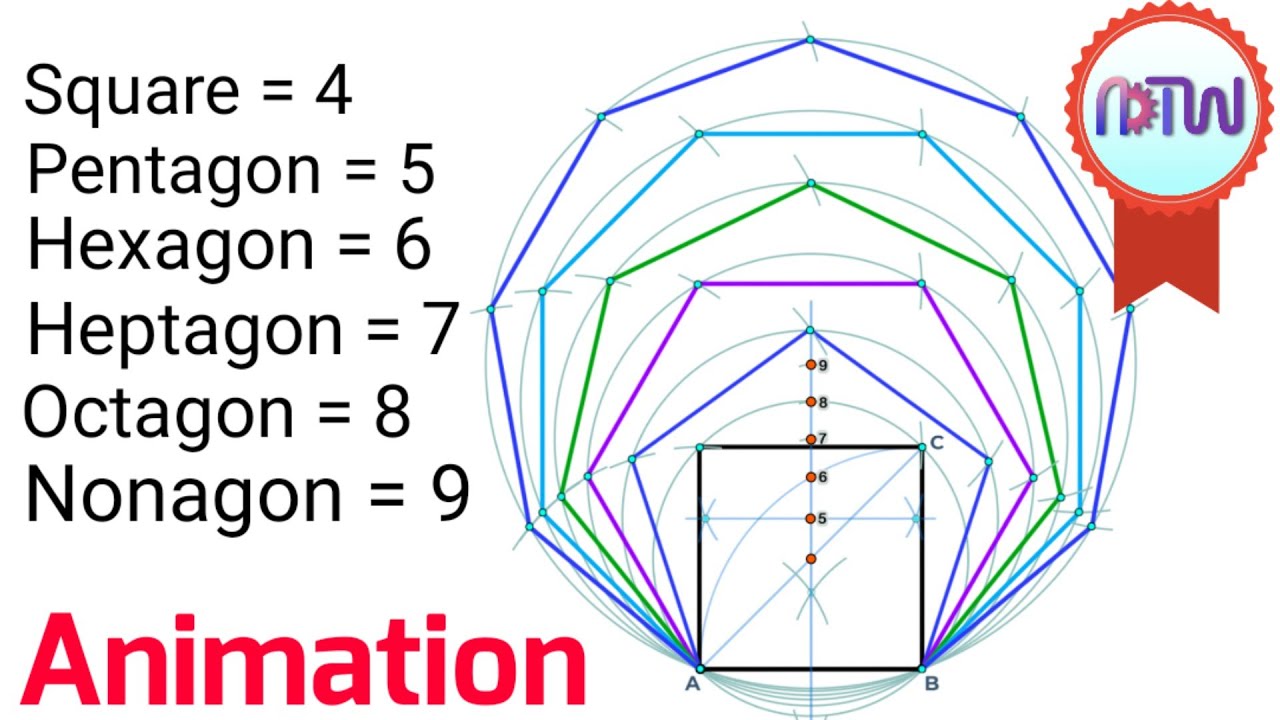
In this video, I have explained the general method to draw all the polygons. Do watch till the end and comment your opinions in the comment section. Your opinion will help me in improving the quality of my videos.
Polygons: https://youtube.com/playlist?list=PLWv6RLx...
pastel cliff
dont we need an assumption about finiteness of the extension here?

for each of these i mean
tterra button...? 🐺
chilly ocean
i do not know field or galois theory
pastel cliff
pain
but the button worked 
det button
if you spam enough maybe a wild det will spawn

dim widget
no you don’t need any extra assumptions
pastel cliff
what's the topos theory egirl button
dim widget

 dim widget
Part of being galois is that you are algebraic in your definition?
pastel cliff
ohh i think so, maybe conrad doesn't explicitly say that but my notes might
dim widget
if so the infinite case reduces to the finite case I think
 dim widget
yes okay
pastel cliff
normal and separable give finiteness right
pastel cliff
wdym
dim widget
Like using galois thory
pastel cliff
oh subgroups
i haven't read conrad's proofs i was just wondering about the difference in assumptions
actually this doesnt really use finiteness anyways

full link
galois implies it's a splitting field for some poly right
oh wait claim is slightly dif

 agile burrow
I like it
cloud walrusBOT
28 members found matching walter!
Page 1/2
========
1.   walterHartwellWhite#4731
2.   walter1775#2137
3.   walter#1555
4.   Walter Black#0344
5.   walter black#0352
6.   walter hartwell white#6346
7.   Walter#5889
8.   Walter White#2822
9.   Walter Benjamin#3244
10.  Waltercito#0930
11.  Walter Hartwell White#9564
12.  Walter Whait#9720
13.  walter_white99.6%#2706
14.  Walter James Bayola#6839
15.  Walter Hartwell White#8465
16.  Walter#2263
17.  walterthedog(astolfo)#5862
18.  walteryellow#0472
19.  yoitsWalter#6304
20.  NaughtyWalterWhite#2828 ```
Please type the number corresponding to your selection, or type `c` now to cancel.,av walter#1555
 pastel cliff
when will this be an emoji
next obsidian
cloud walrus
`28` members found matching `walter`!
```markdown
Page 1/2
========
1. walterH...
NaughtyWalterWhite
,av Walter
 pastel cliff
perfect
cloud walrusBOT
Member selection timed out.
pastel cliff
Determine, up to conjugation, all matrices in Mat$_{4 \times 4}(\Q)$ whose order is exactly 6.
cloud walrusBOT
not sebbb not stμ₂dying
 next obsidian
Owned
pastel cliff
are there 256 of these? or which ones dont work
invariant factors have to divide t^6 - 1
$$(t^2 + t + 1), : : (t-1), : : (t^2 - t + 1), : : (t+1)$$
cloud walrusBOT
not sebbb not stμ₂dying
 pastel cliff
breaks up into these if ive done it right
but not every combination of these things works right?
next obsidian
Normal forms 
 next obsidian
I have no idea
pastel cliff
pain
next obsidian
I am better at module theory than vector spaces
 next obsidian
You can do this with duality and the definition of a determinant using exterior powers for “free” I think

pastel cliff
 hollow shore
hey guys how do we tell if a system of congruence is odd or even?

 rustic crown
what's your guess?
pastel cliff
cloud walrus
**not sebbb not stμ₂dying**
also bump to this if you know anything det
@rustic crown
ping me if you see this det, tabbing out
(or anyone  )
)
rustic crown
.<
pastel cliff
pastel cliff
cloud walrus
**not sebbb not stμ₂dying**
any ideas on this one?
pastel cliff
pastel cliff
Q(2^1/3 , 3^1/3, zeta_3)/Q?
also how much proof does this need
i wanna just  it
it
pastel cliff
it's just those three things right
rustic crown
nah, first two and multiply them with the last (twice)
pastel cliff
okie one sec
that other one scary so i'll type this up
wait but that's the field, what's the group
im used it being something easy like D8 lol
Z/3 x Z/3 x Z/3?
rustic crown
describe what can happen to the generators
z3 has degree 2 over Q, while c2 and c3 have degree 3
you can send z3 to either z3 or z3^2
and ci to ci*z3^j for i = 2,3 and j = 0,1,2
and this gives you a weird group of order 18
you can do some work and see what it's iso to lol
pastel cliff
da frick
rustic crown
rustic crown
and ci to ci*z3^j for i = 2,3 and j = 0,1,2
ofc for this one needs to show that [Q(c2, c3):Q(c2)] = 3
pastel cliff
by Tower Property
rustic crown
no
like you know x^3-3 is the minimal polynomial of c3 over Q
you wanna show it remains a minimal polynomial over Q(c2)
pastel cliff
c3 = cube root of 3 right
rustic crown
yee
 rustic crown
z3 isn't a root
pastel cliff
oh but the products are
rustic crown
,ti not sebbb
cloud walrusBOT
The current time for stμ₂dying is 05:22 AM (EDT) on Sat, 13/05/2023.
det is 6 hours ahead, at 11:22 AM (CEST) on Sat, 13/05/2023.
pastel cliff
 rustic crown
pastel cliff
finals
im finishing up corrections for my algebra hw's
but corrections kinda also mean just doing them in the first place lol
this week has been a long month
and number theory final soon too
in any case
pastel cliff
pastel cliff
<:sad:532803514892812288>
those prod's are still roots right
rustic crown
yep, cause when you cube them up you get either 2 or 3
pastel cliff
rustic crown
and ci to ci*z3^j for i = 2,3 and j = 0,1,2
Z/3 x Z/3 x Z/2?
cloud walrusBOT
det
 rustic crown
just stare at this diagram and figure stuff out
pastel cliff
rebump to this now then
 pastel cliff
rustic crown
just stare at this diagram and figure stuff out <:eeveeKawaii:556858499930259471...
pastel cliff
rustic crown
just stare at this diagram and figure stuff out <:eeveeKawaii:556858499930259471...

rustic crown
all extensions in that are galois, so not so bad
pastel cliff
oh technically cant use galois here
this is an old thing from before we learned that
rustic crown
pastel cliff
can i get a hint on this pls
and to do the final part, it's equivalent to determining all intermediate groups contained in Gal(whole thing/Q(z3)) which is the order 9 group Z/3 x Z/3
rustic crown
pastel cliff
2 on JCF adjacent stuff 4 on Galois
rustic crown
pastel cliff
rebump to this now then
need to say a little more, making sure that not all of them divide t^2-1 or t^3-1 and reducing the order
pastel cliff
hmmm
rustic crown
(is that an "okie i see that "?)
pastel cliff
i gots to think abt it
rustic crown
you want the order to be 6
but if the elementary divisors were like (t-1), (t-1) and (t^2+t+1) then you'd be sad because the order is 3
pastel cliff
rustic crown
need to say a little more, making sure that not all of them divide t^2-1 or t^3-...
thiis should be (t-1)^2 no
wait
actually idk maybe i dont see it
rustic crown
does that divide t^6-1
pastel cliff
ah
rustic crown
(since char Q is not 2)
maybe i'll spell out the details a lil more
say you got a nice operator T which had order 6
so you see that T acts on a vector space of dimension 4, let's call it V
you can turn V into a Q[t]-module by defining t * v = T(v)
now theory tells you that isomorphic Q[t]-modules structure on V correspond to conjugate matrices
so up to conjugation, you wanna identify the iso class of the module V
by structure theorem of f.g mods/pid
they decompose into cyclic modules
if Q[t]/(f) was a summand, then you notice that as you've been given T^6 = 1, the element (t^6-1) in Q[t] must be in the annihilator
therefore each elementary divisor f (which is power of some irreducible) will divide t^6-1
that's why it reduces to understanding irred powers dividing t^6-1
but that got no repeated roots
so just irreds dividing t^6-1
another way to think is via the invariant factor decomposition. the last invariant factor is the actual annihilator of the module, so you don't want that to be dividing t^2-1 or t^3-1, which means it has to be divisible by the irred (t^2-t+1)
uwu?
 rustic crown
,ti not sebb
cloud walrusBOT
The current time for stμ₂dying is 05:58 AM (EDT) on Sat, 13/05/2023.
det is 6 hours ahead, at 11:58 AM (CEST) on Sat, 13/05/2023.
pastel cliff
and those galois questions are scary
pastel cliff
i'll finish these two module questions and beg for extra time on the galois ones
they were due midnight 
rustic crown

 rustic crown
pastel cliff
rebump to this now then
rustic crown
pastel cliff
rebump to this now then
you prolly don't have to give all the reasoning here, just write down the possible invariant factors/elementary divisors
rustic crown


 old zenith
just to be clear, the galois group of an irreducible polynomial in Q(x) of degree n is S_n right?
and then the galois group of any arbitrary polynomial is the product of the galois groups of its irreducible factors?
wraith cargo
old zenith
just to be clear, the galois group of an irreducible polynomial in Q(x) of degre...
this is not true generally
This is true when the polynomial is of prime degree and has exactly two non real roots
old zenith
damn i thought i was starting to understand galois groups
what is the general procedure for determining the galois group of an arbitrary polynomial then
south patrol
old zenith
just to be clear, the galois group of an irreducible polynomial in Q(x) of degre...
So basically you can view the Galois group G of a degree n poly as acting on the n roots, which gives an embedding of G into S_n. But often there will be other restrictions that mean you don't get the whole thing.
old zenith
ye and i am struggling to see those restrictions
dim widget
You could look at Lagrange’s theory of resolvents if you want a more computable criterion
south patrol
old zenith
what is the general procedure for determining the galois group of an arbitrary p...
Often the point is you take a splitting field of the polynomial and break it up into subextensions which let you construct elements of the group. Then getting some bound on its size will help you know when you're done
old zenith
old zenith
and then the galois group of any arbitrary polynomial is the product of the galo...
but this holds right? as long as the roots of each of the factors of the irreducibles are linearly independent
dim widget
It will only really be helpful in low degrees though
south patrol
It's good to work w some examples
old zenith
dim widget
It will only really be helpful in low degrees though
so in general finding the galois group is "pretty hard"?
south patrol
So also like examples of other restrictions that stop you from getting S_n like
It could be that where all the other roots go is determined by one of them
old zenith
obvious example would be cyclotomics right
south patrol
Exactly what I was gonna say lol
old zenith
cos u just change zeta_n and then that fixes where zeta_n^k go
south patrol
Yup yeah
Another way of thinking about this uh
The size of the Galois group of a poly f over Q is the degree of the extension K/Q with K the splitting field
old zenith
and then naively you assume that the galois group is Z/nZ but if you change zeta_n to zeta_n^k where gcd(n, k)>1, then it ceases to be an automorphism or smth like that?
like in Q(i) you cant just map i to -1 cos then you dont have anything mapping to i
is that what is happening in general?
dim widget
No I don’t think that’s the point
wraith cargo
old zenith
is that what is happening in general?
automorphisms preserve order of elements
south patrol
I don't really think that's the key point like
To me the sort of entry point is like
Note that if K,L are field extensions of F and φ: K -> L is a map over F, then for any a in K with min poly f, φ(a) must be a root of f as well
So for example, for the cyclotomics case, we can only send roots of the cyclotomic polynomial to other roots
In general you can generalise the theorem I gave and it allows you to "build up" elements of the Galois group by sending generators of K (over F) to appropriate elements of L
old zenith
ok so in this case K=L since we're discussing automorphisms?
dont rlly see how this holds for K not a superset of L since like what if phi goes from Q(sqrt(2)) to Q(pi)
south patrol
The point is that there are no such maps over Q
Since it'd have to send sqrt(2) to a root of x^2 - 2
and there are none of those in Q(pi)
But, for example, there is an isomorphism Q( 2^{1/3}) -> Q(2^1/3 w) over Q where w is a primitive third root of unity
old zenith
ah
ye i see what you mean, you can't map sqrt(2)->pi because then phi(2)=phi(1+1)=phi(1)+phi(1)=2
but then also phi(2)=phi(sqrt2)phi(sqrt2)=pi^2 which breaks the field structure
i was thinking of the spaces as vector spaces mb
south patrol
But yes it's hard to talk about this more generally without just getting into actual theorems lol
galois theory fun
old zenith
ye
also if you dont mind
could you give a basic rundown of how these ideas can then be applied in differential galois theory? just the basics lol
south patrol
Idk anything about differential galois theory lol
glossy crag
Is this a valid proof of "M free of rank n over PID, N<=M => N free of rank <=n" (been a while, wanted to reproduce it):
n=1 clear, let M be free of rank n, then the span M' of the first n-1 basis elements is free of rank n-1 and N'=N\cap M' is free of rank <=n-1. N/N' embeds into M/M' which is free of rank 1, so N=N'\oplus Ax and N is free of rank <=n.
formal ermine
old zenith
could you give a basic rundown of how these ideas can then be applied in differe...
huh wdym
south patrol
Hm
Is there any nice way to compute idempotents of a group algebra in general? And I suppose more generally a semisimple ring lol but I imagine that's too hard
For example I did a question where we had to compute idempotents of \R[\Q_8]
Oof
formal ermine
dim widget
(Y-1)^2 - X^3 is the minimal f, you should try to prove this
how did you find this (I am aware that you can just find it by 'looking at it', but is there a better way)? do you have a hint for me?
 upper pivot
south patrol
Is there any nice way to compute idempotents of a group algebra in general? And ...
upper pivot
south patrol
Is there any nice way to compute idempotents of a group algebra in general? And ...
right so i thought about this a bit
so my idea is for C[G] mainly
but right like we know its a sum of matrix algebras if G is finite, and so if we have an explicit description of this breakdown then we know the answer as we know the idempotents of a matrix algebra
this is over any field rn ofc
but heres where C comes in lol
you can use some von nuemann algebra theory to decompose C[G] = \oplus p_i C[G] where p_i are projections in the center that are mutually orthogonal and sum p_i = 1 ofc. The center of C[G] correspond to conjugacy classes of C
so this kinda reduces to finding explicit projections in the center like this oof
I have been unable to find this
(p_i C[G] can be seen to be isomorphic to matrix algebras)
(also from von nuemann theory lol)
maybe the spectral projections can help out here hmm
south patrol
Tbh this makes me realise idk how to find like all projections in any particularly nice way lol
for a matrix alg
But also interesing hmm
upper pivot
yeah id just describe them with subspaces kek
btw the kaplansky zero divisor conjecture (that for any group G, F[G] has zero divisors if and only if G has torsion when F is char 0) is proved using von nuemann algebras too!
gtg for a bit but ill come back and think about this
formal ermine
ok this seems way too easy so I'm susing it
what is Spec C[x]/(x^2)? what I did was
by this one theorem it's all prime ideals in C[x] that contain (x^2)
by hilbert's nullstellensatz all prime ideals in C[x] are of the form (x - a) for some a in C
so the only ideal that contains (x^2) will be (x)
thus Spec C[x]/(x^2) is just the origin
is this correct
tribal moss
A prime ideal must always contain all nilpotent elements, so (x) has to be there.
If you add anything in addition to that, you immediately get (1), which is by definition not prime.
So yes.
south patrol
formal ermine
so the only ideal that contains (x^2) will be (x)
Nullstellensatz for this is way overkill
This is a PID
The only divisors of x^2 are (up to units) x, 1 and x^2
0 isn't prime (the ring isn't a domain), and the whole ring is ruled out by definition
dim widget
formal ermine
how did you find this (I am aware that you can just find it by 'looking at it', ...
In terms of "how do you find this" it's just the first thing you write down. In terms of "how do you prove this is the minimal equation" there are many ways
 lapis trench
This is somewhat a general question, but suppose that you have a finitely presented group. Are there useful principles to be able to classify the quotient G/G' where G' is the commutator subgroup of G?
I'm trying to work with the generators but am struggling to make any progress.
lapis trench
The question has been resolved
lapis trench
I forgot that you have the row-Hermite normal form representation for these presentations
That's what I used
 noble hedge
Is there a nice way to find all Sylow p-subgroups of a group? Take D_6 (order 6, not order 12) as an example and look at all Sylow 2-subgroups, of which there are 3. There's only 6 elements, so brute-forcing all conjugations of a subgroup of order 2 would be fine, but what about somthing larger?
GL_2(F_5) would have an unreasonable amount of elements to brute force (at least by hand), so there's probably some method to find conjugations, right?
If $S_1, S_2, S_3$ are the 3 Sylow 2-subgroup of $D_6$, then we should be able to partition $D_6$ into the sets: $N_G(S_1) = {g\in G \mid gS_1g^{-1} = S_1}$, ${g\in G \mid gS_1g^{-1} = S_2}$, and ${g\in G \mid gS_1g^{-1} = S_3}$, right?
cloud walrusBOT
(𒀭)
 coral spindle
It is tricky in general
You can use specific methods from different fields. For example, there are algorithms for permutation groups.
For the specific case of GL_2(F_5), there are techiniques from the theory of algebraic groups. We look at GL_2(F), where F is the algebraic closure of F_5, after which GL_2(F_5) is a particular group of fixed points under a Frobenius automorphism.
There are various powerful results regarding this kind of construction in certain nice cases.
Tl;dr not really, no.
dim widget
noble hedge
That's pretty cool, seems like I have some stuff to look into
A good exercise is to find the p-sylow subgroups of Gl_2(F_p)!
Though it has little to do with finding p-sylow subgroups in general
since there are special tricks
coral spindle
If you do try this exercise, it's good to mention that you should aim for a description of just one of them rather than all of them. It can be hard to actually write down a nice description of some of the conjugates of the nicest one
Or well, not hard per se, just not very illuminating or nice.
noble hedge
I got to the point where I can show there should be p+1 of them, just based off the index of the normalizer and size of Gl_2(F_p), but I wasn't sure exactly how to find which elements I could conjugate one of the subgroups by to find the remaining subgroups
That exercise is actually what sparked this question lol
I had thought that partitioning the group into sets of elements that conjugate one of the Sylow p-subgroups to the rest of them would probably be something I could find with orbits, but got stuck
dim widget
noble hedge
I got to the point where I can show there should be p+1 of them, just based off ...
Do you see an obvious subgroup of order p?
noble hedge
(1,1,0,1) should generate that, right?
dim widget
What is the normalizer of that subgroup?
noble hedge
All matrices where the third (or bottom-left) element is 0, right?
dim widget
noble hedge
All matrices where the third (or bottom-left) element is 0, right?
Yes. So how many conjugates are there?
noble hedge
p+1
but which elements conjugate the Sylow p-subgroup generated by (1,1,0,1) to the remaining subgroups?
dim widget
It doesn't really matter for your problem but you can get p subgroups using (1 0 | 1 1) and the last one from (0 1 | 1 0)
Also all of this generalizes to Gl_n(F_p) and probably to certain other cases as well.
noble hedge
neat
So aside from knowing how many Sylow p-subgroups there are, brute-force (for sufficiently small p I guess) is just the most reasonable way to find all Sylow p-subgroups of GL_2(F_p)?
Aside from the stuff Boytjie had mentioned earlier, which I definitely don't know enough of to comment on
dim widget
I think you can, to some extent, just use the Sylow theorems which is in the vein of problems which ask you to classify all groups of order pq or pq^2 where p, q are small primes. After that you have to actually do some work
I consider this Gl_2(F_p) example the opposite of brute force, but we did start off by observing that there's an obvious natural candidate
I also think that what I led you through was similar to what Boytjie was referring to, but disguised.
noble hedge
Once you have the first subgroup generated by (1,1,0,1), there's p elements that you can conjugate the subgroup by to find the remaining subgroups, right?