#groups-rings-fields
1 messages · Page 82 of 1
 glacial oak

 rustic crown
me like the blue color tho 
 frigid lark
Det is evolving?
frigid lark
but glaceon or vaporeon is blue
 tribal furnace
rustic crown
me like the blue color tho <:eeveeKawaii:556858499930259471>
tribal furnace
rustic crown
me like the blue color tho <:eeveeKawaii:556858499930259471>
me too
rustic crown
me no blue anymore 
 summer path
det still has blue dot
rustic crown

 formal ermine
which direction are you having trouble with
 solar shore
mm the book's haphazardly stated that it uses induction
i think i can get the direction of where if the product is cyclic, then they're all relatively prime
but im not sure where induction really comes into play here
 tender wharf
theyre probably inducting on n
solar shore
mm i see
i wasn't sure if i was inducting on i and j or just n

ah wait
i get it now
i think'

 sinful mirage
does anyone know a text, where the relation between Lie algebra cohomology and Lie group cohomology IN LOW dimensions is discussed?
it is important for me in low dimension,because there the corresponding cohomology groups can be easily defined via cocycles and hands-on maps,etc, not ext/tor functors and bar resolutions, which are too abstract for me right now
 south patrol
formal ermine
permutation is a bijection
south patrol
formal ermine
permutation is a bijection
Homeomorphism  lol
lol
formal ermine
south patrol
Homeomorphism <:stareFlushed:833689610839523368> lol
yeah but like
Gal(L/K) is a topo group
south patrol
Sure
south patrol
Oh okay I misread lol like
formal ermine
and its inverse is also just a permutation
south patrol
Yes that is true
formal ermine
so its also continuous
south patrol
lol
formal ermine
just wanting to make sure I understand this notation
when we say R_p or R_l or whatever we mean the p or l adics over that ring?
 agile burrow
Can you give more context? I haven't heard of p-adics over an arbitrary ring
It could be localization at a prime ideal
 empty rose
try integrating the channels instead
 lethal dune
Why do i have such a hideous color
 kind jacinth
im not sure what i should do in part b. should i understand it as "group action 3Z -> Z with action given by addition thus (n, 3m) = n+3m so then it only has 1 orbit? or is it "group action Z->3Z (which i think makes more sense since 3z is a subgroup of Z?"? but then i dont know how to find the orbits
 south patrol
It says 3Z acts on Z
But also like the notation "group action 3Z -> Z" is uh smth I would avoid
lethal dune
Stay muted
kind jacinth
south patrol
It says 3Z acts on Z
in that case id have (n, 3m) = n + 3m as the action therefore it would only have 1 orbit right? I could say orbit us 0
wait no orbit 0 would give {0, 3, 6, ...} so i think the orbits would be 0, 1, 2?
 chilly ocean
orbit is like coset
kind jacinth
south patrol
What is an orbit?
I have an action G x X -> X and my orbits are the elements in X that would give unique sets of G using a group action? so for example 3Z -> Z6 with group action (3n, m) = (3n+m)mod 6. Z6 being {0, 1, 2, 3, 4, 5} orbits 0 and 3 gives same set, orbits 1, 4 give same thing, and orbits 5, 2 give same set
so then i can say the orbits are 0, 1, 5 in the example above
 delicate orchid
kind jacinth
so then i can say the orbits are 0, 1, 5 in the example above
delicate orchid
kind jacinth
so then i can say the orbits are 0, 1, 5 in the example above
Orbits are sets, you can say those are orbit representatives though
 wooden ember
why everybody muted
delicate orchid
The orbits themselves would be {0, 3}, {1, 4}, {2, 5}
kind jacinth
delicate orchid
The orbits themselves would be {0, 3}, {1, 4}, {2, 5}
ohhh i see. ok then for the exercise I sent the orbits would be {3k}, {3k-1}, {3k-2} ?
delicate orchid
Let me have a look
formal ermine
wooden ember
why everybody muted
chilly ocean
The orbits would be 3Z, 3Z+1 and 3Z+2.
wooden ember
oh lmao it's the "punishment" ok
kind jacinth
chilly ocean
The orbits would be 3Z, 3Z+1 and 3Z+2.
Yeah should have done addition there not subtraction. and the cosets are 0+H, 1+H, 2+H?
delicate orchid
kind jacinth
Yeah should have done addition there not subtraction. and the cosets are 0+H, 1+...
yeah should have addition not subtraction
No your notation was just wrong
chilly ocean
Yes
delicate orchid
But those are the cosets
chilly ocean
how to do backflip
delicate orchid
Spin real fast like
kind jacinth
ok so then i have my cosets same as my orbits since H = 3Z. in part (c) they just want me to say my cosets and orbits are equal to n given that H = nZ? and im not sure about (d)
are cosets and orbits always the same? or its just in this case?
delicate orchid
kind jacinth
ok so then i have my cosets same as my orbits since H = 3Z. in part (c) they jus...
No, they want you to do parts a and b for H = nZ instead of just H = 3Z
chilly ocean
Yes for (c) and for (d) they want you to show that if H is a subgroup of (G,+) then the action defined by the + operation holds the properties we saw previously (equality in cosets and orbits)
delicate orchid
kind jacinth
are cosets and orbits always the same? or its just in this case?
No. Consider the action of D_8 on the corners of a square. How can D_8 form cosets of the corners of a square when the corners aren’t even a group
In a very specific group action they are the same though
Same with conjugacy classes - they’re the orbits of a group acting on itself by conjugation
delicate orchid
delicate orchid
No. Consider the action of D_8 on the corners of a square. How can D_8 form cose...
I'd like to correct this
if you have a group action GxX -> X and define an equivalence relation on X by x ~ y if and only if x and y are in the same orbit then the classes in X/~ are obviously the orbits
which is sort of analogous to cosets
so they're not completely distinct ideas
kind jacinth
delicate orchid
if you have a group action GxX -> X and define an equivalence relation on X by x...
i see, thanks. so I think i was able to do (c) but for (d) im not sure how to generalize it.
because what I get in (C) is nZ, nZ+1, nZ+2, ..., nZ+(n-1)
i dont see how it relates to (d) since G can be any group
delicate orchid
yes that's right
so for a general group G and subgroup H what do you think the appropriate choice for the group action HxG -> G would be?
have a guess if you don't know
kind jacinth
addition should be my group action
delicate orchid
yeah it was addition when you were in Z, but what does it mean to do h+g in an arbitrary group?
kind jacinth
binary operation based on the groups operation?
kind jacinth
delicate orchid
so we just set (h, g) to be hg
but wouldnt this imply that any binary operation would result in cosets = orbits as long as H is a subgroup of G?
delicate orchid
no
I could as easily define (h, g) = h^{-1}gh
it's just that specific action
although out of the 4 I'm thinking of rn 2 do just produce the left/right cosets
so if you round up then yes they all do 
kind jacinth
delicate orchid
I could as easily define (h, g) = h^{-1}gh
but I still dont see the relation of this with (c). so in that case C would be g^n instead of gn? because the current thing in C is addition specific
delicate orchid
kind jacinth
but I still dont see the relation of this with (c). so in that case C would be g...
you probably can't see a relation of that to (c) because it's a completely different action that's irrelevant to the question
I only provided it as an example of an action HxG -> G that doesn't give cosets as orbits
kind jacinth
so is everything they want us to do is instead of giving the general addition, set (h, g) to hg (which implies all binary operations) and thats it?
chilly ocean
suppose we have a galois extension F|K and two intermediate fields L1, L2. Is it possible to express Gal(F | L1L2) in terms of Gal(F | L1) and Gal(F | L2) ?
south patrol
Intersection
This is clear from the Galois correspondence or because a map F -> F fixes L1L2 (pointwise) if and only if it fixes L1 and L2
kind jacinth
if 4 is fixed then is cardinality of G = cardinality of H?

or they mean element 4 is fixed on H which is why its S3?
 fleet pelican
kind jacinth
or they mean element 4 is fixed on H which is why its S3?
fleet pelican
kind jacinth
or they mean element 4 is fixed on H which is why its S3?
Yeah. It is the elements of S_4 which don't move 4 around. I.e. "fix 4"
kind jacinth
fleet pelican
Yeah. It is the elements of S_4 which don't move 4 around. I.e. "fix 4"
alright i see. So I know that the number of left cosets is going to be 4 (because 4!/3! = 4) but is there a quick way i can find these cosets?
fleet pelican
yes
kind jacinth
my subset S3 = {e, (1 2), (1 3), (2, 3), (1 2 3), (1 3 2)} dont wanna do all elements of G not in S3 to find the cosets
fleet pelican
can you find three elements not in H that all give different cosets?
think more abstractly, not concretely
remember how we got H
kind jacinth
i think (1 4), (2 4), (3 4) would give different things?
fleet pelican
That sounds correct. Can you justify that?
kind jacinth
im just thinking of the square with 4 vertices and performing the rotations above would give me something else. Not sure if this is the correct intuition.
fleet pelican
What is the stabilizer subgroup of each?
kind jacinth
fleet pelican
What is the stabilizer subgroup of each?
performing a rotation 4 times
or 2 reflections
fleet pelican
What in S_4 is the stabilizer of each coset of H
kind jacinth
the identity
kind jacinth
fleet pelican
That sounds correct. Can you justify that?
dont think its right though because (3 4) (1 2 3 4) gives (1 2 4) but so does (1 4)(1 2)
fleet pelican
how did you get (1234)?
(1234) along with any transposition will generate all of S_4 if I'm not mistaken
 tribal moss
(1234) and (13) only generate D_8.
formal ermine
yeah that only works if your permutation order (or whatever it's called) is prime
a p cycle and a transposition generate S_p
fleet pelican
oh true rip. at any rate, he shouldn't get (1234) in a coset of S_3
tribal moss
It has to be in some coset.
More concretely, it is definitely in the coset (1234) S_3.
You're probably thinking of (1234) not being in any conjugate of S_3.
formal ermine
someone should rename this channel to "how do i solve for x"
tribal moss
That's #prealg-and-algebra.
 pastel cliff
formal ermine
someone should rename this channel to "how do i solve for x"
pastel cliff
formal ermine
someone should rename this channel to "how do i solve for x"
"find x"
"it's right there"
tribal moss
fleet pelican
oh true rip. at any rate, he shouldn't get (1234) in a coset of S_3
Oh, I see what you meant to say: (34)(1234) is not in the coset (34)S_3, because (1234) is not in S_3.
tribal moss
kind jacinth
im just thinking of the square with 4 vertices and performing the rotations abov...
A better intuition would be: All permutations σ in the coset (4 a) S_3 satisfy σ(4)=a, and onversely the coset contains every permutation with that property.
So you can identify which coset a permutation σ is in just by looking at σ(4).
chilly ocean
suppose we have a galois extension $F|K$ and two intermediate fields L1, L2. Is it possible to express Gal($F | L_1 \cap L_2$) in terms of Gal($F | L_1$) and Gal($F | L_2$) ?
 cloud walrusBOT
matcool473

 coral shale
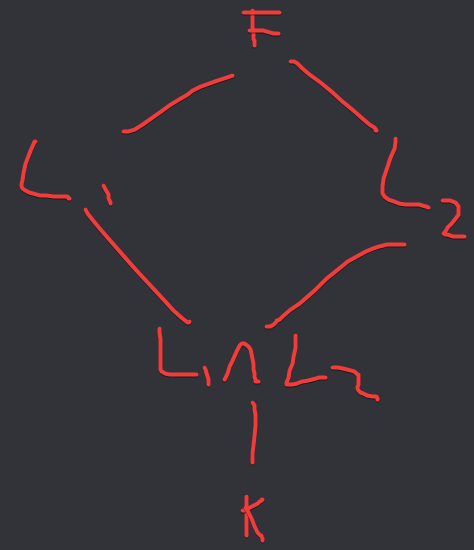
this right 
idk myself, might need normality on some of those to make it work
very familiar diagram
coral shale
Making a guess: I think the latter 2 are just subgroups (maybe normal), and only when the intersection = K do you have a product
formal ermine
isn't it like the subgroup generated by the product of gal f/l1 and gal f/l2 or something
yeah pretty sure it is
chilly ocean
i think its the smallest group that inclused Gal(F|L1) and Gal(F|L2)
is there a specific name for such conctruction between two groups?
 boreal inlet
lmao the channel names threw me off so bad 
formal ermine
chilly ocean
is there a specific name for such conctruction between two groups?
the group generated by their product lol
the proof shouldn't be too involved (maybe 1-2 lines)
it's a fun little exercise
formal ermine
yes
kind jacinth
fleet pelican
how did you get (1234)?
woops ur right. ok (1 4) (2 4) (3 4) are cosets and now we would need to find 1 more coset. actually we dont as thats just the identity.
fleet pelican
kind jacinth
woops ur right. ok (1 4) (2 4) (3 4) are cosets and now we would need to find 1 ...
what do you think the stabilizers are
kind jacinth
stabilizer so if i do (1 4)*x id need to get (1 4) back. x should be the identity?
fleet pelican
use @tribal moss 's comment to help you think about this
fleet pelican
kind jacinth
stabilizer so if i do (1 4)*x id need to get (1 4) back. x should be the identit...
incorrect, you do not need (14) back, you just need that (14)x is in (14)H
 kind jacinth
fleet pelican
incorrect, you do not need (14) back, you just need that (14)x is in (14)H
kind jacinth
fleet pelican
incorrect, you do not need (14) back, you just need that (14)x is in (14)H
then isnt the stabilizer for each coset anything in H?
fleet pelican
H only stabilizes H
kind jacinth
fleet pelican
H only stabilizes H
then for the coset (1 4)H i can have (2 3) as a stabilizer? or anything not involving 1 and 4? i am not sure honestly.
actually, wouldn't the identity in S4 work? (1)*(1 4)H would give back (1 4)H
i dont see why this is incorrect
fleet pelican
I think you need to review the definition of stabilizer?
kind jacinth
fleet pelican
I think you need to review the definition of stabilizer?
stab(H) = {g element of G: g*H = H} right?
fleet pelican
what is stab(xH)?
kind jacinth
element of G such that g*xH = xH
fleet pelican
so what is stabilizer of H?
in our example
and what is stabilizer (14)H, in our example?
remember, stab(H) is a subgroup
as is stab (xH)
also recall, |stab(H)| = |G|/|orbit(H)|
kind jacinth
fleet pelican
also recall, |stab(H)| = |G|/|orbit(H)|
so then the subgroup consists of 6 elements?
but im not sure how to come up with them
kind jacinth
fleet pelican
so what is stabilizer of H?
stabilizer of H is H?
and of xH it would be xH
kind jacinth
kind jacinth
stabilizer of H is H?
if i do (1 2)*(1 2) (being elements of g and H) id get (1 2) and if i do (23)(12) id get (1 3) which is also in H. I think this would work for all cases
 charred crescent
would anyone mind reading through this and telling me if i went astray?
 fleet pelican
kind jacinth
and of xH it would be xH
fleet pelican
kind jacinth
and of xH it would be xH
that is not correct. xH isn't a subgroup.
 celest furnace
I think well defined is wrong here shook
Cuz it doesn’t depend on H cap K is trivial
Should be that h h’^{-1} is in both H and K so is the identity and similar for the k’s
Ah! It’s because you were trying to show that if the inputs are equal then the outputs are equal, but started with the outputs being equal
charred crescent
celest furnace
Ah! It’s because you were trying to show that if the inputs are equal then the o...
so i have to show that g = g' => p(g) = p(g') yes?
fleet pelican
yes
celest furnace
Also I think your injective proof uses circular reasoning too
Phi(g) = e implies g = e seems sketch
charred crescent
well it's using the fact that ker(phi) is trivial implies injective
at least that was my aim
fleet pelican
you have to use it explicitly.
celest furnace
I think it’s cleaner to just do it directly
charred crescent
what do you mean?
so let g,g' in G s.t phi(g) = phi(g') and show that this implies g = g'
celest furnace
Yes
charred crescent
okay, thank you for your help y'all
celest furnace
Actually your proof is right but needs one more step
You should decompose g = hk (which exists clearly) then you get
phi(g) = (h,k) = (e,e)
Then you can use that (a,b) = (c,d) iff a = c and b = d
Technically you did this but I think it would help to state it explicitly
charred crescent
this is in reference to the injective part?
celest furnace
Yes
fleet pelican
but you first need well-defined
celest furnace
Homomorphism looks great
charred crescent
celest furnace
Technically you did this but I think it would help to state it explicitly
okay so im still a little unsure as to what i still need to show regarding injectivity
celest furnace
charred crescent
okay so im still a little unsure as to what i still need to show regarding injec...
Injective is phi(a) = phi(b) implies a = b
Equivalently for groups that given a in ker(phi) a = e
You need the implication going in the right way
charred crescent
so i should not use the phi(g) = e argument?
charred crescent
okay fair
as for the well-defined part:
let g,g' in G such that g = g'.
then g = hk and g'=h'k' for some h,h' in H, k,k' in K
so g = g' => hk = h'k' => (h,k) = (h',k')
thus phi(g) = phi(g'), hence phi is well defined
is this sufficient?
 sonic coral
noooo my abelian grapes
celest furnace
charred crescent
is this sufficient?
No because in the second implication you are assuming it’s well defined
To get that implication you need to show that h=h’ and k=k’
Pretty much if you ever haven’t used a given something is probably wrong ( in this case, you didn’t use that H cap K is trivial)
charred crescent
okay so i must somehow use H cap K is trivial to show h = h' and k = k'
let me try that
celest furnace
Yes
charred crescent
ah okay how about this:
let g,g' in G such that g = g'
then g = hk and g' = h'k' for some h,h' in H, k,k' in K
then hk = h'k' => k(k')^{-1} = h^{-1}h'
because H cap K is trivial, k(k')^{-1} = h^{-1}h' => h^{-1}h' = e and k(k')^{-1} = e
thus h = h' and k = k', so (h,k) = (h',k'), thus phi(g) = phi(g')
charred crescent
i hit enter prematurely lol
celest furnace
yep that's what i had in mind
kind jacinth
fleet pelican
that is not correct. xH isn't a subgroup.
Thats true. the stabilizer of xH should still be H?
it needs to be a subgroup of 6 elements. I can not think of somthing else that could work
south patrol
celest furnace
Potato how are you talking while muted
lol
pastel cliff
muted potat
kind jacinth
kind jacinth
it needs to be a subgroup of 6 elements. I can not think of somthing else that c...
nvm the inverse can work. so (1 4)H(4 1)
sinful mirage

II am trying to prove this. Can someone help me see why the second square commutes?
this is my trial. I proved that first square commutes
 fleet pelican
kind jacinth
nvm the inverse can work. so (1 4)H(4 1)
fleet pelican
kind jacinth
nvm the inverse can work. so (1 4)H(4 1)
I believe there is a theorem which states that the stabilizers in an orbit are all cojugate
 prisma wren
how does y = ax²+bx+c work?
cloud walrusBOT
memeke
 formal ermine
prisma wren
how does y = ax²+bx+c work?
formal ermine
prisma wren
how does y = ax²+bx+c work?
you mod k[x, y] by (x^3, y^2)
sinful mirage
cloud walrus
**memeke**
G_3
lethal dune
sinful mirage
this is my trial. I proved that first square commutes
ϕ_3 is an isomorphism
sinful mirage
sinful mirage
G_3
but i don't see how this helps
fleet pelican
I don't know what you still need to prove?
sinful mirage
lethal dune
ϕ_3 is an isomorphism
yes,but how does this help?
I need to prove that the square commutes
this means $\phi_3 \circ f_2= \pi \circ \phi_2$
fleet pelican
that projection->iso is same as iso-> projection?
lethal dune
check that $G_2\rightarrow[f_3] G_3 \rightarrow{\phi_3} G_2/f_1(G_1)$

 lethal dune
bruh
pastel cliff
khaki ryu
 lethal dune
anyway you can show ϕ3 ∘f3= π by definition
sinful mirage
what si f_3?
tribal moss
kind jacinth
nvm the inverse can work. so (1 4)H(4 1)
One way to think of it is: We have concluded that the coset (14)S3 consists of exactly those permutations that send 4 to 1. What are the elements g such that if h(4)=1 then gh(4) is also 1?
fleet pelican
sinful mirage
what si f_3?
what kind of map is f_2 (remember the sequence is exact)
sinful mirage
fleet pelican
what kind of map is f_2 (remember the sequence is exact)
f_2 is surjective.
 sinful mirage
lethal dune
sinful mirage
lethal dune
this is the unviersal property of the quotients
yeah makes sense
i see now
thanks 
chilly ocean
3x^2+6x-9
how do I factor this quickly?
 queen quarry
chilly ocean
3x^2+6x-9
how do I factor this quickly?
queen quarry
chilly ocean
3x^2+6x-9
how do I factor this quickly?
Divide by 3
x²+2x-3 = (x+p)(x+q) = x² + (p+q)c + pq
=> pq = -3, p+q = 2
Therefore p=-1, q=3 is a solution so
3x²+6x-9 = 3(x-1)(x+3)
I have trouble understanding this proof. Q^# denotes the set of all nonidentity elements of Q.
Since we choose Q as the smallest counterexample, then for all 1=/=g in Q we have g is not in <A, A^g>.
What I don't understand is why does that mean that [[g,A],A] = 1

Can someone give me an idea? Since g is not in <A, A^g> then g is not contained in [g,A] for all g=/=1 but I don't see how to go on from here
fleet pelican
queen quarry
I have trouble understanding this proof. Q^# denotes the set of all nonidentity ...
not entirely sure how the notation here is being used
A^g, <A,A^g>, [g, A]
 warped fulcrum
I am going through Aluffi and there's a problem I'd skipped which I'm trying to have a 2nd go at rn:
Proposition:
There exists a surjective homomorphism $\sigma: \bZ * \bZ \to C_2 * C_3$ where coproducts are considered in Grp.
I avoid denoting many (intermediate) hmorphisms by symbols because otherwise I'd quickly run out of symbols to use.
It is fairly trivial to construct a homomorphism, but I'm having some trouble trying to show that it's surjective. My approach has been to consider homomorphisms $\varphi: \bZ \to C_2 * C_3$ given in the obvious way by composing a (surjective) homomorphism $\bZ \to C_2$ with the (injective) inclusion map $i: C_2 \to C_2 * C_3$, and similarly for $C_3$. Then by applying the universal property on $\bZ * \bZ$, the existence of a homomorphism $\sigma: \bZ * \bZ \to C_2 * C_3$ (unique given the chosen maps) is immediate. I suspect this is the correct homomorphism, but I'm struggling to show that it is surjective. It doesn't seem like I can actually conclude anything about the (surjectivity or injectivity) of the maps $\varphi: \bZ \to C_2 * C_3$, even though they seem to be the most natural choice. Am I on the right track? Any hints?
cloud walrusBOT
humefanboy
 lethal dune
note that Z →C2 and Z → C3 are surjective, can you use that somehow
warped fulcrum
yeah but I'm composing them with injective inclusion maps
I'm not immediately using Z to C2 or Z to C3, I'm using Z to C2 * C3, it doesn't seem like I can say much about that
lethal dune
you can try to use explicit definition of G*H
warped fulcrum
I have not covered that yet
this is supposed to be before the explicit definition which I believe is covered in chapter 8
I'm still at chapter 3
lethal dune
I see
one more thing you can try showing is it's epi (in categorical sense)
Say you have f,g: C2*C3 → X then this will give you 2 maps from Z to X through C2 and C3 and from which you can claim f=g showing epi
in Grp epi=> surjective
try to see if you can fill the details
@warped fulcrum
warped fulcrum
epi is equivalent to surj hmorphism in Grp right?
formal ermine
warped fulcrum
epi is equivalent to surj hmorphism in Grp right?
yes
lethal dune
the proof I was thinking doesn't work
formal ermine
I remember seeing the nlab article for this lol
 elder wave
it's not trivial
elder wave
well ok the direction ryu assumed is the harder one
warped fulcrum
lol
empty rose
...$*$ is coproduct right? i feel like i remember that but idk if i'm just wrong
cloud walrusBOT
bee
 empty rose
(as in, in Grp)
elder wave
empty rose
...$*$ is coproduct right? i feel like i remember that but idk if i'm just wrong
important tex
lethal dune
yeah didn't realise it stops at epi step
warped fulcrum
cloud walrus
**bee**
yes
 coral spindle
empty rose
...$*$ is coproduct right? i feel like i remember that but idk if i'm just wrong
coral spindle
empty rose
...$*$ is coproduct right? i feel like i remember that but idk if i'm just wrong
Yeah, but they call it a "free product" usually
elder wave
🦅
empty rose
(yeah i knew that)
coral spindle
OK
lethal dune
use explicit construction and call it done 
south patrol
Idk I did smth like this a while back lol
lethal dune
south patrol
Isn't this true whenever the forgetful functor has a left adjoint
yes the Free functor
queen quarry
fleet pelican
A^g, <A,A^g>, [g, A]
A^g := {g^-1 a g | a in A}
<A, A^g> is the group generated by A and A^g
[g,A] is the commutator, i.e.
[g,A] := {g^-1 a^-1 g a | a in A}
south patrol
wait so which direction didn you want to prove
which is the hard one
oh epi => surjective ?
cloud walrusBOT
humefanboy
 warped fulcrum
the map I constructed above
I don't know how to show it's epi either
I do know the proof epi <=> Surj in Set, I suspect epi => Surj in Grp is going to trivially follow from that
 warped fulcrum
lol
it seems that the phi's I constructed ought to be surjective because if they were the proof works out perfectly
does that pass for a rigorous proof
empty rose
hm
ok wait
the phis you constructed aren't surjective, but i think the overall sigma is
it's not actually that hard to just take any element of C2 * C3 and produce an element of Z * Z that gets mapped onto it
warped fulcrum
tbh I don't even have the slightest clue what elements of C2 * C3 are supposed to look like, the explicit construction is not given until like chapter 8 of Aluffi I believe
empty rose
...hm
ok well it's still definitely surjective, but idk how to prove it purely from the universal property of C2 * C3
warped fulcrum
ok I will trust you and wait until I learn the explicit definition lol
empty rose
i can explain the basic idea even without the details of the explicit definition
everything in C2 * C3 is some combination of things from C2, and things from C3
things from C2 are produced by the left Z in the Z * Z, things from C3 are produced by the right Z
so overall every combination is produced by Z * Z
but if you try to view this categorically, you don't have like, a homomorphism from C2 to Z
i'm not sure if there's a reasonable way to phrase "surjective" group homomorphisms entirely in terms of arrows to get away from talking about elements of C2 * C3
warped fulcrum
oh I see, pretty weird that Aluffi would give it as a problem this early in the book then
empty rose
i might just be missing something
lethal dune
Aluffi is wild unless there's some easy solution I'm not seeing
queen quarry
queen quarry
I have trouble understanding this proof. Q^# denotes the set of all nonidentity ...
Does anybody have hints for this?
queen quarry
queen quarry
Does anybody have hints for this?
Also [[g,A],A] should be a subgroup of <A, A^g> so then for all nonidentity g: g is not in [[g,A],A] but that's not enough to prove that [[g,A],A] = 1
 feral agate
I don't really understand why there is an inequality at the arrow instead of equality, isn't the orbit-stabilizer theorem applied here?

because we know that the stabilizer is a subgroup
fleet pelican
queen quarry
Also [[g,A],A] should be a subgroup of <A, A^g> so then for all nonidentity g: g...
what is the meanings of the symbols you're using?
queen quarry
fleet pelican
what is the meanings of the symbols you're using?
[x,y] := x^-1 y^-1 x y is the commutator of x and y
A^g := g^-1 A g is the conjugate
fleet pelican
queen quarry
A^g := {g^-1 a g | a in A}
<A, A^g> is the group generated by A and A^g
[g,A] is...
i see
so to answer your original question, by your definitions [[g,A],A] is a subset of <A, A^g>, isn't it?
queen quarry
fleet pelican
so to answer your original question, by your definitions [[g,A],A] is a subset o...
That's correct
fleet pelican
so ur good then?
queen quarry
Not quite, i need to show that [[g,A],A] = 1 for all g in Q but so far I only know that g is not in [[g,A],A] for all g=/=1
I don't see how it's useful that A acts non-trivially on Q
And also I don't understand where the minimality of Q is being used
charred crescent
is dummit and foote a good place to start for representation theory?
fleet pelican
charred crescent
is dummit and foote a good place to start for representation theory?
artin has a great treatment of rep theory
charred crescent
okay thanks
fleet pelican
queen quarry
I don't see how it's useful that A acts non-trivially on Q
so, if something in [[g,A],A] were nonzero
it would be in <A^g,A>
so either you can find a bigger Q, by construction, or you're still in Q.
formal ermine
chilly ocean
How can i start in abstract-algebra
I recommend artin
chilly ocean
formal ermine
I recommend artin
Books?
formal ermine
yes, artin's algebra book
chilly ocean
formal ermine
yes, artin's algebra book
Just one book?
formal ermine
it's a good starting point
formal ermine
read it first, then ask "and after"
sonic coral
formal ermine
yes, artin's algebra book
thoughts on gallian?
formal ermine
no idea
queen quarry
fleet pelican
so either you can find a bigger Q, by construction, or you're still in Q.
What do you mean by that?
feral agate
feral agate
I don't really understand why there is an inequality at the arrow instead of equ...
Any ideas on this?
empty rose
well we're saying that the orbit has at least 4 elements
if the orbit had 8 elements then you would end up with \ $|G_1| = |G_{1,2}| \cdot 8 \geq |G_{1,2}| \cdot 4$
cloud walrusBOT
bee
 feral agate
ohhh I see thanks
warped fulcrum
chilly ocean
How can i start in abstract-algebra
Aluffi
honestly I think it’s manageable, I’m currently going through it and I don’t have that strong of a background in algebra
If you don’t even yet know what a group or a homomorphism is, then certainly not, but if you do know the basics it’s quite a nice book (at least from what I’ve seen so far)
I did learn the basics from Artin, it’s also a nice book but a bit too long, did not complete it lol
sinful mirage
should these two be equivalent?
 agile burrow
yes, but it's a little strange that they're using additive notation for the multiplicative group of C
I guess really the cocyle arises as the choice of a lift of a homomorphism to PGL to a map to GL
sinful mirage
how could one see equivalence?
for one direction this is the hint

but I fail to see why theta is a homomorphism
and for the other direction I have no idea 
sinful mirage
agile burrow
yes, but it's a little strange that they're using additive notation for the mult...
it's me being too illiterate mathematically in notations. in the original text ti was denoted by $\mathbb{C}^{\times}$
cloud walrusBOT
ProphetX
 fleet pelican
yeah, it is the center of the linear group so it commutes...
sinful mirage
I just wrote ti as $C^{*}$
cloud walrusBOT
ProphetX
 agile burrow
It should just be a direct computation to show theta is a homomorphism
sinful mirage
agile burrow
It should just be a direct computation to show theta is a homomorphism
yes. I tried,but don't see
let me show what I did. one sec.
agile burrow
Do you understand what the map GL(V) -> PGL(V) does?
fleet pelican
you are modding out by the center of a group, the center is always normal.
sinful mirage
not precisely
sinful mirage
agile burrow
Do you understand what the map GL(V) -> PGL(V) does?
i guess that's my confusion
agile burrow
Right, that's probably the first step
sinful mirage
$\theta(g_1g_2)=(\pi_V \circ T)(g_1 g_2)=\pi_V(T(g_1g_2))=\pi_V(\alpha^{-1}(g_1,g_2) T(g_1) T(g_2))$
cloud walrusBOT
ProphetX
 sinful mirage
and now i'm stuck cause idk what pi does
agile burrow
If V is a complex vector space, PGL(V) = GL(V) / C*. What this means concretely is that we're identifying all nonzero scalar multiples of a matrix
fleet pelican
Aka GL(V)/{cI:c in C, c not 0}
agile burrow
So in particular, pi takes an element of GL(V) to the equivalence class containing all nonzero scalar multiples of that element
fleet pelican
You will note that A(cI)B(dI)=AB(cdI)
sinful mirage
so in partcular we have that $\pi_V(\alpha^{-1}(g_1,g_2) T(g_1) T(g_2))=\pi_V(T(g_1) T(g_2))$
cloud walrusBOT
ProphetX
 fleet pelican
I should use E instead of I for legibility
 agile burrow
Oh, I see
sinful mirage
(alpha^-1 exists because alpha is nonzero)
agile burrow
Right
sinful mirage
(by assumption of alpha)
agile burrow
I guess it doesn't really matter which side you put alpha on since it'll always be invertible lol
But good, hopefully the forward direction is clear to you now
sinful mirage
cloud walrus
**ProphetX**
and now the real question is: is pi_v a group homomorphism?
because if it is,we are done
agile burrow
Indeed it is. As memeke pointed out, the subgroup of scalar transformations lies in the center of GL(V), hence it is normal
sinful mirage
as PGL(V) is a group, i assume this is just the quotient morphism
agile burrow
That's right
fleet pelican
agile burrow
Indeed it is. As memeke pointed out, the subgroup of scalar transformations lies...
iirc it is exactly the center, but i dont recall the proof offhand
agile burrow
Yeah, it is the center. Maybe it falls out if you consider what commutes with elementary matrices
sinful mirage
(quick question before we finish this direction): does everything we said above hold for V infintei dimensional too?
or only for V finite dimensional
agile burrow
😬 idk about infinite dimensional stuff lol
sinful mirage
(ignoring continuity issues)
agile burrow
seems messy
sinful mirage
just algebraically
agile burrow
Maybe someone else can comment, I have no idea
agile burrow
Yes, the other implication holds as well
The other direction is maybe a bit more involved, but I think we can work through it
So we're starting with a homomorphism G -> PGL(V), right?
sinful mirage
yes
agile burrow
The idea is that we want to try and lift this to a map G -> GL(V)
So what this means is that for each g in G, we should associate some scalar c(g) in C*
And then we can define our map G -> GL(V) by sending g to c(g) \theta(g)
fleet pelican
it is always the case that GL(V)->PGL(V)\equiv GL(V)/Z(V) is homo. There are many issues with I.D. this isn't one.
agile burrow
Ok neat, thanks for the confirmation
sinful mirage
agile burrow
And then we can define our map G -> GL(V) by sending g to c(g) \theta(g)
right
agile burrow
agile burrow
And then we can define our map G -> GL(V) by sending g to c(g) \theta(g)
There's an extra layer of structure imposed on the map c because theta is a homomorphism
Oh wait, I think I have this wrong
Ok yeah let me back up for a second
sinful mirage
so what we have: $\theta:G \to PGL(V)$ homomorphism
cloud walrusBOT
ProphetX
 agile burrow
Right, we start with a homomorphism G -> PGL(V)
Let's try to lift this to a map T: G -> GL(V)
sinful mirage
We want a map $T:G \to GL(V)$, such that $T(g)T(h)=c(g,h) T(gh)$ for some $c(g,h):G \times G \to \mathbb{C}^{*}$ satisfying some condition
cloud walrusBOT
ProphetX
 sinful mirage
yes
agile burrow
However, T(gh) and T(g) T(h) both get mapped to theta(gh) under the projection to PGL(V), right?
What this means is that in GL(V), T(gh) and T(g) T(h) differ by some nonzero scalar multiple because they lie in the same equivalence class in PGL(V)
sinful mirage
agile burrow
However, T(gh) and T(g) T(h) both get mapped to theta(gh) under the projection t...
supposing T satsfies the equality given
but first, we want to construct a map T
then show it satisfies the equality
agile burrow
Sure, but we can just define T by arbitrarily choosing a lift of theta
Like just choose some preimage of theta(g) in GL(V)
sinful mirage
can you please elaborate? I am not very familiar with the word 'lift'
agile burrow
Yeah, let me be more rigorous. So a lift of theta is a map T: G -> GL(V) such that pi o T = theta, where pi is the projection GL(V) -> PGL(V)
agile burrow
The naive thing you can do is just choose some preimage of theta(g) in GL(V) at random
and by construction, this gives you a lift
sinful mirage
(also wait one second)
there might be a mistake because of my notation
the cocycle condition should be addition or multiplication?
is this correct?

or should be * between them
agile burrow
It's easier to write it as multiplication here because it takes place in the multiplicative group of the field
I'd rewrite it with *
sinful mirage
but wait. alpha(g_2,g_3) is a complex nonzero number right
so alpha(g_1,g_2) is added or multiplied with another alpha?
agile burrow
Multiplied
Yeah, more generally one usually defines 2-cocycles as maps G -> A satisfying this condition, where A is some abelian group
In this case A is the multiplicative group of C, so the group operation is multiplication
sinful mirage
agile burrow
and by construction, this gives you a lift
one second,let me get back to this. so if theta(g) in PGL(V), then preim theta(g) in G.
how does this tell me anything about T?
agile burrow
Oh, let me rephrase
So theta(g) lies in PGL(V), which is an equivalence class of elements of GL(V)
You can choose some representative of this equivalence class, which will lie in GL(V)
And just set T(g) to be this representative
Obviously this isn't well-defined, as different choices of representatives lead to different functions T
But bear with me for now
Now T(gh) and T(g) T(h) both lie in GL(V), but there's no reason they need to be equal, right?
sinful mirage
one second. let me try to write down formally what you wrote
to make sure i understand
$\theta:G \to PGL(V)$. Then $\theta(g) \in PGL(V)$, but as $PGL(V)=GL(V)/ \mathbb{C}^{*}$, we define a map $T:G \to GL(V)$ as $T(g) \in GL(V)$, such that what?
cloud walrusBOT
ProphetX
 agile burrow
We're choosing $T(g) \in GL(V)$ such that $\pi \circ T(g) = \theta(g)$
cloud walrusBOT
walter
 agile burrow
So we haven't really made a specific choice for T
The point is that theta(g) is a whole equivalence class of matrices, right?
sinful mirage
yes
agile burrow
Let me just pick out one of these matrices, and I declare that T(g) be equal to this matrix
And I make this choice for every g in G
agile burrow
Indeed, it (sort of) doesn't matter as we'll show later
Right now, different choices will lead to different definitions of T
but assume that we've fixed one such choice of T
sinful mirage
so now I have g many linear maps V->V, namely T(g)
agile burrow
That's right
We've just built some set theoretic function T: G -> GL(V)
And the only thing we know about it right now is that pi o T = theta
Ok, so now let's try to deduce some more structure/information about our map T
There's no reason why T(gh) should be equal to T(g) T(h) since we've just chosen representatives at random for theta(gh), theta(g), and theta(h)
But we can say something nontrivial about them - namely, $\pi \circ T(gh) = \theta(gh) = \theta(g) \theta(h) = (\pi \circ T(g)) (\pi \circ T(h))$
cloud walrusBOT
walter
 sinful mirage
right,this follows from theta being homomorphism
agile burrow
Exactly
In particular, T(gh) and T(g) T(h) lie in the same equivalence class after we pass to PGL(V). Explicitly, they differ from one another by a nonzero scalar
sinful mirage
true
cloud walrusBOT
walter
 sinful mirage
we could formallry write: $\pi(T(gh))=\pi(T(g)) \pi(T(h)) \iff [T(gh)]=[T(g)][T(h)]$, right?
cloud walrusBOT
ProphetX
 agile burrow
Yes, that's right
sinful mirage
cloud walrus
**walter**
yes,now it is left to see cocycle condition si satisfied
agile burrow
Right, and to see this we'll need to use associativity of G
Namely, we'll want to consider that $T((gh)k) = T(g(hk))$
cloud walrusBOT
walter
 agile burrow
It might be easier to write it as T(gh) = alpha(g, h) T(g) T(h), I'm not sure
But it doesn't matter either way
sinful mirage
cloud walrus
**walter**
can we please continue this way as this is how we use it in physics?
agile burrow
Ok, sure
sinful mirage
(it would just replace alpha^{-1} with alpha but to make it consistent)
agile burrow
Fair enough
Yeah, so evaluating the left side we get $T((gh)k) = \alpha^{-1}(gh, k) T(gh) T(k) = \alpha^{-1}(gh, k) \alpha^{-1}(g, h) T(g) T(h) T(k)$
cloud walrusBOT
walter
 agile burrow
Evaluating the right side gives $T(g(hk)) = \alpha^{-1}(g, hk) T(g) T(hk) = \alpha^{-1}(g, hk) \alpha^{-1}(h, k) T(g) T(h) T(k)$
cloud walrusBOT
walter
 agile burrow
Spacing is hard :(
sinful mirage
so we conclude that $\alpha^{-1}(gh, k) \alpha^{-1}(g, h)= \alpha^{-1}(g, hk) \alpha^{-1}(h, k)$
cloud walrusBOT
ProphetX
 sinful mirage
wdym niverting everything
this alpha^{-1} is the inverse of the complex number,not the inverse of the alpha map,right?
i'm confused a bit
agile burrow
Yeah, alpha^{-1} is the inverse of the complex number
So we can just take the reciprocal of both sides of the equation
cloud walrusBOT
walter
 agile burrow
Just like we wanted
sinful mirage
yeah,makes complete sense
agile burrow

Right, so this technically solves your problem but maybe there's one little discrepancy left
We made a lot of choices in constructing T. Hopefully this computation makes it clear that every choice of T leads to some 2-cocycle alpha
sinful mirage
so the outline is,we define a map T, then using that theta is a homomorphism, we infer somethnig about this map T, namely that T(g)T(h) and T(gh) differ by a complex nonzero multile. We now define a map alpha;GxG->C^{*} and from associativity of the operation, we obtain a condtion on alpha
agile burrow
That's right
sinful mirage
agile burrow
We made a lot of choices in constructing T. Hopefully this computation makes it ...
what choices did we make?
agile burrow
Well, we made a choice of representative in theta(g) for each g in G
sinful mirage
yes
agile burrow
And making different choices of representative would've led to different functions T, which would've led to different cocycles alpha
sinful mirage
but nothing changes if we choose a different representative, as when we map by pi, we still get same T'(g) T'(h)=some number T'(gh)
agile burrow
Yeah, so you always get a 2-cocycle but my point is that you might get a different cocycle if you have a different lift T
(This part doesn't matter for your problem, but I think it's interesting so I'm talking about it anyway)
sinful mirage
agile burrow
Yeah, so you always get a 2-cocycle but my point is that you might get a differe...
this seems problematic then
or well
how do I guarantee uniqueness of the lift then?
agile burrow
Well, you don't
sinful mirage
wait is this the stuff which was in the book that the lft is unique iff H^2(G,U(1))={e}?
sinful mirage
ok this would be really nice to clarify,because i am interested very much in why the second cohomology group parametrizes lifts
sinful mirage
to be very concrete this means different representatives, right?
agile burrow
Yes
Again, we get that L(g) and T(g) are both mapped to theta(g) when we pass to PGL(V), so they differ by some scalar
We can write L(g) = f(g) T(g), where f(g) is in C*
Oh, and I guess the lift L will gives us a different 2-cocycle, say uhh beta
sinful mirage
L(g) L(h)=beta(g,h) L(gh)
agile burrow
Perfect
So now we get $f(g) f(h) T(g) T(h) = \beta(g, h) f(gh) T(gh) = \beta(g, h) f(gh) \alpha^{-1}(g, h) T(g) T(h)$
sinful mirage
alpha^{-1} i think no?
cloud walrusBOT
walter
 agile burrow
And rewriting yields $\beta(g, h) = f(gh)^{-1} f(g) f(h) \alpha(g, h)$
cloud walrusBOT
walter
 sinful mirage
right
agile burrow
Hmm, I'm maybe forgetting what happens now
I think the point is to show that $f(gh)^{-1} f(g) f(h)$ is a coboundary
cloud walrusBOT
walter
 sinful mirage
what is the definition of a coboundary?

i am unsure but thiseems very related tolamba here
we have almost same formula
actually,it is thesame
agile burrow
Yeah, we're very close
Oh perfect
Ok yeah
So the point is that lambda here is a coboundary
I'm a little confused though
sinful mirage
the book didn't define coboundary
sinful mirage
cloud walrus
**walter**
in our case f= lambda, beta=w', alpha=w
we have the concrete exact same formula
i just don't know what we use it for
agile burrow
Hm yeah I'm missing like one piece lol
But I guess for your purposes, this suffices
sinful mirage
cloud walrus
**walter**
we should rewrite $f(gh)=\beta^{-1}(g,h) \alpha(g,h) f(g) f(h)$ and we have the same formula exactly
cloud walrusBOT
ProphetX
 agile burrow
The point is that two different lifts of the same projective representation lead to two cocycles which differ by such a function lambda
Conversely, a cocycle gives us a projective representation, and you can probably convince yourself that equivalent cocycles gives you equivalent projective representations
So we get a bijection between projective representations and H^2
Isn't that neat?
sinful mirage
agile burrow
The point is that two different lifts of the same projective representation lead...
did we not show this?
agile burrow
Yeah, that's what we showed
agile burrow
agile burrow
Hm yeah I'm missing like one piece lol
Ok I've resolved this
Yeah, so formally a 2-coboundary is defined to be a map phi: G x G -> A such that there exists a function f: G -> A for which phi(g, h) = f(g) + f(h) - f(gh)
I'm ignoring some more technical stuff
But the point is that our function f that we had above gives us this exactly
sinful mirage
agile burrow
Yeah, so formally a 2-coboundary is defined to be a map phi: G x G -> A such tha...
yeah,i've read that you need to use tor/ext functors,and to get here you use a bar resolutioin
(whatever those words mean),for now i don't mind/care about those details per se
agile burrow
Right, yeah this is all group cohomology stuff
But yeah, no need to concern yourself with that stuff right now if you're working on other things
I've only briefly glanced at connections between group cohomology and projective representations so it was really fun to work through this
sinful mirage
agile burrow
So we get a bijection between projective representations and H^2
but wait,can we elaboraet on this please?
sinful mirage
cloud walrus
**ProphetX**
so i'm at the point we stopped:here
how to continue from here?
agile burrow
Yeah, so our starting point was that we were assuming we had two different lifts L and T of the same projective representation theta: G -> PGL(V)
And from there we deduced that the associated cocycles alpha and beta are equivalent in H^2
sinful mirage
how?
sinful mirage
cloud walrus
**ProphetX**
we concluded this
agile burrow
sinful mirage
Yeah, and that's precisely the equality that holds in the definition here, right?
sinful mirage
sinful mirage
yes,lambda=f, beta=w',alpha=w
agile burrow
Yeah, so the cocycles alpha and beta become equivalent in H^2
sinful mirage
ohh you mean this
$[\alpha]=[\beta]$ for the equivalence relation defined in the picture
cloud walrusBOT
ProphetX
 agile burrow
Yes, that's right
Sorry, I should've clarified
On the other hand, every cocycle gives us a projective representation, and equivalent cocycles in H^2 give us the same projective representations
sinful mirage
so we showed: two different lifts give riise to two different cocycles, which become the same in the cohomology group
agile burrow
Yes
sinful mirage
agile burrow
On the other hand, every cocycle gives us a projective representation, and equiv...
every cocycle gives us a projective representation: this is 1=>2
no?
agile burrow
Right
sinful mirage
now the last part i don't se
agile burrow
Ok, we can work that out explicitly
sinful mirage
equivalent cocycles in H^2 give same proj rep
agile burrow
So if we have equivalent cocycles alpha and beta
We can write $\lambda(gh) = \alpha(g, h) \beta(g, h)^{-1} \lambda(g) \lambda(h)$
cloud walrusBOT
walter
 sinful mirage
right
agile burrow
Let's rewrite this as $\lambda(gh) \beta(g, h) = \lambda(g) \lambda(h) \alpha(g, h)$
cloud walrusBOT
walter
 agile burrow
Oh, hm
Let's see
Ok so maybe I was lying a little bit
I don't know if there's a bijection between H^2 and projective reps
Because I'm not sure if it's the case that every cocycle is realized by some map T: G -> GL(V)
Our starting point for 1 -> 2 is that there exists a map T such that T(g) T(h) = alpha(g, h) T(gh), but I don't know if it's the case that for any cocycle such a map exists
sinful mirage
I believe it is true but the proof is too technical for me to relate it to our language
agile burrow
Hmm ok I'll look into it
 agile burrow
Oh, sure so this is related
Yeah the classical result on H^2(G, A) is that it classifies group extensions 0 -> A -> E -> G -> 1
sinful mirage
there's full proof of this,the bijection is written out and also showed that is both inj and surj
agile burrow
Right, yeah it's nice how explicit this is
sinful mirage
agile burrow
Yeah the classical result on H^2(G, A) is that it classifies group extensions 0 ...
how is this related to proj. reps?
agile burrow
Ok so first let me make an observation
sinful mirage
so what I am sure about,but can't prove: a projective representation <=> U(1) central extension
agile burrow
We had that a lift of a projective representation theta: G -> PGL(V) gives us a map T: G -> GL(V) such that T(g) T(h) = alpha(g, h) T(gh)
sinful mirage
sinful mirage
so what I am sure about,but can't prove: a projective representation <=> U(1) ce...
in this case, H^2(G,U(1)) would classify U(1) central extensions, would classify proj reps
sinful mirage
sinful mirage
so what I am sure about,but can't prove: a projective representation <=> U(1) ce...
this is the missing piece (accepting that proof)
sinful mirage
agile burrow
We had that a lift of a projective representation theta: G -> PGL(V) gives us a ...
yes
agile burrow
Now if alpha(g, h) = 1 for all g, h in G (i.e. if alpha is the trivial cocycle) then the lift T is actually a group homomorphism
What this means is that if the cocycle associated to a lift is trivial, then our projective representation lifts to an actual linear representation
sinful mirage
this is true
is this true also for cocycles equivalent to the trivial cocycle?
or not necessarily
agile burrow
Yes, it's true if you're equivalent to the trivial cocycle as well
(I think)
Now in general, a cocycle won't let you lift to a linear representation. However, it's always the case that you can lift to a linear representation of a different group H
And this group H will end up being a central extension of G
sinful mirage
agile burrow
Now in general, a cocycle won't let you lift to a linear representation. However...
why?
agile burrow
Why can we lift?
sinful mirage
yes,to a different group
agile burrow
I will tell you
So explicitly, if theta: G -> PGL(V) is our projective representation, we can construct a group H = {(g, A) in G x GL(V) : theta(g) = pi(A)}
There's an obvious surjection from H onto G by projecting onto the first factor
sinful mirage
agile burrow
So explicitly, if theta: G -> PGL(V) is our projective representation, we can co...
this is a set.
agile burrow
H is a subgroup of the product group G x GL(V)
so you just have componentwise multiplication
sinful mirage
ok yes
agile burrow
agile burrow
There's an obvious surjection from H onto G by projecting onto the first factor
The kernel of this surjection is the subgroup {(e, lambda I)} where lambda is any nonzero scalar in C
And hopefully it's clear that this is contained in the center of H
sinful mirage
sure
agile burrow
Finally, we get a linear representation H -> GL(V) given by projecting onto the second factor
and so we have a central extension 0 -> ker -> H -> G -> 1
And we've lifted the projective rep G -> PGL(V) to a linear rep H -> GL(V)
In this case, we mean a lift in the sense that the composition H -> GL(V) -> PGL(V) agrees with H -> G -> GL(V)
sinful mirage
agile burrow
Finally, we get a linear representation H -> GL(V) given by projecting onto the ...
pr(H((g1g2,A1A2))=A1A2=pr(H(g1,A1))pr(H(g2,A2)), this is why it's a group homomorphism?
agile burrow
That's right
sinful mirage
agile burrow
and so we have a central extension 0 -> ker -> H -> G -> 1
what's the diff between 0 and 1?
agile burrow
Oh, I just use 0 on the left since the kernel is abelian and 1 on the right since G need not be abelian
In both cases they refer to the trivial group
It doesn't really matter, if anything it's bad notation on my part
sinful mirage
agile burrow
and so we have a central extension 0 -> ker -> H -> G -> 1
here ker=?
agile burrow
ker is the kernel of the map H -> G given by projection onto the first factor
agile burrow
agile burrow
The kernel of this surjection is the subgroup {(e, lambda I)} where lambda is an...
this thing
agile burrow
Yes
agile burrow
sinful mirage
thanks a lot!
one last question if you don't mind: do you agree that proj reps <=> U(1) central extensions?
or proj reps <=> central extensions?
we showed that from a projective rep,we can obtain a central extension by H
is it true that from a central extension H,we can obtain a proj rep?
agile burrow
I'd have to think on it a little bit more. I want to say yes
sinful mirage
my confusion here is. are proj reps central extensions, or U(1) central extensions?
sinful mirage
yes
agile burrow
Ahh ok
So I think if everything is unitary then every time we have a map into the multiplicative group of the field, I think we can just replace it with U(1)
because the point is that in P(U), everything differs by a scalar but since everything is unitary, these scalars have to have norm 1
sinful mirage

this seems slightly related,but does not relate central extensions to proj res
but my guess is this: claim: proj reps <=> H extensions. unitary proj reps <=>U(1) extensions
this makes sense to me
but i can't prove
agile burrow
sinful mirage
this seems slightly related,but does not relate central extensions to proj res
Sure it does, the extensions k* x G are central extensions of G
I think it's saying the same thing we were saying before
Ok, so we've shown that projective reps give central C* extensions
agile burrow
agile burrow
because the point is that in P(U), everything differs by a scalar but since ever...
And if you believe this, every unitary proj rep gives a central U(1) extension
agile burrow
agile burrow
The kernel of this surjection is the subgroup {(e, lambda I)} where lambda is an...
I guess I forgot to clarify here that the kernel is isomorphic to C*
Conversely, if we have a central extension 1 -> C* -> H -> G -> 1 and a linear rep H -> GL(V)
sinful mirage
agile burrow
Ok, so we've shown that projective reps give central C* extensions
why?
we showed they give H extensions
agile burrow
A C* extension of G is a short exact sequence 1 -> C* -> H -> G -> 1
A U(1) extension would be a short exact sequence 1 -> U(1) -> H -> G -> 1
agile burrow
agile burrow
Conversely, if we have a central extension 1 -> C* -> H -> G -> 1 and a linear r...
But given this, observe that the linear rep takes C* as a subgroup of H to C* as a subgroup of GL(V), identifying C* with the nonzero multiples of the identity matrix
Then the fact that G = H / C* implies that the linear rep H -> GL(V) induces a homomorphism G -> PGL(V), which is precisely a projective rep
Explicitly in the last map, if you have an element g in G, you choose a preimage of g in H, map it to GL(V) via the linear rep, and then pass down to PGL(V)
Maybe you want to check that this is well-defined but that isn't hard
So this tells us how to get a projective rep from a central C* extension (or a unitary proj rep from a central U(1) extension)
And I think these constructions should be inverses of one another
sinful mirage
agile burrow
And I think these constructions should be inverses of one another
yeah,makes sense. I'll try to work out this
but first,i'll type up in a TeX file everything we discussed. Thanks for the help 
agile burrow
happy to help
sinful mirage
(in case you're a SE person and want free karma, feel free to answer https://math.stackexchange.com/questions/4671037/equivalence-of-definitions-of-projective-representations?noredirect=1#comment9872664_4671037)

Mathematics Stack Exchange
There are two definitions of projective representations, which I fail to prove equivalence between:
Let $G$ be a group and $\alpha:G \times G \to \mathbb C^{*}$ be a map, which satisfies
\begin{eq...
agile burrow
it was fun to think about
lol maybe i'll get around to it eventually, i usually stick to discord
sinful mirage
(in case you are interested in physical applications of this pure math stuff)

this is the theorem I am aiming towards,but going in small steps
agile burrow
WOAH this seems neat
Yeah, I don't know any of the physics applications of projective reps, but I came across it a few times when I was reading about rep theory and some quantum mechanics stuff
sinful mirage

so we in physics basically want to classify projective unitary reps of the symmetry group G in a hilbert space H
 slate tide
I saw this the other day, it was wild, but 2-cocyles are really common in physics for some reason and I guess this is another reason
sinful mirage
sinful mirage
so we in physics basically want to classify projective unitary reps of the symme...
(this later turns out to be more involved than theorem 4.8)-> the real classifciation is as follows: proj unitary reps <=>unitary reps of the universal central extension of the Lie group (this is a cnetral extensions through which every other central extensions factors through uniquely)
sinful mirage
sinful mirage
(this later turns out to be more involved than theorem 4.8)-> the real classifci...
but theorem 4.8 gives us a classification for certain G,which satisfy that they are simply connected and H^2(g,R)=0
agile burrow
universal central extensions are cool
sinful mirage
I know nothing about them but there's this perfect thesis written by a mathematician https://www.math.ru.nl/~landsman/Nesta.pdf
language is not on the level which we discussed/used, it's much more elegant/abstract
but i'm slowly getting there
agile burrow
You got it king
sinful mirage
slate tide
I saw this the other day, it was wild, but 2-cocyles are really common in physic...
in what context did you see them?
slate tide
a string theory talk I went to, but don't ask me any details, I just went to absorb and not to understand lol
But there may have been some 2-groups floating around somewhere, and I think the main thing was gauge groups
sinful mirage
@agile burrow I think why the confusion with + and * appeared for me haha! if we consider projective unitary reprsentations, then the cocycles will not take values in C*, rather U(1), and hence we will have cocycle relations such as e^{itheta(g,h)}e^{...}=e^{}e^{}
and then indeed the thetas add
agile burrow
ahhh
sinful mirage
lel
sinful mirage
yeah i was confused because i've read the statement in a mathematiics book
that's why PGL
but I use it for PU 😄
sinful mirage
agile burrow
And this group H will end up being a central extension of G
@agile burrow we discussed that a lift in general exists for a central extension of G
in case G is a Lie group, do you perhaps have intuiton why G should be replaced by its universal cover?
cf
 agile burrow
Ahh, I'm afraid I don't know all that much about Lie groups so I don't think I can provide any insight for this
sinful mirage
for our discussion G being algebraic(discrete) our result is true though right?
a discrete group is isomorphic to its universal cover
agile burrow
Yeah, this all works well for discrete groups
fleet pelican
You build a universal covering group as a central extension of a lie group, it is built so that the projection is a covering homomorphism. It's really more of a lie algebra thing though tbh.
sinful mirage
fleet pelican
You build a universal covering group as a central extension of a lie group, it i...
Right but we just showed that a lift exists for a central extension of the group
Is the central extension of the universal cover also a central extension of the group?
I think not
fleet pelican
The universal cover is built via central extension.
fleet pelican
It is really better to think of the extension in the context of the algebra.
sinful mirage
fleet pelican
It is really better to think of the extension in the context of the algebra.
Not necessarily


 indigo ridge
can someone help me understand the statement "and therefore any subgroup of order 3 is cyclic" what is the justification for this?

 solar shore
indigo ridge
can someone help me understand the statement *"and therefore any subgroup of ord...
solar shore
indigo ridge
can someone help me understand the statement *"and therefore any subgroup of ord...
i think its talking about how any group with order 3 is cyclic
indigo ridge
solar shore
i think its talking about how any group with order 3 is cyclic
yeah no kidding
solar shore
every group with prime order is cyclic
indigo ridge
sure but whats the justification?
solar shore
if a group G has order p, then lagrange's theorem says that any subgroup, say <a> for a in G must divide p, so |<a>| must be 1 or p
if it was 1 then its the trivial subgroup, so |<a>| is p
then |G| = p = |<a>|, then G = <a>
hence g is cyclic
indigo ridge
ahh makes sense thanks\
solar shore
np
charred crescent
are the number of left and right cosets equal in general?
 carmine fossil
Yes
 lusty marlin
charred crescent
are the number of left and right cosets equal in general?
lusty marlin
charred crescent
are the number of left and right cosets equal in general?
There exists a very 'natural' bijection from the set of left cosets to the set of right cosets of a given subgroup of a group.
 shell brook
sinful mirage
(in case you are interested in physical applications of this pure math stuff)
shell brook
sinful mirage
(in case you are interested in physical applications of this pure math stuff)
i love this "in case you are interested in physical applications of pure math stuff" [screenshot of pure math theorem]
chilly ocean
Im trying to find all intermediate fields of extension $\mathbb{Q}( \sqrt[4]{2} ) | \mathbb{Q}$. I guess one way would be to find all the intermediate extensions of Q(p), where p is the minimial polynomial X^4 - 4 by galois correspondence and then only look at those which are contained in our given field. But this approach seems horrible. Is there a quick and elegant way to determine all intermediate fields? (I believe theresnonly one, but im not sure how to show it)
cloud walrusBOT
matcool473
Compile Error! Click the  reaction for more information.
(You may edit your message to recompile.)

 sullen island
how do i see that the dual of an injective R-module is projective/dual of a projective R-module is injective? where R is not necessarily commutative (i am not even sure if these statements are true, ive googled but to no avail)
fleet pelican
chilly ocean
Im trying to find all intermediate fields of extension $\mathbb{Q}( \sqrt[4]{2} ...
you can add some of the roots to create other roots.
fleet pelican
chilly ocean
Im trying to find all intermediate fields of extension $\mathbb{Q}( \sqrt[4]{2} ...
there are two intermediate fields
fleet pelican
solar shore
Second is just special case of first. Obviously Z/nZ is cyclic, generated by 1.
frigid lark
sullen island
how do i see that the dual of an injective R-module is projective/dual of a proj...
P is projective if every exact sequence of the form $$0\to A \to B \to P \to 0$$ splits. Now apply the $Hom(_,R)$ functor (a contravariant functor) to the diagram above to get the exact sequence: $$0\to Hom(P,R) \to Hom(B,R) \to Hom(A,R) \to 0 $$ which you can argue that splits.
cloud walrusBOT
Parrot Tea
 frigid lark
Thx
rustic crown
dual of projective is not necessarily injective tho
like for pids R, injective is equivalent to divisible, which is not true even for free R-modules (unless it is 0)
rustic crown
yea that only checks very specific exact sequences
not every module is dual of something for eg
as dualizing kills torsion (for integral domains)
sullen island
rustic crown
dual of projective is not necessarily injective tho
hmmm
but this is true if i take the "standard" duality functor? as in duals of vector spaces
Hom(-, k) where k is a field
rustic crown
well vector spaces are weird
because projective, injective and free are all the same things >.<
sullen island
im having difficulty seeing this even for vector spaces: i can see that Hom(-, k) is exact, but why does that imply for a projective (resp injective) module M, Hom(M, k) is injective (resp projective) ?
rustic crown
because all vector spaces are projective/injective/free
sullen island
hmm i see
rustic crown
yea, projective and injective are duals in the sense of opposite category and not the dualizing functor
projective in R-mod is equivalent to injective in (R-mod)^op
sullen island
how do i prove that? 😮
rustic crown
cloud walrus
**Parrot Tea**
basically this proof lmao
but instead of duals you did (-)^op
frigid lark
rustic crown
projective in R-mod is equivalent to injective in (R-mod)^op
Is (R-mod)^op just the modules over the opposite ring?
rustic crown
left R^op-mods are just right R-mods
so for commutative rings, there is literally no difference in the two categories
but (R-mod) and (R-mod)^op are very different
sullen island
to show Hom(P, k) is injective, i need to show that if i take arbitrary A, B in R^{op}-mod,
$$0 \to Hom(P, k) \to A \to B \to 0$$ splits
cloud walrusBOT
xy
Compile Error! Click the reaction for more information.
(You may edit your message to recompile.)
 rustic crown

sullen island
argh
elder wave

sullen island
latex hates me
rustic crown
there's no Hom(-, k) here >.<
frigid lark
Just do it in Google docs
elder wave
yeah that's what i meant
rustic crown
but is still abelian so we can still define projective/injective
sullen island
rustic crown
there's no Hom(-, k) here >.<
sorry i dont quite understand, im trying to prove your remark on projective iff injective in R-mod^op, so dont i take the duality to the opposite category?
rustic crown
okie what i mean is we're reversing arrows using (-)^op and not hom(-, k)... i didn't even define any k here
sullen island
oh i see...
rustic crown
so show P is injective in the opposite category, start with any monomorphism i : A --> B in (R-mod)^op and a map A --> P.
this is equivalent to having an epimorphism i^op : B --> A and a map f : P --> A in R-mod, since P is projective you can lift this map to P --> B and in the opposite category this gives us an extension B --> P
pastel cliff
ive moved on to JCF now and im confus

how do we know to choose those bases for RCF and JCF
i guess the process is outlined in the second lil paragraph
actually slightly different question, in the first part are we not decomposing straight into the invariant factors?
oh it's just the monic polynomials that make up each invariant factor
ok real question : is JCF the same as RCF but under a different basis?
i.e. different only by row operations on each block
 thorn delta
pastel cliff
ok real question : is JCF the same as RCF but under a different basis?
thorn delta
pastel cliff
ok real question : is JCF the same as RCF but under a different basis?
Yes
 topaz spruce
Hello guys I need ur help
 hallow kiln
pastel cliff
thorn delta
Yes
hallow kiln
pastel cliff
thorn delta
Yes
and this basis only exists when it's over an algebraically closed field right
topaz spruce
hallow kiln
<#576511214025310260> .
Thanks
hallow kiln
pastel cliff
and this basis only exists when it's over an algebraically closed field right
yes, by definition polynomials over non-algebraically closed fields need not split into linear factors.
thorn delta
i think if the irreducible factors of the char poly happen to be linear, then this is enough for the existence of a JNF
but yea, you would get this automatically by just assuming algebraically closed
pastel cliff
JNF = JCF?
rustic crown
JCF is less C than RCF :p
hallow kiln
thorn delta
i think if the irreducible factors of the char poly happen to be linear, then th...
yes of course.
rustic crown
(cause in RCF you have a C way to order the individual blocks based on the invariant factors, but for JCF there is no natural way to order the blocks with different eigenvalues)
so like RCF of a matrix is unique, while JCF of a matrix is only defined up to permutation of blocks with different eigenvalues
ofc for bwocks of the same eigenvalue you can order them on the size
south patrol
RCF doesn't need cringe alg closure
rustic crown
i mean you can talk about JCF of only triangularizable operators 
this word is so hard to say
trianguliozaidhafldif
i always end up saying it trianguralizable >.<
and then it sounds so weird
oh maybe owofied vewsion wouwd be easiew to say since w = w = w
twianguwawizabwe
whut did i say lol
rustic crown
whut does it mean to reduce T?
pastel cliff
like row reduce a matrix
rustic crown
oh
probably not
you can only replace it by a similar matrix
so like you can diagonalize/triangularize it if you want
row-reduction might change the eigenvalues

 rustic crown
nah nobody wants you do to that much work
find the char and min poly
for smol examples they are sufficient to deduce the JCF
pastel cliff
char technically not defined at this point
rustic crown
pastel cliff
when finding JCF, can you reduce T before finding c_T?
c_T >.<
pastel cliff
oh i meant characteristic polynomial by that
rustic crown
:nani:
pastel cliff

 plucky flicker
Hi! How can I prove that for irreducible characters the higher Frobenius-Schur indicator is an integer? Any hint would be appreciated
pastel cliff
rustic crown
find the char and min poly
is this a shortcut to charateristic polynomial then?
rustic crown
whut
rustic crown
i was saying char poly and min poly tell you a lot about the JCF (in smol dimensions), so always useful to compute them quickly
rustic crown
pastel cliff
how would you do this example
pretty much like they did
pastel cliff
my question is how they got c_T(x) so immediately then
rustic crown
oh cause they asked wolfy
pastel cliff

rustic crown
there is a description of the char poly using the sums of principal minors
but asking wolfy is faster
or directly computing is also pretty much same
rustic crown
rustic crown
there is a description of the char poly using the sums of principal minors
but this is only useful to like compute the coefficient of t^n-1 lmao
(because it's just trace)
agile burrow
plucky flicker
Hi! How can I prove that for irreducible characters the higher Frobenius-Schur i...
I found an MO post on this: https://mathoverflow.net/questions/107256/sum-g-gk-frobenius-schur-indicators-s-n-invariants-in-freeassx-i-center-o
I'm almost certain there ought to be an easier way than viewing higher Frobenius-Schur indicators as Adams operations and using the connections to Newton polynomials, but I don't know of it lol

MathOverflow
For any $k$ sums $T_k = 1/|G|\sum_{g\in G} g^k$ belong to the center of the group algebra, for finite group G.
For $k=2$ they "are" (up to details and interpretation) Frobenius-Schur indicators.
F...
plucky flicker
thank you!
 hot lake
plucky flicker
Hi! How can I prove that for irreducible characters the higher Frobenius-Schur i...
hot lake
plucky flicker
Hi! How can I prove that for irreducible characters the higher Frobenius-Schur i...
iirc if we're talking about representations of finite groups, there is a fairly elementary way by interpreting morphisms of representation from V to V as G-invariant subspaces of V² (not sure about that one I'm a little foggy about the details) then using Maschke's theorem to say that this can only have dimension exactly 1. Whether it falls into the symmetric or antisymmetric part or whether there are 2 of them because V secretly splits over the complex numbers, tells you if V was real, quaternionic or complex.
plucky flicker
G is finite and we are working over the field of complex numbers
hot lake
you can also tie the thing into the existence of G-invariant symmetric or hermitian (?) bilinear forms on V
ah wait I only know about the k=2 case
 fervent rock
hi i have a question
Lets say i have group G and centralizers Z(G). Is it right to say that Inn(G) ismorphic to G/Z(G)?
thorn delta
if by "centralizers" you mean the center, then yes
plucky flicker
fervent rock
Lets say i have group G and centralizers Z(G). Is it right to say that Inn(G) is...
Yes, take the homomorphism G --> Inn(G) which sends g to the automorphism of conjugating with g. This is surjective and the kernel is Z(G)
fervent rock
So then from that i have another question
If i am looking at D_5, its Z(D_5) = {e} (the identity)
so Inn(D_5) ismorphic to D_5/{e}
which is basically just saying Inn(D_5) isomorphic to D_5
plucky flicker
ye