
#groups-rings-fields
1 messages · Page 71 of 1
 agile burrow
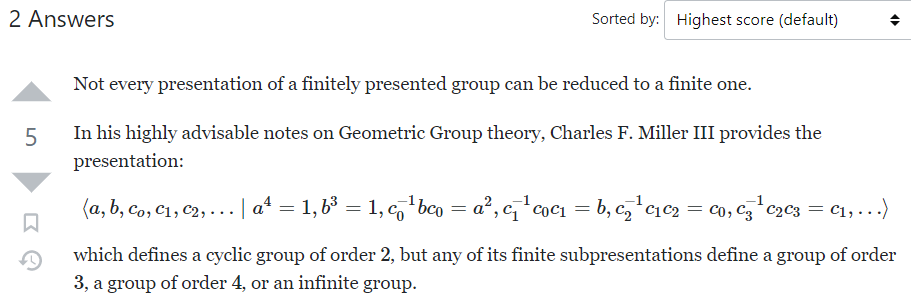
Oh but there are infinitely many generators here
Hmm this is a good question
I will think about it more
 coral shale
 coral spindle
Charles F. Miller III
wow
 rustic crown
agile burrow
Hmm this is a good question
rustic crown
agile burrow
Hmm this is a good question
yea, these things feel very weird to me and i dunno whats the correct way to think about them
 next obsidian
Woah this is wild! Because this is true for abelian groups
agile burrow
Group presentations are hard
coral shale

coral spindle
Free groups are wierd
agile burrow
Very hard
next obsidian
Because of “finitely presented => always finitely presented” for modules
coral spindle
A subgroup of a free group is free, but unfortunately even the free group with 2 generators contains a copy of the free group with infinitely many generators
next obsidian
Cursed fact
coral spindle
We just can't do the same things we would with Abelian groups in the general case 🤷
next obsidian
And the subgroup isn’t even that gross to write down
coral shale
coral spindle
A subgroup of a free group is free, but unfortunately even the free group with 2...
nani

rustic crown
yea consider the subgroup generated by {x^nyx^-n} in F(x,y)
next obsidian
Free group on 2 elements being so fricked is one way to get at Banach-Tarski I believe
coral shale
@warm wyvern you'll love to read up later ^ 
next obsidian
rustic crown
yea consider the subgroup generated by {x^nyx^-n} in F(x,y)
I wanna consider the one generated by {y^nxy^-n} though 
rustic crown
oopsie >.<
rustic crown
next obsidian
Because of “finitely presented => always finitely presented” for modules
its also true for commutative algebras right
next obsidian
Yes
This one is kinda hard to prove tho
Like, it’s not as simple
I think it’s cuz you’re combining generation as a ring with generation of the ideal, module
rustic crown
yea >.<
how do you remember these lol
i always feel i might forget one of these cute sounding facts and they turn out to be massively wrong :p
coral shale
why is algebra:
- look at proof of cool fact, understand it
- forget proof, retain memory of cool fact
and sometimes skip 1 
next obsidian
rustic crown
how do you remember these lol
I have brain problems
coral spindle
That's like, all of math
Oooh there's too much out there to memorise ooooooh so spoooooky
next obsidian
It makes me forget important stuff and remember little nuggets of things
coral shale
coral spindle
That's like, all of math
But some of these are totally non-trivial to reconstruct proofs for
coral spindle
Yes
coral shale
but ig thats all of math when it gets hard
next obsidian
Also often I rmemebe these things because I went “hmm is X true?” Then I look it up and I go “oh wow!”
So I rmemebr it
rustic crown
my brain stops working if even slightest bit of atmosphere around me goes weird, like if my nose gets partially blocked i lose all thinking capabilities
.<
coral spindle
rustic crown
my brain stops working if even slightest bit of atmosphere around me goes weird,...
Ah so when you want to relax you can just plug your nose
and if you want to think again you can eat a curry
🧠
rustic crown
lol
coral shale

coral spindle
No
You should think of projective space as affine space + bits at infinity
the 'top-down' definition that has it as a quotient of lines in the larger space is misleading in this way
Also this is the wrong channel
 formal ermine
oh sorry
coral shale
origin doesn't count as a line wut
 green shell
hi do the rigid motions of a regular n-gon always leave at least one vertex fixed?
coral shale
coral spindle
Also this is the wrong channel
is this linear alg?
man imagine deleting
coral spindle
This is geometry
coral shale
oh ic
rustic crown
green shell
hi do the rigid motions of a regular n-gon always leave at least one vertex fixe...
no, (non-trivial) rotations fix nothing
 coral shale
no?
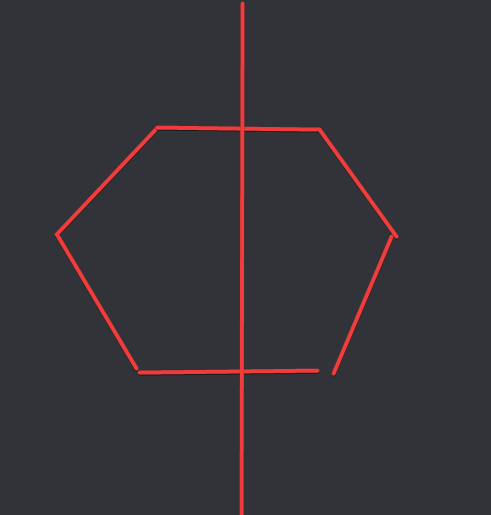
do a line down the middle of a hexagon
that like doesnt touch any vertices
( what a great explanation)
https://i.imgur.com/HUQlWPD.png
 green shell
exactly so how can we possibly capture all reflections by labeling them s_k where k is the vertex that gets fixed
coral spindle
green shell
exactly so how can we possibly capture all reflections by labeling them s_k wher...
This works only in the odd case
coral shale
well regardless, there are only k reflections of a regular k-gon
agile burrow
nvm, I think you are correct det
agile burrow
that any finite generating set yields a finite presentation
The idea is that if you have a finite presentation, then you can consider the corresponding presentation complex
coral shale
coral shale
https://i.imgur.com/uGIkuhB.png
wut about this
agile burrow
that has infinitely many generators
coral shale
ooo.
agile burrow
The idea is that if you have a finite presentation, the corresponding presentation complex has finite 1- and 2-skeleton
coral shale
skeletons. topology!?
green shell
weird yeah the way the proof in my book is written sounds like it's saying that we can enumerate all possible reflections based on which vertex it fixes
agile burrow
then the 2-skeleton of the universal cover is a partial free resolution of Z over ZG
and then it's an application of the same trick you use for finitely presented modules over a ring
coral shale
what is the best way to enumerate the reflections 
I think s_n := s_1r_n
or similar
r_1 being the identity
ok slightly terrible notation
agile burrow
agile burrow
and then it's an application of the same trick you use for finitely presented mo...
Right, because if you have some presentation with finitely many generators, then you can still consider the presentation complex. Again, the 2-skeleton of the universal cover yields a partial free resolution of Z over ZG, where the first term is finitely generated. But by Schanuel's lemma, the kernel of ZG^n -> Z is finitely generated
Mathematics Stack Exchange
In this MO question it is proven the answer is yes for modules. The proof given relies on the snake lemma, which does not generally make sense in the category of rings, groups, monoids, etc.
It se...
Here's something interesting that generalizes this to other algebraic theories
But I like my answer better
 past temple
right
so given a subrepresentation U, we want to find a projector to U since the kernel of that projector will be a linear complement
but we want to make sure that this projector is a homomorphism of representations, as we want the kernel to be a subrepresentation
so the way we do that is, we start with any projector, then we apply the averaging idempotent to it
where "application" means the action of G on Hom(V,V)
being stabilized by this action is equivalent to being a homomorphism of representations
and then we know that the averaging idempotent applied to any vector in a representation of G is stabilized by G
therefore we have demonstrated a projector that is a homomorphism of representations, giving us a complement to our subrepresentation U, completing the proof
formal ermine
why are exact sequences? like I suppose they "appear naturally", but why?
what's so special about them? why not something else?
or is it just mere coincidence?
 void cosmos
do u remember calc 3
a vector field is conservative iff its some F = del (f) for some function f?
yea turns out this shit nots always true
 lethal dune
formal ermine
why are exact sequences? like I suppose they "appear naturally", but why?
lethal dune
formal ermine
why are exact sequences? like I suppose they "appear naturally", but why?
well failure of an complex being exact gives an invariant in some cases, so it's not like why exact sequence but when does it fail
void cosmos
u can have forms that are closed but not exact
a closed form is just a differential form which has derivative = 0
and an exact one is a differential form which is the derivative of some other form with less degree
formal ermine
void cosmos
do u remember calc 3
are you talking to me?
formal ermine
uh I have no idea what you nor ryu are talking about, sorry
void cosmos
do u remember calc 3
formal ermine
I mean exact sequences as in 0 -> M -> M' -> M'' -> 0
void cosmos
yes
formal ermine
I never took calc
formal ermine
yes
void cosmos
okay
 elder wave
since the failure of said statement is measured in the failure of a certain sequence to be exact
void cosmos
let V be a vector space and S be some subspace
do you know about the orthogonal complement
formal ermine
no
formal ermine
yes
void cosmos
okay so let S be a subspace
S^(dagger) is defined to be { x in V | x dot s = 0 for all s in S }
think of it similar to the annihilator (dot product-wise lmfao )
formal ermine
I see
void cosmos
now sometimes you can write the whole vec space as the direct sum of a subspace and its orthogonal complement
like with R^n
do you see that
formal ermine
yeah
void cosmos
thats not always true
exact sequences tell us when this is
when this is not.
thats it
relaly
formal ermine
what would the sequence look like?
void cosmos
think of it
x dot s = 0 ...
kernel? idk
try to experiment with is
with it*
now
u can think of these things but with modules now
u do not have inner products over modules but the quotient structure isnt trivial
so you can htink of this "completing the missing parts" like u did with orthogonal complements
as quotients and shit
so an exact sequence would be when this quotient is exactly whats missing .. something like that
or not this quoteint
this submodule
so basically exact sequences are things that capture a certain situation
cohomology is something that measures how much a certain occurance fails
ur doing the dry version
homological algebra which is this with no motivation or intuition
green shell
coral shale
what is the best way to enumerate the reflections <:Thonk:652978351140765712>
I just needed to read on  the book wasn't claiming that any reflection s must fix a vertex - rather that we only need the reflections that fix at least one vertex to construct all elements of D_n
 void cosmos
most of the time the motivation is geometric or topological ( i think? )
u would have learnt about those in AT or DG
but with a better understanding
agile burrow
Exact sequence
void cosmos
@rustic crown yo you free for a moment
remember when you proved that if a is in the intersection of all prime ideals then a is nilpotent using localizations
i read some stuff about them , can u rewrite it now
i proved (trivially ig) that S^-1 R collapses to 0 iff S has 0
is this enough
and i know how to localize wrt to an element and an ideal
void cosmos
can you re do it now
void cosmos
so i can do it on the exam if i see it XD
rustic crown
me dumb
void cosmos
no u smart
void cosmos
void cosmos
can you re do it now
now that i know some langauge can u re do it
void cosmos
and teach me 😦
rustic crown
okie
rustic crown
so first it's clear that a nilpotent element will be inside every prime right
void cosmos
using zorn?
rustic crown
nah, def of prime
rustic crown
if a is nilpotent, then a^n = 0 in p, so a in p
void cosmos
yes
rustic crown
so we need to show that if s is not nilpotent, then it doesn't lie in some prime
void cosmos
yes
rustic crown
take S = {1, s, s^2, ...}
void cosmos
ok
rustic crown
so you have R --> R[s^-1]
void cosmos
which one
rustic crown
need to find an prime in R that doesn't contain s
and pullback of any prime of R[s^-1] can't contain s
rustic crown
void cosmos
which one
oh me talking about the natural localization map
rustic crown
ye
void cosmos
ok ok
void cosmos
rustic crown
need to find an prime in R that doesn't contain s
pl
ok*
there is a correspondonce
rustic crown
yep, so can we find a prime in R[s^-1]?
void cosmos
between prime ideals in S^-1R and ideals of R that do not intersect S
rustic crown
yep
rustic crown
hm?
rustic crown
when you can find prime ideals in a ring 
void cosmos
did we assume a is nonnilpotent
rustic crown
(say maximals :p)
void cosmos
yea yea
rustic crown
where is a
rustic crown
oh i think i wrote s, but okie
void cosmos
why cant we just preimage
nvm
ik this is local so there must exist atleast one
prime ideal
but idk which one but i dont really care ig
like we do not need to care right?
cuz this is zorn's lemma in disguise
?
ie every element is contained in some maximal (prime) ideal
right?
void cosmos
😠
okay but i think i got it
the whole point of localizing this is that a in R_a is now a unit
rihgt
rustic crown
yep
so a prime in R_a won't contain a
and hence it's preimage also won't contain a
rustic crown
yee so we only need to see why R_a has primes
and that's because it's not the zero ring
rustic crown
void cosmos
isnt any localization local
whut do you mean?
void cosmos
local as in local ring
rustic crown
no no
void cosmos
XD ok
rustic crown
localizing at primes give you local rings
if R is a ring and p a prime, then take S = stuff outside p
so you invert everything that is not in p
and so this new p now beccomes a unique maximal
void cosmos
ohh
rustic crown
by new p, i mean p(S^-1R)
rustic crown
this S^-1R is denoted R_p in this case to confuse everyone
void cosmos
yea
bad question
the localization is a field right?
oh
iff the S is the whole ring
-{0}
nvm
agile burrow
You'd need R to be integral domain for S to be closed in that case
rustic crown
yea
rustic crown
 solar shore
quick question
Indeed, D4, the dihedral group of order 8, has five
subgroups of order 2 and three of order 4.
this doesnt sound right to me
isnt it only 2 of order 4?
R_90 and R_270
is there a third im missing 
 sonic coral
which ones of order 4 do you have
rustic crown
solar shore
R_90 and R_270
you want subgroups of order 4, not elements of order 4

 rustic crown
what's that times cbrt2 - 1
 solar glacier
id have to write it out i cant do that in my head lol hang on
but by times cbrt2-1 whered that even come from
solar glacier
i get -1
solar glacier
that thing being the 1+cubrt2+cbrt4
solar glacier
how do you see that
rustic crown
it's just a very specific thingy
we wanted to compute [Q(that thing):Q]
and it's clear that Q(that thing) is a subfield of Q(cbrt2)
so this degree [Q(that thing):Q] divides 3
now if you can ensure that thing is not rational, you're done
solar glacier
so it must be 1 or 3
but are the minimal polynomials identical for the two splitting fields
solar glacier
or i mean Q adjoing
rustic crown
minimal poly are not the same
but the degree of the extensions are
cause like they're the same thing lol
(hi mniip )
 simple valley
is it the case that if $N \lhd G$ then $<Ind>\nolimits^G_N V = (\text{permutation rep of $G/N$}) \otimes V$?
 cloud walrusBOT
mniip

 delicate orchid
this is true when V is the identity representation, so it must be true in general! 
elder wave
induction
simple valley
what I mean is normality of N "untangles" the induced rep
delicate orchid
delicate orchid
thinkin bout the character
yeah, characters are the same - it's true
infact, I don't even think you need N to be normal
simple valley
wdym
delicate orchid
that iso holds even without N being normal if you just take G/N to be the set of cosets with natural G-action
simple valley
but then it's not \otimes V
 main needle
The prime ideals in $F[X]/I$ are the ideals the corresponding to the ideals in $F[X]$ generated by the prime factors of $f$ where $I = (f(x))$ ?
cloud walrusBOT
ru0xffian
 simple valley
delicate orchid
I do indeed think this is true regardless
simple valley
delicate orchid
I do indeed think this is true regardless
are you sure? I'm no longer sure the question even makes sense
if V is an N-rep you can't quite make a G-rep out of it
delicate orchid
I'm pretty convinced both those reps have the same character when G is normal
simple valley
I was thinking something more along the lines of upgrading G/N-reps to G-reps
but G/N is not a subgroup of G unless direct product in which case trivial
delicate orchid
right that sounds more like lifting than inducing
simple valley
it's not induction if there isn't a coil of wire
delicate orchid
I'm checking le book to make sure
simple valley
ah I think what I really have here is a semidirect product
you can probably formulate something relating lift from (H \ltimes N)/N with induction from H
solar glacier
for this secon patt
part

do I write it as
$(1+\theta)(1+\theta+\theta^2)^{-1}$
cloud walrusBOT
MyMathYourMath
 solar glacier
then find that inverse
delicate orchid
delicate orchid
I'm checking le book to make sure
cause I'm seeing we have the induced character for an arbitrary subgroup is [\text{Ind}N^G \chi(g) = \frac1N\sum{h \in G} \chi'(y^{-1}gy)] where [\chi'(g) = \begin{cases} \chi(g) & g \in N \ 0 & g \not \in N \end{cases}]
If this is equal to the product of the permutation character of $G/N$ with $\chi$ the corresponding $\bC G$-modules will be isomorphic.
cloud walrusBOT
Wew Lads Tbh
 delicate orchid
the permutation character of G/N is obviously [\sigma(g) = \begin{cases} |G/N| & g \in N \ 0 & g \not \in N\end{cases}]
cloud walrusBOT
Wew Lads Tbh
 delicate orchid
hmmm ok now I'm not quite seeing how they multiply to give the same thing
simple valley
ok I have an easy counterexample at hand
I just covered inducing S_5 reps from A_5 reps
delicate orchid
nothing involving tensor products and module isomorphisms is easy 
simple valley
and it doesn't match up
delicate orchid
delicate orchid
hmmm ok now I'm not quite seeing how they multiply to give the same thing
yeah my gut reaction was surprisingly.... wrong!!!!?!?!
simple valley
permutation rep of S_n/A_n is gonna be U+U' (trivial + sign)
 queen bluff
Hello ! If M is a semi-simple R-module, why do we have that for every submodule N of M, M isomorphic to the direct sum N+M/N ? I don't know how to prove this
A semi-simple R-module is such that for every sub module N, there exist P such that it is the direct sur of N and P
delicate orchid
hint, each submodule and quotient of a semi-simple module is semi-simple
gonna take this opportunity to elaborate a bit on my hint, consider the natural surjection from M -> M/N as well
queen bluff
If I restrict this surjection to the "supplementary" of N I have to show that this is an isomorphism right ?
delicate orchid
you mean the submodule that sums with N to make M?
queen bluff
Yes
delicate orchid
yes, you would
queen bluff
But I don't know how to use your first hint sorry
delicate orchid
queen bluff
If I restrict this surjection to the "supplementary" of N I have to show that th...
don't worry too much about it you seemed to know it already
it was to lead you to this realisation (if it was affective or not is up for debate)
queen bluff
delicate orchid
hint, each submodule and quotient of a semi-simple module is semi-simple
I don't know how I am supposed to use that
past temple
im currently struggling on proving the following claim:
let G be a finite group and U, W representations of G, with dim U = 1. I want to show that W is an irreducible representation if and only if U (x) W is
delicate orchid
queen bluff
I don't know how I am supposed to use that
I'm telling you to just ignore it, lol
 south patrol
Oh lol I misread it
queen bluff
Oh sorry !!
south patrol
I thought you meant (M + N)/N lol
delicate orchid
queen bluff
Oh sorry !!
no worries boss, sorry for the confusion
south patrol
past temple
let G be a finite group and U, W representations of G, with dim U = 1. I want to...
Oh lol this was hw for me
Basically to get you started, suppose you have a proper subrep of W. Can you concoct a corresponding subrep of U tensor W?
You can then do a similar thing in reverse
delicate orchid
this question is so much easier with characters  why do they make you people work with modules...
delicate orchid
like I cannot see why ||U \cong CG as 1 dim => W (x) U \cong W|| - this is almost certainly wrong
south patrol
Kinda funny tho that they do general theory kinda painstakingly and then all applications we had were using C
What
Why does the first thing hold
Lol
delicate orchid
it's a dim 1 free module over CG? see this is what I mean
south patrol
Hm why would it be CG
delicate orchid
delicate orchid
it's a dim 1 free module over CG? see this is what I mean
_ _
south patrol
Isn't that saying all 1 dim irreps r the same
south patrol
ye which is not what we're interested in right lol
also like
CG isn't even a dim 1 representation right unless # G = 1
Bruh
delicate orchid
yeah this is why I just don't think of them as modules, ever
delicate orchid
module theorists need pick some rules and stick to them
queen bluff
Does this works ? I have the short exact sequence : 0->N->M->M/N->0 and 0->N->N+P->(N+P)/N->0 , maybe I have to show that P/N is isomorphic to M/N ? I'm getting tired so maybe this is bullshit
And P/N is isomorphic to P right ?
Idk
This makes no sense
Sorry
coral spindle
simple valley
is it the case that if $N \lhd G$ then $\<Ind>\nolimits^G_N V = (\text{permutati...
With what action?
I mean tbh we already have a pretty great description of what happens in this case
I can't remember what theorem in Isaacs, maybe 6.16 is the one?
south patrol
queen bluff
Hello ! If M is a semi-simple R-module, why do we have that for every submodule ...
You should take a complement to N and work with that
Say M = N (+) P
You have to show that N (+) P is isomorphic to what
delicate orchid
coral spindle
I can't remember what theorem in Isaacs, maybe 6.16 is the one?
thank u stack exchange very cool
 queen bluff
N + M/N
coral spindle
delicate orchid
thank u stack exchange very cool
I'm talking about Isaacs' character theory of finite groups
delicate orchid
yeah I've found it now dw
south patrol
To show N (+) P iso to N (+) M/N
queen bluff
P iso to M/N
south patrol
Yup
But really kinda easiest to just eliminate M entirely
so P iso to (N (+) P)/N
Have a go at that
south patrol
Exactly
coral spindle
coral spindle
I can't remember what theorem in Isaacs, maybe 6.16 is the one?
6.16 was indeed it 😎
delicate orchid
shame I cannot decipher it
south patrol
delicate orchid
thank u stack exchange very cool
So true
 queen bluff
Oh nice ! And all the isomorphism I consider are isomorphism of modules @south patrol ?
south patrol
Ye
delicate orchid
the proof I can follow perfectly but the statement of the theorem might as well be Spanish
queen bluff
Nice thank you so much guys !
coral spindle
delicate orchid
the proof I can follow perfectly but the statement of the theorem might as well ...
well maybe this special case is more comprehensible

Theorem 6.16 is quite general
coral spindle
It is an incredible book
 white yoke
Why does this "1 ≠ 0 and if x is any element of R, then x or 1 − x is a unit" imply that R is a local ring?
south patrol
Well if R is a local ring then you have a definite description of what the maximal ideal looks like ig
So try doing that and see what u get
Not sure how to say other than give it away
But maybe you want it given away lol
white yoke
south patrol
Well if R is a local ring then you have a definite description of what the maxim...
All the non units right?
south patrol
Yes
white yoke
But then what
rustic crown
show that forms an ideal
south patrol
Ofc a boring way to do this is just to use known facts on the jacobson radical i think
So you're basically just reproving essentially that
In a special case
If you've seen that
rustic crown
what are the known facts about jacobson radicals lol
white yoke
Idk anything about Jacobson radicals so might be better to avoid that
south patrol
Ye dw
rustic crown
oh you mean that thing
south patrol
Yh
rustic crown
j in J if something something 1 - rj is a unit for every r
rustic crown
i see
rustic crown
rustic crown
show that forms an ideal
from there you would need to then show this is the maximal ideal of the local ring... i.e. every proper ideal is contained in this.
white yoke
rustic crown
from there you would need to then show this is the maximal ideal of the local ri...
If I let m be the set of all non units (i.e. elements of the form 1-x for x a unit) then as long as m is an ideal, it will be maximal (because it contains any other proper ideal since proper ideals cannot contain units)
rustic crown
right
but need to be a bit careful with what you wrote in the first parentheses
if 1-x is a unit, then that doesn't mean x is not a unit
 pastel cliff
can somone help understand what's happening here pls

i know this is just linear algebra
but still
rustic crown
rustic crown
if 1-x is a unit, then that doesn't mean x is not a unit
oh wait you've phrased it a little differently..
pastel cliff
we start with a matrix representing a submodule of a free module and row reduce it to arrive at a nice basis for that submodule?
rustic crown
what i mean is, x non-unit implies 1-x is a unit. but the other way is not true. x unit need not imply 1-x is a non-unit
white yoke
rustic crown
if 1-x is a unit, then that doesn't mean x is not a unit
oh yea
good point thanks
pastel cliff
pastel cliff
can somone help understand what's happening here pls
i promise this isnt a lot
 rustic crown
pastel cliff
i promise this isnt a lot <:sad:532803514892812288>
rustic crown
pastel cliff
i promise this isnt a lot <:sad:532803514892812288>
yea it isnt'
okie lets do that in fields first
say you start with some weird matrix and then i ask you do to do row and column operations
if i just allowed you to do row operations, then you would be left with the reduced row echelon form
but if i allow you to do both, you can make that matrix look really nice
it will be a diagonal matrix with 1s and 0s and there are exact rank(M) many 1s
okie even before that... the question is why would you want to do this weird thing
you can think of a m x n matrix over R as a linear map R^n --> R^m right
if you allow yourself to change basis on both sides, can you make this linear map look really nice?
if R was a field, you can pick basis (x1, ..., xn) and (y1, ..., ym) such that the map is x_i --> y_i for i = 1, 2, ..., r and other x to 0
where r is the rank of your matrix
if R is not a field, then this becomes a little more interesting, since we can't easily kill of an entry of the matrix
over pids, you still can convert this matrix into a nice form using row and column operations
and they have illustrated this Z
so you started with a map Z^2 --> Z^3
the image is the subgroup generated by two weird vectors
when you do a row operation, it's actually multiplying your matrix on the left by an elementary matrix, which in particular is invertible
similarly, when you do a column operation, you're multiplying the matrix on the right with an elementary matrix
pastel cliff

rustic crown
and multiplying by invertible matrices is same as changing basis (on either the source or target)
pastel cliff
rustic crown
if you allow yourself to change basis on both sides, can you make this linear ma...
wdym change basis on both sides
rustic crown
like multiplying a matrix on the right is same as precomposing your map Z^2 --> Z^3 with a nice isomorphism Z^2 --> Z^2
pastel cliff
rustic crown
the image is the subgroup generated by two weird vectors
but we're thinking about this the opposite way right? like a submodule M of a free module R^n must(?) be the image of some linear transformation like this from a basis of the submodule to the whole module?
rustic crown
yea if you assume that the submodule is also free
pastel cliff
is it enough to assume it's finitely generated?
rustic crown
yep, then you get its image of some R^large enough thingy
and if you don't assume that you can just surject it by R^(size of your submodule)
anyway
the point is that if you wanna undersand stuff like (co)kernel or (co)image of this map, you can first convert this matrix to a nicer map and then be happy
pastel cliff
this is the motivation we get at the beginnning
 rustic crown
say you started with the matrix A : R^n --> R^m and then did operations which ends you with B = P^-1 A Q.
where Q : R^n --> R^n and P : R^m --> R^m are nice invertible matrices.
cloud walrusBOT
det
 rustic crown
so with the isomorphism P, you can identify the image of A and image of B easily
and it also induces an isomorphism between the cokernels of A and B
only difference being that the matrix B looks wayyyyy nicer than A
south patrol
Upside down comm diagram
rustic crown
hoomans are so weird
when drawing graphs right and up are the natural choices
but everywhere else, right and down looks natural
pastel cliff
ok but back to the row reduction for a moment
we just row reduce to get a basis for a submodule
rustic crown
okie
yea in that example row reduction was enough to get you to a nice final matrix
but in general you'll also have to use column operations
pastel cliff
and that happens because the matrix encodes the image of Z^2 -> Z^3
which is itself the submodule we’re talking about
rustic crown
pastel cliff
and that happens because the matrix encodes the image of Z^2 -> Z^3
weirdly phrased, but yea something like that
pastel cliff
 rustic crown
anyway, so if M is a finitely presented module, i.e. you have finitely many generators, and the relations are also then finitely generated then this thing can help you understand M nicely
first use the generators to get a surjection R^m --> M
and then the kernel of this it eh relations among the generators
which we assume is finitely generated as well
so you surject that by R^n --> R^m --> M
so image of the first map is exactly the kernel of the second map
so finitely presented modules are exactly the cokernels of matrices R^n --> R^m
if you assume R is noetherian, then a finitely generated module is automatically finitely presented
and pid's are noetherian :3
so if you wanna classify finitely presented modules, a good start is to trouble m x n matrices
if you can classify how they look like up to equivalence, then you're really close to classifying finitely presented modules
next obsidian
I here’s my classification
rustic crown

next obsidian
{R^n/M | M is a fg submodule, and n is a natural number}
 chilly ocean
rustic crown
you never understand math
chilly ocean
rustic crown
you never understand math
you understand some math, and then you get more math that you don't understand
and it keeps on piling up
rustic crown
uwu
 white oxide
bruh isn't this problem my professor posted for the practice midterm kinda like obvious for the <-- direction
 south patrol
I mean
many iff things have one direction way easier than the other
So yeah shouldn't be too surprising overall
This is a typo actually lmao
Should be H subset K or K subset H, of course
past temple

im confused by the application of the orthogonality of characters here to complete this character table
orthogonality of characters states that (X_U, X_V) = 1 if U and V are isomorphic, 0 otherwise, where U and V are irreducible
delicate orchid
past temple
orthogonality of characters states that (X_U, X_V) = 1 if U and V are isomorphic...
This is row orthogonality, column orthogonality is a little different
past temple
how does column orthogonality work?
and can row orthogonality also be used to complete character tables?
 summer path
both orthogonality can be used to complete character tables
chilly ocean
on this topic, does anyone know a good reference for developing some intuition on character theory
past temple
summer path
both orthogonality can be used to complete character tables
how could row-orthogonality be used to complete the above character table?
do we essentially get a system of linear equations?
south patrol
Yes
past temple
ok, that makes sense more or less

im a bit confused about the second-to-last line here
I understand why that identity is true; namely, the irreducible representations appear as direct summands in the regular representation FG, with multiplicities equal to their dimension
however, how does that identity actually help us to compute the character of a last unknown irreducible?
we would need to know what the character of the regular representation of FG is, but how do we even compute that?
delicate orchid
past temple
we would need to know what the character of the regular representation of FG is,...
The regular representation is immaculately well behaved
It’s |G| on the identity and 0 everywhere else
Sorry, regular character
south patrol
My guy said immaculately
delicate orchid
You can see this as the regular rep is the permutation representation of G on itself, which only has any fixed points when the identity is acting on G, in which case it has |G| fixed points
delicate orchid
south patrol
My guy said immaculately
Yeah like Jesus
south patrol
That was a well-conceived joke
delicate orchid
south patrol
That was a well-conceived joke
Unlike the rest of the stuff I post
past temple
delicate orchid
The regular representation is immaculately well behaved
ahhhh right thats perfect
south patrol
Lol
past temple
the character of g is the number of points in G fixed by g
and e fixes every point, while every other element fixes no points
delicate orchid
Yus
 upper pivot
right? nah left regular representation
delicate orchid
Yur
past temple
so beautiful
another note
when computing the derived subgroup of a group
does it suffice to demonstrate some subset of that derived subgroup
then to show that the quotient by that sub-subgroup is abelian?
 toxic zephyr
so i've seen \leq used to denote subspaces/subgroups/subrings. does it also work for subfields? just want to confirm
chilly ocean
How do we know that G_\alpha is a group?
 coral spindle
Try proving it. This occurs because the lower groups form a chain of subgroups
chilly ocean
From transfinite induction
chilly ocean
coral spindle
Try proving it. This occurs because the lower groups form a chain of subgroups
they happen to contain the predecessors?
as a subgroup
The problem is I dont see the explicit construction, where is it?
Of what
oh wait its the next line
for non-limit ordinals
I get it now thanks
 dawn latch
to find all the generators of a group (e.g. Z20), can i just list all the order of each element and conclude that those with order 20 (the same order as Z20), are the generators of the group?
dawn latch
oh yes, my bad for the confusion
coral shale
what u said
dawn latch
thank you
coral shale
element with order equal to order of group is a cyclic generator
dawn latch
how do i find all the distinct subgroups of a cyclic group?
in the case of Z20 (under + mod 20), i know |Z20| = 20. And the positive divisors of 20 are 1, 2, 4, 5, 10, 20.
thus,
<20/1> = <20> = {0}
<20/2> = <10> = {0, 10}
<20/4> = <5> = {0, 5, 10, 15}
<20/5> = <4> = {0, 4, 8, 12, 16}
<20/10> = <2> = {0, 2, 4, 6, 8, 10, 12, 14, 16, 18}
<20/20> = <1> = {0, 1, 2, ..., 17, 18, 19} = Z20
however, with the answer key that our professor provided us, {0, 5} and {0, 1, 2, 3, 4, 5, 6, 7, 8, 9} are said to be subgroups as well. how is that the case?
delicate orchid
I disagree with your professor
 north sand
they arent. probably typo
dawn latch
dawn latch
how do i find **all** the distinct subgroups of a cyclic group?
in the case of...
then, if i could add, the ones I listed are all the distinct subgroups?
north sand
yes
 flint crater
Just want to confirm something. To proof two modules M and N are Jordan-Holder isomorphic is it enough to proof that a chain in M and in N are isomorphic? Or do I need to proof that every possible chain is isomorphic?
simple valley
dawn latch
then, if i could add, the ones I listed are all the distinct subgroups?
A way to see whether that's all of them is to see that <a> = <gcd(a, 20)>, and the values gcd(a,20) can take are exactly the divisors of 20
dawn latch
Is that only for Z_n? how about other cyclic groups, like U(18)?
simple valley
dawn latch
Is that only for Z_n? how about other cyclic groups, like U(18)?
Z_n are the cyclic groups
not sure what you mean by U(18)
a cyclic group is one that is generated by a single element, so a cyclic subgroup of G is generated by a single element of G
dawn latch
oh
dawn latch
simple valley
not sure what you mean by U(18)
my bad, i mean this: U(n) is defined as the set of integers in the range [1, n-1] that are coprime to n, under the operation of multiplication modulo n
or, U(18) = {1,5,7,11,13,17}
delicate orchid
(Z/18Z)^\times
simple valley
that's not always cyclic is it
delicate orchid
It is in this case
But no not always
It’s only cyclic when n is 2, 4, some power of an odd prime, or two times some power of an odd prime
dawn latch
simple valley
that's not always cyclic is it
oh what
simple valley
right so in this case U(18) is isomorphic to C_6
 tribal moss
Ok, U(18) is always cyclic, but U(n) in general may not be.
dawn latch
i'm still not in isomorphism, unfortunately. it's just that U(18) was under the list of cyclic groups in our module.
dawn latch
tribal moss
Ok, U(18) is always cyclic, but U(n) in general may not be.
oh ok
delicate orchid
delicate orchid
It’s only cyclic when n is 2, 4, some power of an odd prime, or two times some p...
Ignored once more
delicate orchid
dawn latch
i'm still not in isomorphism, unfortunately. it's just that U(18) was under the ...
Two groups are isomorphic means you can think of them as being “the same”
dawn latch
delicate orchid
Ignored once more
oh apologies
delicate orchid
You’re just changing what the elements are called
dawn latch
delicate orchid
(Z/18Z)^\times
i'm not sure i get this
tribal moss
delicate orchid
Ignored once more
It's true but didn't really need a response, did it?
simple valley
I'm irked by the use of an "always" quantifier on a statement without free variables
delicate orchid
tribal moss
It's true but didn't really need a response, did it?
Maybe just a thank u… 
dawn latch
delicate orchid
It’s only cyclic when n is 2, 4, some power of an odd prime, or two times some p...
oh ok, so basically U(18) is cyclic since 2 multiplied by 8?
dawn latch
delicate orchid
Maybe just a thank u… <:sadcat:547124024585486359> <:sadcat:547124024585486359> ...
thank u ^ ^
delicate orchid
2*9 but yeah
dawn latch
i was absorbing all the information i am forgetting to reply lol
tribal moss
simple valley
I'm irked by the use of an "always" quantifier on a statement without free varia...
APologies, but it looked like Lowell was about to get himself confused by your "not always".
dawn latch
this is hard
simple valley
U(18) is cyclic because it is generated by 5
the theorem Wew cited might be a little too advanced here
delicate orchid
Yeah, you won’t be told to prove U(n) is cyclic unless it actually is lol
delicate orchid
simple valley
U(18) is cyclic because it is generated by 5
And you prove things are cyclic by finding a generator
tribal moss
It looks like you're not being expected to get any deep insight into U(...) in general right now.
U(18) is just an example of a group where it is not obvious that it's cyclic when you look at its definition, but it turns out it is anyway.
simple valley
anyway my turn especially now that wew is here
delicate orchid
Sorry guys I have to go water my plants….
simple valley
why are all reps of an odd order group complex (except the trivial one)
this is in context of the formula for $\frac{1}{|G|} \sum_g \chi(g^2)$ for real, complex, quaternionic reps
cloud walrusBOT
mniip
 delicate orchid
I think it has something to do with the correspondence between conjugacy classes that square to themselves and real-valued characters
Like if there’s a conjugacy class in an odd order group that squares to itself then it has to just be {e}, but I can’t remember the details
If you want to use the frobby-schur indicator uhhh
ah I see, when the group is odd order $\sum_{g \in G} \chi(g^2) = \sum_{g \in G} \chi(g)$ as the map g -> g^2 is an automorphism of G I think
cloud walrusBOT
Wew Lads Tbh
Compile Error! Click the  reaction for more information.
(You may edit your message to recompile.)
 delicate orchid
Whatever u get the point
simple valley
huh
delicate orchid
Maybe not an automorphism it’s definitely a bijection though which is the main thing
agile burrow
I'm thinking you can look at like \chi(g) = \chi(g^-1) and then use orthogonality to say something
delicate orchid
Then $\sum_{g \in G} \chi(g) = \langle 1, \chi \rangle$ which is 0 unless chi is trivial
cloud walrusBOT
Wew Lads Tbh
 delicate orchid
And 0 implies the character isn’t real valued right?
simple valley
a group of odd order has no elements of order 2?
delicate orchid
Lagrange
delicate orchid
How can they character be real when no odd roots of unity in R?!? Exactly….
tribal moss
simple valley
why are all reps of an odd order group complex (except the trivial one)
You mean all irreducible reps here?
delicate orchid
I presume so, the regular rep is always integer valued
simple valley
yes ofc
delicate orchid
caring about non-irreducibles that's when the pain begins
delicate orchid
delicate orchid
I presume so, the regular rep is always integer valued
also u can just take any irreducible and add it to it's conjugate - what fun!!
tally ho!
dawn latch
If we let G = <a> and |a| = 24, how do i list all the generators for the subgroup of order 8?
i already listed down a^3
since <a^3> = {a^3, a^6, a^9, a^12, a^15, a^18, a^21, a^24} or |a^3| = 8
but how do i know the other ones? do i just manually check each element from a to a^24?
delicate orchid
you're missing the identity in <a^3>
 lusty marlin
a^24 is the identity element
delicate orchid
oh yeah, duh
I quite literally cannot count
anyway - checking each one won't be too bad if you remember tricks like "a is a generator => a^-1 is a generator"
but after a few you might spot a pattern
dawn latch
delicate orchid
anyway - checking each one won't be too bad if you remember tricks like "a is a ...
oh
ok then, i'll just check each manually, hoping there's a pattern to it
thanks
 tender wharf
dawn latch
ok then, i'll just check each manually, hoping there's a pattern to it
tender wharf
dawn latch
ok then, i'll just check each manually, hoping there's a pattern to it
look at the orders 
dawn latch
from this

how was this implied? Because Z24 is a cyclic group of order 24 generated by 1, there is a unique subgroup of order 8, which is < 3 · 1> = <3>
delicate orchid
what other subgroups of order 8 could there possibly be, really
trying to think of how to explain it without just sylow-theorem bashing it
assume there was another group of order 8, as it's a subgroup of a cyclic group it is itself cyclic - it must be generated by an element x of order 8, but all elements of order 8 are in <3> already, so <x> = <3>, thus there is only one subgroup of order 8
delicate orchid
delicate orchid
trying to think of how to explain it without just sylow-theorem bashing it
alternatively C_24 isn't iso to C_8^3 so there's only one sylow 2-subgroup
dawn latch

 delicate orchid
dawn latch
delicate orchid
dawn latch
this is quite literally the same question
 rotund aurora
you have even+even=-1, is that a typo or I'm missing something?
rotund aurora
i guess I should replace Q3 for Q2 in the linear combination
?
fuck it that exercise is kinda dumb anyway
delicate orchid
yeah both coordinates are coprime so I can believe they span everything, if you can show it
rotund aurora
its supposed to create some insight on how you would obtain the points I think in the first place, but meh
tender wharf
dawn latch
notice anything about those ...
well I suppose since it says so
theyre coprime
if k generates a subgroup and n is coprime to k then n generates the same subgroup
dawn latch
tender wharf
if k generates a subgroup and n is coprime to k then n generates the same subgro...
oh, that's neat
tender wharf
There are many ways to check this
fundamental theorem of cyclic groups is probably the most accessible
You could also coset it
dawn latch
a separate (but maybe related) question, given 𝑈(18) = {1, 5, 7, 11, 13, 17} under mult. mod 18. how do i find the number of distinct subgroups of this group? is there a formula
- {1}, the trivial subgroup consisting only of the identity element.
- {1, 5, 7, 11, 13, 17}, the subgroup generated by 5, which has order 2.
- {1, 7, 13}, the subgroup generated by 7, which has order 3.
- {1, 11}, the subgroup generated by 11, which has order 6
this was what i came up with, but how do i know if there's more
delicate orchid
do we mean distinct up to isomorphism or literally every single one
dawn latch
i think the latter, since we haven't reached isomorphism yet
delicate orchid
you could always just google what an isomorphism
anyway there's one subgroup for each factor of 18
dawn latch
for 1, 2, 3, 6, 9?
delicate orchid
and 18
delicate orchid
they don't know what an isomorphism is of course they don't
tender wharf
Actually you don't need that
sigh
Do it by hand then
there's only 6 elements to check
chilly ocean
actually i though i understood the diagram but

if we select G' G and G''
as H G G/H respectively
obvioslu they are isomorphic
and the diagram doesnt tell nothing more than that the lower row is exact
the statement only says that there exists a diagram
and not that for all exact sequence G' G G"
.
 hot lake
uh yeah ?
that works for any short exact sequence
if 0 -> G' -f-> G -g-> G'' -> 0 is exact then G' is isomorphic to ker g and G'' is isomorphic to G/ker g, and they give an isomorphism of short exact sequences
chilly ocean
hot lake
if 0 -> G' -f-> G -g-> G'' -> 0 is exact then G' is isomorphic to ker g and G'' ...
yeah but diagram doesnt say for any such exact sequence but rather that there exists such groups
hot lake
what's at the bottom of the previous page
 hot lake
"for example to say that 0 -> G' -> G -> G'' -> 0 is exact ..."
they are considering any exact sequence
so whatever they say next works for all of them
chilly ocean
yeah okay now it makes better sense
cool thanks
someday ill be able to read diagrams like these
cloud walrusBOT
DraK

 carmine fossil
Well because if this is true and I understand correctly,you can describe all finite fields via multivariate polynomials in a sense
carmine fossil
That's a significantly stronger statement than what I expected
coral spindle
cloud walrus
**DraK**
This is a fine proof, but you can simply observe that F is now a K-vector space, hence has order p^n where n = dim_K F.
(this is me saying that your proof is very overcomplicated)
coral spindle
Well it is very easy to prove :)
In fact I might remind you that it is part of the definition of the degree F:K
carmine fossil
Is the order p^n because you can construct an isomorphism from a K-vector space of dim n to K^n?
And K^n will have p^n elements
coral spindle
Yes
carmine fossil
Ok,I definitely overthought this
carmine fossil
hot lake
it turns out every finite field F is of the form K(alpha1) for some alpha1 in F
Is proving this easy?
coral spindle
It’s not too bad actually
You can prove it by showing that the group of units of a field is cyclic
That proof is a bit tricky but it’s, well, not too bad lol
coral spindle
coral spindle
You can prove it by showing that the group of units of a field is cyclic
N.b. this only applies to finite fields. The general statement is that any finite subgroup of a group of units of a field is cyclic.
coral spindle
rustic crown
you just get used to it
When I first heard this saying, I didn't understand it, but now I'm used to it.
white yoke
In a group ring R[G], I don't understand what the trivial units are? Are they the units in R or are they the units in G?
coral spindle
The units in R
At least, this is the terminology I'm used to
You should double check with the text you're reading.
white yoke
Okay thanks
coral spindle
Context!!!
white yoke
It does say the units in R but something someone said to me confused me because they seemed to suggest it was G
Never mind then haha
So in Z[C_3] the trivial units are {1,-1} ?
coral spindle
If that's the definition then yes
I'm sure you can see why someone might be inclined to call the elements of G multiplied by the units of R "trivial units"
white yoke
Oh yes I've heard that as a definition too, that's what I meant
coral spindle
The "tensor power"
south patrol
One defines it analogously to normal products
like $v^{\otimes n} = v \otimes \dots \otimes v$ n times
cloud walrusBOT
potato

 odd abyss
coral spindle
The "tensor power"
odd abyss
coral spindle
The "tensor power"
I mean seriously
south patrol
I mean that is the name lol
The [...]th/st/rd tensor power of the vector (or vector space or whatever according to context)
odd abyss
s $v^{\otimes n} = v \otimes \dots \otimes v$ n fois
south patrol
Oui
cloud walrusBOT
Baba
 south patrol
exactement
formal ermine
🥖
coral spindle
odd abyss
I mean seriously
I didn’t want to step on potato’s toes 😊
south patrol
I don't have toes
 obsidian sleet
potatoes
south patrol
AYY
coral spindle
south patrol
I don't have toes
I didn’t want to step on any part of you 
south patrol
thank
odd abyss
south patrol
exactement
ok thank you
because im french
Just to be sure
If I have
$v^{\otimes 2}$
cloud walrusBOT
Baba
 odd abyss
$v^{\otimes 2} = v \otimes v$ ?
cloud walrusBOT
Baba
 cloud walrusBOT
Baba
 delicate orchid
why would we define it to be the second one
 south patrol
n terms so the former
odd abyss
tensor product which must appear n times
delicate orchid
cloud walrus
**Baba**
yes but why in god's name would we define it to be this?? We'd keep it consistent with regular multiplication
 delicate orchid
yup
odd abyss
Ok thank you!
rustic crown
coral spindle
When I first heard this saying, I didn't understand it, but now I'm used to it.
 karmic moat
delicate orchid
yes but why in god's name would we define it to be this?? We'd keep it consisten...
karmic moat
delicate orchid
yes but why in god's name would we define it to be this?? We'd keep it consisten...
$v^{2\otimes} = v\otimes v \otimes v$ troll face
cloud walrusBOT
anamono for anamono

 charred crescent
dumb question, but if two conditions are "equivalent" that means one if and only if the other right?
karmic moat
yeah
charred crescent
okay thank you


 formal ermine
what part are you confused about
 hollow mica
the isomorphism with C
hollow mica
I don't get what you mean by "add an element"
formal ermine
just like in R[x]/(x^2) we have x^2 = 0 and thus only linear polynomials
formal ermine
hollow mica
because any term with `(x^2 + 1)` disappears
yes
now do minus one
and you get x^2 = -1
so every time x^2 appears, you can "replace" it with -1
which is equivalent to i, the imaginary unit
formal ermine
yeah
because anything with x^2 will turn into a linear term
thus by induction blabla only linear terms
hollow mica
this all checks out
but is there a general way to make this precise
like the notes I'm reading just dropped this on me
formal ermine
Yes
this was the ring theory explanation
I personally prefer the field theory one
it goes along the lines of
modding a field out by a polynomial is like taking its splitting field over that field
i.e. you add all roots of your polynomial to the field (minimal field that contains the base field and the roots of the polynomial)
the roots of x^2 + 1 in the algebraic closure of R (which is C) are precisely \pm i
so R[x]/(x^2 + 1) = R(i) = C
another way to see this is that [C : R] = 2, and C being algebraically closed. though this might mean nothing to you
R(i) means minimal field over R that contains i
hollow mica
hm idk any field theory probably a good time to learn some
I just picked up some comm alg notes so I could understand tensor product over modules
formal ermine
I'm gonna take a bath now, maybe someone else will be able to help you in the meantime while I'm gone
hollow mica
thanks for the help
formal ermine
np 
hollow mica
dumb question but why does 0 = 1 imply a ring is trivial
rustic crown
because you can muliply both sides by any element of the ring
hollow mica
If 0 = 1 in a ring R, and x \in R is not equal to 0 (and thus or 1), then x = x * 1 = x * 0 = 0.
nice
 warm shoal
I am trying to find the cosets of H
Aren't they just H+0, H+1..., H+4 ?
I know there are 5 because |G|/|H| = 5
Do I have to say anything about left and right cosets?
In this case it's all the same right?
coral spindle
In this case the left and right cosets are the same, yes
warm shoal
Should I state that 🙂 ?
coral spindle
warm shoal
Aren't they just H+0, H+1..., H+4 ?
They are. You should try and prove these are all of them, which is to say that you should try showing that they are all distinct.
coral spindle
warm shoal
Should I state that 🙂 ?
If the question asked you just to 'find the cosets' it is likely that the asker was already aware that they are the same.
warm shoal
oh gotcha
how do I prove they are distinct?
I got all the elements of each
and they encompass all the elements of Z15
and I know H+0 = H+5 = H+10
coral spindle
warm shoal
I got all the elements of each
So if you've done this, then you're done.
hollow mica
It is true that there is a ring isomorphism between R[x]/(x^2 + 1) and C, but since multiplicative inverses exist in C, shouldn't they exist in the first ring too?
but like, while 3 + 4i has inverse (3 - 4i) / 25, the polynomial 3 + 4x in the first ring doesn't have an inverse
hollow mica
hollow mica
It is true that there is a ring isomorphism between `R[x]/(x^2 + 1)` and `C`, bu...
I guess this logic is faulty then
coral spindle
hollow mica
It is true that there is a ring isomorphism between `R[x]/(x^2 + 1)` and `C`, bu...
Multiplicative inverses do exist in R[x]/(x^2 + 1). Try describing them.
You've confused the element 3 + 4x of R[x] with the element 3 + 4x + (x^2 + 1) in R[x]/(x^2+1).
hollow mica
oh they have to multiply to x^2 + 1
coral spindle
No that's not true
coral spindle
x^2 + 1 = 0 in the quotient ring
hollow mica
(x^2 + 1) = {f(x) * (x^2 + 1) where f(x) \in R[x]}
R[x]/(x^2 + 1) = {g(x) + (x^2 + 1) where g(x) \in R[x]}
in this quotient ring, the multiplicative identity is 1 + (x^2 + 1)
hollow mica
so to find the inverse of the coset (3x + 4) + (x^2 + 1), I need to find an f(x) \in R[x] so that
f(x)*(3x+4) + (x^2 + 1) = 1 + (x^2 + 1)
coral shale
set I = (x^2+1)
coral shale
hollow mica
so to find the inverse of the coset `(3x + 4) + (x^2 + 1)`, I need to find an `f...
seems so.
coral spindle
Hint: use the (extended) Euclidean algorithm
formal ermine
coral spindle
Hint: use the (extended) Euclidean algorithm
beat me to it
hollow mica
x^2 + 2 = (3x + 4) * (1/3x + 1/2) - 17/6x
(3x + 4) = (-17/6x)(-18/17) + 4
-17/6x = 4(-17/24x) + 0
am i doing something wrong
coral spindle
I suggest you think a bit more about why the hint is useful
hollow mica
yeah I'm suppose to get a 1 in the last two equations so then I can back substitute
ok scratch that those are just details, if R is isomorphic to S as a ring, and S also has a field structure, then R should also admit the same field structure and thus be isomorphic to S as a field?
coral spindle
Yes
hollow mica
hollow mica
ok scratch that those are just details, if `R` is isomorphic to `S` as a ring, a...
well assuming the field structure S admits is identical to its ring structure + defining inverses, versus some completely different thing
well I guess R could also admit the "completely different" ring structure since they're already isomorphic as rings
 prime sundial
is it possible to construct a group presentation of Z^3 with only 2 relations? so an abelian group of 3 generators, where the commutativity is given with only 2 relations?
warm shoal
Any insight would be greatly appreciated
 barren sierra
what are the conditions to be a subgroup of G?
warm shoal
for all x, y in H, x*y must be in H (for H being a subgroup of G)
barren sierra
cool
warm shoal
and for all x in H, inverse x must be in H
barren sierra
ok so let x, y be in C_a
warm shoal
as I just learned 🙂