#groups-rings-fields
1 messages · Page 65 of 1
 cyan marten
 past temple
wdym
im not rly sure that its easy.. its a ton of computations
thats my current understanding of how character theory is useful atm
is there a simpler way of simply checking if a repn is irreducible or not?
thats what my original question was to begin with
cyan marten
past temple
thats what my original question was to begin with
Yeah, I was trying to understand what you mean by "easy"
Well, maybe one could somehow prove that it's hard to check that
past temple
but character theory isnt applicable for non-algebraically closed fields
and so is there an algorithmic way to tell if a repn over R is irreducible by looking at the matrices?
 brisk spindle
Im stuck here help
 coral spindle
past temple
but character theory isnt applicable for non-algebraically closed fields
coral spindle
past temple
but character theory isnt applicable for non-algebraically closed fields
character theory is applicable for non-algebraically closed fields
just not all of it works, necessarily
According to this mathoverflow question, an algorithm to determine this kind of question is an area of active research: https://mathoverflow.net/questions/111404/algorithm-to-check-is-representation-irreducible-algorithm-to-decompose-the-r

MathOverflow
Question 1 Given a representation of a finite group, what algorithm can be used to check is it irreducible or not ?
(Main case - complex numbers, comments on other cases are also welcome. "Given"...
past temple
i see, i dont think my knowledge of representation theory is quite advanced enough to undersatnd that post
but to be more specific about my question
im trying to show that a particular representation of a finite group in R^4 is reducible over R
all of the matrices of the generators of my group have complex eigenvalues, so they obviously cannot have 1-D R-invariant subspaces
this also implies that my representation cant have any 3-D invariant subspaces, because by complete reducibility, that would imply that there's also a 1-D invariant subspace
but im kind of stuck for 2-D
would it be valid to show that the matrix representations of my group elements cannot be similar to a block-upper triangular matrix with 2x2 blocks?
@coral spindle
coral spindle
Yes
 vivid tiger
1 is not in all of them
 white oxide
nvm i looked up the solution online and i still dont get it
this shit is so frustrating
 tender wharf
could you post the question here so we can take a look

 white oxide
i still dont get how it shows that the number of generators adds up to n, and that line, thus sigma counts each element of Z_n once and only once as a generator of a subgroup of order d dividing n does not make sense at all to me
ig that would have to follow from every single element in Z_n generating a subgroup
but the problem is there's multiple generators of that subgroup
white oxide
I think it’s just one of those things that is hiding in plain sight
But I’ve thought too long about this question for my brain to process anything
And I can see that ur right
white oxide
It’s prolly best to do an example
Yeah
i still dont get it at all
is it like you set up a bijection or something
take Z_4
then by exercise 45 it's subgroups are Z_4 itself, Z_2 and Z_1
phi(4) = 2
phi(2) = 1
phi(1) = 1
sure makes sense
4 generators
Z_4 has 4 elements
tender wharf
try looking at U(4) U(2) and U(1)
white oxide
so are you supposed to set up a bijection between the generators and n
or something
and ig my question is how do you even prove that
white oxide
tender wharf
try looking at U(4) U(2) and U(1)
what does U denote
tender wharf
like the set of positive integers coprime to 4
sorry I need to eat
i may be back but if not someone else will be here
 main needle
If $f \in F[X]$ where $F$ is a subfield of some field $E$. If $a \in E$ is a repeated root of $f$, does that force $a \in F $
 cloud walrusBOT
ru0xffian
 coral spindle
No. Take F = R, f(x) = (x^2 +1)^2, and a = i.
main needle
coral spindle
No. Take F = R, f(x) = (x^2 +1)^2, and a = i.
yeah should've thought about that more. I am trying to show that If $a$ is a repeated root of $f$, then $f, f'$ are not coprime on $F[X]$ but I can't make sure that their divisor must lie on $F[X]$ rather than $E[X]$
cloud walrusBOT
ru0xffian
 coral spindle
The GCD of f and f' in E[X] must divide the gcd in F[X], which is always nonzero.
main needle
Oh yeah that makes a lot of sense. Thanks
 boreal inlet
Prove that if G is a finite group with even number of conjugate classes, then |G| is even.
There's the hint where it says we can use class equation
What I know is
The number of conjugates of an element a in G is the index of Centralizer of a in G
And also, all elements in center of G form a singleton equivalence class by themselves
how should I proceed
main needle
Orbit-Stabilizer ?
boreal inlet
that says index of Stabillizer is the order of orbit for an element
I'm sorry I'm actually lost 
coral spindle
I don't see how orbit-stabiliser would be useful.
I think you should look at the class equation.
Remember also that the order of any equivalence class divides the order of the group.
boreal inlet
coral spindle
Remember also that the order of any equivalence class divides the order of the g...
yes, because it's the index of the centralizer of the representative element
 young fiber
Conjugacy classes partition the group
coral spindle
You have all the information necessary to solve this here. I think you should continue trying to solve it, focusing on the aspects that I pointed out
boreal inlet
ok thankss I'll try, if I still don't able to i'll ask
young fiber
|G| is the sum of orders of conjugacy classes
coral spindle
The fact you state is referred to as the class formula, which has been mentioned already.
boreal inlet
I'm sorry I got stuck in the equation itself
I assumed k elements were in the center
these form k equivalence classes
after that I tried to use this fact
$i_{G}(C_{G}(g)) = \frac{|G|}{|C_{G}(g)|}$
cloud walrusBOT
rikusp2002
 coral spindle
Don't use that fact, you don't need it.
boreal inlet
oh
coral spindle
I will say again that you should look at the class equation
and also recall that the size of any conjugacy class divides the order of the group
boreal inlet
class equation is about the order of G right?
which is the sum of order of Center and sizes of Conjugacy classes
coral spindle
I suggest you go back and look at what it is again
boreal inlet
ok wait
https://groupprops.subwiki.org/wiki/Class_equation_of_a_group this says the same as my textbook does
coral spindle
Let's put this in different words, then.
The sum of the sizes of conjugacy classes is |G|.
Use this fact now
boreal inlet
OH
wait
let's take one conjugacy class
$\frac{|G|}{|C_{G}(g)|} \text{" divides "} |G|$
cloud walrusBOT
rikusp2002
 boreal inlet
which is the size of one conjugacy class
no.
this actually doesn't get me anywhere
coral spindle
It does
boreal inlet
oh..?
coral spindle
I don't know why you're writing out |G|/|C_G(g)| every time
just write |g^G|
As I said, you do not need to use the fact that |g^G| * |C_G(g)| = |G|, only that |g^G| divides |G|.
boreal inlet
You know what let's use contradiction
If order of G is odd
|Z(G)| divides |G| and has to be odd
Also all sizes of conjugacy classes would also be odd
coral spindle
Go on
boreal inlet
How do I show number of conjugacy classes this way is also odd 
Wait
Odd minus odd is even
So
Sum of all elements in conjugacy classes represented by non central elements is even
So number of conjugacy classes is odd
I think we're done
coral spindle
Simplify this proof, by not considering the central and non-central case
Just consider the number of conjugacy classes
boreal inlet
Man it took me forever to do such a simple thing  exam preparation pressure sucks
I'll try to shorten this
Thanks a lot though, you helped a lot

coral spindle
I'll write out the shorter version
If |G| is odd, then the size of every conjugacy class is odd. If there were an even number of conjugacy classes, then since the sum of an even number of odd numbers is even, |G| would be even, which we assumed was false.
coral spindle
It takes time to learn to find proofs quickly. Dw.
boreal inlet

past temple
if i have a morphism f : U -> V (x) W
are there morphism f1 : U -> V, f2: U -> W such that f = f1 (x) f2
where (x) denotes tensor product
coral spindle
This would imply that everything in the image of f is a simple tensor, which is usually false.
E.g. take U = V \otimes W
and of course let V, W be, let's say, vector spaces of dimension at least 2.
past temple
i see
 sonic coral
How do you know if something has index 2?
thats the amount of distinct right (left) cosets right?
coral spindle
Yes
sonic coral
I was told i needed to use that to show a group of order 2p^n for odd prime p is not simple, but I dont know how to get to the fact that it has index 2
 tribal moss
Do you have the Sylow theorems available?
sonic coral
yes
tribal moss
What is the index of a Sylow p-subgroup of the group in question, then?
sonic coral
i know it’s gonna be index 2 since you’re asking me, but i don’t really know why
tribal moss
Hmm.
 next obsidian
Do you know what Lagrange’s theorem is
tribal moss
What is the order of a Sylow p-subgroup in our group?
next obsidian
It gives you a way to compute the index of a subgroup given information about its size
sonic coral
yes. the order of the subgroups divide the order of the group
sonic coral
it gives us the possible orders of the subgroups but not the existence
next obsidian
It gives you a specific formula which implies that the order of the subgroup divides the order of the group
At least in the formulation I’ve seen it
sonic coral
tribal moss
What is the _order_ of a Sylow p-subgroup in our group?
2 right
tribal moss
No, that would be a Sylow 2-subgroup.
tribal moss
So if you have a subgroup of order p^n in a group of order 2p^n, what is its index?
tribal moss
What does "index" mean?
tribal moss
Right. And do you know all of the cosets have the same size?
tribal moss
Which means there are how many of them?
sonic coral
- So an index is the possible ways to partition a group of order n into sets of the same size?
sonic coral
yeah i’m just trying to think about what it is while avoiding the term coset
tribal moss
At this point I think you should really take Chmonkey's hint and look at the statement at https://en.wikipedia.org/wiki/Lagrange's_theorem_(group_theory)

(And I'll admit I had also just internalized "Lagrange's theorem" as just meaning "the order of an element divides the order of the group" -- but there's indeed more to it).
sonic coral
Let H be the sylow p-subgroup of order p^n
then by lagrange theorem, |G| = 2p^n = [G:H] * |H| = [G:H] * p^n
and so [G:H] has index 2
hence H is normal in G by the index 2 lemma and so G is not simple
tribal moss
Right!
 void cosmos
yo howtf is the last statement true

 quiet pelican
void cosmos
yo howtf is the last statement true
quiet pelican
void cosmos
yo howtf is the last statement true
Given f in C(R)
Take a continuous function, g, such that g(s) = 0, g(r) = f(r)
Then g in ker phi_s, and f - g in ker phi_r
 soft ore
Is anyone familiar with any methods to compute high degree (eg. >1,000) primitive polynomials in finite fields?
 formal ermine
soft ore
Is anyone familiar with any methods to compute high degree (eg. >1,000) primitiv...
formal ermine
soft ore
Is anyone familiar with any methods to compute high degree (eg. >1,000) primitiv...
maybe this can be of interest to you? http://www.seanerikoconnor.freeservers.com/Mathematics/AbstractAlgebra/PrimitivePolynomials/theory.html#AppendixD
Mathematical theory behind the algorithm for computing primitive polynomials of degree n modulo p.
soft ore
formal ermine
maybe this can be of interest to you? http://www.seanerikoconnor.freeservers.com...
Thanks, I was hoping someone might know of instances where the performance of this algorithm can be exceeded using algebraic tricks.
soft ore

American Mathematical Society
Advancing research. Creating connections.
Something like this would be a pretty good example
 static needle
I saw this and you immediately know what i mustve been thinking

QUOTIENT GROUP

Ofc im assuming P has total order inwich any $p_i$ and $p_j$ $\in P$ are comparable
cloud walrusBOT
messyinterval

 wraith swan
Moved to #linear-algebra
static needle
wraith swan
Moved to <#540211747613704221>
This deserves to be discussed under #linear-algebra
 coral shale
 coarse musk
so the question says, describe the elements of z[1/6]
coarse musk
so the question says, describe the elements of z[1/6]
So you identified earlier the quotient
Z[x]/(6x-1)
right?
coarse musk
yep
coarse musk
as far as I understand, the notation means that we're looking at polynomials with 1/6 as a root
so x=1/6
and generate 6x-1
as that would equate a 0
and generate a homomorphism from there
as far as I understand till now
coral shale
Sorry, back
So to be clear - there is an isomorphism between A = Z[x]/(6x-1) and B = Z[1/6]
you map x to 1/6 as you've said.
So you should think about quotients like 'modding' out
coarse musk
hmm okay
coral shale
(btw I'll also say understanding this quotient is probably not necessary for the questiono)
but its worth it
coarse musk
yes
coral shale
So, a simpler example
Z[x]/(3)
This should be one you are familiar with
Or even Z/(3)
coarse musk
yes, this contains polynomials with coefficients as 0,1 or 2 if i'm not wrong
coral shale
yes
integer polynomials mod 3
In the same way, think of Z[x]/(6x-1) as integer polynomials mod '6x - 1'
If I give you a cubic polynomial, you can find an element in its class with lower degree by adding multiples of 6x-1, since that is now 0
6x^3 = 6x^3 - x^2(6x-1) = x^2
for example.
just like modular arithmetic
coarse musk
hmm yep i get what you're saying
coral shale
So if your ring is also a euclidean domain - then you know for sure you can utilize the euclidean algorithm
to help simplify
if not, it might be a little more tricky
But back to the question - I don't think it wants you to do this at all
Just directly utilize the definition of Z[a], a ring adjoined with an element
coarse musk
hmm okay, so then how would I get a general description for the elements of Z[1/6]?
coral shale
Yeah, I'm not 100% sure if thats what they want
so you know Z[a] = {n + ma : n, m in Z} ?
coarse musk
the division algorithm?
coral shale
or Z + aZ (maybe you havent seen this notation, related to modules)
coarse musk
coral shale
~~or Z + aZ (maybe you havent seen this notation, related to modules)~~
haven't
coral shale
coral shale
~~so you know Z[a] = {n + ma : n, m in Z} ?~~
ok well, id just stick with this
coral shale
coral shale
~~so you know Z[a] = {n + ma : n, m in Z} ?~~
I mean the actual definition is 'the smallest ring that contains Z and a', but this is more handy to use
coarse musk
hmm yes I've seen that
think I get that
I feel like I understand that, but when faced with a problem I stuggle to apply it
for instance, this problem itself
the 1/6 one
coral shale
oh i think i mistyped, silly me
coral shale
coral shale
~~so you know Z[a] = {n + ma : n, m in Z} ?~~
Its polynomials in a with integer coefficients, im clowning
rusty on this 
 coarse musk
yes, I understand this
coral shale
,,R[a] = {\sum^n_{i=0}k_ia^n : \text{for some $n$ and $k_i$'s}}
coral shale
coarse musk
I feel like I understand that, but when faced with a problem I stuggle to apply ...
Ok, in that case, perhaps 'write' some elements out?
coarse musk
how would I do that, for z[1/6]? I tried to write some polynomials, see what I get if I divide them by the respective power of 6x-1
but stuck from there
coral shale
mmmm
mmm
so just to give an example
2 + 5(1/6) - 3(1/6)^2 is one such polynomial in 1/6
So its a linear combination of non-negative powers of 1/6 with integer coefficients --- another way to view it
Sorry if I'm not being very helpful, the descriptive nature of the Q 
coarse musk
oh wait....OH DAMN OKAY I SEE SOMETHING NOW
ok wait no
i think i get it
so it would be a/6^n, where a,n belong to Z?
if I'm not wrong
coarse musk
oh that's perfect, that's the answer but was struggling to get to that
coral shale
coral shale
So its a linear combination of non-negative powers of 1/6 with integer coefficie...
Using 6(1/6) = 1, yes you do get to this simplification from here
coarse musk
but I had another question, it says show that Z[x]/(2x-1,2)=0
similar, but struggling with this
coral shale
0 being the uh
trivial ring im guessing
Ok, so for starters, (2x - 1, 2), do you know what this ideal 'looks' like
coarse musk
it says, if u kill a unit, the ring dies, show it using this example
coarse musk
coral shale
Ok, so for starters, (2x - 1, 2), do you know what this ideal 'looks' like
I see that it is all polynomials with 0,1 as coefficients, but looking at it as those mod 2x-1
coral shale
indeed
you're taking Z[x] and setting both 2 AND 2x-1 to 0
its isomorphic to
Z_2[x]/(2x-1) = Z_2[x]/(1)
coarse musk
coral shale
Z_2[x]/(2x-1) = Z_2[x]/(1)
i odn't get this
coral shale
which part
coarse musk
how did u come to this conclusion
coarse musk
coral shale
you're taking Z[x] and setting both 2 AND 2x-1 to 0
this i get
coral shale
Z[x]/(2x-1, 2) = Z_2[x]/(2x-1) = Z_2[x]/(-1)
So I claim 2 isomorphisms, which don't you get
coarse musk
how is part 2 equal to part 3
coral shale
because 2x = 0x
coarse musk
the second one
coral shale
oh sorry, i should write -1
coarse musk
ohhhh
coral shale
but ofc, thats the same ideal
coral shale
no its ok lol
coral shale
i dont think trivial is the name
(0) is the trivial ideal
(1) is the ring, or more generally (unit) is the ring (prove this!)
coral shale
thats a bit informal
 elder wave

coral shale
I think it wants you to show R/(unit) = trivial ring
And you can do this by showing (unit) = R
this is defo an exercise worth doing
coral shale
uh
coarse musk
coarse musk
Ok so u can say that 1 maps to 0
As it's an ideal in this situation
coral shale
R/(1) case sure
coarse musk
Yep
coral shale
but your reasoning isnt watertight for a general unit
You need to show an ideal containing a unit is the entire ring
coarse musk
How would u do that?
 coarse musk
Ohh
Okay I'll give a shot!
Thanks a lot for this btw! I get the general idea of how this work
Works
 dreamy chasm
could anyone help me with this problem? I think the quotient ring is a field, because x^2+x+3 is irreducible. how can I find the inverse of x?

 south patrol
Well, I think you should check whether it is irreducible again
quiet pelican
dreamy chasm
could anyone help me with this problem? I think the quotient ring is a field, be...
It’s not irreducible
south patrol
Lol
coral shale
oops finite ring
quiet pelican
quiet pelican
It’s not irreducible
Hint: you’re not working over Z
dreamy chasm
oh. I thought it wasn't bc it couldn't be factored
south patrol
It can
quiet pelican
dreamy chasm
oh. I thought it wasn't bc it couldn't be factored
It can’t over Z, but it can be over Z5
south patrol
Since it's degree 2, you can just check whether it has any roots
And since you're in a finite field, that is a finite task
coral shale
=< deg 3 
south patrol
Indeed
quiet pelican
south patrol
And since you're in a finite field, that is a finite task
It’s also a finite task in Z
Size arguments bound the sizes of roots quite easily
quiet pelican
south patrol
Even the worst possible method is finite
The worst possible reasonable method
You could say, only ever check 0
dreamy chasm
well 1 is a root, right? since we're in Z_5
quiet pelican
Infinitely many times
quiet pelican
dreamy chasm
well 1 is a root, right? since we're in Z_5
Yes
south patrol
So x-1 is a factor
Not irred
Also like follow up question for you: why doesn't the question allow for the quotient to be an integral domain but not a field?
quiet pelican
5 = 0 in Z5
formal ermine
fwiw pZ is maximal iff p is prime
south patrol
Okay, well what I was gonna point out was that any finite integral domain is a field
if R is a finite integral domain and x a nonzero element, then multiplication by x gives you an injective map R -> R
But R is finite, so that map is surjective
That is, there is an element y in R such that xy=1
So x is a unit
 fossil shore
Hey, don't we need X to be countable here, or am I missing something?
 coral spindle
It does not need to be countable, no
Hint for showing this: ||indicator functions||
fossil shore
I was also using indicator functions but had a hard time showing surjectivity
coral spindle
Keep trying
formal ermine
let $A$ be an $A$ module, is there any nice condition when $A$ can be decomposed to a direct sum of ideals? i.e. [ A = \bigoplus a_i ] other than when $A$ is a direct product as a ring?
void cosmos
ig check out artin-weddeburn theorem
coral spindle
We call such rings semisimple, and there are several equivalent conditions.
I realised after I wrote this that you may not have been talking about a decomposition into a direct sum of minimal ideals.
If $R = I \oplus J$, consider the $R$-linear projection map $\pi \colon R \to I$, and in particular consider the image of $1$, which we will call $e = \pi(1) \in I$. Now $e^2 = e\pi(1) = \pi(e) = e$, so $e$ is an idempotent. Now try verifying for yourself that $I = eRe$.
I'll have to keep writing without it then
 lethal dune
yea decomposing into ideals is same as decomposing 1 into idempotents
coral spindle
To finish this thought
$J$ and $I$ are therefore defined by certain idempotents which we'll call $e_I$ and $e_J$. Try verifying that these two idempotents commute.
Furthermore, suppose that you have commuting idempotents that sum to 1. Try showing that this then gives you a decomposition into ideals.
In fact I may have left out that the product of the idempotents should be 0 – perhaps you can check this
sonic coral
Can I get a hint for this one? I have shown that H intersect K is a subgroup of G if both H and K are subgroups of G, but thats as far as ive got.
 sonic coral
the set of all g in G such that g(H intersect K)g' = H intersect K
 barren sierra
Ok so start with an element h in H
You want to show that this condition is satisfied
so in particular h(H ∩ K)h^-1 ⊆ H ∩ K right?
sonic coral
since h in H is also in G, yes
barren sierra
So start trying to show that, and let me know where you get stuck
sonic coral
barren sierra
so in particular h(H ∩ K)h^-1 ⊆ H ∩ K right?
Since H cap K is a subgroup, contained in H, then it is closed and so multiplying by h and h' still gives an element in H cap K?
barren sierra
Errrrr
That's close but not right
Closure means that multiplying an element of H ∩ K by an element of H ∩ K gives you an element in H ∩ K
You do not know if h is in H ∩ K, just that it's in h
sonic coral
yeah i see that now
sonic coral
i know H cap K is also contained in K but i dont think that will help me either
barren sierra
not just containment, you're given two pieces of information about how H ∩ K is normal in H and K
sonic coral
Since H cap K is normal in H, there hk = kh' for some h' in H, right? This is just the definition of normal
barren sierra
Close. The definition (which is equivalent, check it) of normal that I like is that N is normal in G if for all n in N, g in G, we have gng^-1 = n
sonic coral
the n's dont necessarily have to be the same though, right?
barren sierra
They are
They don't have to be though cause of closure properties I guess
I think
Oh wait NVM I'm dumb they don't have to be the same
Ok so N is normal in G if for all n in N, g in G, we have gng^-1 = n' for some n' in N
So it's an element in N
sonic coral
thats why i like my definition bc it helps me remember that they need not be the same
barren sierra
barren sierra
so in particular h(H ∩ K)h^-1 ⊆ H ∩ K right?
And what do we want to show?
sonic coral
h is in H cap K
so in particular we need it in K
h = kh'k^-1 this implies that k is in H?
i think i got that backwards
barren sierra
Write out a full proof, as much as you can, in one go. I'm a bit lost myself about what you have shown and what you haven't shown, and also I think you actually have everything you need and you will see that if you try to write it out in one go
 barren sierra
What is k?
sonic coral
k is in K
coral shale
In particular h = hhh^-1 = ...
sonic coral
h(kh'k^-1)h^-1 = (hk)h'(hk)^-1
coral shale
also for some h' in H n K surely right?
wait i think i misread
I don't think I follow that . . .

k in K, h in H
surely h needs to live in H n K for this to hold
or did i misremember 
sonic coral
i dont know im lost
coral shale
ok ok
N normalsub G
iff
(forall g in G) gHg^-1 = H
iff
(forall g in G)(forall h in H)(exists h' in H) gh'g^-1 = h
I think.
sonic coral
x in G?
coral shale
And I don't think this quite corresponds to what you've written
or wait
oh oh
ok ok lemme think
sonic coral
i think gHg^-1 needs to be contained in H, not necessarily equal to H
coral shale
sonic coral
i think gHg^-1 needs to be contained in H, not necessarily equal to H
iirc, these turn out to be equivalent
equal is the definition ive nicked from the internet
sonic coral
okay, not sure if it matters
coral shale
coral shale
N normalsub G
iff
(forall g in G) gHg^-1 = H
iff
(forall g in G)(forall h in H)(...
oh right yh poorly written by me - if its equal, i cant quite write that implication

Im not entirely sure if you've swapped it
Let A = H n K. Let h in H, a in A.
hAh^-1 \subseteq A
=>
(exists a' in A) a' = hah^-1
=>
(exists a' in H) a' = hah^-1
==========================
This is what I get

(taking this defn)
sonic coral
thats the defn gallian uses also
coral shale
coral shale
Let A = H n K. Let h in H, a in A.
hAh^-1 \subseteq A
=>
(exists a' in A) a' = ...
im unsure how to get to what you wrote
sonic coral
so where did i go wrong
coral shale
well its more like how did you get that statement
sonic coral
i think i need to take a break from looking at this lol
coral shale

I don't see how to get to it from the definitions
I suspect its not necessarily true but uh
yh sure, take a break
sonic coral
okay well lets do it the way you did it, let A = H cap K
coral shale
I generally start by writing the defns down and then making sure every statement I derive are from those directly
formal ermine
I smell cap
coral shale


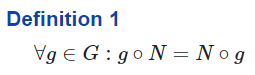
Should be all the defns we need
Let h in H is a good start ofc. But its not necessarily clear how you want to use it in the normal subgroup defns
So I would use letters other than h to state those and see what can be done with some manipulation
sonic coral
so since H cap K is normal in H, h(H cap K)h^-1 is contained in H cap K for all h in H?
coral shale
for all a in H cap K
sonic coral
fixed it?
coral shale
sorry back. i gtg soon, if you're still stuck later and no one else around ill have a look again
N := N_G(H n K) = {g in G : g(H n K) = (H n K)g}
sonic coral
ill look at it tonight or tomorrow, ive been lookin at this for too long
coral shale
want to show forall h in H : h(H n K) = (H n K)h
yh gl. seems to be a matter of writing defns down nicely (avoid overload letters)
and letting A = H n K might make it more readable
I think N normal subgroup G := forall g in G : gN = Ng is better normal subgroup defn, from just looking at the above
indeed - it seems you need to show H n K normal subgroup of H
 but thats given wtf
ok im confused
sonic coral
I think I will just go back to trying to show groups of some order are not simple and ask my professor about this on tuesday
 chilly ocean
any clever way of doing this im missing? i just tried some stuff till i found an element that isnt in the group that should be
 formal ermine
91 is a power of 3
void cosmos
yea
formal ermine
so its multiplicative group is cyclic
therefore all of its subgroups are also cyclic
coral spindle
91 = 7 x 13...
south patrol
Lol
formal ermine
I thought 91 = 3^4
south patrol
The sum of 9 and 1 is 10
coral spindle
This is your Grothendieck moment
 south patrol
Lol
coral spindle
south patrol
Tbf I would assume 91 is prime
Fun divisibility test for 13: a number 10a + b (where b is the final digit, and a is all but the final digit) is divisible by 13 iff a + 4b is divisible by 13. In the case of 91, we have a = 9 and b=1, so a+4b = 13 is clearly divisible by 13.
This comes from the fact that 4x10 - 3x13 = 1.
coral spindle
Well there is a similar one
 chilly radish
a-2b
coral spindle
since 3x7 - 2x10=1, using a similar super secret technique, you get what ShiN just said yeah
so in this case we would get 9 - 2*1 = 7
It's quite fun to try and rederive this, I really suggest you give it a shot
chilly radish
chilly radish
a-2b
Gave this as a hw problem for my students
coral spindle
That's a cool hw problem
south patrol
nice
i don't like it cause 10 is too arbitrar
y
give me the number in base 7 and then i can tell you if it's divisible by 7
coral spindle
Actually, bases are based
See also cohomology: https://ncatlab.org/nlab/show/carrying#in_terms_of_cohomology
quiet pelican
formal ermine
bases are stupid. just write everything in base \infty
Yes I do really like the number jkłx=ŷ (note this isn’t some form of place value system, this is just a randomly assigned identifier for that number)
 rustic crown
yeep
 fervent rock
bless
rustic crown
boytjie uwu
coral spindle
Hey det
I was gonna try and be funny and say that this is the definition of a group property, but I decided not to
rustic crown
i wanna hear one more story about your kids :p
coral spindle
I'll try and adopt some more
fervent rock
So its asking me to show that D4, A4, Z_12 and U(21) are not isomorphic to eachother at all. Z12 is cyclic and thus abelian, U(21) is just abelian, D4 and A4 are not abelian. Z12 cant be isomorphic to any of them and neither can U(12). Only thing is to show D4 is not isomorphic to A4 which I can show by listing the order of the group elements?
coral spindle
Sure
fervent rock
beautifu; thanks bae
coral spindle

 upper pivot
I know this isn’t useful to what you want, but you can formalize what is meant by group property. Any first order sentence in the language of groups is preserved under iso (these are things you can make with basic logical connectives and quantifies, and symbols from the group).
coral spindle
We often talk about things that are not first-order sentences though, so this isn't really sufficient imo
fervent rock
this is an undergrad algebra course that i just want to pass tbh, this stuff is decent but not my stuff
upper pivot
Yeah true
coral spindle
e.g. you cannot define what solvability is in the language of groups
and clearly solvability is a group-theoretic property
rustic crown
teach det logic >.<
fervent rock
i just reckoned that isomorphisms gotta preserve the shits.
coral spindle
I guess you'd need some more logic stuff
fervent rock
and went from there
coral spindle
If Oby were here he would talk about how second order logic is fake
upper pivot
But I have 0 exp with second order logic oof
fervent rock
nvm its D6 but point still stands
 rustic crown
lol i read D4 as D6 earlier :p
fervent rock
yea i misswrote
coral spindle
One way of approaching that might be to count the number of elements of order 3 in those groups btw
I think that should be enough to distinguish them
fervent rock
yea
coral spindle
I leave the details to you
formal ermine
does every nth order logic exist
fervent rock
i was just gonna list the orders but makes sense
cause D6 only has the rotations that are order 6 and refelctions that are order 2
while A4 is just bullshit
coral spindle
D6 has rotations that are of order dividing 6
fervent rock
sure
coral spindle
It also has e.g. rotations of order 2 and 3
rustic crown
rotation of order 1 
fervent rock
hmm
oh yea true
but like considering the order of just the sungular rotation by 360/6
coral spindle
But anyway my point is, I think you can exclude certain orders in A4
fervent rock
something like that
ohhh i get it
a4 have no order 6 but d6 DOes
so its like illegal
coral spindle
true you should call the police
fervent rock
i will
coral spindle
arrest A_4
fervent rock
algebra isnt that bad
but like it hurts my brain sometimes
i felt cheacky about this question tho
thxxx
rustic crown

fervent rock
I have a related question
lets say we have a group on a set of n elements
is there a theorem about the maximum order of the individual elements
or it depends on the operation
coral spindle
Well I mean the order of any element is most certainly <= n
is this what you're looking for?
fervent rock
yea basically
coral spindle
When you see the Theorem of Lagrange you will see more information
coral spindle
The same guy, yes
fervent rock
crying and shitting rn.
coral spindle
Something he can no longer do 
fervent rock
literally worst news ive heard all semester
rustic crown
fervent rock
like the optimization dude?
the lagrange multiplier guy?
fervent rock
yea
rustic crown
except bernoulli are there many mathematicians with the same name?
cuz i wonder if this lagrange is same as the lagrangian lagrange and the lagrange interpolation lagrange
fervent rock
wait arent dihedral groups just permutations on n elements
coral spindle
The Neumann couple is a good example
All groups are permutations, under some interpretation
rustic crown
yoneda
fervent rock
crying so bad rightnow cause i coulda just said its illegal cause d6 is on 6 elements but a4 was on 4
not onto at al
 coral spindle
fervent rock
crying so bad rightnow cause i coulda just said its illegal cause d6 is on 6 ele...
coral spindle
fervent rock
crying so bad rightnow cause i coulda just said its illegal cause d6 is on 6 ele...
no that doesn't work
fervent rock
it doesnt
coral spindle
it doesn't.
fervent rock
i believe oyu
coral spindle
That's not a group-theoretic property.
You can define groups in different ways and produce the same results
for example, the dihedral group with 6 elements and the symmetric group S_3 are isomorphic
fervent rock
okay so in the end. d6 has r_(60 degrees) which is order 6 but a4 has no element order 6 so boom bam boom
done and dusted
coral spindle
rustic crown
cuz i wonder if this lagrange is same as the lagrangian lagrange and the lagrang...
According to Wikipedia at least, yes it's all Joseph-Louis Lagrange
formal ermine
"just use Euler's theorem"
"which one"
rustic crown
use Gauss' lemma
south patrol
Even when you say like Gauss' lemma for polynomials or whatever you still gotta narrow it down
😿
south patrol
I guess two ones that was more focused on in ug curriculum lol
south patrol
Lol
Nice
Which one is the theorem
cause to me Gauss' theorem is the divergence thing lol
formal ermine
R irred iff frac(R) irred is the lemma
south patrol
Lol okay sure
Lol Gauss' lemma in NT feels more like a lemma than the one for polys
rustic crown
so the other one is D UFD => D[x] UFD?
south patrol
Bruh
south patrol
formal ermine
R irred iff frac(R) irred is the lemma
that's basically the same as this
I think it's probably fair to call those basically the same lemma
formal ermine
ye
 rustic crown
true true
south patrol
Oh okay
rustic crown
faktoriell
south patrol
genau
formal ermine
potato why do you have 100k messages in the german server 
formal ermine
I rember
formal ermine
and like
south patrol
But nah I mean I like the language and spent a while on there lmao
formal ermine
99k of those are in the math channel
formal ermine
south patrol
Haven't you asked me this before 😭
I forgor
south patrol
I don't think that's true lol
Well
Like in recent years I basically only message that sure
Yeah lol
7k in science channel
formal ermine
south patrol
But nah I mean I like the language and spent a while on there lmao
deutsche sprache schwäre sprache
south patrol
and about 117k in total
south patrol
formal ermine
deutsche sprache schwäre sprache
lol
okay i haven't seen that joke
deutsche sprache kringelige sprache
jk
formal ermine
wat
formal ermine
pun
south patrol
yes
south patrol
south patrol
okay i haven't seen that joke
oh
i thought you were going
"wat" to this message
lol
aalhbgkjahbdlgiukjhgb
formal ermine
idk what kringeliege is supposed to mean
fervent rock
okay so i have one more question
one step test for subgroups, lets say H subset of G, i gotta show that for a,b in G, ab^-1 is in H and H is nonempty
two step, i show closure and inverse seperatly
formal ermine
and non emptyness or identity
 primal tusk
R is a domain. If i have a polynomial in R[X1,.... Xn] that is a form, how would i prove that any factor of a form is also a form
coral spindle
What is a 'form'?
 naive wedge
Multidegree adds when you multiply
primal tusk
"We call F homogeneous, or a form, of degree d, if all coefficients a(i) are zero except for monomials of degree d"
coral spindle
Suppose f = gh is homogeneous but g is not homogeneous. Inspect the monomials of the product for contradiction
in particular, inspect the multiplication by some highest-degree term in h
primal tusk
ah okay thanks thats a good idea
white oxide
would it be possible to take m = n for #47 to show that there exists an element a in G such that a^n = e? bc the hint says to use the result of exercise 46 and theorem 10.12 (which is that the order of an element of a finite group divides the order of the group) but why wouldn't this work?
 south patrol
I don't really get what you mean
white oxide
like
south patrol
The case m=n always holds
white oxide
it feels like cheating to take m = n
south patrol
It says for all m
south patrol
so how can you just take m=n
white oxide
i know it's because it says for all m
i was just confused as to why they suggested the use of the theorem and the result of the previous exercise
white oxide
to show that x^n = e?
south patrol
Huh
white oxide
nah you just use the hypothesis right
nah im just talking about showing x^n = e
where n is the order of the group
south patrol
But you don't need to show that
It says element of order n
Just because x^n = e for all x by Lagrange doesn't mean there's an element of order n
Or otherwise all finite groups would be cyclic
coral spindle
No
south patrol
The order of the subgroup it generates
coral spindle
an element x of order 2 also satisfies x^4 = e, x^6 = e, etc.
white oxide
would it be a decent idea to use exercise 46 and maybe take d = n
sonic coral
it’s the smallest positive integer n such that x^n = e
white oxide
wdym
coral spindle
Jaxon is defining the order of x, although we're past that now
formal ermine
how do you call the mathcal O?
(was it matcal?)
the one used for ring of integers
 rotund aurora
$\mathcal O$
coral shale
why not Z
coral spindle
Not that ring of integers
coral shale
oh ok.
coral spindle
rotund aurora
The notation Z_K and Z_L given the field extension K<L is pretty nice too tho
coral shale
thought 'algebraic integers' but alright
formal ermine
yeh it's mathcal
south patrol
Indeed
 south patrol
Lol
formal ermine
or do you go "fancy O"?
south patrol
I would say "the ring of integers of..."
formal ermine
just like when you see \ell
coral shale

south patrol
Lol
formal ermine
south patrol
I would say "the ring of integers of..."
now try saying that 10 times in a row really fast
 agile burrow
evocative
formal ermine
I have my use cases, ok?
coral shale
no u dont
formal ermine
yes I do
formal ermine
coral shale
ur a highschooler.
did I stutter
here in germany we write a little thesis in 11th grade
gotta prepare for that
coral shale
no
formal ermine
yes
white oxide
would somebody mind explaining the sentence starting with "By the hypothesis..." im confused about how there can only be one subgroup of order d dividing n follows

sorry le tme post the question
 dreamy chasm
can anyone help clarify what I might be doing wrong here?
x = -4 +_ sqrt(16-b) via the quadratic formula
so we need 16 - b to be a square for the polynomial to have a root
that works for b = 0, 7, 12, 15, 16 (these numbers mod 11)
which are 0,7,1,4,5
 rotund aurora
you are doing the opposite, you want the polynomial to have no roots
also, for b=2 you also obtain roots
but the main argument is fine (you solved the problem anyway, just make sure b is not any of those values)
dreamy chasm
so I should be looking at b =/= 0,7,1,4,5,2?
rotund aurora
you want x^2+8x+b to be irreducible
so 16-b=5-b should NOT be a square
there are (p+1)/2 quadratic residues mod p (including zero) and (p-1)/2 quadratic non-residues
rotund aurora
dreamy chasm
so I should be looking at b =/= 0,7,1,4,5,2?
yes
sonic coral
Let’s say I have 2 Sylow p-subgroups of order p^n, I am not guaranteed that the elements in them both are distinct, right?
 delicate bloom
they both have the same identity element 
sonic coral
well yes, how about nontrivial elements
i’m trying to show groups of a certain order are not simple. and i think i’m gong about it the wrong way by not considering the nontrivial intersection between them
south patrol
Well, you can often do it in the case n=1, but no it needn't be true in general i guess
sonic coral
this counting argument i went with for a group of order 12 and 30 works fine though? I’m just having trouble depicting which orders this argument won’t work and i’ll have work a little harder for.
 static needle
I got a thing ive been thinking about: How does Z/nZ relate to left cosets?
 knotty frigate
Z/nZ is a set of cosets
and bc Z is abelian a left coset of a subgroup is also a right coset of a subgroup
 blissful crystal
does anyone perhaps know what Jacobson means when he says "F(t)[x], t an indeterminate"
next obsidian
it just means a variable
 solar glacier
Indeterminate = variable
blissful crystal
i mean yes
but I'm mostly confused as to why he doesn't write F[t][x] or F[t,x] since he used that notation before
 prisma ibex
F(t) usually means you're adjoining both t and 1/t
so F[t] is polynomials, F(t) is rational functions
next obsidian
prisma ibex
F(t) usually means you're adjoining both t and 1/t
no this isn't accurate
you're adjoining every possible fraction
adjoining just t and 1/t won't give 1/(t+1) for example
 next obsidian
but the part about rational functions is true
prisma ibex
I was probably thinking of F[[t]] versus F((t)) where you can take Laurent series expansions of these rational functions 
 remote nymph
I have to find an example of a latin square that is not the multiplication table of some group and im really struggling with this. I found this random pdf that i feel should be helpful but I dont understand this paragraph

Why can we assume that f is the identity here? at least thats what i think this paragraph is stating
 solar shore
a definition from my abstract alg textbook

i thought the set B is referred to as the codomain?
and b is the image
and the subset of B is the image of A
(or range ive also seen that)
is this just me being pedantic?
barren sierra
image is used in two contexts here
say phi(a) = b
then b is the image of a
but the image of the whole function is the set {phi(a) | a in A}
tender wharf
solar shore
a definition from my abstract alg textbook
hello fellow gallian enjoyer
tender wharf
solar shore
and the subset of B is the image of A
do you mean $\func{\phi}{A}{B}$
cloud walrusBOT
 tender wharf
what this generally means (and I believe it also means this in gallian's book) is that phi must be defined on all of A and it has a codomain of B (but not necessarily a range of B)
the image of A by phi is a subset of B yes, or in other words, $\phi(A) \subseteq B$
cloud walrusBOT
 solar shore
right
no i was just
when they said range, i was confused for a second because i usually hear the subset of b is the range
while b itself is the codomain
i think im just being pedantic
 lapis plume
I am doing part b of the problem. I stuck at the yellow highlighted place, as sth seems to go wrong. Can anyone help me to have a look?


 cunning dust
lapis plume
I am doing part b of the problem. I stuck at the yellow highlighted place, as st...
cunning dust
lapis plume
I am doing part b of the problem. I stuck at the yellow highlighted place, as st...
It looks like you're trying to prove something you're supposed to disprove. You've overcomplicated a bit too.
In any case m doesn't divide r and k doesn't mean it doesn't divide rk (take for example m=6, r=2, k=3).
lapis plume
I see
Umm but what should I do? I can’t find a good reason why $\phi (r+\hat{k})\not=\phi (r)$.
cloud walrusBOT
Trenton
 cunning dust
I think a good way to give you intuition (this also pretty much solves it) is to just notice phi(a) = a (mod m). So you can just use modular arithmetic. And use the hint they gave.
Like consider what phi(1+n-1) is and what phi(1) + phi(n-1) is
lapis plume
cunning dust
Like consider what phi(1+n-1) is and what phi(1) + phi(n-1) is
Got it now, thanks!

 tacit hemlock

can someone please explain why the cycle notation yields a (135)?
for a composition of permutations
if this is "do p, then q", then wouldn't it go something like:
3 -> 4 (from p), then 4-> 5 (in q)
4 -> 1, 1 -> 4
2 -> 5, 5-> 2
so wouldn't the composition yield (5 4 2) instead?
tacit hemlock
coral shale
2 goes to 2
My bad, so would it be (5) (4) (2) and hence not work
tacit hemlock
2
tacit hemlock
what
coral shale
tacit hemlock
3 -> 4 (from p), then 4-> 5 (in q)
u said it yourself
tacit hemlock
i.e., in p, 3 -> 4, then compose by q so that 4-> 5
coral shale
well ofc im only talking about the composition
why would what happens in between matter in the final expression
tacit hemlock
then qp(5): starting with p, 5-> 2, then map with q so that 2-> 1
tacit hemlock
coral shale
qp(1)=3
qp(2)=2, qp(4)=4
wait, why are you doing it in the order 3,51
as in qp(3), then qp(5), then qp(1)
tacit hemlock
coral shale
let f = qp
I see! Thanks!
tacit hemlock

What is the squiggly arrow notation?
I thought it meant "implies" when used to denote a chain of reasoning, or show the next logical step with laying out your working
formal ermine
I think it means t is send to g(f(t))
 summer path
i think it's the same thing as $\mapsto$
cloud walrusBOT
Tubular Cat
 south patrol
squiggly is cute
coral shale
so is det >u<
rustic crown
.<
summer path
shuwi cute voice :3
tacit hemlock

I thought "cardinality" is generally the term used to describe the number of elements in a set?
"The order |S| of a set S"
is this an abuse of terminology?
tender wharf
order kind of is only defined for groups?
you wouldn't say order of an arbitrary set
like for example the set of all cats in the world
I guess you could talk about the cardinality of the set of all cats in the world though
but for all intents and purposes you'll get the same value out of it
if G is a finite group then order of G = card G
tacit hemlock
Do you guys mostly learn through textbooks or lectures
tender wharf
thats more of a #discussion question
tacit hemlock
can I make it personal and ask you specifically 🙂
tender wharf
textbooks
summer path
i mean if it's a class, generally lectures, but also textbook is nice to follow along sometimes; but otherwise textbooks
tacit hemlock
What is an intuitive understanding of a kernel of a function?
i.e. the kernel of a homomorphism
coral spindle
The definition
Once you see the first isomorphism theorem, you'll get a better idea what it means
tender wharf
tacit hemlock
i.e. the kernel of a homomorphism
a normal subgroup 
jokes aside every normal subgroup is actually the kernel of a homomorphism, yes


 wooden ember
You’re looking for all polynomials in L that are null
Do you have an example of such a polynomial?
wooden ember
As in = 0 matrix
Think in terms of L being any matrix, not the one given
Given a matrix how do I get a polynomial that when evaluated at this matrix is = 0
 stark cloak
Hi, there's theorem that says that every permutation can be written as a product of transpositions.
What about a permutation in cyclic form a = (1). What's its decomposition into transpositions?
 pastel cliff
that's it
quiet pelican
stark cloak
Hi, there's theorem that says that every permutation can be written as a product...
You could either do the empty product, or sth like (12)(12)
pastel cliff
that's just the identity element
pastel cliff
quiet pelican
You could either do the empty product, or sth like (12)(12)
this is like saying 1 = .5 * 2
wooden ember
pastel cliff
this is like saying 1 = .5 * 2
It’s explicitly writing the identity as a non empty product of transpositions though so a fair answer
quiet pelican
pastel cliff
this is like saying 1 = .5 * 2
Yes
But it’s still a decomposition
stark cloak
good
thanks
Also in cycle notation I believe that writing (a_k, a_k) to denote one-cycle is ill formed, right?
tender wharf
thats...
yeah
thats not right
you just ignore it
so for example if f is the permutation that sends 1 to 2 and 2 to 1 and fixes 3
stark cloak
Good. That would contradict odd-even theorem.
wooden ember
stark cloak
Also in cycle notation I believe that writing (a_k, a_k) to denote one-cycle is ...
In general the notation for an n-cycle should only contain distinct elements
coral spindle
I have seen people try to write (1 2 3 2) and the like 😦
pastel cliff
pastel cliff
can i get a nudge on this pls <:sad:532803514892812288>
ok with regards to this i think i need to get clear on what everything is first bc im realizing maybe i dont actually get the question lol
we're treating Q x Q as a Q module
t being an element of the Q that's acting as M if we were talking about an R module M
that means a_i is coefficients in Q that's acting as the ring if it were an R module M
but what is v supposed to be
pastel cliff
so asking what Ann(Q) is here is asking what elements of Q we can put into a_i to get the zero matrix right?
perhaps im overthinking but how does the operation come into play?
 feral agate
Can anyone give me a hint on how to start on this one? m is integer greater than 1 btw
 feral agate
So dZ where d is any divisor for m expect for 1
pastel cliff
try and prove it
barren sierra
Why except for 1?
feral agate
barren sierra
Why except for 1?
It is given in the exercise
feral agate
feral agate
So dZ where d is any divisor for m expect for 1
I have shown this, but I don't see how I can argue these are all the subgroups that contain mZ
coral spindle
Give it a shot
barren sierra
Oh so it only wants proper subgroups (since 1 generates Z)? I see
 analog zephyr
For 2, 8Z<4Z<2Z
formal ermine
analog zephyr
For 2, 8Z<4Z<2Z
what?
summer path
it's a chain of subgroups, though i don't think that really helps here since it's already been established that those are subgroups containing mZ