#groups-rings-fields
1 messages · Page 59 of 1
 novel parrot
 pastel cliff
ok so what do you think c is
 vagrant zinc
Thanks now I understand better! ❤️
❤️
pastel cliff
disclaimer that this material is still recent for me and i could say something wrong
novel parrot
so $c = x_1b_1 +x_2b_2$
 cloud walrusBOT
ActiveChapter
 novel parrot
i dont understand why x_1 and x_2 are coprime
pastel cliff
go back to the definition of primes
 oblique river
You were already told! Write b_1 and b_2 as multiples of c
Plug that in to your equation
Divide by c
pastel cliff
oblique river
Or “cancel c from both sides” if you prefer
pastel cliff
nobody gets angry at you here
novel parrot
we can write $b_1$ as multiple of because $b_1 \in (c)$ ?
pastel cliff
but you gotta put forward your own effort too 
cloud walrusBOT
ActiveChapter
 pastel cliff
as helpful as people are here, there is no substitute for sitting down with a problem and tinkering with it yourself
talking helps but there are certain times when you just need to lock yourself in a room w/ pencil and paper
at least for me
novel parrot
cloud walrus
**ActiveChapter**
this is correct?
 chilly ocean
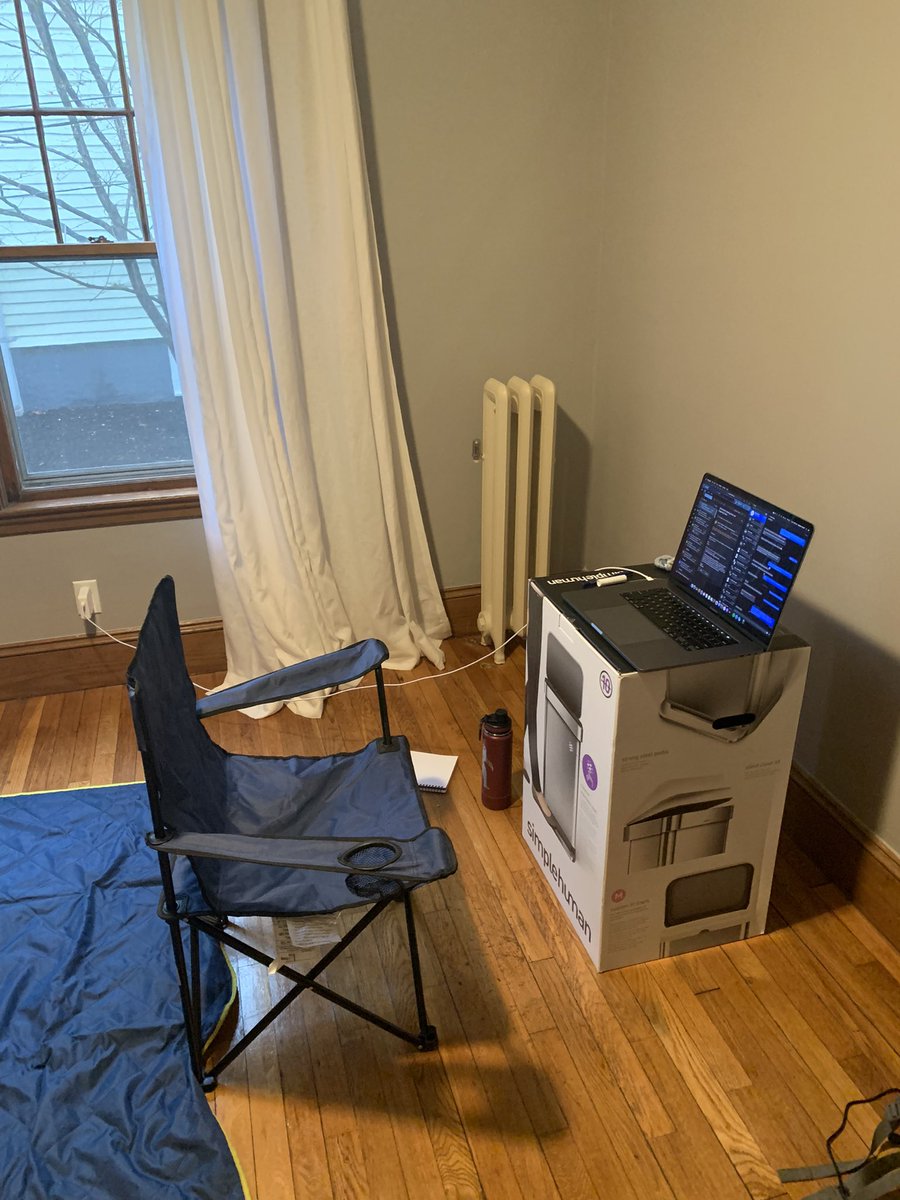
make sure it has good lighting and ventilation. water, too
pastel cliff
and preferably a standing desk
 elder wave
 chilly ocean
most normal moving setup
elder wave
yes it's from twitter
elder wave
chilly ocean
most normal moving setup
lmfao
 rustic crown
Don't see a cute plushie 
elder wave
i sat on the ground and used the package of my mattress as desk for a bit
chilly ocean
rustic crown
Try explaining math to it. Cute and fun
 interesting
I like to write in a notepad to explain stuff
and then delete it
pastel cliff
based chalkboards
chilly ocean
my strongest fighting game era was when i was moving and i played sitting on the ground with my monitor on a bunch of boxes. it's empowering
pastel cliff
i talk to empty classrooms (i fill the seats with the voices)
elder wave
goated setup
this is something i actually do quite often tho, either actually explaining the stuff to someone else or imagining to do so
i tend to find gaps or mistakes like that
novel parrot
if x1 and x2 are prime in PID why are they coprime?
(x1, x2) = (d) and we want to show d is a unit basically
but im stuck after that
anyone know?
novel parrot
$x_1r_1 + x_2r_2 = d$
cloud walrusBOT
ActiveChapter

 pliant forge
elder wave
https://pbs.twimg.com/media/FlwCqybWQAAl5VP.jpg
pliant forge
elder wave
https://pbs.twimg.com/media/FlwCqybWQAAl5VP.jpg
the minimalist lifestyle 😍
novel parrot
 coral shale
write down defns, try contradiction
coral shale
write down defns, try contradiction
i dont really get it
 formal ermine
maybe try bezout
formal ermine
look it up then
idk if it works tho
but this situation kinda looks like bezout idk
formal ermine
yes
novel parrot
so yeah already i know that $(x_1, x_2) = (d)$
cloud walrusBOT
ActiveChapter
 novel parrot
that means that d is the gcd of x_1 and x_2
but x_1 and x_2 are primes / irreducibles
 rustic crown
R[x] is a pid, so compute the GCD to write it as an ideal generated by a single polynomial
 molten silo
ok thank you
chilly ocean
rustic crown
R[x] is a pid, so compute the GCD to write it as an ideal generated by a single ...
I think you could write this like this even in a general ring since the polynomials are monic?
 obsidian loom

Hi, I need some help with this question
Is it correct to conclude that the operation for this group is x * y = x^-1y?
Also, I think I'm supposed to show that $x^{-1}y \in H \implies xy \in H$ but I can't figure it out
cloud walrusBOT
trayan_b

 coral spindle
obsidian loom
Is it correct to conclude that the operation for this group is x * y = x^-1y?
coral spindle
obsidian loom
Is it correct to conclude that the operation for this group is x * y = x^-1y?
No.
The operation for H is the operation for G, restricted to H.
This is what it means to be a subgroup.
obsidian loom
what do you mean by restricted to H
coral spindle
I mean x * y = xy.
obsidian loom
oh
but in this case
for G, x * y = xy but for H, x * y = x^-1y, so it's not closed under the same operation as G
so by this logic it's not a subgroup
coral spindle
I don't know how you're getting this idea that x * y = x^-1 y
I said already that this isn't right
rustic crown
chilly ocean
I think you could write this like this even in a general ring since the polynomi...
That's only for the first division though. The reminders might not be Monic >.<
chilly ocean
rustic crown
That's only for the first division though. The reminders might not be Monic >.<
ah right
But (p(x), q(x)) is principal when p(x) and q(x) are monic, right
rustic crown
Not necessarily. Like what about (x, x+2) in Z[x]
chilly ocean
I see
obsidian loom
coral spindle
I don't know how you're getting this idea that x * y = x^-1 y
We are given that for H, xy = x^-1y, no?
For it to be a subgroup of G, it must be that for any x,y in G, xy =x^-1y also
 coral spindle
obsidian loom
We are given that for H, xy = x^-1y, no?
coral spindle
obsidian loom
We are given that for H, xy = x^-1y, no?
No.
obsidian loom
So the "closed under the same operation as G" property is already given?
@coral shale
coral spindle
We are given that if x and y are in H, then x^-1 y is in H too
 coral spindle
Sorry mu I kinda trod on your toes there
coral shale
u started helping dw
- G is a group, H is a non-empty subset
- forall x, y in H: x^{-1}y is in H
These are your 2 premises
The first step is to show the closure property; ie. xy in H (for all x, y in H)
obsidian loom
Yeah
 tribal moss
The first step is proably to show that H contains the identity!
coral shale
 forgot
obsidian loom
tribal moss
The _first_ step is proably to show that H contains the identity!
Is that not one of the things you have to check?
Oh right
tribal moss
Yes.
coral shale
Indeed, and it should be the first step
tribal moss
Hint: This is the place where you need the assumption that H is not empty.
chilly ocean
what's with all the questions about the subgroup test recently?
i've seen so many over the past week
tribal moss
Perhaps we're in the part of the semester where such-and-such natural organization of an intro to algebra course reaches subgroups? Dunno.
coral spindle
This is why we should have a elementary group theory channel in early uni >:(
chilly ocean
actually agree
coral shale
obsidian loom
I dont see how I would do that
if ur still stuck, take Tropo's hint. There is only one way to combine this with the other premise: x^{-1}y in H
formal ermine
coral spindle
This is why we should have a elementary group theory channel in early uni >:(
yeah in the pre uni category
just like #elementary-number-theory
 thorn delta
i understand the sentiment, but the lines between "elementary" group theory and group theory seem much more blurred than with NT idk
chilly ocean
formal ermine
yeah in the pre uni category
what are the arrows of that category
coral shale
thorn delta
i understand the sentiment, but the lines between "elementary" group theory and ...
theres elementary group theory, then the rest of group theory and algebra
thorn delta
idk exactly what you mean by elementary though
anything in a first course could be considered elementary it seems
obsidian loom
coral shale
if ur still stuck, take Tropo's hint. There is only one way to combine this with...
I did it but I used: xy = x^-1y
and i think earlier you said that was wrong?
obsidian loom
I'll tell you what i wrote
coral shale
Let our group G be integers under addition. Let H be the even numbers.
2, 4 are in H. Inverse of 4 is -4.
You are claiming 2 + 4 = 2 + -4
obsidian loom
We know that H is non-empty. Suppose that H has exactly one element, say x.
Then since for all x,y in H, x^-1y in H, it must be that x^-1x is in H and x^-1x = e, so the identity is in H.
coral shale
obsidian loom
We know that H is non-empty. Suppose that H has exactly one element, say x.
Then...
its great - tiny nitpick: you dont need to suppose H has exactly one element
nor do u want to
You just want to say 'Let x be in H' and this is justified by it being non empty
vagrant zinc
coral shale
xde
obsidian loom
coral shale
You just want to say 'Let x be in H' and this is justified by it being non empty
yeah makes sense, i see why its unnecessary now
obsidian loom
coral shale
next i think u will want to show inverses
I did
coral shale
ok then closure and you're done right?
coral shale
in this particular case the proof needed it yes
(which is why u were stuck at the beginning)
In general, there isn't necessarily an order, sometimes there is.
 obsidian loom
coral shale
(which is why u were stuck at the beginning)
obsidian loom
coral shale
(which is why u were stuck at the beginning)
maybe its just me but group theory is much harder than I expected it to be
coral shale
early on it comes down to writing down or pulling up the definitions relevant to the question
and applying them in the only way possible
later on there will be more thinking / more things u could apply as more theorems are developed
coral shale
vagrant zinc
Guys, a question if I have Z_12 and it tells me that <5> is a generator of Z_12
theres no question; elaborate
vagrant zinc
exactly 5 is a generator of Z_12 but the question is to know if it really is a generator, I did that check
 summer path
So given that you did that check, do you think 5 is a generator of Z/12Z?
vagrant zinc
yepi
summer path
Ok so there is no question
coral shale
vagrant zinc
exactly 5 is a generator of Z_12 but the question is to know if it really is a g...
There is a shortcut
You want to show 5n is not a multiple of 12 for n an integer from 1 to 11
5n = 12m
5 and 12 are coprime, ie gcd(5, 12) = 1
coral shale
coral shale
`5n = 12m`
See if you can finish the rest of the proof
vagrant zinc
I understand, it's good to know first where things come out in order to understand what you're saying
 solar shore
does anyone have any good, free additional resources to study up on some abstract algebra?
summer path
dummit and foote is nice i guess?
solar shore
ive just been looking at my old exams and homework assignments and then redoing them to brush up on my next part of the class
hmm ok noteed
 prisma ibex
solar shore
does anyone have any good, free additional resources to study up on some abstrac...
prisma ibex
solar shore
does anyone have any good, free additional resources to study up on some abstrac...
Keith Conrad's notes are good for reviewing various topics
solar shore
prisma ibex
Keith Conrad's notes are good for reviewing various topics
okay thank you
appreciate it
 quaint raptor
Hey, is this boxed fact true? I don't think it is tbh -- my understanding is:
"if all elements are their own inverse, the group is abelian" is true, but I don't believe you can say it is true the other way around".
This is for a finite abelian group
 formal ermine
what is the context
quaint raptor
just proving that performing your operation on all elements of an abelian group^2 equals the identity element
coral spindle
Z/3Z is an Abelian group, and none of its elements are of order 2
Hint for a correct version of this proof: try pairing elements up with their inverses. What if a^-1 = a?
quaint raptor
awesome - ty. Yeah that makes sense and thats pretty much what I am thinking but just wanted to make sure I wasn't crazy
 south patrol
Also if the boxed fact were true, then you could immediately conclude that the first term is e anyway
 barren sierra
Proofs by diagram chasing are fun and feel like cheating lol
coral shale
barren sierra
Proofs by diagram chasing are fun and feel like cheating lol
profound argument. no cheat.
barren sierra
well yea
chilly ocean
why do you only need to prove that ab^-1 is in the subgroup to prove that it is indeed a subgroup?
and nonempty!!!
it needs to be nonempty!!!!!!!
yeah and that
 chilly radish
chilly ocean
and nonempty!!!
chilly radish
chilly ocean
and nonempty!!!
what about the empty group
chilly ocean
i meant only as in how does it imply closure and inverse closure
chilly ocean
chilly radish
~~what about the empty group~~
aint a subgroup
three lines:
if it contains some element z, then it contains zz^-1 = e. if it contains x, then it contains ex^-1 = x^-1. if it contains x and y, then it containts x(y^-1)^-1 = xy
chilly radish
chilly ocean
aint a subgroup
Sounds sus
chilly ocean
ah u could do zz^-1
chilly radish
(I am joking if it wasn't clear)
elder wave
chilly ocean
and nonempty!!!
 elder wave
i'm reaching, i was just waiting for a chance to post it again
chilly radish
Ok but nonempty is actually important
elder wave

chilly ocean
so many subgroup test questions
all of the group theory courses in the world are doing the same thing right now
but im different
im self studing so it aint count
elder wave
i'm starting to see the point of an extra channel in early university
chilly radish
It's usually easier to check closure properties individually anyways
chilly ocean
i personally think it's absolutely useless
chilly radish
I think letting students prove the equivalence of the condition as an exercise is nice
But not more than that
chilly ocean
if someone is struggling with proving something is a subgroup by the definition and someone suggests the subgroup test, i don't think they're going to get any further with that than they did trying to use the definition
barren sierra
what extra channel?
barren sierra
chilly radish
I think letting students prove the equivalence of the condition as an exercise i...
same
great exercise
chilly ocean
chilly ocean
if someone is struggling with proving something is a subgroup by the definition ...
i see it happen too much here
it aint even a exercies its like two words
 chilly radish
Oh absolutely, I think understanding why it's true is good for getting the noggin jogging if nothing more than to practice abstract symbol pushing
chilly radish
chilly ocean
i see it happen too much here
That's silly
chilly radish
barren sierra
what extra channel?
Another aa channel in early university
chilly ocean
chilly radish
Another aa channel in early university
yeah i was wondering why it wasnt up there
barren sierra
makes sense but then would #real-complex-analysis also get moved there?
chilly radish
This channel is kind of a catch-all at the moment. Another algebra channel was at least momentarily discussed
That was another point of discussion
barren sierra
cause we do have #advanced-analysis
so I guess analogously #adv-algebra makes sense
chilly ocean
i think we should just get rid of all of the channels
chilly radish
We have a button for that, it's called the "leave server" button
barren sierra
just one channel, #math
coral shale
im waiting for my advanced-anime channel
chilly ocean
you have NO idea
barren sierra
#advanced-chill
solar shore
i am incredibly stuck on this one problem 😭
Suppose the group $R*$, find elements $a$ and $b$ such that $|a| = \infty, |b| = \infty$ and $|ab| = 2$
cloud walrusBOT
blanket
 coral shale
ok for starters, what infinite groups do u know
chilly ocean
$\bR^*$? that typically means the non-zero reals (not just non-negative) equipped with multiplication...
cloud walrusBOT
ТТерра
 chilly radish
The positive reals with multiplication don't have order 2 elements, you should try and see why this is true
To add to what was said above
chilly ocean
I have found that the group elements are $e, \sigma, \sigma^2, \sigma^3, \tau, \tau \sigma, \tau \sigma^2, \tau \sigma^3$ but how would i prove them? do i just say since they are finite its trivial?
 cloud walrusBOT
Jester
 chilly ocean
or maybe try proving first that $\sigma^n \neq \tau \sigma^m$ for all m, n integers
cloud walrusBOT
Jester
 chilly ocean
oh nvm its trivial really
 sweet sundial
are the groups Z4 x Z18 x Z15 and Z3 x Z36 x Z10 isomorphic
I think they are cause they have the same order
is that enough or do I need to show more?
 delicate orchid
sweet sundial
I think they are cause they have the same order
delicate orchid
sweet sundial
I think they are cause they have the same order
what order are each of the groups?
delicate orchid
are you sure the first group is order 1080?
delicate orchid
ok  now I believe you that they're the same order
see if you can construct an isomorphism
delicate orchid
no, a bijective homomorphism
delicate orchid
or use some other method of determining if two products of cyclic groups are isomorphic, if you know any
 tender wharf
sweet sundial
I think they are cause they have the same order
tender wharf
sweet sundial
I think they are cause they have the same order
this is almost always insufficient
for example S_n and Z_n! have the same order and are most definitely not isomorphic for quite a lot of values
infinitely many of them
coral shale
Z2 x Z2 and Z4 have the same order; non-isomorphic
 patent girder
what is V_t, is it just a part of the representation?
 south patrol
Basically if groups of the same size were isomorphic then finite group theory would just become counting
chilly ocean
finite group theory is just counting with a little bit of spice
coral shale
missed my cue for
Finite group theory is counting
 coral shale
patent girder
what is V_t, is it just a part of the representation?
coral shale
patent girder
what is V_t, is it just a part of the representation?
better resolution ?
coral shale
well im sure wew can make it out when he sees it
barren sierra
I don't really have many thoughts on how to start.


 barren sierra
but otherwise I got nothing really
 kind temple
H = Hom(Z,A)/im(m*) = coker(m*)
say q is the quotient map.
im(m*) = ker q so it’s exact at Hom(Z,A) (the one furthest to the right)
trivially exact at H since q is surjective
@barren sierra
barren sierra
Oh that's much more simple than what I was thinking
yea make the image "zero" which solves everything
kind temple
im not really sure how i would explain how i got this answer
that’s a good point.
i was just thinking about natural maps out of Hom(Z,A)
it kind of reflects the symmetry of the original SES
where we were mapping Z —> coker(m) = Z/mZ
barren sierra
yea
I saw that in the original one but didn't make the connection
I literally went "Z / mZ is Z quotiented with the image of m"
and did not make the very small next leap
cokernals are strange
I do not have intuition for them outside of some concrete examples
although that probably stems from my lack of intuition about certain category theoretical objects
kind temple
barren sierra
cokernals are strange
i don’t have a lot of intuition for them either yet
barren sierra
cokernals, equalizers / coequalizers, pullbacks, not much intuition yet
kind temple
category theory i feel like takes a lot of time to develop intuition for
kind temple
same
barren sierra
yea it sure feels like it
kind temple
slowly
barren sierra
probably need more exposure
kind temple
yea, more examples and such
barren sierra
It would be nice if my alg geo class was any good
so that I could maybe look at examples relating to that area
but my prof is absolutely awful and I've kinda given up on the class
kind temple
profs can really make or break a class
barren sierra
it's totally broken this class lol
kind temple
dropped my alg top class because my prof really just didn’t want to be there
barren sierra
my algebra prof this sem tho is amazing
kind temple
same
barren sierra
really really enjoying that course
kind temple
what school do u go to?
barren sierra
kind temple
dropped my alg top class because my prof really just didn’t want to be there
See I'd do that but then I'd only be doing 1 math class and 2 CS classes
UIUC
kind temple
was gonna say lol. i’m at umich
kind temple
i do not
barren sierra
damn
he was one of my math profs my first semester here, now he's at UMich
he's super cool
kind temple
idk if i’m doing anything in logic but i’ll def keep an eye out if he’s teaching any interesting courses
 long nebula
So, projective modules are summands of free modules; what's the corresponding statement for injective modules?
barren sierra
Every module is a submodule of some injective module
long nebula
oh alright
hm, how is that a dual notion though?
I don't see how that's related to projective modules being summands of free modules
long nebula
are there cofree modules or smth lol
 next obsidian
long nebula
So, projective modules are summands of free modules; what's the corresponding st...
next obsidian
long nebula
So, projective modules are summands of free modules; what's the corresponding st...
There is none
Welcome to the horror of injective modules
long nebula

I thought injective modules were just projective modules with the arrows flipped though
Why can't you just flip all the arrows on that statement
sweet sundial
coral shale
Z2 x Z2 and Z4 have the same order; non-isomorphic
I think these are actually isomorphic
long nebula
They are not
Think about the order of each element in Z2 × Z2 and the order of each element in Z4
 lusty marlin
sweet sundial
I think these are actually isomorphic
lusty marlin
sweet sundial
I think these are actually isomorphic
ℤ_m × ℤ_n is isomorphic to ℤ_mn iff gcd(m,n)=1
vagrant zinc
solar shore
does anyone have any good, free additional resources to study up on some abstrac...
Introduction to group theory and abstract algebra (from Judson)
 astral stream
Question about Algebra 1. How many proof/theory questions should I do (there are roughly 20-25 in each exercise) and how many computation questions should I do (there are roughly 20-25 questions). I'm reading Fraglieh.
summer path
i think in general when self-studying and doing exercises, i'd say to look to do a couple computation problems and maybe a few proof problems until you feel comfortable and then move on to the next section and then come back and do more if you feel like you needed more practice
but that's just me personally; also fraleigh was pretty nice to read
lusty marlin
How does one show that the center of a group of order 105 cannot have order 7?
astral stream
summer path
but that's just me personally; also fraleigh was pretty nice to read
thanks, is it ok to continue if I can't do the last 3-4 questions?
 agile burrow
lusty marlin
How does one show that the center of a group of order 105 cannot have order 7?
agile burrow
lusty marlin
How does one show that the center of a group of order 105 cannot have order 7?
If Z(G) has order 7, then G/Z(G) has order 15 which implies it's cyclic. This implies that G is abelian
lusty marlin
The conclusion about order 15 groups, does it come from a theorem stating that a group whose order is the product of two primes is cyclic?
lusty marlin
lusty marlin
The conclusion about order 15 groups, does it come from a theorem stating that a...
I'm not saying this is actually a theorem, I am yet to come across such a statement.
summer path
astral stream
thanks, is it ok to continue if I can't do the last 3-4 questions?
i think that's really just up to you tbh; i'd just be comfortable enough with the material in each section to continue
if you want to do all the problems, you can do that too; if you feel like you need some hints, there's probably people who would be willing to help out here (and elsewhere as well)
 obtuse bear
lusty marlin
The conclusion about order 15 groups, does it come from a theorem stating that a...
obtuse bear
lusty marlin
The conclusion about order 15 groups, does it come from a theorem stating that a...
you need additional hypotheses; S_3 has order 6 = 2x3 and is not cyclic
astral stream
Ok thanks for the help
summer path
or at least that's kinda how i approach self-studying; i do know other people who like to work through all the exercises in every section when they read a textbook
lusty marlin
obtuse bear
you need additional hypotheses; S_3 has order 6 = 2x3 and is not cyclic
Right, that example was in mind
tribal moss
lusty marlin
Nice, so since 3 does not divide 5-1, any group of order 15 is cyclic
And from this, the solution to my problem follows immediately.
Thanks guys
solar shore
Give an example to show that if H and K are subgroups of a group G the set HK = {hk | h ∈ H, k ∈ K} need not be a subgroup of G.
im blankin on this

tribal moss
It will be a subgroup if G is abelian, so you'll need to look to non-abelian groups for examples.
solar shore
do you have any good ideas for non abelian groups?
any suggestions ive gotten were with $S_n$ which we havent covered yet
cloud walrusBOT
blanket
 solar shore
all i really got are $D_n, \mathbb Z_n$
cloud walrusBOT
blanket
 tribal moss
Pity, that's the simplest non-abelian groups. How about matrix groups?
cloud walrusBOT
blanket
 solar shore
and $SL(n, \mathbb R)$
cloud walrusBOT
blanket
 next obsidian
D_n works
tribal moss
Hm yes it does, and D_{2·3} is even the same as S_3.
solar shore
tribal moss
Hm yes it does, and D_{2·3} is even the same as S_3.
ok ill take a look at D_2 and 3
tysm!
tribal moss
(I meant the dihedral group with 6 elements).
summer path
some people write the dihedral group of order n as D_{2n} and some write it as D_{n}
solar shore
ohh i see
summer path
though i believe D_{2n} is used more commonly in algebra settings (i may be wrong on this)
astral stream
Why is the yellow part true?
 formal ermine
what's phi_x
formal ermine
astral stream
Why is the yellow part true?
you can construct an explicit isomorphism by sending one generator to another
tribal moss
(a) By Rice's theorem. (b) By Rice's theorem. (c) By Rice's theorem. (d) By Rice's theorem. (e) by Rice's theorem. (f) By Rice's theorem. (g) By Rice's theorem.
Computability is mostly #foundations, tough we also get some questions in #discrete-math.
astral stream
formal ermine
you can construct an explicit isomorphism by sending one generator to another
what does sending one generator to anther mean?
astral stream
formal ermine
you can construct an explicit isomorphism by sending one generator to another
nvm I think I undertand now
tribal moss
That's more of an ad-hoc diagonalization proof -- which is perfectly fine and probably the general style you're supposed to attack the other ones in.
Rice's theorem (google it!) gives a generic construction that happens to settle all these cases in one fell swoop.
It's too late in the night for me to check details with any confidence, sorry.
 prisma shuttle
why does the relation [A,BC] = B[A,C]+[A,B]C hold for eleemtns of sl(2)
where sl(2) is a vector space $V$ with a triple of operators $E,F,H$ such that HE-EH=2E, HF-FH=-2F, EF-FE=H$
cloud walrusBOT
JustKeepRunning
Compile Error! Click the  reaction for more information.
(You may edit your message to recompile.)
 prisma shuttle
I don't see how taht relationship comes directly from these defining properties (for those of u who have worked with it before, this is just the special linear lie algebra on 2 elemetns)
rustic crown
prisma shuttle
where sl(2) is a vector space $V$ with a triple of operators $E,F,H$ such that H...
that's not sl(2). that's a representation of the lie algebra sl(2).
sl(2) is the sub-lie-algebra of 2x2 matrices over C with trace 0
and the lie bracket is [A, B] = AB-BA
so you just have to plug in this definition and verify this works [A,BC] = B[A,C]+[A,B]C
 smoky cypress
Why does the statement bE subset A hold?

I don’t see how it’s connected to bB’=0 or any of the previous statement
I think I’m supposed to use exactness in the middle somehow but I don’t see it
rustic crown
smoky cypress
Why does the statement bE subset A hold?
i didn't read the whole thing, but that should simply follow from that fact that image of bE under E --> B is zero
so by exactness, it should lie in the image of A --> E
smoky cypress
Why is the image of bE 0?
rustic crown
because image is bB
rustic crown
yep
smoky cypress
Oh duh
rustic crown
say that map E --> B is called p, then p(b * e) = b * p(e) in bB = 0
 rustic crown
hehe np
prisma shuttle
rustic crown
so you just have to plug in this definition and verify this works [A,BC] = B[A,C...
ah i see thx u
ima bit stuck on this problem part (h) involving the casimir operator does anyone get how i can finish this

btw the V_{lambda} are defined as this:

I managed to show that the action of C on V is an operator with one eigenvalue, and that this eigenvalue is the scalar that its act on some irreducible subrepresentation of V
are all irreducible subrepresentations V_{lambda} for some lambda or smth? cuz then the problem would immediately follow
but ima not sure how i can show that
tribal moss
Do you have any information about what E, F, and H are?
 rustic crown
prisma shuttle
are all irreducible subrepresentations V_{lambda} for some lambda or smth? cuz t...
rustic crown
prisma shuttle
are all irreducible subrepresentations V_{lambda} for some lambda or smth? cuz t...
yea, take v to be the highest weight vector.
if V is some f.d. irreducible representation, then take v to be the an eigenvector of H with largest (real part of) eigenvalue. since you're working over alg closed field this should be nice. then the submodule generated by this v looks like V_lambda
was this not one of the problems above?
like seeing that this lambda which maybe apriori a weird complex number turns out to be a nice integer
prisma shuttle
rustic crown
was this not one of the problems above?
huh
wdym one fo the problems aboe
the notion is first introduced from problem f) so idt its part of a prev problem?
rustic crown
oh yea this

 hot lake
in f) you showed that any finite dimensional irreducible representation was a V lambda
prisma shuttle
hot lake
in f) you showed that any finite dimensional irreducible representation was a V ...
isnt a representation though
not a subrepresentation
am i missing smth obvious
hot lake
subrepresentations are representations too ?
rustic crown
rustic crown
oh yea this
iirc the idea here was that E(F^kv) = (some nice polynomial in k and lambda) * F^{k-1}v. and you use this for the smallest k such that F^kv = 0 which gives you that dim V = lambda + 1
so every f.d. irred rep does look like V_lambda
prisma shuttle
hot lake
subrepresentations are representations too ?
wait rlly
i thoguth subrepresentatins were just subspaces closed under the action of a representation
hot lake
just like how a subgroup of a group, ... is a group too
tribal moss
That makes them (or rather the representation restricted to them) representations too, doesn't it?
prisma ibex
prisma shuttle
wait rlly
another way to think about this if you know about modules, representations are just modules over the group ring (e.g. if G is a finite group then k-linear representations of G are the same as modules over the ring k[G], or if g is a Lie algebra then k-linear representations of g are the same as modules over the universal enveloping algebra U(g)...)
submodules of modules are still modules
 bleak abyss
My turn
So to recap basic construction
Chamber system C over an index set I, means each element i in I forms a partition of C
So then, for i in I, we say two thing are i-adjecent if they're in same part of the partition corresponding to i
And if J is a subset of I, then J-connectivity means you find a path (or formally a "gallery") where any two elements are connected by some element of J (the element can differ within the path)
Residues are connected components
Morphism C->D for two chamber systems over the same index set is a function such that if c is i-adjacent to c', then phi(c) is i-adjacent to phi(c')
Actually I'll just link these notes
Key point is, if R is a type J residue and S is a type K residue
Then we say S is a face of R if S contains R and K contains J
Now, let's say R is a residue of cotype J (meaning type I\J)
For each K subset J, R has a unique face of cotype K. This is important, if you imagine a simplex with vertices {v_1,...,v_n}, well excluding a vertex defines a unique face, excluding something in that a unique codim 2 simplex, etc
So if we have a chamber system
How do we get its geometric realization?
Well, residues of cotype {i} are vertices
Now, given a residue of cotype {i,j}, it should have a unique face of cotype {i} and a unique face of cotype {j}. So that's two vertices, glue along an edge
Given a residue of cotype {i,j,k}, has a unique face of cotype {i,j}, cotype {i,k}, and {j,k}. 3 edges, glue a triangle in. Keep going
gg
elder wave
cloud walrusBOT
Sloth King Daminark

Sloth King Daminark

Sloth King Daminark

Sloth King Daminark

Sloth King Daminark
 bleak abyss
And yeah an r-flag has as its codim 1 faces just "exclude one of the r elements of the flag"
I'm getting the idea a bit
Embarrassingly slowly but still
 ripe glade
may I ask what course might cover what you're talking about rn?
bleak abyss
I linked the notes earlier. For me it's not a class I'm "taking" exactly but
I'm learning the material off a course
About Bruhat-Tits buildings
cloud walrusBOT
Sloth King Daminark
 ripe glade
thanks, seems way out of my scope of understanding but interesting

 bleak abyss
Okay why am I blanking now?
I need to wake up
So
Vertices of cotype {2}
Well, we take one non-zero vector, then another that's not in its subspace
Divided by q^2
err no
pastel cliff
what does an element of a direct sum look like
in my notes it says that it can expressed as a sum?
prisma shuttle
pastel cliff
what does an element of a direct sum look like
its just a linear combination of the elements in each of the parts of the sum
prisma shuttle
so an element of $V_1\oplus V_2$ is just an element $k_1v_1+k_2v_2$
cloud walrusBOT
JustKeepRunning
 prisma shuttle
where, $k_1, k_2$ are scalars in the field
cloud walrusBOT
JustKeepRunning
 prisma shuttle
pastel cliff
ive been thinking about this completely wrong then
prisma shuttle
pastel cliff
ive been thinking about this completely wrong then
yea i thought about this wrong too before
cloud walrusBOT
JustKeepRunning
 prisma shuttle
and then another type of product to be careful not to get confused with is the tensor product
which sorta looks like a "tilted" direct sum sign
tensor product of $V_1$ and $V_2$ is denoted as $V_1\otimes V_2$
cloud walrusBOT
JustKeepRunning
 prisma shuttle
and note that all the $V_i$ here are vector spaces
cloud walrusBOT
JustKeepRunning
 pastel cliff
prisma shuttle
and then another type of product to be careful not to get confused with is the t...
pastel cliff
prisma shuttle
and then another type of product to be careful not to get confused with is the t...
not there yet but soon
so what is the relationship between direct product and sum
i know the categorical defn of like flipping the arrows
but that doesnt do much for me
elder wave
pastel cliff
a product with all but finitely many zeros <:devastation:898725325335298088>
this is what a direct sum is
elder wave
i'm talking modules
pastel cliff
but shouldnt they also be analogues
elder wave
the point is that every element in your direct sum can be expressed as sum of elements of the components embedded into your product
prisma shuttle
idk i think my def is right for vector spaces?
tahts wut my mentor told me so like...
elder wave
the finitely many non zero condition makes the sum finite
prisma shuttle
idk correct me if ima wrong ig
elder wave
so that it makes sense
pastel cliff
elder wave
the point is that every element in your direct sum can be expressed as sum of el...
so it's just a way of representing it?
elder wave
your definition is related to two subspaces
of the same vector space
because if you take arbitrary families of R-Modules (which K-vectorspaces are a special case of) you can't make sense of addition like that
elder wave
pastel cliff
so it's just a way of representing it?
yes, you can't add elements from arbitrary families of modules
elder wave
your definition is something slightly different
pastel cliff
probably too general but does this mean we can say like, (..., 3, 4 ,5 , ....) is represented as 3 + 4 + 5?
elder wave
there is the external direct sum and the internal direct sum
pastel cliff
that cant be right but i think i need an example if you have one
elder wave
the external direct sum can be constructed for arbitrary families and the internal one only makes sense for subspaces of the same module
prisma shuttle
so wut i was doing was internal direct sum?
elder wave
no internal
prisma shuttle
i thought u said mine only made sense if they were subspaces of teh same module
yea
its internal
pastel cliff
nvm
elder wave
external is what we are doing rn sebb
prisma shuttle
pastel cliff
i think, since you had a scalar operation on it
scalar is from the same field
pastel cliff

prisma shuttle
like k_1, k_2\in K
elder wave
you can even leave the scalars out of it
since k*v1 is in your subspace again anyway
okay where were we
elder wave
sure, take R^n
prisma ibex
for R-modules, \oplus is both a product and a coproduct
pastel cliff
prisma ibex
for R-modules, \oplus is both a product and a coproduct
only in the finite case no?
prisma ibex
yeah
in the infinite case there's an annoying difference between the product and direct product
elder wave
elder wave
sure, take R^n
this is the n-fold direct sum of R
so think R being embedded in R^n as (R,0,0,0,0...)
and that for every component
now you can think of every element in R^n as a sum of Elements in R after embedding them like that
and the condition that finitely many entries are non zero ensures that this makes sense even for infinite index sets
such that your sums are still finite
but unless it is infinite it is indeed just a normal product
and nG will tell you the rest/correct me because i gotta go eat something 
prisma ibex
iirc in general the direct sum is a coproduct, the direct product is a product; the direct sum is smaller because of this condition of finite support, and you have a canonical morphism from the direct sum to the direct product that is an isomorphism in the finite case
elder wave

pastel cliff
prisma ibex
iirc in general the direct sum is a coproduct, the direct product is a product; ...
i can see this, what confuses me is the sum
also since when is timo honorable
prisma ibex
since a while lol
elder wave
pastel cliff
elder wave
pastel cliff
i can see this, what confuses me is the sum
it's called a sum because of what i said
you can't do this for a product
take Z^N for example
pastel cliff
i guess i should be explicit then, for the R^n example, does that mean we have some kind of map from \oplus R_i -> R
elder wave
yes the projection
pastel cliff
lemme just post my notes hold on
ignoring the actual proof

the sum part in the first bit
it's saying what you're saying obv
but doesnt that give us multiple elements that might map to the same sum?
 solar totem
if N a normal subgroup of G, for any a in G, show that (Na)^(gcd(ord(a)),ord(Na))=N
any hints?
elder wave
pastel cliff
but doesnt that give us multiple elements that might map to the same sum?
i'm not sure what you mean here
pastel cliff
(..., 1 , 2, ....) = (...., 2, 1, ...) = 2+1 no?
even though those would be two diff elt's
elder wave
no those are different components
you embed your m_i first and then take the sum
and 2+1 does not make sense in your setting
you're still working with tuples
pastel cliff
elder wave
you embed your m_i first and then take the sum
and this is part of the categorical defn right
i think im close but not there yet
sorry to keep running circles around this
elder wave
i'm working explicitly rn not in categorical slang
take R^3 would you say that (1,2,3)=1+2+3
no right
let's stick to R^3 for now
and think of it as 3 fold direct sum of R
pastel cliff
elder wave
no right
that's what im confused about! like that's what sounds correct but doesnt seem like it is
that didnt make sense but still
elder wave
now we have \iota_1(r) = (r,0,0)
we embed the first component into our direct sum
same for the other two
elder wave
and now (a,b,c) is equal to (a,0,0)+(0,b,0)+(0,0,c)
by just embedding a from the first copy of the real numbers, b from the second copy and c from the third copy
you're probably overthinking this
pastel cliff
i most certainly am
elder wave
pastel cliff
that's what im confused about! like that's what *sounds* correct but doesnt seem...
you're still in R^3
how would 3+2+1 make sense in R^3
pastel cliff
in the infinite case it's just a sum of (0, ..., R, ... 0) finitely many times
elder wave
yeah
because finitely many terms of the element you're trying to represent are non zero
pastel cliff
i got it
 primal tusk
Are ideals different in algebraic geometry and abstract algebra?
pastel cliff
so it also becomes obvious why prod and direct sum are the same in the finite case
if we have a finite product of things of course we can just express it as a sum
elder wave
pastel cliff
so it also becomes obvious why prod and direct sum are the same in the finite ca...
right?
pastel cliff
but the finiteness of the indices in the direct sum guarantees we can do it anytime
thank you timo
elder wave
you're welcome
bleak abyss
GL(3,q) acts on the space of 2-dim subspaces of F_q^3
barren sierra
primal tusk
Are ideals different in algebraic geometry and abstract algebra?
no, ideals specifically refer to the substructure of rings
definitions are the same

 bleak abyss
Top left 2x2 bit should be some invertible 2x2 matrix


 bleak abyss
 primal tusk
@bleak abyss is this related to what this guy studies? https://lsa.umich.edu/math/people/faculty/smdbackr.html
bleak abyss
Yeah
primal tusk
thats awesome
cloud walrusBOT
Sloth King Daminark

Sloth King Daminark

Sloth King Daminark

Sloth King Daminark
 bleak abyss
And I'm pausing to eat so
chilly ocean
inb4 dami gets interrupted by a subgroup test question
prisma shuttle
wait so just to make sure
any subrepresentation of a vector space is ALSO a representation of that same vector space?
is that wut u guys were saying

like basically wut this is saying?
delicate orchid
why would we call it a subrepresentation if it wasn't a representation
rustic crown
subbasis moment
bleak abyss
JustKeepRunning careful
"sub" means subpsace
Not subgroup
So you have a representation of G on V, well is W invariant? If so then you can get a representation of G on W. That's a subrep
 wet zodiac
 sweet sundial
how would i go about showing that the two groups z4 x z18 x z15 and z3 x z36 x z10 are isomorphic
i know i have to find an isomorphism between the two somehow or show that there cannot be an isomorphism
could i maybe just do a counterexample?
south patrol
How would there be a counterexample
But yeah generally hint: Chinese remainder theorem
for checking these things
quaint raptor
Maybe stupid question, but want to clarify something about functions being vectors.
For the most part this makes sense. The thing that is tripping me up is my understanding is that 1) functions do not always have to have their range be the real numbers and 2) it is a requirement that vectors map onto the real numbers.
Wouldn't this mean that you can only say functions are vectors if you know your function maps onto the reals. Asking because I am using (f+g)(x) = f(x) + g(x) for some subgroup problems
chilly ocean
if S is a set and V is any vector space, then the set of functions from S to V becomes a vector space with the operations you expect
- functions do not always have to have their range be the real numbers
then you can clarify "real-valued functions" or "functions into R" or whatever as you write
- it is a requirement that vectors map onto the real numbers.
this phrasing makes me think you're saying all vectors are in some way functions to the reals, which is just false
quaint raptor
I think for part 2 I misinterpreted what I read as it said "A vector maps {1,2,3} onto R"
but thats only for that example / you can map some set of n integers to what I conventionally think of with a vector of that size
ty
 rotund aurora
Is Daminark clinically insane?
 chilly ocean
notation
rustic crown
If R and S are fields
rotund aurora
thanks
rustic crown

formal ermine
isn't this just like the degree of a field extension
formal ermine
ic
chilly radish
Perhaps
 lapis latch
inconceivable
chilly ocean
i can see that both xH and Hx are subsets of f^-1(f(x)) but how are they equal?

also its saying rewrite like its so very obvious but isnt H a set how are you able to just use them like normal group elements is it notation abuse or are the group elements with subgroups form a group or sth like that?
like i wouldnt know if (xH)x^-1 = x(Hx^-1) from the first sight
if y is in the preimage, then f(y) = f(x), which implies that x^{-1}y is in H or y = x(x^{-1}y) is in xH
chilly ocean
chilly ocean
if y is in the preimage, then f(y) = f(x), which implies that x^{-1}y is in H or...
oh yeah that makes sense
xHx^-1 dont even feel stable
shouldnt |xHx^-1| >= |H|
and for appropriate x, >
?
conjugation is a bijection
conjugation?
g -> xgx^-1
well yeah but thats not the same as xHx^-1
since its accumulating
xHx^-1 is the image of H under this
like H = {e} then xHx^-1 would be {e, x, x^-1}
no
when x!=e
that is not xHx^-1
its not?
ohh its not
yeah it aint accumulating the cardinality keeps same trhought
yeah okay since |H| = |xH| = |xHx^-1| ofc there is a bijection
Thanks
 tulip shuttle
Is there an Engineering channel here or no?
next obsidian
No, this is a math server
 agile pine
wrong channel
tulip shuttle
oh okay
coral shale
why isnt 'engineering' censored in here 
chilly ocean
engin**r
summer path
agile pine
wrong channel
Wrong server*
tribal moss
coral shale
why isnt 'engineering' censored in here <:sully:651816820122189834>
Mentions of it don't usually lead to toxic discussion. ¯_(ツ)_/¯
chilly ocean
tulip shuttle
oh okay
check out the servers in #old-network , cheers
just a quick check my verification that $N_S$ is a subgroup:
$$\forall x, y: xy^{-1} S (xy^{-1})^{-1} = xy^{-1} S y{x^-1} = x S x^{-1} = S$$
right?
 cloud walrusBOT
Jester
 tender wharf
i see you're trying to do the subgroup test
chilly ocean
yeah
sure its correct
although y^-1Sy is not super straightforward but it comes from ySy^-1 = S of course
x, y are supposed to be in N btw
yeah
chilly ocean
chilly ocean
although y^-1Sy is not super straightforward but it comes from ySy^-1 = S of cou...
yeah i just remembered it as Sy = yS
just picking on details
pastel cliff
what's the point of using a direct sum in this question

like isnt it the same as a product
chilly ocean
if you wrote a product, i could ask you what the point of using the product as opposed to the direct sum is
pastel cliff
true
why am i even here typing away silly little symbols at my silly little mac with my silly little brain
chilly ocean
south patrol
Direct sum better
pastel cliff
why
pastel cliff
south patrol
And cooler symbol
the only good argument
south patrol
Lol
pastel cliff
pastel cliff
what's the point of using a direct sum in this question
w regards to the actual question, we can say M and N are isomorphic right
going by this def'n
 agile burrow
no, because we don't know that sigma o pi = 1_M
pastel cliff
honorable walter
true tho yeah i realized that at the same time i sent it
well deserved honorable
now to get a walter emoji
,av walter
 pastel cliff
i love this dog
what might the iso look like then
im trying to just define it explicitly
if m \in ker(\pi) map it to (m, 0)
but i dont think saying if m isn't in the kernel just map it to pi(m) is enough
agile burrow
right
agile burrow
I'm trying to think of how I want to explain it
I guess my intuition comes from vector spaces
The way I'm thinking of it is that pi is projecting M onto N and then sigma is a section of pi so that sigma(n) is in pi^-1(n)
And this condition on sigma comes from the fact that pi o sigma = 1_N
So now if I have an element m in M, I can project it to N via pi and then look at what representative it maps to under sigma, namely sigma o pi(m)
I'm explaining this terribly because I'm hungry
prisma ibex
it's better to write \oplus instead of \times if you really have a direct sum, since it's good to remember that you have universal arrows going in both directions
although for instance if you have an argument which ONLY uses the universal property of being a product, then it's fine to write \times to emphasize this
but it's definitely abusive to write \times and then be like "oh btw this is also a coproduct haha"
agile burrow
agile burrow
So now if I have an element m in M, I can project it to N via pi and then look a...
Right, but now the idea is that both m and sigma o pi(m) will map to pi(m). And this is easy to check since we have that pi o sigma o pi(m) = pi(m)
And in particular, this means that m - sigma o pi(m) is in the kernel of pi
so this is how you sort of break an element of M down into a part that lies in the kernel of pi and a part that lies in N
agile burrow
I probably could've texed it too but again, i'm hungry
pastel cliff
all good, i still appreciate
tender wharf
pastel cliff
damn i need a chalkboardd
steal one
cloud walrusBOT
Sloth King Daminark
 cloud walrusBOT
Sloth King Daminark
 bleak abyss
(See page 7 of notes for visuals)

 cloud walrusBOT
Sloth King Daminark
 cloud walrusBOT
Sloth King Daminark

Sloth King Daminark

Sloth King Daminark

Sloth King Daminark

Sloth King Daminark

Sloth King Daminark

Sloth King Daminark

Sloth King Daminark

Sloth King Daminark
 bleak abyss
Back
bleak abyss
$s_i(e_j) = e_j + 2\cos(\theta)e_i = (2\cos(\theta)\sin(\theta), 1- 2\cos^2(\theta)) = (\sin(2\theta),-\cos(2\theta))$
cloud walrusBOT
Sloth King Daminark
 bleak abyss
Now, $(1,0) = a e_i + b e_j = (a\sin(\theta), b-a\cos(\theta))$, so $a = \csc(\theta)$ and $b = \cot(\theta)$

 bleak abyss
Jesus
Eh frick
Forgot to put \ in front of a theta
nbd
holazach why'd you make me do all that work smh
lapis latch
I think you’ve went insane
bleak abyss
no u
 upper pivot
lapis latch
I think you’ve went insane
upper pivot
lapis latch
I think you’ve went insane
'went'
bleak abyss
I'm mostly being a bitch lol this is ez
cloud walrusBOT
Sloth King Daminark

Sloth King Daminark

Sloth King Daminark

Sloth King Daminark
 solar shore

im having a bit of trouble understanding this notation
i understand that <a> is the cyclic subgroup, but what does <a, b> mean? does it mean the numbers produced by ab?
summer path
<a,b> is the set of elements generated by a and b
cloud walrusBOT
blanket
 summer path
not quite
solar shore
or rather
summer path
it's basically the set of all combinations of "multiplying" a's and b's
solar shore
ohh
i see
is there any notation
to describe it succinctly?
i think i get it instinctively but it helps if i can attach notation to it in my head
if not its okay
oh
 summer path
i don't think so? im not sure though
summer path
yeah that's nice in the case where your binary operation commutes :)
solar shore
hehe yep
but so say for matrices, then its different to have, say matrices A,B and the subgroup <A, B>
that would be like, A, B, AB, BA, ABB, AAB,...
not necessarily commutative?
summer path
yeah
solar shore
ok tysm
thank you
im writing notes up rn and i just wanted to like, clarify that for myself later on lolol
summer path
 tender wharf
solar shore
so $\{a^n, b^m|n, m\in\mathbb Z\}$?
tender wharf
solar shore
so $\{a^n, b^m|n, m\in\mathbb Z\}$?
I think you meant a^n b^m?
solar shore
tender wharf
I think you meant a^n b^m?
yeah sorry
also

i dont get why this is true
tender wharf
oh gallian
solar shore
yeah
solar shore
is this a typo?
tender wharf
nope
solar shore
bcs im not understanding why the order of an element is equal to the order of the cyclic subgroup
tender wharf
woah you just got active
tender wharf
solar shore
bcs im not understanding why the order of an element is equal to the order of th...
I mean
think about it for a moment
solar shore
wait
tender wharf
I feel you
 tender wharf
solar shore
tender wharf
solar shore
you have a bad pdf lol
summer path
oh no
solar shore
summer path
at least it wasn't a content typo lol
lovin it
tender wharf
open your dms
solar shore
o
tender wharf
i have a better copy
solar shore
omg thank you
ive been seeing so many typos and its bad
i usually correct it when i speak to my professor but damn
solar shore
wait holy shit
the quality on this pdf is so much better than the one i was using
im crying now
i feel cheated.
tender wharf
lol
it's almost like
I got it from an access code
the 9th edition might have fewer typos
feel free to like dm or @ me if you find something that you think is a typo
summer path
honestly, sometimes it's nice to have a couple typos in proofs so that i can check my understanding
but if there's typos in definitions and theorems, then it's pretty yikes
pliant forge
cloud walrus
**Sloth King Daminark**
jesus
 trail stump
is it true that, if there exist a G-set for a group G, such that G is not faithful on the G-set, and not every element of G act as an identity on the G-set, then G is not simple
coral shale
exists a homomorphism from G with non-trivial/proper kernel <=> G has non trivial/proper normal subgroup <=> G not simple
What you describe results in a non-trivial/proper kernel, I believe.
trail stump
coral shale
What you describe results in a non-trivial/proper kernel, I believe.
yeah idk, it seems like a direct application of the theorem
but i don't think i understand the theorem enough to know if it is the "right" application of it
 void cosmos