#help-0
1 messages · Page 1050 of 1
 brisk bay
so k would have to be 1
 shut tendon
Yep
shut tendon
Thanks for the help
brisk bay
you're welcome
shut tendon
.close
 lone heartBOT
Channel closed
Closed by @shut tendon
Use .reopen if this was a mistake.
Please take a minute to participate in [our survey](#changelog message) if you haven't already!
lone heartBOT
 Available help channel!
Send your question here to claim the channel.
Remember:
• Ask your math question in a clear, concise manner.
• Show your work, and if possible, explain where you are stuck.
• After 15 minutes, feel free to ping <@&286206848099549185>.
• Type the command .close to free the channel when you're done.
• Be polite and have a nice day!
Read #❓how-to-get-help for further information on how to ask a good question, and about conduct in the question channels.
 wanton musk
Is there like a trick to solve these kinds of problems?

 slender gull
Sure.
Sum of all the angles in a triangle is 180.
And the angle for a line is 180 also.
wanton musk
yeah
slender gull
Use those.
wanton musk
so would it be like (180-128)/2
slender gull
For?
wanton musk
2 and 1
 gray isle
Sum of all the angles in a triangle is 180.
And the angle for a line is 180 also.
do you understand that
wanton musk
like should I whole triangle add up to 180
wanton musk
gray isle
> Sum of all the angles in a triangle is 180.
> And the angle for a line is 180 ...
yeah
wanton musk
angle 1 = 56
gray isle
how are you getting 56
wanton musk
so all of the angles = 180 so I subtracted 180 by 68
wanton musk
26
gray isle
where's 26 coming from
wanton musk
because they also give to 128
gray isle
it really feels like you're subtracting random things and feeding me random numbers
gray isle
focus on this only

forget about the existence of the triangle
and apply angle sum on a line is 180°
wanton musk
yeah and in that line you also have 128
gray isle
yeh...
wanton musk
so wouldn't you subtract 180by 128
gray isle
yeh...
wanton musk
to get 1
gray isle
you would
gray isle
well what are you getting for "1" when doing that
wanton musk
I get 52
gray isle
yes
wanton musk
when subtracting 180by 128
gray isle
now that you have two angles in your triangle you can apply
Sum of all the angles in a triangle is 180.
to determine the third angle
gray isle
the combination of this gives the exterior angle theorem
gray isle
yes, would prefer you use the word angle or "" to distinguish from the numbers 1 and 2
gray isle
is it related to this question
 nova bane
no
gray isle
then read #❓how-to-get-help
nova bane
@wanton musk has to close first ryt ?
wanton musk
how to close
gray isle
are you superstitious and are somehow uncomfortable with posting in a channel NOT numbered "0"?
wanton musk
.close
lone heartBOT
Channel closed
Closed by @wanton musk
Use .reopen if this was a mistake.
Please take a minute to participate in [our survey](#changelog message) if you haven't already!
lone heartBOT
Available help channel!
Send your question here to claim the channel.
Remember:
• Ask your math question in a clear, concise manner.
• Show your work, and if possible, explain where you are stuck.
• After 15 minutes, feel free to ping <@&286206848099549185>.
• Type the command .close to free the channel when you're done.
• Be polite and have a nice day!
Read #❓how-to-get-help for further information on how to ask a good question, and about conduct in the question channels.
 high galleon
What is a simple equation that would rise exponentionally from (x=0, y=0) to (x=255, y=∞)?
lone heartBOT
high galleon
What is a simple equation that would rise exponentionally from (x=0, y=0) to (x=...
 ocean sealBOT
~Martin

 heady pollen
and then change the denominator
for a vertical asymptote, we want the denominator to be 0
you want that at x=255
so x-255=0 for x=255
so:
$\frac{1}{x-255}$
ocean sealBOT
~Martin
 ocean sealBOT
~Martin
 ocean sealBOT
~Martin
 ocean sealBOT
~Martin
 heady pollen
so we subtract that from our fraction
so we get:
$f(x)=\frac{-1}{x-255}-\frac{1}{255}$
ocean sealBOT
~Martin
 heady pollen
note that this does not look pretty though xD
 high galleon
Yeah, is there a way to alter the slope?
heady pollen
hmmm
yes there is
you can change the nominator
for example
$f(x)=\frac{-1000}{x-255}-\frac{1}{255}$
ocean sealBOT
~Martin


 high galleon
I did this, maybe there's a more concise way to write it in one function?
 heady pollen
yes you could just do -1/255 instead of -f(0)
high galleon
oh
heady pollen
oh i made a mistake
it is not 1/255
it is 1000/255
$f(x)=\frac{-1000}{x-255}-\frac{1000}{255}$
ocean sealBOT
~Martin
 heady pollen
the nominators are the same
heady pollen
you could also simplify it into one fraction
but that doesn't really make it prettier
$f(x)=-\frac{200000}{51(x-255)}$
ocean sealBOT
~Martin
 lone heartBOT
Channel closed
Closed by @high galleon
Use .reopen if this was a mistake.
Please take a minute to participate in [our survey](#changelog message) if you haven't already!
Available help channel!
Send your question here to claim the channel.
Remember:
• Ask your math question in a clear, concise manner.
• Show your work, and if possible, explain where you are stuck.
• After 15 minutes, feel free to ping <@&286206848099549185>.
• Type the command .close to free the channel when you're done.
• Be polite and have a nice day!
Read #❓how-to-get-help for further information on how to ask a good question, and about conduct in the question channels.
 alpine sable
 lone heartBOT
alpine sable
lone heartBOT
alpine sable
 last ether
Plug in 0 for x, y, and z
alpine sable
I get confused
Tomorrow is my grand test and I mix up all concepts
last ether
What do you get
 alpine sable
Look at this question I have solve it but I can't understand how provide reason that it is defined on given points
last ether
You should know that the domain for $\ln{(a)}$ is $a>0$, where $a$ is the argument of the natural log function
slender gull
alpine sable
Look at this question I have solve it but I can't understand how provide reason ...
Domain restrictions. Check those for your function.
ocean sealBOT
Umbraleviathan
 alpine sable
slender gull
Domain restrictions. Check those for your function.
alpine sable
slender gull
Domain restrictions. Check those for your function.
Can you further explain it
If you have time
last ether
ocean seal
**Umbraleviathan**
Quite literally here
slender gull
Yeah umbraleviathan did a good job imo.
last ether
Gameing
alpine sable
Hmm
alpine sable
alpine sable
It's means that output of function after putting value must not be zero
Then I can say that it's defined on that points
last ether
Like if you're doing f(x, y) stuff, you should know your domains for special functions
last ether
alpine sable
It's means that output of function after putting value must not be zero
Then I c...
You can quite literally say that $\left[\sqrt{x^2+y^2+z^2}\right]_{x,y,z=0,0,0}=0$
ocean sealBOT
Umbraleviathan
 last ether
Since 0 doesn't fall within the a > 0 domain, the natural log goes undefined
alpine sable
last ether
Since 0 doesn't fall within the a > 0 domain, the natural log goes undefined
Oh alright
Okay!!!!
Thank you so much
.close
lone heartBOT
Channel closed
Closed by @topaz moth
Use .reopen if this was a mistake.
Please take a minute to participate in [our survey](#changelog message) if you haven't already!
Available help channel!
Send your question here to claim the channel.
Remember:
• Ask your math question in a clear, concise manner.
• Show your work, and if possible, explain where you are stuck.
• After 15 minutes, feel free to ping <@&286206848099549185>.
• Type the command .close to free the channel when you're done.
• Be polite and have a nice day!
Read #❓how-to-get-help for further information on how to ask a good question, and about conduct in the question channels.
alpine sable
Hey i dont understand this statement
 lone heartBOT
alpine sable
Hey i dont understand this statement
lone heartBOT
lone heartBOT
alpine sable
Hey i dont understand this statement
lone heartBOT
Channel closed
Closed by @worn birch
Use .reopen if this was a mistake.
Please take a minute to participate in [our survey](#changelog message) if you haven't already!
Available help channel!
Send your question here to claim the channel.
Remember:
• Ask your math question in a clear, concise manner.
• Show your work, and if possible, explain where you are stuck.
• After 15 minutes, feel free to ping <@&286206848099549185>.
• Type the command .close to free the channel when you're done.
• Be polite and have a nice day!
Read #❓how-to-get-help for further information on how to ask a good question, and about conduct in the question channels.
 scarlet oriole
Hello guys, can someone help me with this inequality? I need to use the fact that they are lengths of a triangle's sides somehow, but the only thing that I get from that fact is that I can use the triangle inequality or the Cebasev inequality
 lone heartBOT
scarlet oriole
Hello guys, can someone help me with this inequality? I need to use the fact tha...
lone heartBOT
scarlet oriole
Hello guys, can someone help me with this inequality? I need to use the fact tha...
 thorn vortex
this looks more like an olympiad math problem
scarlet oriole
It's the first exercise in my manual💀
It's from 2004 so the problems are indeed harder than in newly made math books🤔
lone heartBOT
@scarlet oriole Has your question been resolved?
lone heartBOT
@scarlet oriole Has your question been resolved?
 hushed mica
@scarlet oriole maybe check Otis exerpts, there a method called Ravi substitution in it, see if that helps
scarlet oriole
hushed mica
<@708739740148564010> maybe check Otis exerpts, there a method called Ravi subst...
Yes, that was the method I was looking for, thank you so much! Really appreciate it🖤
.close
lone heartBOT
Channel closed
Closed by @scarlet oriole
Use .reopen if this was a mistake.
Please take a minute to participate in [our survey](#changelog message) if you haven't already!
hushed mica
scarlet oriole
Yes, that was the method I was looking for, thank you so much! Really appreciate...
Haha np
lone heartBOT
Available help channel!
Send your question here to claim the channel.
Remember:
• Ask your math question in a clear, concise manner.
• Show your work, and if possible, explain where you are stuck.
• After 15 minutes, feel free to ping <@&286206848099549185>.
• Type the command .close to free the channel when you're done.
• Be polite and have a nice day!
Read #❓how-to-get-help for further information on how to ask a good question, and about conduct in the question channels.
 hallow moth
 lone heartBOT
hallow moth
lone heartBOT
hallow moth
 true pulsar
When you multiply 1/sqrt2 by sqrt2/sqrt2 you get sqrt2/2
hallow moth
yes
true pulsar
Multiplying by 1 gives the same thing
true pulsar
cos pi/4 = sqrt2/2 = 1/sqrt2
hallow moth
so its just different notation?
lone heartBOT
Channel closed
Closed by @hallow moth
Use .reopen if this was a mistake.
Please take a minute to participate in [our survey](#changelog message) if you haven't already!
Available help channel!
Send your question here to claim the channel.
Remember:
• Ask your math question in a clear, concise manner.
• Show your work, and if possible, explain where you are stuck.
• After 15 minutes, feel free to ping <@&286206848099549185>.
• Type the command .close to free the channel when you're done.
• Be polite and have a nice day!
Read #❓how-to-get-help for further information on how to ask a good question, and about conduct in the question channels.
alpine sable
Hello, I am looking for help factoring the following Cubic Trinomial. I understand factoring generally, and can do most easily but this one confuses me given the wording and all...
 lone heartBOT
alpine sable
Hello, I am looking for help factoring the following Cubic Trinomial. I understa...
alpine sable
lone heartBOT
alpine sable
Hello, I am looking for help factoring the following Cubic Trinomial. I understa...
alpine sable
My 1st step was to remove the x to make it x((-x^2)+4x+1), and set that to equal zero
At that point I have isolated one x and the other part is a quadratic, but using the quadratic formula here wouldn't reach the same end as the question seems to ask for.
 high rapids
(x-4) is already a factor of P when P=4 right?
alpine sable
Yes.
high rapids
Are you familiar of polynomial long division?
alpine sable
But the question says to set the equation to zero first.
No I am not, feel free to explain or link me something related.
high rapids
Never mind then. Didn't see the zero part
alpine sable
If I look at a graph of the equation (on Desmos or any alternative), P is 4 at three spots which i could fill in as the answers, but I just want to understand how I could get the answer algebraically
high rapids
I would just do (-x^3 + 4x^2 + x)/(x-4) but the question is looking for some other method I guess
Anyway it's an honor to serve you Mr President
alpine sable
Thank you, you are a true patriot.
I just realized I'm allowed to use a graphing calculator, basically I was overthinking it
That's usually why I get questions wrong lmao. Tysm though.
.close
lone heartBOT
Channel closed
Closed by @high talon
Use .reopen if this was a mistake.
Please take a minute to participate in [our survey](#changelog message) if you haven't already!
Available help channel!
Send your question here to claim the channel.
Remember:
• Ask your math question in a clear, concise manner.
• Show your work, and if possible, explain where you are stuck.
• After 15 minutes, feel free to ping <@&286206848099549185>.
• Type the command .close to free the channel when you're done.
• Be polite and have a nice day!
Read #❓how-to-get-help for further information on how to ask a good question, and about conduct in the question channels.
 sleek elbow
So I was watching this 3Blue1Brown video about colliding blocks computing pi and came across something I don't understand. How can he conclude, that the tan() of theta is 1/10 if he just knows the slope of the orange line? https://www.youtube.com/watch?v=jsYwFizhncE&t=699s

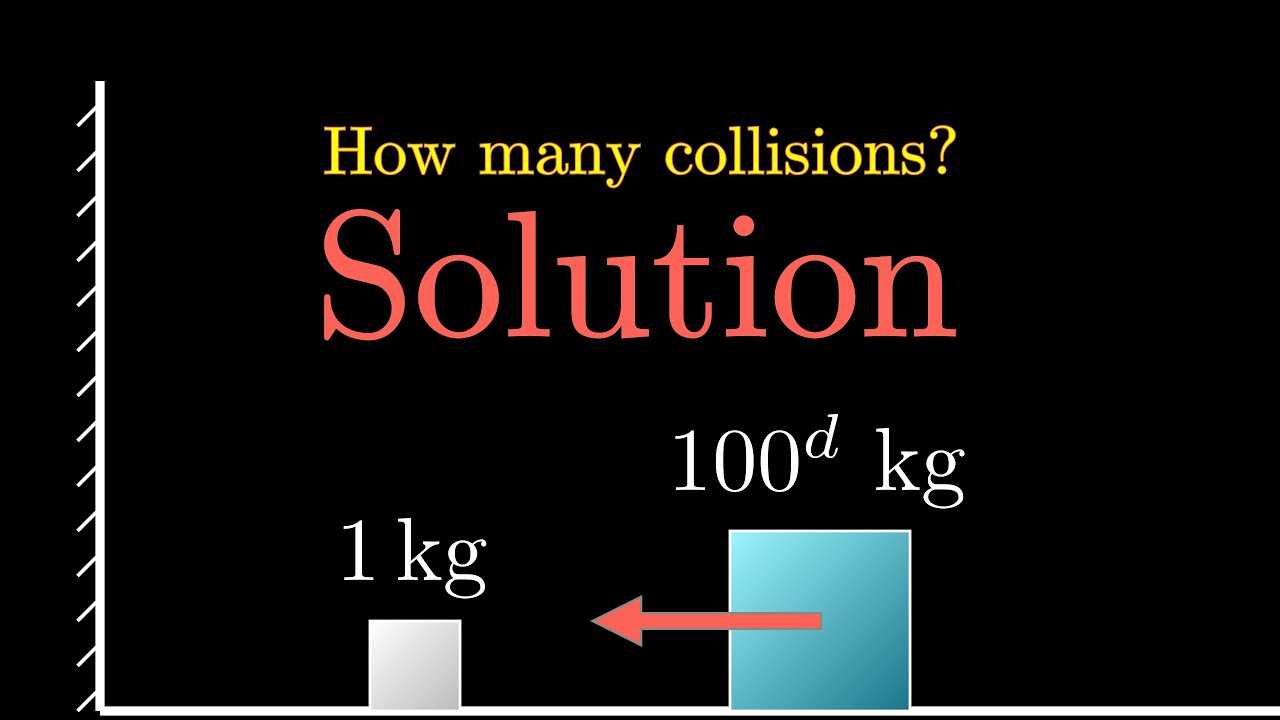
Even prettier solution: https://youtu.be/brU5yLm9DZM
Help fund future projects: https://www.patreon.com/3blue1brown
An equally valuable form of support is to simply share some of the videos.
Special thanks to these supporters: http://3b1b.co/clacks-thanks
Home page: https://www.3blue1brown.com
Many of you shared solutions, attempts, and simula...
lone heartBOT
sleek elbow
So I was watching this 3Blue1Brown video about colliding blocks computing pi and...
 wary stream
Because tan = opp/adj
sleek elbow
I was gonna ask why he knows opp or adj but I just noticed that its just the definition of it but turned 90° counterclockwise, so that's why I didnt realise lol tyty @wary stream
.close
lone heartBOT
Channel closed
Closed by @sleek elbow
Use .reopen if this was a mistake.
Please take a minute to participate in [our survey](#changelog message) if you haven't already!
sleek elbow
.reopen
lone heartBOT
✅
sleek elbow
actually, shouldn't the blue line be called rise and the purple one run? @wary stream
because if you turn it 90°, it goes "up" by the blue line and "right" by the purple one
wary stream
Look at in reference to the angle
Since tan = opp/adj
The blue line is opp, and that's the run
sleek elbow
Oh I was thinking that you had to turn the graphic for some reason but it makes sense, the purple line is up if you dont turn anything
just me being used to lines going kinda bottom left to top right
ty
.close
lone heartBOT
Channel closed
Closed by @sleek elbow
Use .reopen if this was a mistake.
Please take a minute to participate in [our survey](#changelog message) if you haven't already!
Available help channel!
Send your question here to claim the channel.
Remember:
• Ask your math question in a clear, concise manner.
• Show your work, and if possible, explain where you are stuck.
• After 15 minutes, feel free to ping <@&286206848099549185>.
• Type the command .close to free the channel when you're done.
• Be polite and have a nice day!
Read #❓how-to-get-help for further information on how to ask a good question, and about conduct in the question channels.
 fleet bolt
could someone provide me with a generalized way of converting cartesian to polar in R^n with a proof?
lone heartBOT
fleet bolt
could someone provide me with a generalized way of converting cartesian to polar...
 tacit arch
fleet bolt
could someone provide me with a generalized way of converting cartesian to polar...
tacit arch
fleet bolt
could someone provide me with a generalized way of converting cartesian to polar...
why R^n? what's polar coordinates in R^4?
For R^3, it's just cylindrical coordinates, but since z doesn't change, it's essentially the same
fleet bolt
i mean spherical
hyperspherical for higher dimensions
polar->spherical->hyperspherical or however it's called
with one radius and n-1 angles
tacit arch
fleet bolt
polar->spherical->hyperspherical or however it's called

In mathematics, an n-sphere or a hypersphere is a topological space that is homeomorphic to a standard n-sphere, which is the set of points in (n + 1)-dimensional Euclidean space that are situated at a constant distance r from a fixed point, called the center. It is the generalization of an ordinary sphere in the ordinary three-dimensional space...
lone heartBOT
Channel closed
Closed by @fleet bolt
Use .reopen if this was a mistake.
Please take a minute to participate in [our survey](#changelog message) if you haven't already!
Available help channel!
Send your question here to claim the channel.
Remember:
• Ask your math question in a clear, concise manner.
• Show your work, and if possible, explain where you are stuck.
• After 15 minutes, feel free to ping <@&286206848099549185>.
• Type the command .close to free the channel when you're done.
• Be polite and have a nice day!
Read #❓how-to-get-help for further information on how to ask a good question, and about conduct in the question channels.
 normal ingot
The complement of the intersection of two sets is the same as the union of their complements
lone heartBOT
@acoustic plover Has your question been resolved?
Channel closed
Closed by @acoustic plover
Use .reopen if this was a mistake.
Please take a minute to participate in [our survey](#changelog message) if you haven't already!
Available help channel!
Send your question here to claim the channel.
Remember:
• Ask your math question in a clear, concise manner.
• Show your work, and if possible, explain where you are stuck.
• After 15 minutes, feel free to ping <@&286206848099549185>.
• Type the command .close to free the channel when you're done.
• Be polite and have a nice day!
Read #❓how-to-get-help for further information on how to ask a good question, and about conduct in the question channels.
 fervent timber
 lone heartBOT
fervent timber
https://media.discordapp.net/attachments/903481109420048385/994342606643417098/u...
fervent timber
lone heartBOT
fervent timber
https://media.discordapp.net/attachments/903481109420048385/994342606643417098/u...
fervent timber
why can you assume FH is a line segment here?
 tight locust
because it's a segment of a line? lol
fervent timber
tight locust
because it's a segment of a line? lol
if angle GJH is 89 degrees then it wouldn’t be a line segment, right?
alpine sable
if it wasn't a line segment, then what you are trying to prove is false. So I guess it's a reasonable assumption
tight locust
do you accept that GI is a line
fervent timber
tight locust
do you accept that GI is a line
hmm I guess not? if we had another right angle then maybe
fervent timber
alpine sable
if it wasn't a line segment, then what you are trying to prove is false. So I gu...
so for these types of problems how do I know if it’s “close enough” to assume something?
tight locust
how about this: can you find a shorter path between F and H?
fervent timber
tight locust
how about this: can you find a shorter path between F and H?
I mean if the angle is 89 degrees then there would be a slightly shorter path
aka a straight line
alpine sable
fervent timber
so for these types of problems how do I know if it’s “close enough” to assume so...
you don't, it's a bad question - it should definitely be stated in the question. If it was way off 90 deg, then it's clear that FI can never be the same length as IH, so it's necessary here to have that to be a line
and the way it's drawn suggests that its a straight line
fervent timber
alpine sable
you don't, it's a bad question - it should definitely be stated in the question....
oh ok I guess that makes sense
alpine sable
the question should say something like "given a quadrilateral with diagonals intersecting at J as drawn below..."
fervent timber
yeah you’re right, maybe I’m trying to analyze this problem too closely
alpine sable
yeah, at this level, if it looks straight, it probably is
i dont think they will try to trick you too badly
fervent timber
okay thanks
yeah this isn’t my problem, someone else had posted it to another help channel
and I was written off as a troll for asking that question lol
alpine sable
ah i see
fervent timber
@alpine sable give it a read if you'd like, it's hilarious
anyway thanks
.close
lone heartBOT
Channel closed
Closed by @fervent timber
Use .reopen if this was a mistake.
Please take a minute to participate in [our survey](#changelog message) if you haven't already!
lone heartBOT
Available help channel!
Send your question here to claim the channel.
Remember:
• Ask your math question in a clear, concise manner.
• Show your work, and if possible, explain where you are stuck.
• After 15 minutes, feel free to ping <@&286206848099549185>.
• Type the command .close to free the channel when you're done.
• Be polite and have a nice day!
Read #❓how-to-get-help for further information on how to ask a good question, and about conduct in the question channels.
 hardy geyser
 hardy geyser
why does it not factor to (x+2)(x+2)
wary stream
Expand that and you'll see that it's not equal
hardy geyser
wary stream
Expand that and you'll see that it's not equal
oh ok
brisk bay
hardy geyser
oh ok
congratulations did you find what it is equal to
lone heartBOT
@hardy geyser Has your question been resolved?
hardy geyser
brisk bay
congratulations did you find what it is equal to
YES NOT FACTOEABLE!
lone heartBOT
Channel closed
Closed by @hardy geyser
Use .reopen if this was a mistake.
Please take a minute to participate in [our survey](#changelog message) if you haven't already!
brisk bay
ok bye have nice day
lone heartBOT
Available help channel!
Send your question here to claim the channel.
Remember:
• Ask your math question in a clear, concise manner.
• Show your work, and if possible, explain where you are stuck.
• After 15 minutes, feel free to ping <@&286206848099549185>.
• Type the command .close to free the channel when you're done.
• Be polite and have a nice day!
Read #❓how-to-get-help for further information on how to ask a good question, and about conduct in the question channels.
 arctic harbor
I'm not sure what I'm doing wrong, but the correct solution is supposed to be $2250.88
 lone heartBOT
arctic harbor
I'm not sure what I'm doing wrong, but the correct solution is supposed to be $2...
wary stream
arctic harbor
I'm not sure what I'm doing wrong, but the correct solution is supposed to be $2...
lone heartBOT
arctic harbor
I'm not sure what I'm doing wrong, but the correct solution is supposed to be $2...
wary stream
arctic harbor
I'm not sure what I'm doing wrong, but the correct solution is supposed to be $2...
Where's the proof for this answer? Because your work is correct
tight locust
P(1+r/n)^(nt)
arctic harbor
wary stream
Where's the proof for this answer? Because your work is correct
the solution at the end of the worksheet, but I can double check
wary stream
tight locust
P(1+r/n)^(nt)
That's the formula that was used. They just broke up the formula into parts
arctic harbor
tight locust
P(1+r/n)^(nt)
Is this a different equation?
arctic harbor
wary stream
That's the formula that was used. They just broke up the formula into parts
Oh ok
tight locust
arctic harbor
Is this a different equation?
No you did it right
But this is just a more direct formula
arctic harbor
tight locust
But this is just a more direct formula
Okay I see
If everything looks right, then maybe it's a problem with the book
.close
lone heartBOT
Channel closed
Closed by @arctic harbor
Use .reopen if this was a mistake.
Please take a minute to participate in [our survey](#changelog message) if you haven't already!
Available help channel!
Send your question here to claim the channel.
Remember:
• Ask your math question in a clear, concise manner.
• Show your work, and if possible, explain where you are stuck.
• After 15 minutes, feel free to ping <@&286206848099549185>.
• Type the command .close to free the channel when you're done.
• Be polite and have a nice day!
Read #❓how-to-get-help for further information on how to ask a good question, and about conduct in the question channels.
 spare canopy
how would you solve ln(3-x) = 0
lone heartBOT
spare canopy
how would you solve ln(3-x) = 0
tacit arch
,calc log(3-2)
ocean sealBOT
Result:
0
show where it says this is the answer
also show the original question
spare canopy
okay
spare canopy
tacit arch
also show the original question
it says i need to calculate the yellow surface

g(x) = ln(3-x)

 abstract fractal
They're integrating along the y axis
Thus the different bounds
Based on the π though
I suspect you're not just "calculating the surface"
spare canopy
i should finde g(x) = 0 right?
spare canopy
abstract fractal
I suspect you're not just "calculating the surface"
yeah along the y axis
spare canopy
spare canopy
how would you solve ln(3-x) = 0
^^
abstract fractal
Anyways, you're trying to find where the line crosses the x axis, but you should be trying to find where the line crosses the y axis
You're integrating w.r.t. y, not x
lone heartBOT
Channel closed
Closed by @spare canopy
Use .reopen if this was a mistake.
Please take a minute to participate in [our survey](#changelog message) if you haven't already!
Available help channel!
Send your question here to claim the channel.
Remember:
• Ask your math question in a clear, concise manner.
• Show your work, and if possible, explain where you are stuck.
• After 15 minutes, feel free to ping <@&286206848099549185>.
• Type the command .close to free the channel when you're done.
• Be polite and have a nice day!
Read #❓how-to-get-help for further information on how to ask a good question, and about conduct in the question channels.
 wicked axle
hi what does z represent here
 lone heartBOT
wicked axle
hi what does *z* represent here
wicked axle
lone heartBOT
wicked axle
hi what does *z* represent here
wicked axle
how do we get 1.96?
abstract fractal
It's the z score
wicked axle
oh
abstract fractal
There are z tables with a bunch of values
lone heartBOT
Channel closed
Closed by @wicked axle
Use .reopen if this was a mistake.
Please take a minute to participate in [our survey](#changelog message) if you haven't already!
Available help channel!
Send your question here to claim the channel.
Remember:
• Ask your math question in a clear, concise manner.
• Show your work, and if possible, explain where you are stuck.
• After 15 minutes, feel free to ping <@&286206848099549185>.
• Type the command .close to free the channel when you're done.
• Be polite and have a nice day!
Read #❓how-to-get-help for further information on how to ask a good question, and about conduct in the question channels.
alpine sable
Use the function to find the preimage of w.
T(v1 , v2) = (v1 + v2 , v1 - v2)
w= (3,19)
I have tried:
T(3,19) = (3+19 , 3-19) = (22, -16)
v1 + v2 = 22
v1 - v2 = -16
2(v1) = 6
v1 = 3
v2 = 19
Correct answer: v1 = 11 , v2 = -8.
Which part am I doing incorrectly?
lone heartBOT
alpine sable
Use the function to find the preimage of w.
T(v1 , v2) = (v1 + v2 , v1 - v2)
w...
 placid zinc
You're computing the pre-image of (22, -16)
alpine sable
placid zinc
You're computing the pre-image of (22, -16)
I have added the two functions together to find v1 and v2?
 real gazelle
alpine sable
Use the function to find the preimage of w.
T(v1 , v2) = (v1 + v2 , v1 - v2)
w...
real gazelle
alpine sable
Use the function to find the preimage of w.
T(v1 , v2) = (v1 + v2 , v1 - v2)
w...
You are computing T(w), not T^-1(w)
 lean fulcrum
real gazelle
lean fulcrum
real gazelle
Or actually you computed T(w) and then found the preimage of T(w)
alpine sable
real gazelle
You are computing T(w), not T^-1(w)
I dont quite understand. sorry
real gazelle
The problem asks you to find the preimage of w not T(w)
in other words
T(v1, v2) = w
You want to find v1 and v2
real gazelle
yep!
lone heartBOT
Channel closed
Closed by @sacred carbon
Use .reopen if this was a mistake.
Please take a minute to participate in [our survey](#changelog message) if you haven't already!
Available help channel!
Send your question here to claim the channel.
Remember:
• Ask your math question in a clear, concise manner.
• Show your work, and if possible, explain where you are stuck.
• After 15 minutes, feel free to ping <@&286206848099549185>.
• Type the command .close to free the channel when you're done.
• Be polite and have a nice day!
Read #❓how-to-get-help for further information on how to ask a good question, and about conduct in the question channels.
lone heartBOT
@spring quail Has your question been resolved?
Channel closed
Closed by @spring quail
Use .reopen if this was a mistake.
Please take a minute to participate in [our survey](#changelog message) if you haven't already!
Available help channel!
Send your question here to claim the channel.
Remember:
• Ask your math question in a clear, concise manner.
• Show your work, and if possible, explain where you are stuck.
• After 15 minutes, feel free to ping <@&286206848099549185>.
• Type the command .close to free the channel when you're done.
• Be polite and have a nice day!
Read #❓how-to-get-help for further information on how to ask a good question, and about conduct in the question channels.
 covert glade
I am completely lost on how to even solve this
 lone heartBOT
covert glade
I am completely lost on how to even solve this
lone heartBOT
covert glade
I am completely lost on how to even solve this
@covert glade Has your question been resolved?
real gazelle
covert glade
I am completely lost on how to even solve this
your 120/x is correct: this represents the amount of fabric each student has before the new members join
now, how much fabric does each student have after the new members join?
real gazelle
yes!
and then we also know that two more students join right, so the new number of members is x+2
so the amount of fabric they have at the end per student is also equal to 120/(x+2)
Therefore, (120/x) - 5 = 120/(x+2)
Do you see how I got that @covert glade
lone heartBOT
@covert glade Has your question been resolved?
lone heartBOT
Channel closed
Closed due to timeout
Use .reopen if this was a mistake.
Please take a minute to participate in [our survey](#changelog message) if you haven't already!
Available help channel!
Send your question here to claim the channel.
Remember:
• Ask your math question in a clear, concise manner.
• Show your work, and if possible, explain where you are stuck.
• After 15 minutes, feel free to ping <@&286206848099549185>.
• Type the command .close to free the channel when you're done.
• Be polite and have a nice day!
Read #❓how-to-get-help for further information on how to ask a good question, and about conduct in the question channels.
 tepid ravine
 lone heartBOT
tepid ravine
lone heartBOT
lone heartBOT
tepid ravine
lone heartBOT
@tepid ravine Has your question been resolved?
 humble remnant
the answer would just be (1300/2000)^12
lone heartBOT
Channel closed
Closed due to timeout
Use .reopen if this was a mistake.
Please take a minute to participate in [our survey](#changelog message) if you haven't already!
Available help channel!
Send your question here to claim the channel.
Remember:
• Ask your math question in a clear, concise manner.
• Show your work, and if possible, explain where you are stuck.
• After 15 minutes, feel free to ping <@&286206848099549185>.
• Type the command .close to free the channel when you're done.
• Be polite and have a nice day!
Read #❓how-to-get-help for further information on how to ask a good question, and about conduct in the question channels.
 vague iris
The answer is D but it still confuses me. Help pls
 humble remnant
Do you understand how P-Q will give you her current age?
vague iris
humble remnant
Do you understand how P-Q will give you her current age?
Yes. I tried to substitute some numbers to understand it better
humble remnant
Ok so lets use C as her current age
do you understand how C-R will give you her age R years ago?
humble remnant
np :)
vague iris
.close
lone heartBOT
Channel closed
Closed by @vague iris
Use .reopen if this was a mistake.
Please take a minute to participate in [our survey](#changelog message) if you haven't already!
Available help channel!
Send your question here to claim the channel.
Remember:
• Ask your math question in a clear, concise manner.
• Show your work, and if possible, explain where you are stuck.
• After 15 minutes, feel free to ping <@&286206848099549185>.
• Type the command .close to free the channel when you're done.
• Be polite and have a nice day!
Read #❓how-to-get-help for further information on how to ask a good question, and about conduct in the question channels.
 cyan mountain
The transformation would be a horizontal translation 3 units right?
cyan mountain
 lone heartBOT
@cyan mountain Has your question been resolved?
cyan mountain
Is everything else correct, like domain range and vertical asymptote
And graph
.close
lone heartBOT
Channel closed
Closed by @cyan mountain
Use .reopen if this was a mistake.
Please take a minute to participate in [our survey](#changelog message) if you haven't already!
Available help channel!
Send your question here to claim the channel.
Remember:
• Ask your math question in a clear, concise manner.
• Show your work, and if possible, explain where you are stuck.
• After 15 minutes, feel free to ping <@&286206848099549185>.
• Type the command .close to free the channel when you're done.
• Be polite and have a nice day!
Read #❓how-to-get-help for further information on how to ask a good question, and about conduct in the question channels.
 gusty storm
can someone help me figure out how to do this
 lone heartBOT
gusty storm
can someone help me figure out how to do this
gusty storm
lone heartBOT
gusty storm
can someone help me figure out how to do this
gusty storm
I get 1.61 but it doesnt match the answers in the book
gusty storm
 vale wigeon
what coordinates did you get for R?
vale wigeon
what coordinates did you get for R?
coordinates? sorry im new to this
I just tried using pythagoras to find p based on counting
then find q
so i got root 20 and root 37 for p and q
vale wigeon
did you try to calculate |R| as -|P| + 2|Q|??
vale wigeon
you know that's not how this works at all right
gusty storm
i do not
vale wigeon
you're supposed to calculate the vector R itself, then take its length
gusty storm
the textbook doesnt really go over it it just assumes i know how to do this
vale wigeon
so your teacher and your textbook never taught you anything at all about vectors or how vector addition works, yet you are now expected to do this problem?
gusty storm
Yes i am taking a physics class in university, i did not do any vectors in high school
vale wigeon
weird
i think you'd benefit from going to khan academy for a crash course in vectors
gusty storm
Will do thanks
vale wigeon
without that you'll get nowhere in physics
gusty storm
I mean i know about
forces along x and forces along y
use those to find the force youre looking for
but in terms of raw vectors without numbers i never used this stuff
vale wigeon
vector P is (4, 2) and vector Q is (1, -6)
so -P + 2Q = (-4 + 2*1, -2 + 2*(-6) ) = (-2, -14)
gusty storm
and then find the length with pythagoras measuring from the origin?
vale wigeon
yes
gusty storm
i see, very cool thanks Ann
gusty storm
vale wigeon
so -P + 2Q = (-4 + 2\*1, -2 + 2\*(-6) ) = (-2, -14)
sorry one last question, why is the negative sign not being multiplied to the 2
gusty storm
-4 + 2*1 = -2 but -4-2 = -6
see what i mean?
i know youre right i just dont understand because if i were to do this problem again
vale wigeon
no, i don't see what you mean.
-P = (-4, -2)
2Q = (2, -12)
-P + 2Q = (-4 + 2, -2 - 12)
gusty storm
OHH
I thought you were adding the x and y
but youre adding the two x and the two y
vale wigeon
i fail to see why you'd want to add together the x-component of P and the y-component of P
lone heartBOT
Channel closed
Closed by @gusty storm
Use .reopen if this was a mistake.
Please take a minute to participate in [our survey](#changelog message) if you haven't already!
lone heartBOT
Available help channel!
Send your question here to claim the channel.
Remember:
• Ask your math question in a clear, concise manner.
• Show your work, and if possible, explain where you are stuck.
• After 15 minutes, feel free to ping <@&286206848099549185>.
• Type the command .close to free the channel when you're done.
• Be polite and have a nice day!
Read #❓how-to-get-help for further information on how to ask a good question, and about conduct in the question channels.
 sharp scarab
Is there any therom or postulate or any proof name to summarize that perpendicular lines form right angles?
lone heartBOT
sharp scarab
Is there any therom or postulate or any proof name to summarize that perpendicul...
 prime badge
perpendicular doesn't have another meaning though
sharp scarab
true
but if i wrote definition of perp lines
that would imply
the m of whatever angle is 90
does that show its a right angle?
placid zinc
What's your definition of perpendicular?
sharp scarab
well
according to my teachewe
*teacher
the definition of perp angles = the measure of the angle = 90 degrees
placid zinc
Okay, what's your definition of a right angle?
placid zinc
It would count
lone heartBOT
Channel closed
Closed by @sharp scarab
Use .reopen if this was a mistake.
Please take a minute to participate in [our survey](#changelog message) if you haven't already!
Available help channel!
Send your question here to claim the channel.
Remember:
• Ask your math question in a clear, concise manner.
• Show your work, and if possible, explain where you are stuck.
• After 15 minutes, feel free to ping <@&286206848099549185>.
• Type the command .close to free the channel when you're done.
• Be polite and have a nice day!
Read #❓how-to-get-help for further information on how to ask a good question, and about conduct in the question channels.
tacit arch
tacit arch
http://math.oit.edu/~watermang/math_341/341_ch8/F13_341_book_sec_8-1.pdf
First page here and any of the examples
lone heartBOT
Channel closed
Closed by @acoustic plover
Use .reopen if this was a mistake.
Please take a minute to participate in [our survey](#changelog message) if you haven't already!
Available help channel!
Send your question here to claim the channel.
Remember:
• Ask your math question in a clear, concise manner.
• Show your work, and if possible, explain where you are stuck.
• After 15 minutes, feel free to ping <@&286206848099549185>.
• Type the command .close to free the channel when you're done.
• Be polite and have a nice day!
Read #❓how-to-get-help for further information on how to ask a good question, and about conduct in the question channels.
 cedar field
@tacit arch sorry for the ping but I just found something he said if u is x^2+5 du will be 2x which can cancel 4x and x^2+5 can you explain how?
lone heartBOT
cedar field
<@261933205387477002> sorry for the ping but I just found something he said if u...
cedar field
tacit arch
4x dx = 2 * 2x dx = 2 * du
I just dont get the 2 * du part
tacit arch
Have you learned derivatives yet?
cedar field
tacit arch
Have you learned derivatives yet?
yes
tacit arch
So if u = x^2+5, what's the derivative of u wrt x
cedar field
tacit arch
So if u = x^2+5, what's the derivative of u wrt x
wrt?
cedar field
tacit arch
With respect to
oh
tacit arch
right. so use that in 2 * 2x dx
cedar field
tacit arch
right. so use that in 2 * 2x dx
wdym?
cedar field
tacit arch
implies 2 * 2x dx = ?
i still dont get it
@tacit arch you explain 1 more time
tacit arch
it's just algebra from here
cedar field
tacit arch
it's just algebra from here
oh
cedar field
tacit arch
it's just algebra from here
can you go through this with me
lone heartBOT
@cedar field Has your question been resolved?
 fresh parcel
cedar field
can you go through this with me
fresh parcel
cedar field
can you go through this with me
you can treat du and dx as variables
then you solve for dx in terms of du
and then change the dx in the integral to that
lone heartBOT
Channel closed
Closed due to timeout
Use .reopen if this was a mistake.
Please take a minute to participate in [our survey](#changelog message) if you haven't already!
Available help channel!
Send your question here to claim the channel.
Remember:
• Ask your math question in a clear, concise manner.
• Show your work, and if possible, explain where you are stuck.
• After 15 minutes, feel free to ping <@&286206848099549185>.
• Type the command .close to free the channel when you're done.
• Be polite and have a nice day!
Read #❓how-to-get-help for further information on how to ask a good question, and about conduct in the question channels.
 rough light
Please help with this question, not sure how to approach it.
Q) Four times the sum of the first 2 terms of an infinite geometric progression is equal to the limiting sum.
Determine the possible values of the common ratio.
lone heartBOT
rough light
Please help with this question, not sure how to approach it.
Q) Four times the ...
vale wigeon
get some notation in there
perhaps you could call the first term of your GP a and its common ratio r
rough light
Yeah get that, tried solving for 4 x Sum of first 2 terms = Limiting sums
but then im getting a and r
vale wigeon
have you actually written down an equation that says this?
rough light
yeah
vale wigeon
show your equation then
rough light
input the formulas
vale wigeon
i strongly suspect you may have messed it up
 vale wigeon
well
that is definitely one way to go about this
even though personally i would've liked to see you write $4(a + ar) = \frac{a}{1-r}$
ocean sealBOT
Ann
 vale wigeon
because, you know. it's two terms. it's easier to write out their sum explicitly than to chug along with the formula
but no matter
can you now show your work from this?
rough light
vale wigeon
because, you know. it's _two terms_. it's easier to write out their sum explicit...
noted
thanks for the help nonetheless
.close
lone heartBOT
Channel closed
Closed by @rough light
Use .reopen if this was a mistake.
Please take a minute to participate in [our survey](#changelog message) if you haven't already!
lone heartBOT
Available help channel!
Send your question here to claim the channel.
Remember:
• Ask your math question in a clear, concise manner.
• Show your work, and if possible, explain where you are stuck.
• After 15 minutes, feel free to ping <@&286206848099549185>.
• Type the command .close to free the channel when you're done.
• Be polite and have a nice day!
Read #❓how-to-get-help for further information on how to ask a good question, and about conduct in the question channels.
 median leaf
extremely extremely stupid question but
lone heartBOT
median leaf
extremely extremely stupid question but
median leaf
for some reason i am having a major brain fart
can i simplify $(x^2+x^3)^4 = (x^5)^4 = x^{20}$
ocean sealBOT
meek

 harsh girder
no, $x^2+x^3 \neq x^5$
ocean sealBOT
秋水
 lone heartBOT
Channel closed
Closed by @median leaf
Use .reopen if this was a mistake.
Please take a minute to participate in [our survey](#changelog message) if you haven't already!
Available help channel!
Send your question here to claim the channel.
Remember:
• Ask your math question in a clear, concise manner.
• Show your work, and if possible, explain where you are stuck.
• After 15 minutes, feel free to ping <@&286206848099549185>.
• Type the command .close to free the channel when you're done.
• Be polite and have a nice day!
Read #❓how-to-get-help for further information on how to ask a good question, and about conduct in the question channels.
 mighty zinc
How can I learn topology from scratch? And what do I need to know before I try? (And some application would be helpful)
lone heartBOT
mighty zinc
How can I learn topology from scratch? And what do I need to know before I try? ...
vale wigeon
sutherland, and you need some baisc real analysis knowledge
mighty zinc
Sutherland?
vale wigeon
hold on i think this goes better in #books-old
ah nvm i don't have perms for that
i do have a pdf on hand tho
it's where i learned topology from so i can vouch for it
mighty zinc
Ohhh 😮.... I already have it but I didn’t know if it was worth reading
I’ll read it now 😌
.close
lone heartBOT
Channel closed
Closed by @mighty zinc
Use .reopen if this was a mistake.
Please take a minute to participate in [our survey](#changelog message) if you haven't already!
Available help channel!
Send your question here to claim the channel.
Remember:
• Ask your math question in a clear, concise manner.
• Show your work, and if possible, explain where you are stuck.
• After 15 minutes, feel free to ping <@&286206848099549185>.
• Type the command .close to free the channel when you're done.
• Be polite and have a nice day!
Read #❓how-to-get-help for further information on how to ask a good question, and about conduct in the question channels.
 quartz cave
hello
lone heartBOT
quartz cave
hello
quartz cave
I am trying to learn about discrete mathematics
And in the text
With these symbols, the principal and return after n years, denoted by S, can be expressed as S = A(1 + I) + A(1 + I)2 + ... + A(1 + I)n . As well known, this S can be put into a more compact form by first computing S - (1 + I)S as S = A ( (1 + I)n + 1 - (1 + I) ) / I .
This is said
But for me it is not well known why the first statement can be made more compact into S - (1 + I)S
Which steps are taken?
harsh girder
$$S = A(1+I)+A(1+I)^2+\dots+A(1+I)^n$$
$$(1+I)S = A(1+I)^2 +A(1+I)^3+\dots+A(1+I)^{n+1}$$
ocean sealBOT
秋水
 harsh girder
then
$$(1+I)S - S = A(1+I)^{n+1}-A(1+I)$$
ocean sealBOT
秋水
 harsh girder
yes
harsh girder
subtract two equations
quartz cave
But I dont understand how the right side ends up the way it does
A(1+I)^{n+1}-A(1+I)
harsh girder
they have the same part
$$A(1+I)^2+A(1+I)^3+\dots+A(1+I)^n$$
ocean sealBOT
秋水
 harsh girder
so when you subtract two equations, you get
$$A(1+I)^{n+1}-A(1+I)$$
ocean sealBOT
秋水
 quartz cave
But what do you subtract exactly?
 ocean sealBOT
Mr N
 ocean sealBOT
Mr N
 quartz cave
?
harsh girder
$$(1+I)S-S$$
$$=(A(1+I)^2 +A(1+I)^3+\dots+A(1+I)^{n+1})-(A(1+I)+A(1+I)^2+\dots+A(1+I)^n)$$
$$=A(1+I)^{n+1}-A(1+I)$$
ocean sealBOT
秋水
 harsh girder
then you get
$IS = A(1+I)^{n+1}-A(1+I)$
ocean sealBOT
秋水
 harsh girder
so you get S
quartz cave
Aha
Because we divide it
Alright got it
So
(1+I)S - S = IS?
Yes
Sorry
Thank you
🙏
.close
lone heartBOT
Channel closed
Closed by @quartz cave
Use .reopen if this was a mistake.
Please take a minute to participate in [our survey](#changelog message) if you haven't already!
Available help channel!
Send your question here to claim the channel.
Remember:
• Ask your math question in a clear, concise manner.
• Show your work, and if possible, explain where you are stuck.
• After 15 minutes, feel free to ping <@&286206848099549185>.
• Type the command .close to free the channel when you're done.
• Be polite and have a nice day!
Read #❓how-to-get-help for further information on how to ask a good question, and about conduct in the question channels.
alpine sable
How to prove this if a + b + c = 0
 lone heartBOT
alpine sable
How to prove this if a + b + c = 0
lone heartBOT
alpine sable
How to prove this if a + b + c = 0
 naive valley
oh sorry, yeah misread
alpine sable
expand LHS
 median oar
dw i thought that too at first XD
naive valley
pls ignore 😁
alpine sable
But it should be true
ocean sealBOT
秋水
 median oar
 alpine sable
expand LHS and go from there
median oar
a + b + c in this case = 4 not 0
but if u did -2 ,1 ,1 or 2, -1, -1 it'd work cos of the squares and 4th powers
so 2(a^2b^2 + a^2c^2 + b^2c^2) = 0?
naive valley
median oar
so 2(a^2b^2 + a^2c^2 + b^2c^2) = 0?
i think this can't be zero, otherwise the LHS is just a^4 + b^4 + c^4, whereas the RHS is twice that
median oar
oh oops
alpine sable
a^2+b^2+2ab=c^2
median oar
my bad, my turn to misread
so 2(a^2b^2 + a^2c^2 + b^2c^2) = a^4 + b^4 + c^4
that should be true then
alpine sable
guys I think I found a solution
naive valley
i verified the equation using three random numbers so it's obviously true by the "it holds for three random numbers" theorem
 lone heartBOT
@alpine sable Has your question been resolved?
lone heartBOT
Channel closed
Closed due to timeout
Use .reopen if this was a mistake.
Please take a minute to participate in [our survey](#changelog message) if you haven't already!
lone heartBOT
Available help channel!
Send your question here to claim the channel.
Remember:
• Ask your math question in a clear, concise manner.
• Show your work, and if possible, explain where you are stuck.
• After 15 minutes, feel free to ping <@&286206848099549185>.
• Type the command .close to free the channel when you're done.
• Be polite and have a nice day!
Read #❓how-to-get-help for further information on how to ask a good question, and about conduct in the question channels.
 native cloud
 lone heartBOT
native cloud
native cloud
lone heartBOT
native cloud
native cloud
Can anyone help me with this?
I am supposed to find a derivative of the inverse of each of the following function
 dry ridge
What have you tried?

 long iris
native cloud
long iris
native cloud
😂
dry ridge
native cloud
I am supposed to find a derivative of the inverse of each of the following funct...
Find the inverse first then take the derivative.
Isn’t that what your question was?
harsh girder
$$y=x+\frac{1}{x}$$
$$\frac{d}{dy}(y) = \frac{d}{dy}(x+\frac{1}{x})$$
$$1 = \frac{dx}{dy}-\frac{1}{x^2} \frac{dx}{dy}$$
ocean sealBOT
秋水
 ocean sealBOT
AirToastie
 native cloud
ocean seal
**秋水**
native cloud
ocean seal
**秋水**
What is this?
harsh girder
you want to calculate dx/dy
native cloud
native cloud
I did here
harsh girder
that's dy/dx
harsh girder
native cloud
.close
lone heartBOT
Channel closed
Closed by @native cloud
Use .reopen if this was a mistake.
Please take a minute to participate in [our survey](#changelog message) if you haven't already!
Available help channel!
Send your question here to claim the channel.
Remember:
• Ask your math question in a clear, concise manner.
• Show your work, and if possible, explain where you are stuck.
• After 15 minutes, feel free to ping <@&286206848099549185>.
• Type the command .close to free the channel when you're done.
• Be polite and have a nice day!
Read #❓how-to-get-help for further information on how to ask a good question, and about conduct in the question channels.
 stable night
 lone heartBOT
stable night
stable night
lone heartBOT
stable night
stable night
can someone help me with this, im not sure how to use combinations/permutations to solve this
 noble sinew
Find out how many three-digit integers are a multiple of 6
lone heartBOT
@stable night Has your question been resolved?
tight locust
Theres an easy way to do this. The number of multiples of 6 leq 999 is floor(999/6)
stable night
leq is less than equals to?
stable night
tight locust
Theres an easy way to do this. The number of multiples of 6 leq 999 is floor(999...
sorry, i dont get how this gives me the answer
like i dont get the intuition
tight locust
Can you write out what the answer is in words? What does it mean to find the probability of an event occuring?
 mystic flint
999/6 is the number of multiple of 6 from1-999 then u can minus with 99/6 which is from 1-99, then u should get from 100-999
stable night
tight locust
Can you write out what the answer is in words? What does it mean to find the pro...
so i want to find positive three-digit integers from 100-999
so 999/6 gives me multiples of 6, like 6 * 1, 6 * 2... oh wait i see it now
stable night
mystic flint
999/6 is the number of multiple of 6 from1-999 then u can minus with 99/6 which ...
ohhhh righttt
okay
thank u guys sm
lone heartBOT
@stable night Has your question been resolved?
lone heartBOT
Channel closed
Closed due to timeout
Use .reopen if this was a mistake.
Please take a minute to participate in [our survey](#changelog message) if you haven't already!
lone heartBOT
Available help channel!
Send your question here to claim the channel.
Remember:
• Ask your math question in a clear, concise manner.
• Show your work, and if possible, explain where you are stuck.
• After 15 minutes, feel free to ping <@&286206848099549185>.
• Type the command .close to free the channel when you're done.
• Be polite and have a nice day!
Read #❓how-to-get-help for further information on how to ask a good question, and about conduct in the question channels.
 chilly shore
I know that the equation in #1 was not valid but how di prove it? any tips?
 lone heartBOT
chilly shore
I know that the equation in #1 was not valid but how di prove it? any tips?
alpine sable
lone heartBOT
chilly shore
I know that the equation in #1 was not valid but how di prove it? any tips?
alpine sable
if it's not valid, you don't need a general proof, just a single counterexample is enough - plug some numbers in that satisfy the usual kinematic equations
 pliant dune
another way is you could plot velocity against time and try to find out what the area under the graph should be
something like this
 chilly shore
pliant dune
another way is you could plot velocity against time and try to find out what the...
chilly shore
pliant dune
another way is you could plot velocity against time and try to find out what the...
so I have to integrate it somehow?
chilly shore
alpine sable
if it's not valid, you don't need a general proof, just a single counterexample ...
Okay Ill try that thank youuu
pliant dune
chilly shore
so I have to integrate it somehow?
that or split it into a triangle on top of a rectangle
lone heartBOT
@chilly shore Has your question been resolved?
lone heartBOT
Channel closed
Closed due to timeout
Use .reopen if this was a mistake.
Please take a minute to participate in [our survey](#changelog message) if you haven't already!
lone heartBOT
Available help channel!
Send your question here to claim the channel.
Remember:
• Ask your math question in a clear, concise manner.
• Show your work, and if possible, explain where you are stuck.
• After 15 minutes, feel free to ping <@&286206848099549185>.
• Type the command .close to free the channel when you're done.
• Be polite and have a nice day!
Read #❓how-to-get-help for further information on how to ask a good question, and about conduct in the question channels.
 surreal blade
 lone heartBOT
surreal blade
surreal blade
lone heartBOT
surreal blade
surreal blade
How would I solve this?
surreal blade
would that be y'=ue^e?
wary stream
First, what about everything else?
And second, would you be able to differentiate \$y = e^x(cos(x) + 5x)$?
ocean sealBOT
dldh06
 lone heartBOT
@surreal blade Has your question been resolved?
Channel closed
Closed by @surreal blade
Use .reopen if this was a mistake.
Please take a minute to participate in [our survey](#changelog message) if you haven't already!
Available help channel!
Send your question here to claim the channel.
Remember:
• Ask your math question in a clear, concise manner.
• Show your work, and if possible, explain where you are stuck.
• After 15 minutes, feel free to ping <@&286206848099549185>.
• Type the command .close to free the channel when you're done.
• Be polite and have a nice day!
Read #❓how-to-get-help for further information on how to ask a good question, and about conduct in the question channels.
 eternal spoke
can someone help me with the proof of this for a damping oscillator?
 eternal spoke
<@&286206848099549185>
wary stream
eternal spoke
can someone help me with the proof of this for a damping oscillator?
Maybe this will help?
https://www.lehman.edu/faculty/anchordoqui/chapter23.pdf
Page 22 ish, the section labeled "23.5 Damped Oscillatory Motion"
lone heartBOT
@eternal spoke Has your question been resolved?
lone heartBOT
Channel closed
Closed due to timeout
Use .reopen if this was a mistake.
Please take a minute to participate in [our survey](#changelog message) if you haven't already!
lone heartBOT
Available help channel!
Send your question here to claim the channel.
Remember:
• Ask your math question in a clear, concise manner.
• Show your work, and if possible, explain where you are stuck.
• After 15 minutes, feel free to ping <@&286206848099549185>.
• Type the command .close to free the channel when you're done.
• Be polite and have a nice day!
Read #❓how-to-get-help for further information on how to ask a good question, and about conduct in the question channels.
chilly shore
pliant dune
here u is the starting velocity and v is the velocity at time t
Oh rightt I get it, so it could also be zero when an object started from rest
lone heartBOT
chilly shore
Oh rightt I get it, so it could also be zero when an object started from rest
lone heartBOT
@chilly shore Has your question been resolved?
Channel closed
Closed by @chilly shore
Use .reopen if this was a mistake.
Please take a minute to participate in [our survey](#changelog message) if you haven't already!
Available help channel!
Send your question here to claim the channel.
Remember:
• Ask your math question in a clear, concise manner.
• Show your work, and if possible, explain where you are stuck.
• After 15 minutes, feel free to ping <@&286206848099549185>.
• Type the command .close to free the channel when you're done.
• Be polite and have a nice day!
Read #❓how-to-get-help for further information on how to ask a good question, and about conduct in the question channels.
 livid raven
How can you get the anti derivative of $$2^x$$
lone heartBOT
livid raven
How can you get the anti derivative of $$2^x$$
ocean sealBOT
Cheese Grater
 livid raven
Is there a specific formula?
 tall hearth
yeah n^x => (n^x)/(ln(n))
abstract fractal
If you're not interested in using a prememorized formula, you can also write 2^x as e^(ln(2^x))
This is how the formula is derived, basically
lone heartBOT
Channel closed
Closed by @livid raven
Use .reopen if this was a mistake.
Please take a minute to participate in [our survey](#changelog message) if you haven't already!
Available help channel!
Send your question here to claim the channel.
Remember:
• Ask your math question in a clear, concise manner.
• Show your work, and if possible, explain where you are stuck.
• After 15 minutes, feel free to ping <@&286206848099549185>.
• Type the command .close to free the channel when you're done.
• Be polite and have a nice day!
Read #❓how-to-get-help for further information on how to ask a good question, and about conduct in the question channels.
 muted meadow
is there a website where i can finde every formula? sometimes when i google it comes something else
lone heartBOT
muted meadow
is there a website where i can finde every formula? sometimes when i google it c...
muted meadow
i need it for physik and math
tacit arch
no there isn't
 mortal trellis
that website would be quite inconvenient to use I think. there are a lot of formulas
just check the relevant wikipedia articles I guess
lone heartBOT
@muted meadow Has your question been resolved?
Channel closed
Closed by @muted meadow
Use .reopen if this was a mistake.
Please take a minute to participate in [our survey](#changelog message) if you haven't already!
lone heartBOT
Available help channel!
Send your question here to claim the channel.
Remember:
• Ask your math question in a clear, concise manner.
• Show your work, and if possible, explain where you are stuck.
• After 15 minutes, feel free to ping <@&286206848099549185>.
• Type the command .close to free the channel when you're done.
• Be polite and have a nice day!
Read #❓how-to-get-help for further information on how to ask a good question, and about conduct in the question channels.
vale wigeon
you should refresh yourself on such concepts as division and specifically division-with-remainder
lone heartBOT
@alpine sable Has your question been resolved?
lone heartBOT
@alpine sable Has your question been resolved?
lone heartBOT
Channel closed
Closed due to the original message being deleted
Please take a minute to participate in [our survey](#changelog message) if you haven't already!
Available help channel!
Send your question here to claim the channel.
Remember:
• Ask your math question in a clear, concise manner.
• Show your work, and if possible, explain where you are stuck.
• After 15 minutes, feel free to ping <@&286206848099549185>.
• Type the command .close to free the channel when you're done.
• Be polite and have a nice day!
Read #❓how-to-get-help for further information on how to ask a good question, and about conduct in the question channels.
 vocal fulcrum
 lone heartBOT
vocal fulcrum
vocal fulcrum
lone heartBOT
vocal fulcrum
vocal fulcrum
Any formula to solve this?
 modest dragon
see that 4=2^2
modest dragon
vocal fulcrum
Any formula to solve this?
i dont think so
modest dragon
vocal fulcrum
Ah
you got it
lone heartBOT
Channel closed
Closed by @vocal fulcrum
Use .reopen if this was a mistake.
Please take a minute to participate in [our survey](#changelog message) if you haven't already!
lone heartBOT
Available help channel!
Send your question here to claim the channel.
Remember:
• Ask your math question in a clear, concise manner.
• Show your work, and if possible, explain where you are stuck.
• After 15 minutes, feel free to ping <@&286206848099549185>.
• Type the command .close to free the channel when you're done.
• Be polite and have a nice day!
Read #❓how-to-get-help for further information on how to ask a good question, and about conduct in the question channels.
 final ether
How to take the first derivrative from this without using the formual?
final ether

like what would I move and how
woops wrong question

this is essentialy (4-x)^1/2
 minor needle
final ether
this is essentialy (4-x)^1/2
minor needle
final ether
this is essentialy (4-x)^1/2
without using formula? wdym
minor needle
by def.?
final ether
i duno how u call it
like
if there was a 5 in front
we would multiply the 5 with 1/2
and then reduce 1n from the coefficient
right?
but since there is no number there
what hsould I do
and what will happen with the bracket
noble sinew
Use chain rule?
final ether
we did not learn it yet
ocean sealBOT
Modus
 final ether
were learning it tomorrow
minor needle
?
final ether
ocean seal
**Modus**
yues this

we did this today

tomorrow we're doing the chain rule
but i know there is an easier way of finding this out
so i dont have to do the algebra
for a whole page for it
u know?
minor needle
I don't think so it's "easier" way, the only thing which comes to my mind is definition of derivative
final ether
so, essentially
minor needle
if you know it
final ether
would we just multiply 1/2
final ether
can you teach me actually
im curious now lol
i want to know htis
is it too much?
minor needle
it's basically chain rule
generally that rule would work if we had sqrt(x)
or sqrt(x+4)
or something like that
you can google it, but I don't think it's such a great idea, especially since you're going to learn this soon
final ether
i see
thank you
i will look through it on youtube bro
ty for your help so far
.close
lone heartBOT
Channel closed
Closed by @final ether
Use .reopen if this was a mistake.
Please take a minute to participate in [our survey](#changelog message) if you haven't already!
Available help channel!
Send your question here to claim the channel.
Remember:
• Ask your math question in a clear, concise manner.
• Show your work, and if possible, explain where you are stuck.
• After 15 minutes, feel free to ping <@&286206848099549185>.
• Type the command .close to free the channel when you're done.
• Be polite and have a nice day!
Read #❓how-to-get-help for further information on how to ask a good question, and about conduct in the question channels.
wicked axle
im doing 1 - P(X=1) to solve this question but im getting the wrong answer
 lone heartBOT
wicked axle
im doing 1 - P(X=1) to solve this question but im getting the wrong answer
wicked axle
lone heartBOT
wicked axle
im doing 1 - P(X=1) to solve this question but im getting the wrong answer
wicked axle
can someone explain why it's incorrect?
tacit arch
if you show your work someone can correct it

 wicked axle
oh..
i thought P(x=1) was the summation of all probabilities less or equal to x=1
so i thought 1-P(x=1) would work
tacit arch
wicked axle
i thought P(x=1) was the summation of all probabilities less or equal to x=1
nah P(X=1) is just the probability of X equal to 1
wicked axle
i think i was mistaking it for what the binomial table provides
cause if u look at the binomial table at x = 1 it gives 0.071
1-0.071 gives the right answer
tacit arch
read the description of the binomial table
wicked axle
yeah i realize now
i thought i was computing the same thing as what was in the binomial table entry
but i wasnt
makes sense now though thanks
tacit arch
 common mistake everyone makes
lone heartBOT
Channel closed
Closed by @wicked axle
Use .reopen if this was a mistake.
Please take a minute to participate in [our survey](#changelog message) if you haven't already!
Available help channel!
Send your question here to claim the channel.
Remember:
• Ask your math question in a clear, concise manner.
• Show your work, and if possible, explain where you are stuck.
• After 15 minutes, feel free to ping <@&286206848099549185>.
• Type the command .close to free the channel when you're done.
• Be polite and have a nice day!
Read #❓how-to-get-help for further information on how to ask a good question, and about conduct in the question channels.
 bright quiver
 lone heartBOT
bright quiver
normal ingot
lone heartBOT
bright quiver
normal ingot
,rotate
ocean sealBOT
 normal ingot
Where is V?
minor needle
I guess your question is where are V and S
bright quiver
B=V
lone heartBOT
@bright quiver Has your question been resolved?
lone heartBOT
@bright quiver Has your question been resolved?
lone heartBOT
Channel closed
Closed due to timeout
Use .reopen if this was a mistake.
Please take a minute to participate in [our survey](#changelog message) if you haven't already!
Available help channel!
Send your question here to claim the channel.
Remember:
• Ask your math question in a clear, concise manner.
• Show your work, and if possible, explain where you are stuck.
• After 15 minutes, feel free to ping <@&286206848099549185>.
• Type the command .close to free the channel when you're done.
• Be polite and have a nice day!
Read #❓how-to-get-help for further information on how to ask a good question, and about conduct in the question channels.
Channel closed
Closed due to the original message being deleted
Please take a minute to participate in [our survey](#changelog message) if you haven't already!
Available help channel!
Send your question here to claim the channel.
Remember:
• Ask your math question in a clear, concise manner.
• Show your work, and if possible, explain where you are stuck.
• After 15 minutes, feel free to ping <@&286206848099549185>.
• Type the command .close to free the channel when you're done.
• Be polite and have a nice day!
Read #❓how-to-get-help for further information on how to ask a good question, and about conduct in the question channels.
 cunning monolith
I am confused as to how to solve this function. how would i begin to solve? I attached my attempt but I am just confused about the format

 lone heartBOT
cunning monolith
I am confused as to how to solve this function. how would i begin to solve? I at...
lone heartBOT
cunning monolith
I am confused as to how to solve this function. how would i begin to solve? I at...
 tepid sinew
You have to look at this

You have to use the function that matches with the interval
if its h(1) you use 16(1-t^2)
and replacing t=1
but if at the h(t) t>1 and =<2.5 you use the (4-4t)(4t-10)
cunning monolith
how would I know which function to use for each equation? sorry i am still a little lost
tepid sinew
it depends on the t
if 0=<t=<1 you use the top function
but if t is at the interval 1<t=<2,5
you use the function of the bottom
lone heartBOT
Channel closed
Closed by @cunning monolith
Use .reopen if this was a mistake.
Please take a minute to participate in [our survey](#changelog message) if you haven't already!
Available help channel!
Send your question here to claim the channel.
Remember:
• Ask your math question in a clear, concise manner.
• Show your work, and if possible, explain where you are stuck.
• After 15 minutes, feel free to ping <@&286206848099549185>.
• Type the command .close to free the channel when you're done.
• Be polite and have a nice day!
Read #❓how-to-get-help for further information on how to ask a good question, and about conduct in the question channels.
spare canopy
should there be an e^x next to x^2 at the end in the second derivative
 minor needle
spare canopy
should there be an e^x next to x^2 at the end in the second derivative
minor needle
spare canopy
should there be an e^x next to x^2 at the end in the second derivative
you're right
spare canopy
really?
minor needle
ye, reason is product rule
spare canopy
.close
lone heartBOT
Channel closed
Closed by @spare canopy
Use .reopen if this was a mistake.
Please take a minute to participate in [our survey](#changelog message) if you haven't already!
Available help channel!
Send your question here to claim the channel.
Remember:
• Ask your math question in a clear, concise manner.
• Show your work, and if possible, explain where you are stuck.
• After 15 minutes, feel free to ping <@&286206848099549185>.
• Type the command .close to free the channel when you're done.
• Be polite and have a nice day!
Read #❓how-to-get-help for further information on how to ask a good question, and about conduct in the question channels.
cunning monolith
how would I begin to solve this function? i attempted to do some work but I am not sure what to do next
 lone heartBOT
cunning monolith
how would I begin to solve this function? i attempted to do some work but I am n...
minor needle
lone heartBOT
cunning monolith
how would I begin to solve this function? i attempted to do some work but I am n...
minor needle
you should do x + 2 >= 0 on the left
because numerator can be equal 0
and on the right it's enough to solve x^2 - 9 != 0 (we can't divide by 0)
cunning monolith
so that is the domain? how would i format the answer
minor needle
solve them then tell me what you got
cunning monolith
by solve do you mean input 0 and solve the equation that way?
minor needle
solve as you did it in your picture
cunning monolith
how would I solve the problem? like where do I go next. you said the on the right its enough to solve so did I get the equation right or is there just no further work needing to be done because its equal to 0.
minor needle
cunning monolith
how would I solve the problem? like where do I go next. you said the on the righ...
you've solved it correctly but sign should be ≥ not >
on the right you did it wrong, because the denominator can be negative, try calculating value of the function for x = 1, is x = 1 belong to your domain set?
cunning monolith
to calculate the value do i input it into the function as a whole?
 prisma elbow
yeah, sub in x for 1 in any place x appears and see if you get a value
cunning monolith
I ended up with 3/-8
minor needle
cunning monolith
I ended up with 3/-8
so you see x = 1 belong to the domain
you got x > 3
this is why you should do:
$$x^{2}-9 \neq 0$$
ocean sealBOT
Modus
 cunning monolith
then would I solve that ?
prisma elbow
you are trying to find what values of x will make the denominator=0 since you can't divide by 0
cunning monolith
oh okay, so i use that equation to find the value of x that makes the denominator 0?
then the value that makes the denominator 0 is my domain right
minor needle
cunning monolith
then the value that makes the denominator 0 is my domain right
vice versa, you remove that x's from the domain
because the domain is all the values of that wouldn't make expression undefined
cunning monolith
.close