#help-0
1 messages · Page 1045 of 1
 devout lantern
It is terrible written but first graph is f(x) and second graph is g(x) so if you approach from + it means you approach from right side so it is -2
and -2 is g(x)
devout lantern
yes
devout lantern
no problem
 obtuse hatch
.close
 lone heartBOT
Channel closed
Closed by @obtuse hatch
Use .reopen if this was a mistake.
Please take a minute to participate in [our survey](#changelog message) if you haven't already!
 Available help channel!
Send your question here to claim the channel.
Remember:
• Ask your math question in a clear, concise manner.
• Show your work, and if possible, explain where you are stuck.
• After 15 minutes, feel free to ping <@&286206848099549185>.
• Type the command .close to free the channel when you're done.
• Be polite and have a nice day!
Read #❓how-to-get-help for further information on how to ask a good question, and about conduct in the question channels.
 hard berry


 lone heartBOT
hard berry
hard berry
lone heartBOT
hard berry
hard berry
Does my proof look right?
Searched the whole internet for the proof but couldn't find it
lone heartBOT
@hard berry Has your question been resolved?
lone heartBOT
Channel closed
Closed due to timeout
Use .reopen if this was a mistake.
Please take a minute to participate in [our survey](#changelog message) if you haven't already!
lone heartBOT
Available help channel!
Send your question here to claim the channel.
Remember:
• Ask your math question in a clear, concise manner.
• Show your work, and if possible, explain where you are stuck.
• After 15 minutes, feel free to ping <@&286206848099549185>.
• Type the command .close to free the channel when you're done.
• Be polite and have a nice day!
Read #❓how-to-get-help for further information on how to ask a good question, and about conduct in the question channels.
 alpine sable
Quick question, I'm really stuck on the concavity here
 alpine sable
So I was able to find the second derivative, and I found that with any negative number, the answer would come out as positive, thus the concavity is upwards when t < 0
But it keeps marking it incorrectly and I can't necessarily see why
 lilac nest
It asks for interval notation, so maybe you have to write [ (-\infty , 0 ) ]
 ocean sealBOT
Andrea276
 alpine sable
lilac nest
It asks for interval notation, so maybe you have to write \[ (-\infty , 0 ) \]
alpine sable
lilac nest
It asks for interval notation, so maybe you have to write \[ (-\infty , 0 ) \]
ah...
yeah
my bad, thanks for pointing that out
lilac nest
Np👍
lone heartBOT
@alpine sable Has your question been resolved?
Channel closed
Closed by @jaunty rune
Use .reopen if this was a mistake.
Please take a minute to participate in [our survey](#changelog message) if you haven't already!
Available help channel!
Send your question here to claim the channel.
Remember:
• Ask your math question in a clear, concise manner.
• Show your work, and if possible, explain where you are stuck.
• After 15 minutes, feel free to ping <@&286206848099549185>.
• Type the command .close to free the channel when you're done.
• Be polite and have a nice day!
Read #❓how-to-get-help for further information on how to ask a good question, and about conduct in the question channels.
 final crag
hello
lone heartBOT
final crag
hello

 long iris
4,1 works too
lone heartBOT
@final crag Has your question been resolved?
 vale crag
final crag
so for S = {(2,1), (3,1), (3,2), (4,1), (4,2), (4,3)}?
vale crag
final crag
so for S = {(2,1), (3,1), (3,2), (4,1), (4,2), (4,3)}?
sounds about right yes
final crag
vale crag
sounds about right yes
tyy
lone heartBOT
@final crag Has your question been resolved?
Channel closed
Closed by @final crag
Use .reopen if this was a mistake.
Please take a minute to participate in [our survey](#changelog message) if you haven't already!
Available help channel!
Send your question here to claim the channel.
Remember:
• Ask your math question in a clear, concise manner.
• Show your work, and if possible, explain where you are stuck.
• After 15 minutes, feel free to ping <@&286206848099549185>.
• Type the command .close to free the channel when you're done.
• Be polite and have a nice day!
Read #❓how-to-get-help for further information on how to ask a good question, and about conduct in the question channels.
 kindred path
how do i complete the square
 lone heartBOT
kindred path
how do i complete the square
lone heartBOT
kindred path
how do i complete the square
 chrome plank
Start by factoring out the coefficient of the squared terms with the squared terms themselves and the ^1 term
ocean sealBOT
Nonna
 kindred path
then do i move the 100 to the other side?
chrome plank
Keep it there for now
now it's easy to complete the squares
let's complete together 4(z² - 10z), shall we?
kindred path
4(z^2-10z+25)?
chrome plank
yup
But!
We added something that wasn't there before
that's 25 in this case
to make our equation still true, we can subtract it immediately after
There's another caveat
25 was multiplied by 4 because of the parenthesis, so we will have to subtract 100
So our square, completed, looks something like this:
4(z² - 10z + 25) - 25 * 4
= 4(z - 5)² - 100
Do you understand?
kindred path
not the last part
chrome plank
Where, exactly?
kindred path
chrome plank
25 was multiplied by 4 because of the parenthesis, so we will have to subtract 1...
this
chrome plank
Let's say we have an equation,
n = n n can be whatever you want.
Of course, if we add something to the left side, like we did to complete the square, it doesn't hold true anymore
n + k ≠ n if k is not 0
To make things right, we can sum k to both sides
n + k = n + k
or subtract it immediately after
n + k - k = n
But when we added 25, we also multiplied it by 4 because of the parenthesis
4(whatever + 25), if you expand that you get 4 * whatever + 100,
so actually, we added 100, not 25
chrome plank
Sure, if you want that's 4(x + 0)², but it seems useless to write it like that
kindred path
Thank you
chrome plank

lone heartBOT
@kindred path Has your question been resolved?
lone heartBOT
Channel closed
Closed due to timeout
Use .reopen if this was a mistake.
Please take a minute to participate in [our survey](#changelog message) if you haven't already!
Available help channel!
Send your question here to claim the channel.
Remember:
• Ask your math question in a clear, concise manner.
• Show your work, and if possible, explain where you are stuck.
• After 15 minutes, feel free to ping <@&286206848099549185>.
• Type the command .close to free the channel when you're done.
• Be polite and have a nice day!
Read #❓how-to-get-help for further information on how to ask a good question, and about conduct in the question channels.
kindred path
i need help completing the square
 lone heartBOT
kindred path
i need help completing the square
lone heartBOT
kindred path
i need help completing the square
 real gazelle
Wait didn't someone just help you with this
real gazelle
so what do you have so far
kindred path
4x^2+(y^2-4y)+4(z-5)^2-100=0
kindred path
would i do (y-2)^2?
real gazelle
wait where did you get the -100 from btw? in the equation you just posted
kindred path
chrome plank
4(z² - 10z + 25) - 25 * 4
= 4(z - 5)² - 100
this
kindred path
oh bet
real gazelle
so you've got 4x^2 + (y^2-4y) + 4(z-5)^2 = 0
and yep you would do (y-2)^2 that's correct!
but then what do you have to subtract out at the end
kindred path
-2?
kindred path
then i move 4 to the other side?
real gazelle
yep!
kindred path
how do i do completeing the square for (x^2-2x+1)+(y^2-4y+4)-z=0
lone heartBOT
@kindred path Has your question been resolved?
Channel closed
Closed by @kindred path
Use .reopen if this was a mistake.
Please take a minute to participate in [our survey](#changelog message) if you haven't already!
Available help channel!
Send your question here to claim the channel.
Remember:
• Ask your math question in a clear, concise manner.
• Show your work, and if possible, explain where you are stuck.
• After 15 minutes, feel free to ping <@&286206848099549185>.
• Type the command .close to free the channel when you're done.
• Be polite and have a nice day!
Read #❓how-to-get-help for further information on how to ask a good question, and about conduct in the question channels.
 carmine bronze
what I do wrong

 tacit arch
carmine bronze
what I do wrong
tacit arch
carmine bronze
what I do wrong
Your numerator power of x changed from -1/2 to -1 from line 3 to 4. How?
carmine bronze
I added them
-1/2+-1/2=-2/2
right?
right??
right???
right????
riemann why you leave me 😦
lone heartBOT
@carmine bronze Has your question been resolved?
carmine bronze
If anybody sees this message, I still need help
tacit arch
carmine bronze
-1/2+-1/2=-2/2
Powers don't add that way
carmine bronze
oh
tacit arch
x^n + x^n = 2x^n, not x^(2n)
If you were multiplying them, then yes the exponents add
lone heartBOT
@carmine bronze Has your question been resolved?
Channel closed
Closed by @carmine bronze
Use .reopen if this was a mistake.
Please take a minute to participate in [our survey](#changelog message) if you haven't already!
lone heartBOT
Available help channel!
Send your question here to claim the channel.
Remember:
• Ask your math question in a clear, concise manner.
• Show your work, and if possible, explain where you are stuck.
• After 15 minutes, feel free to ping <@&286206848099549185>.
• Type the command .close to free the channel when you're done.
• Be polite and have a nice day!
Read #❓how-to-get-help for further information on how to ask a good question, and about conduct in the question channels.
 shy bolt
 lone heartBOT
shy bolt
https://media.discordapp.net/attachments/903481105888452609/992260821457588284/I...
lone heartBOT
shy bolt
https://media.discordapp.net/attachments/903481105888452609/992260821457588284/I...
Please only use the <@&286206848099549185> ping once if your question has not been answered for 15 minutes. Please do not ping or DM individual users about your question.
@shy bolt Has your question been resolved?
 harsh girder
$\log_{5/8}(t) \geq 1 \implies 0<t \leq \frac{5}{8}$
ocean sealBOT
秋水
 lone heartBOT
Channel closed
Closed due to timeout
Use .reopen if this was a mistake.
Please take a minute to participate in [our survey](#changelog message) if you haven't already!
Available help channel!
Send your question here to claim the channel.
Remember:
• Ask your math question in a clear, concise manner.
• Show your work, and if possible, explain where you are stuck.
• After 15 minutes, feel free to ping <@&286206848099549185>.
• Type the command .close to free the channel when you're done.
• Be polite and have a nice day!
Read #❓how-to-get-help for further information on how to ask a good question, and about conduct in the question channels.
lone heartBOT
 vale wigeon
look for some other angles that you do know how to solve for. there ought to be at least one that's immediate.
also recall some things about triangles and their angles.
 lone palm
Wait, take a step back. What are you first trying to find?
Yes, but what do we need to be able to find angle A?
We need more information.
vale wigeon
i think this is a "show don't tell" scenario.

i suggest that you find this angle i've marked in red.
lone palm
Ye
vale wigeon
well you could say it like that, yes.
lone palm
Yeah, but I'm ngl I've never heard of the 3rd angle theorem.
What you are doing is correct tho.
 nimble fiber
lone palm
Yeah, but I'm ngl I've never heard of the 3rd angle theorem.
nimble fiber
lone palm
Yeah, but I'm ngl I've never heard of the 3rd angle theorem.
If a triangle has angles a b and c, the exterior angle of a = b+c
Exterior angle theorem? Never heard of 3rd angle either
lone palm
nimble fiber
Exterior angle theorem? Never heard of 3rd angle either
Yes, exterior angle theorem.
What type of triangle is this?
So, do you know a property of an isosceles triangle that would help us find x or y?
Ye.
So like, you found one angle.
And the angle that you found is congruent to which other angle?
👍
So now we know that lower left angle and y. Now, we can use a known fact about triangles to find x.
lone heartBOT
Channel closed
Closed by @mental geyser
Use .reopen if this was a mistake.
Please take a minute to participate in [our survey](#changelog message) if you haven't already!
Available help channel!
Send your question here to claim the channel.
Remember:
• Ask your math question in a clear, concise manner.
• Show your work, and if possible, explain where you are stuck.
• After 15 minutes, feel free to ping <@&286206848099549185>.
• Type the command .close to free the channel when you're done.
• Be polite and have a nice day!
Read #❓how-to-get-help for further information on how to ask a good question, and about conduct in the question channels.
 turbid badger
A square of side 257cm then how many square would fit in it to leave no space
lone heartBOT
turbid badger
A square of side 257cm then how many square would fit in it to leave no space
turbid badger
A square of side 257cm then how many square would fit in it to leave no space
.close
lone heartBOT
Channel closed
Closed by @turbid badger
Use .reopen if this was a mistake.
Please take a minute to participate in [our survey](#changelog message) if you haven't already!
lone heartBOT
Available help channel!
Send your question here to claim the channel.
Remember:
• Ask your math question in a clear, concise manner.
• Show your work, and if possible, explain where you are stuck.
• After 15 minutes, feel free to ping <@&286206848099549185>.
• Type the command .close to free the channel when you're done.
• Be polite and have a nice day!
Read #❓how-to-get-help for further information on how to ask a good question, and about conduct in the question channels.
 rugged thistle
There are two wires A and B. If the resistance of B is R and the diameter of A is twice of B, the length and
the nature of the material is the same, find the resistance of A.
lone heartBOT
rugged thistle
There are two wires A and B. If the resistance of B is R and the diameter of A i...
 normal ingot
 rugged thistle
Suppose that you wish to fabricate a uniform wire out of 1.0 g of copper. The resistance of wire is to be 0.5
ohm and if all of the copper are to be used, what will be the diameter of wire? Specific resistance is 1.7x10*
ohm-meter and mass density is 8.92x10⁻³ kg/m .
This one!!
??*
normal ingot
ask one question at a time
lone heartBOT
@rugged thistle Has your question been resolved?
lone heartBOT
Channel closed
Closed due to timeout
Use .reopen if this was a mistake.
Please take a minute to participate in [our survey](#changelog message) if you haven't already!
lone heartBOT
Available help channel!
Send your question here to claim the channel.
Remember:
• Ask your math question in a clear, concise manner.
• Show your work, and if possible, explain where you are stuck.
• After 15 minutes, feel free to ping <@&286206848099549185>.
• Type the command .close to free the channel when you're done.
• Be polite and have a nice day!
Read #❓how-to-get-help for further information on how to ask a good question, and about conduct in the question channels.
lone heartBOT
 placid zinc
Like, find something perpendicular to (1,-3)?
In 2D such a question makes sense, but for most vectors it doesn't
Or at least, I don't know how wolfram would display them all?
,w orthogonal complement to Span(1,-3)
ocean sealBOT

Wolfram Alpha doesn't understand your query!
Perhaps try rephrasing your question?
Click here to refine your query online
 Requested by Kaynex#7520
lone heartBOT
Requested by Kaynex#7520
lone heartBOT
@acoustic plover Has your question been resolved?
placid zinc
,w Vector solutions to (1,-3)•x = 0
ocean sealBOT

 Requested by Kaynex#7520
placid zinc
Requested by Kaynex#7520
placid zinc
How tf
 mortal trellis
,w null space of {(1, -3)}
ocean sealBOT

 Requested by Denascite#8952
lone heartBOT
Requested by Denascite#8952
lone heartBOT
Channel closed
Closed due to timeout
Use .reopen if this was a mistake.
Please take a minute to participate in [our survey](#changelog message) if you haven't already!
✅
mortal trellis
orthogonal vectors are those which have a dot product of zero with the original vector
this means that if you see the original vector as a matrix A then you get Ax=0
vectors x that satisfy Ax=0 are in the null space of A
x is a vector
the vector? not really sure what you are asking
(0,1)
well relying on wolfram is a crutch anyway
you should know what it means to be orthogonal
and be able to calc all that stuff yourself
if the vector has 3 components then the space of all orthogonal vectors is 2 dimensional
in general if v is an orthogonal vector then so is cv for any scalar c
so there is no unique choice v in any case
there is no "the" orthogonal unit vectors
there are 6 different orthogonal unit vectors
one choice is c*(2, 4, 0, 0) because clearly the (2,4,0,0) is orthogonal because the dot product is 0 and then we normalize with the length c=1/sqrt(2^2+4^2) so that it is a unit vector
you can be asked to find a perpendicular vector
but not the perpendicular vector
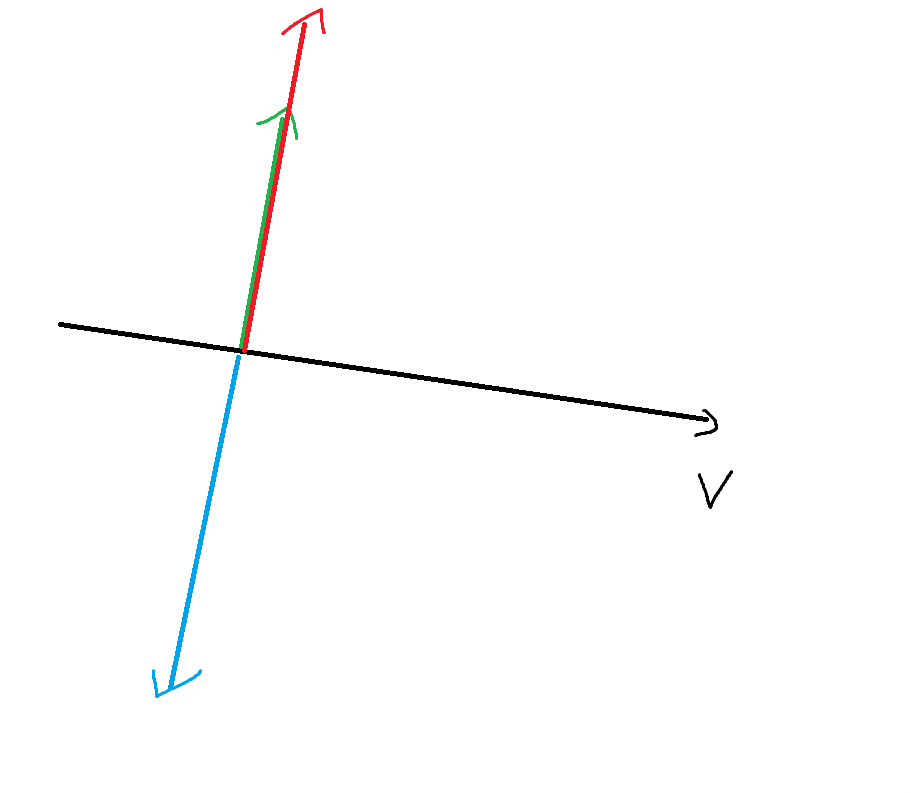
clearly red blue and green are all perpendicular to v
and a lot of other choices aswell
and if I could paint in 3d I would also give you an example in 3d space
where you have even more options
because you can also now go in a third "direction"
which rule
u and v are orthogonal if the dot product of u and v is 0, yes
mortal trellis
you can only multiple a mxn matrix with a sxt matrix if n=s
here you are trying to multiply 2x1 with 2x1 which doesn't work
I don't know how you specify for wolfram alpha that you want to calculate the dot product of two vectors
 drifting hull
you can also use the dot product from wolfram alpha, but then you need to enter row vectors
,w {5,0}.{a,b}
ocean sealBOT

 Requested by Alexander42#6205
mortal trellis
Requested by Alexander42#6205
mortal trellis
we already saw that the dot product is equal to 5a
so you are trying to solve 5a=0 for b
clearly any choice of b is valid here
and this shouldn't be a surprise, because clearly any vector (0,b) is orthogonal to (5,0)
how about you learn how to do this stuff by hand
lone heartBOT
@acoustic plover Has your question been resolved?
Channel closed
Closed by @acoustic plover
Use .reopen if this was a mistake.
Please take a minute to participate in [our survey](#changelog message) if you haven't already!
lone heartBOT
Available help channel!
Send your question here to claim the channel.
Remember:
• Ask your math question in a clear, concise manner.
• Show your work, and if possible, explain where you are stuck.
• After 15 minutes, feel free to ping <@&286206848099549185>.
• Type the command .close to free the channel when you're done.
• Be polite and have a nice day!
Read #❓how-to-get-help for further information on how to ask a good question, and about conduct in the question channels.
 slate kayak
 lone heartBOT
slate kayak
slate kayak
lone heartBOT
slate kayak
slate kayak
What did I do wrong here? My answer sheet says the answer is x = 2
 languid bolt
i've learned a bit of log but not that good so i might be wrong
why did you multiply the left side of the equation by log(10^5)
slate kayak
Bc 5 = equal to that
languid bolt
anyways.... i dont think that log(a) * log(b) = loh(ab)
lone heartBOT
Channel closed
Closed by @slate kayak
Use .reopen if this was a mistake.
Please take a minute to participate in [our survey](#changelog message) if you haven't already!
Available help channel!
Send your question here to claim the channel.
Remember:
• Ask your math question in a clear, concise manner.
• Show your work, and if possible, explain where you are stuck.
• After 15 minutes, feel free to ping <@&286206848099549185>.
• Type the command .close to free the channel when you're done.
• Be polite and have a nice day!
Read #❓how-to-get-help for further information on how to ask a good question, and about conduct in the question channels.
 eternal wharf
is this an error in desmos or am i not getting something, isnt x supposed to be 0.5
 lone heartBOT
eternal wharf
is this an error in desmos or am i not getting something, isnt x supposed to be ...
harsh girder
lone heartBOT
eternal wharf
is this an error in desmos or am i not getting something, isnt x supposed to be ...
harsh girder
$\frac{5}{2} \times \frac{3}{5} -\frac{3}{2}=0$
ocean sealBOT
秋水
 eternal wharf
harsh girder
$\frac{5}{2} \times \frac{3}{5} -\frac{3}{2}=0$
eternal wharf
harsh girder
$\frac{5}{2} \times \frac{3}{5} -\frac{3}{2}=0$
thank you
harsh girder
so 0.6 is correct
lone heartBOT
@eternal wharf Has your question been resolved?
Channel closed
Closed by @eternal wharf
Use .reopen if this was a mistake.
Please take a minute to participate in [our survey](#changelog message) if you haven't already!
lone heartBOT
Available help channel!
Send your question here to claim the channel.
Remember:
• Ask your math question in a clear, concise manner.
• Show your work, and if possible, explain where you are stuck.
• After 15 minutes, feel free to ping <@&286206848099549185>.
• Type the command .close to free the channel when you're done.
• Be polite and have a nice day!
Read #❓how-to-get-help for further information on how to ask a good question, and about conduct in the question channels.
 valid stream

 lone heartBOT
valid stream
valid stream
lone heartBOT
valid stream
valid stream
I'm stuck on question D
vale wigeon
what you wrote will not be helpful here.
prefer writing tan(3x) as tan(2x+x) and making use of the result of part c.
valid stream
oh
so
it didn't want me to use the double angle formulae
for part D
okay that makes it easier lmao thanks
vale wigeon
valid stream
it didn't want me to use the double angle formulae
formulae, plural?
or just the one for tan
also can i see the instructions not to use those in writing please?
valid stream
vale wigeon
also can i see the instructions not to use those in writing please?
it didn't say that
I just assumed I had to use the double angle formula because it was in the exercise in the chapter for double angle formula
😫
I got the answer, just using the compound angle formula
thanks for the help 👍
lone heartBOT
@valid stream Has your question been resolved?
Channel closed
Closed by @valid stream
Use .reopen if this was a mistake.
Please take a minute to participate in [our survey](#changelog message) if you haven't already!
Available help channel!
Send your question here to claim the channel.
Remember:
• Ask your math question in a clear, concise manner.
• Show your work, and if possible, explain where you are stuck.
• After 15 minutes, feel free to ping <@&286206848099549185>.
• Type the command .close to free the channel when you're done.
• Be polite and have a nice day!
Read #❓how-to-get-help for further information on how to ask a good question, and about conduct in the question channels.
 strong meadow
How do we turn fraction to decimal
lone heartBOT
strong meadow
How do we turn fraction to decimal
languid bolt
by dividing the numerator with the denominator
strong meadow
languid bolt
by dividing the numerator with the denominator
thanks
lone heartBOT
@strong meadow Has your question been resolved?
lone heartBOT
Channel closed
Closed due to timeout
Use .reopen if this was a mistake.
Please take a minute to participate in [our survey](#changelog message) if you haven't already!
Available help channel!
Send your question here to claim the channel.
Remember:
• Ask your math question in a clear, concise manner.
• Show your work, and if possible, explain where you are stuck.
• After 15 minutes, feel free to ping <@&286206848099549185>.
• Type the command .close to free the channel when you're done.
• Be polite and have a nice day!
Read #❓how-to-get-help for further information on how to ask a good question, and about conduct in the question channels.
alpine sable
f(x)=ax³+bx²+cx+d
a>0
roots of equation (f o f)(x)=2x : 0,2,p,4,q(2<p<4<q)
f'(2)<0
f'(4)<0
f'(4)-f'(2)=13
f(9)=?
lone heartBOT
alpine sable
f(x)=ax³+bx²+cx+d
a>0
roots of equation (f o f)(x)=2x : 0,2,p,4,q(2<p<4<q)
f'(2)...
vale wigeon
have you made any progress on this so far?
alpine sable
no
vale wigeon
i suggest writing the equation f(f(x)) - 2x = 0 in factored form
also, just to make sure
are the roots of that equation given as 0, 2, 4, a and b? as in, the same a and b that serve as the coefficients on x^3 and x^2 in f itself?
vale wigeon
ok
alpine sable
vale wigeon
i suggest writing the equation f(f(x)) - 2x = 0 in factored form
isnt that too long
even if i factor
vale wigeon
the equation has degree 6
and you know it has five roots so one of them will be doubled
alpine sable
yes
vale wigeon
perhaps it might do you some good to think about which one it might be
maybe consider some cases
vale wigeon
idk yet, but you can keep them as-is until enough info turns up to get any of them
oh wait hold on
sorry, i miscalculated
f composed with itself has degree 9, not 6.
vale wigeon
by the way i think you would've done better to name the two unknown roots of f as p and q
right now you've got a name conflict again
do you have a picture of the problem with the names given there?
even if it's in another language
vale wigeon
ok so now you're going to ignore my request to send a picture (or tell me you don't have one) and instead ping helpers.
sounds just the tiniest bit rude.
alpine sable
i dont have one
vale wigeon
right so then say so instead of acting like you did
alpine sable
alpine sable
but idk how to use the info
ok so help
vale wigeon
i can share another thought:
the multiplicity of 0 as a root of f(f(x)) - 2x may not be able to be all that high
like, maybe consider what happens when d = 0 but c ≠ 0, and what happens when d=c=0 but b ≠ 0...
i'm sure you'll get something along the lines of "multiplicity of 0 is at most 1" or something.
are you actually willing to put in any effort yourself, by the way?
you've shown no work so far. just cries of help and "i don't know how"
alpine sable
well i can atleast get that d is 0
cuz idk where to start?
do you think putting f(x) into f(x) is efficient?
vale wigeon
d=0... that tracks.
so we now have one less variable to worry about, by the looks of it.
i would now think about whether c can be 0
alpine sable
alpine sable
well i can atleast get that d is 0
yeah
alpine sable
wdym
vale wigeon
can the conditions of the problem be satisfied if c = 0?
alpine sable
what if c isnt 0
vale wigeon
like, maybe they can't, and then we can go forward knowing c ≠ 0.
lone heartBOT
@alpine sable Has your question been resolved?
vale wigeon
hm
well, there's always the unpleasant bashing route...
i.e. painstakingly expanding everything to get a system of equations and inequalities of high degree in a, b, c, p and q
lone heartBOT
@alpine sable Has your question been resolved?
lone heartBOT
Channel closed
Closed due to timeout
Use .reopen if this was a mistake.
Please take a minute to participate in [our survey](#changelog message) if you haven't already!
Available help channel!
Send your question here to claim the channel.
Remember:
• Ask your math question in a clear, concise manner.
• Show your work, and if possible, explain where you are stuck.
• After 15 minutes, feel free to ping <@&286206848099549185>.
• Type the command .close to free the channel when you're done.
• Be polite and have a nice day!
Read #❓how-to-get-help for further information on how to ask a good question, and about conduct in the question channels.
 tulip lance
How did they plot point P?
 lone heartBOT
tulip lance
How did they plot point P?
lone heartBOT
tulip lance
How did they plot point P?
 tight locust
do you understand what a locus is?
lone heartBOT
Channel closed
Closed by @tulip lance
Use .reopen if this was a mistake.
Please take a minute to participate in [our survey](#changelog message) if you haven't already!
lone heartBOT
Available help channel!
Send your question here to claim the channel.
Remember:
• Ask your math question in a clear, concise manner.
• Show your work, and if possible, explain where you are stuck.
• After 15 minutes, feel free to ping <@&286206848099549185>.
• Type the command .close to free the channel when you're done.
• Be polite and have a nice day!
Read #❓how-to-get-help for further information on how to ask a good question, and about conduct in the question channels.
 paper holly
 lone heartBOT
paper holly
paper holly
lone heartBOT
paper holly
paper holly
¬( (p ∧ q ∧ ¬r) v (p ∧ ¬q ∧ r) v (¬p ∧ q ∧ r))
would this be a correct answer for this question?
alpine sable
this is correct
paper holly
alpine sable
this is correct
the professor wrote this as a comment "For P = T, q = T and r = F, the first clause becomes T and T and T = T. and marked it as incorrect, so is she wrong?
alpine sable
Let's try it. For $p=T, q=T, r=F$ we have $$\lnot((T\land T\land\lnot F)\lor (T\land \lnot T\land F)\lor (\lnot T\land T\land F))$$ $$\equiv\lnot((T\land T\land T)\lor (T\land F\land F)\lor (F\land T\land F))$$ $$\equiv\lnot(T\lor F\lor F)$$ $$\equiv\lnot T\equiv F$$
ocean sealBOT
bad at maths
 paper holly
alpine sable
Let's try it. For $p=T, q=T, r=F$ we have $$\lnot((T\land T\land\lnot F)\lor (T\...
paper holly
alpine sable
Let's try it. For $p=T, q=T, r=F$ we have $$\lnot((T\land T\land\lnot F)\lor (T\...
yeah that's what i thought, but my prof marked it wrong and the regrade request wrong too
maybe she didn't read the solution properly
.close
lone heartBOT
Channel closed
Closed by @paper holly
Use .reopen if this was a mistake.
Please take a minute to participate in [our survey](#changelog message) if you haven't already!
lone heartBOT
Available help channel!
Send your question here to claim the channel.
Remember:
• Ask your math question in a clear, concise manner.
• Show your work, and if possible, explain where you are stuck.
• After 15 minutes, feel free to ping <@&286206848099549185>.
• Type the command .close to free the channel when you're done.
• Be polite and have a nice day!
Read #❓how-to-get-help for further information on how to ask a good question, and about conduct in the question channels.
 hot bison
assuming this graph doesnt extend beyond what is shown what are the intervals where f is increasing. The graph is y = f(x)
lone heartBOT
hot bison
assuming this graph doesnt extend beyond what is shown what are the intervals wh...
 vale wigeon
bad wording
but yes, [-5, 0] would be one of the intervals on which f is increasing.
vale wigeon
well in fact it would be the only such interval.
 fervent timber
vale wigeon
and at 3 for that matter
fervent timber
vale wigeon
and at 3 for that matter
if the derivative is undefined how do you know if it’s increasing? I thought an increasing function has a derivative that is greater than 0
hot bison
you look left to right
and if it is going up from left I thought that meant that it is increasing
vale wigeon
fervent timber
if the derivative is undefined how do you know if it’s increasing? I thought an ...
the defn of increasingness has nothing to do with differentiability
vale wigeon
i did confirm your answer, so...
fervent timber
vale wigeon
the defn of increasingness has nothing to do with differentiability
but if the derivative is positive then it has to be increasing right? so there is a correlation
hot bison
the [0, 2] for decreasing?
vale wigeon
fervent timber
but if the derivative is positive then it has to be increasing right? so there i...
you got that the wrong way around
hot bison
alr thanks
fervent timber
is there an example where derivative is positive and it’s not increasing?
vale wigeon
if the function is differentiable and increasing then its derivative is positive
hot bison
.close
lone heartBOT
Channel closed
Closed by @hot bison
Use .reopen if this was a mistake.
Please take a minute to participate in [our survey](#changelog message) if you haven't already!
fervent timber
.reopen
lone heartBOT
Available help channel!
Send your question here to claim the channel.
Remember:
• Ask your math question in a clear, concise manner.
• Show your work, and if possible, explain where you are stuck.
• After 15 minutes, feel free to ping <@&286206848099549185>.
• Type the command .close to free the channel when you're done.
• Be polite and have a nice day!
Read #❓how-to-get-help for further information on how to ask a good question, and about conduct in the question channels.
fervent timber
vale wigeon
**if** the function is differentiable and increasing **then** its derivative is ...
okay for the sake of argument let’s say we flip that around, then is the statement not true?
if the derivative is positive than the function is increasing
lone heartBOT
fervent timber
okay for the sake of argument let’s say we flip that around, then is the stateme...
vale wigeon
ah wait no.
fervent timber
I don’t see how that can be not true
vale wigeon
the statement is true
it just requires the function to be differentiable in the first place
fervent timber
vale wigeon
it just requires the function to be differentiable in the first place
but if it’s not differentiable then you can you define increasingness? Is there an alternate definition?
vale wigeon
sure is.
let X be a subset of R, we say that a function f: X -> R is increasing (on X) if for every x1, x2 in X such that x1 < x2 we have f(x1) < f(x2)
that is sometimes called strictly increasing to resolve ambiguity
 lime tartan
Hello lol
Where can I find topics for Algebra, Trigonometric Ratios, Pythagoras' theorem, volume and surface area of prisms and cones etc?
fervent timber
vale wigeon
let X be a subset of R, we say that a function f: X -> R is *increasing (on X)* ...
is there an example of an increasing function that isn’t differentiable anywhere in its domain?
lime tartan
I'm 14 years old btw
vale wigeon
@lime tartan please open your own channel. #❓how-to-get-help
vale wigeon
fervent timber
is there an example of an increasing function that isn’t differentiable anywhere...
a nowhere-differentiable increasing function?
fervent timber
fervent timber
is there an example of an increasing function that isn’t differentiable anywhere...
I know this doesn’t have to exist per your definition, but I’m just curious
vale wigeon
let me try to think of something. I think i have something in mind.
ah yes

this
...oh wait except it might be differentiable at some points
so not quite what you asked for
maybe you could try making some modification of the weierstrass function...
fervent timber
vale wigeon
maybe you could try making some modification of the weierstrass function...
yeah I guess you could put an absolute value somewhere and it’ll work lol
anyway, thanks!
.close
lone heartBOT
Channel closed
Closed by @fervent timber
Use .reopen if this was a mistake.
Please take a minute to participate in [our survey](#changelog message) if you haven't already!
Available help channel!
Send your question here to claim the channel.
Remember:
• Ask your math question in a clear, concise manner.
• Show your work, and if possible, explain where you are stuck.
• After 15 minutes, feel free to ping <@&286206848099549185>.
• Type the command .close to free the channel when you're done.
• Be polite and have a nice day!
Read #❓how-to-get-help for further information on how to ask a good question, and about conduct in the question channels.
 novel lintel
Hey guys
lone heartBOT
novel lintel
Hey guys
novel lintel
Need help with this limit

 novel lintel
I tried using the binomial formula on (1-v^2)^n but didn't got far
 sage summit
how about investigating the behaviour of lim (1-v²)^n for various values of v
novel lintel
humm
if it is 1 or -1 then its 0
otherwise we go to infinity
if v = 0 then the limit is one
sage summit
what if v=1/2 ?
sage summit
yeah
sage summit
well you could try showing that for some intervals [a;b], it's going to be 0
and for some others that it diverges
and for those that contain 0, something deeper
novel lintel
so for a = 0 and b = 1 we would have 0
I am thinking like we can integrate both sides but it feels so wrong
sage summit
it depends if you know some theorems about swapping limits and integrals
or if you know theorems that say that the integral of a positive function is positive
brb there is a critter outside
 novel lintel
I think it wouldn't exist for both?
sage summit
I don't think so
sage summit
cuz |1-v²| < 1 there
novel lintel
oh I see
wait
no I don't
the integral exist if for both v = a,b we have |1-v^2| < 1 ?
sage summit
uh what ?
well there are some "easy" cases
if the interval avoids values of v where 1-v² is large
for [1/4;3/4] you should try actually proving the limit exists and goes to 0
by estimating the integral
lone heartBOT
Channel closed
Closed by @novel lintel
Use .reopen if this was a mistake.
Please take a minute to participate in [our survey](#changelog message) if you haven't already!
lone heartBOT
✅
novel lintel
.close
lone heartBOT
Channel closed
Closed by @novel lintel
Use .reopen if this was a mistake.
Please take a minute to participate in [our survey](#changelog message) if you haven't already!
Available help channel!
Send your question here to claim the channel.
Remember:
• Ask your math question in a clear, concise manner.
• Show your work, and if possible, explain where you are stuck.
• After 15 minutes, feel free to ping <@&286206848099549185>.
• Type the command .close to free the channel when you're done.
• Be polite and have a nice day!
Read #❓how-to-get-help for further information on how to ask a good question, and about conduct in the question channels.
 summer berry
if ln 1 = 0 and log 1 = 0 does that mean log = ln?
 wary stream
$ln \equiv log_{e}$
ocean sealBOT
dldh06
 summer berry
What you are saying is ln is equal to the log if the base is the same?
alpine sable
log isnt the same as ln
summer berry
Yeah that is true
wary stream
I'm saying if you just wrote log, the default is $log_{10}$
ocean sealBOT
dldh06
 wary stream
While $ln \equiv log_{e}$
ocean sealBOT
dldh06
 summer berry
wary stream
I'm saying if you just wrote log, the default is $log_{10}$
summer berry
wary stream
I'm saying if you just wrote log, the default is $log_{10}$
I understand this
 minor needle
summer berry
if ln 1 = 0 and log 1 = 0 does that mean log = ln?
minor needle
summer berry
if ln 1 = 0 and log 1 = 0 does that mean log = ln?
Generally:
$$\log_{a}1 =0$$
for every $a >0 \wedge a \neq 1$.
This not implies logarithms with different bases are equal.
summer berry
wary stream
While $ln \equiv log_{e}$
but not this
ocean sealBOT
Modus
 wary stream
ln, or natural log, is log base e
summer berry
so ln is only equal to log base 10?
wary stream
So if you wrote $log_{e}$, that is just ln, or natural log
ocean sealBOT
dldh06
 wary stream
No, ln is log base e
summer berry
so ln = 10?
wary stream
No, you are misunderstanding
So as I stated, just writing log, is denoted as $log_{10}$
ocean sealBOT
dldh06
 summer berry
Yes that I understand
wary stream
For ln, which is natural log, that is $log_{e}$
ocean sealBOT
dldh06
 summer berry
wary stream
For ln, which is natural log, that is $log_{e}$
summer berry
wary stream
For ln, which is natural log, that is $log_{e}$
I dont get this. What I am understanding here is that ln is equal to log base
wary stream
So log base e, is equivalent to ln
wary stream
So pretty much $ln \equiv log_{2.718...} = log_{e}$
ocean sealBOT
dldh06
 wary stream
Because anything to the 0 power is 1
minor needle
summer berry
If so
this is a property of logarithmic function of form log_a(x)
wary stream
$log_{10}(1) = 0$ can be written like $10^0 = 1$
ocean sealBOT
dldh06
 wary stream
So $log_{e}(1) = 0$ because $e^0 = 1$
ocean sealBOT
dldh06
 summer berry
How long does it take to learn integration?
minor needle
I don't really know what do you mean, by knowing this property rather doesn't help doing integration, it's only a property, small thing
wary stream
I think the integration question was unrelated to the log and ln question
summer berry
wary stream
I think the integration question was unrelated to the log and ln question
Yeah
minor needle
maybe if you calculated definite integral with same log and bound was 1
summer berry
minor needle
maybe if you calculated definite integral with same log and bound was 1
the questions are unrelated
I am talking about integration notation subsititon, are, limits
minor needle
aa sorry I didn't notice you've edited
summer berry
Any thoughts
minor needle
imo it depends on your working (time you spend studying) and your current knowledge
summer berry
minor needle
imo it depends on your working (time you spend studying) and your current knowle...
If its zero on integration
minor needle
it's not really about integration, you are familiar with derivatives?
minor needle
so I'd say u can learn basics doing 120-150 (overall) good common examples of different types (u-sub, trig sub, trig integrals, rational functions, IBP etc.)
summer berry
120-150 what is that?
minor needle
amount of examples
minor needle
you're talking about extrema
minor needle
ah ok, it's really useful thing, especially optimalization
summer berry
You got any resources I can check for that
minor needle
mhm, I'd say u can find resources on the internet or some books about differentiation/integration (math analysis generally)
summer berry
I do that than
And for differentiation and integration the best thing to do is just practicing??
minor needle
for every topic at maths the best thing is practicing, doing questions and analyzing them
summer berry
minor needle
for every topic at maths the best thing is practicing, doing questions and analy...
And if you come across a question you dont seem to understand what steps do ''you'' take?
minor needle
understanding is the key thing here
summer berry
the topic or the question?
minor needle
both, you need to know what you do
summer berry
I can understand the topic
but sometimes there comes a question I cant seem to solve/understand
minor needle
it's normally, nobody knows at sight how to solve some questions, especially if you haven't seen that or similar question before
this is why understanding is so important, it makes you are able to come up with ideas how to solve them
lone heartBOT
Channel closed
Closed by @summer berry
Use .reopen if this was a mistake.
Please take a minute to participate in [our survey](#changelog message) if you haven't already!
lone heartBOT
Available help channel!
Send your question here to claim the channel.
Remember:
• Ask your math question in a clear, concise manner.
• Show your work, and if possible, explain where you are stuck.
• After 15 minutes, feel free to ping <@&286206848099549185>.
• Type the command .close to free the channel when you're done.
• Be polite and have a nice day!
Read #❓how-to-get-help for further information on how to ask a good question, and about conduct in the question channels.
 keen pasture
Look for periodic behaviour
alpine sable
Yes, the previous digit dictates the latter.
Just list out multiples of 13 with 2 digits
13, 26, 39, 52, 65, 78, 91
Then you can form loops like so, (1 3 9) (2 6 5)
 swift shore
wait that's incredible
look
the first number is 13, and 1*3 = 3
the second number is 26, and 2*3 = 6
the third number is 39, and 3*3 = 9
now comes 52, and 5*3 = 15 = ?? = 2
if you notice, 15 mod 13 is 2
6*3 = 18 = 5 (mod 13)
this seems to repeat
sorry idk if that helps lol
alpine sable
Say the first 2 digits are 13. If you want to make a larger number by appending a digit to this number, then your choice can only be 39. Then the number becomes 139, if you want to make it larger still, your only choice is to append 1, and so on
vale crag
alpine sable
13, 26, 39, 52, 65, 78, 91
starts with 7 : well fuck
alpine sable
vale crag
*starts with 7* : well fuck
indeed
vale crag
appending, i.e. adding a new digit at the end of the number
the only ways of having a two-digit number which is a multiple of 13 are, as bad at math listed :
13, 26, 39, 52, 65, 78, 91
the only one of these numbers which starts with a 3 is 39
so if you have a 3 somewhere in a special number like defined in your question (special as in any two consecutive digits form a multiple of 13)
the following digit has to be a 9
let's hope you didn't have a heart attack here
lone heartBOT
@alpine sable Has your question been resolved?
lone heartBOT
Channel closed
Closed due to timeout
Use .reopen if this was a mistake.
Please take a minute to participate in [our survey](#changelog message) if you haven't already!
Available help channel!
Send your question here to claim the channel.
Remember:
• Ask your math question in a clear, concise manner.
• Show your work, and if possible, explain where you are stuck.
• After 15 minutes, feel free to ping <@&286206848099549185>.
• Type the command .close to free the channel when you're done.
• Be polite and have a nice day!
Read #❓how-to-get-help for further information on how to ask a good question, and about conduct in the question channels.
 stable juniper
 lone heartBOT
stable juniper
stable juniper
lone heartBOT
stable juniper
stable juniper
<@&286206848099549185> how do i attept this one
lone heartBOT
@stable juniper Has your question been resolved?
lone heartBOT
Channel closed
Closed by @stable juniper
Use .reopen if this was a mistake.
Please take a minute to participate in [our survey](#changelog message) if you haven't already!
stable juniper
✅
lone heartBOT
Available help channel!
Send your question here to claim the channel.
Remember:
• Ask your math question in a clear, concise manner.
• Show your work, and if possible, explain where you are stuck.
• After 15 minutes, feel free to ping <@&286206848099549185>.
• Type the command .close to free the channel when you're done.
• Be polite and have a nice day!
Read #❓how-to-get-help for further information on how to ask a good question, and about conduct in the question channels.
 dense cape
What did they do here?
 lone heartBOT
dense cape
What did they do here?
dense cape
lone heartBOT
dense cape
What did they do here?
dense cape
So am I supposed to do (3- cos(pi/3) + isin(pi/3))^2?
 royal meadow
(3 - e^ipi/3)^2
= 9 - 6e^ipi/3 + e^2ipi/3, but 2pi/3 is basically -pi/3, so we have:
= 9 - 6e^it + e^-it
there's an identity that goes like e^it + e^-it = 2cos(t), so i think that's how they get the 2cos(pi/3)
dense cape
Oof, that's a new identity to me
royal meadow
it's pretty standard
basically:
e^it + e^-it
= (cos(t) + isin(t)) + (cos(-t) + isin(-t))
= cos(t) + isin(t) + cos(t) - isin(t)
= 2cos(t)
_ _
similarly:
e^it - e^-it
= (cos(t) + isin(t)) - (cos(-t) + isin(-t))
= cos(t) + isin(t) - cos(t) + isin(t)
= 2isin(t)
dense cape
Where did the -t in cos(-t) go?
 royal meadow
i didn't
not sure how they do it, something going on there
let's draw a diagram
i mean we could separate it like
9 - 6e^it + e^-it
= 9 - 7e^it + e^it + e^-it
= 9 - 7e^it + 2cos(t)
but i don't see any 7's? so maybe that's not the way
royal meadow
t = pi/3 so 9 - 7e^it + 2cos(t) = 10 - 7e^ipi/3
actually we can just brute force this
e^ipi/3 = cos(pi/3) + isin(pi/3) = 0.5 + isqrt(3)/2
so 10 - 7e^ipi/3
= 10 - 7(0.5 + i (0.5sqrt(3))
= 6.5 + i (-3.5sqrt(3))
and |6.5 + i (-3.5sqrt(3))| = 0.25 |13 - 7isqrt(3)| = 1/4 sqrt(13^2 + 3 * 7^2) = 1/4 sqrt(316)
which is wrong
hmmmm
oh wait i'm an idiot
|z|^2 = zz*
lone heartBOT
@dense cape Has your question been resolved?
royal meadow
so we have
(3 - e^it)(3 - e^-it)
= (9 - 3e^it - 3e^-it + 1)
= 9 - 3(e^it + e^-it) + 1
= 9 + 1 - 3(2cos(pi/3))
then just divide through by 20
ok that's way easier lmao
i'm smoothbrain
royal meadow
sorry for wasting your time lmao
lone heartBOT
Channel closed
Closed by @dense cape
Use .reopen if this was a mistake.
Please take a minute to participate in [our survey](#changelog message) if you haven't already!
Available help channel!
Send your question here to claim the channel.
Remember:
• Ask your math question in a clear, concise manner.
• Show your work, and if possible, explain where you are stuck.
• After 15 minutes, feel free to ping <@&286206848099549185>.
• Type the command .close to free the channel when you're done.
• Be polite and have a nice day!
Read #❓how-to-get-help for further information on how to ask a good question, and about conduct in the question channels.
 ornate jasper
Renting a bike costs 58 dollars for the first thirty minutes plus a dollar for each succeeding minute. If Ike paid 97 dollars renting a bike? How long did he have the bike?
I am trying to understand how to solve this problem because I am getting 69 minutes but is wrong
lone heartBOT
ornate jasper
```
Renting a bike costs 58 dollars for the first thirty minutes plus a dollar f...
 gray isle
show work
ornate jasper
just can you help me understand this
58 dollars for the first thirty minutes and then goes up every minute after that
wouldnt it be 97 - 58? and add that to minutes that what i thought of but is wrong
royal meadow
let's just go full tryhard and hit it with algebra
so the amount ike pays is gonna be 58 + (x - 30)
if he has the bike for longer than 30 minutes
so 58 + (x - 30) = 97
solve for x
actually wait i also get 69
gray isle
who's saying its wrong
ornate jasper
the book shows 77 min
gray isle
are you sure that it wasn't $50
ornate jasper
it was 58
gray isle
some places/people write 0s that look close to an 8
lone heartBOT
@ornate jasper Has your question been resolved?
lone heartBOT
Channel closed
Closed due to timeout
Use .reopen if this was a mistake.
Please take a minute to participate in [our survey](#changelog message) if you haven't already!
Available help channel!
Send your question here to claim the channel.
Remember:
• Ask your math question in a clear, concise manner.
• Show your work, and if possible, explain where you are stuck.
• After 15 minutes, feel free to ping <@&286206848099549185>.
• Type the command .close to free the channel when you're done.
• Be polite and have a nice day!
Read #❓how-to-get-help for further information on how to ask a good question, and about conduct in the question channels.
final crag
can someone help w part b pls
 lone heartBOT
final crag
can someone help w part b pls
lone heartBOT
lone heartBOT
final crag
can someone help w part b pls
lone heartBOT
@final crag Has your question been resolved?
lone heartBOT
@final crag Has your question been resolved?
real gazelle
final crag
can someone help w part b pls
do you know what pre-image and image are
(if you're still here)
If you come back then ping me so I know you're here
lone heartBOT
@final crag Has your question been resolved?
 iron swallow
Help in 3
lone heartBOT
Channel closed
Closed due to timeout
Use .reopen if this was a mistake.
Please take a minute to participate in [our survey](#changelog message) if you haven't already!
Available help channel!
Send your question here to claim the channel.
Remember:
• Ask your math question in a clear, concise manner.
• Show your work, and if possible, explain where you are stuck.
• After 15 minutes, feel free to ping <@&286206848099549185>.
• Type the command .close to free the channel when you're done.
• Be polite and have a nice day!
Read #❓how-to-get-help for further information on how to ask a good question, and about conduct in the question channels.
 visual vale
 lone heartBOT
visual vale
lone heartBOT
visual vale
 edgy flare
What’s the question?
 edgy flare
What do you mean outline it?
 edgy flare
That looks correct.
visual vale
ok, let me try and draw it
its a bit hard for me lol
im still a little confused about the orientation

Would the orientation be like this?
visual vale
i completely agree with you lol
edgy flare
Just draw that on the left picture
visual vale
ok but could you explain something to me
visual vale
so z=x^2 open up on the z plain
and y=z^2 open up on the y plain
so whatever variable is on the left is the plain that it will open up on?
and that will determine the orientation?
is this is true then i can conclude that in problem (c) x=z^2 will open up on the x plane?
edgy flare
Well, you can try to look it this way, the single variable only has one number that can take that one value. While the squared variables has two numbers that can take the values.
Example: y =-2, 2 both translate to 4 on the z plane
Repeat this for the others
visual vale
oh yeah it doesnt matter if it negative since we are squaring it
edgy flare
So you should have a parabola extending from y=2 and y=-2 going to z= 4
 edgy flare
Let me try to draw on my phone
In your graph you don’t have any negative y values

Not drawn to scale
visual vale
 edgy flare
And as y moves out the parabola should get bigger
visual vale
I put it on this 3d calculator thing and this is what I got
edgy flare
I think your calculator has the blue line as y green as x
Your problem has it rotated
The y is coming toward you and z is vertical on your problem sheet
 edgy flare
Rotate it so that the red line is vertical and the green line is horizontal
edgy flare
Ahh shoot
I drew mine weird
I drew mine the opposite way
I hate these charts so much
 edgy flare
Yeah that looks right now
In the other calculator you see how the gray plane “shade” is slicing it in half
visual vale
i have to slide this on the x axis
edgy flare
You can imagine that y = z^2 is also y=z^2 + x Where x is always 0
edgy flare
Hell yeah it is
visual vale
ill draw it in a bit
but for x=z^2
would it look like this

it would be the same thing no?
edgy flare

I think like the blue line I drew
You see how the red shade the parabola is growing out of the red x-axis?
So x=z^2 should grow out of the y axis
Green axis
visual vale
so the parabola that i drew is wrong
edgy flare
Now this is should be correct with the orientation of your paper:

That is x=z^2
Not wrong
What you drew is correct but you rotated it
You drew the same thing and just switched the x and y in your two pictures
 edgy flare
So that is a slice of it
So that one slice would look like:

The next slice next to it the exact same
So that it looks like a valley moving horizontally with the y-axis being the dip
visual vale
wouldnt that be the same as the 1st one?


man this whole orientation thing got my head smoking
edgy flare
Me too
I think we did the first one wrong
The first one should be like this one
@visual vale
edgy flare
visual vale
This
Because x ^ 2 can’t be negative on the x-axis and we got it moving into the negative direction on the first one

 rigid smelt
your graph of z=x^2 is correct
and i dont really understand what you mean by the graph of z=x^2 is the same as x=z^2?
 rigid smelt
sure
 rigid smelt
yes
 rigid smelt
yes that is correct
visual vale
ok
is there a simple way to know which orientation its going to face
thats the part that i have the most trouble with
i know that the missing axis is the one you slide it on
rigid smelt
you shouldn't really be worrying about that. The main thing that you have to identify is that firstly, which variable is going to take part in the equation, secondly is that are there any particularly slices that can help aid drawing the graph. For example with the equation y=x^2, z is not dependent of y and z, and hence the graph will have a unique slices for any values of z, here z=0 gives you a parabola on the yx-plane. and similarly for z=1, 2, ... the slices all give a parabola graph on the yx-plane
this is usually how one graphs, but of course with other more complicated functions, it's a much much more tedious task to do it by hand
by doing this, you can also graph any equations of 2 variables in the 3-d coordinates systems
for example like cos(x)=y
just try to draw out the slices first and then connect them together to create your graphs
(kind of like how in 2 dimensional coordinates system, you would connect the points)
edgy flare
Waler, on his part c, why is it orientated so that z^2 goes into the negative z plane on one half of the parabola?
visual vale
basically the variable on the left it can be x,y,z, thats the plane that the graph will open on
z=x^2 it opens on the z plane
y=z^2 it opens on the y plane
x=z^2 it opens on the x plane
rigid smelt
edgy flare
Waler, on his part c, why is it orientated so that z^2 goes into the negative z ...
that's because z is dependent on x and vice-versa
visual vale
unliess i got it wrong
edgy flare
But z^2 is always positive?
rigid smelt
i mean there's no real reason why it's such, it's that that's how it looks
yes
but z is not always positive
z is any real number
edgy flare
x=z^2
No matter what z you pick it should be in the positive range once squared
No?
rigid smelt
why can x be negative in y=x^2? the graph of y=x^2 in 2d coord system is a parabola but x is still negative
yes i agree, z^2 is positive
but z is not always positive
rigid smelt
because z^2 is positive, x is always positive
rigid smelt
👍
visual vale
so wait are there negative planes that i should be aware of?
 rigid smelt
ok so you just named the direction of the axis, im still not sure what you are trying to say
visual vale
like for x=z^2
it faces towards me
is there a case where it faces in the opposite direction?
rigid smelt
that would be the case where you look at it from the other side....
or unless you are talking about the graph of x=-z^2
for this, the graph is now reflected across the yz-plane
visual vale
rigid smelt
for this, the graph is now reflected across the yz-plane
yes, i was talking about this
my bad lol
rigid smelt
so yeah, that would be the graph of x=-z^2
visual vale
ok i see
i think i understand it a lot more
i was super lost in the beginning of all this
rigid smelt
if you are just going from 2 dimensional to 3 dimensional geometry, you should always remember that shapes in 2 dimensional geometry is just a shadow of 3 dimensional objects
or as we like to call it, slices of 3 dimensional objects
when you expand out to another axis, you are basically expanding out to another variable
the graph y=x^2 in the xy-plane is a simple curve of a shape that we call a parabola, expanding this to 3 dimensional coordinates we need to also remember to "expand" the graph to anther variable, here it would be z
visual vale
ah ok i see
and there are infinitely many slices
and thats what gives us the shape?
lone heartBOT
Channel closed
Closed by @visual vale
Use .reopen if this was a mistake.
Please take a minute to participate in [our survey](#changelog message) if you haven't already!
Available help channel!
Send your question here to claim the channel.
Remember:
• Ask your math question in a clear, concise manner.
• Show your work, and if possible, explain where you are stuck.
• After 15 minutes, feel free to ping <@&286206848099549185>.
• Type the command .close to free the channel when you're done.
• Be polite and have a nice day!
Read #❓how-to-get-help for further information on how to ask a good question, and about conduct in the question channels.
 polar barn
I have 2 problems that I couldn't figure out.
 lone heartBOT
polar barn
I have 2 problems that I couldn't figure out.
polar barn
lone heartBOT
polar barn
I have 2 problems that I couldn't figure out.
polar barn
I have tried a few things but none of them works
vale wigeon
for #1: let n = 2009 and write A in terms of n
maybe something interesting will happen
lone heartBOT
@polar barn Has your question been resolved?
polar barn
vale wigeon
for #1: let n = 2009 and write A in terms of n
tried as mention above given sqrt(n^4+2n^3+3n^2+2n+1)
vale wigeon
are you sure you did not make any typos just now
polar barn
vale wigeon
are you sure you did not make any typos just now
nope
vale wigeon
"nope" as in "nope there are no typos, this is correct exactly as written" or "nope i am not sure and i think there might be some typos"
polar barn
vale wigeon
"nope" as in "nope there are no typos, this is correct exactly as written" or "n...
there are no typos, this is correct exactly as written
vale wigeon
then im pretty sure you're wrong and it should instead be sqrt(n^4 + 2n^3 + 3n^2 + 2n + 1).
polar barn
oh
my bad, i thought you were referencing to the exercise and not what i typed above, thus i did not check
yes, it should have been n^4
vale wigeon
are you sure you did not make any typos just now
but ok
n^4 + 2n^3 + 3n^2 + 2n + 1 = (n^2 + n + 1)^2, as it happens.
polar barn
vale wigeon
n^4 + 2n^3 + 3n^2 + 2n + 1 = (n^2 + n + 1)^2, as it happens.
i don't even know at this point any more HAHAHA
give me a second, i will check
yep it is
turn's out im just stupid
lone heartBOT
@polar barn Has your question been resolved?
lone heartBOT
Channel closed
Closed due to timeout
Use .reopen if this was a mistake.
Please take a minute to participate in [our survey](#changelog message) if you haven't already!
Available help channel!
Send your question here to claim the channel.
Remember:
• Ask your math question in a clear, concise manner.
• Show your work, and if possible, explain where you are stuck.
• After 15 minutes, feel free to ping <@&286206848099549185>.
• Type the command .close to free the channel when you're done.
• Be polite and have a nice day!
Read #❓how-to-get-help for further information on how to ask a good question, and about conduct in the question channels.
 pale kestrel


 lone heartBOT
pale kestrel
pale kestrel
lone heartBOT
pale kestrel
pale kestrel
Ik it’s not math but can anyone help
pale kestrel
They don’t have a help channel
languid bolt
oh
lone heartBOT
@pale kestrel Has your question been resolved?
 high rapids
Something to do with molar ratio, molar mass and stuff
lone heartBOT
Channel closed
Closed due to timeout
Use .reopen if this was a mistake.
Please take a minute to participate in [our survey](#changelog message) if you haven't already!
lone heartBOT
Available help channel!
Send your question here to claim the channel.
Remember:
• Ask your math question in a clear, concise manner.
• Show your work, and if possible, explain where you are stuck.
• After 15 minutes, feel free to ping <@&286206848099549185>.
• Type the command .close to free the channel when you're done.
• Be polite and have a nice day!
Read #❓how-to-get-help for further information on how to ask a good question, and about conduct in the question channels.
 kindred igloo
Hi, I am trying to mark up my pool table to run a cutting drill but I don't understand how to do the math which would give me the solution for my plot points. I have a total of 15 marks I need to make on a 70" line. Ball 1 will be at 0", and ball 15 will be at 70". I need these points to start off being closer to one another but gradually getting further and further away if that makes sense. I do understand that the average separation should be 4 and 2/3" but I dont know the rest of the math... Can someone either give me those points or show me the formula used to calculate the solution. Thanks in advance!
lone heartBOT
kindred igloo
Hi, I am trying to mark up my pool table to run a cutting drill but I don't unde...
kindred igloo
.close duplicate
lone heartBOT
Channel closed
Closed by @kindred igloo
Use .reopen if this was a mistake.
Please take a minute to participate in [our survey](#changelog message) if you haven't already!
Available help channel!
Send your question here to claim the channel.
Remember:
• Ask your math question in a clear, concise manner.
• Show your work, and if possible, explain where you are stuck.
• After 15 minutes, feel free to ping <@&286206848099549185>.
• Type the command .close to free the channel when you're done.
• Be polite and have a nice day!
Read #❓how-to-get-help for further information on how to ask a good question, and about conduct in the question channels.
 swift mesa
If I have a square root of a difference of squares, is there anything I can assume that would remove the need to use a square root?
lone heartBOT
swift mesa
If I have a square root of a difference of squares, is there anything I can assu...
alpine sable
Do you mean given $\sqrt{a^2-b^2}$ is there any way we can get rid of the square root?
ocean sealBOT
bad at maths
 swift mesa
Not to get rid of it in general, but by assuming something about a and b that isn’t necessarily true
To get rid of the square root
Are there any cases where that expression can be simplified?
alpine sable
a=b=0
swift mesa
I mean a = 0 or b = 0 are trivial cases
I’m looking for something where the simplified expression still has a and b
minor needle
generally if you are able to rewrite it as the square of something then it's possible to simplify it
swift mesa
Clearly it can’t be simplified without assuming something about a and b
alpine sable
swift mesa
Are there any cases where that expression can be simplified?
b=0 or a=0 that's some cases
or if u want it expand it using it's series expansion 💀
alpine sable
alpine sable
or if u want it expand it using it's series expansion 💀
which I think people won't do that generally ig
swift mesa
Is there a series expansion for that entire expression?
Or just what’s under the square root
alpine sable
,w series expansion of sqrt(a^2-b^2)
swift mesa
Oh no
alpine sable
swift mesa
Oh no
u sure u want that?
ocean sealBOT

 Requested by pi=e#5213
alpine sable
swift mesa
Clearly it can’t be simplified without assuming something about a and b
Requested by pi=e#5213
alpine sable
swift mesa
Clearly it can’t be simplified without assuming something about a and b
if a, b are constants and u are looking for a non trivial case
swift mesa
They’re variables
swift mesa
Basically I have a function that’s defined only in a certain area, and I want to create a new function that’s defined everywhere, that matches the original function in the area where it’s defined
And the term that is causing the issue takes the form $\sqrt{a^2-b^2}$
ocean sealBOT
AverageHuman
 alpine sable
swift mesa
Basically I have a function that’s defined only in a certain area, and I want to...
alpine sable
swift mesa
Basically I have a function that’s defined only in a certain area, and I want to...
$\sqrt{a^2-b^2}$
is defined
ocean sealBOT
∆y/∆x=πy+π^2x
 alpine sable
oh ok
swift mesa
I want the output to be real
alpine sable
uhh that's a hard question

probably calculate the series expansion
which will give some approx
and polynomials are defined everywherw
swift mesa
$\sqrt{|a^2-b^2|}$
ocean sealBOT
AverageHuman
 swift mesa
This works, but there’s no way to simplify it
alpine sable
u wanna get rid of the sqrt also?
alpine sable
swift mesa
This works, but there’s no way to simplify it
u can write it as $| \sqrt{a^2-b^2}|$
ocean sealBOT
∆y/∆x=πy+π^2x


 iron swallow
What grade
swift mesa
I’m in college but it’s a personal project
lone heartBOT
@swift mesa Has your question been resolved?
swift mesa
.close