#help-0
1 messages · Page 1039 of 1
 lament glen
 weary wyvern
No
 slender sparrow
 lament glen
no no it's from pi/2 to 2pi
slender sparrow
yes

 alpine sable
ig its better to use some identities
$tan(\frac{\pi}{2}+x)=-cot(x)$
$sin(\frac{\pi}{2}-x)=cos(x)$
 ocean sealBOT
∆y/∆x=πy+π^2x
 slender sparrow
so we are in the 2nd, 3rd and 4th quadrant, but since sin is positive cos is negative
so it's in the 3rd quadrant
lament glen
slender sparrow
so it's in the 3rd quadrant
is sin positive there?
slender sparrow
i mean second
lament glen
yeah
 slender sparrow
.close
 lone heartBOT
Channel closed
Closed by @slender sparrow
Use .reopen if this was a mistake.
Please take a minute to participate in [our survey](#changelog message) if you haven't already!
 Available help channel!
Send your question here to claim the channel.
Remember:
• Ask your math question in a clear, concise manner.
• Show your work, and if possible, explain where you are stuck.
• After 15 minutes, feel free to ping <@&286206848099549185>.
• Type the command .close to free the channel when you're done.
• Be polite and have a nice day!
Read #❓how-to-get-help for further information on how to ask a good question, and about conduct in the question channels.
 mild copper
hi guys, how can I solve this differential equation?

 tacit arch
what have you tried
mild copper
I got these solutions{cos(3x),sen(3x)} from y''+9y=0
using the incomplete DE method
then, I can say the general solution is y = C1.cos(3x)+C2.sen(3x)
now missing the particular solution part
tacit arch
In this section we introduce the method of undetermined coefficients to find particular solutions to nonhomogeneous differential equation. We work a wide variety of examples illustrating the many guidelines for making the initial guess of the form of the particular solution that is needed for the method.
"guess"
 mild copper
hmmm
but I have a sum of functions of g(x)
sen(x)-e^(-x)
do I need to solve 2 times the DE?
y''+9y=sen(x)
and
y''+9y=e^(-x)?
and then add up the 2 yp?
tacit arch
yea go through solutions in example 10 here
https://tutorial.math.lamar.edu/Classes/DE/UndeterminedCoefficients.aspx
In this section we introduce the method of undetermined coefficients to find particular solutions to nonhomogeneous differential equation. We work a wide variety of examples illustrating the many guidelines for making the initial guess of the form of the particular solution that is needed for the method.
lone heartBOT
Channel closed
Closed by @mild copper
Use .reopen if this was a mistake.
Please take a minute to participate in [our survey](#changelog message) if you haven't already!
Available help channel!
Send your question here to claim the channel.
Remember:
• Ask your math question in a clear, concise manner.
• Show your work, and if possible, explain where you are stuck.
• After 15 minutes, feel free to ping <@&286206848099549185>.
• Type the command .close to free the channel when you're done.
• Be polite and have a nice day!
Read #❓how-to-get-help for further information on how to ask a good question, and about conduct in the question channels.
 reef lantern
hey guys, can you help me out with this. Is this true?

 last ether
is c a point or a domain?
 dense sleet
last ether
is *c* a point or a domain?
dense sleet
last ether
is *c* a point or a domain?
Does it really matter?
 marsh rapids
reef lantern
hey guys, can you help me out with this. Is this true?
marsh rapids
reef lantern
hey guys, can you help me out with this. Is this true?
what does your intuition say ?
last ether
dense sleet
Does it really matter?
Not really lol
Just wondering what c is exactly supposed to be
marsh rapids
no
marsh rapids
c is obviously a point because it's one of the 3 most common names for points when talking about continuity, and it definitely isn't a good name for a domain
marsh rapids
last ether
It'll still be continuous
are you sure about that ?
last ether
As far as I'm concerned
Well
I guess if like
Well now that I think about it
Not always
 marsh rapids
that's an example yes
I was thinking of something much more drastic but hey, this works
like $f(x) = (-1)^{1_{\mathbb{Q}}(x)+1}$
which is continuous nowhere but whose absolute value is continuous everywhere
ocean sealBOT
themateo713
 last ether
I mean (-1)^x by itself satisfies
marsh rapids
the problem is you have a function whose domain has no interior
so talking about continuity for f(x)=(-1)^x is .... Rather uninteresting
marsh rapids
your example is almost the simplest yes of course, but not the most interesting/enjoyable
marsh rapids
that's also quite simple indeeed, though I had in mind f(x) = 1 if x != 0 otherwise -1
lone heartBOT
@reef lantern Has your question been resolved?
lone heartBOT
Channel closed
Closed due to timeout
Use .reopen if this was a mistake.
Please take a minute to participate in [our survey](#changelog message) if you haven't already!
lone heartBOT
Available help channel!
Send your question here to claim the channel.
Remember:
• Ask your math question in a clear, concise manner.
• Show your work, and if possible, explain where you are stuck.
• After 15 minutes, feel free to ping <@&286206848099549185>.
• Type the command .close to free the channel when you're done.
• Be polite and have a nice day!
Read #❓how-to-get-help for further information on how to ask a good question, and about conduct in the question channels.
 junior talon
This is from Oscar Levin's open Discrete Mathematics book
The answer for B and e are 6720 and 6660 respectively according to the show answers button
Question is : how do I even begin to get the answers for these? I'm actually totally clueless
 lone heartBOT
junior talon
This is from Oscar Levin's open Discrete Mathematics book
The answer for B and e...
lone heartBOT
lone heartBOT
junior talon
This is from Oscar Levin's open Discrete Mathematics book
The answer for B and e...
lone heartBOT
Channel closed
Closed by @junior talon
Use .reopen if this was a mistake.
Please take a minute to participate in [our survey](#changelog message) if you haven't already!
 quiet hull
8 letters total
8x7x6x5x4
Equal 6720
Calculating possible combinations while removing one from each multiple to account for 1use letters
lone heartBOT
Available help channel!
Send your question here to claim the channel.
Remember:
• Ask your math question in a clear, concise manner.
• Show your work, and if possible, explain where you are stuck.
• After 15 minutes, feel free to ping <@&286206848099549185>.
• Type the command .close to free the channel when you're done.
• Be polite and have a nice day!
Read #❓how-to-get-help for further information on how to ask a good question, and about conduct in the question channels.
 sterile vale
Could somebody explain me this please?
 lone heartBOT
sterile vale
Could somebody explain me this please?
sterile vale
lone heartBOT
sterile vale
Could somebody explain me this please?
sterile vale
I get the limit on the left but what to do about the cos?
 keen pasture
cos is in [-1;1] so it doesn't matter regarding the infinity
sterile vale
keen pasture
cos is in [-1;1] so it doesn't matter regarding the infinity
thank you!
.close
lone heartBOT
Channel closed
Closed by @sterile vale
Use .reopen if this was a mistake.
Please take a minute to participate in [our survey](#changelog message) if you haven't already!
Available help channel!
Send your question here to claim the channel.
Remember:
• Ask your math question in a clear, concise manner.
• Show your work, and if possible, explain where you are stuck.
• After 15 minutes, feel free to ping <@&286206848099549185>.
• Type the command .close to free the channel when you're done.
• Be polite and have a nice day!
Read #❓how-to-get-help for further information on how to ask a good question, and about conduct in the question channels.
alpine sable
 lone heartBOT
alpine sable
alpine sable
lone heartBOT
alpine sable
alpine sable
HOW?!
lone heartBOT
@alpine sable Has your question been resolved?
lone heartBOT
Channel closed
Closed by @delicate egret
Use .reopen if this was a mistake.
Please take a minute to participate in [our survey](#changelog message) if you haven't already!
Available help channel!
Send your question here to claim the channel.
Remember:
• Ask your math question in a clear, concise manner.
• Show your work, and if possible, explain where you are stuck.
• After 15 minutes, feel free to ping <@&286206848099549185>.
• Type the command .close to free the channel when you're done.
• Be polite and have a nice day!
Read #❓how-to-get-help for further information on how to ask a good question, and about conduct in the question channels.
alpine sable
 lone heartBOT
alpine sable
alpine sable
lone heartBOT
alpine sable
alpine sable
How..?
lament glen
it feels like you cut out way too much from the image
 limpid spade
^
lament glen
what's the context exactly and what are you confused about?
but I feel it's a u = -t sub considering the bounds
not sure why they went with the same variable for the sub though
so I might be wrong
 lament glen
oh is a a function
alpine sable
I'm just a little confused about the 1st part although by graph I can easily see they will both give the same result
lament glen
lament glen
but I feel it's a u = -t sub considering the bounds
I think it's this
alpine sable
 lament glen
oh wait you're integrating that
lament glen
oohh
that clears up a lot
yeah it's an even function
since $e^{-2a|t|} = e^{-2a|-t|}$
ocean sealBOT
Doggo
 lament glen
then you can just write it as 2 times 0 to infinity of that function
alpine sable
alpine sable
yes but how is this done? :\
Or is it just using the even property of the function
 plain flame
you mean how to integrate that function?
alpine sable
No, I was confused on how the limits changed and thought it must be some property to change them that way
I know this is very silly
lament glen
lament glen
but I feel it's a u = -t sub considering the bounds
if we ignore the fact that it still uses t as the variable, this sub does give you that integral
since as t -> -infty, u -> infty
and t = 0, u = 0
then dt = -du
so you have negative to flip the bounds
and you get that integral, but the variable is u
alpine sable
Hmmmmm
lone heartBOT
@alpine sable Has your question been resolved?
Channel closed
Closed by @delicate egret
Use .reopen if this was a mistake.
Please take a minute to participate in [our survey](#changelog message) if you haven't already!
lone heartBOT
Available help channel!
Send your question here to claim the channel.
Remember:
• Ask your math question in a clear, concise manner.
• Show your work, and if possible, explain where you are stuck.
• After 15 minutes, feel free to ping <@&286206848099549185>.
• Type the command .close to free the channel when you're done.
• Be polite and have a nice day!
Read #❓how-to-get-help for further information on how to ask a good question, and about conduct in the question channels.
 neat sierra
What would the identity element be?
 lone heartBOT
neat sierra
What would the identity element be?
neat sierra
lone heartBOT
neat sierra
What would the identity element be?
neat sierra
Since we dont know what G actually is
alpine sable
you can give the identity of G a name (a natural choice is 1 or e or 1_G)
neat sierra
Ok, so just call it e then
 dry ridge
Also we know G is a group so we know G has an identity element.
neat sierra
But how do we prove the identity in (G', *)?
Take a in G' (or G). Then just stating that ea = a = ae?
Feels kinda weird
alpine sable
since there are two different operations here, you should specify which one you are using:
$e\star a=a\cdot e=a$ etc
ocean sealBOT
Toby
 alpine sable
but your idea is right
lone heartBOT
Channel closed
Closed by @neat sierra
Use .reopen if this was a mistake.
Please take a minute to participate in [our survey](#changelog message) if you haven't already!
Available help channel!
Send your question here to claim the channel.
Remember:
• Ask your math question in a clear, concise manner.
• Show your work, and if possible, explain where you are stuck.
• After 15 minutes, feel free to ping <@&286206848099549185>.
• Type the command .close to free the channel when you're done.
• Be polite and have a nice day!
Read #❓how-to-get-help for further information on how to ask a good question, and about conduct in the question channels.
 edgy flare
Complex Variables:
lone heartBOT
edgy flare
Complex Variables:
edgy flare


Attached is the problem and the theorem it is referring to. I’m not sure what I am being asked or were to start.
 verbal juniper
I do love Euler's identity
edgy flare
I would probably love your help then 🙂
verbal juniper
I wish I could, but this is beyond my current capabilities at the moment. Sorry!
Just a fan of r*e^(i*theta)
edgy flare
<@&286206848099549185>
lone heartBOT
@edgy flare Has your question been resolved?
edgy flare
<@&286206848099549185>
lone heartBOT
@edgy flare Has your question been resolved?
lone heartBOT
@edgy flare Has your question been resolved?
 fallen verge
Hey poisoned! More CV?
alpine sable
edgy flare
<@&286206848099549185>
you'll probably have more luck posting this in #real-complex-analysis
edgy flare
@alpine sable I asked about posting a homework question there and someone told me it did not belong there.
alpine sable
nah it's fine
people in help channels often come for hs math
if you want help for undergraduate courses you'll likely find it in ''early uni'' or ''advanced''
edgy flare
.close
lone heartBOT
Channel closed
Closed by @edgy flare
Use .reopen if this was a mistake.
Please take a minute to participate in [our survey](#changelog message) if you haven't already!
Available help channel!
Send your question here to claim the channel.
Remember:
• Ask your math question in a clear, concise manner.
• Show your work, and if possible, explain where you are stuck.
• After 15 minutes, feel free to ping <@&286206848099549185>.
• Type the command .close to free the channel when you're done.
• Be polite and have a nice day!
Read #❓how-to-get-help for further information on how to ask a good question, and about conduct in the question channels.
 wintry vortex
 lone heartBOT
wintry vortex
wintry vortex
lone heartBOT
wintry vortex
wintry vortex
So im alittle bit confused, i get that it wants to me to get v_x and v_y
So it wants me to do DX/DT
that just comes out to 4d-dt/3d
alpine sable
seperate it out find the x component of velocity at the given time similar for the y component
Which is very handy actually it comes out to be
Oh no oops
wintry vortex
how do I do that?
I got this

and i know its wrong
but i also dont know how to make it not wrong lol
the examples just kinda snap to a solution, it doesnt show me what they did
alpine sable
This is terrible I think you don't know how to differentiate
differentiation of x component of velocity which is 3t would be 3
which is constant similarly you'll get the y component velocity which will be -1
alpine sable
Now take the magnitude and it comes out to be root 10 super apologies I don't know what I did before but
root 10 is correct
wintry vortex
So do I not need the whole v_x=dx/dt equation?
 alpine sable
wintry vortex
So do I not need the whole v_x=dx/dt equation?
alpine sable
wintry vortex
So do I not need the whole v_x=dx/dt equation?
its the same thing
wintry vortex
okay so to backtrack, why is X a constant?
 wintry vortex
So I dont set T to 3?
alpine sable
wintry vortex
okay so to backtrack, why is X a constant?
which x 3 is the constant you have to differentiate 3t
alpine sable
wintry vortex
So I dont set T to 3?
Normally you would after differentiating but as you can see the velocity is not a function of time and hence constant
differentiate it one more time and you will get the acceleration 0
wintry vortex
How do I know its not a function of time?
alpine sable
wintry vortex
How do I know its not a function of time?
because after differentiation You got a constant
re-read this
wintry vortex
wouldnt it equal 3d?
alpine sable
That's not how we do differentiation
alpine sable
alpine sable
use this
wintry vortex
okay, so how does v_y come out to -1?
along the lines we used last time it should be 4
or -4
alpine sable
same way , no
its 4 - t differentiation of a constant is 0 here 4 - t will come out to be -1 which is the coefficient of t and if you apply the formula you'll get it remember you are differentiaing with respect to t so if no t the answer is 0
wintry vortex
ok, i think i get it
alpine sable
alpine sable
root 10 is correct
This was the answer to be clear
wintry vortex
okay the rest of the formula is alittle easier to understand for me, sqrt v_x^2+v_y^2
 alpine sable
wintry vortex
okay the rest of the formula is alittle easier to understand for me, sqrt v_x^2+...
alpine sable
wintry vortex
okay the rest of the formula is alittle easier to understand for me, sqrt v_x^2+...
yes
wintry vortex
COOL I finally got past the first questions!
TY!
9 more to go by tomorrow and i can have a weekend lmao xD
u rock!
alpine sable
Good luck and learn differentiation ,for your own good
wintry vortex
Lol im trying, I just got the handle on derivatives last week
alpine sable
😄 tc
wintry vortex
okay so to see if i understand this, in this case v_x would be 4 and V_y would be -1
 alpine sable
Yes but you have to find the acceleration for which you have to differentiate one more time
which gives you zero
wintry vortex
ok the acceleration part lost me, what do you mean by that?
why would it equal 0 with acceleration?
alpine sable
Alrght
wintry vortex
sorry 😅 im alittle hopeless with calc, it loses my frequently
alpine sable

this is the relation
differentiating position one time will give velocity as velocity is the rate of change of position
differentiating velocity will give acceleration
So differentiating the position two times will Give you the acceleration
A short Video on this topic will help I think
Do watch it
Here r is position , v is velocity, a is acceleration
d/dt just denotes the differentiation with respect to t
wintry vortex
is there a video you would suggest?
alpine sable

Thanks to all of you who support me on Patreon. You da real mvps! $1 per month helps!! :) https://www.patreon.com/patrickjmt !! In this video, I discuss the relation about position functions, velocity functions and acceleration functions. I go through the mechanical process and discuss the relationship a bit more in depth at the end.
For mor...
Explains with an example
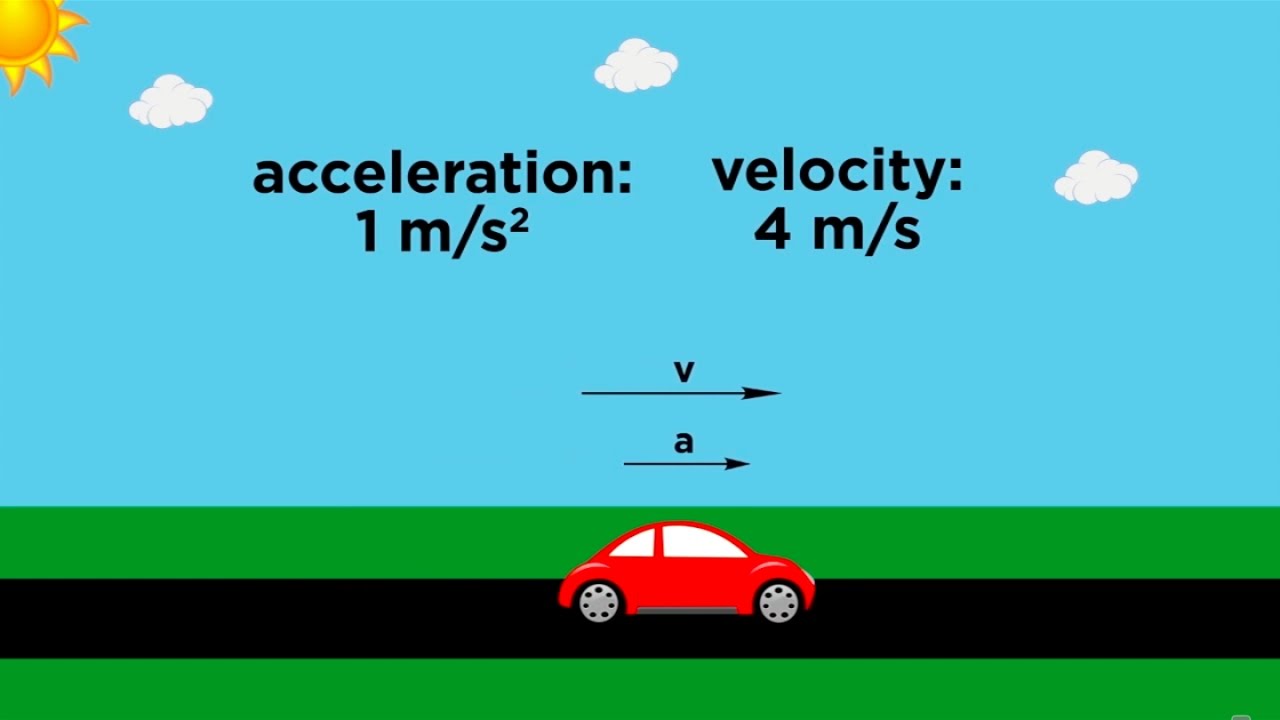
If we are going to study the motion of objects, we are going to have to learn about the concepts of position, velocity, and acceleration. More scalars and vectors! Once we get this stuff out of the way, we can really get cooking.
Watch the whole Classical Physics playlist: http://bit.ly/ProfDavePhysics1
Modern Physics Tutorials: http://bit.ly/...
explains what is position,velocity,acceleration
wintry vortex
so v_x and v_y is showing velocity?
wintry vortex
so to get acceleration i take the second derivative
so it would just be x and y equal 0
oh boy that was more complicated in my head
Cool ty! I'm rolling now!
.close
lone heartBOT
Channel closed
Closed by @wintry vortex
Use .reopen if this was a mistake.
Please take a minute to participate in [our survey](#changelog message) if you haven't already!
Available help channel!
Send your question here to claim the channel.
Remember:
• Ask your math question in a clear, concise manner.
• Show your work, and if possible, explain where you are stuck.
• After 15 minutes, feel free to ping <@&286206848099549185>.
• Type the command .close to free the channel when you're done.
• Be polite and have a nice day!
Read #❓how-to-get-help for further information on how to ask a good question, and about conduct in the question channels.
wintry vortex
 lone heartBOT
wintry vortex
wintry vortex
lone heartBOT
wintry vortex
wintry vortex
ugh, I thought i got this one pretty well and somehow the degrees arent right
so i got the magnitude, then i used tantheta=-1/5 to find the degrees like the example says
am i missing something?
 white obsidian
did you set your calculator to DEG?
wintry vortex
yes

I dont need the answer, just confused on why its not right 😦
I was super confident on that answer lol
white obsidian
well, if your magnitude is correct, then your angle is correct. could enter -11° or 349° instead 🤷♂️
wintry vortex
the magnitude is correct, it already told me its right
WHY WAS 349 degrees right?!
lone heartBOT
Channel closed
Closed by @wintry vortex
Use .reopen if this was a mistake.
Please take a minute to participate in [our survey](#changelog message) if you haven't already!
wintry vortex
.reopen
lone heartBOT
✅
wintry vortex
sorry didnt mean to closewhile u were answering 😅
white obsidian
np. be careful with the quadrants when using arctan 😉
lone heartBOT
Channel closed
Closed by @wintry vortex
Use .reopen if this was a mistake.
Please take a minute to participate in [our survey](#changelog message) if you haven't already!
Available help channel!
Send your question here to claim the channel.
Remember:
• Ask your math question in a clear, concise manner.
• Show your work, and if possible, explain where you are stuck.
• After 15 minutes, feel free to ping <@&286206848099549185>.
• Type the command .close to free the channel when you're done.
• Be polite and have a nice day!
Read #❓how-to-get-help for further information on how to ask a good question, and about conduct in the question channels.
 humble prairie
 lone heartBOT
humble prairie
tacit arch
humble prairie
lone heartBOT
humble prairie
tacit arch
humble prairie
Too tiny to read this resolution
humble prairie
Let me fix . one sec
humble prairie
tacit arch
Too tiny to read this resolution
I need to know what each variable means v

Can anyone help? <@&286206848099549185>
 worn fox
You are posting more than once problem
humble prairie
I deleted
lone heartBOT
@humble prairie Has your question been resolved?
humble prairie
.close
lone heartBOT
Channel closed
Closed by @humble prairie
Use .reopen if this was a mistake.
Please take a minute to participate in [our survey](#changelog message) if you haven't already!
Available help channel!
Send your question here to claim the channel.
Remember:
• Ask your math question in a clear, concise manner.
• Show your work, and if possible, explain where you are stuck.
• After 15 minutes, feel free to ping <@&286206848099549185>.
• Type the command .close to free the channel when you're done.
• Be polite and have a nice day!
Read #❓how-to-get-help for further information on how to ask a good question, and about conduct in the question channels.
 proven saddle
good evening, can you help me with this simplification of radicals
proven saddle

 median oar
which one?
proven saddle
ocean sealBOT
Frosst
 proven saddle
a little
median oar
what do you mean a little
you either know this or you dont you cant know a rule a little
proven saddle
the basics
lone heartBOT
Channel closed
Closed by @proven saddle
Use .reopen if this was a mistake.
Please take a minute to participate in [our survey](#changelog message) if you haven't already!
Available help channel!
Send your question here to claim the channel.
Remember:
• Ask your math question in a clear, concise manner.
• Show your work, and if possible, explain where you are stuck.
• After 15 minutes, feel free to ping <@&286206848099549185>.
• Type the command .close to free the channel when you're done.
• Be polite and have a nice day!
Read #❓how-to-get-help for further information on how to ask a good question, and about conduct in the question channels.
 lethal sinew
I'm not sure if 14 is correct. I double checked my work but it was wrong 
A Quonset Hut's height is its radius.
The volume of a Quonset Hut is the second picture

 lone heartBOT
lethal sinew
I'm not sure if 14 is correct. I double checked my work but it was wrong <a:sani...
lone heartBOT
lethal sinew
I'm not sure if 14 is correct. I double checked my work but it was wrong <a:sani...

 tacit arch
show your math
lethal sinew
i'm not sure how to go about the problem
i plugged in the values but i dont think its how i'm supposed to do the problem bc when i double checked i got 7389 instead of 7540
gimme a sec sorry


tacit arch
swap your h and l
 tacit arch
why would it be larger than 7540
lethal sinew
i honestly have no idea 😭
tacit arch
use a calculator
 tacit arch
try it again
lethal sinew
this is how I originally did it; not sure how it’s wrong 

By swapping the h and l do you mean the values?
nevermind! i got it correct!

.close
lone heartBOT
Channel closed
Closed by @lethal sinew
Use .reopen if this was a mistake.
Please take a minute to participate in [our survey](#changelog message) if you haven't already!
lone heartBOT
Available help channel!
Send your question here to claim the channel.
Remember:
• Ask your math question in a clear, concise manner.
• Show your work, and if possible, explain where you are stuck.
• After 15 minutes, feel free to ping <@&286206848099549185>.
• Type the command .close to free the channel when you're done.
• Be polite and have a nice day!
Read #❓how-to-get-help for further information on how to ask a good question, and about conduct in the question channels.
 daring tulip
The function f has the property that for each positive integer n, the number f(n) is also a positive integer. It is also known that f(n) + f(f(n)) = 2n for each positive integer n.
Find all possible values of f(1000).
Can someone please prove that the only answer is 1000?
lone heartBOT
daring tulip
The function f has the property that for each positive integer n, the number f(n...
@daring tulip Has your question been resolved?
lone heartBOT
Channel closed
Closed due to timeout
Use .reopen if this was a mistake.
Please take a minute to participate in [our survey](#changelog message) if you haven't already!
Available help channel!
Send your question here to claim the channel.
Remember:
• Ask your math question in a clear, concise manner.
• Show your work, and if possible, explain where you are stuck.
• After 15 minutes, feel free to ping <@&286206848099549185>.
• Type the command .close to free the channel when you're done.
• Be polite and have a nice day!
Read #❓how-to-get-help for further information on how to ask a good question, and about conduct in the question channels.
 grizzled vortex
 lone heartBOT
grizzled vortex
grizzled vortex
lone heartBOT
grizzled vortex
grizzled vortex

I did this and got some nonsense... I must be doing something wrong, but I'm not sure where
 vale wigeon
your 2 looks like a z
also no you didn't get nonsense you got exactly what you were supposed to
the numerator approaches a positive number while the denominator approaches zero
perhaps you could argue the denominator x(sin(x)-sinh(x)) ought to approach zero from below and so the limit is -∞ rather than just nonexistent.
...
,w graph y=sin(x)-sinh(x)
ocean sealBOT


 grizzled vortex
oh! Then I guess we are supposed to prove by definition that the limit is infinity...
 okay thanks I'll do that
.close
lone heartBOT
Channel closed
Closed by @grizzled vortex
Use .reopen if this was a mistake.
Please take a minute to participate in [our survey](#changelog message) if you haven't already!
grizzled vortex
.reopen
lone heartBOT
✅
grizzled vortex
vale wigeon
from below
So the right limit and left limit is both minus infiniity, right?
vale wigeon
yes
lone heartBOT
Channel closed
Closed by @grizzled vortex
Use .reopen if this was a mistake.
Please take a minute to participate in [our survey](#changelog message) if you haven't already!
Available help channel!
Send your question here to claim the channel.
Remember:
• Ask your math question in a clear, concise manner.
• Show your work, and if possible, explain where you are stuck.
• After 15 minutes, feel free to ping <@&286206848099549185>.
• Type the command .close to free the channel when you're done.
• Be polite and have a nice day!
Read #❓how-to-get-help for further information on how to ask a good question, and about conduct in the question channels.
 oak fiber
 oak fiber
help
vale wigeon
pointing back at the problem isn't going to help us help you at all
are we to understand you have no idea how to even begin this problem?
tacit arch
oak fiber
this
There's no math yet. Set up your physics equations
lone heartBOT
Channel closed
Closed by @oak fiber
Use .reopen if this was a mistake.
Please take a minute to participate in [our survey](#changelog message) if you haven't already!
Available help channel!
Send your question here to claim the channel.
Remember:
• Ask your math question in a clear, concise manner.
• Show your work, and if possible, explain where you are stuck.
• After 15 minutes, feel free to ping <@&286206848099549185>.
• Type the command .close to free the channel when you're done.
• Be polite and have a nice day!
Read #❓how-to-get-help for further information on how to ask a good question, and about conduct in the question channels.
 obsidian kayak
can i just post it here?
lone heartBOT
obsidian kayak
can i just post it here?
 river fossil
yeah
alpine sable
Mhm
 river fossil
what have you tried
alpine sable
Yes
river fossil
umm no
 clever folio
Any epsilon
river fossil
you can NOT set e
clever folio
I can pick epsilon = 0.5 and your set won't work.
river fossil
so for example, it doesn't work for e = 0.5
obsidian kayak
right
alpine sable
If your set S is {1,2,3}, then max(S) = 3
So set epsilon ≥ 3 (epsilon can be anything ≥ 3), and this is your example. S is also a subset of R+
river fossil
obsidian kayak
what you want is a subset such that if i pick any epsilon > 0, there exists an element in that subset that is smaller than that epsilon
alpine sable

obsidian kayak
river fossil
what you want is a subset such that if i pick *any* epsilon > 0, there exists an...
right that's what confuses me
because epsilon can be .0000009
so i was thinking the empty set
as one example
clever folio
There's a pretty cheeky choice of S listed in the problem..
river fossil
well, there's no element in the empty set that is smaller than e =1
clever folio
You can also consider infinite sets in general.
river fossil
obsidian kayak
because epsilon can be .0000009
so you might try an infinite subset!
you can think about why no finite subset satisfy this condition later
obsidian kayak
ohhhh
clever folio
You can also try and construct a set that works from a finite set that doesn't.
obsidian kayak
so can i since all integers are part of all real numbers
can i just take the set of all postive integers
river fossil
no positive integer is smaller than e = 0.5
obsidian kayak
fucking a
river fossil
lol
obsidian kayak
so e can just be any real number huh
river fossil
yes, bigger than 0
obsidian kayak
is 0 part of the empty set?
river fossil
here's a hint, do you know about sequences?
obsidian kayak
river fossil
here's a hint, do you know about sequences?
mhmm vaguely
clever folio
Try this use S={1}, I pick e=0.5, so you say "Damn! I'll pick instead S'={0,0.5}" then I pick e=0.25 and you do what?
river fossil
ooh, try doot's idea
obsidian kayak
mhmm okay but just one thing
S has to be all positive real numbers right
so it can't include 0
alpine sable
Yeah
river fossil
yes
obsidian kayak
right
alpine sable
But S' cannot contain 0
alpine sable
Lol
obsidian kayak
so if you pick .25 i pick .25 then you pick .009 and i pick .009
and we gon forever and ever
clever folio
S'={1,0.5} is what I meant.
alpine sable

obsidian kayak

alpine sable
I'm thinking S is then R+ itself
That could work ig
clever folio
Yeah but 0.09 is ugly what if I pick something easier like e=1/8 instead lol?
Then 1/16
Then 1/32 and so on.
clever folio
alpine sable
I'm thinking S is then R+ itself
That could work ig
This was the cheeky answer I mentioned lmao
clever folio
clever folio
This was the cheeky answer I mentioned lmao
But does fear see why?
alpine sable
Oh
river fossil
obsidian kayak
i need three examples
try to construct more following doot's example
alpine sable
xD
river fossil
so doot did
{1/1, 1/2, 1/4, 1/8, ...}
alpine sable
0 < 1/n ≤ 1 for any positive Integer n
obsidian kayak
right
clever folio
Positive integer n
 obsidian kayak
okay i just put all real numbers for my first example
time to use the old noggin

alpine sable
Fear just focus one more time on doot's pattern
clever folio
All reals won't work
alpine sable
How so 
clever folio
It has to do with props the q says S must satisfy.
tacit arch
Answer was given in #discussion
obsidian kayak
 clever folio
All reals is real close ur just mixing up the q
For ex -1 can't be in S according to the q.
river fossil
tacit arch
Answer was given in <#268882317391429632>
that's one example that we've also given
alpine sable
Yeah all positive real numbers will work
alpine sable
tacit arch
Answer was given in <#268882317391429632>
partial answer only, it was mostly to make sure you understood how what you were saying was wrong
Can I give one more example
tacit arch
alpine sable
partial answer only, it was mostly to make sure *you* understood how what you we...
I already said it like two times
tacit arch
alpine sable
partial answer only, it was mostly to make sure *you* understood how what you we...
Are you just here to gloat?
obsidian kayak
obsidian kayak
clever folio
All reals is real close ur just mixing up the q
but R+ works right
all positive real numbers
obsidian kayak
okay just making that clear
yeah because S can be a subset of R+
and all positive real numbers is a subset of itself
river fossil
nice
obsidian kayak
clever folio
Yeah, and if I pick epsilon>0 by density you can pick some real t between my epsilon and 0 too ofc.
Or just midpoints or whatever
There's multiple ways to pick t lol.
river fossil
the key here is to have a subset that can contain arbitrarily small elements
tacit arch
alpine sable
0 < 1/n ≤ 1 for any positive Integer n
There was nothing special about the right endpoint here
obsidian kayak
for the other example i pick, epsilon can still be any positive real number right? AKA .00009
clever folio
Yeah
alpine sable
Fear what do you think about doot's example on S = {1/1, 1/2, 1/3,...}
clever folio
Yeah that would work
alpine sable
Nice
obsidian kayak
river fossil
can you reason a little why that would work?
clever folio
But there are simpler ones feeds is trying to lead you to.
obsidian kayak
well
i was thinking about it before
but
i thought about
R+
and all irrationals
but when you said R+ worked
it made me think maybe irratoinals work
since we don't really know the smallest irrational
clever folio
Mmm so there's a property I mentioned earlier about R^+ that the irrationals have too.
clever folio
But try feeds's example it's good lol.
obsidian kayak
alpine sable
Fear what do you think about doot's example on S = {1/1, 1/2, 1/3,...}
mhmmm i know this pattern
obsidian kayak
clever folio
Mmm so there's a property I mentioned earlier about R^+ that the irrationals hav...
lemme see
alpine sable
obsidian kayak
mhmmm i know this pattern
What can you observe here
obsidian kayak
alpine sable
What can you observe here
it's getting infinitely smaller
alpine sable
Hence you can take any epsilon, where there will always exist some element s ≤ epsilon
clever folio
Can you write it out as a sequence and take the limit?
obsidian kayak
alpine sable
Hence you can take any epsilon, where there will always exist some element s ≤ e...
ohhh shittt
mind blown
alpine sable
clever folio
Can you write it out as a sequence and take the limit?
Fear do this
clever folio
U might see it better if u do
obsidian kayak
clever folio
Can you write it out as a sequence and take the limit?
for the irrationals?
clever folio
Because really we're just doing that.
clever folio
obsidian kayak
for the irrationals?
No no for the other examples
We're just tossing sequences at you basically.
obsidian kayak
right
obsidian kayak
river fossil
the key here is to have a subset that can contain arbitrarily small elements
okay i see now
i was confused at first
i thought u meant small elemtns as in
a small number of elements
i see it's now the value of the elements themselves
to be small
alpine sable
You just like need at least one element in S, where if I say any epsilon, your set will always have some s where s≤€
obsidian kayak
right
and since the example 1/1, 1/2, 1/3 will get infinitely smaller
it will work
alpine sable
Yes
obsidian kayak
essentially i guess i'm a person that has to KNOW the values
so when it comes to stuff like this
where we don't know the smallest number
i suck at it
alpine sable
You'll get used to it gradually
tacit arch
Now you can give 1000 examples instead of 3
alpine sable

obsidian kayak
alright then i'm gonna make the set of all irratoinals as my second one
and for the third i'll go with the 1/1,1/2
tacit arch
The bottleneck is your wrist endurance
tacit arch
Harmonic
clever folio
obsidian kayak
and since the example 1/1, 1/2, 1/3 will get infinitely smaller
So like here's one way to do what riemann said take arbitrary elements out if this to produce a new different example set.
alpine sable
S = {1/n : n is a positive integer}
clever folio
river fossil
so doot did
{1/1, 1/2, 1/4, 1/8, ...}
Here's another way. I divided 1 by 2 repeatedly here.
clever folio
So pick a different integer larger than 2 instead.
tacit arch
Find the 3 answers that take the minimum amount of writing
obsidian kayak
right i should've thought of that
since it's greater than 0
any infinite fraction sequence
will satisfy it
clever folio
In this prob you really just want inf sequences that have all pos terms and converge to zero
tacit arch
The one in #discussion was $(0, \infty)$
ocean sealBOT
riemann
Compile Error! Click the  reaction for more information.
(You may edit your message to recompile.)
 clever folio
For ex 1/n! works too
alpine sable
tacit arch
Find the 3 answers that take the minimum amount of writing
R+
(R+)\{1}
(R+)\{2}
obsidian kayak
clever folio
In this prob you really just want inf sequences that have all pos terms and conv...
we didn't cover any infinite sequences yet so i was confused
but good to know
i'm getting a head start on this hw
obsidian kayak
alpine sable
R+
(R+)\\{1}
(R+)\\{2}
is this actually legit?
alpine sable
Ye
tacit arch
Yes lol
obsidian kayak
smh
idk why i think the answer is harder than it is
i just got raped in linear algebra and diff eqs
river fossil
it's alright, our sequence approach is more enlightening
 slender gull
There could be more than one answers.
obsidian kayak
yea you guys helped a lot
slender gull
So you can go for the harder or easier one.
obsidian kayak
thanks for real
slender gull
It's upto you lol.
river fossil
no problem
alpine sable

river fossil
tacit arch
$(0,1), (0,2), {x \in\R^+ \ | \ x\notin \Q}$
ocean sealBOT
riemann
 alpine sable
Yes
alpine sable
It means you excluded {1} from R+
alpine sable
Like say in a Set S you have {1,2,3}
Then S\{1} is {2,3}
alpine sable
Exclusion
alpine sable
xd
obsidian kayak
lone heartBOT
@obsidian kayak Has your question been resolved?
Channel closed
Closed by @obsidian kayak
Use .reopen if this was a mistake.
Please take a minute to participate in [our survey](#changelog message) if you haven't already!
Available help channel!
Send your question here to claim the channel.
Remember:
• Ask your math question in a clear, concise manner.
• Show your work, and if possible, explain where you are stuck.
• After 15 minutes, feel free to ping <@&286206848099549185>.
• Type the command .close to free the channel when you're done.
• Be polite and have a nice day!
Read #❓how-to-get-help for further information on how to ask a good question, and about conduct in the question channels.
 opaque inlet
 lone heartBOT
opaque inlet
opaque inlet
lone heartBOT
opaque inlet
opaque inlet
How do I do question 5?
vale wigeon
write out all possible outcomes and the resulting totals in a table
opaque inlet
vale wigeon
write out all possible outcomes and the resulting totals in a table
I didn’t know how to write it in table form, so I used tree diagrams
vale wigeon
ok sure you can do a tree diagram if you want
you're rolling two dice, and you ignore the second dice unless the first rolled 1 or 2
opaque inlet
Yes
vale wigeon
\begin{tabular}{c|cccccc}
&1&2&3&4&5&6\
\hline
1&2&3&4&5&6&7\
2&3&4&5&6&7&8\
3&3&3&3&3&3&3\
4&4&4&4&4&4&4\
5&5&5&5&5&5&5\
6&6&6&6&6&6&6
\end{tabular}
ocean sealBOT
Ann
 opaque inlet
Yes
vale wigeon
do you understand how i constructed this table?
vale wigeon
11?
opaque inlet
We did something similar to this
opaque inlet
How’d u get 13
vale wigeon
wait, hold on. we were both wrong.
it's 19.
3 in the first row + 4 in the second + 6 in the fifth + 6 in the sixth
 vale wigeon
how many ways are there to seat 5 people at a round table?
opaque inlet
24 ways
vale wigeon
and in how many of these ways are the people seated in order of age (cw or ccw)?
opaque inlet
vale wigeon
and in how many of these ways are the people seated in order of age (cw or ccw)?
That’s the part where I don’t know how to calculate it
vale wigeon
sounds like you're overthinking it
bc there's only two such arrangements
youngest to oldest cw and youngest to oldest ccw
that's it
vale wigeon
what is that number meant to be?
opaque inlet
How many ways 5 people can be seated around a round table, considering both clockwise and anticlockwise.
vale wigeon
then this not only makes no sense but also is not what the problem asks for.
opaque inlet
Yea Ur right it makes no sense
opaque inlet
vale wigeon
youngest to oldest cw and youngest to oldest ccw
What does ccw mean
vale wigeon
counterclockwise.
lone heartBOT
@opaque inlet Has your question been resolved?
Channel closed
Closed by @opaque inlet
Use .reopen if this was a mistake.
Please take a minute to participate in [our survey](#changelog message) if you haven't already!
Available help channel!
Send your question here to claim the channel.
Remember:
• Ask your math question in a clear, concise manner.
• Show your work, and if possible, explain where you are stuck.
• After 15 minutes, feel free to ping <@&286206848099549185>.
• Type the command .close to free the channel when you're done.
• Be polite and have a nice day!
Read #❓how-to-get-help for further information on how to ask a good question, and about conduct in the question channels.
 tribal oxide
 lone heartBOT
tribal oxide
tribal oxide
lone heartBOT
tribal oxide
tribal oxide
im getting the correct answer through lcm removal technique, but im not getting the correct answer through period reduction

 lone heartBOT
@tribal oxide Has your question been resolved?
lone heartBOT
@tribal oxide Has your question been resolved?
lone heartBOT
@tribal oxide Has your question been resolved?
lone heartBOT
@tribal oxide Has your question been resolved?
tribal oxide
alpine sable
Neither seems to anyone else
its alright i can wait
 arctic sail
tribal oxide
im getting the correct answer through lcm removal technique, but im not getting ...
arctic sail
tribal oxide
im getting the correct answer through lcm removal technique, but im not getting ...
Hello, I'm not really comfortable in period reduction at all so I'm sorry if my help is futile.
However, it seems that if you make a linearization of the cos^4 term, the expression of f(x) is easier

Maybe that doing a period reduction is easier with this ? I hope it is x)
tribal oxide
arctic sail
what is linearization of cos^4
but what ur doing here in the end is, what in my class the teacher calls it "avoiding lcm technique", manipulating f(x), so the fundamental period can be easily found, as taking lcm is where the problems between period and fundamental period comes
tribal oxide
tribal oxide
which i have also done in this, maybe not with the linearization of cos^4 term, but in a different way
as idk what linearization means
arctic sail
tribal oxide
what is linearization of cos^4
English is not my native language so I'm sorry if the explanation is messy. The thing is you express a cos^4 term with a sum of cos^1 terms and a constant.
It's the same process that gives the formula cos^2(x) = (1/2)(1+cos(2x)).
Here I just did it with a higher power. You can obtain these expressions using this formula:
 tribal oxide
which i have also done in this, maybe not with the linearization of cos^4 term, ...
tribal oxide
tribal oxide
which i have also done in this, maybe not with the linearization of cos^4 term, ...
but in class, we were taught a different technique where say P is the period of of a function, like say f(x)= sinx + cosx, then the individual periods are 2pi, 2pi, we take lcm (2pi,2pi), which is 2pi, and then we divide this P by every prime number and check if any of those work as the period, and if something matches, then that becomes the new P and we divide it by every prime number and so on, its usually only helpful if theres options in the questions, or if the conditions in question, which make elimination easy,
arctic sail
tribal oxide
but in class, we were taught a different technique where say P is the period of ...
I see, I'm sorry that I can't help you more, I just saw that the expression could be simplified and I thought it could maybe help...
arctic sail
tribal oxide
is i = sq root of -1?
Yes it is, there are actually two formulas, called Euler's formulas that are deduced by the relation e^ix = cos(x)+isin(x)
 tribal oxide
arctic sail
I see, I'm sorry that I can't help you more, I just saw that the expression coul...
tribal oxide
arctic sail
I see, I'm sorry that I can't help you more, I just saw that the expression coul...
basically i want to prove f(x+ 2(pi)^3)= f(x)
tribal oxide
arctic sail
I see, I'm sorry that I can't help you more, I just saw that the expression coul...
it does help, your technique gives the correct ans
tribal oxide
arctic sail
I tried to find out cos^4(x)
Im getting this

Now i have to replace x?💀, Or maybe this can be simplified further
arctic sail
tribal oxide
Im getting this
That's it, and then you need to make another use of the formula to get this result:

It's really useful because you can get formulas like that for any cos^n with n a positive integer
tribal oxide
arctic sail
i understsnd your process now
tribal oxide
tribal oxide
basically i want to prove f(x+ 2(pi)^3)= f(x)
but can you help with this
while using the original form of f(x)
arctic sail
Yes I get it now, it's easy with the expression I got, I'm searching for the original form of f(x)
arctic sail
tribal oxide
Alright, so first thing: I see that you tried to break fractions within the cos^4 the cos terms into sums of 3 other terms. Because you want to prove f(x+2(pi)^3) = f(x), I would advice you to break the fractions like that:

Here I wrote it for the cos^4 term, you'd need to do the same thing with the other cos term
And then, using angle addition formulas, I think that you'll be able to find back f(x)
tribal oxide
arctic sail
i just noticed
once we broke away the pi/2 term
we cant join it back anymore?💀
because the lcm of 4(pi)^2 and 2 doesnt exist...?
but then again i am assuming that
2pi^2 is irrational
but im not very sure abt that claim
arctic sail
tribal oxide
we cant join it back anymore?💀
You can multiply numerator and denominator by 2(pi)^2 and join it back can't you ?
tribal oxide
arctic sail
You can multiply numerator and denominator by 2(pi)^2 and join it back can't you...
right.., im probably thinking too much
basing things of a childhood concept, so im not very sure
ill look into it, once i finish my current workload, thanks for your help tho
.close
lone heartBOT
Channel closed
Closed by @tribal oxide
Use .reopen if this was a mistake.
Please take a minute to participate in [our survey](#changelog message) if you haven't already!
arctic sail
tribal oxide
ill look into it, once i finish my current workload, thanks for your help tho
Np, don't hesitate to reopen if you need more help
lone heartBOT
Available help channel!
Send your question here to claim the channel.
Remember:
• Ask your math question in a clear, concise manner.
• Show your work, and if possible, explain where you are stuck.
• After 15 minutes, feel free to ping <@&286206848099549185>.
• Type the command .close to free the channel when you're done.
• Be polite and have a nice day!
Read #❓how-to-get-help for further information on how to ask a good question, and about conduct in the question channels.
alpine sable
 lone heartBOT
alpine sable
alpine sable
lone heartBOT
alpine sable
alpine sable
This is the graph of c part .I don't know how this was done
It is a unit impulse signal btw i.e δ[n] = 1 for n = 0 and 0 for every other n
tacit arch
Do you know how to find n such that n-4k=0?
lone heartBOT
@alpine sable Has your question been resolved?
lone heartBOT
Channel closed
Closed due to timeout
Use .reopen if this was a mistake.
Please take a minute to participate in [our survey](#changelog message) if you haven't already!
Available help channel!
Send your question here to claim the channel.
Remember:
• Ask your math question in a clear, concise manner.
• Show your work, and if possible, explain where you are stuck.
• After 15 minutes, feel free to ping <@&286206848099549185>.
• Type the command .close to free the channel when you're done.
• Be polite and have a nice day!
Read #❓how-to-get-help for further information on how to ask a good question, and about conduct in the question channels.
 gaunt eagle
 lone heartBOT
gaunt eagle
gaunt eagle
lone heartBOT
gaunt eagle
gaunt eagle
Can anyone see what I'm doing wrong here?
 languid bolt
,rotate
ocean sealBOT

 viral cairn
Hard for me to read but trig sub if thats what your doing your good
lone heartBOT
@gaunt eagle Has your question been resolved?
tacit arch
,w integral (x+1)/sqrt(1-x^2)
ocean sealBOT


 Requested by riemann#2529
tacit arch
gaunt eagle
Can anyone see what I'm doing wrong here?
Requested by riemann#2529
tacit arch
gaunt eagle
Can anyone see what I'm doing wrong here?
Your integral of 1/(1-u)^(1/2) should just be solved with power rule
gaunt eagle
but you could technically also use a trig integral to solve it, right?
by using u^1/2
gaunt eagle
why not?
tacit arch
Differentiate it and find out
lone heartBOT
Channel closed
Closed due to timeout
Use .reopen if this was a mistake.
Please take a minute to participate in [our survey](#changelog message) if you haven't already!
Available help channel!
Send your question here to claim the channel.
Remember:
• Ask your math question in a clear, concise manner.
• Show your work, and if possible, explain where you are stuck.
• After 15 minutes, feel free to ping <@&286206848099549185>.
• Type the command .close to free the channel when you're done.
• Be polite and have a nice day!
Read #❓how-to-get-help for further information on how to ask a good question, and about conduct in the question channels.
 cyan mountain

 lone heartBOT
cyan mountain
cyan mountain
lone heartBOT
cyan mountain
cyan mountain
What did I do wrong?
 gray isle
you randomly used the point(3,2) for some strange reason
lone heartBOT
Channel closed
Closed by @cyan mountain
Use .reopen if this was a mistake.
Please take a minute to participate in [our survey](#changelog message) if you haven't already!
Available help channel!
Send your question here to claim the channel.
Remember:
• Ask your math question in a clear, concise manner.
• Show your work, and if possible, explain where you are stuck.
• After 15 minutes, feel free to ping <@&286206848099549185>.
• Type the command .close to free the channel when you're done.
• Be polite and have a nice day!
Read #❓how-to-get-help for further information on how to ask a good question, and about conduct in the question channels.
 thick lynx
Factor $-a^2b^2 + 2ab^3 - b^4 + a^2c^2 - 2abc^2 + b^2c^2$

 thick lynx
But I don't really see what I can do after that
Hints only please.
 mortal trellis
write it like $(-a^2b^2 + 2ab^3 - b^4) + (a^2c^2 - 2abc^2 + b^2c^2)$. can you factor something out of the first and second term to get something nice for each one?
ocean sealBOT
Denascite
 lone heartBOT
@thick lynx Has your question been resolved?
thick lynx
Hmm
thick lynx
mortal trellis
write it like $(-a^2b^2 + 2ab^3 - b^4) + (a^2c^2 - 2abc^2 + b^2c^2)$. can you f...
b^2 for the first one, c^2 for the second one
But it still wont be very nice?
thick lynx
$$-b^2 * (a^2 - 2ab + b^2) + c^2 * (a^2 - 2ab + b^2)$$
ocean sealBOT
Kepe
 mortal trellis
those terms should scream "I am nice" into your face
ocean sealBOT
Kepe
 mortal trellis
also they are the same which is extra nice
thick lynx
so it's
$$(a - b)^2 * (c^2 - b^2)$$
ocean sealBOT
Kepe
 mortal trellis
yup
lone heartBOT
Channel closed
Closed by @thick lynx
Use .reopen if this was a mistake.
Please take a minute to participate in [our survey](#changelog message) if you haven't already!
Available help channel!
Send your question here to claim the channel.
Remember:
• Ask your math question in a clear, concise manner.
• Show your work, and if possible, explain where you are stuck.
• After 15 minutes, feel free to ping <@&286206848099549185>.
• Type the command .close to free the channel when you're done.
• Be polite and have a nice day!
Read #❓how-to-get-help for further information on how to ask a good question, and about conduct in the question channels.
 hollow fossil
 lone heartBOT
hollow fossil
hollow fossil
lone heartBOT
hollow fossil
hollow fossil
pls help
 north adder
@hollow fossil
lone heartBOT
@hollow fossil Has your question been resolved?
hollow fossil
slender gull
L'hopital's rule.
i dare you to try it. its insanely complex
slender gull
hollow fossil
i dare you to try it. its insanely complex
Definitely is, but still doable.
Just with the rule you can compute the limit.
Now you have to brute force it, that is a different story.
I didn't look into other ways.
But just with the rule I did get th answer and then left.
So yeah unless this is preparation for some exam which requires you to solve this in very less time use the rule.
Or if you simply want something else, people will of course help you.
 rotund plank
I have absolutely no idea how you’d go about this without l’hôp
Do you have any kind of indications from a teacher or something?
If not I’d just hold my breath and use l’hôp
fallen verge
Lhop is le hope here i think
 carmine shuttle
@hollow fossil I have done it for you. You only need to apply L'Hospital Rule 2 times.
(but before posting my answer, please submit your answer here first)
 hollow fossil
carmine shuttle
(but before posting my answer, please submit your answer here first)
hollow fossil
carmine shuttle
(but before posting my answer, please submit your answer here first)
here it is :)
 hollow fossil
carmine shuttle
hollow fossil
carmine shuttle
nice :)
woah which app do you use to get it like that?
in a digital form
carmine shuttle
Microsoft word
hollow fossil
ahh
carmine shuttle
"Alt" + "=" for equation func.
You can also use LaTeX for mathematical notation, but I usually use MS word to sketch my work since it is faster for me to write something.
hollow fossil
carmine shuttle
You can also use LaTeX for mathematical notation, but I usually use MS word to s...
i see. its been so long since ive used word haha
anyways thanks for the help guys :)
carmine shuttle
My pleasure!
lone heartBOT
Channel closed
Closed by @hollow fossil
Use .reopen if this was a mistake.
Please take a minute to participate in [our survey](#changelog message) if you haven't already!
lone heartBOT
Available help channel!
Send your question here to claim the channel.
Remember:
• Ask your math question in a clear, concise manner.
• Show your work, and if possible, explain where you are stuck.
• After 15 minutes, feel free to ping <@&286206848099549185>.
• Type the command .close to free the channel when you're done.
• Be polite and have a nice day!
Read #❓how-to-get-help for further information on how to ask a good question, and about conduct in the question channels.
 tepid drum
Hi
lone heartBOT
tepid drum
Hi
tepid drum
What's the meaning of the notation x belongs <3;6>
Does this mean that both 3 and 6 are have opened boundaries
worn fox
Send context
tepid drum
So both 3 and 6 are excluded from the interval ?

Does this mean that 3 and 6 are excluded from the interval in which x lies in
worn fox
Where is this from? Doesn't look like standard notation
 karmic rapids
I'd read it as $x \in ]3, 6[$
ocean sealBOT
illuminator3
 tepid drum
Idk someone sent me this exercise and needs help but it's the first time i see this notation
tepid drum
karmic rapids
I'd read it as $x \in ]3, 6[$
I read it like that
I'll read it this way
Not [3;6]
Thank you so much for your info
karmic rapids
it looks like "x is smaller than 3 or bigger than 6"
slender gull
No it's open interval
] is used for (
In some places.
]3,6[ means (3,6)
Or so I've been told.
vale wigeon
the french use outward-pointing square brackets for open intervals yes
dense sleet
<> is closed interval at leasz in notation i was taught
vale wigeon
this notation varies by region
slender gull
It does. And yes I was talking about French notation.
tepid drum
So is <> closed or opened
tepid drum
slender gull
]3,6[ means (3,6)
Yea ik this
tepid drum
tepid drum
So is <> closed or opened
I am just talking abt this bc the one who asked the question had the interval in this form so I want to know what to answer him
vale wigeon
tepid drum
So is <> closed or opened
best see your textbook about that
dense sleet
tepid drum
So is <> closed or opened
Id say closed
tepid drum
vale wigeon
best see your textbook about that
Which textbook
It's not my question
Someone sent me a pic of the question
dense sleet
Same country?
dense sleet
What country is he from?
vale wigeon
oh so it's actually a game of broken telephone...
vale wigeon
i've seen angle-brackets used as closed, and also used as open, and also used as intentionally ambiguous
so we really cannot tell
this is NOT a math issue
this is a language issue
dense sleet
 tepid drum
XDDD
tepid drum
No it's just the inequality I sent
It's easy but I wanted to know the notation just
I want to be sire of something small here
 high rapids
I thought language of math was universal
vale wigeon
high rapids
I thought language of math was universal
notation varies by region.
dense sleet
high rapids
I thought language of math was universal
Some countries dont even use base 10 numbers
high rapids
Fr?
dense sleet
Idk if they learn base 10 in school or do math in other bases
 high rapids
Preferably yes
lone heartBOT
Channel closed
Closed by @tepid drum
Use .reopen if this was a mistake.
Please take a minute to participate in [our survey](#changelog message) if you haven't already!
Available help channel!
Send your question here to claim the channel.
Remember:
• Ask your math question in a clear, concise manner.
• Show your work, and if possible, explain where you are stuck.
• After 15 minutes, feel free to ping <@&286206848099549185>.
• Type the command .close to free the channel when you're done.
• Be polite and have a nice day!
Read #❓how-to-get-help for further information on how to ask a good question, and about conduct in the question channels.
 sullen dock
stuck in c
 alpine sable
sullen dock
stuck in c
alpine sable
sullen dock
stuck in c
You can calculate the lowest possible value of LHS to be 4 using parts a) and b)

 lone heartBOT
Channel closed
Closed by @sullen dock
Use .reopen if this was a mistake.
Please take a minute to participate in [our survey](#changelog message) if you haven't already!
Available help channel!
Send your question here to claim the channel.
Remember:
• Ask your math question in a clear, concise manner.
• Show your work, and if possible, explain where you are stuck.
• After 15 minutes, feel free to ping <@&286206848099549185>.
• Type the command .close to free the channel when you're done.
• Be polite and have a nice day!
Read #❓how-to-get-help for further information on how to ask a good question, and about conduct in the question channels.
 hot bison
is the answer to this x^2 + 16x + 64
 lone heartBOT
hot bison
is the answer to this x^2 + 16x + 64
hot bison
lone heartBOT
hot bison
is the answer to this x^2 + 16x + 64
hot bison
or x^2 + 64
 coarse hemlock
yes
lone heartBOT
Channel closed
Closed by @hot bison
Use .reopen if this was a mistake.
Please take a minute to participate in [our survey](#changelog message) if you haven't already!
coarse hemlock
@hot bison i meant the first 1
hot bison
ok
coarse hemlock
x^2+16x+64
hot bison
ok