#help-0
1 messages · Page 1001 of 1
 remote heron

 fossil mason
But it shouldn’t take more than 3 lines :”)
remote heron
yea, i wonder what the issue is with my approach
im sorry im not sure how to get the correct answer
I hope someone comes along though 
fossil mason
16C5-13C5-10C5+7C5
 lone heartBOT
@fossil mason Has your question been resolved?
 quasi scarab
easier than what?
fossil mason
quasi scarab
easier than what?
Then listing out all possible combinations
quasi scarab
that 16c5-.. part is not correct?
@fossil masonoh, i see
i dont know how its called, but u had a similar type of problem not too long ago
its like counting the numbers which are either 2-divisible or 3 divisible
you count each, but then u counted the 6-divisible ones twice so u have to subtract it
the same here:
ALL-THERE IS NO DOCTOR - THERE IS NO DENTIST+ THERE IS NONE OF THEM
sry caps
lone heartBOT
Channel closed
Closed due to timeout
Use .reopen if this was a mistake.
 Available help channel!
Send your question here to claim the channel.
Remember:
• Ask your math question in a clear, concise manner.
• Show your work, and if possible, explain where you are stuck.
• After 15 minutes, feel free to ping <@&286206848099549185>.
• Type the command .close to free the channel when you're done.
• Be polite and have a nice day!
Read #❓how-to-get-help for further information on how to ask a good question, and about conduct in the question channels.
 tame hound

 lone heartBOT
tame hound
tame hound
lone heartBOT
tame hound
tame hound
Does anyone know why we get X divided by two from A to the vertical line, and B to the vertical line?
couldn't one side be longer than the other?
how can we tell if they are equal?
 gray isle
you have an isosceles trapizium
you can justify that they'd be equal from triangle congruency (HL)
tame hound
gray isle
you can justify that they'd be equal from triangle congruency (HL)
what's ”triangle congruency (HL)”? we know that the hypotenuse is the same, and they are both 90°, is that the idea then that they're the same?
lone heartBOT
@tame hound Has your question been resolved?
gray isle
the height will also be the same
HL is the justification that the triangles are congruent
and then you can apply corresponding parts of Cong triangles to justify the bases will have the same length
lone heartBOT
@tame hound Has your question been resolved?
Channel closed
Closed by @tame hound
Use .reopen if this was a mistake.
lone heartBOT
Available help channel!
Send your question here to claim the channel.
Remember:
• Ask your math question in a clear, concise manner.
• Show your work, and if possible, explain where you are stuck.
• After 15 minutes, feel free to ping <@&286206848099549185>.
• Type the command .close to free the channel when you're done.
• Be polite and have a nice day!
Read #❓how-to-get-help for further information on how to ask a good question, and about conduct in the question channels.
 native edge
 lone heartBOT
native edge
quasi scarab
lone heartBOT
native edge
quasi scarab
 native edge
Now how do I get to the result
 flat ore
mhm
flat ore
native edge
And then I plug it into the formula
yeah (x-0)^2 + (y-10)^2
lone heartBOT
@native edge Has your question been resolved?
Channel closed
Closed by @native edge
Use .reopen if this was a mistake.
Available help channel!
Send your question here to claim the channel.
Remember:
• Ask your math question in a clear, concise manner.
• Show your work, and if possible, explain where you are stuck.
• After 15 minutes, feel free to ping <@&286206848099549185>.
• Type the command .close to free the channel when you're done.
• Be polite and have a nice day!
Read #❓how-to-get-help for further information on how to ask a good question, and about conduct in the question channels.
 tribal wasp
Hey I am having trouble figuring out how to approach part eiv?
tribal wasp

 chilly merlin
What topic is this?
tribal wasp
intro to linear algebra
lone heartBOT
@tribal wasp Has your question been resolved?
fossil mason
Could someone help with this ?
 lone heartBOT
@tribal wasp Has your question been resolved?
Channel closed
Closed by @tribal wasp
Use .reopen if this was a mistake.
Available help channel!
Send your question here to claim the channel.
Remember:
• Ask your math question in a clear, concise manner.
• Show your work, and if possible, explain where you are stuck.
• After 15 minutes, feel free to ping <@&286206848099549185>.
• Type the command .close to free the channel when you're done.
• Be polite and have a nice day!
Read #❓how-to-get-help for further information on how to ask a good question, and about conduct in the question channels.
 dawn estuary
$(22i)^{2.3}$
lone heartBOT
dawn estuary
$(22i)^{2.3}$
 bitter vault
Use curly braces 22i^{2.3}
dawn estuary
Why does this not only have a imaginary part, but a real one too?
 ocean sealBOT
piinfa
 dawn estuary
I would have guessed the polar angle is 90° but its actually -153°
 worn fox
Intuitively, because taking powers of complex numbers that are not purely real often involves rotation at some point, so you're going to kick 22i off the imaginary axis by taking a power of it
to calculate you need to write $i = e^{\frac{i\pi}{2}}$
ocean sealBOT
iCaird
 dawn estuary
Thank you! but I am not sure I understand what the equation is for :/
worn fox
do you not understand where it comes from or what you would use it for
dawn estuary
the second
worn fox
if you replace $i$ in your expression with what I gave, then you can calculate powers as usual
ocean sealBOT
iCaird
 worn fox
$(22)^{2.3} \cdot e^{\frac{i\pi*2.3}{2}}$
ocean sealBOT
iCaird
 lone heartBOT
Channel closed
Closed by @dawn estuary
Use .reopen if this was a mistake.
Available help channel!
Send your question here to claim the channel.
Remember:
• Ask your math question in a clear, concise manner.
• Show your work, and if possible, explain where you are stuck.
• After 15 minutes, feel free to ping <@&286206848099549185>.
• Type the command .close to free the channel when you're done.
• Be polite and have a nice day!
Read #❓how-to-get-help for further information on how to ask a good question, and about conduct in the question channels.
 hushed inlet
 lone heartBOT
hushed inlet
hushed inlet
lone heartBOT
hushed inlet
hushed inlet
Can someone help me with this I kinda understand it but im stuck on this
 alpine sable
hushed inlet
alpine sable
hushed inlet
probably b
as it has both edges with weight 2
and other 3 dont and this algo adds minimum weight if it doesnt make a cycle
so 2's should go before bigger weighs
 alpine sable
dijkstra?
alpine sable
probably 11
hushed inlet
Hmmm
alpine sable
 real glen
ab -> bc -> cg -> gh -> hf -> fe
real glen
ab -> bc -> cg -> gh -> hf -> fe
oh right
hushed inlet
Do you know how the Nearest Neighbor Algorithm work?
Im kinda confused on that aswell
 topaz elm
I have something similar to that question as well.
 real glen
pick a vertex and find its shortest edge connected that vertex with another vertex and repeat this step until all vertices are visited
is the gist of nearest neighbor algo
real glen
topaz elm
I have something similar to that question as well.
channel is occupied go to diff channel
topaz elm
Oh ok.
real glen
also they are two diff graphs lmao
hushed inlet
So what vertex would I pick here?
 real glen
it should be b but let me confirm
hushed inlet
Ok thank you
real glen
yeah I think i am correct
hushed inlet
I also kinda confuse on this as well and this is the last one that I have a question about
 real glen
is that k5 graph
hushed inlet
Yes
hushed inlet
ummm not really is there way you can inform me how you got 5?
real glen
so K5 is a complete graph right
meaning every vertex has an edge to another vertex in G
we know from the theorem that we use at most n coloring for graph if G has n vertices
So the max chromatic number for G in our case can be 5. So we are looking to see if we can minimize this number
hushed inlet
Oooooh ok
real glen
but we notice that if we use 4 colors, then there is a 2 vertex in G that has same colours
but since its a complete graph, they share an edge together
which means we didnt do the graph coloring correctly because if two vertices have an edge, they must have different colouring
so the chromatic number is 5
thats the basic proof of it
hushed inlet
Ok I see now thank you cause I was rlly confused on that
Would you happen to be able to help me on this as well? I solved it and I got 92 but I wanna make sure I did it right

 young finch
hushed inlet
Would you happen to be able to help me on this as well? I solved it and I got 92...
young finch
hushed inlet
Would you happen to be able to help me on this as well? I solved it and I got 92...
Just plug in 7
young finch
The variable
x
You can also figure it out with the pattern of the table
Actually no
The data values aren't safe to make an assumption off of
with just the table
lone heartBOT
@hushed inlet Has your question been resolved?
 solemn grove
hushed inlet
Would you happen to be able to help me on this as well? I solved it and I got 92...
solemn grove
hushed inlet
Would you happen to be able to help me on this as well? I solved it and I got 92...
y is the score, x is the hours they put in
@hushed inlet
so if they put in 7 hours of work
x = 7
they’re asking you to find y
when x is 7
using the given formula
hushed inlet
So it would be 87 correct?
hushed inlet
solemn grove
y is the score, x is the hours they put in
or am I still doing it wrong
hushed inlet
yea
lone heartBOT
@hushed inlet Has your question been resolved?
Channel closed
Closed by @hushed inlet
Use .reopen if this was a mistake.
Available help channel!
Send your question here to claim the channel.
Remember:
• Ask your math question in a clear, concise manner.
• Show your work, and if possible, explain where you are stuck.
• After 15 minutes, feel free to ping <@&286206848099549185>.
• Type the command .close to free the channel when you're done.
• Be polite and have a nice day!
Read #❓how-to-get-help for further information on how to ask a good question, and about conduct in the question channels.
Channel closed
Closed due to the original message being deleted
 hollow pulsar
 real glen
wait why are you subtracting
lone heartBOT
Available help channel!
Send your question here to claim the channel.
Remember:
• Ask your math question in a clear, concise manner.
• Show your work, and if possible, explain where you are stuck.
• After 15 minutes, feel free to ping <@&286206848099549185>.
• Type the command .close to free the channel when you're done.
• Be polite and have a nice day!
Read #❓how-to-get-help for further information on how to ask a good question, and about conduct in the question channels.
 trail fern
is quadratic and 2nd order basically synonymous or always tied together?
trail fern
is there a case where quadratic is a different order?
 placid zinc
"order" is a sus word to use here
Every quadratic is a 2nd degree polynomial, every 2nd degree polynomial is a quadratic
trail fern
that part i do understand
but im trying to extend it further and seeing if it's logical

this is the context
i'm trying to see if 9-node and 8-node rectangular elements are both used for 2nd order approximations


and visually they seem to be
lone heartBOT
@trail fern Has your question been resolved?
lone heartBOT
Channel closed
Closed due to timeout
Use .reopen if this was a mistake.
Available help channel!
Send your question here to claim the channel.
Remember:
• Ask your math question in a clear, concise manner.
• Show your work, and if possible, explain where you are stuck.
• After 15 minutes, feel free to ping <@&286206848099549185>.
• Type the command .close to free the channel when you're done.
• Be polite and have a nice day!
Read #❓how-to-get-help for further information on how to ask a good question, and about conduct in the question channels.
Channel closed
Closed due to the original message being deleted
lone heartBOT
Available help channel!
Send your question here to claim the channel.
Remember:
• Ask your math question in a clear, concise manner.
• Show your work, and if possible, explain where you are stuck.
• After 15 minutes, feel free to ping <@&286206848099549185>.
• Type the command .close to free the channel when you're done.
• Be polite and have a nice day!
Read #❓how-to-get-help for further information on how to ask a good question, and about conduct in the question channels.
 lost moon
I have a business, and I am learning how to make projections of future growth, but I feel like I must be doing it wrong because the growth % seems to stay similar. Am I doing projection wrong?
 lone heartBOT
lost moon
I have a business, and I am learning how to make projections of future growth, b...
lost moon
lone heartBOT
lost moon
I have a business, and I am learning how to make projections of future growth, b...
lost moon
The column percentages are the change in monthly recurring revenue from month to month, which for the first 4 months, averages 16.29%, is projecting growth like the bottom a correct way of doing this, or is there a more advanced/accurate method for this?
 tacit arch
,w (17.52 + 16.07 + 15.01 + 16.55)/4
ocean sealBOT


 Requested by riemann#2529
tacit arch
Requested by riemann#2529
tacit arch
there are lots of ways to "project"
this way is fine

Learn how to use regression analysis to forecast sales and discover the time-saving tools that can make the process easier.
lost moon
Just seems like with this way, it must be impossible - either my marketing has to become more efficient (by I don't know what percentage) the whole time
lost moon
to maintain 16%, as the MRR number gets bigger, I have to bring many more customers in with the same marketing dollars
gotcha, so more data may show what I am concerned with
like how much it costs to bring a customer in, and how much I am spending on marketing
reading that site now
ah, you were meaning that 4 data points, as in the 4 months, not the lack of data per month
okaym thanks!
.close
lone heartBOT
Channel closed
Closed by @lost moon
Use .reopen if this was a mistake.
Available help channel!
Send your question here to claim the channel.
Remember:
• Ask your math question in a clear, concise manner.
• Show your work, and if possible, explain where you are stuck.
• After 15 minutes, feel free to ping <@&286206848099549185>.
• Type the command .close to free the channel when you're done.
• Be polite and have a nice day!
Read #❓how-to-get-help for further information on how to ask a good question, and about conduct in the question channels.
 left peak
 tacit arch
.close
lone heartBOT
Channel closed
Closed by @tacit arch
Use .reopen if this was a mistake.
Available help channel!
Send your question here to claim the channel.
Remember:
• Ask your math question in a clear, concise manner.
• Show your work, and if possible, explain where you are stuck.
• After 15 minutes, feel free to ping <@&286206848099549185>.
• Type the command .close to free the channel when you're done.
• Be polite and have a nice day!
Read #❓how-to-get-help for further information on how to ask a good question, and about conduct in the question channels.
 boreal chasm
 lone heartBOT
boreal chasm
boreal chasm
lone heartBOT
boreal chasm
boreal chasm
Honestly have no idea what to do
Do I have to make an assumption or smth
Are these kind of equations solvable without making an assumption
 limpid spade
what assumption
boreal chasm
for example
assume y is in the form of ae^(-2x)
then 4ae^(-2x) + 6ae^(-2x) + 2ae^(-2x) = 24e^(-2x)
limpid spade
first time doing differential equation
's?
boreal chasm
first time doing ones with multiple y terms
tacit arch
boreal chasm
In this section we will discuss the basics of solving nonhomogeneous differential equations. We define the complimentary and particular solution and give the form of the general solution to a nonhomogeneous differential equation.
limpid spade
that's second order differential nonhomogenous equation
boreal chasm
12ae^(-2x) = 24e^(-2x)
a = 2
so ig y = 2e^(-2x) is a solution?
but im assuming there is more solutions
boreal chasm
limpid spade
that's second order differential nonhomogenous equation
What does it mean
limpid spade
look what riemann has sent
boreal chasm
English isn’t my mother tongue so it’s hard to understand
limpid spade
you do not just plug in values in x²+9x+1=0 to find the zero values
boreal chasm
I know
limpid spade
translate it and find a source in your mother language
boreal chasm
There is a formula for it
Is there a formula for second order differential equations
limpid spade
tacit arch
https://tutorial.math.lamar.edu/classes/de/NonhomogeneousDE.aspx
just translate this
lone heartBOT
@boreal chasm Has your question been resolved?
Channel closed
Closed by @boreal chasm
Use .reopen if this was a mistake.
lone heartBOT
Available help channel!
Send your question here to claim the channel.
Remember:
• Ask your math question in a clear, concise manner.
• Show your work, and if possible, explain where you are stuck.
• After 15 minutes, feel free to ping <@&286206848099549185>.
• Type the command .close to free the channel when you're done.
• Be polite and have a nice day!
Read #❓how-to-get-help for further information on how to ask a good question, and about conduct in the question channels.
 cyan saffron
how do i solve this?
 lone heartBOT
cyan saffron
how do i solve this?
lone heartBOT
cyan saffron
how do i solve this?
 real solar
cyan saffron
how do i solve this?
real solar
cyan saffron
how do i solve this?
solving for x or y
cyan saffron
im solving for both
i tried getting x in terms of y and the inverse but that leads to nothing
tacit arch
show the whole original problem and instructions
cyan saffron
(a;b) + [a;b] + 7 = 3a + 3b
this is the original equation
(a;b) is biggest common divisor
[a;b] is smallest common multiple
a,b natural numbers
if (a;b) = d then a = dx, b = dy and (a;b) * [a;b] = a * b
and then i just subtituted
tacit arch
cyan saffron
this is the original equation
where are the instructions?
screenshot the whole thing
cyan saffron
tacit arch
where are the instructions?
the question is if a and b exist
the instructions are in a different language
 rare gale
cyan saffron
how do i solve this?
rare gale
cyan saffron
how do i solve this?
well x = 2, y = 2 is a solution to your original equation, dunno if that helps
cyan saffron
so is x = 4, y = 4
rare gale
(a;b) + [a;b] + 7 = 3a + 3b
but a = b = 2 doesn't work here, so I'm not really sure how you're setting up that equation
cyan saffron
i noticed that too
rare gale
you're not even using the 7 in any way
cyan saffron
rare gale
you're not even using the 7 in any way
the 8 is 7 + 1
cyan saffron
cyan saffron
if (a;b) = d then a = dx, b = dy and (a;b) * [a;b] = a * b
(a;b)+[a;b] + 7 = 3a+3b
d+dxy+7=3dx+3xy
dxy-3dx-3dy+d=-7
d(xy-3x-3y+1) = -7
first case d = 1
xy-3x-3y+1=-7
xy-3x-3y=-8
but that leads to x = 4, y = 20, or the other way around, but when i plug that in it's wrong
oh nvm it leads to x = 2, y = 2 or x = 4, y = 4
but it's still wrong
oh wait completely forgot that (x;y) = 1
thanks anyway
.close
lone heartBOT
Channel closed
Closed by @cyan saffron
Use .reopen if this was a mistake.
Available help channel!
Send your question here to claim the channel.
Remember:
• Ask your math question in a clear, concise manner.
• Show your work, and if possible, explain where you are stuck.
• After 15 minutes, feel free to ping <@&286206848099549185>.
• Type the command .close to free the channel when you're done.
• Be polite and have a nice day!
Read #❓how-to-get-help for further information on how to ask a good question, and about conduct in the question channels.
 dry tundra
 lone heartBOT
dry tundra
cyan saffron
lone heartBOT
dry tundra
cyan saffron
just solve for each and do the division?
dry tundra
yeah u divide at the end to find the percentage but i dont know how to find the values of each of the stations
cyan saffron
just sum up the terms and substitute and then i think you have something like n * station c + k = 110000
and you know n and k
dry tundra
im still lost on what to do
cyan saffron
if station a is three times bigger than station c, what does that mean?
@dry tundra
it means station a = station c * 3
station b = station a + 24200 = station c * 3 + 24200
station d = station c + 24200
dry tundra
so whats station c?
cyan saffron
station c is station c
you know that station a + station b + station c + station d = 110000
dry tundra
does it not have any number valuess?
cyan saffron
cyan saffron
you know that station a + station b + station c + station d = 110000
substitute into this equation what i just said
cyan saffron
are you here just for answers?
dry tundra
both
answer and to figure out how to get the answer so i can do it on my own in the future
cyan saffron
 dry tundra
and now i just add them up and divide each of them by the total to get the percentage right?
cyan saffron
dry tundra
and now i just add them up and divide each of them by the total to get the perce...
sure
dry tundra
okay thanks
let me just finish it to see if it is right
okay so i got 21% for section a. Section B = 43%. Section C = 7%
Section D=29%
@cyan saffron can you explain your workings please. I know that to to get section b you add 24200 to section A and Section D is Section C plus 24200 and section A is just Section c *3. but how do i get section C
lone heartBOT
@dry tundra Has your question been resolved?
cyan saffron
You dont
cyan saffron
cyan saffron
station b = station a + 24200 = station c * 3 + 24200
You have this right here
You substitute and get 8 * station c + 48400 = 110000
lone heartBOT
@dry tundra Has your question been resolved?
dry tundra
Okay thanks
lone heartBOT
Channel closed
Closed by @dry tundra
Use .reopen if this was a mistake.
lone heartBOT
Available help channel!
Send your question here to claim the channel.
Remember:
• Ask your math question in a clear, concise manner.
• Show your work, and if possible, explain where you are stuck.
• After 15 minutes, feel free to ping <@&286206848099549185>.
• Type the command .close to free the channel when you're done.
• Be polite and have a nice day!
Read #❓how-to-get-help for further information on how to ask a good question, and about conduct in the question channels.
 raven galleon
Hello! I need help with this geometry exercise
question b)
 raven galleon
here’s the translation
The figure on the side represents a cube in an o.n. Oxyz. It is known that:
• [ABCD] is a face of the cube and [EFGH] is the face that opposes it (point H is not shown);
point A has coordinates (3, 5, 3);
point D has coordinates (-3, 3, 6);
point E has coordinates (1, 2,-3)
and question b) :
b) Determine the coordinates of point H and comment on the statement: “Point H belongs to one of the coordinate axes”
raven galleon
it just does not make a lot of sense to me
alpine sable
 raven galleon
ohh
how didn’t i think of that
would you be able to help me with the last question of this exercise as well?
question e)
it’s to write the reduced equation of the spherical surface with center at D and passing through vertex F
how do i get the radius here
alpine sable
radius = |DF|
raven galleon
yes but i don’t have the coordinates of F
would i be able to get it if i added vector (DH) to H
lone heartBOT
Channel closed
Closed by @raven galleon
Use .reopen if this was a mistake.
Available help channel!
Send your question here to claim the channel.
Remember:
• Ask your math question in a clear, concise manner.
• Show your work, and if possible, explain where you are stuck.
• After 15 minutes, feel free to ping <@&286206848099549185>.
• Type the command .close to free the channel when you're done.
• Be polite and have a nice day!
Read #❓how-to-get-help for further information on how to ask a good question, and about conduct in the question channels.
left peak

 novel lintel
start from the left
lone heartBOT
@left peak Has your question been resolved?
Channel closed
Closed by @left peak
Use .reopen if this was a mistake.
Available help channel!
Send your question here to claim the channel.
Remember:
• Ask your math question in a clear, concise manner.
• Show your work, and if possible, explain where you are stuck.
• After 15 minutes, feel free to ping <@&286206848099549185>.
• Type the command .close to free the channel when you're done.
• Be polite and have a nice day!
Read #❓how-to-get-help for further information on how to ask a good question, and about conduct in the question channels.
 cloud zodiac
Which way is correct? I’m really confused is I change the -/+ that infront of the surd or the one infront of a normal number when rationalising

 lone heartBOT
cloud zodiac
Which way is correct? I’m really confused is I change the -/+ that infront of th...
cloud zodiac
lone heartBOT
cloud zodiac
Which way is correct? I’m really confused is I change the -/+ that infront of th...
cloud zodiac
Same question but 2 different answers
alpine sable
they are same answers?
cloud zodiac
No
 south mantle
cloud zodiac
Same question but 2 different answers
south mantle
cloud zodiac
Same question but 2 different answers
They are the same answer, they just took the -1 common from all the terms
cloud zodiac
Oh bruh ok thanks
So does that mean that it doesn’t matter which symbol you change. By that I mean it doesn’t matter if I multiply it by -square root of 6 + 3 or by square root of 6 - 3?
lone heartBOT
@cloud zodiac Has your question been resolved?
Channel closed
Closed by @cloud zodiac
Use .reopen if this was a mistake.
Available help channel!
Send your question here to claim the channel.
Remember:
• Ask your math question in a clear, concise manner.
• Show your work, and if possible, explain where you are stuck.
• After 15 minutes, feel free to ping <@&286206848099549185>.
• Type the command .close to free the channel when you're done.
• Be polite and have a nice day!
Read #❓how-to-get-help for further information on how to ask a good question, and about conduct in the question channels.
 zinc thunder
Can you help me with problem 10?
 lone heartBOT
zinc thunder
Can you help me with problem 10?
lone heartBOT
zinc thunder
Can you help me with problem 10?
 naive valley
,rotate
ocean sealBOT
 alpine sable
use circle center
naive valley
if you let x be the distance from the center of the circle to U, and let p be the radius of the circle (I'm not using r because you already have an R), then you should be able to find two equations involving x and p
two equations and two unknowns
zinc thunder
.close
lone heartBOT
Channel closed
Closed by @zinc thunder
Use .reopen if this was a mistake.
Available help channel!
Send your question here to claim the channel.
Remember:
• Ask your math question in a clear, concise manner.
• Show your work, and if possible, explain where you are stuck.
• After 15 minutes, feel free to ping <@&286206848099549185>.
• Type the command .close to free the channel when you're done.
• Be polite and have a nice day!
Read #❓how-to-get-help for further information on how to ask a good question, and about conduct in the question channels.
 hollow falcon
I've found the total differentials, but unsure on how to progress, been stuck on this for a few days
 lone heartBOT
hollow falcon
I've found the total differentials, but unsure on how to progress, been stuck on...
hollow falcon
lone heartBOT
hollow falcon
I've found the total differentials, but unsure on how to progress, been stuck on...
hollow falcon
Ive gotten to this point (red ink) just fine. But when I progress I think I'm making a mistake or something somewhere.

<@&286206848099549185>
lone heartBOT
@hollow falcon Has your question been resolved?
lone heartBOT
@hollow falcon Has your question been resolved?
lone heartBOT
@hollow falcon Has your question been resolved?
tacit arch
hollow falcon
Ive gotten to this point (red ink) just fine. But when I progress I think I'm ma...
You look like you're on the right track
https://math.stackexchange.com/questions/2362700/formula-for-total-differential-with-respect-to-polar-coordinates

Mathematics Stack Exchange
Let $(x,y)$ denote Cartesian coordinates and $(r,\theta)$ the polar coordinates.
That is, $x=r\cos\theta,~~y=r\sin\theta$ and then it is said that for the total derivatives, we have
$$
dr = \frac{...
 bright terrace
tacit arch
You look like you're on the right track
https://math.stackexchange.com/questions...
bright terrace
tacit arch
You look like you're on the right track
https://math.stackexchange.com/questions...
lol
lone heartBOT
@hollow falcon Has your question been resolved?
lone heartBOT
Channel closed
Closed due to timeout
Use .reopen if this was a mistake.
Available help channel!
Send your question here to claim the channel.
Remember:
• Ask your math question in a clear, concise manner.
• Show your work, and if possible, explain where you are stuck.
• After 15 minutes, feel free to ping <@&286206848099549185>.
• Type the command .close to free the channel when you're done.
• Be polite and have a nice day!
Read #❓how-to-get-help for further information on how to ask a good question, and about conduct in the question channels.
 exotic kestrel
 near sluice
Hi! Can anyone please help me with this question. I am confused about type II error and dont know how to calculate beta for the test.
 lone heartBOT
near sluice
Hi! Can anyone please help me with this question. I am confused about type II er...
lone heartBOT
lone heartBOT
near sluice
Hi! Can anyone please help me with this question. I am confused about type II er...
lone heartBOT
@near sluice Has your question been resolved?
near sluice
remote heron
what is beta?
Beta is the type II error
near sluice
remote heron
im not sure what the greeks mean in this context though
What do you mean with the greek letter?
remote heron
near sluice
Beta is the type II error
okay so they want the probability of making a type ii error to be 0.1
and type ii error is like uhh
,w type ii error
ocean sealBOT

 Requested by jan Niku#2119
near sluice
Requested by jan Niku#2119
near sluice
so the type ii error is accept H0 when H1 is true
 remote heron
well youd usually have 2 means floating around
near sluice
I think question a may help we ans for question b
near sluice
not yet. I just realized I did it wrong
remote heron
okay

hows this look for starts
this is just the rejection region on the proposed distribution
near sluice
what is the 2/3
remote heron
the proposed proportion in the report
oh
its not a proportion
i will change
sorry i am very tired lol
near sluice
No you're fine
 near sluice
Okay so the red zone is the rejection region, right?
remote heron
correct
which im thinking is here and one sided because the professor believes that the true proportion is less right
so he wants a really, really low number
then he can say for sure that 100 is too high
remote heron

i just did this but
i think -1.96 is the wrong number

okay
does this calculation make sense?
im trying to find the high value in the rejection region
we know the area to the left of this value we want to find will be 0.05
values at least as extreme as the highest value which will cause rejection
near sluice
yes it makes sense to me
remote heron

so we can fill out a little more
excuse my drawing
the blue distribution is the true distribution
the green is the one proposed by the report
and the red value 85.12 is the least extreme value on the green/proposed distribution which will cause rejection at the 5% level
good to there
?
ocean sealBOT
 Requested by jan Niku#2119
remote heron
Requested by jan Niku#2119
remote heron
i personally find these things impossible to track lol
i have to think very very hard
near sluice
 remote heron
right
near sluice
yes so this is the type II error
remote heron
so we would fail to reject
meaning that we would be to the right of the red line
but on the blue/true distribution
does that make sense?
this is the probability that we make a type II error
the further away the mean of the true distribution is from the mean of the proposed one, the lower this probability
as the means get closer, it becomes much more likely, since evidence must be a lot stronger
this is maybe the weird conceptual jump
but can you identify the region which makes up P(type II error)?

starting where, integrating in which direction, and on which distribution?
near sluice
So we need to use integrating to find type II error?
remote heron
well, in reality you will use a t-table or a z-table
most likely
but by integration i mean area under a curve
its maybe a bad word to use here
can you identify the region where a type ii error occurs?
forget about integration
near sluice
so you mean we find the P( X <85.12)
remote heron
you can jump straight to calculation
but theres so much like
1 minus and complement and weirdness
its nice to have a picture you can point to
here uhh
im using this to review for myself too

here is where we make a type two error
the vertical red bars
in this region, we get a number which is not extreme enough to reject
the least extreme value that causes us to reject is 85.12
so we get maybe like 87
fail to reject
but its false (we know the true mean now)
anything further to the left from 100 we correctly reject
the jump is to this probability
areas under these curves (normalized) are probabilities
so if we normalize the true distribution, and integrate to the right of this value, we will get the probability of making a type ii error
thats a pretty big conceptual jump maybe, does it make sense?
wow i typed a lot  feel free to just read for a sec
near sluice
okay maybe I have the idea to solve problem a
near sluice
remote heron
wow i typed a lot <:bleak:877093280905592842> feel free to just read for a sec
it helps me alot
near sluice
Yes, please. I really appreciate it
near sluice
okay i got 75.81
near sluice
9/sqrt(150)
remote heron
near sluice
9/sqrt(150)
hmm you should be using a normal table
near sluice
so I got x = 75.81
remote heron
rejection region boundary?
near sluice
yes
remote heron
hmm i get slightly different
oops
1s
gosh i dont understand
$-1.645 = \frac{ \sqrt{150} ( x - 100 ) }{ 9 }$
yea?
ocean sealBOT
jan Niku (@pomodoro role)
 remote heron
but this seems so high
it gives a rejection region of up to 98.79
that seems unreasonable
but maybe with 150 people its enough?
near sluice
do we need to sqare root the population variance

 remote heron
are you sure?
 near sluice
Hmmm
remote heron
it seems so high but playing around i think its just
near sluice
miu = 85
remote heron
asking 150 people drives your variance down so low
near sluice
i guess
remote heron
huh?
remote heron
no, you are using the null mean
from the report
you want to find the least extreme value that will let reject that hypothesis
either way, with how tight these are
i dont think the probability of making a type 2 error is very high
near sluice
Okay got it
remote heron
dont suppose you have the actual answer
because it seems like beta should be essentially 0 here
near sluice
why you got beta = 0? can you please explain for me?
remote heron
well like
okay so the null
the variance is super low
like less than 1
maybe 0.8? something ilke that
you know about normal distributions, how like
by 3 standard deviations away from the mean
you have nothing
so if we move from 100 to 85
along a distribution with variance of 0.8
there just isnt anything there anymore
as far as probability
near sluice
yes I know that
remote heron
i could be wrong but thats what im seeing calculating
that we are asking so many people that we are very, very unlikely to not be able to reject the null
i mean if its really not true, and you ask 150 people, you should almost certainly see that
5 or 10 maybe not but after 150 we'd have to see something
so id say like
there is negligible overlap between these distributions
then its extraordinarily unlikely we fail to reject the null hypothesis, as we know it is false
near sluice
okay i undestood
remote heron
remote heron
and really, this should say xbar
not x
does that help with part b lol
near sluice
yeah i know
remote heron
i really have to go to bed
remote heron
n is a weirder one to solve for
near sluice
YES
near sluice
ok! note it

 near sluice
OMG you are so supportive.
 near sluice

near sluice
You too buddy
remote heron
 lone heartBOT
@near sluice Has your question been resolved?
Channel closed
Closed by @near sluice
Use .reopen if this was a mistake.
Available help channel!
Send your question here to claim the channel.
Remember:
• Ask your math question in a clear, concise manner.
• Show your work, and if possible, explain where you are stuck.
• After 15 minutes, feel free to ping <@&286206848099549185>.
• Type the command .close to free the channel when you're done.
• Be polite and have a nice day!
Read #❓how-to-get-help for further information on how to ask a good question, and about conduct in the question channels.
 trail hare
what is 2+2
lone heartBOT
trail hare
what is 2+2
worn fox
alpine sable
I have been waiting for this
Have they tried logs?
 trail hare
so we need to solve this with the help of the photosynthesis of a forehead right?
alpine sable
worn fox
Have they tried logs?
2+2=2 * 2
e^ln(2+2)=e^(ln(2 *2)) = e^(ln(2) + ln(2))
alpine sable
It's .close
trail hare
.close
lone heartBOT
Channel closed
Closed by @trail hare
Use .reopen if this was a mistake.
trail hare
yez
lone heartBOT
Available help channel!
Send your question here to claim the channel.
Remember:
• Ask your math question in a clear, concise manner.
• Show your work, and if possible, explain where you are stuck.
• After 15 minutes, feel free to ping <@&286206848099549185>.
• Type the command .close to free the channel when you're done.
• Be polite and have a nice day!
Read #❓how-to-get-help for further information on how to ask a good question, and about conduct in the question channels.
 delicate geyser
How do i prove 53 * 83 * 109 + 40 * 66 * 96 is composite
lone heartBOT
delicate geyser
How do i prove 53 * 83 * 109 + 40 * 66 * 96 is composite
@delicate geyser Has your question been resolved?
delicate geyser
<@&286206848099549185>
 hard patio
wow, i really wanna learn ways of proving this too
rare gale
,w factor(53 * 83 * 109 + 40 * 66 * 96)
ocean sealBOT

 Requested by Sooshon#9667
rare gale
Requested by Sooshon#9667
rare gale
I guess explicitly writing out the result as the product of two integers proves that it's composite 🙂
hard patio
yeah it does, but maybe theres some creative way to do the same?
rare gale
hard patio
yeah it does, but maybe theres some creative way to do the same?
I'd be curious...can't think of a simpler way to try to factor a number n than to try dividing it by every prime up to sqrt(n). easy enough in a few lines of code using a computer, but it would certainly be a pain by hand. if there's anything more clever than that i'd be curious too. in the case of this expression you'd have to try every prime < 856
hard patio
there is something cheeky going on in this question lol
lone heartBOT
@delicate geyser Has your question been resolved?
lone heartBOT
Channel closed
Closed due to timeout
Use .reopen if this was a mistake.
Available help channel!
Send your question here to claim the channel.
Remember:
• Ask your math question in a clear, concise manner.
• Show your work, and if possible, explain where you are stuck.
• After 15 minutes, feel free to ping <@&286206848099549185>.
• Type the command .close to free the channel when you're done.
• Be polite and have a nice day!
Read #❓how-to-get-help for further information on how to ask a good question, and about conduct in the question channels.
 amber iron
how do i express this in condensed form
 lone heartBOT
amber iron
how do i express this in condensed form
amber iron
lone heartBOT
amber iron
how do i express this in condensed form
amber iron
i might be able to get some combination of factorials and exponentials to express this, but not sure how...
 silver adder
u could use product notation
amber iron
nah, thats cheating 🙂
plus this will go inside another sum, so its gonna look very clunky with product notation
ok yeah i got it
but its a pretty large expression
 lone heartBOT
@amber iron Has your question been resolved?
lone heartBOT
Channel closed
Closed due to timeout
Use .reopen if this was a mistake.
lone heartBOT
Available help channel!
Send your question here to claim the channel.
Remember:
• Ask your math question in a clear, concise manner.
• Show your work, and if possible, explain where you are stuck.
• After 15 minutes, feel free to ping <@&286206848099549185>.
• Type the command .close to free the channel when you're done.
• Be polite and have a nice day!
Read #❓how-to-get-help for further information on how to ask a good question, and about conduct in the question channels.
 zinc urchin
in a circle that outwards a right triangle, is the hypotenuse of that triangle the diameter of the circle?
lone heartBOT
zinc urchin
in a circle that outwards a right triangle, is the hypotenuse of that triangle t...
 serene sigil

 stone pilot
zinc urchin
in a circle that outwards a right triangle, is the hypotenuse of that triangle t...
stone pilot
zinc urchin
in a circle that outwards a right triangle, is the hypotenuse of that triangle t...
yes
lone heartBOT
Channel closed
Closed by @zinc urchin
Use .reopen if this was a mistake.
zinc urchin
.reopen
lone heartBOT
✅
zinc urchin
Since, I'm already here:
A circle is tg with 2 coordinate axes and passes through the point M (2,1). Write the equation of the circle

My solution so far.
I think there is a better explanation of the problem than the one I did in the picture
https://www.youtube.com/watch?v=udtoCSCRW8Y this is probably the solution
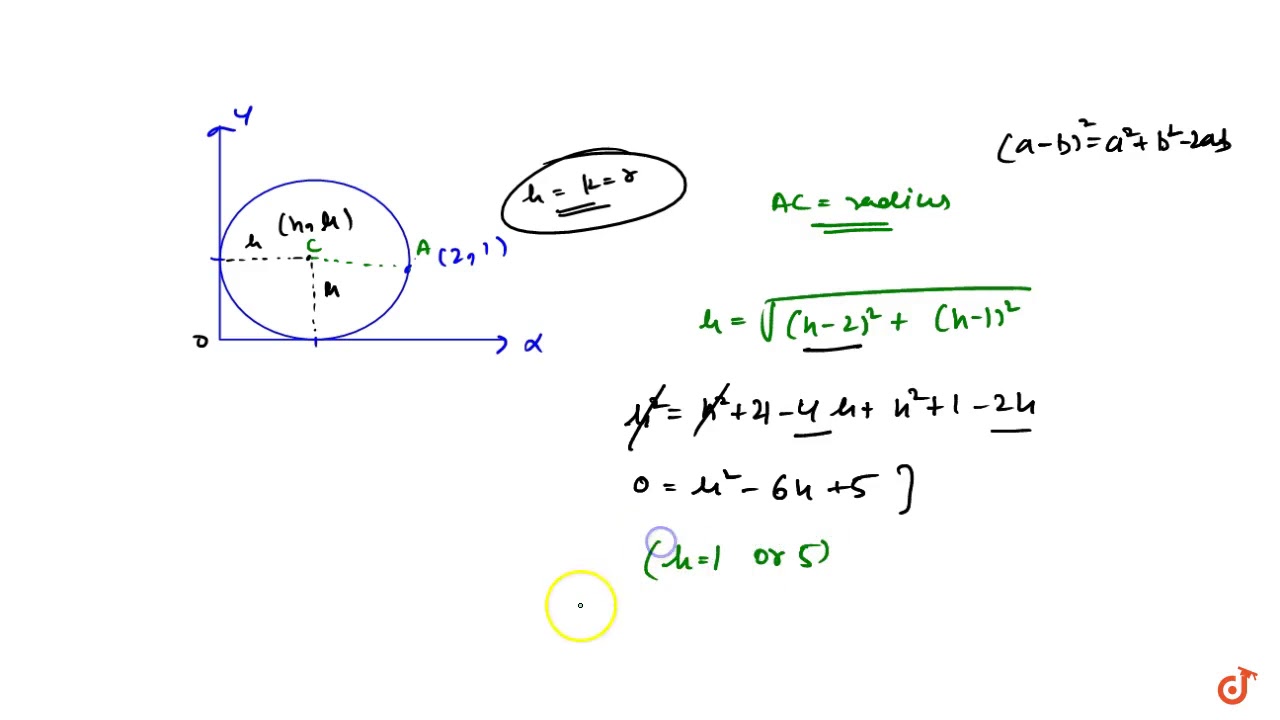
To ask Unlimited Maths doubts download Doubtnut from - https://goo.gl/9WZjCW Equation of the circle which touches the coordinate axes and passes through the point (2,1) is
.close
lone heartBOT
Channel closed
Closed by @zinc urchin
Use .reopen if this was a mistake.
Available help channel!
Send your question here to claim the channel.
Remember:
• Ask your math question in a clear, concise manner.
• Show your work, and if possible, explain where you are stuck.
• After 15 minutes, feel free to ping <@&286206848099549185>.
• Type the command .close to free the channel when you're done.
• Be polite and have a nice day!
Read #❓how-to-get-help for further information on how to ask a good question, and about conduct in the question channels.
 opaque hinge
 lone heartBOT
opaque hinge
lone heartBOT
opaque hinge
 vale wigeon
du/dx = 2x
flat ore
opaque hinge
Like he derived x^2 + 5 to 2x dx?
if u is x^2 + 5 then du/dx = 2x => du = 2x dx
lone heartBOT
@opaque hinge Has your question been resolved?
alpine sable
opaque hinge
Why is du=2xdx
du/dx=derivative of x^2+5=2x
=>du=2x*dx
lone heartBOT
Channel closed
Closed due to timeout
Use .reopen if this was a mistake.
lone heartBOT
Available help channel!
Send your question here to claim the channel.
Remember:
• Ask your math question in a clear, concise manner.
• Show your work, and if possible, explain where you are stuck.
• After 15 minutes, feel free to ping <@&286206848099549185>.
• Type the command .close to free the channel when you're done.
• Be polite and have a nice day!
Read #❓how-to-get-help for further information on how to ask a good question, and about conduct in the question channels.
alpine sable
any help on how to solve it
 lone heartBOT
alpine sable
any help on how to solve it
lone heartBOT
alpine sable
any help on how to solve it
 prime badge
confusing tbh
stone pilot
this reminds me of something
alpine sable
I was thinking of Bayes' theorem
prime badge
apparently it doesn't fail all the time, when the fault is present
it's a three storey story
oh
everything they say is for faulty device, that's not part of the equation
it's a trap
alpine sable
wdym
prime badge
i mean it's confusing on purpose
stone pilot
oh
prime badge
doesn't matter

that's what i think it says
clearly x is 0.1, so the answer is 0.01
stone pilot
rephrasing: a test will detect a fault when the device is faulty 90% of the time
the device will fail when the device is faulty but not detected by the test 10% of the time
whats the probability that a faulty device will not get detected by the test and will fail
alpine sable
stone pilot
rephrasing: a test will detect a fault when the device is faulty 90% of the time...
oh 0.10*0.10 = 0.01
prime badge
correct
alpine sable
thank you both my brain exploded haha u too smart
thanks @prime badge
thanks @stone pilot
.close
lone heartBOT
Channel closed
Closed by @paper ore
Use .reopen if this was a mistake.
Available help channel!
Send your question here to claim the channel.
Remember:
• Ask your math question in a clear, concise manner.
• Show your work, and if possible, explain where you are stuck.
• After 15 minutes, feel free to ping <@&286206848099549185>.
• Type the command .close to free the channel when you're done.
• Be polite and have a nice day!
Read #❓how-to-get-help for further information on how to ask a good question, and about conduct in the question channels.
 fresh fjord
yo
 lone heartBOT
fresh fjord
yo
lone heartBOT
lone heartBOT
fresh fjord
yo
lone heartBOT
Channel closed
Closed by @fresh fjord
Use .reopen if this was a mistake.
Available help channel!
Send your question here to claim the channel.
Remember:
• Ask your math question in a clear, concise manner.
• Show your work, and if possible, explain where you are stuck.
• After 15 minutes, feel free to ping <@&286206848099549185>.
• Type the command .close to free the channel when you're done.
• Be polite and have a nice day!
Read #❓how-to-get-help for further information on how to ask a good question, and about conduct in the question channels.
 tough tangle
 lone heartBOT
tough tangle
tough tangle
lone heartBOT
tough tangle
tough tangle
Im pretty sure the book's answer is wrong, can someone confirm?
at k = 1/3, x = ln(2t-1) is invalid
therefore i gave the minimum value of k to be 1/2
bitter vault
tough tangle
therefore i gave the minimum value of k to be 1/2
you're right
lone heartBOT
@tough tangle Has your question been resolved?
Channel closed
Closed by @tough tangle
Use .reopen if this was a mistake.
tough tangle
bitter vault
you're right
thanks
lone heartBOT
Available help channel!
Send your question here to claim the channel.
Remember:
• Ask your math question in a clear, concise manner.
• Show your work, and if possible, explain where you are stuck.
• After 15 minutes, feel free to ping <@&286206848099549185>.
• Type the command .close to free the channel when you're done.
• Be polite and have a nice day!
Read #❓how-to-get-help for further information on how to ask a good question, and about conduct in the question channels.
 fervent aurora
\
 lone heartBOT
fervent aurora
\
fervent aurora
lone heartBOT
fervent aurora
\
fervent aurora
How do I solve this?
lone heartBOT
@fervent aurora Has your question been resolved?
 round forge
try drawing a graph to visualize the right riemann rectangles

 fervent aurora


I followed the right reimann sum
but Im not getting the right answers

What am I doing wrong?
 proper tangle
fervent aurora
What am I doing wrong?
proper tangle
fervent aurora
What am I doing wrong?
the width is not fixed
width of the subintervals varies
round forge
you can't use the equation here because the equation implies the width (b-a/n) is the same for each interval (4-->7, 7-->12, 12-->15 are not separated equally)
so you have to calculate the riemann sums manually, by hand
draw a graph of the rate
and how it changes over time
to see this visually
fervent aurora
Uhhh
are you sure?
This problem should be solved fairly quickly
is there really no faster way to solve this?
round forge
yeah
round forge
np
fervent aurora
.close
lone heartBOT
Channel closed
Closed by @fervent aurora
Use .reopen if this was a mistake.
Available help channel!
Send your question here to claim the channel.
Remember:
• Ask your math question in a clear, concise manner.
• Show your work, and if possible, explain where you are stuck.
• After 15 minutes, feel free to ping <@&286206848099549185>.
• Type the command .close to free the channel when you're done.
• Be polite and have a nice day!
Read #❓how-to-get-help for further information on how to ask a good question, and about conduct in the question channels.
 fiery spire
Hey, can I have help with this?
I have a R3 matrix, the lines of the matrix are shifted by different values (each row is shifted by a value). I need to derivate the resulted matrix by the column vector of the shifting values.
In other words, what is the derivation of a shifting operator L(Matrix, Row) with respect to row?
Thanks you !
 lone heartBOT
fiery spire
Hey, can I have help with this?
I have a R3 matrix, the lines of the matrix are ...
fiery spire
lone heartBOT
fiery spire
Hey, can I have help with this?
I have a R3 matrix, the lines of the matrix are ...
fiery spire
<@&286206848099549185>
 devout wraith
French?
fiery spire
Pourquoi pas!
fiery spire
Yes I don't mind if it is in french
devout wraith
d'accord, alors tu fais la matricielle du droit en souhaitant la dérivée et en l'a considérant comme nul, soit l'équivalent de 0. Sinon la vectorielle me paraît simple et donc tu fais comme dit avant : tu considères nul la valeur et tu as de quoi faire ton exercice. Et essaye de le résoudre en 2éme degré (= quadratique)
fiery spire
Merci pour ta réponse, mais je n'ai pas vraiment bien compris, est ce que c'est possible d'avoir un exemple
devout wraith
Ah désolé, sinon tu peux attendre d'autres helpers je suis désolé, je suis pas très bien doué en démonstration d'exemples, lol
sorry, have a good day
lone heartBOT
@fiery spire Has your question been resolved?
lone heartBOT
@fiery spire Has your question been resolved?
fiery spire
<@&286206848099549185>
alpine sable
fiery spire
Hey, can I have help with this?
I have a R3 matrix, the lines of the matrix are ...
Hi, are you trying to implement this in a programming language, or just looking for a formula ?
fiery spire
Trying to inplement this in pytorch (python)
alpine sable
fiery spire
Trying to inplement this in pytorch (python)
I see, I think there is a shift function in python for arrays. you can write a loop on the rows of the matrix, and in each iteration i , the row i will be shifted by the ith element of the vector of shifting values
fiery spire
The shifting is implemented for the forward pass
but the backward pass require the derivation of the shifting with respect to the input which is the latencies (thee column vector)
I am stuck in the backward pass
If there is a formula, it may help
alpine sable
I am not familiar with these terms (never worked with pytorch), but if you already have the vector of shifting values, what's preventing from writing the loop inside your code.
alpine sable
fiery spire
If there is a formula, it may help
I don't think there is an easy formula for shifting each row with different values, we can permutate rows and multiply them by constants (elemntary row operations) and even shift the entire matrix, but individual rows, not to my knowledge
fiery spire
I don't know how to derivate an operator, shifting is not an function is an operator in math
I don't know how to derivate it
alpine sable
what do you mean by derivating ?
alpine sable
haha english isn't my native language either.. so you want the derivative of an operator ? why doing this
alpine sable
fiery spire
I don't know how to derivate an operator, shifting is not an function is an oper...
well shifting is a multiplication by a specific matrix
not sure it's an operator
or maybe could be defined as such
but how is the derivative relevant here
fiery spire
Shifitng is like a trnaslation in math
f(x-a) where a is the translation, equivalent to a shifitng value
If we can derivate of a row vector with respect to a single shifting value. It would help
alpine sable
fiery spire
f(x-a) where a is the translation, equivalent to a shifitng value
well if you have a matrix instead of a function f, shifting a matrix a row down for example is equivalent to multiplying it by a well known matrix (all of its coefficients are zeros except one coefficient in the desired row, or something like that)
alpine sable
fiery spire
If we can derivate of a row vector with respect to a single shifting value. It w...
I don't understand here
we usually calculate a derivative with respect to a variable
fiery spire
alpine sable
well if you have a matrix instead of a function f, shifting a matrix a row down ...
How to find this matrix, a genearl formula
alpine sable
not a fixed value
alpine sable
fiery spire
How to find this matrix, a genearl formula
as far as i know don't think there is a formula, look at this example

notice the matrix A was shifted down when we multiplied it by S
in the left
but this is shifting an entire matrix
not one row individually
fiery spire
alpine sable
not one row individually
I have tried already to shift with a matrix didn't work, on python I used broadcasting indexes to shift each row indivudualy, and it worked without a need to a loop
fiery spire
alpine sable
I don't understand here
Assuming that we have a vector and we shift its elements with a x pixel.

How to derivate the new vector produced with this shifting, with respect to x.
Assuming x = 1
 alpine sable
fiery spire
alpine sable
fiery spire
I guess you just need to multiply this vector by the column vector $(0, 1, ....,0)^T$
ocean sealBOT
AimaneSN
 alpine sable
I think a general formula (for shifting vectors) would involve the delta kronecker symbol, but not sure how to write it
fiery spire
ocean seal
**AimaneSN**
It would produce a scalar
fiery spire
alpine sable
I think a general formula (for shifting vectors) would involve the delta kroneck...
Can you give more details please, not familiar with knonecker symbol
worn fox
take the identity matrix and move all the columns to the right, that'll shift your vector down by one
alpine sable
fiery spire
It would produce a scalar
Sorry you're rightt, we should multiply it by a matrix where the first column vector is $(0, 1, ....,0)^T$ and all the remaining column vectors are zeros, but not sure, I need to write this down
ocean sealBOT
AimaneSN
 alpine sable
fiery spire
Can you give more details please, not familiar with knonecker symbol
alpine sable
fiery spire
Can you give more details please, not familiar with knonecker symbol
it's simply $\delta_{i,j}=1$ if i=j, and 0 if not
ocean sealBOT
AimaneSN
 alpine sable
it should be useful here because we only deal with 1's and 0 's
fiery spire
Still can't figure out a derivation of the row with this symbol
alpine sable
worn fox
take the identity matrix and move all the columns to the right, that'll shift yo...
multiplication in the right? in the left?
worn fox
uh on the left
alpine sable
Ah I see
fiery spire
alpine sable
No he mean that the identity matrix is shifted right to get the targeted shifting with the row
fiery spire
yes
worn fox
fiery spire
i was specifically referring how to go from the first vector here to the second
i gather your problem is more complicated than just that
fiery spire
worn fox
i gather your problem is more complicated than just that
As it seems yes
alpine sable
I really think it's better to work on the problem using shift functions in python, even if there is a math formula it would be complicated to implement it in python
alpine sable
fiery spire
As it seems yes
why can't you shift the vector simply using a shift function, or is it not possible
fiery spire
alpine sable
I really think it's better to work on the problem using shift functions in pytho...
I have implemented the shifting, it is not the problem, the problem that pytorch is not able to derivate it alone, I have to do it manualy
fiery spire
alpine sable
why can't you shift the vector simply using a shift function, or is it not possi...
The derivation problem is not easy not the shifting
alpine sable
fiery spire
I have implemented the shifting, it is not the problem, the problem that pytorch...
again not sure what you mean by derivation here
do you mean this
The derivative matrix is presented as a natural generalization of the single variable derivative to multivariable functions.
fiery spire
fiery spire
Assuming that we have a vector and we shift its elements with a x pixel.
This
fiery spire
Yes the shifting part is done but the derivation not
derivation of the shifting output with respect to the latency
alpine sable
fiery spire
derivation of the shifting output with respect to the latency
still don't understand here
can you give an example
fiery spire
Not sure if you would accept it, but would you like to organize a meet (goole meet)
It would be easier to explain
alpine sable
fiery spire
Not sure if you would accept it, but would you like to organize a meet (goole me...
would like to but on my phone here haha
yeah it's difficult to explain this by writing
alpine sable
fiery spire
derivation of the shifting output with respect to the latency
so the output is a matrix right ?
alpine sable
and you want the derivative of this matrix wrt to something?
alpine sable
fiery spire
forgot everything that I have already said
okay nvm
fiery spire
I will explain with the simplest example possible
alpine sable
okay
fiery spire
Assuming that we have a vector, using a shifting function (already existing and working perfectly), it is shifted by x pixel.
fiery spire
Example if x=1
 alpine sable
okay
alpine sable
okay and then
fiery spire
so : output_vector = Shifting(input_vector, x)
All I need is derivation of output_vector with respect to x
alpine sable
yes that's what I meant
fiery spire
alpine sable
yes that's what I meant
I am working on ML project that include this idea
fiery spire
When we are training neural network model, we have to retro propagate the error
using backpropagation
alpine sable
fiery spire
d(output_vector)/dx
one remark here, I think you already know that the derivative doesn't always exist. Not everything is differentiable. I suspect "derivative of a vector" simply doesn't make sense.
alpine sable
fiery spire
When we are training neural network model, we have to retro propagate the error
Oh.. looks interesting
fiery spire
alpine sable
one remark here, I think you already know that the derivative doesn't always exi...
This is what I am afraid of
alpine sable
we know that some functions in math don't have a derivative
also when you write something like d(output)/dx
this means x can have infinitesimal change
but x in your example only takes the values 0, 1 , 2
this is obviously not infinitesimal
x can't be for example 0.0001
alpine sable
fiery spire
I wouldn't mind if there is an approximation, it is allowed in ML
I see. so let's say that instead of d(output)/dx we just say we're looking for the rate of change $\frac{\Delta(output)}{\Delta x}$
ocean sealBOT
AimaneSN
 fiery spire
Yes possible
alpine sable
I am not sure $\Delta(output)$ means anything here either, we're simply calculating a difference between a vector and its shift
ocean sealBOT
AimaneSN
 alpine sable
doesn't seem to make any sense
fiery spire
It make sens in ML, beleive me x)
alpine sable
haha
 obsidian cave
If you're training the model by gradient descent, I'm not sure how it would work with a non-continous operation like shifting
fiery spire
obsidian cave
If you're training the model by gradient descent, I'm not sure how it would work...
If we can find a way to make a continuous approximation possible, seems possible
obsidian cave
For a particular row, the value of the shift will be an integer. Say the loss is high when the value is 2, I couldn't imagine a way for the model to predict what the loss to be when increasing or decreasing the shift because it could change drastically, the next minima could be at 12 with no gradient leading towards it
Then again not saying it's impossible, just saying it's difficult for me to imagine how it could be done
alpine sable
yep i had similar ideas.. the number of shifts can be anything so $\Delta(output)$ doesn't seem to have a formula at all, and it's certainly not a continuous variable
ocean sealBOT
AimaneSN
 fiery spire
Even if it is not a continous, I suppose that the output of this derivation is a vector of 1 and 0,
alpine sable
fiery spire
If we can find a way to make a continuous approximation possible, seems possible
usually approximation goes from continuous variables to discrete variables, I am not familiar with the inverse, or if it's possible in this case
alpine sable
fiery spire
Even if it is not a continous, I suppose that the output of this derivation is a...
it can also be -1 I think
fiery spire
I can just multiply this vector by continous function like this one

The result will be continious
alpine sable
fiery spire
I can just multiply this vector by continous function like this one
if you do this you no longer have values that make sense I think
fiery spire
alpine sable
if you do this you no longer have values that make sense I think
Yeah I am comfusing with another thing
doesn't make sens
seems that it is not possible to create
alpine sable
yeah that's what I suspect
the values this vector takes aren't continuous
there has to be some other way to approach your problem
fiery spire
alpine sable
there has to be some other way to approach your problem
can't see how
alpine sable
fiery spire
can't see how
it depends on what you want to do with the shifted vector
that's what I don't understand
fiery spire
Are you familiar with ML loss backprobagation
alpine sable
fiery spire
Are you familiar with ML loss backprobagation
nope not at all
fiery spire
If not, in order to reduce the loss (difference between targeted output and the current output)
For each parameter of the model, we derivate the loss by this parameter
the new parameter w = w - alpha * (d(loss)/dw)
alpha is the learning rate, somehow how quick with your model converge to the ideal parameter
loss is the produced by differente layers which means for example loss = f(g(t(y(input)))
alpine sable
Ah I see
alpine sable
I suppose the loss function must be differentiable
fiery spire
those internediate function have to be differentiable
so the d(loss)/dw wouldn't be 0
alpine sable
okay, but as I said you don't have the right to write d(loss)/dw unless loss(w) is differentiable
fiery spire
if so our parameter can not learn, to be stuck, so the loss never tend to 0
fiery spire
alpine sable
okay, but as I said you don't have the right to write d(loss)/dw unless loss(w) ...
yes which means that all f g t y function have to be differentiable
in my case one of them which is the shift function, is not differentiable
alpine sable
fiery spire
in my case one of them which is the shift function, is not differentiable
Yep that was the problem
I think the shift should be replaced by something else
fiery spire
I have to find out n approximation or a trick to make it differentiable
fiery spire
alpine sable
I think the shift should be replaced by something else
I can't in my model
obsidian cave
Which matrix exactly are you shifting?
fiery spire
the input, typical all images of a dataset
obsidian cave
and the dataset is labeled?
obsidian cave
which loss function are you using?
fiery spire
CrossEntropy
obsidian cave
fiery spire
In my case it is a supervised classification
classification? so where does the row shifting come in?
fiery spire
row shifting are parameters to train
this why I have to derivate with repect to them
fiery spire
No
inputs are being shifted
and shifting parameters have to be trained by backprop
obsidian cave
Ah I see
And just to be sure is the amount that each row should be shifted in the labels?
fiery spire
obsidian cave
And just to be sure is the amount that each row should be shifted in the labels?
No
the amount that each input should be shifted is a parameter, like weight and bias
obsidian cave
Im sorry Im confused