#help-0
1 messages · Page 973 of 1
 solemn grove
 chilly tangle
Thanks. How do I finish this help section?
 earnest mortar
a module can be a norm...
solemn grove
.close
earnest mortar
that's confusing
solemn grove
earnest mortar
a module can be a norm...
bro, it’s a single |
probs just convention
but I learnt single lines as det of matrix
earnest mortar
solemn grove
bro, it’s a single |
yep but i never denoted |M| the det of M so allow me to be confused 🙂
solemn grove
and double for norm
chilly tangle
How do I get the vector from this matrix, for instance?
solemn grove
earnest mortar
yep but i never denoted |M| the det of M so allow me to be confused 🙂
yeah, probs convention as I said
chilly tangle
solemn grove
yeah, probs convention as I said
It's a brazilian book.
chilly tangle
chilly tangle
How do I get the vector from this matrix, for instance?
How do I transform a vector from a matrix to a vector form?
.close
 lone heartBOT
Channel closed
Closed by @chilly tangle
Use .reopen if this was a mistake.
 Available help channel!
Send your question here to claim the channel.
Remember:
• Ask your math question in a clear, concise manner.
• Show your work, and if possible, explain where you are stuck.
• After 15 minutes, feel free to ping <@&286206848099549185>.
• Type the command .close to free the channel when you're done.
• Be polite and have a nice day!
Read #❓how-to-get-help for further information on how to ask a good question, and about conduct in the question channels.
 wispy cipher
I have an AM-GM inequality question
lone heartBOT
wispy cipher
I have an AM-GM inequality question
wispy cipher
if a^3 + b^3 = c^3
find P such that a^2 + b^2 - c^2 >= P(c-a)(c-b)
I found that (a^2/(c-b)) = (b^2 + bc + c^2)/a
and (b^2/(c-a)) = (c^2 + ac +a^2)/b
but I don't really know how do i transform this to the wanted inequality
earnest mortar
$$a^2 + b^2 - c^2 \geq P(c-a)(c-b)$$
is equivalent to
$$a^2 + b^2 -Pab \geq c(Pc + c - a - b)$$
Notice that
$$(a+b-c)^3 = a^3 + b^3 - c^3 +3a^2 (b-c) + 3 c^2 (b+a) + 3b^2 (-c + a) - 6abc$$ $$(a+b-c)^3 = 3a^2 (b-c) + 3 c^2 (b+a) + 3b^2 (-c + a) - 6abc$$
Maybe you can try using GM-AM on $(a+b-c)^3$
That's the idea i have, not sure if it works
 ocean sealBOT
Silfer
 earnest mortar
nvm with -c it doesnt work
wispy cipher
i tried this way and also with (a+b)^3, (c-b)^3
but they don't work out
<@&286206848099549185>
earnest mortar
are a b and c positive integers ?
wispy cipher
not indicated
wispy cipher
positive real numbers, not integers
wispy cipher
i just looked at it again, a,b,c are positive real numbers
wispy cipher
well they can but if 0 is included
earnest mortar
yes
earnest mortar
intuitively i would say P = 2 or 1
wispy cipher
wispy cipher
I found that (a^2/(c-b)) = (b^2 + bc + c^2)/a
from this i found $$c(a^2 + b^2 -c^2) \geq 2(c-a)(c-b) \frac{ab}{c}$$
sorry \geq
ocean sealBOT
DFGrasped
 wispy cipher
😄
earnest mortar
i'm bad at those things
wispy cipher
this is the first time i see cubes iwith am-gm
so i am stuck
whole evening spent on this 😄
earnest mortar
i never really practiced am-gm
wispy cipher
i had to for some diophantine equations, they are helpful sometimes
earnest mortar
you might find it soon. recently i was thinking about a problem for the entire night. Then I woke up and had the solution in mind
the hardest problem i ever solved
earnest mortar
what's your level ?
earnest mortar
i'm sorry but it's kinda useless to give it now... I mean you can understand it maybe if you know what a bijection is but it's never something that would be given in HS
but if you want to see it i can send it to you
wispy cipher
isn't it if the input and the output sets of functions are one-to one
earnest mortar
wispy cipher
isn't it if the input and the output sets of functions are one-to one
yeah kind of. The rigorous way to define it is about uniting injectivity and surjectivity
wispy cipher
i don't know the english part but I had a class on that
earnest mortar
wait where r u from ?
earnest mortar
I see
wispy cipher
I started maths a little late 😄 so it was also hard
earnest mortar
I never studied maths outside of HS when I went into it
anyways, sorry for not being able to help
wispy cipher
no problem, nice chat though
lone heartBOT
@wispy cipher Has your question been resolved?
lone heartBOT
@wispy cipher Has your question been resolved?
lone heartBOT
@wispy cipher Has your question been resolved?
lone heartBOT
Channel closed
Closed due to timeout
Use .reopen if this was a mistake.
Available help channel!
Send your question here to claim the channel.
Remember:
• Ask your math question in a clear, concise manner.
• Show your work, and if possible, explain where you are stuck.
• After 15 minutes, feel free to ping <@&286206848099549185>.
• Type the command .close to free the channel when you're done.
• Be polite and have a nice day!
Read #❓how-to-get-help for further information on how to ask a good question, and about conduct in the question channels.
 fossil basin
Howdy! Can you help me figuring out the steps to this...?
2^(x+1)+2^(x-1)= 40
5. 2^(x-1)=40
lone heartBOT
fossil basin
Howdy! Can you help me figuring out the steps to this...?
2^(x+1)+2^(x-1)= 40
5...
fossil basin
I know x=4 but im struggling with the process 😦
 placid zinc
Note that 2^(x+1) = 4(2)^(x-1)
fossil basin
sorry i don't get it
placid zinc
If I let u = 2^(x-1), then it becomes:
4u + u = 40
lone heartBOT
@fossil basin Has your question been resolved?
 alpine sable
@fossil basin we're trying to get equal powers so we can add the terms
fossil basin
thanks mate!
lone heartBOT
Channel closed
Closed by @fossil basin
Use .reopen if this was a mistake.
lone heartBOT
Available help channel!
Send your question here to claim the channel.
Remember:
• Ask your math question in a clear, concise manner.
• Show your work, and if possible, explain where you are stuck.
• After 15 minutes, feel free to ping <@&286206848099549185>.
• Type the command .close to free the channel when you're done.
• Be polite and have a nice day!
Read #❓how-to-get-help for further information on how to ask a good question, and about conduct in the question channels.
 nimble frost
 lone heartBOT
nimble frost
lone heartBOT
nimble frost

 tacit arch
nimble frost
tacit arch
nimble frost
what is your question
nimble frost
to find the power series of the function 1/3-x by comparing it to the power series from 1/1-x
 glass lichen
nimble frost
glass lichen
nimble frost
yeah that looks right
also 1/(3-x) and 1/(1-x) for typing
oh wait
centered at 2
glass lichen
yeah
nimble frost
so would that be the entire series
glass lichen
so you want to make $\frac{1}{a-(x-2)}$ appear
ocean sealBOT
Mosh
 nimble frost
oooo
glass lichen
so $\frac{1}{1-(x-2)}$
ocean sealBOT
Mosh
 glass lichen
then just give interval of convergence
nimble frost
ok so it is (1,3)
glass lichen
yes
nimble frost
thank you for your help
lone heartBOT
Channel closed
Closed by @nimble frost
Use .reopen if this was a mistake.
Available help channel!
Send your question here to claim the channel.
Remember:
• Ask your math question in a clear, concise manner.
• Show your work, and if possible, explain where you are stuck.
• After 15 minutes, feel free to ping <@&286206848099549185>.
• Type the command .close to free the channel when you're done.
• Be polite and have a nice day!
Read #❓how-to-get-help for further information on how to ask a good question, and about conduct in the question channels.
 nocturne carbon
i need help with 2 and 3 stepp equations like how to do them
nocturne carbon
like in general
nimble frost
do you have any examples
 nimble frost
res, someone else is using this channel. find another
 wary stream
 mental agate
nocturne carbon
nimble frost
do you have any examples
mental agate
nocturne carbon
nimble frost
do you have any examples
yes
ill get soem
actually i need help with that and more but its all algebra

ones like these
nimble frost
okay. lets look at ex8
what is the opposite of an exponent
like how do you get $x^2$ back to x
ocean sealBOT
axap
 nimble frost
ok what have you learned in math so far
nocturne carbon
man i just fell asleep for one class
nimble frost
ok this is algebra
wary stream
nocturne carbon
idk how to solve any of these
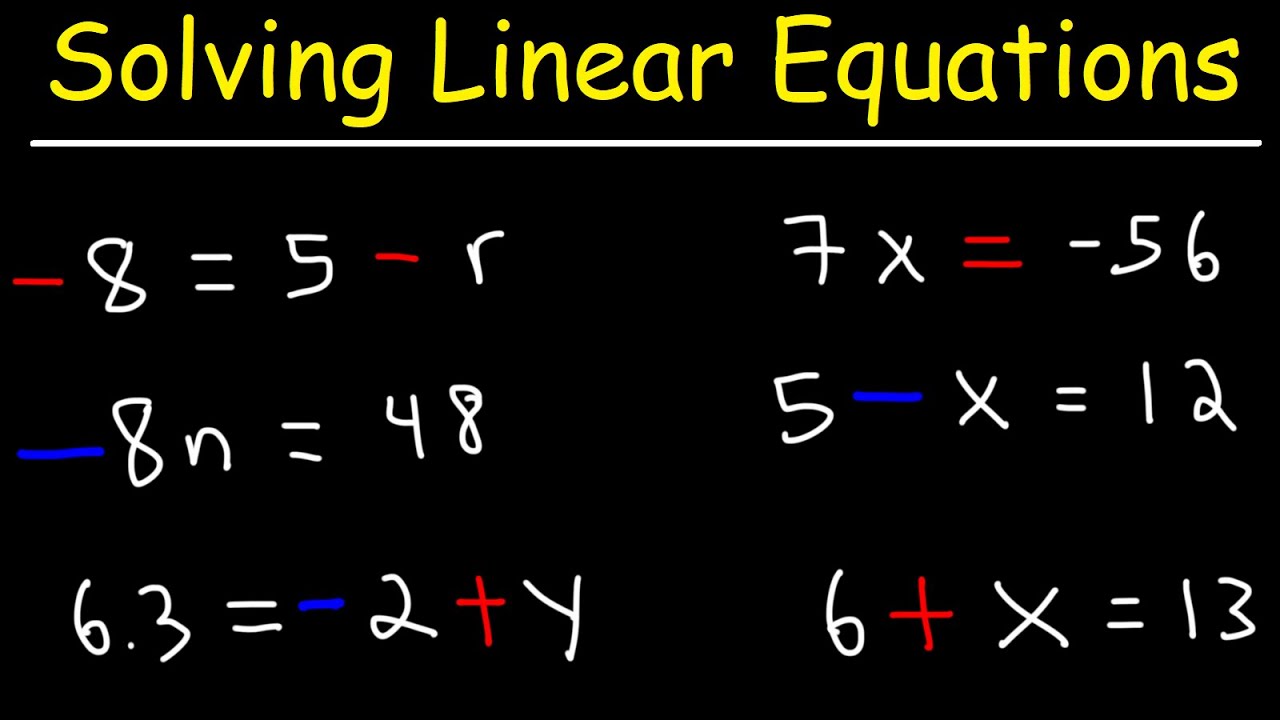
This algebra video explains how to solve linear equations. It contains plenty of examples and practice problems.
Get The Full 1 Hour Video on Patreon:
https://www.patreon.com/MathScienceTutor
Direct Link to The Full Video:
https://bit.ly/3jxdfbE
Full 1 Hour Video:
https://www.youtube.com/watch?v=KntJnewR3W8
Join The Membership Program:
htt...
nimble frost
anything you do to one side you have to do to the other
nocturne carbon
wary stream
https://www.youtube.com/watch?v=7DPWeBszNSM&t=77s&ab_channel=TheOrganicChemistry...
i know how you do thoe
but the ones with fractions and exponents r hard
nimble frost
so if 5x = 10, you would divide both sides by 5 to undo the multiplication
nocturne carbon
yes
nimble frost
same thing with a fraction
nocturne carbon
how do i do it
wary stream
nocturne carbon
but the ones with fractions and exponents r hard
You apply the opposite operation
nocturne carbon
i get so confused with fractions and exponents
nimble frost
just multiply by the inverse of the fraction, turn it upside down
nocturne carbon
i multiply the fraction??
wary stream
nocturne carbon
i multiply the fraction??
Because a fraction is division
nocturne carbon
ohh
nimble frost
what does the exponent do
nimble frost
multiply what
nocturne carbon
it multiplies x
nimble frost
by what
wary stream
For exponents, it's applying exponent rules, you want to have a power of 1, aka $x^1$. So $x^{p^{\frac{1}{p}}}= x^{p \cdot \frac{1}{p}} = x^1 = x$
wary stream
nocturne carbon
it devides??
No
nocturne carbon
nimble frost
what is 144
the square root of x
nocturne carbon
wary stream
No
what
wary stream
You don't divide
nimble frost
so the square root of x^2 will give you x
and that will be equal to the square root of 144
ocean sealBOT
dldh06
For exponents, it's applying exponent rules, you want to have a power of 1, aka $x^1$. So $x^{p}^{\frac{1}{p}}= x^{p \cdot \frac{1}{p}} = x^1 = x$
```Compilation error:```! Double superscript.
l.55 ...o have a power of 1, aka $x^1$. So $x^{p}^
{\frac{1}{p}}= x^{p \cdot ...
I treat `x^1^2' essentially like `x^1{}^2'.
Preview: Tightpage -1310720 -1310720 1310720 1310720
[1{/usr/local/texlive/2020/texmf-var/fonts/map/pdftex/updmap/pdftex.map}]
(./485903210272391178.aux) )
Here is how much of TeX's memory you used:
18267 strings out of 479485
359583 string characters out of 5871962``` nocturne carbon
how do i find a square root again
wary stream
A number times itself
nocturne carbon
144 x 144??
nimble frost
not quite
what number times itself equals 144
what you wrote would be 144 squared
nocturne carbon
thats what idk how to find
wary stream
nocturne carbon
thats what idk how to find
Knowing your squares would be good
nocturne carbon
100
nocturne carbon
is it 144 devided by 14??
nimble frost
whats 14*14
nimble frost
 nocturne carbon
how do i writw this dwn
nimble frost
so this is how we got there
nocturne carbon
okay thanks
nimble frost
does it make sense?
its the square root of both sides
see how the square root of x squared is just x?
nocturne carbon
yes
 trim plinth
not exactly
nimble frost
yeah
nocturne carbon
wait
nimble frost
it could be negative
trim plinth
think of the square of a negative number
nocturne carbon
how
nimble frost
two negative numbers multiply to a positive number
nocturne carbon
yea
nimble frost
so -12*-12 would also be 144
so technically x could be -12 or 12
or you can leave it as x= square root of 144
nocturne carbon
but dont u always automaticly assume that its a possitive numgebr
nimble frost
no
nocturne carbon
if no sign is shwon
nimble frost
not in this case
trim plinth
√ usually denotes the principal square root
nimble frost
we know the RESULT (144) is positive
trim plinth
so if I say √4 I usually mean 2
nimble frost
but we dont know if the numbers that went in are positive
trim plinth
but if I write sqrt(4) it is usually +2 and -2
trim plinth
yeah
wary stream
Yeah, that's a thing
nimble frost
xo, does the problem make sense to you now?
wary stream
If you write the root yourself, it's $\pm$ but if the root was already there, it's just the positive
ocean sealBOT
dldh06
 nocturne carbon
i get it now for this one
nimble frost
cool
wary stream
And also, for exponents, it's applying exponent rules, you want to have a power of 1, aka $x^1$. So $$x^{p^{\frac{1}{p}}}= x^{p \cdot \frac{1}{p}} = x^1 = x$$
nocturne carbon
ocean seal
**dldh06**
but for this one i had to make it does that mean its negatibe
ocean sealBOT
dldh06
 wary stream
nocturne carbon
but for this one i had to make it does that mean its negatibe
wary stream
nocturne carbon
but for this one i had to make it does that mean its negatibe
It's both positive and negative
wary stream
Because $(-12) \cdot (-12) = 144$
ocean sealBOT
dldh06
 wary stream
And $12 \cdot 12 = 144$
ocean sealBOT
dldh06
 wary stream
Recall that you can rewrite fractions like $$\frac{4x}{3} = \frac{4}{3} \cdot x$$
ocean sealBOT
dldh06
 nocturne carbon
yea
 nocturne carbon
how did 2 4s apear
nimble frost

i multiplied both sides by 4
youre allowed to do any operation to one side as long as you also do it to the other side
nimble frost
do my examples make sense to you?
wary stream
nocturne carbon
how did 2 4s apear
I am going to suggest that you should ask your teacher for help or watch videos because it seems like you are lacking basic algebra knowledge
nocturne carbon
not really but ill try understanding it
nimble frost
since x is being multiplied by 3 and divided by 4, i do the opposite of those to get rid of them
nocturne carbon
wary stream
I am going to suggest that you should ask your teacher for help or watch videos ...
ill ask her too
im still confused man
 wary stream
nocturne carbon
im still confused man
wary stream
nocturne carbon
im still confused man
Then ask your teacher for more assistance
trim plinth
x/3=10
nocturne carbon
ngl idk
trim plinth
how do you go from $\frac{x}{3}$ to $x$?
ocean sealBOT
sunflame
 nocturne carbon
i barely have any knowledge of secondary level math
wary stream
nocturne carbon
i barely have any knowledge of secondary level math
That sounds like a problem where you should look up resources and ask your teacher for help
nocturne carbon
i know a fraction is divison
wary stream
Apply the opposite operation that cancels the division
 trim plinth
divide both sides by $\frac{2}{3}$
ocean sealBOT
sunflame
 trim plinth
$x \div \frac{a}{b} = x \times \frac{b}{a}$
ocean sealBOT
sunflame
 trim plinth
$x \divide \frac{a}{b} = x \times \frac{b}{a}$
ocean sealBOT
sunflame
$x \divide \frac{a}{b} = x \times \frac{b}{a}$
```Compilation error:```! You can't use `\relax' after \divide.
\frac ->\protect
\frac
l.55 $x \divide \frac
{a}{b} = x \times \frac{b}{a}$
I'm forgetting what you said and not changing anything.
Preview: Tightpage -1310720 -1310720 1310720 1310720
[1{/usr/local/texlive/2020/texmf-var/fonts/map/pdftex/updmap/pdftex.map}]
(./892725065127444480.aux) )
Here is how much of TeX's memory you used:``` wary stream
Just do another frac
trim plinth
$x ÷ \frac{a}{b} = x \times \frac{b}{a}$
ocean sealBOT
sunflame
 trim plinth
………………………………
wary stream
$\frac{x}{\frac{a}{b}}= x \times \frac{b}{a}$
ocean sealBOT
dldh06
 wary stream
Plug it back in and check
lone heartBOT
@nocturne carbon Has your question been resolved?
Channel closed
Closed by @nocturne carbon
Use .reopen if this was a mistake.
lone heartBOT
Available help channel!
Send your question here to claim the channel.
Remember:
• Ask your math question in a clear, concise manner.
• Show your work, and if possible, explain where you are stuck.
• After 15 minutes, feel free to ping <@&286206848099549185>.
• Type the command .close to free the channel when you're done.
• Be polite and have a nice day!
Read #❓how-to-get-help for further information on how to ask a good question, and about conduct in the question channels.
 undone herald
is this right, and if so, how do I express this properly?
 ocean sealBOT
Zybikron

 merry depot
undone herald
is this right, and if so, how do I express this properly?
merry depot
undone herald
is this right, and if so, how do I express this properly?
is this $\lim_{n\to\infty}\frac{n^{e^{-n}}}{n!}$ or $\lim_{n\to\infty}\frac{ne^{-n}}{n!}$?
ocean sealBOT
Zybikron
 undone herald
first one
merry depot
interesting. Alright
undone herald
ok wait lol I'm redoing the question real quick
but I still think it'll be a problem
cause u end up with infinity^0 right?
like $\frac{{\infty}^0}{n!}$
merry depot
that could be a problem yeah
undone herald
$\frac{{\infty}^0}{\infty}$
ocean sealBOT
RealLifeGamer
 merry depot
do you know about comparison tests or anything?
undone herald
yeah I do but I only just learnt them
so I'm still rusty
is the aim to use a series to prove that n! will be bigger than the numerator?
like ratio test?
or a different one
merry depot
direct comparison test could be nice here, with the right comparison
lone heartBOT
@undone herald Has your question been resolved?
undone herald
what would I be comparing though?
like do I split the fraction into two series or sth?
merry depot
there's a nice comparison function written on your board in the first picture
undone herald
don't neither of the terms converge though?
isn't that a requirement for comparison test?
wait hang on
no I think the top term does converge?
merry depot
undone herald
isn't that a requirement for comparison test?
????

nothing about part of the series terms converging or not
undone herald
so I'm comparing the numerator and denominator right?
merry depot
no
comparison test says to find a different series where each term of the other series is larger (or smaller) than the original, then if the new series converges (or diverges) then the original series also converges (or diverges)
lone heartBOT
Channel closed
Closed due to timeout
Use .reopen if this was a mistake.
Available help channel!
Send your question here to claim the channel.
Remember:
• Ask your math question in a clear, concise manner.
• Show your work, and if possible, explain where you are stuck.
• After 15 minutes, feel free to ping <@&286206848099549185>.
• Type the command .close to free the channel when you're done.
• Be polite and have a nice day!
Read #❓how-to-get-help for further information on how to ask a good question, and about conduct in the question channels.
 unborn valve
 lone heartBOT
unborn valve
unborn valve
lone heartBOT
unborn valve
unborn valve
Hi I would like to know how the sigma here is simplified
I couldn't really see a pattern and I have no idea where to even begin
close
.close
lone heartBOT
Channel closed
Closed by @unborn valve
Use .reopen if this was a mistake.
Available help channel!
Send your question here to claim the channel.
Remember:
• Ask your math question in a clear, concise manner.
• Show your work, and if possible, explain where you are stuck.
• After 15 minutes, feel free to ping <@&286206848099549185>.
• Type the command .close to free the channel when you're done.
• Be polite and have a nice day!
Read #❓how-to-get-help for further information on how to ask a good question, and about conduct in the question channels.
 mild raft
how would you solve this?
lone heartBOT
mild raft
how would you solve this?
mild raft

 severe sluice
a for loop?
lone heartBOT
@mild raft Has your question been resolved?
mild raft
does anyone know how i could know what for instance N = 4 results in using this formula?
i mean mathematically this way i can see if my answer is correct
lone heartBOT
@mild raft Has your question been resolved?
 tawny schooner
mild raft
does anyone know how i could know what for instance N = 4 results in using this ...
tawny schooner
mild raft
does anyone know how i could know what for instance N = 4 results in using this ...
You should substitute N(n) = A*r^(n)
Where A is a constant
Then you can determine the resulting quadratic equation's roots for r
The resulting quadratic will look like this after factoring out common terms: r^2 = r+2
after you find the roots r1 and r2 of this quadratic, your solution will be a linear combination of the two solns: N(n) = Ar1^(n) +Br2^(n)
Determine A and B using initial conditions of the problem
lone heartBOT
@mild raft Has your question been resolved?
lone heartBOT
Channel closed
Closed due to timeout
Use .reopen if this was a mistake.
Available help channel!
Send your question here to claim the channel.
Remember:
• Ask your math question in a clear, concise manner.
• Show your work, and if possible, explain where you are stuck.
• After 15 minutes, feel free to ping <@&286206848099549185>.
• Type the command .close to free the channel when you're done.
• Be polite and have a nice day!
Read #❓how-to-get-help for further information on how to ask a good question, and about conduct in the question channels.
 grave robin
I'm new to the unit circle and I've got a question to solve an equation using it but I'm not sure how
|sin x| = 1/sqrt(2)
the given answers are x = 45 degrees, 135 degrees or x = 225 degrees, 315 degrees
lone heartBOT
grave robin
I'm new to the unit circle and I've got a question to solve an equation using it...
@grave robin Has your question been resolved?
grave robin
<@&286206848099549185>
 grave robin
its just 1/sqrt(2) right?
grave robin
okay, where do I go from there?
 silver adder
,w plot x^2+y^2=1, y = 1/sqrt(2)
ocean sealBOT


 Requested by DETOX#0236
silver adder
Requested by DETOX#0236
silver adder
sin is the y coordinate over time, both points here satisfy y = sin(45 degees) = sin(135 degrees) = 1/sqrt(2)
grave robin
how do I get the 45 and 135 though?
 jovial breach

Khan Academy
Review the unit circle definition of the trigonometric functions.
You can look it up
silver adder
 grave robin
I can see they're the answer, but I don't get how to tell from this
 grave robin
Y being sin X?
silver adder
uhh best to use a different variable while considering the unit circle
y = sin(t)
x = cos(t)
the point p = (cos(t),sin(t))
 grave robin
Okay, I can see that 1/sqrt(2) is 0.7something which is the y axis co-ordinate but from there I'm lost
silver adder
,w plot sin(x) = 1/sqrt(2)
ocean sealBOT
 Requested by DETOX#0236
silver adder
grave robin
Okay, I can see that 1/sqrt(2) is 0.7something which is the y axis co-ordinate b...
Requested by DETOX#0236
silver adder
grave robin
Okay, I can see that 1/sqrt(2) is 0.7something which is the y axis co-ordinate b...
lost on what specifically?
grave robin
How to get the 45 and 135
silver adder
well sin peaks at 90 degrees
and then the point comes down in the 2nd quadrant just like it went up in the 1st quadrant
by symmetry sin(45 degrees) = sin(90 + 45 degrees)
silver adder
hmm


working on a vector rendering library for Unity, for making stuff like this~✨
#madewithunity
Likes
10911
Retweets
2378
 Twitter
·
lone heartBOT
Twitter
·
lone heartBOT
@grave robin Has your question been resolved?
Channel closed
Closed by @grave robin
Use .reopen if this was a mistake.
Available help channel!
Send your question here to claim the channel.
Remember:
• Ask your math question in a clear, concise manner.
• Show your work, and if possible, explain where you are stuck.
• After 15 minutes, feel free to ping <@&286206848099549185>.
• Type the command .close to free the channel when you're done.
• Be polite and have a nice day!
Read #❓how-to-get-help for further information on how to ask a good question, and about conduct in the question channels.
alpine sable
Good day! Got a polynomials problem here
lone heartBOT
alpine sable
Good day! Got a polynomials problem here
alpine sable
p(𝓍) =a𝓍³-3𝓍²-5a𝓍-9
(𝓍-a) is a factor of p(𝓍)
What are the possible values of a?
What I did:
- tried finding p(a), can't solve it
- tried dividing by x-a, too complicated for the question
 gray isle
- tried finding p(a), can't solve it
show work
alpine sable
a⁴-8a²-9=0
gray isle
did you try anything after getting that equation?
alpine sable
Yeah, using any two terms and considering a difference between two squares, taking a common factor, and having two sides and rooting both.
Ok I can let b = a² and solve it quadratically normally
gray isle
note that this is a quadratic equation in a^2,
doing a substitution like u=a^2 may make it cleaer
lone heartBOT
Channel closed
Closed by @orchid flame
Use .reopen if this was a mistake.
lone heartBOT
Available help channel!
Send your question here to claim the channel.
Remember:
• Ask your math question in a clear, concise manner.
• Show your work, and if possible, explain where you are stuck.
• After 15 minutes, feel free to ping <@&286206848099549185>.
• Type the command .close to free the channel when you're done.
• Be polite and have a nice day!
Read #❓how-to-get-help for further information on how to ask a good question, and about conduct in the question channels.
 flat holly
 lone heartBOT
flat holly
lone heartBOT
flat holly
 earnest mortar
wait sec = 1/cos right ?
flat holly
yes
earnest mortar
here you try to find where the derivative is 0
but is it the value of x where the curve reaches the y axis ?
flat holly
oh
right
so if i find the coordinates of the point where the curve intersects the y-axis, how can i find the gradient of the tangent?
earnest mortar
this gives you a coordinate x of the point where it touches the y axis. Just plug this x into the derivative
and x can easily be found here...
lone heartBOT
@flat holly Has your question been resolved?
flat holly
.close
lone heartBOT
Channel closed
Closed by @flat holly
Use .reopen if this was a mistake.
Available help channel!
Send your question here to claim the channel.
Remember:
• Ask your math question in a clear, concise manner.
• Show your work, and if possible, explain where you are stuck.
• After 15 minutes, feel free to ping <@&286206848099549185>.
• Type the command .close to free the channel when you're done.
• Be polite and have a nice day!
Read #❓how-to-get-help for further information on how to ask a good question, and about conduct in the question channels.
Channel closed
Closed due to the original message being deleted
 lapis sparrow
.close
 prisma prawn
is this allowed?

 drowsy lagoon
prisma prawn
is this allowed?
drowsy lagoon
prisma prawn
is this allowed?
no
prisma prawn
drowsy lagoon
no
thanks
 wanton hare
Thats... cursed
lone heartBOT
Available help channel!
Send your question here to claim the channel.
Remember:
• Ask your math question in a clear, concise manner.
• Show your work, and if possible, explain where you are stuck.
• After 15 minutes, feel free to ping <@&286206848099549185>.
• Type the command .close to free the channel when you're done.
• Be polite and have a nice day!
Read #❓how-to-get-help for further information on how to ask a good question, and about conduct in the question channels.
 cedar vault
 lone heartBOT
cedar vault
cedar vault
lone heartBOT
cedar vault
cedar vault
how would i do number c
the total possible combinations is 6 * 6 * 6
216
i would rather not list all the possible combinations that add up to 10... it just seems really inefficient. what other way can i solve it?

it seems the answer is on google
why does the order matter here
lone heartBOT
@cedar vault Has your question been resolved?
lone heartBOT
@cedar vault Has your question been resolved?
lone heartBOT
@cedar vault Has your question been resolved?
lone heartBOT
@cedar vault Has your question been resolved?
lone heartBOT
Channel closed
Closed due to timeout
Use .reopen if this was a mistake.
Available help channel!
Send your question here to claim the channel.
Remember:
• Ask your math question in a clear, concise manner.
• Show your work, and if possible, explain where you are stuck.
• After 15 minutes, feel free to ping <@&286206848099549185>.
• Type the command .close to free the channel when you're done.
• Be polite and have a nice day!
Read #❓how-to-get-help for further information on how to ask a good question, and about conduct in the question channels.
alpine sable
so how do I go about finding the n? @tacit arch
 alpine sable
based on the pdf you linked ,it seems I'm going to have to test it for each n, create a tble
 olive oar
yea thats what youre gonna need to do
you can ball park at the start and look around there
alpine sable
alright but umm
if the purpose of this question is to minimize the error, then theoretically a function which represents the original function the best would have the least amount of error
so can I just go with n = 3? because then according to the formula, you would have f^4(c) which is sin x

another question: What exactly does the x represent on the last line?
is that the very point on the x-axis that minimizes error?
lone heartBOT
@alpine sable Has your question been resolved?
merry depot
alpine sable
so can I just go with n = 3? because then according to the formula, you would ha...
no
alpine sable
merry depot
no
why not?
I guess the part that im stuck on is that I dno how to calculate the numerical value for error
merry depot
You took 4 derivatives, you can see that each of them is $\pm \cos(x)$ or $\pm \sin (x)$ and it will just cycle through those 4 no matter how many derivatives you take. So you can bound the n-th derivative.
ocean sealBOT
Zybikron
 merry depot
alpine sable
why not?
merry depot
alpine sable
why not?
you found an x that makes your set up work. But x is in the interval [-pi,pi]. So I can just pick x = pi and break your equality.
This should work for all x in your interval.
merry depot
why?
merry depot
alpine sable
guess that means it's integration time?
you want $|R_n|<\frac1{1000}$. You know $|R_n|<\left|\frac{f^{(n+1)}(c)}{(n+1)!}x^{n+1}\right|$. So if you can find $n$ such that $\left|\frac{f^{(n+1)}(c)}{(n+1)!}x^{n+1}\right|<\frac1{1000}$ you're good.
ocean sealBOT
Zybikron
 alpine sable
merry depot
you want $|R_n|<\frac1{1000}$. You know $|R_n|<\left|\frac{f^{(n+1)}(c)}{(n+1)!}...
alpine sable
merry depot
you want $|R_n|<\frac1{1000}$. You know $|R_n|<\left|\frac{f^{(n+1)}(c)}{(n+1)!}...
but you said the x thing only works at a specific point and not the interval

merry depot
yeah, so you need a larger value of n until it works for every x in the interval
the more terms in P_n, the better approximation it is, and the smaller R_n is.
alpine sable
so how do I find the n that minimizes the error given an interval?
merry depot
taking it a piece at a time and figuring out how to max/min it
Do you know what $|f^{(n+1)}(x)|$ looks like?
ocean sealBOT
Zybikron
 merry depot
Can you bound that?
alpine sable
So I dno what that exactly means
I get the impression you're trying to find the maximum value
merry depot
what is the maximum/minimum value of sin(x) and cos(x)
merry depot
right, so $|f^{(n+1)}(x)|\leq 1$ and $\left|\frac{f^{(n+1)}(c)}{(n+1)!}x^{n+1}\right|<\left|\frac{1}{(n+1)!}x^{n+1}\right|$
ocean sealBOT
Zybikron
 merry depot
what is the maximum value that x can be?
merry depot
alpine sable
so how do I go about finding the n? <@!261933205387477002>
x is in an interval
merry depot
What interval are you working on?
alpine sable
minus pi to pos pi
merry depot
that is the interval for x, yes?
alpine sable
yes
merry depot
so what is the maximum value for x?
merry depot
is pi larger or smaller than 1?
merry depot
no, just x
if you're working on the interval $[-\pi, \pi]$ then $-\pi\leq x\leq \pi$
ocean sealBOT
Zybikron
 alpine sable
right
merry depot
so x is at most pi
alpine sable
yes
merry depot
So $x^{n+1}\leq \pi^{n+1}$ and you have $$\left|\frac{f^{(n+1)}(c)}{(n+1)!}x^{n+1}\right|<\left|\frac{1}{(n+1)!}x^{n+1}\right|<\left|\frac{\pi^{n+1}}{(n+1)!}\right|$$
ocean sealBOT
Zybikron
 alpine sable
oh
wait no
that makes no sense because f(n+1)(c) is a y value no?
not x?
like I put 1 there because that's the maximum y value the fn can have
merry depot
ocean seal
**Zybikron**
yes
alpine sable
I don't understand where the pi came from
We're trying to find the optimal n right?
merry depot
alpine sable
so how do I go about finding the n? <@!261933205387477002>
your question says this is on the interval [-pi,pi]
merry depot
that's bounds on x
alpine sable
mhmm'
merry depot
so the largest x can be is pi
alpine sable
for an x value yes
merry depot
that's all we're doing with this right now
we already found a bound for the derivative
alpine sable
What does it mean by bounds on x?
merry depot
a min/max value
alpine sable
like min/max value as in the lowest/highest y value given an x value?
merry depot
[-pi,pi] is an interval for x. That means that -pi < x < pi. So you have a lowest and highest value of x.
You also know the derivative is either sin(x) or cos(x). You know that -1 < sin(x) < 1 for any values x (and the same for cos(x)). So you have a lowest and highest value for the derivative.
merry depot
since you have a highest value for x and for the derivative, you can create an inequality that bounds R_n
alpine sable
mhmm
merry depot
ocean seal
**Zybikron**
That inequality is this
alpine sable
oh my God, I missed the part where pi gets subbed into x and not f(n+1)(c)
I was like.. how did a function turn into its domain

Ok
what do I do next?
merry depot
Now you can find an $n$ such that $$\left|\frac{\pi^{n+1}}{(n+1)!}\right|<\frac{1}{1000}$$
ocean sealBOT
Zybikron
 alpine sable
Oh
Ohhhh
Ok so
step 1) Identify the x at which you have the highest y value for a given function of an interval [a,b]
step 2) replace the x with the x value you found in step 1 into Rn
Step 3) solve for n
is that correct?
merry depot
alpine sable
step 1) Identify the x at which you have the highest y value for a given functio...
almost
The x that maximizes the nth derivative may be different than the x that maximizes (x-a).
alpine sable
oh sorry I meant if a is not 0
merry depot
then maximize (x-a) instead of just x
 lone heartBOT
Channel closed
Closed by @tight osprey
Use .reopen if this was a mistake.
lone heartBOT
Available help channel!
Send your question here to claim the channel.
Remember:
• Ask your math question in a clear, concise manner.
• Show your work, and if possible, explain where you are stuck.
• After 15 minutes, feel free to ping <@&286206848099549185>.
• Type the command .close to free the channel when you're done.
• Be polite and have a nice day!
Read #❓how-to-get-help for further information on how to ask a good question, and about conduct in the question channels.
 west hearth
 lone heartBOT
west hearth
west hearth
lone heartBOT
west hearth
west hearth
too late
west hearth
west hearth
so i'm not sure how to proceed with lagrange optimization
when you have inequalities
I tried treating it as a function but it's not helping ://
lone heartBOT
@west hearth Has your question been resolved?
west hearth
<@&286206848099549185>
lone heartBOT
@west hearth Has your question been resolved?
lone heartBOT
@west hearth Has your question been resolved?
 finite flax
west hearth
finite flax
west hearth
f looks like a hyperbola of one sheet and g looks like an ellipsoid. So the max's and min's will be level curves (ellipses)
I got the maximum...dunno how I missed the minimum
lone heartBOT
@west hearth Has your question been resolved?
 oak perch
west hearth
too late
oak perch
west hearth
too late
Replace y with (y/2) you got 5x^2+6xy+5y^2<=64, find the maximum and minimum of x^2+y^2
Then x=(1/sqrt(2))(u-v), y=(1/sqrt(2))(u+v), it turns into given 8u^2+2v^2<=64, find maximum and minimal of u^2+v^2
8u^2+2v^2<=64 is a region bounded by an ellipse u^2/8+v^2/32=1
So clearly maximum is 32, minimum 0
lone heartBOT
@west hearth Has your question been resolved?
Channel closed
Closed by @west hearth
Use .reopen if this was a mistake.
lone heartBOT
Available help channel!
Send your question here to claim the channel.
Remember:
• Ask your math question in a clear, concise manner.
• Show your work, and if possible, explain where you are stuck.
• After 15 minutes, feel free to ping <@&286206848099549185>.
• Type the command .close to free the channel when you're done.
• Be polite and have a nice day!
Read #❓how-to-get-help for further information on how to ask a good question, and about conduct in the question channels.
 rigid flower
How long does it take the minute hand of a clock to traverse an angle of 55°?
lone heartBOT
rigid flower
How long does it take the minute hand of a clock to traverse an angle of 55°?
merry depot
rigid flower
How long does it take the minute hand of a clock to traverse an angle of 55°?
what have you tried?
rigid flower
5 mins = 30 degrees
55 – 30 = 25
30/5 = 25/x
x = 25/6
5 + 25/6 = 55/6
55/6(60)=550secs
answer is 550 secs
here, I'm not confident about it. I was just practicing these types of probs recently
 vale wigeon
overcomplicated but seems correct
lone heartBOT
Channel closed
Closed by @rigid flower
Use .reopen if this was a mistake.
Available help channel!
Send your question here to claim the channel.
Remember:
• Ask your math question in a clear, concise manner.
• Show your work, and if possible, explain where you are stuck.
• After 15 minutes, feel free to ping <@&286206848099549185>.
• Type the command .close to free the channel when you're done.
• Be polite and have a nice day!
Read #❓how-to-get-help for further information on how to ask a good question, and about conduct in the question channels.
 iron parcel
guys how do i know if i triangle is sss sas or asa without the lines telling u so?
lone heartBOT
iron parcel
guys how do i know if i triangle is sss sas or asa without the lines telling u s...
merry depot
iron parcel
guys how do i know if i triangle is sss sas or asa without the lines telling u s...
??? sss, asa, and sas refer to congruence of two triangles. I'm not sure what you mean about a single triangle being one of these?
gray isle
do you have an example?
lone heartBOT
@iron parcel Has your question been resolved?
lone heartBOT
Channel closed
Closed due to timeout
Use .reopen if this was a mistake.
Available help channel!
Send your question here to claim the channel.
Remember:
• Ask your math question in a clear, concise manner.
• Show your work, and if possible, explain where you are stuck.
• After 15 minutes, feel free to ping <@&286206848099549185>.
• Type the command .close to free the channel when you're done.
• Be polite and have a nice day!
Read #❓how-to-get-help for further information on how to ask a good question, and about conduct in the question channels.
 dim jackal
 lone heartBOT
dim jackal
lone heartBOT
dim jackal
 clear frost
1:200 means 1 cm in drawing = 200cm in real life
convert 60m into cm
then just find how long is the train in drawing
@dim jackal
lone heartBOT
Channel closed
Closed by @dim jackal
Use .reopen if this was a mistake.
Available help channel!
Send your question here to claim the channel.
Remember:
• Ask your math question in a clear, concise manner.
• Show your work, and if possible, explain where you are stuck.
• After 15 minutes, feel free to ping <@&286206848099549185>.
• Type the command .close to free the channel when you're done.
• Be polite and have a nice day!
Read #❓how-to-get-help for further information on how to ask a good question, and about conduct in the question channels.
 spare mango
 lone heartBOT
spare mango
lone heartBOT
spare mango
 compact cedar
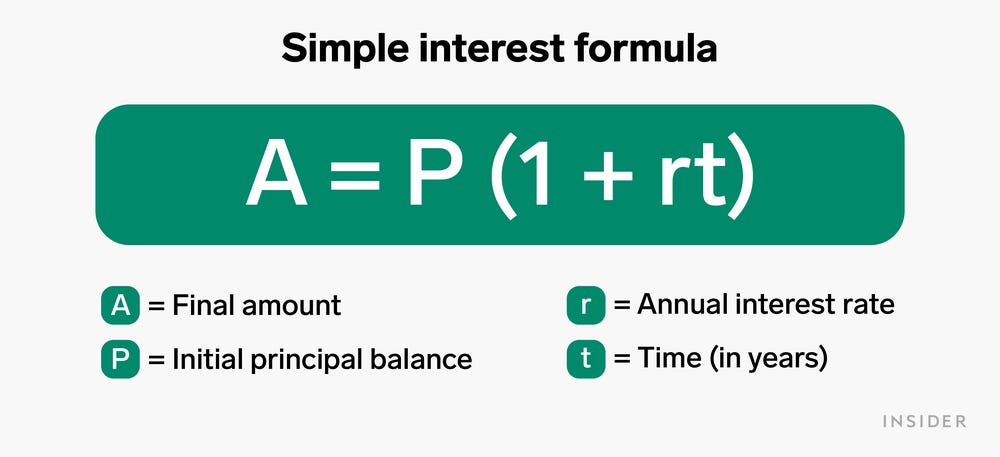
Sub in 1800 for A, and you're trying to find P. Once P is found, you could subtract it from A, and divide that by the T
@swift shore correct?
 swift shore
spare mango
swift shore
spare mango
Oh
compact cedar
The T is 2 years, since it's time. It's a flat interest rate, so that should ring a bell in your head that you don't need to use exponents (that's for compound interest)
compact cedar
yep
spare mango
1800 = P ( 1 + 12.5% * 2 )
compact cedar
Yes. I assume repayments means the "additional" payments due to the interest. So solve for P, and see if you can figure out the rest
lone heartBOT
Channel closed
Closed by @spare mango
Use .reopen if this was a mistake.
lone heartBOT
Available help channel!
Send your question here to claim the channel.
Remember:
• Ask your math question in a clear, concise manner.
• Show your work, and if possible, explain where you are stuck.
• After 15 minutes, feel free to ping <@&286206848099549185>.
• Type the command .close to free the channel when you're done.
• Be polite and have a nice day!
Read #❓how-to-get-help for further information on how to ask a good question, and about conduct in the question channels.
 queen raven
 lone heartBOT
queen raven
queen raven
lone heartBOT
queen raven
queen raven
i get it until the third line
gray isle
the part where they said
$$\therefore 2^{n-1} = 64 = 2^6$$?
ocean sealBOT
ℝamonov
 gray isle
that's sort of a leap and ideally you shouldn't jump to that conclusion like that
64 can be expressed with a base of 2,
similarly 729 can be expressed with a base of 3
$\frac{729}{64} = \br{\frac32}^{n-1} \ \
\frac{3^6}{2^6} = \br{\frac32}^6 = \br{\frac32}^{n-1}$
ocean sealBOT
ℝamonov
 lone heartBOT
@queen raven Has your question been resolved?
lone heartBOT
Channel closed
Closed by @queen raven
Use .reopen if this was a mistake.
lone heartBOT
Available help channel!
Send your question here to claim the channel.
Remember:
• Ask your math question in a clear, concise manner.
• Show your work, and if possible, explain where you are stuck.
• After 15 minutes, feel free to ping <@&286206848099549185>.
• Type the command .close to free the channel when you're done.
• Be polite and have a nice day!
Read #❓how-to-get-help for further information on how to ask a good question, and about conduct in the question channels.
 karmic falcon
hi
lone heartBOT
karmic falcon
hi
karmic falcon
can someone explain me why f(x)*g(x) < (g(x))^2 isn't equivalent to f(x)<g(x)
i guess it has something to do with the rule that you can't divide with a function that can get 0 value right?
 tall hearth
I think it has more to do with the fact that you dont know the sign of g(x)
so you won't know if the sign remains the same or switches
 unborn verge
That's it
tall hearth
f(x)<g(x) this is true at g(x) >= 0
unborn verge
And, quick side note : g(x) can't be zero, otherwise the inequality wouldn't hold
tall hearth
right that also
karmic falcon
but i guess there is a rule which states that you can't add or divide or multiply or subtract any function g(x) which may get the value 0 over r in an eqaution
or sth like this
karmic falcon
then can you help me with this

the 3 and 4 equation
i can't spot the difference
tall hearth
the -1 and +1
tall hearth
karmic falcon
so the 3 can be equal to 0/0 which makes no sense
I don't really understand what you mean
karmic falcon
if you choose x=1 or x=-1
the third equation will be equal to 0/0
which makes no sense
tall hearth
karmic falcon
if you choose x=1 or x=-1
then you mutiply 0 by f(x) which evaluates to 0
karmic falcon
but i already have the answers
and it says that 3 4 are not true
i'm sorry 4 is true
but 3 not
as i said
tall hearth
yes
karmic falcon
yep
and 7 is true
by the same logic
but i am a bit confused at 5
it says it is true
tall hearth
karmic falcon
and 7 is true
yeah (x^4 + 1) can never be 0 so you wont get a 0/0 ig thats the reasoning?
tall hearth
karmic falcon
but i am a bit confused at 5
im guessing thats true?
tall hearth
karmic falcon
.close
send this again
karmic falcon
.close
lone heartBOT
Channel closed
Closed by @karmic falcon
Use .reopen if this was a mistake.
Available help channel!
Send your question here to claim the channel.
Remember:
• Ask your math question in a clear, concise manner.
• Show your work, and if possible, explain where you are stuck.
• After 15 minutes, feel free to ping <@&286206848099549185>.
• Type the command .close to free the channel when you're done.
• Be polite and have a nice day!
Read #❓how-to-get-help for further information on how to ask a good question, and about conduct in the question channels.
 dim kettle
hi
dim kettle
 tall hearth
remainder?
 fluid eagle
do you know how polynomial division works? the result is correct
dim kettle
im not sure
tall hearth

When we divide the polynomial p(x) by q(x) we are basically asking "what should we multiply by q(x) to get p(x)?" If this sounds familiar, it's because it's very similar to dividing numbers! In this introduction we see how some quotients end up as a polynomial, while other times we have a remainder and cannot express the quotient as a polynomial...
I think this should be enough for your specific problem
 tall hearth
dim kettle
ruffini?
tall hearth
dim kettle
ruffini?
uh not sure what this means
dim kettle
tall hearth
uh not sure what this means
its a theorem we use to somplify polynomial higher than 2nd grade sometimes
tall hearth
hes dividing (x^2 + 3x + 2) by (x + 1)
tall hearth
dim kettle
its a theorem we use to somplify polynomial higher than 2nd grade sometimes
oh
dim kettle
tall hearth
hes dividing ``(x^2 + 3x + 2)`` by ``(x + 1)``
why did he wrote is as a multiplication?

 wheat elm

 tall hearth
dim kettle
i never saw divisions like this
tall hearth
tall hearth
dim kettle
i never saw divisions like this
oh damn
dim kettle
can we vc?
tall hearth
im sorry i dont think i can really help you with this
dim kettle
oh ok
tall hearth
dim kettle
can we vc?
no sorry
maybe you wan to close this open a new channel
or wait for someone to help
lone heartBOT
Channel closed
Closed by @dim kettle
Use .reopen if this was a mistake.
Available help channel!
Send your question here to claim the channel.
Remember:
• Ask your math question in a clear, concise manner.
• Show your work, and if possible, explain where you are stuck.
• After 15 minutes, feel free to ping <@&286206848099549185>.
• Type the command .close to free the channel when you're done.
• Be polite and have a nice day!
Read #❓how-to-get-help for further information on how to ask a good question, and about conduct in the question channels.
 feral frost
Anyone willing to help out with a simple example? If for a joint distribution of discrete random variables (X and Y) we know the values of P(Y=y, X=x), how would one go about determining P(X=x, Y=y)?
lone heartBOT
feral frost
Anyone willing to help out with a simple example? If for a joint distribution of...
feral frost
Are they just equal?
lone heartBOT
@feral frost Has your question been resolved?
feral frost
<@&286206848099549185>
 noble sinew
And opperator commutes yes
lone heartBOT
Channel closed
Closed by @feral frost
Use .reopen if this was a mistake.
Available help channel!
Send your question here to claim the channel.
Remember:
• Ask your math question in a clear, concise manner.
• Show your work, and if possible, explain where you are stuck.
• After 15 minutes, feel free to ping <@&286206848099549185>.
• Type the command .close to free the channel when you're done.
• Be polite and have a nice day!
Read #❓how-to-get-help for further information on how to ask a good question, and about conduct in the question channels.
 south cedar
Hello everyone, ive got 10k rows of these, the yellow is the service time (you only see 1's on the screenshot but it goes up), and the red are the waiting times. Does anyone know how I can create a graph like I have above ?I dont get how I can calculate the percentiles on the x axis like on the screenshot

 lone heartBOT
south cedar
Hello everyone, ive got 10k rows of these, the yellow is the service time (you o...
lone heartBOT
lone heartBOT
south cedar
Hello everyone, ive got 10k rows of these, the yellow is the service time (you o...
lone heartBOT
@south cedar Has your question been resolved?
lone heartBOT
@south cedar Has your question been resolved?
lone heartBOT
@south cedar Has your question been resolved?
lone heartBOT
@south cedar Has your question been resolved?
 woven sphinx
south cedar
Hello everyone, ive got 10k rows of these, the yellow is the service time (you o...
woven sphinx
south cedar
Hello everyone, ive got 10k rows of these, the yellow is the service time (you o...
well do you know matplotlib
personally what i would do is i would import this into python (maybe using csv or smth), sort it from least to greatest, calculate the percentile for each, make a bunch of tuples consisting of (percentile, value) and get matplotlib to plot that
if you don't know python/matplotlib thats admittedly a bit unhelpful
also i dont think this really is a maths question ur better off asking in a different server i think
actually there's an easier way if you want to stick with google sheets/excel now that i think of it, but it is assuming that all of the data sets are the same length (are they?)
lone heartBOT
@south cedar Has your question been resolved?
lone heartBOT
Channel closed
Closed due to timeout
Use .reopen if this was a mistake.
Available help channel!
Send your question here to claim the channel.
Remember:
• Ask your math question in a clear, concise manner.
• Show your work, and if possible, explain where you are stuck.
• After 15 minutes, feel free to ping <@&286206848099549185>.
• Type the command .close to free the channel when you're done.
• Be polite and have a nice day!
Read #❓how-to-get-help for further information on how to ask a good question, and about conduct in the question channels.
 balmy plank
Jesse has 4 friends and 5 coworkers.
Each day in the year 2021, Jesse talked to some number of friends: always at least one, but never all 4 in the same day.
Each day in 2021, Jesse also talked to some number of coworkers, but never more than 3 coworkers in one day.
Prove that there were two days in 2021 in which Jesse talked to the same set of friends and the same set of coworkers.
lone heartBOT
balmy plank
Jesse has 4 friends and 5 coworkers.
Each day in the year 2021, Jesse talked to...
balmy plank
<@&286206848099549185>
 remote heron
must be pigeonhole right 
balmy plank
i think so
remote heron
so lets see
you got how many possible pairings out of your friends
$\sum _1 ^3 \binom 4 i$
right?
ocean sealBOT
jan Niku (Shuri for Honorable)
 ocean sealBOT
jan Niku (Shuri for Honorable)
 remote heron
ways to choose 1, ways to choose 2, ways to choose 3
how many is this?
looks like 14?
balmy plank
like should I simplify the expression, right?
remote heron
just solve
coworkers is the same, but with 5
you get 25
so uhh
i mean i dont want to get too hung up on that part
but if you had to calculate this do you think you couldL?
does it make sense how you might do this and do those numbers seem reasonable

balmy plank
1 would be like 1 person and coworker
remote heron
were not mixing friends and coworkers yet
balmy plank
sorry I'm trying to wrap my head around it
remote heron
say you only knew she had 4 friends okay
she has 4 friends
and she tells you
i talked to 2 of my friends
how many distinct groups of people could she be talking about
balmy plank
in 4 days, right?
remote heron
no just once
balmy plank
oh ah
remote heron
do you get like
balmy plank
then it could be one or 2
balmy plank
ye ye
remote heron
so one day
one time
she talked to 2 of her 4 friends
how many possible groupings
balmy plank
2
remote heron
no
balmy plank
but she only talks to one friend per day
remote heron
👀
balmy plank
or would it imply that it's the same person?
remote heron
I'm trying to tell you
she has 4 friends
assume she talked to 2 people
how many groupings could that have been
how many different groups of 2 people could she be talking about
balmy plank
only one right
remote heron
no
balmy plank
sorry
balmy plank
groupings of coworkers and friends or ...?
remote heron
ignore the question all together
balmy plank
ah okie
remote heron
all im asking is if you can use binomial
you have a blue, green, red, and yellow ball
balmy plank
ah i see
remote heron
you draw 2 balls
how many different possibilities are there

This is a Matt Explains video. Still very much a work in progress. All feedback hugely appreciated.
Sorry about the strobing camera focus on the whiteboard! I seem to be in focus this time, but at the cost of my camera freaking-out over the board. I might need a new camera. Or a camera person. Whichever is cheaper.
Read all about the Binomial ...
he solves the exact problem i am asking you

balmy plank
isn't it like (n 2)2+(n 2)2!
ah okie let me watch that real quick
ah so it would just be (4 2)
remote heron
,w 4 choose 2
ocean sealBOT

 Requested by jan Niku#2119
balmy plank
Requested by jan Niku#2119
balmy plank
ah okie
remote heron
this is the tool you need
balmy plank
okie
balmy plank
okay
remote heron
you need to do the nitty gritty
say for example
Each day in the year 2021, Jesse talked to some number of friends: always at least one, but never all 4 in the same day.
here you need to find how many ways all of these pairs can happen
but generally
balmy plank
so that would be the (4 1)
remote heron
you enumerate all the different ways that she could have talked to her friends
all the different groups
(there are 14) but youll need to find that
then youll enumerate the ways she could have talked to her coworkers
(there are 25, but find it)
then you need to see
how many pairings can we make here
one from a group of 14
one from a group 25
balmy plank
ah I see
remote heron
how many unique pairings can we make before we have to start repeating?
is it enough?
im gonna go cook
but uhh
feel free to ping
lone heartBOT
@balmy plank Has your question been resolved?
remote heron
balmy plank
thank you so much
you get it?
lone heartBOT
Channel closed
Closed due to timeout
Use .reopen if this was a mistake.
lone heartBOT
Available help channel!
Send your question here to claim the channel.
Remember:
• Ask your math question in a clear, concise manner.
• Show your work, and if possible, explain where you are stuck.
• After 15 minutes, feel free to ping <@&286206848099549185>.
• Type the command .close to free the channel when you're done.
• Be polite and have a nice day!
Read #❓how-to-get-help for further information on how to ask a good question, and about conduct in the question channels.
 arctic mortar
i have the function f(x)=(x+3)^2
i need to find the inverse function of this function
im lost and i have no idea how to do it
lone heartBOT
arctic mortar
i have the function f(x)=(x+3)^2
i need to find the inverse function of this fun...
 naive valley
on what domain?
arctic mortar
wdym?
naive valley
it doesn't have an inverse function if the domain of $f$ is all of $\mathbb R$
ocean sealBOT
OurBelovedBungo
 naive valley
because it's not one-to-one
arctic mortar
the answer key says f^-1(x)=+-sqrt(x)-3
arctic mortar
oh, yeah i guess it isnt
so the inverse relation?
naive valley
yes
arctic mortar
i see, so how would I find that
naive valley
basically given y, find all x such that f(x) = y
arctic mortar
im confused, my teacher told me to swap the x and y's and then rearrange, so
f(x)=(x+3)^2
y=(x+3)^2
x=(y+3)^2
then rearrange for y but im not sure how to
glass lichen
you want to get y=(stuff)
arctic mortar
yeah
arctic mortar
ohhh,
+-sqrt(x)=y+3?
then
+-sqrt(x)-3=y
glass lichen
yes
lone heartBOT
Channel closed
Closed by @arctic mortar
Use .reopen if this was a mistake.
Available help channel!
Send your question here to claim the channel.
Remember:
• Ask your math question in a clear, concise manner.
• Show your work, and if possible, explain where you are stuck.
• After 15 minutes, feel free to ping <@&286206848099549185>.
• Type the command .close to free the channel when you're done.
• Be polite and have a nice day!
Read #❓how-to-get-help for further information on how to ask a good question, and about conduct in the question channels.
 fringe yoke
X
lone heartBOT
fringe yoke
X
glass lichen
Y
tall hearth
Z?