#help-0
1 messages · Page 965 of 1
 fast raven
 vagrant raptor
we're not at triangle area yet.

use these measurements to figure out the sides of the triangles
 restive pilot
5cm?
restive pilot
sorry, i dont quite understand
vagrant raptor
find the other side
 restive pilot
5 aswell?
vagrant raptor
yes. but we must do the calculation to know that
restive pilot
28-18
restive pilot
12.5
restive pilot
so 12.5 x 4 = 50
 restive pilot
so now i have to add the area of all the triangles to the area of the polygon?
vagrant raptor
find area of big rectangle, subtract area of missing corners!
vagrant raptor
great!
restive pilot
398!
 pine kettle
,w 398!
vagrant raptor
they're messing with you
 ocean sealBOT


 Requested by sills#9713
restive pilot
vagrant raptor
they're messing with you
Requested by sills#9713
restive pilot
vagrant raptor
they're messing with you
ohh LOL
vagrant raptor
there you see what 398! is haha
it's 398 * 397 * 396 * 395 * ... * 2 * 1
but you did it! good job
vagrant raptor
sure
restive pilot
so that would give me full points, on lets say a test?
if i wrote exactly 398 cm squared
vagrant raptor
that's hard for me to say - significant figures and rounding is something teachers and such can be pretty strict about
it depends on if you assume the lengths in the figure to be exact, or to be approximate measurements
restive pilot
mhm okay! how do i round the number correctly then? or like the answer
vagrant raptor

This video covers how to round numbers to a certain number of significant figures.
KS3 - All on your course
GCSE Foundation - All on your course
GCSE Higher - All on your course
Maths Playlist:
https://www.youtube.com/playlist?list=PLidqqIGKox7XPh1QacLRiKto_UlnRIEVh
GCSE Chemistry playlist:
https://www.youtube.com/watch?v=fN8kH9Vvqo0&list=PL...
this explains how to round to significant figures
restive pilot
ohhh okay!!
vagrant raptor
I'm sure there are other good videos on it
restive pilot
it was just an extra question, i got the method which is most imporant
vagrant raptor
yes! and both answers are technically correct
restive pilot
okay! thank you so much this really helped me out
restive pilot
thank you again 😄
 lone heartBOT
@restive pilot Has your question been resolved?
Channel closed
Closed by @restive pilot
Use .reopen if this was a mistake.
lone heartBOT
 Available help channel!
Send your question here to claim the channel.
Remember:
• Ask your math question in a clear, concise manner.
• Show your work, and if possible, explain where you are stuck.
• After 15 minutes, feel free to ping <@&286206848099549185>.
• Type the command .close to free the channel when you're done.
• Be polite and have a nice day!
Read #❓how-to-get-help for further information on how to ask a good question, and about conduct in the question channels.
 iron swallow
Sorry
lone heartBOT
iron swallow
Sorry
 ruby summit
iron swallow
Sorry
ruby summit
iron swallow
Sorry
Please close this help channel if you don't plan to ask a question.
lone heartBOT
@iron swallow Has your question been resolved?
lone heartBOT
Channel closed
Closed due to timeout
Use .reopen if this was a mistake.
Available help channel!
Send your question here to claim the channel.
Remember:
• Ask your math question in a clear, concise manner.
• Show your work, and if possible, explain where you are stuck.
• After 15 minutes, feel free to ping <@&286206848099549185>.
• Type the command .close to free the channel when you're done.
• Be polite and have a nice day!
Read #❓how-to-get-help for further information on how to ask a good question, and about conduct in the question channels.
 hardy panther
Need help solving this question
 lone heartBOT
hardy panther
Need help solving this question
hardy panther
lone heartBOT
hardy panther
Need help solving this question
hardy panther
Here are my notes

Am I doing it right?
<@&286206848099549185>
<@&286206848099549185> '
<@&286206848099549185>
hardy panther
I need help ASAP
vagrant raptor
is it a test?
hardy panther
No it's not
vagrant raptor
what's the rush then
hardy panther
No one has responded in the last few minutes
hardy panther
I need help calculating the percentage change between the 2008 price and the 2018 price for a single family home
 glass lichen
Ok, so wait for someone to help you
hardy panther
I followed the procedure and got what I thought was the answer
It was 18.3 or 18.4%
It was incorrect
Was there something wrong with the equation?
Hello?
glass lichen
Hi, still, be patient
lone heartBOT
@hardy panther Has your question been resolved?
hardy panther
<@&286206848099549185>
hardy panther
<@&286206848099549185>
<@&286206848099549185> am I doing it right?


<@&286206848099549185> STUDENT NEEDS ASSISTANCE!
It's been 15 minutes already
<@&286206848099549185>
<@&286206848099549185>
 buoyant kayak

 slate kayak
hardy panther
It's been 15 minutes already
slate kayak
hardy panther
It's been 15 minutes already
Omg stop pinging so much!! Nobody is obligated to help you nobody is getting paid it is not their job.
hardy panther
With trail and error I managed to solve the question
All of you are useless
.close
lone heartBOT
Channel closed
Closed by @hardy panther
Use .reopen if this was a mistake.
Available help channel!
Send your question here to claim the channel.
Remember:
• Ask your math question in a clear, concise manner.
• Show your work, and if possible, explain where you are stuck.
• After 15 minutes, feel free to ping <@&286206848099549185>.
• Type the command .close to free the channel when you're done.
• Be polite and have a nice day!
Read #❓how-to-get-help for further information on how to ask a good question, and about conduct in the question channels.
 quasi nacelle
I need help figuring this out (cal)
 lone heartBOT
quasi nacelle
I need help figuring this out (cal)
buoyant kayak
lone heartBOT
quasi nacelle
I need help figuring this out (cal)
buoyant kayak
do you know what a secant line is?
buoyant kayak
you would get slope with that, yeah
and what do you know that can get you the equation of a line using the slope and a point?
buoyant kayak
so now that you have the slope, use one of those points to get an equation for the line
quasi nacelle
i plug in slope into the main formula?
buoyant kayak
what is the "main" formula?
quasi nacelle
the function given
buoyant kayak
no
you're trying to get the equation of a line
using the slope and a point
perhaps you know a formula that allows you to do this?
quasi nacelle
y=x-4 got it thanks
buoyant kayak
👍
buoyant kayak
what did you get for b
quasi nacelle
1
buoyant kayak
alright
so c asks for the line tangent to the point x=1 for the function f(x)=x^2-x-12
quasi nacelle
plug it in?
buoyant kayak
well what information would you get by plugging x into the original function?
quasi nacelle
not the tangent line
buoyant kayak
well let's think ahead
for the tangent line, you're trying to find the equation of a line again
so what might you want to use again?
quasi nacelle
point slope form
buoyant kayak
right
and for point slope form, you need a point (x and y) and the slope
you currently have x
so plugging x into the original function will give you what?
quasi nacelle
-12
buoyant kayak
well that's the value, but what is -12?
quasi nacelle
f(x)
buoyant kayak
in other words?
quasi nacelle
the function
buoyant kayak
can you use it in point slope form?
quasi nacelle
not sure
buoyant kayak
if you were to plot points for the function f(x)=x^2 and you plugged in x=2, you'd get 4. what does that 4 represent?
quasi nacelle
the y value
buoyant kayak
exactly
quasi nacelle
ohhhhhh
buoyant kayak
so -12 is..?
quasi nacelle
is y
buoyant kayak
right
so now you have x=1 and y=-12
you just need the slope
how do you go about getting the slope of a function at a point?
quasi nacelle
wait so we dont need x1 and y1?
quasi nacelle
i mean x2 and y2
buoyant kayak
no, you're not getting the slope using $\frac{\Delta y}{\Delta x}$
quasi nacelle
oh ok
ocean sealBOT
a disappointing son
 quasi nacelle
deriv?
buoyant kayak
yep
quasi nacelle
ok wait so im taking the deriv of what exactly? with x = 1 and y = -12
buoyant kayak
forget about those points for now
quasi nacelle
ok
buoyant kayak
you want the derivative of your function
buoyant kayak
right
so that's the derivative, which tells you the slope at a point
you specifically want the slope at x=1
quasi nacelle
0k
buoyant kayak
you have f'(x)=2x-1 and you want the slope at x=1
where f'(x) tells you the slope at any point
quasi nacelle
plug it in
buoyant kayak
yep
quasi nacelle
ohh i was thinking that at first idk where my mind went
buoyant kayak
happens to everyone lol
quasi nacelle
so its 1
buoyant kayak
yep
so now you have the slope, x_1, and y_1
you can create the equation for your line
buoyant kayak
you're plugging in the wrong things
in $y-y_1=m(x-x_1)$, $y$ and $x$ stay as $y$ and $x$
ocean sealBOT
a disappointing son
 quasi nacelle
y-1=1(x-1)
buoyant kayak
yes, that's right
quasi nacelle
y--12=1(x-1)
buoyant kayak
right, now solve for y
quasi nacelle
y=x-13
buoyant kayak
looks good
buoyant kayak
i store it in my heart 🥺
buoyant kayak
go for it
 buoyant kayak
you know the formula you're supposed to use for the mean value theorem?
oh wait
you don't even need that
wait yes you do
i'm a mess
buoyant kayak
buoyant kayak
you know the formula you're supposed to use for the mean value theorem?
back to this lmao
buoyant kayak
wait yeah i was right with thinking i was wrong
instantaneous velocity is the velocity at a point, with velocity being the derivative of position
and you already found the average velocity... so your goal is to just find where the average velocity = the instantaneous velocity
so how can you get from s(t) to v(t)
quasi nacelle
value theoreom?
quasi nacelle
deriv?
quasi nacelle
of s(t)?
buoyant kayak
yeah
quasi nacelle
wait i think ik what to do one sec
got it
i took deriv
and set it = to other one
buoyant kayak
👍
quasi nacelle
and solved for t
thanks
i added u
thanks dawg
do i close this channel?
how so
buoyant kayak
.close
quasi nacelle
.close
lone heartBOT
Channel closed
Closed by @quasi nacelle
Use .reopen if this was a mistake.
quasi nacelle
thanks bud
lone heartBOT
Available help channel!
Send your question here to claim the channel.
Remember:
• Ask your math question in a clear, concise manner.
• Show your work, and if possible, explain where you are stuck.
• After 15 minutes, feel free to ping <@&286206848099549185>.
• Type the command .close to free the channel when you're done.
• Be polite and have a nice day!
Read #❓how-to-get-help for further information on how to ask a good question, and about conduct in the question channels.
 full pelican
How can I change the base of 1 / \sqrt(2) ?
lone heartBOT
full pelican
How can I change the base of 1 / \sqrt(2) ?
full pelican
that is " 1 divided by the square root of 2 " if it isn't obvious
 gray isle
wdym by
"change the base"
full pelican
I need to set the base equal to the base on the other side of the equation
but I don't know how to work with a number such a 1/\sqrt(2)
This is for solving exponential equations
gray isle
can you show the full question
full pelican
nevermind, I was able to use the change of base formula to get a decimal which I think I can use.... but how can I convert .125 into a fraction?
 alpine sable
full pelican
nevermind, I was able to use the change of base formula to get a decimal which I...
alpine sable
full pelican
nevermind, I was able to use the change of base formula to get a decimal which I...
Breh $\frac {.125}{1} = \frac {125}{1000}$
ocean sealBOT
CatHashira
 alpine sable
Just multiply the numerator and denomitaor by 1000
full pelican
is there a way to get it into the form 1/x?
gray isle
simplify the fraction
alpine sable
Ya
lone heartBOT
Channel closed
Closed by @full pelican
Use .reopen if this was a mistake.
lone heartBOT
Available help channel!
Send your question here to claim the channel.
Remember:
• Ask your math question in a clear, concise manner.
• Show your work, and if possible, explain where you are stuck.
• After 15 minutes, feel free to ping <@&286206848099549185>.
• Type the command .close to free the channel when you're done.
• Be polite and have a nice day!
Read #❓how-to-get-help for further information on how to ask a good question, and about conduct in the question channels.
 real maple
Need help with this Khan academy question
lone heartBOT
real maple
Need help with this Khan academy question
real maple
here the pics


from bottom to top
top 3 are answer choices
Need help with this Khan academy question
<@&286206848099549185>
.close
lone heartBOT
Channel closed
Closed by @real maple
Use .reopen if this was a mistake.
Available help channel!
Send your question here to claim the channel.
Remember:
• Ask your math question in a clear, concise manner.
• Show your work, and if possible, explain where you are stuck.
• After 15 minutes, feel free to ping <@&286206848099549185>.
• Type the command .close to free the channel when you're done.
• Be polite and have a nice day!
Read #❓how-to-get-help for further information on how to ask a good question, and about conduct in the question channels.
 lapis tendon
can somone help me
 lone heartBOT
lapis tendon
can somone help me
lapis tendon
lone heartBOT
lapis tendon
can somone help me
lapis tendon
plz
lone heartBOT
@lapis tendon Has your question been resolved?
lone heartBOT
Channel closed
Closed due to timeout
Use .reopen if this was a mistake.
Available help channel!
Send your question here to claim the channel.
Remember:
• Ask your math question in a clear, concise manner.
• Show your work, and if possible, explain where you are stuck.
• After 15 minutes, feel free to ping <@&286206848099549185>.
• Type the command .close to free the channel when you're done.
• Be polite and have a nice day!
Read #❓how-to-get-help for further information on how to ask a good question, and about conduct in the question channels.
 somber mango
How can i find the probability for a discrete random variable? is there are an equation?
lone heartBOT
somber mango
How can i find the probability for a discrete random variable? is there are an e...
 pliant current
somber mango
How can i find the probability for a discrete random variable? is there are an e...
pliant current
somber mango
How can i find the probability for a discrete random variable? is there are an e...
iirc for discrete random variables, you can find the probability mass function
then use the pmf to find probabilities for specific cases
this might help
somber mango
pliant current
iirc for discrete random variables, you can find the probability mass function
tbh i don't know what this is because my teacher didn't say anything about this so i am not sure if i am supposed to use this. My quesiton is based on a homework question and i am a little bit confused about where to start. I know the random variable but to answer the question i need the probability of the outcome for the random variable. Can i DM you the question so you understand what i am talking about?
somber mango
pliant current
<https://ocw.mit.edu/resources/res-6-012-introduction-to-probability-spring-2018...
Thanks for the link. I will see i this will help
pliant current
as much as i would like to help, not sure DMing me would be in your best interest because i havent taken statistics in a while
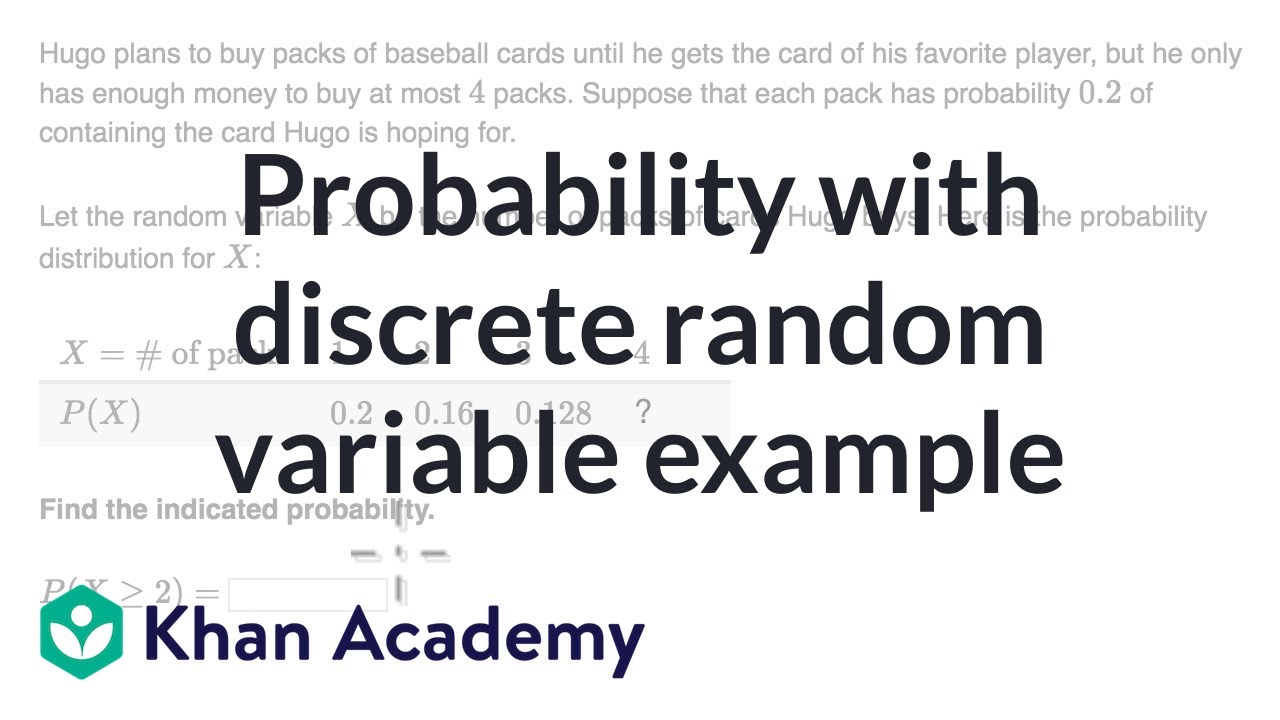
Example analyzing discrete probability distribution.
View more lessons or practice this subject at http://www.khanacademy.org/math/ap-statistics/random-variables-ap/discrete-random-variables/v/example-analyzing-discrete-probability-distribution?utm_source=youtube&utm_medium=desc&utm_campaign=apstatistics
AP Statistics on Khan Academy: Meet one...
perhaps this will be more relevant?
somber mango
pliant current
https://www.youtube.com/watch?v=d2STHFVHGAg
i just finished watching this and in my case i dont have P(X)

this is the confusing part for me
somber mango
pliant current
as much as i would like to help, not sure DMing me would be in your best interes...
ohhh I see np. I am new to statistics too.
pliant current
We define discrete random variables and their probability distribution functions, pdf, as well as distribution tables and bar charts. We illustrate how these work and how to use them with some examples and tutorials.
this should show you how to construct a table like khan's
somber mango
thank you
pliant current
yep
lone heartBOT
@somber mango Has your question been resolved?
somber mango
pliant current
https://www.radfordmathematics.com/probabilities-and-statistics/discrete-probabi...
hey so i watched it but in the question it did not give a PDF function.
pliant current
somber mango
hey so i watched it but in the question it did not give a PDF function.
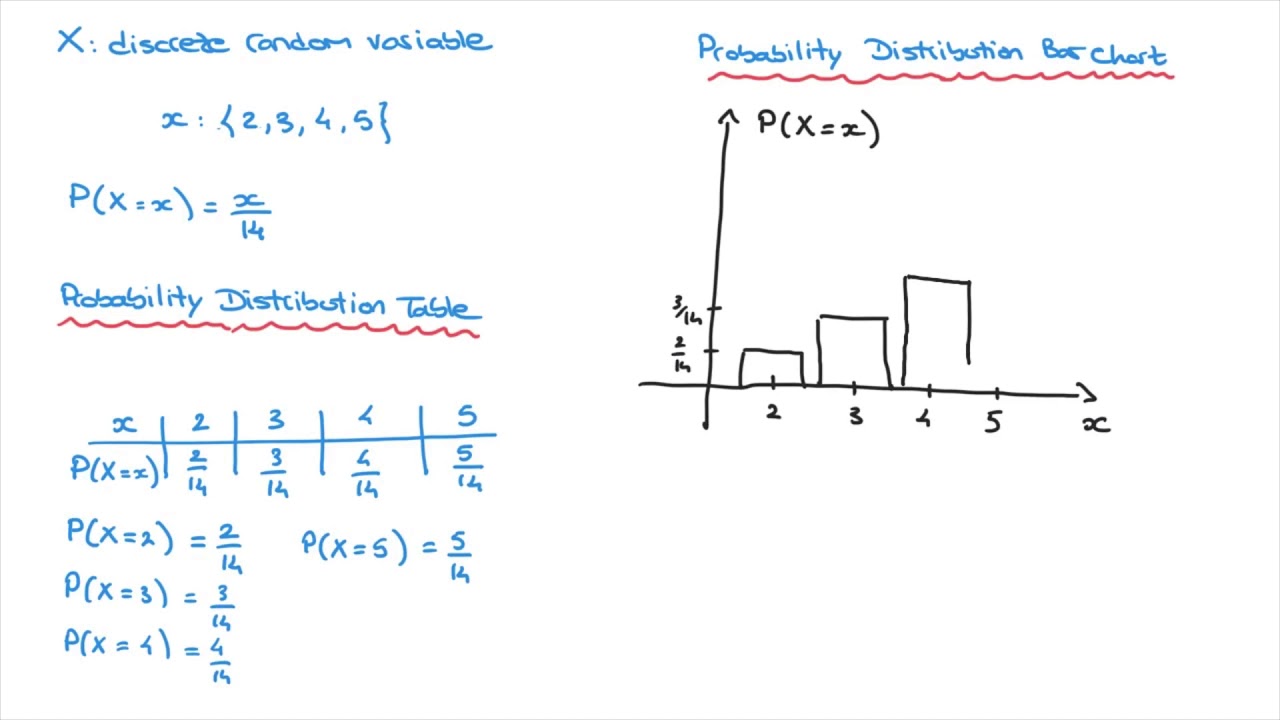
We learn how to construct probability distribution tables and probability distribution bar charts for discrete random variables. The method is explained in detailed and illustrated with some easy to follow examples. This is a must-know when studying discrete random variables and probability distributions.
there's two videos in that page
second one talks about constructing a distribution table
somber mango
got it, i will take a look at this
pliant current
sorry i didnt specify lol
somber mango
np
somber mango
pliant current
https://youtu.be/pC2p2yXxgYQ
the thing is that in this case the question is given the probability of X. If i had that i would have solved the question long time ago
pliant current
can you send the question you're working on so i have a better idea?
somber mango
this question is giving me headache
lone heartBOT
@somber mango Has your question been resolved?
lone heartBOT
Channel closed
Closed due to timeout
Use .reopen if this was a mistake.
Available help channel!
Send your question here to claim the channel.
Remember:
• Ask your math question in a clear, concise manner.
• Show your work, and if possible, explain where you are stuck.
• After 15 minutes, feel free to ping <@&286206848099549185>.
• Type the command .close to free the channel when you're done.
• Be polite and have a nice day!
Read #❓how-to-get-help for further information on how to ask a good question, and about conduct in the question channels.
 hollow cairn
Anyone know how to do this
 lone heartBOT
hollow cairn
Anyone know how to do this
lone heartBOT
hollow cairn
Anyone know how to do this
@hollow cairn Has your question been resolved?
hollow cairn
Nvm I got it ty anyways
 mortal hazel
how did you got it?
lone heartBOT
@hollow cairn Has your question been resolved?
 steady echo
@hollow cairn didn't you say you got it, if that's right, pls close this channel
lone heartBOT
@hollow cairn Has your question been resolved?
lone heartBOT
Channel closed
Closed by @hollow cairn
Use .reopen if this was a mistake.
lone heartBOT
Available help channel!
Send your question here to claim the channel.
Remember:
• Ask your math question in a clear, concise manner.
• Show your work, and if possible, explain where you are stuck.
• After 15 minutes, feel free to ping <@&286206848099549185>.
• Type the command .close to free the channel when you're done.
• Be polite and have a nice day!
Read #❓how-to-get-help for further information on how to ask a good question, and about conduct in the question channels.
 foggy acorn
if my bottom row of the matrix is [ 0 0 (2-a^2) | a-2], what values of a will provide no solution, infinitely many solution, and unique solution?
if this were a^2 - 2 i wouldnt be asking this question but this time it's 2-a^2
lone heartBOT
foggy acorn
if my bottom row of the matrix is [ 0 0 (2-a^2) | a-2], what values of *a* will ...
foggy acorn
i think for unique solution it would have to be a =/= +- sqrt(2) right?
but how about for inf many and no solution?
 oak perch
no solution: a=+/-sqrt(2)
The number of solutions depends on the coefficients of x and y…
foggy acorn
for inf many ill have to find a value for a that will make the value of (2-a^2) and a-2 then?
oak perch
No
 knotty spire
foggy acorn
for inf many ill have to find a value for a that will make the value of (2-a^2) ...
knotty spire
foggy acorn
for inf many ill have to find a value for a that will make the value of (2-a^2) ...
you only have infinite solutions if the last line becomes 0 = 0 in essence
oak perch
You only know that if a=+/-sqrt(2) then it has no solution
When a=/=+-sqrt(2), the situation depends on coefficients of x and y
foggy acorn
would a =/= +-sqrt(2) mean that 2-a^2 = 0 in which i can divide the 3rd row by 2-a^2?
so that 1 = a-2/2-a^2 which would be a unique solution assuming each row having a leading 1
oak perch
I told you it doesn’t only depend on z. You only know that if a=+/-sqrt(2), then no solution.
When a doesn’t equal +/-sqrt(2), the situation depends.
Let B=
(a_11 a_12 b_1-a_13(a-2)/(2-a^2)
a_21 a_22 b_2-a_23(a-2)/(2-a^2)
Let A=
(a_11 a_12
a_21 a_22)
If rank(A)=rank(B)=2, then unique solution, if rank(A)=rank(B)=1 or 0,then infinity many solutions, if rank(A)<rank(B),still no solution
foggy acorn
umm so for example a^2 - 2 = a - 2,
no solution if a = -2, inf many if a = 2, and unique solution if a =/= +-2 right?
knotty spire
foggy acorn
umm so for example a^2 - 2 = a - 2,
no solution if a = -2, inf many if a = 2, ...
oak perch
That’s basically what I told him
knotty spire
I know
oak perch
oak perch
When a doesn’t equal +/-sqrt(2), the situation depends.
Let B=
(a_11 a_12 b_1-a_...
Here
oak perch
Yeah wish he will
foggy acorn
knotty spire
https://en.wikipedia.org/wiki/Rouch%C3%A9%E2%80%93Capelli_theorem
we havent gone through this yet 
so far we've only had Gauss elimination and gauss-jordan
knotty spire
Then read this
They have examples of solving a system where there are no solutions or infinitely many. Notice what the last row becomes.
(and assuming that your problem was initially a square matrix of coefficients, which you haven't stated)
 zenith compass
foggy acorn
if my bottom row of the matrix is [ 0 0 (2-a^2) | a-2], what values of *a* will ...
zenith compass
foggy acorn
if my bottom row of the matrix is [ 0 0 (2-a^2) | a-2], what values of *a* will ...
Is that in RREF?
Umm at least REF i mean
foggy acorn
zenith compass
Umm at least REF i mean
the REF would be as follows:
1 2 1 | 2
0 -6 1 | -3
0 0 (2-a^2) | a - 2
zenith compass
Alright then it is nice
zenith compass
If the last row is something like 1=1, 2=2, you actually find out that the last row is just telling you useless information
oak perch
That’s what I was talking about, you can’t only observe the third row
zenith compass
But if the last row is talking about sth like 0=1, 3=4, you can see it is totally nonsense, which implies no matter what you put x,y,z to be, 0is never 1 and 3 is never 4
foggy acorn
can i ask about the similar example by teacher gave us that deals the same questions? the main difference is that instead of 2 - a^2 it's a^2 - 4
zenith compass
Umm idk my explanation is good. Probably not rigorous but hope you can understand
foggy acorn
just in case cus our teacher's solution for that went by pretty quickly
knotty spire
oak perch
That’s what I was talking about, you can’t only observe the third row
This might not be rigorous, but I think you can if you have the row echelon form, and the only "variable" row is the last one.
zenith compass
knotty spire
This might not be rigorous, but I think you can if you have the row echelon form...
But is he going to give a proof?
oak perch
That’s the case where rank(A)=rank(B)=0 like I said
foggy acorn
foggy acorn
just in case cus our teacher's solution for that went by pretty quickly
but we didnt get taught anything about the rouche capelli theorem yet
zenith compass
Forget that if you haven’t learn
Just rmb “no solutions” means something nonsense in the last row in this question
foggy acorn
our teacher's example was like this:
1 1 -1 | 2
0 1 2 | 1
0 0 a^2 - 4 | a -2
then she said that no solution if a = -2, inf many solution if a = 2, and unique solution is a =/= +-2
knotty spire
With no argumentation as to why?
foggy acorn
for the no sol. only wrote that 0 0 0 | 4 which isnt true
for inf many wrote that 0 0 0 | 0 if a = 2
zenith compass
Consider the square system of linear equations $Ax=b$ with $A=\begin{pmatrix}1&1&-1\0&1&2\0&0&a^2-4\end{pmatrix}, b=\begin{pmatrix}2\1\a-2\end{pmatrix}, x=\begin{pmatrix}x_1\x_2\x_3\end{pmatrix}$ where $a$ is an unspecified real parameter.
ocean sealBOT
Trenton
 zenith compass
Alright tell me, what happens when there is no solution
knotty spire
foggy acorn
for inf many wrote that 0 0 0 | 0 if a = 2
This is actually an application of the theorem, you just don't know it yet
but yeah, this works if you don't know the theorem
foggy acorn
zenith compass
Alright tell me, what happens when there is no solution
no solution of a = -2
zenith compass
foggy acorn
no solution of a = -2
Yes do you know why
foggy acorn
because if you let a = 2 then the bottom row would be 0 0 0 | 4 which is false
foggy acorn
inf many if a = 2 as it will make the bottom row 0 0 0 | 0
for unique solution she said that a would be =/= +- 2
in which the third row will be divided by a^2 - 4 because if a =/= +-2 then a^2 - 4 =/= 0
where the row changes to 0 0 1 | 1/(a+2)
zenith compass
foggy acorn
where the row changes to 0 0 1 | 1/(a+2)
Well this is only true when $a+2\not=0$.
But if $a+2=0$, this step is illegal which leads to no solutions.
Kinda different intuition yet still works.
ocean sealBOT
Trenton
 foggy acorn
does this imply that our teacher missed a step for finding values of a that provide unique solution?
knotty spire
No, but what she did do is leave out mentioning that the two upper rows have no bearing on the amount of solutions
In the more general cases, you can't assume that.
foggy acorn
so for my problem where
1 2 1 | 2
0 -6 1 | -3
0 0 (2-a^2) | a - 2
the two upper rows will have bearing then?
lone heartBOT
@foggy acorn Has your question been resolved?
lone heartBOT
Channel closed
Closed due to timeout
Use .reopen if this was a mistake.
Available help channel!
Send your question here to claim the channel.
Remember:
• Ask your math question in a clear, concise manner.
• Show your work, and if possible, explain where you are stuck.
• After 15 minutes, feel free to ping <@&286206848099549185>.
• Type the command .close to free the channel when you're done.
• Be polite and have a nice day!
Read #❓how-to-get-help for further information on how to ask a good question, and about conduct in the question channels.
 ocean sluice
can someone show me how is this
 lone heartBOT
ocean sluice
can someone show me how is this
lone heartBOT
ocean sluice
can someone show me how is this
 lone heartBOT
@ocean sluice Has your question been resolved?
 little drum
 floral pawn
$\left(\frac{1}{\frac{h}{x}}\right)\frac{1}{x}=\frac{1}{h}$
ocean sealBOT
R31_
 ocean sluice
.close
lone heartBOT
Channel closed
Closed by @ocean sluice
Use .reopen if this was a mistake.
Available help channel!
Send your question here to claim the channel.
Remember:
• Ask your math question in a clear, concise manner.
• Show your work, and if possible, explain where you are stuck.
• After 15 minutes, feel free to ping <@&286206848099549185>.
• Type the command .close to free the channel when you're done.
• Be polite and have a nice day!
Read #❓how-to-get-help for further information on how to ask a good question, and about conduct in the question channels.
 frail grove
How can we know that an angle is positive or negative if we can add and substract 2pi?
lone heartBOT
frail grove
How can we know that an angle is positive or negative if we can add and substra...
frail grove
Is it by finding the reference angle?
 glass gale
I don't think positive or negative angles are really a distinction since you can use an angle of 270 degrees instead of -90 degrees
and achieve the same rotation
it only matters if you're also counting full rotations
which for things like sin and cos you aren't, so there's no difference
frail grove
I needed it to find the phase shift between two phases
 vale sapphire
frail grove
How can we know that an angle is positive or negative if we can add and substra...
vale sapphire
frail grove
How can we know that an angle is positive or negative if we can add and substra...
You reduce it to be between -π and π
Actually no
If we're talking phase and you have something like -3π, the phase is negative that's that
glass gale
frail grove
I needed it to find the phase shift between two phases
I think there was a convention of sign depending on if the first wave is leading ahead of lagging behind the second, not entirely sure.
frail grove
vale sapphire
If we're talking phase and you have something like -3π, the phase is negative th...
Can't we add 2pi to - 3pi?
 vale sapphire
Actually, let me rethink this once more
frail grove
What about in this case
vale sapphire
what's u_c?
frail grove
Vectors
frail grove
It's the angle between uc and v
knotty spire
$\cos \phi = \frac{\vec{u_c}\cdot\vec{v}}{|\vec{u_c}||\vec{v}|} = \cos (\phi + 2\pi k)$, where $k \in \mathbb{Z}$
frail grove
I understand why φ is negative since it's in the inverse way of w what i didn't understand is that if we have the value of φ how can i know if its positive or negative
ocean sealBOT
Remavas
 glass gale
I am trying to find on the internet what the convention for voltage-current phase shift is I think everyone just says the degree and then which lags behind which
here voltage lags behind current
aka. current leads ahead of voltage
frail grove
Yeah it's related to forced lcr oscillations btw
glass gale
I think relying on words rather than a sign is the smart thing to do here since there's no convention
and if there was it would be a hard convention to remember
since it would be rather arbitrary
knotty spire
Yeah, the two most often used conventions I've seen is either using -pi, pi or using no negative angles at all (0, 2pi)
frail grove
So whenever i come across an angle i need to verify that it's between - pi, pi in order to find out its sign
knotty spire
if you are using that convention
lone heartBOT
Channel closed
Closed by @frail grove
Use .reopen if this was a mistake.
Available help channel!
Send your question here to claim the channel.
Remember:
• Ask your math question in a clear, concise manner.
• Show your work, and if possible, explain where you are stuck.
• After 15 minutes, feel free to ping <@&286206848099549185>.
• Type the command .close to free the channel when you're done.
• Be polite and have a nice day!
Read #❓how-to-get-help for further information on how to ask a good question, and about conduct in the question channels.
 leaden tiger
need help with trig
lone heartBOT
leaden tiger
need help with trig

 steady echo
Have u tried firstly simplyifying sin 2theta and cos 2theta?
leaden tiger
i used the double angle formula to get the numerator as 2cos theta - 4sintheta costheta
steady echo
Alright great! How about the cos 2theta?

 leaden tiger
steady echo
Sorry for the delay
leaden tiger
steady echo
Sorry for the delay
np
steady echo
Now you have to factor 2 cos from the numerator, and express the denominator in a diff way using (x-a)(x+a)
Ponder over this a little and see if you get itt
Hint: ||4 sin^2 (x) = (2 sin x)^2||
 steady echo
Yes!
leaden tiger
thankyou for the help!
steady echo
Nppp
leaden tiger
.close
lone heartBOT
Channel closed
Closed by @leaden tiger
Use .reopen if this was a mistake.
lone heartBOT
Available help channel!
Send your question here to claim the channel.
Remember:
• Ask your math question in a clear, concise manner.
• Show your work, and if possible, explain where you are stuck.
• After 15 minutes, feel free to ping <@&286206848099549185>.
• Type the command .close to free the channel when you're done.
• Be polite and have a nice day!
Read #❓how-to-get-help for further information on how to ask a good question, and about conduct in the question channels.
 languid furnace
Can somebody help me with this problem? (financial applications)
 lone heartBOT
languid furnace
Can somebody help me with this problem? (financial applications)
lone heartBOT
languid furnace
Can somebody help me with this problem? (financial applications)
@languid furnace Has your question been resolved?
languid furnace
Bruh
 silver adder
at is the number of days since the start
(a) wants you to plug in t=0 to the population equation
languid furnace
ah okk
silver adder
(b) wants you to plug in t=10, and equate P to 1606, and solve for k
languid furnace
i get the first two problems, but I'm not able to solve the problem for C
i set the equation as 1350 + 400e^-0.22314355t < 1500
but nSolve (t nspire calculator) isn't able to give me the answer
languid furnace
1606 = 1350 + 400e^2k
400e^2k = 256
e^2k = 16/25
==> ln 16/25 = 2k
k = ln 16/25 / 2
= -0.22314355
silver adder
,calc log(16/25)/2
ocean sealBOT
Result:
-0.22314355131421
lol
i mean yeah but its never going to reach it
the better answer is that there is no smallest population according to this equation
languid furnace
can you explain in a bit more detail please?
silver adder
the range of P is (1350,1750]
getting my shit mixed up a little
but yeah there is no minimum value
lone heartBOT
Channel closed
Closed by @languid furnace
Use .reopen if this was a mistake.
Available help channel!
Send your question here to claim the channel.
Remember:
• Ask your math question in a clear, concise manner.
• Show your work, and if possible, explain where you are stuck.
• After 15 minutes, feel free to ping <@&286206848099549185>.
• Type the command .close to free the channel when you're done.
• Be polite and have a nice day!
Read #❓how-to-get-help for further information on how to ask a good question, and about conduct in the question channels.
oak perch
$=\frac{4}{|x^2-2x|}$
ocean sealBOT
Cogwheels of the mind
 alpine sable
.
alpine sable
The greater that sign is looking weird in texit for some reason
ocean sealBOT
Cogwheels of the mind
 oak perch
By definition…
Any positive M there exists δ,any |x|<δ,f(x)>M
It’s a quadratic function
oak perch
What are you doing…
No…
You supposed to show that any positive M, there exists d such that $=\frac{4}{|x^2-2x|}>M$ when $|x|<d$
It’s two quadratic functions of x
ocean sealBOT
Cogwheels of the mind
 oak perch
WLOG you can assume that $M>4$, you can take $d=min(\sqrt{1+\frac{4}{M}}-1,1-\sqrt{1-\frac{4}{M}})$ for example
ocean sealBOT
Cogwheels of the mind
 lone heartBOT
@lime schooner Has your question been resolved?
Channel closed
Closed by @lime schooner
Use .reopen if this was a mistake.
Available help channel!
Send your question here to claim the channel.
Remember:
• Ask your math question in a clear, concise manner.
• Show your work, and if possible, explain where you are stuck.
• After 15 minutes, feel free to ping <@&286206848099549185>.
• Type the command .close to free the channel when you're done.
• Be polite and have a nice day!
Read #❓how-to-get-help for further information on how to ask a good question, and about conduct in the question channels.
 fossil mason
Could I get help for last q
lone heartBOT
fossil mason
Could I get help for last q
fossil mason
 oak perch
ii C(5,5)C(2,1)+C(5,4)C(2,2)
iii ΣC(3,x)C(5,y)C(2,z) where (x,y,z) are (1,4,1) (2,3,1) (3,2,1) (1,3,2) (2,2,2) (3,1,2)
lone heartBOT
Channel closed
Closed by @fossil mason
Use .reopen if this was a mistake.
Available help channel!
Send your question here to claim the channel.
Remember:
• Ask your math question in a clear, concise manner.
• Show your work, and if possible, explain where you are stuck.
• After 15 minutes, feel free to ping <@&286206848099549185>.
• Type the command .close to free the channel when you're done.
• Be polite and have a nice day!
Read #❓how-to-get-help for further information on how to ask a good question, and about conduct in the question channels.
 wise basin
 lone heartBOT
wise basin
wise basin
lone heartBOT
wise basin
wise basin
Fractions are the bane of my existence I have to make the bases equal to each other in order to solve for x
But
Yeah
lone heartBOT
@wise basin Has your question been resolved?
Channel closed
Closed by @wise basin
Use .reopen if this was a mistake.
lone heartBOT
Available help channel!
Send your question here to claim the channel.
Remember:
• Ask your math question in a clear, concise manner.
• Show your work, and if possible, explain where you are stuck.
• After 15 minutes, feel free to ping <@&286206848099549185>.
• Type the command .close to free the channel when you're done.
• Be polite and have a nice day!
Read #❓how-to-get-help for further information on how to ask a good question, and about conduct in the question channels.
 alpine zephyr
Factorise x^2+8x+4
lone heartBOT
alpine zephyr
Factorise x^2+8x+4
 abstract fractal
Yes it is
alpine zephyr
abstract fractal
Yes it is
can u pls tell how sud i split the mkiddle term?
abstract fractal
It's not factorable.
alpine zephyr
abstract fractal
It's not factorable.
ighjt
gray isle
its not factorable over the integers
you can do stuff like completing the square / apply quadratic formula to factorise over the irrationals
alpine zephyr
gray isle
you can do stuff like completing the square / apply quadratic formula to factori...
ohh ok
thnx
.close
lone heartBOT
Channel closed
Closed by @alpine zephyr
Use .reopen if this was a mistake.
Available help channel!
Send your question here to claim the channel.
Remember:
• Ask your math question in a clear, concise manner.
• Show your work, and if possible, explain where you are stuck.
• After 15 minutes, feel free to ping <@&286206848099549185>.
• Type the command .close to free the channel when you're done.
• Be polite and have a nice day!
Read #❓how-to-get-help for further information on how to ask a good question, and about conduct in the question channels.
 wet pulsar
Hi
lone heartBOT
wet pulsar
Hi
wet pulsar
So I’m just having an issue with understanding what an orthogonal function is

Subscribe To The Si Guy
https://www.youtube.com/channel/UCcTgnJE_RKa8-Qzx6lB78lg?sub_confirmation=1
References:
https://amzn.to/3AefoxU
https://amzn.to/3BPMw0a
facebook page https://www.facebook.com/thesiguyEN/
Be a SI guy and join our community of Electrical, Electronics and Communication engin...
I was watching this video
And at 2:07 I just completely stopped understanding what the person was saying
And now I’m trying to understand if a function by itself can be orthogonal, or if a function can be orthogonal only in relation to another function
oak perch
It means it’s a set of functions, any two of them are orthogonal
Two functions being orthogonal means their inner product is zero, where the inner product is defined by an integral
wet pulsar
Ah okay so it’s a set of all the orthogonal functions
How would you know if your set was complete though?
And basically the concept is, given a complete orthogonal set of functions, you can express any other function that isn’t in the set as a linear combination of the complete orthogonal sets elements??
oak perch
If it’s complete, then any periodic function with the same period should be able to be written as a linear combination of them (possibly infinitely many, in terms of convergence)
wet pulsar
Same period as what?
And so only periodic functions can be described as a linear combination
oak perch
I mean if Those functions are cos (2πnx/T), sin(2πnx/T) then all functions with period T. Also some conditions need to be satisfied, not just periodic. I don’t remember the detail, long time since I saw analysis
If it’s not periodic, then maybe we should consider Fourier transform not Fourier series
Anyway I don’t study analysis, stein wrote a great book about Fourier analysis , but I don’t read it, I only know it’s recommended by many.
lone heartBOT
Channel closed
Closed by @wet pulsar
Use .reopen if this was a mistake.
lone heartBOT
Available help channel!
Send your question here to claim the channel.
Remember:
• Ask your math question in a clear, concise manner.
• Show your work, and if possible, explain where you are stuck.
• After 15 minutes, feel free to ping <@&286206848099549185>.
• Type the command .close to free the channel when you're done.
• Be polite and have a nice day!
Read #❓how-to-get-help for further information on how to ask a good question, and about conduct in the question channels.
 snow flicker
 lone heartBOT
snow flicker
lone heartBOT
snow flicker
 tacit arch
Start with the limit definition of differentiable at a
lone heartBOT
@snow flicker Has your question been resolved?
Channel closed
Closed by @snow flicker
Use .reopen if this was a mistake.
Available help channel!
Send your question here to claim the channel.
Remember:
• Ask your math question in a clear, concise manner.
• Show your work, and if possible, explain where you are stuck.
• After 15 minutes, feel free to ping <@&286206848099549185>.
• Type the command .close to free the channel when you're done.
• Be polite and have a nice day!
Read #❓how-to-get-help for further information on how to ask a good question, and about conduct in the question channels.
Channel closed
Closed due to the original message being deleted
lone heartBOT
Available help channel!
Send your question here to claim the channel.
Remember:
• Ask your math question in a clear, concise manner.
• Show your work, and if possible, explain where you are stuck.
• After 15 minutes, feel free to ping <@&286206848099549185>.
• Type the command .close to free the channel when you're done.
• Be polite and have a nice day!
Read #❓how-to-get-help for further information on how to ask a good question, and about conduct in the question channels.
 supple tiger
heyy, I don't understand the underlined notation
also if y'all have any pointers for a), I'd be grateful
 lone heartBOT
supple tiger
heyy, I don't understand the underlined notation
also if y'all have any pointers...
supple tiger
supple tiger
heyy, I don't understand the underlined notation
also if y'all have any pointers...
lone heartBOT
supple tiger
heyy, I don't understand the underlined notation
also if y'all have any pointers...
supple tiger
supple tiger
heyy, I don't understand the underlined notation
also if y'all have any pointers...
meant to underline the left side of the equality in b)
lone heartBOT
@supple tiger Has your question been resolved?
lone heartBOT
@supple tiger Has your question been resolved?
 drifting hull
@supple tiger $\max_{i,j} |a_{i,j}|=\max \lbrace |a_{1,1}|, |a_{1,2}|, \dots |a_{2,1}|, |a_{2,2}|, |a_{2,3}, \dots |a_{n,n}| \rbace$, so the maximum of the absolute values of any entry of the matrix
ocean sealBOT
Alexander42
Compile Error! Click the  reaction for more information.
(You may edit your message to recompile.)
 supple tiger
I'm kinda confused, the subscript on the max means what tho?
i get max|a_i,j| would mean what you said, but is max_i,j|a_i,j| the same thing?
drifting hull
supple tiger
i get max|a_i,j| would mean what you said, but is max_i,j|a_i,j| the same thing?
the subscript just means that you maximize over all possible values of i and j, so yes, it means the same.
lone heartBOT
Channel closed
Closed due to timeout
Use .reopen if this was a mistake.
Available help channel!
Send your question here to claim the channel.
Remember:
• Ask your math question in a clear, concise manner.
• Show your work, and if possible, explain where you are stuck.
• After 15 minutes, feel free to ping <@&286206848099549185>.
• Type the command .close to free the channel when you're done.
• Be polite and have a nice day!
Read #❓how-to-get-help for further information on how to ask a good question, and about conduct in the question channels.
 leaden aspen
Does this seem like a kind of wild question for the second example of implicit differentiation from a book?
lone heartBOT
leaden aspen
Does this seem like a kind of wild question for the second example of implicit d...
leaden aspen
 lone heartBOT
@leaden aspen Has your question been resolved?
 tight locust
Personally I would find dx/dy
leaden aspen
I know it's kind of a theoretical thing
tight locust
Rotate the image by 90 degrees counterclockwise
Then the "rightmost point" just becomes a "minimum"
leaden aspen
Ahh that's super clever - nice
tight locust
Or I guess it would actually be a maximum
leaden aspen
Just getting introduced to implicit diff in calc 1 so I'm getting the basics of it
tight locust
Then set dx/dy = 0
leaden aspen
differentiating it isn't so tough it's kind of the 7 steps to get teh equation after
tight locust
Does what I'm saying make sense
leaden aspen
Yeah I think so - I'm not sure I've been introduced to that method of solving, is that from higher calculus?
tight locust
Sort of, but it doesn't require any actual math above calc 1
Just differentiate the eq with respect to y
And let x = x(y)
leaden aspen
Ok, does that skip right to the inverse if I'm understanding correctly?
tight locust
Yeah pretty much.
leaden aspen
Nice way to jump a step for sure thanks for pointing it out. I was originally just asking if it's a kind of crazy problem for the second example of Implicit differentiation i've ever seen
tight locust
Imo it sort of is
leaden aspen
true true I definitely like that way of solving, will bring it up with my teacher to see if she can walk if through next class
But yeah I'm kinda just looking at it like, might be good to build up to that level eventually haha. I appreciate the help thank you!
.close
lone heartBOT
Channel closed
Closed by @leaden aspen
Use .reopen if this was a mistake.
Available help channel!
Send your question here to claim the channel.
Remember:
• Ask your math question in a clear, concise manner.
• Show your work, and if possible, explain where you are stuck.
• After 15 minutes, feel free to ping <@&286206848099549185>.
• Type the command .close to free the channel when you're done.
• Be polite and have a nice day!
Read #❓how-to-get-help for further information on how to ask a good question, and about conduct in the question channels.
 fluid dawn
I am using 2 different algorithms to try and determine whether someone has diabetes. I have a dataset and margin that determines whether values are off is 0.4. i.e above 0.4 is positive and below 0.4 is negative. I want to show the deviation of the values that are on the wrong side of the margin and use that to compare which algorithm is better. What mathematical theory should I use for that eg. standard deviation or average error margin(by taking the average of the amount of error of each erroneous value) or something else.
lone heartBOT
fluid dawn
I am using 2 different algorithms to try and determine whether someone has diabe...
@fluid dawn Has your question been resolved?
lone heartBOT
@fluid dawn Has your question been resolved?
lone heartBOT
@fluid dawn Has your question been resolved?
lone heartBOT
Channel closed
Closed due to timeout
Use .reopen if this was a mistake.
Available help channel!
Send your question here to claim the channel.
Remember:
• Ask your math question in a clear, concise manner.
• Show your work, and if possible, explain where you are stuck.
• After 15 minutes, feel free to ping <@&286206848099549185>.
• Type the command .close to free the channel when you're done.
• Be polite and have a nice day!
Read #❓how-to-get-help for further information on how to ask a good question, and about conduct in the question channels.
 fading nest
guys
lone heartBOT
fading nest
guys
fading nest
didn't understand how t.o factorize $ax^2-4a+3(x^2+4x+4)$
ocean sealBOT
Xerral
 fading nest
 raven rover
That should be your first message
raven rover
That should be your first message
Oh sorry my bad
raven rover
np np
raven rover
ocean seal
**Xerral**
Where did this problem come from? I'd be surprised if that was just given as a problem and told to factor that
fading nest
well an exercise asked me to factorize this

 bleak ridge
Pane
raven rover
That's so weird - that's a strange question to ask
Don't think I've seen such a thing before
You can factor the (x^2 + 4x + 4)
fading nest
yeah
raven rover
What if you expanded everything
fading nest
for example?
raven rover
You expanded the rightmost term in the polynomial
lone heartBOT
@fading nest Has your question been resolved?
lone heartBOT
Channel closed
Closed due to timeout
Use .reopen if this was a mistake.
Available help channel!
Send your question here to claim the channel.
Remember:
• Ask your math question in a clear, concise manner.
• Show your work, and if possible, explain where you are stuck.
• After 15 minutes, feel free to ping <@&286206848099549185>.
• Type the command .close to free the channel when you're done.
• Be polite and have a nice day!
Read #❓how-to-get-help for further information on how to ask a good question, and about conduct in the question channels.
 flat blaze
 lone heartBOT
flat blaze
lone heartBOT
flat blaze
 neat bane
 flat blaze
6sqrt2
 fluid eagle
flat blaze
fluid eagle
flat blaze
hint: this is a right triangle
lone heartBOT
@flat blaze Has your question been resolved?
lone heartBOT
Channel closed
Closed due to timeout
Use .reopen if this was a mistake.
lone heartBOT
Available help channel!
Send your question here to claim the channel.
Remember:
• Ask your math question in a clear, concise manner.
• Show your work, and if possible, explain where you are stuck.
• After 15 minutes, feel free to ping <@&286206848099549185>.
• Type the command .close to free the channel when you're done.
• Be polite and have a nice day!
Read #❓how-to-get-help for further information on how to ask a good question, and about conduct in the question channels.
 rare salmon
Can Someone Help Me?
 lone heartBOT
Channel closed
Closed due to timeout
Use .reopen if this was a mistake.
Available help channel!
Send your question here to claim the channel.
Remember:
• Ask your math question in a clear, concise manner.
• Show your work, and if possible, explain where you are stuck.
• After 15 minutes, feel free to ping <@&286206848099549185>.
• Type the command .close to free the channel when you're done.
• Be polite and have a nice day!
Read #❓how-to-get-help for further information on how to ask a good question, and about conduct in the question channels.
 wicked orchid
Is this interval convergent or divergent and how do you justify it?

 pale kestrel
I would consider bounding it
 vague coral
^
 wicked orchid
-1 and 1 I think?
pale kestrel
You could.
But then the integral of f(x) = 1 (or g(x) = -1)
from 1 to infinity
is infinite - doesnt converge
This bound does not give you much info.
wicked orchid
My brain hurts man
vague coral
|cos²(x)|<=?
|1+x^4|<= ?
vague coral
pale kestrel
Just the numerator needs to be bounded
yea i know
vague coral
1+x^4 stays itself on (1,+oo)
pale kestrel
0 =< cos^2(x) =< 1
1 =< 1+x^4 < infty
So you should be able to bound that fraction
the denominator isnt of particular importance really...
its the numerator that you need to bound
$$0\leq\cos^2 x\leq1$$
$$0\leq\frac{\cos^2 x}{1+x^4}\leq\frac{1}{1+x^4}$$
ocean sealBOT
 pale kestrel
Think this is getting confusing unless you see ^
This was the process you needed to do to bound the integrand
You can divide by 1+x^4 because it is always positive
Now can you see the approach?
pale kestrel
Can you not see how this chosen bound helps???
I don't know what integrals you have seen --- surely you should know int 1/(1+x^4) looks like it should converge
unless you have just started
vague coral
I think he gets the bounding, but dont know why we should bound
wicked orchid
pale kestrel
I don't know what integrals you have seen --- surely you should know int 1/(1+x^...
I get that part I just don't get how this fits in the grand scheme
pale kestrel


The integral is the area underneath the blue curve
to the right of the purple line
Yes?
pale kestrel
?
vague coral
why 0 ?
pale kestrel
We just know it is the area under the blue curve.
We don't know anything about it - that's what the question is asking.
What we can do
Is show if there is a function (the red curve)
that bounds it
And we know the area under the red curve is finite
then we know the area under the blue curve is also finite.
(both functions are always positive --- so the lower bound for both areas is 0)
wicked orchid
Yeah...
pale kestrel

So we want the black area
We know the red area is greater than the black area
If we know the red area is finite
the black area must also be finite (ie. converges)
$$\int_1^{\infty} \frac{1}{x^n}\dd x$$
ocean sealBOT
 pale kestrel
Have you been show when this integral converges/diverges?
This is the usual goto when trying to bound integrals
wicked orchid
Mm mm
vague coral
a famous guy
pale kestrel
This is a theorem for you?
I'm just checking
If yes, then you can use this exact result to help
wicked orchid
Yeah it is
 pale kestrel
ocean seal
pale kestrel
ocean seal
There is something small you can do to get exactly this
1/x^n
1/(1+x^4) <-- take this.
wicked orchid
Wdym
vague coral
To prove that the integral is converging, you need the theorem that Shuri stated
with 1/x^n
pale kestrel
Look, if we try to use the squeeze/comparison test right now
we get this
$$0\leq\cos^2 x\leq1$$
$$0\leq\frac{\cos^2 x}{1+x^4}\leq\frac{1}{1+x^4}$$
$$\int_1^\infty 0 \dd x\leq\int_1^\infty\frac{\cos^2 x}{1+x^4}\dd x\leq\int_1^\infty\frac{1}{1+x^4} \dd x$$
ocean sealBOT
 pale kestrel
The left integral is ok. That's just 0
But the right integral is not in this exact form

And you can't quite use that theorem.
Rather, before that there is one step to do.
vague coral
a fraction is greater than an another if the denominator is less than the other denominator
don't know which grade it is
vague coral
thats the inverse
ocean sealBOT
 vague coral
yes
wicked orchid
b = 1 + x^4
a = x^4
?
wicked orchid
Left side is convergent, right side is convergent, middle is convergent as well then
Yeah?
vague coral
??
pale kestrel
wicked orchid
Left side is convergent, right side is convergent, middle is convergent as well ...
This alone doesn't sound quite right - I think you need to fully state what is given
in the comparison test

So yes basically what you said, but justify it with 'By the comparison test'
 wicked orchid
Uhh
pale kestrel
You don't just 'integrate both sides of the inequality' really
You are applying the direct comparison test
$$0\leq\cos^2 x\leq1$$
$$0\leq\frac{\cos^2 x}{1+x^4}\leq\frac{1}{1+x^4}\leq\frac{1}{x^4}$$
By the Direct Comparison test (perhaps state explicitly why the conditions needed for the test are satisfied),
$$0\leq\int_1^\infty\frac{\cos^2 x}{1+x^4}\dd x\leq\int_1^\infty\frac{1}{x^4} \dd x$$
wicked orchid
Thank you ❤️
ocean sealBOT
 wicked orchid
.close
lone heartBOT
Channel closed
Closed by @wicked orchid
Use .reopen if this was a mistake.
Available help channel!
Send your question here to claim the channel.
Remember:
• Ask your math question in a clear, concise manner.
• Show your work, and if possible, explain where you are stuck.
• After 15 minutes, feel free to ping <@&286206848099549185>.
• Type the command .close to free the channel when you're done.
• Be polite and have a nice day!
Read #❓how-to-get-help for further information on how to ask a good question, and about conduct in the question channels.
 honest umbra
determine equation of lines that are tangent to ellipse x^2+4y^2=16 and also pass through point (4, 6)
lone heartBOT
honest umbra
determine equation of lines that are tangent to ellipse x^2+4y^2=16 and also pas...
raven rover
honest umbra
determine equation of lines that are tangent to ellipse x^2+4y^2=16 and also pas...
I think there's only one such line.
You have a point, now you just need dy/dx at that point
honest umbra
there r 2 lines, one is x=4 and idk how to get the other one
raven rover
Oh - I didn't notice the vertical
raven rover
raven rover
I think there's only one such line.
You have a point, now you just need dy/dx ...
This - it'll help to draw a picture
lone heartBOT
@honest umbra Has your question been resolved?
lone heartBOT
@honest umbra Has your question been resolved?
lone heartBOT
Channel closed
Closed due to timeout
Use .reopen if this was a mistake.
honest umbra
.reopen
lone heartBOT
✅
 ripe rain
raven rover
I think there's only one such line.
You have a point, now you just need dy/dx ...
ripe rain
raven rover
I think there's only one such line.
You have a point, now you just need dy/dx ...
There must be 2 I believe
lone heartBOT
@honest umbra Has your question been resolved?
lone heartBOT
@honest umbra Has your question been resolved?
honest umbra
.close
lone heartBOT
Channel closed
Closed by @honest umbra
Use .reopen if this was a mistake.
Available help channel!
Send your question here to claim the channel.
Remember:
• Ask your math question in a clear, concise manner.
• Show your work, and if possible, explain where you are stuck.
• After 15 minutes, feel free to ping <@&286206848099549185>.
• Type the command .close to free the channel when you're done.
• Be polite and have a nice day!
Read #❓how-to-get-help for further information on how to ask a good question, and about conduct in the question channels.
fading nest
$x^7-x$
lone heartBOT
fading nest
$x^7-x$
ocean sealBOT
Xerral
 alpine sable
$x(x^6-1)$
ocean sealBOT
Jezier
 buoyant kayak
let u=x^2
 misty dagger
of course u can
fading nest
buoyant kayak
let u=x^2
hmmm wdym
misty dagger
What is x^2-1?
buoyant kayak
i mean rewrite x^6 using exponent rules and let u=x^2, as a sub variable
fading nest
buoyant kayak
i mean rewrite x^6 using exponent rules and let u=x^2, as a sub variable
like $x(x^2-1)(x^4-1)$
ocean sealBOT
Xerral
 buoyant kayak
no
buoyant kayak
$(x^a)^b=x^{a\cdot b}$
misty dagger
Since there x^6, What can you do to break down?
ocean sealBOT
a disappointing son
 fading nest
misty dagger
Since there x^6, What can you do to break down?
fading nest
misty dagger
Since there x^6, What can you do to break down?
lemme think
oak perch
Try factor x^3+1 and x^3-1
fading nest
misty dagger
Since there x^6, What can you do to break down?
$(x^2-1)(x^4+1)$
buoyant kayak
oak perch
Try factor x^3+1 and x^3-1
please don't give answers...
ocean sealBOT
Xerral
 misty dagger
oak perch
Try factor x^3+1 and x^3-1
misty dagger
oak perch
Try factor x^3+1 and x^3-1
?? why you give him answer?
buoyant kayak
oak perch
Oh
misty dagger
Loll
fading nest
misty dagger
?? why you give him answer?
i didnt even understand with the answer
lol
buoyant kayak
right, and 1 and 6 wouldn't be very useful in rewriting
fading nest
ok right
buoyant kayak
so try $(x^2)^3$ as $x^6$
ocean sealBOT
a disappointing son
 buoyant kayak
right
now it'd be easier to see if you made a sub
you can pick any variable you want (other than x), i chose u because it's normally a sub variable
let u = x^2
ocean sealBOT
Xerral
 fading nest
Idk
buoyant kayak
i'm not sure what you did there
fading nest
Oh
buoyant kayak
all i'm advising is to let u = x^2 to make a sub
alpine sable
If $u=x^2$ what's $x^6$ in terms of u?
ocean sealBOT
CatHashira
 alpine sable
Is that what ur asking
fading nest
x^4?
buoyant kayak
1.) in terms of u
2.) exponent is wrong
fading nest
Oh so x^3
alpine sable

fading nest
Cuz 2•3 is 6
buoyant kayak

alpine sable
alpine sable
Do you understand what "in terms of u" Means
buoyant kayak
there should be no x
buoyant kayak
in terms of u means the expression you are telling me should have u as its only variable
no other variables
just u
buoyant kayak
fading nest
x^3
you're very close with this... you're just not putting u lol
fading nest
(x^2)^3
buoyant kayak

fading nest
Lol
buoyant kayak
fading nest
(x^2)^3
with this, where you see an x^2, replace it with a u
that is what a substitution is
replacing something with something else
fading nest
u^3
ocean sealBOT
a disappointing son
 buoyant kayak
notice something special about the inside of the parenthesis?
buoyant kayak
yep
buoyant kayak
not quite, and remember we're in terms of u here
fading nest
Right
buoyant kayak
not sure where the 3x came from?
buoyant kayak
all those x's should be u's
fading nest
Yeah ok
ocean sealBOT
Xerral
 fading nest
Ok
buoyant kayak
so whenever you see a u, replace it with (x^2)