#help-0
1 messages · Page 960 of 1
 karmic dawn
and if you union that with Q you get a set containing Q and all the ordered pairs of Q
karmic dawn
My intuition says uncountable
 pale kestrel
Ok
Well in any case
You probably will approach by constructing a bijection with
a known countable or uncountable set
So if you think its bijective with R, for example, perhaps try thinking of one
If that doesnt work, you can try a bijection with Q or N
=====
For a bijection with R, I would try thinking about decimals
For a bijection with Q or N, I would think about a diagonal counting argument
I haven't much else advice
karmic dawn
Ill give that a go
 lone heartBOT
@karmic dawn Has your question been resolved?
Channel closed
Closed by @karmic dawn
Use .reopen if this was a mistake.
lone heartBOT
 Available help channel!
Send your question here to claim the channel.
Remember:
• Ask your math question in a clear, concise manner.
• Show your work, and if possible, explain where you are stuck.
• After 15 minutes, feel free to ping <@&286206848099549185>.
• Type the command .close to free the channel when you're done.
• Be polite and have a nice day!
Read #❓how-to-get-help for further information on how to ask a good question, and about conduct in the question channels.
 wise basin
 lone heartBOT
wise basin
lone heartBOT
wise basin
 versed cloud
Yh
 fluid eagle
yes, it should probably state
Given the function $f(x) = \frac12(x+3)^2-2$, sketch the graph of $y=\sqrt{f(x)}$.
 ocean sealBOT
Lance
 wise basin
should I just assume that's what my prof meant to put?
fluid eagle
yes
fluid eagle
there's no other possibility i see
lone heartBOT
Channel closed
Closed by @wise basin
Use .reopen if this was a mistake.
Available help channel!
Send your question here to claim the channel.
Remember:
• Ask your math question in a clear, concise manner.
• Show your work, and if possible, explain where you are stuck.
• After 15 minutes, feel free to ping <@&286206848099549185>.
• Type the command .close to free the channel when you're done.
• Be polite and have a nice day!
Read #❓how-to-get-help for further information on how to ask a good question, and about conduct in the question channels.
 gray isle
what have you tried
lone heartBOT
Channel closed
Closed by @gaunt panther
Use .reopen if this was a mistake.
Available help channel!
Send your question here to claim the channel.
Remember:
• Ask your math question in a clear, concise manner.
• Show your work, and if possible, explain where you are stuck.
• After 15 minutes, feel free to ping <@&286206848099549185>.
• Type the command .close to free the channel when you're done.
• Be polite and have a nice day!
Read #❓how-to-get-help for further information on how to ask a good question, and about conduct in the question channels.
 alpine sable
 lone heartBOT
alpine sable
alpine sable
lone heartBOT
alpine sable
alpine sable
<@&286206848099549185>
lone heartBOT
Please don't occupy multiple help channels.
fluid eagle
uwu rotate
ocean sealBOT
 fluid eagle
three distinct pairwise real roots?
alpine sable
Yes
fluid eagle
pairwise distinct?
alpine sable
It means that every solution is différent from the other
fluid eagle
alpine sable
Hint: the $x^2$ coefficient is $0$. What does this tell you about the roots of $P(x)$?
Lance
 alpine sable
0?
fluid eagle
also monic
fluid eagle
monic just means the x^3 coefficient is 1
alpine sable
Oh i see
fluid eagle
what has coefficient 1
alpine sable
P(x)
fluid eagle
?
a polynomial doesn't have a coefficient
If we have a generic non-zero polynomial \[ \sum_{k=0}^n a_k x^k = a_0 x^0 + a_1 x^1 + \cdots + a_n x^n \] then we say $a_k$ is the \emph{coefficient} of $x^k$.
I've Nevers studied this
ocean sealBOT
Lance

 fluid eagle
There is no good reason to fill of this in. Here are arguments why it is a bad idea.
\begin{enumerate}
\item You still have not used the fact that $x_1, x_2, x_3$ are distinct and real.
\item You want to look at $P(x_1) - P(x_2) = 0$, but it loses the essense of $P(x_1) = P(x_2) = 0$.
\item It doesn't really use the fact that the $x^2$ coefficient is $0$, and that $P$ is monic.
\end{enumerate}
Can you think of something else that resolves problems 1 and 3?
Lance
 alpine sable
No i've used it for the last part
fluid eagle
ok this might work, but you still need something else
You have that \[ x_1 + x_1 x_2 + x_2 + a = 0\] and want to prove that $a$ is negative. That is, you want to prove that \[ x_1 + x_1 x_2 + x_2 > 0. \] You have not used the fact that $x_1,x_2,x_3$ are (distinct) roots, only that $P(x_1) = P(x_2)$ which `just so happens' to be $0$. How to use it?
Lance
 alpine sable
Idk i swear
fluid eagle
try thinking back about what you have learned about roots of (monic) polynomials
lone heartBOT
@alpine sable Has your question been resolved?
lone heartBOT
Channel closed
Closed due to timeout
Use .reopen if this was a mistake.
Available help channel!
Send your question here to claim the channel.
Remember:
• Ask your math question in a clear, concise manner.
• Show your work, and if possible, explain where you are stuck.
• After 15 minutes, feel free to ping <@&286206848099549185>.
• Type the command .close to free the channel when you're done.
• Be polite and have a nice day!
Read #❓how-to-get-help for further information on how to ask a good question, and about conduct in the question channels.
alpine sable
0
lone heartBOT
alpine sable
0
alpine sable
0 as in looser
ok im terrible joke
so i have this question

i've been able to do everything except for this one
i just dont know how
its logarithms btw
 marsh rapids
isolate 10^x then take log10
alpine sable
oooooooooooooooooooooooooooooooooo
FACTORIZING
AIGHT
wait
give me a sec to try
wait
@marsh rapids
how would that go?
marsh rapids
10^x(1-0.2) = 40
 open folio
alpine sable
is that even possible
open folio
alpine sable
is that even possible
Distribute and find out
 little drum
$10^x(1 -0.2) = 40$
ocean sealBOT
 open folio
I was just doing these types of problems a few weeks ago
alpine sable
ah alright seems got at this point
i guess ill make 40 10^log 40 and then use some potens law to remove the 10 then yeah i have x-0.2x=log 40
hmm
maybe that didnt work
@marsh rapids
marsh rapids
once you have 0.8 * 10^x = 40, you divide by 0.8 then take the log
 lone heartBOT
@alpine sable Has your question been resolved?
lone heartBOT
Channel closed
Closed due to timeout
Use .reopen if this was a mistake.
Available help channel!
Send your question here to claim the channel.
Remember:
• Ask your math question in a clear, concise manner.
• Show your work, and if possible, explain where you are stuck.
• After 15 minutes, feel free to ping <@&286206848099549185>.
• Type the command .close to free the channel when you're done.
• Be polite and have a nice day!
Read #❓how-to-get-help for further information on how to ask a good question, and about conduct in the question channels.

 lone heartBOT
Channel closed
Closed due to the original message being deleted
Available help channel!
Send your question here to claim the channel.
Remember:
• Ask your math question in a clear, concise manner.
• Show your work, and if possible, explain where you are stuck.
• After 15 minutes, feel free to ping <@&286206848099549185>.
• Type the command .close to free the channel when you're done.
• Be polite and have a nice day!
Read #❓how-to-get-help for further information on how to ask a good question, and about conduct in the question channels.
 short cove
not related to math but.
i am torn between electrical engineering and actuarial science. basically, i realized that my biggest priority is to really understand the subject in depth, not just so that i can use it for application. i am concerned about needing a lot of money to do different engineering projects to show to my employer, i dont think money will be a big problem for actuarial science cuz i can estimate the cost. i think that electrical engineering is pretty specific, which allows me to understand the subject very deeply. on the other hand, actuarial science covers different fields if i am right, which requires me study broadly without much in depth opportunities, correct me if i am wrong. is there any suggestion?
lone heartBOT
short cove
not related to math but.
i am torn between electrical engineering and actuarial ...
 bleak ridge
I mean you get paid to do internships
You probably dont need to make stuff privately to get hired
Especially with how in demand ee is
short cove
bleak ridge
You probably dont need to make stuff privately to get hired
but to stand out tho
bleak ridge
I mean if you find the right area theyd be begging you to join
short cove
i coded 2 years ago, wouldnt say that i am very good, but not a newbie either imo. i found that i had very low confidence in my coding skill because even though i could code projects, i didnt understand the codes in depth
it's like i didnt understand how it really worked
on the other hand, i am very confident in math though i am only in pre u, thats cuz i dont just learn to answer questions, i understand how they work and make sense
and it made me realize my priority, which i mentioned above
short cove
bleak ridge
I mean if you find the right area theyd be begging you to join
but the right area still requires projects to stand out, right?
bleak ridge
If you were in the right area thered be no need to stand out
short cove
what do u mean by right area?
bleak ridge
Like any area with companies hiring
Car companies
Hvac companies
Most stuff you could think of
short cove
oh
bleak ridge
But yeah idk Im biased towards ee
Cause I find it interesting
ee is a great option in general and is super in demand
Its going nowhere but up
And you can get a job in almost every field
Wherever in the country
You dont have to go to the coast
Dont have to go to california
Dont have to go to texas
You can work on nano computer chips, power grids, construction equipment, chemical plants, cars, childrens toys, test equipment
Like you name it
lone heartBOT
Channel closed
Closed by @short cove
Use .reopen if this was a mistake.
bleak ridge
Np
But also keep in mind Im just a rando guy on discord
And theres many options
Even outside of college
lone heartBOT
Available help channel!
Send your question here to claim the channel.
Remember:
• Ask your math question in a clear, concise manner.
• Show your work, and if possible, explain where you are stuck.
• After 15 minutes, feel free to ping <@&286206848099549185>.
• Type the command .close to free the channel when you're done.
• Be polite and have a nice day!
Read #❓how-to-get-help for further information on how to ask a good question, and about conduct in the question channels.
short cove
bleak ridge
But also keep in mind Im just a rando guy on discord
i will
lone heartBOT
short cove
i will
short cove
.close
lone heartBOT
Channel closed
Closed by @short cove
Use .reopen if this was a mistake.
Available help channel!
Send your question here to claim the channel.
Remember:
• Ask your math question in a clear, concise manner.
• Show your work, and if possible, explain where you are stuck.
• After 15 minutes, feel free to ping <@&286206848099549185>.
• Type the command .close to free the channel when you're done.
• Be polite and have a nice day!
Read #❓how-to-get-help for further information on how to ask a good question, and about conduct in the question channels.
alpine sable
 lone heartBOT
alpine sable
alpine sable
lone heartBOT
alpine sable
alpine sable
$\int _{-2}^24-x^2::dx$
ocean sealBOT
Baylum
 alpine sable
this is the integral for volume i had setup for this problem.
my thought process was that the equation for said circle would be y = sqrt(4-x^2)
so square it because we're using the area of squares
and then you get the integral.
but when i solved it, i got 32/3, but the answer is 128/3
 near lagoon
The side of each a square is 2sqrt(4-x^2)
alpine sable
why 2?
i thought you took the equation of the circle and plugged it into the area of the shape you are using. so since its a square it would be (sqrt(4-x^2))^2
which is just 4-x^2
near lagoon
,w plot y=sqrt(4-x^2)
ocean sealBOT


 near lagoon
That's a semi-circle
alpine sable
oh
near lagoon
As y is equal to the square root of something, it is always positive
The other half of the circle is indeed given by y = -sqrt(4-x^2)
The full circle equation is x^2 + y^2 = 4, but it's an implicit equation, so your idea of using the explicit y = sqrt(4-x^2) was good
,w plot y = -sqrt(4-x^2)
ocean sealBOT
 near lagoon
,w plot x^2 + y^2 =4
ocean sealBOT
 alpine sable
so the area then equals (2(sqrt(4-x^2)))^2
near lagoon
Yes
alpine sable
and the 2 is what makes up for the other half being gone in the equation y = sqrt(4-x^2) ?
near lagoon
Yes, exactly, because the circle is symmetrical with respect to the x-axis
lone heartBOT
Channel closed
Closed by @crude ginkgo
Use .reopen if this was a mistake.
Available help channel!
Send your question here to claim the channel.
Remember:
• Ask your math question in a clear, concise manner.
• Show your work, and if possible, explain where you are stuck.
• After 15 minutes, feel free to ping <@&286206848099549185>.
• Type the command .close to free the channel when you're done.
• Be polite and have a nice day!
Read #❓how-to-get-help for further information on how to ask a good question, and about conduct in the question channels.
 summer berry
How do you draw the graph for y = f(-x)
lone heartBOT
summer berry
How do you draw the graph for y = f(-x)
summer berry
I cant seem to quite get it if you put a value in x shouldnt the output of y be the same so no matter what x value you choose the y=x?
 shell widget
Suppose you put positive values of x in f, then f(-x) means you're now putting negative values of x in f. Suppose you put negative values of x in f, then f(-x) means you're now putting positive values of x in f.
so the function gets reflected over the y-axis
summer berry
what youre saying is if i put negative values for ex x = -1 i will get y = 1? and if i put positive values ex x = 2 i will get y = -2?
shell widget
I can't say anything about y cause we don't know what y = f(x) is
shell widget
Yes it is but are you given f?
shell widget
Yes you would
But what y do we get?
We don't know
could be y=141419419841 for x=-1
summer berry
but wait
shell widget
could be y=sqrt(3) for x=-1
summer berry
the question was draw a graph for y = f(x)
does that mean it cant be drawn without a y?
shell widget
It can't be drawn without knowing what y or f(x) is, yes
lone heartBOT
@summer berry Has your question been resolved?
summer berry
shell widget
It can't be drawn without knowing what y or f(x) is, yes
can it be drawn if you know the domain?
shell widget
No but if you wanna know about the graph of y=f(-x), then whatever the graph of y=f(x) is, the graph of y=f(-x) is the same graph but reflected over the y-axis
not rly the same graph once its reflected
but i hope u understand what i mean
summer berry
Yeah graph is the same but coordinates are different
weird than that the question is to draw it if its undrawable
pale kestrel
??
You are given a graph of y = f(x) presumably
Using that, sketch y = f(-x)
Is that not the goal?
summer berry
There was no graph given
Wait there is my bad
I understand if it’s f(-x)
But what happens if it’s y=3f(x) given with the given graph if y=f(x)
pale kestrel
Same story
Plug in x values 1 by 1
To create your sketch
Why don't you play around in desmos instead of asking us
Better you find out for yourself
summer berry
Desmos?
 knotty spire
summer berry
knotty spire
summer berry
Will do thanks I try if things don’t work out I come back
Thanks again for the help
.close
lone heartBOT
Channel closed
Closed by @summer berry
Use .reopen if this was a mistake.
Available help channel!
Send your question here to claim the channel.
Remember:
• Ask your math question in a clear, concise manner.
• Show your work, and if possible, explain where you are stuck.
• After 15 minutes, feel free to ping <@&286206848099549185>.
• Type the command .close to free the channel when you're done.
• Be polite and have a nice day!
Read #❓how-to-get-help for further information on how to ask a good question, and about conduct in the question channels.
 gusty oyster
How can I find:
Z(a/2)=1.5
lone heartBOT
gusty oyster
How can I find:
Z(a/2)=1.5
gusty oyster
Pls help
 placid zinc
Find?
 tacit arch
wtf is Z
gusty oyster
z score
placid zinc
Oh. Compute the table backwards to get
a/2 = something
gusty oyster
placid zinc
Oh. Compute the table backwards to get
a/2 = *something*
Is this formula valid:
P(z<1.5)-P(z<-1.5)?
If I want to find a/2=1.5
placid zinc
a/2 = 1.5 implies a = 3
gusty oyster
I'm sorry I'm still confused
The context is that
I am trying to find confidence level
I had interval and all other information lime intervals
And I was left with
Z(a/2)=1.5
gusty oyster
gusty oyster
z_(a/2)
Two tailed distribution
tacit arch
show all your work for this problem up to this point including the question
gusty oyster
Ok one moment please
tacit arch
maybe you just need a z table
gusty oyster
I'm doing part c
tacit arch
look up P(Z < 2)
gusty oyster
0.9772
tacit arch
gusty oyster
How can I find:
Z(a/2)=1.5
Or is it 1.5
gusty oyster
No it is 2
gusty oyster
tacit arch
Or is it 1.5
That was me giving a random example
tacit arch
gusty oyster
0.9772
P(Z < 2) = 0.9772 sounds right
gusty oyster
That is not the right answer
tacit arch
Right, because the problem wants P(-2 < Z < 2), not just P(Z < 2)
between the samplemeans is between−10 and 10.
that's what that means
tacit arch
so use the formula P(Z < -2) = 1 - P(Z < 2)
gusty oyster
Also, om confused why didn't do:
-10= z(a/2) *5
Like how did they know -10 goes with minus z(a/2)*5
And positive with positive?
tacit arch
that's just convention
gusty oyster
tacit arch
so use the formula P(Z < -2) = 1 - P(Z < 2)
0.0228
And 0.9544 got it
ocean sealBOT
riemann
 tacit arch
so use the formula P(Z < -2) = 1 - P(Z < 2)
tacit arch
tacit arch
so use the formula P(Z < -2) = 1 - P(Z < 2)
this relation
ocean sealBOT
riemann
 lone heartBOT
Channel closed
Closed by @gusty oyster
Use .reopen if this was a mistake.
Available help channel!
Send your question here to claim the channel.
Remember:
• Ask your math question in a clear, concise manner.
• Show your work, and if possible, explain where you are stuck.
• After 15 minutes, feel free to ping <@&286206848099549185>.
• Type the command .close to free the channel when you're done.
• Be polite and have a nice day!
Read #❓how-to-get-help for further information on how to ask a good question, and about conduct in the question channels.
 barren glade
 lone heartBOT
barren glade
barren glade
lone heartBOT
barren glade
barren glade
stuck on c


this is not a quiz / test btw
it's from a book of past question papers i can show further proof
tacit arch
,rotate
ocean sealBOT
 barren glade
how that is the unit vector?
unit vector is equal to the actual vector divided by the modulus
and i did that
oh wait
i can simplify it a little
i + 2j / root 5
that's the simplest form i guess
@tacit arch ?
tacit arch
barren glade
Where is D in this picture
 tacit arch
I think you dot OD with the unit vector of AB and set the j component to zero
barren glade
tacit arch
I think you dot OD with the unit vector of AB and set the j component to zero
huh?
are u saying i did sth wrong?
@tacit arch
barren glade
lamda is what i have to find out the position vector of OD is lamda i
look at the question
barren glade
barren glade
^^
<@&286206848099549185>
god im gonna be stuck here forever aren't i
lone heartBOT
@barren glade Has your question been resolved?
tacit arch
tacit arch
where's your lambda?
Label your work
 tacit arch
I think you dot OD with the unit vector of AB and set the j component to zero
tacit arch
tacit arch
I think you dot OD with the unit vector of AB and set the j component to zero
Did you try this
Or you know BD is a scalar multiple of the unit vector you found
barren glade
i didn't even know what you meant there
could you pls elaborate
or is there a simpler way of doing this because this isn't even my syllabus as far as i remember lol
tacit arch
tacit arch
Or you know BD is a scalar multiple of the unit vector you found
what about this one
you know OD = OB + BD
barren glade
yeah?
tacit arch
barren glade
yeah?
add them
barren glade
ohh
lone heartBOT
Channel closed
Closed due to timeout
Use .reopen if this was a mistake.
Available help channel!
Send your question here to claim the channel.
Remember:
• Ask your math question in a clear, concise manner.
• Show your work, and if possible, explain where you are stuck.
• After 15 minutes, feel free to ping <@&286206848099549185>.
• Type the command .close to free the channel when you're done.
• Be polite and have a nice day!
Read #❓how-to-get-help for further information on how to ask a good question, and about conduct in the question channels.
barren glade
@tacit arch
lone heartBOT
barren glade
<@!261933205387477002>
barren glade
idk what bd is tho
tacit arch
tacit arch
Or you know BD is a scalar multiple of the unit vector you found
.
look at your picture
barren glade
tacit arch
.
what do u mean by scalar multiple?
tacit arch

In mathematics, scalar multiplication is one of the basic operations defining a vector space in linear algebra (or more generally, a module in abstract algebra). In common geometrical contexts, scalar multiplication of a real Euclidean vector by a positive real number multiplies the magnitude of the vector—without changing its direction. The ter...
lone heartBOT
@barren glade Has your question been resolved?
lone heartBOT
Channel closed
Closed due to timeout
Use .reopen if this was a mistake.
Available help channel!
Send your question here to claim the channel.
Remember:
• Ask your math question in a clear, concise manner.
• Show your work, and if possible, explain where you are stuck.
• After 15 minutes, feel free to ping <@&286206848099549185>.
• Type the command .close to free the channel when you're done.
• Be polite and have a nice day!
Read #❓how-to-get-help for further information on how to ask a good question, and about conduct in the question channels.
 cold mauve
hi! does anyone know why this is also reduced row echelon
 pale kestrel
Look up the definition
knotty spire
What does it mean for a matrix to be of a row-echelon form?
 tight locust
,w reduced row echelon form


 cold mauve
pale kestrel
Look up the definition
cold mauve
pale kestrel
Look up the definition
i did before but i'm still kind of confused because i thought it had to be just 1 in the main diagonal and everything else zero

but this has a 4 and a 1 not in the main diagonal
pale kestrel
no
knotty spire
hell no
knotty spire
cold mauve
hi! does anyone know why this is also reduced row echelon
Just as a note, the main diagonal of this matrix is (1,1,0)
tight locust
cold mauve
i did before but i'm still kind of confused because i thought it had to be just ...
Can we even rigorously define the "diagonal" of a non square matrix
knotty spire
Yes, all elements $a_{ii}$.
ocean sealBOT
Remavas
 tight locust
Maybe if you take half entries. Like going through the 2nd row and the 2.5th column
knotty spire
knotty spire
Yes, all elements $a_{ii}$.
within bounds
In linear algebra, the main diagonal (sometimes principal diagonal, primary diagonal, leading diagonal, major diagonal, or good diagonal) of a matrix
    A


{\displaystyle A}
is the list of entries
      A

        i
        ,
        j
...
cold mauve
it still seems like it wouldnt meet this definition because of the 4 and other 1 in column 2
 cold mauve
yes
knotty spire
Is the leading coefficient of each nonzero row a 1
knotty spire
Does each column containing a leading 1 have zeros in all other entries
knotty spire
👍
lone heartBOT
Channel closed
Closed by @cold mauve
Use .reopen if this was a mistake.
lone heartBOT
Available help channel!
Send your question here to claim the channel.
Remember:
• Ask your math question in a clear, concise manner.
• Show your work, and if possible, explain where you are stuck.
• After 15 minutes, feel free to ping <@&286206848099549185>.
• Type the command .close to free the channel when you're done.
• Be polite and have a nice day!
Read #❓how-to-get-help for further information on how to ask a good question, and about conduct in the question channels.
 misty mortar
For this part of the video, it saids
"we can read off that i-hat lands on the coordinates (1,-2).
and j-hat lands on the x-axis over at the coordinates (3, 0)."
How was this deduced?
I thought the coordinates of i were (-1,0) and the coordinates of j were (0,2)
lone heartBOT
misty mortar
For this part of the video, it saids
"we can read off that i-hat lands on the c...
misty mortar
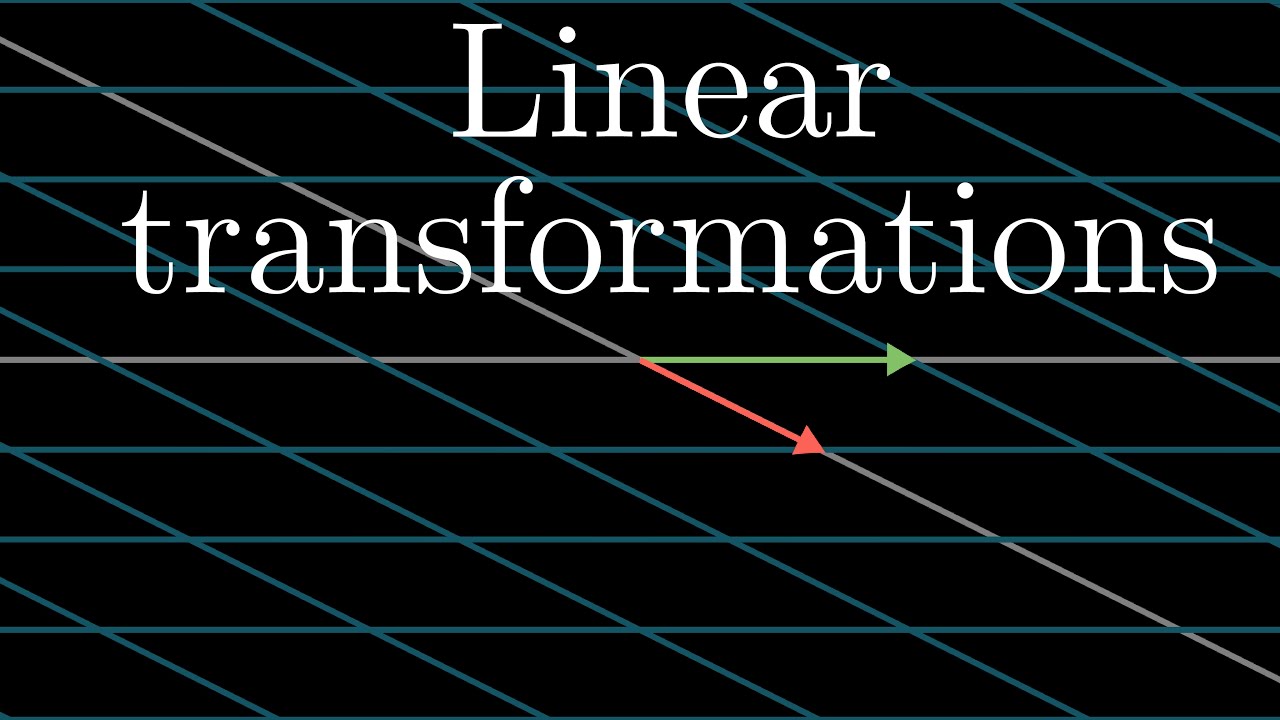
Quite possibly the most important idea for understanding linear algebra.
Help fund future projects: https://www.patreon.com/3blue1brown
An equally valuable form of support is to simply share some of the videos.
Home page: https://www.3blue1brown.com
Full series: http://3b1b.co/eola
Future series like this are funded by the community, through P...
 glass lichen
But yeah, the 1st column of the matrix is the transformed i vector
misty mortar
Around 4:44
glass lichen
2nd is transformed j
misty mortar
I thought the transformed coordinates were supposed to be (-1,0) for i and (0,2) for j
ocean sealBOT
Mosh
 glass lichen
Grant is transforming the vector [-1,2], which is trivially -i+2j
misty mortar
This is what I put
 glass lichen
,rotate
ocean sealBOT
 glass lichen
Ok, sure
misty mortar
I feel like I did something wrong though, because according to this picture transformed i is at (1,0) and transformed j is at (0,2)
glass lichen
what no
the intial vector [-1,2] is not the transformed vector
The goal of the video is to explain where [-1,2] maps to if i maps to [1,-2] and j maps to [3,0]
$T[[-1,2]^T]=T[-i+2j]=-T[i]+2T[j]=-[1,-2]+2[3,0]$
ocean sealBOT
Mosh
 glass lichen
for the linear transformation T
misty mortar
Is this right?
 glass lichen
,rotate
ocean sealBOT
 glass lichen
I mean, what is suppose to do?
misty mortar
I did this part "for the transformation shown here we can read off that i-hat lands on the coordinates (1,-2).
and j-hat lands on the x-axis over at the coordinates (3, 0)."
glass lichen
ok
misty mortar
is it correct?
glass lichen
sure
lone heartBOT
@misty mortar Has your question been resolved?
lone heartBOT
Channel closed
Closed due to timeout
Use .reopen if this was a mistake.
Available help channel!
Send your question here to claim the channel.
Remember:
• Ask your math question in a clear, concise manner.
• Show your work, and if possible, explain where you are stuck.
• After 15 minutes, feel free to ping <@&286206848099549185>.
• Type the command .close to free the channel when you're done.
• Be polite and have a nice day!
Read #❓how-to-get-help for further information on how to ask a good question, and about conduct in the question channels.
 polar cloud
 lone heartBOT
polar cloud
polar cloud
lone heartBOT
polar cloud
polar cloud
How do i do (d). I thought about inverse functions but i dont know how to do that for z= x+iy
 sudden hinge
Draw a sketch
polar cloud
 sudden hinge
so for z = x+ iy, the coordinates are given by (x, y). what happens to those when you reflect?
polar cloud
Ohhhhhhhh damnnnn yeah the coordinates swap
So to reflect it across y=x ,z = x +iy, you make it z= y +ix?
sudden hinge
yes
lone heartBOT
Channel closed
Closed by @polar cloud
Use .reopen if this was a mistake.
Available help channel!
Send your question here to claim the channel.
Remember:
• Ask your math question in a clear, concise manner.
• Show your work, and if possible, explain where you are stuck.
• After 15 minutes, feel free to ping <@&286206848099549185>.
• Type the command .close to free the channel when you're done.
• Be polite and have a nice day!
Read #❓how-to-get-help for further information on how to ask a good question, and about conduct in the question channels.
 arctic leaf
 lone heartBOT
arctic leaf
lone heartBOT
arctic leaf
 wary stream
Probably something to do with v1 was given
So you set that equation equal to vc or vb
arctic leaf
Elaborate pls c’:
wary stream
Was there a value given for v1?
 lone heartBOT
Channel closed
Closed by @arctic leaf
Use .reopen if this was a mistake.
Available help channel!
Send your question here to claim the channel.
Remember:
• Ask your math question in a clear, concise manner.
• Show your work, and if possible, explain where you are stuck.
• After 15 minutes, feel free to ping <@&286206848099549185>.
• Type the command .close to free the channel when you're done.
• Be polite and have a nice day!
Read #❓how-to-get-help for further information on how to ask a good question, and about conduct in the question channels.
alpine sable
How do I solve this?
 lone heartBOT
alpine sable
How do I solve this?
tight locust
lone heartBOT
alpine sable
How do I solve this?
tight locust
For which variable?
knotty spire
alpine sable
How do I solve this?
,rotate -90
ocean sealBOT

 sonic vigil
ac = 18, b = 7 is given? (Just checking I'm reading the question correctly)
 sonic vigil
Is that 6x^2 + 7x + 2
alpine sable
Yeah
sonic vigil
The answer should be:
(3x + 2) * (2x + 1)
alpine sable
Yeah but how do I do it with the formula
Well I used trial and error and got 1 and 3
But then it becomes 4=yb
And I don’t know if it is 4 and 1 or 2 and 2
Or -2 and -2 or -4 and -1
sonic vigil
Well it can't be negative due to the equation only having positive coefficients in the original question
alpine sable
Y is gamma and b is beta btw
alpine sable
sonic vigil
Well it can't be negative due to the equation only having positive coefficients ...
Yeah true
sonic vigil
alpine sable
And I don’t know if it is 4 and 1 or 2 and 2
Only way is trial and error I think
sonic vigil
Well let's say it's 4 and 1
=> (3x + 1)(4x + 1) or (3x+4)(x+1)
In either case, the coefficient of x^2 is not 6, which means it is wrong
lone heartBOT
Channel closed
Closed by @soft ether
Use .reopen if this was a mistake.
Available help channel!
Send your question here to claim the channel.
Remember:
• Ask your math question in a clear, concise manner.
• Show your work, and if possible, explain where you are stuck.
• After 15 minutes, feel free to ping <@&286206848099549185>.
• Type the command .close to free the channel when you're done.
• Be polite and have a nice day!
Read #❓how-to-get-help for further information on how to ask a good question, and about conduct in the question channels.
 cinder sundial
a
lone heartBOT
cinder sundial
a
cinder sundial
in triangle ABC, the angle C is a right angle, lineAB=41, lineAC=9
BUT there's a defect in the description

which of those two triangles was it talking about?
<@&286206848099549185>
sonic vigil
What does the question ask for
cinder sundial
it asks for sinA, cosA, tanA
sonic vigil
Well it doesn't matter, does it? In either case you have sinA = BC/AB, cosA = AC/AB, tanA = BC/AC
pale kestrel
one is a reflected version of the other
cinder sundial
u re right
yes
what am i thinking
the question is solved
thank you shuri and X13
.close
lone heartBOT
Channel closed
Closed by @cinder sundial
Use .reopen if this was a mistake.
Available help channel!
Send your question here to claim the channel.
Remember:
• Ask your math question in a clear, concise manner.
• Show your work, and if possible, explain where you are stuck.
• After 15 minutes, feel free to ping <@&286206848099549185>.
• Type the command .close to free the channel when you're done.
• Be polite and have a nice day!
Read #❓how-to-get-help for further information on how to ask a good question, and about conduct in the question channels.
 unkempt condor
hello
lone heartBOT
unkempt condor
***hello***
unkempt condor
Imagine a square with points a b c d
A B
C D
Im trying to check if the distance between point A-D is the same of A-C (or A-B...)
I have already tryied putting a circle inside of it
The diameter of it is the same of point A-B
I got to this
 lone heartBOT
@unkempt condor Has your question been resolved?
lone heartBOT
Channel closed
Closed by @unkempt condor
Use .reopen if this was a mistake.
Available help channel!
Send your question here to claim the channel.
Remember:
• Ask your math question in a clear, concise manner.
• Show your work, and if possible, explain where you are stuck.
• After 15 minutes, feel free to ping <@&286206848099549185>.
• Type the command .close to free the channel when you're done.
• Be polite and have a nice day!
Read #❓how-to-get-help for further information on how to ask a good question, and about conduct in the question channels.
 fossil grail
 lone heartBOT
fossil grail
fossil grail
sudden hinge
so the smallest is a = 1
lone heartBOT
fossil grail
fossil grail
sudden hinge
so the smallest is a = 1
Oh ok
Thanks, I was being a bit braindead lol
sudden hinge
np
fossil grail
.close
lone heartBOT
Channel closed
Closed by @fossil grail
Use .reopen if this was a mistake.
Available help channel!
Send your question here to claim the channel.
Remember:
• Ask your math question in a clear, concise manner.
• Show your work, and if possible, explain where you are stuck.
• After 15 minutes, feel free to ping <@&286206848099549185>.
• Type the command .close to free the channel when you're done.
• Be polite and have a nice day!
Read #❓how-to-get-help for further information on how to ask a good question, and about conduct in the question channels.
alpine sable
Hello can someone help me?
lone heartBOT
alpine sable
Hello can someone help me?
alpine sable
How can you prove that an operator is adjoint?
tacit arch

lone heartBOT
@alpine sable Has your question been resolved?
alpine sable
tacit arch
<:JustAsk:371662163489718273>
How can you prove that an operator is adjoint?
tacit arch
plug in the definition?
In mathematics, specifically in operator theory, each linear operator
    A


{\displaystyle A}
on a Euclidean vector space defines a Hermitian adjoint (or adjoint) operator
      A

        ∗


{\displaystyle A^{*}}
on that space...
 wicked arrow
lone heartBOT
wicked arrow
lone heartBOT
@alpine sable Has your question been resolved?
Channel closed
Closed by @sweet river
Use .reopen if this was a mistake.
Available help channel!
Send your question here to claim the channel.
Remember:
• Ask your math question in a clear, concise manner.
• Show your work, and if possible, explain where you are stuck.
• After 15 minutes, feel free to ping <@&286206848099549185>.
• Type the command .close to free the channel when you're done.
• Be polite and have a nice day!
Read #❓how-to-get-help for further information on how to ask a good question, and about conduct in the question channels.
 idle spindle

 lone heartBOT
idle spindle
lone heartBOT
lone heartBOT
idle spindle
lone heartBOT
@idle spindle Has your question been resolved?
Channel closed
Closed by @idle spindle
Use .reopen if this was a mistake.
idle spindle
.reopen
lone heartBOT
✅
idle spindle
<@&286206848099549185>
lone heartBOT
@idle spindle Has your question been resolved?
lone heartBOT
@idle spindle Has your question been resolved?
idle spindle
<@&286206848099549185>
lone heartBOT
@idle spindle Has your question been resolved?
idle spindle
.close
lone heartBOT
Channel closed
Closed by @idle spindle
Use .reopen if this was a mistake.
Available help channel!
Send your question here to claim the channel.
Remember:
• Ask your math question in a clear, concise manner.
• Show your work, and if possible, explain where you are stuck.
• After 15 minutes, feel free to ping <@&286206848099549185>.
• Type the command .close to free the channel when you're done.
• Be polite and have a nice day!
Read #❓how-to-get-help for further information on how to ask a good question, and about conduct in the question channels.
 cloud rain
Q. Prove the identity
tan^2x - sin^2x = tan^2x * sin^2x
 jovial breach
idle spindle
jovial breach
idle spindle
Seems right to me, assuming X denotes words present
cloud rain
I tried putting it in the a^2 - b^2 formula and got (tanx+sinx)(tanx-sinx)
 covert agate
$\tan^2x - \sin^2x = \tan^2x \sin^2x$
ocean sealBOT
Chromium
 covert agate
i suggest you start from the LHS
cloud rain
cloud rain
I tried putting it in the a^2 - b^2 formula and got (tanx+sinx)(tanx-sinx)
.
Yeah I took the lhs
cloud rain
jovial breach
Open tan²x
ok now?
 jovial breach
Now are you seeing anything common?
cloud rain
jovial breach
Now are you seeing anything common?
sin^2x
jovial breach
Exactly
cloud rain
oh so:
sin^2x (1-cos^2x)?
jovial breach
Ye
lone heartBOT
Channel closed
Closed by @cloud rain
Use .reopen if this was a mistake.
lone heartBOT
Available help channel!
Send your question here to claim the channel.
Remember:
• Ask your math question in a clear, concise manner.
• Show your work, and if possible, explain where you are stuck.
• After 15 minutes, feel free to ping <@&286206848099549185>.
• Type the command .close to free the channel when you're done.
• Be polite and have a nice day!
Read #❓how-to-get-help for further information on how to ask a good question, and about conduct in the question channels.
 undone agate

 lone heartBOT
undone agate
undone agate
lone heartBOT
undone agate
undone agate
So i eliminated the parameter and tested out some values
So it looks like the curve is moving in the red arrow direction
Does that mean i erase the left side of the graph since it is impossible to have negative time? Therefore impossible to have negative x values?
This is the teacher's key
 lone heartBOT
@undone agate Has your question been resolved?
undone agate
<@&286206848099549185>
Or is it like this?

So t is not necessarily time, and in the equations, t has no restriction on it
So technically t can be negative, and the orientation is going "right"
jovial breach
undone agate
So t is not necessarily time, and in the equations, t has no restriction on it
Yup t is a variable here
undone agate
jovial breach
Yup t is a variable here
Would my 2nd graph be correct with the orientation?
jovial breach
,w plot -16x^2
ocean sealBOT

 jovial breach
Roughly yeah
lone heartBOT
Channel closed
Closed by @undone agate
Use .reopen if this was a mistake.
Available help channel!
Send your question here to claim the channel.
Remember:
• Ask your math question in a clear, concise manner.
• Show your work, and if possible, explain where you are stuck.
• After 15 minutes, feel free to ping <@&286206848099549185>.
• Type the command .close to free the channel when you're done.
• Be polite and have a nice day!
Read #❓how-to-get-help for further information on how to ask a good question, and about conduct in the question channels.
 gaunt garden
I have no clue how to do it
 lone heartBOT
gaunt garden
I have no clue how to do it
gaunt garden
gaunt garden
I have no clue how to do it
lone heartBOT
gaunt garden
I have no clue how to do it
gaunt garden
gaunt garden
I have no clue how to do it
btw it has to be solved with only a simple calculator
 oak perch
False
 marsh sonnet
3^1+2 +3^1 + 3^1+3
= 27 + 3 + 81
= 111:19 is not divisible
oak perch
n=1 it can’t be divided by 19
marsh sonnet
n=2 also false
 frozen stump
oak perch
frozen stump
oak perch
Yeah anyway 3^k mod 19 is a period sequence 3,9,8,5,15,7,2,6,18,16,10,11,14,4,12,17,13,1… if you have the right question to ask them examing finite cases is enough
 rich moon
19 is prime
gaunt garden
rich moon
19 is prime
ah
but still
there could be numbers
actually
i tried
i think
it is possible
because
nvm its false
.close
lone heartBOT
Channel closed
Closed by @gaunt garden
Use .reopen if this was a mistake.
Available help channel!
Send your question here to claim the channel.
Remember:
• Ask your math question in a clear, concise manner.
• Show your work, and if possible, explain where you are stuck.
• After 15 minutes, feel free to ping <@&286206848099549185>.
• Type the command .close to free the channel when you're done.
• Be polite and have a nice day!
Read #❓how-to-get-help for further information on how to ask a good question, and about conduct in the question channels.
 lethal dock
$5:3=\frac{5}{8}, \frac{3}{8}$
lone heartBOT
lethal dock
$5:3=\frac{5}{8}, \frac{3}{8}$
ocean sealBOT
JUGisMUG

 vale wigeon
as written, this is nonsense
if a quantity is split in a 5 : 3 ratio then the two parts are respectively equal to 5/8 and 3/8 of the total
is this what you actually tried to communicate?
alpine sable
vale wigeon
```
if a quantity is split in a 5 : 3 ratio then the two parts are respectively ...
yeah cuz 5:3 is actually just 5/3
i think
lone heartBOT
@lethal dock Has your question been resolved?
lone heartBOT
Channel closed
Closed due to timeout
Use .reopen if this was a mistake.
Available help channel!
Send your question here to claim the channel.
Remember:
• Ask your math question in a clear, concise manner.
• Show your work, and if possible, explain where you are stuck.
• After 15 minutes, feel free to ping <@&286206848099549185>.
• Type the command .close to free the channel when you're done.
• Be polite and have a nice day!
Read #❓how-to-get-help for further information on how to ask a good question, and about conduct in the question channels.
alpine sable
 lone heartBOT
alpine sable
alpine sable
lone heartBOT
alpine sable
alpine sable
.close
lone heartBOT
Channel closed
Closed by @rotund night
Use .reopen if this was a mistake.
lone heartBOT
Available help channel!
Send your question here to claim the channel.
Remember:
• Ask your math question in a clear, concise manner.
• Show your work, and if possible, explain where you are stuck.
• After 15 minutes, feel free to ping <@&286206848099549185>.
• Type the command .close to free the channel when you're done.
• Be polite and have a nice day!
Read #❓how-to-get-help for further information on how to ask a good question, and about conduct in the question channels.
 rapid verge
 lone heartBOT
rapid verge
rapid verge
lone heartBOT
rapid verge
rapid verge
are these correct?
lone heartBOT
@rapid verge Has your question been resolved?
alpine sable
cant even zoom in
so i cant see them clearly
can u send them again once?
4 a is correct i think
4 c is correct
also, these help channels are here for if ur stuck with something. We r not here to check ur work
So ur "question" is not even valid
pls close the channel if u hv no further questions
with .close
lone heartBOT
@rapid verge Has your question been resolved?
Channel closed
Closed by @rapid verge
Use .reopen if this was a mistake.
Available help channel!
Send your question here to claim the channel.
Remember:
• Ask your math question in a clear, concise manner.
• Show your work, and if possible, explain where you are stuck.
• After 15 minutes, feel free to ping <@&286206848099549185>.
• Type the command .close to free the channel when you're done.
• Be polite and have a nice day!
Read #❓how-to-get-help for further information on how to ask a good question, and about conduct in the question channels.
 dull onyx
i have to find g(x), any hints 😭
 lone heartBOT
dull onyx
i have to find g(x), any hints 😭
dull onyx
lone heartBOT
dull onyx
i have to find g(x), any hints 😭
dull onyx
the function is a polynomial with a degree n>=1
vale wigeon
try first figuring out what deg(g) is
you have the differential equation right there
think about what happens to the degree of a polynomial when you take its derivative
dull onyx
its down by one
dull onyx
what happens
vale wigeon
...do you know how degree of polynomials behaves with multiplication
dull onyx
i just dont get what the point of this is
vale wigeon
i am trying to guide you into finding the degree of g using the equation (g')^2 = 4g+9
dull onyx
okay
vale wigeon
then once you find the degree you will be able to give names to the coefficients of g and then plug that into the equation again and equate coefficients
dull onyx
ok so deg(g) is n
vale wigeon
yes
dull onyx
and deg(g’) is n-1
vale wigeon
yes
dull onyx
now what
vale wigeon
what is deg( (g')^2 )?
dull onyx
2(n-1)
dull onyx
1
vale wigeon
no
dull onyx
o
vale wigeon
yes
so
the lhs has degree 2(n-1)
the rhs has degree n
so you have 2(n-1)=n
what is n?
dull onyx
2
vale wigeon
correct
so now that we know g is a quadratic polynomial
let g(x) = ax^2 + bx + c
and independently of that, observe that the limit they give you is actually g'(2) as you should be able to recognize
dull onyx
yes
vale wigeon
so we can rewrite the first equation as g'(2) = 3
okay, so now can you express g'(x) in terms of a, b and c?
dull onyx
g’(x)?
dull onyx
u mean i plug in ax^2… instead of g?
vale wigeon
yes...
vale wigeon
vale wigeon
let g(x) = ax^2 + bx + c
.
dull onyx
ok😭
vale wigeon
finding g has been reduced to finding a, b and c
...what
why are you crying now
what is going on
vale wigeon
😭 != 😂
vale wigeon
no...
dull onyx
.
vale wigeon
forget about the differential equation... just take the derivative first
dull onyx
ok
vale wigeon
what is the derivative of ax^2 + bx + c?
dull onyx
2ax+b
vale wigeon
yes
dull onyx
oh😭
vale wigeon
so you could have and should have just answered that
dull onyx
ok i get it now
vale wigeon
you do?
dull onyx
yea i see
vale wigeon
so you would like to continue on your own?
lone heartBOT
Channel closed
Closed by @dull onyx
Use .reopen if this was a mistake.
 twin pine
is this true for the inverse?:
$\frac{1}{f\left(x\right)}=f^{-1}\left(x\right)$
ocean sealBOT
andreask
 lone heartBOT
Available help channel!
lone heartBOT
Available help channel!
Send your question here to claim the channel.
Remember:
• Ask your math question in a clear, concise manner.
• Show your work, and if possible, explain where you are stuck.
• After 15 minutes, feel free to ping <@&286206848099549185>.
• Type the command .close to free the channel when you're done.
• Be polite and have a nice day!
Read #❓how-to-get-help for further information on how to ask a good question, and about conduct in the question channels.
lone heartBOT
little drum
screams in German
Did you wait 15 mins before pinging?
helper power abooz

summoning fellow helpers
vale wigeon
axis is along x-axis
you mean the axis of symmetry?
the axis of symmetry of the parabola?
vale wigeon
x^2 = 4ay will give you the wrong axis as the axis of symmetry
it'll give you the y axis
lone heartBOT
@alpine sable Has your question been resolved?
vale wigeon
x^2 = 4ay is a parabola that opens vertically
upward or downward depending on the sign of a
i didn't and it doesn't matter whether it faces left or right
vale wigeon
only if you somehow require a to be positive
lone heartBOT
@alpine sable Has your question been resolved?
vale wigeon
if you don't know whether to have the parabola face left or right, choose whichever direction you want - if you end up with a negative a, it's not the end of the world; the parabola just faces the other way
 tulip lance
Hey guys I got a simple question here.
On this example, a) and b) are mutually exclusive while c) is not mutually exclusive?

Ahh awesome thanks!
lone heartBOT
@alpine sable Has your question been resolved?
Channel closed
Closed by @hexed flume
Use .reopen if this was a mistake.
lone heartBOT
Available help channel!
Send your question here to claim the channel.
Remember:
• Ask your math question in a clear, concise manner.
• Show your work, and if possible, explain where you are stuck.
• After 15 minutes, feel free to ping <@&286206848099549185>.
• Type the command .close to free the channel when you're done.
• Be polite and have a nice day!
Read #❓how-to-get-help for further information on how to ask a good question, and about conduct in the question channels.
 signal vector
 lone heartBOT
signal vector
alpine sable
lone heartBOT
signal vector
alpine sable
i can't even understand anything
gray isle
$\lim_{x\to2}\frac{\sqrt{x-1}-\sqrt{3x-2}+1}{x-\sqrt{x-1}-1}$
ocean sealBOT
ℝamonov
 alpine sable
oh sorry i was solving something else
signal vector
no problem take your time sir
alpine sable
sir?
alpine sable
im seeing one sec
if we directly put in the value of 2
we will be dividing by 0
so we need to solve it in some other way
glass lichen
alpine sable
we will be dividing by 0
you get 0/0, which is indeterminate.
alpine sable
yeah
glass lichen
/0 could just be a VA
signal vector
yes
knotty spire
So the path is clear now. Either algebraic manipulation or l'hopital.
signal vector
can u explain ? 😄
knotty spire
Well, generally, if you have roots in the denominator, you can try and multiply the numerator and denonimator by the conjugate of the denominator
signal vector
i tried it and it didnt work
knotty spire
give me a moment
signal vector
ok
lone heartBOT
@signal vector Has your question been resolved?
signal vector
nope
knotty spire
Alrighty, I'll run sympy, just to verify mine
signal vector
ok
signal vector
what is hopitals rule
knotty spire
I guess not
signal vector
nope 😄
knotty spire
sad, because this would make this problem much easier. Haven't found a solution the "conventional" way yet
signal vector
send me the way u did it and i will see if i can understand it
knotty spire
If you don't know l'hopitals rule, you 1) won't understand and 2) you can't use that which you do not know
signal vector
So ? 😄
little drum
so
knotty spire
well after doing the conjugate I arrive at this mess

 lone heartBOT
Channel closed
Closed by @signal vector
Use .reopen if this was a mistake.
knotty spire
.reopen
lone heartBOT
✅
signal vector
re
little drum
🥺
signal vector
:d
knotty spire
little drum
1)
go ahead
little drum
👀
signal vector
nope but i was going to ask my teacher tomorrow
little drum
don't worry
signal vector
little drum
don't worry
uk
little drum
consider substituting $$x - 1 = t^2$$
ocean sealBOT
 signal vector
finally I'm from Morocco, I don't think it's the same technique that we normally do there's the conjugate or the factorization and a lot of techniques,
knotty spire
math is the same everywhere
signal vector
and infact, there is the root x-1 at the top at the bottom, which means that there is a means of factorization which can facilitate the limit for us
 knotty spire
the middle root can be tricky to express unless you're used to this
little drum
$\lim_{t \to 1} \frac{t + 1 - \sqrt{3t^2+1}}{\cancelto{1}{t} , , (t-1)} = 1 - \lim_{t \to 1}\frac{\sqrt{3t^2+1} - 2}{t-1}$
gray isle
since you had two radicals and a constant in the numerator, it would be a bit of a pain to rationalise that directly
ocean sealBOT
 signal vector
ohhh ok
ocean sealBOT
Remavas
 little drum
ocean seal
little drum
ocean seal
now I suppose you can compute this limit?
knotty spire
integral
little drum
,av 273164284446375937
 knotty spire
Now I need to remember myself to use substitutions sigh Got rusty on limits I'm afraid
covert agate
little drum
now I suppose you can compute this limit?
how would you do it
my method is a bit uh
unnecessary
signal vector
can i close the help channel ? :p
covert agate
yea sure
lone heartBOT
Channel closed
Closed by @signal vector
Use .reopen if this was a mistake.
Available help channel!
Send your question here to claim the channel.
Remember:
• Ask your math question in a clear, concise manner.
• Show your work, and if possible, explain where you are stuck.
• After 15 minutes, feel free to ping <@&286206848099549185>.
• Type the command .close to free the channel when you're done.
• Be polite and have a nice day!
Read #❓how-to-get-help for further information on how to ask a good question, and about conduct in the question channels.
 silk fulcrum
Hey I was wondering how to find x here anyone can clue me in a bit?
 silk fulcrum
Given :- AD = BC, Angle ADB = 20° , Angle ACB = 40°
 silk fulcrum
Ahh so we are taking the triangle to over there lemme try
 upper cloak
silk fulcrum
Hey I was wondering how to find x here anyone can clue me in a bit?
upper cloak
silk fulcrum
Hey I was wondering how to find x here anyone can clue me in a bit?
Make 2 equations and solve? I currently don't have notebooks. But here's what u should do
x + 40 + y = 180 ( y is currently angle BAC )
x + y = 140.
In the second triangle
140+20+ t = 180
t = 20 (t is angle CAD)
since AD = BD
y + 20 = x
x -y = 20
x + y = 140
2x = 160
x = 80
silk fulcrum
Ahh yes I was actually trying to solve it using two equations
But I messed up the names of the angles
My bad
upper cloak
No worries, remember algebra is better than geometry lol
silk fulcrum
Hell yes 😂
covert agate
upper cloak
Make 2 equations and solve? I currently don't have notebooks. But here's what u ...
AD = BD??
upper cloak
Oh wait is it equal to bC ONLY
covert agate
BC is a part of BD lol
upper cloak
Yea sorry i didn't see it
covert agate
are you suggesting BC = BD = 0? 
covert agate

next, note that these sides are equal
should be solvable after you do some basic constructions
silk fulcrum
So you drew a triangle with base BC and with an angle 20
But how did you make the sides equal
Is it a part of the drawing
covert agate
silk fulcrum
But how did you make the sides equal
isosceles triangle properties
silk fulcrum
covert agate
isosceles triangle properties
Ahh gotcha
upper cloak
silk fulcrum
Hey I was wondering how to find x here anyone can clue me in a bit?
If that's the case, i couldn't do it i am sorry. (I hate geometry)
covert agate
upper cloak
If that's the case, i couldn't do it i am sorry. (I hate geometry)
so do i
upper cloak
But yea @covert agate is giving a good solution i suppose
covert agate
(in most cases)
silk fulcrum
Okay so is it so that AD = BC = CE (E is the top of the triangle we drew)
silk fulcrum
upper cloak
If that's the case, i couldn't do it i am sorry. (I hate geometry)
Oh you bet I do in 99% of cases
covert agate
silk fulcrum
Okay so is it so that AD = BC = CE (E is the top of the triangle we drew)
eh no
silk fulcrum
Hmm
silk fulcrum
Kk
silk fulcrum
Ahh kk
I'm gonna be stuck a bit more I guess
So with that logic both angles (other than 20) of the drawn triangle is 80 each
Am I correct cause if i am we can construct two equations assuming Angle BAC as y and get the answer
Nvm
I may have gotten the best explanation
Ahh f it
I'm getting close but
Any Helper?
.close
lone heartBOT
Channel closed
Closed by @silk fulcrum
Use .reopen if this was a mistake.
silk fulcrum
.reopen
lone heartBOT
✅

 silk fulcrum
Yep it's 140
 pine kettle
ok sweet
silk fulcrum
And triangle ACD is isoceles