#help-0
1 messages · Page 935 of 1
 long iris
 faint thicket
sure
long iris
I said x first ill make it 100a nothing changes but easier is it a problem for you
faint thicket
nope
long iris
It said 60% the games you won . 60% of 100a is 60a
faint thicket
alright
long iris
You won 8 more games and played totally 10 more games
faint thicket
yeah
long iris
long iris
60a+8/100a+10=65/100
(60a+8)/(100a+10)=65/100
faint thicket
that makes so much sense
long iris
faint thicket
whys it 100a
Becouse at the beginning i said the amount of games your team played is 100a
Because*
faint thicket
long iris
Becouse at the beginning i said the amount of games your team played is 100a
oh yeah
long iris
You can give whatever you want
If you ask why we divide them it is because you played 10 games and you won 6
Can you show that with fraction
It is 6/10
faint thicket
yeah
faint thicket
yeah
long iris
long iris
(60a+8)/(100a+10)=65/100
Can you solve that or should i solve
long iris
You are welcome and dont forget you should find 100a after you find one a
faint thicket
aighhtt
 lone heartBOT
@faint thicket Has your question been resolved?
Channel closed
Closed by @faint thicket
Use .reopen if this was a mistake.
lone heartBOT
 Available help channel!
Send your question here to claim the channel.
Remember:
• Ask your math question in a clear, concise manner.
• Show your work, and if possible, explain where you are stuck.
• After 15 minutes, feel free to ping <@&286206848099549185>.
• Type the command .close to free the channel when you're done.
• Be polite and have a nice day!
Read #❓how-to-get-help for further information on how to ask a good question, and about conduct in the question channels.
 glass lichen
Tasked with proving equivalence classes of $\sim$ in S form a partition. Im at the last step of showing the union is S, however stuck on 1 detail:
Trying to show $a\in S\implies a\in E_i$ for some equivalence class $E_i$. If I assume there isn't an $E_i$ such that $a\in E_i$, does that then mean ${a}$ forms an equivalence class by itself?
lone heartBOT
glass lichen
Tasked with proving equivalence classes of $\sim$ in S form a partition. Im at t...
 ocean sealBOT
Mosh
 glass lichen
ie if $a\notin E_i\forall i$ then is ${a}$ is an equivalence class?
ocean sealBOT
Mosh

 wanton junco
if it didn't then wouldn't the union of all equivalence classes exclude a?
glass lichen
right but im proving $S\subseteq\bigcup_{i=1}^nE_i$
ocean sealBOT
Mosh

 glass lichen
so need to show a in E_i by virtue of a in S
But I think it does, cause $a\sim a$ by reflexivity, the singleton should form a new equivalence class, contradicting preassumption of n equivalence classes
ocean sealBOT
Mosh

 pale kestrel
Indeed, a ~ a by reflexivity. So it must be in some class
glass lichen
yeah
pale kestrel
I think there is notation to represent the class an element belongs to? something like [a] or (a).
You can say a \in [a] by reflexivity, hence there exists some i for which a in E_i
 ocean sealBOT
Mosh
 glass lichen
.close
lone heartBOT
Channel closed
Closed by @glass lichen
Use .reopen if this was a mistake.
Available help channel!
Send your question here to claim the channel.
Remember:
• Ask your math question in a clear, concise manner.
• Show your work, and if possible, explain where you are stuck.
• After 15 minutes, feel free to ping <@&286206848099549185>.
• Type the command .close to free the channel when you're done.
• Be polite and have a nice day!
Read #❓how-to-get-help for further information on how to ask a good question, and about conduct in the question channels.
 meager fiber
Can somebody help me with this ODE
 lone heartBOT
meager fiber
Can somebody help me with this ODE
meager fiber
lone heartBOT
meager fiber
Can somebody help me with this ODE
meager fiber
I need to find the general solution. I know there has to be a complementary part you get from the roots of the auxiliary equation. And I know there is a particular component
so the General Solution Ug = Uc + Up
I rewrote the question as: (U'' + U' - 2)U = 2t
So the auxiliary equation can be written as U^2 + U -2
and my roots were 1 and -2
so Uc = C1*et +C2e-2t
But I am confused on how to do the particular part
How can I solve for Up?
 supple tundra
Particular solution try $\alpha t^2+\beta t + \gamma$
ocean sealBOT
azeem321
 meager fiber
someone told me I can use something called a particular integral
do you know what this is?
meager fiber
supple tundra
Particular solution try $\alpha t^2+\beta t + \gamma$
also im really new to this, can you help me understand what to do with this eqn
glass lichen
You find the homogeneous solutions (L[u]=0)
then guess at a function based on the forcing function
meager fiber
idk what L[u] means, or the forcing function
meager fiber
meager fiber
and my roots were 1 and -2
so Uc = C1*et +C2e-2t
I thought I already found the homogenous solutions
supple tundra
Find a YouTube video explaining this or find a textbook
meager fiber
Whats the point of the help channel if not something like this lol
I tried watching a video on particular integrals but i dont understand
supple tundra
The ODE you've presented is a very simple case. If you can't solve that means you haven't learned the topic properly. Find some videos which go through this. It's gonna be hard to explain to you what to do otherwise
meager fiber
ok
supple tundra
It's like trying to explain to someone how to count when they don't even know what numbers are yet
it wont make sense
until you learn about this shiz
lone heartBOT
@meager fiber Has your question been resolved?
lone heartBOT
Channel closed
Closed due to timeout
Use .reopen if this was a mistake.
Available help channel!
Send your question here to claim the channel.
Remember:
• Ask your math question in a clear, concise manner.
• Show your work, and if possible, explain where you are stuck.
• After 15 minutes, feel free to ping <@&286206848099549185>.
• Type the command .close to free the channel when you're done.
• Be polite and have a nice day!
Read #❓how-to-get-help for further information on how to ask a good question, and about conduct in the question channels.
 silent tiger
Hi!
So i have this problem, where i have a wheel on a 1m surface area.
So the wheel height is 1m, so diameter of circle d=1m, the r=0.5
I also know that the wheel should spin 110 degree.
So if i double diameter of the wheel to 2m, the r=1m, the wheel should only spin half as much, so 110/2=55 degree.
lone heartBOT
silent tiger
Hi!
So i have this problem, where i have a wheel on a 1m surface area.
So the wh...
silent tiger
If i half the diameter than it should spin twice as much, 220 degree
How can i calculate for this wheel any other diameters? For example if i want the wheel to be, 2.45 times bigger? Or any other number
 bleak ridge
So youre trying to see how many degrees the wheel has to spin to travel 1 meter?
For a certain diameter
silent tiger
Yes
bleak ridge
How far a wheel goes when it spins is basically just arclength
The arclength of a circle is angle * radius
Angle in radians specifically
So if distance = angle * radius then angle = distance/radius
If you want to mess with it in degrees and diameter you can do some more conversion
Starting with
$angle = \frac{distance}{radius}$
ocean sealBOT
PapaBread
 bleak ridge
$angle = \frac{2 \cdot distance}{diameter}$
ocean sealBOT
PapaBread
 bleak ridge
This would be the way to do it with diameter
The reason the 2 is on the top is because you need to divide diameter by 2 to get radius
And dividing by a fraction is the same as multiplying by the reciprocal
silent tiger
yea, that is clear
bleak ridge
Then you need to convert the angle to degrees
degrees = 180 * radians/pi basically
So you can just substitute that in
silent tiger
yeah i must work in degrees for sure
bleak ridge
$degrees = \frac{360 \cdot distance}{\pi \cdot diameter}$
ocean sealBOT
PapaBread
 bleak ridge
I think that should work
silent tiger
okay
sounds great
i'm working in a 3D program, for animation and i can't get the wheels to stick, when i use different sizes
the distance is always 1m, as it's just extends it after the 1st meter
This formulas will help a lot
thank you kind sir!
bleak ridge
Np
silent tiger
.close
lone heartBOT
Channel closed
Closed by @silent tiger
Use .reopen if this was a mistake.
Available help channel!
Send your question here to claim the channel.
Remember:
• Ask your math question in a clear, concise manner.
• Show your work, and if possible, explain where you are stuck.
• After 15 minutes, feel free to ping <@&286206848099549185>.
• Type the command .close to free the channel when you're done.
• Be polite and have a nice day!
Read #❓how-to-get-help for further information on how to ask a good question, and about conduct in the question channels.
pale kestrel
 lone heartBOT
pale kestrel
https://images-ext-1.discordapp.net/external/zUcYvoGkbTi-Vbc4vy0tYEmU6u80EPpuo8m...
pale kestrel
lone heartBOT
pale kestrel
https://images-ext-1.discordapp.net/external/zUcYvoGkbTi-Vbc4vy0tYEmU6u80EPpuo8m...
pale kestrel
Find c
According to this answer, this question is doable by pure algebra
After you obtain the relations
=================
a + b = 12.5pi
b + c + e = 12.5pi
a + b + c + d = 25pi
a + b + c + d + e + f = 100
=================
I feel convinced this is impossible
Surely they must have a mistake?
bleak ridge
Isnt this from that one youtube video
pale kestrel
There is just no way to isolate c from this alone
no idea, saw someone ask it today
glass lichen
Just run through the solution you linked
pale kestrel
I'm finding it very hard to go thru it but will try
Different labelling annoying af
I mean - just looking at this alone I feel it's impossible to eliminate
🤔
glass lichen
Throw it into an RREF calculator and see what happens
They're all linear equations
(1 | 0 | 0 | 0 | 1 | 1 | -25/2 (π - 8)
0 | 1 | 0 | 0 | -1 | -1 | 25 (π - 4)
0 | 0 | 1 | 0 | 0 | 1 | (25 π)/2
0 | 0 | 0 | 1 | 1 | 0 | -25 (π - 4))
pale kestrel
thanks good suggestion
damn that means c isn't free?
😂
been too long since I done systems with matrices
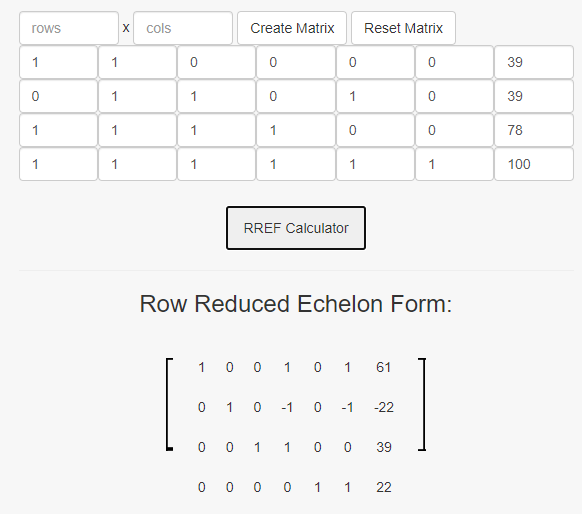
No no, surely that means c aint fixed.
(used estimations of pi)
yh guess must be a mistake.
.close
lone heartBOT
Channel closed
Closed by @pale kestrel
Use .reopen if this was a mistake.
Available help channel!
Send your question here to claim the channel.
Remember:
• Ask your math question in a clear, concise manner.
• Show your work, and if possible, explain where you are stuck.
• After 15 minutes, feel free to ping <@&286206848099549185>.
• Type the command .close to free the channel when you're done.
• Be polite and have a nice day!
Read #❓how-to-get-help for further information on how to ask a good question, and about conduct in the question channels.
 fiery flame
You can set up a system of two equations given the two pieces of information
The first thing you can do is defining the two numbers as variables
Such as x and y
And try to translate the given info in terms of x and y
Well 3:4 is the ratio not the exact values of the two numbers
pale kestrel
I have a lot of sweets. I split them evenly into 7 jars; 3 jars are red 🔴, 4 jars are blue 🔵.
There are 17 more sweets in the blue jars combined than the red jars combined.
How many sweets are in the red jars combined? How many are in the blue jars combined?
pale kestrel
fiery flame
You can set up a system of two equations given the two pieces of information
.
lone heartBOT
@past schooner Has your question been resolved?
pale kestrel
If you don't know something. you should call it something like x
To help form equations.
That is true.
When you're forming equations it is helpful to be more concise
b = r + 17 for example
Now, there is something else that is useful. You know something about the ratio between b and r
From the first line.
"I have a lot of sweets. I split them evenly into 7 jars; 3 jars are red 🔴, 4 jars are blue 🔵"
related in some way, I agree...
hmmm
How about this
call one jar j
You split the sweets evenly
So a single jar always has j sweets.
so how is j related with b and r?
no no.
So to be clear
j is the total number of sweets in the 3 red jars
b is the total number of sweets in the 4 blue jars
lone heartBOT
@past schooner Has your question been resolved?
lone heartBOT
@past schooner Has your question been resolved?
Channel closed
Closed due to the original message being deleted
lone heartBOT
Available help channel!
Send your question here to claim the channel.
Remember:
• Ask your math question in a clear, concise manner.
• Show your work, and if possible, explain where you are stuck.
• After 15 minutes, feel free to ping <@&286206848099549185>.
• Type the command .close to free the channel when you're done.
• Be polite and have a nice day!
Read #❓how-to-get-help for further information on how to ask a good question, and about conduct in the question channels.
 alpine sable
Hey!
lone heartBOT
alpine sable
Hey!
alpine sable
It would be nice If you could help me with this question.
Manny borrowed ₹9000 from her neighbour. Out of which ₹3000 were borrowed at 12% and the remaining at 15% rate of interest per annum. What is the total interest after 3 years?
I actually did it like 3000×12×3/100
I've already learned about this last year but can't remember the steps.
Then I multiplied the rest like 6000×15×3
<@&286206848099549185>
Sorry for the ping
But it's been 15 mins
 proven rune
alpine sable
proven rune
alpine sable
Thanks for the help
lone heartBOT
@alpine sable Has your question been resolved?
Channel closed
Closed by @wise sorrel
Use .reopen if this was a mistake.
lone heartBOT
Available help channel!
Send your question here to claim the channel.
Remember:
• Ask your math question in a clear, concise manner.
• Show your work, and if possible, explain where you are stuck.
• After 15 minutes, feel free to ping <@&286206848099549185>.
• Type the command .close to free the channel when you're done.
• Be polite and have a nice day!
Read #❓how-to-get-help for further information on how to ask a good question, and about conduct in the question channels.
 tranquil kestrel
 lone heartBOT
tranquil kestrel
tranquil kestrel
lone heartBOT
tranquil kestrel
tranquil kestrel
may i know if my solution is right?

 little drum
,calc 3^7
ocean sealBOT
Result:
2187
,calc 7!
ocean sealBOT
Result:
5040
 hasty elk
line 4 is badly phrased
hasty elk
line 4 is badly phrased
how should it be phrased then?
hasty elk
assume claim (k) is true for k\geq 7
what is claim (k)?
for all k\geq 7? are you sure
hasty elk
in mathematics, there is a very big difference between saying "for all x" and "for some x" - by default if you write "for <condition>", it means "for all satisfying <condition>"
for all x, means it applies for all x
for some x, means that there's some specific x it applies for
how does induction work in general?
little drum
Take this as a reference.

A question Camilleone: after we have defined our inductive hypothesis, is it okay to start with the inductive step and show that it holds when our inductive hypothesis is true.. or is it compulsory to build up from the inductive hypothesis to the inductive step?
tranquil kestrel
hasty elk
in mathematics, there is a very big difference between saying "for all x" and "f...
but i did not say for all k in line 4 right? i just write k>= 7
little drum
or is the latter just the convention?
hasty elk
little drum
A question Camilleone: after we have defined our inductive hypothesis, is it oka...
depends on the level
in high school and in foundations you want to see the hypothesis
anything above that we can jump straight into the meat
because it's understood that you're doing induction
hasty elk
tranquil kestrel
but i did not say for all k in line 4 right? i just write k>= 7
which as any mathematician will tell you, generally reads as "for all k\geq 7"
little drum
Thought so.. It's the same as how it's a usual practice to assume LHS = RHS in some proofs and manipulate both sides till you're left with some obvious result, which in higher levels is not desired.
tranquil kestrel
hasty elk
which as any mathematician will tell you, generally reads as "for all k\geq 7"
so i have to add it to become for some k ?
little drum
When you say $k\geq 7$ it also includes numbers like $k = 7.5$ say, does your induction work on these numbers too?
ocean sealBOT
Ansh
 little drum
Take this as a reference.
little drum
little drum
Take this as a reference.
reread the reference and check how they chose to define the variables they introduced such that every line of the proof is pretty well defined.
tranquil kestrel
I THINK I got it
i just need to write for all integers k>= 7
that will solve the problem right?
lone heartBOT
@tranquil kestrel Has your question been resolved?
lone heartBOT
Channel closed
Closed due to timeout
Use .reopen if this was a mistake.
Available help channel!
Send your question here to claim the channel.
Remember:
• Ask your math question in a clear, concise manner.
• Show your work, and if possible, explain where you are stuck.
• After 15 minutes, feel free to ping <@&286206848099549185>.
• Type the command .close to free the channel when you're done.
• Be polite and have a nice day!
Read #❓how-to-get-help for further information on how to ask a good question, and about conduct in the question channels.
 full frost
quick question if i multiply both sides by -4 does the constant C remain as C or do i have to multiply it by -4 as well
 lone heartBOT
full frost
quick question if i multiply both sides by -4 does the constant C remain as C or...
lone heartBOT
full frost
quick question if i multiply both sides by -4 does the constant C remain as C or...
 vale wigeon
is this meant to be the solution to an ODE, with C an arbitrary constant?
if so, then the C can absorb a constant multiplicative factor.
full frost
yea solution to an ODE
full frost
vale wigeon
is this meant to be the solution to an ODE, with C an arbitrary constant?
my friend and i have conflicitng answers can you tell me what i or he did wrong
vale wigeon
can you show yours and your friend's answers
full frost
yea
 vale wigeon
uh huh


 vale wigeon
is that all your work?
vale wigeon
i dont care about that
let me check
your solution does not satisfy the initial condition y(1)=2
vale wigeon
i'm not going to say anything lest i accidentally fuck up myself
 tacit arch
full frost
if i plug in y(1)=2 i get -7 = 7 right
tacit arch
full frost
if i plug in y(1)=2 i get -7 = 7 right
Right. So your solution doesn't satisfy the initial condition
full frost
tacit arch
Right. So your solution doesn't satisfy the initial condition
idk where i fucked up
if i left it as ln
then i get the right answer?
little drum
,w integrate x/(1-2x^2)
ocean sealBOT


 Requested by Ansh#3502
ocean sealBOT
Requested by Ansh#3502
ocean sealBOT
Ansh


 echo socket
|1 - 2y^2/x^2| = 7/x^4, so 1 - 2y^2/x^2 = ±7/x^4
little drum
da heck 😐 that how abs works beans? 
full frost
lol
little drum
but yeah, your initial value suggests a -ve sign on opening the abs
full frost
little drum
but yeah, your initial value suggests a -ve sign on opening the abs
wdym -ve
full frost
never seen someone say -ve
 little drum
ooo
little drum
yha
echo socket
It looks like there are 4 solutions
little drum
yes..
except you use the initial condition
to check which curve actually works for you
in this case, the -ve sign one works
full frost
okay sounds good
little drum
btw I'm also curious, have you not learnt about integrating factors yet?
full frost
i ahve
little drum
:O
full frost
i already finished my ODE class last semeester
my friend is doing it
and wanted some help
little drum
Ah
full frost
im a cs major so this math stuff doesnt really matter to me
if i was a math major then id care
ty iima close now
.close
lone heartBOT
Channel closed
Closed by @full frost
Use .reopen if this was a mistake.
Available help channel!
Send your question here to claim the channel.
Remember:
• Ask your math question in a clear, concise manner.
• Show your work, and if possible, explain where you are stuck.
• After 15 minutes, feel free to ping <@&286206848099549185>.
• Type the command .close to free the channel when you're done.
• Be polite and have a nice day!
Read #❓how-to-get-help for further information on how to ask a good question, and about conduct in the question channels.
 wet spindle
 lone heartBOT
wet spindle
wet spindle
lone heartBOT
wet spindle
wet spindle
why do we add the coefficients instead of multiplying them?
4+2 instead of 4 times 2
 velvet pelican
no it should be 4*2
lone heartBOT
Channel closed
Closed by @wet spindle
Use .reopen if this was a mistake.
lone heartBOT
Available help channel!
Send your question here to claim the channel.
Remember:
• Ask your math question in a clear, concise manner.
• Show your work, and if possible, explain where you are stuck.
• After 15 minutes, feel free to ping <@&286206848099549185>.
• Type the command .close to free the channel when you're done.
• Be polite and have a nice day!
Read #❓how-to-get-help for further information on how to ask a good question, and about conduct in the question channels.
 solid plume
hi, if I want to find the partial derivative respect to x of this function: f(x,y) = x^2 + y^2 + (12-x-y)^2 , can I apply power rule+chain rule directly to the last part or should I distribute the square first?
lone heartBOT
solid plume
hi, if I want to find the partial derivative respect to x of this function: f(x,...
solid plume
I ask because I did it that way (without distributing) but I end up with a different solution if I distribute it, which is correct?
 gray isle
can you show your work
little drum
Both should've been same and correct. Perhaps there's a miscalculation somewhere
solid plume
 gray isle
,rotate
ocean sealBOT
 gray isle
why did you write D_y
solid plume
is D_1*, to refer to the partial derivative respect to the 1st variable
solid plume
oooh I understand now
I saw the "y" as an 1, thats why this happened
Happens when trying to go so fast lol
gray isle
why not just write 1s with a vertical stroke
solid plume
yep true its just that I'm just fast practicing stuff, so I'm not trying to go fancy
thanks !
.close
lone heartBOT
Channel closed
Closed by @solid plume
Use .reopen if this was a mistake.
Available help channel!
Send your question here to claim the channel.
Remember:
• Ask your math question in a clear, concise manner.
• Show your work, and if possible, explain where you are stuck.
• After 15 minutes, feel free to ping <@&286206848099549185>.
• Type the command .close to free the channel when you're done.
• Be polite and have a nice day!
Read #❓how-to-get-help for further information on how to ask a good question, and about conduct in the question channels.
 rancid narwhal
can anyone help me on this
 lone heartBOT
rancid narwhal
can anyone help me on this
lone heartBOT
rancid narwhal
can anyone help me on this
 pliant zephyr
||hint:F=ma||
lone heartBOT
@rancid narwhal Has your question been resolved?
lone heartBOT
Channel closed
Closed due to timeout
Use .reopen if this was a mistake.
Available help channel!
Send your question here to claim the channel.
Remember:
• Ask your math question in a clear, concise manner.
• Show your work, and if possible, explain where you are stuck.
• After 15 minutes, feel free to ping <@&286206848099549185>.
• Type the command .close to free the channel when you're done.
• Be polite and have a nice day!
Read #❓how-to-get-help for further information on how to ask a good question, and about conduct in the question channels.
 fiery finch
y=x*exp(y) what type of equation is this?
lone heartBOT
fiery finch
y=x*exp(y) what type of equation is this?
fiery finch
and can I solve it using matlab?
echo socket
Solve for x or for y?
fiery finch
yeah
echo socket
So which one?
echo socket
y = xe^y
ye^(-y) = x
(-y)e^(-y) = -x
-y = W(-x), where W is the lambert W function
y = -W(-x)
As a side note, lambert W function is defined to be the inverse of xe^x
fiery finch

sorry, is there any particular name for this type of equation?
I have this equation and I have to solve it in matlab, and plot graph
echo socket
I guess y = -W(-x) would be graphed just like y = W(x) but reflected around the origin
fiery finch
oh that's good then
and easy to do
hold on
x=[exp(-1)-0.05:exp(-1):exp(-1)+0.05];
y=[0:0.5:2];
y=x.*exp(y);
plot(x,y);
why there are no lines?

It is supposed to look like this
 echo socket
Weird, that's how it should look yeah
fiery finch
plus there are no lines, there should be something
vale wigeon
x=[exp(-1)-0.05:exp(-1):exp(-1)+0.05];
what were you trying to do with this line?
i have a feeling that at best this just wouldn't produce anything meaningful
fiery finch
I am trying to change x from exp(-1)+0.05 to exp(-1)+0.05
damn now I remember, this will take exp (-1) as difference between subsequent value
vale wigeon
so you want to graph $x = ye^{-y}$ for $e^{-1} - 0.05 \leq x \leq e^{-1} + 0.05$?
ocean sealBOT
Ann
 vale wigeon
do i understand your goal correctly?
fiery finch
aye!!
vale wigeon
right
fiery finch
let me show you something
vale wigeon
so this means you'll have $y = -W(-x)$...
ocean sealBOT
Ann
 vale wigeon
where W is the lambert W function
also, when specifying a linearly spaced vector with colon notation you probably shouldn't be enclosing it in []
fiery finch
This is what I want, this graph came from that equation, y=x*exp(y). I have considered x=δ
 fiery finch
vale wigeon
also, when specifying a linearly spaced vector with colon notation you probably ...
fiery finch
vale wigeon
also, when specifying a linearly spaced vector with colon notation you probably ...
Oh is that so?
vale wigeon
yes. the output of a:b:c is already a vector
anyway
y = linspace(0, 4);
x = y .* exp(-y);
plot(x, y);
modulo color/style settings, this should get you what you want
the dashed lines will have to be plotted separately of course
fiery finch
aye the graph came out!!
vale wigeon
and you'll need to write hold on so that the curve doesn't get overwritten
This MATLAB function creates a vertical line at one or more x-coordinates in the current axes.
you can use this for your vertical lines
xline(exp(-1) - 0.05, '--g');
xline(exp(-1), '--k');
xline(exp(-1) + 0.05, '--b');
so now I just have to do this
hold on;
u=exp(-1)+0.05;
v=exp(-1);
w=exp(-1)-0.05;
plot (u);
plot (v);
plot (w);
I can do this as well? without assigning value?
vale wigeon
i don't think what you wrote will work
fiery finch
vale wigeon
```
xline(exp(-1) - 0.05, '--g');
xline(exp(-1), '--k');
xline(exp(-1) + 0.05, '...
this worked though
Thanks for the help!!
fiery finch
fiery finch
so now I just have to do this
```matlab
hold on;
u=exp(-1)+0.05;
v=exp(-1);
w=ex...
also any idea why this didn't work?
I specified the variable but didn't defined the axis?
vale wigeon
when you feed a single vector of length n into plot, it plots the entries of the vector on the y axis vs. the numbers 1 through n on the x axis
a scalar is a vector of length 1, so all you got is three solitary points at (1, u), (1, v) and (1, w)
fiery finch
so instead of plotting straight lines, matlab marked graph with points
vale wigeon
you didn't communicate properly to matlab what you wanted to plot.
you shouldn't be surprised when matlab doesn't do what you want
lone heartBOT
@fiery finch Has your question been resolved?
Channel closed
Closed by @fiery finch
Use .reopen if this was a mistake.
Available help channel!
Send your question here to claim the channel.
Remember:
• Ask your math question in a clear, concise manner.
• Show your work, and if possible, explain where you are stuck.
• After 15 minutes, feel free to ping <@&286206848099549185>.
• Type the command .close to free the channel when you're done.
• Be polite and have a nice day!
Read #❓how-to-get-help for further information on how to ask a good question, and about conduct in the question channels.
 golden wind
Hello,
y = x^2 is called a parabola in 2d space,
but what is z = x^2 called in the 3d space?
Is it still a parabola?
lone heartBOT
golden wind
Hello,
y = x^2 is called a parabola in 2d space,
but what is z = x^2 called in...
 wintry wadi
 golden wind
I mean like this
 lone heartBOT
Channel closed
Closed by @golden wind
Use .reopen if this was a mistake.
Available help channel!
Send your question here to claim the channel.
Remember:
• Ask your math question in a clear, concise manner.
• Show your work, and if possible, explain where you are stuck.
• After 15 minutes, feel free to ping <@&286206848099549185>.
• Type the command .close to free the channel when you're done.
• Be polite and have a nice day!
Read #❓how-to-get-help for further information on how to ask a good question, and about conduct in the question channels.
 edgy sparrow
ight, this time its the trigs
 lone heartBOT
edgy sparrow
ight, this time its the trigs
edgy sparrow
lone heartBOT
edgy sparrow
ight, this time its the trigs
edgy sparrow
i am aware i need to use these equations


i got them under the same cos function
but idk what i can do with the co efficients
supple tundra
$X\cos(\alpha t) + Y\sin(\alpha t) \equiv R\sin(\alpha t+ \beta)$
edgy sparrow
?
ocean sealBOT
azeem321
 supple tundra
Solve for R and beta
edgy sparrow
how to i remove the coefficnets of x and y?
supple tundra
expand out sin(alpha t+beta) and you will see the path
edgy sparrow
ocean seal
**azeem321**
legit provided in the eq
 supple tundra
expand this out
supple tundra
$\sin(\alpha t + \theta)$
ocean sealBOT
azeem321
 supple tundra
this^
 supple tundra
good
Now you have $X\cos(\alpha t) + Y\sin(\alpha t) \equiv E(\sin(\alpha t)\cos(\theta) + \cos(\alpha t)\sin(\theta))$
edgy sparrow
right.
supple tundra
Can you see what to do?
ocean sealBOT
azeem321

 supple tundra
You've left out the E's for some reason
edgy sparrow
right, ill include the E for both then
supple tundra
From this equation, you can find an expression in terms of X and Y for E
edgy sparrow
ok, ill see what i can do

hows this?
can i expand the cos with tan^-1(x/y)?
i dont think i can tbf
hmm, ok i can see what i need to do now
thank you
.close
lone heartBOT
Channel closed
Closed by @edgy sparrow
Use .reopen if this was a mistake.
Available help channel!
Send your question here to claim the channel.
Remember:
• Ask your math question in a clear, concise manner.
• Show your work, and if possible, explain where you are stuck.
• After 15 minutes, feel free to ping <@&286206848099549185>.
• Type the command .close to free the channel when you're done.
• Be polite and have a nice day!
Read #❓how-to-get-help for further information on how to ask a good question, and about conduct in the question channels.
alpine sable
how to get the total?
 lone heartBOT
alpine sable
how to get the total?
edgy sparrow
lone heartBOT
alpine sable
how to get the total?
edgy sparrow
try this
1 + 1024 + 2 + 1023...
see how many splits u can get
then times that by 1 + 1024 (which is equal to 1025)
alpine sable
.close
lone heartBOT
Channel closed
Closed by @mystic flume
Use .reopen if this was a mistake.
 undone dock
edgy sparrow
1 + 1024 + 2 + 1023...
undone dock
edgy sparrow
1 + 1024 + 2 + 1023...
there is no 1023, its the sum of powers of 2
edgy sparrow
ah-
alpine sable
Yes^
wanton junco
.reopen
lone heartBOT
✅
alpine sable
i am just goona use wolfram alpha
edgy sparrow
nOO
wanton junco
It's a geometric series @alpine sable
wanton junco
^
 alpine sable
how to get the total?
alpine sable
alpine sable
how to get the total?
This is just 2^(n-1) I believe
Where n is the amount of powers of 2 on the list
Probably better ways to do it than counting the amount of numbers on the list but thats what I'd do
1,2,4,8,16,32,64,128,256,512,1024
12 numbers
n=12
Hope this helps
alpine sable
edgy sparrow
i don't know what im looking at, like what is that large sign that looks like reverse Z
Sigma
edgy sparrow
sigma = sum of
alpine sable
That notation is called the sigma notation
edgy sparrow
focus on this equation:
a (starting value) = 1
r (common ratio) = 2
n (number of values) = 12

negative / negative = positive
alpine sable
Oh nvm
alpine sable
edgy sparrow
focus on this equation:
a (starting value) = 1
r (common ratio) = 2
n (number of...
this looks familiar, was it derived from something?
That's the geometric series
edgy sparrow
alpine sable
this looks familiar, was it derived from something?
not sure where it was derived from, but it is the sum of series eq. so ill keep it with tat
undone dock
edgy sparrow
focus on this equation:
a (starting value) = 1
r (common ratio) = 2
n (number of...
putting those values into here doesnt work, it gives smth around 372 which isnt right
edgy sparrow
i got 4095
undone dock
oh what
alpine sable
undone dock
putting those values into here doesnt work, it gives smth around 372 which isnt ...
You calculated it wrong
undone dock
i must have put it in wrong
alpine sable
Yep ^
edgy sparrow
 edgy sparrow
its cool
alpine sable
edgy sparrow
focus on this equation:
a (starting value) = 1
r (common ratio) = 2
n (number of...
n is the exponent?
edgy sparrow
alpine sable
n is the exponent?
ye
alpine sable
do you have that formula memorized or something?
edgy sparrow
yea, its gonna come up for my mocks so i kinda have to memorise it
lone heartBOT
Channel closed
Closed by @mystic flume
Use .reopen if this was a mistake.
Available help channel!
Send your question here to claim the channel.
Remember:
• Ask your math question in a clear, concise manner.
• Show your work, and if possible, explain where you are stuck.
• After 15 minutes, feel free to ping <@&286206848099549185>.
• Type the command .close to free the channel when you're done.
• Be polite and have a nice day!
Read #❓how-to-get-help for further information on how to ask a good question, and about conduct in the question channels.
 odd rover
Q. the probability of hitting a target in any shot is 0.2. if 5 shots are fired find the probability that the target will be hit at least twice.
Is my answer correct?
P (hitting target) = 0.2 = 2/10 = 1/5
This means that, P(not hitting target) = 4/5 = 0.8
Therefore, we can say that from the 5 shots fired 1 will hit, while 4 shots fired will not.
So the probability of target hit once = the probability of hitting target one-time × (the probability of not hitting a target 4 times) = (0.2)×(0.8)^4
And the probability of target never hit = 0.8^5
So now,
The probability of the target hit twice will be = 1 - target hit once - target hit never
= 1 - [0.2×(0.8^4)]−0.8^5
Here taking 0.8^4 common, we get
1 - (0.8^4)(0.2 + 0.8)
= 1 - (0.8^4)(1) = 1 - (0.8^4)
= 1 - 0.4096
= 0.5904
lone heartBOT
odd rover
Q. the probability of hitting a target in any shot is 0.2. if 5 shots are fired ...
@odd rover Has your question been resolved?
odd rover
<@&286206848099549185>
lone heartBOT
@odd rover Has your question been resolved?
odd rover
.close
lone heartBOT
Channel closed
Closed by @odd rover
Use .reopen if this was a mistake.
lone heartBOT
Available help channel!
Send your question here to claim the channel.
Remember:
• Ask your math question in a clear, concise manner.
• Show your work, and if possible, explain where you are stuck.
• After 15 minutes, feel free to ping <@&286206848099549185>.
• Type the command .close to free the channel when you're done.
• Be polite and have a nice day!
Read #❓how-to-get-help for further information on how to ask a good question, and about conduct in the question channels.
 dim bane
Let me know if this is an approved way to post my question. I am essentially stuck on this part. I'm lost where to even begin. I have tried substituting t for 6 since that is the time we are looking to solve with. I imagine I want to swap cos function for the sin function as well but unsure. Any guidance would be appreciated. Thanks
 lone heartBOT
dim bane
Let me know if this is an approved way to post my question. I am essentially stu...
lone heartBOT
dim bane
Let me know if this is an approved way to post my question. I am essentially stu...
@dim bane Has your question been resolved?
 cinder sorrel
wait a minute
i dont get it
youre supposed to conclude the function Q using its derivative?
@dim bane
dim bane
I believe so? Also, time is represented by seconds, not number of hours... according to the video provided with the etext
dim bane
Let me get back to that problem.
cinder sorrel
Q(t)=((480sin((t*pi)/12)/pi)+40x+c
wait let me latex it

Alright this should be our beloved function

 dim bane
Still, how are we getting 240 from a coefficient of 20?
does it have to do with going from cos to sin?
cinder sorrel
yeah we basically have to plug du/dx to be t*pi/12
240 is just because we multiplied 12*20
in the process
wait let me show you
dim bane
oh!
cinder sorrel


so this function is obviously linear

the slope is too big
we still need to figure out that +C
hopefully they gave us informations in the text of question
when t=0 the thing is empty
that means Q(0)=0
now its easy to solve for C
Got it?
dim bane
Not entirely.
cinder sorrel
Okay so
If we have a function
And we want to integrate it
It wont give us simply another function
but rather, it will give us a bunch of functions with the same slope
so when we integrate the given function at the question in order to get what we want, we will get a function with a constant nomial
the constant nomial wont change the slope of the function, but it wont help us do our calculations
dim bane
I set the function = 0 and subbed x out for 0 to solve for C but that just equals 0
 cinder sorrel
How come?
dim bane
Or maybe it does but im just lost
cinder sorrel
You are missing the part where 'why is solving for c necessary"?
dim bane
I really dont get anything about this problem honestly. Looking for a pattern to follow to solve it
dim bane
x^2 + c
cinder sorrel
right
so
if the text question told us that the function we need is f(x)
and they stated that f'(x)=2x
the function we need is obviously f(x)=2x+c
now look at these functions


all of these fit to be integrals of 2x
but which one do we use?
dim bane
The one that intersects where we want to be?
cinder sorrel
exactly, so basically we need more informations
and that information is when they said that "when t=0, the thing will be empty)
now, with the same idea
cinder sorrel
cinder sorrel
which one of these functions gives y=0 when x=0
dim bane
x^2
cinder sorrel
right
so basically the function is x^2
hence c=0
and thats basically it
in such integration problems you have to solve for c
and we just did
so now we have our function
cinder sorrel
just put the function and make it equal to 0
the text said that when x=0 y=0
so we can plug x and y for 0

like you did here
you plugged 0 for y on the left, and 0 for x on the right
cinder sorrel
if the text said that when t=0 the reservoir will be 100m^3 we can solve for 100=f(t)
cinder sorrel
cinder sorrel
if the text said that when t=0 the reservoir will be 100m^3 we can solve for 10...
if that was the case we do this

the fraction = 0 and 20*0 = 0 so
c=100
basically, in such problems, just plug the given x for x, and the given y for y
and solve for c
its kind of annoying on non linear functions but yeah it has to be done
dim bane
Lol I'm still not seeing it. Did you just throw "100" out as a hypothetical?
cinder sorrel
as an example to be precise
yeah
just to demonstrate
this function isnt linear, its almost linear
in linear functions, c will equal whetever the function equals when x=0
in this case, y=0 when x=0 hence c=0
not to be confused, this function isnt linear, but it kind of is at small values of x
cinder sorrel
cinder sorrel
in this case, y=0 when x=0 hence c=0
like if x is below 200 this rule should work
dim bane
Ok
cinder sorrel
so now we have our function
we can go ahead and solve the question
do you get that part?
dim bane
cinder sorrel
Re-evaluating this
dim bane
cinder sorrel
This is the integration of the original function/formula?
cinder sorrel
yeah
dim bane
ok
cinder sorrel
they gave us the derivative of the function that we need
dim bane
So its the antiderivative?
cinder sorrel
yep
dim bane
And when we set the antiderivative equal to zero, and substitue out " t " for 0, we get c = 0.
dim bane
I know we're going around in circles, but makes more sense now. In the word problem they state t = 0, meaning the reservoir is empty at the time
cinder sorrel
t=0 to be precise is about the time
dim bane
Right
cinder sorrel
it means that before we start filling
cinder sorrel
we solve the actual thing i guess?
dim bane
Umm, Im getting 40 but I know thats not correct
cinder sorrel
let me recheck
dim bane
Ok
dim bane
20[ 1 + cos (pi(0)/12)] was the formula I used
the original formula, swapping " t " for 0
cinder sorrel
why are you using the derivative function?
dim bane
Because I dont understand what I am doing.
I should be using the antiderivative function?
cinder sorrel
i mean even i am a bit confused at this point
we do know that the container circulates based on the function of antiderivative
dim bane
The correct answerr is 78.20. I used up my attempts at that version of the problem.
cinder sorrel
what
whyyy
the question said that
whats the y when x= 2
by the antiderivative function Q(2)=78.20
comon i was getting to that...
you got any more questions?
dim bane
The extext will provide me with another version of that question.
cinder sorrel
ok
 cinder sorrel
its easy
just replace 20x with 50x
and do 12*50 as the coefficient of sin
so its (600 sin (tpi/12))/pi + 50x + c
dim bane
ok
cinder sorrel
c=0 in this question also
dim bane
Right
cinder sorrel
we have the function
plug t for 6
and calculate the Q(6)
the antiderivative one
wait let me recheck
dim bane
( sin600(pi(6)/12) )/ pi + 50(6)
dim bane
Sorry, not good at LaTeX yet. Just started using it the other day in a computer science class.
cinder sorrel
yeah
it doesnt matter
i myself prefer writing equations directly
but yeah
its equal to 490.986
 dim bane
😵💫
 dim bane
b. Find the function that gives the amount of water in the reservoir over the interval [0,t]
cinder sorrel
yeah thats the just the antiderivative function
cinder sorrel
nope
cinder sorrel
dim bane
Would be 50[ 1 + cos (pi(6) / 12)] ?
this is the slope of our function
i would say we need to calculate the amount of water

use this
cinder sorrel
q(t)=3500
dim bane
so set the function equal to 3500?
dim bane
We dont sub t out for 3500 in the function?
cinder sorrel
we dont plug for t
we solve for it
leave as it as
and set the function equal to 3500
 cinder sorrel
put x instead of t and retry?
dim bane
Still no solution
dim bane
How did you go about it
cinder sorrel
70.9942
dim bane
I get that, but the formula?
 dim bane
Weird, wonder why it wasnt computing no my end.
cinder sorrel
try a different calculator
dim bane
Thank you for your time and guidance.
cinder sorrel
👍
cinder sorrel
dim bane
Weird, wonder why it wasnt computing no my end.
id suggest desmos maybe
these calculators arent the best
dim bane
Have a good day! Currently snowing two feet where I live. Desmos and symbo lab are handy
.close
lone heartBOT
Channel closed
Closed by @dim bane
Use .reopen if this was a mistake.
cinder sorrel
dim bane
Have a good day! Currently snowing two feet where I live. Desmos and symbo lab a...
nice
yh they are
lone heartBOT
Available help channel!
Send your question here to claim the channel.
Remember:
• Ask your math question in a clear, concise manner.
• Show your work, and if possible, explain where you are stuck.
• After 15 minutes, feel free to ping <@&286206848099549185>.
• Type the command .close to free the channel when you're done.
• Be polite and have a nice day!
Read #❓how-to-get-help for further information on how to ask a good question, and about conduct in the question channels.
 fallow badger
can someone explain the lim t-->infinity to me
 fallow badger
why does it go to zero
 vague coral
I believe s-k is positive, and the limit of exp(-x) when x goes to infinity is always 0
alpine sable
fallow badger
can someone explain the lim t-->infinity to me
If T goes to infinity, the expression becomes $\frac{1}{s-k}e^{-\infty}$.
You can write $e^{-\infty}$ as $\frac{1}{e^{\infty}}$. Any constant raised to infinity other than -1, 0 and 1, tends to infinity as well, which makes the expression to become $\frac{1}{±\infty}$, which is ±0 or 0 itself.
So the whole expression when T approaches infinity, approaches 0.
ocean sealBOT
Pencil
 alpine sable
Hence the answer
alpine sable
ocean seal
**Pencil**
Also any constant times ±infinity tends to ±infinity too, hence the first part of my answer
fallow badger
but if you write the inside part as e^{k-s}t, which is the same as e^-(s-k), how would the infinity go to the denominator
cuz when solving i wrote e^(k-s)t rather than e^-(s-k)t
so thats why im confused
fallow badger
ocean seal
**Pencil**
this makes sense, but why not the other way
alpine sable
I believe that was deliberately done to get rid of the $e^{\infty}$ indeterminate
ocean sealBOT
Pencil
 alpine sable
That's basically just algebraic manipulation
alpine sable
At times while solving limits, we often come accross $\frac{1}{0}$, $\frac{0}{0}$, $±\frac{\infty}{\infty}$, $0^0$ problems too. We just do some algebraic manipulation and proceed, because we're just analyzing what's the value f(x) is approaching to when x approaches some value a.
ocean sealBOT
Pencil
 alpine sable
Yw
lone heartBOT
Channel closed
Closed by @fallow badger
Use .reopen if this was a mistake.
Available help channel!
Send your question here to claim the channel.
Remember:
• Ask your math question in a clear, concise manner.
• Show your work, and if possible, explain where you are stuck.
• After 15 minutes, feel free to ping <@&286206848099549185>.
• Type the command .close to free the channel when you're done.
• Be polite and have a nice day!
Read #❓how-to-get-help for further information on how to ask a good question, and about conduct in the question channels.
 vestal quartz
for french speakers is saying estimation d'erreur is the same as majoration d'erreur ?
lone heartBOT
vestal quartz
for french speakers is saying estimation d'erreur is the same as majoration d'er...
vague coral
vestal quartz
for french speakers is saying estimation d'erreur is the same as majoration d'er...
I don't really know, but I prefer saying estimation d'erreur
Or calcul de la marge d'erreur
vestal quartz
donc c'est juste de donner une majoration et s'ils nous demandent de calculer on calcule la valeur exacte ?
vague coral
C'est quoi le contexte ? Suite numerique ?
lone heartBOT
@vestal quartz Has your question been resolved?
vestal quartz
vague coral
C'est quoi le contexte ? Suite numerique ?
interpolation numerique
vague coral
jai zero connaissances à propos de l'interpolation numérique (à part que je sais c'est quoi le polynome d'interpolation de Lagrange), mais en général tu peux pas avoir de valeur exacte pour quelques choses dans un cas réel, c'est la qu'intervient la marge d'erreur, utile pour les approximations si je dis pas de betises
lone heartBOT
Channel closed
Closed by @vestal quartz
Use .reopen if this was a mistake.
Available help channel!
Send your question here to claim the channel.
Remember:
• Ask your math question in a clear, concise manner.
• Show your work, and if possible, explain where you are stuck.
• After 15 minutes, feel free to ping <@&286206848099549185>.
• Type the command .close to free the channel when you're done.
• Be polite and have a nice day!
Read #❓how-to-get-help for further information on how to ask a good question, and about conduct in the question channels.
 remote heron
 lone heartBOT
remote heron
remote heron
lone heartBOT
remote heron
remote heron
so I've got #1 and it seems pretty straight forward
just that $\hat \lambda = \frac{1}{\bar x}$
ocean sealBOT
jan Niku
 remote heron
my teacher assures me its just notation for the second portion but im having a very hard time understanding
I think its something like
$\sqrt n (g (\frac{1}{\hat \lambda} ) - g (\bar x) ) \to N(0, g'(\frac{1}{\lambda})^2 \sigma ^2 )$
ocean sealBOT
jan Niku
 remote heron
is what im supposed to write?
im not sure
its probably not
im not really sure what to write
dont we have to show that the estimator is asymptotically normal first?
or its just understood that bar x conv to the mean
i'm not sure
im having a hard time understanding this section
according to my notes, the estimator has to be asymptotically normal
then we are allowed to apply a function to it
but if the estimator isnt normal
idk if we ignore that
do you get the remaining portion of the problem?

like this form
this is more what im confused about
specifically the start i guess, the first portion
how do you know what you want to end up with there?
like do i want to throw the reciprocal of the estimator in? or just the estimator?
how do you decide

like this term
how do you know what you want to be in the parenthesis
i have to decide on arguments for the function
or if youre able to help in general with this problem
im not really sure what im doing
I have the MLE im assuming its pretty straightforward from there?

 remote heron
im not really sure either, its just what the question says
its delta method
or propogation of error
although its not clear to me like
what its doing or why were using it
or what its supposed to mean if we do it right
so if you know any of that
itd be helpful
why do we care about the asymptotic distribution of the MLE
ocean sealBOT
IAttemptToIntegrate
 remote heron
so it should be important what gets passed through that function
i guess this makes sense
what doesnt make sense is passing the MLE through a transform
or why thatd be important or useful
especially in this specific case
is that not given by just being asymptotically normal?
ocean sealBOT
IAttemptToIntegrate
 remote heron
I dont understand
oh
okay
but then
sigma^2 is still in this new distribution
and we still dont know it
well im assuming it is
i havent gotten that far yet 
i need to figure out whats up with the left hand side and those functions
unless something insanely lucky and nice happens it will still be unknown after the transform
right
how do you know
right but its still multiplied by the original variance
which youre saying is unknown
I dont know
If im being honest
It's not really clear to me what the utility would be
it seems like you still dont know what you already didnt know
and instead like
now everything is transformed around
so i guess at best you still know exactly as much as you already did
woah cool symbol
okay
ocean sealBOT
IAttemptToIntegrate
 remote heron
this is what we have
$\hat \lambda = \frac{1}{\bar x}$ estimating $\lambda$ in $f(x) = \lambda e^{- \lambda x}$ for $\vec X \sim Exp(\lambda)$

 remote heron
yea
oh, so we'd want to use a transformation on the MLE to get at bar x?
👀
okay
so the idea is that
we have some MLE for a parameter, but its a transformation of something we know a lot about
so if we can trust CLT through a transformation, then we know about the MLE too

okay so
i want to figure out how to finagle the transformation to end up with like
$g(\hat theta) - g(\theta)$ becoming $\bar x - \mu$?
ocean sealBOT
jan Niku
 remote heron
then just determine what the transformation has done to screw up the variance if anything
of this new distribution


 ocean sealBOT
jan Niku
 remote heron
implies id want to do $g (\hat \lambda) - g(\frac{1}{\mu})$ providing $\bar x - \mu$
i think
ocean sealBOT
jan Niku
 ocean sealBOT
jan Niku
 remote heron
do I use $L( \lambda ; \vec x) = \lambda ^n e^{- \lambda \sum x_i}$?
ocean sealBOT
jan Niku
 remote heron
the variance of lambda
i think?
i think we need the variance of the thing were trying to estimate there
im not actually sure thats what it means
what usually goes there
i just assumed
but exponential gives variance of the RV right
not of the mean
or the reciprocal of the mean
unless you can just do like
$\sigma ^2 ( \lambda ) = \int _0 ^{\infty} \left( \lambda ^2 \cdot (\lambda e^{- \lambda x}\right) \dd \lambda - \left( \int _0 ^{\infty} \lambda \cdot \lambda e^{- \lambda x} \dd \lambda \right) ^2$
sorry one sec
im typing
i mean to say
just integrate using shortcut method
ocean sealBOT
jan Niku
 remote heron
how do you know?
but the
the distribution of x this way and the distribution of lambda are different
okay
they are
well we have the variance of x
not of lambda
unless im just like
if im completely not understanding what variance is
like variance should change with lambda right
as we move lambda around
since our MLE treats lambda as a statistic and x bar as a parameter
we should have a different variance
one that depends on x bar
just like variance of x depends on lambda
or im assuming thats how variance of a distribution works
but im pretty mind fucked from this semester so far
i mean
okay so
the variance of the distribution doesnt depend on the data
it only depends on the parameter of the original distribution
if this is true
idk im lost

you did say you believe this is mu^2?

actually now im thinking this is wrong
shouldnt this be $g( \bar x) - g(\mu)$
ocean sealBOT
jan Niku
