#help-0
1 messages · Page 926 of 1
 pulsar moat
my teacher told me angle 1 and 3 are equal
 fading eagle
but back to his question, he's tryin to prove that 5 == 3
fading eagle
well, it is not neccessarily congruent unless stated if this is the only given
 gray isle
well <5 and <3 are indeed congruent, but the attempt at a proof is nonsense
pulsar moat
what's a better way to prove it?
gray isle
if you're allowed to consider vertical angles, you can simply quote that
if you're not, then derive it yourself
from angle sum on line
pulsar moat
ok thank you
gray isle
are all those long lines supposed to be straight lines?
pulsar moat
yes
 lone heartBOT
@pulsar moat Has your question been resolved?
Channel closed
Closed by @pulsar moat
Use .reopen if this was a mistake.
 Available help channel!
Send your question here to claim the channel.
Remember:
• Ask your math question in a clear, concise manner.
• Show your work, and if possible, explain where you are stuck.
• After 15 minutes, feel free to ping <@&286206848099549185>.
• Type the command .close to free the channel when you're done.
• Be polite and have a nice day!
Read #❓how-to-get-help for further information on how to ask a good question, and about conduct in the question channels.
 steep lion
How come the velocity vector (derivative) of the positional vector only differentiates the first and last parts? How come 2j remains unchanged?
 lone heartBOT
steep lion
How come the velocity vector (derivative) of the positional vector only differen...
lone heartBOT
steep lion
How come the velocity vector (derivative) of the positional vector only differen...
 muted niche
I dont think that should be the case.... if its a derivative with respecy to t, then the i and j components should be 0 as they are constants
 frigid geyser
looks like a typo
steep lion
Right, that's what I was thinking. So it should be just -sin(t)k?
muted niche
Indeed
steep lion
Thanks, Khazali, have a good one:)
muted niche
No problem
lone heartBOT
@steep lion Has your question been resolved?
lone heartBOT
Channel closed
Closed due to timeout
Use .reopen if this was a mistake.
Available help channel!
Send your question here to claim the channel.
Remember:
• Ask your math question in a clear, concise manner.
• Show your work, and if possible, explain where you are stuck.
• After 15 minutes, feel free to ping <@&286206848099549185>.
• Type the command .close to free the channel when you're done.
• Be polite and have a nice day!
Read #❓how-to-get-help for further information on how to ask a good question, and about conduct in the question channels.
 formal solar
Hey guys
lone heartBOT
formal solar
Hey guys
 formal solar
 alpine sable
It's occupied love, use another channel
formal solar
alpine sable
can someone help me with this?
Hey guys. In a series
When we want to know if a series converges sometimes we use limit (an) and if the limit converges to 0 then an converges
But other times we use limit comparison test...
I really don't know when to use what?
frigid geyser
$\lim_{n \to \infty} a_n = \alpha$ only means that $a_n$ converges
 ocean sealBOT
xdk1235
 frigid geyser
it doesnt say anything about the series $\sum_{n=1}^\infty a_n$
ocean sealBOT
xdk1235
 frigid geyser
ahh you mean like the limit being zero
Checking if a_n -> 0 is to see if the series stands a chance to converge, if a_n does not converge to zero, the series just diverges. this is all you can get
you never know for sure if the series converges or not just because the limit of the sequence is zero
now for the limit comparison test, say you have some series that you know it converges/diverges, and it looks like you can take the limit of the ratio
thats when you use it
lone heartBOT
@formal solar Has your question been resolved?
formal solar
frigid geyser
you never know for sure if the series converges or not just because the limit of...
Ooooooh okk thanks
lone heartBOT
Channel closed
Closed by @formal solar
Use .reopen if this was a mistake.
Available help channel!
Send your question here to claim the channel.
Remember:
• Ask your math question in a clear, concise manner.
• Show your work, and if possible, explain where you are stuck.
• After 15 minutes, feel free to ping <@&286206848099549185>.
• Type the command .close to free the channel when you're done.
• Be polite and have a nice day!
Read #❓how-to-get-help for further information on how to ask a good question, and about conduct in the question channels.
 vapid crypt
This is the formula for a parallelepiped. Where did the cos theta go and how come it's possible to have that dot product?
 lone heartBOT
vapid crypt
This is the formula for a parallelepiped. Where did the cos theta go and how com...
lone heartBOT
vapid crypt
This is the formula for a parallelepiped. Where did the cos theta go and how com...
 abstract fractal
v • w = |v||w|cosθ, where θ is the angle between v and w
lone heartBOT
Channel closed
Closed by @vapid crypt
Use .reopen if this was a mistake.
Available help channel!
Send your question here to claim the channel.
Remember:
• Ask your math question in a clear, concise manner.
• Show your work, and if possible, explain where you are stuck.
• After 15 minutes, feel free to ping <@&286206848099549185>.
• Type the command .close to free the channel when you're done.
• Be polite and have a nice day!
Read #❓how-to-get-help for further information on how to ask a good question, and about conduct in the question channels.
 north hemlock
 lone heartBOT
north hemlock
north hemlock
lone heartBOT
north hemlock
north hemlock
the vector w is 6i-12j+8k
I'm not sure how this is wrong, perhaps I'm adding wrong?
 vapid crypt
 north hemlock
I-
north hemlock
vapid crypt
hold on, why are u subtracting?
vapid crypt
north hemlock
hold on, why are u subtracting?
the formula of a position vector from two points PQ are <Q1-P1, Q2-P2, Q3-P3>


 charred heron
nice
north hemlock
what I tried to do was uhh
I guess
P + Q = w but Q starts at P but it should start at the origin
or something like that, idk
in any case
.close
lone heartBOT
Channel closed
Closed by @north hemlock
Use .reopen if this was a mistake.
Available help channel!
Send your question here to claim the channel.
Remember:
• Ask your math question in a clear, concise manner.
• Show your work, and if possible, explain where you are stuck.
• After 15 minutes, feel free to ping <@&286206848099549185>.
• Type the command .close to free the channel when you're done.
• Be polite and have a nice day!
Read #❓how-to-get-help for further information on how to ask a good question, and about conduct in the question channels.
alpine sable
How do I differentiate y=arcsin2x
lone heartBOT
alpine sable
How do I differentiate y=arcsin2x
 pliant dune
you shouldn't treat derivatives like fractions in general, but dy/dx = 1/(dx/dy)
pliant dune
so if you take sin of both sides and get sin(y)=2x
alpine sable
Yes I got that
pliant dune
and differentiate wrt to y
alpine sable
Do I divide by 2 first?
 buoyant kayak
pliant dune
so if you take sin of both sides and get sin(y)=2x
buoyant kayak
pliant dune
so if you take sin of both sides and get sin(y)=2x
why this
no need for that
alpine sable
That’s how I was taught it
buoyant kayak
just use chain rule
alpine sable
So 2x = t?
buoyant kayak
i mean if you want to set up a sub and everything sure
pliant dune
buoyant kayak
why this
I just assumed that the problem was more focused on finding the derivative of arcsin so assumed they couldn't take a standard result for it
alpine sable
I’ve never differentiated something where the subject is something like 2x
So I just assumed I needed it to be x =
buoyant kayak
you've never used the chain rule?
ocean sealBOT
a disappointing son
 alpine sable
Arcsin is simple
buoyant kayak
this is the standard derivative for arcsin, you can just apply the chain rule from here
alpine sable
Arcsin2x looks confusing
buoyant kayak
only difference is replacing x with (2x) and applying chain rule
 pale kestrel
pliant dune
you shouldn't treat derivatives like fractions in general, but dy/dx = 1/(dx/dy)
pale kestrel
pliant dune
you shouldn't treat derivatives like fractions in general, but dy/dx = 1/(dx/dy)
tbh people say this, but the chain rule says you can right?
$$\frac{d^2y}{dx^2}$$
ocean sealBOT
Shuri2060
 ocean sealBOT
Shuri2060
 pale kestrel
this expression is meaningless
I guess it doesn't necessarily hold for partials though.
So 'flipping' is only possible with the chain rule
alpine sable
Is this good?
 buoyant kayak
looks good
alpine sable
I gotta use this answer to differentiate 1/(1-4x^2)^1/2
I don’t know how to even start
pliant dune
The chain rule would probably be the way
pliant dune
wait are you integrating or differentiating it?
alpine sable
Integrating
pliant dune
well dy/dx is almost what you want to integrate
alpine sable
Except for the fact it’s multiplied by 2
pliant dune
what would dy/dx be if y=0.5*arcsin(2x)?
alpine sable
Probably just take out the 1/2?
pliant dune
for constant factors you can take them outside of the differentiation
so if you differentiate 0.5*y you get 0.5*dy/dx
pliant dune
well you know that differentiating y gives you 2 times what you want
so differentiating 0.5*y removes the factor of 2 you don't want
alpine sable
So I differentiate again but with 0.5y as the subject?
Wait
Is it
2(arcsin(2x))
@pliant dune
pliant dune
no, I mean since you've already differentiated arcsin(2x) it should be easy to find what the derivative of 0.5(arcsin(2x)) is
alpine sable
That’s 1/(1-4x^2)^1/2 right
pliant dune
yes
then since you know 0.5(arcsin(2x)) differentiates to 1/(1-4x^2)^1/2, you can conclude that 1/(1-4x^2)^1/2 integrates to 0.5(arcsin(2x))+C
pliant dune
pale kestrel
tbh people say this, but the chain rule says you can right?
I'm just saying it because lots of people say it tbh. Like you say it doesn't work with partials but I also imagine there's lots of creative ways people could find to treat derivatives like fractions that don't work
pale kestrel
👌
alpine sable
I’ve been told to use the derivative of ln(cosx) to find the integral of tanx
The derivative of ln(cosx) is -tanx
pale kestrel
alternatively, you can spot that tanx = -(-sinx)/cosx
alpine sable
But the integral of tanx is sec^2(x) right
pale kestrel
uhhhh doubts?
alpine sable
Oh that’s dy/dx
pliant dune
alpine sable
The derivative of ln(cosx) is -tanx
This is the same sort of idea as the second part of the last question, you can multiply both by some factor to find what you differentiate to get tan(x)
alpine sable
So it’s -ln|cosx| + c
alpine sable
You said this
pale kestrel
yes
alpine sable
So I just multiply -1 by the integral of -tanx
pale kestrel
I was lazy and looked at the first result
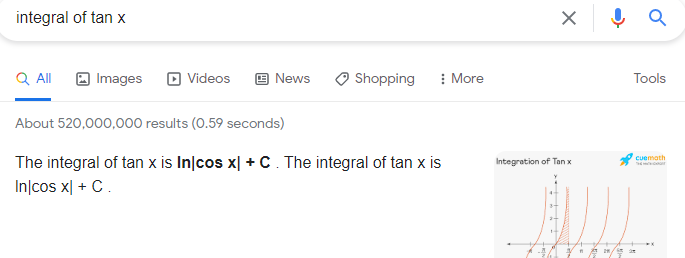
which seems to be wrong lol
,w integrate tan x
ocean sealBOT


 Requested by Shuri2060#9525
pliant dune
pale kestrel
cus complex ig? not sure
Requested by Shuri2060#9525
pliant dune
pale kestrel
cus complex ig? not sure
pretty sure that's why
alpine sable
The integral of cos^2(x) isnt sin^2(x) right
pale kestrel
alpine sable
The integral of cos^2(x) isnt sin^2(x) right
Any idea how to do it?
alpine sable
Nope
alpine sable
That’s just an identity right
pale kestrel
?
alpine sable
A trig identity
alpine sable
Oh it’s cos^2(2x)
ocean sealBOT
Shuri2060
 alpine sable
I don’t see how that helps
pale kestrel
double angle formula
alpine sable
Cos2x?
alpine sable
Does it work if theta is 2x?
pale kestrel
you can either
substitute u = 2x
Or think about what happens when you substitute 2x for x in integrals (like reverse differentiating)
Like if I gave you sin(2x), what does that differentiate to
alpine sable
1/2cos(2x)
pale kestrel
2cos2x
pale kestrel
you can do that to, as long as you substitute properly...
Have you learnt substitution for integrals?
alpine sable
Nope
pale kestrel
ok, then dont'
alpine sable
What approach should I take?
pale kestrel
alpine sable
What approach should I take?
what do you have right now?
alpine sable
Just the question
pale kestrel
$$\int \cos^2x - \frac{1}{2} + \frac{1}{2}\dd{x}$$
ocean sealBOT
Shuri2060
 pale kestrel
After the double angle formula?
alpine sable
You told me not to use it
alpine sable
Oh I see
alpine sable
Cos^2(2x) - sin^2(2x)
pale kestrel
ocean seal
**Shuri2060**
there's only 1 that will help
pale kestrel
ocean seal
**Shuri2060**
$$=\int\frac{1}{2}(2\cos^2x - 1) + \frac{1}{2}\dd{x}$$
ocean sealBOT
Shuri2060
 alpine sable
Man I don’t even know where that 1/2 in front of the bracket came from
alpine sable
Oh yeah
pale kestrel
$$\cos(2x) = 2\cos^2x-1$$
ocean sealBOT
Shuri2060
 pale kestrel
^ we want this form
The point is, we know how to integrate cos x
But we don't know how to integrate cos^2 x
alpine sable
Oh you want cos(2x) instead?
pale kestrel
That's the point of using the double angle formula

We have no idea of how to integrate the original thing
We don't know any functions that differentiate to cos^2 x
alpine sable
What’s the point of having the 0?
pale kestrel
where
alpine sable
The two constants cancel out
pale kestrel
I write it like that
because that is the form of the double angle formula
$$\int\cos^2x \dd{x}$$
ocean sealBOT
Shuri2060
 pale kestrel
This is the original thing you have no idea how to integrate

Writing it in this form was my hint

Because you can use this
Integration is 'hard', and basically boils down to trying to reverse differentiating. If we don't know an integral, we try to change it to something we DO know.
alpine sable
I’m sorry but I’m not understanding any of this
This is the first time for me integrating cos^2(x)
pale kestrel
$$\int\cos^2x \dd{x}$$
$$=\int \cos^2x - \frac{1}{2} + \frac{1}{2}\dd{x}$$
$$=\int\frac{1}{2}(2\cos^2x - 1) + \frac{1}{2}\dd{x}$$
ocean sealBOT
Shuri2060
 pale kestrel
$$=\int\frac{1}{2}\cos(2x) + \frac{1}{2}\dd{x}$$
ocean sealBOT
Shuri2060
 pale kestrel
If this helps?
That is the process
And now we know how to integrate the final thing
alpine sable
That makes sense but I could never see that by myself
pale kestrel
No, it takes experience
A lot of ppl find integration hard at first
cus of this
You don't see the 'tricks' that are meant to be used first time
And need a lot of hints
It's completely different from trying to differentiate
pale kestrel
ocean seal
**Shuri2060**
So this final thing, we can integrate, because
$$\dv{x}\sin(2x) = 2\cos(2x)$$
ocean sealBOT
Shuri2060
 pale kestrel
We need a factor of 1/2 outside
$$\dv{x}\left(\frac{1}{4}\sin(2x)\right) = \frac{1}{2}\cos(2x)$$
ocean sealBOT
Shuri2060
 pale kestrel
ocean seal
**Shuri2060**
pale kestrel
ocean seal
**Shuri2060**
and this is the exact form we need
pale kestrel
Exactly.
It turns out 'most' of the integrals out there are hard/impossible to do
The ones 'chosen' for school exercises
Are handpicked
to be doable
If you picked a bunch of random functions and combined them, you can still easily differentiate with the chain rule
Not so, for integration - most likely it would result in something impossible to integrate by hand.
$$\int e^{-x^2}\dd{x}$$
ocean sealBOT
Shuri2060
 pale kestrel
^ In terms of the functions you know
There is none that satisfy this (an example of something you definitely wouldn't be given to integrate)
alpine sable
Guess I’ll just need a lot of practice
lone heartBOT
@alpine sable Has your question been resolved?
Channel closed
Closed by @quiet crag
Use .reopen if this was a mistake.
Available help channel!
Send your question here to claim the channel.
Remember:
• Ask your math question in a clear, concise manner.
• Show your work, and if possible, explain where you are stuck.
• After 15 minutes, feel free to ping <@&286206848099549185>.
• Type the command .close to free the channel when you're done.
• Be polite and have a nice day!
Read #❓how-to-get-help for further information on how to ask a good question, and about conduct in the question channels.
 fossil valley
 lone heartBOT
fossil valley
pale kestrel
lone heartBOT
fossil valley
pale kestrel
?
fossil valley
Yes
pale kestrel
In words
it should be
'The integral from -2 to 5 of f(x) with respect to x'
ok?
Do you know what the integral is, graphically?
What does it represent?
fossil valley
so am I supposed to subtract f(x) at -2 from f(x) at 5
pale kestrel
no.
fossil valley
pale kestrel
Do you know what the integral is, graphically?
antiderivative
fossil valley
area under the curve
pale kestrel
👌
pale kestrel
fossil valley
area under the curve
More precisely
 glass lichen
fossil valley
area under the curve
glass lichen
fossil valley
area under the curve
signed area
pale kestrel
The integral of f(x) is the signed area between curve of f(x) and the x-axis between the given limits
fossil valley
what does signed area mean?
glass lichen
you find all 3 components, then sum them.
pale kestrel
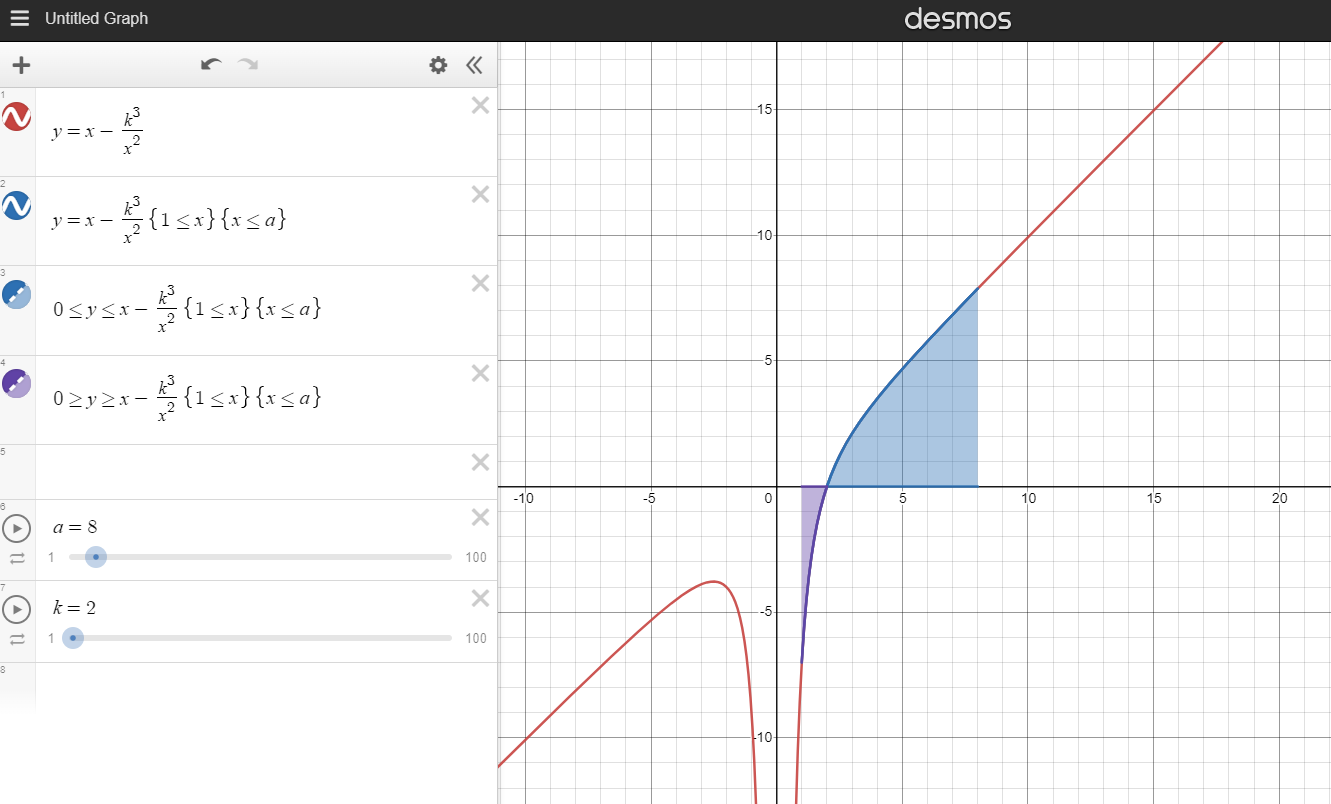
For example in this picture
I would add the blue area
and subtract the purple area
If I'm integrating that random function from 1 to 8
fossil valley
glass lichen
you find all 3 components, then sum them.
and you do that by using the formula that comes with solving those right
glass lichen
you find areas, yes.
fossil valley
pale kestrel
If I'm integrating that random function from 1 to 8
Got it
fossil valley
glass lichen
you find areas, yes.
Damn I thought I had to integrate the function or something
pale kestrel
You aren't given a function
glass lichen
I mean, you look at the page and see no function
fossil valley
thank you
glass lichen
Hence why you shouldn't be thinking "Oh I need to actually integrate"
fossil valley
.close
lone heartBOT
Channel closed
Closed by @fossil valley
Use .reopen if this was a mistake.
Available help channel!
Send your question here to claim the channel.
Remember:
• Ask your math question in a clear, concise manner.
• Show your work, and if possible, explain where you are stuck.
• After 15 minutes, feel free to ping <@&286206848099549185>.
• Type the command .close to free the channel when you're done.
• Be polite and have a nice day!
Read #❓how-to-get-help for further information on how to ask a good question, and about conduct in the question channels.
 still crest
How do I prove that this equation has exactly one root in the given interval?
 lone heartBOT
still crest
How do I prove that this equation has exactly one root in the given interval?
alpine sable
lone heartBOT
still crest
How do I prove that this equation has exactly one root in the given interval?
alpine sable
ladies and gentlemen, i need quick help please!
 little drum
still crest
How do I prove that this equation has exactly one root in the given interval?
little drum
still crest
How do I prove that this equation has exactly one root in the given interval?
Graph
Do you know derivatives? and it's uses?
still crest
Yes I'm supposed to solve this with derivatives
still crest
little drum
Like to find minima/maxima and all..
Kind of yea
little drum
So first of all, imagine or try to make a rough sketch of how the graph for e^(-x) would look like
Go for an unoccupied channel please?
5, 19 and 25 are available!?
alpine sable
little drum
Go for an unoccupied channel please?
oh my, i'm sorry..
sorry to bother.
still crest
little drum
So first of all, imagine or try to make a rough sketch of how the graph for e^(-...
One sec

Is it approaching 0?
little drum
uhh .. yeah that's about right
so your clue is that sin 0 = 0 < e^0, sin 1 > 1 / e
you just need to show that the graph don't intersect more than once in that interval
still crest
I don't think I'm supposed to do this with graphs
little drum
i-
Umm but the visualization comes that way
anyways, sin x is increasing in that interval while e^-x is continuously decreasing
So they can only intersect at most once, or not .. but sin 0 < e ^ 0 and sin 1 > e^-1 so they must've intersected once
hence only one solution
still crest
I understand this solution but that's not what the exercise wants. This set of exercises has exercises with derivatives
little drum
Uhh, you need the derivatives to show that the graph for sin and e^-x is increasing/decreasing in the interval!?
still crest
No I probably need some kind of theorem
little drum
Ig if you're curious about using a theorem... you could use the IVT THEOREM
Have you heard of Intermediate value theorem?
still crest
I found the solution in my high school book xD
I'm studying in uni
With bolzano's theorem you prove there is at least one root and with rolle's theorem you prove there can't be 2 solutions so there is only one
.close
lone heartBOT
Channel closed
Closed by @still crest
Use .reopen if this was a mistake.
little drum
smh so round about way to doing easy stuff
lone heartBOT
Available help channel!
Send your question here to claim the channel.
Remember:
• Ask your math question in a clear, concise manner.
• Show your work, and if possible, explain where you are stuck.
• After 15 minutes, feel free to ping <@&286206848099549185>.
• Type the command .close to free the channel when you're done.
• Be polite and have a nice day!
Read #❓how-to-get-help for further information on how to ask a good question, and about conduct in the question channels.
Channel closed
Closed due to the original message being deleted
Available help channel!
Send your question here to claim the channel.
Remember:
• Ask your math question in a clear, concise manner.
• Show your work, and if possible, explain where you are stuck.
• After 15 minutes, feel free to ping <@&286206848099549185>.
• Type the command .close to free the channel when you're done.
• Be polite and have a nice day!
Read #❓how-to-get-help for further information on how to ask a good question, and about conduct in the question channels.
 median python
I can’t figure out how to do this problem
lone heartBOT
median python
I can’t figure out how to do this problem
median python

 wary stream
,rotate
ocean sealBOT
 gray isle
you fked up the last application of pythag you did
gray isle
for x?
median python
Ye
gray isle
yes
lone heartBOT
Channel closed
Closed by @median python
Use .reopen if this was a mistake.
median python
.reopen
lone heartBOT
✅
median python
I’m having trouble with this problem too
 pale kestrel
median python
I’m having trouble with this problem too
pale kestrel
median python
I’m having trouble with this problem too
,rotate
ocean sealBOT
 lone heartBOT
Channel closed
Closed by @median python
Use .reopen if this was a mistake.
Available help channel!
Send your question here to claim the channel.
Remember:
• Ask your math question in a clear, concise manner.
• Show your work, and if possible, explain where you are stuck.
• After 15 minutes, feel free to ping <@&286206848099549185>.
• Type the command .close to free the channel when you're done.
• Be polite and have a nice day!
Read #❓how-to-get-help for further information on how to ask a good question, and about conduct in the question channels.
 knotty saddle
help =((((
 lone heartBOT
knotty saddle
help =((((
lone heartBOT
knotty saddle
help =((((
@knotty saddle Has your question been resolved?
Channel closed
Closed by @knotty saddle
Use .reopen if this was a mistake.
Available help channel!
Send your question here to claim the channel.
Remember:
• Ask your math question in a clear, concise manner.
• Show your work, and if possible, explain where you are stuck.
• After 15 minutes, feel free to ping <@&286206848099549185>.
• Type the command .close to free the channel when you're done.
• Be polite and have a nice day!
Read #❓how-to-get-help for further information on how to ask a good question, and about conduct in the question channels.
 marble bloom
Can I please get help with number 17
 lone heartBOT
marble bloom
Can I please get help with number 17
wary stream
lone heartBOT
marble bloom
Can I please get help with number 17
wary stream
,rotate
ocean sealBOT
 wary stream
marble bloom
Can I please get help with number 17
wary stream
marble bloom
Can I please get help with number 17
Like it says, use law of cosines to find the angles
marble bloom
wary stream
Like it says, use law of cosines to find the angles
I’m so confused man
wary stream
Don't ask in an occupied channel
Read #❓how-to-get-help
wary stream
marble bloom
I’m so confused man
Do you know what law of cosines is?
marble bloom
wary stream
Do you know what law of cosines is?
Yeah it’s where you have to set stuff equal to cosines like side side side and angle side angle right
wary stream
But the formula for it, do you know it?
marble bloom
Ngl no
There’s so many different formulas
Isn’t it like two of the sides squared minus the side across squared?
wary stream
There's literally a formula for law of cosines
wary stream
You can Google it
marble bloom
C= square root of a squared plus b squared minus two ab times cos angle opposite c
But the problem is there is not angle opposite c
There’s all sides
wary stream
You're finding the angle
gray isle
there an angle opposite every side in a triangle
gray isle
from the cosine rule/law
marble bloom
The Who now?
gray isle
there are 4 variables in the cosine law that represent,
3 sides (which are all known)
and angle (which you want to find)
marble bloom
Exactly
wary stream
Use the law of cosines
marble bloom
So now I need to find an angle
wary stream
To find that angle
marble bloom
But for that forumula
I need an angle
And I don’t have an angle so I can’t use that formula
gray isle
wdym
marble bloom
It says it needs angle opposite of c
gray isle
yes
marble bloom
 wary stream
You have everything else but the angle, you're finding the value of the angle
wary stream
That's just a variable
marble bloom
So what do I put next to cosine
gray isle
that's a pretty suboptimal representation of the cosine law for this
marble bloom
DOSENT an angle need to go next to the cosine
gray isle
in this case the gamma would be the opposite side c
gray isle
which can simply be represented by the capital C
wary stream
marble bloom
DOSENT an angle need to go next to the cosine
That is the value you're looking for
The angle
marble bloom
Ok so I would put a C after the the cosine
But there’s already a little c in the problem
The little c is what we’re solving for
gray isle
well yeh...since c=17,
you'd replace c with 17
 wary stream
,rotate
ocean sealBOT
 gray isle
extend that radical bar pls
gray isle
and as mentioned before
that's a pretty suboptimal representation of the cosine law for this
which requires you to do more work when solving for (capital) C
marble bloom
So what I gotta do
lone heartBOT
@marble bloom Has your question been resolved?
gray isle
algebraic manipulation
consider first isolating cos(C)
(there is also a form of the cosine rule that starts with that already isolated)
lone heartBOT
@marble bloom Has your question been resolved?
Channel closed
Closed by @marble bloom
Use .reopen if this was a mistake.
Available help channel!
Send your question here to claim the channel.
Remember:
• Ask your math question in a clear, concise manner.
• Show your work, and if possible, explain where you are stuck.
• After 15 minutes, feel free to ping <@&286206848099549185>.
• Type the command .close to free the channel when you're done.
• Be polite and have a nice day!
Read #❓how-to-get-help for further information on how to ask a good question, and about conduct in the question channels.
 silent hornet
i need to complete the rhombus, im not sure how, idk what formulas to use. P is the interception point of the diagonals
 lone heartBOT
silent hornet
i need to complete the rhombus, im not sure how, idk what formulas to use. P is ...
lone heartBOT
lone heartBOT
silent hornet
i need to complete the rhombus, im not sure how, idk what formulas to use. P is ...
lone heartBOT
Channel closed
Closed by @silent hornet
Use .reopen if this was a mistake.
Available help channel!
Send your question here to claim the channel.
Remember:
• Ask your math question in a clear, concise manner.
• Show your work, and if possible, explain where you are stuck.
• After 15 minutes, feel free to ping <@&286206848099549185>.
• Type the command .close to free the channel when you're done.
• Be polite and have a nice day!
Read #❓how-to-get-help for further information on how to ask a good question, and about conduct in the question channels.
 woeful jasper
I'm stuck. I'm trying to solve the thermal diffusion equation in spherical polar coordinates, where the diffusion equation is written in terms of r (point in space) and time t only.
lone heartBOT
woeful jasper
I'm stuck. I'm trying to solve the thermal diffusion equation in spherical polar...
 tacit arch
woeful jasper
I'm stuck. I'm trying to solve the thermal diffusion equation in spherical polar...
tacit arch
woeful jasper
I'm stuck. I'm trying to solve the thermal diffusion equation in spherical polar...
What have you tried and mathematically what are you trying to prove? Pics are ok
woeful jasper
this is what im trying to get to , and ive got close but im out by a factor of 1/r and I can't figure out why

Because I havent worked with polars much I'm thinking I must've done something wrong during the separation of variables
tacit arch
Do you know the laplacian in spherical coordinates?
 tacit arch
Does the rest match the last eqn here
http://www.thphys.nuim.ie/Notes/MP469/Laplace.pdf


 tacit arch
Cool
And since you don't need the angle coordinates, that should simplify pretty easily
woeful jasper
 tacit arch
woeful jasper
tacit arch
woeful jasper
Yea I don't know where this comes from, but you can multiply it by r or 1/r and it'll still be true
woeful jasper
How can I relate it into the rest of my working ?
tacit arch
Did you calculate both sides of the equation already and show that they're equal?
tacit arch
woeful jasper
this is what im trying to get to , and ive got close but im out by a factor of 1...
First eqn here
tacit arch
I think you're doing too much
 tacit arch
All you have to calculate is 2 things. The laplacian of T and the time derivative of T. Then you multiply the latter by 1/h^2 and set that equal to the Laplacian. This gives you an equation for h in terms of k and alpha
Somewhere you should be able to divide by T and only have constants remain
woeful jasper
Im not sure i understand

I've gotten this , where I get the variables separated and make them equal to a const
woeful jasper
Yeah I dont thjink so either as I've done it the way i would with cartesians
But I'm not sure where to begin with polars

 tacit arch
Stop doing separation of variables
All you're really doing is plugging in the second equation into the first
woeful jasper
I'm not sure what I ought to do
How I should start different

I don't understand why the laplacian is = 0 in the beginning
del2 T = 1/h2 dT/dt
suddenly making it = 0 doesnt make sense
tacit arch
woeful jasper
I don't understand why the laplacian is = 0 in the beginning
This is very different from what you're initially asking
Read your question again and again
woeful jasper
my initial question is getting from the diffusion eqn in polars to a general solution
i got very close to the shown equation however I am out by a factor of 1/r
i do not understand where the 1/r comes from , so i figured it may come from some part of the polar coordinates
tacit arch
woeful jasper
Did you calculate the right hand side of this?

 tacit arch
What's rT?
woeful jasper
 woeful jasper
 tacit arch
Looks good. Now d^2(rT)/dr^2
woeful jasper
 tacit arch
After dividing by r, can you factor out T?
woeful jasper

 tacit arch
So you have the left hand side now. The right hand side is a little simpler
 woeful jasper
 woeful jasper
 tacit arch
Now factor out a T again
woeful jasper
 tacit arch
woeful jasper
tacit arch
woeful jasper
Actually I think the 1/r is part of T here
tacit arch
woeful jasper
Same here

 tacit arch
woeful jasper
tacit arch
woeful jasper
Looks good. Multiply by 1/h^2
woeful jasper
 woeful jasper
 tacit arch
Divide by T and solve for h
woeful jasper
 tacit arch
Me thinks you're done
woeful jasper
my guy this is insane
tacit arch

tacit arch
It's easy to get lost if your first path is in the wrong direction. We've all been there
woeful jasper
thank you
next i gotta create the general solution , but now i have the equations i needed
i hope this wont take as long 🥵
tacit arch
I think your calculation skills are pretty good. You just need to review this solution again and learn from it. Why did I tell you to calculate those things in that order? Why did separation of variables not help you?
woeful jasper
I think in my case I've been taught to begin with separation of variables and work that way, with no indication of what a general solution may be looking like.
So with this question it was generous for them to give T in that form
tacit arch
Yea if you do enough pde and ode problems, you get used to "Show this function satisfies the differential equation" and it becomes plug and chug. That's vastly different than showing "show there exists functions that satisfy this differential equation and that it's unique."
woeful jasper
Yeah that's impression I'm getting. I want to get more comfortable with spherical polars
lone heartBOT
@woeful jasper Has your question been resolved?
Channel closed
Closed by @woeful jasper
Use .reopen if this was a mistake.
Available help channel!
Send your question here to claim the channel.
Remember:
• Ask your math question in a clear, concise manner.
• Show your work, and if possible, explain where you are stuck.
• After 15 minutes, feel free to ping <@&286206848099549185>.
• Type the command .close to free the channel when you're done.
• Be polite and have a nice day!
Read #❓how-to-get-help for further information on how to ask a good question, and about conduct in the question channels.
 fossil grail
 lone heartBOT
fossil grail
fossil grail
lone heartBOT
fossil grail
fossil grail
ok so, im not 100% sure but
I'm pretty sure it's 7
because
25000=a(r)^n-1
a is 100
25000=100(3)^n-1
250=3^n-1
3^5=243, so 3^6>250
6=n-1
n=7
not sure if this is correct though
lone heartBOT
@fossil grail Has your question been resolved?
tacit arch
fossil grail
25000=100(3)^n-1
Where does 3 come from?
fossil grail
tacit arch
Where does 3 come from?
oh it says that it trebles
tacit arch
Your work looks right
lone heartBOT
Channel closed
Closed by @fossil grail
Use .reopen if this was a mistake.
Available help channel!
Send your question here to claim the channel.
Remember:
• Ask your math question in a clear, concise manner.
• Show your work, and if possible, explain where you are stuck.
• After 15 minutes, feel free to ping <@&286206848099549185>.
• Type the command .close to free the channel when you're done.
• Be polite and have a nice day!
Read #❓how-to-get-help for further information on how to ask a good question, and about conduct in the question channels.
 fleet bolt
Just need to understand the method for these two
lone heartBOT
fleet bolt
Just need to understand the method for these two

 alpine sable
It’s the centroid
fleet bolt
sorry should've said it more clearly, need to get to the values of x in both of those problems
@alpine sable
alpine sable
Ik
It’s directly related to property of centroid
Do u know how a centroid divides a median
In what ratio
fleet bolt
1:2?
alpine sable
2:1
alpine sable
Yes
fleet bolt
Thanks a lot for your help mate, it was right in front of me
alpine sable
Ok
lone heartBOT
Channel closed
Closed by @fleet bolt
Use .reopen if this was a mistake.
Available help channel!
Send your question here to claim the channel.
Remember:
• Ask your math question in a clear, concise manner.
• Show your work, and if possible, explain where you are stuck.
• After 15 minutes, feel free to ping <@&286206848099549185>.
• Type the command .close to free the channel when you're done.
• Be polite and have a nice day!
Read #❓how-to-get-help for further information on how to ask a good question, and about conduct in the question channels.
 gloomy portal
<@&286206848099549185> I need help in math can somebody help please
alpine sable
What u need help with
gloomy portal
Factoring polynomials
alpine sable
Also don’t ping helpers immediately
gloomy portal
Oh okay
alpine sable
It clearly says after 15 minutes
muted niche
make sure to ping helpers with a minimum of 15 minute intervals
gloomy portal
Okay
Um how do I factor these

I learnt the foil method the other day very grateful to learn to in first outer inner last
Hello epilson
gloomy portal
Okay
alpine sable
Bruh
gloomy portal
I am not familiar I tried learning that
alpine sable
Where are u getting these questions from
alpine sable
Did your teacher not teach you about quadratic equations before giving all this homework
gloomy portal
She does not teach well at all
alpine sable
Bruh
gloomy portal
It’s fine I’m here all day
alpine sable
But I’m not
gloomy portal
Oh
alpine sable
I need to study myself
gloomy portal
Yes true
alpine sable
I can recommend u a text which u can read
gloomy portal
Ok
alpine sable
I can’t teach you
gloomy portal
Okay
Can you factor the first one as a example and show working out
I got photographic memory in photos
alpine sable
 alpine sable
Don’t memorise
lone heartBOT
@gloomy portal Has your question been resolved?
gloomy portal
No it’s hasn’t
little drum
gloomy portal
(Q-3) (Q-15)
Yes lol
Epsilon did write ( q - 3 )( q - 15 ) no?
Like there's, q² - 18q + 45
so, the gist "middle term splitting" goes like: you split the middle term, that is 18 here, into two numbers a, b such that a + b = 18 and a x b = 45
Unfortunately though, you'll have to practice a bit before you start immediately recognizing the numbers, like a = 15, b = 3 here..
And then you write q² - 18q + 45 = q² - 15q - 3q + 45 = q( q - 15 ) - 3( q - 15 ) = ( q - 3 )( q - 15 )
that's it
I'll give you b. too.. but the rest, you've gotta learn from your intuition :o
b. p² - 15p - 54 = p² - ( 18 - 3 )p + ( 18 x -3 ) = p( p - 18 ) + 3( p - 18 ) = ( p + 3 )( p - 18 )
gloomy portal
Is this correct guys

 proven rune
gloomy portal
Is this correct guys
proven rune
gloomy portal
Is this correct guys
ayo wy u spamming everywhere
choose one channel
.close
lone heartBOT
Channel closed
Closed by @proven rune
Use .reopen if this was a mistake.
Available help channel!
Send your question here to claim the channel.
Remember:
• Ask your math question in a clear, concise manner.
• Show your work, and if possible, explain where you are stuck.
• After 15 minutes, feel free to ping <@&286206848099549185>.
• Type the command .close to free the channel when you're done.
• Be polite and have a nice day!
Read #❓how-to-get-help for further information on how to ask a good question, and about conduct in the question channels.
 muted island
 lone heartBOT
muted island
muted island
lone heartBOT
muted island
muted island
anyone kind enough to help me with this?
inequalities
i have no idea how its supposed to be done
 vale wigeon
,rccw
ocean sealBOT
 muted island
vale wigeon
,rccw
muted island
vale wigeon
,rccw
Thank you
vale wigeon
god, the wording on this
muted island
Apologies though..
vale wigeon
you have nothing to apologize for
it's not your fault
it's the fault of whoever made this exercise sheet
anyway, the inequalities they give you take care of the left and right edges of your region.
muted island
Hahaa alrighty
muted island
vale wigeon
anyway, the inequalities they give you take care of the left and right edges of ...
How so
vale wigeon
do you know what the graph of just the inequality y ≥ x-8 looks like?
vale wigeon
maybe you should review that before trying to assemble a region out of four inequalities
do you at least know what the graph of the equation y = x-8 looks like
muted island
I had, a year ago. But it confuses me often. Is it okay if you explain it to me step by step ?
vale wigeon
idk how to explain it to you "step by step"
i'd need to basically teach you from scratch how to graph straight lines
muted island
If you have time for it.. sure
vale wigeon
no, i don't have time for it.
lone heartBOT
Channel closed
Closed by @muted island
Use .reopen if this was a mistake.
Available help channel!
Send your question here to claim the channel.
Remember:
• Ask your math question in a clear, concise manner.
• Show your work, and if possible, explain where you are stuck.
• After 15 minutes, feel free to ping <@&286206848099549185>.
• Type the command .close to free the channel when you're done.
• Be polite and have a nice day!
Read #❓how-to-get-help for further information on how to ask a good question, and about conduct in the question channels.
alpine sable
 lone heartBOT
alpine sable
lone heartBOT
lone heartBOT
alpine sable
lone heartBOT
@alpine sable Has your question been resolved?
alpine sable
<@&286206848099549185>
muted island
the positive 3 means moving your object to the right side 3 units whereas the positive 1 you'll have to move your object upwards 1 unit
whereas negative integers does the opposite
@alpine sable
alpine sable
Thank U
lone heartBOT
@alpine sable Has your question been resolved?
Channel closed
Closed by @spiral galleon
Use .reopen if this was a mistake.
Available help channel!
Send your question here to claim the channel.
Remember:
• Ask your math question in a clear, concise manner.
• Show your work, and if possible, explain where you are stuck.
• After 15 minutes, feel free to ping <@&286206848099549185>.
• Type the command .close to free the channel when you're done.
• Be polite and have a nice day!
Read #❓how-to-get-help for further information on how to ask a good question, and about conduct in the question channels.
vapid crypt
for cross product, axb and bxa, how do you know which cross product will give/result in a positive vector?
lone heartBOT
vapid crypt
for cross product, **a**x**b** and **b**x**a**, how do you know which cross prod...
vapid crypt
for example, if I want the positive perpendicular vector, which order do I use? axb and bxa
vapid crypt
alpine sable
Do you know about the right hand thumb rule?
kind of

here's a picture
alpine sable
vapid crypt
Assuming positive means up for you, axb is what you are looking for.
Because
Actually, tough to explain with text.
But try to totally grasp the thumb rule.
Or wait for someone else to reply.
vapid crypt
OK, do you have a video link for thumb rule
vapid crypt
OK i see
lone heartBOT
@vapid crypt Has your question been resolved?
vapid crypt
also, the other way if I have the angle, which unit vector is n? (in the picture)
 lone heartBOT
Channel closed
Closed due to timeout
Use .reopen if this was a mistake.
Available help channel!
Send your question here to claim the channel.
Remember:
• Ask your math question in a clear, concise manner.
• Show your work, and if possible, explain where you are stuck.
• After 15 minutes, feel free to ping <@&286206848099549185>.
• Type the command .close to free the channel when you're done.
• Be polite and have a nice day!
Read #❓how-to-get-help for further information on how to ask a good question, and about conduct in the question channels.
 willow gull
Help
lone heartBOT
willow gull
Help
willow gull

 sweet parrot
i need help with inventory management.
so i have uncertain/unknown distribution for the demand: [100-20,100+20]
over period of 12 months i need to find:
best Q, r that will bring TC to minimum in the worst case of demand
if anyone has knowledge about this/guide/video/or even the correct name for this model that would be helpful , ping me please
 jagged imp
sweet parrot
i need help with inventory management.
so i have uncertain/unknown distribution ...
jagged imp
sweet parrot
i need help with inventory management.
so i have uncertain/unknown distribution ...
this channel is taken
jagged imp
willow gull
which question are you struggling with and what have you done so far?

 covert agate
do you know what stationary points are
willow gull
I genuinely dont know
vale wigeon
so you just wrote down that equation without knowing where it came from?
lone heartBOT
@willow gull Has your question been resolved?
willow gull
I’m confused
 craggy salmon
you have to take the derivative of $\frac{e^{3x-5}}{x^2}$
ocean sealBOT
Dev Shah
 lone heartBOT
Channel closed
Closed due to timeout
Use .reopen if this was a mistake.
Available help channel!
Send your question here to claim the channel.
Remember:
• Ask your math question in a clear, concise manner.
• Show your work, and if possible, explain where you are stuck.
• After 15 minutes, feel free to ping <@&286206848099549185>.
• Type the command .close to free the channel when you're done.
• Be polite and have a nice day!
Read #❓how-to-get-help for further information on how to ask a good question, and about conduct in the question channels.
 uneven wedge
How would I solve for a when a is a positive integer and:
2/3 = 1/a + 1/3a + 1/(a-1) ? Cross multiplication? Should I combine anything beforehand?
lone heartBOT
uneven wedge
How would I solve for a when a is a positive integer and:
2/3 = 1/a + 1/3a + 1/(...
gray isle
you could consider multiplying both sides by the lcm of the denominators of all the fractions directly (or any common multiple, but lcm would be ideal)
combining your fractions into a single fraction first is fine too
there are multiple routes that can be taken, just make sure that the steps are mathematically valuid
uneven wedge
gray isle
combining your fractions into a single fraction first is fine too
So combining the right side?
gray isle
you can do that first if you want
 hollow cairn
(Here's how i solve it)
 lone heartBOT
@uneven wedge Has your question been resolved?
lone heartBOT
Channel closed
Closed due to timeout
Use .reopen if this was a mistake.
Available help channel!
Send your question here to claim the channel.
Remember:
• Ask your math question in a clear, concise manner.
• Show your work, and if possible, explain where you are stuck.
• After 15 minutes, feel free to ping <@&286206848099549185>.
• Type the command .close to free the channel when you're done.
• Be polite and have a nice day!
Read #❓how-to-get-help for further information on how to ask a good question, and about conduct in the question channels.
lone heartBOT
covert agate
do you know the 1st derivative test?
ok
do you know critical numbers?
what about derivatives..?
bruh
i need to know how much you know
before explaining
if you give up no one can help you
what’s that formula?
 lean spire
 lone heartBOT
Channel closed
Closed by @slow hedge
Use .reopen if this was a mistake.
Available help channel!
Send your question here to claim the channel.
Remember:
• Ask your math question in a clear, concise manner.
• Show your work, and if possible, explain where you are stuck.
• After 15 minutes, feel free to ping <@&286206848099549185>.
• Type the command .close to free the channel when you're done.
• Be polite and have a nice day!
Read #❓how-to-get-help for further information on how to ask a good question, and about conduct in the question channels.
 eager shale
 lone heartBOT
eager shale
gray isle
lone heartBOT
eager shale
gray isle
you didn't set up your equation properly
x/40 is the ratio of the bases,
however 15/33 is NOT the ratio of the left sides of the triangles (as 33 is not the length of the leg of the big triangle)
lone heartBOT
Channel closed
Closed by @eager shale
Use .reopen if this was a mistake.
Available help channel!
Send your question here to claim the channel.
Remember:
• Ask your math question in a clear, concise manner.
• Show your work, and if possible, explain where you are stuck.
• After 15 minutes, feel free to ping <@&286206848099549185>.
• Type the command .close to free the channel when you're done.
• Be polite and have a nice day!
Read #❓how-to-get-help for further information on how to ask a good question, and about conduct in the question channels.
still crest
 lone heartBOT
still crest
still crest
lone heartBOT
still crest
still crest
I tried transfering it to the polar form but then I don't know what to do after I find the polar form
What do I do with the exponent?
craggy salmon
post that form too

 toxic pagoda
Please help me
 craggy salmon
aight, now turn the trig form into e^i(theta)
craggy salmon
toxic pagoda
Please help me
still crest
craggy salmon
aight, now turn the trig form into e^i(theta)
Oh, I have no idea how to that
Wait
e^(i*7π/18)?
still crest
(4sqrt(2))^120*(e^120 * 7pi/18)?
craggy salmon
yup
still crest
That was way easier than I thought
craggy salmon
now simplify if you wanna
still crest
Yep 1 sec
craggy salmon
it is pretty easy yeah!
still crest
(4sqrt(2))^120*(e^(140π/3))
craggy salmon
you can subtract 2npi from the exp without changing it's value
still crest
I thought pi as different letters and I thought it was imaginary unit
Lmao
Yeah I got it
Thank you very much
still crest
craggy salmon
I didn't have the symbol and was lazy for latex lol
Yeah I'm on phone which also makes me lazy to use it
.close
lone heartBOT
Channel closed
Closed by @still crest
Use .reopen if this was a mistake.
lone heartBOT
Available help channel!
Send your question here to claim the channel.
Remember:
• Ask your math question in a clear, concise manner.
• Show your work, and if possible, explain where you are stuck.
• After 15 minutes, feel free to ping <@&286206848099549185>.
• Type the command .close to free the channel when you're done.
• Be polite and have a nice day!
Read #❓how-to-get-help for further information on how to ask a good question, and about conduct in the question channels.
 jaunty crane
can someone help me with a simple math
lone heartBOT
jaunty crane
can someone help me with a simple math


 gray isle
the instructions/goal is unclear
proven rune
jaunty crane
change the gradient x to (x+1)
what do u want m8 its unclear
jaunty crane
like they give 3logy=mx+n
hold up

change the 3logy=mx+n
into logy=...
any ideas?
find m and n is the question
covert agate
but thats a logarithmic equation?
jaunty crane
oh yea my y needs to be log y
the variables x and y are related by the equation 3logy = mx+n. The diagram below shows a straight line formed by plotting logy against x+1. Calculate the value of m and n
let me translate
there
(x, y) = (a - 1, 10^b)??
covert agate
ok how do i explain this
covert agate
jaunty crane
3 log y = m (x + 1) + n - m right
so subbing those points,
3 (4) = m (4) + n - m, and
3 (10) = m (7) + n - m
there you have a system of equations
jaunty crane
oh i can just plug x+1 to the equation from the first place?
lone heartBOT
@jaunty crane Has your question been resolved?
lone heartBOT
@jaunty crane Has your question been resolved?
lone heartBOT
Channel closed
Closed due to timeout
Use .reopen if this was a mistake.
Available help channel!
Send your question here to claim the channel.
Remember:
• Ask your math question in a clear, concise manner.
• Show your work, and if possible, explain where you are stuck.
• After 15 minutes, feel free to ping <@&286206848099549185>.
• Type the command .close to free the channel when you're done.
• Be polite and have a nice day!
Read #❓how-to-get-help for further information on how to ask a good question, and about conduct in the question channels.
 earnest lodge
 lone heartBOT
earnest lodge
earnest lodge
lone heartBOT
earnest lodge
earnest lodge
I feel completely lost
 solar merlin
(mainly) unrelated, but R.I.P Trifon Madas. he was truly a legend
earnest lodge
I've looked at the answer key
completely lost
I've been lost for the previous 12 questions
but I understood the answer and managed to solved it
but qn 13 is 😐😭
pale kestrel
Ok, notice anything about the Left hand side thing
earnest lodge
to infinity?
pale kestrel
Perhaps try writing out what the first few terms are...
But I think you are expected to recognise this is geometric series. (and use the formula for it)
earnest lodge
oh my god
I tried writing out the terms for the right side but not the left side
thank you
lone heartBOT
@earnest lodge Has your question been resolved?
lone heartBOT
Channel closed
Closed due to timeout
Use .reopen if this was a mistake.