#help-0
1 messages · Page 905 of 1
 oak chasm
You add x to it.
So, let's try corner cases.
It worked for 30.
We tried one x value.
So it can sometimes work.
We need it to be able to give us ANY number greater than 1.
And it's easy to get really high numbers.
You just add the really high number to x.
But what about really low numbers?
You can add a low number to x, but you can't subtract something from x.
So if you need to subtract something, you're stuck.
 median mauve
ok
oak chasm
We're adding the number we want to get.
So, subtracting would mean the number is negative.
But we're not looking for negative numbers.
median mauve
yes
median mauve
ok
oak chasm
What do we need to check?
We handled adding negative numbers.
Do we ever need to add 0 or 1?
median mauve
no
oak chasm
Why not?
median mauve
from a x+lo to x+hi?
oak chasm
Sorry?
median mauve
oak chasm
We're adding the number we want to get.
here
oak chasm
Yes, n = number we want to get + x.
Hmm.
My question was wrong.
The number we want to get is greater than 1.
So, it's at least two.
x is at least zero.
At least two plus at least zero is at least two.
And so we need to be able to get all ns that are at least two.
And we are.
Does that make sense?
median mauve
yes
oak chasm
OK, so we can get any n - x - 1 value we need.
So we can get any odd 3 or higher as our odd factor.
Does that make sense?

 oak chasm
Something I've noticed is that you need to know what you need to show.
Like you explain why it's true, but you leave out some things that are needed.
oak chasm
No problem.
median mauve
.close
 lone heartBOT
Channel closed
Closed by @median mauve
Use .reopen if this was a mistake.
 Available help channel!
Send your question here to claim the channel.
Remember:
• Ask your math question in a clear, concise manner.
• Show your work, and if possible, explain where you are stuck.
• After 15 minutes, feel free to ping <@&286206848099549185>.
• Type the command .close to free the channel when you're done.
• Be polite and have a nice day!
Read #❓how-to-get-help for further information on how to ask a good question, and about conduct in the question channels.
 tawny fable
Hi there
lone heartBOT
tawny fable
Hi there
tawny fable
I am having some problems with some questions in calculus
tawny fable

Thanks!
well, I proved the first one.
with the help of @queen thicket
but the thing is, that I really cant tell why the second one is not true.
I prove the first one using the defenition of limits.
and using the fact that it is continuous and the rationals density in R
and it looks like I could do it just the same with < and not <=
exactly the same.
so its either I have a problem in my writing, or I have a problem understanding something
 noble sinew
limits don't hold strict inequalities is where it breaks down
just like 1/n>0 for all n but lim n->inf of 1/n=0
so our 1/n>0 turned in to lim n->inf of 1/n>=0 when taking limit
tawny fable
So shouldnt I get something weird in my proof?
noble sinew
You likely thought and used that limit holds strict inequalities
And just did a false proof
 queen thicket
@noble sinew I believe he did it with epsilons and deltas <:)
You can post your proof here and we'll tell you where it breaks down if u want
It's probably right at the end
tawny fable
ill translate it to english and rewrite it
so couple of mins
🙂

it took me a little while xD
but anyways. please let me know where am I wrong.
queen thicket
last set of inequalities ur using $-(f(q) -f(x_0))<-\varepsilon$ which is not true it's the other way around
 ocean sealBOT
Celephinnor
 tawny fable
what do you mean?
queen thicket
$-(f(q) -f(x_0))<-\varepsilon$ is equivalent to $f(q) -f(x_0) > \varepsilon$
tawny fable
I am subtracting
ocean sealBOT
Celephinnor
 queen thicket
yes and substracting reverses inequalities
queen thicket
ocean seal
**Celephinnor**
as in this
queen thicket
$|f(q) -f(x_0)|<\varepsilon$ means $f(q) -f(x_0) < \varepsilon$ AND $ f(x_0) -f(q) < \varepsilon$
ocean sealBOT
Celephinnor
 queen thicket
If you have $a<b$ and $c<d$ then you cannot do $a-c<b-d$
ocean sealBOT
Celephinnor
 tawny fable
hmm
queen thicket
but you can do $a-d<b-c$
ocean sealBOT
Celephinnor
 queen thicket
Substracting reverses the inequalities
ocean sealBOT
RanZ
 queen thicket
ocean seal
**Celephinnor**
queen thicket
ocean seal
**Celephinnor**
then you would know one of these is useless because trivially true
Told you last time whenever you're substracting epsilons with epsilons you did something wrong
epsilons never cancel out in analysis
queen thicket
Just 1 really
queen thicket
your only mistake is not reversing the inequality
wdym you can't get rid of the | |?
noble sinew
Well you are trying to prove something false - so ofc you are gonna get stuck at a point you are aware?
queen thicket
He's showing his proof for the first part
tawny fable
queen thicket
He's showing his proof for the first part
yup
tawny fable
queen thicket
your only mistake is not reversing the inequality
in order to reverse the inequality I have to really understand why am I doing this
or to be able to explain that
queen thicket
You are doing this to show $0<g(x_0)-f(x_0) + 2\varepsilon$ or something
ocean sealBOT
Celephinnor
 queen thicket
Which in turn will imply $0 \leq g(x_0) -f(x_0)$
ocean sealBOT
Celephinnor
 tawny fable
well yeah
but we can not choose epsilon = 0 as I said.
and also, is that by addition?
I mean
ofc I want to prove that, I just don't get how to continue from where I am if I cant use substraction
queen thicket
You can use substraction
Just get the inequality in the right order
Instead of 0 on the right you'll just get 2epsilon
If u understand this step we can finish the proof by choosing adequate epsilon
I think the problem is you don't understand what $|f(x)-f(x_0)|<\varepsilon$ means
ocean sealBOT
Celephinnor
 queen thicket
Can you tell me what $|a| < b$ means ?
ocean sealBOT
Celephinnor
 queen thicket
You can make a drawing or pick numbers to check is u want
tawny fable
I think
you're right.
I am having some trouble understanding it
I went back to our lecture notes.
tawny fable
ocean seal
**Celephinnor**
and I see now that it is just a shortcut to say that:
$f(x_0) - \varepsilon < f(x) < f(x_0) +\varepsilon$
ocean sealBOT
RanZ
 tawny fable
which means that f(x) is reaching f(x_0) at a certain point
since we can pick any epsilon we want
queen thicket
Yep
tawny fable
ocean seal
**Celephinnor**
doesnt it mean we can change it to lim x--> x_0 of f(x_0) = f(q)?
queen thicket
No because there's no x in f(x_0) <:)
queen thicket
taking the limit as x->whatever of f(x_0) is just f(x_0) <:)
queen thicket
yep
tawny fable
So by saying ill get 2 epsilons on the right side
do you mean using the other side of the inequation?
I just don't understand exactly what does it mean "use the subtraction correctly"
queen thicket
Yes I mean using the other side of the equation
Then multiply by -1 which reverses the inequality
and then ADD
Substracting inequalities is a pretty good way to make mistakes
I advise you to only ever ADD inequalities
If u need to substract just multiply by -1 before adding
tawny fable
but when multiplying by -1 how does it change the absolute value?
queen thicket
ocean seal
**RanZ**
No no i mean multiplying by -1 in this
After you got rid of the absolute value
tawny fable
something like this?
 queen thicket
the idea is good
but the execution is wrong
because you've just made a loop
where you choose epsilon = g(q)-f(q)/2 before having defined q which depends on delta which depends on epsilon
this is highly illegal
<:)
tawny fable
queen thicket
this is highly illegal
true..
I just really dont understand this I guess..
i mean
I understand what is not legal
here
thats fine
but what should I do to make it work?
queen thicket
I'll write u something nice for u to see
do you mind me using $\forall$ and $\exists$ or do you want plain old english ?
ocean sealBOT
Celephinnor

 lone heartBOT
@tawny fable Has your question been resolved?
 queen thicket
part 3 coming

 tawny fable
so when you say it wouldnt work for >
it is because if you were assuming toward a contradiction it would be assuming it is <= 0
lone heartBOT
Channel closed
Closed due to timeout
Use .reopen if this was a mistake.
Available help channel!
Send your question here to claim the channel.
Remember:
• Ask your math question in a clear, concise manner.
• Show your work, and if possible, explain where you are stuck.
• After 15 minutes, feel free to ping <@&286206848099549185>.
• Type the command .close to free the channel when you're done.
• Be polite and have a nice day!
Read #❓how-to-get-help for further information on how to ask a good question, and about conduct in the question channels.
 tawny zodiac
suppose we have a bag of marbles, the bag contains 5 red marbles, 3 yellow marbles, and 2 blue marbles. We draw the marbles two times without replacement.
what is the probability of getting at least 1 yellow marble? Show your work in percentage form, rounded to the nearest hundredth.
my work:
3/10 + 3/9
= 27/90 + 30/90
= 57/90
= 0.633333
= 63.33%
I keep getting 63.33% but the answer is 53.33%?
lone heartBOT
tawny zodiac
suppose we have a bag of marbles, the bag contains 5 red marbles, 3 yellow marbl...
@tawny zodiac Has your question been resolved?
tawny zodiac
<@&286206848099549185>
 weak prairie

Yo just sent a photo
The opposite event to getting at least one yellow is getting no yellows at all, so we can take the probability of no yellows away from one to get the probability we get at least one yellow
You get it ?
tawny zodiac
weak prairie
You get it ?
oh yea, im getting 53.33% now
weak prairie
Nicee
tawny zodiac
just one more question, why does my previous method not work?
weak prairie
Because that’s calculating the probability you get a yellow marble in your first go, and a yellow marble in your second go ( should be 2/9 not 3/9), I’ll show you how to do it that way correctly
 tawny zodiac
ohh ok
I kind of get it now
thanks so much, I am going to close this now.
.close
lone heartBOT
Channel closed
Closed by @tawny zodiac
Use .reopen if this was a mistake.
Available help channel!
Send your question here to claim the channel.
Remember:
• Ask your math question in a clear, concise manner.
• Show your work, and if possible, explain where you are stuck.
• After 15 minutes, feel free to ping <@&286206848099549185>.
• Type the command .close to free the channel when you're done.
• Be polite and have a nice day!
Read #❓how-to-get-help for further information on how to ask a good question, and about conduct in the question channels.
 red sluice
So i have to make a frequency table but numbers 1-5 and 7-9 all have value of atleast 1
lone heartBOT
red sluice
So i have to make a frequency table but numbers 1-5 and 7-9 all have value of at...
 lone heartBOT
@red sluice Has your question been resolved?
lone heartBOT
Channel closed
Closed due to timeout
Use .reopen if this was a mistake.
Available help channel!
Send your question here to claim the channel.
Remember:
• Ask your math question in a clear, concise manner.
• Show your work, and if possible, explain where you are stuck.
• After 15 minutes, feel free to ping <@&286206848099549185>.
• Type the command .close to free the channel when you're done.
• Be polite and have a nice day!
Read #❓how-to-get-help for further information on how to ask a good question, and about conduct in the question channels.
 tawdry spindle
Need some assistance
lone heartBOT
tawdry spindle
Need some assistance
tawdry spindle
I need to find the error in approximating xe^x by x+x^2+(x^3)/2+(x^4)/6 on [-1,2]
@alpine sable this channel has just been claimed by me
go to the other ones. there is 3, 9, 11, and 23
lone heartBOT
@tawdry spindle Has your question been resolved?
lone heartBOT
Channel closed
Closed due to timeout
Use .reopen if this was a mistake.
Available help channel!
Send your question here to claim the channel.
Remember:
• Ask your math question in a clear, concise manner.
• Show your work, and if possible, explain where you are stuck.
• After 15 minutes, feel free to ping <@&286206848099549185>.
• Type the command .close to free the channel when you're done.
• Be polite and have a nice day!
Read #❓how-to-get-help for further information on how to ask a good question, and about conduct in the question channels.
 glass lichen
what about it?
 analog kettle
how do you solve b with v(t)=1000?
glass lichen
do you know logs?
analog kettle
a bit
glass lichen
so.. you'd set V(t)=1000, isolate for the exponential part, then take logs
analog kettle
?? how do you write the equation for that
analog kettle
ohh so its the 10000(1.5)
glass lichen
yes.
analog kettle
how do you isolate the exp?
glass lichen
recall algebra.
lone heartBOT
@analog kettle Has your question been resolved?
Channel closed
Closed by @analog kettle
Use .reopen if this was a mistake.
Available help channel!
Send your question here to claim the channel.
Remember:
• Ask your math question in a clear, concise manner.
• Show your work, and if possible, explain where you are stuck.
• After 15 minutes, feel free to ping <@&286206848099549185>.
• Type the command .close to free the channel when you're done.
• Be polite and have a nice day!
Read #❓how-to-get-help for further information on how to ask a good question, and about conduct in the question channels.
 topaz mesa
Hey, I'm curious why x^3(mod6) is always x(mod6). Is there an name/theorem for this phenomenon?
lone heartBOT
topaz mesa
Hey, I'm curious why x^3(mod6) is always x(mod6). Is there an name/theorem for t...
@topaz mesa Has your question been resolved?
 jagged imp
I don't know if there's a name for it, but this is equivalent to proving that x^3-x is always 0 mod 6. x^3-x=x(x-1)(x+1)
thats the product of 3 consecutive integers, which must be divisible by 6
and is therefore 0 mod 6
lone heartBOT
Channel closed
Closed due to timeout
Use .reopen if this was a mistake.
Available help channel!
Send your question here to claim the channel.
Remember:
• Ask your math question in a clear, concise manner.
• Show your work, and if possible, explain where you are stuck.
• After 15 minutes, feel free to ping <@&286206848099549185>.
• Type the command .close to free the channel when you're done.
• Be polite and have a nice day!
Read #❓how-to-get-help for further information on how to ask a good question, and about conduct in the question channels.
 crimson beacon
Help
 lone heartBOT
crimson beacon
Help
lone heartBOT
crimson beacon
Help
 severe sluice
crimson beacon
Help
severe sluice
crimson beacon
Help
hint: try drawing a line parallel to the bottom line that goes through the middle point
crimson beacon
severe sluice
hint: try drawing a line parallel to the bottom line that goes through the middl...
I cant visualize it
Ohh
Got it
Ilike this?
 severe sluice
yeah
lone heartBOT
Channel closed
Closed by @crimson beacon
Use .reopen if this was a mistake.
 devout summit
crimson beacon
140°?
devout summit
crimson beacon
140°?
No... You mean x=140°?
crimson beacon
360-280?
crimson beacon
devout summit
No... You mean x=140°?
Yeah
devout summit
crimson beacon
360-280?
Is this 140?
crimson beacon
devout summit
Is this 140?
Its 80
I just figured out after I got the wrong answer
devout summit
Yes. So, x=80°
crimson beacon
Thanks
lone heartBOT
Available help channel!
Send your question here to claim the channel.
Remember:
• Ask your math question in a clear, concise manner.
• Show your work, and if possible, explain where you are stuck.
• After 15 minutes, feel free to ping <@&286206848099549185>.
• Type the command .close to free the channel when you're done.
• Be polite and have a nice day!
Read #❓how-to-get-help for further information on how to ask a good question, and about conduct in the question channels.
 void swift
I am learning what slices are, but I fail to see how to use them in the context of this question.
 lone heartBOT
void swift
I am learning what slices are, but I fail to see how to use them in the context ...
void swift
lone heartBOT
void swift
I am learning what slices are, but I fail to see how to use them in the context ...
void swift
In other words... I haven't a clue how to get started on this question.
red sluice
.reopen
 velvet magnet
Its a tetrahedron
So u can use the vector form of the formula for calculating volume of a tetrahedron
By taking the point vectors of a,b,c
void swift
But this is from my calculus unit
I want to know how to use cross sections and/or slices to solve this
 cursive badger
triple integral
you want to figure out each of the bounds
so
0≤z≤c (bounds for outermost), gotta start somewhere
0≤y≤b-bz/c (so that when z is 0, y is maxed out, when z is max, y is 0, and they increase/decrease at the same rate)
and then 0≤x≤a-az/c-ay/b
so that when z and y together are maxed out, x is 0 (since when they're maxed it's the triangle on the yz plane)
and when they are 0, x is at its maximum value
combine all those bounds into an integral where volume is constant (no duh)
then evaluate the horrifying abomination you have spawned
void swift
Sorry, could you slow down a bit? What is the meaning of a triple integral, what exactly does it convey
 void swift
So is it like
int int int x y z
(not sure what the thing I'm writing even means)
cursive badger
so as you go up (through your z bound)
you add up a 2d area, each infinitely thin
which are those slices you see
then each of those 2d areas can be found by integrating through changing y bounds (since as z increase, the y bounds will change) to find the width at each point
void swift
cursive badger
https://www.iti-global.com/uploadIMG/rfUploads/CADfix/CAM/slice-gen.png
Looks like the layers a 3d printer would be printing
cursive badger
and that width changes based on both the length and height
mhm, but infinitely thin
since this is calculus
not rectangulus
just picked this image since it was the first approximation I found for how I see it
a triple integral is literally three integrals
$\int\int\int_Ef(x,y,z)dV$
ocean sealBOT
Scythe
 cursive badger
in this case it's
$\int_0^c\int_0^{b-\frac{b}{c}z}\int_0^{a-\frac{a}{c}z-\frac{a}{b}y}{1dxdydz}$
ocean sealBOT
Scythe
 void swift
$V=\int\int\int dxdydz$ ?
ocean sealBOT
K004
 cursive badger
more or less, yeah
you can consider it to be
$\int_0^c\int_0^{b-\frac{b}{c}z}f(y,z)dydz$
ocean sealBOT
Scythe
 ocean sealBOT
Scythe
 cursive badger
and then you can turn the next integral into another function
void swift
My understanding in English:
The volume is controlled by the product of the 3 "sliders" of x, y, and z.
cursive badger
yup
void swift
Wow, those are messy aren't they
 silver viper
ocean seal
**Scythe**
silver viper
ocean seal
**Scythe**
btw $\iiint_E$
ocean sealBOT
kiid
 cursive badger
omg tysm
you're my new favorite person
but yeah, you're integrating areas along a line (the z axis), each of which are found by integrating lines along a line (the y axis), the length of which are found by taking the difference between points (x axis)
I'd draw and send a picture of a cross section
but not in a good situation rn to do that
void swift
Here is the solution for the question. I couldn't make heads or tails of it before.
 cursive badger
ummmmm
your teacher is on drugs, I'm afraid
no lucid or sane person would use a fourth variable to solve this
it makes so much more sense and is simpler to simply use a triple integral
the hell
void swift
I couldn't understand what they were doing, felt dumb reading it
cursive badger
dw, I don't know what's going on either
except for the first line! it's the equation of the plane
which was given in the problem
void swift
I will try using the triple integral approach. Hope it won't annihilate me too badly 
cursive badger
it's just lots of work
REMEMBER
when evaluating a dx integral, TREAT ALL OTHER VARIABLES AS CONSTANTS
z stays z. ln(y^3) stays ln(y^3)
they do not change, only the variable being integrated by is modified to find the antiderivative and get a final answer
void swift
I will keep that in mind!
Thank you Scythe!
void swift
It's no worry, you already helped a lot, thanks!
lone heartBOT
Channel closed
Closed by @void swift
Use .reopen if this was a mistake.
Available help channel!
Send your question here to claim the channel.
Remember:
• Ask your math question in a clear, concise manner.
• Show your work, and if possible, explain where you are stuck.
• After 15 minutes, feel free to ping <@&286206848099549185>.
• Type the command .close to free the channel when you're done.
• Be polite and have a nice day!
Read #❓how-to-get-help for further information on how to ask a good question, and about conduct in the question channels.
 rich ivy
in which case would it be best to use each of these options?
 lone heartBOT
rich ivy
in which case would it be best to use each of these options?
lone heartBOT
rich ivy
in which case would it be best to use each of these options?
@rich ivy Has your question been resolved?
lone heartBOT
@rich ivy Has your question been resolved?
lone heartBOT
Channel closed
Closed due to timeout
Use .reopen if this was a mistake.
lone heartBOT
Available help channel!
Send your question here to claim the channel.
Remember:
• Ask your math question in a clear, concise manner.
• Show your work, and if possible, explain where you are stuck.
• After 15 minutes, feel free to ping <@&286206848099549185>.
• Type the command .close to free the channel when you're done.
• Be polite and have a nice day!
Read #❓how-to-get-help for further information on how to ask a good question, and about conduct in the question channels.
 shadow stream
would the support be from 0 < U < 3?
i kind of tried this:
1 - 0 = 1
3 - 0 = 3
1 - 1 = 0
3 - 2 = 2
and chose the greatest and smallest number
 lone heartBOT
shadow stream
would the support be from 0 < U < 3?
i kind of tried this:
1 - 0 = 1
3 - 0 = 3
1...
lone heartBOT
shadow stream
would the support be from 0 < U < 3?
i kind of tried this:
1 - 0 = 1
3 - 0 = 3
1...
 lone heartBOT
@shadow stream Has your question been resolved?
lone heartBOT
Channel closed
Closed by @shadow stream
Use .reopen if this was a mistake.
lone heartBOT
Available help channel!
Send your question here to claim the channel.
Remember:
• Ask your math question in a clear, concise manner.
• Show your work, and if possible, explain where you are stuck.
• After 15 minutes, feel free to ping <@&286206848099549185>.
• Type the command .close to free the channel when you're done.
• Be polite and have a nice day!
Read #❓how-to-get-help for further information on how to ask a good question, and about conduct in the question channels.
 tidal condor
graph the solution set of each given system of linear inequalities.
 tidal condor
<@&286206848099549185>
lone heartBOT
@tidal condor Has your question been resolved?
lone heartBOT
Channel closed
Closed due to timeout
Use .reopen if this was a mistake.
Available help channel!
Send your question here to claim the channel.
Remember:
• Ask your math question in a clear, concise manner.
• Show your work, and if possible, explain where you are stuck.
• After 15 minutes, feel free to ping <@&286206848099549185>.
• Type the command .close to free the channel when you're done.
• Be polite and have a nice day!
Read #❓how-to-get-help for further information on how to ask a good question, and about conduct in the question channels.
 cunning raven
please help I'm dying. I mainly want to understand why cos for x, and sin for y, as well as why my typed answer is marked wrong.
 lone heartBOT
cunning raven
please help I'm dying. I mainly want to understand why cos for x, and sin for y,...
cunning raven
lone heartBOT
cunning raven
please help I'm dying. I mainly want to understand why cos for x, and sin for y,...
cunning raven
please ping me
weak prairie
The curve you’ve defined - as t moves from 0 to 2 pi, moves anti-clockwise around the circle
So you really want sin(t) to start at 2 pi and go to zero so change it to sin(2pi - t) and cos(2pi -t)
cunning raven
weak prairie
The curve you’ve defined - as t moves from 0 to 2 pi, moves anti-clockwise aroun...
how did you see that it moves anti-clockwise?
Actually I kind of see why now
cunning raven
weak prairie
So you really want sin(t) to start at 2 pi and go to zero so change it to sin(2p...
but why is x cos and y sin?
<@&286206848099549185>
I'm so confused
what is the difference between using sin and cos
but can you help me visualize the difference btween using sin and cos
for y and x
I get how the start is affected
you assume t 0
t=0
that makes sense
now what if i switch cos and sin
what will happen
how do you understand this
I get that
but how do you visualize the cos and sin
and decide on which one to use and how to format them
but how do you know to place cos for x and sin for y
oh
how about sin?
ok I'm starting to get this, but what about the difference between behavior in sin and cos and how that affects the parametric graph?
isn't there a difference to using them since cos and sin behave differently even though being in the same range as each other?
is there any way to make desmos show the direction of parametric graph
no i think they meant clockwise?
and x = h+bsint, y = k+bcost traces the circle centered at (h,k) clockwise?
what if i want to start from halfway?
basically yeah
do I just change t's domain?
so basically sin and cos are in charge of clockwise/counterclockwise
and h,k are in charge of center
and b is in charge of radius
t is in charge of position then?
that's all i need to know for this?
if I have more questions do I start another thread?
 whole geyser
cunning raven
what if i want to start from halfway?
whole geyser
cunning raven
what if i want to start from halfway?
you can use sin(t+(pi/2))
cunning raven
whole geyser
you can use sin(t+(pi/2))
isn't that more of a painful way of formatting instead of just changing t's domain?
whole geyser
cunning raven
isn't that more of a painful way of formatting instead of just changing t's doma...
t domains remains 0 to 2pi
cunning raven
this is still a bit confusing to me
whole geyser
about clockwise you can use - t instead of t
whole geyser
cunning raven
this is still a bit confusing to me
sorry if i get you confusing.
cunning raven
I think i get how this whole thing works if we just start from the beginning of the circle
but starting halfway or other stuff like that I'm still confused
beginning as in middle right

then can you explain c to me? I followed the video provided and am still confused
i don't get how negatives affect the graph
whole geyser
cunning raven
i don't get how negatives affect the graph
sin(-t) =-sin(t)
you can use it.
cunning raven
parametrics is so confusing
why is this relevant in the function?
oh wait
I think I messed up in reducing the function of h and k to that of only determining the center
i think they also have a role in where you start the circle
<@&286206848099549185>
wtf
can we get the mods
I'll see if she continues the clownery
Still confused about what to do for halfway
I'm pretty much all caught up for starting at base (1,0)
but still confused about (0,1),(-1,0),(0,-1)
what should i consider when writing for different positions?
I get how to do it at (1,0) [base]
x = cos(t) y = sin(t) counterclockwise, center (0,0), starting at (1,0) 0<=t<=2pi
whole geyser
cunning raven
x = cos(t) y = sin(t) counterclockwise, center (0,0), starting at (1,0) 0<=...
its start from (1,0)
cunning raven
whole geyser
its start from (1,0)
typo
x = sin(t), y = cos(t) would be starting at (0,1) then?
whole geyser
cunning raven
x = sin(t), y = cos(t) would be starting at (0,1) then?
yes
whole geyser
cunning raven
but how do you determine direction then?
counter clockwise if t is between 0,2pi
cunning raven
whole geyser
counter clockwise if t is between 0,2pi
but you still start at (0,1)
asfisafsdflkfaksdfj;asldfj
whole geyser
you shift the beginning point
cunning raven
cunning raven
please help I'm dying. I mainly want to understand why cos for x, and sin for y,...
what are the valid forms to answering this question?
yeah
I'm dying this is really damn confusing
 cunning raven
but x = sin(t), y = cos(t) would be starting at (0,1)
how is it that switching sin and cos will not affect the starting point?
but when t = 0 x = 0
how are you starting at (4,1)
well in this case for a) t is starting at 0
so wouldn't x=0+4sin t, y=1+4cos t set the starting point somewhere else?
whole geyser
@tough hatch can you check this?
 cunning raven
god I am so confused
if you just set t to negative that will reverse the direction??
cunning raven
whole geyser
yeah
Ok so basically sin and cos are for starting points then
and t is for direction
whole geyser
cunning raven
Ok so basically sin and cos are for starting points then
not necessarily.
cunning raven
ah rihgt\
you need to use them with negatives as well
so like halfway for a circle of radius 1 would be
x = -cost, y = sint
and if I want it clockwise i set it to
x = -cos(-t), y = sin(-t)
whole geyser
cunning raven
so like halfway for a circle of radius 1 would be
x = -cost, y = sint
for an halfway circle you must have half domain.
cunning raven
oh god
whole geyser
whole geyser
for an halfway circle you must have half domain.
i mean, if your full circle is 0 till 2pi,
then your halfway is 0 till pi.
cunning raven
You know what I'll just fiddle with this thing https://www.geogebra.org/m/cAsHbXEU

GeoGebra
Plot the parametric equations [math]x=f(t)[/math], [math]y=g(t)[/math] for some interval [math]t_{min}\le t \le t_{max}[/math].
I have more questions so I don't want to be too fixated on this topic
how do i create a slider
yeah I see
I'm also kind of struggling with optimization
 cunning raven

i watched this video to get a better understanding of optimization https://www.youtube.com/watch?v=cUMvwG7wvzM
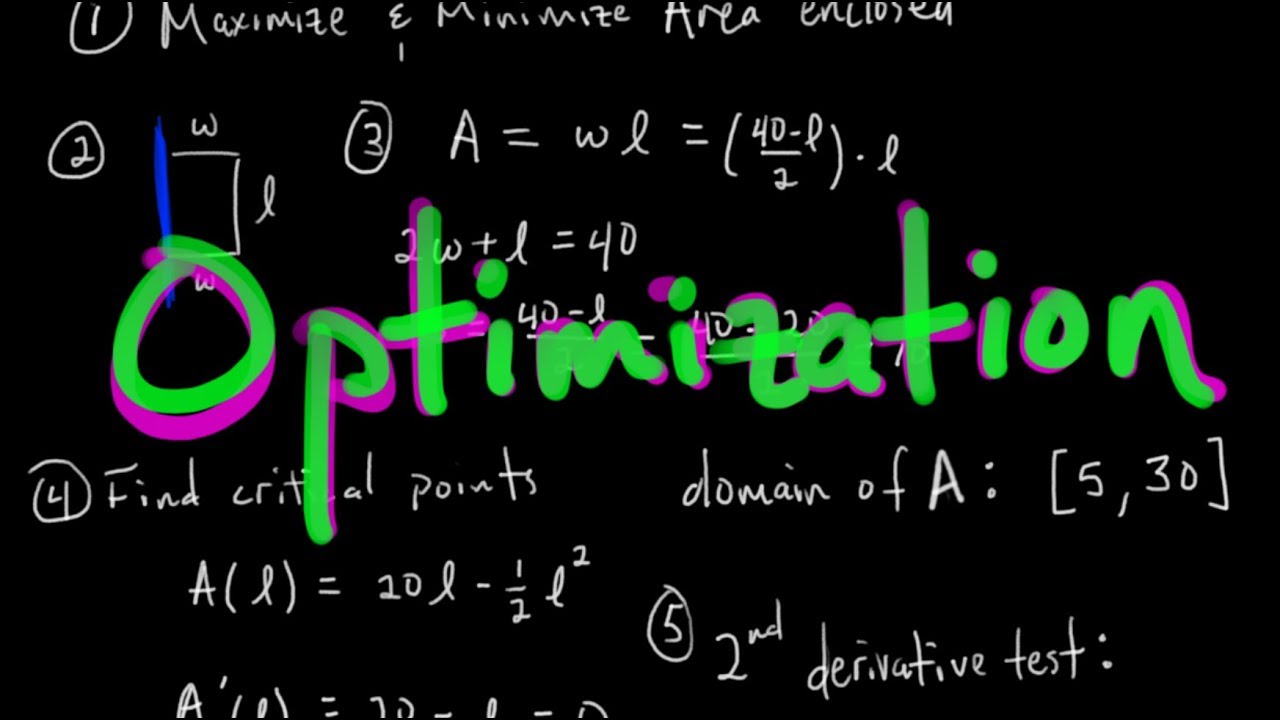
Optimization problems are like men. They're all the same amirite?
hello?
Sorry my keyboard is not working
ok my keyboard works again
I'll send the work I did so far

did I mess up by calculating the cost
I think the optimization is asking for minimizing price so that's what I went for
whole geyser
its an open top, so you have 1 wl
cunning raven
is the next part finding the derivative?
what's the fastest way of finding critical number?
whole geyser
alright. have fun. see you later
cunning raven
second derivative test?
yeah my bad for bad wording
that's what I meant
yeah but the domain of w kind of debunks that
ignore waht i just typed
wait but isn't this the normal function
don't we find =0 for derivative
function with no derivative applied
but don't I find c'(w) = 0 for critical number
c(w) = 30w^2 + 270/w
this isn't c'(w)
this is so weird

the problem is w is a really nasty number
i calculated
I got 1.6509
ok
alright
ocean sealBOT
 cunning raven
wait is 3/cuberoot(6) actually correct?
yeah
but within the cuberoot you still have a 10
how did you take that out
I'm ad
bad*
how do I do the 2nd derivative test on c''(w)?
is w' 3/cuberoot(6)?

@tough hatch
after this do i just sub w back into cost equation
well i see that it's addition statement
and w itself is pos
ok
I think im correct to assume that it is minimum
what do i do next?
yeah
sorry for bad wording
ok

ah right
I got 245.3 rounded
aight
this one is actually tricky af

thanks a lot for the help so far
sorry if I'm being a bother
 tawny condor
@cunning raven Do you know trigonometry?
tawny condor
okay

Mark the small side as x, as in the picture
You know the angle is 60 degrees.
Now using x and L, find the area of the rectangle, and use that to find for what x the area is largest.
cunning raven
tawny condor
Now using x and L, find the area of the rectangle, and use that to find for what...
alright lemme work on it
this is what I have so far. I am stuck
 tawny condor
You are making this too complicated
w is indeed L - 2x
but for the other side of the rectangle, just look at the small triangle on the bottom right
You have an angle, and a side. you should be able to use that to find the side of the rectangle
cunning raven
I'm sorry I don't get what you are saying
cunning raven
tawny condor
You have an angle, and a side. you should be able to use that to find the side o...
how do you use the triangle at the rihgt to solve for w?
cunning raven
but that's h
the small triangle doesn't encompass w
I have no idea what a degenerate rectangle is
tawny condor
@cunning raven Use the angle, 60
and the side x
in the small triangle
to find the side you need
with trigonometry
@tough hatch I think you're just overcomplicating this
Idk
cunning raven
oh frick did you mean make a small triangle with the rectangle
tawny condor
Like
That's not what they asked about tho
They are trying to find the area with L and x
I didn't say you were
@cunning raven

In this triangle
 cunning raven
I'm confused about how to find the top and bottom of the rectangle
yeah mb
that was on me
should have used tan
 cunning raven
tawny condor
subtract the 2 small sides, from the whole side of the triangle
cunning raven
tawny condor
subtract the 2 small sides, from the whole side of the triangle
isn't that just l-2x
tawny condor
Yeah
tawny condor
No
L is a constant
they want the answer to have L in it
Just look at L as a number, not a variable
cunning raven
dfaq
tawny condor
It's like
instead of giving you a side of 3
they want to generalize it
so call the side "L"
Refer to L as a number
cunning raven
how are you supposed to do 2nd derivative test with that abomination?
tawny condor
You don't need a second derivative test
Only first
but okay
lets say
you need to take the derivative of
L * x
what would that be?
cunning raven
but isn't 2nd derivative test more clean
cunning raven
tawny condor
what would that be?
L
tawny condor
cunning raven
but isn't 2nd derivative test more clean
sometimes no
tawny condor
cunning raven
L
great
cunning raven
tawny condor
sometimes no
how do you test first derivative
cunning raven
k
cunning raven
tawny condor
I'll show you when you get there
Are you sure this is what I'm supposed to do
 tawny condor
the side is not x/tan(60)
Also...
tan(60) has a value
use your calculator
or just use ur head
An angle of 60 forms the golden right triangle
90 60 30
cunning raven
tawny condor
now find h again
 tawny condor
good job!
now
the only thing you need to do, is show that this is the maximum point, right?
cunning raven
right so 2nd derivative test or 1st?
tawny condor
there is no 1st test or whatever
it's logic
look at the original area
and multiply out the brackets
You get
-2sqrt(3)x^2 + sqrt(3)Lx
this is a parabola.
cunning raven
ah
tawny condor
and since there is a negative in front of the x^2
it will face down
which means that the critical point must be a maximum
you can do a second derivative test if you want
Anyways, now all that's left is to calculate the sides of the rectangle when x = L/4
cunning raven
w = L-2x
cunning raven
tawny condor
Anyways, now all that's left is to calculate the sides of the rectangle when x =...
is the final answer
x = L/4
y = L/2
cunning raven
mbmb
cunning raven
tawny condor
now find the other one
h = Lsqrt(3)/4
cunning raven
tawny condor
question done!
ty
tawny condor
np! :D
cunning raven
tawny condor
np! :D
One more question, how would you set up the equations for this problem?
 tawny condor

I would mark this as x.
That way, you have the whole bottom side (x + 4) and you can find the height of the building to the ladder
(By using similar triangles)
Then, once you have the 2 sides, use Pythagoras theorem to find L.
You always need to mark a variable, find what you need the maximum/minimum of using that variable,
Find the derivative,
Find the critical point of the variable you marked,
And then you know for what value of it, what you needed is maximum/minimum.
cunning raven
tawny condor
(By using similar triangles)
don't you need theta to use similar triangles?
tawny condor
theta?
cunning raven
angle
tawny condor
Similar triangles. Not trigonometry.
cunning raven
how do you use similar triangles again?
 cunning raven
yup
tawny condor
the ratio of their length is always the same.
So:
AB/AD = BC/ED
which is also equal to AC/AE
But you don't need that part
cunning raven
tawny condor
the ratio of their length is always the same.
I see that's cool
cunning raven
tawny condor
the ratio of their length is always the same.
wait this is a bit wack
 cunning raven
tawny condor
simplify what's inside the exponent
cunning raven
tawny condor
simplify what's inside the exponent
is that even possible?
tawny condor
Ok let me try then
tawny condor
okay I see what you mean
cunning raven
tawny condor
okay I see what you mean
yeah
I thought that it'd be more nice to just derivative them in square form
cunning raven
frick how does chain rule go again
yeah it was not done
I panicked after seeing its scale
tawny condor
okay thats
weird
I don't think you're supposed to get this kind of derivative.
Let me see where is the problem.
cunning raven
thanks I also think this is sus


 cunning raven
holy frick that looks cancer
tawny condor
The real problem is the derivative of the inside.
Maybe this is how they want him to do it, if so they are evil...
I don't see a better way to do this.
OH
@cunning raven
There is something called thales theorem
Did you learn that?
cunning raven
never
tawny condor
tawny condor
Look back here
oh wait.
gimme a sec
I got this for the length

to be honest I don't know
yeah right
nothing cancels out bro
Oh
(4+x)^2 you mean?
The squared cancels.
So?
Tell me
What cancels out?
@cunning raven You'd have to do it that way. Just take the derivative and compare it to 0 I guess.
Oh so yeah
I mean cool
cunning raven
I'm so confused
tawny condor
But 1. that doesn't make it that much better
- I don't think we even need to open the parenthesis there.
tawny condor
cunning raven
wait this is a bit wack
Take what you got there, multiply with the derivative of the inside
Don't touch what's inside the exponent, when you compare it to 0 it doesn't matter.
Anyways, I have to go
cunning raven
aight thanks for the help
tawny condor
good luck with that monstrosity
cunning raven
what does it look like?
I kind of have to somewhat expand for chain

what I have so far
how do you product rule thi
yeah
f'g + g'f
ocean sealBOT


 cunning raven
I'm sorry would you mind showing me how you got here step by step
I'm kinda noob
also what do you mean when you say radicand?
I'm honestly confused at how you bypassed chainrule
yeah
ok
but you still need to multiply the others via chain

 cunning raven
Sorry my keyboard is going nuts again
ok it's back
thanks for the hard work trying to get that damn bot to compile
ocean sealBOT
 cunning raven
ocean seal
cunning raven
ocean seal
do you just ignore the square root at the very outside?
ocean sealBOT
 cunning raven
ocean seal
cunning raven
ocean seal
what about here then
it's missing the square root at the very outside?
so we're ignoring the first part of the chain basically for now
im noob at math
OHHHHHHH
I get it now
ocean sealBOT

 ocean sealBOT
 cunning raven
yeah
but again im questioning if the problem intended on the derivative to be this complicated
yeah i see that
are you sure that this is the only way to solve this question?
or if the approach is even correct to begin with?
yeah i see this way
I'm confused why they put something like this in Calc1
is there a more easy/simple way
wo
w
how do I test the crit number after this?
yeah
cunning raven
ocean seal
how did you go from this
cunning raven
ocean seal
to this?
the other one is the simplified ?
I see
the numerator is also unpleasant
ocean sealBOT
 cunning raven
I honestly just
yeah I see
yeah, if you don't mind, can you help me with this one? I'm on my last submission attempt on my webassign so if I get this question wrong 1 more time I lose permanent marks.
no
webassign is hw

I have to use the
dy/dx = (dy/dt)/(dx/dt) thing
I know I got (dx/dy) correct
but (d^2y/dx^2) is
aafdasdf
I already submitted wrong (d^2y/dx^2) 4 times
I'm on my last submission attempt
ocean sealBOT
 ocean sealBOT
 cunning raven
uh
this is also complicated method
yeah
yeah but how do i know that it's the actual answer
im trying it right now
My keyboard is problematic again
f(x)=lnx(1/x)
dy/dx = (1/x^2)(1-lnx)

aight

is this the correct answer 100%?
if you don't mind can you help me check for this one?
i can't hand it in wrong
aight ty
hello?
which two?
aight
THanks a lot. Do you mind answering one last quick question?

for the same question
this was the line of thinking i was going through
but idk about the interval part
how do i determine that? set it equal to 0?
I see, and how do I pinpoint that?
I'm talking abotu like systemic and structured approach
ah right thanks for jogging my memory
so the deciding point is whether t is greater than or smaller than 3/2
so is the answer (3/2, infinity)?
so it's better to transform the derivative to be in terms of x then solve?
i see.
Aight I gtg now. Thanks a lot for the help.
lone heartBOT
@cunning raven Has your question been resolved?
Channel closed
Closed by @cunning raven
Use .reopen if this was a mistake.
Available help channel!
Send your question here to claim the channel.
Remember:
• Ask your math question in a clear, concise manner.
• Show your work, and if possible, explain where you are stuck.
• After 15 minutes, feel free to ping <@&286206848099549185>.
• Type the command .close to free the channel when you're done.
• Be polite and have a nice day!
Read #❓how-to-get-help for further information on how to ask a good question, and about conduct in the question channels.
lone heartBOT
@thin osprey Has your question been resolved?
lone heartBOT
Channel closed
Closed due to the original message being deleted
Available help channel!
Send your question here to claim the channel.
Remember:
• Ask your math question in a clear, concise manner.
• Show your work, and if possible, explain where you are stuck.
• After 15 minutes, feel free to ping <@&286206848099549185>.
• Type the command .close to free the channel when you're done.
• Be polite and have a nice day!
Read #❓how-to-get-help for further information on how to ask a good question, and about conduct in the question channels.
devout summit
Modifying it to A(x-h)+B(y-k)+C=0
devout summit
devout summit
Modifying it to A(x-h)+B(y-k)+C=0
Changing h shifts the line left or right. While k allows up and down movement
I understand
Suppose you wanted to shift the line Ax+By+C=0 left "h" units without changing slope, the new equation would be
A(x+h)+By+C=0
Umm you mean changing C to C+Ah?
Yes that would shift your line left by "h" units
Yes sure. Negative values of h in
A(x+h)+By+C=0 shifts to h units right
lone heartBOT
Channel closed
Closed by @rigid mesa
Use .reopen if this was a mistake.
lone heartBOT
Available help channel!
Send your question here to claim the channel.
Remember:
• Ask your math question in a clear, concise manner.
• Show your work, and if possible, explain where you are stuck.
• After 15 minutes, feel free to ping <@&286206848099549185>.
• Type the command .close to free the channel when you're done.
• Be polite and have a nice day!
Read #❓how-to-get-help for further information on how to ask a good question, and about conduct in the question channels.
 zinc hamlet
Hello
lone heartBOT
zinc hamlet
Hello
zinc hamlet
I need help with going to polar coordinates. I have x^2 + y^2 = a^2
But i want to use sqrt(x) = r cos (phi) and the similar to y
And my question would be about radiuss, if I use this substitution, then radiuss = sqrt(a) or i have to calculate putting everything in x^2 + y^2 = a^2 ?
I tried putting x = r^2 cos^2 (phi) and y = r^2 sin^2 (phi) in x^2 + y^2 = a^2 and tried to plot it, but it did not look similar to a circle
For more context, I need to integrate region bounded by z^2 = x*y and x^2 + y^2 = a^2. Just using x = r cos phi and y = r sin (phi) gives me an awful integral I dont know how to integrate, therefore I am using different substitution, but now I cant figure out the upper limit for radius
<@&286206848099549185>
lone heartBOT
@zinc hamlet Has your question been resolved?
lone heartBOT
@zinc hamlet Has your question been resolved?
Channel closed
Closed by @zinc hamlet
Use .reopen if this was a mistake.
zinc hamlet
.close
lone heartBOT
Available help channel!
Send your question here to claim the channel.
Remember:
• Ask your math question in a clear, concise manner.
• Show your work, and if possible, explain where you are stuck.
• After 15 minutes, feel free to ping <@&286206848099549185>.
• Type the command .close to free the channel when you're done.
• Be polite and have a nice day!
Read #❓how-to-get-help for further information on how to ask a good question, and about conduct in the question channels.
@desert zephyr Has your question been resolved?
lone heartBOT
@desert zephyr Has your question been resolved?
 vivid crater
 late bridge
what's stoping you from arguing that since $\langle w , g\circ f (u)\rangle = 0 $ it is the case that $\langle f^{\star}\circ g^{\star}(w) , u\rangle = 0$
ocean sealBOT
Brun。
 late bridge
genuine question, idk if that does it
lone heartBOT
@desert zephyr Has your question been resolved?
lone heartBOT
Channel closed
Closed due to timeout
Use .reopen if this was a mistake.
Available help channel!
Send your question here to claim the channel.
Remember:
• Ask your math question in a clear, concise manner.
• Show your work, and if possible, explain where you are stuck.
• After 15 minutes, feel free to ping <@&286206848099549185>.
• Type the command .close to free the channel when you're done.
• Be polite and have a nice day!
Read #❓how-to-get-help for further information on how to ask a good question, and about conduct in the question channels.
 pliant sonnet
someone can help me to understand linear functions
 icy trail
hmm, what specifically
 alpine sable
@pliant sonnet


 lone heartBOT
@pliant sonnet Has your question been resolved?
lone heartBOT
@pliant sonnet Has your question been resolved?
Channel closed
Closed by @pliant sonnet
Use .reopen if this was a mistake.
Available help channel!
Send your question here to claim the channel.
Remember:
• Ask your math question in a clear, concise manner.
• Show your work, and if possible, explain where you are stuck.
• After 15 minutes, feel free to ping <@&286206848099549185>.
• Type the command .close to free the channel when you're done.
• Be polite and have a nice day!
Read #❓how-to-get-help for further information on how to ask a good question, and about conduct in the question channels.
 wide plaza
I need to prove triangle LJM congruent to triangle LNK using one of the triangle congruency theorems. (SSS, ASA, SAS, AAS, or HL). I can't figure out how though... 
 lone heartBOT
wide plaza
I need to prove triangle LJM congruent to triangle LNK using one of the triangle...
devout summit
wide plaza
I need to prove triangle LJM congruent to triangle LNK using one of the triangle...
lone heartBOT
wide plaza
I need to prove triangle LJM congruent to triangle LNK using one of the triangle...
devout summit
wide plaza
I need to prove triangle LJM congruent to triangle LNK using one of the triangle...
EFC CDF? Is it a different question?
devout summit
Better
wide plaza
So.... What do I do, precisely?
devout summit
There is also an angle between the sides which is common
Namely, angle JLM and NLK
devout summit
Right. I edited it to NLK
Now that a pair of sides and an angle between them are shown to have equal measures, which test should we use? @wide plaza
lone heartBOT
@wide plaza Has your question been resolved?
wide plaza
devout summit
Now that a pair of sides and an angle between them are shown to have equal measu...
omg im so sorry
euclid
im back now
wide plaza
devout summit
Now that a pair of sides and an angle between them are shown to have equal measu...
wdym by test?
@devout summit
devout summit
wide plaza
wdym by test?
Congruency theorems
wide plaza
devout summit
Congruency theorems
so the pair of sides are lm and lk right?
devout summit
Pair of sides congruent are just the ones already given (in the problem)
LM, LK and LN,LJ
wide plaza
hmm
wide plaza
devout summit
Pair of sides congruent are just the ones already given (in the problem)
ok yea i get that
devout summit
devout summit
Now that a pair of sides and an angle between them are shown to have equal measu...
So which theorem?
lone heartBOT
@wide plaza Has your question been resolved?
lone heartBOT
Channel closed
Closed due to timeout
Use .reopen if this was a mistake.
Available help channel!
Send your question here to claim the channel.
Remember:
• Ask your math question in a clear, concise manner.
• Show your work, and if possible, explain where you are stuck.
• After 15 minutes, feel free to ping <@&286206848099549185>.
• Type the command .close to free the channel when you're done.
• Be polite and have a nice day!
Read #❓how-to-get-help for further information on how to ask a good question, and about conduct in the question channels.
 dire crown
Can someone give me a quick explanation of what indefinite integrals are? I under stand how normal integrals work.
lone heartBOT
dire crown
Can someone give me a quick explanation of what indefinite integrals are? I unde...
 pine kettle
I have not learned integrals from a teacher yet but isn't the indefinite integral where you add C to your antiderivative because