#help-0
1 messages · Page 879 of 1
 novel spruce
almost, that double counts the corners
it would be 9 + 9 + 7 + 7 = 32 which is none of the above I think
since you count the top and bottom, then count the sides but don't doublecount the corners
 novel spruce
¯_(ツ)_/¯
 maiden urchin
now you're not counting the corners at all
novel spruce
oh well, it depends if the path is inside or outside the lawn
yeah i'm wrong
so I guess it would be 11 + 11 + 9 + 9 = 40 by the same reasoning, except the path is on the outside
 lone heartBOT
@hard ether Has your question been resolved?
Channel closed
Closed by @hard ether
Use .reopen if this was a mistake.
 Available help channel!
Send your question here to claim the channel.
Remember:
• Ask your math question in a clear, concise manner.
• Show your work, and if possible, explain where you are stuck.
• After 15 minutes, feel free to ping <@&286206848099549185>.
• Type the command .close to free the channel when you're done.
• Be polite and have a nice day!
Read #❓how-to-get-help for further information on how to ask a good question, and about conduct in the question channels.
 lone heartBOT
 shy loom
https://cdn.discordapp.com/attachments/565126024736538624/903820308132286474/unk...
shy loom
https://cdn.discordapp.com/attachments/565126024736538624/903820308132286474/unk...
 hard ether
maybe factorise it?
 glass lichen
that's completely different to simplify.........
shy loom
idk
glass lichen
can you post the question verbatum then?
shy loom
ok hang on
glass lichen
The actual question should be posted from the getgo as well
 visual bolt
Function is undefined so no solutions?
glass lichen
visual bolt
Function is undefined so no solutions?
not true.
shy loom
"find the domain of the following functions"
glass lichen
Ok so what have you tried?
glass lichen
well.... do you know what the domain of a function is..?
that'd be a good place to start, understanding the question
shy loom
tbh i have no idea what the domain is but i know what it does
 alpine sable
shy loom
uh like the range..?
alpine sable
shy loom
uh like the range..?
yes, domain is similar to range
glass lichen
shy loom
tbh i have no idea what the domain is but i know what it does
so google it.. or check your notes
lone heartBOT
Channel closed
Closed by @shy loom
Use .reopen if this was a mistake.
lone heartBOT
Available help channel!
Send your question here to claim the channel.
Remember:
• Ask your math question in a clear, concise manner.
• Show your work, and if possible, explain where you are stuck.
• After 15 minutes, feel free to ping <@&286206848099549185>.
• Type the command .close to free the channel when you're done.
• Be polite and have a nice day!
Read #❓how-to-get-help for further information on how to ask a good question, and about conduct in the question channels.
 broken pine
can someone help me on this problem? I don't know where to start nor do the problem!
 lone heartBOT
broken pine
can someone help me on this problem? I don't know where to start nor do the prob...
broken pine
lone heartBOT
broken pine
can someone help me on this problem? I don't know where to start nor do the prob...
broken pine
ping me if anyone's gonna help
lone heartBOT
@broken pine Has your question been resolved?
broken pine
<@&286206848099549185> please help!
alpine sable
where can I ask questions?
alpine sable
ty bro
broken pine
np

 astral dagger
main thing to note
the distance from any point of a triangle to its circumcenter is constant
https://www.cuemath.com/geometry/circumcenter/ this may help you

Circumcenter of triangle is the point where three perpendicular bisectors from the sides of a triangle intersect or meet. Learn more about this interesting concept of circumcenter of triangle, its methods, and solve a few examples.
 bright swallow

 charred flint
@bright swallow use an available help channel above
broken pine
alpine sable
ty
lone heartBOT
@broken pine Has your question been resolved?
broken pine
<@&286206848099549185> pleaaaase hellllppppp
broken pine
broken pine
can someone help me on this problem? I don't know where to start nor do the prob...
.
.close
lone heartBOT
Channel closed
Closed by @broken pine
Use .reopen if this was a mistake.
lone heartBOT
Available help channel!
Send your question here to claim the channel.
Remember:
• Ask your math question in a clear, concise manner.
• Show your work, and if possible, explain where you are stuck.
• After 15 minutes, feel free to ping <@&286206848099549185>.
• Type the command .close to free the channel when you're done.
• Be polite and have a nice day!
Read #❓how-to-get-help for further information on how to ask a good question, and about conduct in the question channels.
 jaunty onyx
hi! would just like to ask help for this question on ideals of gaussian integers
lone heartBOT
jaunty onyx
hi! would just like to ask help for this question on ideals of gaussian integers
jaunty onyx
my thoughts are i can do two things
which is correct? and if lcm, how do i get the lcm of two gaussian integers? tia!
<@&286206848099549185>
lone heartBOT
@jaunty onyx Has your question been resolved?
jaunty onyx
<@&286206848099549185> please sorry
lone heartBOT
@jaunty onyx Has your question been resolved?
 vale wigeon
@jaunty onyx still here?
jaunty onyx
vale wigeon
<@789058235704934400> still here?
hi yes sorry
still no luck
my thoughts now are
the lcm and the product are associates
so it doesn't really matter which one i choose
is this the right way to think about this problem @vale wigeon ? thank you!
vale wigeon
the lcm and the product are not associates
this isn't even true in Z
just find the gcd with the Euclidean algo
then get the lcm by lcm(a,b) = ab/gcd(a,b)
at each step in the division process, do the division as in C, then round to the nearest Gaussian integer
lone heartBOT
Channel closed
Closed by @jaunty onyx
Use .reopen if this was a mistake.
Available help channel!
Send your question here to claim the channel.
Remember:
• Ask your math question in a clear, concise manner.
• Show your work, and if possible, explain where you are stuck.
• After 15 minutes, feel free to ping <@&286206848099549185>.
• Type the command .close to free the channel when you're done.
• Be polite and have a nice day!
Read #❓how-to-get-help for further information on how to ask a good question, and about conduct in the question channels.
 upper escarp
 lone heartBOT
upper escarp
lone heartBOT
upper escarp
 lone heartBOT
Channel closed
Closed by @upper escarp
Use .reopen if this was a mistake.
Available help channel!
Send your question here to claim the channel.
Remember:
• Ask your math question in a clear, concise manner.
• Show your work, and if possible, explain where you are stuck.
• After 15 minutes, feel free to ping <@&286206848099549185>.
• Type the command .close to free the channel when you're done.
• Be polite and have a nice day!
Read #❓how-to-get-help for further information on how to ask a good question, and about conduct in the question channels.
alpine sable
 lone heartBOT
alpine sable
alpine sable
lone heartBOT
alpine sable
alpine sable
i tried to solve this problem, however my answer isn't the same as the one in the textbook
textbook answer

answer i got
 lone heartBOT
@alpine sable Has your question been resolved?
lone heartBOT
Channel closed
Closed due to timeout
Use .reopen if this was a mistake.
lone heartBOT
Available help channel!
Send your question here to claim the channel.
Remember:
• Ask your math question in a clear, concise manner.
• Show your work, and if possible, explain where you are stuck.
• After 15 minutes, feel free to ping <@&286206848099549185>.
• Type the command .close to free the channel when you're done.
• Be polite and have a nice day!
Read #❓how-to-get-help for further information on how to ask a good question, and about conduct in the question channels.
 delicate crescent
 lone heartBOT
delicate crescent
delicate crescent
lone heartBOT
delicate crescent
delicate crescent
not sure how to do (a)
any help is appreciated
i see
thanks for helping
.close
lone heartBOT
Channel closed
Closed by @delicate crescent
Use .reopen if this was a mistake.
Available help channel!
Send your question here to claim the channel.
Remember:
• Ask your math question in a clear, concise manner.
• Show your work, and if possible, explain where you are stuck.
• After 15 minutes, feel free to ping <@&286206848099549185>.
• Type the command .close to free the channel when you're done.
• Be polite and have a nice day!
Read #❓how-to-get-help for further information on how to ask a good question, and about conduct in the question channels.
 wispy olive
Is the number of terms in an Arithmetic Sequence = ((First Term + Last Term)/Common Difference) + 1?
lone heartBOT
wispy olive
Is the number of terms in an Arithmetic Sequence = ((First Term + Last Term)/Com...
alpine sable
no it should be ((last term-first term)/common difference)+1
think about the equation un = u1 + (n-1)d
rearrange it for n
wispy olive
Shit that's what I meant.
I wrote that in the notebook and asked the wrong thing here 😂 .
Thanks.
lone heartBOT
Channel closed
Closed by @wispy olive
Use .reopen if this was a mistake.
Available help channel!
Send your question here to claim the channel.
Remember:
• Ask your math question in a clear, concise manner.
• Show your work, and if possible, explain where you are stuck.
• After 15 minutes, feel free to ping <@&286206848099549185>.
• Type the command .close to free the channel when you're done.
• Be polite and have a nice day!
Read #❓how-to-get-help for further information on how to ask a good question, and about conduct in the question channels.
 wary zodiac
How do u integrate 1/(x+1)^2
lone heartBOT
wary zodiac
How do u integrate 1/(x+1)^2
wary zodiac

 devout summit
wary zodiac
How do u integrate 1/(x+1)^2
devout summit
wary zodiac
How do u integrate 1/(x+1)^2
You know how to perform substitution?
devout summit
Yes
wary zodiac
Is that how u solve it
wary zodiac
So -(x+1)^-1?
devout summit
Yep!
wary zodiac
Thanks mate
devout summit
+C at the end
lone heartBOT
Channel closed
Closed by @wary zodiac
Use .reopen if this was a mistake.
lone heartBOT
Available help channel!
Send your question here to claim the channel.
Remember:
• Ask your math question in a clear, concise manner.
• Show your work, and if possible, explain where you are stuck.
• After 15 minutes, feel free to ping <@&286206848099549185>.
• Type the command .close to free the channel when you're done.
• Be polite and have a nice day!
Read #❓how-to-get-help for further information on how to ask a good question, and about conduct in the question channels.
 foggy raven
Hello, may I ask for help. how do I solve the equation for the area of this graph using integrals?
 lone heartBOT
foggy raven
Hello, may I ask for help. how do I solve the equation for the area of this grap...
foggy raven
lone heartBOT
foggy raven
Hello, may I ask for help. how do I solve the equation for the area of this grap...
foggy raven
Is it safe to assume that both fuctions are sine waves rotated 90 degrees?
devout summit
Are exact specifications given?
foggy raven
No
devout summit
Then how could you even determine the exact area?
foggy raven
We don't need to determine the exact area, just find the equation for it
devout summit
foggy raven
Is it safe to assume that both fuctions are sine waves rotated 90 degrees?
But you can’t assume this
foggy raven
hm... I'll keep exploring
devout summit
You can write an expression though\\$\int_c^d(f(y)-g(y)),dy$
 ocean sealBOT
Euclid31415
 foggy raven
devout summit
You can write an expression though\\\\$\int_c^d(f(y)-g(y))\,dy$
foggy raven
devout summit
You can write an expression though\\\\$\int_c^d(f(y)-g(y))\,dy$
I see, thanks, I'll watch thishttps://www.youtube.com/watch?v=kgg5Rspf1Js for further explanation

This calculus video tutorial provides a basic introduction in finding the area between two curves with respect to y and with respect to x. It explains how to set up the definite integral to calculate the area of the shaded region bounded by the two curves. In order to find the points of intersection, you need to set the two curves equal to eac...
I'll close this now
.close
lone heartBOT
Channel closed
Closed by @foggy raven
Use .reopen if this was a mistake.
Available help channel!
Send your question here to claim the channel.
Remember:
• Ask your math question in a clear, concise manner.
• Show your work, and if possible, explain where you are stuck.
• After 15 minutes, feel free to ping <@&286206848099549185>.
• Type the command .close to free the channel when you're done.
• Be polite and have a nice day!
Read #❓how-to-get-help for further information on how to ask a good question, and about conduct in the question channels.
 mortal mantle
im not sure how i should approach this question
 mortal mantle
what i do understand is taht since we are finding the volume about the y axis, my interval would be [0,1]
but i get stumped from here, would i have to find the integral of y=1/4x^2?
i believe this comes into play but translating it to here is the problem for me

well i think im just supposed to find the integral of 1/4x^2
 dull oak
 mortal mantle
but ive tried and i got it incorrect
i used an online calculator
but i can snip it

and that gives me 3.9875
which cant be right if you look at the graph
oh yeah i include pi
but taht would make it an even greater number lol
 obsidian crane
mortal mantle
but i get stumped from here, would i have to find the integral of y=1/4x^2?
obsidian crane
mortal mantle
but i get stumped from here, would i have to find the integral of y=1/4x^2?
It's the same shape if you rotate it about the y axis 
devout summit
mortal mantle
im not sure how i should approach this question
Third of all, we are rotating about y-axis and not the x-axis
obsidian crane
I'm guessing the area will be = integral between (0, 2)
mortal mantle
so when we rotate about the y axis, the bound would be like this ?
 obsidian crane
shouldn't it be this ? (after rotating) I might be wrong
 devout summit
mortal mantle
im not sure how i should approach this question
devout summit
mortal mantle
im not sure how i should approach this question
Rotating y=1/4 x^2 about y axis gives a paraboloid
mortal mantle
yeah so i would just have to find the integral of pi(1/4x^2)^2
over the bound [0,2]
devout summit
mortal mantle
yeah so i would just have to find the integral of pi(1/4x^2)^2
It isn’t right
mortal mantle
oh wait sqrt(4y)^2
devout summit
Yes
mortal mantle
oh let me try this
obsidian crane
Its important to note you have to rotate the bounded region and also the graph of this parabola is symmetrical about the y axis.
devout summit
So basically, it looks like a cylinder with a paraboloid dent on it
mortal mantle
i got this but im not sure if it is right
 devout summit
It would be\\$\int_0^1\pi(2)^2,dy-\int_0^1\pi(\sqrt{4y})^2,dy$
ocean sealBOT
Euclid31415
 mortal mantle
let me try this out hold on
i got it!
but let me understand
so when it says we have to rotate about the y axis, we must make everythin in our equation in terms of y right ?
i think i may have forgotten to pi on the two before i came here ;/
but thank you for the help guys, appreciate it
.close
lone heartBOT
Channel closed
Closed by @mortal mantle
Use .reopen if this was a mistake.
lone heartBOT
Available help channel!
Send your question here to claim the channel.
Remember:
• Ask your math question in a clear, concise manner.
• Show your work, and if possible, explain where you are stuck.
• After 15 minutes, feel free to ping <@&286206848099549185>.
• Type the command .close to free the channel when you're done.
• Be polite and have a nice day!
Read #❓how-to-get-help for further information on how to ask a good question, and about conduct in the question channels.
alpine sable
if i have a right triangle, will every median to the hypotenuse be equal the 2 parts that it created?
lone heartBOT
alpine sable
if i have a right triangle, will every median to the hypotenuse be equal the 2 p...
 rigid smelt
yes, because the circumcentre of a right triangle is always at the midpoint of its hypotenuse
 dreamy needle
Hello 👋, got a question about asymptotes, its been a while for me and I cant seem to work out how to find the vertical asymptote of (x^2+4x)/(x^2)
The Horizontal is 1 and the Vertical is the denominator set to 0 but it doesnt make sense as its just x^2
alpine sable
dreamy needle
Hello 👋, got a question about asymptotes, its been a while for me and I cant se...
Please make sure to open a new channel instead of taking someone elses
But to answer your question quickly, you do just set it equal to 0 and so the vertical asymptote is x=0 because when you do x^2 = 0 and solve for x, you will get 0
lone heartBOT
@alpine sable Has your question been resolved?
lone heartBOT
Channel closed
Closed due to timeout
Use .reopen if this was a mistake.
lone heartBOT
Available help channel!
Send your question here to claim the channel.
Remember:
• Ask your math question in a clear, concise manner.
• Show your work, and if possible, explain where you are stuck.
• After 15 minutes, feel free to ping <@&286206848099549185>.
• Type the command .close to free the channel when you're done.
• Be polite and have a nice day!
Read #❓how-to-get-help for further information on how to ask a good question, and about conduct in the question channels.
 gilded ridge
im cofused on it all pls help there is many questions i need help with

 robust geode
Say your questions then
 mighty sinew
Just replace the values in the expression
lone heartBOT
@gilded ridge Has your question been resolved?
Channel closed
Closed by @gilded ridge
Use .reopen if this was a mistake.
robust geode
🤔
lone heartBOT
Available help channel!
Send your question here to claim the channel.
Remember:
• Ask your math question in a clear, concise manner.
• Show your work, and if possible, explain where you are stuck.
• After 15 minutes, feel free to ping <@&286206848099549185>.
• Type the command .close to free the channel when you're done.
• Be polite and have a nice day!
Read #❓how-to-get-help for further information on how to ask a good question, and about conduct in the question channels.
 balmy zinc
hi i dont know how to do this, btw this is transformation of functions

 bold summit
ok sorry
robust geode
If you want information on how to get help, feel free to see #❓how-to-get-help
 next chasm
Im not sure if im right but shouldnt it be something like 1 + 2/(x-2)
robust geode
Desmos is for sure a good tool for learning how things change by what you put
For example, you want y=1/x to be shifted to the right by 2 units
Well that means that for example, the forbidden value 0 wouldn't be at 0 anymore, but at ...
2 !
robust geode
That's why Davo wrote "x-2" at the bottom
Because 2-2=0 and that's a no no for your function
next chasm
And same goes for left
If you got x
You add +1 to it
For each unit you go left
Think of it this way, if x intercept is at 10 for example
In a graph
If you move it 1 unit to the right
So x-1
The intercept is at 11
Since you need x+1 instead of x to intercept
And before the changes it was at 10
Like here teachers used to explain it that way for students who didnt understand, if you dont get it its fine
But remember when it says left, +1 right, -1
And when it comes to stretching the graph
When it says vertically
It means to the y axis
So for example if before stretching when you have x=1 y=10, and you stretch it by a factor of 2, when x=1 y should be 20, and if you stretch it by a factor of 0.5 y should be 5
Up down basically +-
lone heartBOT
@balmy zinc Has your question been resolved?
next chasm
So like if in graph 1/x you got x =1 y =1 right
In the deformed graph
We got 1+ 2/(x-2)
robust geode
@balmy zinc Are you still there ? lol
next chasm
So it should be equal to -1
next chasm
robust geode
<@!483548485589925898> Are you still there ? lol
He prolly having a seizure after reading all my texts lmao
robust geode
Yeah that's what I'm thinking lol
balmy zinc
im a bit confused about vertically dilating and the difference with horizontal dilations on how you write it
next chasm
Horizontal means length wise
Vertical - height vise
So if it says horizontal dilitation
If at Y value you have X
Then after dilitation
At Y value you should have 2X
If you dilitate
By 2
next chasm
And this not your channel
 cunning prism
im confusion
next chasm
Not here
cunning prism
where then
next chasm
Open help channel
cunning prism
k ty
balmy zinc
thanks I understand it now
lone heartBOT
Channel closed
Closed by @balmy zinc
Use .reopen if this was a mistake.
next chasm
Np
lone heartBOT
Available help channel!
Send your question here to claim the channel.
Remember:
• Ask your math question in a clear, concise manner.
• Show your work, and if possible, explain where you are stuck.
• After 15 minutes, feel free to ping <@&286206848099549185>.
• Type the command .close to free the channel when you're done.
• Be polite and have a nice day!
Read #❓how-to-get-help for further information on how to ask a good question, and about conduct in the question channels.
 frozen tree
Hey this is a stupid question but
lone heartBOT
frozen tree
Hey this is a stupid question but
frozen tree
??
 quasi briar
frozen tree
Hey this is a stupid question but
quasi briar
frozen tree
Hey this is a stupid question but
What
frozen tree
.close
lone heartBOT
Channel closed
Closed by @frozen tree
Use .reopen if this was a mistake.
 slate kayak
Hi, what is the greek symbol called in math that looks like a Q
 vale sapphire
Ω ?
vale sapphire
σ ?
slate kayak
No
quasi briar
Not your channel btw
quasi briar
Okay but it isn’t open yet
vale sapphire
well technically it's not actually inactivated yet
vale sapphire
it's fine just go to another one and i'll be back
slate kayak
Okay
quasi briar
It’s okay just make sure u read rules because a lot of people seem to not be
 obsidian crane
-1 ?
 echo kelp
yes
quasi briar
echo kelp
can someone solve this
Not your channel
lone heartBOT
Available help channel!
Send your question here to claim the channel.
Remember:
• Ask your math question in a clear, concise manner.
• Show your work, and if possible, explain where you are stuck.
• After 15 minutes, feel free to ping <@&286206848099549185>.
• Type the command .close to free the channel when you're done.
• Be polite and have a nice day!
Read #❓how-to-get-help for further information on how to ask a good question, and about conduct in the question channels.
mighty sinew
Let $X=C^0([-a,a])$ be the space of functions continuous on $[-a,a]$ and let $T:X\to \mathbb{R}$ be a linear operator s.t. $Tf=f(0)$. Assuming $X$ has the $L^1$ norm, namely $||f||1 = \int{-a}^a |f(x)|,dx$ show that $T$ is not bounded.
lone heartBOT
mighty sinew
Let $X=C^0([-a,a])$ be the space of functions continuous on $[-a,a]$ and let $T:...
ocean sealBOT
Aram
 mighty sinew
I proved this for the sup norm, but the L1 norm beats me
vale sapphire
So you need to show that you can have an arbitrarily large value but still a finite integral, ie a finite area under the curve
i have a solution in mind, but i don't know how to hint at it
Okay, here's a hint : ||Use a triangle||
vale sapphire
And here's a hint that's almost the whole solution : ||k*1/k = 1 yet k isn't bounded||
precisely
mighty sinew
I actually thought about that, like a sequence of continuous functions that peaks at x=0 but is 0 everywhere else, but I figured the limit isn't continuous, idk if that's a problem
vale sapphire
no
all you need to show is that Tf can get arbitrarily large
You're not trying to show Tf can be infinite
mighty sinew
hm I see
vale sapphire
peaks at x=0 but is 0 everywhere else
close, but the point of the triangle is to have continuity
mighty sinew
yeah sure
so a function like 1-n|x|, |x|<1/n and 0 elsewhere basically
ah makes sense i guess
thx
.close
lone heartBOT
Channel closed
Closed by @mighty sinew
Use .reopen if this was a mistake.
Available help channel!
Send your question here to claim the channel.
Remember:
• Ask your math question in a clear, concise manner.
• Show your work, and if possible, explain where you are stuck.
• After 15 minutes, feel free to ping <@&286206848099549185>.
• Type the command .close to free the channel when you're done.
• Be polite and have a nice day!
Read #❓how-to-get-help for further information on how to ask a good question, and about conduct in the question channels.
 rough salmon
if i hv N amount of odd nums n M amount of even nums
 small bear
Look at the even numbers first, does it matter how many you have? What is the parity of that sum?
small bear
Yes, you notice that the even numbers always sum up to an even number
rough salmon
so odd amount of odd nums would give ya an odd sum ig
rough salmon
small bear
Yes, you notice that the even numbers always sum up to an even number
ya
thx
tiz server finally has the help channel functions lmao, i hv been for such a long time
ask in an unoccupied channel man
.close
lone heartBOT
Channel closed
Closed by @rough salmon
Use .reopen if this was a mistake.
Available help channel!
Send your question here to claim the channel.
Remember:
• Ask your math question in a clear, concise manner.
• Show your work, and if possible, explain where you are stuck.
• After 15 minutes, feel free to ping <@&286206848099549185>.
• Type the command .close to free the channel when you're done.
• Be polite and have a nice day!
Read #❓how-to-get-help for further information on how to ask a good question, and about conduct in the question channels.
 south kayak
Hello how can I know the exact 'definition' of a real life curve ? I need to describe the following chair so that anyone can replicate exactly as it is, and as it has quite a lot of curvy lines, I don't know how to describe them.
lone heartBOT
south kayak
Hello how can I know the exact 'definition' of a real life curve ? I need to des...
 static fern
sorry buddy

 maiden crow
 south kayak
ask in an occupied channel 😂
 oak chasm
maiden crow
oak chasm
maiden crow
Sorry, this channel is busy. Please ask in one of the channels directly under "Math Help (Available)".
lone heartBOT
@south kayak Has your question been resolved?
south kayak
eh? xd
 polar barn
south kayak
eh? xd
polar barn
south kayak
eh? xd
its a chair
not sure how i can describe that
OH
oh
you want to describe a real life curve? @south kayak
lone heartBOT
@south kayak Has your question been resolved?
lone heartBOT
Channel closed
Closed due to timeout
Use .reopen if this was a mistake.
lone heartBOT
Available help channel!
Send your question here to claim the channel.
Remember:
• Ask your math question in a clear, concise manner.
• Show your work, and if possible, explain where you are stuck.
• After 15 minutes, feel free to ping <@&286206848099549185>.
• Type the command .close to free the channel when you're done.
• Be polite and have a nice day!
Read #❓how-to-get-help for further information on how to ask a good question, and about conduct in the question channels.
 thorn kindle

lone heartBOT
thorn kindle
<:sotrue:826971355542192148>
lone heartBOT
@thorn kindle Has your question been resolved?
lone heartBOT
Channel closed
Closed due to timeout
Use .reopen if this was a mistake.
Available help channel!
Send your question here to claim the channel.
Remember:
• Ask your math question in a clear, concise manner.
• Show your work, and if possible, explain where you are stuck.
• After 15 minutes, feel free to ping <@&286206848099549185>.
• Type the command .close to free the channel when you're done.
• Be polite and have a nice day!
Read #❓how-to-get-help for further information on how to ask a good question, and about conduct in the question channels.
 whole path
The answer the book gave was 1:50000
What went wrong guys ?


 normal grail
hello , i want to understand math (algebra ) and using it. i am really good at math but i want to go deeper outside school can you recommend me some books i will really appreciate it and if you know about books to learn about functions (graph)
whole path
normal grail
hello , i want to understand math (algebra ) and using it. i am really good at...
Kindly go to an available section and ask your question there, thanks
lone heartBOT
@whole path Has your question been resolved?
Channel closed
Closed by @whole path
Use .reopen if this was a mistake.
lone heartBOT
Available help channel!
Send your question here to claim the channel.
Remember:
• Ask your math question in a clear, concise manner.
• Show your work, and if possible, explain where you are stuck.
• After 15 minutes, feel free to ping <@&286206848099549185>.
• Type the command .close to free the channel when you're done.
• Be polite and have a nice day!
Read #❓how-to-get-help for further information on how to ask a good question, and about conduct in the question channels.
slate kayak
 lone heartBOT
slate kayak
slate kayak
lone heartBOT
slate kayak
slate kayak
The plane V has a parametric description (1st one) & The line L has a parametric description (2nd one)
How do I prove that the line L is parallel to plane V?
lone heartBOT
@slate kayak Has your question been resolved?
devout summit
slate kayak
Equate both the parametric descriptions and see if there is a solution
slate kayak
You mean I should put the line numbers on one side and then put a “=“ and the plane numbers on the other side?
devout summit
I assume they have given a,b,c linearly independent
slate kayak
Yeah i think so
devout summit
slate kayak
You mean I should put the line numbers on one side and then put a “=“ and the pl...
Yes
slate kayak
Okay will do
devout summit
We are basically looking for the position vector of the point of intersection by equating
And since a,b,c are linearly independent, we can equate the coefficients of each of those separately!
slate kayak
Ah
devout summit
I have to go do some work now sorry
slate kayak
Okay bye
devout summit
devout summit
We are basically looking for the position vector of the point of intersection by...
If we show intersection does not exist we have shown both are parallel
slate kayak
Thnx for the help
I sitll dont know how to do it
This exercise is different from the others the others dont work with base base they just give the R3 equation instantly
Idk what to do
Ok byeee
.close
lone heartBOT
Channel closed
Closed by @slate kayak
Use .reopen if this was a mistake.
Available help channel!
Send your question here to claim the channel.
Remember:
• Ask your math question in a clear, concise manner.
• Show your work, and if possible, explain where you are stuck.
• After 15 minutes, feel free to ping <@&286206848099549185>.
• Type the command .close to free the channel when you're done.
• Be polite and have a nice day!
Read #❓how-to-get-help for further information on how to ask a good question, and about conduct in the question channels.
 rapid nova
Prove that $y^\frac{3}{5} \arcsin{\sqrt{\abs{x}}}$ is differentiable at $(0, 0)$
lone heartBOT
rapid nova
Prove that $y^\frac{3}{5} \arcsin{\sqrt{\abs{x}}}$ is differentiable at $(0, 0)$
ocean sealBOT
rept1d

 torpid delta
rapid nova
Prove that $y^\frac{3}{5} \arcsin{\sqrt{\abs{x}}}$ is differentiable at $(0, 0)$
torpid delta
rapid nova
Prove that $y^\frac{3}{5} \arcsin{\sqrt{\abs{x}}}$ is differentiable at $(0, 0)$
$f(x,y)$ ?
ocean sealBOT
TC159
 rapid nova
torpid delta
$f(x,y)$ ?
rapid nova
torpid delta
$f(x,y)$ ?
yes
torpid delta
rapid nova
yes
Ah, just to be sure
rapid nova
ocean seal
**rept1d**
<@&286206848099549185>
astral dagger
ocean seal
**rept1d**
show that (\underset{(x,~y)\rightarrow(0,~0)}{\lim}~f(x,~y)) exists
ocean sealBOT
SubGui
 astral dagger
since y and arcsin are continuous functions at (0, 0)
you may have no trouble in calculating it
rapid nova
astral dagger
show that \(\underset{(x,~y)\rightarrow(0,~0)}{\lim}~f(x,~y)\) exists
yeah, i understand this is what i need to do
though i've trying to do that for a while, unable to succeed
how can I prove that this limit exists?
astral dagger
the side limits evaluate to the same value
and this value is the same as f(0, 0)
as f(x, y) is continuous

rapid nova
btw are you sure about the limit of $f(x, y)$ itself?
and not $\frac{f(x, y) - f(0, 0)}{\sqrt{x^2 + y^2}}$
ocean sealBOT
rept1d
 rapid nova
i'm not sure if the existence of lim f(x, y) is enough
astral dagger
if the function is continuous, then it may be differentiable
astral dagger
but I hope someone else can help you precisely
astral dagger
you mean in differential equations?
well, boundary conditions are used to find the constant from the general solutions, but it is not its only use
they define how the functions behaves in the neighborhood of the point
rapid nova
is it somehow related to my question?
 golden falcon
rapid nova
is it somehow related to my question?
golden falcon
rapid nova
is it somehow related to my question?
not really, it's just that lil.flack0o got bored waiting in his channel and tried to hijack this one
 dreamy cedar
Please do not interrupt question channels. There are several others available right now
 sly mantle
i think we should start cracking down a bit more on interrupting help channels
they’re in a section literally called occupied
golden falcon
rapid nova
Prove that $y^\frac{3}{5} \arcsin{\sqrt{\abs{x}}}$ is differentiable at $(0, 0)$
while in general this question may be pretty hard, for most well-behaved functions it's enough to prove that all partial derivatives exist in some neighbourhood of the point and are continuous at this point.
One important point, btw. This theorem only proves sufficient conditions, and there are some differentiable functions that don't have continuous partial derivatives. Luckily, I don't think this is your case.
golden falcon
- Find all partial derivatives analytically. 2. Prove using your favourite definition of continuity that they are indeed continuous at (0, 0)
rapid nova
Am i allowed to find partial derivatives before I know they exist?
golden falcon
If you can find them, they exist.
You have a nice analytical function, not some horrific specifically-crafted monster, like Weierstrass's function, it should be alright
Although this absolute value does make it slightly harder
You can make your life simpler and just rewrite your function in two branches for x<0 and x>=0, for example
rapid nova
golden falcon
One important point, btw. This theorem only proves sufficient conditions, and th...
Is there a name for these sufficient conditions (a theorem or something) so that I can mention it in the proof?
glass lichen
rapid nova
Am i allowed to find partial derivatives before I know they exist?
proof of differntiability in multivar typically follows the following process iirc:
Find the partials
Compute the tangent plane
show that the tangent is a good approximation
golden falcon
Then find the derivatives for each branch and prove that they are continuous using limits, for example
golden falcon
rapid nova
Is there a name for these sufficient conditions (a theorem or something) so that...
I don't think there's an epic name for it
rapid nova
not an epic name but just something so that i can google more if i need
golden falcon
You can call it something like A sufficient condition for the differentiability of the function
in terms of partial derivatives
rapid nova
ok thank you
golden falcon
Or at least that's what it's called in almost every textbook I've seen
The main problem you will encounter is trying to prove that multivariable limits exist, but it shouldn't be too hard either.
lone heartBOT
@rapid nova Has your question been resolved?
rapid nova
golden falcon
The main problem you will encounter is trying to prove that multivariable limits...
ok, so for example
[
\pdv{y} \qty(y^{3/5} \arcsin{\sqrt{\abs{x}}}) = \frac{3 y^{-2/5} \arcsin{\sqrt{\abs{x}}}}{5}
]
but according to WolframAlpha
[
\lim_{(x, y) \to (0, 0)} \frac{3 y^{-2/5} \arcsin{\sqrt{\abs{x}}}}{5}
]
does not exist
ocean sealBOT
rept1d
 rapid nova
i know WA can be wrong sometimes but i'm not sure
golden falcon
well, it looks right to me. Lemme look into it quickly
golden falcon
rapid nova
i know WA can be wrong sometimes but i'm not sure
Are you sure that you need to prove that the function is differentiable and not to check if it's differentiable or not?
rapid nova
yes
 rapid nova
i only need to prove it for (0, 0)
golden falcon
too bad

Although wolfram happily tells that there are some points where it is differentiable

It's just that this amazing domain doesn't contain (0, 0) unfortunately
rapid nova
can it be that WA is wrong?
golden falcon
Extremely unlikely
But everything is possible. Your best bet will probably be (dis)proving the differentiability using the general definition
golden falcon
Which is something like this: 1. $$ f(x, y) - f(0, 0) = f'_x(0, 0)x + f'_y(0, 0)y + \alpha(x, y) \sqrt{x^2+y^2}$$ 2. Find $$\alpha(x, y)$$ analitically and show that $$\alpha(x, y) \sqrt{x^2+y^2} \neq o(\sqrt(x^2+y^2))$$ at $(x, y) \rightarrow (0, 0)$ or something like this
ocean sealBOT
Dmytr
 golden falcon
If your teacher is a troll, proving that the function is non-differentiable will be a sufficient counter
lone heartBOT
Channel closed
Closed by @rapid nova
Use .reopen if this was a mistake.
Available help channel!
Send your question here to claim the channel.
Remember:
• Ask your math question in a clear, concise manner.
• Show your work, and if possible, explain where you are stuck.
• After 15 minutes, feel free to ping <@&286206848099549185>.
• Type the command .close to free the channel when you're done.
• Be polite and have a nice day!
Read #❓how-to-get-help for further information on how to ask a good question, and about conduct in the question channels.
alpine sable
need some help on a standard deviation question
 lone heartBOT
@alpine sable Has your question been resolved?
torpid delta
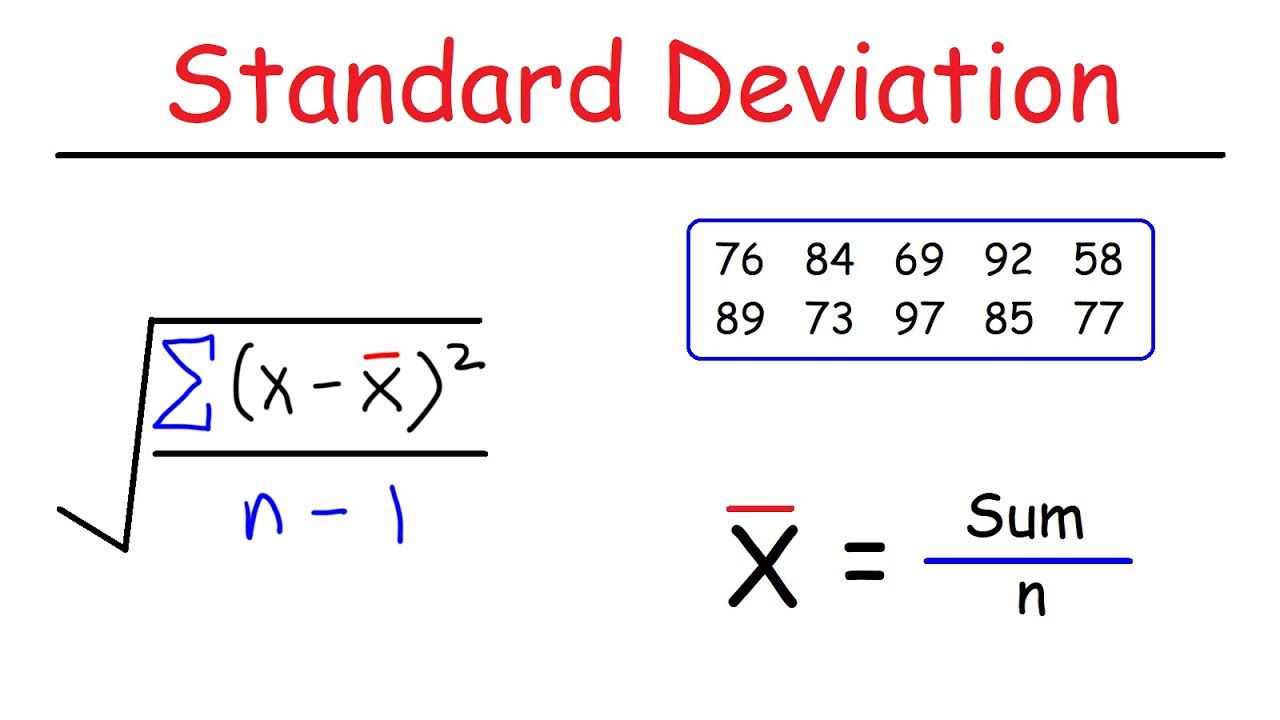
This Statistics video tutorial explains how to calculate the standard deviation using 2 examples problems. You need to calculate the sample mean before you can calculate the sample standard deviation.
How To Calculate The Standard Deviation Using Excel:
https://www.youtube.com/watch?v=k17_euuiTKw
Ten Side Hustles For College Students
https://...
try watching this
 ocean sealBOT
TC159
 torpid delta
$= \sum_{i=1}^{N} x_i^2 - 2\bar{x}\cdot\sum_{i=1}^{N}(x_i) - N* \bar{x}^2$
 dense tangle
Could I have some help soon as you are done helping the other person?
ocean sealBOT
TC159
 alpine sable
yes
alpine sable
this is a little complicated
torpid delta
uhhh
alpine sable
all I know is the normal formula
alpine sable
yup
torpid delta
$(x-u)^2 =x^2 -2xu + u^2$
ocean sealBOT
TC159
 torpid delta
for every x, right?
alpine sable
yup
torpid delta
therefore $\sum_{i=1}^{N}(x- u)^2$
ocean sealBOT
TC159
 torpid delta
$= \sum_{i=1}^{N} x_i^2 - 2u\cdot\sum_{i=1}^{N}(x_i) + N\cdot u^2$
because we sum the square of every x_i
because 2xu factors as 2u(x)
so the sum of 2ux_1 + 2ux_2 .... = 2u(sum of all)
alpine sable
yup
ocean sealBOT
TC159
 alpine sable
oh ok
torpid delta
you have N which is the number of archers right?
torpid delta
lmao
alpine sable
it just randomly came up
torpid delta
N is 20. you calculated u and have the sum of the squares
you can substitute everything to get
$\sum_{i=1}^{N}(x- u)^2$
ocean sealBOT
TC159
 alpine sable
yes..
torpid delta
$\sqrt{\frac{\sum_{i=1}^{N}(x- u)^2}{N}}$
ocean sealBOT
TC159

 alpine sable
 alpine sable
yes..
torpid delta
alpine sable
how did u get 434
I didn't zoom in, looked like a 3
3452360 - 2*434*8280 + 20* 434^2
alpine sable
but am I correct about the mean
alpine sable
oh ok
torpid delta
torpid delta
``3452360 - 2*434*8280 + 20* 434^2``
google says this is 32440
alpine sable
yup
alpine sable
wait
torpid delta
Am waiting
alpine sable
all I do is 32440 divided by 20
alpine sable
lamme try
torpid delta
I already did
alpine sable
oh nevermind
torpid delta
 alpine sable
so 40 is the answer
torpid delta
yes
alpine sable
what about the squares of their score
 alpine sable
ohh ye
torpid delta
it's the $\sum_{i=1}^{N} x_i^2$
ocean sealBOT
TC159
 alpine sable
do u know how to do the second part
torpid delta
what second part
I've already done everything xD
Let's go over again, alright?
you want to calculate this

but to calculate this you need to calculate this

You know that $(x-u)^2 = x^2 - 2xu + u^2$
ocean sealBOT
TC159
 torpid delta
alpine sable
one archers score is incorrectly
torpid delta
alpine sable
one archers score is incorrectly
you do that after
putting the first value
that's the second exercise
alpine sable
ye but how I lost myself trying to
alpine sable
so do I take away that value from the 8280
 alpine sable
yup
ocean sealBOT
TC159
 torpid delta
$\sum_{i=1}^{N} x_i^2 - 2u \cdot \sum_{i= 1}^{N} x_i + \sum_{i=1}^{N} u^2$
ocean sealBOT
TC159
 torpid delta
first sum is the sum of the squares
second sum is the sum of all scores
third is a constant sum so it is equal to the itself times the number of times it repeats, in this case N
therefore giving you
$\text{Sum}{\text{squares}} - 2u \cdot \text{Sum}{\text{Scores}} + N \cdot u^2$
ocean sealBOT
TC159
 torpid delta
You know all of these values so you can just substitute
alpine sable
after all this it says: "One archers score is incorrectly recorded as 349. They actually scored 369"
torpid delta
alright, but first do this exercise ok?
that's the next one
or have you done this one?
torpid delta
anyway substitute to get $\sum_{i=1}^{N}(x_i- u)^2$
ocean sealBOT
TC159
 torpid delta
and then substitute in the formula to get the standard deviation
 torpid delta
alpine sable
it's the point I lost out everything
torpid delta
alpine sable
it's the point I lost out everything
wdym?
alpine sable
then how do I calculate the new mean
 alpine sable
yup
torpid delta
 alpine sable
yes...
torpid delta
torpid delta
what this is saying is that basically the archer scored 20 more points
so the total number of points is the original + 20
that is 8300
8300/20 to get the mean
alpine sable
415
torpid delta
so the mean is 415 and the sum of scores is 8300. HOWEVER
you do not know the sum of the squares
alpine sable
correct
torpid delta
How do you calculate the new sum of the squares? simple, since he had 349
you simply add (349 + 20)^2 - 349^2
which is 40*349 + 400
alpine sable
14360
torpid delta
3452360 [old number] + 14360 [difference] = [new number]
alpine sable
3466720
torpid delta
okay so now you have
the mean, the sum of squares, the sum of the scores, and the number of archers
considering u is the mean and N is the number of archers, are you missing anything in this formula?
 alpine sable
so we do square of the new number divided by the n of archers?
torpid delta
what?
alpine sable
I meant square root
torpid delta
No, first we substitute here...
alpine sable
oh
torpid delta
do you not remember?
alpine sable
I got confused
torpid delta
we have this
 torpid delta
and since we can't calculate this directly, we tried to change this part:

and got this:
 alpine sable
u is?
 alpine sable
oh ok
torpid delta
Anyway, are we missing anything?
No, so lets substitute
3466720 - 2*415*8300 + 20* 415^2
which is 1374377720
so now we have:
$\sqrt{\frac{1374377720}{20}}$
torpid delta
alpine sable
I'm still typing
I copypasted into google
torpid delta
yo wtf I made a mistake somewhere
alpine sable
wdym
alpine sable
k
torpid delta
$\sqrt{\frac{22220}{20}} =33.331666625$
ocean sealBOT
TC159
 torpid delta
rounding to nearest whole is 33
torpid delta
If you feel confident I got everything right.
I can tell you for a fact that the mean is correct
alpine sable
alright
damn ur a geniua
genius
but
the first standard deviation is 35
still ur intelligent af
 keen wasp

why is this muyltiplication allowed

this is some context
pls ping me if u figure it out
alpine sable
ima close the room so u can have it
keen wasp
oh wait
alpine sable
no worries we r done
keen wasp
oh sorry i didnt reralize u guys changed these
alpine sable
dont worry lol
keen wasp
sorry
lone heartBOT
Channel closed
Closed by @waxen axle
Use .reopen if this was a mistake.
Available help channel!
Send your question here to claim the channel.
Remember:
• Ask your math question in a clear, concise manner.
• Show your work, and if possible, explain where you are stuck.
• After 15 minutes, feel free to ping <@&286206848099549185>.
• Type the command .close to free the channel when you're done.
• Be polite and have a nice day!
Read #❓how-to-get-help for further information on how to ask a good question, and about conduct in the question channels.
 harsh belfry
Needed some help with this question
 lone heartBOT
harsh belfry
Needed some help with this question
harsh belfry
lone heartBOT
harsh belfry
Needed some help with this question
harsh belfry
I've been stuck on this for awhile.
I know that the car 70 feet away (y)
and the distance the light travels is the variable I'm searching for
 wary stream
Do you know the speed of light?
harsh belfry
I do
torpid delta
isn't this a physics question?
harsh belfry
torpid delta
isn't this a physics question?
Calculus
harsh belfry
Its very similar to some physics questions ive seen though.
wary stream
Do you have the full question?
 wary stream
Never mind
harsh belfry
 torpid delta
oh wait
harsh belfry
I made it a bit bigger

 torpid delta
i am horrible at interpreting questions
harsh belfry
sin(70/x)
torpid delta
what does it mean for the light to move across the wall
wary stream
Derivative
harsh belfry
So tc159 it doesnt mean the speed of the light itself it means the speed at which the police light rotates
ie the wall
torpid delta
are you calculating the limit of the variation of the position right part of the light beam in respect to delta t or the left
harsh belfry
wary stream
Derivative
Should I find the derivative of sin(70/x)
harsh belfry
torpid delta
are you calculating the limit of the variation of the position right part of the...
Not sure how to answer that question.
torpid delta
Are we calculating the speed that the right part of the beam or the left..

that's my main question
wary stream
The x is the distance
torpid delta
so the left?
wary stream
Yes
 harsh belfry
I'm not sure where to start here.
torpid delta
y = tan(theta) * x
harsh belfry
Should I find the derivative of that
torpid delta
v_theta = 28rev/m
1 rev = 2pi
v_theta = 56pi/m
v_theta = dtheta/dt
@wary stream how do you suggest solving this, partial x, partial theta?

 raw shard
why would it be partial derivatives
torpid delta
raw shard
why would it be partial derivatives
that's my first guess
oh wait y is fixed...
nevermind
I'm pretty stupid
wary stream
torpid delta
that's my first guess
You keep trying to overcomplicate things
raw shard
you realize this is probably a calculus 1 problem right
torpid delta
wary stream
You keep trying to overcomplicate things
I have no idea, at what level of education people are
anwayy
raw shard
post the question again and i can attempt to help
torpid delta
 raw shard
i suck at these problems though
 torpid delta
raw shard
you realize this is probably a calculus 1 problem right
torpid delta
raw shard
you realize this is probably a calculus 1 problem right
(what is calculus 1 by the way, I never used that naming )
raw shard
there are different calculus classes, it’s 1, 2, then 3, partial derivatives are 3
wary stream
torpid delta
(what is calculus 1 by the way, I never used that naming )
Differential calculus
torpid delta
so calc 1 is like limits, derivatives early calculus?
torpid delta
I see
raw shard
yeah i can’t help with this, i’m terrible at setting these up sorry
harsh belfry
No problem 
torpid delta
The way I'd solve it is probably too complicated sorry...
 raw shard
these kinds of problems are called related rates if you wanna look into them
harsh belfry
Will watch some youtube videos on it in the mean time. Do you think I should be able to ping helpers?
torpid delta
I would probably solve it like this $\theta(t) = 8* 2pi/60*t, x(t) = 70 \frac{\cos(\theta)}{\sin(\theta)}$
raw shard
yes
raw shard
you can definitely ping helpers
torpid delta
so you can get a purely time dependent formula for x
raw shard
just post the problem again if you do
torpid delta
@harsh belfry
$\tan(\theta) = \frac{x}{y} = \frac{x}{70}$
ocean sealBOT
TC159
 torpid delta
yes?
harsh belfry
uhh
torpid delta
$x = 70 \cdot \tan(\theta)$
ocean sealBOT
TC159
 harsh belfry
mind telling me how you got there?

 harsh belfry
38
torpid delta
have you learnt radians, by the way?
torpid delta
what the fuck, this involves the derivatives of trig functions
how could you not have learnt radians xddd
harsh belfry
I mean I personally am not at all experienced with them
torpid delta
anyway basically a revolution is a single turn which corresponds to the perimeter of a circle of radius 1, aka 2pi
harsh belfry
I just know they have to do with angles
torpid delta
basically radians are a unitless way to describe angles
If an angle has x radians, then the angle of the arc of radius 1 and length x is x radians
basically radians relate to the arclength of a circle of radius 1
anyway
since it spins at 38 rpm
it does 38 revolutions, aka 38 * 2pi
per minute
38*2pi/60 per second
$\theta = \frac{76\cdot \pi}{60}t$
ocean sealBOT
TC159
 harsh belfry
38*2pi got it
torpid delta
anyway
substitute in the equation for x to get
$x = 70 \cdot \tan(\frac{76\cdot \pi}{60}t)$
ocean sealBOT
TC159
 torpid delta
derivative on both sides
torpid delta
$v_x = \frac{70 \cdot 76 \cdot pi}{60} \cdot \sec^2 \left(\frac{76\cdot \pi}{60}t\right)$
ocean sealBOT
TC159
 torpid delta
now all we gotta do is get the corresponding time for the corresponding time
which isn't hard since that is exactly theta we have that inside secant squared
$v_x = \frac{70 \cdot 76 \cdot \pi}{60} \cdot \sec^2 \left(\theta \right)$
ocean sealBOT
TC159

 harsh belfry
torpid delta
$v_x = \frac{70 \cdot 76 \cdot pi}{60} \cdot \sec^2 \left(\frac{76\cdot \pi}{60}...
harsh belfry
torpid delta
$v_x = \frac{70 \cdot 76 \cdot pi}{60} \cdot \sec^2 \left(\frac{76\cdot \pi}{60}...
I need to re-read this a couple of times give me a moment
torpid delta
harsh belfry
I might've messed upif you have an r
harsh belfry
oops sorry it was a typo
 coral pagoda
torpid delta
how could you not have learnt radians xddd
coral pagoda
torpid delta
how could you not have learnt radians xddd
Based on previous discussions, they struggled a bit in trig. So they learned, but probably forgot about it.
torpid delta
I see
alpine sable
TC r u currently busy
torpid delta
y
alpine sable
ok nvm
alpine sable
ok
harsh belfry
Currently watching a video on related rates to hopefully get better at this.
If you wonder why I've gone radio silent
Will be closing.
.close
lone heartBOT
Channel closed
Closed by @harsh belfry
Use .reopen if this was a mistake.
Available help channel!
Send your question here to claim the channel.
Remember:
• Ask your math question in a clear, concise manner.
• Show your work, and if possible, explain where you are stuck.
• After 15 minutes, feel free to ping <@&286206848099549185>.
• Type the command .close to free the channel when you're done.
• Be polite and have a nice day!
Read #❓how-to-get-help for further information on how to ask a good question, and about conduct in the question channels.
alpine sable
 lone heartBOT
alpine sable
alpine sable
lone heartBOT
alpine sable
alpine sable
hi
wary stream
What's your question?
alpine sable
how do i do it'
wary stream
Do what exactly?
alpine sable
everything.
wary stream
That's more helpful then saying " how to do it "
 cunning obsidian
With respect to x or y?
wary stream
Probably y
alpine sable
idk it just says differientiate
cunning obsidian
Probably gonna find dy/dx xd
wary stream
Implicit differentiation
cunning obsidian
Start by differentiating both sides
alpine sable
is this better? tf
 cunning obsidian
It is
 cunning obsidian
Left side is correct but you also have to differentiate right side, which can get annoying expanded
I suggest using chain rule
wary stream
alpine sable
You didn't differentiate the right side
alpine sable
so i do product rule 2 times?
wary stream
Yes
cunning obsidian
Product rule works too
alpine sable
ok
cunning obsidian
It’s just less ideal
glass lichen
implicit on sin(x+y) is going to be much easier and more efficient btw
cunning obsidian
^
wary stream
That too
cunning obsidian
$\frac{d(\sin (x+y))}{dx}=\frac{d(\sin (x+y))}{d(x+y)}\cdot \frac{d(x+y)}{dx}$
ocean sealBOT
3_n


 cunning obsidian
Not quite.. you missed the dy/dx’s
alpine sable
Where do I put them
glass lichen
anywhere you differentiated y
alpine sable
So wherever I see y
ocean sealBOT
Mosh
 glass lichen
⛓️ 📏
cunning obsidian
XD
alpine sable
Idk what that is supposed to mean
glass lichen
chain rule 