#help-0
1 messages · Page 874 of 1
 raw shard
 subtle cedar
Then divide and distribute and that jazz and make it 24
 snow nest
then just expand the brackets and that shit
subtle cedar
This is a sweet discord server tysm
raw shard
well actually add everything together on the left side
then subtract constants
but i’m sure you knew that
subtle cedar
Yes
snow nest
the scary thing of maths is you don't know what others know
raw shard
lol
snow nest
so i'm always scared to assume that say, you know how to do the navier stokes equation
you don't but like
subtle cedar
Algebra is where I’m at
raw shard
makes me think of vectors
raw shard
oh
snow nest
the Millennium Prize Problems
if you knew how to do it you'd quite literally win a million USD
"To date, the only Millennium Prize problem to have been solved is the Poincaré conjecture, which was solved in 2003 by the Russian mathematician Grigori Perelman. He declined the prize money."
why the heck did he decline a million
 old hemlock
Is x^(2/6) equal to x^(1/3)? If you do legal math and simplify the exponents, it is the same. However, if you graph them, they are not the same. X^(2/6) will never be negative since you square it. X^(1/3) however can be negative. Therefore they are technically not equal.
Take x=-1 for example, they both give different answers
If they are equal, they should give the same answers
raw shard
they are equal for positive x
actually wait
the 2/6 one has even exponents
so it turns negatives positive
the 1/3 one leaves it as positive or negative
snow nest
i'm getting the same answers for both?
raw shard
are you doing the root first or power first
 violet surge
whats h can anyone help me really quick
 old hemlock
Doesn't matter, you square the negative either way
raw shard
law of sines
 tight venture
What’s 34.5 • 2?
old hemlock
Idk what topic of math this is
raw shard
@violet surge do you know law of sines?
violet surge
no
raw shard
do you know some trig?
old hemlock
@raw shard #serious-discussion pls
raw shard
so law of sines is A/sin(a) = B/sin(b) = C/sin(c)
the capital letters are the side lengths
the lowercase letters are the angles opposite to the side lengths
you know i might be overcomplicating this
when you split the triangle, is the base 6000 for both triangles?
aka is it split directly down the center
violet surge
hm i get what you're saying
but if you split it straight down
i dont think its 6k for each
raw shard
then law of sines is all i can think of
there could be another way but i don’t know one
wait is this from like, an assignment
actually no that won’t help, i can already see the base won’t be 6000
@violet surge do you want to try law of sines?
violet surge
yeah sure
 devout summit
violet surge
whats h can anyone help me really quick
devout summit
violet surge
whats h can anyone help me really quick
Turns out this particular triangle is isosceles
raw shard
wow i over complicated it
violet surge
 raw shard
not surprised
raw shard
i can do advanced stuff but not basic stuff without overcomplicating it lol

 snow nest
what is that
 cyan willow
Binomial cd function
snow nest
like what do those values signify
cyan willow
it's the table
snow nest
i am big dumb never heard of that
cyan willow
Actually nvm, show me your way
 alpine sable
hi does this tree have a depth of 3 or 4?
 snow nest
hang on wait i've forgotten my combinations
alpine sable
I got points taken off because my program said it was 3
snow nest
gimme a second
cyan willow
Oki
 frank nacelle
hey
cyan willow
Ok
raw shard
if it’s related to math yes
frank nacelle
what is the purpose of \e
 late parcel
 frank nacelle
,help
 ocean sealBOT
A brief description and guide on how to use me was sent to your DMs!
Please use ,list to see a list of all my commands, and ,help cmd to get detailed help on a command!
raw shard
c
raw shard
c has nothing to do with population
late parcel
?
frank nacelle
habitat decreases as population increasise
floods are natural disasters and happen even if population is low or high
habitat can be reduced due to high population
late parcel
Ok thanks
frank nacelle
,tex e
ocean sealBOT
sainallani
 frank nacelle
what is the purpose of euler's constant
raw shard
it’s basically the face of calculus
frank nacelle
sorry im in alg 2 rn
raw shard
other than that i really don’t know, i just know it’s really important
frank nacelle
oh ok
raw shard
do you know e^(pi*i)?
frank nacelle
no clue man
raw shard
never mind then
late parcel

Thank you so much
Really appreciate the help
That was AP environmental by the way
frank nacelle
no problem
late parcel
But it uses a lot of math
frank nacelle
oh should i take it?
im in 9th grade
should i take it next year?
is it ez and useful if im not gonna go into science major?
late parcel
I’m a senior. From what I have heard it is one of the easiest APs but for me it’s hard
frank nacelle
oh
late parcel
I love science so it’s intersecting to me but it’s all on the teacher when it comes to difficulty
 dense lotus
how would i solve this
 late parcel
My teacher spend 9 years at Virginia Tech and has like 2 masters and a bachelors degree so it is an intense class at my school
 rapid nova
raw shard
do you know e^(pi*i)?
rapid nova
raw shard
do you know e^(pi*i)?
e^(ix) = cos x + i sin x
is better
e^(pi i) is just its special case
 bleak ridge
,rotate
ocean sealBOT
 raw shard
do you know if the angle opposite to 100 degrees is also 100 degrees?
probably not actually
bleak ridge
Ye itd only be that if you extended the left line down
Thatd prob be a way of finding it out
Idk if itd be the best
raw shard
i have something
dense lotus
raw shard
do you know if the angle opposite to 100 degrees is also 100 degrees?
The bottom right? Doesnt seem like it
raw shard
now that i think about it i can’t think of anything
i thought of something but it was incomplete
so it wouldn’t help
dense lotus
i dont know where to start in the problem
raw shard
i did
devout summit
(5x+y)+(5x-y)=180 - 100
bleak ridge
Since the angles add up to 180 in the triangle
raw shard
it’s not a rectangle
devout summit
devout summit
(5x+y)+(5x-y)=180 - 100
This is even better you directly get x
raw shard
i don’t know how you got that
 short night
need help
 dense lotus
devout summit
This is even better you directly get x
dense lotus
devout summit
This is even better you directly get x
why would you subtract 100
rapid nova
do right arrows mean they are parallel?
dense lotus
yes
dense lotus
Can you highlight the co interior angle lines for representation?
 devout summit
5x-y=2x+y
dense lotus
100 = 7x + 2y, where 7x would be 56?
 cedar slate
 devout summit
dense lotus
100 = 7x + 2y, where 7x would be 56?
devout summit
dense lotus
100 = 7x + 2y, where 7x would be 56?
That's fine too. (It's 7x+2y=80 though)
dense lotus
That’d be in the top right, right?
And how would i get the value of Y from the equation 5x-y=2x+y
snow nest
5x - y = 2x + y
5x - 2y = 2x
-2y = -3x
2y = 3x
y = 3x/2
 wise stump

Isn't sin3pi/4 = sqrt2/2
but cos3pi/4 = -sqrt2/2?
doesn't that mean they're not equal at x = 3pi/4
 limber urchin
 white blaze
is there a function that i can use to produce a landscape similar to this but with more bumps to it? rn im using the following:
sin(x) * (abs(square(x ** 2 + y ** 2)))) / sin(x)
 bleak ridge
You could use that as a base function and use perlin noise or smthn to add that randomness
Idk if thats applicable to your problem but
white blaze
ah thats such a good idea
thank you :) my mind is so beat rn i really appreciate it!
bleak ridge
Np
 paper saddle
does anyone know how to solve for p, focus, and directrix for this parabola equation?

 sweet dove
Need some help :/
 paper saddle
sweet dove
Need some help :/
paper saddle
sweet dove
Need some help :/
scale factor is just the new rectangle over the old one
but u shouldnt have skipped me
cause no one helped me yet
 glass wren
can anyone tell me why i cant do ths

apparently its because the individual limits does not exist but i dont understand why ;-;
 craggy niche

 charred flint
@glass wren it's fine to think it works like that
it's just that you shouldn't have an equals sign for something that's not a number that exists
 formal bane
do u guys know any app good for math? like photomath
 quiet finch
formal bane
do u guys know any app good for math? like photomath
quiet finch
formal bane
do u guys know any app good for math? like photomath
I quite enjoy this website
Symbolab: equation search and math solver - solves algebra, trigonometry and calculus problems step by step
It's not as convenient as simply taking pictures of problems but it can do more
formal bane
ok ty i will try, i have calculus assignment 😭
 gloomy hazel
can someone help me to do this
"the given limit represents the derivative of a function y=f(x) at x=a. Find f(x) and a."

 solar jetty
hi
can someone suggest some projects to be done with newton raphson method
a unique one infact
where you explain the project objective
methodology
problem statement
and algorithm
 scarlet heart

 inner sequoia

 loud cedar
think about it
(a+b)^2=
(a+b)(a+b)
which means
there are:
a times a
a times b
b times a
b times b
 lapis valley
scarlet heart
lapis valley
scarlet heart
what part
loud cedar
a times a and b times b can be expressed as a^2 and b^2
then there are two abs so 2ab
@inner sequoia
lapis valley
You let $u = t^3+4$ so $du = 3t^2 \ dt \rightarrow dt= \frac{du}{3t^2}$ and then if u substitute dt it just becomes the 2nd line.
ocean sealBOT
hduxueiwkwnxudi
 scarlet heart
never mind i figured it out
lapis valley
nice
 wheat prawn

 sacred orchid
is dis channel busy or no?
 slow wraith
what postulate is this?
 sweet dove
paper saddle
scale factor is just the new rectangle over the old one
sweet dove
paper saddle
scale factor is just the new rectangle over the old one
Ah ok thanks
paper saddle
slow wraith
what postulate is this?
there are 2 sets of correlating sides and 1 set of correlating angles
do you know all the different postulates
@slow wraith
paper saddle
ok well is there are 2 sets of correlating sides and 1 set of correlating angles
so if you had to take a guess which postulate would you think it is
slow wraith
SAS?
paper saddle
yea
slow wraith
this one is AA right?
 slow wraith
yeah i thought so
paper saddle
all postulates are gonna be only triangles
slow wraith
no its like SSS bc both of them are congruent triangles right
paper saddle
the postulates prove if two triangles are congruent
but congruency isnt supposed to be used as proof of a postulate
because the main reason for them is to find whether triangles are congruent
slow wraith
ohhhhh
paper saddle
so the reason its sss is because there are 3 sides that are congruent
it only gives you 2 sides but you can find the 3rd side to be congruent because of how the triangles connect
paper saddle
np
 ocean sealBOT

 light kestrel
first i take the derative of r right
i mean isolate the r
so r = sqrt(15/pi)
no
fkkk
relate rates make my brain hurt
 spice path
seems like the right track

 shadow widget
you australia?
spice path
Hell yeah
shadow widget
awesome lol
light kestrel
Dame
shadow widget
if u know how to do the question pls help out
shadow widget
spice path
So good luck on your exam
tyty
shadow widget
thankss
 scarlet agate
can i ask a question
spice path
bruh, why are they all asking in the one chat
 wanton spoke
I see. Yeah idk either It's just that I am used to have only 1 equation for a worded problem. May I ask if I can solve the problem using one equation only? Like, formulate a different equation and solve that to find n, the number of students?
 ashen blade
gonna assume this channel is free since there hasn't been a comment in 10 mins
https://i.imgur.com/XsEggRW.png
from the 3rd to 4th step
why do they divide x+y by z
as opposed to the entire thing?
it's (x+y)(dx/dt + dy/dt) = z(dz/dt)
so shouldn't z divide the entire thing?
dz/dt = [(x+y)(dx/dt + dy/dt)] / z
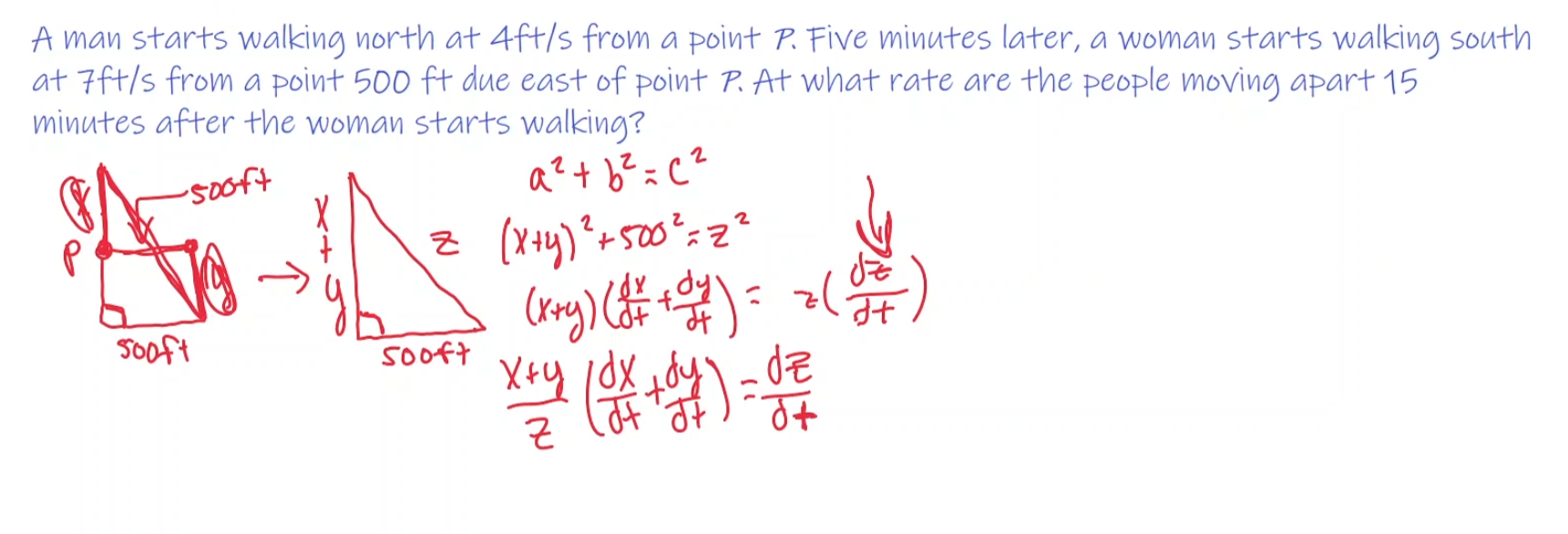 solar jetty
hey
can someone suggest applications of newton raphson method
an equation
or smthing like that
like for eg: manning equation
 mellow tinsel
For a two by two matrix:
If A^3*A^3=I, A^3≠I, and A^2≠I, how do I figure out what A is?
 chrome patrol
Can anyone tell this

please can anyone share the written solution for this? will really help, thanks :p
 thorn kindle
No.
 pulsar lance
Differentiate numerators and denominators to find limits and then equate both of those limits to find p
ashen blade
sorry, does anybody have an idea about this?
https://i.imgur.com/XsEggRW.png
from the 3rd to 4th step
why do they divide x+y by z
as opposed to the entire thing?
it's (x+y)(dx/dt + dy/dt) = z(dz/dt)
so shouldn't z divide the entire thing?
dz/dt = [(x+y)(dx/dt + dy/dt)] / z
chrome patrol
pulsar lance
Differentiate numerators and denominators to find limits and then equate both of...
can you please solve this? and share?
ashen blade
bro go solve it yourself
people here aren't going to do your homework for you
chrome patrol
ok rude but its okay understood
ashen blade
im literally stating facts
chrome patrol
ok
ashen blade
at least make an attempt at the problem before asking
chrome patrol
ok
alpine sable
How do i write an equation using the point-slope form?
 alpine sable
Thanks
 lapis goblet
how do i find the surface(s) of intersection of 2 ellipsoids
 jaunty crane
 lapis goblet
<@&286206848099549185>
lapis goblet
lapis goblet
how do i find the surface(s) of intersection of 2 ellipsoids
.
what about the volume

 ripe wasp

 pulsar yarrow
 plush wagon
please help me understand the given solution of problem
plush wagon
please help me understand the given solution of problem
What part do you not get?
 rich basin

for (d), why can you simply just find the derivative and then you can calculate for when it equals 0 you can find the time for which it will be empty
like if you have something like v = u +at, how can you differentiate in respects to t, and get "a" to find when v = 0?
you can't because a is a constant, but why in (d), you can calculate t, and find the equation equalling to 0

 gray reef
Can't sorry
 opaque totem
issfine
 raw nexus
Hello this channel free?
opaque totem
yeaa kinda
opaque totem
opaque totem
i mean can u help me with this
raw nexus

I've worked out, the total weight of the empty ferry to be correct 30.4367 MN
I'm just stuck on this question below?

The answer is 3505 m^3 but not sure how to get this answer
The distance D is 0.4m
Please can someone help me?
<@&286206848099549185>
 light oyster
If i choose x and y from the interval [a,b], its obviously (x,y) always in [a,b], but how can i denote it?
its $(x,y)\subseteq[a,b]$ or $(x,y)\in[a,b]$?
ocean sealBOT
小馬
 light oyster
For a function f defined on the interval [a,b], for some c$\in$[a,b], is it always true that f(c)$\in$[f(a),f(b)]?

 alpine sable
Given the expression $\sqrt{ T^2 + 4T\sin\alpha + 4w^2 }$, with everything but $w$ being positive real numbers, how do I get it to the form $Cw$ where $C$ is a real number?
ocean sealBOT
leadersheir
 alpine sable
<@&286206848099549185>
pls help me i have no idea to do question :Want to write three types of mark on a stick that is not one long, which is a line that divides the stick into 10 equal parts. A mark that divides the wood into 15 equal parts. and the line that divides the wood into 18 equal parts When cutting the sticks as written here How many sticks will you get in all?
alpine sable
alpine sable
Given the expression $\sqrt{ T^2 + 4T\sin\alpha + 4w^2 }$, with everything but $...
i would start by defining $\beta$ as $T^2 + 4T\sin\alpha$
ocean sealBOT
bertaunth
 alpine sable
since everything other than $w$ is a positive real number (a constant)
ocean sealBOT
bertaunth

 keen basalt
Can anyone help me solve this problem?? Thanks in advance 💗

 wary iron
@keen basalt I hope this helps https://socratic.org/questions/d-dx-cosx-cos2x-1-cosx

Socratic.org
the answer [-((2cos(x)-2)sin(2x)-sin(x)cos(2x)+sin(x))/(cos(x)-1)^2] show below d/dx[(cosx-cos2x)/(1-cosx)]= [(1-cosx)(-sinx+2sin2x)-(cosx-cos2x)(sinx)]/(1-cosx)^2 [-sinx+2sin2x+sinxcosx-2cosxsin2x-sinxcosx+sinxcos2x]/(1-cosx)^2 [-sinx+2sin2x-2cosxsin2x+sinxcos2x]/(1-cosx)^2 ((1-cos(x))(2sin(2x)-sin(x))-sin(x)(cos(x)-cos(2*x)))/(1-cos(x)...
pulsar yarrow
keen basalt
Can anyone help me solve this problem?? Thanks in advance 💗
You can use either quotient rule or product rule(for which you have to break it into two parts ig and it'd be more tedious)
keen basalt
pulsar yarrow
You can use either quotient rule or product rule(for which you have to break it ...
Yeah I tried to solve it in that way.
I also at first tried to simplify the equation using cos2x formula then tried to differentiate but then the answer doesn’t match with the other. Now I don’t know what to do
pulsar yarrow
keen basalt
Yeah I tried to solve it in that way.
I also at first tried to simplify the equa...
you don't need the cos(2x) formula for derivatives only for integrals
d/dx (cos(2x)) = -sin(2x) * 2 using chain rule
keen basalt
pulsar yarrow
you don't need the cos(2x) formula for derivatives only for integrals
So does that mean this process is wrong?
 pulsar yarrow
keen basalt
So does that mean this process is wrong?
pulsar yarrow
keen basalt
So does that mean this process is wrong?
the algebraic process involved doesn't look wrong i guess other than the fact that you missed a negative sign(?)
But this doesn't work because you're enlarging the domain of the function
alpine sable
can i ask a question about a direct investigation i currently have, its on 'loopy polygons' and the main part is finding a formula that links the number of shapes and the perimeter so you can estimate the perimeter by only having the shape
and the the formula section is what i am struggling on the most, please dm me if you feel like you can help 🙂
thank you in advance
pulsar yarrow
alpine sable
can i ask a question about a direct investigation i currently have, its on 'loop...
you'd probably be better off just asking where you're struggling here rather than wait for somene to help you in dms
just a suggestion
alpine sable
pulsar yarrow
you'd probably be better off just asking where you're struggling here rather tha...
ok ok i'll get a screenshot of the task sheet and the section im confused on
so that is part a of the direct investigation, i have created the six shapes asked and found the inner/outer perimeter

this is the graph plus a few patterns+notes i've noticed, but i'm really struggling to find a pattern linking the number of squares in the loop, to the inner/outer perimeter
 rapid nova
alpine sable
this is the graph plus a few patterns+notes i've noticed, but i'm really struggl...
rapid nova
alpine sable
this is the graph plus a few patterns+notes i've noticed, but i'm really struggl...
can you link the number of squares in the loop to the inner perimeter if we assume that the loop is always rectangular?
alpine sable
rapid nova
can you link the number of squares in the loop to the inner perimeter if we assu...
well in my case i have to make sure the pattern works for at least 3 of my shapes
rapid nova
i understand but for a start answer my question
alpine sable
rapid nova
can you link the number of squares in the loop to the inner perimeter if we assu...
well i'm not completly sure since this whole time i've been trying to find a pattern with my shapes, not by assuming they are always rectangular.
rapid nova
also try considering different shapes of loops with the same amount of squares
you will see their perimeters match
that's because you can always rearrange squares in such a way that it becomes rectangular, and on each step the perimeters do not change
(if you move square by square)
alpine sable
rapid nova
that's because you can always rearrange squares in such a way that it becomes re...
yeah but for some reason i can't think to find a pattern that links the number of squares to the perimeter. like i'm not sure how i'm supposed to know the perimeter with just the number of squares. i'm listening to your advice and i understand rearranging the shape to a rectangular way to keep the same perimeter but to me changing the shape of the shape, i'm not show how that would help me
rapid nova
if you know how to calculate perimeters for a rectangular loop, then you also know how to calculate it for every loop with the same number of squares
rapid nova
rapid nova
can you link the number of squares in the loop to the inner perimeter if we assu...
so try finding an answer to this question
 harsh belfry

I wasnt too sure on how they got to this step.
Did they just divide by 10?
then toss over the dh/dt?
light oyster
yeah
alpine sable
harsh belfry
by the looks of it
harsh belfry
Alright, then I'm not sure why its not working with my numbers
I was given

Which gave me
 harsh belfry
Sure
ocean sealBOT
小馬
 light oyster
$1 = 32.4\pi\frac{dh}{dt}$
alpine sable
Do I ask questions here? Like I'm extremely new to the group
ocean sealBOT
小馬
 light oyster
yeah
alpine sable
alpine sable
Do I ask questions here? Like I'm extremely new to the group
if there are currently no questions
harsh belfry
My ROC is 8 (Theirs is 10)
light oyster
$\implies dt = 32.4\pi dh$
ocean sealBOT
小馬
 harsh belfry
They have 324pi I have 9pi
So my equation is

I would just divide by 8
for

right?
For some reason I keep getting marked wrong
 alpine sable
if there are currently no questions
alpine sable
alpine sable
if there are currently no questions
Ouuu, so I don't ask now...
harsh belfry
this is my last attempt on trying to get the correct answer 😅
light oyster
like ms^-1
harsh belfry
Perhaps I could post the original question.
Maybe I got a step wrong?

I'll outline my process

is the formula for volume
my r, as stated in the question is 3 times my height
therefore r:
 light oyster
calculate dV/dt first
 vapid oak
that is the move yes, becuase you need to find dr/dt
harsh belfry
Only once i insert r I can find my derivative right?
light oyster
yeah
 harsh belfry
harsh belfry
harsh belfry
Because v=1/3pir^2h would give a very different derivative than
harsh belfry
harsh belfry
this equation
harsh belfry
light oyster
calculate dV/dt first
Does this make sense?
Not sure if I did that part correctly
alpine sable
Do we ask calculus related questions here?
light oyster
yes
harsh belfry
Channel in use
harsh belfry
light oyster
then it becomes finding dh/dt
So did I do this correctly?
Im a little bit confused.
alpine sable
Oh as I said I'm extremely new so sorry
light oyster
$\frac{dV}{dt} = \frac{d}{dt} \frac{1}{3}\pi(\frac{3h}{2})^22h$
ocean sealBOT
小馬
 vapid oak
you cannot just do that
light oyster
but the question told you to calculate the rate of change
vapid oak
yes, but you just plugged something into the idea of rate of change for Volume to try and work out height
 harsh belfry
vapid oak
you cannot just do that
harsh belfry
vapid oak
you cannot just do that
What should I start by doing then?
I'm very new to ROC calculus questions
vapid oak
i dont have much paper with me but ill try my best to explain
yeah they are very hard so no worries
basically you want to differentiate the Volume function
so you want to differentiate V= 1/3 * pi * (3h/2)^2 * h
harsh belfry

OH
Sorry I skipped a step
I actually meant i plugged in r into this equations
second
writing it
 light oyster
I thought its my mistake lol
harsh belfry
Nah nah, I had forgotten to mention that I found the derivative already
vapid oak
well what did you get for the derivative
harsh belfry
 vapid oak
you're forgetting quite a few variables there
harsh belfry
huh
vapid oak
expanding the brackets first, the expression is $\frac{\pi \cdot 9h^3}{12}$
ocean sealBOT
Omfish
 vapid oak
harsh belfry
vapid oak
harsh belfry
do you undertstand where I got that from just from simplifying this expression
harsh belfry
I dont...
vapid oak
harsh belfry
so we have 1/3 and pi, and then the (3h/2)^2 becomes 9h^2/4 and theres an extra h
so Ive combined it all
$\frac{1}{3} \cdot \pi \cdot \frac{9h^2}{4} \cdot h$
ocean sealBOT
Omfish
 harsh belfry
yeah I did that part
I just simplified it
I think this guy did the same thing as me
vapid oak
harsh belfry
however you got this which is incorrect
 harsh belfry
Whats wrong with mine?
 warm brook
harsh belfry
warm brook
harsh belfry
This is right. The only thing missing is $\frac{dh}{dt}$
ocean sealBOT
kirby
 vapid oak
and then you equate it to 8, to find dh/dt

 warm brook
Yes, I think so


 vapid oak
wait
vapid oak
harsh belfry
wait you have subsituted 2 in for the height too early
 vapid oak
that is looking good
and remember, you know that equals 8
so, still using r as a variable, try and find out what dh/dt is
 vapid oak
well im not sure why you've decided to use b as dh/dt but yes
 vapid oak
that is your formula for the rate of change of the height
and so now you may plug in your value of r
warm brook
Yes
harsh belfry
I'll go check if its right
warm brook
harsh belfry
That's just dividing both sides by 9pi in this one
harsh belfry
oh that would have been easier
haha
i havent slept in over 24 hours so I'm a bit out of it
will write that in my notes
Thanks.
 vapid oak
hope you learnt something or that this helped you figure somethings out 🙂
raw nexus
This channel free?
harsh belfry
Yes'
 grave saddle
Im to assume my end dates are october 2021.
How would I calculate how many months there are to this date from any date (month and year)
so like if I have march 2020, ill get 19
raw nexus

I have worked out the up thrust acting on the spar bouy to be 6.5749MN
It's asking "what is the tension"
Which I'm not sure how to work out?
alpine sable

can someone help me with this guy? I've currently done it like this so far but I don't really know how to continue or if I'm even on the right track. Thanks in advance!

 alpine sable
thanks, you can tag me
alpine sable
alpine sable
thanks, you can tag me
Brackets
Exponent
Division
Multiplication
Addition
Subtraction
Solve in this order.
Exponent means square, squareroot stuff.
 alpine sable
Brackets
Exponent
Division
Multiplication
Addition
Subtraction
alpine sable
alpine sable
Brackets
Exponent
Division
Multiplication
Addition
Subtraction
Thank you! ❤️

 plain halo
 harsh belfry

In this problem I am given the speed of 600
I am solving for the rate in radians that the elevation
My angle is 45 deg
I keep getting the answer incorrect
 visual bolt
ok
harsh belfry
I think I would be using tangent at 45 degrees 5/x

Would I start by finding the derivative?
visual bolt
yes yes do that for tan 60 and 70
 thorn wasp
If I have to "vertically shrink [a function] by a factor of 2", I multiply the original function with 1/2 right?
the function in hand is, sqrt(x). so shrinking by a factor of 2 will make y = 1/2sqrt(x). right?
or is it the opposite?
harsh belfry
😅

 spare vale
I mayve labelled wrong

 tender anchor
Are vectors in the domain of multivariable functions? E.g If we have a multivariable function f(x,y) defined everywhere, can we write f(<1,1>) = f(1,1)? I would assume not but I'm just checking
 oak chasm
@tender anchor If the vector is in the domain, yes. For example, if the function is ℝ² → ℝ, then you can use any vector in ℝ² as input.
tender anchor
oh cool. Thanks for helping!
oak chasm
No problem.

 glacial hawk
wait so EU-EP-PU=-UP?
visual bolt
0?
oak chasm
Nope.
tender anchor
yep
 spare vale
 glacial hawk
this statement would be true right?
spare vale
Ignore the jaffas 😤😤😤
glacial hawk
glacial hawk
.
 grim pelican

need help
for part a I went ahead and computed for the standard equation of the sphere
idk if thats what they want tho
grim pelican
i did the first part idk the 2nd part


 waxen cypress
Hi! Just wanna ask how I can antidifferentiate this equation. The it’s dydx for the sequence of integrating but i’m not sure how I can integrate this trig with polynomial inside

 rigid kiln
my gut says integration by substitution but I'm not sure
 rigid kiln
you can find this angle

 novel kettle
Ok but it should be 360° right
rigid kiln
the interior angles of that shape will sum to 360 yeah
novel kettle
Ohhh so the out side one doesn't matter? Then do I find a° or the other one that you did
 novel kettle
Oh ok thank you
rigid kiln
no prob, hope that makes sense
novel kettle
So that will be 60° so now I do 180°-125°=a° which will be 55°
 tulip swallow
what is pronumeral
novel kettle
I don't even know 
 unkempt umbra
Quick question:
if the sum of 4 vectors is the 0 vector, does it mean that they form a parallelogram? or does it just mean that they form any regular quadrilateral ?
tulip swallow
if u move in 4 straight lines and end up back where u started
what would that be (yes a quadrilateral)
but if the vectors are not connected end to end like that, they don't form anything
take (1,1),(1,-1),(-1,-1),(-1,1) vectors going away from origin. they don't form anything
 stark plover
By what does the function y = 4^x need to be stretched to "end up" with 7^x? Express your answer in the form log(a)b.
 tawny fable
Hi
Can a linear equation with more variables than equations have one unique solution?
raw shard
@stark plover start with 4^(n*x) = 7^x
take ln of both sides
if you know logarithms well and you look at it for a second, it’s obvious what n should be
stark plover
@raw shard isn’t this the starting equation though?
 raw shard
if a and b are constants i don’t think it’s possible for those two to always be equal
actually it’s definitely not possible
7^x grows much faster
stark plover
So the best we'd be able to do is define a and b in terms of x and b/a?
raw shard
define a or b in terms of x
if it need to be in that format, pick a few x values, maybe 1 2 and 3 and try stuff
i still don’t think this will work
can’t think of a reason why it would, even if it’s defined in terms of x
 arctic gust
stark plover
By what does the function y = 4^x need to be stretched to "end up" with 7^x? Exp...
arctic gust
stark plover
By what does the function y = 4^x need to be stretched to "end up" with 7^x? Exp...
i guess multiply by (7/4)^x?
then both eqs would be the same
raw shard
they need it in terms of a log
arctic gust
oh
raw shard
technically something stupid like log2(2^((7/4)^x)) will work
but i hate this
that’s a test
 rose plaza
and whats the problem?
 dull ocean
how do i work with n
raw shard
@rose plaza you aren’t allowed to ask for help on tests
rose plaza
raw shard
<@863536115323109396> you aren’t allowed to ask for help on tests
i wont do
raw shard
there’s a timer in the top right, and stuff is blacked out
there’s a time limit on a study guide
dull ocean
bruh
rose plaza
:DDD
rose plaza
no dude
rose plaza
raw shard
sometimes you can literally see people post stuff that obviously says test
xD
raw shard
as soon as i saw that you blacked stuff out i was suspicious
still doesn’t explain why there’s a time limit on a study guide
and i know that’s a time limit and not a timer
there’s a progress bar under it
well, beside it
 fading zephyr
is this a graded evaluation
raw shard
they literally said it was a study guide, but you can see a time limit
doesn’t check out
 tall wing
band
fading zephyr
someone else confirmed it's an exam, so banned

 eager pebble
I tried looking up the formula for linear approximation and it's f(a)+f'(a)(x-a)
but idk what to do with that
raw shard
yes that’s it
you pick a value close to x
basically pick a value a that is close to x, that you know the value of f(a)
raw shard
yeah x would be 6.05 and 6
so something close to there that you know the value of 1/a
do you know what 1/6 is?
eager pebble
yeah
eager pebble
so what would x be? 6.05?
raw shard
yes
eager pebble
hmm ok
@raw shard I plugged that in and got 0.16528 but it says its wrong
then it gave me this as a hint
 eager pebble
hmm let me try again
raw shard
@verbal marsh what’s after that 2 on the end?
 verbal marsh
raw shard
<@896517328261488730> what’s after that 2 on the end?
verbal marsh
raw shard
<@896517328261488730> what’s after that 2 on the end?
x
rose plaza
raw shard
had a feeling it was
same
raw shard
so they took out a (1-x^2)^(-7/3)
rose plaza
if u factor it out you have to adjust the terms in the inside of the bracket
raw shard
multiply the coefficient by (1-x^2)^(-7/3) and the stuff after the coefficient by (1-x^2)^(7/3)
verbal marsh
rose plaza
if u factor it out you have to adjust the terms in the inside of the bracket
i see it as the factor*A=(1/1-x^2)^4/3, then just isolate A
verbal marsh
raw shard
multiply the coefficient by (1-x^2)^(-7/3) and the stuff after the coefficient b...
What coefficient?
raw shard
the number in the front
the 2/3
i knew i shouldn’t have said coefficient lol
probably to get ride of the negative exponents in the parentheses
i guess whatever to get rid of the negative exponents
verbal marsh
For better context
raw shard
i was about to say you can simplify it a bit more lol
verbal marsh
Is this for formality? Because can’t you tell the expression is > 0 at x = 0 from the first line of the second derivative?
Oh wait
There’s a dividing by zero moment
verbal marsh
It’s cool, my question has been answered
 lapis goblet
sinx/x doesn’t have an elementary solution I though
Integral of sinc x is like Si(x)
 fresh quail
it does if u change
the order of integration
it would give an elementary solution
just trying to figure out
lapis goblet
If x =2, x = sqrt(y)
Then you have to solve for y
Same for y = 4, y=0
I’d recommend graphing it
Easier to visualize
lapis goblet
Yeah so graph the function along with the boundaries
Then find which lines are used when going vertically
 alpine sable

Is that right so far and need help filling rest out
I don’t understand the rest of it
lapis goblet
yeah
looks right so far
the other 2 boxes for the sqrt is asking what happens when a is bigger than 1
lets say
y = 3sqrtx
try graphing it on desmos seeing what happens
then try y = -3sqrtx
and finally when a is between -1 and 1, which would be a fraction or 0. y = .5sqrtx , y = -.5sqrtx
i think you should be able to draw some conclusions from these graphs
alpine sable
Ok I’ll give it a go. Thanks @lapis goblet
lapis goblet
np
 glacial cave
 brave remnant
Hello

Can someone explain to me
What value (I should) use to represent a value approaching negative infinity
 jagged trout
big negative numbers
arctic gust
whats the whole q
brave remnant
arctic gust
whats the whole q
?
arctic gust
the entire question?
brave remnant
Not important…
brave remnant
Which are
arctic gust
like -10000000
arctic gust
tbh thats not how you solve limits
brave remnant
Probably not
arctic gust
i think you use a few rules
brave remnant
Yes I know
You can use a rule for this
However
It should be possible without of course
lapis goblet
just keep plugging in large negative numbers and see what happens if you dod
jagged trout
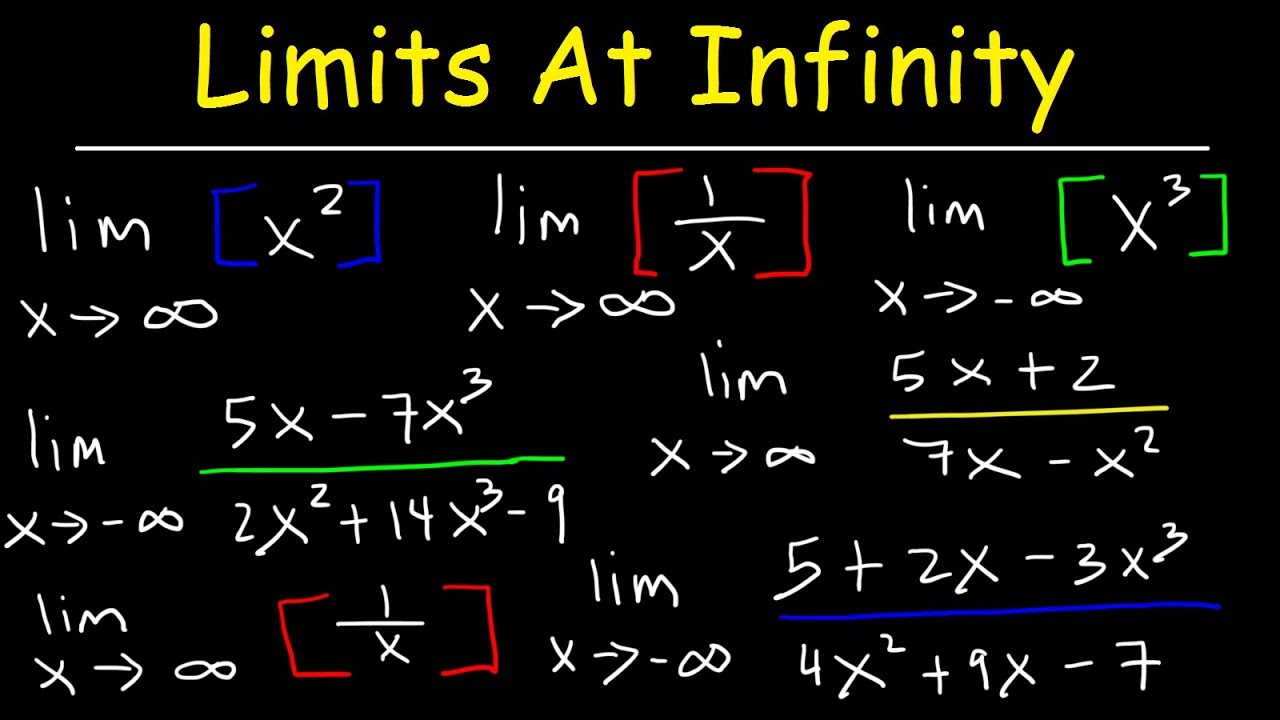
This calculus video tutorial explains how to find the limit at infinity. It covers polynomial functions and rational functions. The limit approaches zero if the function is heavy at the bottom or if the degree of the denominator exceeds that of the numerator. The limit approaches a constant value if the degree of the numerator and the denomin...
arctic gust
even if you approx using this method you still wont get the answer unless you simplify/factorize
brave remnant
Great
lapis goblet
see what happensa nd see if it converges at 0 or diverges to infintiy/ negative infinty what have you
arctic gust
lol its easier to factorize than squaring/adding/subtracting those huge negative values
brave remnant
Well I would probably do both
brave remnant
^
lapis goblet
just plug in and see what happens
in this case itll just get closer to 0
so lim at inf is 0
arctic gust
anyway if you get 1/x anywhere, if it approaches negative infinity it becomes 0
lapis goblet
yes
arctic gust
but thats only if you are lucky
lapis goblet
basically if the x is in the denominator then it'll prob appraoch 0
arctic gust
if you get x in the numerator theres a very low chance you'll get it right
brave remnant
!thank @arctic gust @lapis goblet @jagged trout
arctic gust
yw
 raw shard
i think the problem is that on one side they did i^5 first and on the other they did sqrti first
actually that’s definitely the problem
 cinder sorrel
i thought it doesnt affect
arctic gust
the trick is in the 5th step RHS
cinder sorrel
(whats rhs )
raw shard
stuff like this confuses me
cinder sorrel
arctic gust
it should be plus minus 1 not just -1
but thats the same tho?
arctic gust
yeah
lapis goblet
they didn't put +- sqrti for step 6
arctic gust
i^4 ig
cinder sorrel
arctic gust
i^4 ig
but its the same
arctic gust
lapis goblet
they didn't put +- sqrti for step 6
yeah
raw shard
@lapis goblet i^2 is -1
lapis goblet
no im saying because the sqrt
cinder sorrel
lapis goblet
no im saying because the sqrt
thezy dont have to put +/-
lapis goblet
technically you do
cinder sorrel
its just more explanatory
well not exactly
you are demanded to give one right equation
not all the correct ones
raw shard
i don’t get this so i’m just gonna say something is obviously wrong lol
cinder sorrel
if i say sqrt9 is 3 im not wrong
lapis goblet
cinder sorrel
you are demanded to give one right equation
there is no "one right equatoin"
it's a set of 2 solutions
-1 = -1, 1= 1
this is what happens when you take sqrts
ppl usually omit the negative because they have no use for it
cinder sorrel
but its not wrong if we disregard either of them
lapis goblet
or the asnewr is only defined when y>= 0
arctic gust
you have to check if the square root gives a positive or negative value
if positive, both should be
cinder sorrel
when we say a = b, we dont necessarily mean that a equals nothing but b
raw shard
step 3 is definitely the problem
cinder sorrel
raw shard
step 3 is definitely the problem
how come?
raw shard
(sqrt(i))^5 = -sqrt(i), sqrt(i^5) = sqrt(i)
actually i guess step 2 and 3 are the problems
because step 2 implies step 3
alpine sable
Guys, emergency : I need to use Math to figure out who roped me into this.
 mild yacht
hey, can someone figure out what n equals to? totally lost herw

 glass lichen
mild yacht
hey, can someone figure out what n equals to? totally lost herw
glass lichen
mild yacht
hey, can someone figure out what n equals to? totally lost herw
is the e, and?
and what have you tried?
mild yacht
glass lichen
is the e, and?
yes sir
glass lichen
$(n+2)!=(n+2)(n+1)!$
ocean sealBOT
Mosh

 thorn wasp
 mild yacht
glass lichen
then it's simple algebra
mild yacht
glass lichen
then it's simple algebra
that's my problem lol but ye ty
nvm got it
<3 ty
raw shard
@thorn wasp possibly do both sides do the power of 10
so you have 10^ln(x+1) / x = 10000
and maybe rewrite 10 as e^ln(10)
actually that doesn’t really help
are you three aware that only one person can use a channel at a time
 elfin wasp
sorry, didn't see.
 vernal fog
$\sum_{x=1}^{\infty} \frac{1}{x}$
im not sure if this results in 2 or infinity, and im not sure how to look for it online
i am stuck with the little math i learned at school and im trying to learn some things rn
how would i put this equation to words?
$\sum_{x=1}^{\infty} \frac{1}{x}$
ocean sealBOT
Java³
 glass lichen
the harmonic series diverges
vernal fog
actually i meant
$\sum_{x=1}^{\infty} \frac{1}{x²}$
ocean sealBOT
Java³
 glass lichen
converges to pi^2/6
glass lichen
 vernal fog
thx
 limpid flower
Hi, is there a simple explanation why any algebraic number has a multiplicative inverse that is also an algebraic number?
I googled it and found only explanations that uses properties of rings, which is a concept I'm not familiar with, and I once saw a very simple proof that didn't include any ring related stuff.
 lucid imp

I just need help with this 1 question and I should be able to do the rest myself
I just completly forgot how to figure this out
warm brook
@lucid imp
Go down from the top, what’s the limit as x->1 from the left and from the right?
If they’re the same, then the limit exists
lucid imp
warm brook
<@541314248781856770>
Go down from the top, what’s the limit as x->1 from the l...
from the right is it 1 and from the left is it 2?
or is it not 2 since its a open circel
circle
warm brook
Holes don't matter for limits, you just look at the value it approaches
warm brook
lucid imp
from the right is it 1 and from the left is it 2?
but yes
alpine sable
warm brook
Holes don't matter for limits, you just look at the value it approaches
HA
warm brook
alpine sable
HA
?
alpine sable
Think about it for 0.5 seconds. 😬
lucid imp
since the numbers are not the same is it DNE
warm brook
Yes
warm brook
alpine sable
Think about it for 0.5 seconds. 😬
My definition is not precise, I know
lucid imp
okay thanks
alpine sable
warm brook
My definition is not precise, I know
Well no I was referring to-. . .Nevermind.
grumble grumble
warm brook
lucid imp
okay thanks
In general if
[\lim_{x\to c+} f(x) = \lim_{x\to c-} f(x)]
then $\lim_{x\to c} f(x)$ exists and is the result above.
ocean sealBOT
kirby
 warm brook
Yes


 warm brook
Yes