#help-0
1 messages · Page 831 of 1
 oak chasm
 wispy olive
I do not have any question, and sorry for interrupting.
oak chasm
@unkempt umbra Well, you can write that if the metric space is ℝ, then .... If the metric space is ℚ, then .... If the metric space is ℤ, then ....
Or something like that.
 odd drift
How do you divide fraction?
oak chasm
@odd drift Sorry, this channel is busy.
odd drift
: (
 gentle prism
can someone help with question 20 and 21
 oak chasm
@gentle prism Sorry, this channel is busy.
gentle prism
ok
 unkempt umbra
oak chasm
<@259400178048434177> Well, you can write that if the metric space is ℝ, then .....
unkempt umbra
oak chasm
<@259400178048434177> Well, you can write that if the metric space is ℝ, then .....
ok, so let's say that i take the metric space as R
how do I formulate this?
would it be correct if I said this?
no not that

this
but there exists is crossed
forgot to cross it
because it does not exist
 oak chasm
@pastel wyvern Sorry, this channel is busy.
 quaint rock
Find the next number in the series?
2, A, 9, B, 6, C, B, D, ?
(A) 9 (B) 10
(C) 12 (D) 19
unkempt umbra
i'm not proving, but i have to illustrate how I came to the conclusion that a certain set is/is not a neighbourhood
i don't think it has to be as rigurous as proof
oak chasm
@austere elk Sorry, this channel is busy.
 austere elk
aight
oak chasm
Oh, then you can say that if r is rational, then -1 + r/π is in B(-1, r). Since π is irrational, then -1 + r/π is irrational and is not a member of ℚ. If r is irrational, then -1 + r/2 is in B(-1, r). Since r is irrational, -1 + r/2 is irrational and is not a member of ℚ. In all cases, a member of B(-1, r) is not in ℚ.
Since ℤ ⊆ ℚ, that applies to ℤ as well.
 vague coral
how do you write in maths without latex ?
unkempt umbra
this is pretty much what i was looking for
it think it could count as actual proof as well, right?
oak chasm
Yes, I think so.
oak chasm
vague coral
how do you write in maths without latex ?
Get the Unicode symbols from Wikipedia or something and get a program that will replace you typing \\in (doubled \\ so that you can still type LaTeX without it replacing) with ∈ or something.
 vagrant rover
oak chasm
vagrant rover
oak chasm
@vagrant rover No, one's a reciprocal of the other. They're only equal if 1 km = 5 liters in your problem.
 silk terrace
so the question is written really weirdly imo. It states that;
silk terrace
for all b_1,b_2 in R^m, lambda in [0,1]. Show the general result
silk terrace
 crisp grove
holds for all b means F(b) must be constant
crisp grove
holds for all b means F(b) must be constant
But what is it that I have to show as the hint doesn't resonate with me.
crisp grove
it that the whole question btw?
silk terrace
Assume that F(b) is optimal for all b. Then it holds that f(b) is convex in b
Show the general result
silk terrace
yes
crisp grove
then there's only one b :/
silk terrace
f(b) denotes the optimal value of a linear program
crisp grove
or no matter what b we choose
silk terrace
P(b) is F(b).
crisp grove
confusing as hell... which b is which? which b is the variable and which one is the constant??
can you please post the whole question? like from the book/paper
silk terrace
its in swedish so give me a second. The question is weirdly written that is why I am currently stuck haha. Hold on
 pastel wyvern
pastel wyvern
pastel wyvern
Pls help me
 twilit relic
Hi, I'm just going over already submitted test questions that I bombed yesterday. This was my 2nd attempt at it. Still doesn't feel right. Can anyone help me identify where my thinking went wrong?

 alpine sable
any math tutors can help me? Can pay money I have a test tomorrow I really need help please dm me if you can. :)
 turbid anchor
twilit relic
Hi, I'm just going over already submitted test questions that I bombed yesterday...
turbid anchor
twilit relic
Hi, I'm just going over already submitted test questions that I bombed yesterday...
top: arrange teachers and students; bottom: students in a group are not ordered so divide by number of arrangements. this is multichoose (do google that) if i'm not mistaken.
 twilit relic
turbid anchor
top: arrange teachers and students; bottom: students in a group are not ordered ...
twilit relic
turbid anchor
top: arrange teachers and students; bottom: students in a group are not ordered ...
Alright thanks! Gonna do investigating in multi choose right now!
turbid anchor
the basic idea is: decouple teach assignment with student assignment, then imagine lining up students in a row, take first 3 in first group (one is teacher), next 4 in second group, last 5 in last group and shuffle them (the denominator)
twilit relic
turbid anchor
the basic idea is: decouple teach assignment with student assignment, then imagi...
Your formula is (or looks like) permutations with identical elements. Is this the same idea as what you've said? (Sorry, my mind is a little slow today)
As in treat it like permutations with identical elements

This was also what I submitted
I had no clue what I was really doing as I was really burned out 😅
turbid anchor
i could be wrong, that's what i believe currently. i haven't heard the term 'permutation with identical elements' but my calculation is also 166320.
hey maybe you're right on that test all along!
twilit relic
Ahaha I do hope so
alpine sable
hi can someone help with this question, i forgot how to do it
A function is given by:
f(x) = x^3 + 1
Determine an equation for the tangent at the point with the first coordinate
 devout sigil
what is first coordinate?
 fresh sluice
Maybe at x=1.
alpine sable
yes 1
fresh sluice
So f(1)=1^3+1=2.
devout sigil
anyways tangent gradient is f’(x)
fresh sluice
So the first coordinate is (1,2).
alpine sable
first coordinate 1.
 sick ledge
twilit relic
Hi, I'm just going over already submitted test questions that I bombed yesterday...
sick ledge
twilit relic
Hi, I'm just going over already submitted test questions that I bombed yesterday...
3P3x12P4x8P5x3P3
alpine sable
where did u get 2 from
alpine sable
yh
fresh sluice
So you take the derivative of the equation x^3+1.
First of all, we can apply the power rule, so nx^n-1.
devout sigil
fresh sluice
First of all, we can apply the power rule, so nx^n-1.
parenthesis
fresh sluice
We subsite 3 as n, since the power is n.
Yes.
Sorry.
I like to type the process :).
sick ledge
sick ledge
3P3x12P4x8P5x3P3
Change them all into c rather than p,forgot there is no arrangement difference
fresh sluice
Anyways, we get 3x^2, and since the derivative of a constant is zero.
We get 3x^2, so f'(x)=3x^2.
Just remember to use the power rule.
nx^n-1, where n is the exponent.
alpine sable
yes
fresh sluice
In this case n=3, since in the equation x^3, 3 is the exponent.
devout sigil
parenthesis for the second time
fresh sluice
Now, we input 1 for f'(x), and get f'(1)=3(1)^2.
Sorry, I forget to use them a lot, normally when typing.
We get 3.
So that's the answer.
devout sigil
that’s not the equation
fresh sluice
devout sigil
parenthesis for the second time
Sorry, thanks for reminding me, though.
fresh sluice
devout sigil
that’s not the equation
Wasn't the question for x^3+1?
So the derivative of that is 3x^2+0, or 3x^2.
alpine sable
yh
devout sigil
the equation of the tangent
fresh sluice
Oh.
devout sigil
3x² is just the gradient
alpine sable
i have to find
 devout sigil
so when x=1, 3 is only the gradient
 fresh sluice
Now, equation for tangent line is y-y_1=m(x-x_1).
M is the gradient, or slope, or how steep it is.
I'm pretty sure, correct me if I'm wrong.
devout sigil
alpine sable
f’(x)=3x²=3 if x=1
alpine sable
ok so f'(x) is 3
fresh sluice
Yes.
alpine sable
what is f'(x_0) and x_0
devout sigil
apparently she couldn’t plug that into the table so i just said it
alpine sable
x_0 = 1
fresh sluice
Oh.
alpine sable
right
alpine sable
yh so
fresh sluice
I'm pretty sure it is, since x_1=1.
And for the tangent line, just use the equation.
You get the coordinates first, so f'(1)=(1,3).
I think it's like that.
Or at the coordinate of f(1)=(1)^3+1.
Correct me if I'm wrong.
devout sigil
1^3+1=3(1)+c
fresh sluice
Yes.
devout sigil
devout sigil
1^3+1=3(1)+c
using y=mx+c
devout sigil
f’(x)=3x²
fresh sluice
f'(x_0)=3(x_0)^2
devout sigil
f’(1)=3
fresh sluice
You input x_0 as the x coordinate.
alpine sable
that gives zero as well
fresh sluice
Yep, so for x=1.
You take for the non derivative graph, where it's (1,2), and the gradient for the tangent line equation.
fresh sluice
Mostly, tangent line equations are used for two points.
devout sigil
f’(x) ≠ 3
fresh sluice
Yep.
It can't, unless x=1.
You put f'(x)=3x^2, since you're taking the derivative of f(x).
fresh sluice
Say the question one more time.
devout sigil
alpine sable
what was the equation for the tangent
3x²
fresh sluice
devout sigil
3x²
That's the equation of the tangent line, so I guess so.
devout sigil
is gradient
devout sigil
so use y=mx+c
fresh sluice
Yep.
devout sigil
i alr mentioned that above
fresh sluice
And put the gradient as m, since gradient=slope, I think.
Gradient means steepness of slope, so the same thing.
alpine sable
ok so y = f'(x_0) * (x - x_0) + f(x_0)
devout sigil
m=f’(x)
devout sigil
y=[f’(x)]x+c
fresh sluice
Oh yeah.
alpine sable
what is c tho
fresh sluice
C represents the y intercept.
In the equation.
Like y=3x+7, 7 is the y-intercept.
I like to use y=mx+b more often though.
alpine sable
idk how to use y= mx + b
lol
so the tangent gives 3
how do i write the equation
fresh sluice
@devout sigil come back.
y=mx+b is mostly used for writing a linear equation.
Or a straight line.
fresh sluice
No.
fresh sluice
Remember, you sue the derived equation as m.
alpine sable
ye
fresh sluice
Like you literally put it in.
Like y=(f'(x))x+c.
That's what @devout sigil mentioned.
alpine sable
ok np
fresh sluice
Please wait, I'll be back.
 wanton beacon

I get discount but not markup and finding the original price
<@&286206848099549185>
 tiny crown
@wanton beacon what was ur answer?
wanton beacon
$75.60
But I don’t get markup and the other one
Like how to solve these type of problems
 ocean sealBOT
Ricky
 tiny crown
@wanton beacon this is what you're working with right?
wanton beacon
Yeah
tiny crown
$P_{final}=P_{initial}+P_{tax}$
ocean sealBOT
Ricky
 tiny crown
does this make sense?
wanton beacon
Yeah
tiny crown
try to calculate each price using this formula then
 alpine sable
oh ok
wanton beacon
tiny crown
does this make sense?
Actually i dont get it
tiny crown
which part?
If a book is priced at $100, and a tax of 10%, what would be its final price?
tiny crown
tiny crown
If a book is priced at $100, and a tax of 10%, what would be its final price?
This first, ez example
What would be the final price?
tiny crown
Should the final price be more expensive or cheaper than the original price?
wanton beacon
Cheaper
tiny crown
Why
tiny crown
Tax is a discount?
tiny crown
Yes
See it from a POV of a seller. If u sell a book at $100 bucks, and the govt taxes u 10% of it, what would u sell it for, to ensure you get the same profit?
tiny crown
If you add tax to a price of a product, the final price of the product is the price itself + tax equivalent of price
if a product is priced at $100
and a tax of 10%
the tax price (ONLY TAX) is $10
and final price is $100 + $10 = $110
markup is basically increasing one's price due to external factors, in this case, tax.
wanton beacon
21.60 dollars
@tiny crown
So now I need help on the original price one
Is the original price 2250/7
@tiny crown
For the last problem
wanton beacon
Thanks!!
fresh sluice
@alpine sable , post it here.
 gloomy aurora
I have a question
fresh sluice
Yes?
alpine sable
im also alive
gloomy aurora
Suppose I have an equation of the form
1/x + 1/y = 2
I use implicit differentiation to obtain dy/dx
Can I instead rearrange the equation to x+y = 2xy and then use implicit
alpine sable
idk calc
 loud blade
Hi could someone explain 1) a? I got -8,6 but in the textbook my answer was wrong

Do I not just add the first pair for each of the f and g functions?
 loud blade
 astral dagger
maybe it is required to work like sets
astral dagger
maybe it is required to work like sets
Wdym by that
alpine sable
 tidal trellis
wat
tidal trellis
whats the answer
astral dagger
tidal trellis
consider (5=(\sqrt{5})^2)
ocean sealBOT
SubGui
 astral dagger
then apply difference of squares
tidal trellis
what ?
astral dagger
loud blade
Wdym by that
for example, if f and g shares a pair, the difference between them only get rids of this pair
same for adding, but it only appears one time and every other term of each
well, I'm not certain
loud blade
astral dagger
same for adding, but it only appears one time and every other term of each
Right above the question it says that
 loud blade
astral dagger
same for adding, but it only appears one time and every other term of each
loud blade
astral dagger
same for adding, but it only appears one time and every other term of each
If you don’t mind could you explain what this question is trying to ask for? Is it saying that I can only add functions. That have the same corresponding domains
wispy olive
Can someone explain the reason and intuition behind the graphs(parabolas) of quadratics equations? Like I know we arrange it in the form $y = a(x-h)^2 + k$ and (h,k) is a point where the parabola touches and the axis of symmetry is x = h. But why is it so?
astral dagger
aren't these parabolas?
alpine sable
Vertex form, and it's written like that to show obvious transformation of functions. Adding k will change the up and down, and h will change left and right
wispy olive
astral dagger
aren't these parabolas?
Yes.
alpine sable
I'm curious what you're asking. Why what?
ocean sealBOT
Senku Ishigami
 alpine sable
It's explained in transformation of functions. Its written in this form (vertex form) so the vertex and transformations are easily visible and understandable
a will change how "fat" the function is, and it changes how wide it is. H changes the x intercept, and k changes the y intercept
astral dagger
yeah, the canonical form of a parabola equation is given by (y-y_0=\dfrac{1}{2p}\cdot(x-x_0)^2), in which ((x_0,~y_0)) are the vertex coordinates and (p) , called parameter, is half the distance between the foci and the directrix
ocean sealBOT
SubGui

 onyx lodge

 small bear
y = a(x-h)^2 + k    (a > 0)
 >= 0 + k           (we used a(x-h)^2 >= 0)
  = k

Minimum when a(x-h)^2 = 0   =>  x=h, thus the axis of symmetry


y = a(x-h)^2 + k    (a < 0)
 <= 0 + k           (we used a(x-h)^2 <= 0)
  = k

Maximum when a(x-h)^2 = 0 => x=h, thus the axis of symmetry```Algebraic explanation of maximum/minimum part, implying the axis of symmetry due to the symmetry of (x+h)^2
 meager nimbus
"(x-1)(x-2)(x-3)....(x-10). Calculate dy/dx when X = 6".
I tried expanding it, but I think it takes too long and the numbers get too big. I don't think it's the ideal solution. Any ideas on how to solve this? Thank you in advance
wispy olive
small bear
Algebraic explanation of maximum/minimum part, implying the axis of symmetry due...
Elaborate please.
small bear
When a parabola is written in the form a(x-h)^2 + k we know the vertex must be at (h, k) due to the above argument.
We use standard inequalities like t^2 >= 0 for all t
And equality is achievable when t = 0
Let me change the variable name
wispy olive
small bear
When a parabola is written in the form `a(x-h)^2 + k` we know the vertex must be...
Yes.
But.
I asked why.
small bear
That is an algebraic explanation of the why, I think you are probably looking for something else however
And to answer that, you probably need to start from the very definition
alpine sable
Not honestly sure WHAT he is asking
small bear
How the parabola is formed, using the foci and the directrix

 high crest
 crystal narwhal
why cant this be -7rs
crystal narwhal
why cant this be -7rs
Since when is -3+4=-7?
crystal narwhal
In my head I did 2 - 9 = -7
oak chasm
-5 + 4 isn't -9.
oak chasm
No problem.
crystal narwhal
Im tired af
 tawny fox
Lol
 vast cypress
hey, i'm trying to study for my midterm and this is one of the practice problems
i have no idea where to start

cos(pi*t) will be cos of pi which is 1
the other one will approach 0
wait no i mean 2
ah bruh
it was that easy
high crest
cos of pi is -1...
 prime badge
is it?
prime badge
cuz like if it was x - y = 2
silk terrace
But it is no where obvious to me
prime badge
oh Q is rational
silk terrace
ye
prime badge
ok ok
silk terrace
prime badge
ok ok
Would you know how to proceed (or how to in general)?
prime badge
no
alpine sable
how to calculate distance PT
 turbid anchor
OC=10,move PT up until T hits C, notice now PO=6-4=2, use pythagorean theorem to calculate PT.
 pseudo surge
what shouild i learn before integrals_
 gloomy wharf
turbid anchor
OC=10,move PT up until T hits C, notice now PO=6-4=2, use pythagorean theorem to...
gloomy wharf
turbid anchor
OC=10,move PT up until T hits C, notice now PO=6-4=2, use pythagorean theorem to...

 zealous ice
i need help voice
turbid anchor
gloomy wharf
ah i'm tired please think a little yourself, google stuff like high school geometry problems or prism formulas and the like. these don't look like hard problems.
zealous ice
<@&286206848099549185> voice help
wispy olive
In $x^2 + 6x + 7$, is the answer x = $+ or - sqrt(2) - 3$?
ocean sealBOT
Senku Ishigami
 ocean sealBOT
Aerials

 verbal ermine
u have one of them
ur other one is -sqrt2+3
u cant write it in a +- form, you'll need more signs
wispy olive
ocean seal
**Aerials**
Yeah.
wispy olive
ocean seal
**Aerials**
Why?!!?
 silver current
.
wispy olive
It should be +sqrt(2) - 3 and -sqrt(2)-3.
wispy olive
verbal ermine
use the quadratic formula
I am using completing the square xD.
verbal ermine
wispy olive
It should be +sqrt(2) - 3 and -sqrt(2)-3.
yes
wispy olive
Yeah.
verbal ermine
but u said the answer is +- (sqrt2 - 3)
if u expand that you get sqrt 2 is 3
and -sqrt2 + 3
wispy olive
Oh no.
verbal ermine
which isnt the same
verbal ermine
wdym?
wispy olive
±.
wispy olive
Yeah.
verbal ermine
$\pm(\sqrt2-3)$
ocean sealBOT
Aerials
 verbal ermine
thats what u think it is right?
ocean sealBOT
MikeRoma

 grand oak
how can I simplify that to get the value of c?
 hushed pasture
so f'(c) = -1/2
grand oak
yes
hushed pasture
grand oak
how can I simplify that to get the value of c?
this is the derivative
so find the derivative of f
grand oak
(oh and we cant use the power rule cause we havent learned that)
the original function was f(x) = 1/sqrtx
hushed pasture
so use fraction rule first and then sqrt rule
grand oak
we havent done those either .-.
which is why im tryna directly solve for f'(c)
and not f'(x) first
hushed pasture
use this one is much better: $\lim_{h \to 0} \frac{f(c+h) - f(c)}{h}$ this also the formula of derivative at c

 grand oak
conjugate pair?
hushed pasture
nah it will give you $\lim_{h \to 0} \frac{\sqrt{c+h}-\sqrt{c}}{h}$ and multiply up and bottom with $\sqrt{c+h}+\sqrt{c}$
ocean sealBOT
Salah
 hushed pasture
ocean seal
**MikeRoma**
hushed pasture
ocean seal
**MikeRoma**
also in this limit you can multply up and bottom with $\sqrt{x} + \sqrt{c}$
ocean sealBOT
Salah
 grand oak
ight give me a sec
 sand geode
sorry for that
grand oak
ohmygod https://i.imgur.com/IKmrDbV.png
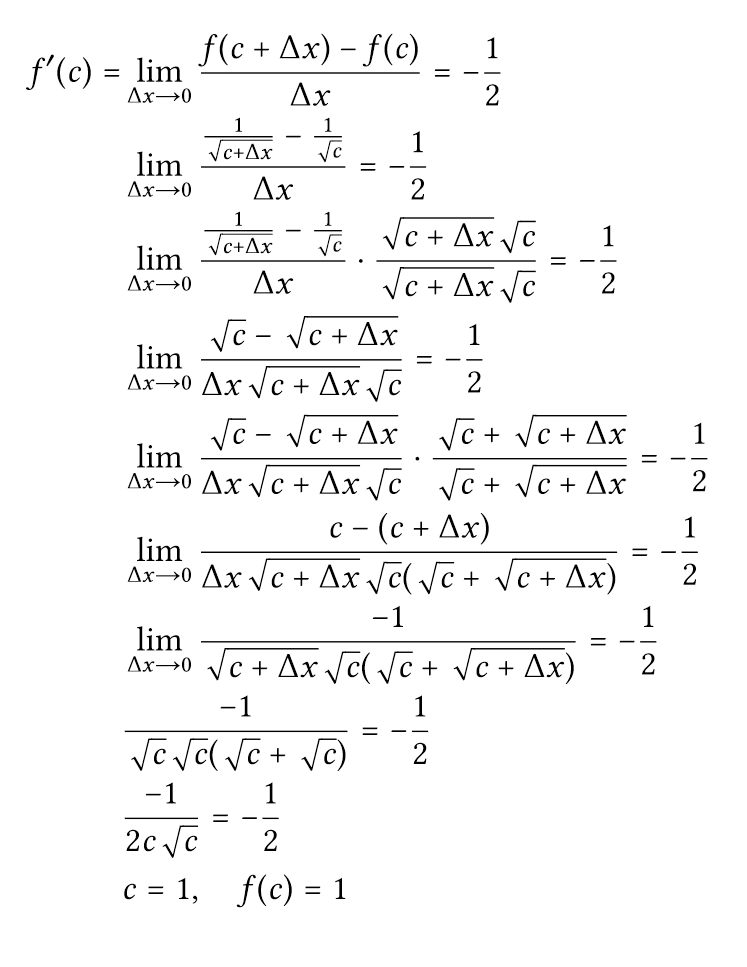
that was so painful
thanks a lot @hushed pasture !!!
hushed pasture
$\lim_{x \to c} \frac{\sqrt{x}-\sqrt{c}}{x-c} = \lim_{x \to c} \frac{x-c}{(x-c)(\sqrt{x}+\sqrt{c})} = \lim_{x \to c} \frac{1}{\sqrt{x}+\sqrt{c}} = \frac{1}{2\sqrt{c}} = -\frac{1}{2}$
ocean sealBOT
Salah
 hushed pasture
@grand oak it's simpler than you think🤣
grand oak
wait-
grand oak
no?
grand oak
ocean seal
**Salah**
its $\lim_{x \to c} \frac{\frac{1}{\sqrt{x}}-\frac{1}{\sqrt{c}}}{x-c}$ not $\lim_{x \to c} \frac{\sqrt{x}-\sqrt{c}}{x-c}$
ocean sealBOT
MikeRoma
 hushed pasture
ah ok so it's this is such a massive derivative hhhhhhhhhhhhh
 trim oracle
This is physics but I just want to make sure I’ve rearranged correctly?

 glass lichen
trim oracle
This is physics but I just want to make sure I’ve rearranged correctly?
glass lichen
trim oracle
This is physics but I just want to make sure I’ve rearranged correctly?
check 3rd to 4th line
did you multiply by c^2 correctly?
alpine sable
How do I find out e, f, and g?

 upper spruce
Is this room free?

Someone pls help
I understood that the expression inside log is Tan(x+45)
 golden nymph
alpine sable
How do I find out e, f, and g?
golden nymph
alpine sable
How do I find out e, f, and g?
e solve for time when s=0 again
f sub this time in v
g double the maximum height
upper spruce
How to solve further?
upper spruce
I would get –( cos+sin )
 orchid kayak
ay, I just wanna to confirm if I did the math correct
Is this channel open or being used?
upper spruce
Yeah it's open
 golden nymph
,calc tan(34*pi/180)
ocean sealBOT
Result:
0.67450851684243
,calc 2.12*0.675
ocean sealBOT
Result:
1.431
Yup seems correct
orchid kayak
o wait I forgot to put 3m instead of 2
golden nymph
Oh lol
orchid kayak
also thanks for checking it for me
golden nymph
,calc 1.431+1.64
ocean sealBOT
Result:
3.071
I have no idea 🙁

 toxic delta
upper spruce
toxic delta
upper spruce
Using this channel?
golden nymph
upper spruce
I got the soln but the method book is using is way complicated
So do you need help understanding that or what?
I think that’s the best method
upper spruce
I understood the soln but I'm preparing for competitive exam and I don't have much time to take longer steps
I guess that there is some shortcut via which the soln will become shorter
golden nymph
I am not sure there is
upper spruce
@toxic delta u may use the channel
toxic delta
Thanks!

Can someone help me figure out what I did wrong please! I know the last part I added but it’s still wrong
golden nymph
Yeah I don’t expect baby pluto to ask a calculus question but what do I know
toxic delta
LMAO
alpine sable
golden nymph
e solve for time when s=0 again
f sub this time in v
g double the maximum height
sub this time in v? wdym? sub what in for v? v = 0?
 undone garnet
Question: How can I prove that Ax = b has a solution for every b when T: R^m --> R^n? Ik that b should be a linear combination of all vectors in Matrix A, but idk how to prove that either? so any ideas?
golden nymph
alpine sable
sub this time in v? wdym? sub what in for v? v = 0?
Sub the time in e inside the v function
golden nymph
undone garnet
Question: How can I prove that Ax = b has a solution for every b when T: R^m -->...
Occupied
golden nymph
toxic delta
LMAO
You want from y=0 and not from x=0
You have to solve for the x where y=0
undone garnet
golden nymph
Occupied
oops sorry!
toxic delta
Ohhh
upper spruce
toxic delta
Can someone help me figure out what I did wrong please! I know the last part I a...
What are the limits of the function?
toxic delta
upper spruce
What are the limits of the function?
Uhhhhh 9 and 1
Right? That’s where I goofed up?
golden nymph
Yup
toxic delta
Ah man haha simple mistakes. Thanks!
golden nymph
Wlc!
toxic delta
undone garnet
oops sorry!
Good to go if you need
undone garnet
Perfect!
 quartz osprey
 undone garnet
so lol again:How can I prove that Ax = b has a solution for every b when T: R^m --> R^n? Ik that b should be a linear combination of all vectors in Matrix A, but idk how to prove that either? so any ideas?
golden nymph
quartz osprey
Occupied
quartz osprey
after 🤪
golden nymph
quartz osprey
after 🤪
No
golden nymph
toxic delta
Good to go if you need
.
golden nymph
undone garnet
Question: How can I prove that Ax = b has a solution for every b when T: R^m -->...
.
alpine sable
golden nymph
e solve for time when s=0 again
f sub this time in v
g double the maximum height
so that solves the velocity upon impact, but what about finding its speed? second part of f
 thick shard
how can I solve this? I can't seem to factor it by grouping
 golden nymph
GUYS CHECK WHETHER THE CHANNEL IS OCCUPIED OR NOT!!!
quartz osprey
ok
golden nymph
alpine sable
so that solves the velocity upon impact, but what about finding its speed? secon...
Just remove the negative lol
alpine sable
lol
upper spruce
undone garnet
so lol again:How can I prove that Ax = b has a solution for every b when T: R^m ...

You can prove it graphically.... here I have taken example of 2x=10
glass lichen
undone garnet
so lol again:How can I prove that Ax = b has a solution for every b when T: R^m ...
You can have a system w/o solutions...
so you cant prove this
upper spruce
undone garnet
oh by Ax = B, I mean for a matrix
A and B are constants ?
undone garnet
No, A is a matrix
glass lichen
$\begin{bmatrix}0&0&0\0&0&0\1&1&1\end{bmatrix}x=[0,0,0]^T$
ocean sealBOT
Mosh
 glass lichen
you haven't specified what n and m are either
undone garnet
Let me send the question, 1 sec
glass lichen
Good idea... send the question when you ask it.
undone garnet

My answers are:
A - Onto
B - One to One
C - Both
my issue is that idk how to prove my answers
glass lichen
nowhere does it say prove
undone garnet
well they want a short explanation
they are looking for that
doesn't have to necessarily be a proof, but instead something like an explanation that explains my answer
upper spruce
Onto: T:Rn→RmT:Rn→Rm is said to be onto RmRm if each b in RmRm is the image of at least one x in RnRn
One-to-one: T:Rn→RmT:Rn→Rm is said to be one-to-one RmRm if each b in RmRm is the image of at most one x in RnRn
And then, there is another theorem that states that a linear transformation is one-to-one iff the equation T(x) = 0 has only the trivial solution.
That doesn't say anything about onto.
Then there is this bit that confused be about onto: Let T:Rn→RmT:Rn→Rm be a linear transformation and let A be the standard matrix for T. Then: T maps T:RnT:Rn onto RmRm iff the columns of A span RmRm.
glass lichen
ok well when m>n, you have more columns than rows
so if you take the set containing the columns of A ${A_1,...,A_m}$ this is a spanning set by extremal properties. So the set spans and is thus onto
ocean sealBOT
Mosh
 glass lichen
That's my guess, linear algebra in this sense was my weak side
undone garnet
What is a spanning set? Sry we havent learned that yet
glass lichen
a set that spans the space
$\mathbb{R}^2$ has a spanning set ${[1,0]^T, [0,1]^T}$ for example
ocean sealBOT
Mosh

 distant talon
if a whole year fits into a month how many minutes is a day?
distant talon
how many minutes does a in game day need to be to fit a 365 game days in a normal month on earth (trying to make a game)
 fringe comet

Question, what is the second question asking exactly and did I do the first question right?

 harsh nimbus
did you try using power rule
fresh sluice
fringe comet
Real zero's are when the function equals zero.
And the numbers are real.
fringe comet
i figured that problem out
fresh sluice
alpine sable
First of all, we can simplify all the terms.
First of all, 1/3*x^3=x^3/3. Now, -1/2 times x^2, since they're next to each other, gets you -x^2/2. Now, we get x^3/3-x^2/2-6x.
We can simply find the derivative of any number with a constant combined with x, it is that constant.
Now, for x^3/3, and -x^2/2.
Now, we can do x^3/3 by the following.
First we take out the constant, and if we look back, we multiplied x^3 by 1/3.
Now, we have to find the derivative of x^3, since d/dx(1/3)=0.
The derivative of x^3=3x^2.
Now, we multiply both numbers again, and we get x^2.
Since a third of three=1, and we have x^2 leftover.
Now, we can apply the same for -x^2/2.
We can take out the constant which we concluded to be -1/2, before.
Now, we have to take the derivative of x^2, which is 2x.
Now, we multiply each terms together, again.
We get -x.
Now, we can conclude this as x^2-x-6.
There.
@alpine sable , there.
alpine sable
ohh
 velvet cobalt
Find and sketch the domain of the function:

My answer: x >= 0, y >= 2
correct answer:

Basically, I'm really confused with the x^2 + 1/4y^2 <= 1 part of the correct answer.
 alpine nacelle
4-4x²-y² >= 0 iff 4 >= 4x²+y² iff 1 >= x²+1/4 * y²
velvet cobalt
Alright, I understand the problem. However, can't you just leave it at 4 >= 4x^2 + y^2?
hushed pasture
velvet cobalt
Alright, I understand the problem. However, can't you just leave it at 4 >= 4x^2...
yeah you can
 wintry sail
any word of advice in being able to do math problems faster as I feel lie
velvet cobalt
👍
wintry sail
I am getting slower with doing integration with calculus 2
hushed pasture
wintry sail
any word of advice in being able to do math problems faster as I feel lie
practice and always try to learn the concept not just learning ways to solve problems
wintry sail
Okay as for me did not do math is 5 years and my parents never enocurage in doing hard math but feel like passion in doing it and getting back into it
hushed pasture
wintry sail
Okay as for me did not do math is 5 years and my parents never enocurage in doin...
go for logic, sets and applications, those courses will improve your thinking
wintry sail
Okay as am using UDEMY krista king calculus 2 course
hushed pasture
wintry sail
Okay as am using UDEMY krista king calculus 2 course
is he\she doing highschool or college programme?
wintry sail
Just for fun but do think college
This is a course online and all

Udemy
Krista King is a Udemy instructor with educational courses available for enrollment. Check out the latest courses taught by Krista King
alpine sable
Are u guys in a middle of convo?
can i ask a question here?
I'm guessing im good
If I were to find the limit of this function at x = -5

would it be -2 or -3? I was thinking it's probably -3 because limits don't actually approach x = -5...
 buoyant edge
The function approaches -3 the closer you get to x = -5 from either side, so the limit as x --> -5 is -3
This is a case where the value of the function is different from the limit, since the function is discontinuous at x = -5
 misty mortar
What test should I use for this?

 hard ether
Is there a quick formula for this


 wary stream
fringe comet
wary stream
fringe comet
You don't need the equation, all the info you need to answer that question is in the graph
fringe comet
 gusty fog
<@167370037072625664>
gusty fog
<@167370037072625664>
11
fringe comet
wary stream
You don't need the equation, all the info you need to answer that question is in...
wait really how
gusty fog
Is this pre calc
fringe comet
yes sir.
gusty fog
Ah
wary stream
fringe comet
wait really how
Do you know what domain and range is?
And intercepts
And asymptotes?
fringe comet
wary stream
Do you know what domain and range is?
domain is the x-ints, no? and the range being the y-ints, the ints are where it hits a certain axis, and the asymptotes are places where the graph never reaches but infinitely approaches
wary stream
Domain and x intercepts are two different concepts
gusty fog
Domain is possible set of input values
wary stream
The domain of a function is the set of values that we are allowed to plug into our function
gusty fog
Exactly
wary stream
So looking at the graph, what is the allowable domain?
fringe comet
that's what confuses me but ill try: 1 and -1?
wary stream
No
gusty fog
What is it
wary stream
fringe comet
that's what confuses me but ill try: 1 and -1?

Khan Academy
Finding the domain and the range of a function that is given graphically.
Perhaps that will help
fringe comet
is it -infitity < x < infinity ?
wary stream
Nope
alpine sable
buoyant edge
This is a case where the value of the function is different from the limit, sinc...
I did that but got the question wrong
wary stream
Closer though
wary stream
No
gusty fog
Rip
wary stream
fringe comet
im confused bc of the way the graph is
It's because of the dotted lines too
gusty fog
All real numbers?
wary stream
They are there for the domain and range too
gusty fog
gusty fog
All real numbers?
Huh?
buoyant edge
@alpine sable Are you being asked for the limit or the function value at that point?
ocean sealBOT


 Requested by dldh06#2659
gusty fog
Requested by dldh06#2659
gusty fog
So what's the domain
fringe comet
is it 1 / x^2
gusty fog
@wary stream
alpine sable
buoyant edge
<@456226577798135808> Are you being asked for the limit or the function value at...
yes
wary stream
Like for that graph, f(x) = 1/x, the domain is (-inf, 0) U (0, inf)
buoyant edge
what
wary stream
Because there in an asymptote at x = 0
wary stream
fringe comet
is it 1 / x^2
No, I was showing an example
alpine sable
 fringe comet
wary stream
No, I was showing an example
fringe comet
wary stream
No, I was showing an example
oh
but how would that work for my example
theres a parabola in the middle
wary stream
Use the asymptotes
fringe comet
so (infite, 0) U (0, -infite)
alpine sable
buoyant edge
what
I have to find what y value i get when lim x -> -5
buoyant edge
Oh, the y value is -2
The little white circle is a hole, which means the function is discontinuous at that point. The black dot is the actual function value.
wary stream
fringe comet
im so so confused
The asymptotes are values you can't use. So for the left side, it would be (-inf, -4) U (-4, ___). That blank is some other value that I won't say so you can figure it out yourself
It goes up to that asymptote but does not include it
fringe comet
-inf, -4) U (-4, inf) ?

 queen mural
can someone help me plz?
fringe comet
-13<x<0 , how do i convert this to a notation that uses {x | x ... }
i think its called set builder notation?
 warm brook
{x : -13<x<0}
alpine sable
what trig identity is this talking about

I was able to simplify to $4cos(8t) - 3cos(\frac{\pi}{2} - 8t)$ but idk what to do after that
ocean sealBOT
bee_ryan
 alpine sable
what do you need to do after that, assuming that's correct?
since it's using only cosine
they likely want you to use

one of the two terms will have a square root
oh i see, ill try that
 astral stump
im not sure if this is the right place to ask but anyways
how does a person find the aspect ratio of a screen size
eg.
1920×1080 = 16:9
3440x1440 = 21:9
i don't know how given the input of 1920 and 1080 how do i come up with the 16:9 number
astral stump
is there formuial?
alpine sable
It's just fractions
astral stump
im trying to make a script so i need to some how program it
alpine sable
Do you know how to reduce 15/3 to 5/1?
astral stump
i can do it ez pen and paper yeah but i'm not sure scripting wise i guess
alpine sable
You could write a GCD algorithm
I'm sure there are packages that will reduce fractions for you though
turbid anchor
search for something called euclid's algorithm for gcd, copy stackoverflow code, etc.
warm brook
the O(N) way to do it is to divide width/height and just multiply by every integer until you get something close enough to another integer and that’s your aspect ratio 😉 (don’t do this, euclid’s algorithm is way better)
astral stump
kk lol thanks guys
 warm brook
no, just find the intervals that f(x)>0 and f(x)<=0
fringe comet
warm brook
no, just find the intervals that f(x)>0 and f(x)<=0
im not sure how to do that tbh
 low topaz
how many digits are there in TREE(3)
 placid zinc
Too many to be expressible
alpine sable
 warm brook
fringe comet
im not sure how to do that tbh
warm brook
fringe comet
im not sure how to do that tbh
huh, where is the graph > 0 and <= 0
alpine sable
wat am i doing wrong in the last one
 low topaz
is pi equal to the circumference over the diameter of any circle
warm brook
low topaz
is pi equal to the circumference over the diameter of any circle
no
wait
over they diameter yes
i thought you just said circumference
C = 2pi * r
warm brook
fringe comet
IDK
start by just finding where the graph is 0
glass lichen
low topaz
is pi equal to the circumference over the diameter of any circle
yes... it doesnt magically break for some random circle
 visual ermine

 low topaz
glass lichen
yes... it doesnt magically break for some random circle
low topaz
glass lichen
yes... it doesnt magically break for some random circle
if it can be shown as a fraction wouldn't pi be rational
glass lichen
no
cause either C or d will have some irrationality
thus it isnt rational since it fails the definition
You cant have a circle with integer circumference and diameter
low topaz
ok
 woeful pulsar
alpine sable
what trig identity is this talking about
woeful pulsar
alpine sable
what trig identity is this talking about

The trigonometric R method is a method of rewriting a weighted sum of sines and cosines as a single instance of sine (or cosine). This allows for easier analysis in many cases, as a single instance of a basic trigonometric function is often easier to work with than multiple are. The R method is most often used to find the extrema (maximum and mi...
 stiff holly
Kinda lost on how to get the equation of the perpendicular line?

 ancient saddle
stiff holly
Kinda lost on how to get the equation of the perpendicular line?
ancient saddle
stiff holly
Kinda lost on how to get the equation of the perpendicular line?
Hello, do you know how to get the equation of a plane given its normal vector?
 tight locust
i don't think you even have to do any math for this specific problem
just use a bit of common sense
if a point is on the yz-plane then what can you say about it?
ancient saddle
No, in the yz plane, y and z can take any value, but x is fixed
stiff holly
rip i thought it was xy
ancient saddle
tight locust
i don't think you even have to do any math for this specific problem
Hello, I'm really curious about this, could you elaborate please?
ancient saddle
ancient saddle
Hello, do you know how to get the equation of a plane given its normal vector?
I asked this because with this concept we could get the answer much faster, but there's still another method I know. Anyway, maybe EndTimes' method is much better
stiff holly
i feel like you have to put it into a parametric form and use the point for t right?
wait no that wouldnt work
ancient saddle
Take any pair of vectors contained in the plane, how is their cross product related to the plane?
stiff holly
orthognal
ancient saddle
stiff holly
orthognal
great, so if you want the line to be perpendicular to the plane, how can you use that?
stiff holly
My problem is im only giving one equation, how do i take the cross product of one vector
ancient saddle
You can find 2 vectors contained in the plane
just plug in random values to x and y so you can find z at least 3 times so you get 3 different points, with those 3 points you can get 2 vectors contained in the plane
 analog arrow

 tight locust
what are you trying to find out lmao
tight locust
 elder glacier
draw a venn diagram
elder glacier
@tight locust i have drawn a ven diagram
and i get it to people not studying art, not studying english but people studying german
i get |E^c intersection A^c intersection C|
 jaunty root
Why is there no symbol for irrational numbers?
placid zinc
There kind of is: R\Q
jaunty root
placid zinc
There kind of is: R\Q
Yeah that's right but I'm kind of wondering that there is still no notation for irrationals
tight locust
 elder glacier
@tight locust god i hate venn diagrams, appreciate your help, but is there a way to use set law algebra in this case so you don't have to use a venn diagram?
tight locust
de morgan's law and distributive law
elder glacier
right so you get |E^c intersection A^c intersection C|
tight locust
yeah
tight locust
$(a+b)^n = \sum_{k=0}^n \binom{n}{k} a^kb^{n-k}$
ocean sealBOT
EndTimes
 tight locust
(a+b)^3 = a^3 + 3a^2b + 3ab^2 + b^3
 woven horizon
tight locust
(a+b)^3 = a^3 + 3a^2b + 3ab^2 + b^3
woven horizon
tight locust
(a+b)^3 = a^3 + 3a^2b + 3ab^2 + b^3
Can u type it again?
tight locust
?
woven horizon
tight locust
?
its confusing what u wrote :/
woven horizon
tight locust
i literally gave you the formula lmao
o i needed the process f
tight locust
this is the process

 pseudo ocean
$\forall a>b\geqslant 3; a,b \in \mathbb{N}, prove~that~b^a>a^b$
ocean sealBOT
bo may lai so may vcl
 pseudo ocean
is it possible to let a=b+k for some k
and then let g(b)=(b+k)lnb-bln(b+k)
then we have g'(b)=lnb-b/(b+k)
since b>=3, g'(b)>0.... qed
im just wondering whether
you can consider the k variable as a constant
im confused
bc a and b changes right.......
 rigid smelt
i think you might be overthinking this
pseudo ocean
wdym
rigid smelt
using the inequality they gave, a>b, you can obtain the information that a^a>a^b
by raising a to the power of both sides
and since a and b are affirmatively positive and a>b, the sign is not changed
pseudo ocean
but b^a<a^a
rigid smelt
im not sure if you can consider k as a constant
rigid smelt
hmmm wait but does it matter tho
 velvet condor
induction...?
pseudo ocean
velvet condor
induction...?
idk
pseudo ocean
rigid smelt
hmmm wait but does it matter tho
yes
pseudo ocean
pseudo ocean
then we have g'(b)=lnb-b/(b+k)
to differentiate this
if k is not a constant then boom
rigid smelt
i mean technically we only need the partial derivative wrt b anyway if it werent, since we only cared about the change wrt b
velvet condor
it makes more sense when you let k=1, and then 2,....
right....
correct me if im wrong
rigid smelt
well technically k is any natural numbers here
pseudo ocean
hmm
rigid smelt
so yeah, thats why i was thinking it also does play a role in g
pseudo ocean
i think i understand what u are trying to say
rigid smelt
but then it looks like you were only caring about the change wrt b
pseudo ocean
pseudo ocean
then we have g'(b)=lnb-b/(b+k)
(for any natural number k)
rigid smelt
so it wouldnt matter either way
pseudo ocean
yes
 rigid smelt
what is your answer
 light kestrel
 rigid smelt
,rotate
ocean sealBOT
 light kestrel
oop i forgot to multiply the first 2 terms
rigid smelt
uhh im not sure what you are doing
velvet condor
can try using wolfram alpha to double check
light kestrel
rigid smelt
uhh im not sure what you are doing
ye lol
velvet condor
,w d/dx (5tanx +2cscx)
light kestrel
im using product rule
ocean sealBOT

 Requested by Minh Baka#9435
rigid smelt
Requested by Minh Baka#9435
rigid smelt
theres no product here
light kestrel
what
rigid smelt
there is no product (of two functions in x) in 5tan(x) + 2csc(x)
why would you use product rule
velvet condor
u mean tanx= sinx(1/cosx)?
light kestrel
and g is the 2cscx
velvet condor
5 is a constant.......
light kestrel
5 is attached to tanx tho
 remote parcel


 rigid smelt
channel is occupied, please move
light kestrel
rigid smelt
but you are looking at f+g
o
so the product rule only works when the 2 terms are multiplied?
rigid smelt
there is a reason its called product rule
rigid smelt
and there is a reason its written as $(uv)'=uv' +u'v$
ocean sealBOT
waler
 rigid smelt
light kestrel
anyway so i would i solve that without product rule
rigid smelt
light kestrel
anyway so i would i solve that without product rule
how do you differentiate f+g wrtx where f and g are two functions in x
i think you have done this quite a lot already
having seen you done it in the other channels
tight locust
what is the derivative of 2x?
 high palm
rip
light kestrel
2
tight locust
and what is the derivative of x
light kestrel
1
tight locust
so what is the derivative of (x+x) ?
tight locust
what is x + x?
velvet condor
tight locust
so what is the derivative of (x+x) ?
2
$\frac{d}{dx}{(x)}=\frac{dx}{dx}=\frac{1}{1}=1$
ocean sealBOT
Minh Baka
 velvet condor
big brain
tight locust
good job. but i was asking uwu
tight locust
(f+g)' = f' + g'
tight locust
yes
light kestrel
right
tight locust
and what's the derivative of 2csc(x)
light kestrel
so that would be 2-cscxcotx
light kestrel
the rule says theres - infront of cscx tho
tight locust
d/dx 2csc(x) = -2csc(x)cot(x)
light kestrel
the - would go infrotn of 2?
tight locust
yes but there is an order in which symbols have to go. you wrote it as subtraction instead of multiplication
light kestrel
oh ok
 devout hornet
any clue on part d
 warm brook
@devout hornet lagrange interpolation is fine for any x_j, even if they're not uniform. The textbook you're using (bc I'm 99% sure that is a screenshot from a textbook) will describe the lagrange interpolation better than I could on discord message
devout hornet
this is jsut an assignment i have not from a textbook as far as im aware
I have part a and b now i think but not sure how to go one from that
warm brook
Here you just need to do the 3rd degree polynomial centered about j-1,j,j+1
Ah okay
Okay, it's a little better now, so error is taken by the taylor expansion of f about x_j
It looks like you have a theorem for it, let me look through my numerical analysis notes to see if I have something similar
devout hornet
thanks so much
warm brook
Okay so for Lagrange interpolation on the interpolation $P(x)$, $f(x)$ has the form
[f(x) = P(x) + \frac{f^{(n+1)}(\xi_x)}{(n+1)!} \prod_{k=0}^n(x-x_k).]
The proof of this I can provide, but I'll leave it to you/your notes, as I presume it's already been shown
ocean sealBOT
kirby
 warm brook
So the error at a given point $x$ would be
[|f(x)-P(x)| = \left|\frac{f^{(n+1)}(\xi_x)}{(n+1)!}\prod_{k=0}^n(x-x_k)\right|]
ocean sealBOT
kirby
 warm brook
Not particularly, it's just a lot of variables, and in reality, you're already given that $|f^{(3)}| \le M$ and $n=2$ in this case
ocean sealBOT
kirby

 glossy briar
do you know what that symbols called
warm brook
$\xi$?
ocean sealBOT
kirby
 glossy briar
yes
warm brook
xi
glossy briar
how do you pronounce it I mean
warm brook
It's hard to write it, but it's pronounced zye
ocean sealBOT
Mrmangoman1123
Compile Error! Click the  reaction for more information.
(You may edit your message to recompile.)
 warm brook
No, that's $\zeta(2)=\pi^2/6$
ocean sealBOT
kirby
 glossy briar
ohhhh