#help-0
1 messages · Page 824 of 1
 queen raven

 alpine sable
Which one?
yo
can someone help xd
i think i forgot basic math
Ok let me see
can someone tell whats 35 divided by 14
i keep finding 2.7
and calculator says 2.5
 sweet gulch
2.5 is correct. Could you show how you got 2.7. Maybe we can find the error?
alpine sable
Yeah it's not gonna be very easy to do
sweet gulch
I didn't see, the channel was busy.
Sorry :D
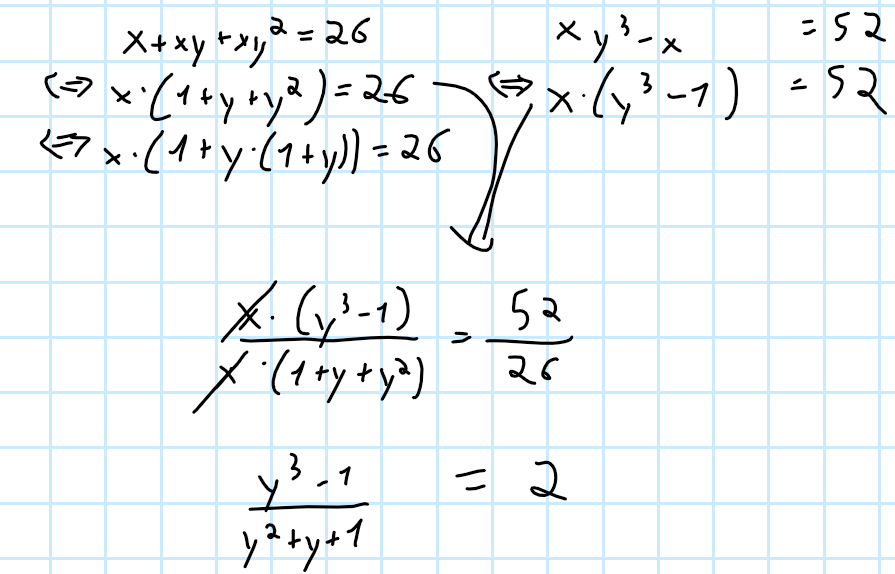
https://i.imgur.com/RTD68fT.png
I simplified it a little bit.
With that you could brute-force by trying some numbers.
I got the solution on the 4th attempt.
@rigid mesa
 sour umbra
 sweet gulch
Our prof often solved it that way.
Not sure if your prof wants it that way. See if he's fine with that.
Because of the -1 and the 1+, I'd guess that there isn't really a better way to simplify.
And I'd say that's there on purpose
alpine sable
sweet gulch
2.5 is correct. Could you show how you got 2.7. Maybe we can find the error?
 sweet gulch
The 07 is not the next number. You don't simply append the 07
You have to take the 7 and multiply by 10 (going to the next digit)
Then you divide again (70/14) which is 5. Giving you the missing .5
 restive fable
hello anyone here who can help me with this?

 sudden garden
is factoring is same as writing expressions as a product of factors
 earnest cairn
sudden garden
is factoring is same as writing expressions as a product of factors
earnest cairn
sudden garden
is factoring is same as writing expressions as a product of factors
Yea
sweet gulch
Is this the correct approach and conclusion? (Using quotient criterium and L'Hospital)
 sudden garden
earnest cairn
Yea
sudden garden
earnest cairn
Yea
thankyouu
 gray isle
you didn't divide / manipulate your fractions properly
sour umbra


 glass lichen
x in n dimensionsl space
 hidden junco
ah so x is a vector ?
hidden junco
ahh ty
glass lichen
It's an n-tuple coordinate vector
 vital timber

if im doing u_x
do i ignore the whole sin(y)?
or is it chain rule and product rule
 uncut tapir
u_x means partial derivatives with respect to x
That's why Laplace's equation here is written as u_xx + u_yy = 0
vital timber
i mean when im solving for the first x
when i solve for u_x
I take the derivative of e^x
uncut tapir
Yes
uncut tapir
sin(y) is treated as a constant since it's only a function in y
You're only taking partial derivatives
uncut tapir
Yeah then you'd apply the product rule of partial derivatives
vital timber
ok ty!!
sudden garden
factor 5+5x-y-xy
uncut tapir
Product rule sorry since there's two functions of x multiplied by each other
uncut tapir
@vital timber The chain rule applies if say x and y are functions of t and you want to calculate u_t
sudden garden
glass lichen
Also we don't give answers
i want the answer to observe it and learn.
uncut tapir
so with e^x sin (xy), apply the product rule for u_x and treat y as if it was a constant
uncut tapir
sudden garden
factor 5+5x-y-xy
Also this question is a bit confusing since the highest common factor of all 4 terms is 1
Usually when you factorise an expression it means taking out the highest common factor outside the bracket and dividing all terms inside the bracket by that term
sudden garden
yes, this is confusing.
uncut tapir
So is there a specific form they're looking for?
 plush moon
What is the standard form of the equation of a straight line?
 sudden garden
uncut tapir
So is there a specific form they're looking for?
sudden garden
uncut tapir
So is there a specific form they're looking for?
just tellingg to factorize
uncut tapir
I might know what's going on actually
I think you need something that looks like
(ax+b)(cy+d)
So it's almost like a quadratic
sweet gulch
gray isle
you didn't divide / manipulate your fractions properly
Is this the part in question?
 sudden garden
yes,that thing
uncut tapir
If you expand the brackets you'd get an xy term, an x term, a y term and a constant term which is what the expression is
Have you tried it?
First hint would be, you need either +x and -y or a -x and a +y to make -xy
gray isle
@sweet gulch yes. that part is incorrect.
sweet gulch
gray isle
<@266337193772056577> yes. that part is incorrect.
Oh. I see why. Thank you :D
plush moon
plush moon
What is the standard form of the equation of a straight line?
can anyone help me :) ?
 robust grail
plush moon
can anyone help me :) ?
robust grail
plush moon
can anyone help me :) ?
It's in #help-1
 green wadi
Can somebody please help?
 sweet gulch
green wadi
Can somebody please help?
sweet gulch
green wadi
Can somebody please help?
continous means that there is no "jump".
lim f(x) with x->0 has to be equal both when x starts at +infinity and at -infinity
the channel is busy rn
@green wadi Does this solve your question?
 feral lodge
show that if a and b are two even integers then the number a² + b² is also even ?
 snow hull
I'm on question 8 tab if anyone is free
sweet gulch
Oh nvm. He is offline.
snow hull
I have my question in number 8
alpine sable
why is it if you multiply 3(-2) it’s minus 6 but if you multiply 3(-2)^ it’s plus twelve and not minus 12 does anyone know?
sweet gulch
alpine sable
why is it if you multiply 3(-2) it’s minus 6 but if you multiply 3(-2)^ it’s plu...
Do you mean 3(-2)^2?
alpine sable
sweet gulch
Do you mean 3(-2)^2?
yes sorry
sweet gulch
In that case you first solve the "exponent" (english is not my first language) (-2)^2 which is 4
Then you do 3*4 which is 12
It's a rule just like * comes before +
alpine sable
but why is it not minus 4
sweet gulch
(-2)^2 = (-2)*(-2) which is 4 since (-x)*(-y)=x*y (- * - cancels each other out)
 silver current
quick question, does identity matrix only have ones from the left diagnol
gray isle
product of two negatives is positive
alpine sable
sweet gulch
``(-2)^2`` = ``(-2)*(-2)`` which is ``4`` since (-x)*(-y)=x\*y (``- * -`` cancel...
i get u now thanks it makes sense!
 light sleet
can someone explain to me and guide me on this math arithmatic? I dont quite understand

 smoky ledge
sweet gulch
light sleet
can someone explain to me and guide me on this math arithmatic? I dont quite und...
smoky ledge
sweet gulch
light sleet
can someone explain to me and guide me on this math arithmatic? I dont quite und...
It states A~B so if the 4ft at the bottom changes to 2ft, all other sides half too.
Then you can apply the volume formula for this figure with all sides being half of figure a
light sleet
sweet gulch
It states A~B so if the 4ft at the bottom changes to 2ft, all other sides half t...
so literally figure be is just half of figure A in a way?
sweet gulch
The figure itself is not half. The volume will be lass than half, since multiple sides half.
iirc the formula for the left one would be 4*10*3 so the one for the right would be 2*(10/2)*(3/2) which is 2*5*1.5 like LeiFire said.
light sleet
so.. just multiplying the a figure, then- can you explain it in a way I can do that? like even get to that? cuz I still dont understand when it comes to multiplying and dividing stuffl ike this
sweet gulch
You are not allowed to directly multiply the volumes. You have to adapt the formula
light sleet
alright, then can you teach me how I can simplistically adept the formula?
sweet gulch
Put in the new values

Since the side with 4ft halfes, you can insert all other sides with half the original value
Then you just put that information into the volumetric formula of the figure
The channel is busy right now
Wait your turn
<@&268886789983436800>
 tall wing
@trim vector read #❓how-to-get-help and follow the rules there. first warning
sweet gulch
The most important information was the A~B which is pretty hidden if you ask me
That dictated the sides to half
Glad I could help :D
light sleet
❤️

 amber urchin
alpine sable
I have a panic attack just looking at this shit
amber urchin
alpine sable
I have a panic attack just looking at this shit
I guess contact your local doctor
amber urchin
alpine sable
or literal emotional support?
That one
 blazing rose
the correct answer to this is 14/3 but i got 10/3
blazing rose
...
amber urchin
blazing rose
...
Question about the form: Do you have to use this limit comparison that you wrote down or is it not obligatory?
blazing rose
wym limit comparison
im using sigma notation just to make sure i know how to
ik i can just use a definite integral
amber urchin
blazing rose
wym limit comparison
In other words, I know a better way, but I don't know what you learn
amber urchin
blazing rose
ik i can just use a definite integral
Alright, fair
blazing rose
yeah a regular integral of x^2 + 1 from 0 to 2
sweet gulch
alpine sable
Start by replacing the f(x) in the bottom by the value of f(x) from the top.
Now you should be able to refactor and get the value on the right.
x != +-2 is just there since we lose that value because we are not allowed to divide by zero (which we would do otherwise)
alpine sable
 blazing rose
bru
alpine sable
sweet gulch
Start by replacing the f(x) in the bottom by the value of f(x) from the top.
Now...
ive never done triple layered fractions before, where do i even start?
because its under the 1, wouldnt that just cancel out or what?
sweet gulch
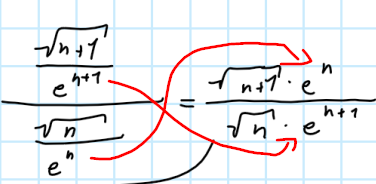
1/((x+2)/(x-2)) <=> 1*(x-2)/(x+2)
If the dividor is divided by a number you can instead put it at the top (by multiplying the top with it)
https://i.imgur.com/nAsYXOn.png example
 alpine sable
i literally have no idea
sweet gulch
 alpine sable
so i multiply the (x+2)/(x-2) by the 8x?
sweet gulch
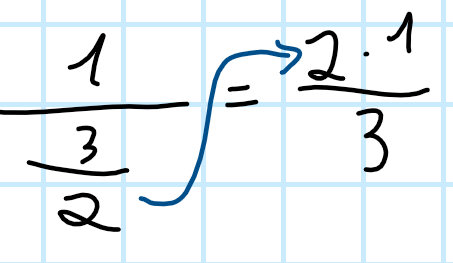
If a dividor get's divided by 2 itself,
you can instead multiply the denometor by 2
and have the same effect
I'd completly ignore the equation at the start.
Just focus on the left side and try to make it the same as the right side.
alpine sable
so if i multiply by the reciprocal, I can just flip it right
sweet gulch
You could say it like that.
By multiplying both the denominator and the dividor with the reciprocal, you get this result.
 red kestrel
Can someone explain why 0! Is 1? First year Mathematics lecture
sweet gulch
red kestrel
Can someone explain why 0! Is 1? First year Mathematics lecture
I'd just accept it. It's like x^0 = 1
0! means that you have no numbers at all to multiply. So the neutral factor 1 is the only one that remains
You could see it that way:
0! <=> 1*0! <=> 1*() <=> 1
glass lichen
3!=6
2!=6/3=2
1!=2/2=1
0!=1/1=1
alpine sable
sweet gulch
You could say it like that.
By multiplying both the denominator and the dividor ...
so like this?
 red kestrel
glass lichen
3!=6
2!=6/3=2
1!=2/2=1
0!=1/1=1
red kestrel
glass lichen
3!=6
2!=6/3=2
1!=2/2=1
0!=1/1=1
Thanks makes sense
sweet gulch
alpine sable
so like this?
The second to last line seems kind of odd. You forgot to put "brackets" around the second part of the denomitor.
x^2+4x+4-((x-2)*(x-2)) = x^2+4x+4-(x^2-2*(2x)+4) = x^2+4x+4-x^2+4x-4 = 8x
(I left out the dividor since it doesn't change)
alpine sable
when do u flip the sign in an inequality
sweet gulch
With the dividor (like you sucessfully equated) you get 8x/(x^2-4)
 dusk solstice
I need help
glass lichen
alpine sable
when do u flip the sign in an inequality
Dividing/multiplying by negatives and reciprocal are the common ones
alpine sable
sweet gulch
The second to last line seems kind of odd. You forgot to put "brackets" around t...
i got the right answer so cant fault that
 swift nexus
I got two loans - one is for $x for 25 years and has an annual interest of i%, and another is for $y for 20 years and has an annual interest of j%
How do I calculate the weighted average between them?
alpine sable
i as in imaginary?
 dense flower
if i wanna pull 5 specific items out of 10 in a specific order
do i need to do anything after calculating 1/10 * 1/9 * 1/8 * 1/7 * 1/6 ?
does this probability already account for order ?
or i need to do (1/10 * 1/9 * 1/8 * 1/7 * 1/6)^5 ?
swift nexus
@alpine sable no, sorry. just a variable
 alpine sable
<@&286206848099549185>
alpine sable
alpine sable
<@&286206848099549185>
Wait at least 15 minutes before pinging
k
can u help doe?
 whole willow
did you draw the graph?
 quick jolt
how is this done? its on a practice test but our teacher hasnt gone over this kind of work
 whole willow
no
alpine sable
i sorry
whole willow
paste your graph
alpine sable
k sir
glass lichen
quick jolt
how is this done? its on a practice test but our teacher hasnt gone over this ki...
polynomial division
whole willow
quick jolt
how is this done? its on a practice test but our teacher hasnt gone over this ki...
you're multiplying a linear by a quadratic to give a cubic
you can do polynomial division or inspection
alpine sable
Ignore T
 quick jolt
whole willow
you're multiplying a linear by a quadratic to give a cubic
quick jolt
whole willow
you're multiplying a linear by a quadratic to give a cubic
like i said, my teacher hasnt gone over this so i have no idea what any of that means
not even sure why its on the practice test
whole willow
do you know what a quadratic is?
quick jolt
no
whole willow
ax^2 + bx + c = 0
quick jolt
?
whole willow
that's the form for a quadratic equation
quick jolt
yeah idk what that is
glass lichen
so review your notes...
glass lichen
I highly doubt that, given polynomial division comes decently after quadratics.
quick jolt
ive done polynomial long division, but never done quadratic equations
whole willow
@alpine sable Did you find the value for T at the intersection?
whole willow
you need to find the value of t when both lines intersect
and find the area under the graph
by using 1/2b*h
alpine sable
K ty
quick jolt
do i just long divide (2x+1)/6x^3-5x^2-2x+1) ?
whole willow
yes
quick jolt
ok that makes more sense thanks
one more question, do i make my final answer the result or the remainder
whole willow
you shouldn't get a remainder?
quick jolt
i got a remainder of 3x+1
whole willow
you must've done something wrong then
you should get a quadratic
something with x^2
quick jolt
? i still dont know what you mean
whole willow
a quadratic equation is an equation of the form ax^2 + bx +c
like 3x^2 - 4x + 1
it has the highest power of x being 2
quick jolt
yeah, i think i mightve made a positive a negative somewhere, ill go over it
whole willow
you can try doing the division and post your working
so I can see where you went wrong
alpine sable
Could I just u suvat equation
whole willow
yes
whole willow
no
 austere star
Can anyone help me please?
whole willow
it should be -8x^2
quick jolt
yeah, sorry forgot the sign
quick jolt
hold on one sec cart
quick jolt
i got a remainder of 0 and a quadratic of 3x^2 -4x +1 @whole willow thanks
whole willow
that's option b)
quick jolt
yes
austere star
Can you help me cruizer
whole willow
paste the question
 whole willow
quick jolt
yes
whole willow
quick jolt
yes
btw you can immediately tell that option b is the answer if you look carefully
because if you are multiplying (2x+1)(quadratic) both the constant terms multiply to get +1
quick jolt
yeah, thats how i check my answer, but my teacher never called it a quadratic
just a result
alpine sable
whatcu get @whole willow
whole willow
so like (2x+1)(4x^2+3x+2),
I know the constant term is 2
because 1 x 2
i didn't do it
austere star
austere star
Will you help
alpine sable
nw i get it ty @whole willow
whole willow
what is a prime factor
austere star
what
whole willow
it's asking you to find the prime factor
whole willow
so tell me what you understand by that
austere star
ohh
okay
from what I understand
I have to make a tree

Like this for example
austere star
the odd numbers
quick jolt
2 and 3 are prime arent they
quick jolt
then the tree is done?
whole willow
what two numbers multiply to get 15
austere star
yeah
austere star
5 is a prime?
quick jolt
yes
whole willow
there aren't any whole numbers that you can multiply to get 5 other than 5 and 1
austere star
Ah okay
whole willow
ok
whole willow
yes
quick jolt
yes
austere star
Or do I simplify the 5
quick jolt
5 is prime
austere star
ahh okay
whole willow
since no two numbers other than 5 and 1 multiply to make 5
if you got 6 for example
you can further simplify it
by taking 2 and 3
austere star
what about 27
whole willow
you tell me
whole willow
because 27 is an odd number
austere star
3 x 9
 quartz osprey
hello
 quick jolt
     *
   /    \
  *      *
heres a format for future reference
whole willow
yes
austere star
okay
 sonic wyvern

im trying to integrate this function
im integrating by parts
i said u = x^2 + 4x
so du = 2x + 4
then with what we have left, dv = cos(x) dx
so v = sin(x)
using u * v - integral(v * du)
sonic wyvern
i get (x^2 + 4x)(sin(x)) - integral[(sin(x))(2x + 4)] dx
austere star
Oh
alpine sable
@whole willow i got 320 m
alpine sable
that sound right?
sonic wyvern
sonic wyvern
i get `(x^2 + 4x)(sin(x)) - integral[(sin(x))(2x + 4)] dx`
i used integration by parts again
and i ended up with (x^2 + 4x)(sin(x)) + (2x + 4)(cos(x)) + 2sin(x)

but this is what wolframalpha got
 kindred helm
taken?
 edgy breach

Im using Khan academy to learn how to prove that d/dx[lnx]=1/x. You can see in the pic it's multiplying 1/x by the definition of e. Why is this the definition of e? surely the limit where n tends to zero of (1+n)^1/n would be 1^infinity = 1? so then it would be ln 1? therefore you'd get 1/x * 0
obviously it is correct. But can someone please explain to me why this is the definition of e? thanks
 late cipher
hi guys, i can't figure out the steps to sec - 2pi. I think the answer is 1 but i don't know how to get there or if that's even correct
 woven dock
sonic wyvern
and i ended up with `(x^2 + 4x)(sin(x)) + (2x + 4)(cos(x)) + 2sin(x)`
woven dock
sonic wyvern
and i ended up with `(x^2 + 4x)(sin(x)) + (2x + 4)(cos(x)) + 2sin(x)`
Seems that you just mixed up the positive and negative sign.
late cipher
oh sory i didn't realize this was a question in progress
woven dock
edgy breach
obviously it is correct. But can someone please explain to me why this is the de...
I hope this helps!
https://www.emathzone.com/tutorials/calculus/exponential-limit-of-11nne.html
eMathZone
In this tutorial we shall discuss the very important formula of limits, [\mathop {\lim }\limits_{x \to \infty } {\left( {1 + \frac{1}{x}} \right)^x} = e] Let us consider the relation [{\left( {1 +
woven dock
late cipher
hi guys, i can't figure out the steps to *sec - 2pi*. I think the answer is 1 bu...
Hello there
edgy breach
late cipher
hi guys, i can't figure out the steps to *sec - 2pi*. I think the answer is 1 bu...
cos(2pi radians) = cos(360deg) because pi rad = 180deg
cos(360) = ?
secx = 1/cosx
edgy breach
woven dock
I hope this helps!
https://www.emathzone.com/tutorials/calculus/exponential-limi...
Thanks
 late cipher
i think i got it crypto, thank you!
edgy breach
late cipher
i think i got it crypto, thank you!
nw
late cipher
i also need help with cot - 11pi/6
sorry, i'm having a hard time with this assignment
late cipher
i don't think so, as in do i know cot is tan?
 kindred hull
😐
 fossil tangle

 flint mango
can someone help please
 quartz osprey

how am i wrong?
i cant think of any other answer for this one since its literally just (t-6)^2
 raw shard
@quartz osprey could it just be programmed wrong or something
like it says there’s supposed to be 2 but there’s only 1
because i can’t think of any either
 tender vault
anyone here good at physics?
glass lichen
tender vault
anyone here good at physics?
 raw shard
bruh
 worldly ember
anyone knows how to solve this for x1, x2, x3 whilst using the inverse method? (sorry, don't know a lot of the english terms)

I got the determinant, but idk how to do the other stuff
alpine sable
I mean, I can solve for x1 x2 and x3 but I don't need an inverse method for that. . .
Do you NEED to use the inverse method?
worldly ember
yes
silver current
is this correct?

 gentle ingot
Should be yeah
 opal geode
Question: P(35, 19)
It’s dealing with factorials. I need to put it into scientific notation, rounded to four decimal places.
The equation should be 35! / (35-19)! correct?
quartz osprey
raw shard
<@218422432376160257> could it just be programmed wrong or something
yea i got no clue
opal geode
opal geode
**Question:** P(35, 19)
It’s dealing with factorials. I need to put it into sci...
[Solved] I was able to find a function on my calculator to solve it. Texas Instruments for the win 💪
 mossy viper
Need help when anyone gets a chance
 quartz osprey

lmao this makes no senes to me i got a + number for irhtat one
i plugged in -1 and ended up with a + number

along with this one it just doesnt make sense to me now
lol
i dont get how these dont work
raw shard
@quartz osprey maybe you used the wrong brackets/parentheses?
idk interval notation off the top of my head
quartz osprey
the brqacksts or U
gentle ingot
Maybe use union instead of a comma yeah
GL
Oh you forgot to include what happens from {x|[5,infinity)} which could also be it
gentle ingot
Probably, that's the standard. The problem could want it formatted differently though
quartz osprey
hmmm i cant think of any other way though
gentle ingot
There are other ways to format it: instead of (-5,0) you could do -5<x<0
tender vault
 gentle ingot
Do you know how to find slope
 orchid apex
glass lichen
orchid apex
glass lichen
assuming you mean the fibonacci numbers
 small bear
Uhm, by the definition of the fibonacci numbers, F{n+1} = F{n} + f{n-1}
 left helm
can someone help me pls?
my friend asked me this question and i think her answer is wrong
glass lichen
But yeah, recursive definition is sufficient
left helm
ii) Twice one number exceeds five times another number by 4.
Let x represent the first number.
Let y represent the second number.
her answer: 2x > 5y + 4
glass lichen
no need for induction
left helm
is it not 2x=5y+4?
 stable mango
left helm
ii) Twice one number exceeds five times another number by 4.
Let x represent t...
stable mango
left helm
ii) Twice one number exceeds five times another number by 4.
Let x represent t...
come to #help-2
left helm
thanks
 rapid spear
glass lichen
no need for induction
rapid spear
glass lichen
no need for induction
Yeah that was super simple sorry for dumb questions lol. If I wanted to show F_n+2F_{n-1}=F_{n+2}-F_{n-2} would I need induction?
glass lichen
oh you asked something different
yeah you also need to work on writing them
$F_{n+2}F_{n-1}=F_{n+2}-F_{n-2}$?
rapid spear
Yeah, RHS is now LHS and new rhs
 ocean sealBOT
Mosh
 glass lichen
can you screenshot it...?
rapid spear
Here it is sorry lol. Hard to be type on mobile
ocean sealBOT
mondy1000
 glass lichen
Gut says you should be able to just use definition
though perhaps easier to show $F_n+2F_{n-1}+F_{n+2}-F_{n-2}=0$
ocean sealBOT
Mosh
 rapid spear
Not sure how to show =0 but definition seems reasonable?
small bear
I don't think that is true, especially considering 0, 1, 1, 2 as the base case
glass lichen
yeah just walked through it quickly it isnt true
rapid spear
It’s for n >/ 2
rapid spear
glass lichen
yeah just walked through it quickly it isnt true
Just saw counterexample or proof didn’t work out?
small bear
Oh nevermind, there is a span of 5 there, it is true for 0, 1, 1, 2, 3
Okay, then just using the definition of the sequence should be simple
 dusty seal
does someone understand sequence here ?
 wary kiln
 rapid spear
small bear
Okay, then just using the definition of the sequence should be simple
rapid spear
small bear
Okay, then just using the definition of the sequence should be simple
Having trouble getting to the F{n+2} term to add
small bear
ocean seal
**mondy1000**
Are you absolutely certain it's written like this?
rapid spear
I’m sorry for wasting ur time I switched the n-2 and n+2 terms. Rhs is $F_{n+2}-F_{n-2}$
ocean sealBOT
mondy1000
 small bear
That makes more sense, also how would you rewrite F{n+2}?
 wild oxide
Can I get some help with these 2 questions?
small bear
wild oxide
Can I get some help with these 2 questions?
Channel occupied sorry
rapid spear
F_{n+1}+F_n
small bear
Alright, since F{n+2} is negative, subtract that from the equation
and continue reducing the highest order number until everything cancels out
 fossil bluff
can someone please explain this


 compact lynx
do you understand that notation
as in, do you understand what f(-1), f(1) and f(3) means
compact lynx
okay so let's start there
f(x) just means that it's a function f on x yes
that outputs a value y
you do something to x that outputs a value y
 bold mantle
Yes
compact lynx
so if you're trying to find the value of
f(-1), the function f on -1
what are you trying to find
bold mantle
Idk a y value?
 lone sandal
youre substituting the number inside the parentheses into the equation, basically, and returning the value
compact lynx
you're trying to find the corresponding value that the function outputs
when you input the number -1 as x
because you're applying the function f to -1
lone sandal
so if you were to replace the x inside the equation with the number, say, -1, what would you get in return
compact lynx
same thing with 1 and 3
 rocky arch
compact lynx
so if you're trying to find the value of
rocky arch
compact lynx
so if you're trying to find the value of
-1 is the input or the x value. You are putting that value into the function to see what the output or y value is
compact lynx
wrong person to reply to but ya
lone sandal
your eventual goal is to get a single number on the right side of the equation. that will be your answer (y value)
lone sandal
👍
bold mantle
So ill tali back in a min or 2
lone sandal
mind if i borrow the channel for a moment? ive got a problem of my own lol
if not im fine with waiting
bold mantle
So turns out I'm pretty dumb and I forgot how to solve a simple equation
I think I am right on the part I got to
lone sandal
what answers did you get?
lone sandal
the correct writing would be f(-1) = 3x-4 but yes youre starting off correct
lone sandal
you dont need to multiply out the left side, its a placeholder
bold mantle
ok
lone sandal
the only thing youre concerned about is the right side
bold mantle
Ok
 devout bronze
U dont treat functions like regular variables
lone sandal
so, if you substitute -1 in for the x on the left side, what should you do for the x on the right side?
bold mantle
Add -1
lone sandal
substitution means applying the same change for the variable on both sides of the equation
basically, changing every instance of x to the same value youre substituting
bold mantle
would you mind starting with f(-1) = 3x -4 and solve it step by step so I can understand what you do, I think I learn best like that
lone sandal
sure!
basically if you substitute something in for x, you substitute it everywhere
f(-1) = 3(-1) - 4
youre plugging it in for every instance of x
lone sandal
lucky for you, the f is just a placeholder
you basically change it to y at the end of the problem
bold mantle
Oh ok
lone sandal
so all youre concerned about for the time being is 3(-1)-4
bold mantle
I remember that from class
bold mantle
Ok
lone sandal
or, if your professor wants you to write in terms of y, it would be y = -7
 stuck monolith
could someone help me with slope int.
5(x + 3y + y) = 10x
im trying to get it into the formula
y = mx+b
lone sandal
first, do you know how to get rid of the 5 on the left side?
thatll make things a bit easier
stuck monolith
i got x as 5/20x but my graphing paper doesn’t have enough room for it
what do i do then?
lone sandal
actually, first lets try getting all of the x terms on the right side
wait actually you got the right answer lol
stuck monolith
ye
lone sandal
but can you simplify y = 5/20x?
stuck monolith
im not sure if we should
lone sandal
you should
stuck monolith
all other problems I haven’t
gentle ingot
Def better to simplify (unless ur instructor says not to)
lone sandal
idk why theyd say not to
stuck monolith
i have no idea if he wants me to or not
lone sandal
well for the time being, id suggest simplifying
stuck monolith
I’ll just do it anyway
alr well I can take it from here I just needed some clarification
lone sandal
no problem! happy to help
 random eagle
can someone help
 compact lynx
do you understand what it means for a set to be closed under an operation
also just for a sanity check, the rewind marker next to the ones you answered means..?
random eagle
compact lynx
do you understand what it means for a set to be closed under an operation
yeah when you make an operation from two numbers from the same set and the result is from the same set
random eagle
compact lynx
also just for a sanity check, the rewind marker next to the ones you answered me...
oh they were just guesses i put them back
this is the original question
 random eagle
ok
 velvet niche
This is probably a basic question, but I'm using the HTML5 canvas to create a Fibonacci spiral (including squares) based on an index entered by the user. The squares and arcs are drawn based on a position multiplied by a scale. That scale can be anything above 0 and determines how big the shape is while keeping everything correct. I want to calculate the scale based on the index (index being the nth number in the sequence) so that the largest square for each index is roughly the same size
I probably explained that terribly
 somber cape
so u want to get the nth fibonacci number without knowing all of the numbers before it?
is there a reason why u cant start at index 0 and work ur way up to n?
velvet niche
My actual function for calculating the nth Fibonacci number does that, my issue is I need to have some variable be inversely proportional to the nth Fibonacci number. So for reach Fibonacci number that gets drawn, the square/arc is roughly the same size
In other words, if n is big, I want scale to be small. If n is small, I want scale to be big
 wintry vortex

Anyone know where i messed up?
i made the equation 4800=k(12)^3
which i got k=2.7
then plugged k into the equation p=2.7(18)^3
and got that answer
any help would be apricated, not really sure why its wrong
alpine sable
What’s a radical?
glass lichen
alpine sable
What’s a radical?
$\sqrt{7} , \sqrt[3]{\pi}$ ,etc
ocean sealBOT
Mosh
 glass lichen
anything with a root symbol pretty much
wintry vortex
wintry vortex
Just bumping my question for anyone who can help.
so it doesnt get lost
Anyone know how to do this, i cant seem to get a different answer
glass lichen
$P\propto s^3\iff P=ks^3$
ocean sealBOT
Mosh
 wintry vortex
With you so far, i used that formula to make the equation 4800=k(12)^3
 wintry vortex
i dont think so, their example has the answer in hp
glass lichen
Unit conversion is absorbed into the prop constant
 astral dagger

glass lichen
since converting the units will just be another scaling factor
glass lichen
I just said that but ok
astral dagger
as you'd end up converting everything back
glass lichen
so yeah, $k=Ps^{-3}$
ocean sealBOT
Mosh
 astral dagger
glass lichen
I just said that but ok
astral dagger
glass lichen
I just said that but ok

wintry vortex
i sent a picture of my work
its midway through sending lol, my signal is soso lol
ok, maybe its not going to send
Im still on board with what your doing and thats the route i went, it just came up wrong and idk why
 reef whale

 buoyant kayak
PEMDAS
 pulsar locust

https://cdn.discordapp.com/attachments/540211747613704221/892569281378799616/Snapchat-1926426597.jpg

can anyone help me figure the next steps?
$$M=\left[\begin{array}{ccc|ccc}
1 & 4 & -2 & 1 & 0 & 0\
4 & 15 & 6 & 0& 1 &0\
0 & 0 & 2 & 0& 0& 1 \
\end{array}\right]~.$$
ocean sealBOT
burga
 glass lichen
you just row reduce...
pulsar locust
$$M=\left[\begin{array}{ccc|ccc}
1 & 4 & -2 & 1 & 0 & 0\
4 & 15 & 6 & 0& 1 &0\
0 & 0 & 2 & 0& 0& 1 \
\end{array}\right]~.\left[\begin{array}{ccc|ccc}
1 & 4 & -2 & 1 & 0 & 0\
4 & 15 & 6 & 0& 1 &0\
0 & 0 & 2 & 0& 0& 1 \
\end{array}\right]$$
ocean sealBOT
burga
Compile Error! Click the  reaction for more information.
(You may edit your message to recompile.)
 pulsar locust
made some progress
the one on the right still needs work
im just trying to follow the example
 visual ermine
Someone help?w
 wintry vortex
 pulsar locust
https://cdn.discordapp.com/attachments/540211747613704221/892569281378799616/Snapchat-1926426597.jpg how do they get from the first matrix shown to the second one
 dusty willow

For proving that A U L subset A bar could I just explain that A bar is the smallest closed set containing all points of A?
So trivially A is a subset of A bar
And by definition a closed set should contain all of its limit points, so L should also be a subset
Or do I need to prove that the limit points of A are the same as the limit points of A bar? And could I do this by Bolzano Weierstrauss (or however the fuck you spell it)?
Proving the opposite direction should be harder
Honestly I'm not entirely sure how to start with that
I have some ideas but I don't think any of them are good
<@&286206848099549185>

Also I have no idea what the fuck I'm doing with this
I've deduced that this probably isn't gonna work in R
I'm trying to think of some weird ass metric space where this could work
Like N or Q or something
alpine sable
wintry vortex
what the fuck are you doing
stop
they are not active anyway
its pointless
dusty willow
Okay
dusty willow
It’s not that advanced
There are people in here doing math far more complicated than this
This is like intro college level
dusty willow
I’m a sophomore
 sick torrent
How do u do a question like this?
 sick torrent
How do u know
dusty willow
Take the function f(x) = 1/x. How do you know that this function is discontinuous?
sick torrent
No clue. Where did u get f(x)=1/x
dusty willow
I made it up
sick torrent
Oh
dusty willow
It doesn’t matter where I got it from
That function is discontinuous
Can you tell me why?
And where it would be discontinuous
dusty willow
Are there any values of x for which the function is undefined?
sick torrent
Like the vertical Asymptote
dusty willow
Yeah
sick torrent
Hold on please
gentle ingot
Good luck learning so much math so quickly venom
Also wait r u a sophomore in HS or college
sick torrent
dusty willow
Yeah
Um ion think it’s factorable so there isn’t a vertical asymptote
alpine sable
I am a sophomore in Kindergarten
compact lynx
that’s… not what indicates that there isn’t a vertical asymptote
dusty willow
gentle ingot
Also wait r u a sophomore in HS or college
High school
gentle ingot
If it's factorable that doesn't mean there's a vertical asymptote
Oh nice!!
What math classes do you take in school @dusty willow
gentle ingot
I'm trying to move up out of my required courses quickly since I already know the content but it's kinda tedious
I'm a freshman btw
gentle ingot
Mhm
compact lynx
@sick torrent I mean, first off, do you know what type of shape this function will take just by inspection
compact lynx
Yeah, by degree is the best way to predict the shape of the graph
this might help a little
Try out these step-by-step pre-calculus instructions for how to determine whether a function is discontinuous.
but TL;DR is that if there isn’t a term that results in a zero in the denominator of a rational function then it’ll be continuous for what you need to know for now
sick torrent
If the denominator is 0 then it is not continuous?
compact lynx
If there is a term in the denominator that for a value of X results in the denominator equaling zero
then yes, it will not be continuous at x
Either it will have a hole discontinuity or a unremovable discontinuity
compact lynx
as this level of math, that’s all you need to know, yes
gentle ingot
^
sick torrent
Ohh
 ruby sluice
sick torrent
ruby sluice
sick torrent
But how do u “give the intervals”
sick torrent
compact lynx
What’s the interval
Uhhhh
compact lynx
close but not quite
sick torrent
Oh
compact lynx
intervals should be from one end to another, u just gave a single end
compact lynx
Say a function is continuous from a to b, but not a or b
You’d say the interval is (a,b) yeah
sick torrent
Oh yeah
compact lynx
So if a function is continuous from neg inf to inf the interval notation would be
sick torrent
(-infinity, infinity)
sick torrent
That’s right?
gentle ingot
Ye
sick torrent
Yay
compact lynx
👍
sick torrent
Thank you
 vestal oriole
I need da help with geometry
raw shard
@vestal oriole i can maybe help
raw shard
don’t go to a channel to ask for help in a different channel again please @vestal oriole
vestal oriole
mb mb
sick torrent
Is intervals only for x ?
compact lynx
No, intervals are actually all over math
sick torrent
Oh
sick torrent
Ohhhhhhh
gentle ingot
Domain can be used for any variable but usually when domain is spoken about people mean x
 gentle ingot
Wdym would that be the answer? What does the problem make u find
I think you have it but at the same time idk what you're asking
If you're trying to find the interval then yes it's (-2,2)
sick torrent
The interval
sick torrent
gentle ingot
If you're trying to find the interval then yes it's (-2,2)
Oh thank you
gentle ingot
Great job
raw shard
is it possible it wanted the interval in the form using the symbols?
gentle ingot
-2<t<2 is another way to say the same thing as (-2,2)
sick torrent
Form of symbols?
gentle ingot
Could you send a full screenshot?
raw shard
the person who made the question is wrong then
gentle ingot
It might be asking for the interval where the function isn't defined
raw shard
also yes that would help
sick torrent
 gentle ingot
Hmm idk what to say, maybe just click the help button
The question is probably wrong since me and quantum both think so
sick torrent
That’s what it says
 raw shard
yeah the person who made it input the wrong answer
sick torrent
Oh
raw shard
you’re right though
gentle ingot
^
sick torrent
What the heck
raw shard
lol
sick torrent
I got it right 💀
gentle ingot
Did u make a typo or something lol
gentle ingot
Lol it happens to the best
mossy viper
tried this problem, need help on where I went wrong

 lost steeple
mossy viper
tried this problem, need help on where I went wrong
lost steeple
mossy viper
tried this problem, need help on where I went wrong
I think you find the average value
and then see which ones are very off
add em all up
divide it
mossy viper
I had found q1 and q3 then the IQR and followed the steps
lost steeple
idk what those are
mossy viper
all the quartiles
just having a hard time finding the outlier
solved it
i had miscounted
lost steeple
I see
https://gyazo.com/87054ad94f680e802de1387cab71f22a
Can someone tell me how to simplify this?
 mossy viper
mathway says 1
 silver viper
lost steeple
https://gyazo.com/87054ad94f680e802de1387cab71f22a
Can someone tell me how to si...
silver viper
lost steeple
https://gyazo.com/87054ad94f680e802de1387cab71f22a
Can someone tell me how to si...
factor out a 2^x from the numerator
silver viper
yea
alpine sable
where to find chemistry group
 haughty falcon
One message removed from a suspended account.
One message removed from a suspended account.
One message removed from a suspended account.
 toxic zephyr
post the question then lmao
haughty falcon
One message removed from a suspended account.
One message removed from a suspended account.
toxic zephyr
you need to rearrange the question
you should recognize that 10x^2 + 60x is 10(x^2 + 6x)
so your aim would be to isolate out the x^2 +6x and then multiply it by 10
yeah pre much
x^2 +6x +5 =0
x^2 +6x = -5
10(x^2 +6x)=10(-5)
10x^2 +60x = -50
haughty falcon
One message removed from a suspended account.
One message removed from a suspended account.
lost steeple
silver viper
yea
How can I factor out the 2^x
haughty falcon
lost steeple
How can I factor out the 2^x
One message removed from a suspended account.
lost steeple
What do it factor into
toxic zephyr
2^x(1^x-1)=2^2x-2^x
dusty willow
Can someone help me in #advanced-analysis?
silver viper
lost steeple
How can I factor out the 2^x
$2^{2x} - 2^x = (2^x)(2^x) - 2^x$
dusty willow
I'm being ignored
ocean sealBOT
kiid
 dusty willow
I don't like being ignored
lost steeple
toxic zephyr
2^x(1^x-1)=2^2x-2^x
Oh
haughty falcon
ocean seal
**kiid**
One message removed from a suspended account.
lost steeple
k
dusty willow
I sit around waiting for help and I end up wasting time
haughty falcon
dusty willow
I sit around waiting for help and I end up wasting time
One message removed from a suspended account.
One message removed from a suspended account.
dusty willow
Just go to #advanced-analysis
haughty falcon
One message removed from a suspended account.
dusty willow
My question is there
haughty falcon
One message removed from a suspended account.
One message removed from a suspended account.
One message removed from a suspended account.
One message removed from a suspended account.
One message removed from a suspended account.
 stone hatch
?
 haughty falcon
stone hatch
?
haughty falcon
stone hatch
?
One message removed from a suspended account.
stone hatch
so 28?
toxic zephyr
yeah
stone hatch
thanks
 unique peak
Is Negative squared a negative or positive
haughty falcon
One message removed from a suspended account.
One message removed from a suspended account.
toxic zephyr
unique peak
Is Negative squared a negative or positive
its a negative unless the negative is in a bracket with the squared applying to the whole bracket
since it follows PEMDAS
haughty falcon
haughty falcon
One message removed from a suspended account.
One message removed from a suspended account.
raw shard
if you’re going to put that into a calculator, why do you need help?
haughty falcon
raw shard
if you’re going to put that into a calculator, why do you need help?
One message removed from a suspended account.
toxic zephyr
hes trolling man
silver viper
haughty falcon
One message removed from a suspended account.
and they allow discord, but not calculators? sure
haughty falcon
One message removed from a suspended account.
raw shard
every school can see what you’re on lol
silver viper
then use ur phone for calculator lmao

 thorn vortex
haughty falcon
stone hatch
what is a parallelogram?
thorn vortex
haughty falcon
stone hatch
what is a parallelogram?
One message removed from a suspended account.
One message removed from a suspended account.
One message removed from a suspended account.
thorn vortex
that definition is false
haughty falcon
One message removed from a suspended account.
One message removed from a suspended account.
thorn vortex
a rectangle can be called a parallelogram too
stone hatch
62 i think
haughty falcon
thorn vortex
a rectangle can be called a parallelogram too
One message removed from a suspended account.
thorn vortex
''too scientific''
haughty falcon
One message removed from a suspended account.
stone hatch
i got the answer calm down loel
haughty falcon
stone hatch
?
One message removed from a suspended account.
haughty falcon
One message removed from a suspended account.
haughty falcon
stone hatch
i just didnt know what a pall thingy is
One message removed from a suspended account.
 unique tiger
wdasw477896541321..,.,
 robust flame
Can someone help me w this?

 robust flame
X= 17/22
 sacred aurora
 winged lodge
Can someone help
winged lodge
Can someone help
cross multiply
winged lodge
sacred aurora
cross multiply
??
winged lodge
robust flame
X= 17/22
You sure?
sacred aurora
YES
winged lodge
I need the written work techer said
robust flame
winged lodge
You sure?
Yep
thorn vortex
winged lodge
Can someone help
multiply every sides by 5
alpine sable
does anyone have a good explanation on this?

 plucky oar
someone know this?


 opaque oxide
i got 18/20 lez goo
 rich ivy
Hey are science questions allowed?
 tiny minnow
Who can make 4Dimensions
 sick crane
yo anyone know what’s the opposite of:
5x – 3y + 12?
toxic zephyr
alpine sable
does anyone have a good explanation on this?
basically its referring to rise over run
f(x) and f(a) are two points where x is greater than a
by denoting f(x), its referring to the y co-ordinate at the point x
alpine sable
and h is the difference right
alpine sable
so as the difference approaches 0 you get the instantaneous rate of change at that point right
toxic zephyr
yes sir
winged lodge
help
 alpine sable
thanks
 tropic swift
help

 thin mica
@tropic swift circle the first one and the third one. If you want explanation. Search up on youtube organic chemistry tutor - how to combine like terms
 vestal hawk
hey guys for function generators what does DC offset do to the wave?


 tight locust
the model is proportional to the original; thereby all its measurements must differ from the original by some common factor k; the height of the model is thus kt and the radius must be kj
now we are given that the formula for the model is 1/8pij^2t
now we set these two formulas equal to each other
$\pi (kj)^2 kt = (1/8) \pi j^2 t$
ocean sealBOT
EndTimes

 loud sentinel
kj^2 or (kj)^2
ocean sealBOT
EndTimes
 tight locust
so $(j_{model})^2 = (kj_{original})^2$
ocean sealBOT
EndTimes
 loud sentinel
oh ok
tight locust
then just solve for k
 frigid hatch
how can I prove that a quadrilateral is a parallelogram if I know that the sides are parallel two by two
 pine tulip

wtf is this
do i have to open this on excel ?
or do i just subtract 0.9234 from 100
loud sentinel
frigid hatch
how can I prove that a quadrilateral is a parallelogram if I know that the sides...
If u wanted to prove in terms of angle then
 alpine sable
is anyone good at statistics that could help me with graphing stuff
 vocal edge
umm go ahead
alpine sable
 vocal edge
do you have the data?
vocal edge
?