#help-0
1 messages · Page 823 of 1
 summer goblet

 fair osprey
Which are vertical lines? Blue ones? Also what don’t you know how to do?
 fallow nebula
fair osprey
Which are vertical lines? Blue ones? Also what don’t you know how to do?
fallow nebula
fair osprey
Which are vertical lines? Blue ones? Also what don’t you know how to do?
i dont know the solution to solve a and b
fair osprey
Did your teacher give notes or anything like that?
Wait a second I’m finding a vid that explains it
Here’s a vid that might help https://youtu.be/Z65mz__8DQ0
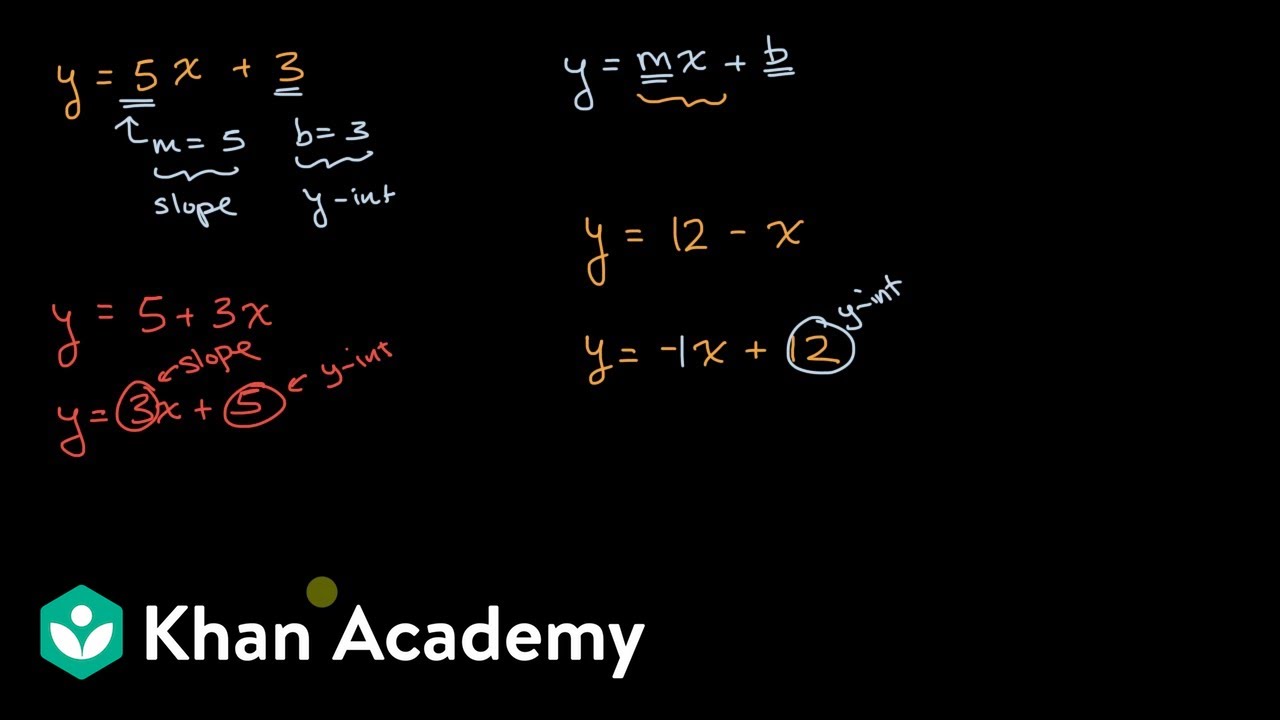
Slope and y intercept from equation

Now that we are familiar with the coordinate plane, it's time to learn more about lines, as these are the simplest things to graph. Lines have slopes, and they usually have intercepts, so lets learn what these words mean!
Watch the whole Mathematics playlist: http://bit.ly/ProfDaveMath
Classical Physics Tutorials: http://bit.ly/ProfDavePhysics...

Slope-intercept form
Practice this lesson yourself on KhanAcademy.org right now:
https://www.khanacademy.org/math/algebra/two-var-linear-equations-and-intro-to-functions/slope-intercept-form/e/slope-from-an-equation-in-slope-intercept-form?utm_source=YT&utm_medium=Desc&utm_campaign=AlgebraI
Watch the next lesson: https://www.khanacademy.org/ma...
@fallow nebula try one of those?
fallow nebula
wait
fair osprey
clueless.file on wait mode

 buoyant kayak
set up two equations using those pictures
fallow nebula
i am watching them
buoyant kayak
for the first picture, how many widths and how many heights make up that tower?
buoyant kayak
no?
look at the towers
how many bricks are laying horizontally and how many are vertical
in the first tower
fair osprey
How many kinds of bricks if that helps
buoyant kayak
what
 alpine sable
only vertical bricks
buoyant kayak
i'm asking you how many of each there are
alpine sable
2
buoyant kayak
your answer should be two numbers
alpine sable
what
fair osprey
You can make vertical v and horizontal h(for variable names, or just use x and y)
 alpine sable
oh
fair osprey
alpine sable
Count how many bricks are vertical in the 30 cm tower
alpine sable
5
buoyant kayak
and how many are standing up
alpine sable
the right tower?
buoyant kayak
alpine sable
the right tower?
left tower. how many are standing up
alpine sable
4
buoyant kayak
so you have 5 on their side and 4 standing up
now look at the dimensions of the bricks
alpine sable
5x + 4y = 30
alpine sable
reallly?
buoyant kayak
yep
alpine sable
is that it
alpine sable
ok thanks
buoyant kayak
alpine sable
is that it
there's still another equation you need to solve it. do the same thing for the right tower.
alpine sable
ok let me try
buoyant kayak
you used x as the width and y as the height of the brick
alpine sable
4x + 3y=23
alpine sable
ok
ill try using elimination
wait I think I did somehting wrong
so I multiplied 5x + 4y = 30 by 4
and multiplied 4x + 3y=23 by 5
buoyant kayak
you'd multiply one by a negative factor
alpine sable
I got 20x+16y=90 and 20x+15y=115
buoyant kayak
if you're using elimination
buoyant kayak
just curious, what are your answers?
 marsh shuttle
Anybody free to help
 harsh belfry
This is probably a stupid question
But I was wondering what occurred between these two steps algebraically.

to this

I know it has something to do with the bottom part of the fraction obviously right
but for some reason Im having a hard time visualizing it
 wispy olive

 raw shard
yes
harsh belfry
Ah thanks for the clarification.
raw shard
no problem
marsh shuttle
Hey quantum do you know anything about linear programming for algebra 2
raw shard
no
wispy olive
 alpine sable
@wispy olive oo i've done that problem before
i dont remember exactly how to solve
but i can pm u the solution if u want?
wispy olive
Shhh it is IMO Problem 6, 1996, something I am far far from to understand. I do not even have this question. Just that this is a seriously hard problems. So if anyone solves this I want them in my friends list and respect +100 trust +100 for them.
This problem took some mathematicians like 1 years to solve.
And I am doing Grade 9 Math  .
.
 haughty falcon
One message removed from a suspended account.
One message removed from a suspended account.
 alpine sable
haughty falcon
One message removed from a suspended account.
alpine sable
haughty falcon
One message removed from a suspended account.
speak
I also have a question
say
it
"kitten"
9/20/2021 how many days
???/
Is that in our present
Time
what
wispy olive
alpine sable
<@!723209758781472808> oo i've done that problem before
Did you solve it correctly?!!?
alpine sable
If it was 9/20/2021 how many days do I have to add to make it into our present time
alpine sable
wispy olive
Did you solve it correctly?!!?
well no...
wispy olive
Are you an IMO winner?
alpine sable
...................
wispy olive
Still xD.
alpine sable
Can anyone answer ;w;
If the (m+n)th term of a G.P is p and the
(m-n)th term is q , show that the mth and nth
terms are √pq and {p/q}m/2n
Can anyone help me with this?
Hewwo?
wispy olive
Meow.
alpine sable
Meow
alpine sable
wispy olive
Meow.
Meow so know the answer
 outer scaffold
alpine sable
If it was 9/20/2021 how many days do I have to add to make it into our present t...
outer scaffold
alpine sable
If it was 9/20/2021 how many days do I have to add to make it into our present t...
7?
wispy olive
alpine sable
If it was 9/20/2021 how many days do I have to add to make it into our present t...
Ayoo just add with some brains?
Of course 8 days.
outer scaffold
no 7
outer scaffold
its 7
outer scaffold
milk
wispy olive
How is the gravity.
outer scaffold
strong
wispy olive
Are you near Black Holes or Huge Star or Small Star.
outer scaffold
opposite of china
outer scaffold
cover hole up with big rock
outer scaffold
eren yeager
wispy olive
Nah.
outer scaffold
yes
outer scaffold
Chungus yeager
wispy olive
Cats and Monkey Supremacy.
wispy olive
outer scaffold
Chungus yeager
OH NO-
outer scaffold
ok
wispy olive
Oh sorry sorry.
outer scaffold
sorry
 sly mantle
@strange lion don't shitpost here
 manic torrent
@marsh shuttle sorry for the long wait OBJECTIVE FUNCTION : 500x+150y
CONSTRAINTS:
x ≥ 0
y ≥ 0
7x + 3y ≤ 16
6x + 5y ≤ 14
where x = number of tables and y = number of chairs
 rigid wind
using lagrange?
 vital prawn
Anyone free to help?
alpine sable
wispy olive
Ayoo just add with some brains?
I am dumb you know
wispy olive
alpine sable
I am dumb you know
Nah, me more.
alpine sable
I can't even answer the coordinates of X and Y
rigid wind
7 days ? 20 to 27
alpine sable
Ohhhh
It's 28 for me and I been banned for 8 days?
Something is not right
I'ma do an appeal
 candid minnow


for 29 my graph looks something like this but how do I use this to draw my graph in Polar coordinates
 ornate lantern
is anyone good at solving substitution and elimination

example: 2x+y=3
3x+2y=5
candid minnow
ornate lantern
is anyone good at solving substitution and elimination
multply the first equation by 2 and the subtract that by 3x+2y=5
vital prawn
But does 1.5in roundest to the nearest square inch = 1 or 2?
 dusty quiver

I am having trouble reasoning through the first 4 options
Since A is compact, it is closed and bounded, so any subset of a closed set is also closed
riht?
Nvm
[0,1] (0,1) is a counter example
specifically the first two
candid minnow
candid minnow
any1 know?
dusty quiver
option 1: R^n is not compact so since A is compact R^n \ A =/= empty
 winged spindle
how much vbucks can i buy with 41 billion dollars?
dusty quiver
5
 robust flame
Can anyone help me with b) ?

 minor root
Is there someone here who's really good at solving three equations three unknowns?

 minor root
 harsh belfry
I remember going over this briefly in class, but Fairly certain I may be going about the process incorrectly.
Any advice?

Do I not insert c for x?
 fast oak
 alpine sable
just put 5 in for x
 gentle jolt
ive got no idea where to put this but i got an idea that id like to hammer out that has to do with the lucas numbers pascals triangle and f(x,y,n) = x^n + y^n
if anyone would like to discuss this new idea in mathematics voice, @ me
I'd love to iron it out with a second perspective
my "question" is a bit too complicated to just write it down, im not even sure what id write atm
fast oak
idk how to solve it
 candid fog
u put 5 where x is
 hoary shell
wouldnt it just be 12(3x3x3x3x3) + 9?
wispy olive
ornate lantern
is anyone good at solving substitution and elimination
Yes, ask.
candid fog
yes
fast oak
ok
candid fog
or u could just use a calculator
 undone dock
$f(x) =12\cdot 3^x +9 \implies f(5) = 12 \cdot 3^5 +9$
fast oak
what the answer?
 ocean sealBOT
K.
 fast oak
ok ty u
ornate lantern
wispy olive
Yes, ask.
2x+y=3
3x+2y=5 thats the equation
ornate lantern
candid minnow
multply the first equation by 2 and the subtract that by 3x+2y=5
ok but i need someone to explain me the concept since this is new for me
wispy olive
ornate lantern
2x+y=3
3x+2y=5 thats the equation
Okay.
fast oak
f( 5 ) = answer is 2925?
wispy olive
ornate lantern
ok but i need someone to explain me the concept since this is new for me
See.
What you do is.
Let us say.
undone dock
fast oak
f( 5 ) = answer is 2925?
yes
wispy olive
We are gonna use Substitution.
fast oak
ok ty u sir 🙂
ornate lantern
mhm
wispy olive
So for that, first we simplify the equation in terms of 1 variable.
2x+y=3
3x+2y=5
Let us simplify for y here.
With 2x+y=3, we get y = 3 - 2x.
Right?
ornate lantern
yes
wispy olive
Okay.
So we know that y is 3-2x.
So in the other equation which is 3x+2y=5.
We substitute this value.
So we do -
3x + 2(3-2x) =5.
We solve for this.
3x + 6 - 4x = 5.
-x = -1.
x = 1.
Right?
We get the value of x.
ornate lantern
ok i kinda understand it
wispy olive
Now we substitute the value of x in the other equation to get y.
2x + y =3.
2(2) + y =3.
4 + y =3.
y = -1.
And hence, we know that x = 1 and y = -1.
So you understood substitution?
ornate lantern
ya i have an understanding of it
wispy olive
Cool.
Next we can do Elimination.
And solve 2 more of each kind for you to understand better, if you want.
ornate lantern
thanks btw!
ornate lantern
wispy olive
And solve 2 more of each kind for you to understand better, if you want.
ok sure
vital prawn
 tender belfry
2
tender belfry
2
Is 15.4919 rounded to the nearest cubic inch = 15.5?
wispy olive
Elimination is simply subtracting one equation from the other.
wispy olive
ornate lantern
thanks btw!
Welcome!
So now we do Elimination for the same equation.
2x+y=3
3x+2y=5.
We subtract or add the first or second equation such that we get only 1 variable's value in the answer.
So.
We do.
3x + 2y = 5.
-2x + y = 3.
But see.
Here, if we solve this, x + 3y = 8 does not give us the value of 1 variables.
Hence, we use the basic laws of arithmetic we know.
If we multiply both the equation by some number which gets us the value of 1 variable, we get it right.
So we multiply 2x+y=3 by 3.
And 3x+2y=5 by 2.
ornate lantern
like a common multiple?
wispy olive
Well, not really.
See.
We need 2 variable values of the top part and bottom part to completely cancel each other.
So the answers/values should be the same.
wispy olive
wispy olive
So we multiply 2x+y=3 by 3.
And 3x+2y=5 by 2.
We get -
- 6x + 3y = 9.
- 6x + 4y = 10.
We can subtract any of the 2 from 1 another.
For the sake of simplicity, let us do it simply.
6x + 3y = 9.
-(6x + 4y = 10).
Which gets us -
6x + 3y = 9.
-6x -4y = -10.
We get that -y = -1.
ornate lantern
ya
ornate lantern
yes'
wispy olive
So we can simply substitute for y = 1 to solve for x.
ornate lantern
so we need to find value of x
wispy olive
6x + 3y = 9.
6x + 3(1) = 9.
6x = 9 - 3.
6x = 6.
x = 1.
And we are done.
With both the methods.
wispy olive
1 more method which is much faster and easier is graphing, but dunno if you are allowed to use a graphing Calculator.
ornate lantern
we are aloud to use calculators
ornate lantern
ok thanks for the help
ornate lantern
yes i think i get the concept i just need to practice more
wispy olive
Cool.
I can send lots of practise.
But those will probably be harder than the kind of problem you sent.
ornate lantern
could you send them to me? id like to see because i think on my test it would be much harder
wispy olive
And for further use in life if you would, you can just graph the 2 equations in Desmos, since your main problem will merely require you to solve for 2+ variables as a tool.
For bigger problems.
wispy olive
ornate lantern
could you send them to me? id like to see because i think on my test it would be...
Sure.
DM or here?
ornate lantern
u can send them in dms and thanks again
 wanton spoke
 fast oak
oh ok
 tough coral
statistics
is stupid
i hate it
bru i studied for like 5 hours for that test and i still got an 87
 crisp grove
huh
 fast oak
Use the following function rule to find f( 40 )
alpine sable
 crisp grove
are you posting your entire question paper here?
alpine sable
No
crisp grove
definitely looks like it
alpine sable
crisp grove
definitely looks like it
Ya it looks like that
 lime moth
One message removed from a suspended account.
 light tusk
lime moth
One message removed from a suspended account.
light tusk
lime moth
One message removed from a suspended account.
Then multiply it 1 by 1 with the degrees of each book category
You should have 4 answer, each answer for different book
lime moth
One message removed from a suspended account.
fast oak

 echo spire
Hello! Can Someone help with A7 B)? I need to express that logarithm with the help of a

 somber osprey
 sour echo
anyone knows how to do 4b and 5b
 echo spire
echo spire
echo spire
This is what I managed to solve

 verbal ermine
sour echo
anyone knows how to do 4b and 5b
verbal ermine
sour echo
anyone knows how to do 4b and 5b
just square f
manic torrent
sour echo
yea but it’ll be a squared fraction
your answer can't be a squared fraction?
sour echo
lemme try
verbal ermine
do you know how $\left(\frac{a}{b}\right)^2$ simplifies
ocean sealBOT
Aerials
 manic torrent
sour echo
lemme try
manic torrent
sour echo
lemme try
i mean
verbal ermine
it’s just $\frac{a^2}{b^2}$
ocean sealBOT
Aerials
 verbal ermine
so just square the top and bottom
manic torrent
i asked if you can't have an answer in fraction
like did your teacher say you cant have that answer?
verbal ermine
manic torrent
your answer can't be a squared fraction?
nah it says how u should express ur answer
 verbal ermine
$(2x)^2 \neq 2x^2$
ocean sealBOT
Aerials
 manic torrent
ocean seal
**Aerials**
manic torrent
ocean seal
**Aerials**
@sour echo
sour echo
that’s what i did
sour echo
oh
verbal ermine
that means not equal to
verbal ermine
you have to square both terms
sour echo
it’s 4x^2?
verbal ermine
yes
manic torrent
yup
 tidal thistle
what's the difference of rational equation and rational function
manic torrent
they're both rational meaning they have fractions
then they just differ on the equation and function part
 daring pebble
One is an equation, other is a function
sour echo
this is what i got for 5b most likely wrong tho!!

 barren shuttle
Hello, is it possible for this system to be inconsistent when all the variables are on the right?
 verbal ermine
sour echo
this is what i got for 5b most likely wrong tho!!
verbal ermine
sour echo
this is what i got for 5b most likely wrong tho!!
if u solved that quadratic correctly, it’s right
sour echo
o ok
 sick torrent
How come the vertical asymptote is only x=2 and not x=-5

 jagged imp
f has a hole at x=-5, instead of an asymptote, since the numerator and denominator both have a factor of x+5
 eternal osprey
How does one determine the vertical and horizontal asymptotes of this function?
 sick torrent
jagged imp
f has a hole at x=-5, instead of an asymptote, since the numerator and denominat...
sick torrent
jagged imp
f has a hole at x=-5, instead of an asymptote, since the numerator and denominat...
Ahhhhhh
Thx boo
tender belfry
vital prawn
Is 15.4919 rounded to the nearest cubic inch = 15.5?
Technically yes
tender belfry
vital prawn
Is 15.4919 rounded to the nearest cubic inch = 15.5?
Non technically also yes
sick torrent
Why isn’t the answer DNE?

 edgy sand
There is a trick you can do with fractions that are approaching inf. Subtract highest factor of variable in the denominator from numerator
sick torrent
Huh?
rigid wind
divide both numerator & denominator by x
sick torrent
Why
rigid wind
this limit approaches -inf
sick torrent
Ik the answer I just don’t know how
sick torrent
rigid wind
divide both numerator & denominator by x
Is it cuz it’s the highest factor?
rigid wind
yeah, and you can evaluate individual terms as x goes to +inf
sick torrent
And to know if it’s a negative or positive infinity it depends on the answer?
rigid wind
a simple example: lim x/2 as x -> inf
or lim x/(-2) as x -> inf
1 approach +inf, the other one -inf
sick torrent
But how would u do it on a complex question like the one I sent
edgy sand
Its the greatest common factor in the denom. Therefore you divide all of you numerator and denominator by x. See if you can set it up
So divide everything on top by x, and everything on the bottom by x
 tight locust
for infinite limits of rational functions all you need to do is compare the leading terms
sick torrent
Like so?
 tight locust
everything else becomes negligible as you go to infinity
edgy sand
edgy sand
There is a trick you can do with fractions that are approaching inf. Subtract hi...
.
tight locust
like in that example you can ignore the lower degree terms
and turn it into x^3/(-8x)
edgy sand
No don't cancel them yet. Just set up
tight locust
it's simple.
sick torrent
edgy sand
No don't cancel them yet. Just set up
Then how?
tight locust
what is bigger: 100^2 or 100?
sick torrent
The first one
tight locust
yep
so the terms of higher degree grow A LOT faster than the terms of smaller degree.
you can say that x^2 is a lot "bigger" than x
sick torrent
Yeah
tight locust
so when you take an infinite limit, you can ignore all the lower degree terms
because they become very small, relative to the higher degree term
tight locust
wdym
sick torrent
How to u use that information to find out if it’s a -inf + inf or DNE
tight locust
i just showed you. in your example you ignore all the terms but the biggest one. so you get the limit as x goes to infinity of x^3/(-8x)
tight locust
do you see any common factors on the top and bottom?
tight locust
yes
edgy sand
anything divided by infinity is 0 as its getting very close to 0
sick torrent
Infinity?
tight locust
yes
edgy sand
Any pos int atleast
sick torrent
But
tight locust
and what is -1/8 * infinity?
tight locust
yes
tight locust
yes
sick torrent
Oh
sick torrent
The whole process of getting to -1/8 is confusing
tight locust
how?
sick torrent
I didn’t understand
tight locust
what don't you understand?
tight locust
all you have to do is take the ratio of the biggest terms and evaluate
tight locust
ok. let's take that limit you have there
the limit as x approaches infinity of (x^3-6x^2-5x-2)/(7-8x)
now i want you to look at the top and bottom.
what is the biggest term on top?
what is the biggest term on the bottom?
sick torrent
X^3 for top and -8x for bottom
tight locust
yes.
now since it's an infinite limit, those other terms don't matter. so we can take the limit of this much simpler fraction
the limit as x approaches infinity of x^3/(-8x)
tight locust
now you have a power of x on top and the power of x on the bottom. they cancel. you get:
x^2/(-8)
yep
sick torrent
So then what?
tight locust
now this is a function you can directly evaluate.
essentially, we have: (infinity)^2/-8
tight locust
yes. infinity^2 is just infinity. infinity times 1/8 is also just infinity. then the negative changes the sign so you have -infinity.
tight locust
😎

 faint hill
Who can help with that

 unique tiger
<@&286206848099549185>
unique tiger
so 8 log x e right?
unique tiger
okay ....then
= (1/e)* log _x(e)*d/dx ---- is this right?
so 8 In (e) i think
so = (In e^8)/(In x) ???
okiee thanks

 harsh ocean
Does there exist an integral with lower bound only?
crisp grove
 narrow meadow
wait what we can just move logs outside of limits?
narrow meadow
wait what we can just move logs outside of limits?
u definitely can
narrow meadow
any kind of logs?
harsh ocean
like a symbol
crisp grove
reason being log(x) is continuous function
narrow meadow
🤔
crisp grove
harsh ocean
like a symbol
u mean like Riemann lower sum?
narrow meadow
so any sort of continuous function I can just shift in and out of limits?
harsh ocean
to represent the lower value given to the constant
 placid zinc
You can put the limit in, if the new limit you are creating exists
narrow meadow
wdym
placid zinc
Which is the same as "is continuous there"
harsh ocean
crisp grove
u mean like Riemann lower sum?
 crisp grove
I don't there is
alpine sable
im having some trouble with this problem

especially with the -2
how do I take that into account
placid zinc
Have you found the homogeneous solution yet?
Or the complementary solution or whatever you call it
ocean sealBOT
bee_ryan
 placid zinc
Okay! So you're left with the particular solution now
We can do this with undetermined coefficients
alpine sable
im not sure what the general form is tho
 placid zinc
For sin(x), the guess is Asin(x) + Bcos(x)
alpine sable
yes
placid zinc
For 2, the guess would normally be A
There's a problem with that however. We can't just put a constant in, because our homogeneous solution tells us that constants are eliminated
(Don't even need the homogeneous solution, obviously the left will bring a constant to zero since there's no y, only y' and y")
Whenever this happens, just multiply your guess by x.
Correct guess is Ax
alpine sable
ohh i see
ok ill try that
so the overall guess would be $y_p(x) = Acos(x) + Bsin(x) + Cx$?
ocean sealBOT
bee_ryan
 fast oak


 crisp grove

crisp grove
harsh ocean
Its better to do a normal integral with upper bound 0 and lower bound what you want
 opaque oxide
im dying inside
 opaque oxide
Yes
 vale wigeon
so what is troubling you here?
opaque oxide
im just supposed to add it then put a negative sign right?
opaque oxide
thats what i answered
harsh ocean
Yea
crisp grove
u mean you are in a test rn?
opaque oxide
no
harsh ocean
Lol
crisp grove
you wouldn't say yes, would you?
opaque oxide
Its practice
opaque oxide
cuz its hard
crisp grove
ah
crisp grove
a bot
 spice mortar
hello
may i ask for help here? 😛
i am kinda stuck with something that i think it's fairly simple

it's probability
i have to determine a.) and b.) but i keep getting weird results
crisp grove
It's just inverse Bayesian
spice mortar
yeah
i have the formula
but i legit don't know what values to put instead of A/B
respectfully
crisp grove
what is the probability that you'll pick a black ball if you were to pick from the first urn?
P(B| K1) =?
 crisp grove
@fast oakchannel busy
fast oak
Ohh ok sorry
spice mortar
@crisp grove ok, can you please tell me - i know that B stands for black ball chosen, doesn't matter the box
what exactly would i do
i am legit loosing my mind because i have been trying to solve this since last night and i don't get it right
first it's
we look at the number of all the balls
and the black ones
and we get probability for that right?
crisp grove
So you happened to pick from the first urn, you have thee prob P(B|K1) = (number of black balls in K1)/(total number of balls in K1)
so what's P(B|K1)
crisp grove
?
crisp grove
and what about P(B|K2) then?
crisp grove
you sure you counted them right?
crisp grove
ok
 crisp grove
we know that $$P(B) = P(K1)P(B|K1) + P(K2)P(B|K2)$$
spice mortar
A1 and A2 stand for box 1 and box 2 being chosen
ocean sealBOT
Ryuzaki
 crisp grove
then what's P(B)?
spice mortar
spice mortar
A1 and A2 stand for box 1 and box 2 being chosen
so in that case
both A1 and A2 should be 50%
ie. 1/2?
crisp grove
y
spice mortar
so
crisp grove
so P(B) = ?
crisp grove
Now you need to find P(K1|B) ie given the ball is black, probability that it's picked from A1
crisp grove
DO you know that $P(B|K1)*P(K1) = P(B)*P(K1|B)$
ocean sealBOT
Ryuzaki
 crisp grove
can you figure out P(K1|B) from here?
spice mortar
so B is
probability of black ball chosen
so it's number of black balls divided by number or total balls?
spice mortar
spice mortar
probability of black ball chosen
regardless of the box
i am sorry, i am kinda losing my mind here 😅
crisp grove
yeah if you write it out in eng you'll get something like P(K1|B) = (number of black balls in K1)/(total number of black balls in K1, K2 combined)
crisp grove
spice mortar
i am sorry, i am kinda losing my mind here 😅
are u not familiar with prob rules/identities? Bayes' rule?
crisp grove
crisp grove
yeah if you write it out in eng you'll get something like P(K1|B) = (number of b...
you can use this one if you are really confused
spice mortar
to be honest, i am doing this last moment and trying to figure out on my own
so yeah
everything i did so far was from internet and my uni docs
but they don't give answers xD
in uni docs
crisp grove
ofc they don't
spice mortar
crisp grove
P(K1)P(B|K1) / P(B)
2.7%
crisp grove
2.7%???
crisp grove
P(B) is not 9
also if you are using the counting method, then there are 5 balls in K1 not .5*.5
you literally took one method for nominator and another for denominator
crisp grove
P(k1) = .5 yes
spice mortar
ok
next part
P(B|A1) is nm of black in A1 / total nm of balls
so it's 5/10
0.5
crisp grove
hm
spice mortar
am i right?
crisp grove
crisp grove
hm
.
crisp grove
what's the value of P(B)?
spice mortar
and P(B) is probability that you will get the first ball black out of all the balls
both A1 and A2
crisp grove
ocean seal
**Ryuzaki**
this
crisp grove
ya
you should get the same ans anyways
first of all the + sign in the denominator suddenly turned into -
and also 0/0 is not 0
crisp grove
bruh
crisp grove
spice mortar
P(B) is 9/22?
could be i didn't calculate
 gloomy perch
@crisp grove Hi are u good in complex number ?
spice mortar
it's 9 total black balls out of total 22 balls
spice mortar
ok i will do the math
crisp grove
,calc 9/22
ocean sealBOT
Result:
0.40909090909091
xD don't
crisp grove
,calc .5*.5 + .5*1/3
ocean sealBOT
Result:
0.41666666666667
,calc .5.5 + .5*1/3
ocean sealBOT
The following error occured while calculating:
Error: Unexpected part ".5" (char 3)
crisp grove
,calc .5*.5 + .5*1/3
ocean sealBOT
Result:
0.41666666666667
NO that's the value of P(B)
crisp grove
now calc P(K1|B) = P(K1)*P(B|K1)/P(B)
spice mortar
=0.60975
so that was A
a.)
60%
and to do b.) which is

we take the probabilities of P(A1|B) and P(A2|B)
 spice mortar
i am calculating
i got values for P(A1|B) and P(A2|B) - 0.6 and 0.4 = 3/5 and 2/5
we consider as P (A1) and P (A2):
Event A1 - the first ball, black, drawn from box K1 - then, after that first draw, a total of x balls remained in box K1, of which x black;
Event A2 - the first ball, black, drawn from the box K2 - then, after that first draw, a total of x balls remained in the box K2, of which x black;
Event B2 - the second drawn ball is black (of course, it must be drawn from the same box as the first ball).
 daring schooner
Hello, may I ask if the labeling of the vertices are correct, considering the quadrilateral is called ABCD?
 harsh belfry

I've been working on this for over two hours
and I just cant figure out how to find the derivative for this.
When I put it into quotient form I can't figure out how the trig functions work with one another.
If anyone could help me out on this I'd really appreciate it.
This is the problem in quotient rule

Any help at all would be appreciated. Im just so worried.
I have a test today and I cant do this.
I feel like I'm about to break down. I haven't slept in over 24 hours now.
 halcyon comet
can anyone help me in a practice test
 vague coral
about what ?
ocean sealBOT
querty
 ocean sealBOT
querty

 icy trail
copy paste 😎
but im not sure where to go from here?
rationalise?
dosent the bottom have a factor of (b+a)^(0.5)
oh wait can i do $\frac{b+a}{\sqrt{b+a}} = \sqrt{b+a}$
ocean sealBOT
querty
 icy trail
ohh and thats the same as multiplying by (b+a)^0.5
or would lead to the same thing
because the b+a would cancel
$\frac{(b+a)^2}{(b-a)(b+a)}$
ocean sealBOT
querty
 icy trail
thankyou : )
alpine sable

I’m not sure how to prove that AC is the diameter
Please ping with response
There are two ways, one of them is a cheeky way that I go by quite often:
- Show that cord AB and cord CB are perpendicular, thus ACB is a triangle in a semicircle, making AC the diameter.
- Get the equation of the circle/ the radius, get half of the distance of AC and show that it equals the radius.
@alpine sable
As for method 1, here's a graphic demonstration

This proves that if angle B (which is on the circumference) is a right angle, the line between the two other points is the diameter.
How do you get that AB and BC are perpendicular:
$\frac{yb - ya}{xb - xa}$
ocean sealBOT
Samy
 alpine sable
You multiply this by $\frac{yb - yc}{xb - xc}$ , if your answer is -1, they're perpendicular.
ocean sealBOT
Samy

 barren river
Quick question, what does y=ax^2+bx+c A B and C stand for
 glass lichen
barren river
Quick question, what does y=ax^2+bx+c A B and C stand for
glass lichen
barren river
Quick question, what does y=ax^2+bx+c A B and C stand for
the co-efficients...?
alpine sable
C is the y intercept, a is the coefficient of x^2 which indicates whether the parabola's mouth will be facing up or down
barren river
what does that mean for C
alpine sable
C is the value of y at x = 0, the place at which the curve cuts the y axis
barren river
So like I put the value of Y into C when I am finding the axis X?
alpine sable
Oh, no
barren river
kinda confused
 barren river
So it's from the picture
alpine sable
alpine sable
As for method 1, here's a graphic demonstration
Okay, but how do you know that the fact that it’s a right triangle makes AC be a diameter? Also, isn’t there a possibility where it’s not a right triangle and AC still passes through the center?
alpine sable
alpine sable
Okay, but how do you know that the fact that it’s a right triangle makes AC be a...
As for how do you know that, if all the points lie on the circumference, it must be a diameter.
But let me demonstrate your doubt
If this is the case, AC can't be a diameter because one of the points is not on the circle's circumference
 alpine sable
icy trail
just not the one you drew
alpine sable
icy trail
just not the one you drew
Yeah that makes AC a diameter for another circle but please no
icy trail
please no?
alpine sable
My question is how do you actually prove that the fact that it’s a right triangle makes AC the diameter of the circle
Because you assumed that to answer the initial question
But I want to know where that assumption is coming from
alpine sable
alpine sable
My question is how do you actually prove that the fact that it’s a right triangl...
Do you know the rule that says that an angle in a semi-circle is 90 degrees?
barren river
Sorry but, how do I know if a parabola mouth will be facing up or down if no picture are provided
alpine sable
a coefficient
alpine sable
alpine sable
Do you know the rule that says that an angle in a semi-circle is 90 degrees?
No
alpine sable
barren river
Sorry but, how do I know if a parabola mouth will be facing up or down if no pic...
If a is negative, it's down. Otherwise it's up. Also you'd be better in luck if you ask in another channel
barren river
Well there's no A, but X
alpine sable
barren river
Well there's no A, but X
That means a is 1 (if there's an x^2)
barren river
alright
 coarse kernel
is the channel free?
alpine sable
alpine sable
No
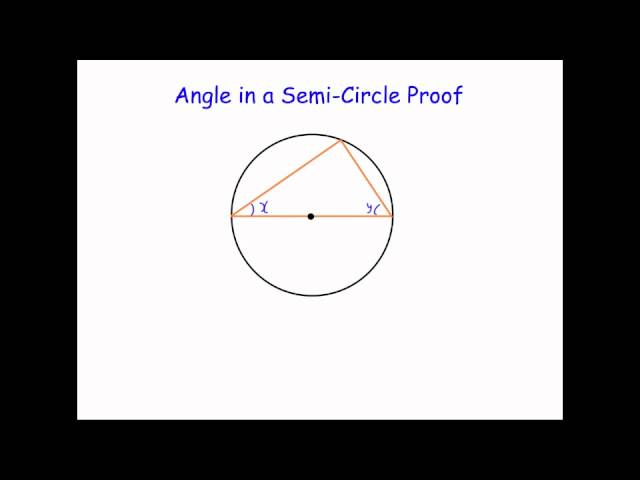
This video explains why the angle in a triangle within a semi-circle is always a right angle, 90 degrees.
Practice Questions: https://corbettmaths.com/wp-content/uploads/2019/02/Circle-Theorem-Proofs.pdf
If you accept this rule (you should lol) then reversing it gives you the answer to your question
 oak jewel
Is this open?
Find all complex numbers making this true

how would i go about solving that?
 supple tundra
oak jewel
Find all complex numbers making this true
supple tundra
oak jewel
Find all complex numbers making this true
Do you know how to find the magnitude of a complex number?
oak jewel
maybe, can you further explain? i don't do this in english*
supple tundra
If $ z = x+iy $ then $|z| = |x+iy| = \sqrt{x^2+y^2}$
ocean sealBOT
azeem321
 oak jewel
Yep, but i learned it today and dont fully understand it
or how to implement it
|z|=sqrt(x^2+y^2)
 hushed pasture
no wait
oak jewel
when its absolute Z, the "i" goes away?
hushed pasture
you have that z = x + iy
oak jewel
yep
alpine sable
Calculate the range of values of x which satisfy the inequality
2x − 3 > 6x + 1
hushed pasture
so $|z -5| = |x-5 + iy| = \sqrt{(x-5)^2+y^2}$
ocean sealBOT
Salah
 hushed pasture
@oak jewel clear?
oak jewel
the complex led gets cleared like that... ok yep clear
i thought it might be like that, thats great
so what i would do is put that in for all.... let me just quickly do that
|x+1|=|x|+|1| right?
just to be absolutely clear
alpine sable
No
oak jewel
lol forget that. yep no it isnt
supple tundra
oak jewel
the complex led gets cleared like that... ok yep clear
If I asked you to find the magnitude of $3+4i$ could you do it?
ocean sealBOT
azeem321
 oak jewel
would that be sqrt(3^2+4^2)=5?
 distant gate
Good day! Can u help me solved this num? Thanks a lot for help ❤️
 alpine sable
The chan is occupied
supple tundra
oak jewel
would that be sqrt(3^2+4^2)=5?
Correct. The question you have presented, they simply want you to find all complex numbers $z$ such that when you calculate $z+3+4i$ and find it's magnitude, you get the same magnitude when you calculate the magnitude of $z-5$
ocean sealBOT
azeem321

 alpine sable
^2
supple tundra
oak jewel
This is sufficient to define all the coordinates which satisfy your original equation. To clean it up though, you can square both sides
 errant tangle
could someone help me prove this
 alpine sable
oak jewel
y^2 cancels
alpine sable
oak jewel
y^2 cancels
Yeah, you should be able to express x with y now
||
x=F(y)
Your solutions are F(y) + yi, with y in R
||
oak jewel
yep, thanks a lot!! @alpine sable @supple tundra i will try to solve it myself, i may come back here if im unsucessfull
supple tundra
oak jewel
yep, thanks a lot!! <@456226577798135808> <@!872024354572103731> i will try to s...
The equation you get will be in the form $y = mx + c$ all the points on that line $(x,y)$ satisfy your orginal complex magnitude equations. So if the point $(2,3)$ was on your line, then $2+3i$ would be one the solutions
ocean sealBOT
azeem321
 oak jewel
i got a line y=-2
 elder glacier
is this occupied?
alpine sable
errant tangle
could someone help me prove this
rewrite 7pi/18 as pi/3 + pi/18 and 5pi/18 as pi/3 - pi/18 and several trigonometric formula will help
errant tangle
alpine sable
rewrite 7pi/18 as pi/3 + pi/18 and 5pi/18 as pi/3 - pi/18 and several trigonomet...
thank you!!
elder glacier
can someone help me with a and b, im having difficulty wrapping my head around this, and apologies if this in occupation, thanks.
 oak jewel
supple tundra
The equation you get will be in the form $y = mx + c$ all the points on that lin...
oak jewel
supple tundra
The equation you get will be in the form $y = mx + c$ all the points on that lin...
i think i messed up. can you help me verify, is the line y=-2? and so all x values and only y=-2 is on the line-?
supple tundra
If you got it right, then any point on that y=-2 line will satisfy
 oak jewel
brilliant thanks a lot!!
supple tundra
oak jewel
brilliant thanks a lot!!
You can test a point on that line to make sure. (0,-2). Let z = -2 and sub it into equation
eternal osprey
Can anyone help me find asymptotes with limits?
 oak jewel
if z was a point, lets say (-1,4) how would you verify it?
hushed pasture
eternal osprey
Can anyone help me find asymptotes with limits?
find the domain first
alpine sable
for the point (-1,4), z = -1+4i
supple tundra
oak jewel
if z was a point, lets say (-1,4) how would you verify it?
Remember you let $z = x+iy$
ocean sealBOT
azeem321
 supple tundra
right
supple tundra
oak jewel
we have not went through this in class reee
is this complex loci stuff? i struggled with it when i was learning it
oak jewel
anything
the professor is lost i think
he spend 20 minutes integrating 1 today
and he got the integral of 1= x^2/2
elder glacier
ur prof is hitting bongs before class
oak jewel
he looks like walter white
maybe meth, dead people in the basement, los pollos hermanos, mike ehrmantraut
elder glacier
LOL
 silver current
 alpine sable
nvm i cant type it
 twin pine
how can I find this without L'Hopital?
\lim _{x\to +\infty }\left(x\cdot \:sin\left(\frac{1}{x}\right)\right)
 rocky atlas
Would be great if you can write it on copy and show then
rocky atlas
twin pine
how can I find this without L'Hopital?
.
crisp grove
$\lim_{x\to +\infty }\left(x\cdot \sin\left(\frac{1}{x}\right)\right)$
ocean sealBOT
Ryuzaki
 glass lichen
h=1/x then it becomes a known limit
ocean sealBOT
marc

 rose prism
is the domain 0 less than or equal to x greater than or equal to 6

 ancient saddle
Hello, the set is Z^2, so your drawing should be some points that satisfy the condition
If that's what you've done, it should be ok
ocean sealBOT
marc
 ancient saddle
I guess they are just asking you to draw it to prove you understand the condition
 cold spindle
guys i ahve exam tommorow can any1 help me study
harsh belfry

I'm a little confused since this wasnt covered much in class.
I wasnt sure where to start exactly.
Would I find the derivative of the function?
glass lichen
You need slope of the line and a point on the line
alpine sable
harsh belfry
Would I find the derivative of the function?
Yeah that gives you the slope that Mosh is talking about
harsh belfry
Got it got it.
I only know these equations mathematically. I'm not good with knowing what they actually do.
glass lichen
The definition of derivative us the slope function...
 pliant spruce
How would you solve this?
harsh belfry
If thats the case, once I fiind the derivative and insert the given x value. Would this work out to be y=?
glass lichen
If you didn't know that, you can't say you know it mathematically
glass lichen
harsh belfry
If thats the case, once I fiind the derivative and insert the given x value. Wou...
No
cold spindle
help
glass lichen
If you plug something into a derivative you don't get a function value
You get the slope of the tangent at that point...
glass lichen
Yes...
alpine sable
harsh belfry
If thats the case, once I fiind the derivative and insert the given x value. Wou...
To get an equation of a line using just one point and a gradient, you equate the gradient to a fraction of a ("y" - the y value of the point) over ("x" - the x value of the point) and you'll get the equation
harsh belfry
glass lichen
If you didn't know that, you can't say you know it mathematically
I just memorize what equations are to be put where. I really wish I has the opportunity to use more graphs and see what the values im changing and what Im doing has on the graph. Sorry if I'm annoying you.
I'm very new to this.
Thanks samy. Will do.
❤️
 quartz oxide
Diving one equation by the other should allow you solve for y directly
alpine sable
2(26) = 52 I think that's what they mean.
So 2[x + xy + x(y^2)] = x(y^5) - x
One other way I can think of is to get x in terms of y (from the second equation) and remove every x in the first equation with that value you get
np
 hazy lynx
having a hard time with this one: find the limit as x approaches 1 of x^-1 - 1 / x - 1
i looked it up online and its saying you can simplify it to ((1 - x) / x)) / x -1 but i dont get how you get there? how do you get the -1 in the numerator on top?
 noble sinew
hazy lynx
having a hard time with this one: find the limit as x approaches 1 of x^-1 - 1 ...
noble sinew
hazy lynx
having a hard time with this one: find the limit as x approaches 1 of x^-1 - 1 ...
Is this x^(-1)-1/(x-1)?
hazy lynx
uhh its (x^-1) - 1 / (x-1)
noble sinew
So like I wrote?
hazy lynx
oh ok
noble sinew
I mean can just use linearity of limit so this is equal to limit as x->1 of 1/x + limit as x->1 of 1/(x-1)
hazy lynx
ah ok ty
 queen raven
i need help with trinomial factorisation