#help-0
1 messages · Page 822 of 1
 ivory thicket
 oak jewel
hi
ivory thicket
im doing regression analyiss/report and we had to throw a ball 10 times at 10 distances... i have to attach a photo of the setup
would I get away with this u reckon?

 quartz oxide
Guy literally just asked a question
oak jewel
idk, you are kinda walking over me
ivory thicket
ohl
oak jewel
i asked this
ivory thicket
ill help 1 sec
quartz oxide
You mean, the one in calculus?
oak jewel
yes
 oak jewel

im to prove this with the reciprocal rule
how would i go about doing that, and what does the rule mean?
 strong furnace
1- use the difference quotient limit definition of derivatives
2- it shows the relation between derivative of function and derivative of its reciprocal
 unique tiger
i think this could help you.. it explains how the reciprocal rules work https://youtu.be/1IzOta0ILqI

Some of the links below are affiliate links. As an Amazon Associate I earn from qualifying purchases. If you purchase through these links, it won't cost you any additional cash, but it will help to support my channel. Thank you!
►PRODUCT RECOMMENDATIONS https://www.amazon.com/shop/brithemathguy (affiliate links)
Reciprocal Rule: Reciprocal Ru...
oak jewel
cheers, i will check that out ^
oak jewel
strong furnace
1- use the difference quotient limit definition of derivatives
2- it shows the ...
why didnt i think of that lol, thanks
 solar perch
Does this mathematic formula work: https://youtu.be/eMKwC6WyIMQ??

Best of Devon Larratt - Armwrestling Champion
Best of created by Max Krest
Information:
The used music and video footage of the matches doesnt belong to me.
The 2021 match original video footage: https://www.youtube.com/watch?v=jHVeV67qBv0&t=842s
WAL 405 original video footage: https://www.youtube.com/watch?v=GNMqJS61NT0&t=632s
 fringe socket
im trying to solve systems of equation and the matrix det is 0 hence no inverse
that means there could be 0 solutions or infinitely many solutions right?
 placid zinc
Ye
fringe socket
say I got something like this
x+5/4z=0
y+1/4z=0
z=-4/5x and z=-4y
thats it's two solutions right..? or is there way more
placid zinc
Infinitely many
placid zinc
To better understand, set one variable to be "free":
x = 5z/4
y = -z/4
Now, give any value of z you want, and get an x and y that solves the system
There's a one-dimensional subspace of solutions

 verbal ermine
integral sign?
 silver current
integral
 fresh lynx
Thanks!

 small cypress

whats the fastest way to do this with calc?
nono i mean the convesrion from m n sec to km n h
just the time
whats the fastes way to fo it?
250m is 0.25km right
how do u convert the time
5/3600?
 slate moat
Everyday a fruit seller sells 50% of his stock. 10% of
the stock gets spoiled during the night. If a total of 1983
fruits got spoiled in three days period, how many fruits
did he start with?
 plush shuttle
I’m so confused, how do I get the mean without the standard deviation/how do I get the standard deviation without the mean?
 plush shuttle
I’ve got the answers now, but I’m still a bit confused so I wouldn’t mind an explaination on how to get them
 fair vine
mean will be the central value for a symetric distribution , as long as its symmetric it will even out regarldess how it looks and thats what youre supposed to get from them saying its normal dist
plush shuttle
So with a question like this the mean is always just the middle of the two numbers given?
As long as it’s normal distribution
fair vine
provided its a symetric distritbution yes, if its skewed it wont work that wouldnt be a normal one though
plush shuttle
Ok
So for the standard deviation we would find the Z value of 0.49 right?
Then rearrange the Z=X-mean/standard deviation formula
And use the 10500 and 15000 (or 6000?)
 jade otter
how do u calculate elo uwu
 split relic
e
 novel kettle
Yoo so is 7:30am to 10:30am 3 hours and 30 minutes?
fair vine
@plush shuttle i believe your z value is too low, 2 standard deviations is about 96% so it should be slightly above, might be wrong though didnt do this for a while
plush shuttle
I would’ve thought you’d find the Z value for 0.49 as it’s half of the 98% they give you in the question
fair vine
ah okay i thought you meant your z is 0,49, z for 0,49 is right
plush shuttle
2.326 I think is what I got
fair vine
yeah looks good, thats what i meant with should be above 2
fair vine
np, what i originally wanted to ask myself: manhattan distance is x+y, it there a name for max(x,y) ?
plush shuttle
No idea sorry
fair vine
nvm found with google Chebyshev distance
 gentle coyote

any clue?
btw my exam is over i just wanna know if i did it correct

here further proof ig

?
this one also

 alpine sable
what did u mark
gentle coyote
i marked b
alpine sable
if its A then right
alpine sable
25
alpine sable
doing
gentle coyote
ok
alpine sable
but 25 im sure is A
gentle coyote
alr

 sage summit
that middle step is so wrong
 jade birch
Second line is wrong
 rigid wind
k/3 + 1
alpine sable
yes
rigid wind
instead of (k+1)/3
alpine sable
alpine sable
it shud be (k+3)/3
which is this
 vital delta
How ?
alpine sable
(k+1)(k+2) is taken out as common
u are left with (k/3) +1 in the parentheses
which is (k+3)/3
alpine sable
np
 alpine sable
for first principle u do [f(x+h)-f(x)] / h
 junior ore
alpine sable
for first principle u do [f(x+h)-f(x)] / h
junior ore
alpine sable
for first principle u do [f(x+h)-f(x)] / h
how do i exactly sub that lol
 glass lichen
do you have the statement for "radius and tangent" theorem?
junior ore
uh nope
i guess it just that theorem of two tangents equal from external point
and for radius uh i no idea that theorem
theres multiple it hink
and i dunno how it helps for this
glass lichen
oh, radius-tangent is just the fact they're orthogonal
junior ore
what is orthogonal
 vale wigeon
perpendicular
glass lichen
perpendicular
junior ore
oh lol
vale wigeon
your function's graph is a semicircle of radius 3 centered at (0,4)
junior ore
glass lichen
since they took the positive sqrt
wym by that
isnt it cuase - infront of x^2?
glass lichen
... the sqrt is positive
junior ore
righh
junior ore
junior ore
isnt it cuase - infront of x^2?
so this?
junior ore
glass lichen
what I said is what I meant.
wait but is my theory correct too then?
glass lichen
what theory...?
junior ore
or wrong
glass lichen
no, that's just from the algebra... has nothing to do with the fact it's the upper semicircle.
glass lichen
,w graph sqrt(9-x^2)+4=y
 ocean sealBOT


 Requested by Omegabet_#9771
junior ore
Requested by Omegabet_#9771
junior ore
does it have to do with where it concaves?
glass lichen
????
glass lichen
Ive told you why the shape is what it is
junior ore
righh
glass lichen
anyway, they want you to find the slope of a radius then take the perpendicular slope.
junior ore
glass lichen
anyway, they want you to find the slope of a radius then take the perpendicular ...
righh
glass lichen
right*
glass lichen
k
junior ore
glass lichen
k
thanks for that
can i hassle u with my 2nd inquiry
which is a continuation of that concaving thing
so it doesnt matter if there is a - in front of the x^2?
it can curve up or down if - is the coeff?
 cerulean wolf
Negative leading coefficient of a quadratic leads to a concave down parabola
so it has a maximum as shown by differentiating
junior ore
cerulean wolf
Negative leading coefficient of a quadratic leads to a concave down parabola
oh so my statement is correct then right
junior ore
cerulean wolf
Negative leading coefficient of a quadratic leads to a concave down parabola
so if + coeff it would concave up?
cerulean wolf
Yes coz then the stationary point would have be negative if u do f’(x)
negative is max
- has a min so concave up
cerulean wolf
Then for higher order polynomials u look where the function decreases and increasing ie point of inflexions
but know quadratics first then build up
junior ore
cerulean wolf
Then for higher order polynomials u look where the function decreases and increa...
yee
 grizzled sundial
How would you differentiate sin(3x) where x is in degrees?
<@&286206848099549185>
alpine sable
using chain rule
grizzled sundial
i know that
but i ended up with (pi/60)*cos(x) in radians
but the answer is (pi/60)*cos(3x) in rad
junior ore
alpine sable
using chain rule
yooo
can i ask what ur name is
i have a friend who has the exact same initials and same pfp lol
verbal ermine
grizzled sundial
but the answer is (pi/60)*cos(3x) in rad
?
you should get 3cos3x
where did you get pi/60 from
it doesn’t matter whether x is in degrees or radians, the differential is the same
cerulean wolf
yes should always be 3cos3x
 fierce frigate
is 94.72225 7 siggnificant figures
alpine sable
junior ore
i have a friend who has the exact same initials and same pfp lol
that's just a mere coincidence
verbal ermine
fierce frigate
is 94.72225 7 siggnificant figures
yes
fierce frigate
then whyy the hell was i wrong
verbal ermine
whats the q
glass lichen
cerulean wolf
Negative leading coefficient of a quadratic leads to a concave down parabola
Yes, but a circle isn't a polynomial in the sense you're talking about
alpine sable

Help
Help
Help
Please
So this is the solution and the very left problem is the original question. can someone explain what is happening in each step?
 cerulean wolf
alpine sable
So this is the solution and the very left problem is the original question. can ...
cerulean wolf
alpine sable
So this is the solution and the very left problem is the original question. can ...
Do you know row reduction / Gaussian elimination
alpine sable
yes
i have a question though
so i know that the goal is the make the numbers below the diagonal all 0s
but it seems like sometimes it gets super messy and there are various ways to do it
but do they all lead to the correct answer?
i swear sometimes i try these on my own and it seems like i took the wrong "path"
 alpine sable
@cerulean wolf also why is there a negative?
in front of the matrix
like the first step he did he just swapped row3 and row1, where is that negative from?
 crisp grove
@vital delta they are just the range from n to 2n-1
 pastel wyvern
4.5 square using identities
alpine sable
what is pascals traingle
vital delta

crisp grove

alpine sable
Yo guys
I’m really confused
Dividing polynomials by long division
Why do you need to divide the first term of the numerator by the first term of the denominator
 narrow forge
verbal ermine
narrow forge
verbal ermine
is this the original q?
 edgy perch
Hi I need halp :P
 hidden junco
How does it equalt 19,958,400 ? When i plug in the number 6 in the equation I get 12

 fathom dagger
@hidden junco there are 12 holes, not 6
hidden junco
Is that not 2 seperate graphs ?
 stone minnow
hidden junco
How does it equalt 19,958,400 ? When i plug in the number 6 in the equation I ge...
stone minnow
hidden junco
How does it equalt 19,958,400 ? When i plug in the number 6 in the equation I ge...
There are 12 verticles, instead of 6
fathom dagger
11!/2 is 19,958,400
stone minnow
hidden junco
Is that not 2 seperate graphs ?
I believe not
hidden junco
bruhhhhh
fathom dagger
it couldn't be 2 graphs if the answer is 19M
 tidal thistle
Topic is about Rational Fractions, I already found their y but I have a value that has an undefined y. Do I need to include it to the graph? If so, how?
 queen raven
how do i factorise with a leading coefficient that is not 1
 wary stream
queen raven
how do i factorise with a leading coefficient that is not 1
wary stream
queen raven
how do i factorise with a leading coefficient that is not 1
Quadratic formula is a for sure method
Or look up any factoring method
queen raven
i spent like 20 mins trying to factorise it before realising it couldnt be factored further 🤦
alpine sable
Is that for all the imaginary numbers? (Sorry for late reply)
 thorny panther
can someone explain me how to get to 1/2(cos^2xcos^2y + 1) from the equation above?

eh?
oh wait lemme try
 bronze drum

 glossy fulcrum
 thorny panther
yeah, idk....
yea
alright
Kinda messy :v but so far I got to this

Leave the original equation which is cos^2xcos^y and try to eliminate the rest
 shut estuary
could someone pls tell me if i did this correctly
 thorny panther
shut estuary
could someone pls tell me if i did this correctly
thorny panther
shut estuary
could someone pls tell me if i did this correctly
(A+b)^2 != a^2+b^2
Like leave cos^2xcos^y alone
And work on the rest
shut estuary
oh
 thorny panther
Did it :v

But now I have to somehow reverse it
yeah just figured that out
haha
thanks alot
alpine sable
what is the inverse of the slope for?
 arctic wren
Could someone explain this to me ?

i tried to understand
but it's confuses me a lot
 viral slate
Hmm, so if you are familiar with derivation, antiderivation is the operation you can use on the result of derivation to get the original function back
arctic wren
but how do i find this function ?
viral slate
The operation is useful for multiple purposes such as computing the area of curves, but it has some issues and limitations, for example the derivative of 2x+2 is 2 and the integral or antiderivative of that is clearly 2x but information on if there was a constant added such as we had 2 there is lost
depends on what you are computing the integral for. polynomials are rather easy as they are easy to derivate, but computing integrals is often about trying to check what could have been derivated to get the function you are integrating
http://integral-table.com/ you can check some formulas form there or from some other similar source
 nocturne juniper
arctic wren
Could someone explain this to me ?
nocturne juniper
arctic wren
Could someone explain this to me ?
its basically just inverse derivative
its called indefinite integral
integrals can be used to find the area of a certain part of a curve
and there are other uses too
arctic wren
but there's a table of those primitives?
i'm looking into my book and in one of the examples f(x) = x² and F(x) equals x³/3
or i just have to take like
alpine sable
ahh thank you! I'm so forgetful with all these math words haha
arctic wren
if x² is the derivative of x² so A*C *X^(C-1) should be euqal to x² ?
 full linden
vital delta
full linden
vital delta

How did he go from the top form to bottom form
if you expand that, you get 2 summations. but doing that doesnt get you that result
i^2 and i
<@&286206848099549185>
 sweet gulch
- If your question has not been answered for a minimum of 15 minutes, you may use the <@&286206848099549185> tag once.
@vital delta

 small bear
vital delta
i^2 and i
small bear
vital delta
i^2 and i
And what is the sum of i and i^2? Use those identities to transform it into what is written there
||https://brilliant.org/wiki/sum-of-n-n2-or-n3/ The identities can be found on the link, though you should have them covered||
vital delta
I know the identies but im failing to see how they simplify to get that result
small bear
What can you factor from those identities?
vital delta
n+1
small bear
just n+1?
vital delta
n+1/2
small bear
 crimson maple
What are you doing with the Collatz conjecture 🤔
small bear
vital delta
n+1/2
Great, factor them out
What are you left with?
(inside the parenthesis)
vital delta
(n(2n+1)/3)+n
small bear
Can you show me a picture perhaps, that doesn't look right
vital delta

 wanton dawn
crimson maple
wanton dawn
crimson maple
What are you trying to solve for, in this question?
small bear
vital delta
I don't see any factoring done
crimson maple
wanton dawn
What are you trying to solve for, in this question?
i saw people talking about it
i wanna know how to do it
small bear
Does it make sense to you why
$\frac{n(n+1)}{2} + \frac{n(n+1)(2n+1)}{6} = \frac{n(n+1)}{2} \left( 1 + \frac{2n+1}{3} \right)$
 rain yew
 vital delta
i factored (n+1)/2
rain yew
i need help here
rain yew
ok
ocean sealBOT
peaceGiant
 small bear
yes, we take everything out
Now, simplify inside the brackets
Write that 1 as 3/3 and go from there
try to match the given expression you had
vital delta
thank you @small bear
small bear
Right, x->3- means the limit goes to -inf
It isn't bounded from below, though it is from above
yeah, in that case it's unbounded
No, unbounded means it doesn't have any value where it stops (The asymptote here is vertical anyway so that doesn't matter)
Bounded would mean there is a precise value it goes to
Exactly
 prisma geyser
Can someone help me with that? I tried to translate the question so it might have some errors, but i guess it is ok.
Idk how to solve this, idk too much of chi-square, and its relation to degrees of freedom..

i guess it is true cause is 4*(Normal Distribution^2) so might be 4 degrees of freedom
 gray gorge
No, if Y is normally distributed, then any c*Y is also normally distributed for any scalar c

Mathematics Stack Exchange
Suppose that X is a random variable (say, a normal random variable with mean a and variance b). Then is the sum $X + X$ equal to $2X$?
I am asking this because I know that $2X$ has mean $2a$ and
prisma geyser
gray gorge
https://math.stackexchange.com/questions/1618991/is-the-sum-of-random-variables-...
but is not cY, it is cY^2 no?
and (Y^2) is chi-square
am i wrong?
gray gorge
prisma geyser
but is not c*Y, it is c*Y^2 no?
My mistake, but in that case it should be a chi-squared distribution with just one degree of freedom
 charred flint
yaya
those aren't the subsets those are the elements of the set
{6,8} is a subset too
 flat copper
hi i have no idea on how to format this for an answer
 charred flint
ummm
prisma geyser
gray gorge
My mistake, but in that case it should be a chi-squared distribution with just o...
I watched this video, i guess if it's 4*Z^2 so (Z²+Z²+Z²+Z²) and as shown at the video this means that is 4 degrees of freedom right?
 charred flint
you're right but wrong reason lol
it's 2^4
you can make subsets by asking "is 6 in it? yes/no" etc
to get 4 yes/no questions, so 2*2*2*2
gray gorge
prisma geyser
I watched this video, i guess if it's 4*Z^2 so (Z²+Z²+Z²+Z²) and as shown at the...
Yes but like I linked you before, we're not dealing with 4 copies of i.i.d. variables, but 4 multiplied by one single variable
It's like saying throwing two dice is the same as multiplying the outcome of one dice with 2
prisma geyser
Hm......
prisma geyser
gray gorge
Yes but like I linked you before, we're not dealing with 4 copies of i.i.d. vari...
what is i.i.d? sorry
gray gorge
identically independently distributed
gray gorge
np
 echo idol
the question asks which one of these is a function, i havent learned a lot about these but im guessing that b is sin x?

 thorn kindle
4 choose 4 + 4 choose 3 + 4 choose 2 + 4 choose 1
,w (4 choose 4) + (4 choose 3) + (4 choose 2) + (4 choose 1)
ocean sealBOT

 charred flint
also 4 choose 0
thorn kindle
Oh do you have to count the empty set?
 eternal arrow
In the library at the moment
Can someone help me answer a question?
Test got postponed for tmrw so we are all in the library atm

Dont mind the calcs. Used a different formula on accident
small bear
eternal arrow
How do we find local extremes in general?
small bear
We set the derivative of the function equal to zero
f'(x) = 0
and then we solve for x
Can you do that?
small bear
f'(x) is given, set it equal to zero first
eternal arrow
??
small bear
Can you tell me what f'(x) is?
 raw shard
@eternal arrow i think i’m pretty good at this so i can answer anything that confuses you
eternal arrow
umm ok
raw shard
what do you not understand?
eternal arrow
just go to priv dm. Dont need to clog this question channel
eternal arrow
oh ok

Im just confused how to solve this :/ I learn off of solutions cuz its hard to learn something u dont understand from discord text lol
raw shard
you might need second derivatives to tell you if it’s a local minimum or maximum
small bear
raw shard
you might need second derivatives to tell you if it’s a local minimum or maximum
It's given that x>0, so it wont be
small bear
[5] is 5 points is awarded for the mock question
eternal arrow
ye
small bear
(It just wants the coordinate of A)
 raw shard
ok so yeah you need to find the value of x when f’(x)=0
the other guy already said that i know
eternal arrow
Just send the solution and il stiudy off it
eternal arrow
usuallly how i learn that orchanic tutor on yourube
raw shard
you have to at least try
raw shard
f’(x) = 3x^2-8x-3 = 0
i just learned this stuff off of articles
you can rewrite this as 3x^2 = 3+8x
i can’t help you if you don’t try just so you know
alpine sable
Does anyone know how to find area of c ik the answer 75 but I don’t know why

<@&286206848099549185>
eternal arrow
raw shard
you can rewrite this as 3x^2 = 3+8x
Its fine il do it myselg
 astral pilot
 alpine sable
Boys and girls , please reccommend me good combinatorical book
 dusty willow
<@&286206848099549185>

Help?
I have a test on this stuff on Thursday
I'm scared out of my mind that I'm going to fail
 fossil gyro
how do i find the period from the questions 5-10 when the coefficient of x isn't there?

no answers just step-by-step solution
<@&286206848099549185>
 prisma dove
dusty willow
prisma dove
dusty willow
What exactly do you need help with tho?
dusty willow
I don't know, @prisma dove
Umm.. for 3.6 I had the idea of using boundary points to prove that any finite set should be closed, but I don't think this is correct
Probably not, and I should be ashamed that I had such a stupid idea
prisma dove
Ok, let's do 3.6 then
First
Notice that finite union of closed sets is still closed
Try to prove this if you haven't
dusty willow
Okay
prisma dove
Now
Let's prove that a point in a metric space is a closed set
using a bunch of different definitions (ways)
dusty willow
A set is closed if it contains all of its own boundary points
That's kinda what I was thinking
prisma dove
Yup, let's now compute the boundary of a point in a metric space.
prisma dove
dusty willow
My idea is that open sets can't be finite, right?
They can, depending on the topology.
for instance
dusty willow
If you have (0, 1), for instance, this can't be finite because you have an infinite number of points that get closer and closer to 1
Wait
Okay
I see
prisma dove
We could have the trivial metric on a set X
And you notice that in the topology induced by this metric
every point is open
and every point is closed
so finite sets can be open
depending on the metric/topology
And now we are dealing with general metric spaces
You need to have this in mind
dusty willow
Okay
dusty willow
Okay
alpine sable
anybody available?
dusty willow
What happened?
prisma dove
\textbf{Theorem}
\
\
Let $X$ be a metric space and $x \in X$ a point in $x$, we have that
$$
{x}
$$
Is closed in $X$.
\
\
Indeed, first we prove a lemma.
\
\
\textbf{Lemma} Every metric space is Hausdorff, i.e for every metric space $X$ and $x,y \in X$ distinct points in $(X,d)$, we have that there exists $U \subset X$ and $V \subset X$ open sets with $x \in U$, $y \in V$ and $U \cap V = \varnothing$
\
\
\textbf{Proof of the Lemma}
\
\
Indeed, let $x,y \in X$ be distinct points in a metric space $(X,d)$. Then, we have that $d(x,y) > 0$. Now, take $\varepsilon := d(x,y)$. \
\
We have that $x \in B(x, \varepsilon / 2)$ and $y \in B(y,\varepsilon / 2)$ are open neighborhoods, but $B(x, \varepsilon /2) \cap B(y, \varepsilon / 2) = \varnothing$.
\
\
That's the case, since if $z \in B(x, \varepsilon /2) \cap B(y, \varepsilon / 2)$, we would have that $d(x,z) < \varepsilon / 2$ and at the same time $d(z,y) < \varepsilon / 2$. This would imply then that
$$
d(x,z) + d(z,y) < \varepsilon := d(x,y)
$$
But by the triangle inequality, we have that
$$
d(x,z) + d(z,y) \geq d(x,y)
$$
Which is a contradiction, so every metric space is Hausdorff ; $\square$
\
\
\textbf{Proof of the Theorem}
\
\
We will prove that for a metric space $(X,d)$ we have
$$
{x} = \overline{{x}}
$$
Hence every point in a metric space is closed. Indeed, suppose by way of contradiction that $\exists y \in X$ with $y \neq x$ and $y \in \overline{{x}}$. This is a contradiction, since this would imply that any open neighborhood of $y$ intersects ${x}$. But by the previous lemma, we always have that there exists an open neighborhood of $y$ that does not contain ${x}$.
\
\
So indeed
$$
{x} = \overline{{x}}
$$
And every point in a metric space is closed ; $\square$
ocean sealBOT
MisterSystem
 prisma dove
That might have been a typo
I have corrected it now
\textbf{Corollary}
\
\
Finite sets in a metric space $(X,d)$ are closed.
\
\
Indeed, finite sets are a finite union of points, and since points are closed in a metric space and finite union of closed sets are closed, we get the result ; $\square$
ocean sealBOT
MisterSystem
 prisma dove
Anyways, I tried to be very detailed and highlight everything I have used
The fact that metric spaces are hausdorff is pretty important and you use that a lot
for instance
(Hint : Use the Hausdorff condition to solve problem 3.10)
alpine sable
if I have two grades, 70 & 93, but one is worth 60% of overall grade and the other is worth 40%, how would I calculate my grade
 harsh nimbus
Which one is worth which
 warm granite
Can someone help me out with a problem im having in R, even if you have an idea on how to implement in python I can look up function equivalents in R. I have a CSV file with Columns being thousands of variables and rows being individual patients. I added a row at the bottom that calculates missing data for each variable. I simply want to filter based on this final row, but I dont know how because the filter function wont work since its not a variable (or column) The row is also not named, anyone have an idea?
prisma dove
prisma dove
That might have been a typo
@dusty willow idk if you have seen it btw
dusty willow
Seen what?
alpine sable
harsh nimbus
Which one is worth which
70 worth 60%
prisma dove
dusty willow
Seen what?
the correction
alpine sable
2^a = 3^b = 6
Is the sum of A and B equal to the product of A and B?
Any idea on how I can approach this?
Btw, not supposed to solve with logarithms.
prisma dove
dusty willow
You prove by contradiction with triangle inequality
Yeah so, that's a classic question in introductory topology/real analysis and so on
anyways, feel free to comment on the proof and ask too
but try the other problems
dusty willow
alpine sable
`2^a = 3^b = 6`
Is the sum of A and B equal to the product of A and B?
Any idea...
Sum of A and B is rarely equal to the product of A and B
fossil gyro
hey
alpine sable
In this case the answer is just "Yes". I didn't get any solution or reasoning.
alpine sable
fossil gyro
hey
'ello
fossil gyro
i posted my hw here didnt get the answer
can yall help
5-10

whats the period
and how to find it
verbal ermine
The distance between the repetition of any function is called the period of the function
the period of sin and cos is 2pi and the period of tan is pi
 proper gale

Could you please help me at this
It is Homogeneous differential equations of the first order.
glass lichen
Looks like exact with integrating factor
vital delta

how is this k(k-1)/2
it should be k(-k+1)/2
splitting the summation gives
k(k+1) - n
]
vital delta
?
 ancient saddle
that's the sum of natural numbers from 1 to the k-th natural number
vital delta
rigjht but what aboutt the 1
glass lichen
That equals k after the summation
Cause 1+1+1...+1 k times is k
Alternatively you can just reindex the sum with x=n-1
Then its sum x=0 to k-1 of x
 runic ravine
 fossil gyro
i don't understand what y'all are saying but fax
runic ravine
i know 3.1 has no solutions, so i'm unsure why 3.2 would be any different ^
ancient saddle
vital delta
it equalts 1(k+1)
Do you mean that the sum of 1 from n=1 to k is 1(k+1)?
vital delta

this is what the prof did
sum of 1 from j= i -1 is (i+1)
sum of (i-1) from i=2 to n is not n(n-1)/2
its n(-n+1)/2
 reef crane
help
 vital delta
use another channel michi
reef crane
which one
vital delta
doestnmatter. this one taken
 ancient saddle
vital delta
sum of (i-1) from i=2 to n is not n(n-1)/2
ancient saddle
vital delta
sum of (i-1) from i=2 to n is not n(n-1)/2
Ok, you should show you work, I'm sure that n(-n+1)/2 is wrong because it leads to a negative number, and I'm sure that what Mosh said is true
 young kite
ancient saddle
ancient saddle
Ok, you should show you work, I'm sure that n(-n+1)/2 is wrong because it leads ...
young kite
ancient saddle
ancient saddle
Ok, you should show you work, I'm sure that n(-n+1)/2 is wrong because it leads ...
I'll just send a query to wolfram so you can see the final result is indeed n(n-1)/4
,w sum from i=2 to i=n of (sum from j=1 to j=(i-1) of 1/2)
reef crane
ccan someone help
ocean sealBOT

 Requested by leonardogtf#2239
 eager fern
Idk hoe to find values of f(x) with a graph of y = f’(x)
 fossil gyro
me neither
eager fern
Ik that f(4) is concave down and f(6) is concave up but idk what to do with that
ancient saddle
vital delta
it simplifies to n(n+1)/2 - n
exactly, now just add up those numbers
eager fern
Would it be f(6) since that’s where there’s a positive slope?
Pls man idk how to do these
ancient saddle
reef crane
help
Hello, what exactly do you need help with?
 fresh wigeon
Hey guys. Some help with this problem would help! thanks
 ancient saddle
fresh wigeon
Hey guys. Some help with this problem would help! thanks
ancient saddle
fresh wigeon
Hey guys. Some help with this problem would help! thanks
Hello, do you know chain rule?
placid zinc
Derivative of the outside
Plug in the inside
Then multiply by the derivative of the inside
Of course, the derivative of f(x) is f'(x)
glass lichen
vital delta
this is not true
$\sum_{n=1}^k 1=k$
ocean sealBOT
Mosh
 glass lichen
is what I said.
fresh wigeon
placid zinc
Of course, the derivative of f(x) is f'(x)
so what do i do first
wouldnt the derrivative of wlnxplus1 just be 2overxplus1
ancient saddle
fresh wigeon
wouldnt the derrivative of wlnxplus1 just be 2overxplus1
yes
that's g'(x)
fresh wigeon
yeah thats gprimex
sorry im on a small keyboard i cant type hard things without effort
ancient saddle
(f(g(x))' = f'(g(x)) * g'(x), that's the chain rule
placid zinc
What is 2/(x + 1)?
placid zinc
Is that some derivative of f or g?
fresh wigeon
derrivative of gofx
ancient saddle
just follow chain rule, you don't know what f is, so f'(g(x)) stays like f'(2ln(x+1))
placid zinc
So you'll want to keep the objects you're working with straight.
g(x) = 2ln(x + 1)
g'(x) = 2/(x + 1)
fresh wigeon
yes
placid zinc
And that's handy, as the chain rule has a g'(x) in it
fresh wigeon
@ancient saddle i got fprime4ln
which isnt even an option
wait there is an option for the unsimplified version of it
nevermind
i thought my teacher would have simplified it
this would be just 2 only right


because you can use chain rule for one and two
im really confused on what its asking
i think its just one, right
maybe im just getting confused on what its asking
ancient saddle
fresh wigeon
wait there is an option for the unsimplified version of it
how would you simplify it?
fresh wigeon
ancient saddle
how would you simplify it?
nvm lol
do u know the answer for the one above though
is it just one
or option two or three
i think its just one
becuase two uses product and three uses quotient
channel
busy
ancient saddle
fresh wigeon
is it just one
I think it's correct
fresh wigeon
ancient saddle
I think it's correct
yeah i think that too
alpine sable
Hey. Can someone help me understand that matrix play that happened here. In the second line how we got the X transpose.

They ended up making ATheta=B kind of equation.
 misty wolf
This makes me scared of going to uni lol
alpine sable
Vectors
D dimensional
It said something like "because it is a scalar, it's transpose would be equal as well. "
 slender bane
misty wolf
slender bane
misty wolf
oh 
alpine sable
Yup
But the new A became a D×D matrix
Didn't really get the play that happened
Yes
Dot is a dot product
 winter rock
alpine sable
Hey. Can someone help me understand that matrix play that happened here. In the ...
winter rock
alpine sable
Hey. Can someone help me understand that matrix play that happened here. In the ...
Damn
I don't understand a thing of the pic u sent
Gl
alpine sable
winter rock
I don't understand a thing of the pic u sent
Just focus on the marked part. And see if the vector/matrix play makes any sense
winter rock
I'm in 11th grade
alpine sable
Yes
Okay
I think I get it now
The three matrix can be multiplied in any order right?
I meant like A*(BC)=(AB)*C
Cool. Makes sense now
Thanks
Yes. I studied it . Just a bit rusty. Thanks for your help.


 bold mantle
Help

Number 13
How do I apply the formula rise over run to this
<@&286206848099549185>
bold mantle
Yes
 modest yew
You have the right idea but it's not quite that easy
5 and -4 are just point
Points*
You have to find the change in y and the change in x
And divide change in y by change in x
Am I making sense?
bold mantle
Ok
Yes
But there is 4 different points, the questions im used to are just two points on a graph and a line through both of them
And u find the slope with that
modest yew
That's a good observation
This is the same thing
You can pick any two points
It doesn't matter which points you pick from the table
bold mantle
Why?
bold mantle
Ok
modest yew
If the line is truly straight, the slope between point 1 and 2 will be the same as between 3 and 7. Or 1 and 8903949. Does that make more sense?
modest yew
Yup!
bold mantle
Well I got it from here, thanks for the help
modest yew
Yeah ya do! And ofc
alpine sable

 steel scaffold
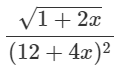
yo how do i simplify this using binomial approximation? https://i.imgur.com/9zZ2EYa.png
 misty wolf
you can convert the top to (1+2x)^0.5
and then do the binomial expanison on it and then multiply it by the biomial expansion of (12+4x)^-2
 small bear
The sum from j=2 to i of 1
small bear
The sum is shifted from 2 to i
Don't over-complicate it, what does it mean to sum 1's from 2 to i
1+1+...+1 i-1 many times
vital delta
its no different than 1 to i
small bear
vital delta
its no different than 1 to i
What do you mean
vital delta
 small bear
$\sum_{j=2}^{i} 1 = \sum_{j=1}^{i-1} 1 = 1 \cdot (i-1)$
ocean sealBOT
peaceGiant
 small bear
when we sum a constant, it doesn't matter if we start from 2 and go to i or start from 1 and go to i-1 since it is the equal amount of iterations
small bear
vital delta
so 3 to n is i + 2 ?
sum from 3 to n of 1?
vital delta
yes
vital delta
ocean seal
**peaceGiant**
is this really true ?
small bear
n-2
vital delta
it doesnt follow the formula
small bear
vital delta
it doesnt follow the formula
Second sum does
The formula says, if you add c, n - many times, you get c*n
vital delta
OH you just offset by one in that calculation
small bear
Yeah
alpine sable
What are those type of equations called?
 glass lichen
alpine sable
What are those type of equations called?
glass lichen
alpine sable
What are those type of equations called?
exponentials
small bear
There is no equation in the image, though we are looking at an expression involving negative exponents
vital delta
how would that affect say n(n+1)/2 if it was j = 2
small bear
vital delta
how would that affect say n(n+1)/2 if it was j = 2
Sum of i (from 1 to n) = n(n+1)/2
If we skip first step, which is summing a 1
Sum of i (from 2 to n) = n(n+1)/2 - 1
vital delta
so the formulas themselves dont really change
they just shift by a factor a -n depends on where you start from 1
small bear
Sure, that is one way to look at it
small bear
np
steel scaffold
misty wolf
and then do the binomial expanison on it and then multiply it by the biomial exp...
can you show how you will simplify after multiplying?
the correct answer is 1/144(1+x/3) but idk how to get to that
 slate jetty
Hi, can anyone help me see if my proof is in the right direction? I don't know how good my proof is. I don't know if it's a bad proof, or what. I am new to proof writing.
had only 5 weeks in my proof writing class so far
 fair cargo
how do I calculate how thick my aquariums glass would need to be to hold the weight of the water on inside?
Im trying to build my own aquarium!
 ocean spear
I need help https://fog.ccsf.edu/~wjeh/math95/circle_approach/trig_answer_circle.pdf for 3g I'm getting the opposite wrong. I need help on H 4 too😓
glass lichen
slate jetty
Hi, can anyone help me see if my proof is in the right direction? I don't know h...
dont ask to ask.
 steel scaffold
yo how do i simplify this using binomial approximation? https://i.imgur.com/9zZ2...
steel scaffold
steel scaffold
yo how do i simplify this using binomial approximation? https://i.imgur.com/9zZ2...
any1 can help with this? <@&286206848099549185>
i want someone to show how to get to the answer: 1/144(1+x/3)
small bear
 clever hare
The sum of the n-th row of a binomial expansion is ?
clever hare
small bear
The sum of the `n-th` row of a binomial expansion is `?`
it's like 2^n right
small bear
One less, 2^(n-1)
clever hare
oh i see
small bear
Occupied
small bear
256 = 2^(?)
clever hare
ohh i see
raw shard
wow literally no one reads the rules
that gets annoying and i don’t even ask questions
clever hare
no we're at the 7th? right because (n-1)
raw shard
not exactly
small bear
Actually the opposite, let me make the analogy
clever hare
ah ok im here to listen!
slate jetty
Should I now ask in a different chat?
small bear
The sum of the n-th row is 2^{n-1}

The sum of the 9-th row is 2^{9-1} = 2^8
wait so it is the 7th row or am i missing something😅 sorry im a litte confused
small bear
small bear
```
The sum of the n-th row is 2^{n-1}
The sum of the 9-th row is 2^{9-1} = 2^8...
As you can see, the 9-th row's sum is 2^8 = 256
So which row would it be?
clever hare
9th?
small bear
yeah
small bear
No problem, I want to additionally say that wikipedia starts the Pascal's triangle with row 0. I find that unnatural and perhaps you should ask your teacher about what the questions asks
@clever hare
 abstract fractal
"I find that unnatural"
Programmers: I have no such weakness
small bear
True, but counting in mathematics starts from n=1, so that's why I am making the remark
(eh, it's controversial but still -.-)
clever hare
small bear
No problem, I want to additionally say that wikipedia starts the Pascal's triang...
ahh i see, i will ask for you!
small bear
clever hare
ahh i see, i will ask for you!
If we start with row 0
n-th row's sum is 2^n


If we start with row 1
n-th row's sum is 2^{n-1}
 rose prism

can anyone help me find the domain and range
im struggling atm to understand domain and range
alpine sable
The domain describes the amount of inputs you're allowed to put into the function (so the valid values of x).
alpine sable
alpine sable
The domain describes the amount of inputs you're allowed to put into the functio...
In your case, as you can see the values of x start from zero and extend to infinity, so the domain is x > 0
abstract fractal
<@&268886789983436800> Ayo somethings not right here
 dreamy cedar
Banned
rose prism
alpine sable
The domain describes the amount of inputs you're allowed to put into the functio...
then domain would be something like 0 >
right
but what would the number on the right be
0 < x <
alpine sable
x, on the graph, is greater than or equal to 0
rose prism
yea
rose prism
but i got 0 is less than or equal to x is greater or equal to 24
abstract fractal
You can prolly put infinity on the right if you really want to
alpine sable
rose prism
but i got 0 is less than or equal to x is greater or equal to 24
Can you show the function?
Because the graph itself with this arrow show that the x can be up to infinity
rose prism
alpine sable
Can you show the function?
wym
u want me to show the whole problem
or something
alpine sable
Maybe. I just want to know what functions form this graph (if you have the equation of any)
alpine sable
rose prism
but i got 0 is less than or equal to x is greater or equal to 24
Does the marking scheme or model answer tell you this?
rose prism
no thats what my teacher got and im tryin to figure out how she got it
lol
cause idk how she got 24
she got -1.5 < y < 0.5 for range
abstract fractal
There must be more info given somewhere
alpine sable
rose prism
she got -1.5 < y < 0.5 for range
Yeah that's a fine range
alpine sable
Oh sure, the range describes the.. range of Y values lol
rose prism
yea ik that
alpine sable
But the thing is, it describes the range of Y (output) values for all inputs (X) you can enter
vital delta
 rose prism
ok
vital delta
Is that second summation correct ?
alpine sable
rose prism
yea ik that
So yeah in the case of a drawn graph, getting both the range and the domain is done by just looking at the points on the maximum and minimum possible x or y points on the graph
rose prism
so how is it 1.5?
vital delta
Based on the algorithm it should be i - 1. Not i
alpine sable
rose prism
so how is it 1.5?
Do you see when the x is 6?
Isn't the y at 1.5?
Oh it's actually not apparent
there's no way the graph has all the info you need
rose prism
would this make more sense
the top question relates to the graph “describe the stock price as a function”
alpine sable
I don't think so
actually if you look on the graph at x = 3, you'll see y = -1.5
which is the lowest that y has went to
rose prism
yea and 0.5 would be?
alpine sable
and if you look at x = 6, you'll see that y is 0.5 which is the highest that y has went to
 alpine sable
What does the question say?
alpine sable
rose prism
so as the days increase why would the cases be constant?
That seems to be the case for what's after day 35 but I still want to see the question to understand you better
 alpine sable
rose prism
would constant be the same thing as increasing
alpine sable
rose prism
would constant be the same thing as increasing
Okay so an increasing function is the part of the function in which it goes up.
rose prism
yes
alpine sable
Whats 3x +1?
If the point marked C is called a constant, then this is the point at which the gradient is 0
rose prism
i dont get it
alpine sable
Did you learn differentiation yet?
 hushed heron
alpine sable
Whats 3x +1?
hushed heron
alpine sable
Whats 3x +1?
x is a variable, if u only have "3x+1" x can be anything
rose prism
alpine sable
Did you learn differentiation yet?
no
alpine sable
Well then, it is the point at which the graph turns
hushed heron
if u have "3x+1=something" (that something being a number) x can be only one thing and u can find x
oop forgot to tag @alpine sable
rose prism
oh
alpine sable
I can't tell what a negative or positive function is so I'll go instead of confusing you
rose prism
lol
alpine sable
But now you know that C is not a point at which the function is increasing
rose prism
alpine sable
But now you know that C is not a point at which the function is increasing
yk that range is the lowest and highest it went what would domain be
 hasty gull
Hiii, this is my first time on the server. I needed some help with calc hw and I asked my brother and classmates but they don't seem to understand it well enough to teach me. So literally a minute ago I wished there was like a server for calculus because so many people take the class and so here I am after my search!
This is the question I need help with <@&286206848099549185> . I was thinking that after I plugged in fx into the formula on the right, h would cancel out but it didn't. A little confused on how to find the derivative.

 remote heron
hasty gull
This is the question I need help with <@&286206848099549185> . I was thinking th...
remote heron
hasty gull
This is the question I need help with <@&286206848099549185> . I was thinking th...
i can help in a sec but you shouldnt ping helpers so fast
what work do you have so far?
hasty gull
oh my bad i read the guide wrong
remote heron
any progress?
hasty gull
i decided to work other other problems and come back to this one later
remote heron
ah, alright, did you still need help?
rose prism
alpine sable
the same but in terms of x
ty
hasty gull
remote heron
ah, alright, did you still need help?
yes
remote heron
same problem?
hasty gull
yea
small cypress
if we had asequence of 2,4,8,14,22
how would u find the nth term>
quadratic seiqeneces
hasty gull
i use an ipad
um so basically rn i changed the sqrt to the power of 1/2
becuase my brother told me theres a shortcut in finding derivatives
where u get rid of part of the exponent and make it the coefficient or something lilke that
ocean sealBOT
jan Niku
 hasty gull
yes this thing
hmmm i got an answer using the rule
i will try it out and see if it works
 scarlet chasm
Why is the eigen vector of this [1,0,0]?

If the first row is all 0s it’s just assumed that the same row on the eigen vector is a non zero number?
alpine sable
 scarlet chasm
Or is it if there’s no dependence on x1 it’s a number
@alpine sable the cardinality is just how many elements are in the set A intersect B
alpine sable
so would it be 2
 sly mantle
scarlet chasm
Why is the eigen vector of this [1,0,0]?
sly mantle
scarlet chasm
Why is the eigen vector of this [1,0,0]?
use definition of eigenvector
scarlet chasm
alpine sable
so would it be 2
- Number of not the value of
@sly mantle o ic so it can’t be the 0 vector cus it needs to equal {1,0,0}
sly mantle
v is an eigenvector of A if v!=0 and Av=cv for some scalar c
check A(1,0,0)=c(1,0,0) for some scalar c
scarlet chasm
That's a way to check my work but I just forgot how free variables worked when solving matrix problems
sly mantle
free vars arise in solving linear systems so you may want to review that
 red carbon
Can anyone help me with this question?

So theres a trick that my instructor gave us, which is:
(x)(x') + (y)(y') = (r)(r')...
so I did
(r)(r') = x(-y-x^3) + y(x)
This simplifies down to -x^4 = (r)(r')
Transfer that to polar which is r' = -(r^3) (cos^4 theta)
but im not sure where to move from here.
hasty gull
remote heron
$\dv x a x ^b = a \cdot b x ^{b-1}$
Thank you for this I am almost done with my calc hw for the day!
 shut crest
calc seems hard
 red carbon
<@&286206848099549185>
hasty gull
shut crest
calc seems hard
i don't think its hard I just have a sloppy professor
 rough yoke

hey! i'm having issues trying to figrue out this problem
I understand that you swap X and Y and solve for y, but im stuck with x = y^3 +7y - 1 and i'm not sure how I would go about solving for Y
raw shard
@shut crest if you have a good tutorial or teacher it’s not that bad
remote heron
red carbon
Transfer that to polar which is r' = -(r^3) (cos^4 theta)
would this mean you get a center at r=0?
or uhh
i mean that you have a trivial solution
idk if thats what the problem is even asking 
but it looks like ur gettin buried
rough yoke
Oh i'm sorry I didn't realize this wasn't empty
red carbon
yeah Im supposed to get a center... but im also supposed to show that the origin itself is a spiral.
rough yoke
I saw the smalltalk and figured it was empty
red carbon
and im not sure how to do that lmao.
shut crest
raw shard
<@696953667403644938> if you have a good tutorial or teacher it’s not that bad
ok


 red carbon
I mean i set it into a jacobian and I got purely complex eigenvalues.
remote heron
this guy goes over something like that
at 7 minutes
maybe 
wish i knew more about this stuff or which channel to ask in
questions 0 you will get buried too fast
rose prism
alpine sable
the same but in terms of x
so for the graph i showed you eariler it would be 0 is less than or equal to x greater or equal to 6
since the highest for x is 6
 fallow nebula
Can someone help me with math graph?
Can someone explain me the solution to this?

<@&286206848099549185>
 rocky quest
I need help in my elementary statistics problem I am doing
 fair osprey
fallow nebula
Can someone explain me the solution to this?
fair osprey
fallow nebula
Can someone explain me the solution to this?
A or b? Also can you get better photo?