#help-0
1 messages · Page 818 of 1
 cerulean kelp
 wary stream
Then set up a system of equations from the RREF
cerulean kelp
wary stream
Then set up a system of equations from the RREF
?
wary stream
Did you do $$A - \lambda \cdot I = 0$$ and then RREF?
 ocean sealBOT
dldh06
 cerulean kelp
ocean seal
**dldh06**
cerulean kelp
ocean seal
**dldh06**
I will try rref
 unique ingot
Can someone explain how line 3 turned into the equation on line 4?

 prisma cape
unique ingot
Can someone explain how line 3 turned into the equation on line 4?
prisma cape
unique ingot
Can someone explain how line 3 turned into the equation on line 4?
i dont understand either
i know the overall concept
 silver current
unique ingot
Can someone explain how line 3 turned into the equation on line 4?
silver current
unique ingot
Can someone explain how line 3 turned into the equation on line 4?
The brackets are misplaced
unique ingot
My textbook answers are full of errors so you might be able to solve it a diff way
silver current
like there is a bracket on the power of 32
unique ingot
Yeah confusing
prisma cape
yeah
 wary stream
silver current
wary stream
silver current
I know that you are trying to help but next time, don't do the full work. Ask the person for their attempt and see what they got stuck on
unique ingot
I got the same answer as you too
silver current
wary stream
I know that you are trying to help but next time, don't do the full work. Ask th...
Sorry, ill try to follow that next time
silver current
unique ingot
I got the same answer as you too
you are correct then
unique ingot
I wonder how it got 1/2 and 1
silver current
unique ingot
I wonder how it got 1/2 and 1
that solution is wrong but the answers given are right ig
 kindred harbor
Hello
I am taking a CS class called 222 "intro to discrete structures"
and on the homework there is a problem that I just wanted to run by someone to see if I did it right but basically
they have a sample of 50 people and want to take 8 of them, how many different ways can they be arranged
and I thought it would be 50!/8!
 small bear
kindred harbor
and I thought it would be 50!/8!
small bear
kindred harbor
and I thought it would be 50!/8!
You've over-counted
You can use just combinations to solve the problem
kindred harbor

for Part A it would be35,254,642,500 because

but idk about part B
I think its just (50 - 8)! * 8!
but that seems like too big of a number
small bear
Well in this question, we care which student is where (they are distinguishable)
kindred harbor
maybe when it says "arranged left to right" it means that you pick a group of 8 students and its asking how many ways you can arrange that 8 students?
small bear
From the 50 students, we permute them, and we get all the permutations
kindred harbor
I fractured my foot so I missed a few lectures which doesn't help
small bear
However, once we sit down the students, or we draw a line at the 8th person, we don't care about the arrangement of the other people
kindred harbor
okay so its just 8! then?
small bear
rather we would have 50! / (50-8)!
kindred harbor
2.16 * 10^13 ish?
small bear
the factorial function is a very fast growing function, so this shouldn't be surprising
small bear
kindred harbor
2.16 * 10^13 ish?
,w 50! / (50-8)!
ocean sealBOT


 Requested by peaceGiant#0724
kindred harbor
Requested by peaceGiant#0724
kindred harbor
cool
now for the last one
its kind of confusing because
c) 8 of the students are lined up from left to right. In how many ways can this be done if we consider only their majors, and not their names?(3 points)
idk where it mentioned names in the last problem but if I had to guess thats what it means by left to right?
so if I had to guess, instead of 50! / (50-8)! it would be for each major, take 8 students from their group and see the possible arrangements?
small bear
Names mean they are distinguishable, John sitting next to Alex from left to right is different than Alex sitting to John (we can't use combinations*)
 craggy fossil
pls help me 1+1
kindred harbor
so
kinda similar to the first problem?
I just figure out the permutations of each different major and then multiply?
craggy fossil
PLEASE 1+1
kindred harbor
what would the first group be?
just 8!?
if theres 8 students in the major and I am finding the possible arrangements for those 8 students, it would just be 8!?
small bear
kindred harbor
I just figure out the permutations of each different major and then multiply?
Yeah it would be similar, we again permute all the students, and then divide by the number of students that are not distinguishable
kindred harbor
so for example
small bear
kindred harbor
if theres 8 students in the major and I am finding the possible arrangements for...
yes, but we don't multiply, we divide by it
small bear
We still have the ordinary 50! students aligned
kindred harbor
but its by major
small bear
Still, we need to work with all of them
kindred harbor
it says arranged considering only their major
but I digress, im not really sure what you are getting at
small bear
So first of we choose 8 people from the 50 to be selected right?
kindred harbor
I dont believe so no
small bear
Why not?
kindred harbor
because its not just any 8 out of the 50
the 8 all have to be of the same major

similar to part 8
its basically asking
if I have 8 students from each major
how many combinations are there
small bear
kindred harbor
> c) 8 of the students are lined up from left to right. In how many ways can thi...
you consider only their major, they don't have to be from the same major
kindred harbor
so I would find out the possibilities for computer engineers, then for computer science majors
I think they do?
oh
I keep trying to assimilate part c with a
but they are different
you are right
so its just 50! then?
small bear
No no, that would be if we wanted to select 50 students for something, 50! is bigger than all of our answers (for part (a) and (b)) so it certainly isn't
kindred harbor
like I dont understand why the majors matter at all if they can have any group of any major
oh wait I think im starting to see now
small bear
Let's rephrase the problem into something that makes sense
kindred harbor
so I pick 8 students given the 4 different majors and their criteria
so I have to find the number of possibilities per major and add?
small bear
Yes, and here the name doesn't matter of the student, only the major does, let me explain in detail with an analogy
I have a box of 50 balls, 8 are coloured red, 12 blue, 20 green and 10 yellow,
(c) In how many ways can I put them in a row (only 8 balls*) so they all give a different arrangement of colours
This is the same statement, just simplified
kindred harbor
hmm okay
small bear
Now when we have for example, green blue yellow ... and another case where I choose perhaps a different green ball to be in first place, it wouldn't matter, they are both green
Does it make sense?
(The explanation I gave is really poor lol)
kindred harbor
yeah it does
 vale wigeon
wait what problem are y'all doing
kindred harbor
order does not matter
vale wigeon
i'm a little suspicious of peacegiant's analogy
small bear
kindred harbor
> c) 8 of the students are lined up from left to right. In how many ways can thi...
^
vale wigeon
ah.
 small bear
kindred harbor
small bear
kindred harbor
^
 dense haven
i have a question, - - equals + right? what does + + equal? and what does - + equal?
i forgot..
kindred harbor
-
- = -
small bear
So instead of looking at the students as students, we just want to put the names of the majors in a line of 8 so that each time, we don't get a repetitive combination
CS EE CE ...
EE CS CE
EE CE CS

are all different

but

CS (Anna)    EE  CE
CS (John)    EE  CE

would be the same
oohhhh
so basically I can only take one student per major?
dense haven
kindred harbor
- + = -
and + +?
kindred harbor
adding a positive is just adding
dense haven
good i thought that too.
small bear
kindred harbor
so basically I can only take one student per major?
You can only work with 4 majors basically, it's a permutation with repetition
kindred harbor
im confused on how I would like write that out though
for Part A I kinda wrote it like this:
 small bear
If that is the product of all of them it should be correct
With this one it's permutations with repetition, have you perhaps written a formula down (so we can make an intuitive sense out of it) or do you not have it?
kindred harbor
I may have a formula in my notes let me check
nPn = n! / (n- n )!
oh here with repetitions its
n! / r1! * r2! * ... rk!)
small bear
Nvm, so we have 50 majors in total right?
kindred harbor
no
50 students in total
theres 8 CE majors, 12 CS majors, 20 EE majors and 10 SE majors
small bear
yes, 50 majors when we combine the students, 8CE Majors etc
small bear
Yup, in how many ways can we permute all of them?
 small bear
That would be directly yes, this means that we don't care about the rest 42 students/majors
Now, all of those combinations will have repeating students with the same majors, we don't want that
We need to remove very permutation from all of the majors
kindred harbor
so I need to limit it to 1 per major?
small bear
Starting with the CE Major (8 students), how many permutations would we have to divide so that we have no repetition
kindred harbor
divide by the number of students in each major?
small bear
Well by the factorial, since we permute the students
small bear
We wouldn't sum them
kindred harbor
multiply?
small bear
There is something off since this is not an integer
kindred harbor
wdym everything is an integer
oh the result has to be an integer yeah
well the problem is
I have to have more than one student from a major
theres not 8 majors
so its okay to have 4 computer engineering students for example
and its okay to have the same student multiple times since they say the name doesnt matter?
small bear
We need to view it like that yes, A permutation of (CS, CE, EE, SE) with repetition, in a row of 8
small bear
Gimme a second
It would be just 4^8 I believe when we rephrase the question like that
Alright so what we want to do is fill in this row with (CS, CE, EE, SE)
_ _ _ _ _ _ _ _
Does that make sense?
(since each major has more or equal to 8 students, we just need to put the letters in that row)
kindred harbor
yeah
small bear
Alright, for the first one, how many options do we have?
small bear
yup, so that would give 4^8
small bear
No problem, we got there in the end

 alpine sable
 spark reef
guys i just started limits i need some clarification
spark reef
guys i just started limits i need some clarification
DM me ill help u in around 20 mins since my phone boytta die
spark reef
would A be f(1)?
oh no i just need this quick clarification i’m about to go to class
but when it’s a line like that does it still count as a limit or does it not because it actually crosses 3?
small bear
spark reef
would A be f(1)?
A limit is just a value that a function approaches (in this case the function f(g(x))). This value would be same as f(1) since g(x) is well-defined for x=3
spark reef
ohh so since the values at x->a- and x->a+ are approaching 1 its still the limit?
thanks for clearing that up!
 bronze flint
can anyone help me with this one?

 tawdry sphinx
do you know Pythagorean Theorem?
tawdry sphinx
the this should not be hard right?
bronze flint
like the whole thing?
 glass lichen
The radical
tawdry sphinx
yeah exact result sqrt(18)
tawdry sphinx
never round when not in physics lol
glass lichen
That you can use the decimal expansion
tawdry sphinx
or you can see that sqrt(18) lies between sqrt(16)=4 and sqrt(25)=5
bronze flint
u too
glass lichen
No
tawdry sphinx
ok
alpine sable
4pq + 4qr + 5pq -7qr -8qp
 oak chasm
@alpine sable First, put the variables in alphabetical order in each term.
alpine sable
ohh ok so 4pq + 4qr -+ 5pq - 7qr -8pq
oak chasm
Yes, but you have an extra - now.
alpine sable
why
alpine sable
sorry i didn’t realise i put that in by accident my bad
oak chasm
OK, so you have 4pq + 4qr + 5pq - 7qr - 8pq.
alpine sable
yes
oak chasm
OK, the first term is 4pq.
It has one copy of p and one copy of q.
What other terms have exactly that?
alpine sable
5 and 8
oak chasm
Right.
Those are called like terms because they have the same number of copies of each variable.
So, you add the number in front (the coefficient) from each together.
alpine sable
ohh so the answer would be pcq -3qr
alpine sable
pq*
oak chasm
4 + 5 - 8
alpine sable
yo can yall help me on 9 questions?
alpine sable
ah yes i see now
oak chasm
OK, what other terms are left over?
alpine sable
thanks i was getting it wrong because i wasn’t putting the like terms in alphabetical order
oak chasm
4pq + 4qr + 5pq - 7qr - 8pq
4qr and -7qr are left over.
Each has one q and one r.
So they're like terms.
We add the numbers in front.
4 - 7
-3
So, -3qr
alpine sable
that’s right thanks
oak chasm
No problem.
 desert oyster
Hello
alpine sable
 desert oyster
Does someone knows this?
 woven sphinx
know what
woven sphinx
alpine sable
well what have you tried
 woven sphinx
idk seems like this channel is already occupied wait a bit
alpine sable
woven sphinx
well what have you tried
i think its 1st
woven sphinx
alpine sable
you can first multiply both sides by 2
woven sphinx
alpine sable
i think its 1st
why do you think so?
alpine sable
cuz it looks like the problem
woven sphinx
sorry to say you're wrong
woven sphinx
$A=\frac{1}{2}h(b_1+b_2)$
$\frac{A}{(b_1+b_2)}=\frac{1}{2}h$
ocean sealBOT
A Fellow Human
 woven sphinx
can you take it from there?
alpine sable
3rd one then innit?
woven sphinx
yeah it is
alpine sable
ty
woven sphinx
desert oyster
alright you know binomial theorem right
desert oyster
woven sphinx
alright you know binomial theorem right
I kinda do but i didn´t understood it at all
could you explain me?
i don´t need answers only explanation please
woven sphinx
don't understand as in you don't know why it's true, or how to apply it?
desert oyster
both
woven sphinx
all right
so we don't necessarily need to prove this but i can explain a bit later
anyways
i'm assuming you know $(x+y)^n=\sum^n_{i=0}\binom{n}{i}x^iy^{y-i}$ right?
ocean sealBOT
A Fellow Human
 desert oyster
yes i do
 final crystal
Solve: d2y/dx2 - 2 dy/dx + y = x^2 + 4 e^3x ????
woven sphinx
cool
bro wait
anyways
we apply the following substitutions:
$x=3y$
$y=-p$
$n=19$
ocean sealBOT
A Fellow Human
 desert oyster
No worries keep explaining
bronze flint
@alpine sable
alpine sable
yep
bronze flint
what were ur question again?
woven sphinx
those substitutions would give $(3y-p)^{19}=\sum^{19}_{i=0}\binom{19}{i}(3y)^i(-p)^{19-i}$
alpine sable
 ocean sealBOT
A Fellow Human
 bronze flint
alpine sable
bronze flint
alpine sable
just opposite it
desert oyster
Mmm so i should substitute then?
bronze flint
N = -L+M
alpine sable
bronze flint
N = -L+M
answer not shown
woven sphinx
ocean seal
**A Fellow Human**
we want the coefficient of $y^2p^{17}$ so we want the exponent of $y$ to be $2$ and $p$ to be $17$
ocean sealBOT
A Fellow Human
 woven sphinx
turns out we actually want the specific case $i=2$
ocean sealBOT
A Fellow Human
 bronze flint
np
 woven sphinx
anyways if we only consider the $i=2$ term of that particular expression, we have the expression $\binom{19}{2}(3y)^2(-p)^{17}=\binom{19}{2}\cdot3^2\cdot(-1)^{17}y^2p^{17}$
ocean sealBOT
A Fellow Human
 woven sphinx
so our coefficient is $\binom{19}{2}\cdot3^2\cdot(-1)^{17}$
ocean sealBOT
A Fellow Human
 desert oyster
yes it does tysm
woven sphinx
yw
woven sphinx
alpine sable
yeah
 woven sphinx
yes
 alpine sable
so last option?
woven sphinx
yep
 austere glade
Pls help, how i can do it?
 desert oyster
<@&268886789983436800>
 sly mantle
ty
 woven sphinx
nope
alpine sable
2nd one then?
woven sphinx
3rd
 woven sphinx
yes
 woven sphinx
what is e-10, multiplied by h?
alpine sable
then last
woven sphinx
are you very sure
alpine sable
honestly no
woven sphinx
suppose e is 10, h=2
then the question becomes 10-10 times 2
are you sure that's equal to 10-2*10?
alpine sable
1st one then?
woven sphinx
no
2nd one
i mean surely you know that e.g. the number 11-10, when multiplied by 2, equals 2*(11-10) instead of 2*11-10 or 11-2*10
alpine sable
thanks
 uncut tapir
Is this a test?
woven sphinx
cos ur calculating the difference first then multiplying
uncut tapir
Well if it was a test you wouldn't be allowed to ask
alpine sable
yep
 chrome plinth
If two points are on the same line segment or ray, are they collinear?
small bear
chrome plinth
If two points are on the same line segment or ray, are they collinear?
Any two points are collinear (in Euclidean geometry and others)
 woven sphinx
do you know the compound interest formula
uncut tapir
And be careful there's a trap on this question
woven sphinx
what did u try?
 random seal
i mean i put in the wrong numbers, I am supposed to put the intrest rate as "5.4%"
as in 1.35*4 because it is quarterly
uncut tapir
That's not correct
random seal
but I don't know why
uncut tapir
Oh yeah ^4 is
 woven sphinx
so you're not paid every year, you're paid every quarter
how many quarters are in 6 years?
random seal
24
woven sphinx
and each time you're paid 1.35% of your income
so the correct balance would be $1000\cdot(1.0135)^{24}$
ocean sealBOT
A Fellow Human

 uncut tapir
No, that's not 1.35/100
 uncut tapir
I don't know why they have k in the denominator but that can't be right. Unless the rate refers to annual interest
But it doesn't. It says the interest rate is quarterly
 alpine sable
Best tips for absolute math beginners?
uncut tapir
Practice practice practice
desert oyster
Yes yes
 regal portal
hey
im doing eliminations linear systems the question is
x+2y=4 and x+y=2
I need two same coefficents and opposite signs
how would I multiply an equation to make it have opposite signs will still remaiing have one same coefficent?
<@&286206848099549185>
 hollow basin
Why do I keep getting error


 amber urchin
hollow basin
Why do I keep getting error
amber urchin
hollow basin
Why do I keep getting error
Put multiplication sign between arcsin(155) and 60
hollow basin
 amber urchin
hollow basin
amber urchin
hollow basin
Maybe basic calculator needs to evaluate arcsin(155) first
So try that and then multiply answer by 60 and divide by 97.73
small bear
Domain of arcsin(x) is -1 <= x <=1
hollow basin
I m having no luck
 rigid wind
what are you trying to compute? why is arcsin there
 small bear
alpine sable
because the domain of arcsin is [-pi/2, pi/2]
small bear
alpine sable
because the domain of arcsin is [-pi/2, pi/2]
That's the range
small bear
arcsin(x) is the inverse of sin(x), that means the domain and ranges are swapped, if we constrict sin(x) from -pi/2 to pi/2 due to periodicity (and the fact the function must be injective), it's easy to see that is the range for arcsin
hollow basin
Fuck you prof he made a error in the class
alpine sable
hollow basin
Fuck you prof he made a error in the class
math profs are scatter brained as fuck
hollow basin
Thank you to everyone that tried to help
 brazen forge
If I have 3 vectors and one is supposed to be perpendicular to the other two. Does that mean the other two have to be parallel to each other?
rigid wind
in 2D?
brazen forge
3D
For one of my questions I have to figure out, out of 3 vectors one is perpendicular to the other two
rigid wind
means they belong on a plane
brazen forge
I found the that one vector is perpendicular to the other two, but those two aren’t parallel to each other
brazen forge
rigid wind
means they belong on a plane
I have a x,y,z
rigid wind
for simple test just take (0, 0, 1) and any 2 vectors on xy-plane
brazen forge
Idk how to do that, I took the dot product and then compared that to square root
And compared that to the magnitudes of the vectors *
rigid wind
dot product == 0 means they perpendicular to each other
brazen forge
Yes and that’s how I found that the one vector is perpendicular to the other two vectors
rigid wind
what does the question ask
brazen forge
But when I compared those other two vectors to each other I got that they aren’t perpendicular or parallel to each other
brazen forge
One of the vectors ,
u =< 5, -2, 1>
v = < 2, 3, -4>
w = < 7, 6, 8>
Is perpendicular to the other two. Which is it
rigid wind
brazen forge
Yes and that’s how I found that the one vector is perpendicular to the other two...
.
you said you found it
tawdry sphinx
brazen forge
One of the vectors ,
u =< 5, -2, 1>
v = < 2, 3, -4>
w = < 7, 6, 8>
Is perpendicu...
use dot product
brazen forge
I got U and V are orthogonal and V and W are orthogonal
So I said V is the one perpendicular to the other two
tawdry sphinx
yes so you are done right?
rigid wind
yeah
brazen forge
But I thought that would’ve meant U and W would have to be parallel
brazen forge
But I thought planes were 2D
rigid wind
a 2d plane in 3d you can rotate it around
put your pen perpendicular to your notebook
it's perpendicular to any line you draws on the notebook
doesn't matter if those lines parallel or whatever

 sick torrent
 vague gate
 swift nexus
probably a very silly question: I have an amount (say $1500) that I'm going to pay as a loan for 30 years. I originally got $1000 and paid $1500 in 30 years.
How do I calculate the yearly average interest rate of this loan?
 ashen blade
@swift nexus so you're paying $1500 once a year for 30 years?
kind of don't understand how you've worded your question, need some more clarification
swift nexus
@ashen blade: No. I'm paying $1500 after a total of 30 years of payment. I'm paying monthly (theoretically, I'm not actually paying anything :D).
I originally got a loan of $1000.
I'm trying to understand how to calculate the annual average interest rate
swift nexus
exactly
ashen blade
1 sec
1000(1+i/12)^(30*12) = 1500
if you're paying interest monthly its like that iirc
I know for sure if it's yearly it'd be
1000(1 + i)^30 = 1500 so
oh if you want the annual rate just do this one ^
swift nexus
how do I get i from that?
ashen blade
1000 is your starting amount, 1500 is your ending amount
do you know how to calculate compounding amounts normally
its lit the formula PV * (1 + i)^n = FV
PV = present value
n = num of years
FV = future value
swift nexus
like literally 1(1+ i)^30 = 1500/1000 , how do I extract i
ashen blade
its just rearranging that to calculate interest
simple math?
if there's an exponent to 30 on one side, what do you do?
swift nexus
sqrt of 30
ashen blade
yeah so
swift nexus
or however it's called
ashen blade
np
gonna post my question here since you're done
anybody know how to prove the subspace for the following?
{ p ϵ P | p(1) = 0}
where P represents the set of all polynomials
alpine sable
do you know the conditions for a subspace
ashen blade
yup
needs to have zero vector / function etc, needs to satisfy closed by addition and closed by scalar multiplication
the answer in the book is finding some strange span for it and it's confusing me because there's no explanation about how to do that
alpine sable
You are finding that { p ϵ P | p(1) = 0} is a subspace of something? if so what
ashen blade
if I do say: let m ϵ P, n ϵ P
and then have m = a0 + a1x = 0
and n = b0 + b1x = 0 I'd just prove it normally? or
alpine sable
or that it is itself a subspace
ashen blade
P is the vector space of the set of all polynomials
I guess I could think of it as a larger subspace
alpine sable
Could you post the exact question please
ashen blade
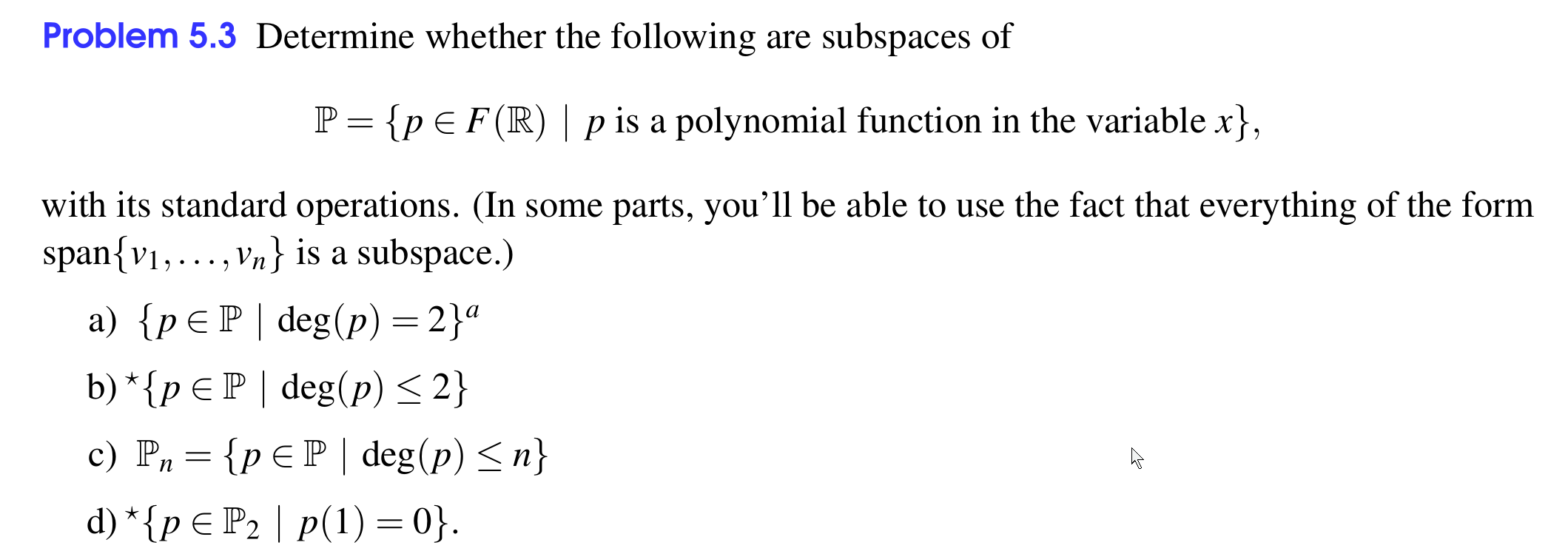
it's d)
oh it should've been P2 ... guessing it refers to set of all degree 2 polynomials(?)
so something in a0 + a1x + a2x^2 form im guessing
alpine sable
2 or less

so there only three cases (degree 0, 1, and 2)
a0 = 0, a1 + a2 = 0, and a1 + a2 + a3 = 0 for degrees 0, 1, and 2 respectively
ashen blade
sorry, then could I confirm
is there even a difference between these two then?
https://i.imgur.com/lQ6xJwp.png
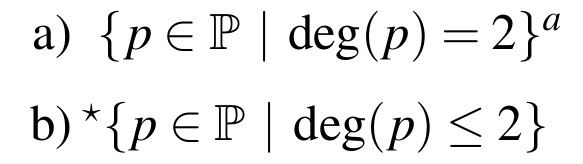
that had me confused too
glass lichen
One is bounded degree and one is just that degree
Ironically in the opposite order to what I said
ashen blade
so for a), I'd only have to prove for some arbitrary polynomial p(x) = a0 + a1x + a2x^2 is a subspace for P?
feels like if I can prove degree 2 for (a), wouldn't it mean I could prove the lower degrees are also subspaces by default for (b)?
because the set of higher degree polynomials seems to encompass the set of lower degree polynomials
like how you can have p(x) = a0 + a1 * x for one and q(x) = a0 + a1 * x + a2 * x^2 for the other
or am i just misunderstanding this?
glass lichen
Yes, for a you can only have quadratics, but for b you have constant, linear and quadratic polynomials
alpine sable
ashen blade
so for a), I'd only have to prove for some arbitrary polynomial p(x) = a0 + a1*x...
Yes. If you multiply that by a constant, is it still a polynomial function? If you add arbitrary quadratics together, is it still a polynomial function?
What do the highlighted things mean?
 ashen blade
thank you for the clarification
ashen blade
alpine sable
Yes. If you multiply that by a constant, is it still a polynomial function? If y...
yup, because (without even getting to write it out) - a sum of two polynomials is still a polynomial, and the scalar multiplication of a polynomial is still another polynomial
alpine sable
Yeah
ashen blade
alpine sable
What do the highlighted things mean?
I don't understand the "a" there - it might've been an error that they wrote, but the "*" just means there's textbook solutions of it in the back of the book
although they often don't really clarify things and don't feel that helpful for me personally
alpine sable
What textbook is this?

 vague coral
ashen blade
vague coral
ashen blade
I don't think I have the right to distribute this freely with others, sorry
you'd have to be from my school taking the same course
okay, I think I'm starting to understand this better
and I'll avoid the span method for now because it's still honestly confusing
but with a question like https://i.imgur.com/EFqMB8I.png
I only need to prove it is a subspace through the 3 tests normally by accounting for deg 0 ~ 2 (which in turn seem to be proved once I just show that a poly 2 function is always a subspace of P)

and with this one https://i.imgur.com/5PqgVj1.png

I'd just create some arbitrary deg 1 polynomial function and set it to 0
ie. a + bx = 0
and then do the three tests to prove
thanks for the help, blake and mosh!
 raw bloom
Hey was wondering if anyone could clarify to me if my answers for this problem to see if it looks ok? was doing them for a while
 small bear
raw bloom
small bear
raw bloom
This doesn't look good
Expand 3 (x-3)^2 - 4 and see that it doesn't equal 3x^2 - 9x + 5
small bear
We start from 3x^2 - 9x + 5 right
raw bloom
yes
small bear
A good move is to get the coefficient of x^2 in front of the parenthesis
Something like 3(x^2 - 3x) + 5
Does that make sense?
small bear
Great, now you need to complete the square inside the parenthesis, do you know how to do that?
raw bloom
i think so let me try
 sudden garden
if the perimeter of the parallelogram ABCD is 52cm^2 find its area. i want the method how to find the area when the perimeter is given.
small bear
sudden garden
if the perimeter of the parallelogram ABCD is 52cm^2 find its area. i want the ...
Channel is occupied, please go to another one
raw bloom
would i have to take half of 3 then?
small bear
yup
raw bloom
if i was completing the square
ok
ok so i have so far 3(x+1 and a half)^2-2 and a quarter+5
looking good so far?
small bear
You skipped a couple of steps, let's go step by step
raw bloom
ok
small bear
which number do you have to add and subtract to get a perfect square?
(sometimes referred to as the magic number)
raw bloom
-3?
small bear
Nope, we have x^2 - 3x and we would need (-3/2)^2
ocean sealBOT
peaceGiant
 small bear
Yes, that number is -3, half of -3/2 is that, and then we need to square it
alpine sable
6859 how about not being rude for no reason
raw bloom
and i had 3(x^2-9x)+5
raw bloom
yes
small bear
Alright, so when we have the following given A^2 + 2AB + B^2
and we know what A is, we can figure out B which is our magic* number
please stop flooding the channel
amber urchin
Imagine if that worked lol
raw bloom
so B is then -3
wary stream
Stop
glass lichen
At least he pinged mods himself
raw bloom
im sorry @small bear would it be possible to do this in dm's?
these people are spamming
glass lichen
<@&268886789983436800> apologises for 2nd ping
small bear
raw bloom
im sorry <@!206074524150530049> would it be possible to do this in dm's?
There we go, we can continue here now
sly mantle
b&
small bear
Channel is free
 short pumice
Heyy can anybody help me with this ?

 harsh belfry
I've been working on this for a little while now,

My equation for s(t) is

What I was assuming I could do is plug in my values into the following equation
 wary stream
harsh belfry
My equation for `s(t)` is
wary stream
harsh belfry
My equation for `s(t)` is
I don't think this is the right equation to use
wary stream
harsh belfry
This one is
harsh belfry
👍
short pumice
short pumice
Heyy can anybody help me with this ?
<@&286206848099549185>
harsh belfry
Im assuming that the final velocity would be 0, we are calculating for v_o, and a = to the acceleration, and h would be 3.
harsh belfry
wary stream
This one is
Am I correct in that?
wary stream
harsh belfry
Am I correct in that?
No, h is not 3
harsh belfry
Ah would it be 220 here?
wary stream
Nope
harsh belfry
Hm
wary stream
I think having it like this would be better $$v^2 = v_{0}^2 +2a \Delta x$$
ocean sealBOT
dldh06
 harsh belfry
If this is the case how would I calculate for my change in x?
silver current
read the question again
wary stream
$$\Delta x = x_f - x_i$$
ocean sealBOT
dldh06
 harsh belfry
ah so if its xfinal - x ininital
then if my final destination - the initial of 3
then 220-3
wary stream
Yes
harsh belfry
Thanks
harsh belfry
wary stream
Yes
I appreciate the help here dldh. @silver current Haha, yeah I don't know why it didnt compute that if its being thrown from 3ft high that it wouldnt be included in h.
Thanks again.


 oak chasm
@snow wraith When you prove two things are congruent by saying that some things are the same in them, you need to know that those things are the same in them.
Hypotenuse-Leg means the hypotenuse is the same length in both triangles.
And a leg is the same length in both triangles.
Does that make sense?
 snow wraith
Yeah
oak chasm
OK, so what is marked on the diagram as the same in both triangles?
snow wraith
the angles that make them congruent?
oak chasm
@snow wraith The right angle in each and a leg in each, right?
@proven flare No, sorry.
 proven flare
oak chasm
<@709266218946920458> No, sorry.
proven flare
oak chasm
<@709266218946920458> No, sorry.
No problem :))
oak chasm
One leg in each is marked with a dash, right?
@snow wraith See the red line there across the leg?
 snow wraith
Yes
oak chasm
The same number of lines is across the leg in the other triangle.
Since you have the same markings on both legs, they're the same length.
That's how they mark lengths the same.
So, we have a leg the same in both.
We have the right angle the same in both.
But they said Hypotenuse-Leg.
We don't know that the hypotenuse is the same in both.
The hypotenuses aren't marked as the same length.
Does that make sense?
snow wraith
Ye-ye
oak chasm
So, Hypotenuse-Leg is wrong since we don't know that the hypotenuses in both are the same and one leg in both are the same.
We can't use Hypotenuse-Leg because of that.
Does that make sense?
oak chasm
OK, do you know how to answer the question?
snow wraith
Yep! Thank you for the help
oak chasm
You're welcome.
wary stream
I feel like this is just a horrible question but just find the odd one out
I told you what to do
Find the odd one out
 pine mural
easier said than done
 charred flint
@pine mural there are multiple answers, just pick one and give a math-y reason
pine mural
how do i do that?
charred flint
you have to be creative, notice something special about one of them
anything will do
harsh belfry
pine mural
how do i do that?
bottom right one I would think since all of the other graphs are continuous in at leat one direction
pine mural
yeah i was just about to say that
harsh belfry
👍
pine mural
harsh belfry
👍
now all i have to do is explaining it
harsh belfry
pine mural
now all i have to do is explaining it
I mean.... just say that. That the rest of the graphs are continuous in at least one direction and the bottom right one isn't.
I don't think this should be too crazy difficult considering you know the answer.
You could write the intervals for each graph and state that the bottom right one is not infinite in either direction.
I don't know what your requirements are.
@pine mural
pine mural
harsh belfry
I don't know what your requirements are.
Which graph above (upper left, upper right, lower left or lower right) does not belong? Support your response with proper statements and mathematical facts.
harsh belfry
Vegeta I'm not going to do your work for you buddy.
If it was up to me I would start off by writing the graphs out in interval notation. Then I would state that the observation was that the bottom right one was non-continuous in either direction.
If you need help writing it in interval notation feel free to ask.
pine mural
harsh belfry
Vegeta I'm not going to do your work for you buddy.
i dont want u to i just wanted to show the requirements
harsh belfry
👍
I've been trying my best at this question for a good bit and I'm wondering if I went about it incorrectly.

I started off with finding the derivative of the function s(t)
s'(t) =

I plugged in the given value of 12 seconds into the expression and solved for velocity.

v=-18.2
I then plugged in the velocity into the following equation and solved for the pos.

I solved for s which was 133.4
I believe this should be correct.
And the velocity at impact would indeed be -18.2.
But It seems it's incorrect
Ideas?
 modest yew
so idk if i'm the best person to help with this as i'm actually taking what appears to be the same level of physics as you are
but i'm pretty sure you just went about it the wrong way
you need to find initial height first.
 harsh belfry
modest yew
so idk if i'm the best person to help with this as i'm actually taking what appe...
harsh belfry
modest yew
so idk if i'm the best person to help with this as i'm actually taking what appe...
(I am doing calculus) 😄
modest yew
oh lmao
harsh belfry
is the equation I am working with right now.

Not sure if that looks familiar to you
(my gravity constant is different for the moon obviously)
modest yew
is s0 initial speed?
harsh belfry
That would be the initial position
v_0 would be the initial velocity.
and -0.8 I believe is the gravity on the moon.
modest yew
no
thats the mistake i think
-1.6 m/s/s is the gravity
its acceleration yeah, but thats also the force of gravity
harsh belfry
Ah I was judging it off of this value.
 harsh belfry
Alright.
I'll try it again with a value of -1.6 acting as G
Only reason I think the gravity would be 0.8t^2 is that it's derivative is 1.6t
And it's second derivative (acceleration) is 1.6
modest yew
but...
yep thats the mistake
ok
so
gravity is acceleration
it is not velocity
when you drop a ball it accelerates towards the earth
harsh belfry
s(t)=position
s'(t)=velocity
s"(t)=acceleration
I'm not sure if theres a disconnect in the wording here.
I haven't done physics before actually.
harsh belfry
I was given s"(t) so i reversed it to find the previous value.
modest yew
i solved it, maybe it would help for youto take a look?
harsh belfry
Yeah sure.
 modest yew
lol sounds about right
charred flint
,rotate ccw
ocean sealBOT
 modest yew
thanks!!
harsh belfry
👍 thanks
hmm even if this is the correct answer I would have to find the answer utilizing the equations given to me.
harsh belfry
To make sure your calculated height it feel until impact was 320.
And the velocity at impact was?
modest yew
yeah thats my best guess at least
didnt get that far yet
can you explain your thought process for the velocity question? then ill take a look
sorry @dull harness ! try a different channel
<@&268886789983436800>
sly mantle
b&
harsh belfry
(I took a screenshot in case they deleted their own post)
It's a bit difficult to explain my thought process being that I am new to the subject.
modest yew
quick thinking! you got this calculus stuff :)))
yeah no worries i totally get it
(and same)
harsh belfry
I believe mathematically I should be correct here but I'm assuming I muddled up one of my variables somewhere.
modest yew
what formula were you given for this question?
harsh belfry
Finding the original eq right now. Second.

Then I was given the method to find the derivative for that same equation.
The first derivative gives me the velocity, the second gives the acceleration.
harsh belfry
s(t) is the position, (sorry should have said)
modest yew
no worries
harsh belfry
so heres why I came to the conclusion that the gravity was -0.8
They give us the acceleration. (which is the second derivative)
-1.6
the first derivative of that would be
-1.6t+1
and if we took one more step back
we would have
-0.8t^2+(rest of the original equation)
harsh belfry
Is this the correct thought process though? haha
modest yew
kind of
so the most recent equation you posted
the original
you do not take the derivative of that to find the first answer. the one where i got 320. all you do is use that pure formula.
now for the second part, you do need to take a derivative
harsh belfry

I simplified it to just

for the sake of being able to find the first derivative
harsh belfry
The derivative of this expression (cant include time yet)

is...

-0.8*the exponent, then minus the exponent by one
-0.8*2 then 2-1
 high crest
Is v0 = 1 then? 😕
harsh belfry
hmmm
Wait kex I think you helped me out alot there.
We dont know the velocity
therefore I cant find the derivative
harsh belfry
0
harsh belfry
ahh wait
modest yew
or ma'am
 harsh belfry
-19.2 is my actual velocity!!!!!
modest yew
oh also
i just noticed
for question 1
i solved using 20 instead of 12 as time
so 320 def isnt right
sorry about that
modest yew
oh ok good lol
yeah i was just thinking about it and i was ike hmmm thats a weird number to get
harsh belfry
if I set this equal to 0 and solve for s then It should work


Unfortunately my positon is incorrect haha
but velocity is right
harsh belfry
Thank kex.
harsh belfry
how far did it fall... idk
modest yew
one seccc

think i screwed up my signs at the end
AH
you used
final velocity
instead of initial velocity
initial velocity is 0
harsh belfry
OHHH
IM AN IDIOT
modest yew
LMAO
harsh belfry
HAH
harsh belfry
 harsh belfry
Hahahaha
modest yew
IM SO EXCITED
high crest
Congrats 😄
modest yew
and a Kex
high crest
Chemistry student^^
 candid atlas
yo
harsh belfry
We hit all our bases here didnt we.
modest yew
dang we really covered all the bases
 modest yew
great teamwork
harsh belfry
modest yew
dang we really covered all the bases
jinx
modest yew
and... life goes on. see y'all next time


 harsh belfry
See ya dude, nice to meet you lol
candid atlas
how is that wrong?
candid atlas
1/80 + 1/70 = 1/x
LCD is 560
so
7/560 + 8/560 = 1/x
that is 15/560
take the reciprocal
you get 37.3 minutes
convert that to seconds
2238
modest yew
alright
give me a minute to attempt it myself
something must be wrong but the logic sounds right
candid atlas
oh
modest yew
try flat 37?