#help-0
1 messages · Page 779 of 1
 vestal hollow
Like with the values given
And trying to abstract it so instead of 2500 it's just "d" as a distance
 oak chasm
Right, you can replace 2500 with d for the distance between Frisco and Kansas City.
You don't need any other values.
Well, I guess you can use the times.
vestal hollow
Let the distance from Frisco and Kansas City be d. Let f(t) be the distance traveled from Frisco to Kansas City on the first trip and g(t) the distance traveled from Frisco to Kansas City on the second trip, where t represents time.
f(8:00 AM) = 0 and f(5:00 PM) = d.
g(8:00 AM) = d and g(5:00 PM) = 0.
Then, f(8:00 AM) - g(8:00 AM) = -d and f(5:00 PM) - g(5:00 PM) = d.
0 is between -d and d
So by the IVT, f(t) - g(t) must equal 0 at some t in = [-t, t]
Then at some point the busses cross (the distance between them becomes zero) at some time t.
I feel like I messed this up a bit 
oak chasm
t from 8 to 17
f(t) - g(t) is continuous
f(8) - g(8) = -d
f(17) - g(17) = d
0 is between -d and d
Oh, you're fine.
The only thing is t ∈ [8 AM, 5 PM]
Since t isn't a distance.
You'll want to define f(t) and g(t) better.
They're both the distance to Frisco at time t.
f(t) is the distance to Frisco at time t on the first trip.
g(t) is the distance to Frisco at time t on the second trip.
Sorry, from Frisco, not to Frisco.
The distance is between two points, so the distance from Frisco to Kansas City, if those are the two points, is constant, so you don't want to use that definition.
If it's the distance from the bus to Frisco, that isn't constant.
vestal hollow
The only place I am getting hitched up is physically interpreting f(8:00 AM) - g(8:00 AM) = -d
oak chasm
Well, what's f(8 AM)?
vestal hollow
The distance from Frisco at 8 AM on the first trip. So 0.
oak chasm
What's g(8 AM)?
vestal hollow
The distance from Frisco at 8 AM on the second trip. So d
oak chasm
What's f(8 AM) - g(8 AM)?
vestal hollow
Well yeah, 0 - d = -d. But what does that mean physically? 😅
It's a negative distance so I guess it's meaningless physically
Only a quantity that exists within the mathematics necessary to get a solution
But I can';t help but feel like there should be a way to visualize it
oak chasm
It's how much closer the second bus is to Frisco than the first bus.
The second bus starts out as -d closer than the first bus.
Or d farther.
vestal hollow
oak chasm
It's how much closer the second bus is to Frisco than the first bus.
OhH!!!!!!!
Wow thank you so much
I think I'll have to rewrite it once or twice more but this makes a lot more sense
oak chasm
You're welcome.
 harsh belfry

So I have the correct answer
however, apparently theres an issue.

I ended up messaging my professor
and this is what he said
oak chasm
Right, you took the limit.
harsh belfry
so essentially would my answer end up being
oak chasm
What's f(x + Δx)?
harsh belfry
oak chasm
What's f(x + Δx)?
(x+h)^3
oak chasm
harsh belfry
would my answer here end up being
H^2+3x^2+3xh
Yes.
harsh belfry
Thanks, wanted to make sure since I only have one attempt left.
oak chasm
Make sure to use Δx.
 harsh belfry
I really hope this works out... I hate the awkward notation for change in x
would be nice if it was represented by h or just delta
 shrewd prism
9x^2+x^2=15^2
why am I not allowed to sqr root both sides of the equation and end up with
9x+x=15
i am dying
harsh belfry
got it right, thanks chai
oak chasm
You're welcome.
@shrewd prism Powers and roots don't distribute over addition.
First combine like terms.
shrewd prism
oak chasm
<@538748487538442278> Powers and roots don't distribute over addition.
so if I did 10x^2=15^2 then I could sqr root
oak chasm
Yes.
oak chasm
You're welcome.
shrewd prism
10x^2=15^2
x^2=1.5^2
x=1.5
this is wrong right? ^
10x^2=15^2
x^2=(15^2)/10
x^2=22.5
x=sqrroot(22.5)
oak chasm
Yes, it's incorrect. The second one is correct.
But there's a catch.
x² = 22.5 has two solutions.
shrewd prism
ohhh right the + and - thing right
oak chasm
Right.
shrewd prism
ok ty
shrewd prism
ok tysm
oak chasm
No problem.
shrewd prism
oak chasm
<@538748487538442278> Powers and roots don't distribute over addition.
and subtraction right?
oak chasm
Right.
shrewd prism
so if I had 3x^2 * x^2 =...
could I square root it into this?
sqrroot(3)x*x
wait no I need to square root the 3
oak chasm
Yes, if you do the square root on the 3.
Powers and roots distribute over multiplication and division.
shrewd prism
hmm ok tysm for all ur help
oak chasm
You're welcome.
shrewd prism
I didn't know about this until now ;-;
harsh belfry
Sorry to bother you Chai, but I assume this problem is incorrect due to a similar issue. But I'm not given a deltax to work with which is confusing me.


What would I do here?
oak chasm
What's f(x)?
shrewd prism
o right so if I had 3x^2 +y^2 = ...
can I still sqrroot the whole equation?
shrewd prism
I meant + oops
oak chasm
Oh, OK.
You could, but you can't distribute.
sqrt(3x² + y²)
Square root of the whole thing.
Not sqrt(3x²) + sqrt(y²).
shrewd prism
right so sqrt(3)x+y?
shrewd prism
huh what's the difference
oak chasm
The difference between what?
harsh belfry
oak chasm
What's f(x)?
(x)^3-9x
oak chasm
@harsh belfry What's f(3)?
harsh belfry
(3)
harsh belfry
Yessir
harsh belfry
Would it not be written like this?

 shrewd prism
oak chasm
You could, but you can't distribute.
shrewd prism
oak chasm
You could, but you can't distribute.
would I be able to distribute a power/root on an equation with 2 different variables on one side at all?
oak chasm
@shrewd prism If they're multiplied or divided.
Powers and roots distribute over multiplication and division.
harsh belfry
oak chasm
There's two xs to replace.
Perhaps?
 harsh belfry
Im confused
oak chasm
You're welcome.
harsh belfry
 oak chasm
Right.
oak chasm
What's f(x) - f(3)?
harsh belfry
x^3-9x
 ocean sealBOT
Chai T. Rex
\[\frac{x^3 - 9x}{x - 3}\]
 oak chasm
Factor the top.
harsh belfry
If I factor the numerator it should be x^2+3x
harsh belfry
x?
ocean sealBOT
Chai T. Rex
 harsh belfry
ahhhh
oak chasm
Then you factor x² - 9.
harsh belfry
then cancel the x's
oak chasm
No, you can only cancel whole factors.
There's no factor of x on the bottom.
There's a factor of x - 3, but that's not x.
So factor x² - 9 on top.

 gray kiln
no
oak chasm
Right, you can't do that because x - 3 is a whole factor.
x isn't on the bottom as a factor.
You can only cancel factors.
oak chasm
Factors are things you multiply, not add or subtract.
On the bottom, the only factor you have is x - 3, not x.
x isn't multiplied by something on the bottom, so x isn't a factor.
Does that make sense?
oak chasm
x is multiplied by something on top.
It's a factor there, but not the bottom.
So factor x² - 9.
gray kiln
at fisrt, when i was learning i did the same thing😆
oak chasm
No.
harsh belfry
am I doing something wrong
gray kiln
@harsh belfry do u know to find zero of polynomial?
oak chasm
With a difference of squares, you have something squared minus something squared.
It's a difference of two squares.
Does that make sense?
 alpine sable
You can’t factor out if there is a plus/minus sign @harsh belfry
harsh belfry
I really really don't understand anything right now.
shrewd prism
isn't there something about (a+b)(a-b) right
harsh belfry
I don't know what to say
shrewd prism
about quadratics or something
gray kiln
1 method is that u could try to find the values of x for which x^2-9 is 0
harsh belfry
yeah
harsh belfry
yes
shrewd prism
omigosh right ok
oak chasm
x² - 3² is a difference of squares.
It's the difference (subtraction) of two squares.
Does that make sense?
shrewd prism
(x+3)(x-3)?
harsh belfry
yes
shrewd prism
waw ok ty
oak chasm
So, we have x² - 3².
harsh belfry
yes
harsh belfry
I'll have to look into it more on my own to make sure I understand this
but I get the premise
harsh belfry
16?
oak chasm
No, factor it.
harsh belfry
(5)(5) - (3)(3)
alpine sable
@harsh belfry different language, but look at the bottom one
 oak chasm
Do you remember how I showed you to factor a difference of squares?
a² - b² = (a + b)(a - b)
We have 5² - 3².
How do you factor that?
harsh belfry
(5+3)(5-3) if I'm following the format
harsh belfry
I do
oak chasm
OK, so x² - 9 = (x + 3)(x - 3).
ocean sealBOT
Chai T. Rex
 oak chasm
Now we have three factors on top.
We have one factor on bottom.
Can we cancel one of the factors on top with the one on bottom?
harsh belfry
would x-3 on the top and bottom cancel out
harsh belfry
x^2+3x would be our answer
harsh belfry
I never would have been able to do this holy shit
gray kiln
u will be
oak chasm
Well, if you practice on some more problems with maybe some help when you get stuck, you'll be able to do it.
 thorn kindle

alpine sable

 lusty pewter
The length of a rectangular magazine is 8 cm more than its width and the area of the magazine is
240 cm2. Find the dimensions of the magazine.
How is this question quadratic?
 jagged imp
you wrote $5^{\ln_5(2)}=5$. this is incorrect
ocean sealBOT
Sneaky
 jagged imp
yes
 silver current
thank you

 split oriole
alpine sable
if not ples help me
split oriole
alpine sable
if not ples help me
Have you tried to solve this?
alpine sable
no because i dont know what to do
split oriole
Okk do you have any idea about derivative?
split oriole
Take the derivative of given equation then find dy/dx , at value (7,1) find the values of dy/dx ( that will be slope of tnagent) now use point slope form find equation of that tangent ,same for (-1,5) ,
When you get two tangents just find the point of intersection by elimination,or other mehtod you line
alpine sable
is finding derivative the only way to solve this?
split oriole
I know this method ,but wait for someone ,they will help
alpine sable
bcz my teacher teaching circle without derivative
 fervent anchor
alpine sable
if not ples help me
fervent anchor
alpine sable
if not ples help me
Write equations of tangents at both points and find intersection of both
split oriole
alpine sable
bcz my teacher teaching circle without derivative
Okk let me check
oak chasm
You can get the angle to the point.
From the center of the circle.
Then the tangent of the angle is the slope to from the center to that point.
alpine sable
center (2,1)?
oak chasm
And then the tangent line is perpendicular to the radius line.
fervent anchor
alpine sable
if not ples help me
Write equation of (7,11) and (-1,5)
And (7,11) and (-1,5)
Substitute in equation of circle and show that D=0
D= discriminant = b²-4ac
oak chasm
So, the slope you got for the radius line, you take the negative reciprocal of it.
@alpine sable Yes.
So, let's find the radius slope from center (2, 1) to point (7, 11).
Rise is 10, run is 5.
Slope is 2.
Tangent line is perpendicular to radius line.
alpine sable
what is rise and run
oak chasm
Do you know how to find a slope?
alpine sable
no
oak chasm
Do you know how to find a gradient?
alpine sable
no also
oak chasm
OK, so the slope is how far it goes up over how far it goes right.
The rise over the run.
So, from (2, 1) to (7, 11), it goes up 10.
It goes right 5.
oak chasm
OK, so that's the radius line slope.
The slope of the radius from the center to that point.
Now a tangent line is perpendicular to a radius line.
A perpendicular slope is the negative reciprocal.
2
-2
-1/2
See how I took the negative, then the reciprocal?
alpine sable
im confused
fervent anchor
oak chasm
A perpendicular slope is the negative reciprocal.
Yes
oak chasm
@alpine sable Where are you stuck?
alpine sable
all
fervent anchor
alpine sable
all


 dense blaze
can i check that the limit for 1/x^2 as x tends to 0 doesnt exist? or is it + infinity
even though the both the left and right side tends to (same value) infinity

 raven swallow
When do we say that the limit exists?
Go look up "when the limit exists" real quick
 gray isle
the limit can be represented as +inf but technically the limit doesn't exist as +inf isn't a number
split oriole
I think we can if we work on extended real line.
dense blaze
raven swallow
Go look up "when the limit exists" real quick
when the left hand side limit = right hand side limit
dense blaze
gray isle
the limit can be represented as +inf but technically the limit doesn't exist as ...
oh
raven swallow
dense blaze
when the left hand side limit = right hand side limit
And does it?
Example when it doesn't: 1/x
dense blaze
raven swallow
And does it?
ya it does to +infinity
but.i think ramonov said it isnt a number
raven swallow
dense blaze
when the left hand side limit = right hand side limit
Existence of a limit is a technical question with respect to this definition
as far as I'm concerned
Infty is not a number, of course, but at least it's the same for right- and left-sided limit
We say DNE for cases like 1/x, x to 0, and +INF for cases like 1/x^2, x to 0
 split oriole
For infinite solution a1/a2=1/b2=c1/c2

 thin berry
split oriole
For infinite solution a1/a2=1/b2=c1/c2
thin berry
split oriole
For infinite solution a1/a2=1/b2=c1/c2
Is there a method for 1 solution and no solution ?
split oriole
thin berry
Same idea with b and c then
Why z
 dull oak
 split oriole
That is variable
thin berry
split oriole
Why z
Oh you are right
Thank you so much
Hmm so it is a no solution right ? @split oriole
Oooh got it
 narrow carbon
anyone knows what I'm supposed to do here? I kind of don't get it

 raven swallow
Is this a test?
narrow carbon
nopee, my test is next week
raven swallow
Well the first problem, what does P stand for?
narrow carbon
that's what I don't know. They were written like that without any further explanation
I don't even know where the numbers came from
narrow carbon
huh
raven swallow
P is population
t is time in years, since time is the only thing that the population depends on
In this problem
raven swallow
It doesn't matter, they ask you to find years, years is time "t"
You wanna find such t that P =....
That P=48
Which leads to the equation
P(t)=48
Solve for t
Get years needed
raven swallow
narrow carbon
60,1 and 6
Oh yes, put t=0 for your interest, you'll get the initial amount of goats, when 0 years have passed
narrow carbon
ayt ayt thank youu so much
 rough python
I have figured upto that number of sylow 2-subgroups will be 1 or 3 and the number of sylow 3-subgroups will be 1 or 4. But I don't know how to determine the exact number of those two sylow p-subgroups.
 split oriole
rough python
I have figured upto that number of sylow 2-subgroups will be 1 or 3 and the numb...
split oriole
rough python
I have figured upto that number of sylow 2-subgroups will be 1 or 3 and the numb...
Here Z 24 is cyclic ,so every subgroup will be normal
Now use this fact

 placid zinc
For any general series tests
First question to ask yourself:
"Is it alternating?"
Second question:
"Is the limit to 0?"
Third question:
"Can I integrate it?"
It isn't alternating.
Limit is obv 0.
It looks integrable
Integral test is a winner here

 round hawk
@placid zinc That’s a very useful suggestion. Got it! Thanks~
 strange fossil
strange fossil
strange fossil
@placid zinc can u help pls
 dense carbon
if I have how does it go from that to that
√3 + 2√3 - 4 / √3 + 2√3 + 4
3√3 - 4/3√3 + 4
rough python
split oriole
Here Z 24 is cyclic ,so every subgroup will be normal
So, I figured that number of both the sylow 2-subgroup and sylow 3-subgroup will be 1 since they will have to be conjugate of each other. Right?
So, I think this answer given in the book is wrong, right?

 fresh bolt
dense carbon
if I have how does it go from that to that
fresh bolt
dense carbon
if I have how does it go from that to that
hello
dense carbon
fresh bolt
hello
Hey
fresh bolt
dense carbon
Hey
are you trying to ask
how does this √3 + 2√3 - 4 / √3 + 2√3 + 4 become 3√3 - 4/3√3 + 4?
dense carbon
yes
dense carbon
(x+a) (x+b) formula?
fresh bolt
no
dense carbon
no :/
fresh bolt
√3 is simply equivalent to 1 * √3 which is 1√3
dense carbon
ohh
fresh bolt
1 * any value will return the value itself right? eg. 1 * 10 = 10, 1 * 100 = 100 etc.
fresh bolt
yea so √3 + 2√3 - 4 is basically = 1√3 + 2√3 - 4 = 3√3 - 4
of course you dont have to show the 1√3 part if you know how it works
dense carbon
oh ok
fresh bolt
dense carbon
3√3 - 4/3√3 + 4
what do you mean become only 1? it becomes 3√3
dense carbon
i meant
fresh bolt
after adding 2
fresh bolt
yea
dense carbon
but what abou √3 + √3?
fresh bolt
√3 + √3 is 2√3
but now the qn is asking 1√3 + 2√3 so its 3√3
okay how about this
you know factorization?
fresh bolt
1√3 + 2√3 = √3 (1 + 2) = 3√3 * factor out √3
alpine sable
Hey there! The path to fail is dead. @dense carbon
rough python
dense carbon
√3 + 2√3 - 4 / √3 + 2√3 + 4
The equation is clearly wrong. The right hand side will be 5√3 - 4/√3 + 4.
dense blaze

how do i use the second statement to get the qn in the first sentence
i initially tried to change it to sin5x/5x * 5x/sin4x but it doesnt work
i could use the double angle formula but i think the qn wants us to use the second equation
 fringe robin
dense blaze
fringe robin
dense blaze
divide and mulitply num by 5x and divide and multiply denominator by 4x
dense blaze
fringe robin
divide and mulitply num by 5x and divide and multiply denominator by 4x
oh right yeah
i get (1)(5/4)
fringe robin

 arctic wren
If my rate is 20kPa/min do i have to convert to seconds? If so, how? Cause Pa = kg/m.s²
fervent anchor
arctic wren
If my rate is 20kPa/min do i have to convert to seconds? If so, how? Cause Pa = ...
What rate?
arctic wren
fervent anchor
What rate?
20kPa/min
gray isle
multiply by 1 for unit conversion. eg multiply by min/(60 sec)
fervent anchor
arctic wren
If my rate is 20kPa/min do i have to convert to seconds? If so, how? Cause Pa = ...
See you need to convert into seconds?
See that what you want?
fervent anchor
arctic wren
If my rate is 20kPa/min do i have to convert to seconds? If so, how? Cause Pa = ...
Rate is 20kpa per minute and if you want in seconds just divide it by 60; 20/60 = 1/3kpa/sec
@arctic wren
arctic wren
Tyy
fervent anchor
Yea np👍
 midnight sapphire

im new to the course im doing i know its low level for u guys
dont rinse me lmao
 vale wigeon
have you ever done things with composition of functions before?
 chilly tide
how does this simplify to n+2/(n+1)! as i am getting the answer of n+2/(n+1)n!
 vale wigeon
have you plugged numbers into functions before?
@chilly tide channel busy please move
midnight sapphire
yes
chilly tide
vale wigeon
<@478187837771087873> channel busy please move
to which one
midnight sapphire
iv plugged into function before
vale wigeon
okay, so you know that, for example, f(42069) would be just 10 + 42069
midnight sapphire
but not this level
vale wigeon
@chilly tide any one that's free right now
midnight sapphire
vale wigeon
okay, so you know that, for example, f(42069) would be just 10 + 42069
yeah!
chilly tide
vale wigeon
<@478187837771087873> any one that's free right now
ok
vale wigeon
we all overthink things from time to time
midnight sapphire
well thanks hahah
fringe robin
chilly tide
how does this simplify to `n+2/(n+1)!` as i am getting the answer of `n+2/(n+1)n...
because (n+1)*n! is (n+1)!
fervent anchor
chilly tide
how does this simplify to `n+2/(n+1)!` as i am getting the answer of `n+2/(n+1)n...
(n+1)n! is (n+1)!
chilly tide
ye i kinda figured out indirectly when i substituted n=4
i dont understand how you know just by looking at the statement but it is true
 rocky atlas
Because 5!=5 x 4 x 3 x 2 x 1, which is 5 x 4!
if n is 4 you would multiply 5 to 4 factorial that is n +1 to n!
fervent anchor
chilly tide
i dont understand how you know just by looking at the statement but it is true
n! is n * (n-1) * (n-2) * ...... * 3 * 2 * 1
(n+1) * n! is (n+1) * n * (n-1) * ..... * 3 * 2 * 1 which is (n+1)!
rocky atlas
It's the concept of instant conversion of higher factorial into lower factorial
Practise questions to get mastery of this concept!

By shortcut method I know answer is 3/2
But I want to know if this question of mine when asked in exam, how am I supposed to solve it with proper method which doesn't require me to use binomial expansion
vale wigeon
divide numerator and denominator by x^10
 stuck jolt
^
vale wigeon
they're clearly both tenth-degree polynomials, which hopefully is obvious without any expansion
rocky atlas
Still infinity by infinity form
vale wigeon
???
rocky atlas
X to the power 10 will be cut in denominator but what about those binomials..
vale wigeon
(x+1)^10/x^10 = ( (x+1)/x )^10 lol
stuck jolt
rocky atlas
X to the power 10 will be cut in denominator but what about those binomials..
Well, once you divide by x^10, they will be simplified
vale wigeon
you will have $\frac{(1 + \frac1x)^{10} + (1 + \frac2x)^{10} + (1 + \frac3x)^{10}}{1 + (1 + \frac3x)^{10}}$
ocean sealBOT
Ann
 stuck jolt
That is clean latex
rocky atlas
Oh
Power is same so they come within bracket
And then it becomes 0
Wow it was easy thanks
 clear vessel
a committee of four is to be selected from 10 candidates, 5 men and 5 women. Assuming each candidate is equally likely to be selected, determine the probabilities that the chosen committee contains: i) no women ii) two men and two women
stuck jolt
10C4?
stuck jolt
clear vessel
no it asks for the probability
That is the probability
vale wigeon
no it isn't captain_mat01
clear vessel
stuck jolt
That is the probability
I checked the answer on my textbook its 1/42
I just dont understand how they get it
vale wigeon
10C4 is the total number of committees possible
clear vessel
Ive never seen probability in permutations and combinations question
stuck jolt
Probability gets me everytime
vale wigeon
qweb, what you have here amounts to choosing a committee at random from the 10C4 possible committees that could be formed
so the (favorable outcomes)/(total outcomes) formula can and should be used
clear vessel
alr thank u so much
 icy trail

any idea why this dosent work?
x=1/9 gives different values for each side of the equation
 tropic sail
If I wanted to find the speed at any point in time of a car ride. I would take the derivative of a function of distance and time. How would I plot that function of distance and time?? Would I plot the point at each second and connect it like a peicewise function? Or would I use splines to approximate it? How would this be done?
 merry iris
 sage bronze
icy trail
x=1/9 gives different values for each side of the equation
sage bronze
icy trail
x=1/9 gives different values for each side of the equation
it does work for sqrt x = -1/3
,w 7(-1/3) + 9 = 10(-1/3) +10
ocean sealBOT


 Requested by HELLOBELLO#7557
sage bronze
icy trail
x=1/9 gives different values for each side of the equation
Requested by HELLOBELLO#7557
sage bronze
icy trail
x=1/9 gives different values for each side of the equation
it doesnt if u take into account negative sqrt
icy trail
hmm okay, thanks for the help !
sage bronze
np
alpine sable
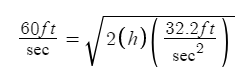
i got a question on an assignment and i forgot like everything about radical functions over the summer, heres the question
60ft/sec = sqrt( 2(?)(32.2ft/sec^2) ) | solve for the (?)
im not sure how to handle the 32.3ft/sec^2
inside the radical
this is the full question https://i.imgur.com/aIyPZCY.png

here is what i think the function is https://i.imgur.com/ZSgDFm0.png
 sage bronze
alpine sable
here is what i think the function is https://i.imgur.com/ZSgDFm0.png
sage bronze
alpine sable
here is what i think the function is https://i.imgur.com/ZSgDFm0.png
square both sides
solve for h
alpine sable
oh yeah thanks a lot, i forgot like all the simplifying stuff for math
sage bronze
alpine sable
oh yeah thanks a lot, i forgot like all the simplifying stuff for math
np
 zenith spruce
 ebon umbra
Oh
 slow haven
9^(3 + 9^333)
what is the last 2 digits of this
some nerd got this

however I got 29, simply because it seems all powers all 9, 9^x where x is 3 more than a multiple of 9, seem to end in 29
I now realise 81 is the correct answer
midnight sapphire

10+g(x)

1 fuck off
2 no
i need help with m e math not ur discord nitro shite
slow haven
(1 + x)(3 - x) + 12 i think
since it's just g of x but with 10 added after
you could expand it to make it simpler

 glass lichen
Yes
 vernal cosmos
Yes
 humble tinsel
thank you
 serene linden
Hi everyone, I was studying a maths course when I came across this section which detailed Addition and Multiplication on the vector space R2.
The first operation, addition, looks like vector addition
However, the second, I have never seen before.
I was wondering if anyone could help enlighten me.
 ionic jewel
idk if there's a name but they are just defining an operator
their "multiplication" operator does what it says it does
it's probably gonna ask to prove that's a vector space or something
serene linden
Right,if I am not mistaken, the second one looks like it's asking to multiply 2 vectors . From recent memory, multiplying two vectors are usually either vector or dot product . So when this turned up, I was super confused.
 reef urchin
it's called a binary operation if it doesn't define what the operator is
ionic jewel
it's a newly defined operator, yeah binary operation
they are arbitrarily telling you what to do if you see v_1 • v_2
reef urchin
what topic is this? looks like advanced algebra
serene linden
Undergraduate Maths
I think it could be classified under abstract algebra?
Has to do with fields and groups. This photo came from a section called complex numbers, specifically where they are building the complex numbers from group and field axioms.
reef urchin
ah yes, it's algebra then, and R2 is a set where the elements in your case, are (x1, y1), (x2, y2), and the elements x1,x2,y1,y2 are elements in R. hope this makes sense!
tropic sail
how would I calculate the length of the function cosh(x) from a different x points?
specificly these 2 marked points

 jolly stone
tropic sail
how would I calculate the length of the function cosh(x) from a different x poin...
jolly stone
tropic sail
how would I calculate the length of the function cosh(x) from a different x poin...
you mean the arc length right? there is an arc length formula integral sqrt(1+f'(x)) dx from point A to point B
so your function will be integral sqrt(1+sinh^2(x)) dx from x=-10 to x=10
,w integral sqrt(1+sinh^2(x)) dx
ocean sealBOT

 Requested by samuraiwarmsakuraba#8817
serene linden
reef urchin
ah yes, it's algebra then, and R2 is a set where the elements in your case, are ...
Requested by samuraiwarmsakuraba#8817
serene linden
reef urchin
ah yes, it's algebra then, and R2 is a set where the elements in your case, are ...
Yup, it makes sense. Although, my main confusion came from seeing two elements in R2 being multiplied together to produce another coordinate.
To the best of my knowledge, R2 is a vector space. It's home to all the coordinates on the normal x and y axis.
These coordinates can be treated as vectors.
The vectors can be added in this fashion which is similar to the first
statement in the first picture I posted.

However, I have never seen two vectors which can be multiplied together give another vector, besides vector product, but those usually use 3D vectors and return 1x3 vectors (3D coordinates).
 prisma dove
ionic jewel
their "multiplication" operator does what it says it does
prisma dove
ionic jewel
their "multiplication" operator does what it says it does
That's multiplication of C
tropic sail
jolly stone
you mean the arc length right? there is an arc length formula integral sqrt(1+f'...
This

I didn't expect it to be so big...
ocean sealBOT
 Requested by samuraiwarmsakuraba#8817
 ionic jewel
prisma dove
That's multiplication of C <:stare:826920038623346729>
ionic jewel
prisma dove
That's multiplication of C <:stare:826920038623346729>
sure enough, their R^2 is really just budget C
jolly stone
hmm why does it look like that
prisma dove
 jolly stone
oh it has to be sqrt(1+(f'(x))^2)
prisma dove
prisma dove
@serene linden that's from John Conway's functions of one complex variable
jolly stone
tropic sail
This
wait it is that
prisma dove
That's one of the many ways to define the field of complex numbers
tropic sail
jolly stone
wait it is that
Is the integral a difficult one?
cause it says undefined...
jolly stone
,w tanh(10)|cosh(-10)|-tanh(-10)|cosh(-10)|
ocean sealBOT
 Requested by samuraiwarmsakuraba#8817
serene linden
prisma dove
<@!374234103941300225> that's from John Conway's functions of one complex variab...
Requested by samuraiwarmsakuraba#8817
serene linden
prisma dove
<@!374234103941300225> that's from John Conway's functions of one complex variab...
Oh, so does that mean that these two operations are specific to complex numbers only? Sort of like properties?
jolly stone
oh i see, you have a
prisma dove
serene linden
Oh, so does that mean that these two operations are specific to complex numbers ...
What do you by ''specify'' in this case?
Yeah so
R^2 endowed with this product + vector addition of R^2 makes it a field
and in fact
tropic sail
jolly stone
oh i see, you have `a`
ah yes. good spot! i forgot about that
prisma dove
if you mean ''specify'' in the sense that this field is now isomorphic to the algebraic closure of R
Then yeah
serene linden
I have just never seen two R2 coordinates get multiplied to give another coordinate in R2 in this way before so it was kind of confusing
prisma dove
yeah so, this multiplication really defines C
prisma dove
serene linden
I have just never seen two R2 coordinates get multiplied to give another coordin...
Oh
This comes out intuitively
So
You already know that the field of complex numbers
Is really just adjoing to the real numbers
an element called i
such that i^2 = -1, right?
And with this
We can usual algebraic manipulations such that this forms a field
Now
Let's do the following
serene linden
prisma dove
This comes out intuitively
Sorry to interrupt, but this photo taken from further down the notes, is more familiar to me, especially the multiplication bit. Perhaps this has something to do with the previous photo, just that I can't see the connection?
 prisma dove
Given $x_{1}+y_{1}i$ and $x_{2} + y_{2}i$ both in $\mathbb{C}$, we know that $(x_{1}+y_{1}i)(x_{2}+y_{2}i) = x_{1}x_{2} + x_{1}y_{2}i + y_{2}x_{1}i + y_{2}y_{1}i^{2} = (x_{1}x_{2}-y_{1}y_{2}) + (x_{1}y_{2}+y_{1}x_{2}) i $
\
\
If we interpret the imaginary part as the second coordinate, we get that
$$(x_{1},x_{2}) \cdot (y_{1}, y_{2}) = (x_{1}x_{2}-y_{1}y_{2}, x_{1}y_{2}+y_{1}x_{2})
$$
ocean sealBOT
MisterSystem
 prisma dove
Can you see it now?
prisma dove
You have seen
when you learned about complex numbers
Did your teacher talked about polar form?
And how complex numbers can be identified with points in the plane?
serene linden
prisma dove
Did your teacher talked about polar form?
Is that the same as polar coordinates, basically representing real coordinates (x,y) as (r, theta)?
serene linden
prisma dove
And how complex numbers can be identified with points in the plane?
Yup, imaginary axis replaces y axis.
prisma dove
serene linden
Is that the same as polar coordinates, basically representing real coordinates (...
yeah
prisma dove
serene linden
Yup, imaginary axis replaces y axis.
exactly
serene linden
I see the connection between your explanation and the imaginary axis, and I am guessing that this image is a more formal way to define the imaginary axis. However, how does it connect to polar coordinates?
 prisma dove
I just mentioned polar form
Because I think people recognize this geometrical interpretation of the complex numbers
More easily
When talking about polar form
But ofc, this is connected to the polar form.

This lecture is part of an online undergraduate course on complex analysis.
We review the basic arithmetic of complex numbers, and given some applications to some problems in number theory related to sums of two squares. At the end we briefly cover the quaternions.
For the other lectures in the course see https://www.youtube.com/playlist?list...
This video is really good
It introduces C at the beginning
Using this construction
give it a check if you get interested
serene linden
Got it. Thank you for helping me clear up the confusion and for the references/resources. 🙂
prisma dove
Np 😄
 remote heron
try drawing a picture maybe?
lmc

so just from the picture and idk if this helps
but you can get uhh
oh im not gonna type that
nah theyre not trivial usually
well they are and they arent
but you do have to keep trying stuff
lemme try scribblin
oh, nice
prisma dove
$P(A \cup B) = P(A) + P(B) - P(A \cap B)$. But $P(A \cap B) = P(A) \cdot P(B)$ since they are independent events.
\
\
Now use the fact that $P(A) = 1 - P(A^{c})$ to conclude that $P(A) = \dfrac{2}{3}$
ocean sealBOT
MisterSystem
 prisma dove
Can you continue from here?
 wary stream
There is a mathematical approach that mistersystem stated and that was exactly what I did
prisma dove
prisma dove
Can you continue from here?
All you have to do now is find P(B)
Which you should be able to do since you know P(A \cap B) = P(A) P(B)
nice
 unkempt hatch
is there a mistake in this?

the answer integrates 2 and the -8/sqrt(3x+4) terms independently. so the du occurs only on the -8 term
but why do i get a different answer if i consider both the terms together
 mild tartan
oh..
wary stream
unkempt hatch
but why do i get a different answer if i consider both the terms together
What do you exactly mean by this part?
unkempt hatch
the answer kinda does this way. splitting the integral for both terms
 unkempt hatch
is there a mistake in this?
unkempt hatch
unkempt hatch
is there a mistake in this?
i am considering them together and then solving
 robust phoenix
well hello there
unkempt hatch
hi

 maiden holly
What if x=0 
unkempt hatch
robust phoenix
is that true ?
this channel is already occupied by me. please take another channel
shrewd prism
robust phoenix
is that true ?
i don't think so but I'm dumb so
robust phoenix
unkempt hatch
this channel is already occupied by me. please take another channel
Alright i thought you finished
shrewd prism
just replace x with a number and find out
robust phoenix
It actually is true
unkempt hatch
robust phoenix
Alright i thought you finished
not yet
unkempt hatch
thanks
unkempt hatch
have a good day too!
unkempt hatch
unkempt hatch
is there a mistake in this?
can anyone point the mistake in this approach?
 distant horizon
unkempt hatch
is there a mistake in this?
distant horizon
unkempt hatch
is there a mistake in this?
u need to sub in the x values again
so it would be 2/3 (3x+4) - 16sqrt(3x+4)/3
unkempt hatch
but the answer is 2x - 16sqrt(3x+4)/3 + c
distant horizon
unkempt hatch
but the answer is 2x - 16sqrt(3x+4)/3 + c
you can split the integral
and first part is 2x and you can use u sub for the rest
unkempt hatch
but why does not splitting the integral result in a completely different answer?
unkempt hatch
distant horizon
so it would be 2/3 (3x+4) - 16sqrt(3x+4)/3
u couldn't get this answer right?
 simple hamlet
robust phoenix
is that true ?
simple hamlet
robust phoenix
is that true ?
yeah true
simple hamlet
maiden holly
What if x=0 <:opencry:586078614865444865>
x should not be equal to 0 loul
unkempt hatch
unkempt hatch
is there a mistake in this?
<@&286206848099549185>
alpine sable
robust phoenix
is that true ?
x gets cancelled, so it's 4/1 now. So it's practically true
unkempt hatch
how does that apply here?
however, by this logic, collectively doing it must lead to the correct answer (which is not the case here)
oh ok. but my q is why does collectively doing it lead to the wrong answer?
however i think i have definitely seen cases where my approach works correctly (just not in this case)
take another channel
there is ongoing discussion
hmm ig
yeah
just remembered i had called helpers earlier. helpers, forgive me lol
vestal hollow
Can removable discontinuities still form vertical asymptotes?
Let h(x) = f(x)/g(x), where f and g are polynomials. There are three zeros of g, one of which is a zero of f, but if we factor f and g, we can cancel this common zero. So if we remove the common zero then our number of vertical asymptotes should just be 2 right?
Let me try it in Desmos
Ah yeah it seems you're right
gray isle
@unkempt hatch can you repost your question and issue you're having
unkempt hatch
sure
gray isle
It doesn't really matter if you split the integral here
unkempt hatch
basically, my q is what's the mistake here?
 unkempt hatch
gray isle
It doesn't really matter if you split the integral here
unkempt hatch
gray isle
It doesn't really matter if you split the integral here
but it's leading me to a diff ans
gray isle
you forgot the +C and where's the rest of your work
unkempt hatch
wdym by the rest of my work
gray isle
well the original integral is in x
your current result is in u
your final result should be in x
unkempt hatch
u just substitute u as 3x+4 right?
unkempt hatch
distant horizon
so it would be 2/3 (3x+4) - 16sqrt(3x+4)/3
basically this
gray isle
don't forget about the constant of integration
alpine sable
hello
unkempt hatch
ohk, even with adding c my answer is not correct
gray isle
note that 2/3 (3x+4) can be expanded
and the sum of constants is just another constant
unkempt hatch
ahhhh ok. so when i expand and get +8, it just morphs into +c (in the case of the correct answer: 2x - 16sqrt(3x+4)/3 + c)?
unkempt hatch
please take another channel. this is occupied
gray isle
yeh pretty much. you should reach the same result.
alpine sable
Is this channel occupied?
Cool
What is unique factorization Theorem and product notation
M2.3
I know all of it but that just sound weird
Is that the factor^2 (or the number the factor repeated)

What is that
I have never seen this sign before
And How exactly can i use this without a calculator
Yeah
This is a specification for exam without a calculator

Can you please tell me what 2n say and why n=1 and why 10
And what to do if there is somthing on the left
Like 4-
Or -2
placid zinc
You're multiplying 10 different numbers, and they follow the pattern of 2n, when you plug n = 1,2,3...9,10
alpine sable
So the 10 is 10 numbers, 2n is how I progress which is multiply the previous number plus 2 and n=1 is the start point ?
Alright
So what's the upper bound ?omg I feel so stupid
Is it upper and lower bound
reef urchin
alpine sable
so for this question, u start from n=1 and u stop at when n=10
alpine sable
reef urchin
so for this question, u start from n=1 and u stop at when n=10
Yeah I understand that but lil is saying somthing different I think
alpine sable
alpine sable
So the 10 is 10 numbers, 2n is how I progress which is multiply the previous num...
I said there 10 are 10 number where you multiply
So what are you trying to say
What's upper bounds
No
It is the sum of numbers
It is the sum of numbers you multiply
gray isle
why are you using the word sum here
gray isle
The word is product
reef urchin
if the lower bound n=5, and the upper bound is 10, you’d start at n=5 to n=10

 gray isle
-2 is being multiplied to the whole thing
alpine sable
But how can I get the pattern here

The next one will be 3×what ?
9?
Guys?
Sorry
Why we added 1
The first one would be 3×3-1 you made the second one 3×4-1
reef urchin
so we’d go from x=3 to x=4 to x=5 ... until u get to x=7
alpine sable
reef urchin
so we’d go from x=3 to x=4 to x=5 ... until u get to x=7
Why ? How did you know that
He didn't say n+1
gray isle
by definition of the notation
alpine sable
Who said x should increase by 1 every time why not two
alpine sable
gray isle
by definition of the notation
What definition
What property why you assume I know that
gray isle
have you done stuff with summation or sigma notation before?
alpine sable
gray isle
have you done stuff with summation or sigma notation before?
No
I don't remember
Where can I get the basics I need
gray isle
look up summation notation for the bare basics of this type of notation
alpine sable
Wait a minute I only saw the sum sign in A level biology
Nah I finished it with A*
No just the biology
You can take it as one year
No you can choose
It's A level as and a2
A2
Yeah
You can do it in one year
 red phoenix
A level maths doesn’t do the sun sign
Only further maths
Apart from statistics tho
For maths statistics is part of it
Which kinda sucks
I suppose, but the a level module makes you memorise the damn sampling techniques
 desert moon
how do you choose which one will be -lambda and which one will be +lambda?

in the 2 ode that you make, one will have positive coeff, the other will have -ve coeff
so one sol will have sine cos, and the other sinh cosh
alpine sable
gray isle
look up summation notation for the bare basics of this type of notation
Do you have any articles you suggest or videos
gray isle
Khan for basics
Prof Leonard for more depth
fervent anchor
desert moon
so one sol will have sine cos, and the other sinh cosh
Yes
Partial DE
 dark talon
alpine sable
gray isle
Khan for basics
Prof Leonard for more depth
dark talon
alpine sable
gray isle
Khan for basics
Prof Leonard for more depth
Alright thank you
Ummm youtube is so confusing
alpine sable
gray isle
Khan for basics
Prof Leonard for more depth
Do you have any part of a text book that explain it
gray isle
the explaination/notation should be pretty simple
still not sure what your issue is with understanding it
alpine sable
I just want to be academically aware of details
Videos on YouTube don't even mention the terminology
gray isle
what videos are you watching
alpine sable
I finished the khan academy 3 min video and now watching the organic chemistry tutor
They look like explaining it just for fun not for exams
gray isle
How would expect the explaination for exams to be different?
Org Chem is pretty good too
alpine sable
Like in text books contain the slightest details and the people who wrote are expert in exams so they know hoe to portray it from the beginning with suitable terminology to the academical level needed for exams
We all know youtube is just an extra thing it can't be the main
 solar pebble
red phoenix
A level maths doesn’t do the sun sign
solar pebble
red phoenix
A level maths doesn’t do the sun sign
what's the sun sign?
solar pebble
@alpine sable British Mathematics Syllabus is an absolute pisstake
red phoenix
🌞
solar pebble
Sigma does not look like the sun 
alpine sable
solar pebble
Sigma does not look like the sun <:thinkies:827642567775748163>
Yeah so it's signa
gray isle
if you're not satisfied with what YouTube provides, do you have a textbook with such explainations?
alpine sable
No I am asking you if you know any
gray isle
generic math textbook or #book-recommendations
but it really feels like you're trying to overcomplicate things
alpine sable
alpine sable
It's in M2.3
I need to know concepts and vocabulary of product notation and unique prime factorisation
gray isle
and like I mentioned, product notation shouldnt be that hard to grasp
$\prod_{n=1}^{4} n$
ocean sealBOT
ℝamonov
 gray isle
e.g the above would represent
1 * 2 * 3 * 4
alpine sable
So product notation is like sigma notation but *
gray isle
yes
 alpine sable
8^7 ?
red phoenix
Yes
alpine sable
My calculator has no product notation
WHy did he add 0x?

This channel is occupied
As you see
SO i dont udrestand from where this 0x are gotten
gray isle
simplify by hand
alpine sable
So what about unique prime factorisation
alpine sable
What does it mean
gray isle
expressing integers as a product of primes
alpine sable
Yeah we need the unique way of it
gray isle
e.g 6 is the product of the primes 2 and 3
hence its unique prime factorisation is 2 * 3
alpine sable
That's just the prime factorisation and I know I
It
What is the unique prime factorisation
gray isle
The prime factorisation is inherently unique
unique is an unnecessary word being added on
alpine sable
But in M2.3 it said prime factorisation once and another time unique prime factorisation Theorem
Use the concepts and vocabulary of prime numbers, factors (divisors), multiples, common
factors, common multiples, highest common factor, lowest common multiple, and prime
factorisation (including use of product notation and the unique factorisation theorem)
gray isle
well the unique prime factorisation theorem just states that the prime factotisation is unique
alpine sable
Why is it in unique please involve concepts and vocabulary
gray isle
unique as in there is only one
there is only one prime factotisation for each integer greater than 1
alpine sable
I looked it up and that's really disappointing
It's not unique
What next?

-x/xˇ3 = xˇ-2
correct?
It is not root))
gray isle
not sure what you mean
they introduced all those terms with 0 to keep terms aligned and so that you don't make mistakes like what you just did
in fact I don't even know what you did
$ax^m - bx^n \neq (a-b)x^{(m-n)}$
ocean sealBOT
ℝamonov

 gray isle
yes
alpine sable
Why he keeps those
gray isle
note how in their work all their terms align nicely
so when they're doing subtraction, they're actually subtracting like terms
gray isle
well depending on your divisor, you may not know if they're needed.
but in general you should do it anyway
alpine sable
So, when he subtracted first 0x with power term, the others delete after that?
 gray isle
uh huh...and?
alpine sable
So, when he subtracted first 0x with power term, the others delete after that?


 gray isle
wdym by others 0x
alpine sable
what is wdym?
gray isle
wdym means what do you mean
alpine sable
0x are the terms he added to ease this problem
so i asked
Whe he did 0xˇ3 -3xˇ3
Others are romved after that_
?
gray isle
you were being unclear by not writing the power
gaps are implied to be 0
the terms are already in the first row to indicate the powers of each column so it is unnecessary to write them out every single time
the main purpose of writing them at the start was to keep everything aligned
gray isle
where is what needed?
gray isle
It's quite common in math courses
gray isle
multiply by pi/180°
alpine sable
yeah but can u tell me why it's like that
because of the unit circle?
and I also need the formula for vice versa
2pi because of the circumference of the unit circle and there is also 360 degrees there
pi means half the circle, which is also 180 degrees. 1 degree is therefore pi/180
180 pieces of pi makes a pi
180 degrees make a pi u mean?
but i don't understand the formula tho