#help-0
1 messages · Page 772 of 1
 alpine sable
ye
alpine sable
ye
 wary stream
You should just read into factors of integers
alpine sable
ok
 median osprey
Hi
alpine sable
hi
median osprey
can someone please help me to rearrange this equation

i want Cp0 to be the subject
and its not working out with me
wary stream
median osprey
This is horribly typed
median osprey
what do you mean
wary stream
median osprey
and its not working out with me
What did you try?
Is that supposed to be $Cp^{0}$? Or $Cp_{0}$?
 ocean sealBOT
dldh06
 median osprey

 vivid anvil
oh
median osprey
i did this but its not working out
vivid anvil
So it's a subscript?
median osprey
but i keep getting it wrong
wary stream
You made Cp0 the subject
 rich basin
How would you do a limit question forexample
when x -> 0
for something like 2/x
what would it be
median osprey
thank you
rich basin
sorry for this really easy question
 warped phoenix
ohhh right mb, tyy
 thorn hound
<@&268886789983436800> can i get screen share so i can stream math
 dreamy cedar
Role added
alpine sable

need help im legit just confused

I have a question
Is that from IXL
Pain if it is
IXL is pain
ixl?? idk what that is this is on webwork
Oh cool
ixl is a math practise site
Like webwork you could say
ahh cool
Anyways I remember something like that question from kumon
Of course that was a while ago
 vagrant vault
IXL learning? Does it have English Science and Math sections? I think I may know what application your referring too
If not nvm
alpine sable
alpine sable
need help im legit just confused
for y = 5, find the value of c given that the curves intersect
 hollow swift
alpine sable
for y = 5, find the value of c given that the curves intersect
hollow swift
alpine sable
for y = 5, find the value of c given that the curves intersect
I want to know how to solve it too
alpine sable
i need some more explanation idk
well here's a graph with an arbitrary value of c

you want your function to be continuous, so you'd want to choose c such that they "intersect" (they dont really of course) at y=5 (or here x)
oh i see i see
 alpine sable
F(4) is constant so its derivative wrt x is 0
 tall wing
 stiff echo

 thorn kindle
h=f(g(x))
 soft belfry
Mathematically
 opal wing
alpine sable
F(4) is constant so its derivative wrt x is 0
opal wing
alpine sable
F(4) is constant so its derivative wrt x is 0
I figured that out after I asked haha, thank you however for the reply!
 snow ravine

 bold tinsel

 dark granite
@alpine sable , @vale wigeon , and @alpine sable . In case this helps...you can count the answer to this combinatorially by counting the complement via the Principle of Inclusion and Exclusion and subtracting from the total. The total would be 4^3 since we're essentially finding the number of functions from {x_3, x_4, x_5} to {y_1, y_2, y_3, y_4}. Now we count the complement. So consider y_3 or y_4 isn't mapped to. Then we note that if y_4 isn't mapped to, we have 3^3 since that's the number of functions from {x_3, x_4, x_5} to {y_1, y_2, y_4}...similar can be said for y_3 not being mapped to. But then we realize we've overcounted the complement since it could've been that y_3 AND y_4 wasn't mapped to. When y_3 and y_4 isn't mapped to, we have 2^3 since that's the number of functions from {x_3, x_4, x_5} to {y_1, y_2}. Thus the answer is given by the following expression.
ocean sealBOT
logician
 dark granite
that^ is the value of n
opal wing

I am not sure what I did wrong here, I need to find the area of thay section
I got -60 but since it is above the X-axis, I thought it would be 60 but was wrong
<@&286206848099549185>
alpine sable
 eternal spindle
do you have the answer to this
 rigid smelt
opal wing
I got -60 but since it is above the X-axis, I thought it would be 60 but was wro...
rigid smelt
opal wing
I got -60 but since it is above the X-axis, I thought it would be 60 but was wro...
your integral was not set up properly
notice that relative to the y-axis, x=y^2-5y+20 is under the line x=3y+8
and not the opposite
so the integrand should be 3y-8 - (y^2-5y+20)
also channel seems occupied, you should move (referring to fwa)
 proven briar
sorry!
rigid smelt
np 👍
 opal wing
rigid smelt
notice that relative to the y-axis, x=y^2-5y+20 is under the line x=3y+8
opal wing
rigid smelt
notice that relative to the y-axis, x=y^2-5y+20 is under the line x=3y+8
Would you be able to show this on paper? I am not accustomed to Y variable of the acis
alpine sable

the line stays above the parabola relative to the y axis
so your order of subtraction is off
hi i need help
dark granite
alpine sable
hi i need help
hi i need sleep
in all seriousness tho, ask your question and explain what you've done to attempt to answer your question
alpine sable
If the weight of 12 sheets of thick paper is 40 grams, how many sheets of the same paper would weigh 2500 grams?
i havent done anything
dark granite
okay
this is all about proportions
so how I'd solve this is via the following equation
solve for x
ocean sealBOT
logician


 opal wing
alpine sable
the line stays above the parabola relative to the y axis
opal wing
alpine sable
the line stays above the parabola relative to the y axis
Oh okay, so it is the same as the X-axis, just that I should rotate the graph?
Okay, I also have another question


I am starting to assume the total area is 0 since they are symmetrical and one is above the x axis and one is below
<@&286206848099549185>
 gray gorge
opal wing
I am starting to assume the total area is 0 since they are symmetrical and one i...
gray gorge
opal wing
I am starting to assume the total area is 0 since they are symmetrical and one i...
They're asking for the shaded area, and not the integral (sadly)
opal wing
gray gorge
They're asking for the shaded area, and not the integral (sadly)
I don't understand
Don't we find the area using the integral?
gray gorge
Integral means signed area, which is to say that anything below the x-axis is negative, potentially cancelling out anything above it
 quartz oxide
I think he tried getting the area and it returned incorrect
opal wing
I did, yes
I multiplied the 2.837 by 2 since they are symmetrical
Since I am finding the shaded area and not the signed area, wouldn't my math be correct for the second attempt @gray gorge ?
 placid zinc
CodeK
 night geyser
@long magnet do not spam questions channels.
placid zinc
opal wing
Oh okay, so it is the same as the X-axis, just that I should rotate the graph?
The picture of the graph is misleading - the area will be very large. 2.837 is wrong. It's hard to see what you are doing, what techniques are you using for the integral?
opal wing
placid zinc
The picture of the graph is misleading - the area will be very large. 2.837 is w...
Well, that was my second attempt. For my second attempt, I kept both functions separated and took the integral of both separately. In my first attempt, O combined the 2 functions when looking for intersections and integrated just one function and I got a very high number there
placid zinc
So you used u-sub or ibp?
 ocean sealBOT

 whole sluice
pls help solve question 5.i
Yess!
transpose 3 and 2 on the other side
We will take both 3 and 2 and put it on the other side of the equals to sign and change the signs of 2 and 3 from division to multiplication.
yes
3 & 2 with 1 + 2y and 3 with y - 1
yes
How?
yes
wait are you telling that we are multiplying the whole equation with 6?
and why
yes
i got a solution can i show you

 vale wigeon
you are missing a ton of parentheses here.
and also something went horribly wrong with the multiplication itself.
whole sluice
in that y-1 portion i was about to tell
vale wigeon
what exactly did you attempt to do there as your first step?
multiply both sides by 6?
whole sluice
pls wait a bit
vale wigeon
...okay
then say whatever else you were going to say.
@whole sluice i'm waiting lol
whole sluice
thanks for waiting a "bit"
vale wigeon
i don't know how long "a bit" is supposed to be
 hoary citrus
Kekw
vale wigeon
and you didn't say anything about what you were doing exactly
were you redoing the problem from scratch? were you trying to continue from the work you presented? you said nothing about that, so i had no way of knowing.
 warped jay

 sleek elbow
warped jay
sleek elbow
warped jay
 fair slate
warped jay
fair slate
warped jay
What are u stuck on or confused by?
 glass hare

I do not know if this is correct
The question is to symbolize the statement using quantifiers, predicates, and logical connectives
glass hare
<@&286206848099549185>
 vital pine
what method am I supposed to use for this
 alpine sable
looks like the change of base formula might help.
vital pine
can I not use partial fraction?
alpine sable
you don't have a polynomial at this moment, so no.
vital pine
it is a polynomial tho
alpine sable
in the numerator, i mean.
vital pine
yeah ex, e square x and e cube x
alpine sable
sure but it's in the base, so unless you simplify it into ax^n for natural n's, it's not a polynomial.
vital pine
yeah so I can write dx / xlogex.loge square x. log e cube x right?
so it won't be in the base anymore
alpine sable
not sure what this means, try using log_a for the base a in plain text
vital pine
alpine sable
not sure what this means, try using log_a for the base a in plain text
basically what I'm saying is iwhatever is in numerator can be taken in the denominator other than dx, so that it can be converted into a polynomial without the bases
alpine sable
but yeah you can use $\log_b(a)=\frac{1}{\log_a(b)}$ into here
ocean sealBOT
Al𝟛dium
 alpine sable
vital pine
basically what I'm saying is iwhatever is in numerator can be taken in the denom...
alpine sable
vital pine
basically what I'm saying is iwhatever is in numerator can be taken in the denom...
yes, all i said it's that it wasn't a polynomial what you had at that moment, not that you couldn't simplify it into one
vital pine
alpine sable
yes, all i said it's that it wasn't a polynomial what you had *at that moment*, ...
ah ok thanks!
now that it's a polynomial I can use partial fraction and do it yeahM
?*
eternal spindle
@alpine sable thanks man how did I miss that lol
 floral imp
having trouble on approaching how to solve this problem
you are given 5 numbers on a consecutive range from 15 to 19
how would you choose them such that the sum of all choices you make are 100
find longest and shortest solution
you can make a choice on a number you already chose before
alpine sable
look, what you have is $\int\frac{1}{x\ln(ex)\ln(ex²)\ln(ex³)}\dd x$ and by using the log laws $\int\frac{1}{x(1+\ln(x))(1+2\ln(x))(1+3\ln(x))}\dd x$
@vital pine
ocean sealBOT
Al𝟛dium
 floral imp
i'm sorry for invading
alpine sable
this channel is occupied, please read #❓how-to-get-help @deep scroll .
 deep scroll
Uh ok
vital pine
ocean seal
**Al𝟛dium**
yeah i got that thanks!
alpine sable
do you know how to continue from here?
vital pine

this is the solution I git
got*
thanks for your help! @alpine sable I was going nuts tryanna solve this since yesterday
glass hare
The question is to symbolize it by using quantifiers, predicates, and logical connectives.

Can someone help?
alpine sable
vital pine
thanks for your help! <@456226577798135808> I was going nuts tryanna solve this ...
yw.
 vague coral
what's the problem ? @glass hare
glass hare
glass hare
The question is to symbolize it by using quantifiers, predicates, and logical co...
Symbolize the statement
the statement Some Triangles are Scalene
Im not sure if my answer is correct
 prime badge
I'd guess you need "in"
glass hare
in?
prime badge
like set membership, but that doesn't sound right
I don't know, do you have a similar example where you know the answer?
glass hare
 prime badge
aha
no I think you got it right
unless you assume x is predicate it's the only option
 harsh cargo

hi uh can someone help please
its study for an exam and i don't know how to do it
like at all
placid zinc
Have you set up the differential equation?
harsh cargo
but
placid zinc
Remember that acceleration is dv/dt
placid zinc
So the particle is fully described by:
harsh cargo
but velocity is just v
placid zinc
dv/dt = k(4 - v^2)
placid zinc
Yes, I suppose both sides are a way to represent the acceleration
How much differential equations do you know? This is an example of one.
In that the derivative of v is equal to a function of v itself
harsh cargo
ok
that kinda does make sense
but i still don't understand

the answers
say this
i know why they use half
cause you need v not 2v
placid zinc
I am not understanding it haha. wtf is x here? What does d(1/2 v^2)/dx get?
harsh cargo
wait i kinda get it
ok ok
idk why tf x is there
which is v stupid
but anywaysssssss
they're using 1/2 because
when u differentiate v^2
it becomes 2v
so they half it
placid zinc
Right. So the left becomes v(dv/dx)
placid zinc
Oh kek. I forgor that v(dv/dx) = a
Where x is indeed displacement
So all is good, the left side is indeed a
placid zinc
And v^2 = 4 + Ae^(-2kx) does indeed fit the condition in the question
harsh cargo
yeaaa i get thatttt
placid zinc
Sorry I'm not great with dms. Feel free to ping though
harsh cargo
oohhhh
okkkk
das okkk
are you
any good
w vectors
by chance
i'm struggling with those too
placid zinc
Ye
harsh cargo

i never understood vectors tbh
sooo
uhhh
yea
does vector L's tail at point L?
or is the arrow there
 harsh cargo
placid zinc
I have the best paint skills.
harsh cargo
placid zinc
I have the best paint skills.
period.
placid zinc
Green represents vector b.
Red represents vector c.
It's ideal to generally think of all vectors as coming from the origin
You might then wonder why I drew grey as not coming from the origin
harsh cargo
ohhh so the vector is classified by the point the arrow is at
but grey
is the resultant
vector
right?
placid zinc
Very nice you know where I'm going with this
Specifically, you get this equation:
Red + Grey = Green
placid zinc
Rearranging that, and putting labels:
Grey = b - c
placid zinc
Now, I want to go up to point C,
Then go only half-way to point B.
Which I can do with:
C + Grey/2
That gets me L. With me on that one?
placid zinc
Of course, I have a better label for grey:
L = c + Grey/2
L = c + (b - c)/2
L = (b + c)/2
So, it's neat to find that the midpoint of B and C is given by the average of b and c
alpine sable
hey guys i just finished my math exam and i have a lil question
placid zinc
Just generally handy to draw and label all of the arrows you'll need, all of then either start at the origin or at other vectors
Then write any loops you have as an eqaution
alpine sable
a rectangular wire of length and breadth 7 cm and 9 cm respectively is made into a square so what is the side of the square
i have written square root 63 because side of square is square rooted area is this correct?
placid zinc
What is the breadth of a wire? haha
 rigid wind
yeah root 63 sounds right
alpine sable
yes but 2(l+b) = 2(9+7) = 16*2 = 32 and a square as 4 sides so 32/4 = 8. sooo are both right coz in what i wrote its root 63 but in the second one its root 64
 slow inlet
Yes
rigid wind
oh yeah
alpine sable
is what i wrote correct
 fringe turret
guys whats 1+1
 errant tangle
2
 icy trail
10
 light sleet
Alright so Im doin this problem right? and the angle for c is clearly 45 degrees, but it doesnt show the degrees for B. Since it's a right angle I thought "hmm it's clearly 90 degrees plus 45 degrees (which equals 45) then 180 - 45 (which equals 135) and the answer I submitted was wrong. Why?
 light sleet
wait-
OHHHHH
Oh my gosh I'm stupid, I completely missed that
thanks for pointing that out
 shell widget
np
alpine sable
i need help

 cloud mirage
a
light sleet
now this angle i don't understand, what is this

i just need to know the degrees on the angle for A I'll do the rest
alpine sable
90 degrees
look at the angle
its a kind of squarey instead of the normal curve when showing an angle
means its 90 degrees
soo
light sleet
so: 180 - 90 - 34.. right?
alpine sable
both are right
alpine sable
its 56
light sleet
hm, I must've did something wrong
alpine sable
180-90 = 90 ...... 90 - 30 = 60 ....... 60 - 4 = 56 ................basic math dude

 alpine sable
u mean x
 unique fjord
?
unique fjord
alpine sable
u mean x
if im right the value of x is just 1
alpine sable
x^2 = 0+255 .............. x^2 = 255.................. x= square root of 255 = 15.9
unique fjord
alpine sable
x^2 = 0+255 .............. x^2 = 255.................. x= square root of 255 = 1...
hm so u transposed it?
alpine sable
yup
rigid wind
225, in which case it's +-15
alpine sable
oh-
unique fjord
alpine sable
oh-
yea that was my answer (with the big help of itsjustnai) with completing the square thingy
alpine sable
yup
rigid wind
unique fjord
is it a=1 b=0 c=225
when it's simple as x^2 = a constant you don't bring quadratic formula with a,b,c in
just take +- root 225
unique fjord
i see
alpine sable
OH WAIT
unique fjord
huh-
alpine sable
ROOT OF 225 is 15 . sorry i read the 225 as 255
unique fjord
alpine sable
ROOT OF 225 is 15 . sorry i read the 225 as 255
its ok XDD
unique fjord
rigid wind
just take +- root 225
hm so technically my answer is just the same? x=15 and x=-15?
alpine sable
yea
unique fjord
cuz we had to answer the same thing but solve it byy completing the square
unique fjord
alpine sable
yea
i see
 alpine sable
do you know how to square root anyways just askin
unique fjord
yep
alpine sable
cool
 alpine sable
u can
 cinder mantle
ok ty
alpine sable
go ahead
cinder mantle
expanded (x+3)^2 is as its griz said (x+3)(x+3)
it will then look like
(x+3)(x+3) = 16
unique fjord
i see
rigid wind
there's an easier solution to expanding
cinder mantle
@unique fjord
unique fjord
cinder mantle
oh shi-
sorry
alpine sable
@unique fjord heres a hint distributive method
cinder mantle
nah its fine
rigid wind
again, square of something is a constant, you take root of that, so x+3 = +- 4
alpine sable
what a smart guys vee
unique fjord
rigid wind
again, square of something is a constant, you take root of that, so x+3 = +- 4
oh
o h
wait but isnt that completing square?
idk
alpine sable
umm @cinder mantle continue..
unique fjord
but like i cant even use the quadratic formula?
rigid wind
you can, a lot more work tho
unique fjord
rigid wind
you can, a lot more work tho
 cinder mantle
u expand it so it becomes (x^2+6x+9)=16
with expanding u do
(a+b)(a+b)
it will look like
a*a + a * b + b * a + b * b
ultiamtely resulting in a^2 +2ab+b^2
we can apply this to (x+3) ^2 where a=x b=3
hence the result (x+6x+9)
@unique fjord does this make sense
unique fjord
uh-
alpine sable
i have an easier method -
alpine sable
(x-3)^2 = 16
lol
(x-3)(x-3) = 16
so we will use the distributive formula in another way
so
x(x-3) - 3(x-3) = 16
wait guys
nothing
so then we will just use the normal distributive formula
2x-3x - 3x+9 = 16
5 x - 3x +9 = 16
2x+9 = 16
2x = 16-9
2x = 7
x = 7/1
7/2
i think
rigid wind
same method, but you made a mistake, x^2 not 2x
unique fjord
wait- my dad is explaining it to me at the same time as you-
cinder mantle
ahahahhahahah
cinder mantle
alpine sable
x(x-3) - 3(x-3) = 16
that is actually a really good way of explaining it
 woven shale
Anyone free to help
cinder mantle
what u got cuz
woven shale
my question is in 3
unique fjord
my dad just multiplied x+3 with x+3 in a grade 1 style like
. x+3
. x+3
. -----
. 3x+9
x^2+3x
=x^2+6x+9
unique fjord
and then transposed the 16 to the other side-
unique fjord
rigid wind
i think you should try the x+3 = +- 4 tho :p
i see
unique fjord
i like math but its just hard to memorize
its easy to understand, i just cant remember anything right after that
alpine sable
unique fjord
i like math but its just hard to memorize
thats where ur wrong dont memorize!
 glass lichen
moved the 16 to the other side would be better phrasing, transposed has an actual meaning
unique fjord
alpine sable
thats where ur wrong dont memorize!
oooh
wait so how then
internalize?
alpine sable
the thing about math is u dont need to memorize u need to remember
like u gtta remember that + changes to - after tranposing
and vice versa
 teal turtle
when you practice enough you naturally know how to do things
alpine sable
teal turtle
when you practice enough you naturally know how to do things
i agree with u

im lost
how does a score from b??
 rigid wind
row i column j is 1 if i connects to j
glass lichen
B goes to A, so the B row and the A column get a 1 where they meet
rigid wind
oh true
woven shale
alpine sable
anybody got any upto high school level questions
Are u available rn?
alpine sable
ye
woven shale
 alpine sable
you really gotta find that with a scietific calc
woven shale
I got one
woven shale
I need working out
woven shale
apparently its 3 root 2
alpine sable
yea i guess
 woven shale
yep
alpine sable
in college u get to use a scientific calc i think
 royal elm
when u say apparently, did you find out how to do it?
alpine sable
he got it from the internet therefore he has the ability to use apparently
royal elm
No i mean does he still need help with figuring it out?
alpine sable
do you @woven shale
woven shale
alpine sable
do you <@!499933760859406336>
yeah
whithout that table how do u get root 3 over 2
woven shale
?
cinder mantle
do u not use the unit circle?
woven shale
yea im pretty sure u gotta use the unit circle]
 left spear
If it asks for exact values don't use approximations
cinder mantle
i thinks its the unit circle
so first quad is theta=alpha where alpha is the related acute angle
2nd quad is alpha = 180˚-theta
3rd quad is alpha = 180˚+theta
4th quad is alpha = 360˚-therta
theta is the angle given in this case, 120
woven shale
yep
cinder mantle
and 120 falls in which quadrant?
woven shale
2nd
woven shale
yep
alpine sable
sin 60 degrees
woven shale
k
 cinder mantle
yw
 fringe robin
Consider a square with vertices at (1, 1), (-1, 1), (-1, -1) & (1, -1) Let S be the region consisting of all points inside the square which are nearer to the origin than to any edge Sketch the region S & find its area
How do i sketch this?
fringe robin
bruv
Let S be the region consisting of all points inside the square which are nearer to the origin than to any edge Sketch the region S & find its area
this part
glass lichen
Oh yeah, sorry I just woke up lol
fringe robin
Lmao np
glass lichen

Mathematics Stack Exchange
I'm hoping someone can confirm my solution to the following problem or perhaps provide better alternatives. Cheers.
A shape is defined by consisting of all the points closer to the center than the...
woven shale
<@&286206848099549185>
 fringe robin
woven shale
<@&286206848099549185>
fringe robin
woven shale
<@&286206848099549185>
Occupied 
fringe robin
glass lichen
https://math.stackexchange.com/questions/2515367/area-of-points-in-a-square-clos...
ill see thanks
cinder mantle
woven shale
<@&286206848099549185>
this is using the cosine rule
what is the cosine rule?
soz i didnt mean to ping helpers
mybad
woven shale
yep
cinder mantle
a and be are the two sides either side of them which is 8 and 7
chuck that all in the formula u get ur c^2
woven shale
Ok then root
cinder mantle
correct
woven shale
and answer
woven shale
Ty once again
cinder mantle
yw :)
fringe robin
fringe robin
Consider a square with vertices at (1, 1), (-1, 1), (-1, -1) & (1, -1) Let S be ...
?

 obsidian wagon
hey so here I don't understand how we multiplied cos(theta)sin(theta) with [cos(theta)/sin(theta). + sin(theta)/cos(theta)] to get cos^2(theta)+sin^2(theta)=1

is it because we multiple cos and sin both sides to give this?
rigid smelt
no, they just rewritten cot(x) and tan(x) in terms of sin(x) and cos(x), thats all
obsidian wagon
in regards to the final answer
i understand the cot and tan rewritten
what i dont understand is the ones in the bracket of second part :/
rigid smelt
which ones in the brackets?
obsidian wagon
 rigid smelt
cos(theta)/sin(theta) + sin(theta)/cos(theta)
then again
like i have said
they just rewrote cot(theta) and tan(theta) thats all
and then they expanded the thing
obsidian wagon
obsidian wagon
how did this give cos^2 theta + sin^2
rigid smelt
by expanding the brackets
notice that cos(theta)/sin(theta) cancels out with the sin(theta) in cos(theta)sin(theta)
equivalently for sin(theta)/cos(theta)
obsidian wagon
rigid smelt
notice that cos(theta)/sin(theta) cancels out with the sin(theta) in cos(theta)s...
ohh wait i see
but how does it square up if they both cancel out

*or expand to cos^2theta+sin^2theta=1
ocean sealBOT
waler
 rigid smelt
similarly for the second term
alpine sable
dark granite
<@456226577798135808> , <@!183668144404037632> , and <@456226577798135808> . In ...
FFFFF this makes a lot of sense, Thank you so much!!
rich basin

 magic warren
this cant be factorised right? a(b+c)-d(b+c)
 candid sluice
glass lichen
rich basin
candid sluice
glass lichen
rich basin
what info are you given?
rich basin
Just that
rich basin
no
glass lichen
Then you cant solve it
rich basin
just that question and i'm pretty sure the information relating to that would just be in like a data table you can search up
glass lichen
Yeah, so search up the density and bulk modulus of each material
then plug into the formula
rich basin
so what exactly is the formula?
glass lichen
$v=\sqrt{\frac{B}{\rho}}$
ocean sealBOT
Mosh
 glass lichen
for bulk B and density rho
rich basin
is there like a formula sheet where i can get like all the formulas for a certain topic?
 uneven sorrel
.
rich basin
Like it is just all over the place, and some of them I have no idea without a formula sheet
rich basin
Not google, but like a data sheet all
 alpine sable
Lol
rich basin
@glass lichen Wait how do you know the formulas of by heart?
glass lichen
Ask your prof about a formula sheet, or check the textbook
 urban gust
If there is a multivariable function which is not continuous at a point will its partial derivatives exist?
 ionic jewel
urban gust
If there is a multivariable function which is not continuous at a point will its...
ionic jewel
urban gust
If there is a multivariable function which is not continuous at a point will its...
partial derivatives don't imply continuity, but continuity does imply partial derivatives
glass lichen
if m+n is even, then m and n have the same parity
 restive hill
 glass lichen
even and odd
is the parity of the integer
yes
though m and n dont have to be the same number
 vernal dragon

i tried to substitute sint=u and then integrate why is that wrong?
in the correction they prefer i take into account the trigonometric rules
glass lichen
but yeah, m+n is even means either m and n are odd, or they are even. however if m and n are odd, mn is odd
so m and n need to be even
alpine sable
vernal dragon
did you change the upper and lower bounds
glass lichen
And did you account for the absolute value bars?
alpine sable
i got the answer as 1 i maybe wrong though
wait mb
I havent done integration in school yet so please check my answer
its coming

,r
,rotate
ocean sealBOT

 split oriole
Is that modulus?
glass lichen
abs value
 split oriole
ocean seal
split oriole
ocean seal
Multiply divide by 2 then make 2sinx cosx to sin2x , them split integral in postitive and negative part
vernal dragon
allahs goat this server is busy
woven shale
oh
glass lichen
vernal dragon
why do we need to change the interval when we change the trig identity
you dont
you change the bounds
vernal dragon
bounds?
glass lichen
however you havent done a sub there, so nothing changes
vernal dragon

they change the interval when they change the trig identities
do you agree with that statement?
@glass lichen
 gray isle
they skipped steps
vernal dragon
damn that makes sense
but i am still not getting the same resuly
resuly
result

this is how i did it
gray isle
you can't ditch the abs value bars
vernal dragon
oookey damn
gray isle
it may help to look at a graph of the function
vernal dragon
still when i integrate sin ( ) i get minus cos. the abs bar makes it plus cos. cos 2pi - cos 0 is still 0
gray isle
you can't really integrate over the absolute value like that
vernal dragon
 gray isle
$\int |f(x)| \dd{x} \neq \big|\int f(x) \dd{x}\big|$
vernal dragon
damn
ocean sealBOT
ℝamonov
 gray isle
it may help to look at a graph of the function
and consider what's happening geometrically

that is a graph of y = |sin(2x)| from 0 to 2pi
vernal dragon
 gray isle
what's ds
vernal dragon
gray isle
what's ds
ds is length
 gray isle
the period is 2 times shorther
wdym
alpine sable
 upbeat helm
It's not possible to find all the angles here right?
upbeat helm
It's not possible to find all the angles here right?
there are other channels
vernal dragon
gray isle
> the period is 2 times shorther
wdym
sin (2x) compared to sin x is has a shorter period
agree?
gray isle
yeh.
gray isle
do you have any issue accepting that the above graph is of what I said it is
alpine sable
May I ask why not do a u=sin t substitution?
gray isle
you still need to deal with the abs val bars in one way or another
vernal dragon
alpine sable
May I ask why not do a u=sin t substitution?
in the correction they are not prefering it but i tried it and got 0 as anwser and thats wrong
omg
i got it
because of the abs bar i to add when i normally should subtract
right?
gray isle
very bad wording
vernal dragon
can u attach where it is bad wording so i can rewrite
gray isle
because of the abs bar i to add when i normally should subtract
the whole thing is bad and unclear
and it may also seem in one interpretation you are still misunderstanding
vernal dragon

usually sin 2t looks like this

because of out abs bar it looks like your attachment

in my exercise they are asking me to determinate the area of the function, where the interval is t € (0,2pi)
alpine sable
im pretty stupid but why not break the intervals from 0 to pi to pi to 2pi
 alpine sable
vernal dragon
if u let me finsh i was going to say that i promise
alpine sable
vernal dragon
if u let me finsh i was going to say that i promise
sorry
vernal dragon
alpine sable
sorry
its all love brother
gray isle
it looks like you're still fudging it
gray isle
the worked solution is supposed to be a relatively clear way to solve it
you're making a crap ton of random arbitrary splitting and illegal sign adjustments
that i can't even begin to describe
vernal dragon
ok damn
vernal dragon
ok think i need to go back to basics but thanks for your help
gray isle
don't try and integrate over absolute values like that
it doesn't end well
going back, do you have any issue accepting that my graph is of what I said it is
 vernal dragon
i dont have any issue that your graph represent (sin (2x))
gray isle
are you familiar with the relation between the the definite integral and the signed area between a curve and the x-axis?
or what people refer to as the signed area under a curve
vernal dragon
i am not familiar with signed area under the curve
gray isle
what about just area under the curve
vernal dragon
i am familiar with area under the curve
gray isle
when calculating the area from the integral, stuff above the x-axis is counted as positive, under the x-axis is counted as negative
vernal dragon
i 100% agree with that statement
gray isle
e.g. if you were to integrate
y = -1 from x=0 to 1,
you'd get -1 which is the signed area
instead of 1 which would be the actual area
vernal dragon
yes i agree
gray isle
that's more or less the difference
anyway moving on
note that the period of |sin(2x)| is pi/2
as indicated from the graph above
vernal dragon
i agree that the half period is from t €(0,pi/2)
vernal dragon
are u telling the that from 0 to pi/2 its a whole period?
gray isle
the period of sin(x) is 2pi
the period of sin(2x) is pi
the period of |sin(2x)| is pi/2
vernal dragon
or should i forget the term
gray isle
because as indicated by the graph i made,
vernal dragon
i agree with that
gray isle
the graphed function |sin(2x)| repeats every pi/2
vernal dragon
yes
vernal dragon
agree
gray isle
so to calculate one of those regions you can integrate |sin(2x)| from x=0 to pi/2
gray isle
since you're considering 0 < x < pi/2, then 0 < 2x < pi
the sin of 2x will be positive and the absolute value bars can be removed now
only then should you actually do the integration
vernal dragon
gray isle
only then should you actually do the integration
thanks for your patience with me
 buoyant willow
Hey ho, don't need much help, just need to clarify a concept.
Usually functions like this start with a y in the beginning, but this time it's in the middle, do I still solve it the same way?

 ancient saddle
buoyant willow
Hey ho, don't need much help, just need to clarify a concept.
Usually functions...
ancient saddle
buoyant willow
Hey ho, don't need much help, just need to clarify a concept.
Usually functions...
Hello. Yes, it represents the same relation between x and y, it's just been rearranged
 vale gorge
Help: Find positive intergers a,b such that: (a+1)^2-4b and (a-1)^2-4(b-a+1) are square numbers.
buoyant willow
ancient saddle
Hello. Yes, it represents the same relation between x and y, it's just been rear...
Thank you!
 shell widget
@vital snow Use the formula for a straight line, y - y_1 = m(x - x_1) where (x_1,y_1) is a point on the line/a point the line goes through.
and m is the slope
 vital snow
then would i put it back into y=mx+b?
shell widget
no
vital snow
@shell widget
shell widget
They tell you that the line you want is parallel to y=mx+c so that you can know what the slope of your line will be
vital snow
the slope will be the same on the parallel line right?
shell widget
@vital snow The slope of the line required(which passes through the point (a,b)) will be same as the slope of the line y=mx+c
And that slope is "m"
vital snow
i don’t understand what point (a,b) is for
shell widget
Plug it in the equation y - y_1 = m(x - x_1)
This is the equation for a line with slope m and goes through point (x_1, y_1)
vital snow
so y-b=m(x-a)
shell widget
Yes
vital snow
and then isolate y?
shell widget
ok
shell widget
?
vital snow
perpendicular line’s slope is -x/m
shell widget
slope will be negative reciprocal of m
-1/m
and then same thing, plug the point and the slope in y - y_1 = m(x - x_1)
shell widget
you forgot that (x_1, y_1) is (a,b)
shell widget
y-b=(-1/m)(x-a)
shell widget
If u want

 hybrid moon
Are rectangles inscribed in a right triangle usually solved using optimization
 rare adder
747 digits were used to number the pages of the book. how many pages were there in the book? can anyone help me with this?
hybrid moon
How would I solve this particular YouTube problem if they didn’t ask for the largest rectangle area
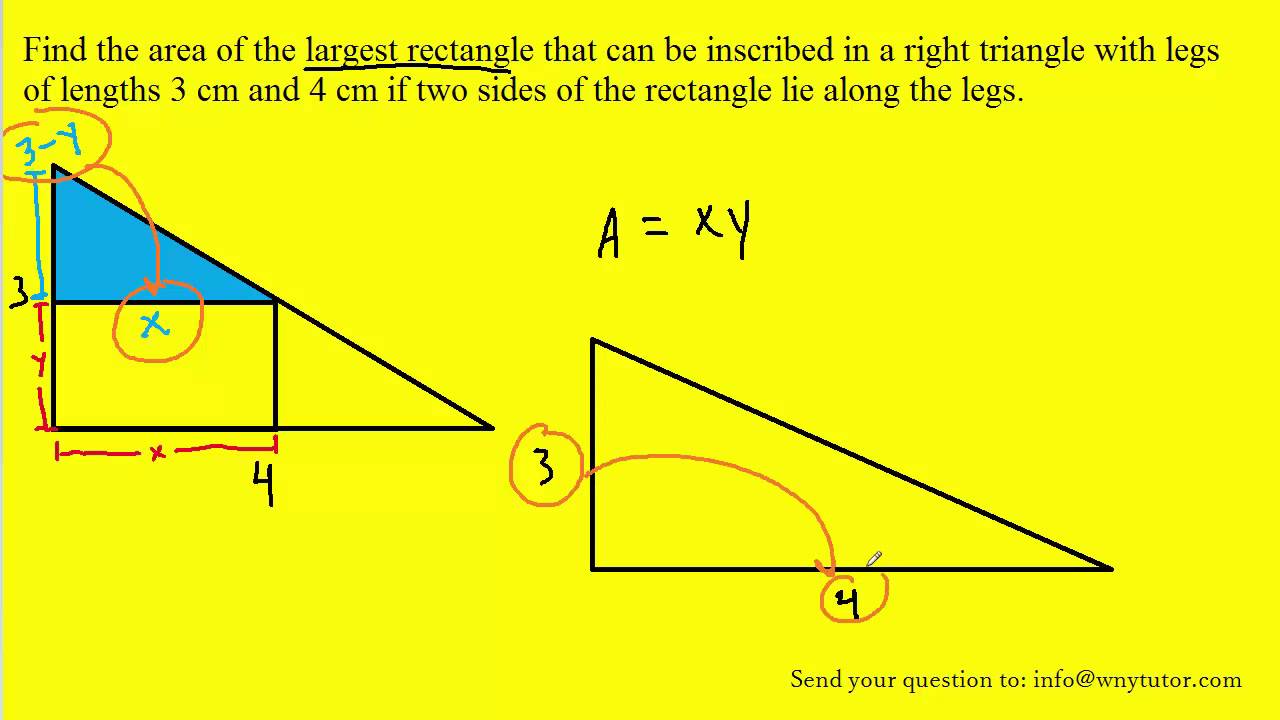
Find the area of the largest rectangle that can be inscribed in a right triangle with legs of lengths 3 cm and 4 cm if two sides of the rectangle lie along the legs.
hybrid moon
No the goal is to solve not the largest
 fading zephyr
so yes, you'd make a function that incorporates the dimensions of the triangle into the computation and then take the derivative
hybrid moon
I have a similar hw question
fading zephyr
it says it there
hybrid moon
But I don’t want to post that one
fading zephyr
if in your HW you are not looking for the largest, it isn't the same problem
gray isle
if no size restriction is stated, anything goes
fading zephyr
what ramonov said, which is the same as i told you in discussion
hybrid moon
What I’m asking is how do I solve this question if they didn’t have a size restriction
fading zephyr
just use geometry and trig
fading zephyr
we can't say anything else if you don't show the actual problem
gray isle
if no size restriction is stated, anything goes
fading zephyr
cuz we don't know what you are given nor what you need
gray isle
the best you'd get is an expression for area in terms of variables
fading zephyr
"trig and geom" is the best we can tell you
gray isle
which is more or less what i suspect they'd start with in the vedior before optimisation
are they copyrighted by your school or something?
hybrid moon
No don’t want to get in trouble for cheating
gray isle
homework is usually ok. tests are not
hybrid moon
Yeah but my school is wack
fading zephyr
you could make a drawing in which you indicate which quantities are known and which ones are sought after, without any numbers
just assign them letters
hybrid moon
Alright I’ll do that
fading zephyr
then people here can help you set up your equations
hybrid moon
That’s actually a good idea
gray isle
,rotate
ocean sealBOT
 gray isle
apply properties of similar figures to express y in terms of x
hybrid moon
Essentially:
16-y/x=16/10
gray isle
why 16-y/x
hybrid moon
The upper triangle length
ocean sealBOT
ℝamonov

 hybrid moon
Yes I am
gray isle
which is pretty much meaningless
hybrid moon
Y
gray isle
why did you think that gives a ratio of 16/10
and how are similar figure being applied
the blue segment and green segment aren't even sides in the same shape
instead you should simply consider

the red triangle will be similar to the largest triangle
hybrid moon
Wait okay so proportion should be 16-y/y=10-x/x
gray isle
overcomplicating it
gray isle
why not just focus on the red triangle instead of wandering to the triangle in the top left for some strange reason
no
and also please use parentheses around your numerators and denominators to make them clearer
why not just focus on the red triangle instead of wandering to the triangle in the top left for some strange reason
gray isle
yes, the ratio of the legs in the red triangle is y/x
what about the ratio of the legs in the largest triangle
gray isle
yeh
hybrid moon
Ok then what do I do next
gray isle
express y in terms of x
gray isle
well you have one side of the rectangle in terms of x
get the other side in terms of x
their product will be the area
division by 0


 cinder finch
ocean seal
cinder finch
ocean seal
The triangle is equivalent to (y * 10) + {(x * y)/ 2} + {(16 - y) * 10)} = The Area of the triangle
You would be required to find equivalent sides on each end which will give you an expression of what the area of the triangle would be
 real quartz
eternal spindle
pls help
real quartz
eternal spindle
pls help
did you find out fx and gx
hybrid moon
gray isle
their product will be the area
What
gray isle
what what?
real quartz
the form ax+b / cx^2 + x + d doesnt have a horizontal asymptote unless c is equal to 0
gray isle
@hybrid moon
real quartz
that is, it is make sense that c=0, and that we have a form ax+ b / cx + d
real quartz
oh