#help-0
1 messages · Page 741 of 1
 inner sequoia
 surreal meadow
this means that the value of f(0) coincides with the value of g(2), essentially saying that f was shifted 2 units to the right
 golden nymph
to get g?
inner sequoia
surreal meadow
this means that the value of f(0) coincides with the value of g(2), essentially ...
OH
so f will be to the right of g
surreal meadow
no
golden nymph
no
surreal meadow
f is to the left of g
inner sequoia
nvm i got my directiosn confuse
surreal meadow
"f was shifted 2 units to the right"
inner sequoia
thought right was left
surreal meadow
so as to say that g is 2 units to the right
golden nymph
inner sequoia
thought right was left
amaznig
inner sequoia
golden nymph
amaznig
ikr
inner sequoia
surreal meadow
this means that the value of f(0) coincides with the value of g(2), essentially ...
the number in parentheses is X right?
surreal meadow
yes, these are both functions of x
surreal meadow
0 is below 2
g(1) and f(1) are ploted on y = g(x) and y = f(x)
the x values are the same
so they are not to the left or right of each other
golden nymph
are you talking about the graphical representation of addition in a function?
inner sequoia
oh yes i forgot that was a y value
golden nymph
or what is the topic
surreal meadow
the overarching question is "why does f(x-a) shift the function a units right and not left"
inner sequoia
surreal meadow
the x values are the same
OH
but if the y values were the same
then the lower one would be to the right?
surreal meadow
then the x values show why f(x) is to the left of g(x)
yes
jnow
now
no
lower on the x-axis means left
inner sequoia
lower on the y axis
surreal meadow
lower on the y-axis means the number is lower as well
left on the x-axis means the number is lower
surreal meadow
inner sequoia
but if the y values were the same
go on with this thought
when the y values are the same
 surreal meadow
that's when the x-values are the same
inner sequoia
equal y value
 surreal meadow
yes
inner sequoia
the one that previously had a lower y value, when set at an equal y value to the other function, will be to the right on the x axis
HOLY SHIT IM DUMB
if you subtract from x you are subtracting from the y axis bcs i was changing what y was giving me not what x was giving me
but x is the same
DAMN IT I DIDNT NOTICE
inner sequoia
i am subtracting from f(x), not from x itself
f(x) is the y value
so lower y value
but if the y values are made equal
then the one that had the lower y value when the x value is equal will be greater
surreal meadow
this works here because this is a linear function
but think of it for f(x)=x^2
g(x) = (x-1)^2
you're not simply subtracting 1 from y, or the function, you're substituting x-1 for x
inner sequoia
surreal meadow
you're not simply subtracting 1 from y, or the function, you're substituting x-1...
in my head it still works
surreal meadow
take x = 50
inner sequoia
i am squaring a lower number to get y, meaning the y value is still lower
but if i square a higher number then i will get a higher y
surreal meadow
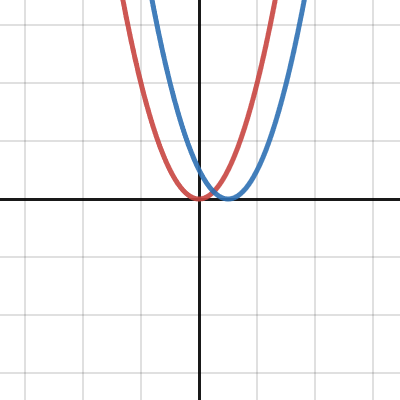
Desmos
inner sequoia
but if i set the x values equal then the previously higher y will be to the left of the lower y
surreal meadow
check out those functions
in some intervals, x^2 is higher
in some (x-1)^2 is higher
(x-1)^2 =/= x^2 - 1
inner sequoia
surreal meadow
(x-1)^2 =/= x^2 - 1
ik
but f(x) is the y value
and x+1 is greater than x
surreal meadow
yes
inner sequoia
but if i set both at equal y values then x will be to the right
because a lower number is being squared
so if x is equal then it will be lower
inner sequoia
what
surreal meadow
(-3 -1)^2 > (-3)^2
inner sequoia
well yes but if its negative then its the reverse
surreal meadow
think of it from the plane's perspective again
doing x-1 means shifting every x value to the left by 1
inner sequoia
yes
surreal meadow
so the plane is moving to the left by 1, while keeping the curve stationary
inner sequoia
yes
surreal meadow
in other words, the curve is moving to the right by one while keeping the plane stationary
inner sequoia
mhm
 arctic blade
@alpine sable hmm I've just thought, perhaps probability isn't what i want. it may give a nice [0,1] value, but it doesn't sound right. To explain further, I'm going to use this 'value' of how different/off-trend this mew value is to feed to another function to decide how to correct it.
I have three other ideas:
-
fit a curve to it, then find the squared difference between the predicted value from the curve and the actual value.
-
fit a curve and calculate the derivative, regarding the gradient as the 'trend' then somehow compare that to the new value
-
find the weighted mean, meaning newer values 'matter more', and somehow compare the new value to that.
Which do you think is best? Or another method entirely.
 alpine sable
It's hard to say, although I don't think you need a value between 0 and 1 for that application
So maybe taking the squared error from the prediction would work fine
inner sequoia
what is difference between vertical stretch and horizontal shrink
alpine sable
Horizontal shrink doesn't extend vertically I guess
arctic blade
@alpine sable hmm, I'll continue researching. i could use a better time series model, like ARIMA or Bayesian. The main question, that if you could answer would be used in all of these applications, is that if i do somehow have a predicted value, and a real value, what's the best way to compare them?
a squared difference, a ratio, or some other way?
alpine sable
We usually use squared or absolute difference in machine learning
arctic blade
hmm, thanks 🙂
arctic blade
might give a few a go and try and experiment, see which works better
alpine sable
Yeah in the end it comes down to which works better in practice
 ripe mountain
does anyone know a simple 3d function of two variables that has at
one point a minimum in one direction and a maximum in another direction
surreal meadow
what do you mean by that
ripe mountain
surreal meadow
what do you mean by that
hmm i guess i can show this
 austere bridge
a saddle point?
ripe mountain
that one is the part c for the problem
here's part a: Draw a rough sketch (three-dimensional of course) of the graph of a simple function
of two variables that has an absolute minimum at a single point (say, at (0,0,0)).

that would be an answer to the part a
where the absolute minimum is at (0,0,0)
ripe mountain
ripe mountain
does anyone know a simple 3d function of two variables that has at
one point a m...
my teacher said the most stragithforward answer to this problem has something to do with a 3d funciton that resembles a pringle, but i'm not exactly sure what he meant
austere bridge
a function like this?
 alpine sable
Yes
ripe mountain
that's x^2-y^2 right?
austere bridge
yeah it is
 surreal meadow
what's part b?
austere bridge
but if you look from the other way, it's a maximum
 ripe mountain
that's a maximum?
oh wait
it is at that point
because there's nothing else "below" it
ripe mountain
surreal meadow
what's part b?
Draw a rough sketch of the graph of a simple function of two variables that has an
absolute maximum at a single point.

that would be the answer
surreal meadow
what's part c?
ripe mountain
ripe mountain
does anyone know a simple 3d function of two variables that has at
one point a m...
this is part c
surreal meadow
can you send the words verbatim
ripe mountain
Draw a rough sketch of the graph of a simple function of two variables that has at
one point a minimum in one direction and a maximum in another direction.
 fair vine
it doesnt say absolute, wouldnt sin(x+y) do?
surreal meadow
then yeah, x^2-y^2 looks like what you want
ripe mountain
fair vine
it doesnt say absolute, wouldnt sin(x+y) do?
yeah i think that also would work
ripe mountain
surreal meadow
then yeah, x^2-y^2 looks like what you want
hmm okay thx
alpine sable
For future reference that's called a saddle point
ripe mountain
in general?
ripe mountain
alpine sable
For future reference that's called a saddle point
a point with a max in one direction and a min in another direction?
alpine sable
Yea
ripe mountain
ohh okay thx
alpine sable

In mathematics, a saddle point or minimax point is a point on the surface of the graph of a function where the slopes (derivatives) in orthogonal directions are all zero (a critical point), but which is not a local extremum of the function. An example of a saddle point is when there is a critical point with a relative minimum along one axial di...
Anyway just a fun fact
ripe mountain
3d is so cool man but there's so many things i need to think about lmao
i need to evaluate this where x=0, did i do this okay?


 placid zinc
No haha. Can't just sub in half the limit
ripe mountain
what confuses me about this is it's basically infinity * zero, which would be indeterminate, does that affect the problem
 placid zinc
Oh wait, you only care about where x = 0?
ripe mountain
for this particular case, yeah
 tight locust
1^inf = 1
placid zinc
Yeah basically. 1^h = 1, no matter what h is doing
ripe mountain
wdym tending 1
tight locust
well the typical example of a 1^inf limit is this
(1+1/x)^x
as x approaches infinity
so the base approaches 1 as the exponent approaches infinity
hence tending 1 and not exact 1
tight locust
yes
ripe mountain
tight locust
1^inf = 1
so i'd just evaluate the limit to 1^infinity and say 1^anything is 1, so L=1
tight locust
yep
ripe mountain
ooh i see thx
tight locust
tight locust
(1+1/x)^x
you should recognize this limit
ripe mountain
it's pretty common i assume?
tight locust
it's called e
 frail crater
What’s 1+1-2x2-23
alpine sable
Do you understand pemdas
frail crater
No
alpine sable
You evaluate parentheses first, then multiplication and division, then plus and minus
inner sequoia
is there diff between reflection along y or x axis
bcs when i check calculator reflecting using g(x)=f(-x) and reflecting using f(x)=-f(x) are exactly the same
surreal meadow
yes there is a difference
plot sin(x) and try it
and then plot cos(x) and try it
 dawn galleon
Parametric equation= (-1,2,5) + s(4,0,-1) + t(-1, -5, 1)
Scalar equation = 5x + 3y + 20z +101=0
Vector equation= r . (5i+3j+20k) =101

did i do these right
<@&286206848099549185>
surreal meadow
^
surreal meadow
i think you're smart enough to understand that that's not logical
dawn galleon
surreal meadow
i think you're smart enough to understand that that's not logical
no
no one answered so i posted it again
now i can use the helpers role
surreal meadow
now you can use the helpers role in 15 minutes
dawn galleon
surreal meadow
now you can use the helpers role in 15 minutes
yes my next helper role will be in the next 15 mins
surreal meadow
you clearly didn't read #❓how-to-get-help
dawn galleon
i did it says ping helper role after 15 mins
surreal meadow
you may use the <@&286206848099549185> tag once
fuck me
your scalar equation looks wrong
dawn galleon
surreal meadow
your scalar equation looks wrong
No how
surreal meadow
which leads me to believe that your vector and parametric are too
dawn galleon
surreal meadow
which leads me to believe that your vector and parametric are too
do not guess
surreal meadow
its not a guess
surreal meadow
looks good
dawn galleon
and my vector equation is good too?
surreal meadow
yes
 stable leaf
what is a scalar equation?
dawn galleon
Ok good should it be
5x + 3y + 20z =110 or 5(-1)+3(2)+20(5) = 101
surreal meadow
yes
stable leaf
dawn galleon
Ok good should it be
5x + 3y + 20z =110 or 5(-1)+3(2)+20(5) = 101
did you try graphing them
dawn galleon
no
stable leaf
i mena obviously you can also juts plug in numbers and i assume that works?
surreal meadow
dawn galleon
Ok good should it be
5x + 3y + 20z =110 or 5(-1)+3(2)+20(5) = 101
why would it be the second one?
dawn galleon
idk i thought it might be 2nd one
surreal meadow
but why?
dawn galleon
idk
surreal meadow
dawn galleon
do not guess
.
dawn galleon
yes
stable leaf
@surreal meadow
do you have the answer?
I mean i got an answer that i believe is correct
surreal meadow
the answer to what?
surreal meadow
the one he gave was incorrect
stable leaf
the one i have
i just didn't wanna post it in here because I don't think you are suppose to give direct answer
stable leaf
5x+3y+20z=101?
surreal meadow
looks good
stable leaf
maybe @dawn galleon just needs to plug a number into his equation and solve for the right side
surreal meadow
he already solved it
stable leaf
oh i see
 celest anvil

what i tried

so i know from this graph

that the radius is 3
the height is the upper function 2-(x^2+1)^-2
the bounds are 0 to3
im doing something wrong or missing something
stable leaf
101
plug in a poiint
point
and test it
see what you get on the right side
pick a, b, c
try them
dawn galleon
ye it should be 101 ty
 arctic wren
Maybe this is a dumb question but why this function is differentiable ? How i can check that?
$f(x)= x^{2}, x \le 1$
$f(x) = 2x -1 x > 1 $
 ocean sealBOT
Guilhotina

 topaz scaffold
celest anvil
im doing something wrong or missing something
topaz scaffold
celest anvil
im doing something wrong or missing something
I think you gotta do the top function minus the bottom function
$\int_{0}^{3}2\pi x ((2-(x^2+1)^{-2})-(x^2+1)^{-2}) ,dx$
 small bear
you check the derivative of the top function from the right or 1+, and the derivative of the bottom function from 1- (the left)
ocean sealBOT
RipeOrange
 celest anvil
ok i'll try that
small bear
if they match, its differentiable, otherwise it isn't
ocean sealBOT
Guilhotina
 arctic wren
this isn't continuous in x =1 , right ?
surreal meadow
yup its not
celest anvil
topaz scaffold
I think you gotta do the top function minus the bottom function
can you calculate it? i can't
topaz scaffold
,w integrate 2\pi x ((2-(x^2+1)^{-2})-(x^2+1)^{-2}) dx
ocean sealBOT


 Requested by RipeOrange#4907
topaz scaffold
Requested by RipeOrange#4907
topaz scaffold
Ah this just becomes $\int_{0}^{3}4\pi x (1-(x^2+1)^{-2}) ,dx$
ocean sealBOT
RipeOrange
 celest anvil
roger roger
topaz scaffold
This should be easy to integrate
Use the chain rule thing
No idea what it's called for integrals
Reverse chain rule (?)
celest anvil
ye thx
tight locust
topaz scaffold
Reverse chain rule (?)
u sub
topaz scaffold
Ah

 red phoenix
what are yuou doing?
red phoenix
integrals defo find area
consider just changing y wit hx
and finding the integral against the x-axis
it would be the same right?
 carmine lion
yea?
red phoenix
doesn't this give you confidence in your answer?
red phoenix
yes
carmine lion
ok
 carmine lion
red phoenix
but remember you want area
carmine lion
red phoenix
but remember you want area
thing is
why doesn't it show a sideways parabola
thats the only thing im confused about
red phoenix
idk, i suppose you can just turn your head?
perhaps it can only generate curves with x
carmine lion
ah ok
red phoenix
perhaps it internally changes the y to x

 queen nova
Dylan has a fish tank at home. He knows its height, h, is one inch less than twice the width, w, and the length, l, of the fish tank is seven inches longer than the height.
What would be the expression to represent the volume?
alpine sable
or we reject the advertismenet
alpine sable
queen nova
Dylan has a fish tank at home. He knows its height, h, is one inch less than twi...
(w-1)* w * (w+6)
i wish my math was this easy
what are you 15?
are you even allowed on discord
am i getting trolled
queen nova
im 15 yea
carmine lion
alpine sable
am i getting trolled
 alpine sable
carmine lion
alpine sable
carmine lion
I'm respectful?
carmine lion
idk
alpine sable
oh
carmine lion
it seemed like ur overreacting
alpine sable
are people who are 15 allowed on discord with discord ToS?
carmine lion
yes
alpine sable
no im just surprised
alpine sable
oh okay
carmine lion
yea
 solar cradle
Its not really any concern of us how old anyone here is, if they're using the channels appropriately then they're fine
It's discords job to enforce their rules
 wary stream
solar cradle
Its not really any concern of us how old anyone here is, if they're using the ch...
wary stream
solar cradle
Its not really any concern of us how old anyone here is, if they're using the ch...
If they're under age, the mods have to ban them
From the server
alpine sable
have u seen that linkedin math problem about telling how fast horses are from 3 rounds or wtvr
their question seemed like one of those math questions that circulate on fb
i'm like 30 in uni so i'm in no place to judge lol
but their question truly threw me off
like is this an IQ question
@tame needle great musician
 graceful harness
 alpine sable
great dj
queen nova
Is this right? I got stuck on the last part
 alpine sable
-16 is in the wrong place
queen nova
oh ok
alpine sable
-16 * -12 = + 192
wary stream
alpine sable
-16 is in the wrong place
What do you mean wrong place?
alpine sable
if you expand (x-16)(x-12) = x^2 - 30x + 192
and that is not x^2 + 4x -192
so unless im understanding this wrong
 woeful pulsar
alpine sable
(w-1)* w * (w+6)
woeful pulsar
alpine sable
(w-1)* w * (w+6)
avoid giving answers directly
alpine sable
huh
woeful pulsar
like ensure you engage the person asking to see how they thought about the question
arctic wren
if the line r is tanget to f(x) = -x² and g(x0 0.5 + x²
The unique possible solution is for R= 0 , right ?
queen nova
what is this in simplest form?

wait I think I got it
x^2 +4x-42?
I mean
x^2+8x-42?
woeful pulsar
arctic wren
if the line r is tanget to f(x) = -x² and g(x0 0.5 + x²
The unique possible sol...
g(x)=0.5+x^2?
If you draw them out you should see the lines
wary stream
queen nova
x^2+8x-42?
I'm doing it mentally but I did not get this, what's your work?
wary stream
Sounds right
queen nova
got it ty
arctic wren
woeful pulsar
g(x)=0.5+x^2?
If you draw them out you should see the lines
oo ok, another question is there a math symbol to represent that one line is tangent to a function at poin a ?
 glass lichen
arctic wren
oo ok, another question is there a math symbol to represent that one line is tan...
glass lichen
arctic wren
oo ok, another question is there a math symbol to represent that one line is tan...
no, just use words
 remote lodge
what does the n represent in a recursive formula?
glass lichen
remote lodge
what does the n represent in a recursive formula?
the term number
$a_n=f(a_{n-1})$
ocean sealBOT
Mosh
 remote lodge
ok thanks Mosh
 tropic ice
how do they go from first step to second?
 red phoenix
tropic ice
how do they go from first step to second?
red phoenix
tropic ice
how do they go from first step to second?
they do a find of substitute
has h(x) = x^2 +2x
imagine you have h(g) = g^2 + 2g
now just add the (x)
so you have
h(g(x)) = g(x)^2 + 2g(x)
tropic ice
so
@red phoenix how do you know where the x goes
if im doing a(x) = x^3 + 4x
a(b) = b^3 +4b
A(b(x)) = b(x)^3+ 4b(x)
oh i see
why does khan subtract instead of add
tropic ice
and this is called find a substitute?
tropic ice
what did I do wrong here

oh
pretend its +10
apparently g(f(3)) is -5

oh
wait
gosh
im so stupid
i got the answer nvm
 tropic ice
6
queen nova
Can someone help me with this:
 wary stream
queen nova
Can someone help me with this:
wary stream
queen nova
Can someone help me with this:
Find the GCF
 flint stratus
someone from indonesia?
queen nova
ok so thats 6x^2
wary stream
Divide all the terms by the GCF
 ionic jewel
 copper prawn
Can Sigma be used the other way around?
copper prawn
Can Sigma be used the other way around?
not the notation, but addition works like that in general
you could do $\sum_{n=0}^4 (5-n)$
ocean sealBOT
bunny
 ocean sealBOT

 ionic jewel
just goes to 0, notation always requires lower to higher
copper prawn
oooooof
this functions gonna look terrible
its already got floored powers to the log of 10

thx

 stark grail
Can anyone guide me for this ques ? I cant do this TvT

 gaunt magnet
bruh channel in use
stark grail
im sorry
gaunt magnet
gaunt magnet
<@&286206848099549185>
 craggy ember
I need just strait help in general
gaunt magnet
 oak chasm
<@700774145365114920>
oak chasm
<@700774145365114920>
i got -14
 devout sigil
@stark grail I can help u now... let’s move to #help-7|zen1thxyz if u want?
stark grail
devout sigil
<@839081716663451650> I can help u now... let’s move to <#423244559682764800> if...
sure! thank you so much!
 thorn kindle

oak chasm
12 + 2s + t = 0
-9 - s - t = 0
2s + t = -12
s + t = -9
2s + t = -12
2s + 2t = -18
t = -6
s = -3
z = 4 - 2(-3) + 4(-6)
z = -14
@gaunt magnet Got the same.
thorn kindle

gaunt magnet
oak chasm
12 + 2s + t = 0
-9 - s - t = 0
2s + t = -12
s + t = -9
2s + t = -12
2s + 2t = ...
Yay Nice ty
Do u get this for this ques

 oak chasm
@Usman#0988 That looks fine.
gaunt magnet
thanks
i got
4x+5y-z-7=0
for this
 oak chasm
Yes. To check your work, try [0, 2, 3], [0, 2, 3] + [4, -3, 1], and [0, 2, 3] + [-2, 3, 7].
@gaunt magnet


 sly mantle
unpack definitions
 versed prairie
Are ya talkin to me
sly mantle
yes
versed prairie

The first explains why it is reflexive.
And I can't even understand what those bizarre symbols on the right means
Can you explain to me why this is reflexive 
sly mantle
what does R being reflexive mean?
versed prairie
It should have an identity relation and it can also have sets that are related to themselves
The fact is, I can decode if the Ordered Pair is given but if they are given in the form of equations I am getting hella confused.
sly mantle
the wording's off
versed prairie
It's been a year since I've touched this topic So yeah it'll be a little distorted
sly mantle
recall R is a relation on Z. we say R is reflexive if each element of Z (ie integer) is related to itself via R
versed prairie
Hmm
sly mantle
use the definition of R. to prove R is reflexive, we must show that, for each integer x, 5 divides x-x
versed prairie
So here they've given A and xRy and they've said x-y is divisible by 5 which means x-y = 5m where m is the integer so if we substitute x instead of y in x -y we get a 0 and we'll get 5m = 0
Is this ryt?
Taking the 5 out we can write it as 5(m) = 0 and taking the 5 to the RHS we get m = 0
Is this enough to prove that this equation is reflexive
sly mantle
R is a relation, not an equation. we don't call equations reflexive
gaunt magnet
oak chasm
Yes. To check your work, try [0, 2, 3], [0, 2, 3] + [4, -3, 1], and [0, 2, 3] + ...
ok ty
versed prairie
versed prairie
Yeah rel not an equation 😅
This proves that the relation is reflexive doesn't it?
sly mantle
the crux of the proof is really just saying x-x = 0 = 5(0). the work done above is just to help you
sly mantle
also in the proof we should state that we're letting x be an arbitrary element of Z (ie an arbitrary integer) before doing any algebra
 sly mantle
the crux of the proof is really just saying x-x = 0 = 5(0). the work done above is just to help you
what's left is to do a 'well written' proof using this as the argument
versed prairie
Hmm
So we have to take x as an arbitrary element of R and prove that x - y = 5m is reflexive
sly mantle
R is a relation, not the set upon which the relation is defined
versed prairie
on Z ...
sly mantle
reminder
use the definition of R. to prove R is reflexive, we must show that, for each integer x, 5 divides x-x
versed prairie
Here the R is defined on Z by xRy to mean x-y is divisible by 5
So yeah got your point
sly mantle
a way we can write the proof goes:
let x in Z. then we have x-x=0=5*0. this shows 5 divides x-x, which is to say xRx. thus R is reflexive
 sly mantle
you're welcome
alpine sable
is the bottom eqn true or false?
 placid zinc
The equation is true. Canceling as shown is a faux pas
alpine sable
placid zinc
The equation is true. Canceling as shown is a faux pas
so why is it true then?
solar cradle
Its the chain rule
placid zinc
I mean I could give a proof, but most people are happy with "the limit definition agrees with it"
thorn kindle
Derivatives are fractions
topaz scaffold
I want to see the proof
thorn kindle
Basic rules of multiplication apply. It's that simple
placid zinc
dy/dx = du/dt when dydt = dxdu
devout sigil
dy/dx is not a fraction
thorn kindle
y = ∫ du/dt dx
alpine sable
they aren't fractions, but we can manipulate them like fractions
solar cradle
"can"
alpine sable
derivatives are actually ratios
thorn kindle
And what are ratios?
solar cradle
They're introduced as if they are but they aren't really
placid zinc
It's very convenient to think of dy and dx as objects in their own right, but they don't really represent anything.
alpine sable
no, dy/dx is a ratio, but we manipulate them like fractions
fractions are part of a whole
thorn kindle
Ratios are fractions
alpine sable
but ratios compare two objects
ratios are not fractions!!!!
fractions are a part of a whole
ratios are not
devout sigil
It is the rate of change of y with respect to x. dy is a very small change in y and dx is a very small change in x
placid zinc
Let's use an example.
y = x²
dy/dx = 2x
What is dx here?
thorn kindle
placid zinc
Let's use an example.
y = x²
dy/dx = 2x
What is dx here?
The infinitesimal Δ
placid zinc
That's just words haha. What actually is it?
thorn kindle
Everything i can possibly communicate to you through a text message is just words lmao
alpine sable
 thorn kindle
Unless youd like me to use emojis
alpine sable
dy and dx are ratios
you can think of two number lines
one corresponding to x and the other y
placid zinc
Fair point. But I can heavily quantify y, and dy/dx. Both are functions R → R
alpine sable
if you nudge x some quantity delta x, it corresponds to nudging y some delta y
and if you take the nudge to be very small, it becomes dx, thus the ratio with dy is dy/dx
placid zinc
How small is "very small"?
thorn kindle
As small as you want
thorn kindle
dx can be whatever you want. I actually have been required to use dx as a real number
alpine sable
bruh
this is one of the most important concepts of modern math
it's the concept of 'approach'
it
yeah
thorn kindle
hold on i can show you one of my textbook problems
placid zinc
Okay lol no need
I know that you can replace dx with a real number to get an approximation to a change in y
I would never say "dx can be a real number" though
topaz scaffold
What happened to the fraction arguments?
placid zinc
Idunno. I started asking what a differential was and we've gone a long way since
alpine sable
no they are not
fractions are part of a whole while ratios only compare two objects
devout sigil
A derivative is a gradient function if u are a total noob. If not I can join this debate lol
 solar cradle
That's just an approximation
topaz scaffold
alpine sable
fractions are part of a whole while ratios only compare two objects
And in the end its still dy divided by dx right?
To get your derivative
devout sigil
thorn kindle
an actual textbook problem
It is for a fixed point of a function
devout sigil
alpine sable
derivative not same as gradient
I meant this^^^^
alpine sable
no
celest anvil
don't you split dy/dx during u substitution?
alpine sable
topaz scaffold
And in the end its still dy divided by dx right?
no, there is no concept of dividing in differentials
topaz scaffold
Yea
thorn kindle
also separation of variables
devout sigil
In fact dy/dx is the gradient function of the tangents to the function at a given point
thorn kindle
if dy/dx = 1 then dy = dx then ∫ 1 dy = ∫ 1 dx => y = x + c
topaz scaffold
I don't know enough about this to argue so imma just watch
topaz scaffold
thorn kindle
if dy/dx = 1 then dy = dx then ∫ 1 dy = ∫ 1 dx => y = x + c
Btw forgot the constant for the y
ionic jewel
you don't need one
dawn galleon

ionic jewel
he subtracted the constant on the Y side from both sides and got a new unique (single) constant on the other side
topaz scaffold
Oh yea oof mb
placid zinc
So let me go back to it:
y = x²
So dy/dx = 2x
What is dx?
0.05?
A real number?
If not a real number, what object is it?
topaz scaffold
$dx = \lim_{x \to 0} x$ (?)
ocean sealBOT
RipeOrange
 dawn galleon
yes
thorn kindle
d/dx f(x) = lim Δx->0 (f(x+Δx)-f(x))/Δx
you need infinitesimals to make calculus work
unless you wish to reject the concepts of infinity and limits themselves entirely.
which is possible
there is a geometric construction of the derivative
 cloud zinc
how can I find P(S and (C or S)) in the formula:
P(S | (C or S)) = P(S and (C or S)) / P(C or S)
solar cradle
S and (C or S) = S
It's easier to verify when you're familiar with set notation
S and (C or S) is the same as $S \cap (C \cup S)$ and since $S \subset (C \cup S) \Rightarrow S \cap(C \cup S ) = S$
ocean sealBOT
Billy Clintorus

 cloud zinc
solar cradle
S and (C or S) = S
cloud zinc
solar cradle
S and (C or S) = S
okay
so this is simply P(S | (C or S)) = P(S) / P(C or S)?
solar cradle
ye
solar cradle
npnp
cloud zinc
so this should be 5/12
however, my textbook says
ohh nvm
I put in the wrong number
 next hatch
is it possible for an integral to be unsolvable?
was given this question

tried solving 3 and couldn't find any solutions
oak chasm
@next hatch It's not asking you to integrate them.
thorn kindle
the substitution won't work on 3 but that is integrable
 wild marten
works on (2)
next hatch
i understood the question but thought hey lets try integrate them
next hatch
i chucked 3 into symbolab and it said no solutions possible
ionic jewel
,w integral of x sqrt(1+x^3) dx
ocean sealBOT
 ionic jewel
there u go
next hatch
fuck symbolab
wild marten
next hatch
i chucked 3 into symbolab and it said no solutions possible
(2) is solvable using u = 1+x^3
ionic jewel
not pretty, but it does work
next hatch
thanks lester i understood the question
wild marten
ionic jewel
there u go
its in terms of hypergeometric function
wild marten
so I think they are not taught about this yet
wild marten
next hatch
hypergeometric what
you can search about it
next hatch
tf is that lmao
ionic jewel
oh well i didn't say he could understand it, just that it has an integral
wild marten
ohk
wild marten
its pretty easy actually
next hatch
yeah but im doing biomed with this as an elective and no more electives after
so it probably won't be useful
plus im really behind lmao i gotta get my shit together
wild marten
you'll get it together, good luck
next hatch
thanks ill need it xx
cloud zinc
cloud zinc
I put in the wrong number
I got a wrong answer

so if it is 13/30 / 12
it is 13/360
in the book it is 13/28
devout sigil
Which question are u referring to?
ocean sealBOT
Lester
 wild marten
$13/30 / 12 = (13*12)/30$
ocean sealBOT
Lester

 strong furnace
wild marten
$13/30 / 12 = (13*12)/30$
strong furnace
wild marten
$13/30 / 12 = (13*12)/30$
frac{a}{b} works
cloud zinc
where did the 28/30 come from?
wild marten
strong furnace
frac{a}{b} works
I know that, but the OP wrote it in that way so..
devout sigil
It’s from C U S
cloud zinc
if P(C or S) = P(C) + (S) - P(C and S)
solar cradle
I messed it up, this is a cluster lol
cloud zinc
it is 12
solar cradle
You wont get 12 for a probability
devout sigil
I’m wondering why u must take into consideration C n S
Question stated “given that they might prefer the computer lab or the science lab”
solar cradle
So earlier you had P(S) / P(C or S), P(S) = 13 / 28, P(C or S) = 1
devout sigil
0<= probability <= 1
cloud zinc
solar cradle
So earlier you had P(S) / P(C or S), P(S) = 13 / 28, P(C or S) = 1
P(S) = 13/30
cloud zinc
devout sigil
Question stated “given that they might prefer the computer lab or the science la...
I had that formula down
solar cradle
Using the formula you wrote, you can see that if you're careful, P(C or S) = P(C) + P(S) - P( C and S) = (15 + 8)/ 28 + (5 + 8)/ 28 - 8 /28
Where are you getting 30 from?
cloud zinc
the total of the people
solar cradle
5 + 8 + 15 = 28
cloud zinc
plus 2
strong furnace
well then your P(S or C) changes to 28/30 then
solar cradle
oh i didn't see that 2 in the corner lol
cloud zinc
lmao
cloud zinc
S or C excludes the 2 right?
solar cradle
cloud zinc
S or C excludes the 2 right?
yes
strong furnace
they are equal
cloud zinc
oh so its it the same thing?
strong furnace
yeah the "union" and "intersection" operators are commutative and associative
 wispy shadow
help
 topaz scaffold
Just wondering, is this a test?
 dark granite
wispy shadow
help
dark granite
wispy shadow
help
what have you tried? You need to show us that you have at least attempted the problem Also, we don't help with quizzes/tests/exams.
 topaz scaffold
Try expanding the log
 honest hawk
i was thinking that
so log(A)+log(10^B)
Im always stupid with logarithms
ill simmer on this
topaz scaffold
honest hawk
i was thinking that
so log(A)+log(10^B)
Assuming the log is base 10 this becomes log(A) + B
honest hawk
i agree
topaz scaffold
And then...?
honest hawk
Lets see.
Give me a second
just to make sure, the base 10 part of the log and the (10^B) part cancel out, correct?
 honest hawk
I dunno--this was on a pre-made ANKI deck

am i doing this right? Sorry, the work is done via computer mouse
topaz scaffold
 vale wigeon
what does this even mean
vale wigeon
what does this even mean
0.1 * A I think
honest hawk
(I might need assistance on another one later on if that's okay.)
topaz scaffold
honest hawk
am i doing this right? Sorry, the work is done via computer mouse
You just need to figure out how they are approximating logA
Don't do the last step
Idk how they got the approximation tbh
topaz scaffold
Do you get a calculator?
topaz scaffold
Ah that's probably why
honest hawk
Wish leads me to believe that something too complicated will not be given
the most ive seen on practice questions are the simple log rules needing to be used
topaz scaffold
The 0.A thing might just be a simple approximation instead of a more accurate one then
honest hawk
makes sense. Ill probably keep it on the backburner until a question that involves it comes up
topaz scaffold
Cool
 minor elbow
 topaz scaffold
Cool
honest hawk
Well, hopefully this is more simple

I can take this one for granted because ive used it before, but trying to derive the proof
lmao all i got is this
 topaz scaffold
What's log(1)?
strong furnace
if I am looking at it right
the estimation assumes
scientific notation
so A in (0,10)
honest hawk
topaz scaffold
What's log(1)?
Should just be 0
topaz scaffold
honest hawk
Should just be 0
Yep
alpine sable
could someone please tell me what the derivative graph would look like for this
honest hawk
oh duh, that makes sense
topaz scaffold
So you just get log A
honest hawk
jeez i need to make connections
topaz scaffold
alpine sable
could someone please tell me what the derivative graph would look like for this
When the graph is increasing it's positive. When it's decreasing it's negative
Neither would be 0
strong furnace
if you're still not sure about the logarithm thing the approximation is within ~0.2 of the actual value always
honest hawk
strong furnace
if you're still not sure about the logarithm thing the approximation is within ~...
Many thanks! :)
alpine sable
topaz scaffold
When the graph is increasing it's positive. When it's decreasing it's negative
is that as x approaches infinity?
so lets say a quartic is decreasing as x approaches infinity
alpine sable
topaz scaffold
Just wondering, is this a test?
XD
topaz scaffold
alpine sable
XD
I gotta make sure yk
strong furnace
when working with just graphs of the functions its probably better to just look at the slope of tangent
gaunt magnet
 alpine sable
Uh, what's the question? I just completed log today :/
topaz scaffold
What question?
alpine sable
Oh, got it.
strong furnace
gaunt magnet
do you know how to get the direction ratio of perpendicular line from plane equation
alpine sable
@honest hawk you can try new base introduction to make it easier I guess.
gaunt magnet
strong furnace
do you know how to get the direction ratio of perpendicular line from plane equa...
wait i did it do u get
 strong furnace
that would be correct
topaz scaffold
alpine sable
<@239126092647104512> you can try new base introduction to make it easier I gues...
Eh?
gaunt magnet
ty
alpine sable
topaz scaffold
Eh?
Uh, it's just introducing a new base.
dawn galleon
hey someone check my vector equation
quick please
i get

r . (5i+3j+20k)
<@&286206848099549185>
strong furnace
dawn galleon
r . (5i+3j+20k)
thats an expression not an equation
you're lacking the right hand side
dawn galleon
strong furnace
thats an expression not an equation
i got (5,3,20).r = 101
strong furnace
right
dawn galleon
strong furnace
right
should their be an arrow on r
strong furnace
anything to show it is a vector
gaunt magnet
strong furnace
anything to show it is a vector
and must add the . before the r
strong furnace
there's a . before the r?
dawn galleon
strong furnace
there's a . before the r?
 strong furnace
well you had one in your msg so idk what's new anyway yeah that should work
dawn galleon
strong furnace
well you had one in your msg so idk what's new anyway yeah that should work
so i need to add the dot rightZ?
strong furnace
man you need to just show r (dot product) (5,3,20) = 101
use whatever notations are in your book/course
dawn galleon
strong furnace
man you need to just show r (dot product) (5,3,20) = 101
so the vector equation is (5,3,20) = 101
i dont need to do anything
stable leaf
dawn galleon
Parametric equation= (-1,2,5) + s(4,0,-1) + t(-1, -5, 1)
Scalar equation = 5x + ...
^
 hardy mirage
uh I've been stuck at this question for a while
if a line's gradient is 2 and y-intercept is -6, determine the x-intercept
I have no idea on how to solve it
someone please help
 tawdry flower
do you have any formulas that might help you?
hardy mirage
uh no
stable leaf
do you have an equation
tawdry flower
as a matter of fact you do - the equation of a line in point-slope form
$y - y_{0} = m(x - x_{0})$
ocean sealBOT
kirafa
 tawdry flower
You're given the gradient, which is "m". And you're told that the line passes through the y-intercept (in other words, the point (0, -6) )
tawdry flower
$y = mx + b$
ocean sealBOT
kirafa
 tawdry flower
m is the slope (or gradient) and b is the y-intercept
hardy mirage
then what is the y?
hardy mirage
um what's the name of this equation?
tawdry flower
i think it's called slope-intercept form
the equation i gave before is called point-slope form
tawdry flower
I think that one's called standard form, but people tend not to use that so much
stable leaf
maybe to get the intercepts easily?
hardy mirage
hmm these two formula's usage is the same?
stable leaf
they are all the same
stable leaf
i guess it is
kinda
i was more thinking of just an equation but maybe they are the same thing
 manic glade
does this look right?

 ivory otter
Hey so im kinda confused, what is spearmans coefficient of rank correlation used for exactly
and how is it different from the normal correlation coefficient formula
 covert breach
ivory otter
Hey so im kinda confused, what is spearmans coefficient of rank correlation used...
covert breach
ivory otter
Hey so im kinda confused, what is spearmans coefficient of rank correlation used...
for rank correlation
covert breach
ivory otter
and how is it different from the normal correlation coefficient formula
normal correlation is not for rank
essentially correlation is for ratio/interval data, whereas rank correlation is for ordinal data
ivory otter
Google search: "How to answer a question without answering the question"
covert breach
i mean i answered the question, idk what u want
rank correlation is used when u have ranked (ordinal) data, and normal correlation is used for actual values (interval/ratio data)
 severe sluice
i don't quite understand this (if you continue using the same logic but you don't divide both sides of the equation by 3/2 in the first step, the result will be different)

<@&286206848099549185>?
alpine sable
severe sluice
i don't quite understand this (if you continue using the same logic but you don'...
i dont understand.. how will the resukt be different?
ocean sealBOT
Unity's Particle System
 severe sluice
(woops. meant 3/2.)
alpine sable
ocean seal
**Unity's Particle System**
@severe sluice T is directly proportional to 2/3 times of E(total), and E(total) is equal to 3/2 times PV
So can't T be directly proportional to PV?
man can u not delete the soln before i read it xD
ocean sealBOT
Unity's Particle System
 alpine sable
Isn't the proportionality constant here not the same as that given in the text?
red phoenix
alpine sable
Isn't the proportionality constant here not the same as that given in the text?
i agree
 tribal geyser
Hey guys how do u do 14)c

Coz I thought u just multiply growth constant and 10
coz for k I got -In(0.9)/4
But the answer is 0.028..
<@&286206848099549185>
tawdry flower
i guess i can give it a shot
devout sigil
Me too
devout sigil
Nah u can do it man
tawdry flower
lol alright
devout sigil
We can compare answers u know (:
devout sigil
Did u correctly find the value of k?
tribal geyser
Yes
devout sigil
What is it
tribal geyser
0.02634012891
devout sigil
Geez I’ll take the exact value
tribal geyser
-In(0.9)/4
devout sigil
Ah thanks that’s better
tawdry flower
To say that the population fell by 20% is to say that it was 80% of what it was before. So we want to find "t", such that $P(t) = 0.8P_{0}$. Re-write P(t) as $P(t) = P_{0}e^{-kt}$.
ocean sealBOT
kirafa
 tawdry flower
WHAT
tawdry flower
oh woops
tribal geyser
yep C)
devout sigil
Bruh
tawdry flower
stfu im doing my best
.>
ok, let's consider the population after 10 years: P(10). According to the model we're given, we have $P(10) = P_{0} e^{-10k}$.
devout sigil
Bro ur faster than me I think I’ll leave this equation for u
tawdry flower
The percentage decrease in the population (compared to now) can be found through the ratio of P(10) to P(0), which is:
$\frac{P(10)}{P(0)} = \frac{P_{0}e^{-10k}}{P_{0}}$
so we get $e^{-10k}$


 tribal geyser
yes
tawdry flower
yeah, you can get it from there by plugging in k
tribal geyser
I did but the answer is 2%
tribal geyser
No lol, I got that correct
tawdry flower
yeah im getting this wrong too
but idk what i'm doing wrong
hold up, the answer is 2%?
tribal geyser
Yesh
tawdry flower
so the population decreased by 2% after 10 years?
tribal geyser
Yes