#help-0
1 messages · Page 732 of 1
 ionic jewel
 carmine lion
it doesn't matter
ionic jewel
it will be confusing later, but ok sure
 wanton vortex
no
ionic jewel
y-(-3) = m(x-(-2))
y+3 = m(x+2)
wanton vortex
what's it matter
ionic jewel
are you familiar with this abe
 cerulean vine
ionic jewel
<@869794440531804160> <@420505138936020993> go to <#342850939306246145> if you w...
cerulean vine
ionic jewel
<@869794440531804160> <@420505138936020993> go to <#342850939306246145> if you w...
Oh sorry
ionic jewel
carmine lion
thats part (b)
oh that's quite convenient
carmine lion
lol
carmine lion
wait do i use the value from part a
ionic jewel
y+3 = (3x^2-1)(x+2)
no
you use the one you literally did like 5 seconds afo
this?
remember
carmine lion
oh yea
 alpine sable
Hello, can someone help me solve that?
a = ⁴log x and b = ²log x.
If ⁴log b + ²log a = 2, so a + b = ?
@ abe
carmine lion
busy atm sorry ced
carmine lion
ionic jewel
@ abe
its a cubic
 plush wagon
Hi bunny I got solution
alpine sable
carmine lion
busy atm sorry ced
Oke np
carmine lion
$y=3x^3+9x^2-x-3$
 ocean sealBOT
abe
 ionic jewel
no!
carmine lion
-3
ionic jewel
we are doing question c
plush wagon
It's sin2y = 2cos(y)sin(y)
ionic jewel
question c defines a new cubic
carmine lion
ionic jewel
y+3 = (3x^2-1)(x+2)
this.
carmine lion
yea
ionic jewel
is it right?
carmine lion
$y=3x^3+9x^2-x-6$
ocean sealBOT
abe
 carmine lion
should be
ionic jewel
,w expand (3x^2-1)(x+2)
ocean sealBOT


 carmine lion
wait whot
ionic jewel
okay it's not right
carmine lion
oh
ionic jewel
even when you subtract the 3 over it's still not right
carmine lion
x+2 not x+3
ionic jewel
yes
anyways
you didn't need to do that
so I'm going to not write it like that, but keep that in mind for later
carmine lion
oh ok
ionic jewel
y+3 = (3x^2-1)(x+2)
carmine lion
ok
carmine lion
take 3 over
ionic jewel
lol ok yes
ionic jewel
and the x and y in the problem are a point the line goes through
carmine lion
yes
ionic jewel
right?
so we want to be finding the (x,y) point on the polynomial y = x^3-x+3 that satisfy this right?
carmine lion
yea
ionic jewel
so y = x^3-x+3
carmine lion
maybe label it (x_1, y_1)
ionic jewel
you have that
and you have
y+3 = (3x^2-1)(x+2)
two equations, two unknowns
,w x^3-x+6=(3x^2-1)(x+2)
ocean sealBOT
 carmine lion
yea
ionic jewel
well as Wolfram so kindly told us, the answer to that set of equations is x = 1
so now you need the line L since you know x = 1
y+3 = 2(x+2)
y = 2x-1
ocean sealBOT
abe
 carmine lion
because the -3's cancel
ionic jewel
+3+3 is not equal to 0
carmine lion
LOL
ionic jewel
ah yes
ocean sealBOT
 ionic jewel
HMPH
carmine lion
uh oh
ionic jewel
rather doesn't seem to fit now does it
carmine lion
ya
ionic jewel
did i simplify the line wrong or something else
carmine lion
,w solve x^3+3x^2-4=0
ocean sealBOT

 ionic jewel
,w solve y+3 = (3x^2-1)(x+2), y = x^3-x+3
ocean sealBOT
 ionic jewel
okay so 1,3 is on the curve
 misty moss
why this is so confusing
carmine lion
,w graph y= x+1, y = x^3-x+3 on [-5,5]
ionic jewel
well i definitely botched something, although it seems solid
ocean sealBOT


 ionic jewel
mine seems to work
ocean sealBOT
 ionic jewel
okay well besides me not being able to do simple algebra, do you understand the solution?
we made two equations, solved for x
then solved the line from that
y+3 = 2(x+2)
y = 2x-1
this is what I did to mess it up lol
oops
carmine lion
ionic jewel
okay well besides me not being able to do simple algebra, do you understand the ...
not quite
ionic jewel
oh just that part
remember how we had
y + 3 = (3x^2-1)(x+2)
i just plugged the x= 1 into that slope part
3(1)^2-1 = 2
so we get y+3=2(x+2)
carmine lion
aah
alpine sable
Alright now I'm very confused

How did he get 0.364?
Tan is opp/adj
but opp is unknown
wanton vortex
tan(20) = ~0.364
14tan(20) = ~5.10
alpine sable
wanton vortex
tan(20) = ~0.364
14tan(20) = ~5.10
How do I get this ratio?
What do I put into my calculator?
wanton vortex
idk why the solution to tan(20) was written like that
but to find A (the side opposite to the angle, which was initially unknown) in the equation tan(20) = A/14, you just have to multiply each side by 14, and then calculate 14tan(20)
wait i'm confused though
nvm i get it
@alpine sable are you still confused?
 tired hamlet
I have been trying this for 45 mins and watching videos and am so confused, can I have some help?
 alpine sable
wanton vortex
<@456226577798135808> are you still confused?
alpine sable
wanton vortex
<@456226577798135808> are you still confused?
sadly yes
I still don't get this
alpine sable
wanton vortex
nvm i get it
What is it?
wanton vortex
alpine sable
I still don't get this
what do you not understand
how they got tan20 = A/14.0?
alpine sable
wanton vortex
what do you not understand
The ratio
What is it?
I found the 3.6 thing
I just entered tan(20)
But why
I really don't get it
wanton vortex
tan(theta) = sin(theta)/cos(theta)
tan(20) = sin(20)/cos(20) = (A/C)/(14/C) = A/14
tan(20) = A/14 -> 14tan(20) = A -> A = 5.10

 rigid smelt
so basically from all the given information in the diagram, find the radius of the cross section created by the upper plane of the sphere and the cone
 plucky slate
hello, cubic spline function is like normal f(x) = ax^3 + bx^2 + cx + d?
rigid smelt
channel might still be used, you should move
 kindred dock
26th one

 jagged imp
does the word "logarithm" mean anything to you
or are you supposed to do it without those
kindred dock
No
jagged imp
one of your index laws is a^0=1
kindred dock
Idk what are index laws
jagged imp
for any a
kindred dock
Can u solve and send the working
alpine sable
he not looking to understand I assume
kindred dock
alpine sable
he not looking to understand I assume
Nono Iam trying to understand
I have an exam Tom i am not understanding this lesson
jagged imp
jagged imp
one of your index laws is a^0=1
uh so by this 1=3^0
so you can rewrite the equation as $3^{2x+1}=3^0$
ocean sealBOT
Sneaky
 jagged imp
then you can equate exponents and solve

 winter linden
Ayo can anyone teach me how to divide numbers with decimals 
 vale wigeon
one of you will have to move to another channel
 silk peak
winter linden
Ayo can anyone teach me how to divide numbers with decimals <:WatermelonDog:7671...
silk peak
winter linden
Ayo can anyone teach me how to divide numbers with decimals <:WatermelonDog:7671...
make one of the numbers a whole number by moving decimal to the right. do the equation then put the decimal back
carmine lion
rigid smelt
channel might still be used, you should move
should i dm you this, cuz i was afk
or should i ask again elsewhere on the server
 pure temple
hi can i get help
rigid smelt
erm lets just move to a new channel, abe
 alpine sable
saw that lol
 obtuse finch
lol
pure temple
Please just help me bro my test is tmr
pure temple
We tried it but the answers wrong
alpine sable
I'm assuming its 8 tbh
pure temple
wait to find the volume of the cone do u have to use the slanted height in the formula or just the height?
pure temple
Okay the question is to find the volume of the whole thing
alpine sable
if you want to find the volume of the whole thing im gonna assume you're gonna need to find each seperatly then add it up
oh ok
shouldnt be hard
alpine sable
do you have the final answer?
pure temple
yes mam
pure temple
Okay madam
pure temple
ok 1 sec
obtuse finch
its 329.87cm3
alpine sable
ok give me few mins
pure temple
^
alpine sable
pure temple
How do u find the hemispheres height
The radius is 3 of the hemisphere so that means the length of the cylinder is 8 and then the length of the cone is 5. Plugging that in you get 15pi for the cone 72pi for the cylinder and 18pi for the hemisphere which is 105pi ≈ 329.9
pure temple
@alpine sable u good?
alpine sable
im almost done
pure temple
Oh thanks for ur helpo 88 but idek solved it
obtuse finch
@alpine sable could you tell us how you figured it out once your done?
pure temple
wdym why r u writing in terms of pi?
alpine sable
Wait let me show you my working out
obtuse finch
ok
pure temple
okay sir!
alpine sable
obtuse finch
<@456226577798135808> could you tell us how you figured it out once your done?
sure

@obtuse finch @pure temple
if something is unclear let me know
obtuse finch
yeh it was just the cyclinder i was doing 2 times Pi instead of just Pi , thanks for the help, I appreciate it.
alpine sable
im 90 years old and im married to 4 wives so no thx
pure temple
make me ur fifth
alpine sable
no
pure temple
i have a soft spot for sugar daddies
alpine sable

 night geyser
knock it off.
vale wigeon
we all saw that
alpine sable
i didnt see
pure temple
actually please
alpine sable
was afk
night geyser
sigh.
alpine sable
carmine lion
um
so i started with the 2nd part before first idek why
but here

I used similarity (not sure if its what thats called)
carmine lion
ty for your help
alpine sable
first part is kind of the same I will do it too and send you
carmine lion
but im already getting help from someone
alpine sable
oh
carmine lion
apprecieate the effort tho
alpine sable
still gonna do it tho 😂 its a tasty problem
carmine lion
do u want the full problem
alpine sable
oh there is more to it?
carmine lion

yes
but the first 2 is harder
like u need to understand the problem, the remaining is just careful working out
alpine sable
idk the first 2 are really easy actually they just need a tiny bit of focus
alpine sable
carmine lion
like u need to understand the problem, the remaining is just careful working out
ya exactly
carmine lion
it took 3 attempts for me to fully understand the problem
 winter creek
carmine lion
winter creek
carmine lion
why did they get kicked...

 harsh swallow
i?

 shrewd blade
please help
 glass lichen
shrewd blade
glass lichen
shrewd blade
what have you tried..?
shrewd blade
well I havent got how to do it at all
glass lichen
shrewd blade
well I havent got how to do it at all
ok well the question has 2 points and slope/gradient
so take a stab in the dark at what formula you'd use..
 blazing sage
Hi guys. Can u check out answer and explain why it is this answer? Thanks
Like explain why isit that answer. Explanation required because i dont get it
If u guys are ok with it, imma upload the document here. Its not a ss. Its a pdf file if u dont mind
glass lichen
well you need to actually ask the question...
no one knows what you're talking about
blazing sage
The qns is gona be uploaded. Wait a min🤣
glass lichen
you could've posted the question w/ your 4 messages
vale wigeon
is your internet slow?
blazing sage
Just qns 1 and 2 explanation will do
Imma send the question now wait
Here it is. Thanks guys
vale wigeon
uhhhhhhh
you
might want to post a version of this that doesnt have your name on it
alpine sable
Yeah if your uni finds your assignment online they will not be happy
And it’s pretty terrible practice to have people sort through a large document for you
wanton vortex

 glass lichen
kindred dock
glass lichen
kindred dock
- hard to read
- what's the question?
kindred dock
9(b+2a)^2 -4a^2
glass lichen
ok, what have you tried?
kindred dock
 gray isle
Factorise?
gray isle
Factorise?
Yea
gray isle
this is a difference of two squares
kindred dock
?
gray isle
hmm?
kindred dock
Wdym?…
gray isle
I mean what I said
that you have a difference of two squares
similar to quite a few of the other questions present
kindred dock
Yea
gray isle
There's a special factorisation for that
 glass lichen
yes.. so apply that here
kindred dock
That’s the thing Iam not getting how I should do it
blazing sage
vale wigeon
uhhhhhhh
ok sorry
 crisp grove
they must cover the same legth, so, how much does B cover?
blazing sage
i dont have any other ways to show the qns besides pdf file. its too big of a qns
 wild marten
this is the famous SAT question
this video would make it clear : https://www.youtube.com/watch?v=kN3AOMrnEUs
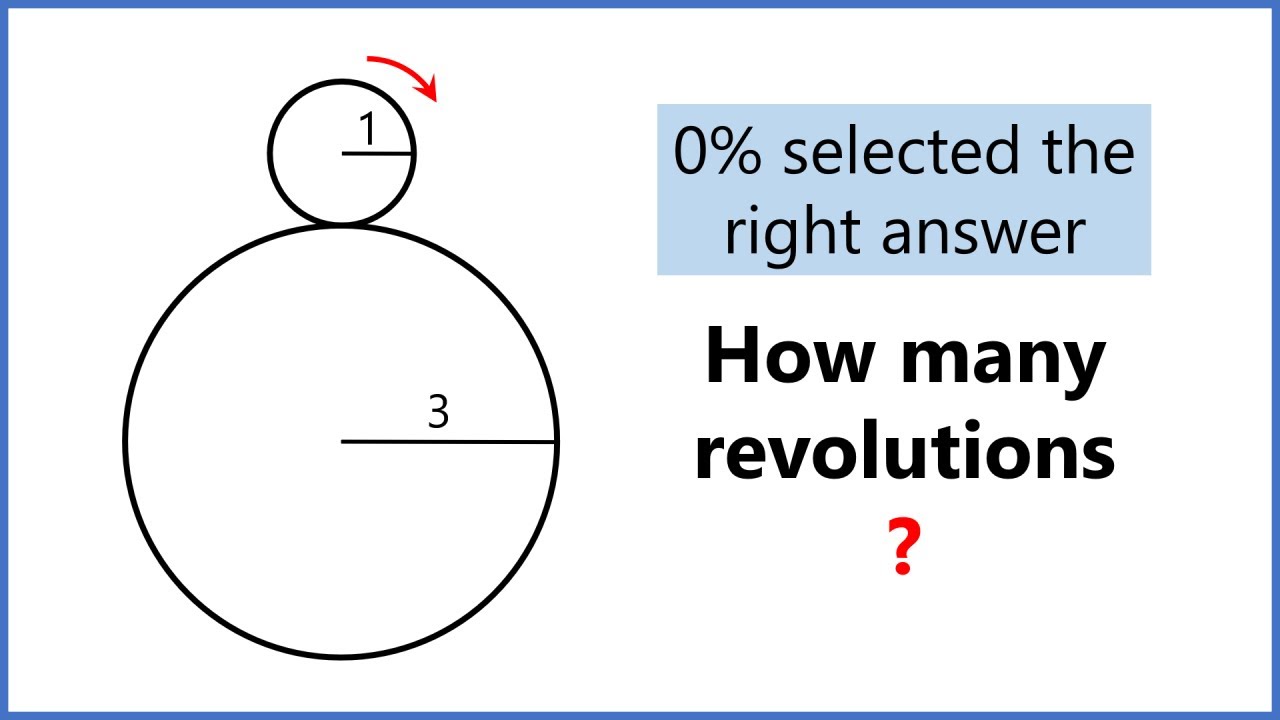
Problem: Circle A has 1/3 the radius of circle B, and circle A rolls one trip around circle B. How many times will circle A revolve in total?
1982 SAT Question
In the figure above, the radius of circle A is one third the radius of circle B. Starting from position shown in figure, circle A rolls around circle B. At the end of how many revolution...
 prime badge
the video is weird
it says the correct answer is not present ||because it should be 4, but why not 10||
fascinating
still don't get it
crisp grove
I calculated taking both of them fixed like gears so I got 3
 strong furnace
Because center is translating
 sharp barn
How we solve this
 crisp grove
sharp barn
How we solve this
crisp grove
sharp barn
How we solve this
u need to solve this in 2 different interval, when 4-x² ≥0 and when <0
obtuse finch
thats what i said
sharp barn
yep
sharp barn
crisp grove
u need to solve this in 2 different interval, when 4-x² ≥0 and when <0
So how do we find the positive interval first
crisp grove
when is 4-x²≥0?
 crisp grove
that's what I'm asking u, u should be able to solve this or atleast try
when is 4-x²≥0??
elementary inequality
strong furnace
Do you know how to solve basic inequalities?
sharp barn
Yes...
strong furnace
crisp grove
when is 4-x²≥0??
Can you solve this?
crisp grove
@strong furnace that was yr username, I though like 5ppl are typing
obtuse finch
-x^2+x-2 solve this now
strong furnace
crisp grove
<@373549242754793472> that was yr username, I though like 5ppl are typing
maybe I am worth 5 😁👍
sharp barn
strong furnace
Can you solve this?
2?
crisp grove


strong furnace
sharp barn
2?
You would want to go over inequalities if that's what you came up with
obtuse finch
He has a major in maths no cap
sharp barn
Holy cow then what is it
obtuse finch
just wait 8 mins
glass lichen
Just a suggestion @obtuse finch dont spam the channel if you cant help
glass lichen
You cant, given you suggested wait so someone else can help
glass lichen
there's nothing to solve, that's an expression
sharp barn
Yeah what is there to solve
obtuse finch
glass lichen
there's nothing to solve, that's an expression
I apologise i thought i knew
but tbh factorise
-x^2+x-2
glass lichen
obtuse finch
but tbh factorise
-x^2+x-2
over R or C?
sharp barn
x(-x+1)-2?
glass lichen
you cant factor that over R
obtuse finch
glass lichen
over R or C?
which curriculum are you following?
obtuse finch
factorise it
glass lichen
over R or C?
obtuse finch
what does that mean, its just quadratic equation
crisp grove
no real roots @obtuse finch
glass lichen
it's irreducible over R, so I was asking you meant factorize over the complex numbers or over the real numbers
sharp barn
Ok back to my question how do i go from what i have already done
crisp grove
sharp barn
Ok back to my question how do i go from what i have already done
what have u "already done"?
sharp barn
sharp barn
,
crisp grove
@sharp barn so you assumed |4-x²| = 4-x²?
sharp barn
Ok then what is it
crisp grove
you know when |a| = a? or -a??
sharp barn
a?
glass lichen
You need to consider when the thing inside the absolute value bars is positive and negative
sharp barn
ok..
glass lichen
so it's easy to verify that 4-x^2>0 when -2<x<2 either by solving the inequality or a rough sketch
so solve $4-x^2=2-x$ and take any solutions such that $-2\leq x\leq 2$
ocean sealBOT
Mosh
 sharp barn
So what i have done is wrong?
crisp grove
sharp barn
So what i have done is wrong?
in short yes
u also have to account for the modulus by restricting the values.
crisp grove
ocean seal
**Mosh**
.
sharp barn
Can you show me the wroking of how u would have done it?
Then explain from there cuz i dont know how to do it
crisp grove
first $ | 4-x^2|$ will be $4-x^2$ if $4-x^2\geq 0$.
ocean sealBOT
Ryuzaki
 crisp grove
make sure you understand this
sharp barn
Yes okay
crisp grove
and $|4-x^2|=x^2-4$ if $4-x^2 <0$
ocean sealBOT
Ryuzaki
 sharp barn
wait i dont get the second one
crisp grove
that's the absolute value function
sharp barn
U just reverse their position
glass lichen
|a| = a when a is non-negative and -a when a is negative
crisp grove
$ |x| = \begin{cases} x , &x\geq 0 \ -x , &x<0\end{cases}$
ocean sealBOT
Ryuzaki
 crisp grove
so if $4-x^2<0$ then $ | 4-x^2 | = -(4-x^2)$
ocean sealBOT
Ryuzaki
 crisp grove
so $4-x^2 \geq 0$ means $ -2 \leq x \leq 2$
ocean sealBOT
Ryuzaki
 sharp barn
Why is it -2<=x<=2

 sharp barn
Roots of 2’-1?
crisp grove
yes but remember we assumed x must lie in between -2 and 2 and we see that both 2 and -1 lies in that interval. so 2, -1 will be roots
that's the first part
for the second part we assumed that 4-x^2 < 0 => x < -2 or x>2
and that gives us the equation -(4-x^2)=2-x
which has the roots -3, 2, but we assumed x <-2 or x>2 which gives us only one root, -3.
 unborn dome
can someone help me out with this question
 crisp grove
so combining both we get the roots 2, -1, -3
unborn dome
i think its sin(4x) = 9/20 but not entirely sure how to go from there
sharp barn
crisp grove
so combining both we get the roots 2, -1, -3
Alright then where do we go from here
crisp grove
that's your answer, you don't need to go anywhere
unborn dome
unless i have to convert the -0.45 using the unit circle but.....
crisp grove
unborn dome
i think its sin(4x) = 9/20 but not entirely sure how to go from there
yes correct
are you allowed to use calculator?
unborn dome
yea i am
crisp grove
then sin(4x)=9/20 gives 4x = asin(9/20)
unborn dome
still abit confused @crisp grove
cuz lets say i use a calculator online
the thing doesnt accept answers in n
 strong furnace
unborn dome
can someone help me out with this question
strong furnace
unborn dome
can someone help me out with this question
this says smallest positive solution
what the calculator is giving you is a general expression for solution
crisp grove
unborn dome
the thing doesnt accept answers in n
which value of n gives positive solution, smallest to be exact
unborn dome
so cant i just do 6.68592/90
crisp grove
@strong furnace so you have phd on which topic?
crisp grove
unborn dome
so cant i just do 6.68592/90
why /90?
 hardy basin
Can someone help me integrate this (1/r) * (du/dr)
u is a function of r
strong furnace
crisp grove
<@!373549242754793472> so you have phd on which topic?
grindset
crisp grove
choose n=any integer of your choosing
strong furnace
but is that the smalles postive solution*?
crisp grove
yes but they asked for smallest positive solution
crisp grove
strong furnace
but is that the smalles postive solution*?
well yes
strong furnace
bruh brainfart
crisp grove
now it's outdated
unborn dome
gm
hm
this is indeed a tricky question
@crisp grove how about 6.68592 +90(-0.45)
crisp grove
n = integer...
crisp grove
well if you wanna ask for every single integer, it's gonna take forever
I leave that part for you
unborn dome
hm still a bit confused
shrewd blade
need help plz
 crisp grove
I believe you have already asked this question before
shrewd blade
I havent got the actual answer 😦
crisp grove
ok I'm giving the straight answer
shrewd blade
thank you
ocean sealBOT
Ryuzaki
 unborn dome
@crisp grove i figured it out
because 9/20 isnt on the unit circle i just did arcsin(0.45)/4
crisp grove
answer is correct but idk what you mean by 9/20 not being on the unit circle
alpine sable
Probably that their unit circle doesn’t show the value 9/20
unborn dome
cuz in this video @crisp grove the guy already has a perfect decimal and translated it https://www.youtube.com/watch?v=sqz5wbGzXEI&ab_channel=Mathispower4u
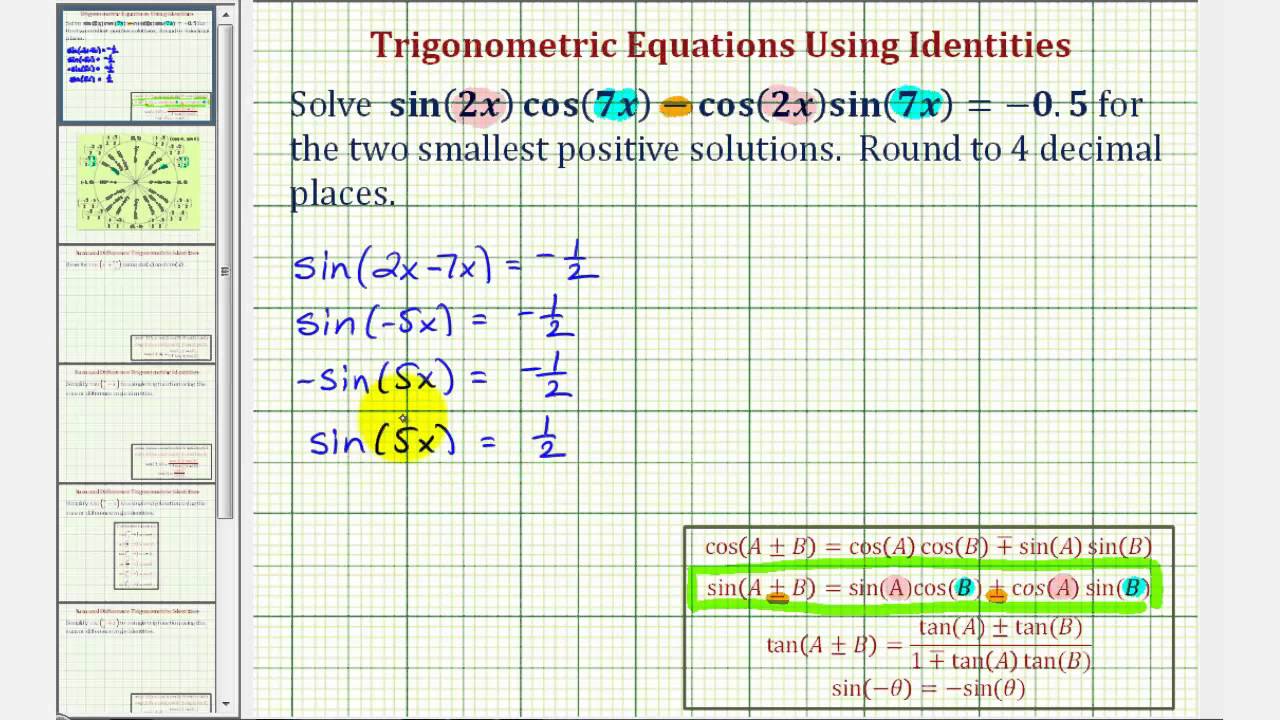
This video provides an example of how to solve a trigonometric equation using sum and difference angle identity.
Site: http://mathispower4u.com
to which he gets 1/2
crisp grove
lol
that's not what you call 'not being on the unit circle'
sin(x) takes every value from -1 to 1
crisp grove
it's just not a typical everyday angle like pi, pi/2, pi/6 etc
shrewd blade
?
unborn dome
yea.
crisp grove
shrewd blade
<@!468830761261203476> I coouldnt solve it with this equation
well
basic linear equation ig
shrewd blade
fineeee
unborn dome
@crisp grove does that mean if i cant find a typical everyday angle with the decimal given turned into a fraction, I could just do the arcsin(decimal) division thing
crisp grove
yes
unborn dome
aaaaaah thats a relief
sorry for asking all these qustions @crisp grove
my math professor is notorius for being a speedrunner, records that would put Dream to shame
I try to keep up but man she's just knocking units within like hours
crisp grove
as long as they are relevant, it's fine
 astral dagger
unborn dome
my math professor is notorius for being a speedrunner, records that would put Dr...
astral dagger
unborn dome
my math professor is notorius for being a speedrunner, records that would put Dr...
 unborn dome
lmfao
it be like dat
Dream Running Music 1 HOUR (Trance Music for Racing Game). If you want the link to the video (the one I used) here it is
https://www.youtube.com/watch?v=tJFqdLg58i4
Subscribe, because i'm going to make more 1 hour videos on the music that dream uses.
crisp grove
yes
glass lichen
yeah, x is a function of k
shrewd blade
so do Ijust write x=-3+k as the answer?
glass lichen
yes
kindred dock
How did he get 11?
 glass lichen
cba to actually do it, but given ryuzaki already said it was correct..
glass lichen
kindred dock
How did he get 11?
well can you find x and y explicitly?
glass lichen
thanks peanut gallery
kindred dock
shrewd blade
8 and 3 are the numbers
Ik that but I have to do the working
shrewd blade
kindred dock
Ik that but I have to do the working
okk
glass lichen
$x-y=5 \ xy=24$
ocean sealBOT
Mosh
 shrewd blade
ocean seal
**Mosh**
shrewd blade
ocean seal
**Mosh**
yep thats the equation
glass lichen
Im aware it is.
kindred dock
I got that and then I got stuck
shrewd blade
glass lichen
Im aware it is.
lol 🙂
glass lichen
$x-\frac{24}{x}=5$
ocean sealBOT
Mosh
 kindred dock
@glass lichen what to do after that
glass lichen
Solve for x
kindred dock
Iam not able to
glass lichen
It's a quadratic after you've multiplied through by x
crisp grove
,w x-24/x=5
ocean sealBOT


 Requested by Ryuzaki#6999
kindred dock
Requested by Ryuzaki#6999
kindred dock
Why should I multiply by x?
 gloomy lintel
To get rid of the -24/x
 hushed pasture
$\lim_{n \to +\infty} \sum_{k = 1}^n \frac{1}{n + k^{\alpha}}, \alpha>0$
ocean sealBOT
Salah
 hushed pasture
I want to find limit for this but I did only for for alpha = 0 and 1
 twin nimbus
Is that a question?
hushed pasture
twin nimbus
Is that a question?
what do you mean lol
twin nimbus
That was a statement. "I want to find the limit, and I did it for alpha = 0 and alpha = 1" Did you get 1 and ln(2) respectively? Do you need a general form?
hushed pasture
yeah now i need for every alpha except for 1 and 0
twin nimbus
What have you done so far?
hushed pasture
nothing I don't know where to start
I think of factorizing the deno by n but it doesn't work
twin nimbus
you have computed the limit with two specific values of alpha, what approach did you take?
hushed pasture
twin nimbus
you have computed the limit with two specific values of alpha, what approach did...
when alpha = 0 the hole sum equal 1
twin nimbus
I know
hushed pasture
and for alpha = 1 it's a Reimann itegral
but when I tried for alpha = 2
I get stuck
because i think of finding a pattern
twin nimbus
If you want to guess a pattern, you already have enough information to
But that's not a proof.
 winter salmon
 twin nimbus
@winter salmon what are your thoughts on this problem? It's related rates, and I assume you're in Calc 1.
winter salmon
twin nimbus
<@!654112215414210590> what are your thoughts on this problem? It's related rat...
im in pre calc 2 and tbh i don't really know where to start our teacher just put this problem in our homework we are supposed to be leraning about functions rn
twin nimbus
So you can make two equations using the perimeter and area. Can you do that for me?
(Recognize that the depth will always be the same, so maximizing area is the same as maximizing volume)
winter salmon
72*24 = 24 * x * y?
twin nimbus
where did the 72 come from?
@alpine sable #rules #❓how-to-get-help this channel is currently in use.
alpine sable
Aight
winter salmon
twin nimbus
where did the 72 come from?
i turned 6ft into 72 inches
 winter mango
so uh
twin nimbus
I see!
winter mango
nvm sorry for interrupting
twin nimbus
But that's not quite correct @winter salmon
winter salmon
1728 = 4y + 6x + 96
1728 is from 72 * 24
and 4y + 6x + 96 is the perimeter of the bookshelf
twin nimbus
On the left your units are inches^3, on the right your units are inches
Clearly these two values cannot be equal
winter salmon
ah
twin nimbus
sorry, I know how to solve this problem, and I have in fact already solved it, but I did so using a calc 3 technique, and I can't recall how to do so using only precalc...
winter salmon
twin nimbus
sorry, I know how to solve this problem, and I have in fact already solved it, b...
could you walk me through how you solved it with your calc 3 technique
twin nimbus
I used a Lagrange multiplier.
In mathematical optimization, the method of Lagrange multipliers is a strategy for finding the local maxima and minima of a function subject to equality constraints (i.e., subject to the condition that one or more equations have to be satisfied exactly by the chosen values of the variables). It is named after the mathematician Joseph-Louis Lagra...
\begin{align*}
f(x, y) &= xy &&\text{The area function we want to maximize} \
g(x, y) = 0 &= 3x + 2y - 72 && \text{The contraint, given by the perimeter and total length of board.} \
\mathscr{L}(x, y, \lambda) &= f(x, y) - \lambda g(x, y) \
&= xy - \lambda (3x + 2y - 72) \
\grad \mathscr{L} = 0 &= \qty(\pdv{\mathscr{L}}{x}, \pdv{\mathscr{L}}{y}, \pdv{\mathscr{L}}{\lambda}) \
&= \qty(y - 3 \lambda, x - 2 \lambda, 72 - 3x + 2y)
\end{align*}
 pallid wigeon
Hi all! I have a simple problem I’m stuck on. I’m trying to find the percent error of a cone’s volume when the error of the radius and height are 1 and 2 percent respectively.
twin nimbus
Then you solve the three equations.
 twin nimbus
Hi Atlas, sorry, I was in the middle of something a little involved with stuck in a dream. I'm not sure if he's coming back though.
winter salmon

pallid wigeon
Oh, I’m sorry! Should I join another lobby?
ocean sealBOT
OmnipotentEntity
 twin nimbus
Sorry, I had a little bit of a markup issue
When you solve these three equations, you should get that x = 12, and y = 18, (and lambda = 6).
However, I have no idea how to do this using only things a precalc student would know
can you share the name of your book, and tell me what chapter you are on?
@winter salmon
winter salmon
well
twin nimbus
I might be able to come up with a more level appropriate solution
twin nimbus
Well... what topics have covered in class lately @winter salmon ?
winter salmon
twin nimbus
Well... what topics have covered in class lately <@!654112215414210590> ?
logarithms, imaginary numbers, square roots and exponents, functions
and inequalities
twin nimbus
It's weird that you'd get a constraint optimization problem then.
Have you talked about finding maxima and minima?
winter salmon
is maxima and minima just maximum and minimum
glass lichen
winter salmon
is maxima and minima just maximum and minimum
yes, plural of maximum is maxima
winter salmon
oh
twin nimbus
\begin{align*}
A(x,y) &= xy \
72 &= 3x + 2y \
y &= 36 - \frac{3}{2}x \
A(x) &= x\qty(36 - \frac{3}{2}x)
\end{align*}
ocean sealBOT
OmnipotentEntity
 twin nimbus
Then you just find the maximum of this parabola.
winter salmon
ohhhh
twin nimbus
which will be midway between the two roots, or where the slope = 0, depending on the technique
 oak chasm
Or at the vertex of the parabola.
winter salmon
twin nimbus
Then you just find the maximum of this parabola.
216
twin nimbus
That's the area.
 dull onyx
twin nimbus
which will be midway between the two roots, or where the slope = 0, depending on...
dull onyx
twin nimbus
which will be midway between the two roots, or where the slope = 0, depending on...
wait whats the first technique ㅠㅠ i just say f’(x) = 0
oops sorry u guys aren’t finished</3
twin nimbus
The vertex is at the average of the two roots.
of any parabola.
(because symmetry)
twin nimbus
winter salmon
216
That's the total area, but you want the dimensions, so you have to find x and y.
winter salmon
x= 24 y = 9?
twin nimbus
3 * 24 + 2 * 9 = 90
Clearly it cannot be these two values.
because it fails your constraint.
(besides, I already revealed the answer upthread)
hushed pasture
twin nimbus
But that's not a proof.
it seems like you already know the answer
twin nimbus
hushed pasture
it seems like you already know the answer <:thonkzoom:533366356536721418>
I have a guess, which is ln(1 + alpha), but I don't know if it is correct.
hushed pasture
twin nimbus
I have a guess, which is ln(1 + alpha), but I don't know if it is correct.
if you are free send me what you did, if not dm me later
twin nimbus
winter salmon
wait no that wouldnt work
what are you having difficulties with?
winter salmon
i was thinking of x = 0 and y = 45 but wouldn't that be an extraenous solution
twin nimbus
You're trying to find the location of the vertex of this parabola, to find the maximum area that satisfies this constraint.
You found the area to be 216. But at what x location did that occur?
winter salmon
(12,219) would be the vertex
twin nimbus
ok. So x = 12
twin nimbus
No, 72
your constraint is 72. The 90 was a failing constraint from earlier that you supplied.
twin nimbus
Yes.
winter salmon
y = 18
twin nimbus
yw
twin nimbus
hushed pasture
if you are free send me what you did, if not dm me later
I apologize, I didn't actually do any work, and I also didn't think my guess through well. It is unlikely to be ln(1+alpha).
alpine sable
hello, why is 6a9 not considered a term?


 tough hatch
 autumn epoch
think about what happens to S after shoveling for 5 hours (h=5)
obviously S cannot be negative as S represents the amount of snow left to shovel
twin nimbus
alpine sable
hello, why is 6a9 not considered a term?
What does 6a9 mean? It seems like a keymash.
Actually, I think that might be the point. It doesn't carry a well-defined mathematical meaning, so it cannot be a term in an expression (because what would you even do with it?)
alpine sable
well that's an example of what a term isn't in my textbook, 6 is supposed to be the coefficient and 9 is supposed to be a factor of a
alpine sable
twin nimbus
Actually, I think that might be the point. It doesn't carry a well-defined math...
that makes sense as another example was 3x-, in which the negative notation was kind of pointless
twin nimbus
9 is supposed to be a factor of a
So x6 implies that x is divisible by 6?
alpine sable
oh do you mean when you reverse the equation?
twin nimbus
You said a9 means "9 is supposed to be a factor of a". If 9 is a factor of a, then there is some number b such than 9b = a.
alpine sable
oh wait I used the wrong word my bad
what is the word for a number which multiplies another one?
I'm stupid
oh product
alpine sable
yes
twin nimbus
what you're saying is 6a9 = 6 times a time 9?
alpine sable
yes
twin nimbus
you could parse it like that, I suppose, but it's kinda abnormal.
alpine sable
so is it a term?
twin nimbus
I would imagine that depends on who you ask. I would consider it malformed unless there was a very good reason and explicit explanation.
tough hatch
could you actually post a pic of wherever u got this in your book?
alpine sable
sure
twin nimbus
like, you're in an algebra where multiplication is non-commutative
even then I would prefer explicit rather than implicit.
alpine sable
I mean the thing is, abviously multiplication is commutative so 6a9 is the same as 54a, which is a term
I think the author might have made a mistake?
twin nimbus
multiplication is not always commutative in all systems.
it is in our familiar real numbers though.
alpine sable
yeah
twin nimbus
I think the point the author is making is if you have a numerical coefficient, it always goes first.
6a9 is bad, but 6 * 9a or (6*9)a is acceptable.
alpine sable
yeah well if that's the authors point, it's still incorrect in the realm of real numbers
tough hatch
it would probably help us if you posted the pic btw
twin nimbus
only if you consider a9 to be well formed. Which I don't.
 twin nimbus
yeah, he does the same thing with 7 sqrt(a8)
tough hatch
yeah i see that the author is saying that 6a9 is not a term
it just makes no sense to write it that way, unless you are a masochist.
like omnipotent said, better write it as (6•9)a or 54a
twin nimbus
or if you're in a non-commutative algebra 6 * a * 9
alpine sable
definetely in commutative algebra as he explained the commutative property earlier on
tough hatch
the author seems to be introducing to you the convention of writing coefficients to the left of the variables
alpine sable
so 6a9 is not a term but 54a is?
twin nimbus
alpine sable
definetely in commutative algebra as he explained the commutative property earli...
The point being that even if you're in a non-commutative algebra, I would still prefer if you wrote the right multiplication of a numeral explicitly rather than implicitly.
tough hatch
just write them coefficients first, variables last
alpine sable
still no idea how it doesn't count as a valid term in commutative algebra
tough hatch
but even without this strange list you should be able to understand what terms already look like
and how we write them
alpine sable
tough hatch
but even without this strange list you should be able to understand what terms a...
That I do but I was just wondering
twin nimbus
The thing about mathematics is there are definitions and then there are conventions. You can define a9 = a * 9. But the point is this usage is not conventional, so other people reading your work will have a difficult time.
alpine sable
the author did also explain how the multiplication notation is arbitrary when multiplying a variable
tough hatch
alpine sable
still no idea how it doesn't count as a valid term in commutative algebra
this was not the point
alpine sable
straight up completely lostr
tough hatch
tough hatch
just write them coefficients first, variables last
commutativity is far from what the author is trying to say
it's just a matter of notation
alpine sable
ok, so is 6a9 not a valid term?
tough hatch
with how they defined it in your book, probably
tough hatch
the point is to write coefficients first, then variables last
for example
54wxyz
that's it
alpine sable
ohhh wait I see your point
tough hatch
you're overthinking this
twin nimbus
Not stupid. Just learning
alpine sable
that's a nice way of putting it
i am a new here..I want to start olympiad math>>I am a high school student..i sthere any plan for beginers to start
when a value x is a power of 2, that is, x = 2^n for some nonnegative integer n, we can readily write x in hexadecimal form by remembering that the binary representation of x is simply 1 followed by n zeros. the hexadecimal digit 0 represents 4 binary zeros. So, for n written in the form i + 4j, where 0 <= i <= 3 , we can write x with a leading hex digit of 1 (i = 0) , 2(i = 1) , or 8(i = 3), followed by j hexadecimal 0's. As an example, for x = 2,048 = 2 to the power of 11, we have n = 11 = 3 + 4 * 2, giving hexadecimal representation 0x800.
could someone help me understand this
ionic jewel
alpine sable
i am a new here..I want to start olympiad math>>I am a high school student..i s...
literally just do problems (with solutions) and if you spend more than like an hour or two look at the solution and learn whatever technique you are missing
twin nimbus
@alpine sable I think you mean x = 2^n not 2n
alpine sable
twin nimbus
<@456226577798135808> I think you mean x = 2^n not 2n
yes
ionic jewel
the IMO math server has tons of solutions problems, but you could also do easy putnam ones and such
twin nimbus
@alpine sable the powers of two are 1, 2, 4, 8, 16. Right? In hex this is 0x1, 0x2, 0x4, 0x8, 0x10.
alpine sable
ionic jewel
the IMO math server has tons of solutions problems, but you could also do easy p...
thanx>>but where is the server
twin nimbus
Do you see the pattern?
ionic jewel
alpine sable
thanx>>but where is the server
dmd
check #question of the day and #problem of the day
and also general competitive math questions in that server
alpine sable
ionic jewel
check #question of the day and #problem of the day
Where?
ionic jewel
alpine sable
Where?
dmd you the server
 spice crypt
can anyone help me figure out how to evaluate this?

I tried changing to cylindrical coordinates but I either screwed up or that just doesn't work
not entirely sure how to approach this question with spherical coordinates, since that sqrt(1-x^2) term would be dependent on both phi and theta
spice crypt
yep
 river knot
ill try lol i forgot lots of my calc III
spice crypt
thanks
river knot
im currently prepping for GRE subject so i need to k now this lol
gimme a sec to play with it a bit
spice crypt
apparently spherical coordinates have multiple standards for how they're written for some reason. Just so we're on the same page, this is the conversion I was taught
 spice crypt
thanks
river knot
can you try it using cylindrical
cause i looked at my calc book and it looks as though you can do either
but if you need it done in spherical ill try spher
spice crypt
it might work, I might've just screwed up the cylindrical coordinate change
river knot
ok lemme try real quick
spice crypt
all I need is how to get it, doesn't matter which transform we use
river knot
ok
tough hatch
spice crypt
can anyone help me figure out how to evaluate this?
it helps to graph your bounded region too!
river knot
true
tough hatch
so you can change the bounds easily
spice crypt
that's good to know, thanks!
river knot
yes
wait calc III
i have this one called
vector calculus by
Jerrold Marsden and Anthony Tromba
imo
this one is more clear cut concise
and right to the point
lots of physics examples too
but this is calc III
for calc I,II i like stuart over larsen but if you REALLY wanna learn then buy
calculus on manifolds by spivak
lol yes james stuart
and just doing exercises honestly
im sort of stuck on that triple integral lol
spice crypt
dw I've been stuck on it for at least an hour now
ionic jewel
,calc 23+46
ocean sealBOT
Result:
69
 young patrol
nice
 blissful tinsel
nice
ocean sealBOT
The following error occured while calculating:
Error: Value expected (char 1)
tough hatch
tough hatch
think about what happens to `S` after shoveling for 5 hours (h=5)
woot woot
 maiden shoal
would like someone to check on my work
autumn epoch
@tough hatch would the answer for it be A
winter mango
yes
astral dagger
,tex Changing to cilindrical coordinates, we have (\begin{cases}x=r\cos(t)\y=r\sin(t)\z=z\\end{cases}), then (\rm{d}z,\rm{d}y,\rm{d}x) must be equal to (|J|\cdot\rm{d}r,\rm{d}t), with (|J|=\begin{Vmatrix}\partial_r x&\partial_t x&\partial_z x\\ \partial_r y&\partial_t y&\partial_z y\\ \partial_r z&\partial_t z&\partial_z z\\end{Vmatrix}=\begin{Vmatrix}\cos(t)&-r\sin(t)&0\\sin(t)&r\cos(t)&0\0&0&1\\end{Vmatrix}=|r|) being the Jacobian of the transformation. Then, you still need to find the limits for that variables, since the region is upper bounded by a sphere of radius (\sqrt{2}) and lower bounded by a cone. Also, the limits for (x) and (y) determine how the region is bounded on its sides, with a cilinder of radius (1). So, we make (0\leq r\leq 1) and (0\leq t\leq 2\pi) and integrate: (\int_0^{2\pi}\int_0^1\int_r^{\sqrt{2-r^2}}r,\mathrm{d}z,\mathrm{d}r,\mathrm{d}t=\dfrac{4}{3}\cdot(\sqrt{2}-1)\pi~~ \bold{u.~v}).
I hope it's correct
spice crypt
I had tried something with spherical coordinates and managed to get $\frac{1}{3}(\sqrt{2}-1)\pi$

 astral dagger
ocean seal
**(𒀭)**
astral dagger
ocean seal
**(𒀭)**
well, the best way to confirm it is using elementary school maths hahahaha
spice crypt
wait I can plug this into desmos or something and get an approximation
 slender marten
Throw into wolfram triple integral calculator to be sure.
spice crypt
 slender marten
Why you pulling out jacobian for this problem. :/
slender marten
$\iint_{D} \left( \int_{z = r}^{\sqrt{2 - r^2}} \dd{z}\right) \dd{A}$.
ocean sealBOT
stabulo
 ionic jewel
also \iiint
spice crypt
good to know :)
slender marten
You don't need to compute a jacobian here, since dA is a well known one.
astral dagger

In geometry, a spherical cap or spherical dome is a portion of a sphere or of a ball cut off by a plane. It is also a spherical segment of one base, i.e., bounded by a single plane. If the plane passes through the center of the sphere, so that the height of the cap is equal to the radius of the sphere, the spherical cap is called a hemisphere.
spice crypt
slender marten
You don't need to compute a jacobian here, since dA is a well known one.
it is?
astral dagger
slender marten
You don't need to compute a jacobian here, since dA is a well known one.
Just for completeness
slender marten
The polar coordinates area element is the most well known one I know of for sure.
$\dd{A} = r\dd{r}\dd{\theta}$.
ocean sealBOT
stabulo
 slender marten
Maybe, if you're new to it, it's not well known.
ocean sealBOT
SubGui
 ionic jewel
spherical equivalent is also well known i believe
spice crypt
neat
slender marten
I think so, there's probably only two well known ones.
astral dagger
ionic jewel
spherical equivalent is also well known i believe
(\rho^2\sin(\varphi),\rm{d}\rho\rm{d}\varphi,\rm{d}\theta)
ocean sealBOT
SubGui
 slender marten
Maybe, some rarely used command or something.
ionic jewel
ah I've seen \[ but not \(
ocean sealBOT
SubGui
 slender marten
I prefer the other phi though.
 ionic jewel
i handwrite that way but i think the other one looks nicer
slender marten
I don't like the other since it varies from what books or online resources use, I love consistency.
ocean sealBOT
bunny
 ionic jewel
$\Phi$
ocean sealBOT
bunny
 ionic jewel
hmph
ocean sealBOT
stabulo
 ionic jewel
ah i see
tired hamlet
How would I start this can I have some help I have been trying for a long time but am confused

 candid sluice
ocean sealBOT
candid sluice
ocean sealBOT
cup

 red phoenix
alpine sable
can someone help me with
red phoenix
alpine sable
can someone help me with
What are you thinking?
ocean sealBOT
cup
 alpine sable
then i do
$\int _0^{\pi }\cos ^2\left(x\right)dx+\int _0^{\pi }8\cos \left(x\right)dx+\int _0^{\pi }16dx$
ocean sealBOT
cup
 alpine sable
but idk what to do from here
 solar cradle
There's a nice identity for cos^2(x) that you could use
red phoenix
alpine sable
but idk what to do from here
cos^2 x does have formulas
You can alternatively work it out by hand
Also can do by parts once, and get a sin^2x to worry about instead
astral dagger
tired hamlet
How would I start this can I have some help I have been trying for a long time b...
(\dfrac{(x+2)^2}{25}-\dfrac{(y+1)^2}{16}=1)
ocean sealBOT
SubGui
 astral dagger
https://www.softschools.com/math/pre_calculus/hyperbola_asymptotes/ this make it easy
Hyperbola: Asymptotes
ocean sealBOT
cup
 alpine sable
This is the identity?
ionic jewel
alpine sable
$\int _0^{\pi }\cos ^2\left(x\right)dx+\int _0^{\pi }8\cos \left(x\right)dx+\int...
2nd and 3rd integrals are trivial using integral rules, first one you can use an identity (which isn't what you linked) or you can do IBP iirc
red phoenix
alpine sable
if it isnt what i linked then what is it
integrate 1/2 * (cos(2x) + 1)
alpine sable
ok ty
 hallow kite
Can anyone help explain a simple rational equation algebra problem?
I'm super confused rn!
glass lichen
are you going to ask...?
glass lichen
I mean posting the question is usually a good place to start...
hallow kite
how does this become 2x(x+1)-1?

I'm not sure how to solve this bc its a little too compound for me atm
glass lichen
distribute it
hallow kite
do you put x(x+1) in front over 1?
glass lichen
$=2x(x+1)-\frac{x(x+1)}{x(x+1)}$
ocean sealBOT
Mosh
 hallow kite
So if this cancels out, -1 is left?
 hallow kite
ok one last question
Do you ever put this over 1? or should I just leave it be most of the time

 gaunt glacier
Most people would not put it over 1, but it doesn't matter if you do, the result will be the same. If it makes it easier, go for it. But eventually you won't do that, because it's just more writing
hallow kite
Ok thank you very much. I was having trouble and this cleared things up. 🙌


 noble sinew
sure but to test if the results are consistent with the model you should do a test like G-test or Fisher's test or some other related test
 warped phoenix
noble sinew
sure but to test if the results are consistent with the model you should do a te...
warped phoenix
noble sinew
sure but to test if the results are consistent with the model you should do a te...
idk what those are 😅
noble sinew
Well ye above an introductory stat course probably but you can't conclude anything really by looking at those values
since any simulation is gonna have some variance
so idk what they want you to say, but the probability of the null hypothesis being true (so the simulation is consistent with the model) is 0.8175
warped phoenix
noble sinew
Well ye above an introductory stat course probably but you can't conclude anythi...
the answer was that it was not consistent with the model "because more cars were selected as gray or white in the simulation than black. The number of values in the random number generator for new black cars sold was greater than for gray or white."
which holds true with what i drew out, so i suppose that is correct
noble sinew
That is just wrong
Try flipping a coin 2 times, if you got 2 heads would you say the coin is not fair?
clearly sample size matters, if we however flipped it 100 times and got like 90 heads one can probably conclude it is indeed not fair
if you did 800 simulations and got the same proportions the p-value would be around 0.05 so that is when you could conclude something is wrong with the simulation
warped phoenix
ah