#help-0
1 messages · Page 731 of 1
 jade peak
b=1 --> 3.10
b=2 --> 3.14
u were right
3 is also 3.14
that is due to limit of display
3
it does just round based on decimal
thanks...
 sour kelp
someone told me a graph that is symmetric with the x axis can not be a function. So what about f(x)=0?
 vale wigeon
that's the one exception
unless it's the graph of the zero function, it's going to fail the vertical line test
sour kelp
ok, thank you
 alpine sable
Hey, I have a question, what is x=log 0 , base e?
 rigid smelt
undefined
alpine sable
why
rigid smelt
because there is no x such that e^x = 0
alpine sable
cant we even use*i , for a complex solution or is there not even a complex solution
rigid smelt
again, it is undefined
alpine sable
oh,
rigid smelt
if there were i would have said its a complex number or something else
vale wigeon
@alpine sable no, there is not even a complex solution.
e^z can return every complex value except 0
alpine sable
yes
 rigid island
hello
question about logs

why doesn't my method work
the method on the left is the correct working, however, why doesn't my method work?
 jagged imp
uh
 woeful pulsar
why did you write log(4^x)
rigid island
i'm not sure , that's what the worked example said
 woeful pulsar
yeah there probably is
 merry coral
I created an algorithm to look at the winning and losing streaks of ETH on the 1-hour chart.
Here are what they look like plotted. X being the streak (-4 means 4 negative closes in a row, 4 means 4 positive closes in a row)
The amount of winning streaks is higher than losers because the market was in an uptrend.
So, question:
What's the most accurate parabola or distribution that shows this? (5159 inputs checked, let me know if you need numbers)


 vernal igloo
These are contradicting statements. It says that every point on the gold line is a solution to the equation
y = 1/2x + 3
and every point on the green line is a solution to y = x + 1 So, the only point that's a solution to both equations is the point of intersection
??
There's no solution here. y depends on what x is, so any point on the line works.
There's not something called a "solution" here.. unless I am not understanding something
if there were equations like
2x + 3y = 50
4x + 9y = 43
then here there is a solution

 crisp grove
do you know Cayley Hamilton theorem?@bleak hearth
 bleak hearth
no
crisp grove
oke then computer pA+qI
bleak hearth
ik how to multiply divde matrics
crisp grove
and make them equal with A² elementwise
you'll get 4 equation in terms of p and q and solve them
bleak hearth
yea multply by itself
crisp grove
yes
computer the sum of pA+qI
and compare
@vernal igloo what seems to be your problem?
bleak hearth
ok so for multiplying ig tot (5 4 -4 -3)
crisp grove
ok
bleak hearth
but i dont know how to make it pA+qI
crisp grove
what's pA+qI?
bleak hearth
yea we just solved it
crisp grove
so what's pA? what's qI and what's their sum?
vernal igloo
crisp grove
<@431962622460428318> what seems to be your problem?
They say there's only one "solution" but in that case there isn't.
in slope intercept form, there's no "solution". y depends on what x is.
there's only a "solution" when it's something like 2x+6y = 45
like, "the only point that's a solution to both equations is the point of intersection" makes no sense there
crisp grove
why isn't there a solution in SI form?
bleak hearth
umm i did what u said and got
crisp grove
all the slope intercept form, or ther form are just the representation, the line doesn't change
bleak hearth
(4 2 -2 0)
crisp grove
u get the same solution in every form
merry coral
lol what disribution is this
 crisp grove
@merry coral Normal?
bleak hearth
ohh i can shsow it like this
(4 2)
(-2 0)
merry coral
ooo
crisp grove
@bleak hearth what's that?
bleak hearth
u said to add a and I
vernal igloo
crisp grove
u get the same solution in every form
like, "The only point that's a solution to both equations is the point of intersection" makes no sense there when they also say that every point on the gold line and the green line is a solution
vernal igloo
every point on the gold line is a solution for the first equation
ye
and l2 for green
crisp grove
and the only point that is solution to both is the intersection
vernal igloo
how is it a solution when you're not trying to solve something??
in slope intercept form, you can just pick any x, and find any y, and you get your answer.
alpine sable
Can anybody tell me how he gets pi/2 here as a value that makes the function = to 0? I get the other two answers but not pi/2 UPDATE: Nevermind, he just added 2pi
 crisp grove
vernal igloo
how is it a solution when you're not trying to solve something??
in slope interc...
crisp grove
vernal igloo
how is it a solution when you're not trying to solve something??
in slope interc...
ya but that method only gives the point on that line
bleak hearth
Ryuzaki how do i represent it as linear?
crisp grove
for ex y=x/2+3 will give u point in gold line only
if u want to find a point that both lies on gold and green as well, you have to look for common points in green and gold, whic is, in this case the intersection
crisp grove
bleak hearth
Ryuzaki how do i represent it as linear?
you are supposed to find pA+qI elementwise
bleak hearth
when doing A+i do i use A^2
vernal igloo
calling it a "solution" is just weird unless the intent is to find one point that's both on the green and gold line
crisp grove
for example
p(1 2; 3 4) + (1 0; 01) = (p+1 2p; 3p 4p+1)
do similar to this with pA+qI
crisp grove
@vernal igloo that is a solution if the system
y=x/2+3
y=x+1
these are called system of linear equations
vernal igloo
crisp grove
<@431962622460428318> that is a solution if the system
y=x/2+3
y=x+1
these are ...
i might have got confused a lil bit, but i was more used to look at systems of equations like:
2x + y = 65
5x+6y = 90
crisp grove
equivalent
vernal igloo
because in here, you cant just pick any x, and find any y.
but in the one you posted, you can just pick any x, and find any y for both of them
crisp grove
A²
bleak hearth
ahhh
crisp grove
?
bleak hearth
ok i got it but 1 question @crisp grove why do we quate A^2 to pA +Qi
crisp grove
because question says write A^2 in the form pA+qI
so we are equating them and solving for p and q
bleak hearth
ahh ok tytytytytytytytyty ❤️
alpine sable
Can someone tell me how he manipulates this to remove the square root on the right? I can't quite figure it out:
 alpine sable

urgent question
what would the range be of the inverse?
would it be all real numbers or (3,infinity)
 glass lichen
alpine sable
urgent question
glass lichen
alpine sable
urgent question
why urgency?
alpine sable
i got a test tomorrow
glass lichen
ok.. well range of f^(-1) is the same as domain of f...
alpine sable
i agree
by law
but
f(x) has a domain of all real numbers
therefore the range of inverse would be domain of non-inverse
but...

as u can see
no its domain
yeah
 gray isle
misread
glass lichen
yes
alpine sable
how so? it says its undefined at a certain point
glass lichen
I mean desmos also stops it randomly, so Im not trusting what desmos says
vale wigeon
dunno i'm def not the person to ask
 halcyon geode
Unless you're doing a PhD ain't no university program requiring 50/60 hours per week
Actually, I retract my statement cuz I don't know that much about programs outside Europe
Well, IMHO universities over here tend to try to get some resemblance of balanced workload, they tend to fail but not so miserably as to reach 60 hours. I did had a semester where I had 38hours of lectures+exercices, but for the most part it also meant we didn't had to put more than 2-4 hours in the weekend as exercices were done in those sessions
So up to 50,in particular semesters, I could see. But between universities trying to get a more or less standard level (with the whole credit system) and less of a workaholic culture I don't see going at that rate constantly
Unless you're going for 20/20, which is less of a thing over here so your mileage may vary
(to be fair, the only people getting 17+/20 on my program where people that kinda did work on their free time for fun, so maybe that's where the 50/60 hours comes from)
Which country is it?
Yeah no totally
Credits between different programs are not the same
I agree with that same here. But they give some amount of bounding. If the university goes too overboard, students will complain that it's requires significantly more time than whatever amount of credits is supposed to be worth it
Programs do vary, but in my experience is less "this program requires 60 hours of work" and rather "this program will have an 80% fail rate in the first year and then people will have to work 40 hours per week"
mmmh let's put it like this. Over here the med program is one of the hardest on the amount of workload, but each class is actually fairly easy (got friends there). Is just that they cover so much material that they do have 40/50 hours of workload
meanwhile there are certain first year courses on physics and math that are known to be grinders with incredible high fail rates
The thing is, the amount of material is not much, and grinding it wouldn't improve that much the results
rather, students just need to get more and more exposure thorugh long process to really get the material
because the exams require working and making proves about things tou haven't seen in class
Dunno if i make sense?
 wanton vortex
me, someone who is interested in studying physics/math in college and is reading this: 
halcyon geode
Mind you, i could be totally off mark
(Like, psychology has the same credits, but they probably put like 20 hours each week...)
I wouldn't say the harders, but one of the hardest yeah. They fight all the time with engineering and math/physics about who has it hardest xD
Belgium
The thing is, i do think that med, while being really hard, is also less prone to drop out exactly because most people can grind 40/50 hours for memory if they're motivated enough, which med students tend to be
So i don't think drop rates are the best indicators, in that case first year physics/math would take the crown with 80% drop rates
But....it's also because for a lot of students it will be the first real math physics exposure
When they realize physics is not nice simplifications and woah dude, and that math is not "i enjoy doing a bunch of calculations"
That's the thing, that's subjective
For example, i do think med students put more hours than math and engineering
like, probably for certain
But i don't think math students will win much by studying more, things require time to be really processed
So any more hours than that it will be a waste
Would be, if you could qualify that, and add "correct expectations" "same faculty culture"
Another thing that makes med super hard here is that second year has a limited number of places
so it doesn't matter if you pass, if you don't pass up to a certain spot in your class, you're fucked
which is a load of bullshit, but you know, happens
Which means math student here tend to help each other, med students tend to fucking compete against each other
Also that
Here a lot of people that failed the entrance exam for polytech go into physics and math thinking they'll tend simply transfer
and get thoroughly fucked xD
I have no idea where to get them sorry, it's also university based, so half of them will be in french, half in dutch, dunno if there are english versions
40 yeah, but there is a lot of difference betwen 40-45 to 50-55. because it mostly means you still get a semblance of personal life. 44 hours is 8h/day on weekday +2 hours saturday/sunday. Hard, lots of work, still allows you to have a life
after that, each freaking hour on top of that is a total pain
But yeah, i had 38h of lectures+excercies in my first semester and the third one
 lofty gorge
To chip in I've had 40 ish hours of work a week in the UK.
halcyon geode
But yeah, bottom line, 40 hours is definitely within the average of total work, some semester you might push 45, 50/60 is another level
woeful pulsar
looks at my expected weekly workload
70
i overloaded math by 40%
probably that i study at 140% speed
because courses at this level are easy
 noble sinew
50h expected work each week is pretty standard in Europe iirc
upper limit for yourself or expected on a course?
halcyon geode
yeah, still you're not getting multivariate calculus if the curriculum says "single variable calculus" :p
noble sinew
noble sinew
50h expected work each week is pretty standard in Europe iirc
like my expected work is 50h each week (I'm not actually spending that much time) but that just depends on each person
undergrad
halcyon geode
same thing over here, i'm assuming the program is rigorous :p
alpine sable
i studied 3 h a day and got all high grades on math/physics/algebra but its my first year so it could be cus its easier material. it rly depends on the person (and yes its college
i think as u said w lectures n stuff its not like you /have/ to dedicate sm hours to study? cus you are also learnin those hours of classes
i did online school so i didnt rly have lectures
videos or stuff i watched were included on those hours
 heavy spear
that is why ii am trying to finish ap calc ab and calc bc
in highschoo,
also take stats in 12th
in 10th rn
alpine sable
i think rather about time is u rly have to be jn the mindset to focus during that time
3h isnt a lot so i was able to turbo focus and get it all in
halcyon geode
states or europe?
heavy spear
halcyon geode
states or europe?
states
halcyon geode
I meant starberry, i knew you were in the states since the ap thing is from there xD
halcyon geode
programa de mates?
alpine sable
not precisely, but ppl who study math do the same programme yea
noble sinew
how tf do you not use more than 3h lol - I have 12h lectures each week+3 assignments each week + self study + excercises
halcyon geode
Is a bit different tho, here there is the 3+2 system, argentine is the 5 year program no?
alpine sable
yes! 6 years
halcyon geode
In south america we tend to have a year to put people up to speed cuz our schools suck ass
noble sinew
ah lol
halcyon geode
I don't know about argentina in particular
alpine sable
noble sinew
how tf do you not use more than 3h lol - I have 12h lectures each week+3 assignm...
i dont have lectures and i didnt have to give in assignments (i still did em
halcyon geode
But that's my experience back home and friends from colombia
alpine sable
cus i took online classes
heavy spear
lol
honestly i can blame online classes for ruining my life xd
cause i dont understand anything i learned so im strugling this year
but lifes life
noble sinew
Atleast you don’t have my prof - he was new at the course and decided he wanted to make the exam totally different and harder. Result? 50% of class failed the exam (around 80 ppl).
heavy spear
wait a min if u take calc in highschool and pass you dont need to in college from my understanding that iis the main reason im taking calc xd
halcyon geode
Definitely not true
You neeed a strong background of algebra, if you are confortable with the practical aspects of limits and derivatives is a big plus too
alpine sable
you should probably continue this discussion in #math-discussion or the like
halcyon geode
True, sorry
heavy spear
true xd
alpine sable
noble sinew
Atleast you don’t have my prof - he was new at the course and decided he wanted ...
literally why would he do that HDJD
people be like: imma become a prof to shit these students!
noble sinew
Lmao ye idk - however the Uni decided that the questions weren’t solveable in the given timeframe and offerered everyone another exam if they wanted to
alpine sable
hell yea thats epic!
 vale wigeon
@heavy spear have you ever worked with the concepts of "odd function" and "even function"?
heavy spear
no
vale wigeon
and you haven't been introduced to them in class either?
heavy spear
no
vale wigeon
then you are being asked a question which you don't have the right tools for
vale wigeon
i mean, you're being given homework on something you haven't been taught.
unless you were expected to learn about it yourself? in which case you should study the section(s) of your textbook which talk about odd and even functions.
heavy spear
we dont have a text book
it is so stupid
like i have to use khan academy to learn concepts since the teacher is kinda lazy and it is inperson learning not even online
vale wigeon
you should talk to your teacher and make them actually do their job i think
heavy spear
ik im pretty sure the teacher hates me since i ask about 20 question on the hw every day
lmao
some times she just gives me answers
withought explaining
vale wigeon
yikes
heavy spear
ye
vale wigeon
i mean ok like
heavy spear
well i am tryign my best so
vale wigeon
i could either tell you the actual definition
of odd and even functions
but this will take some time getting used to
heavy spear
ok
vale wigeon
or i could tell you a shortcut trick which works for this exercise in particular but won't give you a true understanding
heavy spear
nah i want to understand it cause ill prob need it for the test or somthing
vale wigeon
okay
we say that a function f is odd if f(-x) = -f(x) for all x, and we say it is even if f(-x) = +f(x) for all x
in terms of graphs, odd functions have 180° rotational symmetry about the origin while even functions have reflection symmetry about the y-axis
examples of even functions include: |x|, x^2, 1/(x^4 + 1), cos(x), etc.
examples of odd functions include: x, x^7, sin(x), 1/x^3, etc.
heavy spear
k
i think that first part should help me get the answer to the question just plug and chug lmao
vale wigeon
it is just plug and chug yes
heavy spear
thx btw
vale wigeon
a lot of students find themselves confused by it
which is why i was initially apprehensive about giving it to you
heavy spear
are you a teacher you said students ?
vale wigeon
i'm not a teacher, though i do tutor one on one occasionally
i mean students in a broad sense
like, school students who come here
heavy spear
nice
 astral dagger
Hello, I was trying to solve a question that defined a piecewise function f(t) and found some answers that I don't know if are correct or not. Either way, what I want to know is if there's a proof to this:
 crisp grove
proof of?
 ocean sealBOT
Ryuzaki
 astral dagger
indeed, I tried to solve another related question that the answer doesn't seem to satisfy it
like, maybe it has to do with how the function was defined
crisp grove
this statement is indeed true, u sure what you did was right
astral dagger
,tex (f(x)=\begin{cases}1,~\text{if}~0\leq x< 1\0,~\text{if}~x\geq 1\\end{cases})
ocean sealBOT
SubGui
 ocean sealBOT
SubGui
 astral dagger
if it indeed satisfy the statement, then I was just using it wrong
crisp grove
how's f*f /=2-x?

 twin nimbus
I believe he means V(5)
 vital sleet
oops
vale wigeon
V(5) is 10, as you can calculate for yourself.
vale wigeon
V(t) = t^3 - 6t^2 + 35
vital sleet
mhm
twin nimbus
\begin{align*}
V(t) &= t^3 - 6 t^2 + 35 \
V(5) &= (5)^3 - 6 (5)^2 + 35 \
&= 125 - 150 + 35 = 10
\end{align*}
vale wigeon
V(5) = 5^3 - 6 * 5^2 + 35
ocean sealBOT
OmnipotentEntity
 twin nimbus
Is there an established inverse function for $y = x - \sin x$?
ocean sealBOT
OmnipotentEntity
 twin nimbus
I know it's not elementary.
But is there a special function? Something with properties I can reference somewhere?
 warped phoenix

I know how they solve A because I know the formula
but I don't really know what anything means
could someone ELI5? google's not being that helpful LOL, what exactly is the margin of error? For a., it's +/-34.81, what does that 34.81 mean
twin nimbus
The 34.81 is the amount above and below you have to go to make a range where there's a 50% chance the true value falls within the range
warped phoenix
50% chance that what value falls within that range?
any given number? or the 1800
or the 7950 😅
 pine cipher
someone please help 🥺
 warped phoenix
pine cipher
someone please help 🥺
warped phoenix
pine cipher
someone please help 🥺
channel in use
pine cipher
😭
twin nimbus
So if you have an average loan value of $7950, and you pick someone randomly within the population, what is the probability that this person will have a loan of exactly $7950?
Very low, surely.
twin nimbus
What is the probability that person will have a loan between $7900 and $8000? Higher.
Margin of error gives us a way of formalizing it.
Also, I'm not certain your values are correct for the record.
warped phoenix
wdym
for the z-score?? thats what was given to us in the question, idk what a z-score is but my teacher said we dont need to know cuz we'll learn it later
but everything else you see is what my teacher wrote out and said was correct
twin nimbus
the margin of error is the standard deviation * the z score
I don't think you divide by sqrt(n) here.
that should have already been done for you in calculating the standard deviation
warped phoenix
thats what my teacher said to do :/
so when the confidence level is 50% they want to know the probability of having a loan between, 3975 and 11925?
since thats 50% and 150% of 7950
that sounds wrong hahaha
warped phoenix
twin nimbus
No, use the stdev
what does the standard deviation mean
we're told that it's 1800
twin nimbus
It's the square root of the variance.
warped phoenix
does that mean that most loans will be 1800 more or 1800 less than 7950
twin nimbus
it means that, on average, the total loan amount will be different from 7950 by 1800
in this case, "on average" is doing a lot of work.
But that kinda gives you a feeling for the idea behind standard deviation
warped phoenix
so on average, if i were to pick a random person of the sample, their loan might be 9750 OR 6150?
twin nimbus
not quite.
warped phoenix
😦
twin nimbus
Let's say I choose a loan at random, and its amount is 8000. The difference in this case is 50.
I choose another loan, this time the amount is 10,000. The difference is 2050.
Then I choose yet another loan, this one is 2500. The difference is 5450.
I do this a whole bunch of times, then I take the average.
This is kind of what the standard deviation is trying to do.
The mathematics is different behind the scenes, though, for rather complex reasons that you'll learn about in a college statistics course.
so you get slightly different answers, but they're morally similar.
Does this help @warped phoenix ?
 dapper tendon
yes pls u can share it!!
warped phoenix
twin nimbus
Does this help <@!745478303590383616> ?
1 sec
soooo
the standard deviation of this example means that the typical difference of a loan given will vary by $1800?
so the individual loan someone gets wont be a difference of 1800, but the average difference of the entire sample would be $1800
twin nimbus
Yes. And the distribution of that difference is assumed to be normally distributed (which is why you're using a z score)
So there will be more people close and fewer farther away in a very specific sort of sense.
warped phoenix
ok so ive got the stdev down, but the margin of error of 34, what does that mean in accordance to this
the deviation is a difference of $1800, does a margin of error of 34 mean that
idek tbh what it could mean
twin nimbus
Again, I don't think that the MOE of 34 is correct.
warped phoenix
ahahahha thats what my teacher is sticking with ig 😅
but even if its wrong, what does it mean?
that the stdev of $1800 is off by like 34% or something?
idk thats my best guess
twin nimbus
It means, that, because your confidence level is 50%, there is a 50% chance that if you selected someone at random, their actual loan value would be in that range.
7950 +- 34
or 7916 - 7984
warped phoenix
ohhhhhhhhhhhhhhhhhhhhh
so there's a 50% chance that a random person's loan, when there is a difference of 34, will be within the range of the stdev?
(i think...? 😅 )
alpine sable
hi all how would i set up this integral?
 warped phoenix
alpine sable
hi all how would i set up this integral?
warped phoenix
alpine sable
hi all how would i set up this integral?
channel in use
twin nimbus
Let's say you have a bin of balls. And half of them are blue and half of them are red. And you pick a ball and then put it back and shuffle it around each time. You'd get a series of random blue and red ball pulls. You might get 0001000001000111 (where 0 is blue and 1 is red). But each pull has a 1/2 chance of coming up either blue or red.
alpine sable
Two angles of a polygon are right angles and every other angle is 120 degrees. Find the number
of sides of the polygon.
can someone help
please
i have an exam tomorrow
pls
warped phoenix
alpine sable
Two angles of a polygon are right angles and every other angle is 120 degrees. ...
channel in use dude
alpine sable
warped phoenix
channel in use dude
wtf does that mean
twin nimbus
Now we apply this logic to your MOE example. Let's say 0 represents a value within the MOE and 1 is a value outside of it.
warped phoenix
alpine sable
wtf does that mean
twin nimbus
It's still 1 in 2.
instead of picking balls directly, you're picking a value and then examining it to determine if it's inside or outside of the MOE
So if you pick someone and their loan is 7000, it would become a 1. And 7943 would become a 0.
and the assertion is that this MOE gives the range such that whether you get a 1 or a 0 is 50%.
warped phoenix
so there is a 50% chance that we pick someone who's loan is in that range of -34/+34?
twin nimbus
Yes
warped phoenix
then what was the point of the stdev range?
twin nimbus
and if you make the range bigger the chance goes up
if you make the range smaller the chance goes down
warped phoenix
but regardless of the range, it will be within the diff. of 1800?
is that what the stdev is for here @twin nimbus
warped phoenix
well then idk what the stdev is for then 😦
because the MOE is already the important range for us
twin nimbus
You can find any MOE using the stdev
warped phoenix
ohhhhhhhhhhh
wait yeah the stdev is kinda irrelevant here outside of the fact that it's used for the formula
🤦♂️
i see
ig i understand then, ty!!!!!!!!!!!!!!!!!!!!!
i love the hat in time pfp btw 🙂
twin nimbus
thx.
Bumping my question again. Does anyone know a special function or a combination of special functions that is the inverse function of y = x - sin x ? I'm trying to analyze cycloid behavior and I keep running into situations where I need to work around being unable to invert this.
alpine sable
twin nimbus
Bumping my question again. Does anyone know a special function or a combination...
are you a mathematician
twin nimbus
no.
alpine sable
ok
warped phoenix
twin nimbus
Bumping my question again. Does anyone know a special function or a combination...
its been more than 15 minutes since ur original question has been posted, i think ur free to tag helpers now 😄
sorry i cant help im in 10th grade lol
twin nimbus
Ok, I'll put a little bit more work into my question and ping.
 velvet forum
is the inverse not just y = -x + sin(x)?
alpine sable
What would be the most effective/fastest way to solve this problem?: One of two pumps takes 24 minutes longer than the second to fill a container. In 35 minutes, both pump the tank full at the same time. How many minutes does it take for the first pump to fill the container?
 placid zinc
alpine sable
What would be the most effective/fastest way to solve this problem?: One of two...
placid zinc
alpine sable
What would be the most effective/fastest way to solve this problem?: One of two...
Think of the rates as "containers per minute", not "minutes per container"
 clever locust
dapper tendon
yes pls u can share it!!
clever locust
dapper tendon
yes pls u can share it!!
So basically you want to solve the limit
$$\lim_{n\to\infty}\frac{n^{1000000000}}{2^n}=\lim_{n\to\infty} \frac{n^{10^9}}{2^n}.$$
We start by noting a few properties of this which are really easy to prove (for example the first two derivatives can be proven using induction). So if we differentiate the function on the same form as those in the numerator and denominator we have that
$$\dv[m]{x}x^m=m!,$$
$$\dv[m]{x}a^x=\ln^m(a)a^x,$$
where $m$ is a positive integer and $a$ is a positive real number. Now we also note that if $a>1$ we have that
$$\lim_{x\to\infty} \dv[m]{x}a^x=\infty,$$
and if $k$ is a positive integer strictly smaller than $m$ we also have that
$$\lim_{x\to\infty}\dv[k]{x}x^m=\infty.$$
Using what we have now established we can easily see why we can use L'Hôpital's rule $10^9$ times, as we would have $10^9$ instances of an $\frac{\infty}{\infty}$ indeterminate form. Do doing this we get
\begin{align*}
\lim_{n\to\infty} \frac{n^{10^9}}{2^n}&=\lim_{n\to\infty} \frac{(10^9)!}{\ln^{10^9}(2)2^n}\
&=\frac{(10^9)!}{\ln^{10^9}(2)}\lim_{n\to\infty}\frac{1}{2^n}\
&=0
\end{align*}
and thus the limit equals zero.
ocean sealBOT
Lorago
 clever locust
It's a really stupid solution but it works lol
Hopefully I typed it up correctly, I was kind of in a rush
 ionic jewel
10^9 lhopitals in one problem I'm a fan
lofty gorge
The usual method is done by considering the 10^9+1th term in the series expansion for 2^n
lofty gorge
2^n is greater than just that term, so you sandwich with that
ionic jewel
,w series expansion for 2^x
ocean sealBOT


 ionic jewel
2^x = sum_(n=0)^∞ (x^n log^n(2))/(n!)
 ionic jewel
yeah i was going to point that out but seemed obvious enough
astral dagger
crisp grove
how's f*f /=2-x?
the user that answered used the convolution defn. to show that (f\ast f = \int_0^t f(\tau)\cdot f(t-\tau),d\tau), such that (0\leq \tau<1) and also (0\leq t-\tau<1), in which (t-1\leq \tau<t), but then for the first integration, the integrand would be (1) and the for the second, would be (0). That part is the easiest to understand, but then he said when (1\leq t\leq2), the integral must be (f\ast f=\int_{t+1}^{1}1,d\tau=\tau~\biggr|_{t-1}^1=1-(t-1)=2-t), so (f\ast f=\begin{cases}1,~\text{if}~0\leq x<1\ 0,~\text{if}~x\geq 1\2-x,~\text{if}~1\leq x\leq 2\\end{cases}). These limits of integration didn't make sense to me.
ocean sealBOT
SubGui
 astral dagger
that t is a dummy variable
 quick fox
Are you alllowed to cancel 3x+2 in this expression

In the question it does not say that x does not equal -2/3
 austere bridge
quick fox
Are you alllowed to cancel 3x+2 in this expression
austere bridge
quick fox
Are you alllowed to cancel 3x+2 in this expression
you can cancel them out, but you have to keep track of the fact that you did, so the answers you get might not all be valid
it depends on the context
austere bridge
then yeah I would cancel them out and specifically say "assuming x does not equal -2/3"
quick fox
Ok cool ty
 nocturne bronze
oka so what are 12(fiften)-25(twentifive) and tgen plus fore?
<@&268886789983436800> is it ok to mention=
nocturne bronze
no thank
 tame falcon
For the latter, please read #❓how-to-get-help .
 digital raft
Hey , i'm trying to understand what this is

its the mean square difference
but why would they divide by Y_n
nocturne bronze
digital raft
where Y_n is the actually value
as far as i know , the mean square difference is the sum of the difference squared of the actual value and the predicted value
<@&286206848099549185>

 austere bridge
if $g(x)$ and $f(x)$ are inverses, then $g(f(x))=x$. We can take the derivatives of both sides to get $g'(f(x))\cdot f'(x)=1$, or $g'(f(x))=\frac{1}{f'(x)}$
ocean sealBOT
cgodfrey
 austere bridge
so if you can find an $x$ such that $f(x)=26$, then the answer you want is $1/f'(x)$
ocean sealBOT
cgodfrey

 verbal gull
so then 1/3x^2 is my final answer?
austere bridge
no, but you're on the right track
now you have to find the right number to plug in for x
verbal gull
So would x be 3 then?
austere bridge
yep
verbal gull
So my finally answer is 1/27
austere bridge
yes


 slender forge
Yes
slender forge
Yes good job
slender forge
Ya there is no -8x when factored
 hardy geyser
ooops
slender forge
U can foil ur factorization to check it
U would have gotten something like -8x^(3)+…
Which obviously is not equal to any of the original terms
hardy geyser
yes its k
slender forge
Good job
digital raft
digital raft
Hey , i'm trying to understand what this is
Any help on this ?
hardy geyser
@digital raft r u in college
digital raft
@hardy geyser yes
halcyon geode
Uh, weird, dunno why they're dividing either. The difference divided would give you a relative error, but never heard about that being used for the squared deviation
Maybe try #probability-statistics
 winter salmon

what did i do wrong here 

oops forgot to put the mininum
sqrt 2/2
but its still wrong
 obsidian cave
Wierd why does the range option let you pick the type of bracket?
winter salmon

obsidian cave
Is it supposed to open with a square bracket? and close with a regular bracket?
winter salmon
obsidian cave
Is it supposed to open with a square bracket? and close with a regular bracket?
i checked my answer in a calculator and i was right in every area but idk why it is still saying its wrong
obsidian cave
winter salmon
sqrt 2/2
Isnt the minimum supposed to be -7/2?
winter salmon

winter salmon
obsidian cave
Isnt the minimum supposed to be -7/2?
wait wut how did you get that
 obsidian cave
np
digital raft
@halcyon geode okay thanks will do
 gloomy lintel
obsidian cave
Wierd why does the range option let you pick the type of bracket?
gloomy lintel
obsidian cave
Wierd why does the range option let you pick the type of bracket?
In interval notation, a square bracket means these values are included but a normal bracket means these values are not included, eg an asymptote
so like (2,5] means 2<x<=5
gloomy lintel
Yep
obsidian cave
I watched Veritasiums newest video yesterday and though there were many interesting parts I was confused about one, the one at the 7:56 timestamp (here https://youtu.be/094y1Z2wpJg&t=476 ) (PS if you didnt watch the full video you definitely should)
He says that (using 3n+1,) on average an odd number is multiplied by 3/4 to get to the next odd number, and apparently does that by getting the geometric mean, he shows the sequence he uses so I drew the pattern from it (it can also be drawn from his
explanation)
3/2 * 1/2 + 3/4 * 1/4 + 3/8 * 1/8 ....
Essentially each term is 3/(2^(2n)) and it is summed from n=1 to infinity, evaluating it numerically as well as on Wolfram Alpha shows it equals 1. Even ignoring the geometric sequence and brute forcing the original problem as such (in python)
def next_odd(num):
    """Returns the factor multiplied by to reach the next odd with 3n+1"""
    num0 = num
    num = 3 * num + 1
    while not num % 2:
        num //= 2
    return num/num0

# get factor multiplied by for 100,000 big odd numbers
L = [next_odd(i) for i in range(100001,200001,2)]

# get average factor
print(sum(L)/len(L))
shows that on average going from one odd to the next multiplies by 1. What am I doing wrong? How did Veritasium get 3/4? Clearly he must be right because odd numbers do eventually drop to 1 with 3n+1
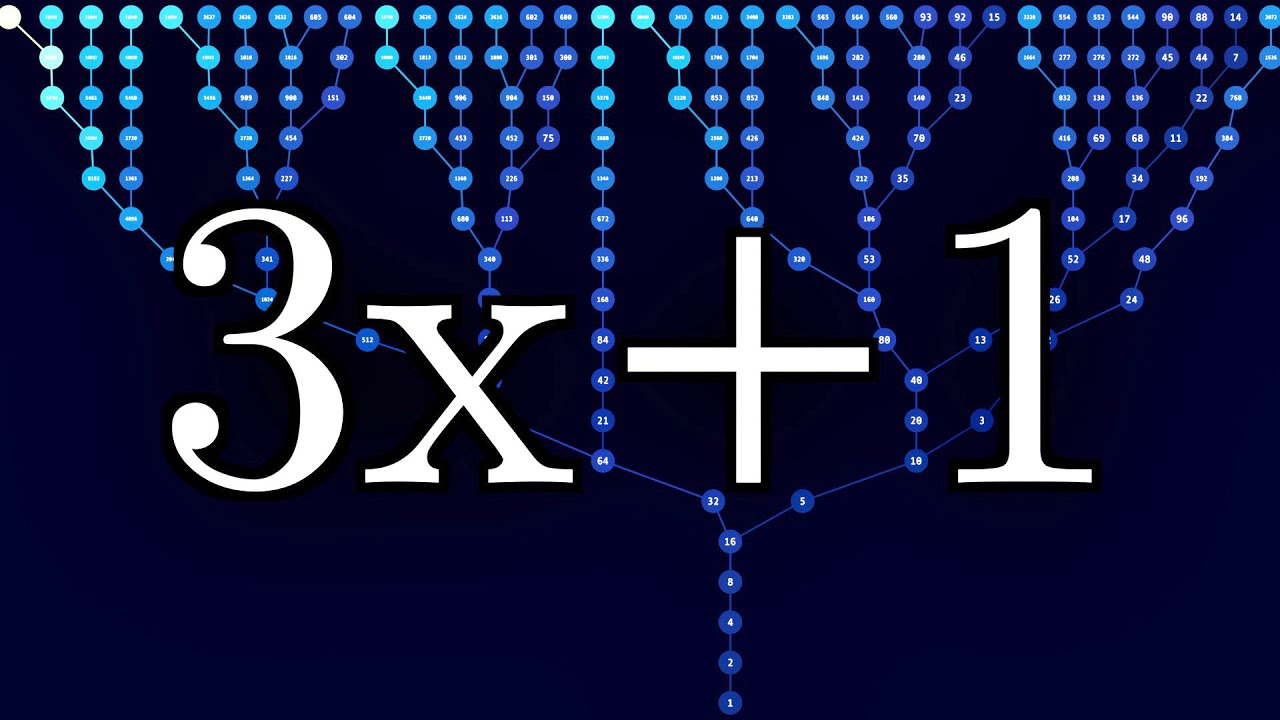
The Collatz Conjecture is the simplest math problem no one can solve — it is easy enough for almost anyone to understand but notoriously difficult to solve. This video is sponsored by Brilliant. The first 200 people to sign up via https://brilliant.org/veritasium get 20% off a yearly subscription.
Special thanks to Prof. Alex Kontorovich for in...
Sorry for the wall
austere bridge
you're calculating the wrong thing. You should find next_odd(i) / i, and find the average of that
ionic jewel
also this the heuristic approach to the collatz conjecture, and you can read that relevent part of the Wikipedia page if you are so inclined
austere bridge
oh nvm I misread the code
alpine sable
obsidian cave
I watched Veritasiums newest video yesterday and though there were many interest...
Enclose code with code
Makes it easier to read
obsidian cave
How do I do that?
alpine sable
```
obsidian cave
Alright thanks
 topaz scaffold
austere bridge
topaz scaffold
austere bridge
@obsidian cave I think you want the geometric mean, not the arithmetic mean
instead of $S=\frac{a_1+a_2+\cdots+a_n}{n}$, you want $M=(a_1\cdot a_2\cdots a_n)^{\frac{1}{n}}$
ocean sealBOT
cgodfrey
 austere bridge
you might have to get clever about trying to calculate it in python, though
obsidian cave
Any idea why use this over arithmetic mean? I mean the statement "on average an odd number is multiplied by 3/4 to get to the next odd number" seems to more apply if an arithmetic mean was used
austere bridge
I'm not completely sure why
oh wait I just realized I wrote that wrong
$M=(a_1\cdot a_2\cdots a_n)^{\frac{1}{n}}$
ocean sealBOT
cgodfrey
 austere bridge
oh the two are the same lol
but you might run into trouble naively trying to compute that in python
austere bridge
yeah, doing something like that would also work
obsidian cave
I'm trying it with 100000 bit floats and as n increases the mean just constantly decreases, down to something e-300 at n=1000
Increasing precision isnt helping
 thorn kindle
Just a simple 2liner. Take an arraylist, find the product, then raise it to the power of 1/size
 keen saddle
An arc is basically a line segment limited between 2 points of a circunference?
glass lichen
keen saddle
An arc is basically a line segment limited between 2 points of a circunference?
it's the section of the circle defined by those 2 points, yes
line segment would be the chord
austere bridge
@obsidian cave
def next_odd(num):
    num0 = num
    num = 3 * num + 1
    while not num % 2:
        num //= 2
    return num

L = []
for i in range(1,2001,2):
    L.append(next_odd(i) / i)

prod = 1
for i in L:
    prod *= i
prod = prod ** (1 / len(L))
print(prod)
the following gives a number close to 0.75 in naive python
but it breaks if you make the upper bound much larger
obsidian cave
Why next_odd(i) / i ?
austere bridge
I moved the division out of the next_odd function
austere bridge
obsidian cave
Why next_odd(i) / i ?
otherwise it should be called next_odd_ratio or something like that
it's the same code
obsidian cave
Oh my bad didnt see that
Alright thanks I see then
I wonder if theres a way to get the geometric mean from the terms 3/2 * 1/2 and 3/4 * 1/4
 twin nimbus
Please don't ping helpers if it hasn't been 15 minutes
 shut rampart
twin nimbus
Please don't ping helpers if it hasn't been 15 minutes
shut rampart
twin nimbus
Please don't ping helpers if it hasn't been 15 minutes
sorry botu that
didnt know the rules
i think it has something to do with the horseshoe lookin thing on the bottom
but idk
twin nimbus
Independence is when P(A|B) = P(A)
If you rewrite the intersection in terms of the conditional probability you can figure out the second. But the first is clearly dependent
shut rampart
twin nimbus
Independence is when P(A|B) = P(A)
yes
oh
yeah
just realized how dumb i am lol
i forgot that the | line means given
shut rampart
twin nimbus
If you rewrite the intersection in terms of the conditional probability you can ...
what abotu this tho

i thought that 3 to 2 odds means that out of 5 possibilities it will be 3 the one way and 2 any different way
lofty gorge
"against"
shut rampart
lofty gorge
"against"
oh so its 2/5
ok
i am terrible with actually reading questions
how about this

@lofty gorge
i know that A is right
lofty gorge
What did you do for c
shut rampart
lofty gorge
What did you do for c
i added the probabilities of both of the things
and averaged it
i think
lofty gorge
winning with rain and winning without rain?
shut rampart
yup
lofty gorge
you have to multiply those terms by the chance of it raining
shut rampart
oh
so
um
wait how does that make sense @lofty gorge
i got 3/25 and 8/25
and i added them
but if i multiplied both by the chance or it raining it would be tiny
lofty gorge
I forgot to write something down
My bad
It's P(rain)*P(winning with rain)+P(not rain)*P(winning with no rain)
However you say that in words
lofty gorge
("or not, respectively" should be at the end of what I said initially)
shut rampart
lofty gorge
("or not, respectively" should be at the end of what I said initially)
so it has to be .28
28 percent chance of winning
lofty gorge
lofty gorge
It's P(rain)\*P(winning with rain)+P(not rain)*P(winning with no rain)
0.8*0.35 + 0.2*0.6 = 0.4?
shut rampart
lofty gorge
0.8\*0.35 + 0.2*0.6 = 0.4?
that isnt the right calculatoin
its 0.8x0.32 + 0.2x.12
shut rampart
lofty gorge
By winning with no rain I meant the 60% in the question
oh
lofty gorge
I would write winning and no rain if I meant the 0.12
lofty gorge
b is P( losing n not rain)
lofty gorge
shut rampart
i think it has something to do with the horseshoe lookin thing on the bottom
.
where the n is that
I'm asking for P(rain)P(win | rain) + P(not rain)P(win | not rain), and 0.12 is P(win n not rain)
shut rampart
uh
huyh
huh
ok
nvm
so then it is .26
wiat no
.3
.,4
.4
yeah it s .4
lofty gorge
The values given in the question are "if it rains, this is the probability of winning after that". Part b is asking for "not raining and winning", not "if it rains, what is the probability of them winning". For the formula you need in c, you need the first, not the second kind
Is that clearer?
 onyx chasm
is this chat occupied?
 viscid topaz
Open
onyx chasm
okay well
$$\text{where did I go wrong?}$$
$$\lim_{n\to\infty}dx\Sum[i=1]{n}f\left(a+i\cdot dx\right) \mathop{=}\limits^{set} \lim_{n\to\infty} \Sum[i=1]{n} f(i)$$
$$dx=1\text{, a=0} \implies b=n \because dx=\frac{b-a}{n}$$
$$\implies \lim_{n\to\infty} \Sum[i=1]{n} f(i)= \lim_{n\to\infty}\int_0^n f(x) dx$$
ocean sealBOT
Pedrosso
 onyx chasm
and if you're gonna tell me it's because dx=1 and dx should approach 0, tell me why that would mess it up
astral dagger
onyx chasm
okay well
 astral dagger
onyx chasm
and if you're gonna tell me it's because dx=1 and dx should approach 0, tell me ...
astral dagger
onyx chasm
and if you're gonna tell me it's because dx=1 and dx should approach 0, tell me ...
maybe it'd be ok to say dx = 1 if that limit was not there, cause then you'd be talking about a Riemann sum using partitions with size equal 1
onyx chasm
unless of course I'm not wrong but Im just assuming I'm wrong because I'm always wrong
astral dagger
onyx chasm
***unless of course I'm not wrong but Im just assuming I'm wrong because I'm alw...
that's kinda sad
onyx chasm
I actually haven't proved myself wrong and I'm trying to find a convergent series to try to prove it wrong. But it looks wrong
onyx chasm
astral dagger
maybe it'd be ok to say dx = 1 if that limit was not there, cause then you'd be ...
well, yeah
O:
Illegal xD
alpine sable
i know test are not allowed but are u guys allowed to help on a task that is both assessment + assignment or is it not allowed
glass lichen
alpine sable
i know test are not allowed but are u guys allowed to help on a task that is bot...
if it's an assessment no
alpine sable
ok
 ionic jewel
i don't see that being done anywhere
of course I don't really understand the problem z but the 1/2T_s i think you mean was in front of the sum before
astral dagger
 red lagoon
that star means convolution or is another property?
 restive glacier
dy/dx=(dy/du)(du/dx) can I cancel the du?
placid zinc
That equation is true, and we call it the chain rule
Be aware of "cancel the du" as these aren't fractions, but notations for derivatives
restive glacier
So (dy/du)(du/dx)=(dy/1)(1/dx) is false?
ocean sealBOT
Pedrosso
 restive glacier
So (dy/du)(du/dx)=(dy/1)(1/dx) is false?
restive glacier
restive glacier
So (dy/du)(du/dx)=(dy/1)(1/dx) is false?
@placid zinc is this false?
rigid smelt
that is false
placid zinc
dy/1 is jibberish
rigid smelt
that is like saying derivative of y wrt 1 where 1 is a variable
restive glacier
Ok thanks
 echo aurora
cause i dont wanna post the questions in here
rigid smelt
oh well too bad then
echo aurora
its like college questions
echo aurora
im not worried abt judging im worried abt the questions being leaked getting traced
like the college seeing it
 echo aurora
nah im not
rigid smelt
sounds very suspsicious
echo aurora
im just tryna relearn how to do piecewise functions
A car company charges $35 a day to rent a car for the first 6 days. The charge then drops to $25 a day for each additional day up to 6 days. After that, the rate drops to $12 a day. The rental company does not allow you to rent a car for longer than 3 weeks. There is also a one-time rental free of $40. Define a piecewise function
this is an example
how would u turn that into a piecewise function
rigid smelt
so what have you tried?
echo aurora
i barely remember it, as far as i got was 35b and 1 </ b </ 6
but i fr dont remember any of it
rigid smelt
first of what is b supposed to represent?
 neat rose
 echo aurora
days
rigid smelt
please move
alpine sable
what is 444,214,773,035,046,582,606 divided by 2?
echo aurora
</ is less than or equal to
echo aurora
i have multiple questions to go thru and i dont really have time to fully learn it but if you can give me the equation for the first 6 days and then how to connect that to the next time frame i should be able to do the rest
rigid smelt
technically you just have to divide it into two cases
like how you did, in the case with 1<=b<=6
tho im having a bit of trouble analysing the question
they are asking to draw a piecewise function for the rent?
and what is the condition for the one-time rental fee?
how long is that one-time rental?
and also, how long of a period do they want us to draw the piecewise function over? 3 weeks?
echo aurora
thats why i wanted to skip it till maybe we do other questions and maybe we might learn what its asking for from doing other stuff first
rigid smelt
since we are goign to be graphing money against time but they didnt tell us how long of a period we should graph it
sure
echo aurora
ok so im given a parent function, given a transformed function
it says to write the transformed function in terms of the parent function but i thought thats already done when u make a transformed function>
echo aurora
 rigid smelt
ah ok
so basically, they want you to write it in terms of f(x)
and not in terms of x
for example, a transformation h(x)= x^2 + 2 where the parent function is f(x)=x^2 can be written as h(x) = f(x) + 2
rigid smelt
sure
 digital radish
Hey guys can I have some help
echo aurora
g(x)=3f(x-2)+4?
rigid smelt
its currently occupied
digital radish
Fuck
rigid smelt
echo aurora
g(x)=3f(x-2)+4?
yes good
rigid smelt
 rigid smelt
what are you tasked to do here? write the transformation in terms of x?
echo aurora
same thing as before just different ones to fill out
gives u different info
that second box is the parent function, 4th box is the way it changes
echo aurora
g(x)=.75(x+1)^2-2?
rigid smelt
not 0.75
oh wait
nvm, sorry miscalculated
but the constant is not -2
remember, f(x) = 3x^2 -5
echo aurora
so +3?
rigid smelt
no
echo aurora
or -7
echo aurora
20
rigid smelt
no 18 is not correct
0.75 * (x+1)^2 is correct
now its just the constant that you are wrong
rigid smelt
no im just giving you an example of why 5 * 0.25 is not 20
this is just simple multiplication....
ok instead of writing 0.25, i will write 1/4
can you do 5 * 1/4 - 2 now?
rigid smelt
not that either....
idk you but theres no way to read * into /
oh didnt see you wrote -0.75
yeah its -0.75
echo aurora
Ok one sec
ok so i did the rest of the other questions for that
so now i have a composite function
and i have to turn it into f(m) and m=g(x)

 fringe robin
9=10-1 99=100-1 and so on
fringe robin
use that to add
placid zinc
Add 1 to every term, ez sum
 dull oak
oh i see
placid zinc
Then subtract after
ionic jewel
eg 9+99 = 110-1-1
fringe robin
ye
ionic jewel
yes
placid zinc
But that's a large number isn't it
ionic jewel
1111(2020 times) then a 0 - 2020
dull oak
wouldnt that lead to 2016 1's?
ionic jewel
kinda thinking it was 2017 or 2018
 ivory crypt
you should consider how many 1 in 11110-2020, then add 2016,I think answer is 2016
 inland horizon
i think it's 2016 ones too but never saw a problem like that so i'm no t sure
ionic jewel
,calc 11110-2020
ocean sealBOT
Result:
9090
 steel horizon

 night geyser


 inland horizon
Posting in different channels is not allowed kingarthur
 cerulean vine
I found these online
steel horizon
btw im not a genius so i cant help 😦
cerulean vine
Ohh
Its on gradient of a straight line
If thar helps?
@inland horizon what do you mean
inland horizon
the rules of the server to ask for help
cerulean vine
inland horizon
the rules of the server to ask for help <:stare:826920038623346729>
Yez
I asking for solution and explanation
ionic jewel
 plush wagon
What is Derivative of sin^2y = 0?
plush wagon
What is Derivative of sin^2y = 0?
wait with respect to what?
plush wagon
dy/dx
plush wagon
Q7
 ionic jewel
here's a Wolfram for your problems
plush wagon
But answer doesn't include cosy
ionic jewel
,w derivative of sin^2(y(x)) wrt x
ocean sealBOT
 plush wagon
 plush wagon
ionic jewel
it probably gets cancelled with the other term or something?
plush wagon
ionic jewel
it probably gets cancelled with the other term or something?
No i don't think so
plush wagon
ionic jewel
what is that k thing?
a constant
ionic jewel
fine Wolfram if you don't want to be useful
well anyways let's do the second part
derivative of cos(xy)
-sin(xy)(y+xy')
plush wagon
Yes that's what I got
ionic jewel
2sin(y)cos(y)y'-sin(xy)(y+xy')= 0
plush wagon
Yes
ionic jewel
y'2sin(y)cos(y)-ysin(xy)-y'xsin(xy) = 0
y'(2sin(y)cos(y)-xsin(xy))= ysin(xy)
cos doesn't go away as far as I can tell
unless there's some magical trig identities
expand our sin(xy) and it magically cancells?
ionic jewel
,w y'2sin(y)cos(y)-ysin(xy)-y'xsin(xy) = 0
ocean sealBOT


 cerulean vine
Am i to young to to be learning derivatives
cerulean vine
Ohh wait im dumb
ionic jewel
and yeah idk @plush wagon either book is wrong or there's some weird trig tricks i don't want to work out
 carmine lion
@ionic jewel can u help with my question pls
cerulean vine
Sin cos and tan come under geometric transfo?
ionic jewel
sin cos and tan are trigonometry
plush wagon
ionic jewel
and yeah idk <@643741115501117470> either book is wrong or there's some weird tr...
Answer written in book is wrong , i think so
carmine lion
those are trig funtions arthur
sine cosine and tangent

how can i do part (c), i've done (a) and (b)
ocean sealBOT
abe
Compile Error! Click the  reaction for more information.
(You may edit your message to recompile.)
 ionic jewel
first of all the derivative is 3x^2 -1
cerulean vine
This discord server makes me feel dumb
ionic jewel
we want the slope of the line at a point such that it goes through point P
cerulean vine
Im 14 and in the uk you finish school at 17
So we gonna learn this stuff like next year
ionic jewel
so assuming we are finding the x value where this is true, we need the line to satisfy,
slope is 3x^2-1, goes through (x,y), and goes through (-2,-3)
carmine lion
ionic jewel
we want the slope of the line at a point such that it goes through point P
sooo
$3a^2-1=m$
ionic jewel
so what's the general form of a line that goes through (x,y) and (-2,-3)?
ocean sealBOT
abe
 carmine lion
thats 1 right?