
#help-0
1 messages · Page 720 of 1
 tough hatch
,, u_x(y) = \frac{\partial}{\partial x} u(y)
 ocean sealBOT

 light mango
uhhh
tough hatch
is u(y) constant?
light mango
these calculations add c to the equation which im supposed to solve
thats not intergate?
light mango
tough hatch
is u(y) constant?
no
light mango
the velocity of the fluid
tough hatch
so no equation for it
light mango
yea thats what im supposed to do
 tidal bay
u2-u1=u3-u2....?
light mango
huh
yea so i definitely integrate in this problem
thats how it works
so i find it weird that you guys find that weird
 warm iris


 dull onyx
mental illness
 thorn tapir
.....wat
 royal drift
Hi, i really want to study english math but dont know where to start can someone help me pls?
 woeful pulsar
what do you mean by "english math", like "math in english"?
royal drift
Yes correct, i really want to study abroad
woeful pulsar
hmm Khanacademy is a pretty good resource for studying math in english
royal drift
Do they charge money tho?
 dusk canyon
Khan Academy is free
 west hearth
Got a question, why do we write dy/dx when it’s actually delta x that tends to 0 and not delta y
Because doesn’t “d” imply some very very small quantity
tough hatch
(d/dx) y
west hearth
Oh
What’s the d doing alone in the numerator
Or is that just notation
For taking the derivative of y = f(x)
tough hatch
well\
we also have integrals of functions of x like $\\int x\diff x$
ocean sealBOT
 west hearth
Yeah
tough hatch
dy and dx are also called differentials
west hearth
Yes
tough hatch
you can integrate a derivative, both with respect to x
west hearth
Yeah
ocean sealBOT
 west hearth
I also wanted to ask uhh when we limit delta x to 0
Why doesn’t delta y also tend to 0
It’s hard to grasp this
Also is it possible to have an infinitely large change in y when dx tends to 0?
tough hatch
e.g. $\int x\left(\frac{\diff}{\diff x}\right)\diff x = x$
ocean sealBOT
 west hearth
Well delta x limiting to 0 would mean that there is a very very very small change in x
So shouldn’t that cause a very very very small change in y
Ah
Makes sense
Wdym
If you are far along a vertical asymptote then the y values are increasing rapidly wrt to x right
tough hatch
dx tends to 0 doesn't mean x approaches a value where the function is asymptotic
west hearth
Yeah so how do we show that delta y also doesn’t tend to 0
If the change is very very small
 merry coral
tough hatch
merry coral
tough hatch
why shouldn't it?
 rocky fossil
 tough hatch
west hearth
Yeah so how do we show that delta y also doesn’t tend to 0
tough hatch
west hearth
Yeah so how do we show that delta y also doesn’t tend to 0
if there is a very small change in y then that means delta y is very small, i.e. close to 0
merry coral
rocky fossil
thanks
tough hatch
ez answers 
rocky fossil
lol
wait
is that a property
is log_9(m) = log(m)/log(9) a property
wait
oh nvm
i got it
 flat pecan
are you guys finished?
flat pecan
Given a deck of 40 cards of 4 seeds with 10 cards each of values:2,3,4,5,6,7, J, Q, K, A, what is the chance of drawing 5 cards of distinct values?

 shell widget
@old cobalt What they mean by rearranging is that u isolate "x" by algebraic operations
quadratic formula is the same thing but the rearranging is already done
 old cobalt
Thank you 🙏
flat pecan
flat pecan
Given a deck of 40 cards of 4 seeds with 10 cards each of values:2,3,4,5,6,7, J,...
anyone?
<@&286206848099549185>
 noble sinew
So 1st draw doesn’t matter, then 2nd draw has prob (39-3)/39, 3rd draw has prob (38-3-3)/38 and so on
Multiply the probabilities together and you get the answer
flat pecan
I did try something like that but doesn't appear to be working
noble sinew
It does
flat pecan
Ok, what if I wanted to find the number of combinations which satisfy what is being asked?
 vale wigeon
4 seeds? did you mean suits?
flat pecan
How would I go about that?
flat pecan
vale wigeon
4 seeds? did you mean suits?
Idk how its called in English, but its the 4 common types
vale wigeon
yeah suits
the number of hands with all cards having distinct values is 10C5 * 4^5
divide that by 40C5 to get your probability
flat pecan
Why 4^5?
vale wigeon
10C5 = number of ways to choose which 5 ranks you get
and 4 ways to choose the suit for each rank
ocean sealBOT


 Requested by ScapeProf#9427
vale wigeon
Requested by ScapeProf#9427
vale wigeon
,w (10C5 * 4^5)/(40C5)
flat pecan
Xd
vale wigeon
,w (C(10,5) * 4^5)/C(40,5)
ocean sealBOT

 vale wigeon
there we go
flat pecan
I see thanks
flat pecan
noble sinew
works fine?
Yeah yeah I was just thinking in terms of combinations
Thanks a lot both of you
 fossil tree
can someone explain to me what a norm of a vector is in english, i look it up and have no clue what it means still
 true crystal
It is kinda its length
fossil tree
ok? wdym kinda
true crystal
A length means that you have a notion of distance which is not unique in all context
but it is a way to understand it
fossil tree
so whats the difference between a norm and its magnitude then
wouldnt that be the same
true crystal
If I have to go from point a to b I can represent a vector that goes from a to b and its norm would give me the distance between the points
fossil tree
would finding its absolute value i.e its magnitude be the same
vale wigeon
except 'magnitude' typically refers only to euclidean norm
fossil tree
huh
vale wigeon
while 'norm' can be more general
vale wigeon
there are ways of assigning a length to every vector in your space that aren't the same as the euclidean norm you're used to but which are still consistent
there are certain rules an assignment of lengths must obey in order to be called a norm
fossil tree
so to find the norm id do the sqrt of ux^2+uy^2+uz^2?
vale wigeon
"the norm" requires context
fossil tree
the question has no context
vale wigeon
can you show the question
maybe it's a devil-in-the-details thing
as it so commonly is with math
true crystal
That is the Euclidian norm
fossil tree
If u = (−1, 2, 2) is a vector in R3
, find the following:
a) ||u || (the norm of u)
well it wouldnt send the symbol
but thats legit it
vale wigeon
okay
so they probably want the euclidean norm
since it sounds like youre not quite at the level where you would give 'exotic' norms any consideration
true crystal
yes
vale wigeon
yes
fossil tree
math complicated, thanks my guys
true crystal
but at a higher lever you should be more specific
vale wigeon
in math sometimes it makes sense to measure distance in ways other than the euclidean norm
fossil tree
isnt that the same thing tho
true crystal
Yeah there is some distance that are easier to deal with depending on the context
 alpine sable

Other than Euclidean norms?
What can be the other ways?
In algebraic forms or smth?
fossil tree
ok this is all going way over my head
i slept through every class so idk whats going on
alpine sable
@true crystal sorry for pinging but like I would really want to know what is meant by what Ann said
Some examples that is
true crystal
alpine sable
Other than Euclidean norms?
There are a lot of other vectorial spaces than Euclidian space
 true crystal
alpine sable
<@437730285438894084> sorry for pinging but like I would really want to know wha...
true crystal
alpine sable
<@437730285438894084> sorry for pinging but like I would really want to know wha...
Which one
alpine sable
vale wigeon
in math sometimes it makes sense to measure distance in ways other than the eucl...
This one
true crystal
Probably vector space
true crystal
alpine sable
This one
Here is another notion of norm :
$||f||=\sqrt{\int_0^1 f^2(x)dx}$
true crystal
Yes
alpine sable
 sorry this is beyond me
true crystal
You are like really quick I was going to change it xD
alpine sable
Guess this isn't for me
ocean sealBOT
King1219
 true crystal
alpine sable
<@437730285438894084> sorry for pinging but like I would really want to know wha...
true crystal
alpine sable
<@437730285438894084> sorry for pinging but like I would really want to know wha...
Why didn't you ping Ann then ?
alpine sable
Because
I am afraid

Is there some quick way of finding this?
For three degree things I would just check it manually but for 4 I just checked whether the things in the options make the thing 0
 oak chasm
Yes. You can either plug in each pair and see if it produces zero or you can divide the polynomial by (x - (-1))(x - 2) and factor it.
alpine sable
Factor the remainder?
oak chasm
You need to be careful of multiplicities, though.
oak chasm
If they're zeroes, there will be no remainder.
alpine sable
Yeah that's why quotient
oak chasm
(x - zero) evenly divides a polynomial.
 oak chasm
There will be a real number x that produces a higher value when filled into that polynomial than other reals.
alpine sable
Just put it as 1
Cause for any other thing
Or 2 actualy
But for any other thing it becomes minus
2 is small too
One returns 12
Bro
Why didn't I think of this

Ok now this is the one I couldn't solve after 15 minutes
Ugh
Shouldn't I put the value as 2
And then find the root of one equation or something
Lemme try
No
Doesn't make sense
Probably divide the 2 expressions
No still I will have 2 things remainder and quotient
Ugh
oak chasm
One must be (x - 2)(x - m) and the other must be (x - 2)(x - n).
true crystal
If (x - 2) is a factor of x^2 + ax + b what does that mean ?
alpine sable
oak chasm
One must be (x - 2)(x - m) and the other must be (x - 2)(x - n).
This
oak chasm
For some m and n.
alpine sable
I know that but I don't know how to proceed after it
true crystal
Yeah is means that 2 is a root
oak chasm
OK, so expand the two things.
oak chasm
Expand (x - 2)(x - m). Expand (x - 2)(x - n).
alpine sable
Ok
true crystal
Try to subtract the second and the first
alpine sable
I actually did that
true crystal
then for x = 2 you get something
oak chasm
Did you expand the two?
alpine sable
No substracted both the things
I get 2
And that is correct

Today I learnt so much about polynomials
It's confusing how did I do that
oak chasm
That's not always correct.
alpine sable
I know I can expand stuff
oak chasm
For example, a = c and b = d is possible, which gives you 0/0.
alpine sable
 shadow furnace
We are probably assuming they are different.
oak chasm
You shouldn't.
oak chasm
Well, as demonstrated, the key is wrong.
alpine sable
x-2 is a common factor
oak chasm
x - 2 is also a common factor when the polynomials are identical.
shadow furnace
Well, it might not be the only common factor.
oak chasm
Right, so there are multiple answers.
alpine sable
As demonstrated you are wrong
oak chasm
OK, well good luck.
"The answer key says you're wrong" is a very good bit of reasoning.
Answer keys are always right.
alpine sable
You said answer key was wrong because c = d was possible
But it also might be that c != d
That basically means multiple answers (0 and 2)
And that was just me meming
Sory
merry coral
 sage vale
hi, I need help- figured out dzya and dxda, but unsure about dyda. based on the graph, 1) there's no cross section on the xz plane I can use to find xz bounds and 2) there aren't 2 y surfaces for the y bounds. one of them is literally a line??
 fossil tree
how do i determine if vectors are coplanar, also what does coplanar mean
 glass lichen
fossil tree
how do i determine if vectors are coplanar, also what does coplanar mean
glass lichen
fossil tree
how do i determine if vectors are coplanar, also what does coplanar mean
coplanar mean they share a plane
so any set of 2 R3 vectors will be coplanar since you need 2 vectors to span to get a plane
 grand shell
$X^2 - Y^2 = 4P$ where $X,Y,P \in \mathbb{Z}$ has a solution $X = P-1$ and $Y = P+1$. Is there a way to find the smallest solution X,Y?
ocean sealBOT
Rahakasvi

 mortal void
is this channel free now?
i have a small doubt bout a thing its pretty basic
11/4hrs is the value of time give to me on a question what its real value i should be putting
cause its value coming is 2.75hrs
so does that mean its value should be 2hrs 45minutes?
 remote heron
mortal void
so does that mean its value should be 2hrs 45minutes?
remote heron
mortal void
so does that mean its value should be 2hrs 45minutes?
yea
does it make sense?
mortal void
thankyou
remote heron
np
mortal void
not really
remote heron
which part?
mortal void
i just thought that 75 is 75% of the 3rd hour
remote heron
it is 😄
its just confused because of the fact that a whole hour is 60 minutes
not 100 like youd intuitively expect it to be probably, with percent
its maybe easier to see like
75% = 3/4 = (1+1+1)/4
so three quarters of an hour, a quarter of an hour is 15 minutes
hope some of that makes sense 🤔
mortal void
yeah
remote heron
this is probably a good time to go back to thinking of it as pies/pizza or whatever is helpful with percentages since a clock is divided in the same way
mortal void
yeah thankyou its clear now
 glossy forge
Idk what’s the error
 remote heron
glossy forge
Idk what’s the error
remote heron
glossy forge
Idk what’s the error
is it really just that 5 becoming a three
that seems so dumb
mortal void
hhaha
remote heron
,w 26=3(x+1)^2-1
ocean sealBOT

 Requested by jan Niku#2119
glossy forge
Requested by jan Niku#2119
glossy forge
Is it???
remote heron
theres a sign error too
mortal void
lol i didnt saw the question and i was like his maths was perfect there
remote heron
,w 26 = 5(x+1)^2-1
ocean sealBOT
 Requested by jan Niku#2119
mortal void
glossy forge
Idk what’s the error
Requested by jan Niku#2119
mortal void
glossy forge
Idk what’s the error
can you tell me where are you doing it?
remote heron
 glossy forge
I didn’t think it was the 5
mortal void
is it some kinda app where we will solve and it will tell us our result
remote heron
theres some weirdness in this step
i thought you might be able to "eat" it with the plus or minus
but now im not sure
glass lichen
$x=-1\pm 3$
remote heron
ye
glossy forge
There is no 5 though
remote heron
there is a 5 in the prompt but i think its just a typo
ocean sealBOT
Mosh
 glossy forge
I think it’s the error
 fluid crown
does anyone know how this can transform into an equation
 glossy forge
Is this a correct way of doing it to
 remote heron
i dont think theres a correct way
unless your class is using something specific
the answer is correct
remote heron
fluid crown
does anyone know how this can transform into an equation
what even is this
like you want to write the repeating decimal?
 topaz scaffold
You can change it into a fraction if it's a repeating decimal
But not an equation
 wooden crag
glossy forge
Is this a correct way of doing it to
wooden crag
glossy forge
Is this a correct way of doing it to
could have skipped a few steps by using quadratic formula
if it's been taught to you
glossy forge
remote heron
Can you explain why it’s suppose to be -1
 vapid ermine
@glossy forge its true but useless one
 loud turtle
I have a quick question for anyone whos got time
remote heron
specifically they sort of switched the sides which you can do but its a little confusing
but just do like
vapid ermine
move the -1 to the opposite side and divide by 3 @glossy forge it will be easy
loud turtle
I have the value of ph but I dont know how to isolate the OH since this is my first time using log
 ocean sealBOT
jan Niku
 vapid ermine
then it will be so
(x+1)²=9
x+1= 3 x+1=-3
x=2 x=-4
true crystal
loud turtle
I have the value of ph but I dont know how to isolate the OH since this is my fi...
You're formula is clearly wrong
glass lichen
loud turtle
I have the value of ph but I dont know how to isolate the OH since this is my fi...
isolate for log(H) then use definition of log
glossy forge
ok thanks
loud turtle
true crystal
You're formula is clearly wrong
it is? the teacher gave me this
wooden crag
is OH a single variable or O * H
loud turtle
its a chem formula
glass lichen
yeah, pH is measure of hydrogen, not hydroxide
true crystal
loud turtle
it is? the teacher gave me this
pH is with H3O+
glass lichen
anyway, the math is the same regardless
loud turtle
true crystal
pH is with H3O+
but it tells me that its also with OH
true crystal
no
loud turtle
you arent wrong I also have your version of the formula
oh well that doesnt matter the math is what matters here
glass lichen
King is just pointing out an error in the question, however the math to isolate for whatever's in the log is the same
yes
true crystal
glass lichen
King is just pointing out an error in the question, however the math to isolate ...
yes
loud turtle
glass lichen
isolate for log(H) then use definition of log
I dont know what definition of log is this is my first time
glass lichen
$a^b=c\iff \log_a(c)=b$
ocean sealBOT
Mosh
 glass lichen
definition of log is how logs are defined...
fluid crown
remote heron
what even is this
apparantly its some kind of equation which is derived after using godels numbering
 hardy vault
can someone help

 naive field
the rules are : in case of basic medium ph=14+log oh , in case of acidic medium ph=-log h30
in basic, the concentration of ho is 10 exponent 14+ph , in acidic the concentration oh h30 is 10 exponent -ph
 jagged rapids
hardy vault
can someone help
jagged rapids
hardy vault
can someone help
Won't that be $\binom{9}{5}$
ocean sealBOT
killBird
 hardy vault
ocean seal
**killBird**
hardy vault
ocean seal
**killBird**
oh bruh lol
jagged rapids
As we choose any 5 numbers and then order them in only the increasing way
 glass lichen
 wicked plover
have you drawn it?
wicked plover
i have to draw it?
glass lichen
well I'd hope you'd make a diagram if it isnt provided...
since it's clearly geometry
oak chasm
It's arbitrary. You can write B, A, and T on any three different vertexes.
oak chasm
@hallow flax No, a is the opposite side of A.
 hallow flax
oak chasm
<@!708023635226394695> No, a is the opposite side of A.
hallow flax
oak chasm
<@!708023635226394695> No, a is the opposite side of A.
Ok, then my apologies, different from what we learn here in europe.
oak chasm
t is the opposite of T. b is the opposite of B.
wicked plover
oak chasm
t is the opposite of T. b is the opposite of B.
could you draw it out for me? if possible
hallow flax
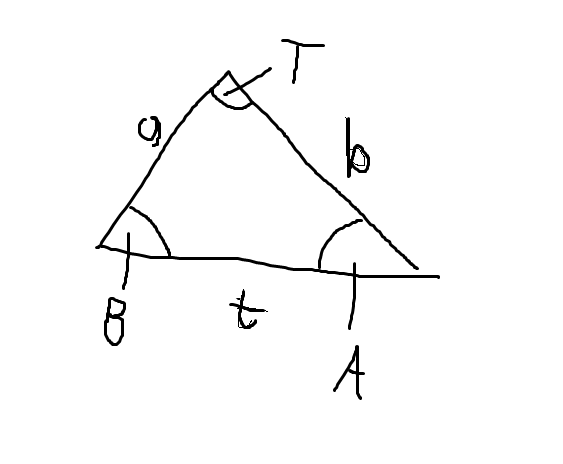 hallow flax
oak chasm
t is the opposite of T. b is the opposite of B.
hallow flax
oak chasm
t is the opposite of T. b is the opposite of B.
Makes sense, thanks!
hallow flax
Do you have any idea?
oak chasm
Fill in the values you know.
 celest anvil
 oak chasm
@celest anvil Sorry, channel is busy.
hallow flax
You have two angles of a triangle, so you can find out the third one.
Do you know how?
wicked plover
i add them together?
hallow flax
You can the sum of angles in a triangle is 180°
hallow flax
Correct.
It isn't a rectangle triangle, so you have two laws, you can use. Do you know which ones?
wicked plover
Sine Law and Cosine Law
hallow flax
Exactly! To find out sides, I suggest the law of sines. So you can just figure the remaining sides out, using the law of sines.
Do you know what the law of sines says?
wicked plover
my issue is
last year
i slept through the trig online class
so i actually have no idea or any background information about cosine law and sine law
hallow flax
the law of sines says: $\frac{sin(\alpha)}{a}=\frac{sin(\beta)}{b}=\frac{sin(\gamma)}{c}$
ocean sealBOT
Sparender
 ocean sealBOT
Sparender
 wicked plover
oh okook
hallow flax
Basically, what it says, is the sin of the angle opposite to a certain side / this certain side, equals the sin of an angle opposite to another certain side / that other certain side.
You get it?
hallow flax
What exactly do you mean, by "their all equal to eachother"?
 hallow flax
Check the formulas the "TeXit" Bot sent, and check them with the sketch a sent.
Perhaps it makes sense then 🙂
hallow flax
you have your sketch infront of you, right?
wicked plover
yea
wicked plover
yeah
hallow flax
and A = 62°
wicked plover
yep
hallow flax
Now you have one part of the law of sines:
send that again.
I did not get to see it.
hallow flax
$\frac{35,2}{sin(62°)}=\frac{t}{sin(T)}$
ocean sealBOT
Sparender
 wicked plover
yeah
hallow flax
Does that make sense?
hallow flax
$\frac{35,2}{sin(62°)}=\frac{t}{sin(83)}$
ocean sealBOT
Sparender
 hallow flax
Ok, you have that. Do you know, how to proceed?
wicked plover
howw did u get 83
hallow flax
$\frac{35,2}{sin(62°)}=\frac{t}{sin(83°)}$
ocean sealBOT
Sparender
 hallow flax
Perfect, so, do you know, how to move on?
hallow flax
you just have to rearange that, to have t on one side, and then plug it into your calc, and then you got it
hallow flax
Look at this again: $\frac{35,2}{sin(62°)}=\frac{t}{sin(83°)}$
ocean sealBOT
Sparender
 hallow flax
how could you get rid of the sin(83) to have t on the right side, isolated?
hallow flax
you can just multiply by sin(83)
then you get: $\frac{35,2}{sin(62°)}*{sin(83°)}={t}$
ocean sealBOT
Sparender
 hallow flax
Wait, I have to plug that into my calc, one sec.
Almost, check your rounding again.
40, yes, or 39,6, or 39,57
wicked plover
40
hallow flax
depending on how precise of a result you need, that should be stated by your teacher.
hallow flax
Perfect, hope that solves your question 🙂
hallow flax
Perfect, pleased to hear!
wicked plover
Hey but i have a question
hallow flax
Yes 🙂
wicked plover
i have another question and its reversed
hallow flax
Send it.
 hallow flax
Draw a little sketch
wicked plover
Ok
hallow flax
Then we can go through it together.
wicked plover
by the way you are an amazing tutor
hallow flax
Good, so, we now have a problem.
The law of sines, gives us two possible solutions for angles in triangles.
Do you know about the unit circle?
wicked plover
no i sadly dont
hallow flax
Ok, the problem is, for a set sin, cos value, there [in most cases!] are two possible solutions between 0 and 360°.
For the these solutions [considering our problem] will be between 0° and 180°, so in theory, both angles could be possible for a triangle.
So, we have to use the law of cosines, as this law will give us only one possible solution for triangles [sum of all angles 180°, thats why].
You get that?
hallow flax
Do you know anything about the law of cosines?
$a^2 = b^2 + c^2 - 2bc\cos(\alpha)$ and $b^2 = a^2 + c^2 - 2ac\cos(\beta)$ and $c^2 = b^2 + a^2 - 2ba\cos(\gamma)$
ocean sealBOT
Sparender
 hallow flax
these are the three which you should know, imo.
again, considering this triangle: https://cdn.discordapp.com/attachments/269573202018041856/868214658983682108/1200px-Triangle_-_angles_vertices_sides.svg.png
 wicked plover
Oh
no i didnt know anything about the law of cosines
but
I see
i have no idea
a = b + c
hallow flax
You want Angle B, so, the pertinent one for you, would be the one starting with $b^2$
ocean sealBOT
Sparender
 wicked plover
Umm yea
hallow flax
Good, so we will use the following formula:
hallow flax
$b^2 = a^2 + c^2 - 2ac\cos(\beta)$
ocean sealBOT
Sparender
 wicked plover
oh
hallow flax
you now have your different values, given in the task. You can just plug them into this formula, and solve it.
Do you know how?
or better, what I mean
hallow flax
Try it out, and see if it works 🙂
hallow flax
b = 6, a = 5, c = 7
hallow flax
$b^2 = 36$
ocean sealBOT
Sparender
 hallow flax
$a^2 = 25$
ocean sealBOT
Sparender
 hallow flax
$c^2=49$
ocean sealBOT
Sparender
 hallow flax
wicked plover
but
hallow flax
wicked plover
but
Yes
 ocean sealBOT
Sparender
 hallow flax
Yes, thats what we want to find out.
wicked plover
my calculator doesnt give me a answer
hallow flax
now you have to rearrange this equation again, so that "cos(B)" is isolated on one side, I would suggest.
hallow flax
wicked plover
my calculator doesnt give me a answer
What kind of a calculator do you have?
Does it have CAS?
hallow flax
try this: https://www.geogebra.org/calculator
However, I suggest you use a physical calculator, you also get to use it during examinations, etc.. to get a bit of extra practice in rearranging equations, etc. [if it isn't a CAS calculator] it won't harm for sure.
hallow flax
I would start off with the easy stuff.
25 +49, you can get to the right side, just by - 25 and - 49
then you have the following: $-38=-70*cos(B)$
ocean sealBOT
Sparender
 hallow flax
You get that?
What I did, is just basically I moved the 25 and 49 to the left, by simply subtracting, so [-25] and [-49], that gets rid of them on the right, and on the left it makes 36-25-49, and that equals to -38.
.
Then I simplyfied $-257$
ocean sealBOT
Sparender
 ocean sealBOT
Sparender
 hallow flax
With that, you are almost there!
How can you get cos(B) to be the only thing on the right?
ocean sealBOT
Sparender
 hallow flax
the - gets cancelled out, so you are left with:
wicked plover
Ohh
ocean sealBOT
Sparender
 hallow flax
and now, to get B, you take it arcus cos.
Perfect!
I hope, I could help 🙂 If you have more questions, just send them, I am happy to help 🙂
wicked plover
Thank you so much
hallow flax
You are welcome!
glossy forge
Did I plug this in right, or does only the first x needs to be substituted
 hallow flax
What is the task?
wicked plover
ocean seal
**Sparender**
0.5?
hallow flax
wicked plover
0.5?
well, yes, 0,542, and what do you get for the angle then?
glossy forge
 wicked plover
wht angle?
hallow flax
wicked plover
wht angle?
for B
hallow flax
glossy forge
So here, for a, you then have $y=3^2-3*3+2$
ocean sealBOT
Sparender
 hallow flax
wicked plover
0.5
hallow flax
wicked plover
0.5
You still have to apply arcus cosin
wicked plover
whattttttt
hallow flax
to get the cos/sin value for a angle you just use the stuff you are used to, probably.
hallow flax
Yes, sounds pretty much right, it should be 57,121°.
I suggest you not to round intermediate results, to get a precise result at the end.
hallow flax
hallow flax
So here, for a, you then have $y=3^2-3*3+2$
you get that @glossy forge ?
wicked plover
ohh
hallow flax
hallow flax
you get that <@!868023074702901288> ?
What you do for this problem, is you insert 3 for every x in the equation of this quadratic function, then you simplify.
hallow flax
wicked plover
ohh
🙂
hallow flax
Ok, no problem. I should be around for at least another hour or so 🙂
wicked plover
Ok great
glossy forge
hallow flax
you get that <@!868023074702901288> ?
You didn’t answer my question
glossy forge
glossy forge
Did I plug this in right, or does only the first x needs to be substituted
.
hallow flax
glossy forge
you have plug the x in for every x in the equation of this function.
You only did that, for the first one.
and on the left side of the equation, you don't have any x, so I suggest to leave something like f(3) or y there.
glossy forge
ok thank you
 ionic jewel

 timber sage

 meager lily
is this server dead
glass lichen
meager lily
is this server dead
clearly not.. but this is a help channel

 full cypress
how are bases with different exponents like terms?
glossy forge
Can someone tell me if I plugged these in right or not
 alpine sable
full cypress
how are bases with different exponents like terms?
alpine sable
full cypress
how are bases with different exponents like terms?
wdym? pretty sure they are not, which is the reason you cannot add or subtract them when simplifying
hallow flax
glossy forge
Can someone tell me if I plugged these in right or not
As far as I can see, I think the channel is in use, however, you should keep something like f(3)= on the left side.
glossy forge
Is the =(3) part of the equation or should I leave it out
hallow flax
glossy forge
Is the =(3) part of the equation or should I leave it out
Lets move to channel 3.
full cypress
 full cypress
full cypress
full cypress
@alpine sable
glossy forge
hallow flax
Lets move to channel 3.
It’s a yes or no question
full cypress
in this expression somehow they do
alpine sable
full cypress
in this expression somehow they do
here there is no adding or subtracting, so you'd have to use the exponent rule
full cypress
so it doesnt matter if they have the same exponent in this case?
alpine sable
 alpine sable
full cypress
so it doesnt matter if they have the same exponent in this case?
alpine sable
full cypress
so it doesnt matter if they have the same exponent in this case?
nope in most cases it only matters when adding and subtracting
here you can use the power of a fraction rule to make it look better
like this
 clever locust
meager lily
where does the 2 come from in the last step
clever locust
meager lily
where does the 2 come from in the last step
Not sure if anyone has answered somewhere else, but differentiating sqrt(x) is the same as differentiating x^(1/2), and as you should see then a factor of 1/2 should pop out, which is where the 2 comes from
alpine sable
$\frac{(xy^2)^-2)}{(x^2y)^-2}
full cypress
"nope" as in they dont matter right?
alpine sable
$\frac{(xy^2)^{-2}} {(x^2y)^{-2} }$
alpine sable
full cypress
"nope" as in they dont matter right?
yes
ocean sealBOT
Venti
 alpine sable
full cypress
thank you for taking time out your day an helping me out with that
alpine sable
full cypress
thank you for taking time out your day an helping me out with that
it's my pleasure
if you need any more help then fire away
alpine sable
meager lily
where does the 2 come from in the last step
hmm could you show the full picture, I'm trying to figure it out but I'm as stuck as you at this point lol
full cypress
im good now but ill hit up if need help with sum else tho
alpine sable
hopefully I'll be awake by then but there other wonderful helpers who are happy to help (I hope) if not
alpine sable
alpine sable
hmm could you show the full picture, I'm trying to figure it out but I'm as stuc...
I having a feeling it's cuz x cannot = 0
no it doesn't
@meager lily it's because the derivative of u given by du/dx is 1/2*sqrt(x)
completely forgot how derivatives work for a minute there lol
 alpine sable
yeah and then how does 1/a^12÷b^8 become 1 ÷ a^12 * b^8?
 keen socket
Dividing by fliping the b^8
So it becomes 1/a^12 × 1/b^8
Which is 1/a^12 b^8
U could also see the fraction as a^-12×(1/b^8)
Which would then be (1/a^12)×(1/b^8)
Which gives the same result
keen socket
alpine sable
yeah and then how does **1/a^12÷b^8** become 1 ÷ a^12 * b^8?
Division and multiplication are inverses of each other
alpine sable
yeah
keen socket
So when u divide by b^8 thats the same as saying the reciprocal of b^8
Which is 1/b^8
alpine sable
Okay, I get it now. Thanks for the explanation 👍
keen socket
Np
alpine sable
It's 1 am for me, so I might just be tired lol. Goodnight anyways
keen socket
Goodnight
alpine sable
glossy forge
Can someone tell me if I plugged these in right or not
What im confused

not sure if im starting this off right..
i write it down as
$32=27e^{k(12)}$
oops
ocean sealBOT
Reverie
 ocean sealBOT
Reverie
 alpine sable
not sure what im doing wrong
ocean sealBOT
Reverie
 keen socket
Yh
keen socket
No
keen socket
Its ln(5/7)/12
alpine sable
oh actually would it not be
keen socket
Becuz when u natural log e^k(12)
alpine sable
1/12 ln(5/27)
wicked plover
its 0.014
alpine sable
oh so it's 32 not 5
keen socket
Yes
alpine sable
ah got it
keen socket
32/27
 topaz scaffold
Vertex form would be $y = a(x-18)^2+12$
ocean sealBOT
RipeOrange
 topaz scaffold
We know at x = 0, y = 0
So plugging that in you get $0 = a(0-18)^2+12\implies a = \frac{-12}{18^2}$
ocean sealBOT
RipeOrange

 upper pebble
i see
 lethal token
Thank you
 sour grail
5=log(50 000P) i need to isolate P and i forget how to do
topaz scaffold
sour grail
5=log(50 000P) i need to isolate P and i forget how to do
Just send in one channel...
glossy forge
Did I plug this in correctly

 topaz scaffold
Law of cosines
 wary stream
wicked plover
wary stream
wicked plover
Law of cosines
ionic jewel
law of cosines
glass lichen
just plug and chug
topaz scaffold
Yep
wicked plover
ahh i see
topaz scaffold
Plug into the equation
 sleek elbow
I just learned about law of cosines and its so useful O_O
topaz scaffold
Now derive it
wicked plover
maybe if i learned 😭
topaz scaffold

sleek elbow
topaz scaffold
Now derive it
whats derive? english is not my native language
sleek elbow
Oh dw I did :))
topaz scaffold
sleek elbow
Oh dw I did :))
Niceee
sleek elbow
Deriving stuff is a lot of fun to me lol
wicked plover
wait
wicked plover
wicked plover
is the answer 18.71?
glossy forge
 glossy forge
ionic jewel
its asking for f(x) = 3, not f(3)
glossy forge
ionic jewel
its asking for f(x) = 3, not f(3)
Is this right?
topaz scaffold
wicked plover
hey.. could someone tell me if im right
ionic jewel
f(x) = 5x^2+3, they tell you that the output is 3
that means when you plug in the input, you get out 3
so 3 = 5x^2+3
and you solve for x
topaz scaffold
,w √(10^2 + 20^2 + 21020*cos(68))
ocean sealBOT

 Requested by RipeOrange#4907
wicked plover
Requested by RipeOrange#4907
wicked plover
damn it
topaz scaffold
Oh wait
wicked plover
is that the answer?
topaz scaffold
,w √(10^2 + 20^2 - 21020*cos(68))
ocean sealBOT
 Requested by RipeOrange#4907
topaz scaffold
Requested by RipeOrange#4907
topaz scaffold
Yea you're right
wicked plover
Ayee lesgo
topaz scaffold
Apparently I forgot the right formula oof

 velvet condor
..............................
ionic jewel
the direction of v
 silk coral
Well I’m not sure how to find it
ionic jewel
angle from the positive x axis
silk coral
Is it just slope
ionic jewel
try drawing a triangle, with the positive x axis and the vector
then using trig to find the angle between them
silk coral
So is it A?
ionic jewel
yea
 glass lichen
how'd you get 10.7?
wicked plover
sine law
silk coral
10 sin 64 is 8.988
glass lichen
$\frac{\sin(64)}{\overline{BC}}=\frac{\sin(42)}{10}$
ocean sealBOT
Mosh
 silk coral
I don’t think so
glass lichen
no
shadow furnace
wicked plover
?
Well, what are we trying to find in the question?
glossy forge
ionic jewel
and you solve for x
ok thank you
wicked plover
length of the side BC
shadow furnace
ocean seal
**Mosh**
So from this equation can you solve for BC?

 warm wren
Isosceles doesn't mean that it's not obtuse or acute. It can be both. However I'm pretty sure that's not an isosceles triangle you got there anyway. @silk coral
It can be obtuse, or right, or acute, and also be isosceles, here's an example:

 shadow furnace
Which of those questions?
shadow furnace
Do you remember the formula for the volume of a pyramid?


 shadow furnace
Hmm, read the question carefully
shadow furnace
 small chasm
i need the area base tho and i don’t know how to get it
small chasm
i need the area base tho and i don’t know how to get it
What does 'area base' mean? $A_{base}?$
ocean sealBOT
ShurjoA
 shadow furnace
Is that the same as the house's base?
shadow furnace
Yes
shadow furnace
No problem!
alpine sable
yo i just finished calc ii but i left with some existential questions
what does it mean to calculate the cosine of pi/2 radians
or idk the cosine of 3pi/4
small chasm
thanks
i got it right
ok how do u calculate the height when they give you the slant height and the radius
like what’s the formula
woeful pulsar
alpine sable
what does it mean to calculate the cosine of pi/2 radians
cosine is a function, that takes angle to number
if you draw the unit circle and place your angle counterclockwise from the x-axis, then the cosine is just the x-coordinate of the point found.
small chasm
small chasm
ok how do u calculate the height when they give you the slant height and the rad...
^
woeful pulsar
small chasm
ok how do u calculate the height when they give you the slant height and the rad...
what radius?
alpine sable
can u use another channel
woeful pulsar
you mean cone?
small chasm
 alpine sable
uh nvm actually just go on
woeful pulsar
small chasm
yeah notice the right angle triangle
small chasm
yes
alpine sable
woeful pulsar
cosine is a function, that takes angle to number
if you draw the unit circle an...
thanks
im remembering now
woeful pulsar
small chasm
yes
use that right angle triangle to calculate the height?
woeful pulsar
pythagorean
small chasm
ok
small chasm
thanks
i keep getting the wrong answer
for my question
idk why
never mind
the height is
12cm
alpine sable

someone halp
pls
Are u familiar with zeroes of a polynomial?
@alpine sable
wait sorry
this is 1
right
because -6 and -3
Ye
but idk how u solve for a polynomial function
also I need help with dis


Well u gotta look for the points in which y=0
So you can analyse the function
why y=0?
owo
so like both x values hav eto equal 0?
Oh no i mean
Give me a second
oo oki
Bru discord is taking ages to open in my PC
woeful pulsar
yeah alternatively you can sketch f(x) for various k
alpine sable
Anyways
Yea u can plug different x and see what graph has those points
But
oh and btw im speaking of the 1st question about graphs
ohhh
yeah I got 1 because I did -6 and -3
idk why they work tho lmao
alpine sable
alpine sable
But
That would take too long
I really ned to finish alg 1 by the end of the month
or else I wont be able to transfe rto a new hs
if the product of a polynomial is 0, one of the factors has to be 0, right?
you got this!
are all products of polynomials 0
ok so, analyzing the zeroes of the graph of a function can be useful since we know that if y=0 it means that one of the factors is 0
so you gotta find what x's makes the function have a 0
in this case
x + 6 = 0
ye so -6
and -3
but idk why it works TBH
alr if we have a polynomial that equals 0
wait