#help-0
1 messages · Page 709 of 1
 pliant crater
 bright pasture
... Hmm
 noble sinew
That is cheating my friend
 ancient creek
Please read the rules man
 heavy otter
not here
 merry coral
solve this and I will give you a cookie

could it be something to do with binomial distibution
also corners have 2 adjcent, side has 3, middle has 4

 night geyser
f(x) = x^2 is a function
despite f(-1) = f(1)
[since (-1)^2 = 1 = 1^2]
what matters is that each INPUT has one OUTPUT, not that each output has one input
(ie you have it backwards)
 shrewd otter
Also, there is a class of functions called "injective functions" (one to one functions) which have the property that each output has one input.
noble sinew
merry coral
could it be something to do with binomial distibution
yes
 clever folio
Is it not just asking you to use the distance formula for vectors?
Oh wait I see somebody already mentioned the distance formula to you lol.
The distance formula for vectors can be written in terms of crods products.
Sorry dot products
Not cross products
So d(r_a,r_b)=sqrt of some junk to minimize then use max/min procedures from calc 1?
 severe socket

can anyone help with this?
I dont even understand a(x)=p(x)/x cuz isnt that literally just a(x)=p?
clever folio
Pretty sure the euclidean distance in terms of dot prod is d(a,b)=sqrt((a-b) * (a-b)) for your side question.
 ionic jewel
severe socket
I dont even understand a(x)=p(x)/x cuz isnt that literally just a(x)=p?
ionic jewel
severe socket
I dont even understand a(x)=p(x)/x cuz isnt that literally just a(x)=p?
step 1: go learn function notation
f(x) is not f times x
severe socket
i know this
 glass lichen
You dont
severe socket
what
glass lichen
given what you just said is completely false
glass lichen
ionic jewel
f(x) is not f times x
.
 vagrant rover
What is the difference between a slope and an average rate of change?
glass lichen
vagrant rover
What is the difference between a slope and an average rate of change?
average rate of change is slope of a secant
slope is.. slope
vagrant rover
glass lichen
average rate of change is slope of a secant
what is a secant?

 alpine sable
anyone able to explain to me how this was gotten?

ive gotten to the end of this integeral, and im going through changing the limits over
and im going on my calc cos^-1(-5/7)
and im getting a different answer
i understand that sec=-1 is pi
 void yoke
Er what confuses you?
alpine sable
void yoke
Er what confuses you?
i get a different answer on the first limit of -7/5
void yoke
What do you get?
 void yoke
Remember if cos < 0 and y < 0, the answer has to be in the 3rd quadrant.
Okay. Well you got the answer!
alpine sable
i was going 1/ since its sec, but i just had to switch fraction.
i was doing it wrong, stupid mistake. sorry.
void yoke
Ah. I see.
alpine sable
typical of me to get everything right and intergrate it right but mess up on this.
void yoke
Calculus can be annoying because of the many steps.
glass lichen
wait till you hear about householder algorithm 
 shut elk
hi, free?
question is show that ${m \choose n} + {m \choose n-1} = {m+1 \choose n}$. that is, $\frac{m!}{n!(m-n)!}+\frac{m!}{(n-1)!(m-n+1)!}$, they said that this has common denominator $n!(m-n+1)!$
looking at the denominators, I don't see where they
i mean, where did the -1 go?
void yoke
Assuming it is a well formed problem, This can be solved by combining fractions.
shut elk
i'm interested in understanding how the common denominator makes sense
but yes, absolutely
 ocean sealBOT
Ee

 lime rain
this formula take radians or degrees?
 shut elk
another chat please kuster.
void yoke
$$ = \frac{A}{n(n-1)!(m-n)!}+\frac{B}{(n-1)!(m - n +1)(m-n)!} $$
$$ = \frac{A(m-n+1)}{n(n-1)!(m-n)!(m-n+1)}+\frac{Bn}{n(n-1)!(m - n +1)(m-n)!} $$
Lol oops
shut elk
i'll grab the text and display it in latex
ocean sealBOT
smb3dx
 alpine sable
severe socket
alpine sable
severe socket
Hello yngPaul! Suppose the company stocks $W$ number of widgets. Then the number of widgets sold ($x$) must be an integer in the interval $[0,W]$. Given that the profit function is $p(x)=5x-2-2x^2$ the defining statement for the average profit per widget is [A(x) = 5-2x-\frac{2}{x},] where $x$ in an integer in the half-open interval $(0,W]$; you must exclude $x=0$ since the concept of average profit per widget does not make sense when you haven't sold anything.
ocean sealBOT
AndersM
 glass lichen
alpine sable
Hello yngPaul! Suppose the company stocks $W$ number of widgets. Then the number...
glass lichen
alpine sable
Hello yngPaul! Suppose the company stocks $W$ number of widgets. Then the number...
Dude. Stop spamming channels from hours old questions
severe socket
alpine sable
Hello yngPaul! Suppose the company stocks $W$ number of widgets. Then the number...
thanks bro i figured it out but i actually have another question if you could help
glass lichen
channel is in use
shut elk
ty mosh
void yoke
$$ = \frac{A(m - n + 1)}{n!(m-n+1)!}+\frac{Bn}{n!(m - n +1)!} $$. I think …
ocean sealBOT
smb3dx
 glass lichen
A already has (n-1)!...
void yoke
This is fine.
shut elk
i get that like, you're answering the question and stuff
void yoke
n! > (n-1)! So you usually want the larger denominator.
alpine sable
severe socket
thanks bro i figured it out but i actually have another question if you could he...
I don't know if I can, but I can give it a try.
void yoke
Finding common denominators.
shut elk
yes, but i don't see (2) to (3)
void yoke
Multiply the left by (m-n +1)/(m-n+1)
The right by n/n
Then simplify the ! In the denominators.
 silk coral
 shut elk
ok thanks.
 limpid scroll
could someone help me with this question?
 void yoke
Look up Pythagorean theorem.
void yoke
Luxury you okay?
silk coral
Could I get some help on that question
void yoke
Yes
silk coral
I know how to do it with triangles but not quadrilaterals
void yoke
Er call the 4 arcs r, s, t, and u
limpid scroll
which grade math is that?
silk coral
Ohh you use the entire arc
void yoke
Can you find r + s + t + u + u?
silk coral
It would be 420 right
void yoke
Yup!
void yoke
Look at only the segments that make up “x”
void yoke
Yes.
silk coral
Ok thank you so much for the help
void yoke
Yep. Yw.
 limpid scroll
my geometry class never taught me that ;-;
silk coral
Are you still taking it
limpid scroll
no it was last year
 topaz scaffold
I don't understand the labels here
silk coral
It’s labeling the arcs and the angles
topaz scaffold
Ohhh the angles for the arcs
silk coral
Yeah
topaz scaffold
Oki give me a minute
silk coral
Thanks
shrewd otter
What does x represent?
Well, can we make negative sales?
Can we make fractional sales?
The channel is clearly occupied.
It's like you don't care about other people.
topaz scaffold
@silk coral Not sure how to explain what I did here
 shrewd otter
limpid scroll
sorry
shrewd otter
limpid scroll
sorry
Just apply quadratic formula.
limpid scroll
ok
silk coral
topaz scaffold
<@!844354753424130068> Not sure how to explain what I did here
Thanks that kind of makes sense
 tired hamlet
How would I set up B?
 topaz scaffold
How do you know the rotation command?
So the 2 equations you have need to take in H and output A
So your H would be your x and your A would be your y in the normal case
shrewd otter
,rotate
ocean sealBOT
 ionic jewel
the bot is surprisingly good at flipping images the right way
unless people manually do it after
topaz scaffold
Does it guess or does it actually have detection?
It always rotates counterclockwise I think
shrewd otter
Most people are right handed, so they take photos with the camera on the left.
Leading to clockwise rotation.
tired hamlet
Wait so would the formula be 8H+20=10H?
topaz scaffold
Yep
ionic jewel
shrewd otter
Most people are right handed, so they take photos with the camera on the left.
yeah i figured it would be the photo direction, makes sense
topaz scaffold
For question 2
alpine sable
Can we say that the net force on the block = F_BR - f_BS = ma?

So the force on the block from the rubber band is greater at 7 inches than at 6 inches, which implies that the difference would be greater than as well?
topaz scaffold
It's asking for the net force
And since the block isn't moving for both 6 and 7 inches, the net force is 0
It's probably best to ask these questions in a physics server
alpine sable
topaz scaffold
And since the block isn't moving for both 6 and 7 inches, the net force is 0
So you think it's (b)?
 rugged ermine
topaz scaffold
alpine sable
So you think it's (b)?
rugged ermine
topaz scaffold
alpine sable
So you think it's (b)?
Yes
alpine sable
topaz scaffold
Yes
It's not
alpine sable
Apparently (C)
alpine sable
Me neither
topaz scaffold
The force from the rubber band should be cancelled by the force from the friction until the rubber band reaches 8 inches right?
Then it moves cause the force from the rubber band is greater
ionic jewel
I'd say b too
ionic jewel
why not
who cares it's net force
doesn't the friction force equal it
but the other direction
so it all goes away
 lilac maple
Hey, very quick question on permutations:
If I have a set of 13 building blocks and I can arrange them in any order, am I then correct in assuming that the amount of possible orders would be calculatable as permutations? (with both n & r being 13)
Or am I vastly overcomplicating things and the actual result would just be something like 2^13 😅
topaz scaffold
Think about it like this
For the first spot, we have all 13 blocks as choices
For the second one, we'll only have 12 left to choose from
And so on
ionic jewel
,w 13 permute 13
topaz scaffold
So you'll end up getting 13!
ocean sealBOT


 topaz scaffold
Same thing as 13!
ionic jewel
but 13! is the normal way to think about it, not the permute formula right away
topaz scaffold
Yea lol
topaz scaffold
ionic jewel
but 13! is the normal way to think about it, not the permute formula right away
Right
 static fern
bow*
lilac maple
Perfect, so my assumption was correct 😄
topaz scaffold
Cool
lilac maple
thanks for the quick help!
topaz scaffold
Np

 native temple
if $ \frac{3}{10} = 0.3 $ and $0.3 \times 3 = 0.9$ how does $ \frac{3}{10} = 0.3$?
ocean sealBOT
Nerdy_Coder

 velvet condor
?:)
 opal wyvern
...what
 undone dock
$\frac{3}{10}\cdot3=\frac{3\cdot3}{10}=\frac{9}{10}=0.9$
opal wyvern
3/10 = 0.3 i dont know how else to put it
ocean sealBOT
K.
 native temple
but how can you get 3/10 to equal 10?
opal wyvern
Multiply it by 33.33 repeating i suppose
native temple
opal wyvern
Multiply it by 33.33 repeating i suppose
why does 33.33 need to be repeated for 3/10 to equal 10?
opal wyvern
cause if .33 isnt repeating infinitely it is not equal to 1/3
opal wyvern
Homie am I answering your question or are we answering yours
This channel is in use

Solve for y'
 unkempt stream
opal wyvern
Solve for y'
unkempt stream
opal wyvern
Solve for y'
Isolate y'
Multiply both sides by 2sqrtxy
Factor it
Bring both y' to 1 side
And the rest on the other
opal wyvern

 pastel bobcat
(-26) + 7 = (-12) = ??
16
 unkempt stream
No
pastel bobcat
k sorry
opal wyvern
i forgot the minus y on the right side
 unkempt stream
opal wyvern
unkempt stream
opal wyvern
You're doing the wrong this
Multiply the right side only for mr
Me
Wait
opal wyvern
What do you mean by that
opal wyvern
 opal wyvern


 unkempt stream
Multiply both sides then distribute so we can bring y'to one side
Then factor out the y'
 unkempt stream
How did you get that y' to one side
opal wyvern
frick i did it wrong
unkempt stream
You know to cancel out multiplication you use division right?
opal wyvern
yep
unkempt stream
Yeah lol
So the only way to get it to one side is to subtract which I've been trying to get you to do lol
You were on the right track on the very top of the page
opal wyvern
 opal wyvern
which x in which equation
unkempt stream
The one near (2-sqrtxy)
opal wyvern
 unkempt stream

Ok look here
You're over complicating it here
You only have to bring y' to one side
opal wyvern
How tf did you get from third from the bottom to second from the bottom
pastel bobcat
man maths is fun and hard at the same time
unkempt stream
Oh did some in my head
opal wyvern
And why do you have an exponent of 3/2 instead of 1/2
unkempt stream
You had to distribute
(Xy) times sqrt xy is (xy)^3/2
Since same base you add exponents
Might be wrong though
Haven't done calc in a long time
unkempt stream
Yh :v
 unkempt stream

Sorry I changed it to 4
This should show that I distributed it
And fuk wait

@opal wyvern
You had it right at one point
But you're not distributing
The thing you multiplied

 unkempt stream
Np

 pastel bobcat
unkempt stream
Np
pastel bobcat
unkempt stream
Np
u had the patience to help him solve that big question
man u really are the best
 brave thicket
does anyone know a faster way of finding the nᵗʰ term in an arithmetic sequence rather than the common formula? -> An = A1 + (n – 1)d
brave thicket
pastel bobcat
i havent reached those standards yet
ok bhai
pastel bobcat
brave thicket
ok bhai
thik behena


 flat vale
what's the problem with this working out?

 fathom pulsar
Help its urgent
 flat vale
other channel?
ancient creek
flat vale
Is this working out incorrect?
it looks correct imo 

 wary iron
No clue im struggleing with this question
 pearl marlin
wary iron
No clue im struggleing with this question
pearl marlin
wary iron
No clue im struggleing with this question
Like 1/2 of 54 = 54/2
Means you multiply 54 by 1 and Then divide by 2.
ancient creek
wary iron
so in first collem i put 2 then in second collom i put 1?
no he was giving you an example with 1/2, you are given 4/9
pearl marlin
wary iron
so do i put 4 in first collem and 9 in second sorry im dumb
Relate it with my given example you will see what will come in first box and in second box

 agile berry

 limpid scroll
is there a property thats supposed to help me here
limpid scroll
the rectangles bro?
velvet condor
yup
 twin haven
velvet condor
together with x and β they sum up to 360
twin haven
velvet condor
together with x and β they sum up to 360
they are vertically opposite tho
@velvet condor can you explain
velvet condor
90° angle+90°angle+x+β=360°....
pearl marlin
Can you take derivative inside that bracket?
ocean sealBOT
bunny
 ionic jewel
i just forgot how to do math :)
 random flax
I imagine this is not in use
My question is on calculating weighted averages

(This is the example from google sheets site: https://productivityspot.com/calculate-weighted-average-google-sheets/)

Productivity Spot
You can calculate weighted averages in Google Sheets by using a built-in formula: AVERAGE.WEIGHTED.
Problem is that I do not get 94.4--> I use summation (price*quant)/summation(qusnt)

And I get 97.4
I am so confused, I am pretty sure I am right but this is on a site so
Can someone confirm?
random flax
<@&286206848099549185>
 rancid tendon
depends on your number system
no plagiarism
you have access to a phone, just use the calculator if you wanna cheat on your test
 snow yoke
can somebody help me with some math problems?
 pseudo goblet
you on something
random flax
Should I just move my original qn to another room?
ionic jewel
<@&268886789983436800> ban this guy for like 5 reasons
random flax
rancid tendon
this room is taken by <@!649627116169592875>
thanks but I will just move to another room
 tame falcon
What?
 strong furnace
this guy is racist
ionic jewel
snow yoke
can somebody help me with some math problems?
looks open now, post it
rancid tendon
the last legit question is rodian_alxs 's
tame falcon
Stop spamming GIFs
snow yoke
i'll take a pic then i send here the problem, thanks
 warm granite
Lets say I have a plot, I want to draw a line and say everything above this line is good and everything below is not. Whats this line called? For reference, I have a plot of correlations and say everything above 0.3 is good?
what should I google to find the code for this?
rancid tendon
a cut-off line maybe?
warm granite
thats a good idea, im gonna try that
warm granite
no in r
rancid tendon
@warm granite https://gis.stackexchange.com/questions/267857/selecting-features-above-or-below-a-line-using-r

Geographic Information Systems Stack Exchange
Given a line and a set of points, I can't figure out how to use sf to identify which side of the line each point falls.
A small reproducible example follows, adapted from a different question
L...
I googled "plot line select above"
<@&268886789983436800>
ionic jewel
<@&268886789983436800>
 fading citrus
Thanks
pseudo goblet
tf
ionic jewel
did you get both?
warm granite
@rancid tendon Thanks
rancid tendon
yw
fading citrus
Yes
Well no, it was only one person
They just posted two pics right as I banned them so it came through
rancid tendon
there was the repeat offender @restive swan and the new one @stray turtle
rancid tendon
good
fading citrus
Anyway sorry, back on topic
 rough compass
can someone help me with calc
ionic jewel
post your question
rough compass
what is the largest area of a rectangle that can be inscribed in a semicircle of radius 6
 thorn kindle
18
rough compass
how did u do it tho
thorn kindle
I am smart
rancid tendon
troll?
thorn kindle
No.
ionic jewel
he's not
but you can express the side lengths of the rectangle as a function of x
then optimize it using the derivative method
rough compass
ye i didnt know how to make it a function tho
ionic jewel
y = sqrt(36-x^2) is the function of the relevent semicircle
the rectangle will have two dimensions
one of which is the height, the other is the length
the height is going to be the value where the corner hits the semicircle, which is a point on the semicircle
so it's going to be sqrt(36-x^2) for one dimension
then the other is just going be be the distance x, but in both the positive and negative directions, so 2x
then you can go from there
rough compass
k ty
thorn kindle
Gg
random flax
Wait its 36?
rough compass
yep
random flax
here's how i did it
rough compass
how did u solve it @random flax
random flax
oh let me send a pic
rough compass
ok
random flax
I used geometry and pythagoras
and derivative
Haven't done this maths in a long time haha
rough compass
ima need it cuz my parents expect an A lmao
random flax
not that I would know
random flax
rough compass
ima need it cuz my parents expect an A lmao
xD
wait up I am downloading dc on my phone
to take a pic
rough compass
all g
 ionic jewel
I'm too lazy to check your math but you did what I suggested so looks good to me
,w max 2x*sqrt(36-x^2)
ocean sealBOT
 ionic jewel
yep it's 36
 ionic jewel
i appreciate your drawing and work it's done quite a bit better than mine lol
rough compass
ye i didnt even think about using trig at all
random flax
I didn't remember the formulas so I went straight from pythagoras
Yeah better to use Bunny's method in exam
But yeah my idea is, the corner point will always be hypotenuse=radius of 6, rectangle so x and y can be pythagorized
that's your boundary condition
x will be height on both sides (rectangle opp side= prop) and y is by symmetry 2y
thorn kindle
It is easier with the whole circle then just take half of it
random flax
Therefore, Area =2xy--> maximize with derivative
random flax
thorn kindle
It is easier with the whole circle then just take half of it
Dang that's smart
ionic jewel
thorn kindle
It is easier with the whole circle then just take half of it
ah yes this is how i did it very roundabout first before the calc solution
the corner is gonna be at r = 6 theta = pi/4
 ionic jewel
which is 6(sqrt(2))/2, then double that for the length of a side for 6sqrt(2), square for area to get 36(2), then divide by 2 since it's a semicircle to get 36
that's how I did it in my head but not sure how to show it's actually the largest besides just already knowing
random flax
Its largest cause a circle must be 360 degrees, by circle geom, if u fit a square into circle, you will have 4 equal 90 degrees
and since the radius can go across both edges in a square, can never do this with a rectangle
 snow yoke
can you please tell me which letter is the answer and the procedure?
random flax
yeah b and c can be eliminated with y(0)=0
since sin0=0
you are left with y(0)=1 which is false
d can be eliminated with first derivative
so a is the answer
wait
snow yoke
?
random flax
it may be the other way around lemme write it
snow yoke
okok thanks alot
random flax
Yeah a is the correct answer
Try doing derivative of a and d
for b and c just substitute x=0 and you will see y(0) is not 0 since sin(0)=0
for a, do derivative an put in x=0, you get 1-1
for d u should get 1+1
still in head but u should be able to try it in derivative calc if ur derivative game is weak like me
snow yoke
thanks 🙂

the following curvilinear integral at arc differentials:
where γ is the arc of the curve of parametric equations
is valid:
@random flax can you help me with this one too?
please
random flax
Haha I am no good at differentials, the earlier one was easy substitution
random flax
nope, I am new to this serevr
snow yoke
oh ok thanks
random flax
what is that gamma sign equal to?
 obtuse fox
snow yoke
oh ok thanks
obtuse fox
snow yoke
oh ok thanks
You want some help based on your pfp
snow yoke
my pfp is fine
snow yoke
i translated here
snow yoke
snow yoke
the following curvilinear integral at arc differentials:
where γ is the arc of...
.
snow yoke
ahaha
random flax
Nope sorry couldn't do it. I dont remember parametrics anymore
@fading zephyr
he is smart
random flax
ah alr
 snow plaza
 random flax
@snow plaza So there are 3 things here
First you change the order of integration, take out the y terms
Second, you realize the antiderivative of tan inverse by using u substitution
And yeah
snow plaza
random flax
First you change the order of integration, take out the y terms
how can ı do that
random flax
Well how to change the order of integration? https://www.youtube.com/watch?v=NETmfwOAKpQ
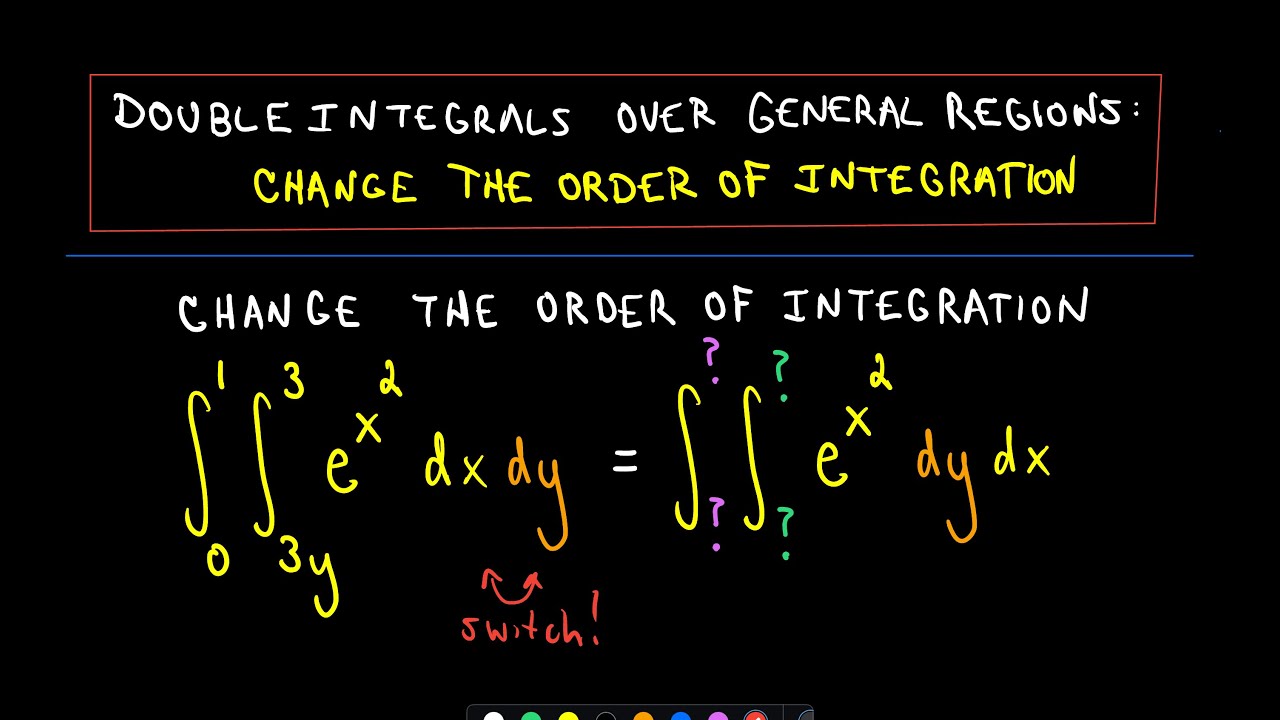
Thanks to all of you who support me on Patreon. You da real mvps! $1 per month helps!! :) https://www.patreon.com/patrickjmt !! Double Integrals - Changing Order of Integration - Full Example.
In this video, I show an example of how to switch the order of integration. I also integrate the function to get the final answer.
For more free math ...
And I will send u my solution

 random flax
snow plaza
how can ı do that
random flax
snow plaza
how can ı do that
hope it helps
 random flax
no sorry I dk that
 winter linden
So was at tutions today doing some leniar equations ... so the problem was 3x - 2y = 4 .. so to solve it the tr transposed 3x to the other side but he took 3x 1st then - 4 and aslo on the Lhs
The minus sign is gone... can explain how this works
 winter linden
So was at tutions today doing some leniar equations ... so the problem was 3x - ...
winter linden
winter linden
So was at tutions today doing some leniar equations ... so the problem was 3x - ...
Plz help 🙏
random flax
um
wait
I am not sure I understood the question properly
Is this what you meant?

@winter linden
for 3x-2y=4 to 2y=3x-4, move 4 from RHS to LHS, and 2y from LHS to RHS
so if you go a+b=1--> this is same as a=1-b
^that logic. Is this the qn?
winter linden
Oohhhhhhh ooo ooo o now it makes sense i was just a bit confused cuz the the answer was from lhs to rhs ahh but now it makes sense
Yeah now it makes sense thanks @random flax
random flax
lmao, I have been confused with negatives too many times to count
I understand the feeling
 zenith hemlock
I need help with b and c. full ans to c is dp/dt=0.024P btw. This is the exponential growth and decay topic!

 arctic mango
For part b, just find out the fractional change in the population a t = 0 and t = 6
For part c, you have to differentiate P to get dP/dt = P_0 (0.024) e^(0.024t) = 0.024P.
 topaz palm
zenith hemlock
arctic mango
For part b, just find out the fractional change in the population a t = 0 and t ...
topaz palm
zenith hemlock
arctic mango
For part b, just find out the fractional change in the population a t = 0 and t ...
but i dont have P0
arctic mango
zenith hemlock
but i dont have P0
You don't need it. It gets cancelled when you take the fractional change
Fractional change is ∆P/P_0, multiply it by 100 to get percentage.
∆P = P(t = 6) - P_0.
zenith hemlock
alright i got the answer thanks for the insight!
alpine sable

Now remote learning sucks and emailing my teacher takes like 3 hours for him to replyy
so how do you even do these?
zenith hemlock
arctic mango
For part c, you have to differentiate P to get dP/dt = P_0 (0.024) e^(0.024t) = ...
actually im still confused how does P_0 (0.024) e^(0.024) suddenly became 0.024P
 torn heron
Anyone knows how to do? Is there any formula that I could use? Thanks
 arctic mango
zenith hemlock
actually im still confused how does P_0 (0.024) e^(0.024) suddenly became 0.024P
arctic mango
zenith hemlock
actually im still confused how does P_0 (0.024) e^(0.024) suddenly became 0.024P
I made a slight mistake.
Check it now. Does it make sense?
d(e^(kt))/dx = ke^(kt)
pearl marlin
torn heron
Anyone knows how to do? Is there any formula that I could use? Thanks
Area of ellipse - area of rhombus
pearl marlin
torn heron
Anyone knows how to do? Is there any formula that I could use? Thanks
For OB use pythagorus in triangle AOB
zenith hemlock
arctic mango
Check it now. Does it make sense?
How does the 2nd line become 3rd? (edit: nevermind, sorry for ping)
 torn heron
pearl marlin
Area of ellipse - area of rhombus
torn heron
pearl marlin
Area of ellipse - area of rhombus
Area of ellipse =pi x OA x OB?
pearl marlin
torn heron
Area of ellipse =pi x OA x OB?
Yes
torn heron
pearl marlin
Yes
Thanks
 prime badge
zenith hemlock
How does the 2nd line become 3rd? (edit: nevermind, sorry for ping)
prime badge
zenith hemlock
How does the 2nd line become 3rd? (edit: nevermind, sorry for ping)
the first line says that
zenith hemlock
oh my god.... thank you
 chilly panther
Hi I'm quite confused. I've been asked to find the coefficient of a negative power using binomial theorem... It's something along the lines of
$\left(3x^2-\frac{1}{5x^3}\right)^{13}$
and then I'm asked to find the coefficient of like say x^{-7}
I'd know how to do it if it was positive 7 but I seriously did not think it was possible to do this for negative powers
like you can't do ^{-7}C_13 so I'm confused
ocean sealBOT
mcacutt
 noble sinew
x^(-7)=1/(x^7)
And some of your terms will be with x in denom because you have 1/(5x^3) in your original expression
chilly panther
I've just looked up the expansion for the question I've been given and I see it now... So I'd find nChoosek for the positive version which would give me a solution with x on the bottom? Hence the negative power?
noble sinew
Yep
chilly panther
noble sinew
Yep
thank you
 warm cloud
is this channel busy
 vale wigeon
not at the moment
but if you're not quick in posting your question, you might get spoken over
warm cloud

Help with this question would be appreciated
I'm not sure how I can related the mean to the standard deviation
I did the first part of the question, the new mean is equal to $0.818 or 81.8 cents
vale wigeon
,calc 0.787 * 1.04
ocean sealBOT
Result:
0.81848
up
yup*
okay
SD(cX) = |c| SD(X) for any random variable X and constant c
here you have c = 1.04 and X is the number of loaves per purchase
 warm cloud
vale wigeon
here you have c = 1.04 and X is the number of loaves per purchase
warm cloud
vale wigeon
here you have c = 1.04 and X is the number of loaves per purchase
ohh i get it
vale wigeon
@alpine sable this channel is busy
 unkempt grail
would anyone have a godo visualization tool to study this specific function
<x,Ax> where x is a vector and A is a matrix
 night berry
I have a vague-ish problem to solve that i do not know how to start with.
So, my mentor told me that I have to find out the price of old phones depending on some parameters, and to do that using fourier transform
any ideas how to go about it? or what questions I should ask my mentor
warm cloud
Do you have the complete question in written form?
night berry
@warm cloud no, he just told me that and then vanished, so I'm really confused
do you have any ideas
warm cloud
what are the parameters? do you know how many there are?
night berry
parameters are like when the phone was originally bought, etc, that's what I'm guessing
can it be solved using fourier?
 tame coral
Just a thought, but maybe using fourier transform and having some historical data of prices of older models, you could point out how different parameters/components of phone degrade phone's price over time.
Abstract ideas for abstract question🤔
warm cloud
Idk, the question seems very vague. without any limitation/conditions, you can use any function to say anything 
night berry
but like can you tell me what I should ask him?
about the details
to tell me about
warm cloud
like @tame coral pointed out, you could ask for historical data
tame coral
What are knowns, and what you want to solve for?
night berry
I'll ask him that
warm cloud
you could also ask "What am i allowed to ask" and get all the required info 
night berry
hack
tame coral
Jesus I should've asked that today in a job interview
because I worked out, if they say "do you have any questions" and you say "no" you seem quite uninterested, so I was coming up with some semi-relevent questions
 small holly
how do i simplify √87?
glass lichen
small holly
how do i simplify √87?
cant, it doesnt have any square factors
small holly
alright ty
 nova widget
ye because none of them are perfect squares
small holly
wait that works for me
nova widget
how?
nova widget
is the -6 directly below the $\sqrt{87}$ or below the entire $3 \pm \sqrt{87}$?
ocean sealBOT
g-e-o-m-e-t-r-i-c
 small holly
the entire thing
nova widget
okay
 shell heron
small holly
its
```
3±√87/-6
```
shell heron
small holly
its
```
3±√87/-6
```
thats actually good since u could then remove the "√3" im pretty sure
-6 = -√36 = -√12 * √3
nova widget
yes but that would be $\frac{3\pm\sqrt{87}}{-(\sqrt{12}\cdot\sqrt{3})}$
shell heron
uh
ocean sealBOT
g-e-o-m-e-t-r-i-c

 woeful briar
how much is 2.44140625E14?
 icy storm
@woeful briar it is:
ocean sealBOT
kyaaa.holo2
 woeful briar
i do not understand
icy storm
Ok, let's start with an example:
woeful briar
yes
icy storm
When we have a decimal, say 0.5
If we were to describe this in common words this would be "one half". But in terms of place value, we would say that this is "five tenths".
woeful briar
yes
icy storm
because the decimal digit one place after the decimal point, is the "tenth" place.
woeful briar
no i do not get it
icy storm
just like how the 0 in the number 50 is in the "tens" place
woeful briar
ohhh
woeful briar
icy storm
just like how the 0 in the number 50 is in the "tens" place
isnt 5 in the tens place?
 spring escarp
Can I ask just a simple question here I don't have a problem
Can we prove the model of PA in z2?
icy storm
@woeful briar ok, anyways so the 5 is in the tens place. Basically, we say things like "tens" and "hundreds" and etc in place value because those numbers of digits corresponds to how many multiples of 10 there are.
woeful briar
ocean seal
**kyaaa.holo2**
btw @icy storm so this is about 100 trillion?
icy storm
$$50 = 5\times 10 + 0\times 1$$ so there is 5 tens and 0 ones (5 in the tens place, 0 in the ones place). And yeah, that would be 200 trillion.
ocean sealBOT
kyaaa.holo2
 icy storm
forgive my mistake earlier lol, that was bad. But it doesn't change the substance of what I'm trying to teach (I'm just a little tired i guess lol)
My point is that, like how we have tens and hundreds in whole numbers, we also have tenths and hundredths etc with decimal numbers.
icy storm
oh- i didn't get to the main point yet, but... if I helped, then no worries 😅
woeful briar
yea i think i just work my way up with those numbers
icy storm
I guess it's a matter of "explanation vs answer"
woeful briar
ocean seal
**kyaaa.holo2**
this
icy storm
yeah. Essentially with every positive power of 10, we move the decimal point one place to the right
woeful briar
got it!
alpine sable
anyone able to explain to me how the limit of 1/2e was dropped? im thinking that would be 1/2 + infinity which would be infinity?

 gray isle
where's 1/2 + infinity coming from?
alpine sable
well 1/2e^-t^2 is inifnity i thought?
spring escarp
Hey@gray isle
Z2 doesn't succumb to Gödel right so we can prove the consistency of pa in it
I mean it can prove its own consistency
gray isle
can't help with that sry
 normal hamlet
 scarlet heath
how do I find this?
 alpine sable
scarlet heath
how do I find this?
alpine sable
scarlet heath
how do I find this?
Find the unit vector pointing in the direction of u and scale it by the magnitude of v


 upper pebble
ocean sealBOT
upper pebble
ocean sealBOT
cole
 scarlet heath
how do I find this?

 rigid smelt
have you heard of/learned logs
scarlet heath
yeah
rigid smelt
so using your knowledge of log, how do you get rid of the base?
basically try to do something that will either cancel out 3 or 5
scarlet heath
isnt it when you raise it to the same base?
scarlet heath
so I can do like x+5=3^5^2x-9
ocean sealBOT
waler
 rigid smelt
scarlet heath
so I can do like x+5=3^5^2x-9
rigid smelt
scarlet heath
so I can do like x+5=3^5^2x-9
no...
so lets say you want to cancel out 3
what operation do you do?
scarlet heath
do I multiply it by log_3?
rigid smelt
not "multiply", you take log_3 on both side
the log is an operation, a function, and the argument is part of it
its not "multiplied" to the log
scarlet heath
alright
rigid smelt
so what do you have after taking log_3 on both sides?
scarlet heath
so it becomes x+5=log_3^5^2x-9?
rigid smelt
edgy notation
scarlet heath
yeah kinda messy I hsould learn latex
ocean sealBOT
waler
 rigid smelt
did you mean this?
scarlet heath
yeah
rigid smelt
now what can you do?
scarlet heath
a
scarlet heath
oh so it becomes 2x-9log_3(5)
rigid smelt
missing brackets
but yes
so now its just a linear equation
solve for x
approximate
scarlet heath
so x = 18.18?
scarlet heath
damn it
rigid smelt
also they asked to approx to 3 decimal places
scarlet heath
so 18.185
rigid smelt
rigid smelt
also they asked to approx to 3 decimal places
this is just to say that the representation of your answer isnt correct either
scarlet heath
what do I do about the 2x then infront of the log
rigid smelt
can you show your work?
like that would make everything much clearer on what you did wrong
scarlet heath
 rigid smelt
this is wrong, very wrong, (2x-9)log_3(5) is not the same as 2x - 9log_3(5)
 scarlet heath
so the answer was x=9.422
rigid smelt
yes
 brisk tree
How to find the number of solutions of cos(cos(x))=x/10?
 last osprey
Help mee::::
( 11 )The support lines on the sides of a triangle have the equations r, s and t. Calculate the area of the triangular region bounded by these three straight lines.
r : y = x, s : x + y = 0 e t : y = (15x/100) + 1
( 27 )Let us consider the line r , of the equation x + y − 3 = 0 and the circumference of the equation below. What is the position of the line r with respect to the circumference.
x2 + y2 − 2x − 2y − 3, 75 = 0
( 33 )Determine the coordinates of the points where the line r of the equation y = −x + 5 intersects the circle of the equation below.
x2 + y2 + −2x + −10y + 21 = 0

 brisk tree
Doesn't divide
brisk tree
brisk tree
How to find the number of solutions of cos(cos(x))=x/10?
<@&286206848099549185>
alpine sable
brisk tree
Doesn't divide
thanks
alpine sable
@scarlet heath that picture made me xd
 pliant bear
Is there any reasonable way to show that for x in (-2,2), |x| + √(4-x²) ≥2, attaining its minimum on 0?
the plot is obvious

like, I know how to do the symmetry-then-local-extrema-then-boundary-points argument, but that seems rather clumsy and overly complicated
pliant bear
brisk tree
<@&286206848099549185>
oh, wait, does this mean the channel is occupied? sorry, never used the questions channels :/
ancient creek
pliant bear
Is there any reasonable way to show that for x in (-2,2), |x| + √(4-x²) ≥2, atta...
Perhaps consider rewriting this equation as a piecewise equation :P
pliant bear
ancient creek
Perhaps consider rewriting this equation as a piecewise equation :P
I mean the symmetry argument is the easy part, I was wondering whether the ≥2 would pop up more easily
But I found out that I could minimize the square instead and this works out quite elegantly 🙂
 ancient creek
Oh ok nice
 austere violet
If n (A) = x, n (B) = y and n( AUB)= z , express n (A∩B) in terms of x, y and z help someone

vagrant rover
Can you write $4x^3y^5$ as $4x^3*y^5$?
ocean sealBOT
Dexter is VACCINATED x2
 austere violet
yes
austere violet
its for both
ocean sealBOT
Dexter is VACCINATED x2
 austere violet
ahh yaa ig..
 vale sapphire
yes
austere violet
vale sapphire
yes
If n (A) = x, n (B) = y and n( AUB)= z , express n (A∩B) in terms of x, y and z help someone
vagrant rover
And you would get the same result?
vale sapphire
austere violet
If n (A) = x, n (B) = y and n( AUB)= z , express n (A∩B) in terms of x, y and z ...
draw a venn diagram
vale sapphire
vagrant rover
And you would get the same result?
When you're confused when dealing with symbols, switch to numbers
austere violet
umm
vagrant rover
So you can separate a variable from its coefficient?
vagrant rover
vale sapphire
When you're confused when dealing with symbols, switch to numbers
Ah okay, yeah that probably helps
vale sapphire
Do you really think that 2×3²×3² is equal to (2×3²)(2×3²)
vagrant rover
ocean seal
**Dexter is VACCINATED x2**
Wait so you can't write it as ^ this?
vale sapphire
yup
vagrant rover
k I'm confused
vagrant rover
I thought you said yes
AHH, yes or no xd?
I'm going to go with yes, so can you separate a variable from its coefficient?
vale sapphire
Yes
vagrant rover
So why do we have coefficients?
vale sapphire
When nothing is written between two things it means multiplication
vagrant rover
What exactly is a coefficient used for
vale sapphire
That's like asking me what the point of multiplying by 2 is
vale sapphire
oh wait
vagrant rover
waiting
vale sapphire
the coefficient of x³ is just the number that multiplies x³ in your expression
that's all a coefficient is
Although, the term is usually reserved for when it's a constant number
vagrant rover
So you if you have 4x^3 then that is basically like x^3*x^3*x^3*x^3?
alpine sable
😔
 vale sapphire
no
vale sapphire
the latter
vale sapphire
You're mixing up exponents and multiplication
vagrant rover
Right right
vale sapphire
4x³ is x³+x³+x³+x³
vagrant rover
vale sapphire
4x³ is x³+x³+x³+x³
Oh, I see
vale sapphire
like with numbers
4*3 is 3+3+3+3
nobody is changing the rules when going into symbols
vagrant rover
So if the coefficient is so important to the variable then how come we can seperate them?
vagrant rover
vale sapphire
nobody is changing the rules when going into symbols
I see
vale sapphire
the point of variables is only to be able to make more general statements
vale sapphire
vagrant rover
So if the coefficient is so important to the variable then how come we can seper...
wdym "so important to the variable"
vagrant rover
Like it determines the value when we simplify
glass lichen
Yes you have to multiply by the co-efficient...?
 light mango

 alpine sable
how do i get the number of people
In this group of archeologists, the ratio of the number of chief archeologists to the number of
senior archeologists must be 3 : 4,
while the ratio of the number of senior archeologists to the number of student archeologists
must be 8 : 3.
Six student archeologists are going on the trip.
 warped phoenix

i have no idea how i'd do this
the only equation I could come up with is 64 = 2 * w * 8?
<@&286206848099549185>
anyone?
topaz scaffold
So you can start by finding your parameters
The volume will be 576*h (in inches)
The time derivative of height will be 8
Assuming that there's no sand at t = 0 so h(t=0) = 0
Using those two we can get that h(t) = 8t
topaz scaffold
topaz scaffold
The volume will be 576*h (in inches)
Plugging in to this we get 576*8t
V = 4608t (in cubic inches)
V = 8t/3 (in cubic feet)
Then you can plug in 64 for V to find t